Archive
09/15/2017 – Ephemeris – Two local astronomy events tomorrow
Ephemeris for Friday, September 15th. The Sun will rise at 7:21. It’ll be up for 12 hours and 30 minutes, setting at 7:52. The Moon, 2 days past last quarter, will rise at 3:10 tomorrow morning.
There are two local astronomical events tomorrow. Tomorrow the Leland Heritage Celebration will take place from 10 a.m. to 4 p.m. at Fish Town in Leland. The Grand Traverse Astronomical Society will be there to show the Sun through member’s telescopes and give out NASA items for the kids. We’ll exhibit pictures gained from last month’s total solar eclipse. Then starting at 9 p.m. the crew will be at Northwestern Michigan College’s Rogers Observatory for a star party, viewing Saturn and the wonders of the Milky Way including star clusters and nebulae of clouds of gas and dust that mark locations of either the birth or death of stars. Rain will affect the Leland event. The observatory is located on Birmley Road.
The times given are for the Traverse City/Interlochen area of Michigan. They may be different for your location.
Addendum
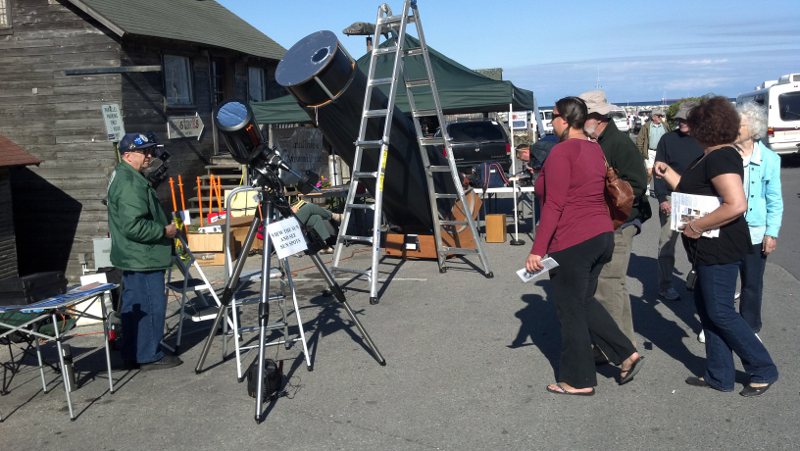
GTAS telescopes at Leland Heritage Celebration in 2011.
09/14/2017 – Ephemeris – Cassini will go out in a blaze of glory tomorrow morning
Ephemeris for Thursday, September 14th. The Sun will rise at 7:20. It’ll be up for 12 hours and 33 minutes, setting at 7:54. The Moon, 1 day past last quarter, will rise at 2:05 tomorrow morning.
Just about 24 hours from now the Cassini spacecraft will end its 20 year mission to Saturn and its 13 years of orbiting the planet. Monday, 4 days ago, it passed the great moon Titan for the last time, giving it one last gravitational boost into a suicidal plunge into Saturn’s atmosphere. At 7:55 tomorrow morning EDT (11:55 UTC), Cassini is expected to lose its stabilization in the thin upper atmosphere or Saturn and lose its connection with the Earth. It is expected to burn up, traveling at 70,000 miles an hour to become a part of the planet it investigated for 13 years. Instead of recording data for transmission to Earth later, it will be taking real-time atmospheric sampling, transmitting immediately up to the very end.
The times given are for the Traverse City/Interlochen area of Michigan. They may be different for your location.
Addendum
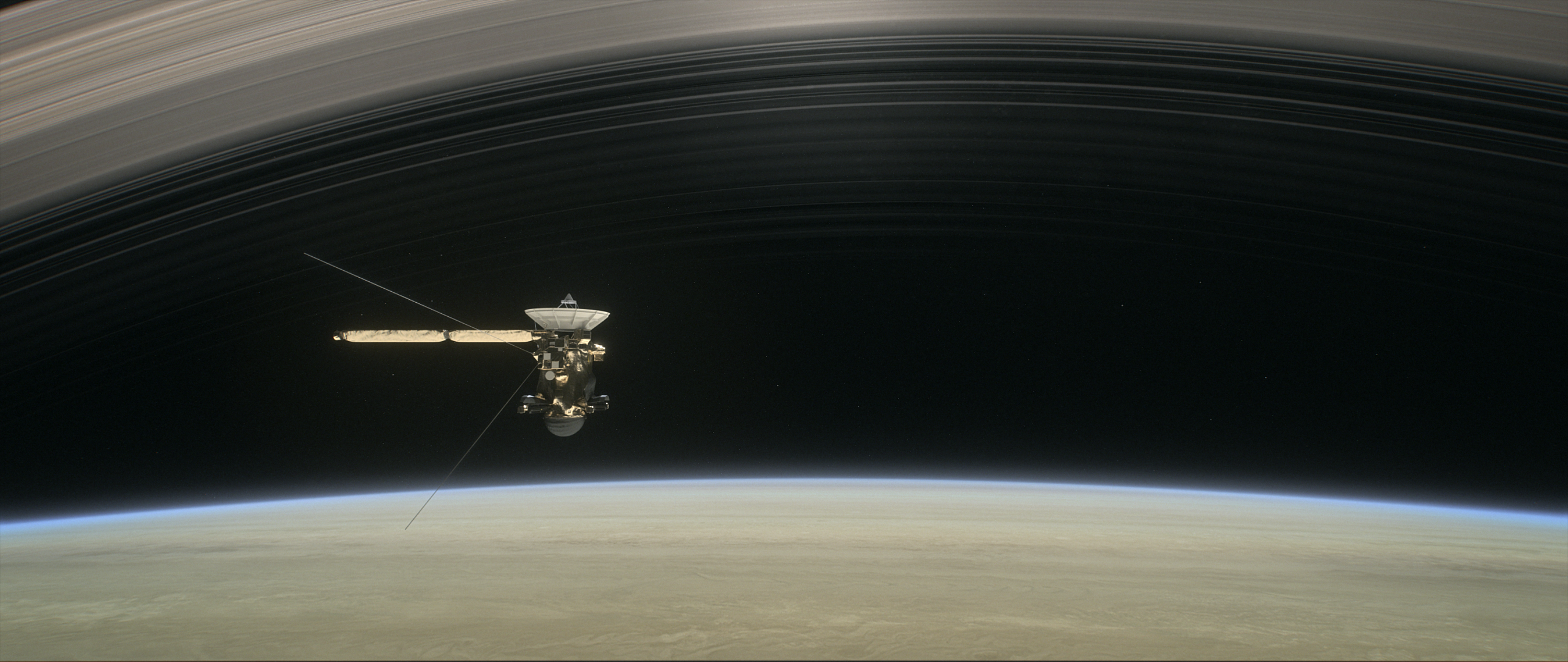
An artist’s visualization of Cassini slipping between the rings and the atmosphere of Saturn. Credit NASA/JPL.
Here’s a link to yesterday’s news conference at JPL on the end of the Cassini Mission: https://youtu.be/gs-dscW95PE.
Link to Emily Lakdawalla’s Planetary Society post on the final days of Cassini including NASA TV coverage: http://www.planetary.org/blogs/emily-lakdawalla/2017/0911-cassini-eom-timeline.html.
09/13/2017 – Ephemeris – Looking for the bright planets this week
Ephemeris for Wednesday, September 13th. The Sun will rise at 7:19. It’ll be up for 12 hours and 36 minutes, setting at 7:56. The Moon, at last quarter today, will rise at 1:05 tomorrow morning.
Let’s take our weekly look at the bright planets. Jupiter is sinking really low in the west-southwest setting before the end of twilight. Jupiter will set at 9:11 p.m. Saturn can be seen moving from the south-southwest to the southwest tonight. The reddish star Antares is below and right of Saturn. Saturn’s rings are spectacular in telescopes. The planet will set at midnight. In the morning sky, brilliant Venus will rise at 4:48 a.m. Mercury will rise at 5:46 and Mars will rise at 5:54 a.m.
The times given are for the Traverse City/Interlochen area of Michigan. They may be different for your location.
Addendum
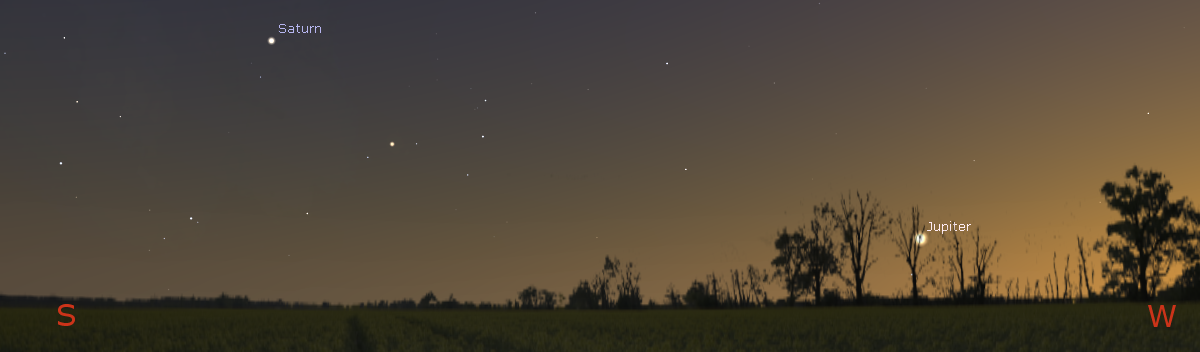
The setting Jupiter and Saturn at 8:30 p.m., September 13, 2017. Created using Stellarium. Click on image to enlarge.
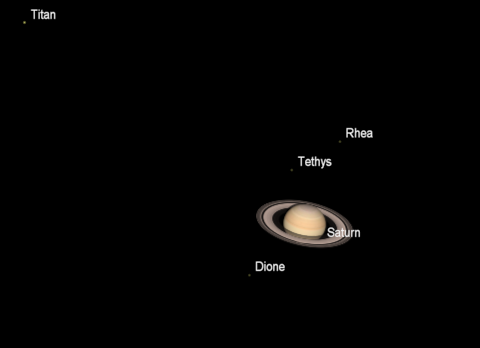
Saturn and its brightest moons overnight September 13/14, 2017. Created using Cartes du Ciel (Sky Charts).
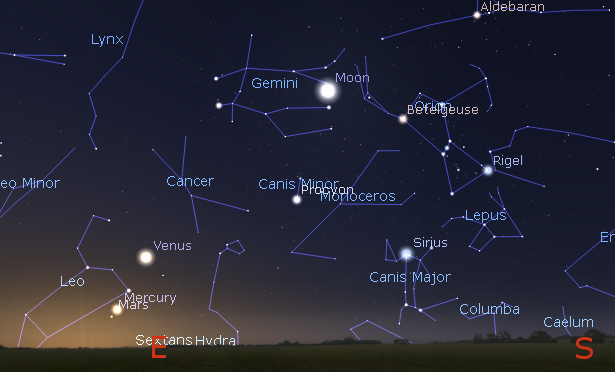
Planets in the morning sky at 6:30 a.m. September 14, 2017. Created using Stellarium. Click on the image to enlarge.
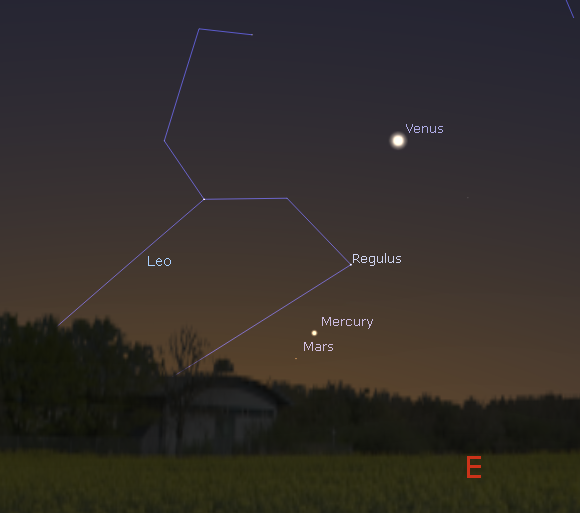
Morning planets close up at 6:30 a.m. September 14, 2017. Created using Stellarium.
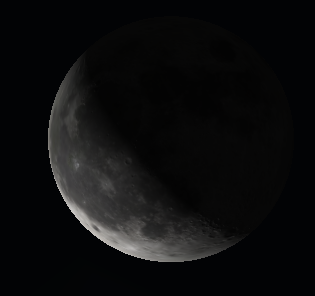
The fat crescent Moon as it might be seen in binoculars at 6:30 a.m. September 14, 2017. Created using Stellarium.
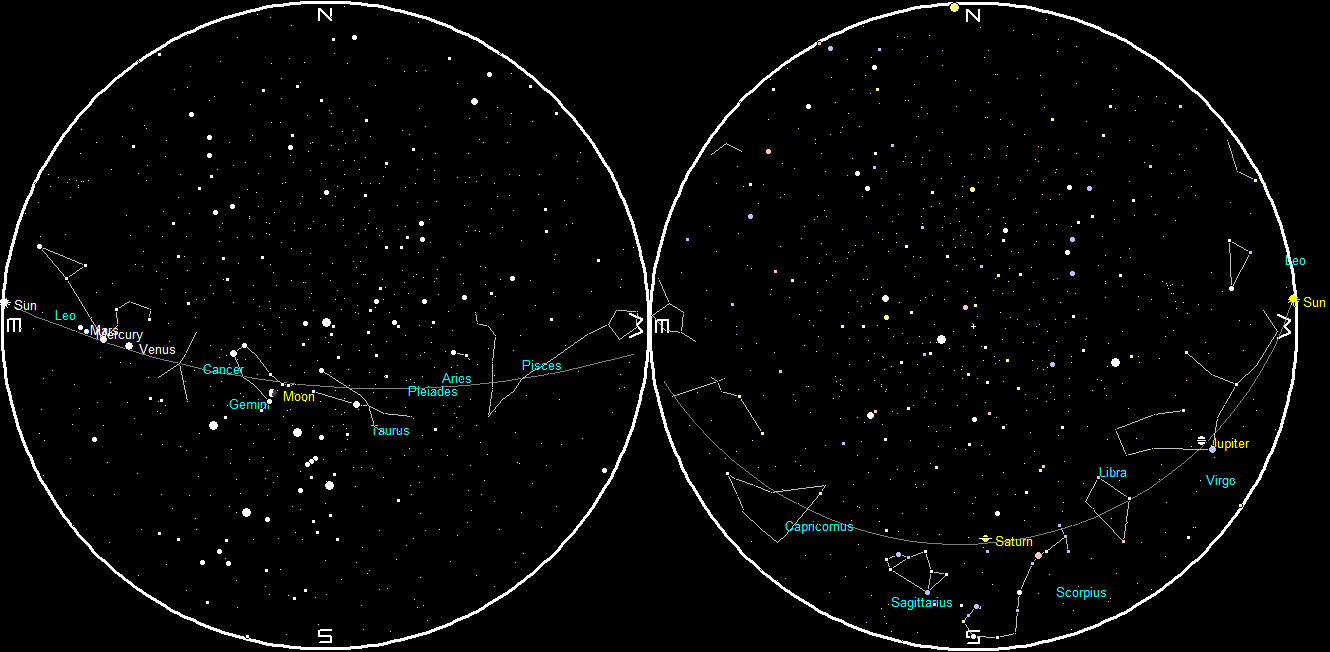
Planets at sunset and sunrise of a single night starting with sunset on the right on September 13, 2017. The night ends on the left with sunrise on the 14th. Click on the image to enlarge. Created using my LookingUp program.
09/12/2017 – Ephemeris – The Moon will hide the bright star Aldebaran after sunrise this morning
Ephemeris for Tuesday, September 12th. The Sun will rise at 7:18. It’ll be up for 12 hours and 40 minutes, setting at 7:58. The Moon, 1 day before last quarter, will rise at 12:13 tomorrow morning.
This morning during daylight at around 8:40*. the bright star Aldebaran will disappear behind the Moon. Binoculars or a small telescope can be used to spot Aldebaran, the bright star in the constellation Taurus the bull’s eye. Taurus and the rest of the winter constellations are visible before sunrise. The sky needs to be absolutely clear to be able to spot the event. The star will be seen to approach the bright side of the Moon. The star will reappear around 9:53 a.m.* on the dark western edge of the Moon. These events are called occultations. They come from the word occult, which means hidden. In actuality the solar eclipse of three weeks ago was a spacial case of an occultation for those in the path of totality.
The times given are for the Traverse City/Interlochen area of Michigan. They may be different for your location.
* The disappearance and appearance times for Aldebaran are within a couple of minutes for Western Michigan. For other locations in the occultation path Stellarium will give pretty good times for the events by modeling the occultation as I did below. Like a solar eclipse where you are determines the timing of the event.
Addendum
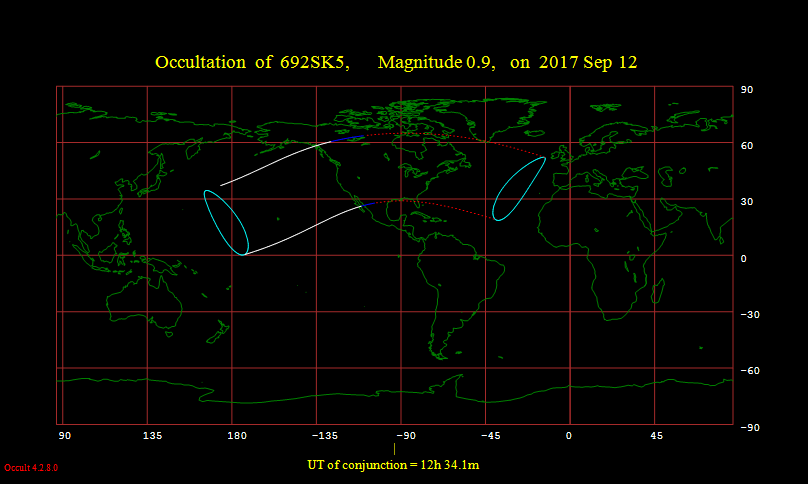
Map of where the occultation is visible. For the area bounded in red, the occultation is visible in the daytime. Credit: Occult4 by IOTA.
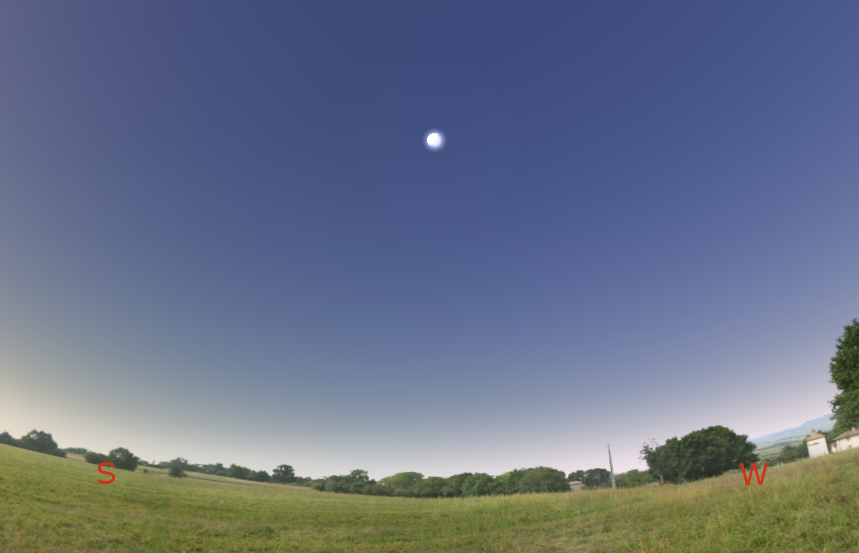
Position of the Moon in the sky near the start of the occultation, 8:35 a.m. September 12, 2017. Created using Stellarium.
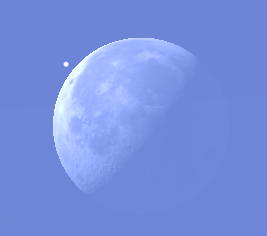
Aldebaran and the Moon at 8:35 a.m. September 12, 2017. Created using Stellarium.
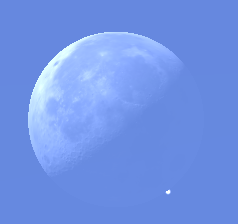
Aldebaran reappearing from behind the Moon at 9:53 a.m. September 12, 2017. Created using Stellarium.
09/11/2017 – Ephemeris – The celestial dolphin and an arrow
Ephemeris for Monday, September 11th. The Sun will rise at 7:16. It’ll be up for 12 hours and 43 minutes, setting at 8:00. The Moon, 2 days before last quarter, will rise at 11:27 this evening.
Located below the eastern edge of the Summer Triangle of three of the brightest stars in the sky, which is high in the east to overhead in our sky at 9 p.m., is the tiny constellation of Delphinus the dolphin. Delphinus’ 6 stars in a small parallelogram with a tail, really does look like a dolphin leaping out of the water. The parallelogram itself has the name Job’s Coffin. The origin of this asterism or informal constellation is unknown. Of the dolphin itself: the ancient Greeks appreciated this aquatic mammal as we do, and told stories of dolphins rescuing shipwrecked sailors. There’s another tiny constellation to the right of Delphinus, Sagitta the arrow a small thin group of 5 stars, which represents Cupid’s dart.
The times given are for the Traverse City/Interlochen area of Michigan. They may be different for your location.
Addendum
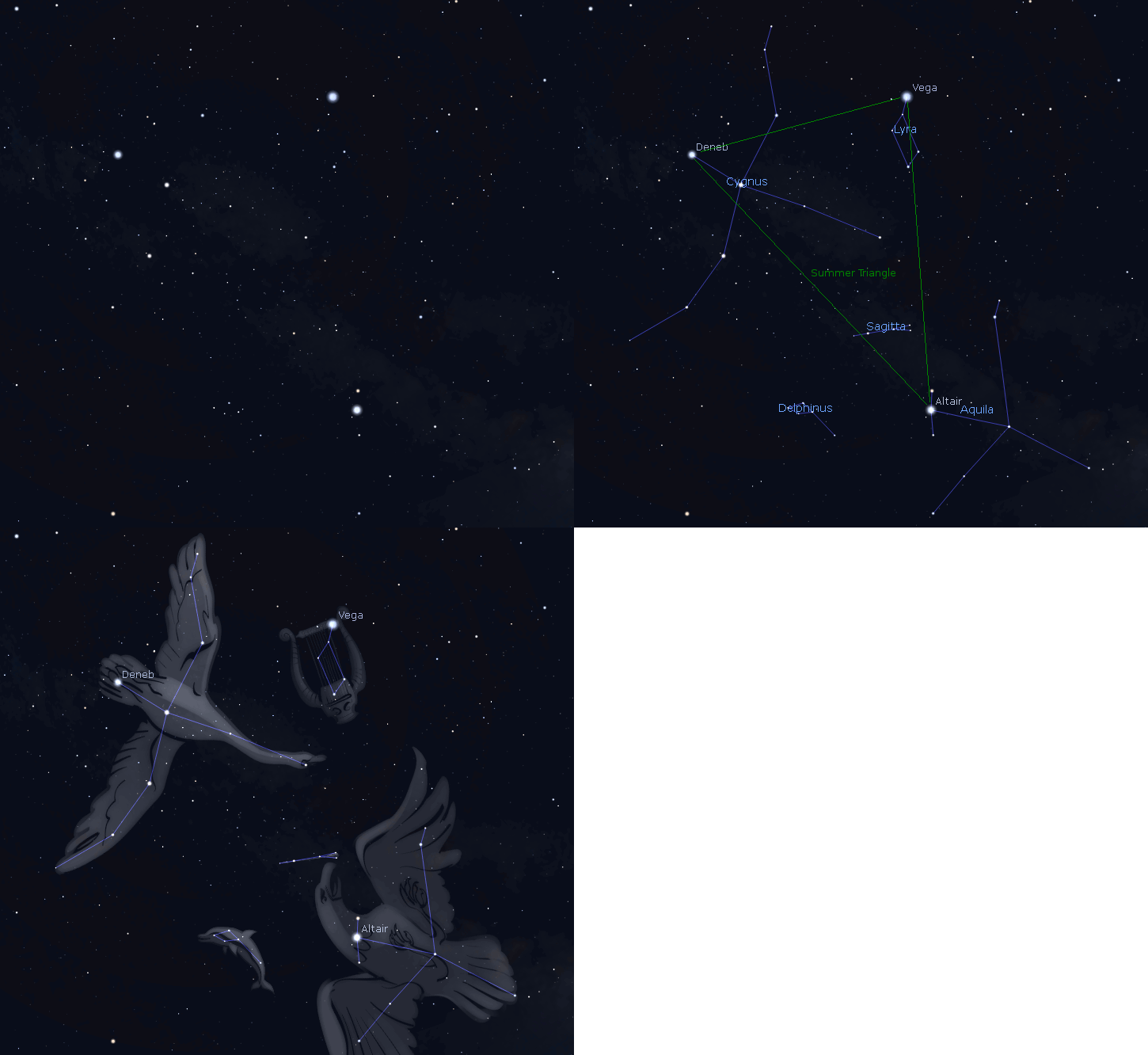
Delphinus and Sagitta finder animation. Created using Stellarium and GIMP. Click on image to enlarge.
09/08/2017 – Ephemeris – Dance of the planets in the morning
Ephemeris for Friday, September 8th. The Sun will rise at 7:13. It’ll be up for 12 hours and 52 minutes, setting at 8:05. The Moon, 2 days past full, will rise at 9:39 this evening.
In clear skies after 6:15 or so in the morning two planets and a star can be spotted below Venus in the east. This may take binoculars to spot. Brightest of the two highest stars will be the planet Mercury, which will reach its greatest elongation from the Sun next Tuesday. The star Regulus is a bit to the left of it, and dimmer. Hardest of all to spot will be Mars, below, left of them. On the 16th Mercury and Mars will be in a very close conjunction, about one fifth of the Moon’s diameter apart. Mars, now is very far away, and is as dim as a Big Dipper star, which though bright, fares poorly in twilight. Next July when Mars is close to us, it will be brighter than Jupiter. The positions of Mercury, Regulus and Mars will change rapidly in the next week or so.
The times given are for the Traverse City/Interlochen area of Michigan. They may be different for your location.
Addendum
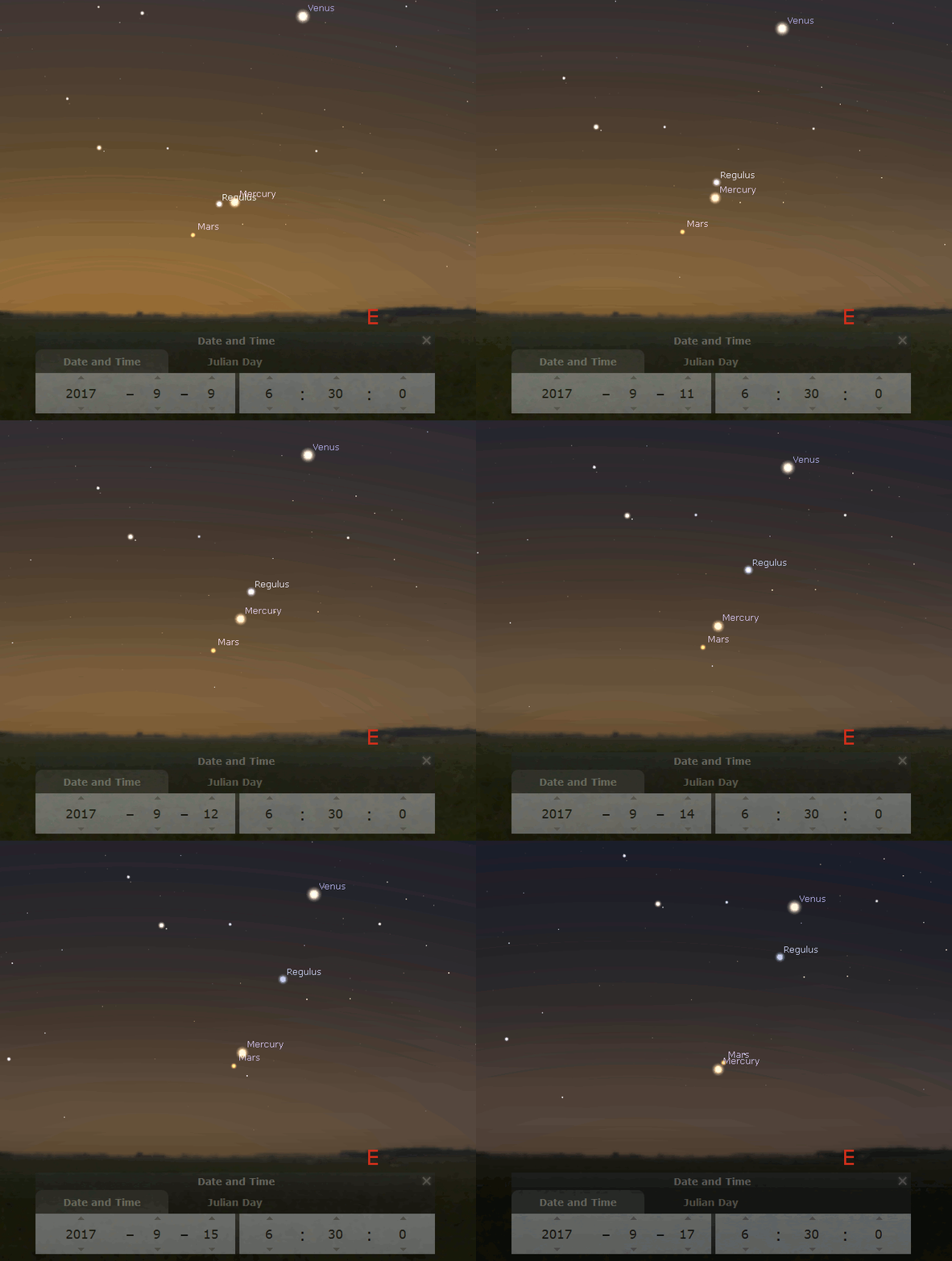
Dance of the morning planets Mercury, Mars, Venus with the star Regulus at 6:30 a.m. (about 45 minutes before sunrise) on the mornings of September 9 through 17, 2017. Created using Stellarium and GIMP.
09/07/2017 – Ephemeris Extra – The Earth is currently under a G4 Geomagnetic Storm – Aurora’s may be visible
Aurora Alert
At this time (0300 UT September 8, 2017) the Earth is experiencing a strong geomagnetic storm see Spaceweather.com.
Also check out the NOAA Space Weather Prediction Center. Check the Aurora Forecast.
09/07/2017 – Ephemeris – Capella rising
Ephemeris for Thursday, September 7th. The Sun will rise at 7:12. It’ll be up for 12 hours and 55 minutes, setting at 8:07. The Moon, 1 day past full, will rise at 9:08 this evening.
For those with the advantage of a low northern horizon, will see a bright star moving nearly parallel above the horizon over the evening hours or notice its change in position from night to night, moving to the northeast. The star is Capella, northernmost of the bright winter stars. It never quite sets for locations north of the latitude of Ludington (44° N), meaning it’s circumpolar like the Big Dipper. It’s slow motion, due to its position close to the north pole of the sky sometimes makes it seem odd. I’ve gotten several calls about it over the years. Capella is the brightest star in the constellation Auriga the charioteer, a constellation I see as a pentagon, with a small triangle of three stars on one side. I’ll wait until the winter season to talk further about them.
The times given are for the Traverse City/Interlochen area of Michigan. They may be different for your location.
Addendum
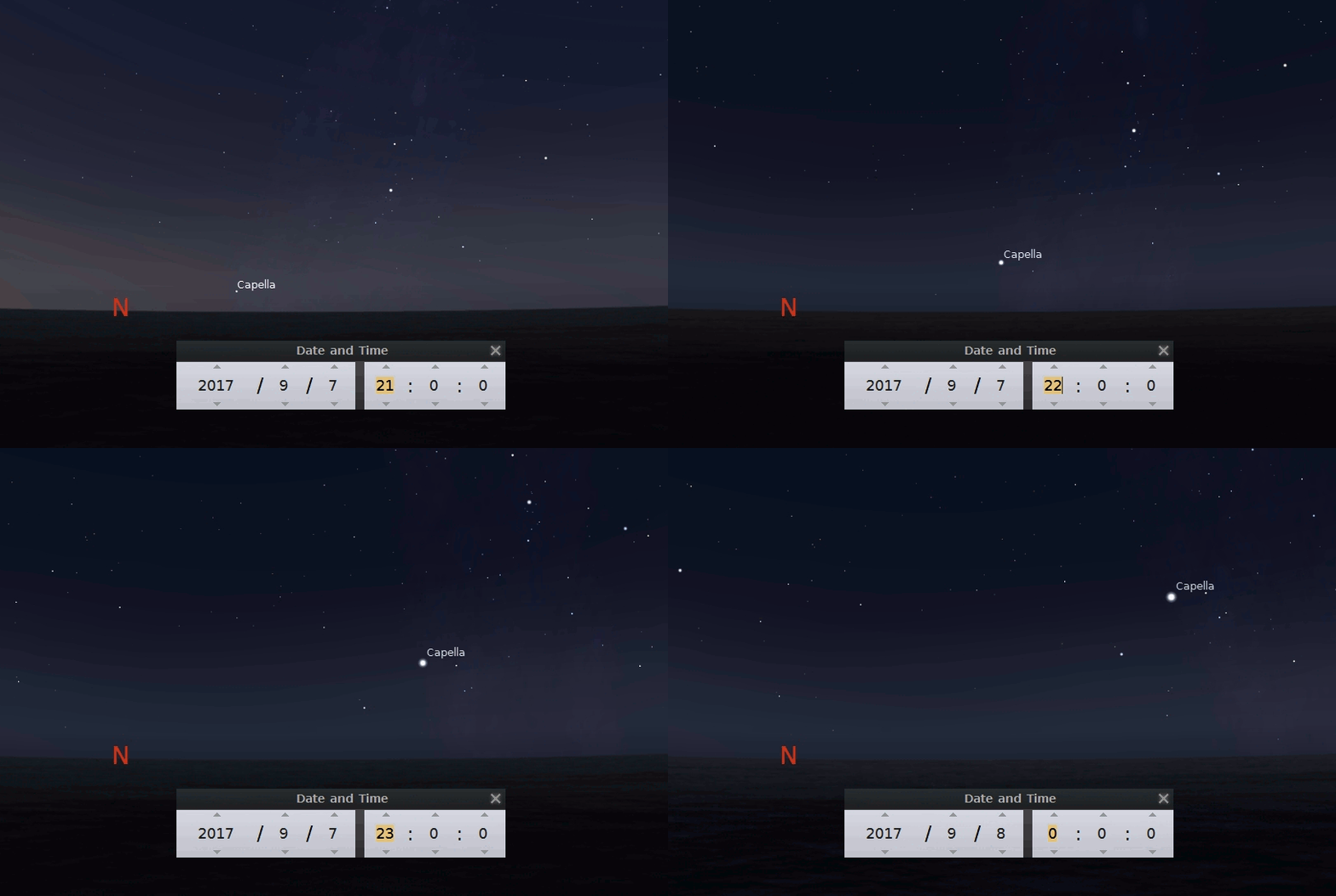
Capella appearing to rise like an aircraft taking off. Shown here at hourly intervals from 9 p.m. to midnight. Created using Stellarium and GIMP.
09/06/2017 – Ephemeris – A look at the bright planets known from antiquity
Wednesday, September 6th. The Sun will rise at 7:11. It’ll be up for 12 hours and 58 minutes, setting at 8:09. The Moon, at full today, will rise at 8:38 this evening.
Let’s take our weekly look at the bright planets. Jupiter is sinking really low in the west-southwest setting before the end of twilight. The bright blue-white star Spica, which pales in comparison to Jupiter, is seen below it dimly in the twilight. It will pass north of Spica on September 11th. Jupiter will set at 9:36 p.m. Saturn can be seen moving from the south-southwest to the southwest tonight. The reddish star Antares is below and right of Saturn. Saturn’s rings are spectacular in telescopes. The planet will set at 12:29 a.m. In the morning sky, brilliant Venus will rise at 4:31 a.m. and be visible until about 6:45 tomorrow morning. Mars and Mercury follow Venus up in the east rising just before 6 a.m.
The times given are for the Traverse City/Interlochen area of Michigan. They may be different for your location.
Addendum
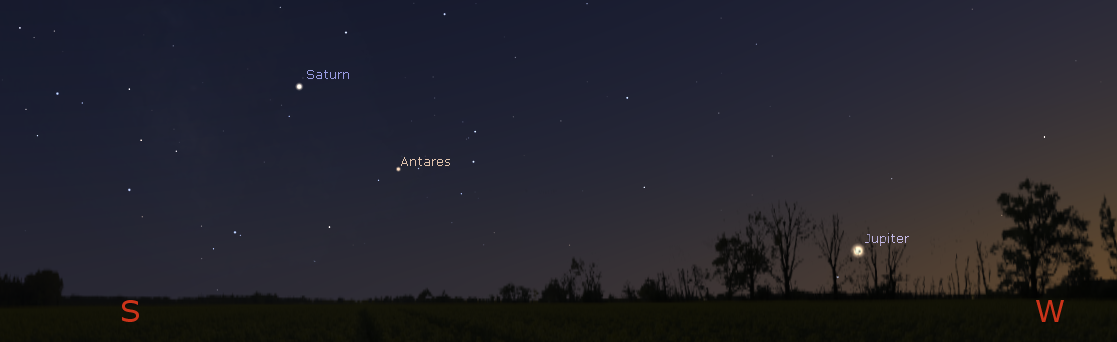
The setting Jupiter and Saturn near the Moon at 9 p.m., September 6, 2017. Created using Stellarium. Click on image to enlarge.
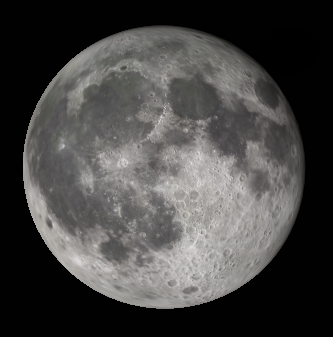
The moon as it might be seen in binoculars at 10 p.m.. Created using Stellarium.
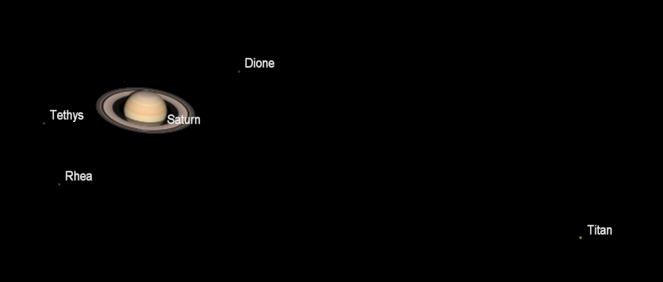
Saturn and its brightest moons overnight September 6/7, 2017. Created using Cartes du Ciel (Sky Charts).
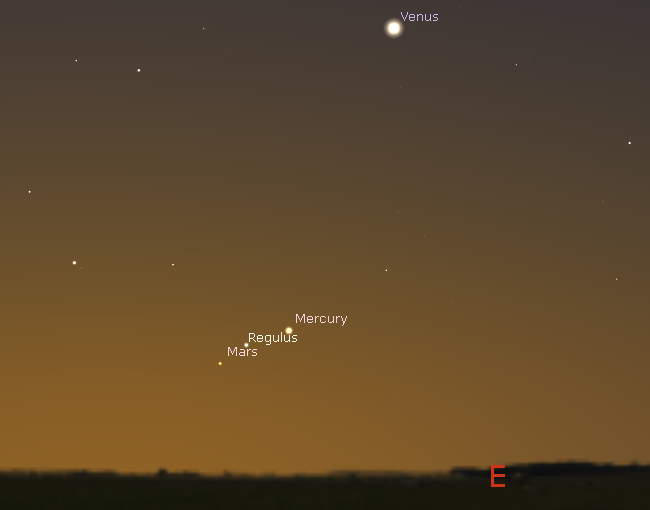
Venus with Mercury and Mars at 6:30 a.m. September 7, 2017. Created using Stellarium.
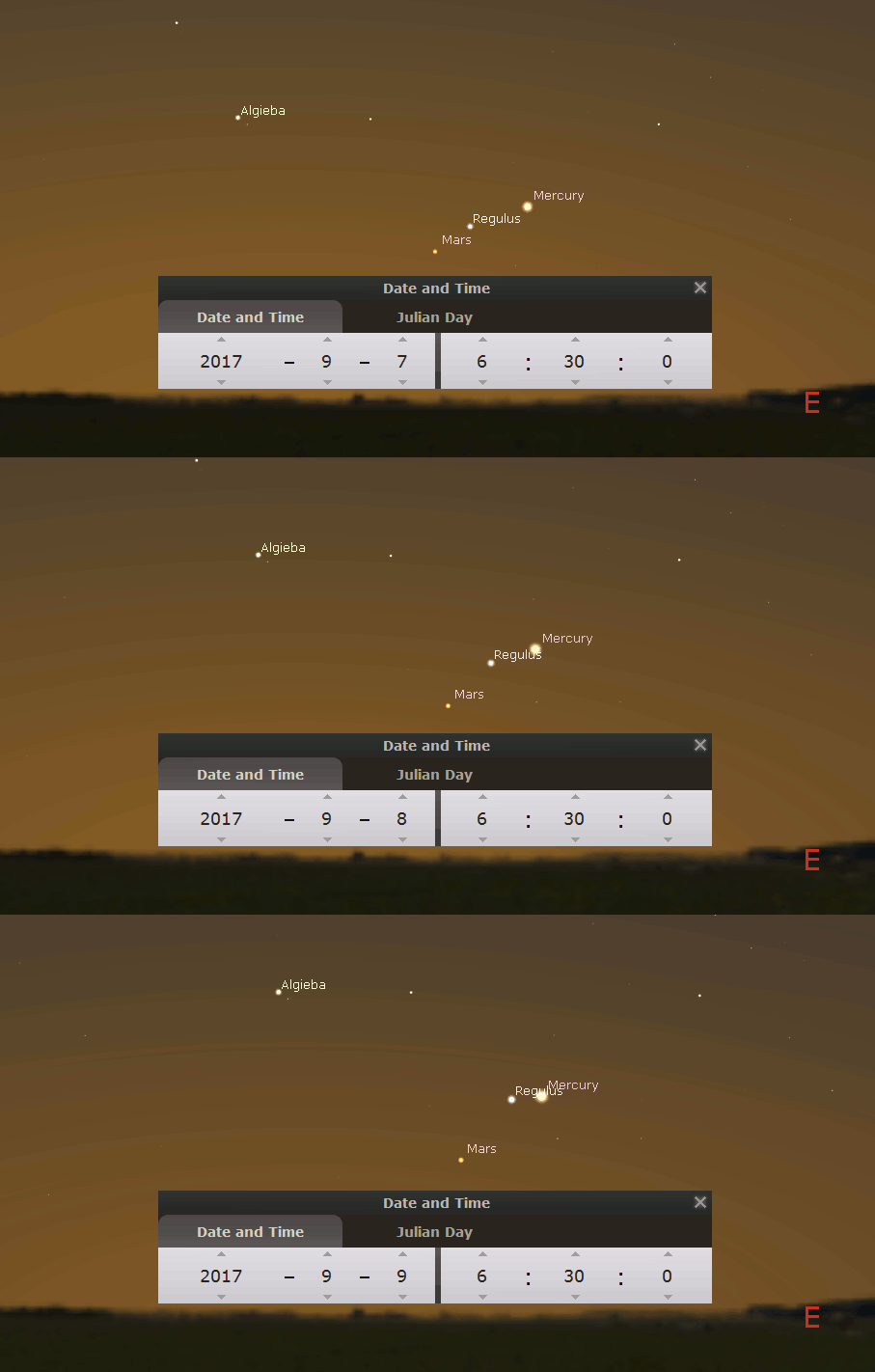
A 3 day animation od Mercury, te star Regulus and Mars starting September 7, 2017 at 6:30 a.m. Created using Stellarium and GIMP. Click on image to enlarge.
On Friday I’ll have an animation that will take these planets further.
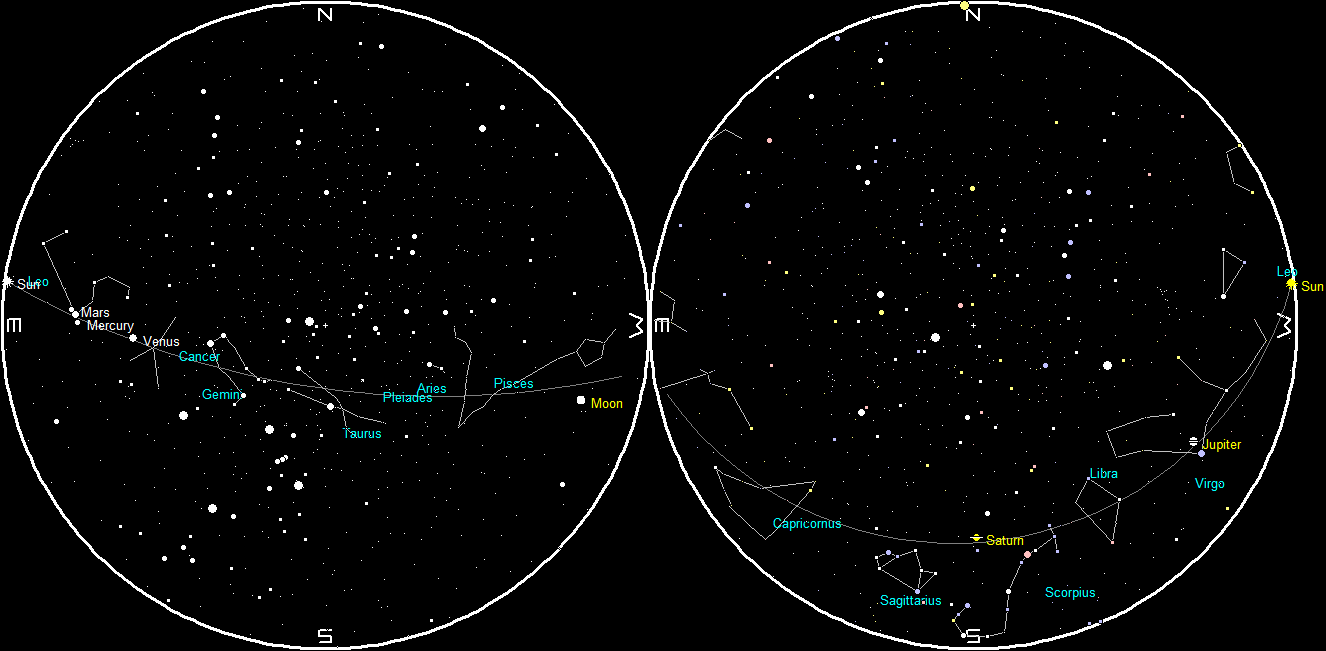
Planets at sunset and sunrise of a single night starting with sunset on the right on September 6, 2017. The night ends on the left with sunrise on the 7th. Click on the image to enlarge. Created using my LookingUp program.
09/05/2017 – Ephemeris – Neptune’s at opposition from the Sun today
Ephemeris for Tuesday, September 5th. The Sun will rise at 7:09. It’ll be up for 13 hours and 1 minute, setting at 8:11. The Moon, 1 day before full, will set at 7:22 tomorrow morning.
The sea green eighth planet from the Sun is named for the Roman god of the sea, Neptune. Today it is at opposition from the Sun, meaning it is opposite the Sun in the sky, rising at sunset. It resides at 30 times the Earth’s distance from the Sun. It is seen now against the stars of the constellation of Aquarius. While it is barely visible in binoculars the bright Moon will serve as a pointer to it tonight, but also make it hard to find. It will be three and a half moon widths left of the Moon* at 10 p.m. In telescopes it shows a tiny disk, so it’s not quite star-like. The large dark spot seen on Neptune in 1989 by Voyager 2 soon disappeared, however two years ago Neptune began to show activity again as seen from Earth and by the Hubble Space Telescope.
The times given are for the Traverse City/Interlochen area of Michigan. They may be different for your location.
* For the Eastern Daylight Time zone (0200 UT, 2017/09/06). Add one Moon diameter for every hour prior to 0200 UT, subtract one for every hour after 0200 UT.
Addendum
Click on the charts to enlarge
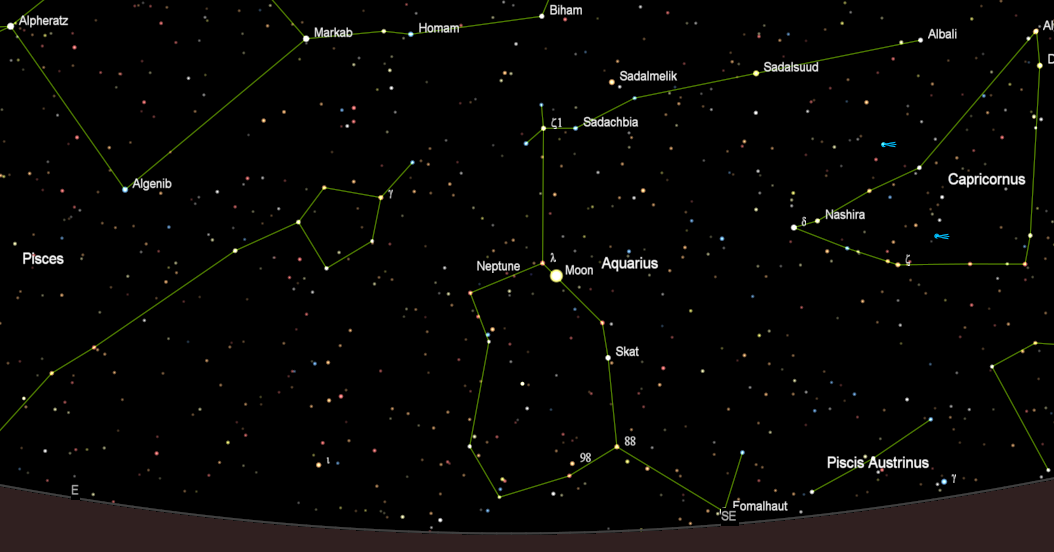
The constellations around Neptune at 10 p.m. September 5, 2017. Created using Cartes du Ciel (Sky Charts).
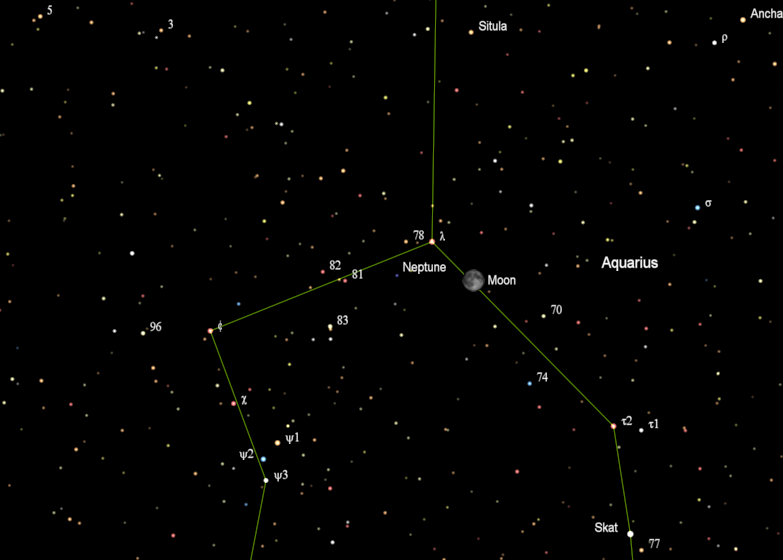
Finding Neptune tonight, September 5, 2017. Neptune moves slowly, so this finder chart, without the Moon, will work for a few months, Created using Cartes du Ciel (Sky Charts).
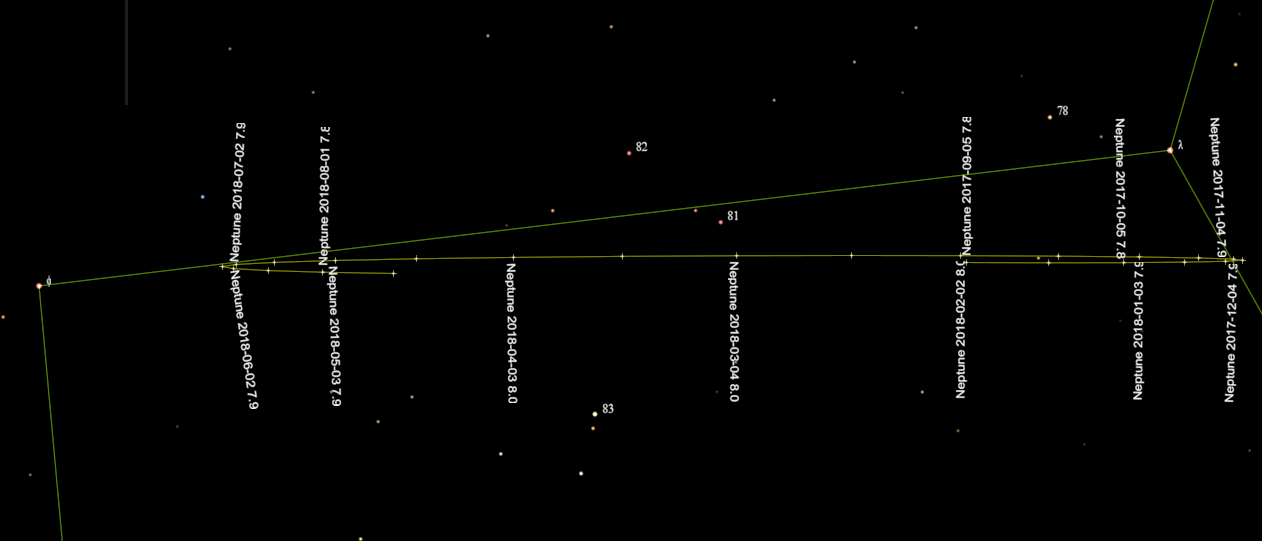
A 300 day track for Neptune with positions every 15 days starting September 5, 2017. Created using Cartes du Ciel (Sky Charts).
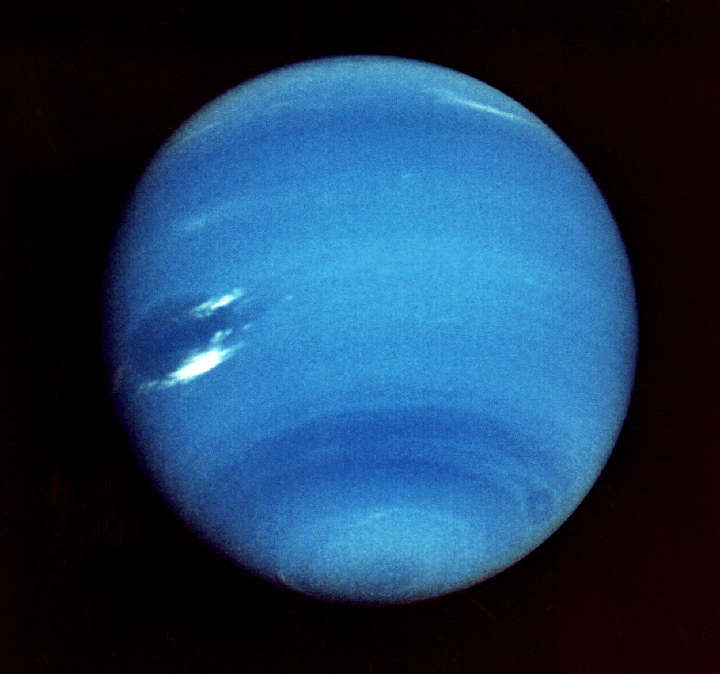
Neptune with the Great Dark Spot in 1979 as seen by Voyager 2. Credit NASA/JPL
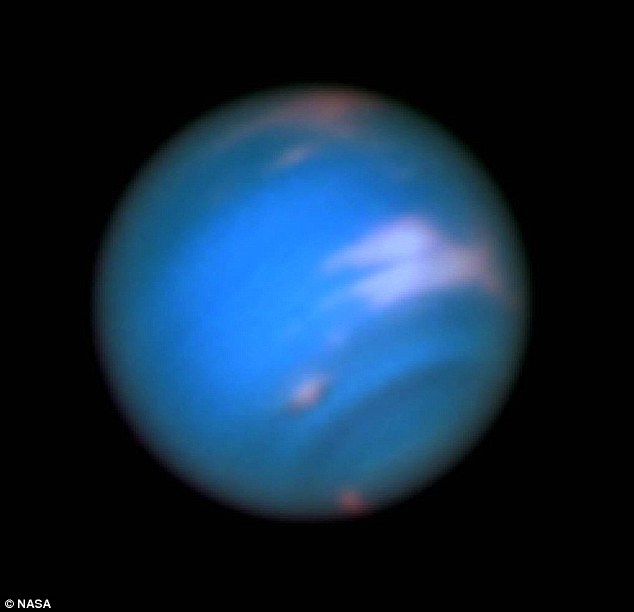
Neptune from the Hubble Space Telescope in 2016. Credit NASA/ESA.
 Bob Moler's Ephemeris Blog