Archive
11/06/2017 – Ephemeris – Taurus’ angry red eye, Aldebaran
Ephemeris for Monday, November 6th. The Sun will rise at 7:27. It’ll be up for 9 hours and 57 minutes, setting at 5:24. The Moon, 3 days past full, will rise at 7:52 this evening.
Last night the Moon passed in front of or occulted the bright star Aldebaran. Above right of Moon tonight is Aldebaran the bright orange star with a V shape of other stars in the face of Taurus the bull. Aldebaran appears at the lower left tip of that letter V laying on it’s side. With the bright Moon, it might take binoculars to pull out the faint stars of the V. Aldebaran isn’t actually part of the group, called the Hyades star cluster. The cluster is about 153 light years away, while Aldebaran is 65 light years away. The star has an orange hue because its surface is cooler than the Sun’s. However Aldebaran is 44 times larger in diameter, and shines 425 times brighter than the Sun. The name Aldebaran means “Follower” because it follows the Pleiades star cluster above it.
The times given are for the Traverse City/Interlochen area of Michigan. They may be different for your location.
Addendum
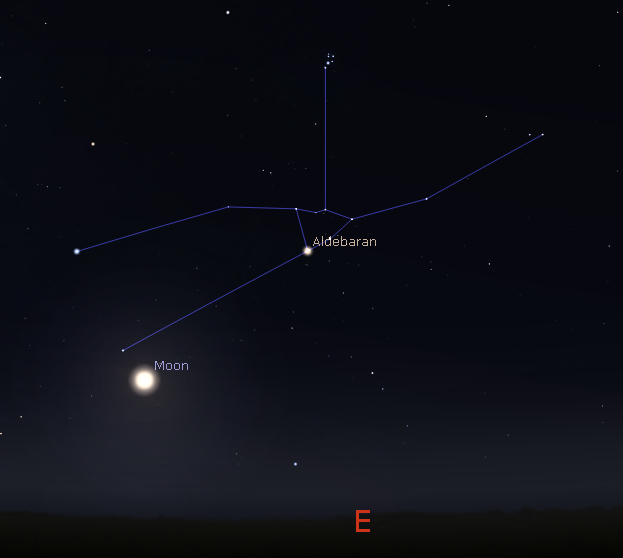
Aldebaran in the Hyades (unlabeled), with also the Pleiades, unlabeled, at the top and the Moon. at 9 p.m., November 6, 2017. Created using Stellarium.
11/05/2017 – Ephemeris Extra – There will be an Occultation of Aldebaran tonight*
This posting will not be broadcast.
* Or tomorrow morning, depending where you are.
Ephemeris extra for Sunday, November 5th. The Sun will rise at 7:25. It’ll be up for 10 hours and 5 minutes, setting at 5:25. The Moon, 2 days past full, will rise at 7:01 this evening.
Tonight just after 8 p.m. the bright star Aldebaran will disappear at the left edge of the Moon. Aldebaran is angry red eye of Taurus the bull. The star will reappear at the dark upper right edge of the Moon. Start looking at 8 p.m. or before. Use binoculars or a small telescope to spot the star against the glare of the bright Moon. The star is nowhere as bright as shown in the illustrations below. Star appearances and disappearances appear instantaneous, unlike what the illustrations show.
Aldebaran Occultation begins at 8:07 p.m. EST (1:07 UTC Nov 6th)
Aldebaran Occultation ends at 9:00 p.m. EST (02:00 UTC Nov 6th)
Note the times are for the Traverse City/Interlochen area. It will vary by a few minutes for northern lower Michigan. The position angles of the entrance and exit points of Aldebaran will also be different.
Otherwise use a planetarium program like Stellarium to preview the event. However, set the program for topocentric coordinates. In Stellarium that’s in the Configuration window, Tools Tab and check the Topocentric coordinates box. Topocentric coordinates are the apparent positions for your location on the Earth. So also make sure your location is correct. The geocentric conjunction of the two bodies will be November 6, 2:42.9 UTC, so it will occur after midnight on the morning of November 6th for locations in northern Europe and Asia.
Addendum
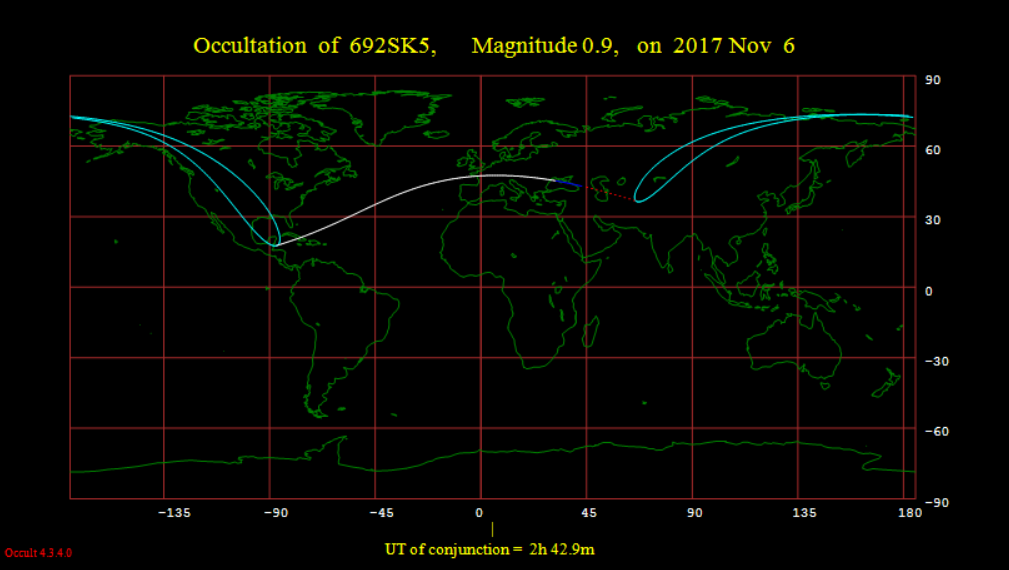
Occultation Map for the occultation of Aldebaran by the Moon . Credit Occult 4 program from IOTA.org.
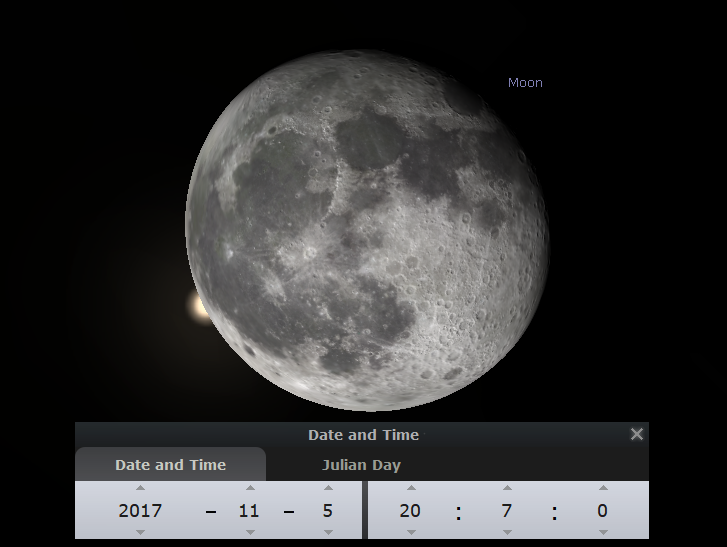
Aldebaran at the start of the occultation at 8:07 p.m. for the Traverse City/Interlochen area. Created using Stellarium.
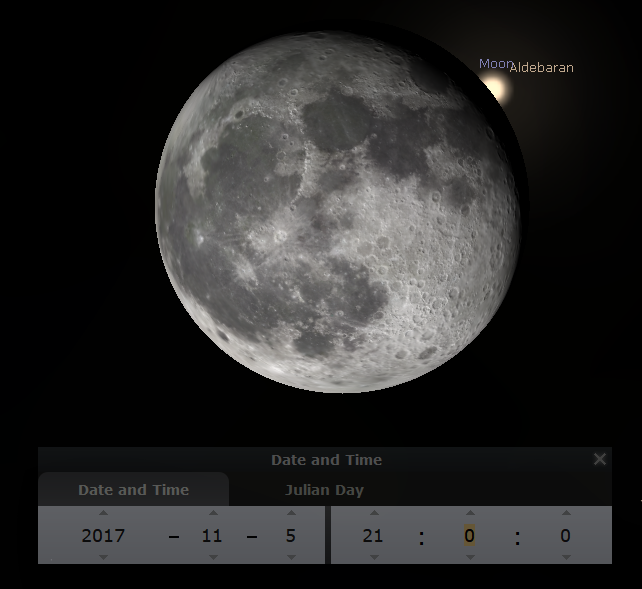
Aldebaran at the end of the occultation at 9:00 p.m. for the Traverse City/Interlochen area. Created using Stellarium.
11/03/2017 – Ephemeris – The Sun is the topic at tonight’s GTAS meeting
Ephemeris for Friday, November 3rd. The Sun will rise at 8:23. It’ll be up for 10 hours and 5 minutes, setting at 6:28. The Moon, 1 day before full, will set at 8:35 tomorrow morning.
This evening the Grand Traverse Astronomical Society will hold its monthly meeting at the Northwestern Michigan College’s Rogers Observatory at 8 p.m. with a program featuring member Don Flegel in a talk about the Sun. Don’s the keeper of our solar telescope and wanted a good excuse to learn more about the Sun, so he decided to study up and give this talk. That’s how I do it.
After the talk, at 9 p.m. there will be a star party, if it’s clear, to view the heavens including the Moon. The observatory is located south of Traverse City, on Birmley Road between Garfield and Keystone roads.
It’s time to change our clocks again at 2 a.m. Sunday. Turn your clocks back one hour. That’s Fall Back one hour for a bit of extra sleep.
The times given are for the Traverse City/Interlochen area of Michigan. They may be different for your location.
Addenda
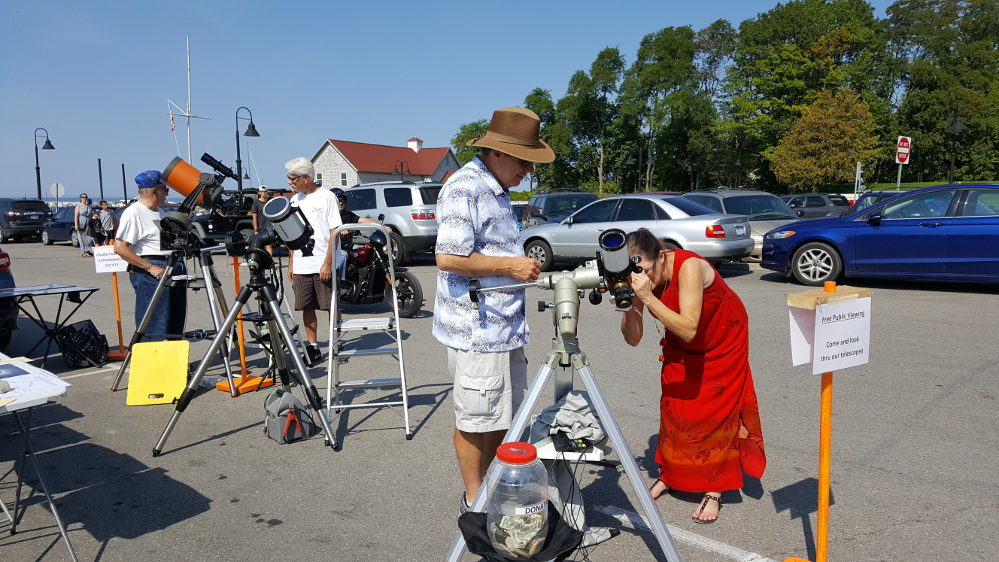
Don Flegel, in the foreground, with the society’s solar telescope assisting a person viewing the Sun at he Leland Heritage Festival 2017 at Fishtown. Man in the background in the blue cap is Gary Carlisle. The telescope in the middle is mine.
Occultation of Aldebaran by the Moon Sunday Night
Occultation Map for the occultation of Aldebaran by the Moon . Credit Occult 4 program from IOTA.org.
For the Traverse City/Interlochen area:
Aldebaran Occultation start 8:07 p.m. Nov 5th (01:07 UT Nov 6th)
Aldebaran Occultation end 9:00 p.m. Nov 5th (02:00 UT Nov 6th)
I’ll have an Ephemeris Extra posting, Sunday November 5th with more information.
11/02/2017 – Ephemeris – Interstellar asteroid discovered passing through the solar system
Ephemeris for Thursday, November 2nd. The Sun will rise at 8:21. It’ll be up for 10 hours and 7 minutes, setting at 6:29. The Moon, 2 days before full, will set at 7:21 tomorrow morning.
Apparently an interloper has entered the solar system. No, it’s not Nibiru, unless Nibiru is only 525 feet (160 meters) across. It’s name, for now, is A/2017 U1. It’s official name, when it gets one, will be given to this new class of asteroids.. It’s on a hyperbolic trajectory, meaning it won’t be back. We know there are rogue planets, kicked out of their star systems, so why not asteroids and comets? It had an interstellar space velocity relative to the Sun of 15.8 miles per second (25.5 km/s) coming from the direction of the constellation of Lyra. Interestingly that’s the direction the Sun is traveling toward relative to our neighboring stars at nearly the same speed. Maybe it didn’t so much as to run into us, but the Sun and our solar system ran into it!
The times given are for the Traverse City/Interlochen area of Michigan. They may be different for your location.
Addendum
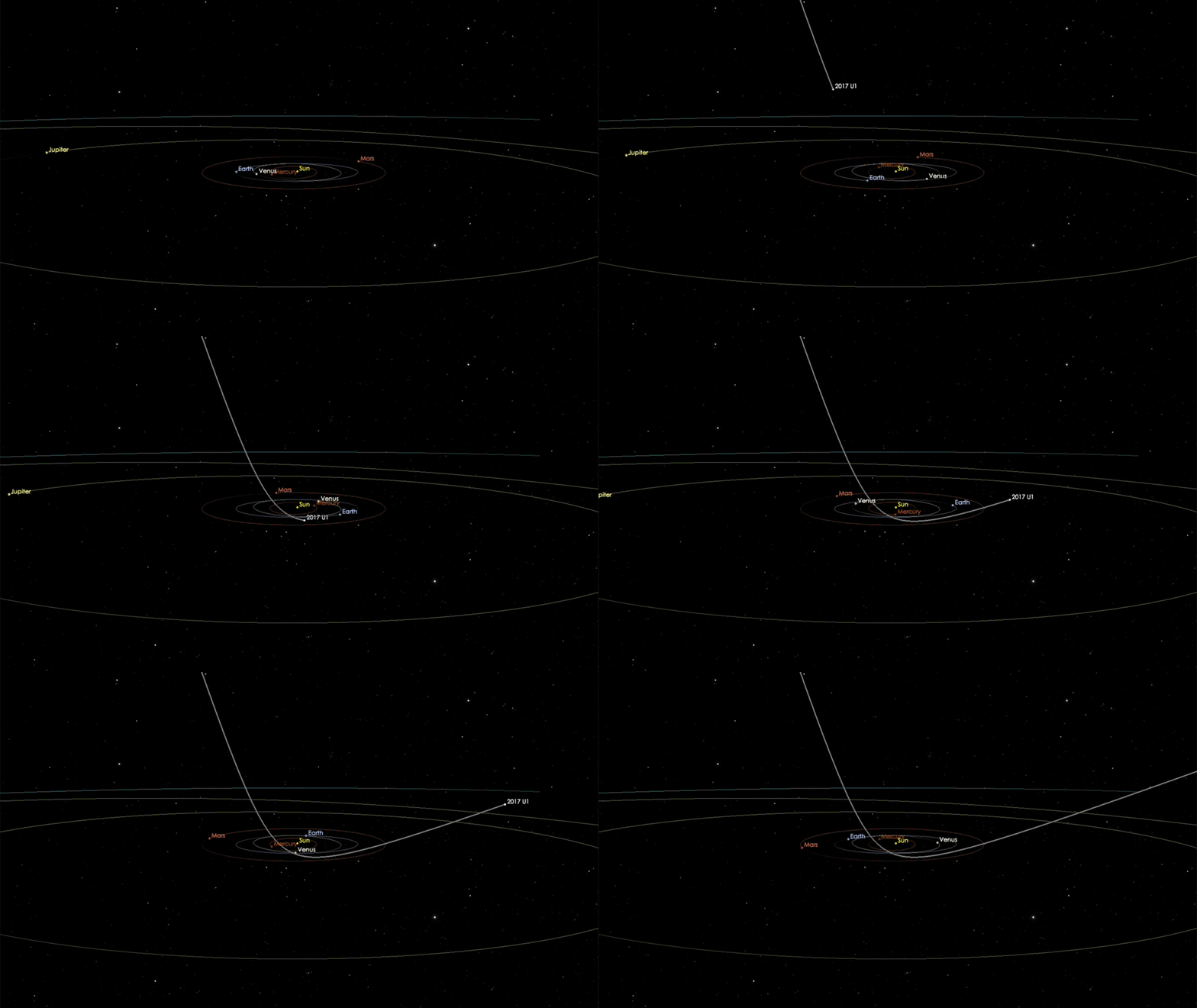
Asteroid A/2017 U1 orbit animation. Click to enlarge. Credit NASA/JPL-Caltech.
This body was discovered because it came close to the Earth. There are probably many of them passing through the solar system that never come close enough to be found.
Here’s a link: https://www.nasa.gov/feature/jpl/small-asteroid-or-comet-visits-from-beyond-the-solar-system
11/01/2017 – Ephemeris – Looking at the bright planets for November 1st
Ephemeris for Wednesday, November 1st. The Sun will rise at 8:20. It’ll be up for 10 hours and 10 minutes, setting at 6:30. The Moon, 3 days before full, will set at 6:08 tomorrow morning.
Let’s take our weekly look at the bright planets for this first day of November. Saturn is sinking low in the southwestern sky in the evening. Saturn’s rings are still spectacular in telescopes, but since Saturn is so low in the sky the turbulence of the thick atmosphere makes Saturn fuzzy and seemingly to go in and out of focus. Saturn will set at 9:02 p.m.
Tomorrow in the morning sky, Mars, heading away from the Sun will rise in the east at 5:25 a.m., Venus, is heading closer to the Sun, will rise at 6:53 in the east. Jupiter is in the morning sky but too close to the direction of the Sun to be seen. Mercury has moved into the evening sky and will reach it’s greatest elongation from the Sun in 22 days, but will not be easily visible even then.
The times given are for the Traverse City/Interlochen area of Michigan. They may be different for your location.
Addendum
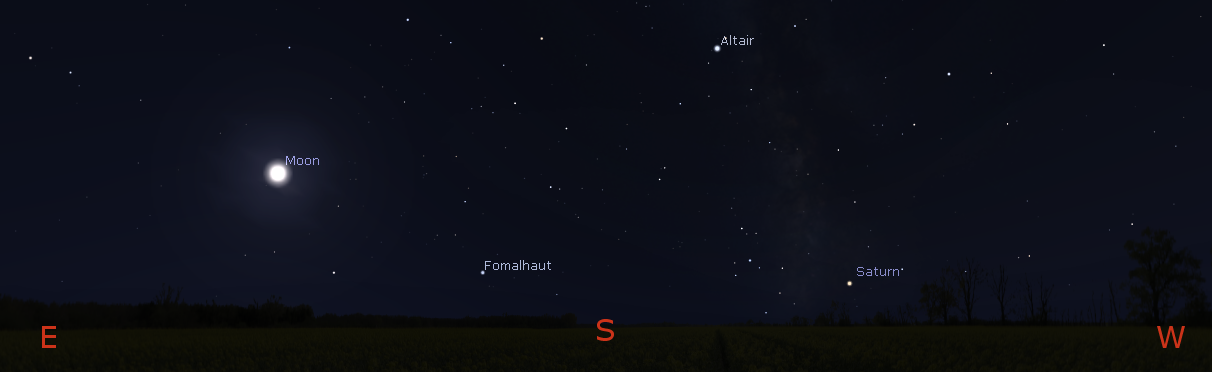
Saturn and the Moon at 8 p.m. November 1, 2017. Click on the image to enlarge. Create using Stellarium.
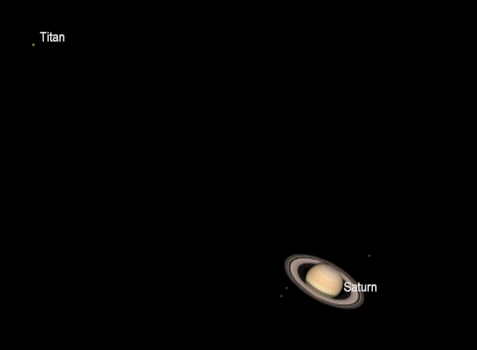
Saturn and its brightest moon Titan in the evening of November 1, 2017. Created using Cartes du Ciel (Sky Charts).
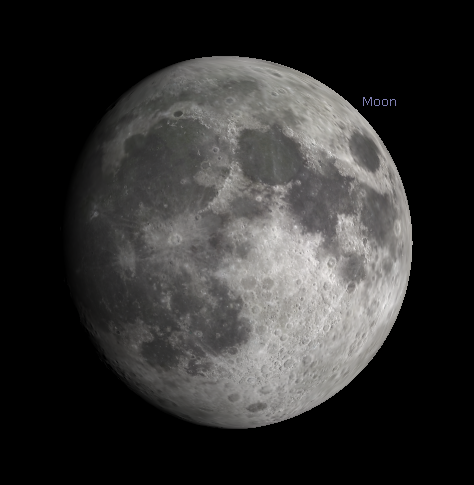
The Moon as it might be seen in binoculars at 8 p.m., November 1, 2017. Created using Stellarium.
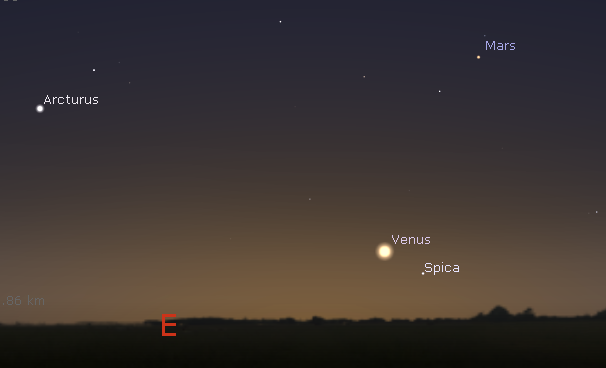
Mars and Venus at 7:30 a.m. November 2, 2017. Created using Stellarium.
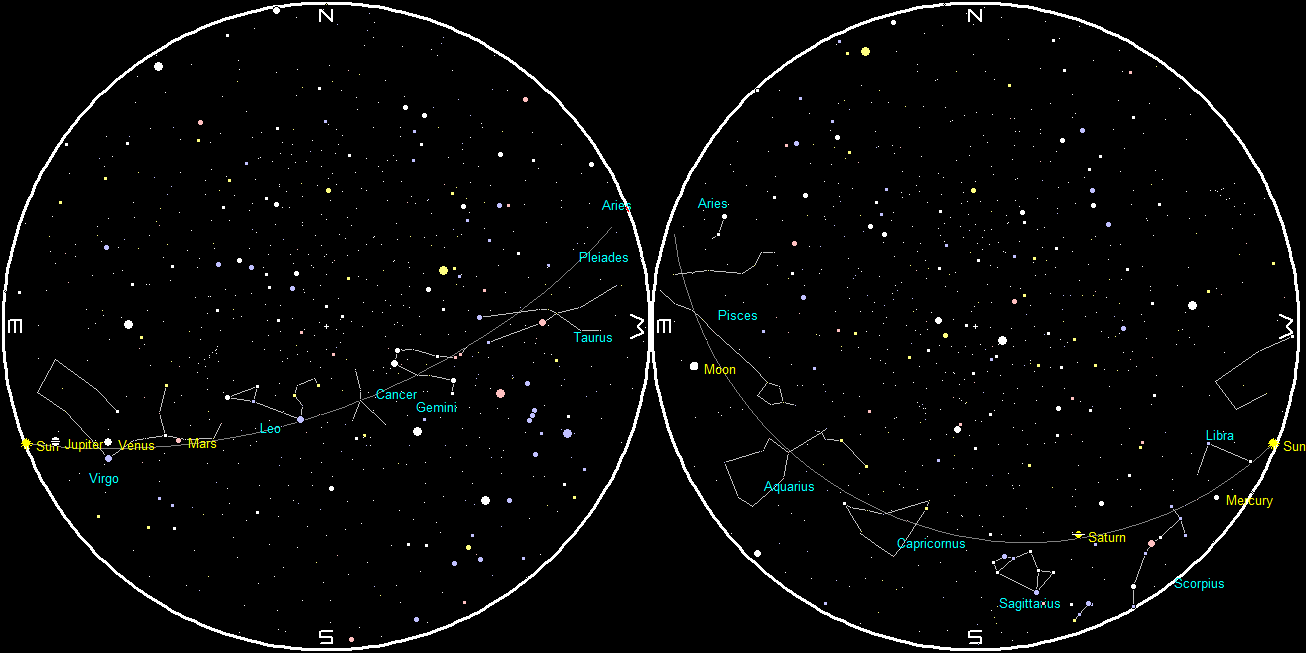
Planets at sunset and sunrise of a single night starting with sunset on the right on November 1, 2017. The night ends on the left with sunrise on the 2nd. Click on the image to enlarge. Created using my LookingUp program.
 Bob Moler's Ephemeris Blog