Archive
01/31/2018 – Ephemeris – Lunar Eclipse happening now* and the bright planets for this week
* The Ephemeris radio program run at 6:19 a.m. and 7 a.m. EST will run during the lunar eclipse.
Ephemeris for Wednesday, January 31st. The Sun will rise at 8:02. It’ll be up for 9 hours and 47 minutes, setting at 5:50. The Moon, at full today, will rise at 6:15 this evening.
We have a lunar eclipse in progress this morning. Before the partial phase starts the Moon will have a dusky appearance because the Moon will be in the Earth’s outer penumbra shadow. The partial phase starts at 6:48 a.m. (11:48 UT), when the upper left part of the Moon will enter the Earth’s inner shadow, called the umbra. The Moon will be fully immersed in the shadow beginning at 7:51 a.m. (12:51 UT). It will probably disappear by then because the Sun will rise just after 8 a.m. and the Moon will set, at least in the Interlochen/Traverse City area at, 8:04.
Venus is our evening planet, but too close to the Sun to spot. At 7 a.m. Jupiter and Mars below left of it are in the south while Saturn is low in the southeast. Tomorrow morning Jupiter will rise at 2:20 a.m., Mars will follow at 3:25. Last of all Saturn will rise at 5:50 a.m.
The times given are for the Traverse City/Interlochen area of Michigan. They may be different for your location.
Addendum
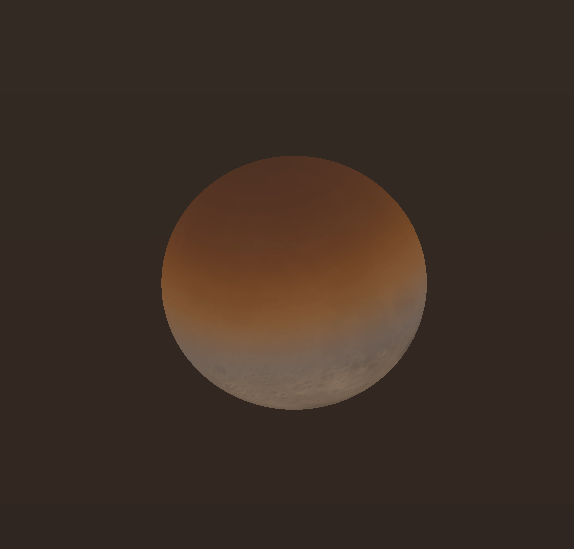
The partially eclipsed Moon at 7:40 a.m. January 31, 2018 from Traverse City, MI as simulated by Stellarium.
For more on the eclipse see yesterday’s post: https://bobmoler.wordpress.com/2018/01/30/01-30-2018-ephemeris-looking-for-tomorrows-lunar-eclipse/.
On to the planets
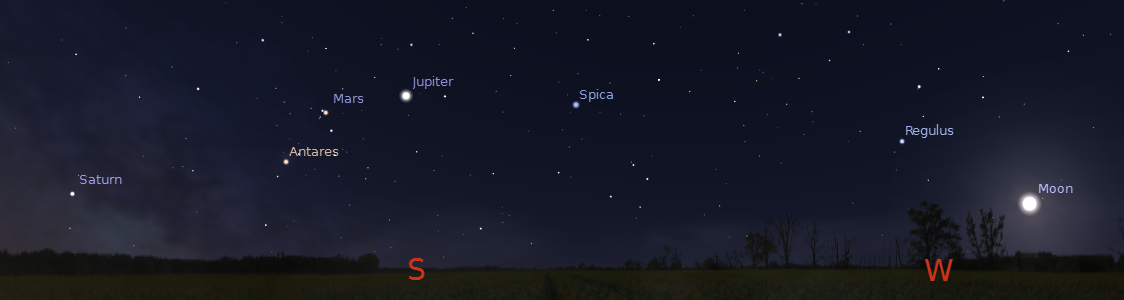
Morning planets and the partially eclipsed moon at 7 a.m. this morning, January 31, 2018. Click on the image to enlarge. Created using Stellarium.
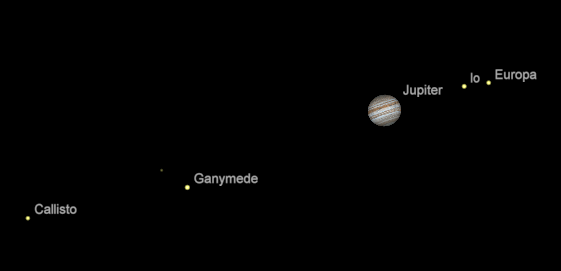
Jupiter and its moons at 7 a.m. this morning January 31, 2018. Created using Cartes du Ciel (Sky Charts).
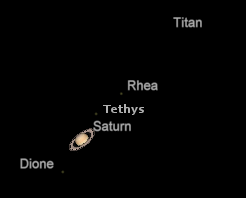
Saturn and its brighter moons at 7 a.m. this morning January 31, 2018. Created using Cartes du Ciel (Sky Charts).
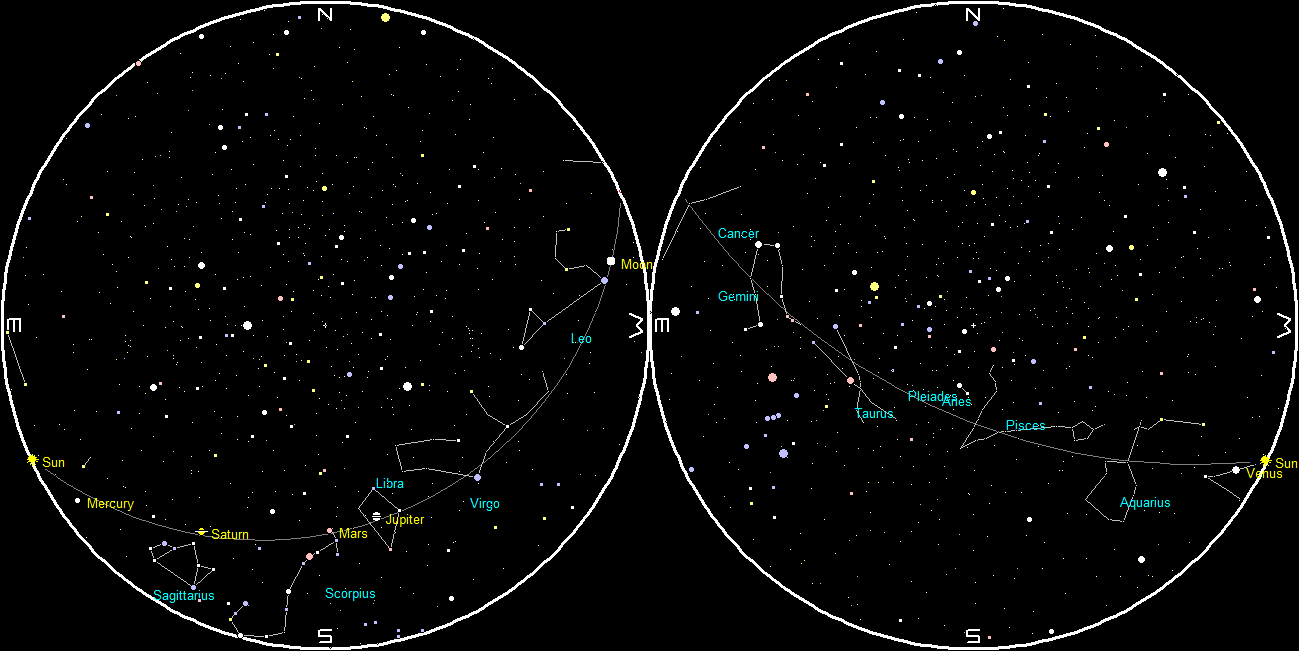
Planets at sunset and sunrise of a single night starting with sunset on the right on January 31, 2018. The night ends on the left with sunrise on February 1st. Click on the image to enlarge. Created using my LookingUp program.
01/30/2018 – Ephemeris – Looking for tomorrow’s lunar eclipse
Ephemeris for Tuesday, January 30th. The Sun will rise at 8:04. It’ll be up for 9 hours and 44 minutes, setting at 5:48. The Moon, 1 day before full, will set at 8:04 tomorrow morning.
At a bit before 5 this morning the Moon passed perigee, it closest approach to the Earth in its monthly orbit of the Earth. It was 223,072 miles (359,000 km) away. That makes tonight’s Moon, 12 hours or less before full, a super moon. It will rise tonight at about 5:01. However it’s setting that is of interest because it will be in eclipse. The partial phase of tomorrow morning’s lunar eclipse will begin at 6:48 a.m. (11:48 UT), when the upper left part of the Moon will enter the Earth’s inner shadow, called the umbra. The Moon will be fully immersed in the shadow beginning at 7:51 a.m. (12:51 UT). It will probably disappear by then because the Sun will rise just after 8 a.m. and the Moon will set, at least in the Interlochen/Traverse City area at, 8:04.
The times given are for the Traverse City/Interlochen area of Michigan. They may be different for your location.
Addendum
The partially eclipsed Moon in twilight at 7:40 a.m. January 31, 2018 from Traverse City, MI as simulated by Stellarium.
The following is an article I submitted to Green Elk Rapids website that was also published in the Elk Rapids News. Elk Rapids is a village about 20 miles north of Traverse City on the east shore of Grand Traverse Bay. I added the metric units for this post.
We will have a calendrical coincidence on January 31st along with a natural event, and just missing another natural event all having to do with the Moon. The first is that the full moon on January fits one of the definitions for a “blue moon”, the second full moon in a month. Of course the Moon doesn’t actually turn blue. It doesn’t really care. Since February is shorter than a lunation, a lunar month, it will not have a full moon. However March will have two full moons like January.
The second is a real event. The Moon being opposite the Sun in the sky, the definition of a full moon, will pass into the Earth’s shadow causing a lunar eclipse or eclipse of the Moon. In this case, a total eclipse. A lunar eclipse of some type occurs in about one in six full moons. We only have to be on the night side of the Earth to see it. That’s the rub this time, because the eclipse will be in progress at sunrise. The partial phase starts at 6:48 a.m. From about 6:30 on the upper left part of the Moon will appear dusky as the Moon sinks deeper in the Earth’s outer shadow, where the Sun is only partially blocked. The Moon will sink farther and farther into the Earth’s inner shadow called the umbra until at 7:51 a.m. it will be totally immersed. By then the sky will be quite bright, with sunrise to occur at 8:02. The Moon should completely disappear and will set unseen at 8:04. Folks a few states west of us will see, more than likely, a coppery colored totally eclipsed Moon. Some TV preacher some years ago called it a blood moon, hoping to sell books about the end times.*
The color comes from the sum of all the sunrise and sunsets happening on Earth at that instant. The red sunrise we see is caused by the blue light being scattered out of the Sun’s light by molecules in the Earth’s atmosphere. It gives us the blue sky. Our atmosphere also bends the Sun’s light. When we see the full disc of the Sun just clear the horizon, it’s still actually fully below the horizon. The light of the sunrise that passes over our heads continues on, being bent further and becoming redder, and fills the Earth’s shadow by the time it reaches the Moon’s distance, making the Moon red. Volcanic ash in the upper atmosphere can make the Moon almost disappear during totality.
This full moon is also a so-called “super moon”. These occur when the full moon is nearest the Earth in its monthly orbit of the Earth. January first’s full moon was the closest of the year, you might say a super-duper moon. The Moon reached its perigee, closest point or 221,581 miles (356,600 km) away 5 hours before the Moon was officially full. This time perigee is the day before full, about 1,500 miles (2,400 km) farther away. These are measured center to center. The closest an Elk Rapids observer will be to the Moon on the 31st will be at about 12:30 a.m. at 219,920 miles (353,927 km), subtracting most of the Earth’s radius. Of course the Moon won’t look that big being high in the south then. By moon set it will retreat to 223,778 miles (360,136 km) from an Elk Rapids observer. The increased apparent size of the rising or setting Sun or Moon is an optical illusion. The Moon is closer to us when high in the sky than when on the horizon.
The next lunar eclipse visible to us is next year, on the night of January 20-21, 2019.
* The Elk Rapids News didn’t like my dig about the TV preacher and omitted this sentence. I rather expected them to.
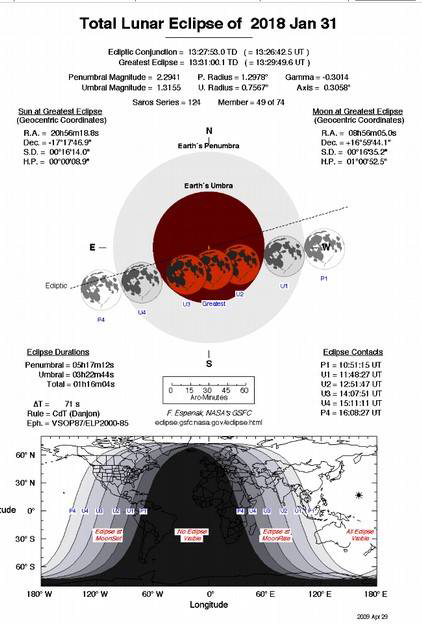
Credit NASA.
The original page for this graphic is: https://eclipse.gsfc.nasa.gov/LEplot/LEplot2001/LE2018Jan31T.pdf
    Total Lunar Eclipse January 31
Event               Time EST   Time UT
                    GT Area
Enter penumbra      5:51 a.m.  10:51   Unseen
Begin partial phase 6:48 a.m.  11:48
Totality begins     7:51 a.m.  12:51
Sun rises           8:02 a.m.
Moon sets           8:04 a.m.
Mid eclipse                    13:28
Totality ends                  14:07
End partial phase              15:11
Leave penumbra                 16:08   Unseen

The shading of the penumbra is generally noticeable within 1/2
hour before the partial phase begins and again after it ends.
01/29/2018 – Ephemeris – Michigan fireball
Ephemeris for Monday, January 29th. The Sun will rise at 8:05. It’ll be up for 9 hours and 42 minutes, setting at 5:47. The Moon, 2 days before full, will set at 7:13 tomorrow morning.
The meteoroid that exploded over southern Michigan nearly two weeks ago was seen by many people, mostly in the southeastern Michigan though some reports were from around here. The explosion, high in the atmosphere registered 2.0 on an earthquake recording seismograph in Ann Arbor. That was just from the pressure wave. Pieces of meteorites from it have been found laying on the snow. It appears to have been a normal stony meteoroid. The strewn field where the meteorites have been found is in Hamburg township, southwest of Brighton. The meteoroid came in at 28,000 miles per hour (45,000 kph), a lot slower than a Perseid meteoroid. Rule of thumb for the nomenclature of these things: meteoroid, before; meteor, the light in the sky, meteorite, what’s left that hits the ground. Unfortunately, I didn’t see it.
The times given are for the Traverse City/Interlochen area of Michigan. They may be different for your location.
Addendum
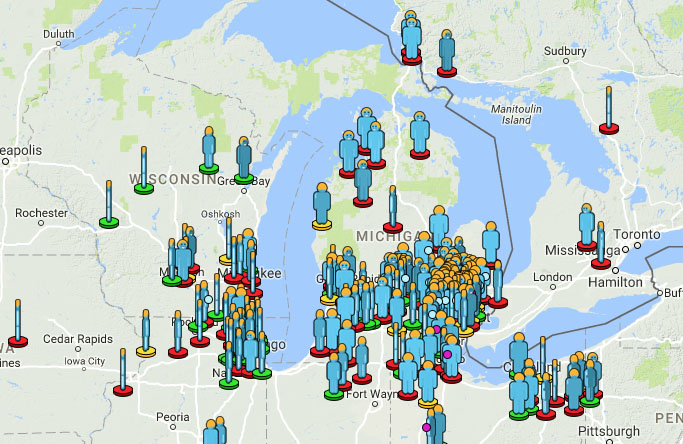
A map of the location of observers of the fireball. Map credit Google & American Meteor Society.
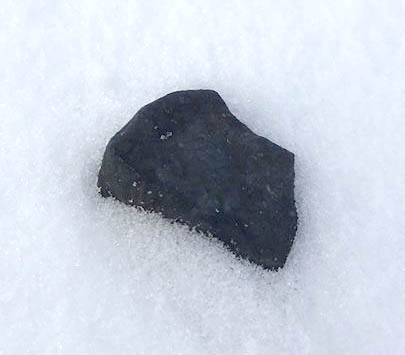
A piece of the meteorite found in the strewn field southwest of Brighton, MI. It appears to be a low iron chondrite, a common rocky meteorite. Credit Mike Hankey / American Meteor Society.
Here’s a Sky and Telescope post about the event: http://www.skyandtelescope.com/astronomy-news/observing-news/michigan-fireball/
01/26/2018 – Ephemeris – The Moon tonight: The Bay of Rainbows
Ephemeris for Friday, January 26th. The Sun will rise at 8:08. It’ll be up for 9 hours and 34 minutes, setting at 5:43. The Moon, 2 days past first quarter, will set at 3:59 tomorrow morning.
A look at the Moon tonight will reveal that the sunrise line, or terminator has almost completely revealed the large sea of Showers or Mare Imbrium to the upper left of center of the gibbous disk. At the extreme upper left straddling the terminator is one of my favorite features, the Bay of Rainbows or Sinus Iridium. It’s a colorful name for something that’s as gray as the rest of the Moon. It looks like a bay off of Imbrium, and has an arch like a rainbow. It’s arch is the Jura Mountains, which jut into Mare Imbrium at Cape Heraclide, just catching sunlight, and Cape Laplace farther into morning. What’s cool is catching it as the sunlight is hitting the mountains while the convex floor, following the Moon’s curvature is only partially illuminated.
The times given are for the Traverse City/Interlochen area of Michigan. They may be different for your location.
Addendum
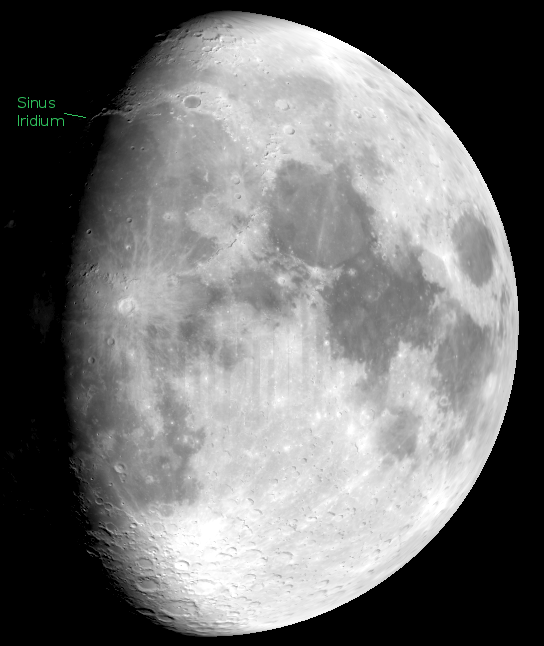
The Moon at 8 p.m. January 26, 2018 highlighting Sinus Iridium. Created using Virtual Moon Atlas.
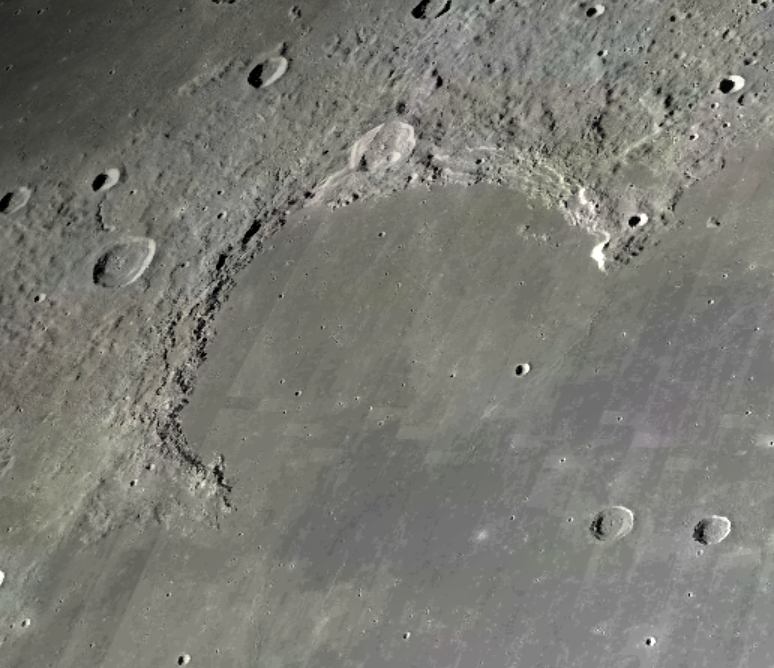
Sinus Iridium photographed by the Lunar Reconnaissance Orbiter as texture mapped on the globe of the Virtual Moon Atlas.
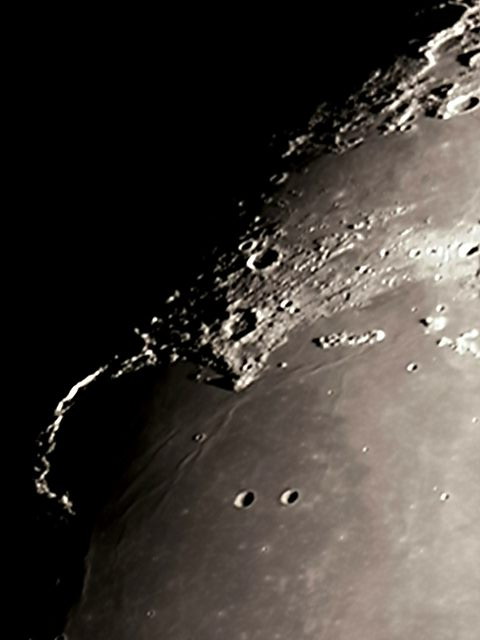
Sinus Iridium at sunrise. Photo by “Seb2003” on http://forums.futura-sciences.com/materiel-astronomique-photos-damateurs/5809-images-de-lune.html.
01/25/2018 – Ephemeris – The Moon tonight: Copernicus on the terminator
Ephemeris for Thursday, January 25th. The Sun will rise at 8:09. It’ll be up for 9 hours and 32 minutes, setting at 5:41. The Moon, 1 day past first quarter, will set at 2:48 tomorrow morning.
Let’s take a look at our slightly gibbous moon, just a day past first quarter with binoculars or a small telescope. The terminator, in this case the sunrise line will appear to cross the crater Copernicus to the right of the Moon’s center if you’re viewing it right side up. To the North across the Sea of Showers, or Mare Imbrium is the large flat floored crater Plato. South of Copernicus is a recently named sea, Mare Cognitum, the Known Sea, after the first successful close photography by the Ranger 7 spacecraft in 1964. South of the is Mare Nubium, the Sea of Clouds. South of that are the lunar highlands with the stark crater Tycho and the huge crater Clavius with an arc of craters of decreasing size within it.
The times given are for the Traverse City/Interlochen area of Michigan. They may be different for your location.
Addendum
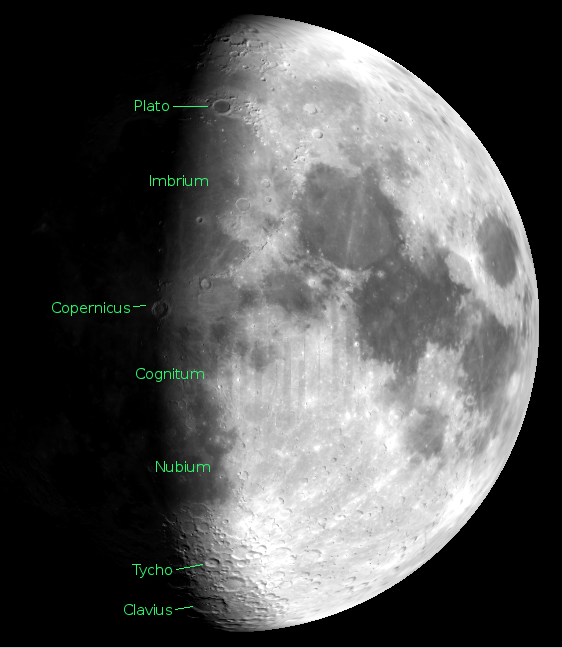
The waxing gibbous Moon tonight at 8 p.m., January 25, 2018. Created using Virtual Moon Atlas.
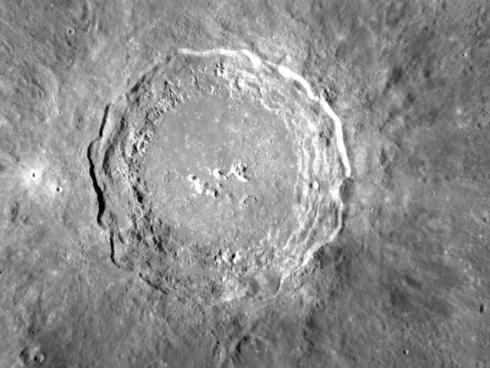
The crater Copernicus. Credit: NASA/GSFC/Arizona State University.
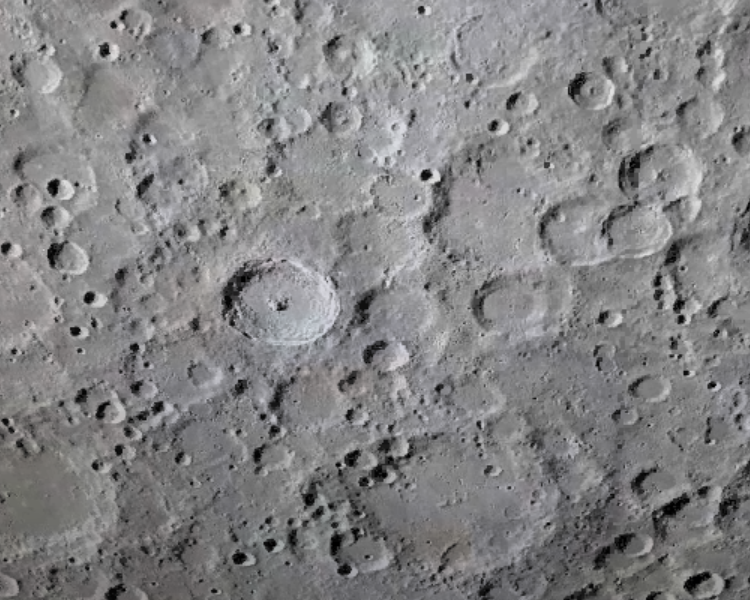
The Lunar highlands near the crater Tycho showing a surface saturated with craters. Credit: Virtual Moon Atlas with the texture from NASA’s Lunar Reconnaissance Orbiter. The lunar phase was omitted.
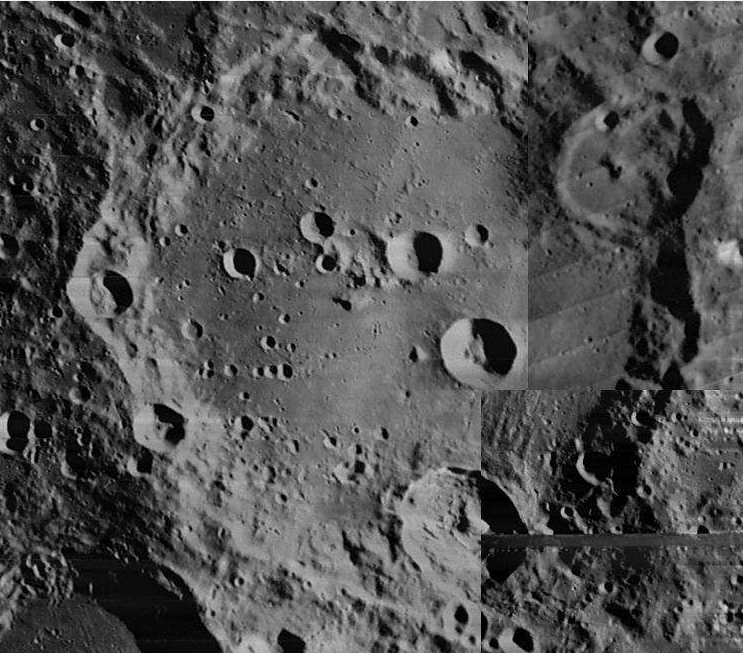
Clavius as photographed by one of the Lunar Orbiter spacecraft in the 1960s From Digital Lunar Orbital Photographic Atlas. Credit Jeff Gillis, Lunar and Planetary Institute.
01/24/2018 – Ephemeris – Our weekly look at the bright planets
Ephemeris for Wednesday, January 24th. The Sun will rise at 8:10. It’ll be up for 9 hours and 30 minutes, setting at 5:40. The Moon, at first quarter today, will set at 1:38 tomorrow morning.
Let’s take our weekly look at the bright planets. All of the bright naked eye planets save one are in the morning sky now, but Venus sets only 14 minutes after the Sun. At 7 this morning Jupiter is in the south-southeast and is a lot brighter than Mars, below and left of it. Saturn is very low in the southeast. Jupiter will rise at 2:44 a.m. tomorrow with Mars following at 3:30. And Saturn will rise at 6:15. Saturn’s rise times will increase by 3 to 4 minutes each morning. It will be in a lot better position to spot in the coming weeks. The morning sky you’ll see at 7 a.m. will be the same stars as in the early summer sky with the summer triangle in the east. Scorpius is rising with the red star Antares below and left of Mars.
The times given are for the Traverse City/Interlochen area of Michigan. They may be different for your location.
Addendum
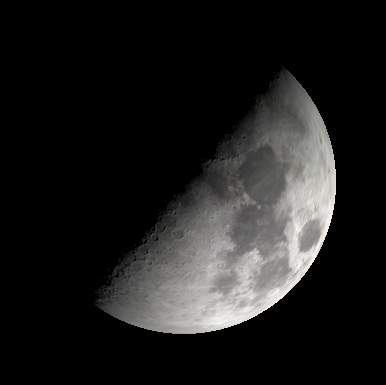
The first quarter Moon as it might be seen in binoculars at 8 p.m. tonight. January 24, 2017. Created using Stellarium.
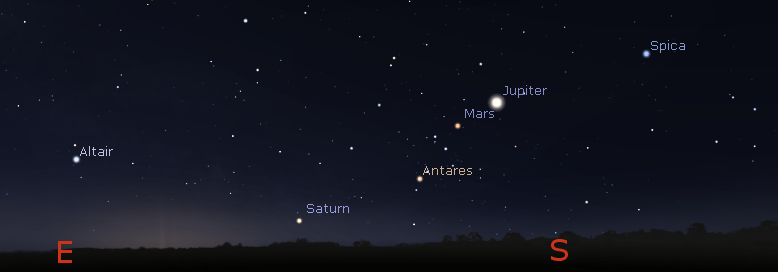
Jupiter and Mars are easily visible, but Saturn is low in the southeast at 7 this the morning, January 24, 2018. Click on the image to enlarge. Created using Stellarium.
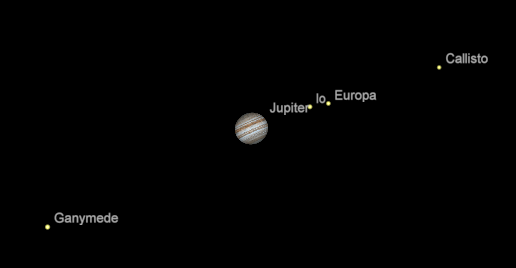
Jupiter and its moons at 7 a.m. this morning January 25, 2018. Created using Cartes du Ciel (Sky Charts).
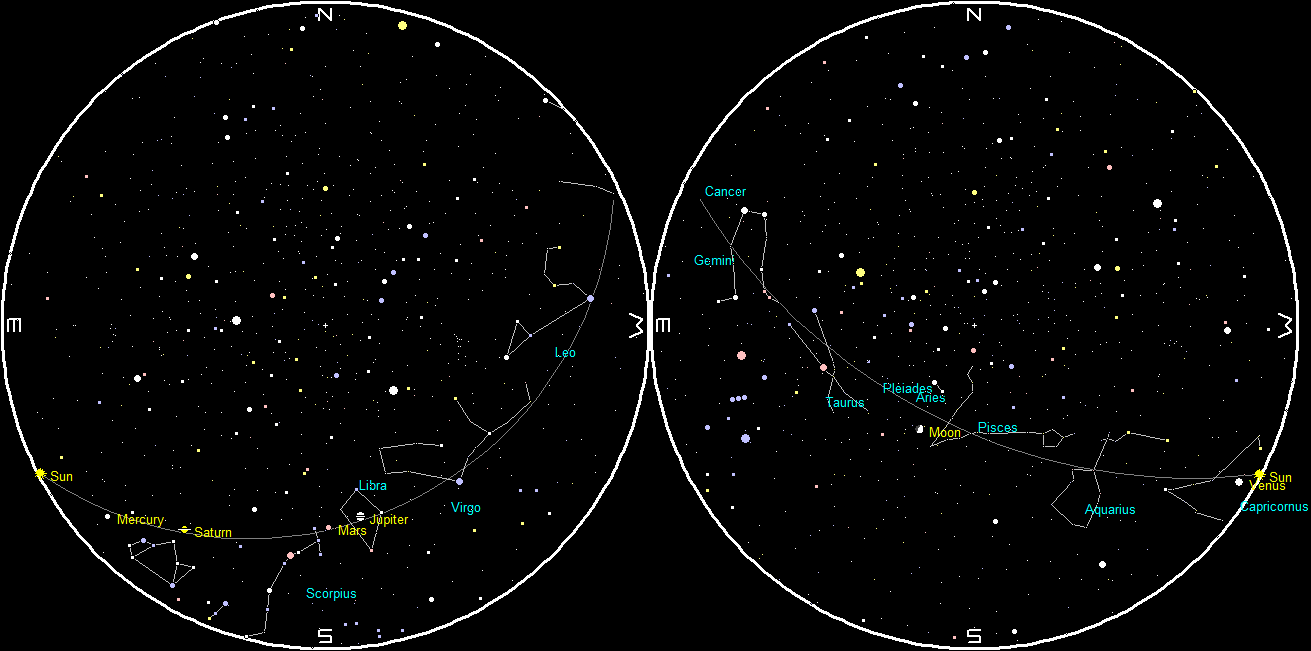
Planets at sunset and sunrise of a single night starting with sunset on the right on January 24, 2018. The night ends on the left with sunrise on the 25th. Click on the image to enlarge. Created using my LookingUp program.
01/23/2018 – Ephemeris – The Moon tonight: the Sea of Tranquility and a crater named for Julius Caesar
Ephemeris for Tuesday, January 23rd. The Sun will rise at 8:10. It’ll be up for 9 hours and 28 minutes, setting at 5:38. The Moon, 1 day before first quarter, will set at 12:30 tomorrow morning.
Let’s take a look at the Moon tonight with binoculars or a small telescope. The crescent Moon tonight has completely revealed the Sea of Tranquility, or Mare Tranquillitatis. Right on the western edge, east to us, of the sea is a ruined crater called Julius Caesar. It seems to have formed by a small asteroid collision in the first half billion years of the Moon’s existance. It’s shape was distorted by the impact that created the Sea of Tranquility. The Moon’s so-called seas are all pretty much impact craters, just really big ones. North of Tranquility is the Sea of Serenity which will be completely in sunlight tomorrow night. By the way, the Grand Traverse Astronomical Society telescope clinic that was scheduled for January has been moved to February 2nd.
The times given are for the Traverse City/Interlochen area of Michigan. They may be different for your location.
Addendum
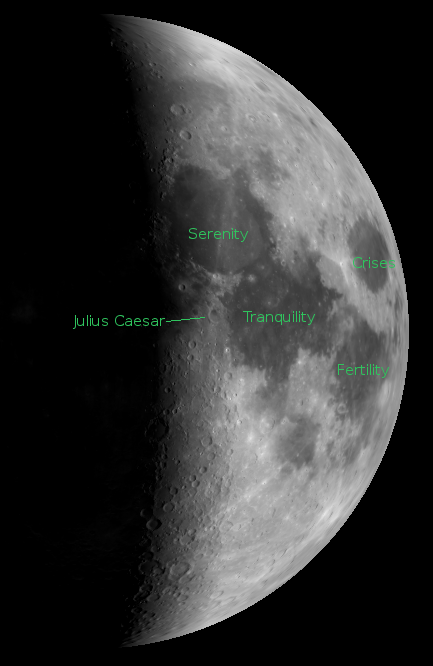
The fat crescent Moon at 8 p.m. January 23, 2018. Created using Virtual Moon Atlas.
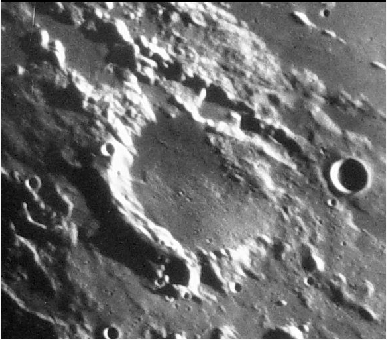
The crater Julius Caesar from photographs supplied with Virtual Moon Atlas.
01/22/2018 – Ephemeris – The Pup
Ephemeris for Monday, January 22nd. The Sun will rise at 8:11. It’ll be up for 9 hours and 25 minutes, setting at 5:37. The Moon, 2 days before first quarter, will set at 11:24 this evening.
Sirius is the brightest night-time star and is located in the southeast at 9 p.m. below and a bit left of Orion the Hunter. We’ve visited Sirius last week. There is another star in the Sirius system that is practically invisible due to its dazzling glare. It’s Sirius B, nicknamed the Pup, alluding to Sirius’ Dog Star title. The tiny star was suspected as far back as 1834 due to Sirius’ wavy path against the more distant stars. Sirius is only 8.6 light years away. Sirius A and the Pup have 50 year orbits of each other. The star was first seen by Alvan Clark in 1862 while testing a new telescope. The Pup was the first of a new class of stars called white dwarfs. The Pup is about the size of the Earth, with the mass of our Sun, and 5 times hotter than the Sun’s surface. It’s out of fuel and slowly collapsing.
The times given are for the Traverse City/Interlochen area of Michigan. They may be different for your location.
Addendum
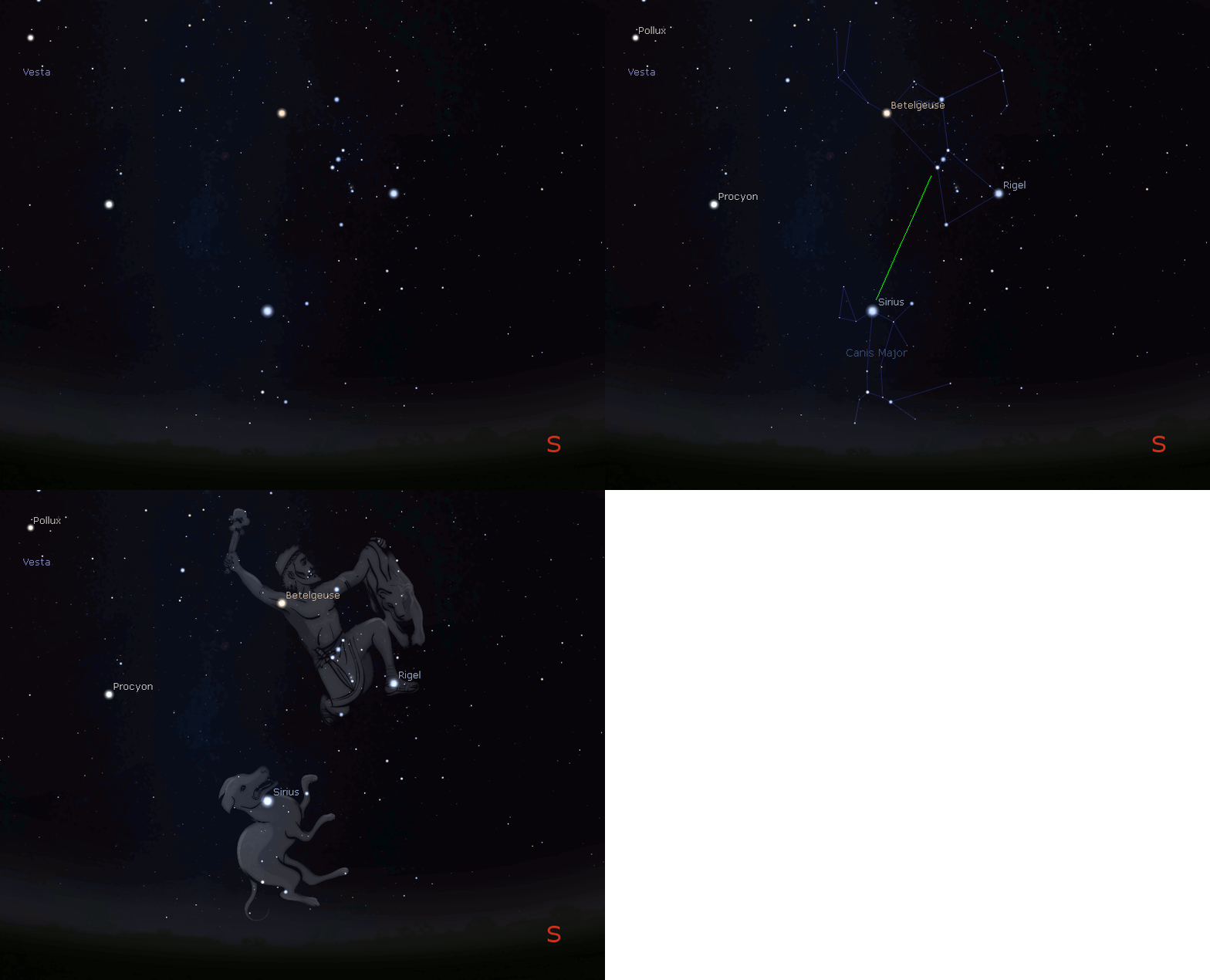
Orion and Canis Major Animation for 9 p.m. January 20, 2017. Created using Stellarium and GIMP.
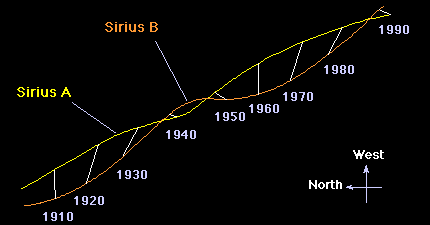
Sirius A & B’s path in the sky showing the wobble that betrayed the Pup’s presence. Credit Mike Guidry, University of Tennessee.
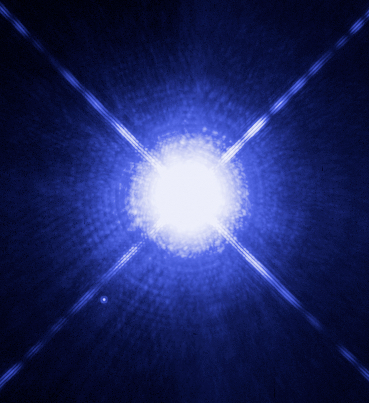
Sirius A and B (near the diffraction spike to the lower left), A Hubble Space Telescope photograph. Credit NASA, ESA.
01/19/2018 – Ephemeris – Orion’s large hunting dog
Ephemeris for Friday, January 19th. The Sun will rise at 8:14. It’ll be up for 9 hours and 19 minutes, setting at 5:33. The Moon, 3 days past new, will set at 8:15 this evening.
The brightest star-like object in the evening sky is Sirius, also known as the Dog Star. It also is the brightest night-time star in our skies period. Tonight at 9 p.m. it’s located low in the southeastern sky. The Dog Star name comes from its position at the heart of the constellation Canis Major, the great dog of Orion the hunter, which is seen almost like he’s begging, feet to the right. The three stars of Orion’s belt tilt to the southeast and point to Sirius. The name Sirius means ‘Scorcher’, a reference to its great brilliance and twinkling. To me it has a blue tinge like an arc light in a telescope. Its Egyptian name was Sothis, and its appearance in the dawn skies in late June signaled the flooding of the Nile, and the beginning of the Egyptian agricultural year.
The times given are for the Traverse City/Interlochen area of Michigan. They may be different for your location.
Addendum
Orion and Canis Major Animation for 9 p.m. tonight. Created using Stellarium and GIMP.
01/18/2018 – Ephemeris – The spectacular Great Orion Nebula
This is Bob Moler with Ephemeris for Thursday, January 18th. The Sun will rise at 8:14. It’ll be up for 9 hours and 17 minutes, setting at 5:32. The Moon, 2 days past new, will set at 7:15 this evening.
The constellation Orion the hunter is the south-southeast at 9 p.m. its upright rectangle of four stars frame his belt of three stars in a straight line and still tilt a bit to the left. Below the belt is what appear to the unaided eye as three more stars arranged vertically, his sword. Binoculars aimed at the middle stars of the sword will find a glowing haze around those stars. That is the Great Orion Nebula. It is the birth place of stars, and is even illuminated by a clutch of four hot young stars. One of the discoveries of the Hubble space telescope are what appear, and are tiny cocoons of gas and dust in which stars condense and form. They are called Proplyds, which are short for protoplanetary disks. In each one is the red center, a young star just beginning to shine.
The times given are for the Traverse City/Interlochen area of Michigan. They may be different for your location.
Addendum
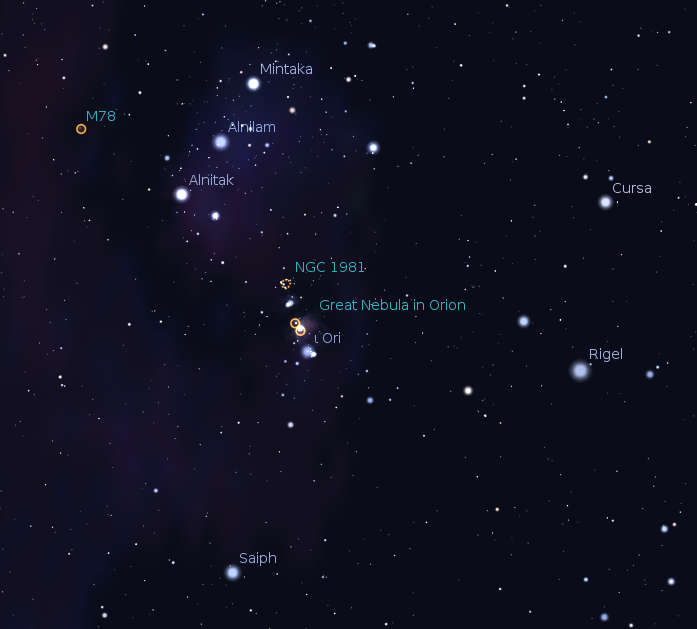
The lower part of Orion with the Great Orion Nebula. Created using Stellarium.
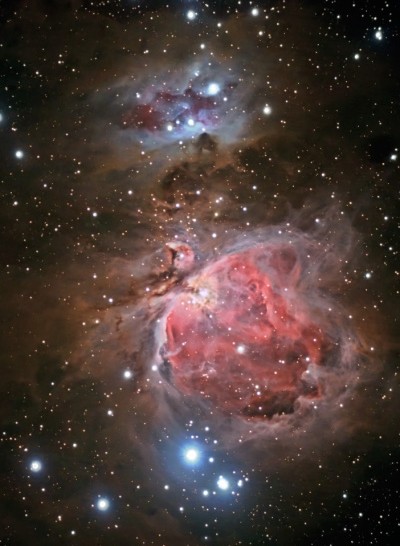
The Great Orion Nebula (M42) long exposure photograph by Scott Anttila. Includes all the sword stars.
A new video just posted by NASA
 Bob Moler's Ephemeris Blog