Archive
02/14/2018 – Ephemeris – Let’s take our weekly look at the bright planets
Ephemeris for St. Valentine’s Day and Ash Wednesday, February 14th. The Sun will rise at 7:44. It’ll be up for 10 hours and 25 minutes, setting at 6:09. The Moon, 1 day before new, will rise at 7:42 tomorrow morning.
Let’s take our weekly look at the bright planets. All of the bright naked eye planets save one are in the morning sky now. Heading away from the Sun after sunset is Venus which sets 42 minutes after the Sun, and probably is not visible in the bright evening twilight. That will improve in a couple of weeks. At 7 in this morning’s twilight bright Jupiter is in the south to the left of it is dimmer Mars and below it the red star Antares. The two are about the same brightness now. The name Antares means “Rival of Mars”. Saturn is very low in the southeast. Jupiter will rise at 1:31 tomorrow morning, with Mars rising at 3:13. Saturn will end the procession, rising at 5:01 a.m.
The times given are for the Traverse City/Interlochen area of Michigan. They may be different for your location.
Addendum
This morning
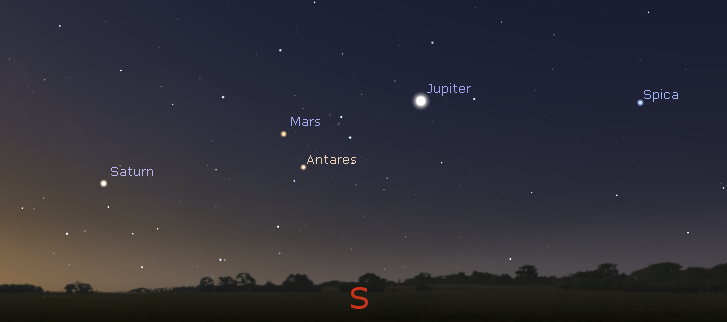
The morning planets of Jupiter, Mars and Saturn. Seen at 7 a.m. as morning twilight brightens, February 14, 2017. Created using Stellarium.
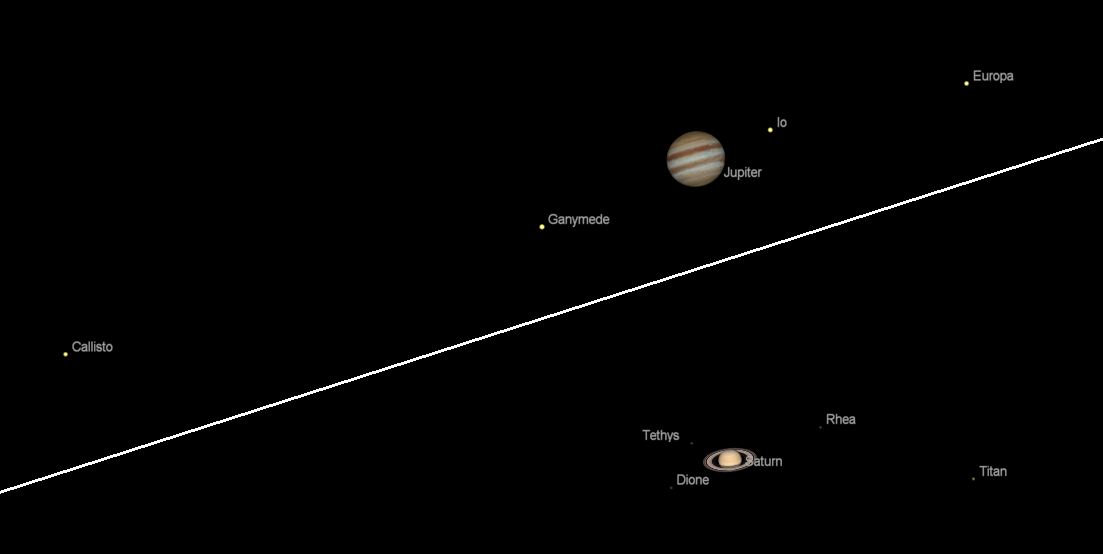
Jupiter and Saturn with their brighter satellites this morning at 7 a.m. February 14, 2018. They are displayed at the same scale. Saturn in about twice as far as Jupiter. Its disk is a bit smaller than Jupiter’s so it appears about half as large. The extent of the rings appear to be about the same as Jupiter’s diameter. Created using Stellarium.
This evening

Venus, the planet of love, about to set over Lake Michigan at 6:30 p.m., February 14, 2018. While a lovely planet in our skies, it is rather a hell hole inside it’s atmosphere. Created using Stellarium.
All night planets
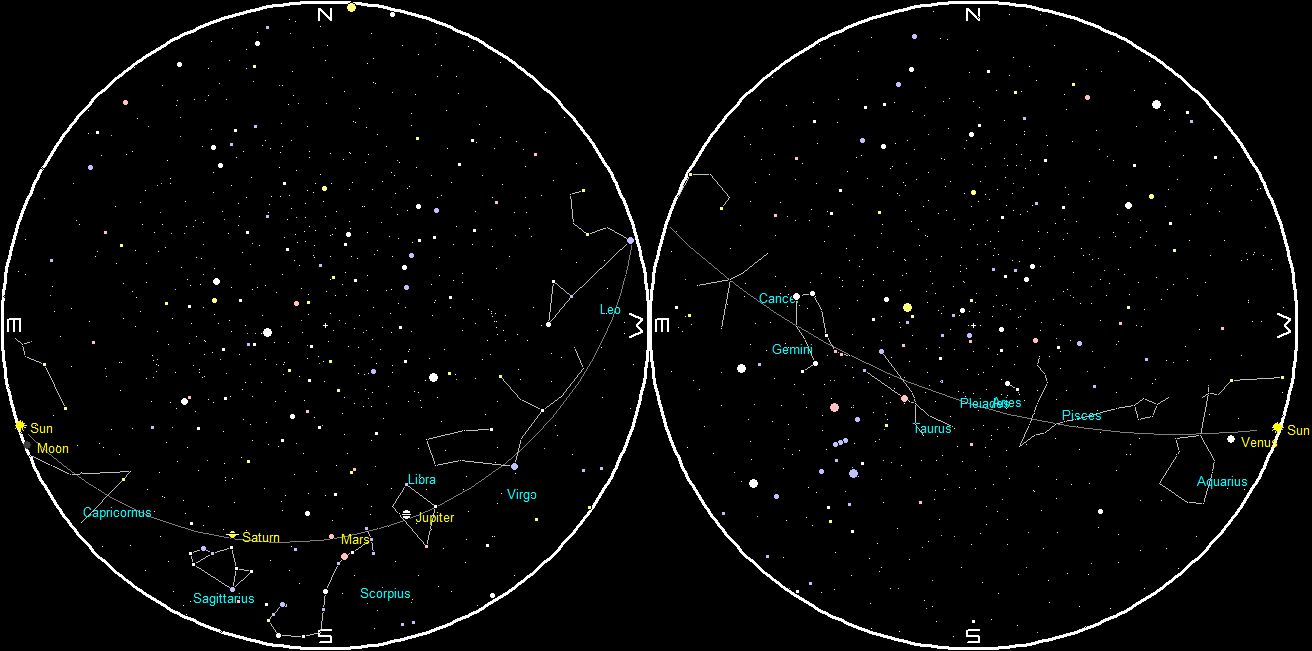
Planets at sunset and sunrise of a single night starting with sunset on the right on February 14, 2018. The night ends on the left with sunrise on February 15th. Mercury is not shown because it is mostly south of the Sun. It will be in superior conjunction on the 17th. Click on the image to enlarge. Created using my LookingUp program.
02/13/2018 – Ephemeris – Looking out the thin side of the Milky Way’s disk
Ephemeris for Fat Tuesday, February 13th. The Sun will rise at 7:46. It’ll be up for 10 hours and 22 minutes, setting at 6:08. The Moon, 2 days before new, will rise at 7:07 tomorrow morning.
With Orion and the winter stars grabbing our attention in the south, let’s look to the northeast to southeast where the stars are not as many, and with the exception of the Big Dipper and some other stars, not as bright. The inner stars of the Big Dipper are part of a sparse star cluster only about 80 light years away. The reason for the sparseness is that here we are looking out the thin side of the Milky Way’s disk. It will be our spring sky. To the west is the autumn evening skies. The thick part of the disk runs from the south-southeastern horizon, to just west of the zenith to the northwestern horizon. The reason the Milky Way isn’t as bright as the summer sections, is that we are looking away from the center to the outer spiral arms. We are in a small arm with the Great Orion Nebula.
The times given are for the Traverse City/Interlochen area of Michigan. They may be different for your location.
Addendum
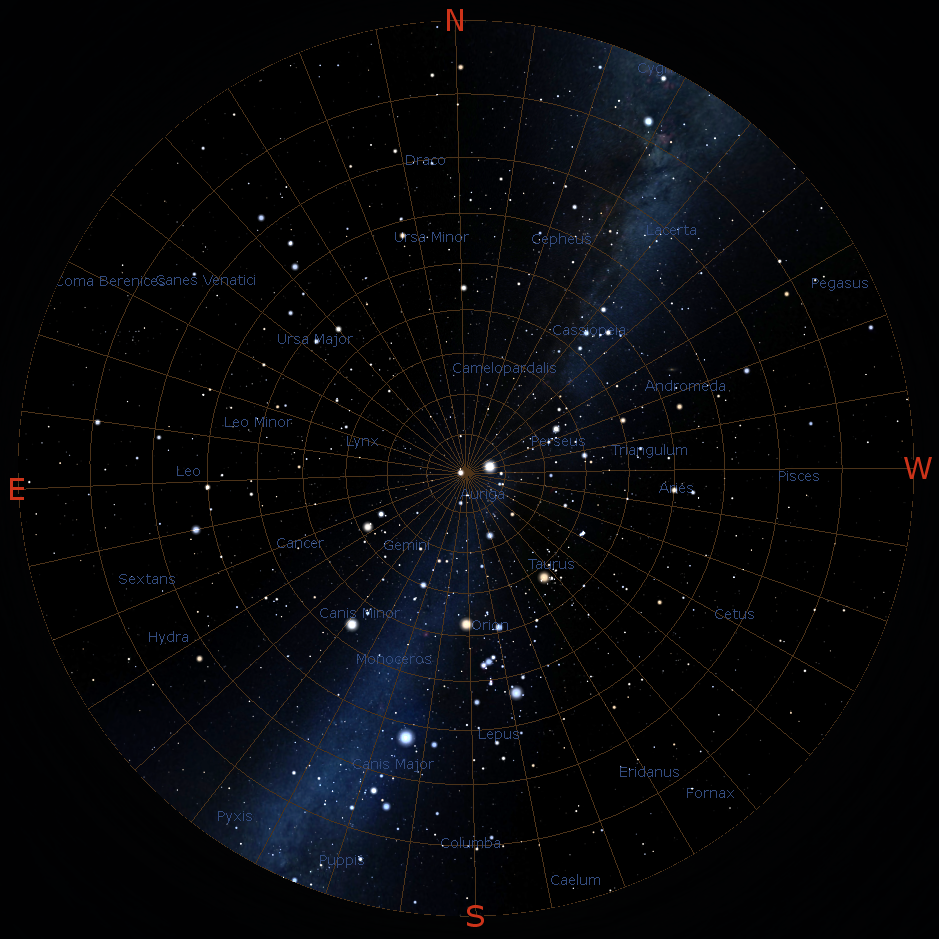
The dome of the sky at 9 p.m. February 13, 2018 showing an enhanced Milky Way. Showing also the drop off in stars off that band to the east and west. Click on image to enlarge. Created using Stellarium.
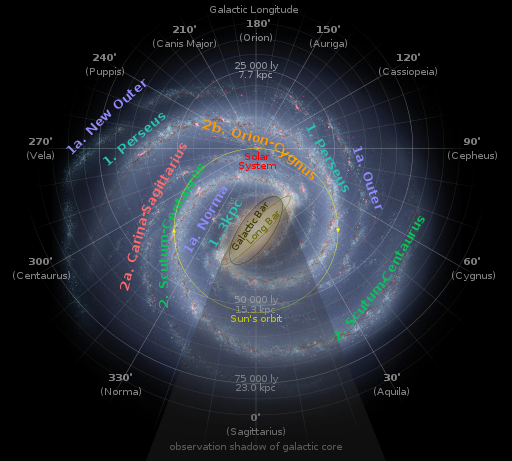
Our place in the Milky Way. Note that we appear to be in a barred spiral galaxy. The arms are numbered and named. 3kpc is the 3 kiloparsec arm. 1 parsec = 3.26 light years. The Sun is about 27,000 light years from the center. Credit NASA and Wikimedia Commons, via EarthSky.org
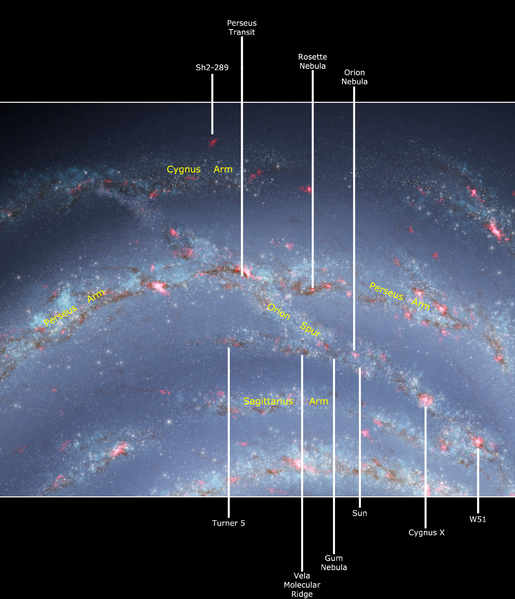
Our galactic neighborhood on the Orion spur or arm. Credit R. Hurt on Wikimedia Commons, via EarthSky.org.
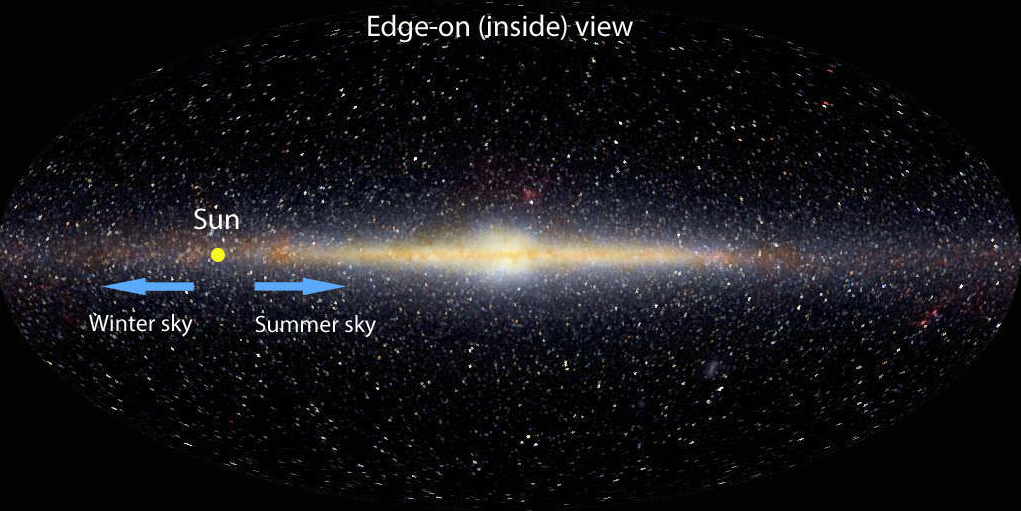
The summer and winter Milky Way viewing directions. During Spring and Autumn, we look out the sides to the universe beyond. Credit: NASA with annotations by Bob King at Universe Today.
02/12/2018 – Ephemeris – The Winter Circle
Ephemeris for Monday, February 12th. The Sun will rise at 7:47. It’ll be up for 10 hours and 19 minutes, setting at 6:07. The Moon, 3 days before new, will rise at 6:29 tomorrow morning.
The winter skies are blessed with more first magnitude stars than any other season. Six of these stars lie in a large circle centered on the seventh, It’s called the Winter Circle. This circle is up at 9 p.m. Starting high overhead is yellow Capella in Auriga the charioteer. Moving down clockwise is orange Aldebaran in the face of Taurus the Bull. Then down to Orion’s knee we find blue-white Rigel. Down and left is the brightest star of all the brilliant white Sirius the Dog Star in Canis Major, lowest of these stars in the south-southeast. Moving up and left is white Procyon in Canis Minor, Above Procyon is Pollux in Gemini the twins. All these are centered, well not quite, on Betelgeuse the bright red star in Orion’s shoulder.
The times given are for the Traverse City/Interlochen area of Michigan. They may be different for your location.
Addendum
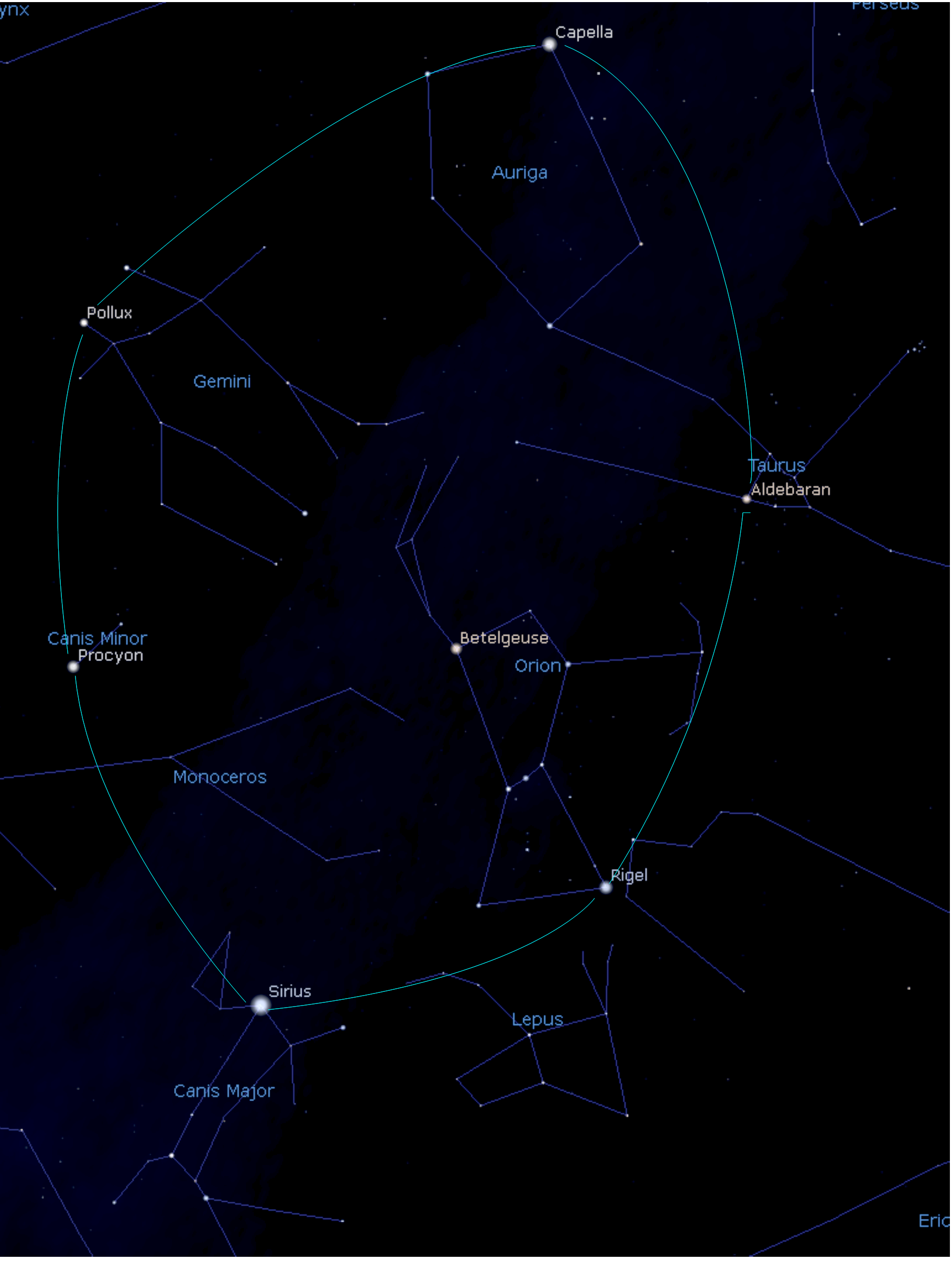
The bright stars of winter arrayed in a circle (well almost). Created using Stellarium.
02/09/2018 – Ephemeris – Morning planet high jinx
Ephemeris for Friday, February 9th. The Sun will rise at 7:51. It’ll be up for 10 hours and 11 minutes, setting at 6:02. The Moon, 2 days past last quarter, will rise at 4:05 tomorrow morning.
This past Wednesday morning the Moon passed Jupiter, Earlier this morning the Moon passed north of Mars, and on Sunday morning Saturn will appear south of The Moon. There is a once in about 2 year event, that is red Mars passing Antares, the red giant star in Scorpius, one of the easiest constellations to spot because it actually resembles a scorpion. The name Antares means “Rival of Mars” because they have the same color: Ant meaning anti and Ares is the Greek god of war and counterpart of the Roman god Mars. Mars will pass Antares on average of
every 22 ½ months, its period around the Sun. Since we are viewing it from a moving Earth, it varies. Mars will pass Antares next on January 19th, 2020.
The times given are for the Traverse City/Interlochen area of Michigan. They may be different for your location.
Addendum
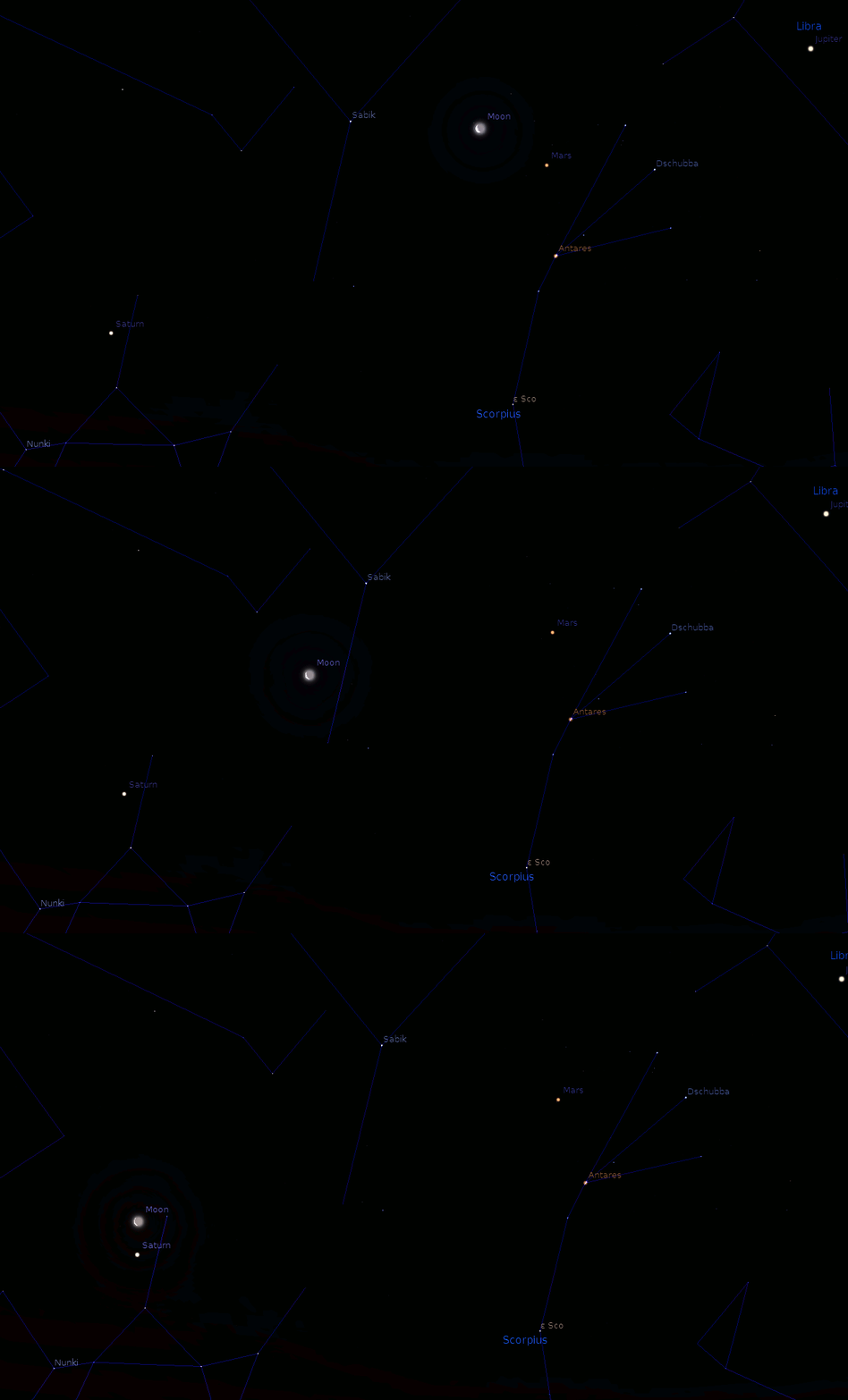
Morning planets and the Moon at 7 a.m. on the mornings of February 9, 10 and 11, 2018. See Mars changing position compared to Antares. Click on image to enlarge. Created using Stellarium and GIMP.
02/08/2018 – Ephemeris – The wonderfully named stars of Orion
Ephemeris for Thursday, February 8th. The Sun will rise at 7:53. It’ll be up for 10 hours and 8 minutes, setting at 6:01. The Moon, 1 day past last quarter, will rise at 3:09 tomorrow morning.
The constellation of Orion the hunter is visible in the south at 9 p.m. The stars of Orion are interesting in themselves. Starting at the top left of the seven bright stars of Orion’s torso is Betelgeuse the bright red star, whose name means something like “Armpit of the Giant”. The star in Orion’s other shoulder is Bellatrix the “Amazon Star”. Below are the three stars of Orion’s belt, from left to right; Alnitak, Alnilam and Mintaka. Their names mean “Girdle”, “Belt of Pearls”, and “Belt” respectively. Down to Orion’s knees we look on the left to the star Saiph pronounced ‘safe’ which means “Sword”, though it is some ways from the stars of Orion’s sword. Finally there’s the bright blue-white star Rigel whose name means “Left Leg of the Giant”.
The times given are for the Traverse City/Interlochen area of Michigan. They may be different for your location.
Addendum
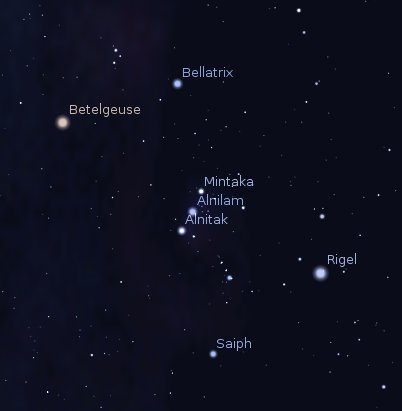
The named stars of Orion. Created using Stellarium.
Betelgeuse, pronounced Beetlejuice is the name of a 1988 movie, where Betelgeuse (spelled properly) is a particularly mischievous demon. Don’t say his name three times, or he’ll come and ‘help’ you. Oops, I did. It is a red giant star near the end of its life.
Bellatrix, is now known to most of us now as the first name as the first name of Bellatrix Lestrange from J. K. Rowling’s Harry Potter book and movie series. Other members of the Black family have astronomical names, such as Regulus (Leo) Black, and Sirius (Canis Major) Black.
The names of the belt stars were taught to me by Evelyn Grebel of the Grand Rapids Public Museum in the late 1950s. She was one of the founders of the Grand Rapids Amateur Astronomical Association. The names Alnitak, Alnilam and Mintaka have stuck with me ever since. It was through her that I was able to worm my way into working at the museum’s new then unnamed planetarium. I also remember being in her office with her, listening to the radio as Alan Shepard made his historic suborbital flight on May 5th, 1961.
Rigel is a hot blue-white star, and will probably become a red giant star like Betelgeuse. There is another bright star named Rigel, but most don’t know it. It’s Rigel Kentaurus, the leg of the centaur of Centaurus. It’s better known as Alpha Centauri, a catalog designation, and the nearest star to the solar system.
02/07/2018 – Ephemeris – Where are the bright planets today?
Ephemeris for Wednesday, February 7th. The Sun will rise at 7:54. It’ll be up for 10 hours and 5 minutes, setting at 6 p.m. The Moon, at last quarter today, will rise at 2:10 tomorrow morning.
Let’s take our weekly look at the bright planets. All of the bright naked eye planets save one are in the morning sky now, but Venus sets only 32 minutes after the Sun, and probably is not visible in the bright evening twilight. That will improve by month’s end. At 7 this morning Jupiter is in the south, below left of the Moon and is a lot brighter than Mars, below and left of it. Mars is above the red star Antares, and the two are about the same brightness now. The name Antares means “Rival of Mars”. Mars will appear to pass its closest to Antares Sunday morning. Saturn is very low in the southeast. Jupiter will rise at 1:56 a.m. tomorrow with Mars following at 3:19. Saturn will rise at 5:26 a.m.
The times given are for the Traverse City/Interlochen area of Michigan. They may be different for your location.
Addendum
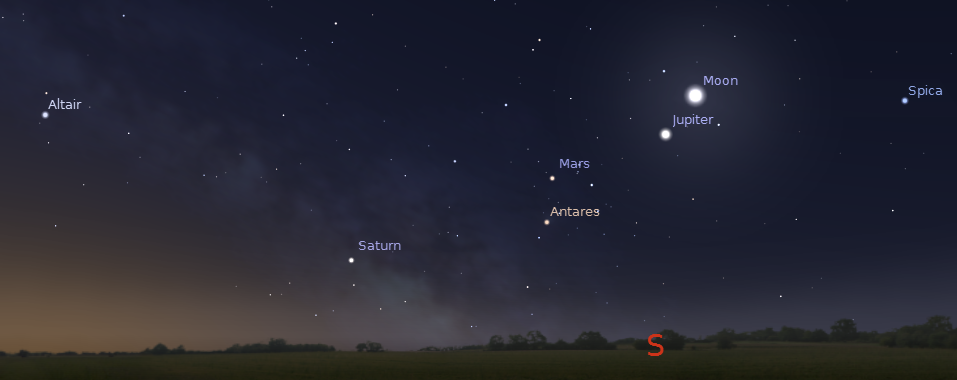
Morning planets and the Moon at 7 a.m. this morning, February 7, 2018. Click on the image to enlarge. Created using Stellarium.
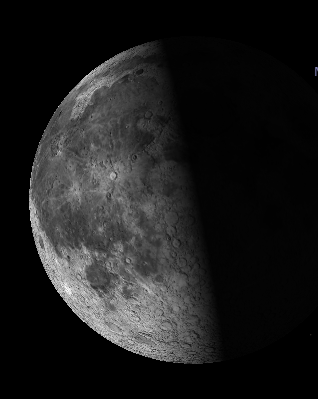
The last quarter Moon as it might be seen in binoculars at 7 a.m. this morning February 7, 2018. Created using Stellarium.
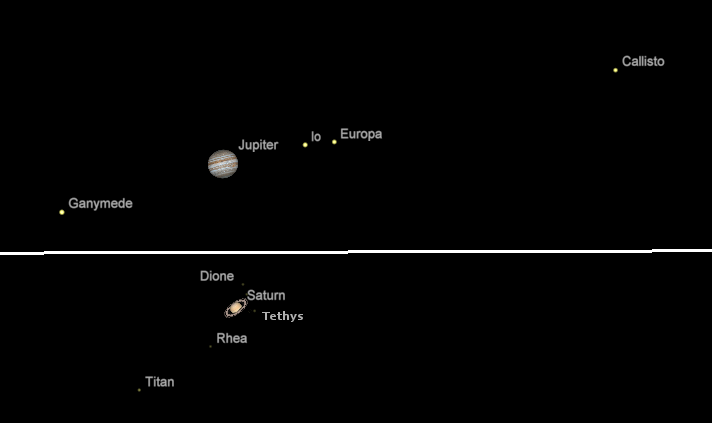
Telescopic views of Jupiter and Saturn at the same scale or power at 7 a.m. this morning, February 7, 2018. Created using Cartes du Ciel (Sky Charts).
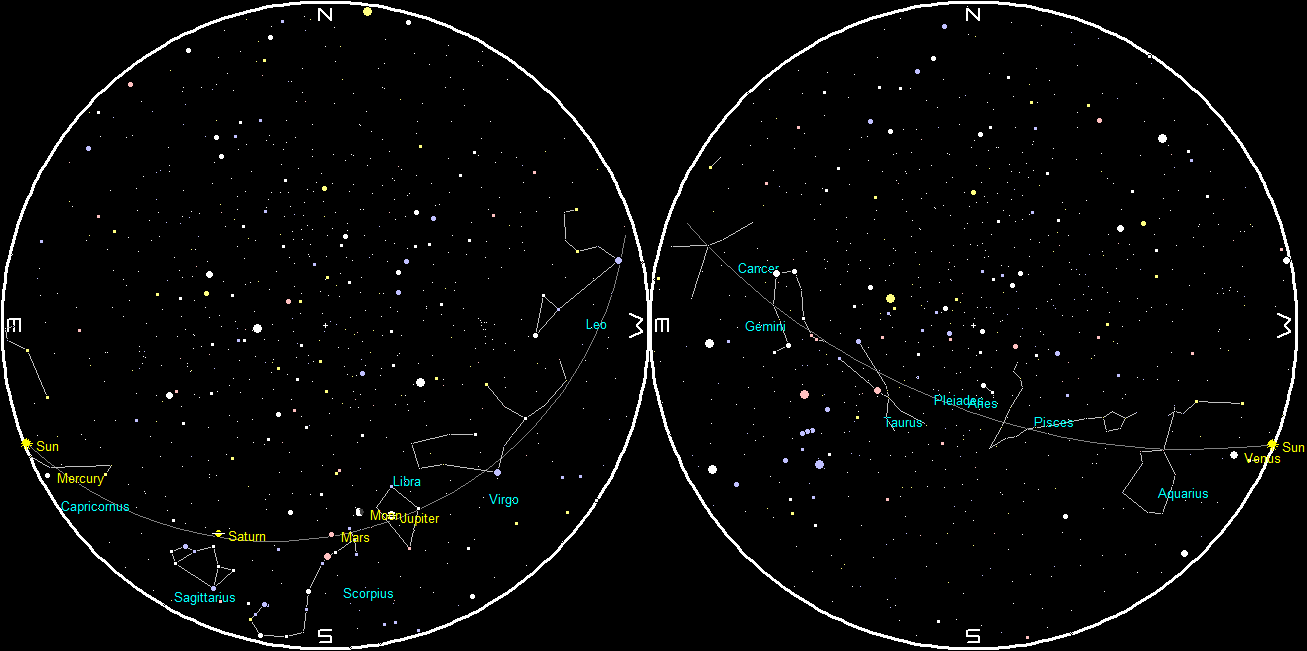
Planets at sunset and sunrise of a single night starting with sunset on the right on February 7, 2018. The night ends on the left with sunrise on February 8th. Click on the image to enlarge. Created using my LookingUp program.
02/06/2018 – Ephemeris – Monoceros the Unicorn
Ephemeris for Tuesday, February 6th. The Sun will rise at 7:55. It’ll be up for 10 hours and 2 minutes, setting at 5:58. The Moon, 1 day before last quarter, will rise at 1:09 tomorrow morning.
Among all the constellations in the sky of animals real and mythical, there is also a unicorn. It’s called Monoceros, and inhabits the southeastern sky at 9 p.m. bounded by Orion on the right, Canis Major, the great dog below and Canis Minor, the little dog to the left. Unfortunately for observers without optical aid Monoceros, though large, is devoid of any but the faintest stars. Maybe that’s why no one sees unicorns anymore. It has many faint stars because the Milky Way runs through it. To the telescope it is a feast of faint nebulae or clouds of gas and dust, the birth place of stars, including the red rose of the Rosette Nebula, and the strange and tiny Hubble’s Variable Nebula. It also contains beautiful telescopic triple star system, Beta (β) Monocerotis.
The times given are for the Traverse City/Interlochen area of Michigan. They may be different for your location.
Addendum
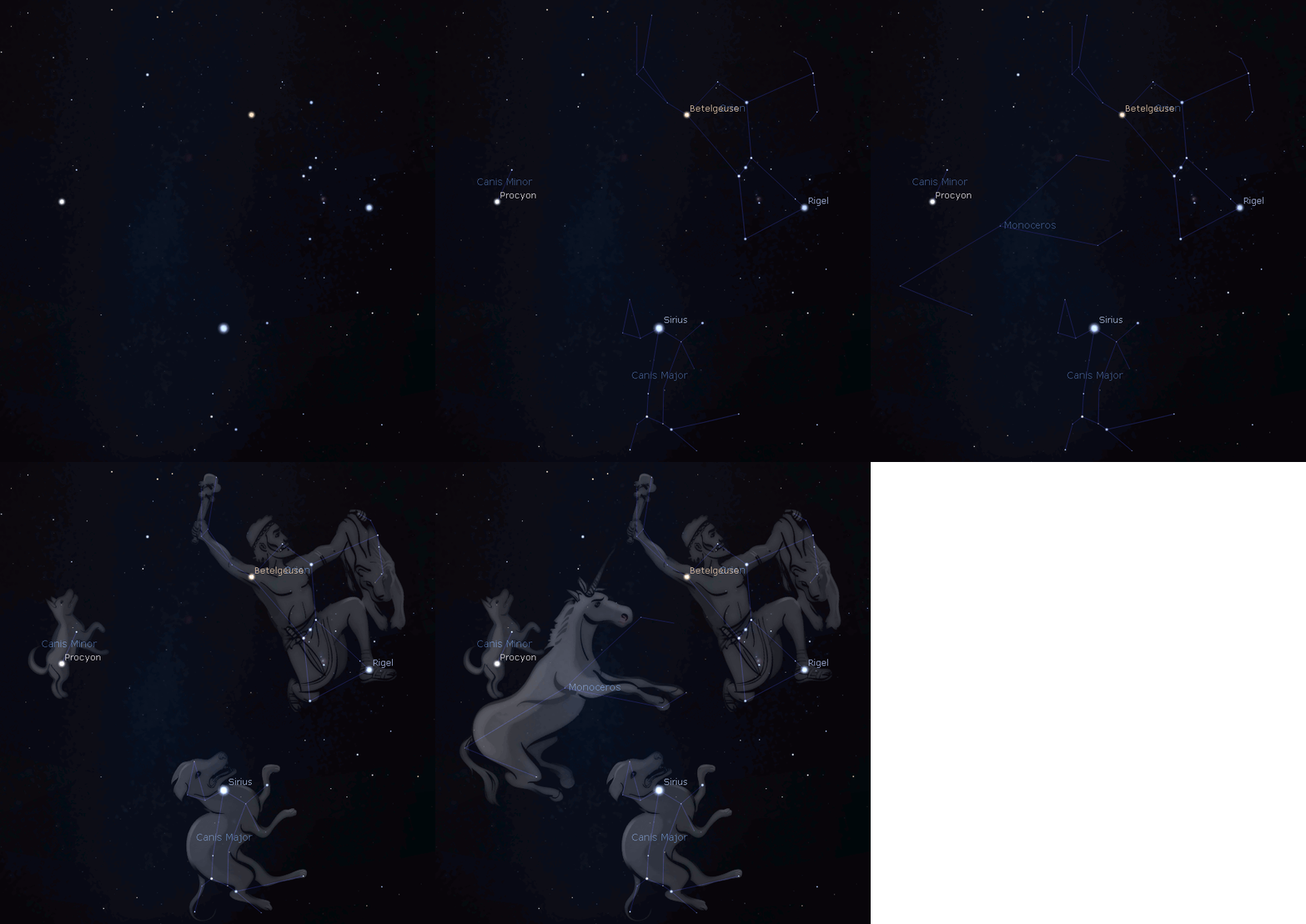
Monoceros finder chart animation. Created using Stellarium and GIMP.
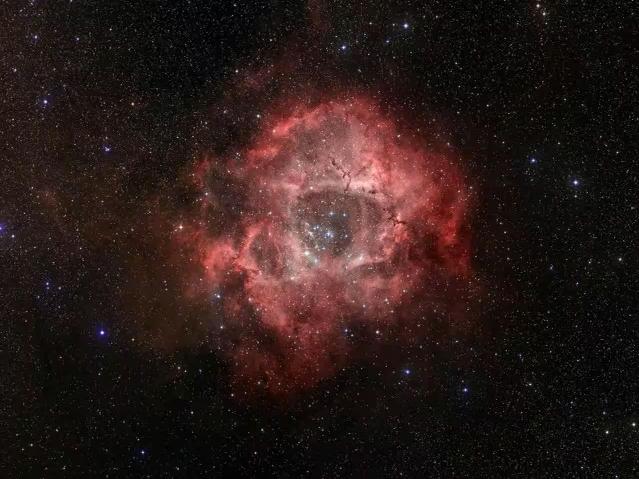
Rosette Nebula in the infrared from the Spitzer Space Telescope. Credit: NASA/JPL/Caltech
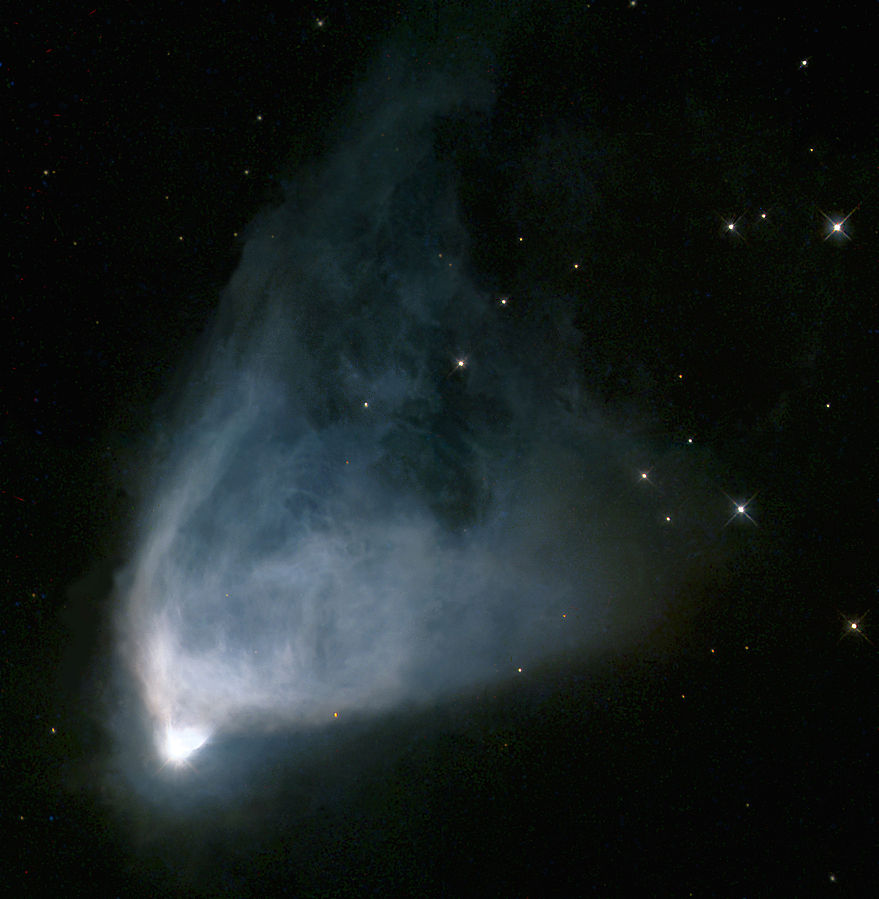
Hubble’s Variable Nebula photographed appropriately enough by the Hubble Space Telescope. Credit: NASA/ESA and The Hubble Heritage Team (AURA/STScI).
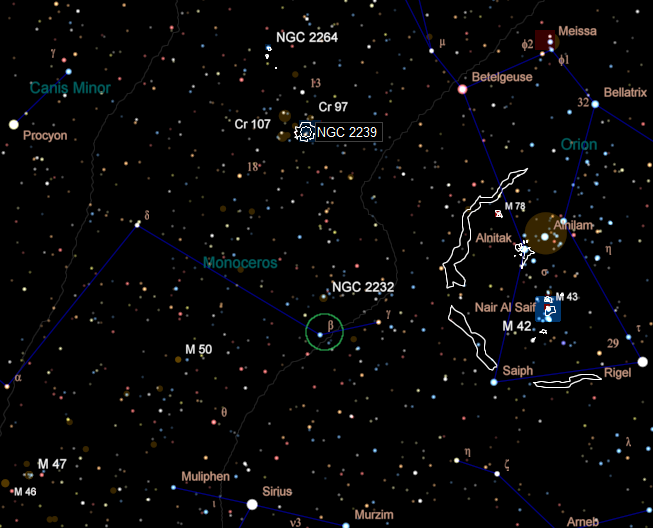
Looking at some faint objects in Monoceros. NGC 2239 is the star cluster in the center of the Rosette Nebula. The nebula itself is extremely faint. It shows in photographs, but I’ve never seen it visually. The green circle shows Beta Monocerotis, the triple star. All these stars are extremely blue-white hot. Created using Cartes du Ciel (Sky Charts).
Also in the chart above is the semicircular Barnard’s Loop, a supernova remnant a great long exposure photography target.
02/05/2018 – Ephemeris – The rabbit that got away
Ephemeris for Monday, February 5th. The Sun will rise at 7:57. It’ll be up for 10 hours even, setting at 5:57. The Moon, 2 days before last quarter, will rise at 12:06 tomorrow morning.
Orion, the central winter constellation is seen in the south at 9 p.m. He is a hunter, but he’s preoccupied with the charge of Taurus the bull from the upper right. At Orion’s feet, and unnoticed by him is the small constellation of Lepus the hare. It’s very hard to see a rabbit in its dim stars: however, I do see a rabbit’s head ears and shoulders. A misshapen box is the head and face of this critter facing to the left. His ears extend upwards from the upper right star of the box, and the bend forward a bit. Two stars to the right of the box and a bit farther apart hint at the front part of the body. Some see a whole rabbit facing the other way. In Lepus telescopes can find M79, a distant globular star cluster, one of the few in the winter sky.
The times given are for the Traverse City/Interlochen area of Michigan. They may be different for your location.
Addendum
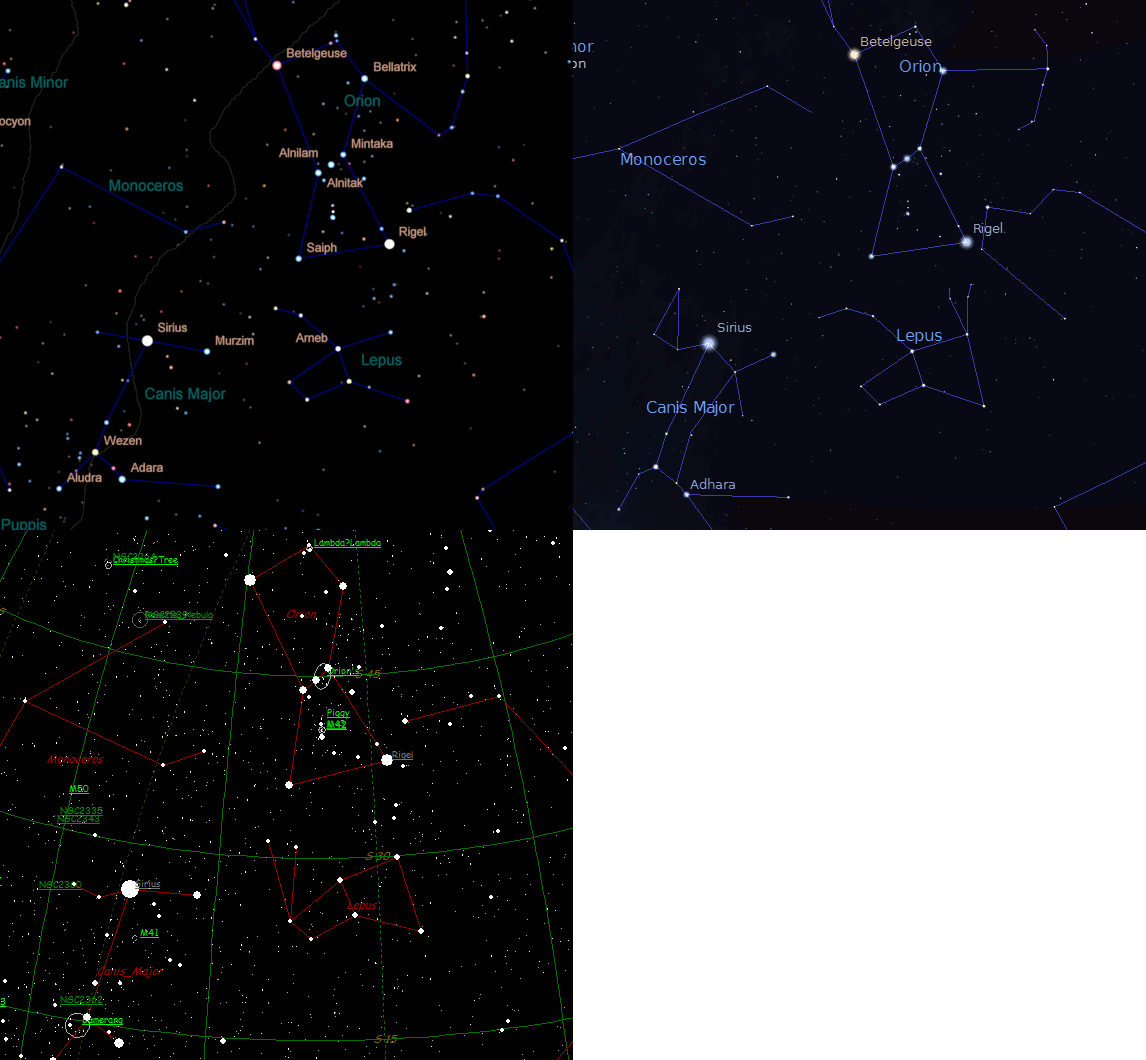
Pick your favorite Lepus outline. Cartes du Ciel, Stellarium, or Hallo Northern SKY (with grid lines).
02/02/2018 – Ephemeris – Telescope clinic rescheduled to tonight
Ephemeris for Ground Hog Day, Friday, February 2nd. The Sun will rise at 8:00. It’ll be up for 9 hours and 52 minutes, setting at 5:52. The Moon, 2 days past full, will rise at 8:43 this evening.
If you’ve received a telescope for Christmas and are having trouble setting it up, or have an unused one in a closet, basement or attic, bring them to Northwestern Michigan College’s Rogers Observatory tonight at 8 p.m. The Grand Traverse Astronomical Society will be holding their annual telescope clinic to help you understand and use your telescope. Last month’s meeting and clinic was canceled due to the weather. The clinic will extend through the period that will be set aside for a star party if it’s clear, to test the telescopes and show the owners how to use them. Like anything telescopes take some time to learn how to use them and find celestial objects. The observatory is south of Traverse City on Birmley Road.
The times given are for the Traverse City/Interlochen area of Michigan. They may be different for your location.
02/01/2018 – Ephemeris – Previewing February skies
Ephemeris for Thursday, February 1st. The Sun will rise at 8:01. It’ll be up for 9 hours and 49 minutes, setting at 5:51. The Moon, 1 day past full, will rise at 7:30 this evening.
Lets look ahead at our short month of February. It’s so short that this year it has no full moons. To make up for it both January and March have two. We’re in the depths of winter but the Sun is continuing its return to northern climes. This is reflected in the increase in daylight hours, from 9 hours 49 minutes today to 11 hours 7 minutes on the 28th. These times are for the Interlochen/Traverse City area. Daylight durations are slightly shorter in the northern part of our listening area and slightly longer to the south. As the month goes on the weather should generally warm and clear up. Venus is moving away from the Sun and will become more and more visible after sunset as the month wears on. Today Venus will set 24 minutes after the Sun. This will increase to an hour after the Sun.
The times given are for the Traverse City/Interlochen area of Michigan. They may be different for your location.
Addenda
February Evening Sky Chart
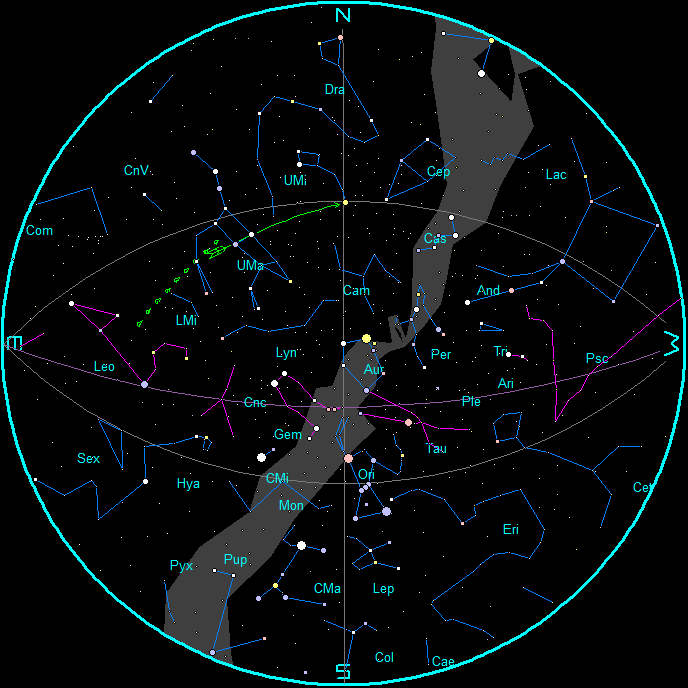
Star Chart for February 2018 (9 p.m. EST February 15, 2018). Created using my LookingUp program. Click on image to enlarge.
The planets and stars are plotted for the 15th at 9 p.m. EST in the evening and 6 a.m. for the morning chart. These are the chart times. Note that Traverse City is located approximately 45 minutes behind our time meridian. (An hour 45 minutes behind our daylight saving time meridian. during EDT and 45 minutes behind our daylight standard time meridian. during EST). To duplicate the star positions on a planisphere you may have to set it to 1 hour 45 minutes (Daylight Time) or 45 minutes (Standard Time) earlier than the current time if you are near your time meridian.
Note the chart times of 9 p.m. and 6 a.m. are for the 15th. For each week before the 15th add ½ hour. For each week after the 15th subtract ½ hour. The planet positions are updated each Wednesday on this blog. For planet positions on dates other than the 15th, check the Wednesday planet posts on this blog.
February Morning Star Chart
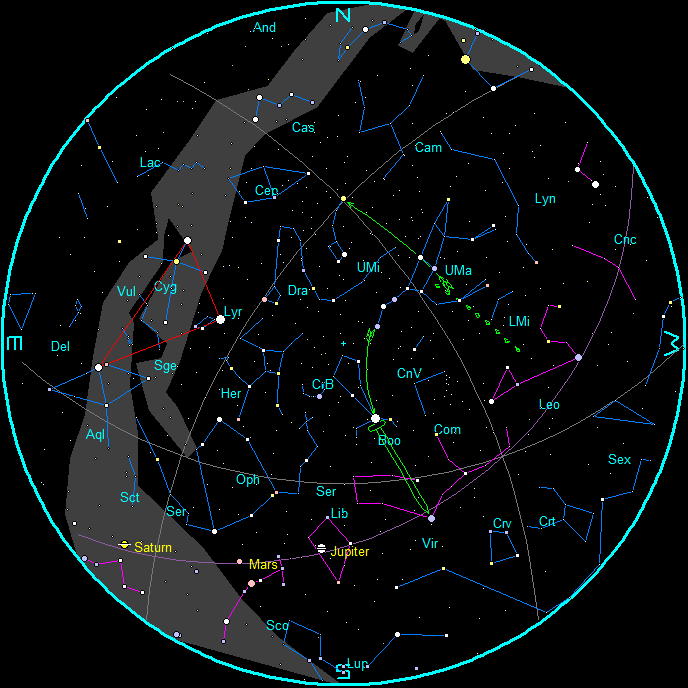
Star Chart for February 2018 mornings based on 6 a.m. February 15th. Created using my LookingUp program. Click on image to enlarge.
For a list of constellation names to go with the abbreviations click here.
Star chart annotations
- Pointer stars at the front of the bowl of the Big Dipper point to Polaris the North Star.
- Leaky Big Dipper drips on Leo.
- Follow the arc of the handle of the Big Dipper to the star Arcturus.
- The Summer Triangle is in red.
Twilight
Evening nautical twilight ends at 6:58 p.m. EST on the 1st, increasing to 7:31 p.m. EST on the 28th.
Evening astronomical twilight ends at 7:30 p.m. EST on the 1st, increasing to 8:04 p.m. EST on the 28th.
Morning astronomical twilight starts at 6:22 a.m. EST on the 1st, and decreasing to 5:45 a.m. EST on the 28th.
Morning nautical twilight starts at 6:56 a.m. EST on the 1st, and decreasing to 6:19 a.m. EST on the 28th.
NASA Calendar of Planetary Events
    Date    Time    Event
Feb 01 	Th	    Venus: 5.7° E
    01  Th  1:24 pm Moon-Regulus: 0.9° S
    07  We 10:54 am Last Quarter
    07  We  2:47 pm Moon-Jupiter: 4.7° S
    09  Fr 12:12 am Moon-Mars: 4.8° S
    11  Su  9:16 am Moon Apogee: 405700 km
    11  Su  9:46 am Moon-Saturn: 2.7° S
    11  Su 11:40 am Mars-Antares: 5.1° N
    11  Su  6:21 pm Moon South Dec.: 20° S
    14  We  4:11 pm Moon Descending Node
    15  Th  3:52 pm Partial Solar Eclipse - S. America, Antarctica
    15  Th  4:05 pm New Moon
    17  Sa  7:08 am Mercury Superior Conj.
    23  Fr  3:09 am First Quarter
    23  Fr 12:07 pm Moon-Aldebaran: 0.7° S
    25  Su  3:07 pm Moon North Dec.: 20.1° N
    27  Tu  9:48 pm Moon Perigee: 363900 km
    27  Tu 12:28 pm Moon-Beehive: 2.3° N
    28  We 12:03 am Moon Ascending Node
Mar 01  Th          Venus: 12.4° E
Sky Events Calendar by Fred Espenak and Sumit Dutta (NASA’s GSFC),
http://eclipse.gsfc.nasa.gov/SKYCAL/SKYCAL.html
If you go to the above site you can print out a list like the above for the entire year
or calendar pages for your time zone.
Sun and Moon Rising and Setting Events
     LU                  Ephemeris of Sky Events for Interlochen/TC
     February, 2018    Local time zone: EST
     +-----------------------------------------------------------------------+
     | DATE |  SUN     SUN  DAYLIGHT|   TWILIGHT*    |MOON  RISE OR    ILLUM |
     |      |  RISE    SET    HOURS |  END    START  |PHASE SET** TIME FRACTN|
     +=======================================================================+
     |Thu  1| 08:01a  05:51p  09:49 | 06:57p  06:55a |      Rise 07:30p   97%|
     |Fri  2| 08:00a  05:52p  09:52 | 06:58p  06:54a |      Rise 08:43p   92%|
     |Sat  3| 07:59a  05:54p  09:54 | 07:00p  06:53a |      Rise 09:53p   85%|
     +------+-----------------------+----------------+-----------------------+
     |Sun  4| 07:58a  05:55p  09:57 | 07:01p  06:52a |      Rise 11:01p   76%|
     |Mon  5| 07:57a  05:57p  10:00 | 07:02p  06:51a |      Rise 12:06a   66%|
     |Tue  6| 07:55a  05:58p  10:02 | 07:04p  06:50a |      Rise 01:09a   57%|
     |Wed  7| 07:54a  06:00p  10:05 | 07:05p  06:49a |L Qtr Rise 02:10a   47%|
     |Thu  8| 07:53a  06:01p  10:08 | 07:06p  06:48a |      Rise 03:09a   37%|
     |Fri  9| 07:51a  06:02p  10:11 | 07:07p  06:46a |      Rise 04:05a   28%|
     |Sat 10| 07:50a  06:04p  10:13 | 07:09p  06:45a |      Rise 04:57a   20%|
     +------+-----------------------+----------------+-----------------------+
     |Sun 11| 07:48a  06:05p  10:16 | 07:10p  06:44a |      Rise 05:45a   13%|
     |Mon 12| 07:47a  06:07p  10:19 | 07:11p  06:42a |      Rise 06:29a    8%|
     |Tue 13| 07:46a  06:08p  10:22 | 07:13p  06:41a |      Rise 07:07a    3%|
     |Wed 14| 07:44a  06:09p  10:25 | 07:14p  06:40a |      Rise 07:42a    1%|
     |Thu 15| 07:43a  06:11p  10:28 | 07:15p  06:38a |New   Set  06:07p    0%|
     |Fri 16| 07:41a  06:12p  10:31 | 07:16p  06:37a |      Set  07:09p    1%|
     |Sat 17| 07:40a  06:14p  10:34 | 07:18p  06:36a |      Set  08:13p    5%|
     +------+-----------------------+----------------+-----------------------+
     |Sun 18| 07:38a  06:15p  10:37 | 07:19p  06:34a |      Set  09:17p   10%|
     |Mon 19| 07:36a  06:16p  10:40 | 07:20p  06:33a |      Set  10:23p   17%|
     |Tue 20| 07:35a  06:18p  10:43 | 07:22p  06:31a |      Set  11:29p   25%|
     |Wed 21| 07:33a  06:19p  10:46 | 07:23p  06:30a |      Set  12:38a   35%|
     |Thu 22| 07:32a  06:21p  10:49 | 07:24p  06:28a |      Set  01:46a   46%|
     |Fri 23| 07:30a  06:22p  10:52 | 07:25p  06:27a |F Qtr Set  02:54a   57%|
     |Sat 24| 07:28a  06:23p  10:55 | 07:27p  06:25a |      Set  04:00a   69%|
     +------+-----------------------+----------------+-----------------------+
     |Sun 25| 07:27a  06:25p  10:58 | 07:28p  06:23a |      Set  04:59a   79%|
     |Mon 26| 07:25a  06:26p  11:01 | 07:29p  06:22a |      Set  05:52a   88%|
     |Tue 27| 07:23a  06:27p  11:04 | 07:31p  06:20a |      Set  06:38a   94%|
     |Wed 28| 07:22a  06:29p  11:07 | 07:32p  06:18a |      Set  07:17a   99%|
     +-----------------------------------------------------------------------+
     * Nautical Twilight
     ** Moonrise or moonset, whichever occurs between sunset and sunrise
 Bob Moler's Ephemeris Blog