Archive
04/30/2019 – Ephemeris – Previewing May skies
Ephemeris for Tuesday, April 30th. Today the Sun will be up for 14 hours and 11 minutes, setting at 8:46, and it will rise tomorrow at 6:33. The Moon, half way from last quarter to new, will rise at 5:30 tomorrow morning.
Let’s look ahead at the month of May, the month when the promise of spring is finally fulfilled. Daylight hours in the Interlochen/Traverse City area will increase from 14 hours and 14 minutes Tomorrow to 15 hours 19 minutes on the 31st. The altitude, or angle, of the sun above the southern horizon at local noon will ascend from 60 degrees tomorrow to 67 degrees at month’s end. The altitude of the sun in the Straits area will be a degree lower than that. Local apparent noon this month, when the sun passes due south, will be about 1:38 p.m. Early this month we’ll have The Eta Aquariid meteor shower early in the morning. Mars is our only evening planet, falling way behind the Earth 217 million miles (349 million km) away at mid-month.
The times given are for the Traverse City/Interlochen area of Michigan. They may be different for your location.
Addendum
May Evening Star Chart
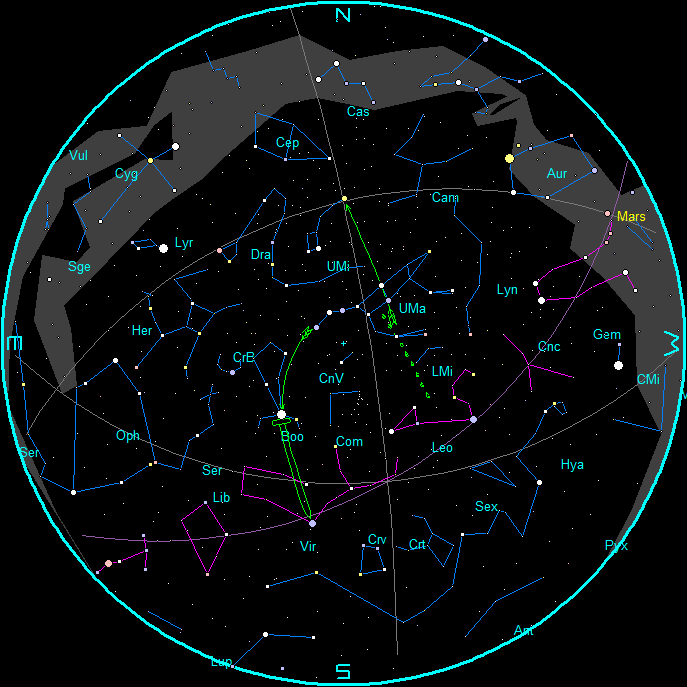
Star Chart for May 2019 (11 p.m. EDT May 15, 2019). Created using my LookingUp program. Click on image to enlarge.
The planets and stars are plotted for the 15th at 11 p.m. EDT in the evening and 5 a.m. for the morning chart. These are the chart times. Note that Traverse City is located approximately 45 minutes behind our time meridian, West 75° longitude. (An hour 45 minutes behind our daylight saving time meridian during EDT). To duplicate the star positions on a planisphere you may have to set it to 1 hour 45 minutes earlier than the current time.
Note the chart times of 10 p.m. and 5 a.m. are for the 15th. For each week before the 15th add ½ hour (28 minutes if you’re picky). For each week after the 15th subtract ½ hour. The planet positions are updated each Wednesday on this blog. For planet positions on dates other than the 15th, check the Wednesday planet posts on this blog.
May Morning Star Chart
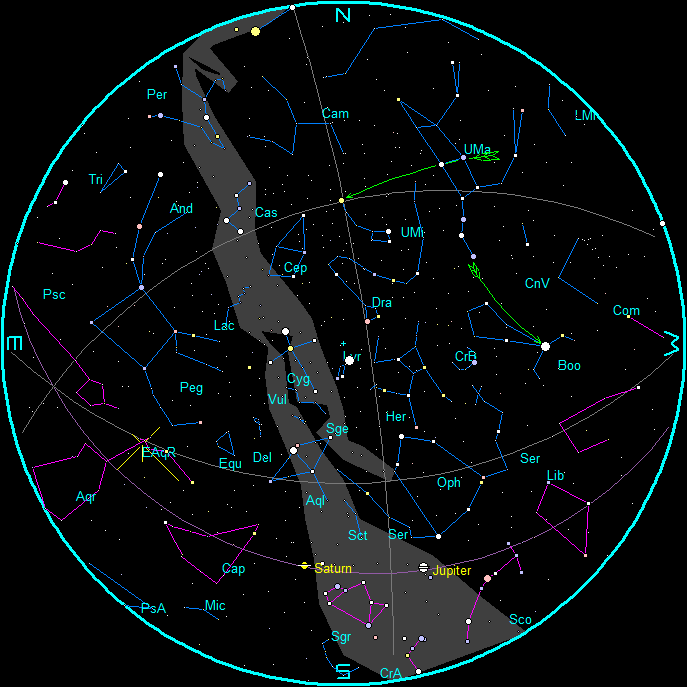
Star Chart for May mornings 2019 (5 a.m. EDT May 15, 2019). Created using my LookingUp program. Click on image to enlarge.
For a list of constellation names to go with the abbreviations click here.
- Pointer stars at the front of the bowl of the Big Dipper point to Polaris the North Star.
- Leaky dipper drips on Leo
- Follow the arc of the handle of the Big Dipper to the star Arcturus, and
- Extend like a spike to Spica,
- The Summer Triangle is in red.
- EaqR is the radiant of the Aquariid meteor shower that peaks on the 5th-6th. See Ephemeris Extra Saturday the 4th.
Twilight Limits, Nautical and Astronomical
| EDT | |||||||
| Traverse City |
Morning twilight | Evening twilight | Dark night | Moon | |||
| Date | Astro. | Nautical | Nautical | Astro. | Start | End | Illum. |
| 2019-05-01 | 4h41m | 5h25m | 22h02m | 22h46m | 22h46m | 4h41m | 0.11 |
| 2019-05-02 | 4h39m | 5h24m | 22h03m | 22h48m | 22h48m | 4h39m | 0.05 |
| 2019-05-03 | 4h37m | 5h22m | 22h05m | 22h50m | 22h50m | 4h37m | 0.02 |
| 2019-05-04 | 4h34m | 5h20m | 22h06m | 22h52m | 22h52m | 4h34m | 0 |
| 2019-05-05 | 4h32m | 5h18m | 22h08m | 22h54m | 22h54m | 4h32m | 0.01 |
| 2019-05-06 | 4h30m | 5h17m | 22h09m | 22h56m | 22h56m | 4h30m | 0.04 |
| 2019-05-07 | 4h28m | 5h15m | 22h11m | 22h58m | 23h58m | 4h28m | 0.09 |
| 2019-05-08 | 4h26m | 5h13m | 22h13m | 23h00m | – | 4h26m | 0.17 |
| 2019-05-09 | 4h24m | 5h12m | 22h14m | 23h02m | 1h00m | 4h24m | 0.27 |
| 2019-05-10 | 4h22m | 5h10m | 22h16m | 23h04m | 1h54m | 4h22m | 0.38 |
| 2019-05-11 | 4h20m | 5h08m | 22h17m | 23h06m | 2h41m | 4h20m | 0.5 |
| 2019-05-12 | 4h18m | 5h07m | 22h19m | 23h08m | 3h21m | 4h18m | 0.61 |
| 2019-05-13 | 4h16m | 5h05m | 22h20m | 23h10m | 3h55m | 4h16m | 0.73 |
| 2019-05-14 | 4h14m | 5h04m | 22h22m | 23h12m | – | – | 0.83 |
| 2019-05-15 | 4h12m | 5h02m | 22h23m | 23h14m | – | – | 0.91 |
| 2019-05-16 | 4h10m | 5h01m | 22h25m | 23h16m | – | – | 0.91 |
| 2019-05-17 | 4h08m | 4h59m | 22h26m | 23h18m | – | – | 0.96 |
| 2019-05-18 | 4h06m | 4h58m | 22h28m | 23h20m | – | – | 0.99 |
| 2019-05-19 | 4h04m | 4h56m | 22h29m | 23h22m | – | – | 1 |
| 2019-05-20 | 4h02m | 4h55m | 22h31m | 23h23m | – | – | 0.98 |
| 2019-05-21 | 4h00m | 4h54m | 22h32m | 23h25m | 23h25m | – | 0.93 |
| 2019-05-22 | 3h59m | 4h53m | 22h33m | 23h27m | 23h27m | 0h07m | 0.87 |
| 2019-05-23 | 3h57m | 4h51m | 22h35m | 23h29m | 23h29m | 0h56m | 0.8 |
| 2019-05-24 | 3h55m | 4h50m | 22h36m | 23h31m | 23h31m | 1h38m | 0.71 |
| 2019-05-25 | 3h54m | 4h49m | 22h38m | 23h33m | 23h33m | 2h13m | 0.62 |
| 2019-05-26 | 3h52m | 4h48m | 22h39m | 23h35m | 23h35m | 2h43m | 0.52 |
| 2019-05-27 | 3h50m | 4h47m | 22h40m | 23h37m | 23h37m | 3h10m | 0.42 |
| 2019-05-28 | 3h49m | 4h46m | 22h42m | 23h38m | 23h38m | 3h34m | 0.33 |
| 2019-05-29 | 3h47m | 4h45m | 22h43m | 23h40m | 23h40m | 3h47m | 0.24 |
| 2019-05-30 | 3h46m | 4h44m | 22h44m | 23h42m | 23h42m | 3h46m | 0.16 |
| 2019-05-31 | 3h44m | 4h43m | 22h45m | 23h44m | 23h44m | 3h44m | 0.09 |
Twilight calendar was generated using Cartes du Ciel (Sky Charts).
See my blog post: Twilight Zone for the definitions of the different periods of twilight here: https://bobmoler.wordpress.com/2018/09/27/.
NASA Calendar of Planetary Events
May  1 We          Venus: 27.8° W
     2 Th  7:39 am Moon-Venus: 3.9° N
     4 Sa  6:45 pm New Moon
     5 Su  9:12 am Eta Aquariid Meteor Shower: ZHR = 60
     6 Mo  5:52 pm Moon-Aldebaran: 2.4° S
     7 Tu  7:36 pm Moon-Mars: 3.3° N
     9 Th  1:46 am Moon North Dec.: 22.2° N
     9 Th  2:50 pm Moon Ascending Node
    10 Fr  9:35 pm Moon-Beehive: 0°
    11 Sa  9:12 pm First Quarter
    13 Mo  5:53 pm Moon Perigee: 369000 km
    18 Sa  5:11 pm Full Moon
    20 Mo 12:54 pm Moon-Jupiter: 1.8° S
    21 Tu  8:59 am Mercury Superior Conj.
    22 We  2:41 am Moon South Dec.: 22.3° S
    22 We  3:12 pm Moon Descending Node
    22 We  6:25 pm Moon-Saturn: 0.6° N
    26 Su  9:27 am Moon Apogee: 404100 km
    26 Su 12:33 pm Last Quarter
Jun  1 Sa          Venus: 20° W
All event times are given for UTC-5 hr: Eastern Standard or UTC-4 hr: Daylight Saving Time starting May 10th.
Sky Events Calendar by Fred Espenak and Sumit Dutta (NASA’s GSFC),
http://eclipse.gsfc.nasa.gov/SKYCAL/SKYCAL.html.
If you go to the above site you can print out a list like the above for the entire year or calendar pages for your time zone.
Sun and Moon Rising and Setting Events
     LU                  Ephemeris of Sky Events for Interlochen/TC
     May, 2019    Local time zone: EDT
     +-----------------------------------------------------------------------+
     | DATE |  SUN     SUN  DAYLIGHT|   TWILIGHT*    |MOON  RISE OR    ILLUM |
     |      |  RISE    SET    HOURS |  END    START  |PHASE SET** TIME FRACTN|
     +=======================================================================+
     |Wed  1| 06:33a  08:47p  14:14 | 09:59p  05:21a |      Rise 05:54a    9%|
     |Thu  2| 06:31a  08:48p  14:17 | 10:01p  05:19a |      Rise 06:18a    4%|
     |Fri  3| 06:30a  08:49p  14:19 | 10:02p  05:17a |      Rise 06:44a    1%|
     |Sat  4| 06:28a  08:51p  14:22 | 10:04p  05:15a |New   Set  08:36p    0%|
     +------+-----------------------+----------------+-----------------------+
     |Sun  5| 06:27a  08:52p  14:24 | 10:06p  05:14a |      Set  09:44p    1%|
     |Mon  6| 06:26a  08:53p  14:27 | 10:07p  05:12a |      Set  10:52p    5%|
     |Tue  7| 06:24a  08:54p  14:30 | 10:09p  05:10a |      Set  11:58p   10%|
     |Wed  8| 06:23a  08:55p  14:32 | 10:10p  05:09a |      Set  12:59a   18%|
     |Thu  9| 06:22a  08:57p  14:35 | 10:12p  05:07a |      Set  01:54a   28%|
     |Fri 10| 06:20a  08:58p  14:37 | 10:13p  05:05a |      Set  02:41a   38%|
     |Sat 11| 06:19a  08:59p  14:39 | 10:15p  05:04a |F Qtr Set  03:21a   49%|
     +------+-----------------------+----------------+-----------------------+
     |Sun 12| 06:18a  09:00p  14:42 | 10:16p  05:02a |      Set  03:55a   61%|
     |Mon 13| 06:17a  09:01p  14:44 | 10:18p  05:00a |      Set  04:26a   72%|
     |Tue 14| 06:15a  09:03p  14:47 | 10:19p  04:59a |      Set  04:54a   81%|
     |Wed 15| 06:14a  09:04p  14:49 | 10:21p  04:57a |      Set  05:22a   89%|
     |Thu 16| 06:13a  09:05p  14:51 | 10:22p  04:56a |      Set  05:51a   95%|
     |Fri 17| 06:12a  09:06p  14:53 | 10:24p  04:55a |      Set  06:22a   99%|
     |Sat 18| 06:11a  09:07p  14:55 | 10:25p  04:53a |Full  Rise 08:59p  100%|
     +------+-----------------------+----------------+-----------------------+
     |Sun 19| 06:10a  09:08p  14:57 | 10:27p  04:52a |      Rise 10:07p   98%|
     |Mon 20| 06:09a  09:09p  15:00 | 10:28p  04:50a |      Rise 11:10p   95%|
     |Tue 21| 06:08a  09:10p  15:02 | 10:30p  04:49a |      Rise 12:07a   89%|
     |Wed 22| 06:07a  09:11p  15:03 | 10:31p  04:48a |      Rise 12:56a   83%|
     |Thu 23| 06:06a  09:12p  15:05 | 10:33p  04:47a |      Rise 01:37a   75%|
     |Fri 24| 06:06a  09:13p  15:07 | 10:34p  04:45a |      Rise 02:13a   66%|
     |Sat 25| 06:05a  09:14p  15:09 | 10:35p  04:44a |      Rise 02:43a   57%|
     +------+-----------------------+----------------+-----------------------+
     |Sun 26| 06:04a  09:15p  15:11 | 10:37p  04:43a |L Qtr Rise 03:09a   47%|
     |Mon 27| 06:03a  09:16p  15:13 | 10:38p  04:42a |      Rise 03:34a   38%|
     |Tue 28| 06:03a  09:17p  15:14 | 10:39p  04:41a |      Rise 03:57a   29%|
     |Wed 29| 06:02a  09:18p  15:16 | 10:40p  04:40a |      Rise 04:21a   20%|
     |Thu 30| 06:01a  09:19p  15:17 | 10:42p  04:39a |      Rise 04:46a   13%|
     |Fri 31| 06:01a  09:20p  15:19 | 10:43p  04:38a |      Rise 05:13a    7%|
     +-----------------------------------------------------------------------+
     * Nautical Twilight
     ** Moonrise or moonset, whichever occurs between sunrise and sunset
04/29/2019 – Ephemeris – Follow the arc to Arcturus
Ephemeris for Monday, April 29th. Today the Sun will be up for 14 hours and 8 minutes, setting at 8:45, and it will rise tomorrow at 6:34. The Moon, 3 days past last quarter, will rise at 5:06 tomorrow morning.
The Big Dipper, now nearing the zenith at 10 p.m. points to several stars and constellations. It’s handle points to two bright stars. First we follow the arc of the handle to the bright orange star Arcturus, the 4th brightest night-time star. The reason I say night-time is that the sun is a star also but by definition is not out at night. The arc to Arcturus is a how to find Arcturus and a clue to its name. Arcturus, midway up the sky in the east, lies at the base point of the kite shaped constellation of Boötes the herdsman. From Arcturus, straighten out the arc to a spike and one soon arrives at Spica a blue-white star in Virgo the virgin, now low in the southeast. Spica is also sometimes pronounced ‘Speeka’.
The times given are for the Traverse City/Interlochen area of Michigan. They may be different for your location.
Addendum
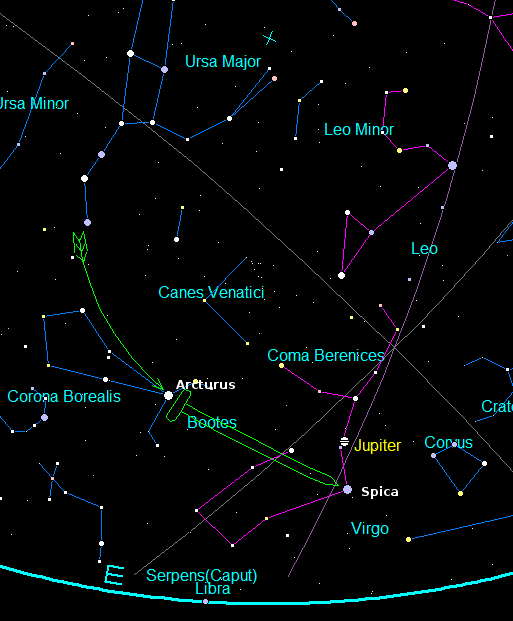
How to find the stars Arcturus and Spica from the Big Dipper in late April. Created using my LookingUp program.
04/26/2019 – Ephemeris – The story of Ursa Major and Boötes
Ephemeris for Arbor Day, Friday, April 26th. Today the Sun will be up for 14 hours even, setting at 8:41, and it will rise tomorrow at 6:39. The Moon, at last quarter today, will rise at 3:39 tomorrow morning.
Seen in the east at 10 p.m. tonight is the kite shaped constellation of Boötes the herdsman. The bright star Arcturus is at the bottom of the kite to the right. It is pointed to by the arc of the handle of the Big Dipper, higher in the east. Boötes represents a young hunter named Arcas, son of Callisto, a beautiful young lady who had the misfortune of being loved by Zeus the chief of the Greek gods. Zeus’ wife Hera, found out about it, and since she couldn’t punish Zeus, turned the poor woman into a bear. Arcas, many years later, unaware of the events surrounding his mother’s disappearance was about to kill the bear when Zeus intervened and placed them both in the sky to save her, as Arcas still pursues her across the sky nightly.
The times given are for the Traverse City/Interlochen area of Michigan. They may be different for your location.
Addendum
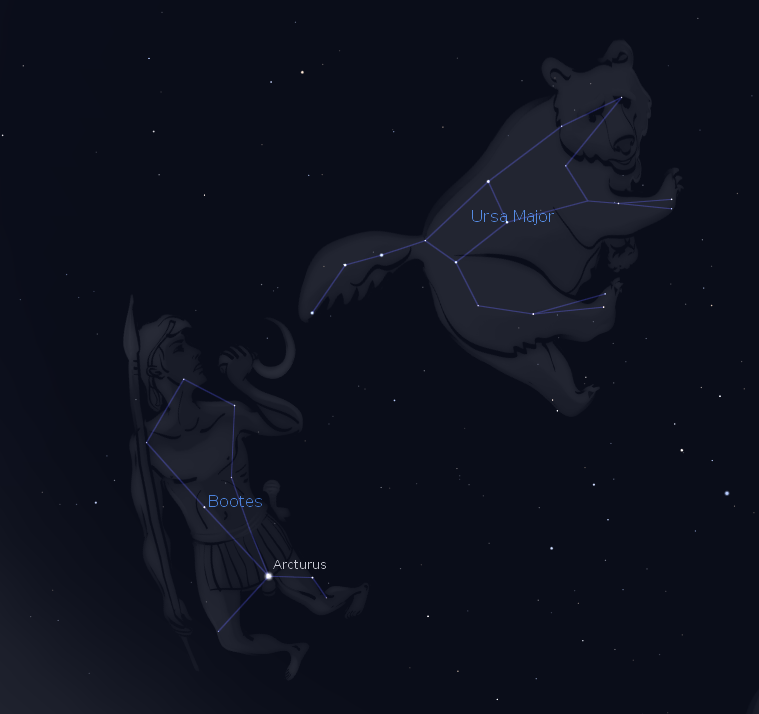
Bootes and Ursa Major aka Arcas chasing Callisto around the pole of the sky. Created using Stellarium.
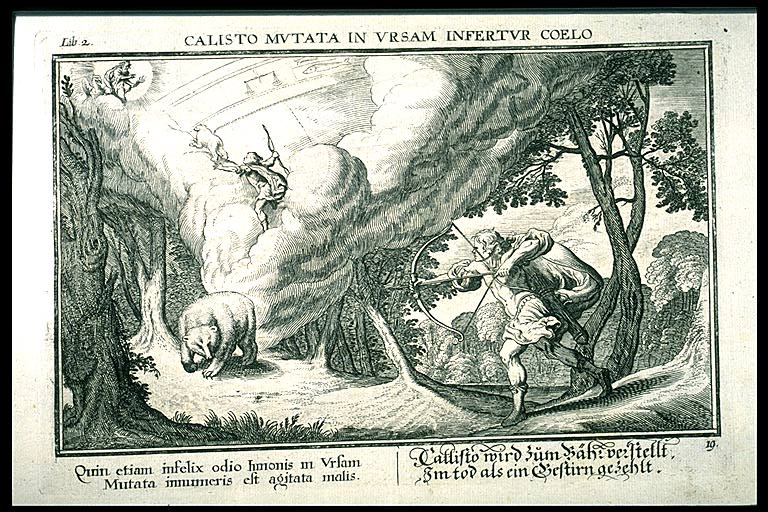
Arcas about to slay the bear by the 17th century artist Baur. Source: University of Virginia Electronic Text Center
04/25/2019 – Ephemeris – About Ursa Major
Ephemeris for Thursday, April 25th. Today the Sun will be up for 13 hours and 57 minutes, setting at 8:40, and it will rise tomorrow at 6:40. The Moon, 1 day before last quarter, will rise at 3:01 tomorrow morning.
The Big Dipper has many names to many peoples and countries around the world. Officially to the International Astronomical Union, it’s part of Ursa Major, the Great Bear, also recognized by many Native Americans, and Europeans. It’s even in the Bible. In the Book of Job the star Arcturus is a miss-translation. Arcturus means Guardian of the Bear. It should be the Bear itself, and most modern translations catch that mistake. Anyway, the Anishinaabe people around the Great Lakes say the stars of the bear are that of another creature, that of the Fisher, Ojiig, a mammal of the weasel family that brought summer to the Earth, and now heralds the seasons by his position in the sky.
The times given are for the Traverse City/Interlochen area of Michigan. They may be different for your location.
Addendum

An animation to visualize the Great Bear, Ursa Major and the Fisher, Ojiig, from the stars of and around the Big Dipper. Created using Stellarium.
04/24/2019 – Ephemeris – Looking at the bright planets this week
Ephemeris for Wednesday, April 24th. Today the Sun will be up for 13 hours and 54 minutes, setting at 8:38, and it will rise tomorrow at 6:42. The Moon, 2 days before last quarter, will rise at 2:16 tomorrow morning.
Let’s look at the planets for this week. Mars will be in the western sky this evening, above the V-shaped stars of the face of Taurus the bull. It will set at 12:18 a.m. In the morning sky we have Jupiter, in Ophiuchus, which will rise tomorrow at 12:39 a.m. in the east-southeast. Saturn will be next to rise at 2:27 a.m., also in the east-southeast. It is in Sagittarius. Tomorrow morning the Moon will be just right of the ringed planet. Venus will rise at 5:47 a.m. in the east. Venus will remain in our morning sky, though too close to the rising Sun to be easily glimpsed until August when it passes behind the Sun to enter the evening sky. It will be in position later this year to be our bright evening Christmas Star.
The times given are for the Traverse City/Interlochen area of Michigan. They may be different for your location.
Addendum
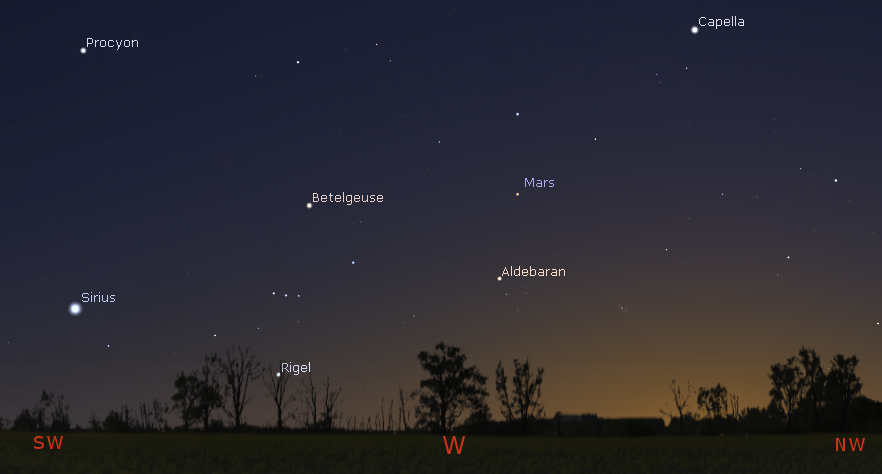
Mars and the setting winter stars tonight at 9:30 p.m. April 24, 2019. Click on the image to enlarge. Created using Stellarium.
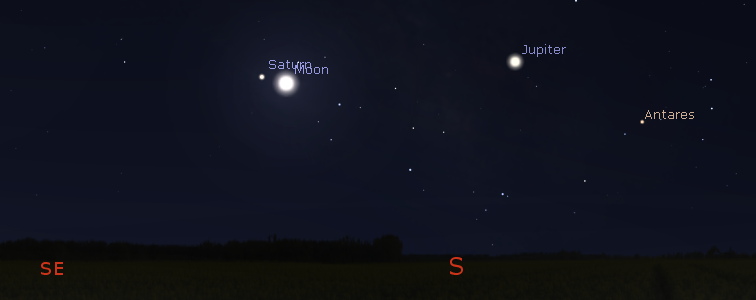
Morning planets and Moon at 5:30 a.m. April 25, 2019. Click on the image to enlarge. Created using Stellarium.
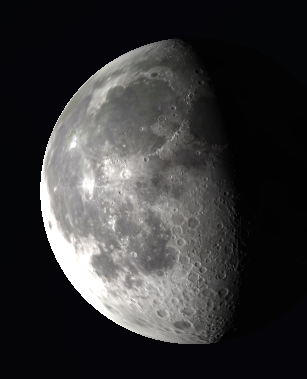
The waning gibbous Moon at 5:30 a.m. April 25, 2019. Created using Stellarium.

Jupiter and Saturn with the same magnification at 5:30 a.m. tomorrow morning April 25, 2019. Created using Cartes du Ciel (Sky Charts).
Note that the moon Io is transiting the planet at 5:30 a.m. Io will not be that visible. Here’s the timeline.
| Moon | Event | Date | UT | EDT |
| Io | Shadow start | 25 Apr 2019 | 07:33 | 3:33 AM |
| Io | Transit start | 25 Apr 2019 | 08:32 | 4:42 AM |
| Io | Shadow end | 25 Apr 2019 | 09:45 | 5:45 AM |
| Io | Transit end | 25 Apr 2019 | 10:44 | 6:44 AM |
Times supplied by the Pluto Project: https://www.projectpluto.com/jevent.htm.
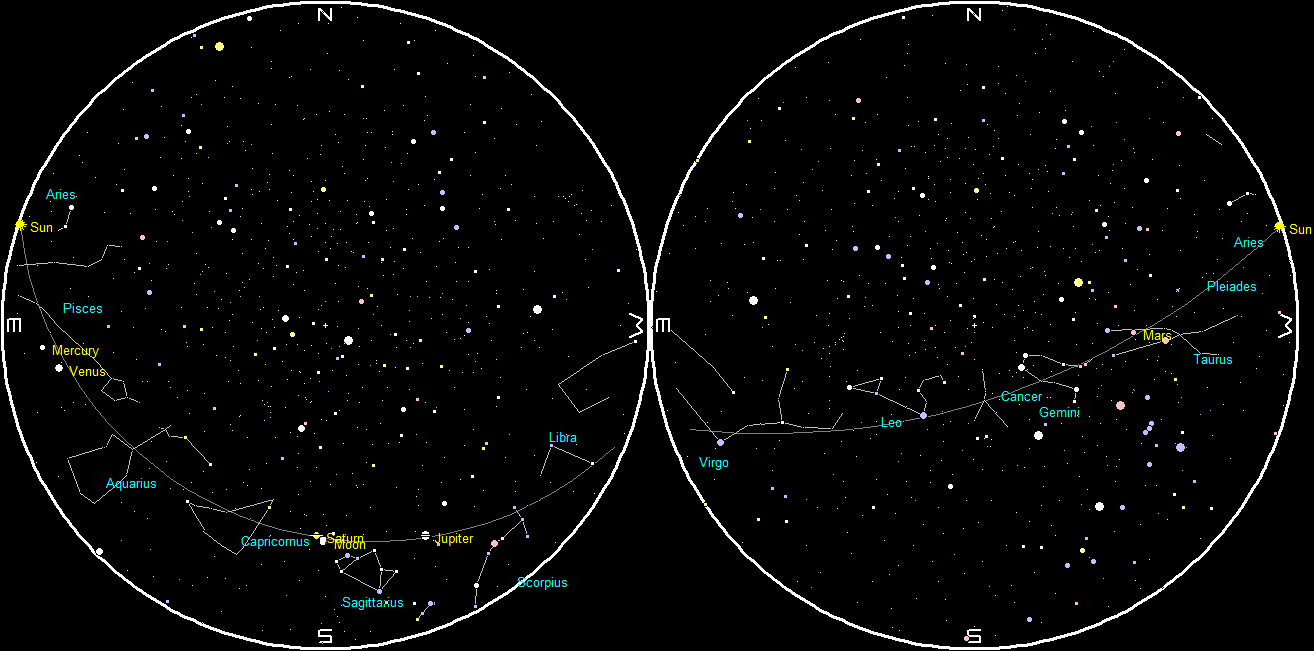
Planets and the Moon at sunset and sunrise of a single night starting with sunset on the right on April 24, 2019. The night ends on the left with sunrise on the 25th. Click on the image to enlarge. Created using my LookingUp program.
04/23/2019 – Ephemeris – The story of Coma Berenices
Ephemeris for Tuesday, April 23rd. Today the Sun will be up for 13 hours and 52 minutes, setting at 8:37, and it will rise tomorrow at 6:43. The Moon, 3 days before last quarter, will rise at 1:24 tomorrow morning.
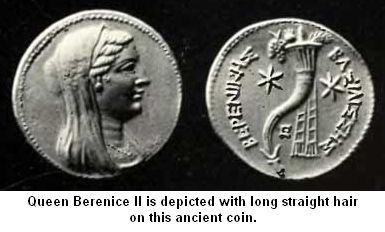
High in the southeast at 10 p.m. is a tiny and faint constellation of Coma Berenices, or Berenice’s hair. In it are lots of faint stars arrayed to look like several strands of hair. The whole group will fit in the field of a pair of binoculars, which will also show many more stars. The hank of hair was supposed to belong to Berenice, a real Queen of Egypt, of the 3rd century BCE. who cut off her golden tresses and offered them to the gods for the safe return of her husband from war. Her husband did return safe, and at that same time her hair disappeared from the temple. The oracle of the temple pointed to this constellation showing that her sacrifice was enshrined in the stars.
The times given are for the Traverse City/Interlochen area of Michigan. They may be different for your location.
Addendum
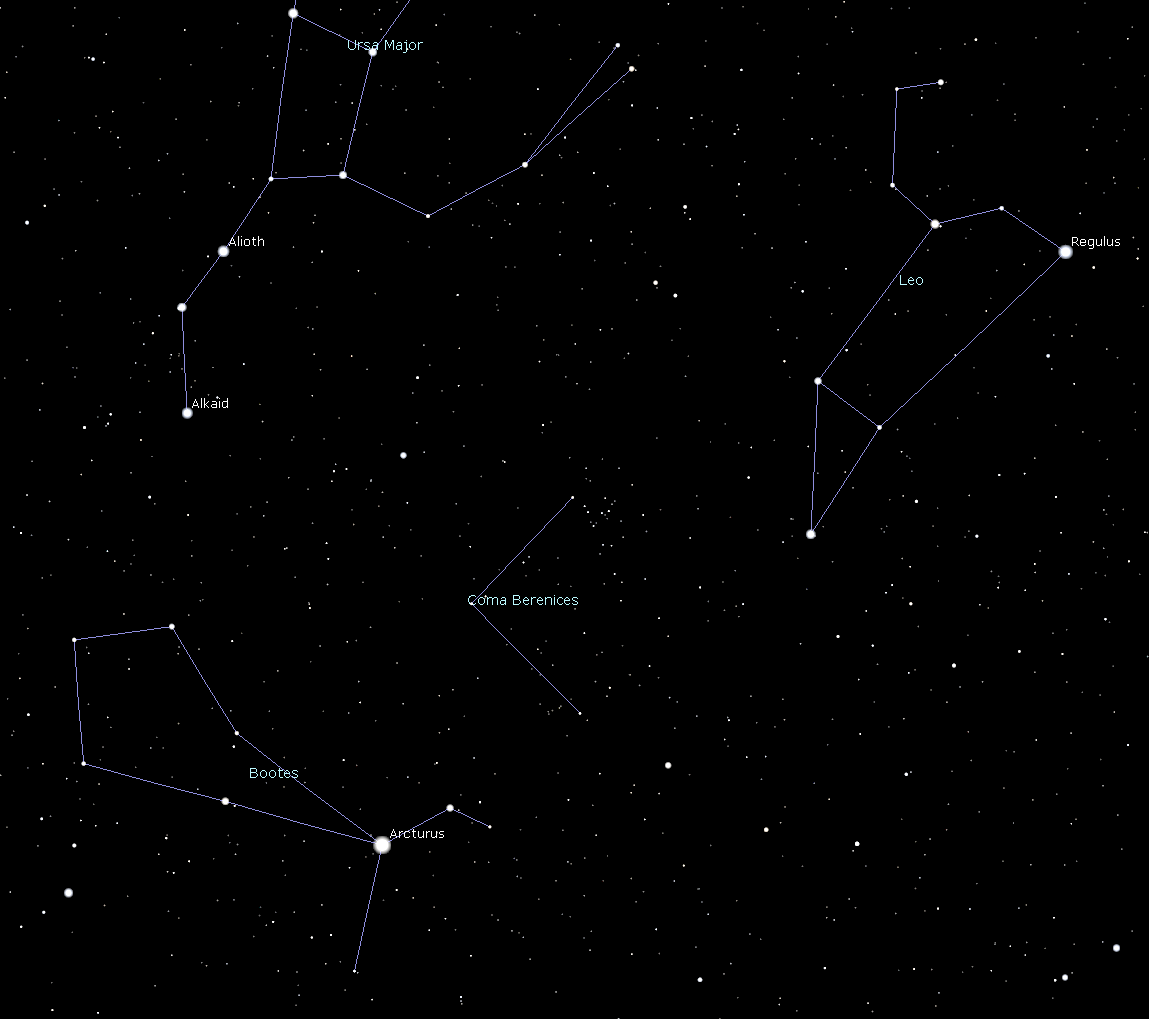
Coma Berenices and neighboring constellations at 10 p.m. on April 16, 2015. Note that only the upper right star of the upside down L shape actually belongs to the cluster. Created using Stellarium.
04/22/2019 – Ephemeris – Earth Day
Ephemeris for Earth Day, Monday, April 22nd. Today the Sun will be up for 13 hours and 49 minutes, setting at 8:36, and it will rise tomorrow at 6:45. The Moon, 3 days past full, will rise at 12:24 tomorrow morning.
A good slogan for this Earth Day or any day is “Support your local planet.” As an amateur astronomer I look around the solar system at all the habitable planets. The Earth is it. Mars may be terraformed at great expense, that is made more earth-like. There may be life in the oceans of Jupiter’s moon Europa, or Saturn’s Enceladus, but they are not habitable for us. Terraforming (stopping and reversing climate change) the Earth would be the easiest and much more practical. One look at our nearest neighbor Venus will show us our fate, hopefully in billions of years from now, a hell hole of heat and a crushing atmosphere. Our job is push-off that day as far as we can, and keep the Earth a blue-green oasis in the solar system.
The times given are for the Traverse City/Interlochen area of Michigan. They may be different for your location.
Addendum
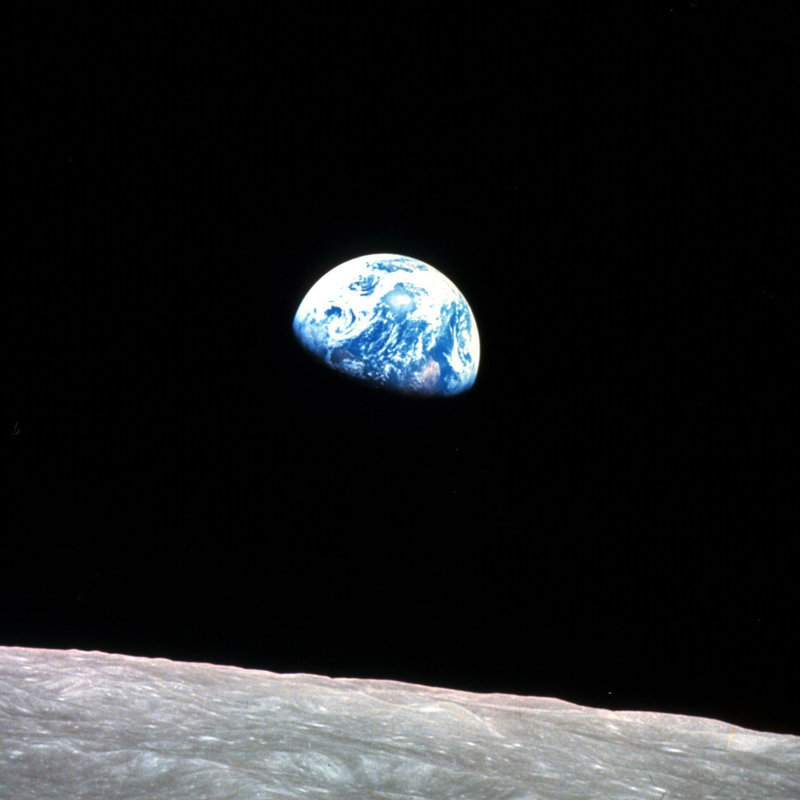
Earth rising above the Moon’s limb from Apollo 8. Credit: NASA/Apollo 8
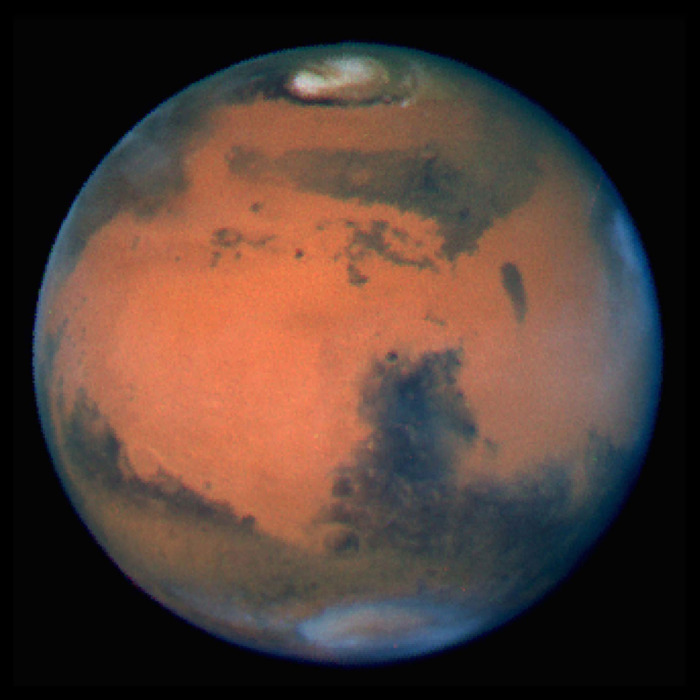
Mars had its day, but that ended about 3 billion years ago. Being half the size of the Earth, Mars cooled down, lost its magnetic field, so the solar wind stripped away most of its atmosphere and water. Credit NASA.
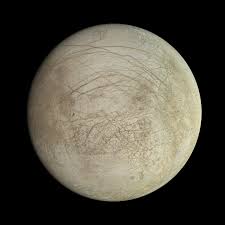
Europa, one of the four Galilean moons of Jupiter and easily seen in small telescopes, is slightly smaller than our Moon. Under that thick icy shell lurks an ocean with more water than all the Earth’s oceans. There’s probably volcanic vents like the black smokers in Earth’s oceans where a whole ecology of extremophiles could live like they do on Earth. Credit: NASA.
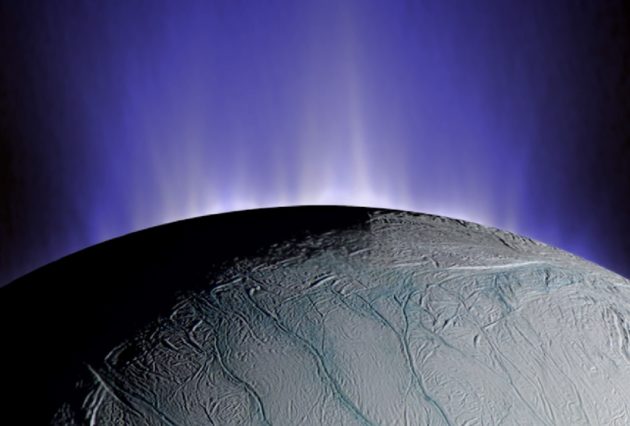
Enceladus, a small moon of Saturn spews continuous geysers of water from cracks in its south polar region indicating an ocean below its frozen icy exterior. Sampling the plumes with the right instruments may detect life on this small world without the need for drilling. Credit: NASA.
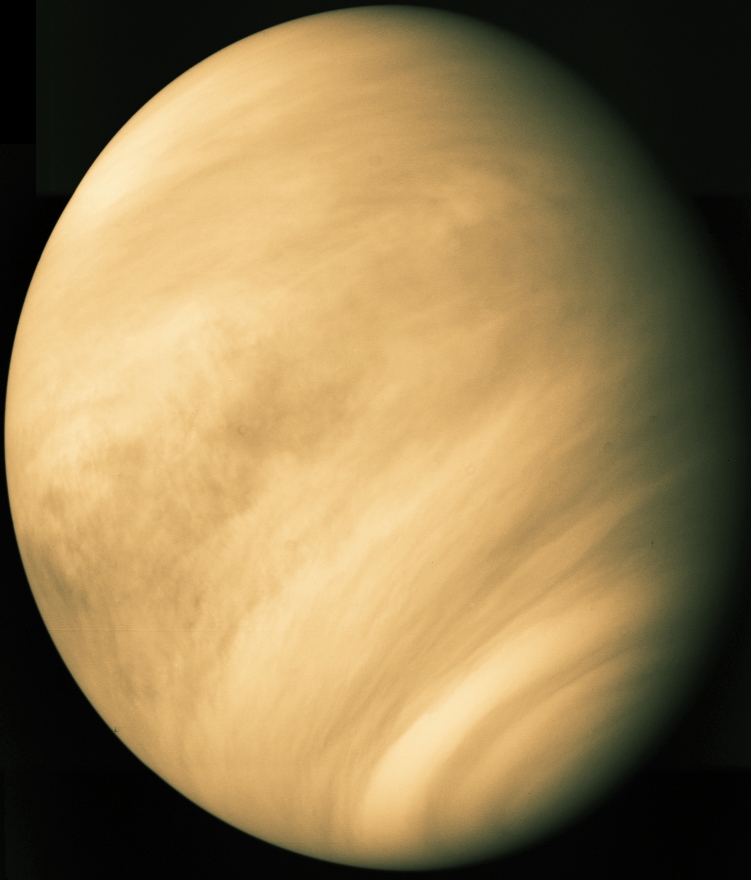
Is this our future? Venus had the misfortune of ending up too close to the Sun. It has a hellish landscape of nearly 900 degrees F, and 90 times the Earth’s atmospheric pressure. Its clouds consist of sulfuric acid. Talk about a runaway greenhouse effect and acid rain… Credit: NASA.
04/19/2019 – Ephemeris – Why Sunday is Easter
Ephemeris for Good Friday, Friday, April 19th. Today the Sun will be up for 13 hours and 40 minutes, setting at 8:32, and it will rise tomorrow at 6:50. The Moon, at full today, will rise at 8:56 this evening.
Easter will be celebrated by western Christian churches this Sunday. Easter is a movable feast in that it falls on a different date each year following the first full moon of spring. It’s an attempt to follow the Jewish Passover, which starts on the 15th of the month of Nisan. Being a lunar calendar the 15th the generally the night of the full moon. And since the Last Supper was a Seder, the Christian church wanted to follow Passover as closely as possible using the Roman solar based (Julian*) calendar where the year was 365.25 days long. Passover starts at sunset tonight. The western churches eventually adopted the Gregorian calendar to keep in sync with the seasons. The Eastern churches kept the old Julian Calendar and other considerations to calculate the date of Easter, which arrives a week later.
The times given are for the Traverse City/Interlochen area of Michigan. They may be different for your location.
* The Julian calendar is named after Julius Caesar who proposed it in 46 BC. It took effect on January 1, 45 BC. By the Julian calendar today is April 6.
04/18/2019 – Ephemeris – Tides
Ephemeris for Thursday, April 18th. Today the Sun will be up for 13 hours and 37 minutes, setting at 8:31, and it will rise tomorrow at 6:52. The Moon, 1 day before full, will set at 7:22 tomorrow morning.
The Moon and the Earth gravitationally attract each other. And the Moon raises tides in the Earth itself and its oceans. The Earth’s tides on the mass of the Moon has slowed its rotation so it continually shows the Earth the same face. The Moon, only one 81st the mass of the Earth hasn’t been as successful at greatly slowing the Earth’s rotation. It does cause the world’s timekeepers to add one second occasionally to the time stream to offset our atomic clocks to the Earth’s rotation. The most noticeable effects of the Moon’s tidal force is the tides in the Earth’s oceans. The highest tides are when the Sun and Moon are in line with the Earth at new and full moon. Small bodies of water like the Great Lakes don’t have luni-solar tides greater than 2 inches (5 cm). The Great Lakes do have tide like effects called seiches, like water sloshing in a bath tub, caused by wind or barometric pressure, and can be several feet high.
The times given are for the Traverse City/Interlochen area of Michigan. They may be different for your location.
Addendum
This link from NOAA explains tides better than I can: https://scijinks.gov/tides/.
This link is the explanation of seiches: https://oceanservice.noaa.gov/facts/gltides.html.
04/17/2019 – Ephemeris – Let’s look for the bright planets
Ephemeris for Wednesday, April 17th. Today the Sun will be up for 13 hours and 34 minutes, setting at 8:30, and it will rise tomorrow at 6:53. The Moon, 2 days before full, will set at 6:53 tomorrow morning.
Let’s look at the planets for this week. Mars will be in the western sky this evening, above the V-shaped stars of the face of Taurus the bull. It will set at 12:23 a.m. In the morning sky we have Jupiter, in Ophiuchus, which will rise tomorrow at 1:07 a.m. in the east-southeast. Saturn will be next to rise at 2:54 a.m., also in the east-southeast. It is in Sagittarius. Venus will rise at 5:56 a.m. again in the east-southeast. By 6:30 in the morning they will be strung out from the south down to the eastern horizon. Venus will remain in our morning sky, though more difficult to see until August when it passes behind the Sun to enter the evening sky. Tiny Mercury may be glimpsed a bit left and just below Venus in the bright twilight.
The times given are for the Traverse City/Interlochen area of Michigan. They may be different for your location.
Addendum
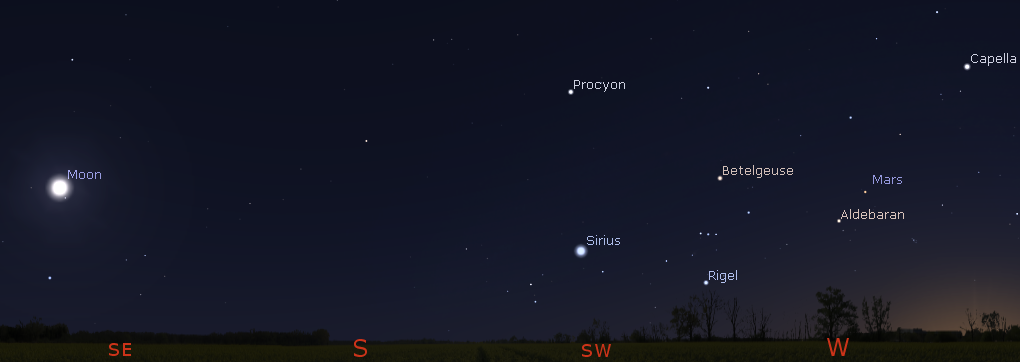
Mars and the Moon tonight at 9:30 p.m. April 17, 2019. Click on the image to enlarge. Created using Stellarium.
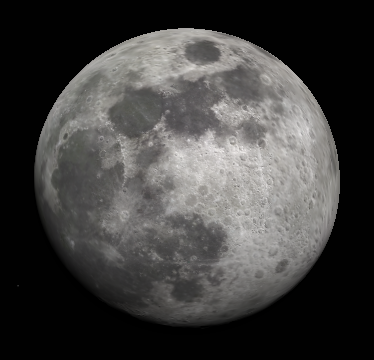
The waxing gibbous nearly full Moon at 9:30 p.m. April 17, 2019. Created using Stellarium.
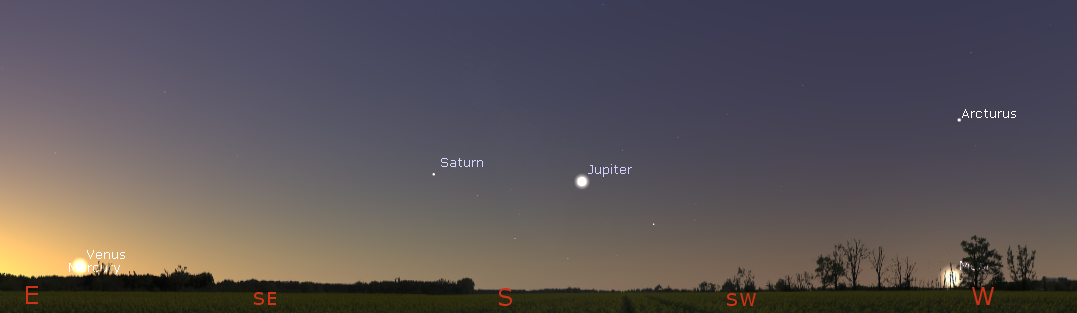
Morning planets and Moon at 6:30 a.m. April 18, 2019. Click on the image to enlarge. Created using Stellarium.
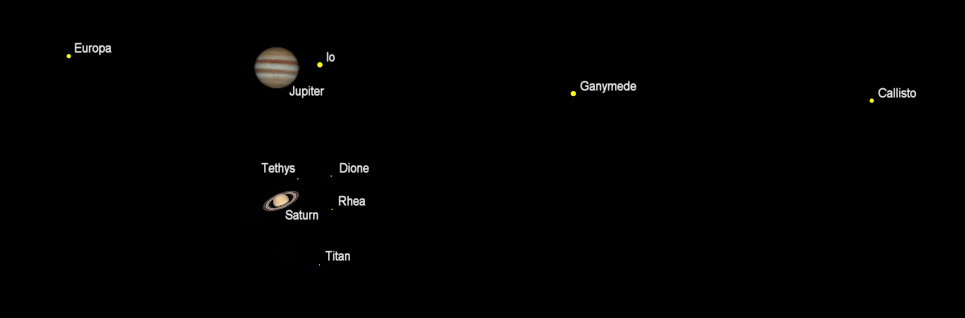
Jupiter and Saturn with the same magnification at 6:30 a.m. tomorrow morning April 18, 2019. Click on the image to enlarge. Created using Cartes du Ciel (Sky Charts).
Jupiter’s moon Io events earlier in the morning
| Moon | Event | Date | U.T. | EDT |
| Io | Shadow start | 18 Apr 2019 | 05:40 | 1:40 AM |
| Io | Transit start | 18 Apr 2019 | 06:44 | 2:44 AM |
| Io | Shadow end | 18 Apr 2019 | 07:51 | 3:51 AM |
| Io | Transit end | 18 Apr 2019 | 08:56 | 4:56 AM |
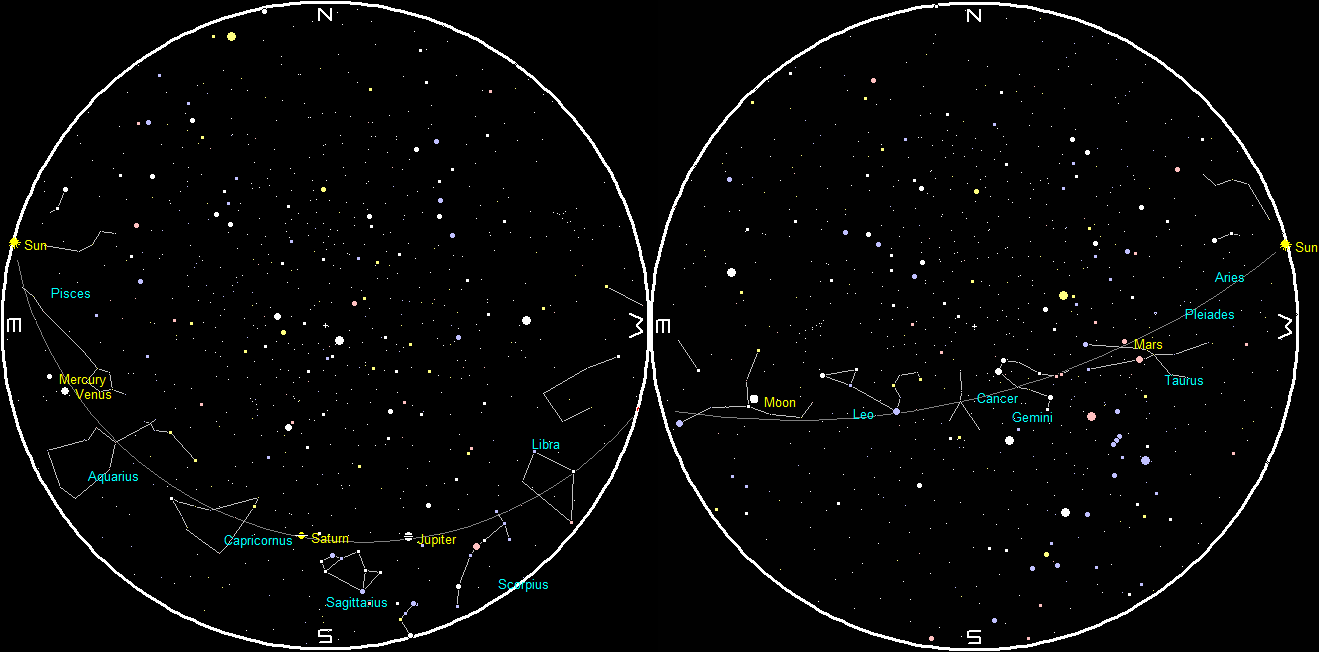
Planets and the Moon at sunset and sunrise of a single night starting with sunset on the right on April 17, 2019. The night ends on the left with sunrise on the 18th. Click on the image to enlarge. Created using my LookingUp program.
 Bob Moler's Ephemeris Blog