Archive
10/17/2019 – Ephemeris – Fomalhaut, the loneliest star in the sky
Ephemeris for Thursday, October 17th. Today the Sun will be up for 10 hours and 54 minutes, setting at 6:55, and it will rise tomorrow at 8:01. The Moon, half way from full to last quarter, will rise at 9:18 this evening.
There’s a bright star that appears for only seven and a half hours on autumn evenings. It’s appearance, low in the south-southeast at 9 p.m., is a clear indication of the autumn season. The star’s name is Fomalhaut, which means fish’s mouth. That’s fitting because it’s in the constellation of Piscis Austrinus, the southern fish. At our latitude it’s kind of the fish that got away, because Fomalhaut appears to be quite alone low in the sky. The dimness of the constellation’s other stars and location close to the horizon make the faint stars hard to spot. The Earth’s thick atmosphere near the horizon reduces their brightness by a factor of two or more, so Fomalhaut, one of the brightest stars in the sky, keeps a lonely vigil in the south.
The times given are for the Traverse City/Interlochen area of Michigan. They may be different for your location.
Addendum
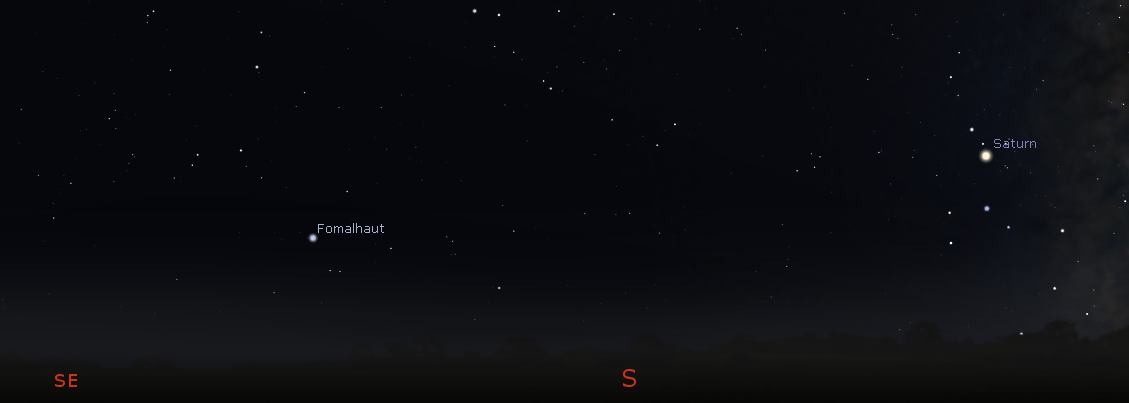
Fomalhaut, Saturn and the southern evening stars at 9 p.m. tonight, October 17, 2019. Click on image to enlarge. Created using Stellarium.
10/16/2019 – Ephemeris – The bright planets and another talk I’m giving tonight
Ephemeris for Wednesday, October 16th. Today the Sun will be up for 10 hours and 57 minutes, setting at 6:56, and it will rise tomorrow at 8:00. The Moon, 3 days past full, will rise at 8:44 this evening.
Let’s look at the bright planets for this week. Mars, Venus and Mercury are too close to the Sun to be seen. Venus and Mercury are on the evening or east side of the Sun, Mars is on the west or morning side. Bright Jupiter will be low in the southwestern sky as it gets dark. It will set at 9:46 p.m. Saturn, the ringed planet, will be in the south-southwestern sky in the evening, and set at 11:32 p.m.
Tonight at 7 p.m. I will be giving an illustrated talk Apollo and the Moon Race at the main branch of the Traverse Area District library on Woodmere in Traverse City. It traces the events from Sputnik to the last Apollo mission to the Moon, the tumultuous 15 years of the space race between the United Stares and the Soviet Union.
The times given are for the Traverse City/Interlochen area of Michigan. They may be different for your location.
Addenda
The planets this week
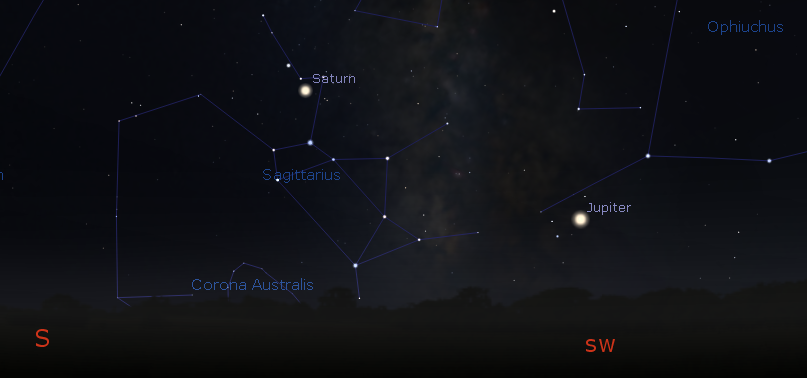
Jupiter, Saturn and the Moon at 8:30 p.m. tonight October 16, 2019. Click on the image to enlarge. Created using Stellarium.
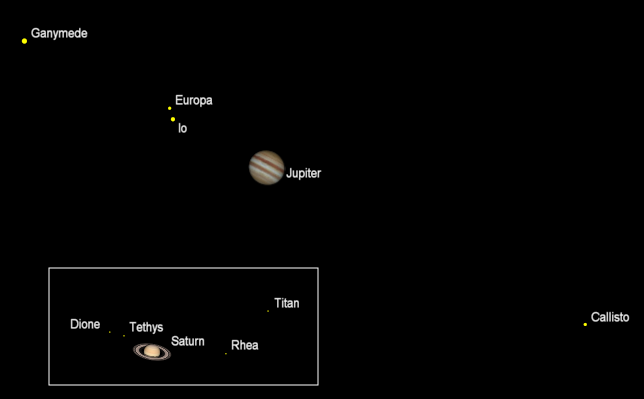
Telescopic views of Jupiter and Saturn with the same magnification at 8:30 p.m. tonight October 16, 2019. Created using Cartes du Ciel (Sky Charts).
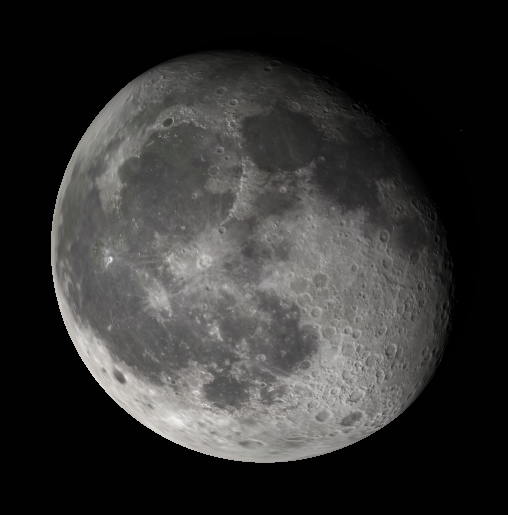
The waning gibbous Moon at 9:30 tonight October 16, 2019. Created using Stellarium.
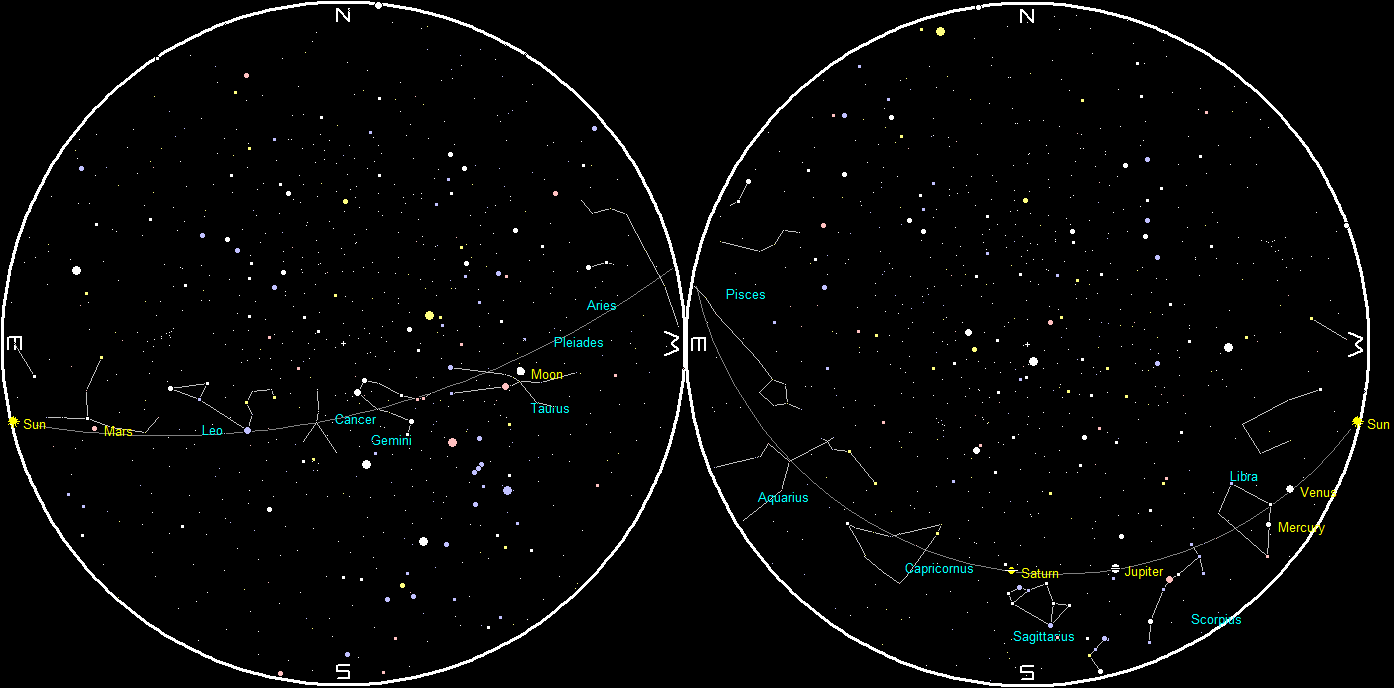
Planets and the Moon at sunset and sunrise of a single night starting with sunset on the right on October 16, 2019. The night ends on the left with sunrise on the 17th. Click on the image to enlarge. Created using my LookingUp program.
Apollo and the Race to the Moon

Apollo and the Race to the Moon Title slide
10/15/2019 – Ephemeris – The celestial Fisher paints the fall colors
Ephemeris for Tuesday, October 15th. Today the Sun will be up for 11 hours even, setting at 6:58, and it will rise tomorrow at 7:59. The Moon, 2 days past full, will rise at 8:14 this evening.
The tree leaves are turning to reds and yellows as we advance into autumn. The native Anishinaabe peoples, whose homeland we share, have a story about how that came to be. Of how a magical weasel-like creature called the Fisher or in the native language, Ojiig, brought summer to the Earth from Skyland. For his trouble he was shot with an arrow in his only vulnerable spot, the tip of his tail. As he fell to Earth the Great Spirit, Manitou caught him and placed him in the sky where we see the Great Bear (Ursa Major) and the Big Dipper. Every autumn late at night we see his tail, the handle of the dipper, swoop down to the ground where his tail paints the leaves with his blood.
The times given are for the Traverse City/Interlochen area of Michigan. They may be different for your location.
Addendum
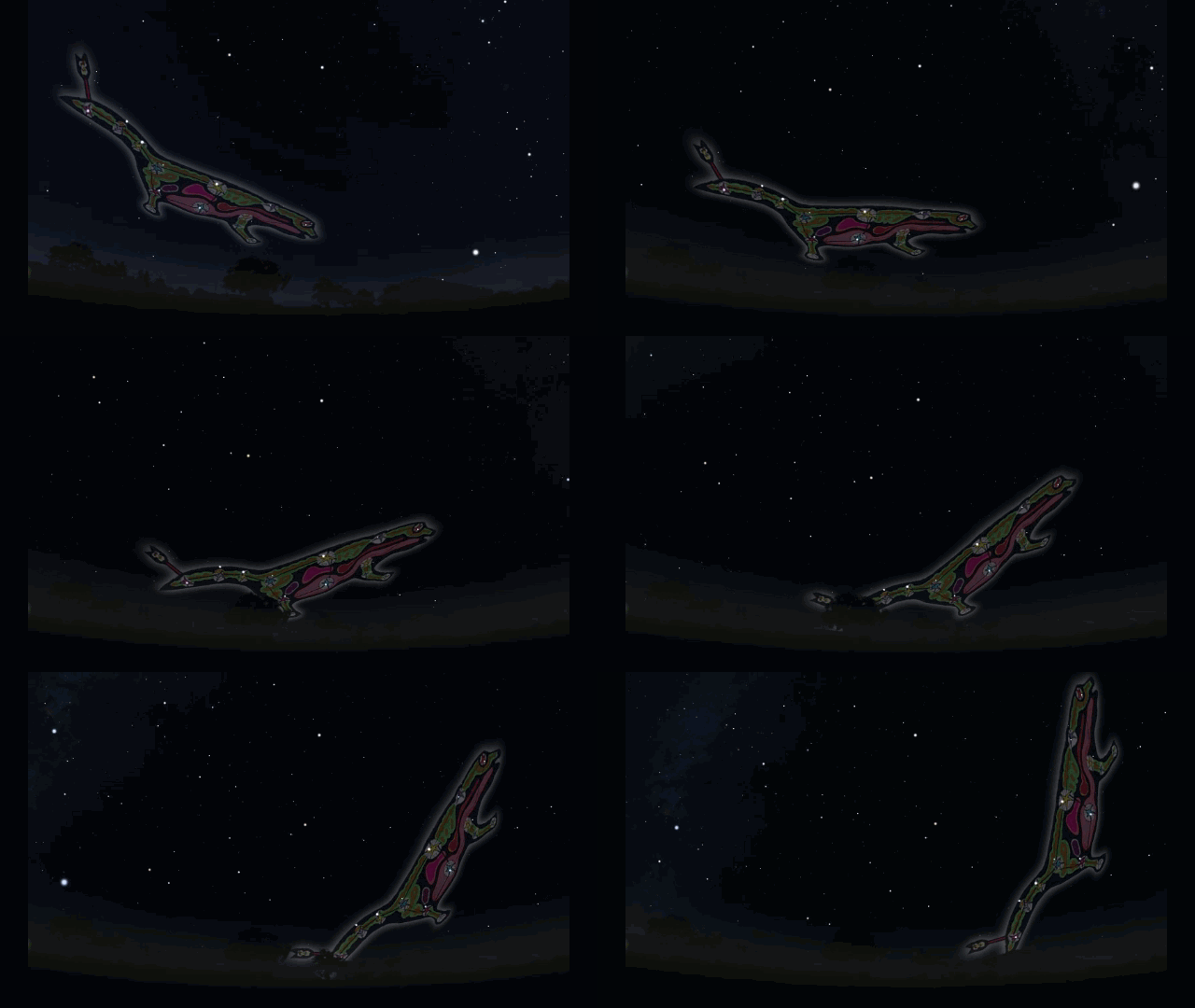
An animation of Fisher brushing his tail along the horizon on autumn nights. Created using Stellarium.
The constellation art is part of the latest versions of Stellarium. Ojibwe (Anishinaabe) constellation art by Annette S Lee and William Wilson from Ojibwe Sky Star Map Constellation Guide, ISBN 978-0-615-98678-4.
See the version of the story I learned: The story of the Fisher Star.
There are other variations of the story, and other adventures of the Fisher. Perform an Internet search for: Fisher or Fisher Star or Ojiig.
10/14/2019 – Ephemeris – Columbus Day
Ephemeris for Columbus Day, Monday, October 14th. Today the Sun will be up for 11 hours and 3 minutes, setting at 7:00, and it will rise tomorrow at 7:57. The Moon, 1 day past full, will rise at 7:49 this evening.
Today the United States celebrates Columbus Day, a Monday near the date Christopher Columbus landed on a Caribbean island, and found people who got there at least 15 thousand years earlier. Due to superior technology, and nothing else really, the Europeans conquered the peoples of the continents they called the Americas, deeming the indigenous peoples, incorrectly, as savages. My astronomical journey started with learning the constellations and their stories from the ancient Greeks. About seven years ago I began to investigate the constellations and stories of the Anishinaabe peoples whose ancient lands we live on, which turn out to be as rich and meaningful as those I learned in my youth from the Old World.
The times given are for the Traverse City/Interlochen area of Michigan. They may be different for your location.
10/11/2019 – Ephemeris – Interstellar comet 2I/Borisov ejects the same gas like ordinary solar system comets
Ephemeris for Friday, October 11th. Today the Sun will be up for 11 hours and 12 minutes, setting at 7:05, and it will rise tomorrow at 7:54. The Moon, 2 days before full, will set at 6:24 tomorrow morning.
The interstellar comet 2I/Borisov, which was discovered August 30th by the Crimean amateur astronomer Gennady Borisov has given its first clues of its makeup. With data collected from the William Herschel Telescope in the Canary Islands the comet was discovered to give off cyanogen, a cyanide gas. This is just like what is given off by comets that belong to the solar system. As the comet comes closer to the Sun and warms up further more and different gasses will be liberated. It was the discovery of cyanogen in Halley’s Comet back in 1910 caused a panic because on that pass the comet’s tail swept past the Earth. However a comet’s tail is so tenuous that no cyanogen was detected in the Earth’s atmosphere.
The times given are for the Traverse City/Interlochen area of Michigan. They may be different for your location.
Addendum
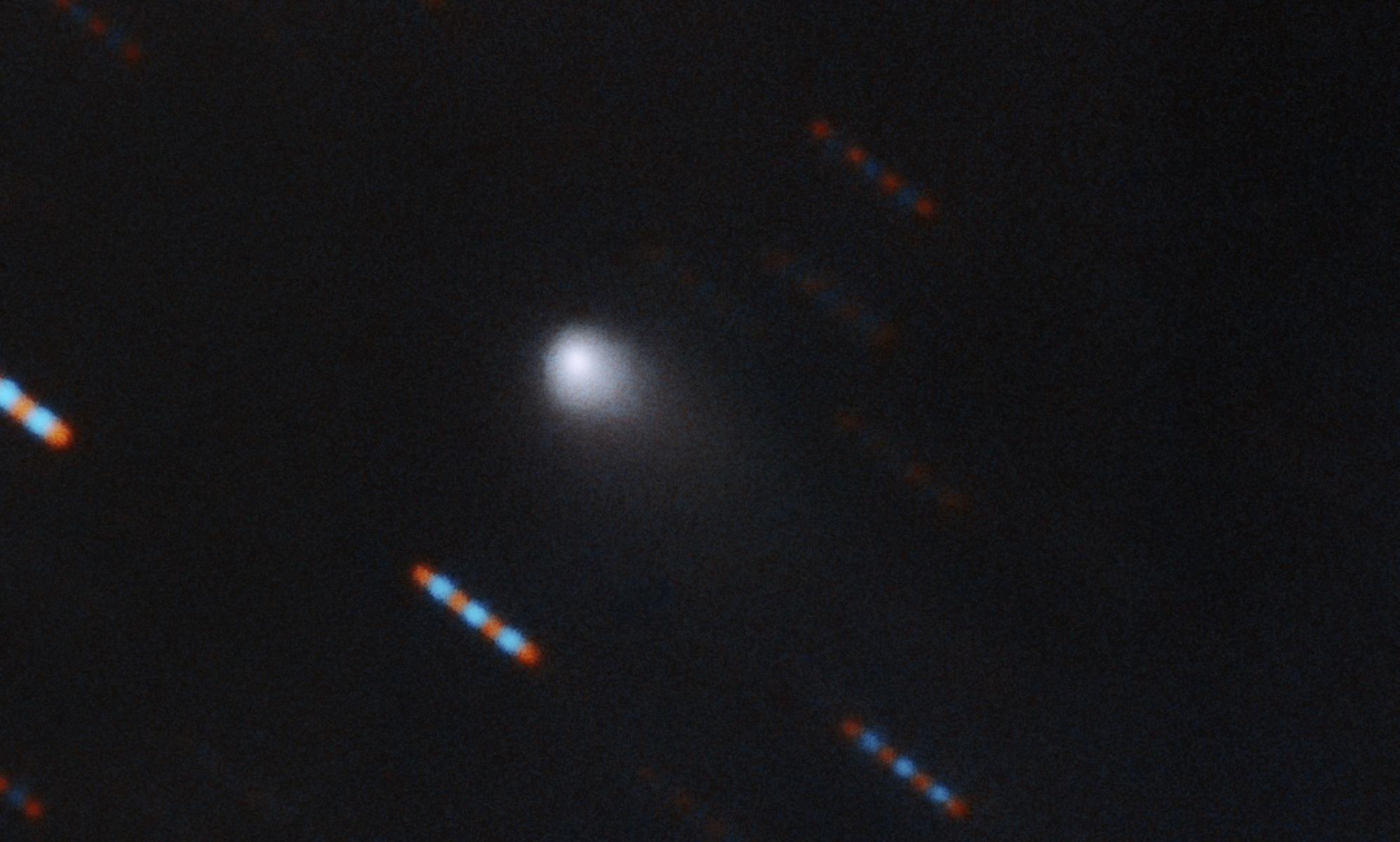
Color photograph of 2I/Borisov. Image Credit: Gemini Observatory/NSF/AURA
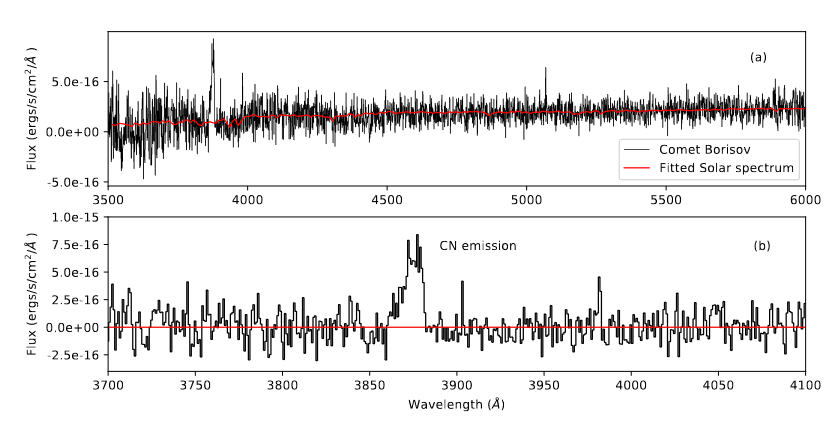
Spectrum of 2I/Borisov. Top covers part of the visible and ultraviolet spectrum. The bottom zooms in on the CN emission. Credit https://arxiv.org/abs/1909.12144
10/09/2019 – Received word that C2 has also been discovered. This is also normal and can color the coma green. (I recorded the program on 10/06 illustrated this post on 10/07 due to being away due to my daughter’s surgery.)
10/10/2019 – Ephemeris – Saturn’s moon Enceladus may have the building blocks of life
Ephemeris for Thursday, October 10th. Today the Sun will be up for 11 hours and 15 minutes, setting at 7:07, and it will rise tomorrow at 7:52. The Moon, 3 days before full, will set at 5:23 tomorrow morning.
Even though the Cassini mission to Saturn ended two years ago its data will be will be studied for decades by scientists around the world. One of Cassini’s discoveries were geysers of water ice being ejected from the small moon Enceladus, that creates Saturn’s tenuous E ring. Two instruments aboard Cassini, a mass spectrometer and a cosmic dust analyzer, discovered organic compounds in the geysers and the E ring. Further analysis by German geologists found nitrogen-oxygen molecules among the ice grains. These are like the constituent compounds that make up amino acids which on Earth make up the proteins of life. Currently both NASA and the Europeans are considering return missions to Enceladus.
The times given are for the Traverse City/Interlochen area of Michigan. They may be different for your location.
Addendum
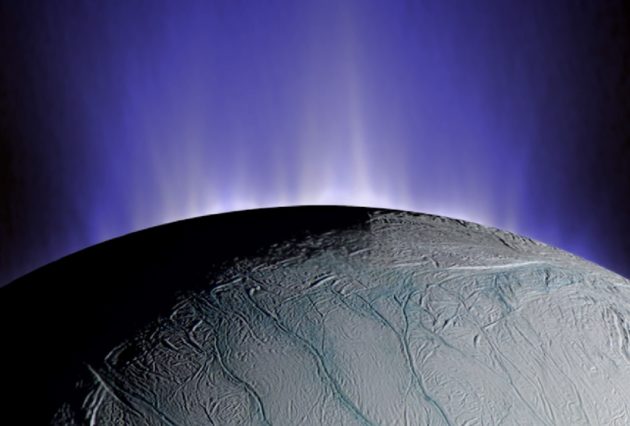
Enceladus, a small moon of Saturn spews continues to geysers of water rom cracks in its south polar region indicating an ocean below its frozen icy exterior. Sampling the plumes with the right instruments may detect life on this small world without the need for drilling. Credit: NASA/JPL – Caltech
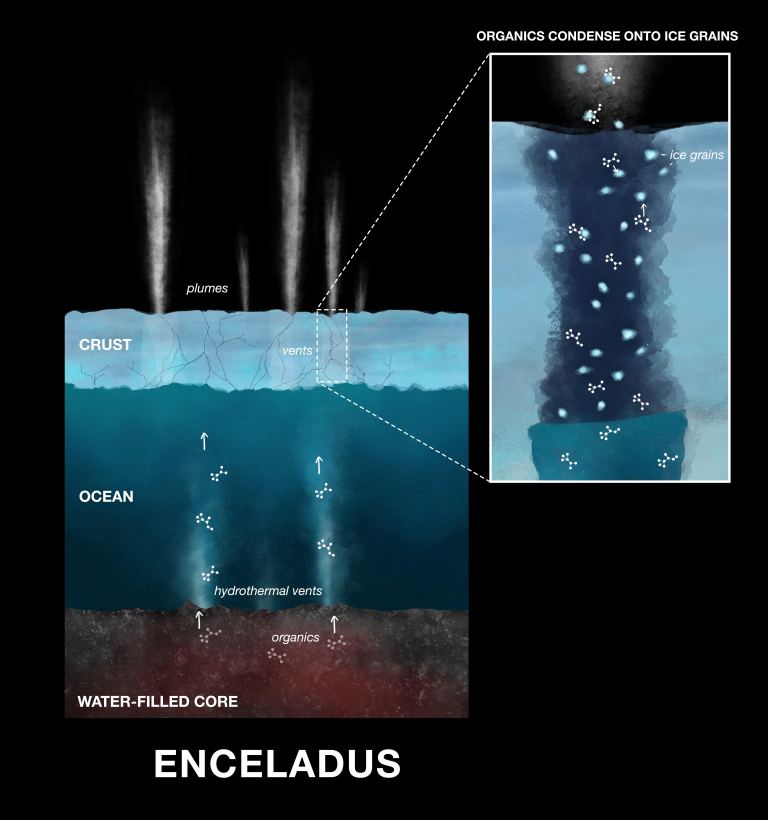
How organic compounds are attached to ice grains and ejected from Enceladus. Credit: NASA/JPL – Caltech.
10/09/2019 – Ephemeris – Where are the bright planets?
Ephemeris for Wednesday, October 9th. Today the Sun will be up for 11 hours and 18 minutes, setting at 7:09, and it will rise tomorrow at 7:51. The Moon, half way from first quarter to full, will set at 4:22 tomorrow morning.
Let’s look at the bright planets for this week. Mars, Venus and Mercury are too close to the Sun to be seen. Venus and Mercury are on the evening or east side of the Sun, Mars is on the west or morning side. Bright Jupiter will be low in the southwestern sky as it gets dark. Jupiter will set at 10:09 p.m. Jupiter is moving at nearly its fastest to the east now and next year will be where Saturn is now. Saturn, the ringed planet, will be in the south-southwestern sky in the evening, and set at 11:58 p.m. Next year it will be a bit farther east. Jupiter is approaching Saturn in our sky. They will cross paths late next year, December 21st, something they do about every 20 years.
The times given are for the Traverse City/Interlochen area of Michigan. They may be different for your location.
Addendum
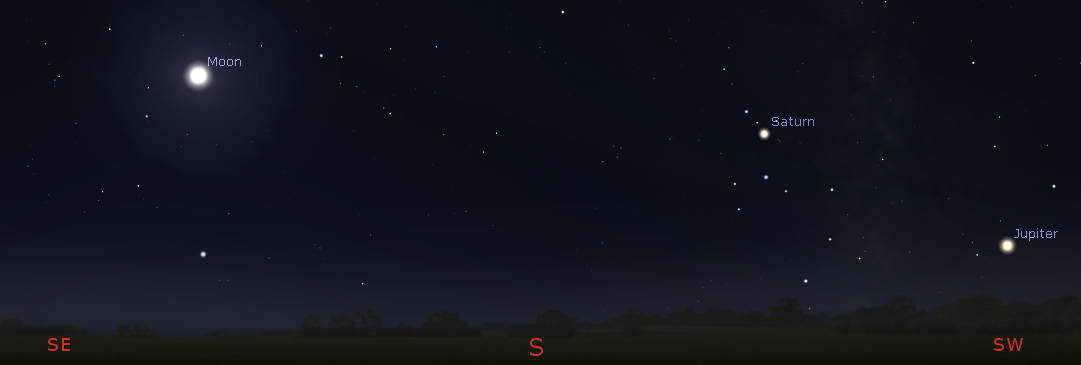
Jupiter, Saturn and the Moon at 9 p.m. October 9, 2019. Click on the image to enlarge. Created using Stellarium.
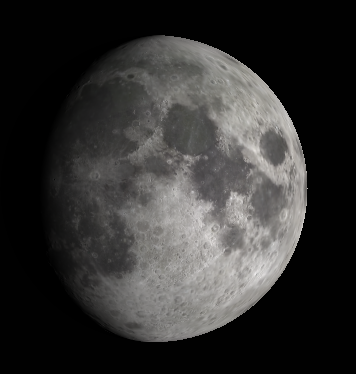
The gibbous Moon as it might appear in binoculars at 9 p.m. October 9, 2019. Created using Stellarium.
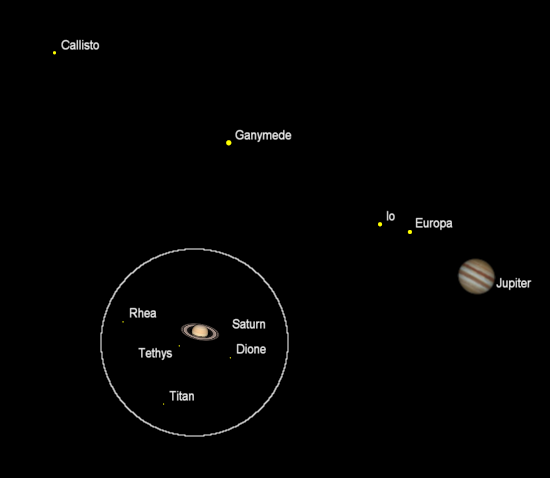
Telescopic views of Jupiter and Saturn with the same magnification at 9 p.m. October 9, 2019. Created using Cartes du Ciel (Sky Charts).
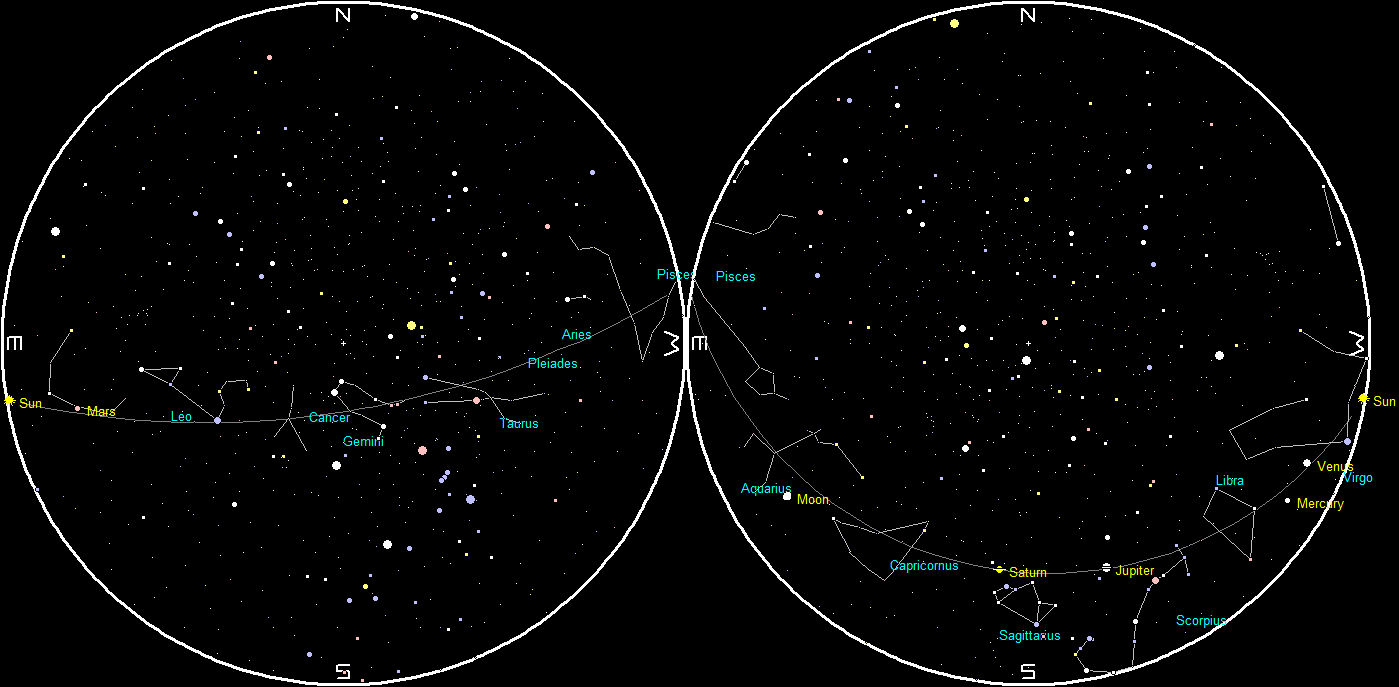
Planets and the Moon at sunset and sunrise of a single night starting with sunset on the right on October 9, 2019. The night ends on the left with sunrise on the 10th. Click on the image to enlarge. Created using my LookingUp program.
10/08/2019 – Ephemeris – Ada Lovelace Day
Ephemeris for Ada Lovelace Day, Tuesday, October 8th. Today the Sun will be up for 11 hours and 21 minutes, setting at 7:10, and it will rise tomorrow at 7:50. The Moon, 3 days past first quarter, will set at 3:21 tomorrow morning.
Ada Lovelace Day, is an international celebration of the achievements of women in STEM, science, technology, engineering and math. Ada Augusta King, Countess of Lovelace, daughter of Lord Byron, born in 1815 is considered the world’s first computer programmer, writing a program on Jacquard loom punch cards for Charles Babbage’s Analytical Engine. Unfortunately the Analytical Engine never made it past the planning stage. The recently completed incredibly successful Cassini Mission mission had three women in top roles: Project scientist, Linda Spilker; Spacecraft Operations Team Manager, Julie Webster; Imaging Science Subsystem Principle Investigator, Carolyn Porco, plus many more. STEM fields are still male dominated but lets encourage women to enter them too.
The times given are for the Traverse City/Interlochen area of Michigan. They may be different for your location.
Addendum

Ada, Countess of Lovelace (1815-1852) considered the first computer programmer, even though the machine she wrote code for was never built. Credit: Science & Society Picture Library
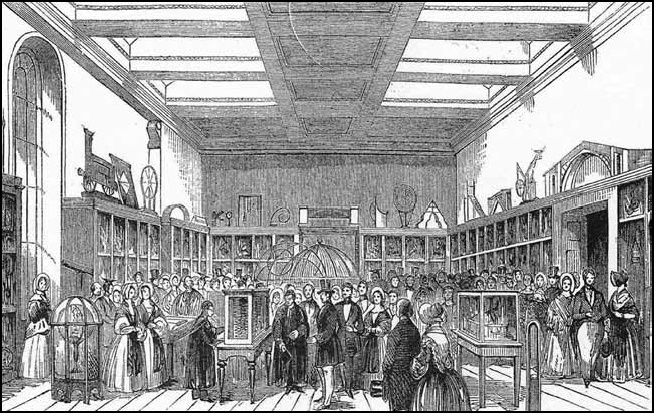
Part of Charles Babbage’s Analytical Engine on display, in 1843, left of center in this engraving of the King George III Museum in King’s College, London. Unknown engraver.
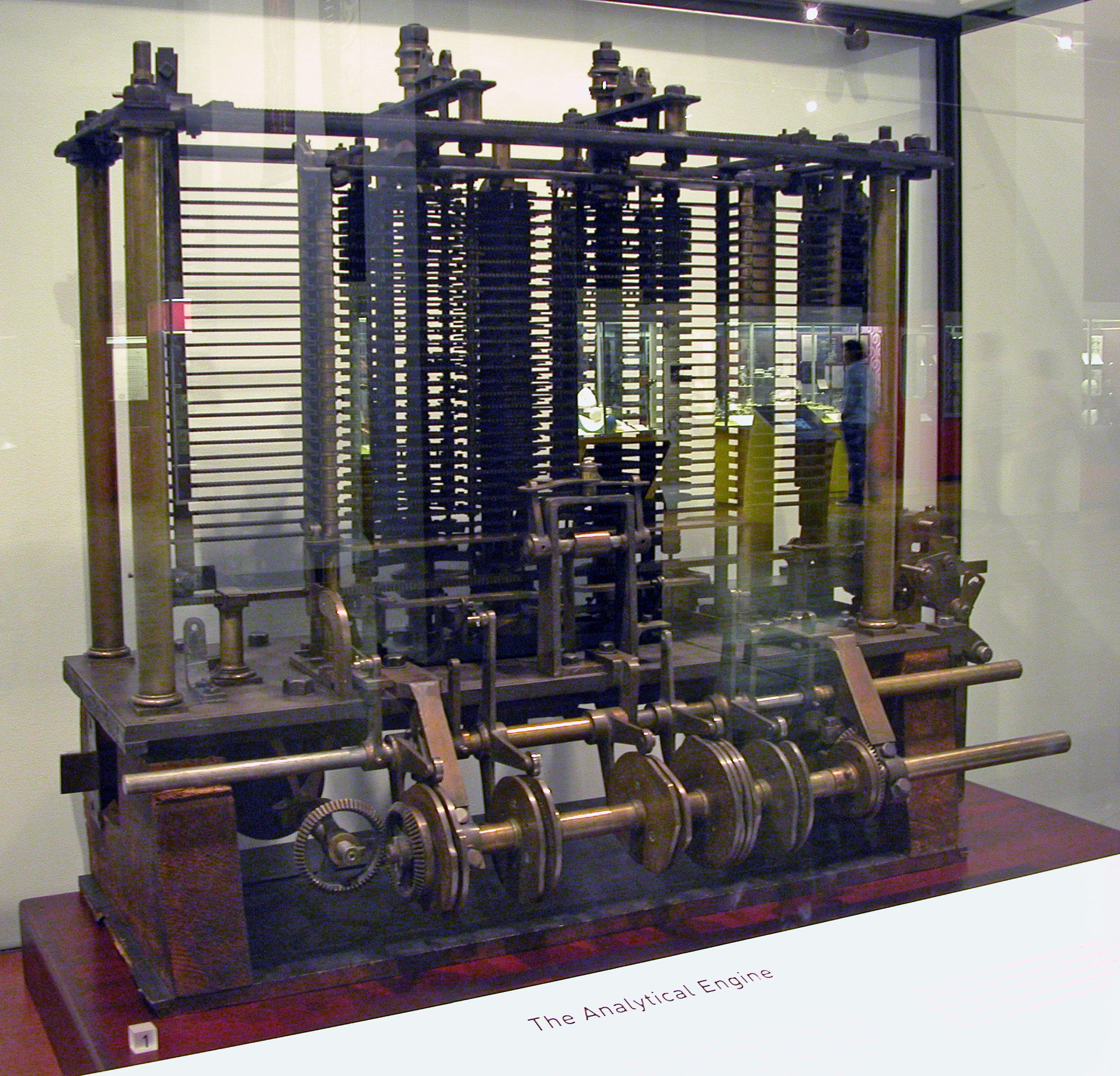
Trial model of a part of the Analytical Engine, built by Charles Babbage, as displayed at the Science Museum (London). By Bruno Barral (ByB), CC BY-SA 2.5.
10/07/2019 – Ephemeris – Tides on and by the Moon
Ephemeris for Monday, October 7th. Today the Sun will be up for 11 hours and 24 minutes, setting at 7:12, and it will rise tomorrow at 7:49. The Moon, 2 days past first quarter, will set at 2:21 tomorrow morning.
We always see the same face of the Moon turned toward the Earth. This does not mean that the Moon doesn’t rotate. It means that the Moon rotates on its axis in exactly the same time it takes to orbit the Earth. That is no coincidence. The effect of the Earth gravitation across the diameter of the Moon have essentially locked the Moon’s rotation to its revolution period. The crust of the far side of the Moon is thicker than the Earth facing side. The Moon is trying to do the same thing to the Earth. Its pull on the side of the Earth facing it is greater than the pull on the Earth’s opposite side. This stresses the Earth and raises tides in the ocean which actually slow the Earth’s rotation a tiny bit. As a consequence it pushes the Moon away by about 3.8 centimeters a year.
The times given are for the Traverse City/Interlochen area of Michigan. They may be different for your location.
Addendum
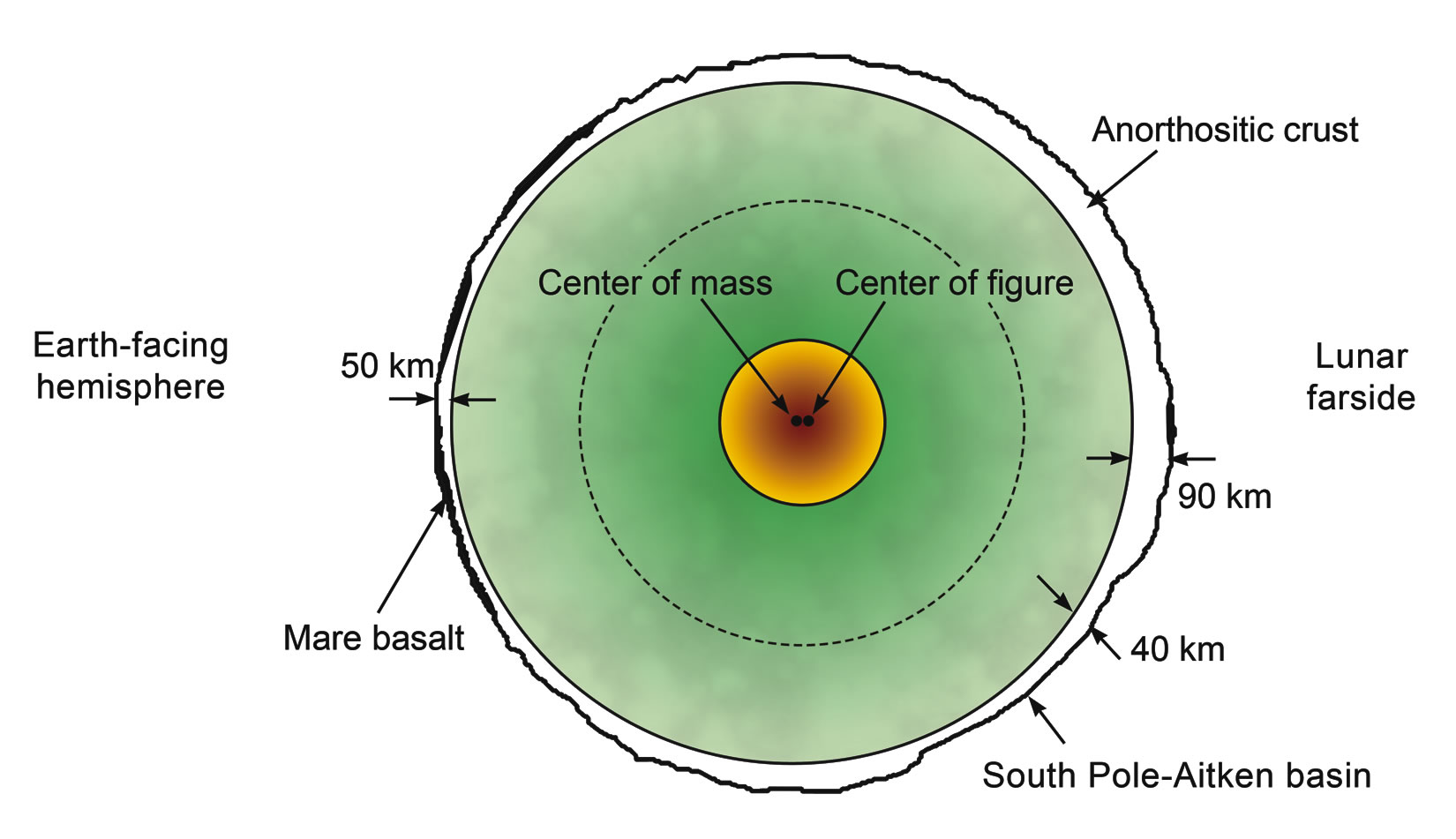
Asymmetry of the crust of the Moon. Credit Lunar and Planetary Institute and Center for Lunar Science and Exploration.
For more information on this illustration: https://www.lpi.usra.edu/exploration/training/illustrations/planetaryInteriors/ 4th illustration.
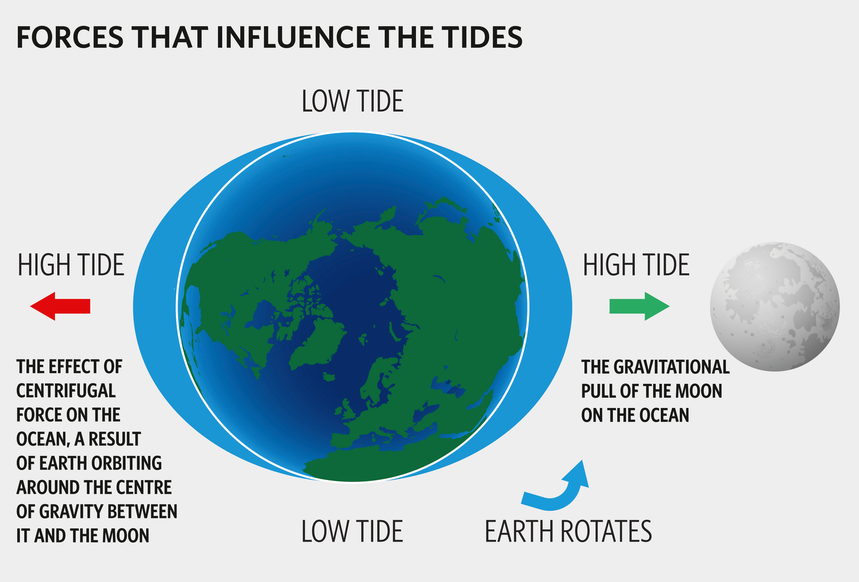
Credit: Cosmosmagazine.com
10/04/2019 – Ephemeris – Astronomy events in Traverse City this weekend
Ephemeris for Friday, October 4th. Today the Sun will be up for 11 hours and 34 minutes, setting at 7:18, and it will rise tomorrow at 7:45. The Moon, 1 day before first quarter, will set at 11:33 this evening.
Tonight and tomorrow night there will be astronomy events at the Northwestern Michigan College’s Rogers Observatory and weather permitting tomorrow night on Front Street in Traverse City.
- Tonight there is the monthly meeting of the Grand Traverse Astronomical Society with a program at 8 p.m. and a star party starting at 9 p.m.
- Tomorrow night at the observatory from 7 to 8:30 p.m. NMC, the Rogers Observatory and the Traverse Area District Library will present Storyteller’s Night Sky with Mary Stewart Adams.
- At the same time, if it’s clear, members of the Grand Traverse Astronomical Society will set up telescopes on the East 200 block of Front Street in Traverse City for the International Observe the Moon Night.
The times given are for the Traverse City/Interlochen area of Michigan. They may be different for your location.
 Bob Moler's Ephemeris Blog