Archive
03/17/2021 – Ephemeris – Let’s search for the naked-eye planets for this week
This is Ephemeris for St. Patrick’s Day, Wednesday, March 17th. Today the Sun will be up for 12 hours and one minute, setting at 7:51, and it will rise tomorrow at 7:49. The Moon, halfway from new to first quarter, will set at 12:18 tomorrow morning.
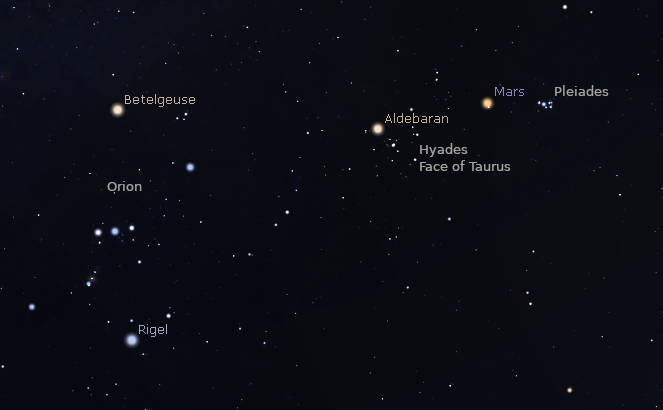
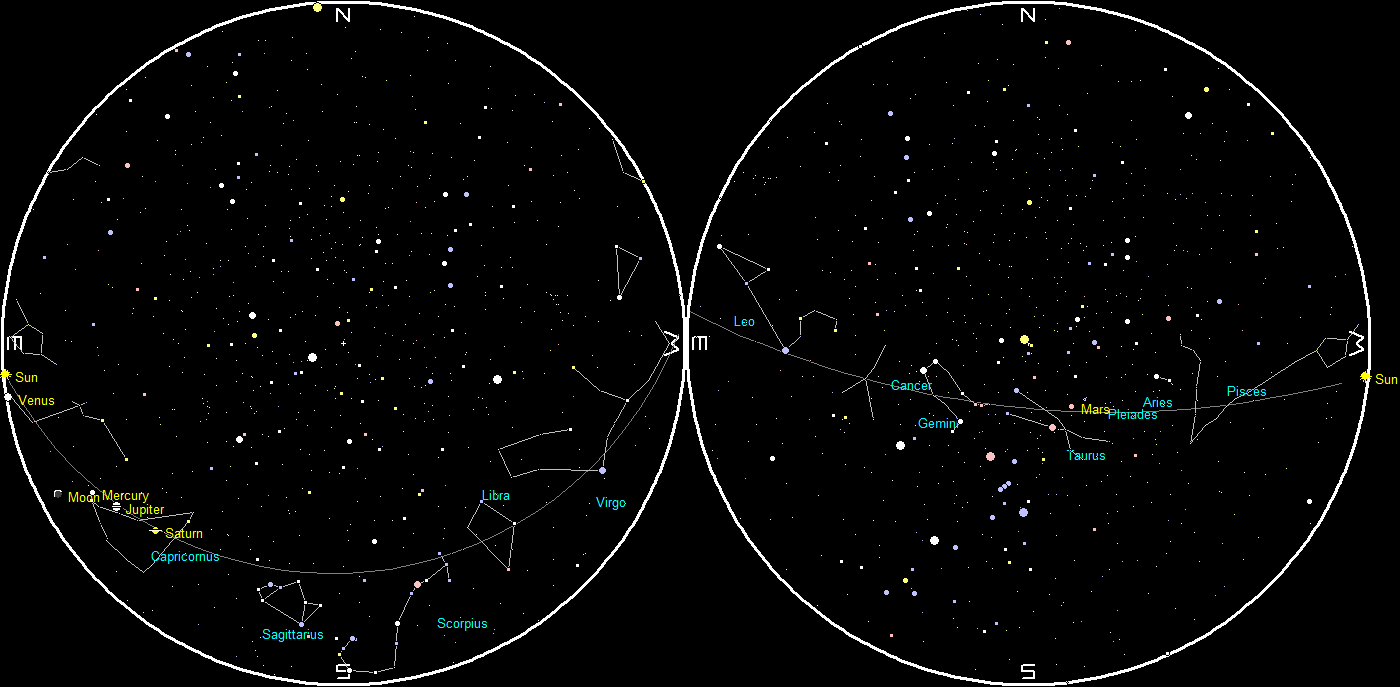
Let’s search for the naked-eye planets for this week. Unfortunately the only one you’ll find in the evening is Mars. It can be found high in the west-southwest at 9 pm tonight, above a line between the Pleiades star cluster on its lower right and the letter V of stars that is the face of Taurus the bull on its lower left. The Pleiades will be above tonight’s waxing crescent Moon. Mars will set at 2:07 am.
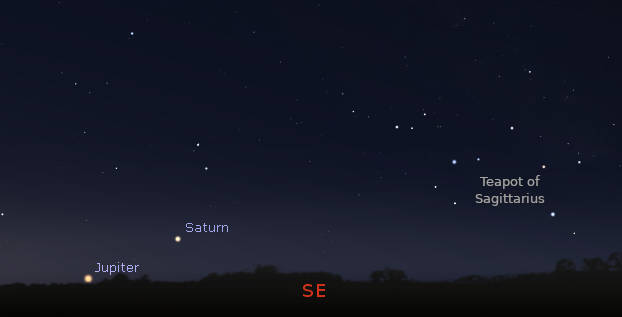
Right now the other four naked eye planets are just west of the Sun in the Morning sky. But only Saturn and Jupiter are at a far enough angle from the Sun to be just be glimpsed in the morning sky. Saturn will rise at 6 am, with Jupiter a half hour later. By 7 am they will be low in the southeast.
The astronomical event times given are for the Traverse City/Interlochen area of Michigan. They may be different for your location.
Addendum
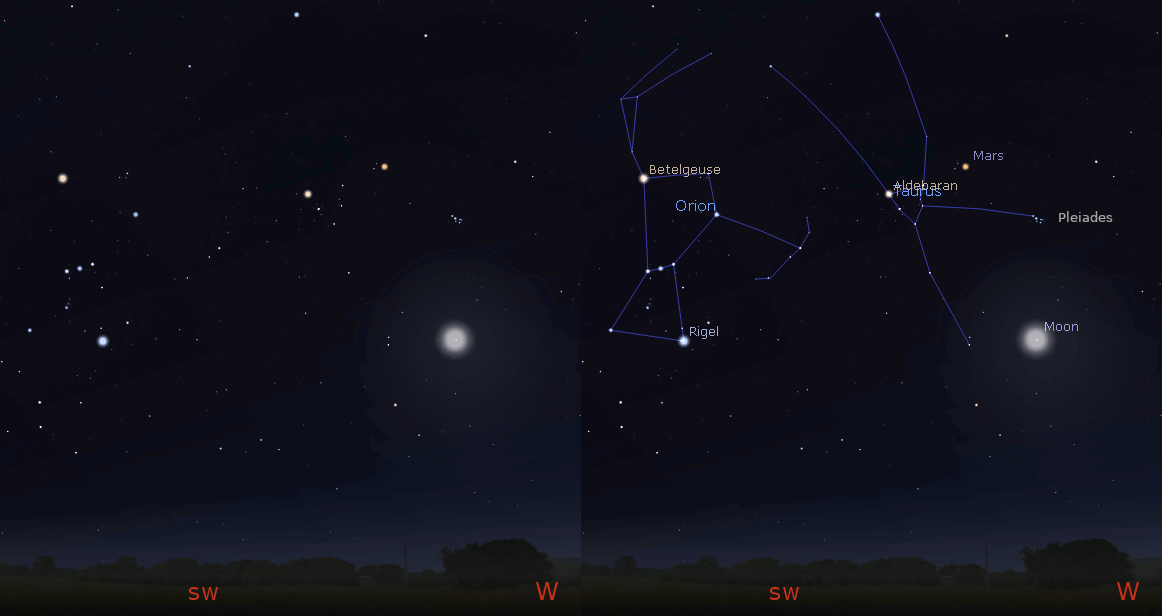
Mars finder animation for 9 pm, or about 70 minutes after sunset, tonight March 17, 2021. Created using Stellarium and GIMP.
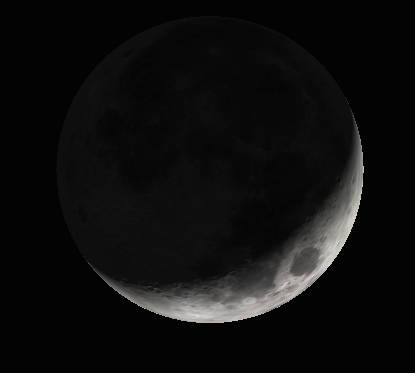
The Moon as it might appear tonight, March 17, 2021, in binoculars or a small telescope. Created using Stellarium.
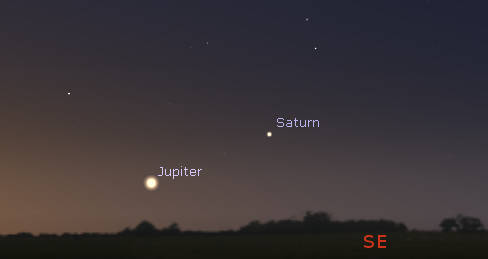
Jupiter and Saturn tomorrow morning at 7 am, March 18, 2021. Created by using Stellarium.
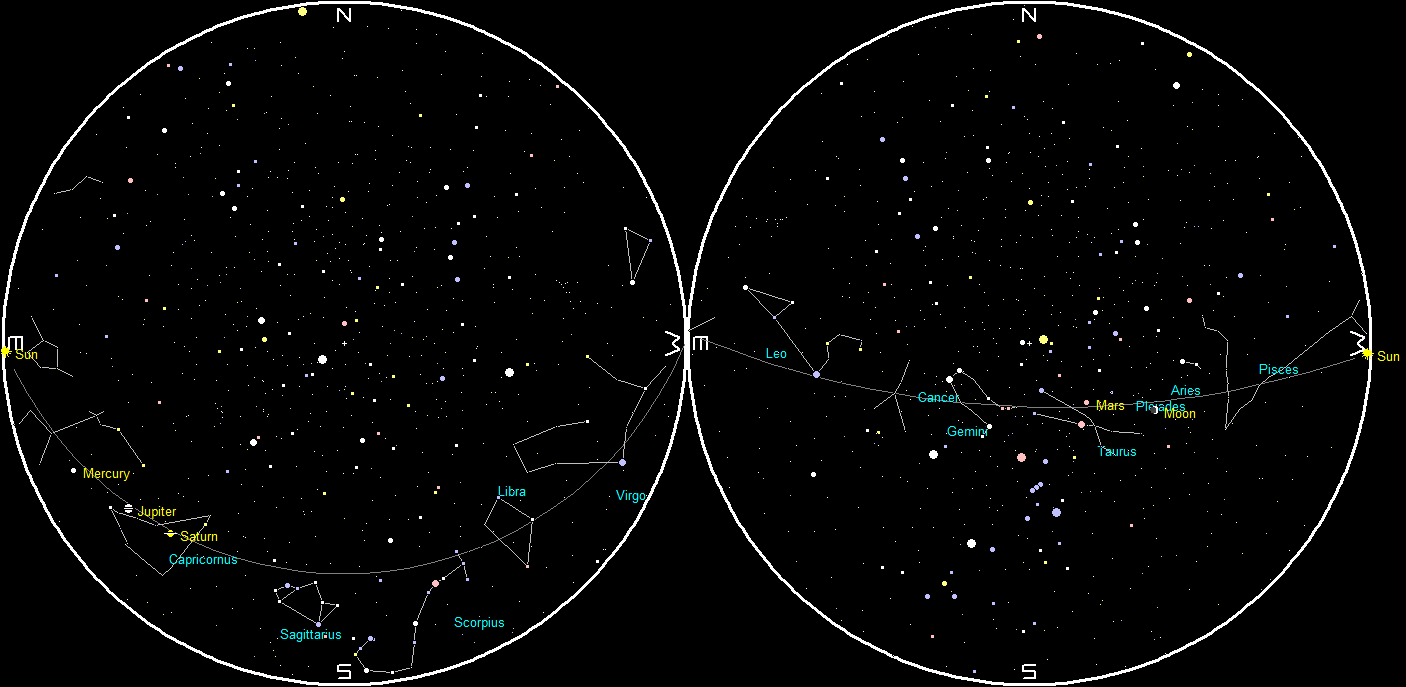
Planets and the Moon at sunset and sunrise of a single night starting with sunset on the right on March 17, 2021. The night ends on the left with sunrise on the 18th. Venus is too close and south of the Sun to be plotted. Click on the image to enlarge. Created using my LookingUp program.
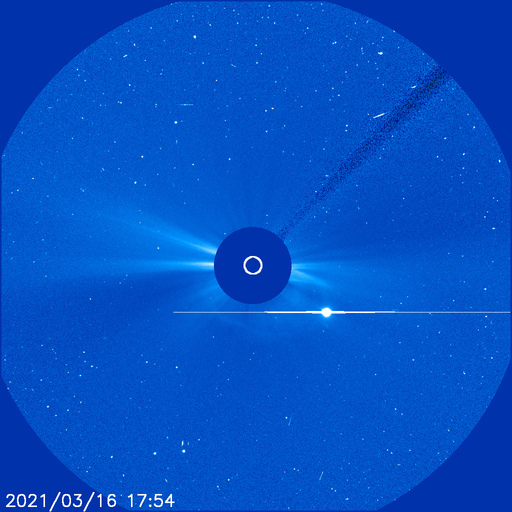
Venus in the Solar and Heliospheric Observatory (SOHO) LASCO C3 image. It will pass south and behind the Sun on the 26th and officially enter the evening sky.
03/16/2021 – Ephemeris – Tonight we’ll have exactly 12 hours of night
This is Ephemeris for Tuesday, March 16th. Today the Sun will be up for 11 hours and 57 minutes, setting at 7:50, and it will rise tomorrow at 7:50. The Moon, 3 days past new, will set at 11:15 this evening.
Did you notice what I just said? Sunset’s at 7:50 pm and sunrise’s at 7:50 am. Tonight we’ll have exactly 12 hours of night. That’s what the word equinox means, equal night… But the vernal or spring equinox isn’t until Saturday when spring starts. By then night, including twilight, will be down to 11 hours, 50 minutes. The disparity comes down to modern versus older definitions. Equinox, being Latin is an older definition. The modern instant of sunrise and sunset occurs when the top of the Sun’s disc touches the sea horizon. Because our atmosphere bends light, and at its greatest when looking at the horizon, the Sun will have set already, geometrically, by the time the bottom edge of the Sun appears to touch that sea horizon. Making daylight a bit longer than you’d think.
The astronomical event times given are for the Traverse City/Interlochen area of Michigan. They may be different for your location.
Addendum

How the atmosphere bends the light of the Sun or Moon rising or setting to appear higher than it actually is. S is the actual position of the Sun, S’ is the apparent position of the Sun. The blue line is the observer O’s horizon. The gray line is the actual, though much exaggerated, light path bent or refracted by the Earth’s atmosphere. The black line is the apparent sight line to the Sun. Credit Francisco Javier Blanco González, 2017
03/15/2021 – Ephemeris – Newly discovered comet may reach naked-eye brightness by December
This is Ephemeris for Ides of March, Monday, March 15th. Today the Sun will be up for 11 hours and 54 minutes, setting at 7:49, and it will rise tomorrow at 7:52. The Moon, 2 days past new, will set at 10:12 this evening.
Now that daylight saving time is here all the times I give for sunrises and sunsets bump up at least an hour along with anything else the rises or sets. It’s lighter out in the evening now. The end of nautical twilight, by which time it’s dark enough to see most of the stars and constellations ends around 8:21 tonight, but that will continue to advance toward 11 pm by July. On to possibly happier news, a comet was discovered, and is called Comet 2021 A1 (Leonard). It could reach naked eye visibility and be brightest in mid-December. I mean could. Comets are unpredictable, and so is our weather that time of year. I’ll have more on Comet Leonard, its antics and more about comets in general as it heads in from the outer solar system during this year.
The astronomical event times given are for the Traverse City/Interlochen area of Michigan. They may be different for your location.
Addendum
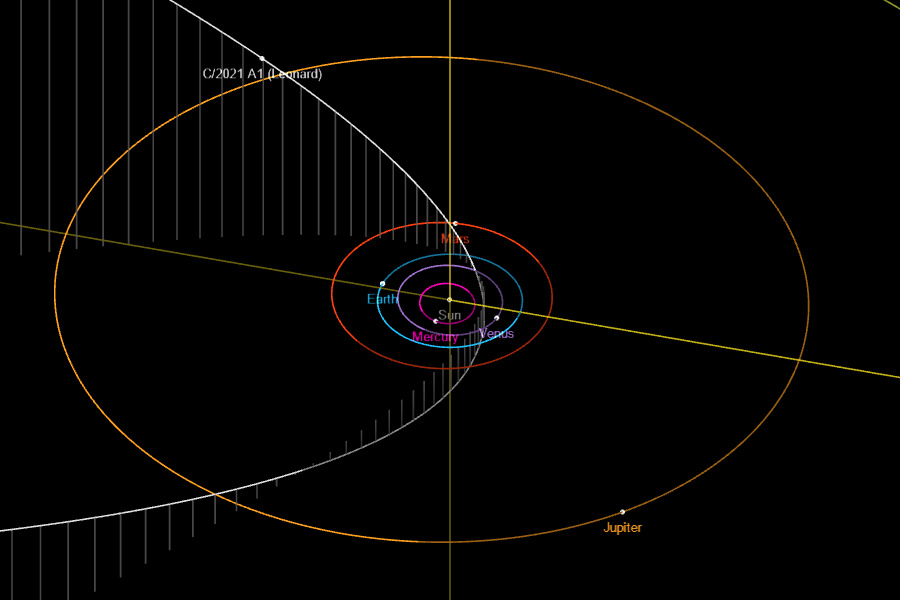
Comet C/2021 A1 (Leonard) orbit and position as of March 15, 2021. The vertical lines (I call them stilts) show the orbit’s position above or below the plane of the Earth’s orbit. It will reach its closest point to the Sun on January 3, 2022, just inside Venus’ orbit. Click on the image to enlarge. Credit NASA/JPL Small-Body Database Browser.
03/12/2021 – Ephemeris – It’s about time
This is Bob Moler with Ephemeris for Friday, March 12th. Today the Sun will be up for 11 hours and 45 minutes, setting at 6:45, and it will rise tomorrow at 6:58. The Moon, 1 day before new, will rise at 7:31 tomorrow morning.
Sunday morning at the instant the clock strikes 2 am, it will magically become 3 am. March 14th will become the shortest day of the year at 23 hours. The hour will be returned, without interest I might add, on the first Sunday in November. And we can’t even say “Spring forward.” It’s not even spring yet. “Late winter forward” just doesn’t have the same ring to it. Actually noon is not midday for those who work days. It’s more like two in the afternoon, maybe later. We have more leisure time after work than before, which kind of makes sense. But in summer the Sun’s out a long time anyway. In late June the Sun doesn’t set until 9:30 at night around here. It doesn’t get really dark until after 11 pm. It may be great for golfers, but not for those who enjoy the night sky.
The astronomical event times given are for the Traverse City/Interlochen area of Michigan. They may be different for your location.
Addendum
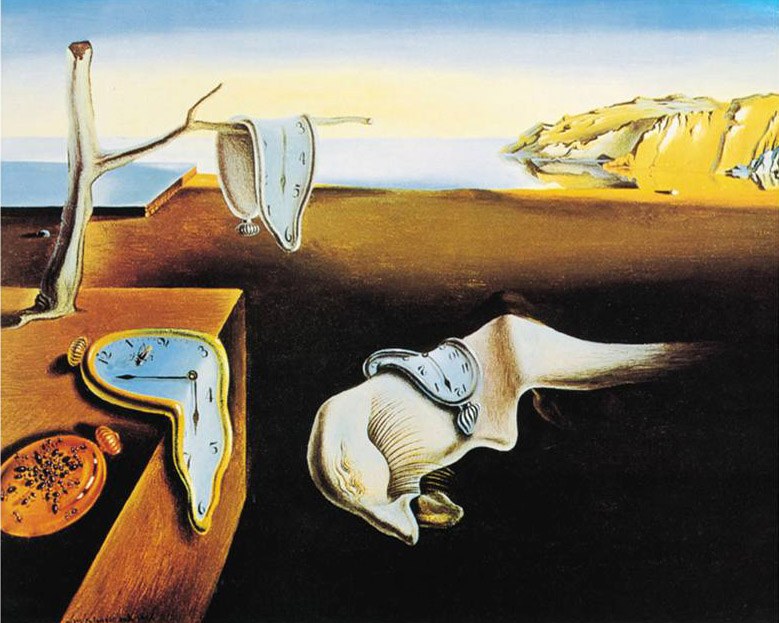
The Persistence of Memory by Salvador Dalí.
Growing up in the 1950s I wasn’t aware that we in Michigan didn’t set our clocks forward or back with the seasons until we got a television. All of a sudden in April all the evening shows came on an hour earlier. Around Halloween, they went back to their former times. In the 60s the politicians started to mess around with our clocks, first on the Federal level, then the state level. Long story short, we’re doing the spring forward, fall back thing like almost everyone else. The problem I see is that we are far west of our Eastern Standard Time meridian of 75 degrees west longitude, which runs through Philadelphia, PA. I live 43 Earth rotational minutes west of there. Standard time for us is almost like Daylight Saving Time for New York City. So come Sunday we will experience double daylight time. Kinda like “Double Secret Probation.” /rant
03/11/2021 – Ephemeris – The Guardian of the Bear is rising
This is Ephemeris for Thursday, March 11th. Today the Sun will be up for 11 hours and 42 minutes, setting at 6:44, and it will rise tomorrow at 7:00. The Moon, 2 days before new, will rise at 7:09 tomorrow morning.
The brightest star of spring is Arcturus which will be visible by 9 pm low in the east-northeast. Arcturus can most famously be found by following the arc of the handle of the Big Dipper, which resides fairly high in the northeastern sky to it. “Follow the arc of the handle to Arcturus.” It’s the fourth or fifth brightest star in the sky, depending on the list. It was regarded as the “Guardian of the Bear”, meaning the Great Bear, Ursa Major, of which the Big Dipper is its hind end. Apparently it’s guarding its rear. Arcturus will stay in our evening sky until the end of summer and has a fascinating story of its own aside from its ancient mythology, which I’ll talk about when it’s higher in the sky. It’s located at the base of a kite shaped constellation called Boötes, which is now horizontal and too close to the horizon to be appreciated.
The astronomical event times given are for the Traverse City/Interlochen area of Michigan. They may be different for your location.
Addendum
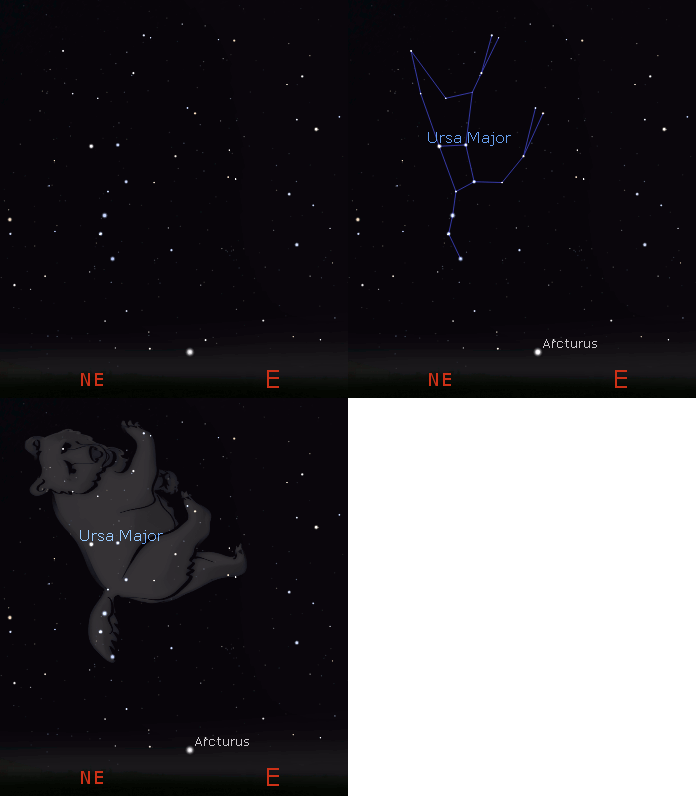
Arcturus rising finder animation for 9 pm tonight, March 11, 2021. Created using Stellarium and GIMP.
03/10/2021 – Ephemeris – Searching for the naked-eye planets for this week
This is Ephemeris for Wednesday, March 10th. Today the Sun will be up for 11 hours and 39 minutes, setting at 6:42, and it will rise tomorrow at 7:01. The Moon, 3 days before new, will rise at 6:43 tomorrow morning.
Let’s search for the naked-eye planets for this week. Unfortunately the only one you’ll find in the evening is Mars. It can be found high in the west-southwest at 8 pm tonight, between the Pleiades star cluster on its right and the letter V of stars that is the face of Taurus the bull on its left. Mars will set at 1:13 am. Right now the other four naked eye planets are just west of the Sun in the Morning sky. But only Saturn is at a far enough angle to be just be glimpsed in the morning sky. It will rise at 5:27, about an hour and a half before sunrise in the east-southeast. By 6 am it will have risen and moved to the southeast. Even Jupiter might be spotted lower and left of Saturn, especially if you’re looking across the Lake Huron horizon.
The astronomical event times given are for the Traverse City/Interlochen area of Michigan. They may be different for your location.
Addendum
Mars finder chart for tonight March 10, 2021 at 8 pm. Click on the image to enlarge. Created using Stellarium.
The morning planets at 6 am, Thursday, March 11, 2021. Created using Stellarium.
Planets and the Moon at sunset and sunrise of a single night starting with sunset on the right on March 10, 2021. The night ends on the left with sunrise on the 11th. The planet traffic jam in the morning is starting to break up. Saturn and possibly Jupiter can be spotted before sunrise now. Click on the image to enlarge. Created using my LookingUp program.
03/09/2021 – Ephemeris – A celestial warning to keep off thin ice
This is Ephemeris for Tuesday, March 9th. Today the Sun will be up for 11 hours and 35 minutes, setting at 6:41, and it will rise tomorrow at 7:03. The Moon, halfway from last quarter to new, will rise at 6:12 tomorrow morning.
The native Anishinaabe peoples of the Great Lakes Region, which includes the tribes of our area, have one constellation of winter I know of. It is The Wintermaker which uses many of Orion’s stars and whose arms stretch from Aldebaran in Taurus the bull to Procyon the Little Dog Star, embracing the whole of the winter sky. Now that spring is nearly here he is sinking into the west, losing to the heat of the Sun. The first constellation of spring is Curly Tail, or the Great Underwater Panther. It uses the stars of Leo the lion’s backward question mark as its curly tail and the small knot of stars that are the head of Hydra the water snake below Cancer the crab as its head. His warning: Keep off the thinning ice or break through and be snatched by the great panther that lives below.
The astronomical event times given are for the Traverse City/Interlochen area of Michigan. They may be different for your location.
Addendum
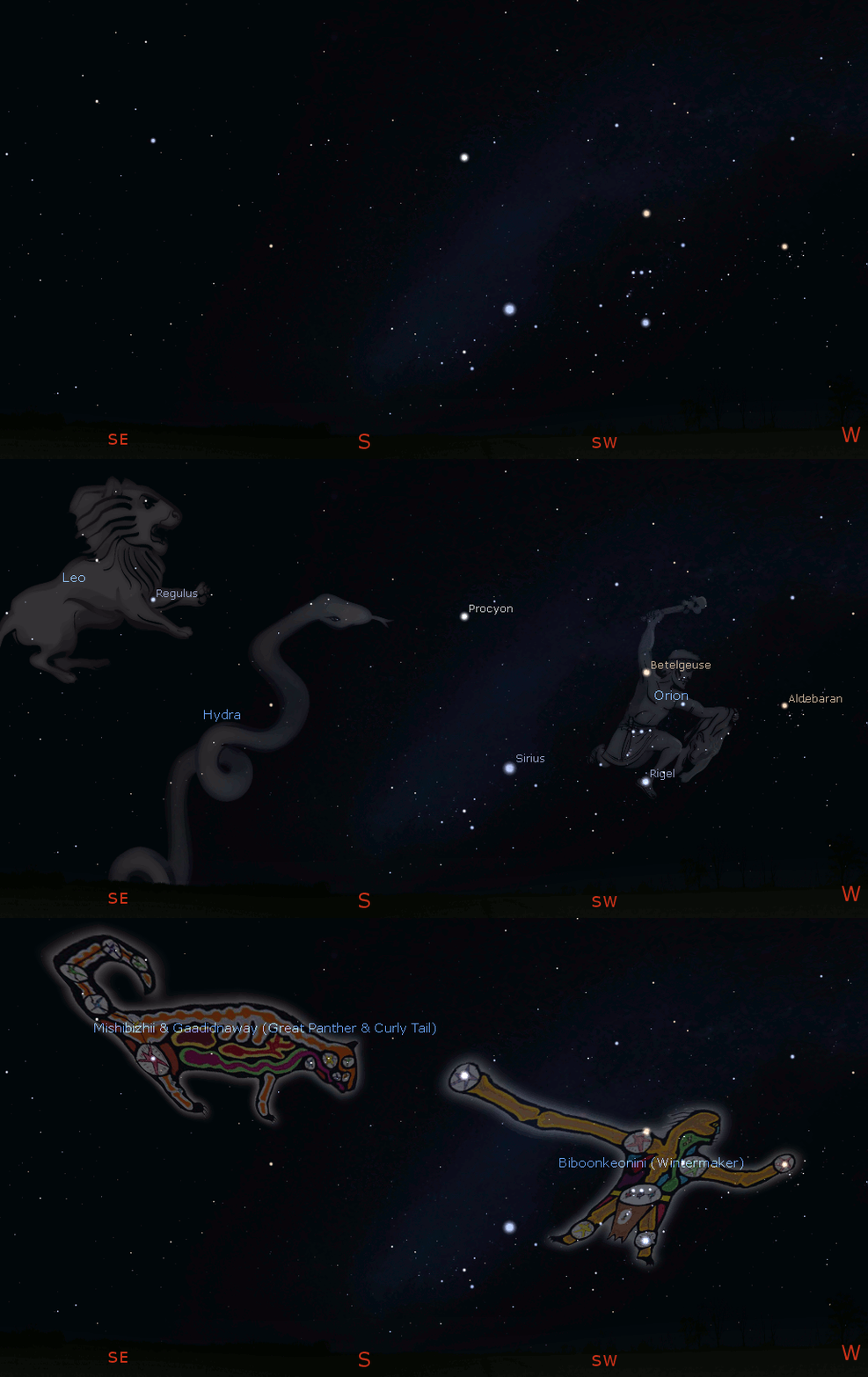
The Great Underwater Panther finder animation. Three frame animation of Unannotated sky, International Astronomical Union constellations, and Anishinaabe (Ojibwe) constellations of Curly Tail and Wintermaker. Click on the image to enlarge. Created using Stellarium and GIMP. Additional credits below.
The time is set for the above image is 10 pm on March 9th.
The constellation art is part of the latest versions of Stellarium. Ojibwe (Anishinaabe) constellation art by Annette S Lee and William Wilson from Ojibwe Sky Star Map Constellation Guide, ISBN 978-0-615-98678-4. There is also an Ojibwe Sky Star Map poster suitable for framing.
03/08/2021 – Ephemeris – 45 years ago today I saw and photographed Comet West!
This is Bob Moler with Ephemeris for International Women’s Day, Monday, March 8th. Today the Sun will be up for 11 hours and 32 minutes, setting at 6:40, and it will rise tomorrow at 7:05. The Moon, 3 days past last quarter, will rise at 5:34 tomorrow morning.
On this day 45 years ago, in 1976, during the first year of these Ephemeris programs I was able to report on, observe and photograph the brightest comet I had seen up till that time: Comet West. It was not supposed to be a bright comet, but as it rounded the Sun, it began to brighten spectacularly. Later I found out that it’s nucleus broke into several fragments, liberating a great quantity of gas and dust. It turned out to be a very dusty comet which ended up in a broad and bright tail. It was going to be visible before sunrise, and this was the first morning in a while it was clear. Even before the head of the comet rose, the tail could be seen rising in the east. I was able to get several photographs of this wonderful comet!
The astronomical event times given are for the Traverse City/Interlochen area of Michigan. They may be different for your location.
Addendum
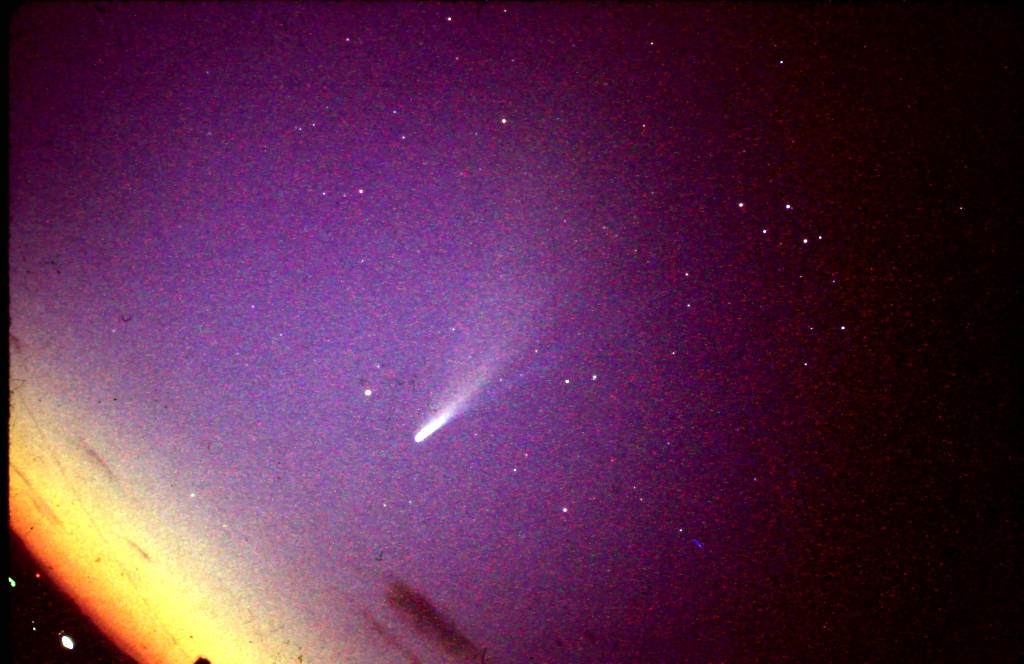
Comet West, C/1975 V1, as photographed by me at about 6 am, March 8, 1976. The wide, curved dust tail is most prominent with the narrow blue ion tail pointed more directly at the rising Sun. The small summer constellation of Delphinus the dolphin is to the upper right. The diamond shape of stars at the front of the dolphin’s body is an asterism called Job’s Coffin.
In the image above is tilted about 45 degrees to the horizon in the lower left due to the fact that it was on an equatorial mount, where up and down is north and south in the sky, horizontally is east and west. It’s cocked 45 degrees to the horizon because we are at 45 degrees latitude. Actually the angle is 90 – your latitude which around here is 90 – 45 = 45.
I got up early in the morning of March 8th 1976. I had my telescope mount outside because it takes awhile to set it up to true north and everything. The telescope and camera that mounts on it were taken inside. I just left it there covered with a tarp and wasn’t observing too much that winter. When I got up in wee hours of the morning of the eighth I found out that my telescope mount was buried in the middle of a snowdrift, so I had to dig it out. As I was digging it out I looked to the east and saw the tail of the comet rising before the head did. I then redoubled my efforts and got everything set up so I could take photographs of the comet.
I had built a small telescope a few years before for a solar eclipse as a kind of contingency camera in case my automatic cameras I had built didn’t work. It was a 108 mm f/6 reflecting telescope that I attached a camera back to and took some minute or two long exposures that way. I then realized that the sky was getting brighter, so I quickly switched, and took a couple of wide angle pictures with the 50 mm lens with tracking. That’s one of them above that shows the lovely comet with the long tail.
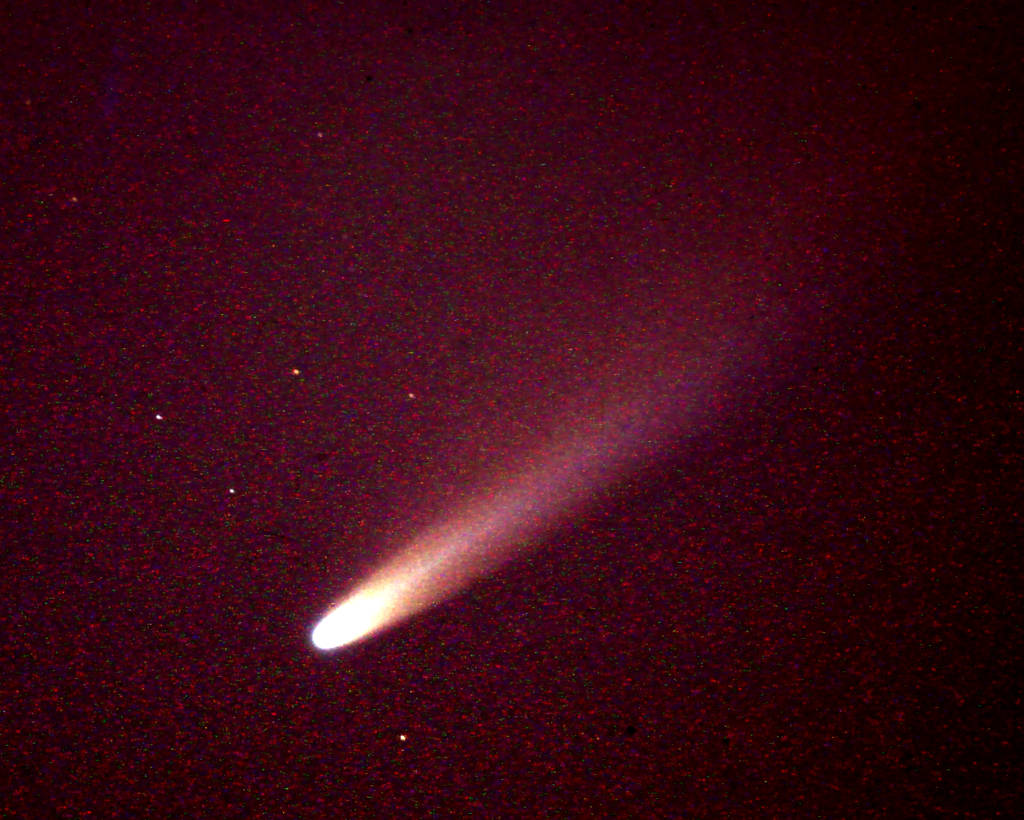
Comet West taken through the 108 mm f/6 telescope around 5:30 am, March 8, 1976 by a much younger me.
03/05/2021 – Ephemeris – Virtual Star Party Tonight!
This is Ephemeris for Friday, March 5th. Today the Sun will be up for 11 hours and 23 minutes, setting at 6:36, and it will rise tomorrow at 7:11. The Moon, at last quarter today, will rise at 2:41 tomorrow morning.
The Grand Traverse Astronomical Society will host a virtual star party at 8 pm tonight. It is via the Zoom app for smartphones, tablets or computers. It will be hosted by Dr. Jerry Dobek, astronomy professor at Northwestern Michigan College. During a virtual star party the images are produced real time or near real time using a telescope mounted digital camera. That is if it’s clear. If cloudy we’ll have a virtual, virtual star party using recently acquired images captured for his astronomy classes. In January, we got a tantalizing look at the Great Orion Nebula. We’ll explore more of these wonders. It should be spectacular! Instructions to join and a link can be found on the society’s website gtastro.org.
The astronomical event times given are for the Traverse City/Interlochen area of Michigan. They may be different for your location.
03/04/2021 – Ephemeris – A very crabby constellation
Mar 4. This is Ephemeris for Thursday, March 4th. Today the Sun will be up for 11 hours and 20 minutes, setting at 6:34, and it will rise tomorrow at 7:12. The Moon, 1 day before last quarter, will rise at 1:26 tomorrow morning.
Lying between the stars Castor and Pollux in Gemini high in the southeast and the star Regulus in Leo the Lion in the east-southeast is the dimmest constellation of the zodiac, Cancer the crab. To me its 5 brightest stars make an upside down Y. There are the stars in the center of the constellation Asellus Borealis and Asellus Australis, the north and south donkeys. There’s a fuzzy spot between and just west of them called Praesepe, the manger from which they are supposedly eating. In binoculars, it resolves into a cluster of stars called the Beehive star cluster. We amateur astronomers also know it as M 44, the 44th object on 18th century comet hunter Charles Messier’s list of fuzzy objects that might be mistaken for comets.
The astronomical event times given are for the Traverse City/Interlochen area of Michigan. They may be different for your location.
Addendum
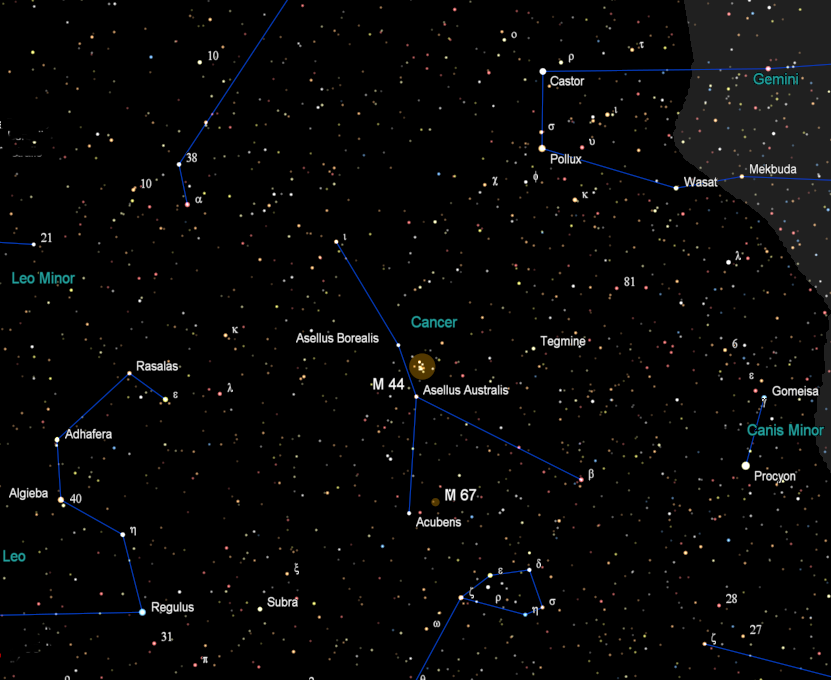
The constellation Cancer finder chart. Created using Cartes du Ciel (Sky Charts).
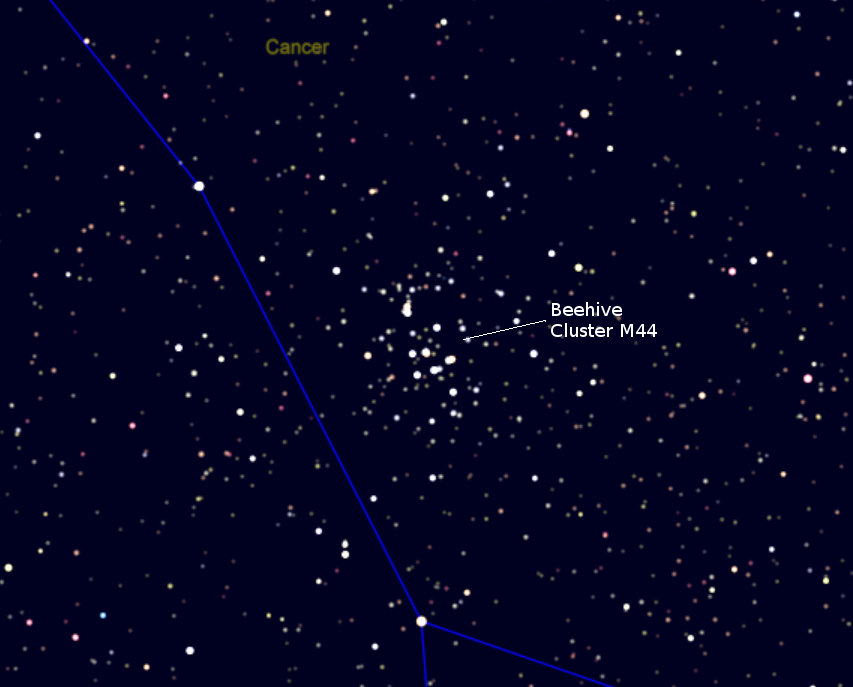
The Beehive star cluster, M44. Its ancient name was the Praesepe or manger when glimpsed by the naked eye. Created using Cartes du Ciel (Sky Charts)
Note in the top image above the star cluster M 67 at the bottom of Cancer, near the star Acubens. M 67 requires a small telescope to spot. They are both open or galactic star clusters which lie in or very near the plane of the Milky Way, denoted by the milky band. Part of the milky band can be seen at the upper right of the chart. M 44 is quite close to us, at only 610 light years away so is physically close to the plane of the Milky Way. M67, however is 2,610 to 2,930 light years away and is quite a bit farther than M 44 from the plane of the Milky Way. It is also much older (4 billion years old) than the stars of the Beehive (600 to 700 years old).
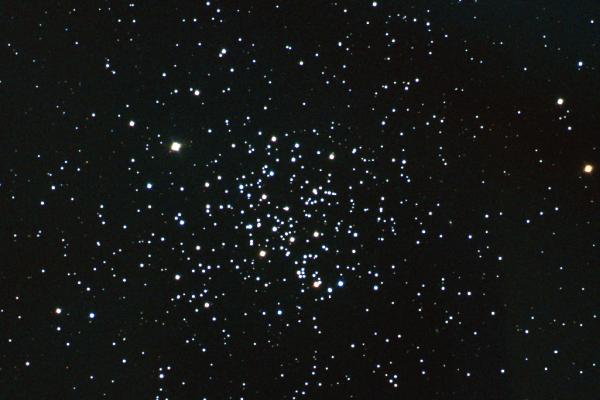
M67 is a beautiful telescopic object. Credit Nigel Sharp, Mark Hanna, AURA/NOAO/NSF.
 Bob Moler's Ephemeris Blog