Archive
06/16/2021 – Ephemeris – Let’s search for the naked-eye planets for this week
This is Bob Moler with Ephemeris for Wednesday, June 16th. Today the Sun will be up for 15 hours and 34 minutes, setting at 9:30, and it will rise tomorrow at 5:56. The Moon, 1 day before first quarter, will set at 1:55 tomorrow morning.
Let’s search for the naked-eye planets for this week. Venus can be spotted low in the west-northwest twilight by 10 pm or a little after. Venus will set at 11:04 pm. Mars can be found in the west-northwest at 10:30 tonight, It’s in Cancer and by next Wednesday will pass in front of the Beehive star cluster which can be easily seen in a pair of binoculars. Check it out each night before then and watch Mars approach the cluster, now to its upper left. Mars will set at 11:55 pm. Jupiter and Saturn, are in the morning sky. Saturn will rise at 12:12 am. It’s seen with the stars of Capricornus. Brighter Jupiter, to the left of Saturn, will rise at 1:01 am. By 5 am, these two planets will be in the south-southeast in the morning twilight.
The astronomical event times given are for the Traverse City/Interlochen area of Michigan. They may be different for your location.
Addendum
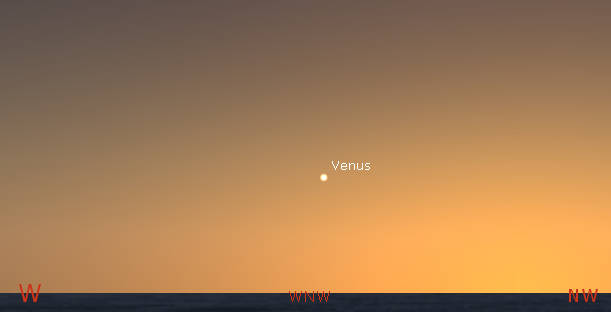
Venus in evening twilight at 10 pm or a half hour after sunset tonight over a sea or Lake Michigan horizon. Venus is a bit less than 10 degrees altitude. Created using Stellarium.
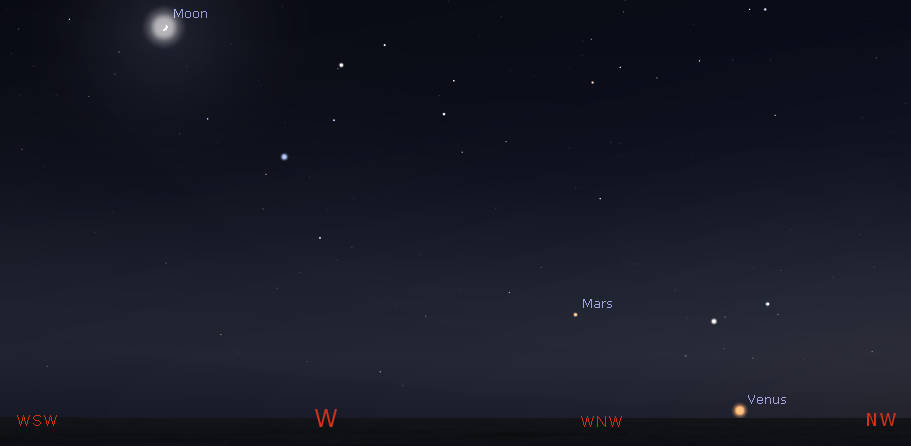
The Moon, Mars and Venus at 11 pm or an hour and a half after sunset tonight over a sea or Lake Michigan horizon. Click on the image to enlarge. Created using Stellarium.
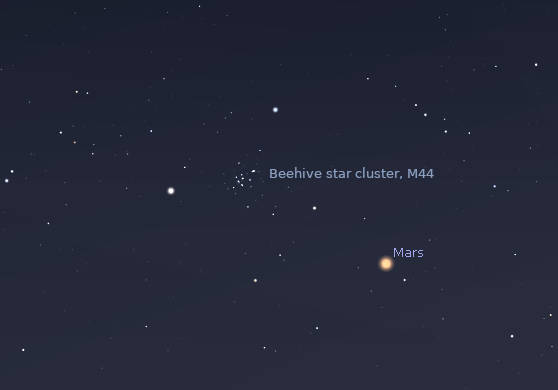
Mars and the Beehive star cluster at 11 pm tonight as they might be seen in binoculars. Created using Stellarium.
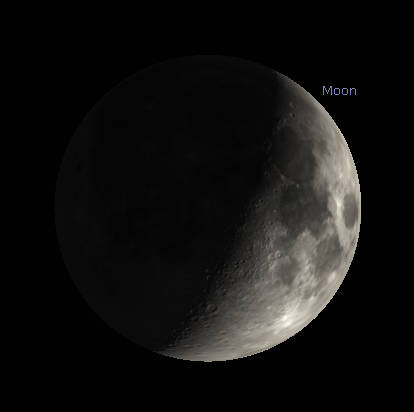
The Moon as it might appear tonight in binoculars or small telescope tonight. Created using Stellarium.
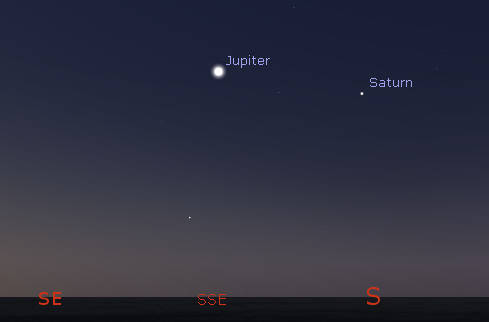
Jupiter and Saturn at 5 am or an hour before sunrise tomorrow morning. Created using Stellarium.
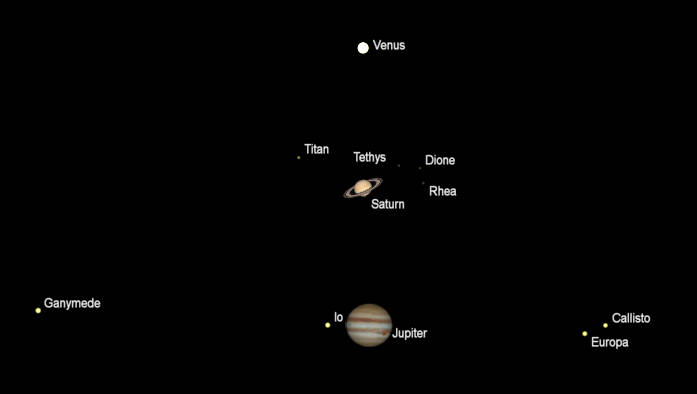
Telescopic views of Venus, Saturn and Jupiter. Venus at the same magnification. Venus, seen at 10 pm, will be 10.72″ in diameter. Saturn at 5 am will be 18.00″ in diameter, its rings 44.43″ in extent. And Jupiter will be 43.43″. The normal cutoff for whether to show a planet here is an apparent diameter of 10″ or greater. Mars doesn’t make the cut, its apparent diameter will be 3.98″ tonight. The ” symbol means seconds of arc (1/3600th of a degree). Created using Cartes du Ciel (Sky Charts).
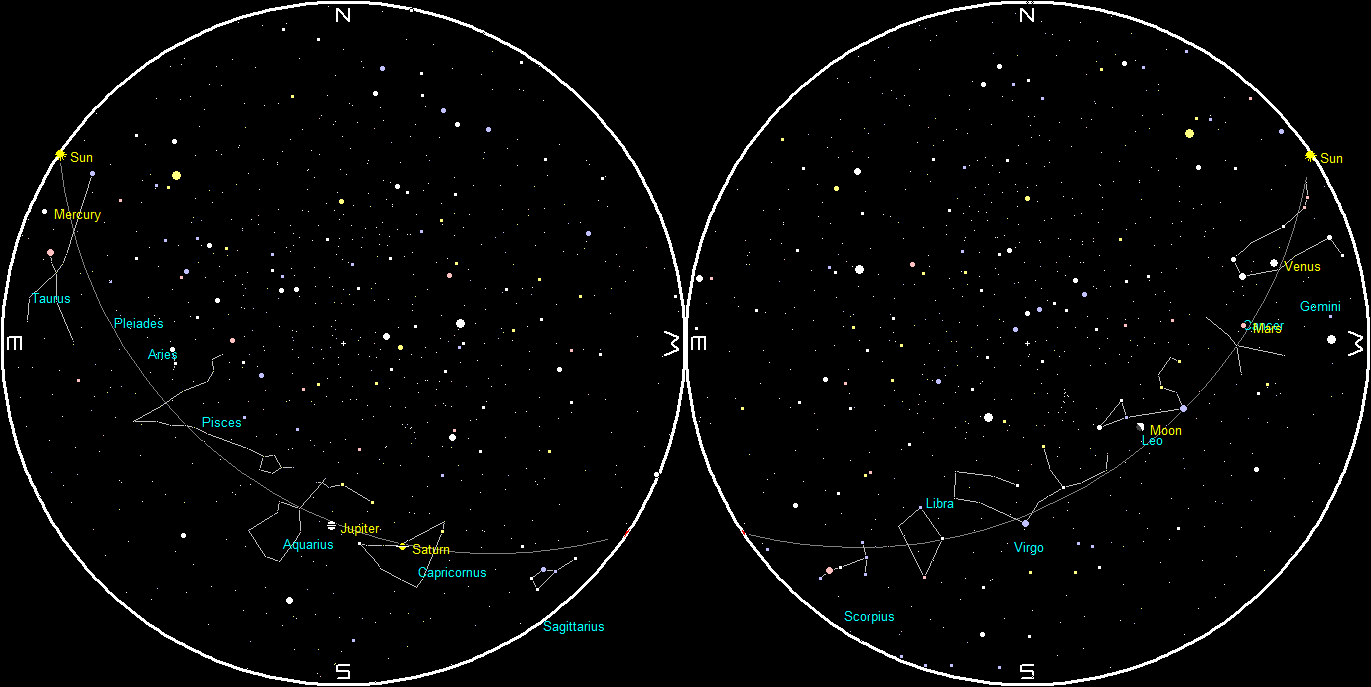
Planets and the Moon at sunset and sunrise of a single night, starting with sunset on the right on June 16, 2021. The night ends on the left with sunrise on the 17th. Click on the image to enlarge. Created using my LookingUp program.
06/15/2021 – Ephemeris – Today we had the earliest sunrise of the year
This is Ephemeris for Tuesday, June 15th. Today the Sun will be up for 15 hours and 33 minutes, setting at 9:30, and it will rise tomorrow at 5:56. The Moon, 2 days before first quarter, will set at 1:29 tomorrow morning.
Today is the day of the year with the earliest sunrise, which in the Interlochen/Traverse City area is 6:56 am. We are 5 days before the summer solstice, the longest day in terms of sunshine hours. With the Sun nearing its maximum angle above the celestial equator, the projection of the Earth’s equator on the sky it cuts those longitude timelines quicker because they are closer together than at the equator. This is counters somewhat the Sun’s speed slowing down as the Earth is reaching the farthest point in its orbit. The latest sunset will occur about June 26th, a span of 11 days. In December the span between the earliest sunset and latest sunrise because of the Sun’s increased speed, by being nearly at its closest to us, is 24 days.
The astronomical event times given are for the Traverse City/Interlochen area of Michigan. They may be different for your location.
Addendum
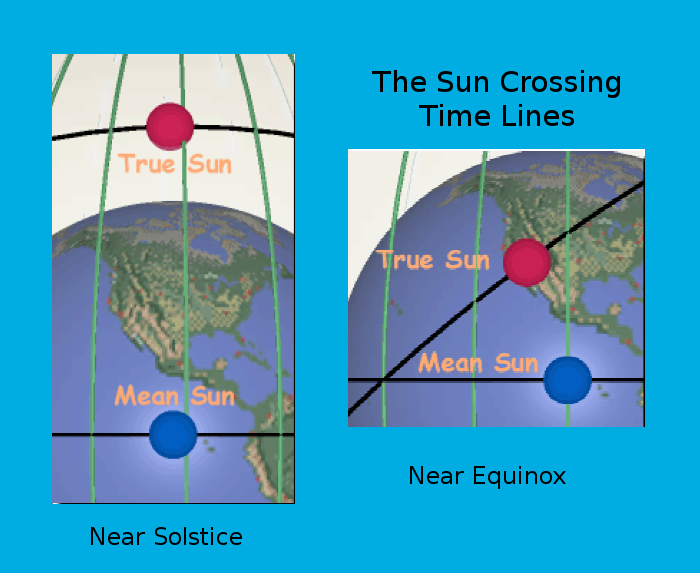
How the Sun’s declination affects how rapidly it appears to cross time lines (meridians)
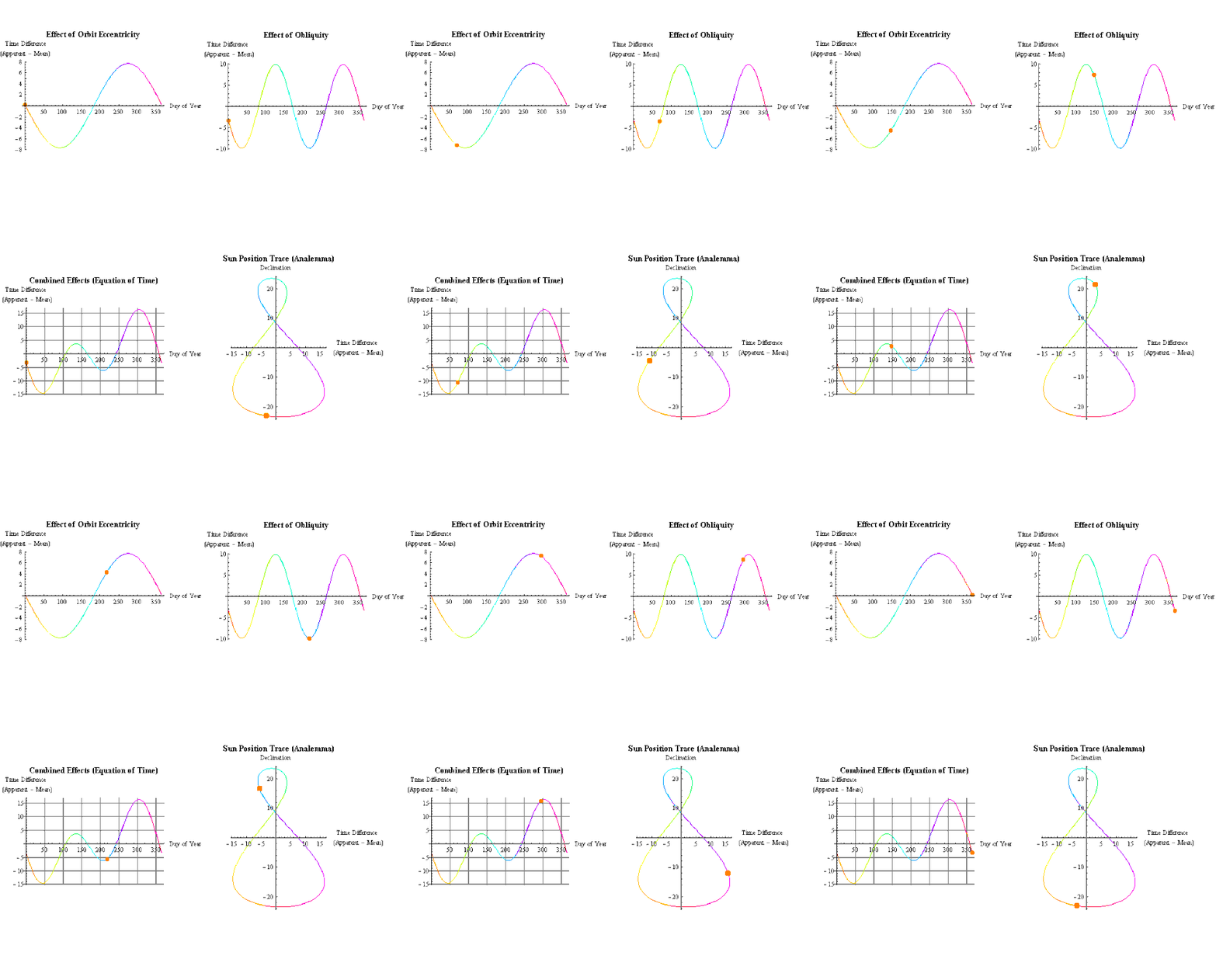
These graphs show how the earth’s orbit eccentricity and tilt of the Earth’s axis (obliquity) affect sundial time keeping vs. actual clocks. This also affects sunrise and sunset times. The figure 8 in the lower right is the analemma, sometimes seen on old Earth globes, a graphical representation of the equation of time (sundial corrections from apparent to mean solar time).
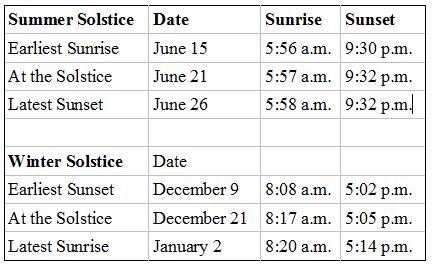
Table of Earliest and Latest Sunrises and Sunsets during the year for Interlochen/Traverse City area of Michigan. This table was created for 2017, 4 years ago. However, the instant of the summer solstice occurred just after midnight on June 21st, That instant slipped back into just before midnight in 2021. This is why we use the Gregorian calendar. The slide is corrected by having 3 out of four century years being normal years.
06/14/2021 – Ephemeris – Images of the Moon: Then and now
This is Bob Moler with Ephemeris for Flag Day, Monday, June 14th. Today the Sun will be up for 15 hours and 33 minutes, setting at 9:29, and it will rise tomorrow at 5:56. The Moon, 3 days before first quarter, will set at 1 am.
The waxing crescent Moon shows its cratered highlands and flat lava plains that early telescopic astronomers fancied as water filled and called them seas, so the nomenclature stuck, and we call them seas to this day. When I grew up in the 1950s I was captivated by the moonscapes painted by Chesley Bonestell with their sharp rugged mountain peaks. The actual lunar landscape turned out to be softer, more rounded. The Earth’s surface features are younger than the Moon’s due to plate tectonics, something few geologists in the 1950s believed in. The Moon’s features are generally billions of years old and erosion by meteoroid impacts and ejecta have covered the landscape with a fine dust, over the eons, that smooths out its features.
The astronomical event times given are for the Traverse City/Interlochen area of Michigan. They may be different for your location.
Addendum
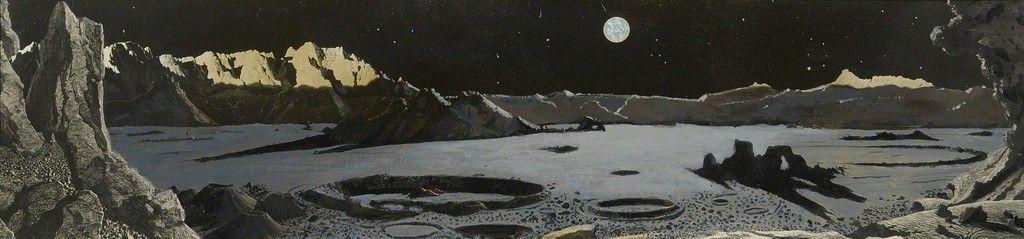
A Chesley Bonestell moonscape. Note the sharp detail including an arch at center right and an overhang at right. Such was the state of our ignorance before spacecraft like Ranger, Surveyor, Lunar Orbiter and Apollo reached the Moon. Click on the image to enlarge. Credit Chesley Bonestell.
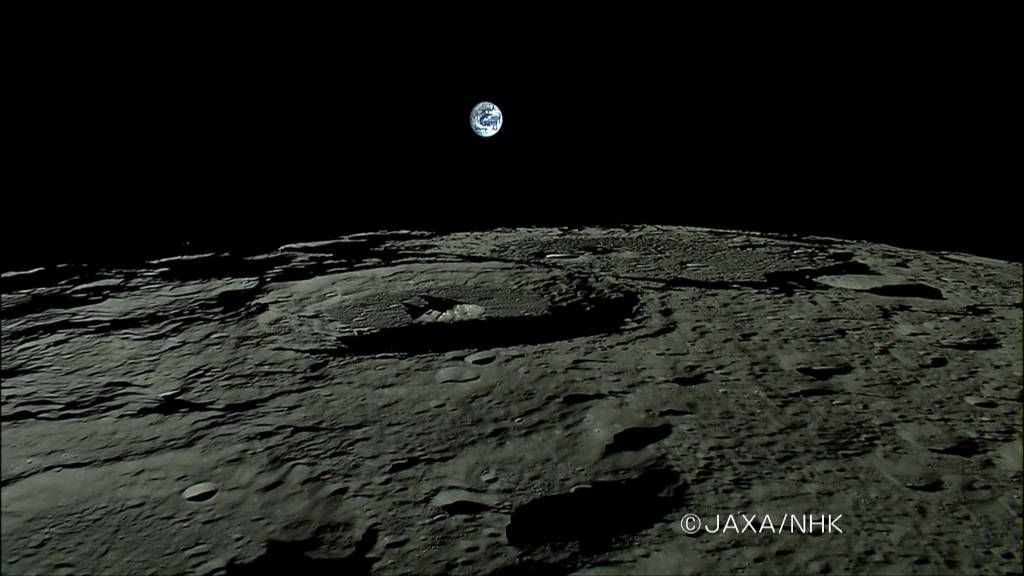
Moonscape photographed by JAXA (Japan) spacecraft Kaguya with about the same orientation as the Bonestell painting, except from orbit. Click on the image to enlarge. Credit JAXA/NHK.
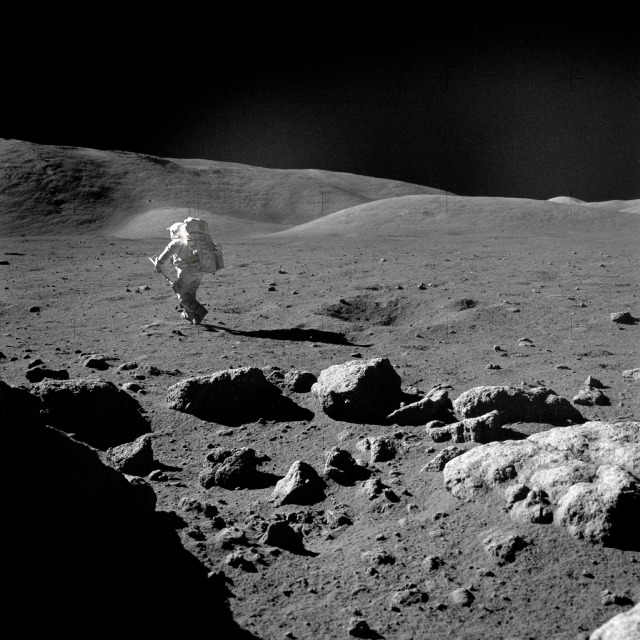
Image from Apollo 17 showing lunar erosion. Even the rocks in the foreground show that they were eroded. The image also shows astronaut Dr. Harrison “Jack” Schmidt. Click on the image to enlarge. Credit NASA.
06/11/2021 – Ephemeris – Spotting the one-day-old Moon
This is Bob Moler with Ephemeris for Friday, June 11th. Today the Sun will be up for 15 hours and 31 minutes, setting at 9:28, and it will rise tomorrow at 5:56. The Moon, 1 day past new, will set at 10:56 this evening.
Tonight the thin crescent Moon, some 40 hours old, or more properly 40 hours from eclipsing the Sun, will be to the right and a bit below the bright planet Venus. It might be possible to spot it. I do remember spotting the tiny sliver of a Moon the next evening after a solar eclipse in 1970. But that was in March*, when the ecliptic, the path of the Sun and near the path of all the planets and the Moon, was angled more vertically than it is this time of year. That means that the Moon and planets, when near the Sun, are lower in the sky after sunset than they would be in late winter and early spring. Venus is slowly moving away from the Sun, from our vantage point, while Mars, above and left of it, is slowly retreating toward the Sun. Their apparent paths will cross on July 13th.
The astronomical event times given are for the Traverse City/Interlochen area of Michigan. They may be different for your location.
* On the program, I mistakenly said April.
Addendum
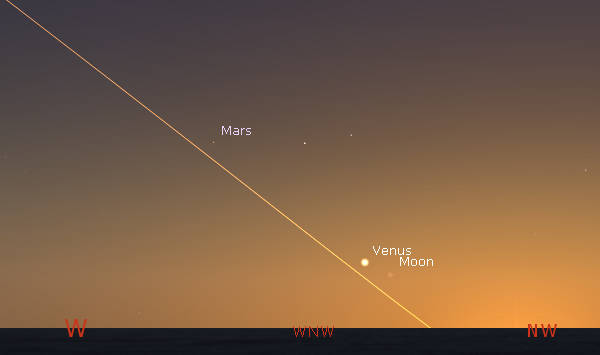
Sunset sky and ecliptic (orange line) 45 minutes after sunset tonight, June 11, 2021. Note the low angle of the ecliptic, the apparent path of the Sun and near the path of the planets. The angle will get even lower as summer progresses. So planets close to the Sun will set shortly after the Sun. Created using Stellarium.
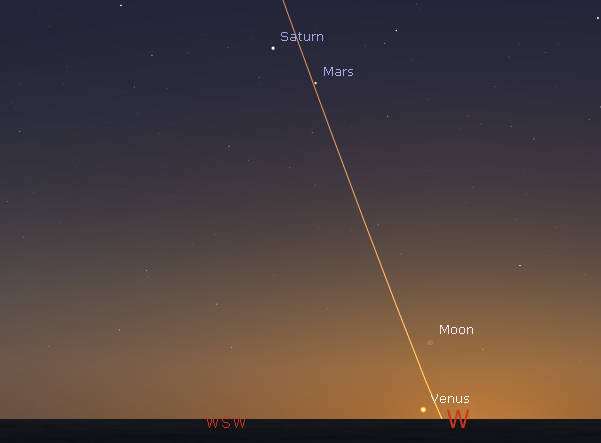
This is the sky one day after the March 7, 1970 eclipse and 45 minutes after sunset. Being March, note how steep the angle of the ecliptic, so planets close to the Sun are higher in the sky. Also, twilight ends quicker in March than in June.
Ephemeris Extra – Sunrise solar eclipse
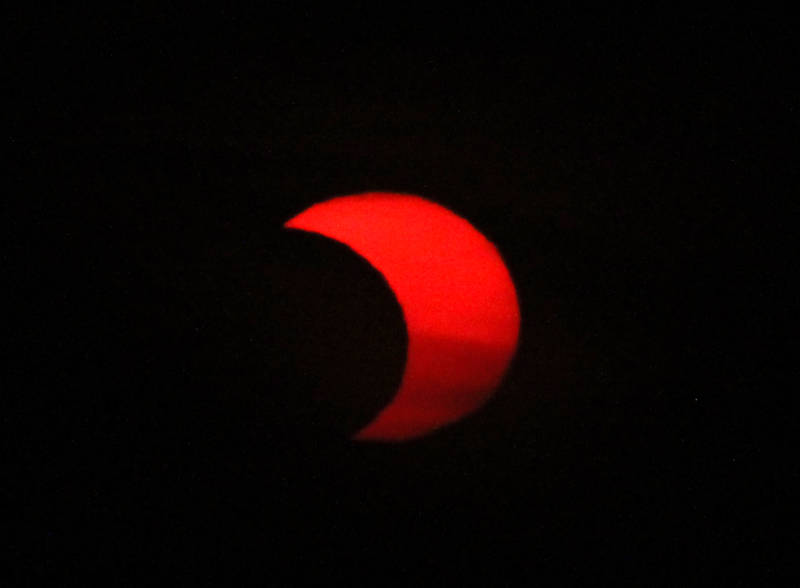
The partially eclipsed Sun this morning, taken through a solar filter, so it’s redder than it actually was. Taken shortly after 6 am from Traverse City, MI West Middle School. There were quite a bit of clouds on the horizon. Credit Bob Moler.
Here is an unfiltered view taken a few minutes earlier:
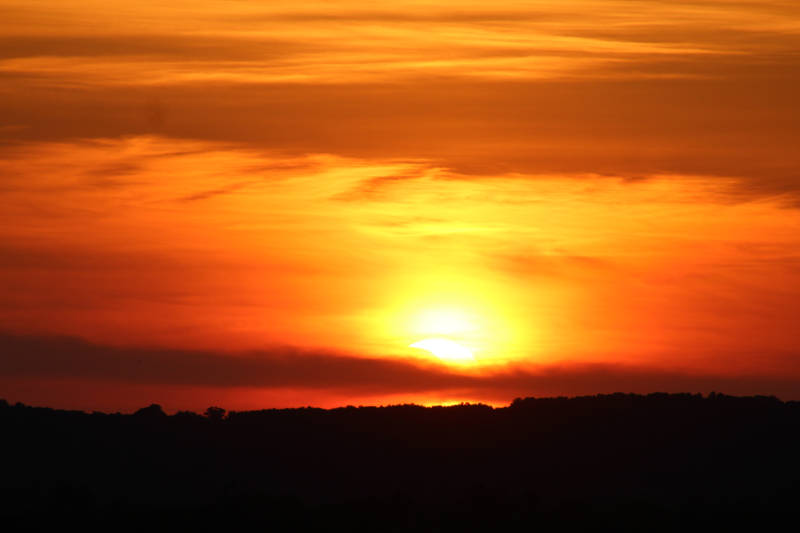
Here is an unfiltered shot of the Sun bisected by a cloud. Credit Bob Moler.
06/10/2021 – Ephemeris – Let’s take a belated search for the naked-eye planets for this week
This is Ephemeris for Thursday, June 10th. Today the Sun will be up for 15 hours and 30 minutes, setting at 9:27, and it will rise tomorrow at 5:56. The Moon is new today, and won’t be visible.
Let’s take a belated look at the naked-eye planets for this week. Venus can be spotted low in the west-northwest twilight by 10 pm or a little after. Venus will set at 10:58 pm. Mars can be found in the west at 10:30 tonight, and about to leave the constellation of Gemini, the twins. Tonight it’s below and left of Gemini’s brightest star, Pollux. Mars will set at 12:10 am. Jupiter and Saturn, are in the morning sky. Saturn will rise at 12:40 am. It’s seen with the stars of Capricornus. It has begun its retrograde or westward motion caused by the fact that we are viewing it from another moving planet. Brighter Jupiter, is now in Aquarius, and will rise at 1:28 am. By 5 am, these two planets will be in the south-southeast in the morning twilight.
The astronomical event times given are for the Traverse City/Interlochen area of Michigan. They may be different for your location.
Addendum
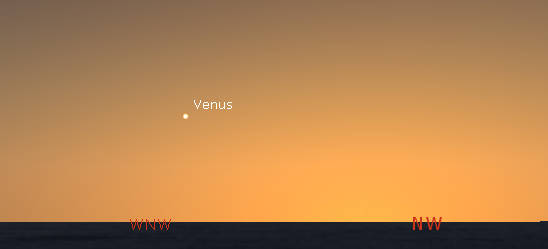
Venus in the evening twilight at 10 pm or a half hour after sunset tonight, June 10, 2021. Created using Stellarium.
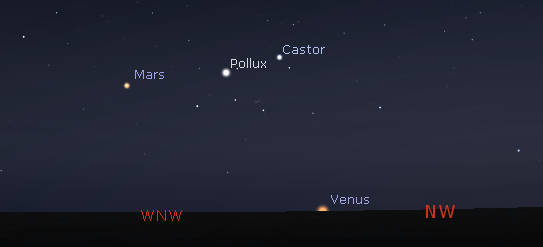
Mars in the evening with Castor and Pollux at 11 pm or about an hour and a half after sunset. Created using Stellarium.
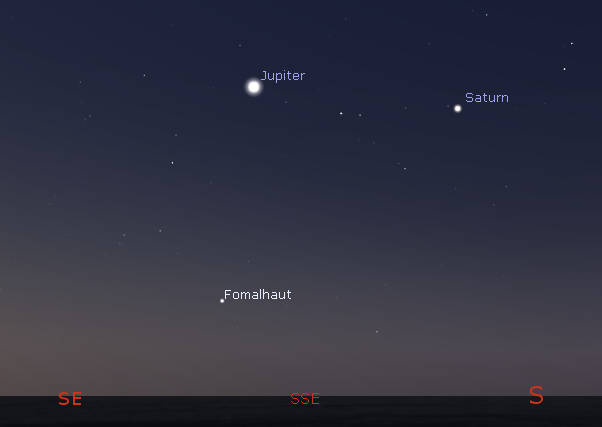
Jupiter and Saturn at 5 am, one hour before sunrise. Created using Stellarium.
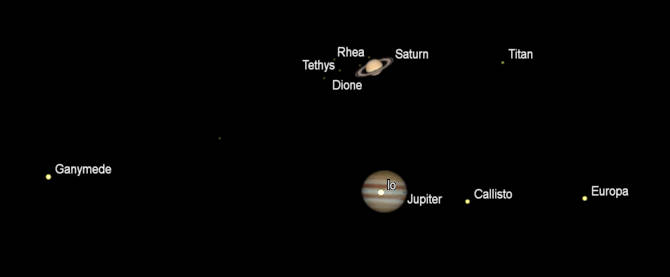
Saturn and Jupiter as seen in a small telescope at the same magnification at 5 am June 11, 2021. Apparent diameters: Saturn, 17.85″, rings, 41.58″; Jupiter, 42.60″. Mars is too far away to make out detail on its surface, except maybe a polar cap. Its apparent diameter is 4.04″. Venus’ apparent diameter is 10.55″ and will be added when it gets far enough from the Sun to be easily seen. The normal cutoff for whether to show a planet here is an apparent diameter of 10″ or greater. The ” symbol means seconds of arc (1/3600th of a degree). Note that Io is transiting the face of Jupiter. It would normally not be visible, but its shadow on Jupiter might be. Created using Cartes du Ciel (Sky Charts).
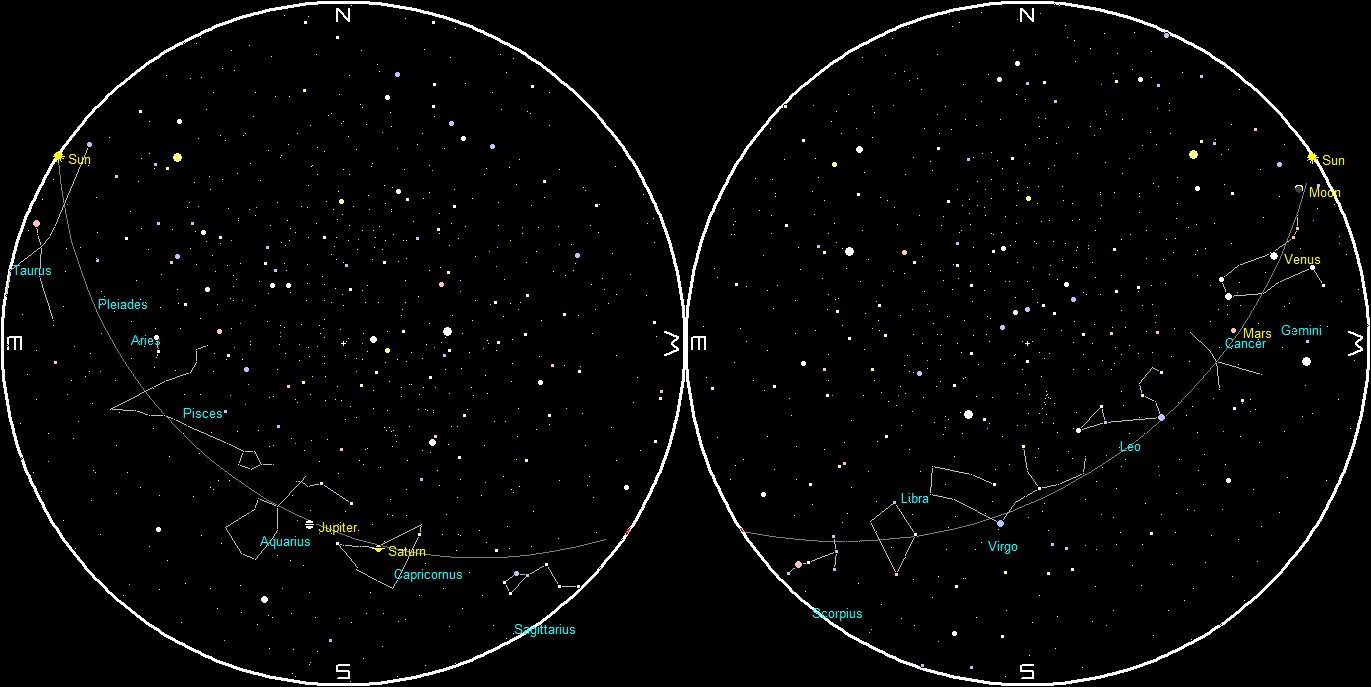
Planets and the Moon at sunset and sunrise of a single night, starting with sunset on the right on June 10, 2021. The night ends on the left with sunrise on the 11th. Click on the image to enlarge. Created using my LookingUp program.
06/09/2021 – Ephemeris – The Sun will be partially eclipsed as it rises tomorrow morning
I’ll review the planets tomorrow. However, tomorrow morning, if it’s clear down to the northeastern horizon, we will get to observe, safely, the Sun rise while being in eclipse. Here’s today’s program:
This is Ephemeris for Wednesday, June 9th. Today the Sun will be up for 15 hours and 30 minutes, setting at 9:27, and it will rise tomorrow at 5:57. The Moon, 1 day before new today, will rise with the Sun at 5:57 tomorrow morning.
The Moon rising with the Sun will also be eclipsing the Sun, so the Sun will have a big bite taken out of its left side as it rises tomorrow. We will be witnessing the last 40 some minutes of the eclipse as the Sun rises. The Sun is dangerous to look at. If you have eclipse glasses from the 2017 eclipse, use those. Otherwise, use pinhole projection from one side of a box to the opposite side. The longer the box, the bigger and dimmer the image. If using a corrugated cardboard box, make a big hole at the pinhole end, cover it with a thin piece of cardboard or aluminum foil. Punch several holes of various sizes spaced out on that end to project multiple images of the Sun, so you can choose the best to view. Good luck!
The astronomical event times given are for the Traverse City/Interlochen area of Michigan. They may be different for your location.
Addendum
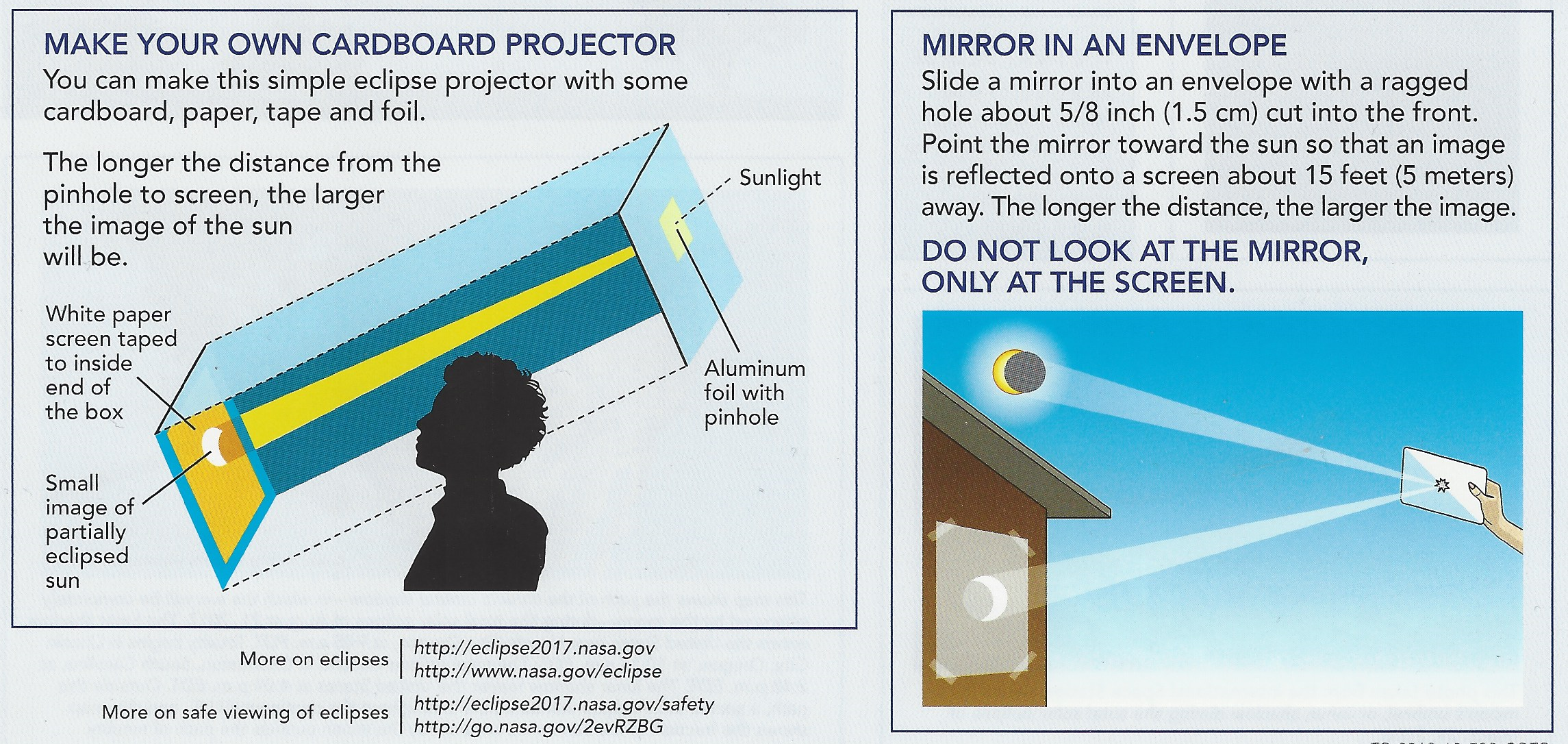
Pinhole projection is the simplest way to project the Sun’s image. A long box can be used to project the image inside. The diameter of the pinhole is a compromise between sharpness and brightness of the image. The farther the image is projected, the larger and dimmer it is. The throw of the image can be increased by using a mirror masked with a quarter of an inch or larger hole and sending the image 10 or more feet away. Credit NASA.
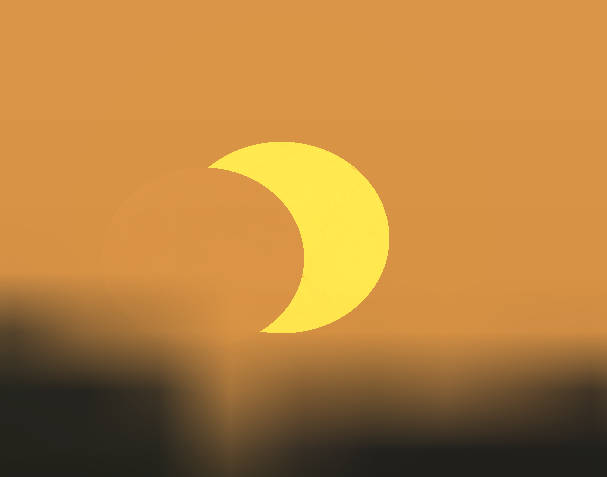
A Stellarium creation of what the eclipsed Sun would appear about 10 minutes after rising as seen from the Traverse City/Interlochen area.
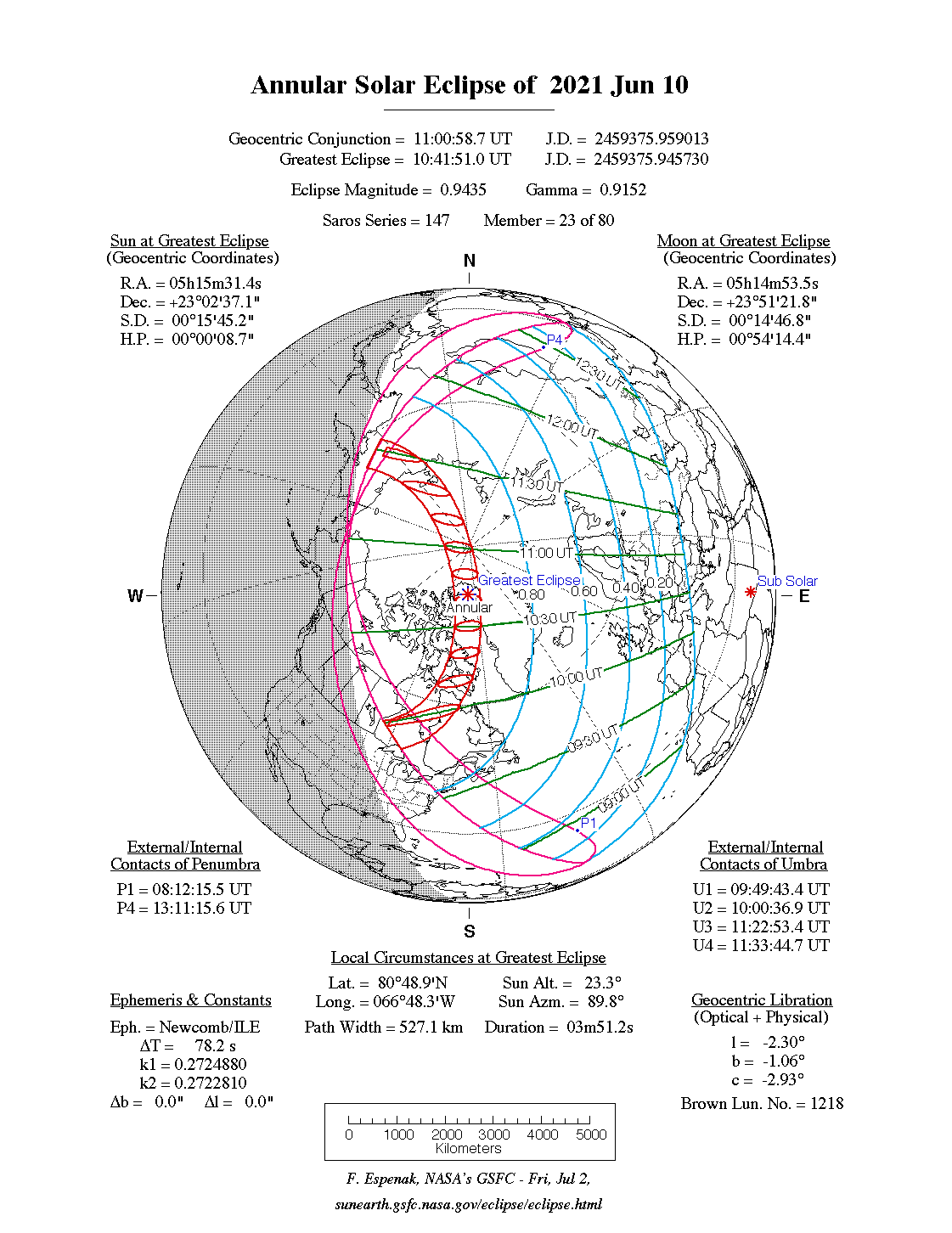
The visibility map for the June 10, 2021 annular solar eclipse. In an annular eclipse, the Moon is too far away and appears too small to cover the face of the Sun. So, at maximum, a ring of bright Sun surrounds the Moon. It’s sometimes called a ring of fire. For locations within the big floppy figure 8, the eclipse either ends near sunrise (bottom lobe) or starts near sunset (top lobe). The double line with the ellipses in it is the path of where the ring is visible, the path of annularity. Locations within the grid on the right will see a partial eclipse. Credit: NASA/GSFC/Fred Espenak, adapted from https://eclipse.gsfc.nasa.gov/SEplot/SEplot2001/SE2021Jun10A.GIF
06/08/2021 – Ephemeris – The Sun will be partially eclipsed as it rises Thursday
This is Ephemeris for Tuesday, June 8th. Today the Sun will be up for 15 hours and 29 minutes, setting at 9:26, and it will rise tomorrow at 5:57. The Moon, 2 days before new, will rise at 5:22 tomorrow morning.
Thursday morning we in Michigan will witness the last moments of a solar eclipse as the Sun rises. The Sun will be partially eclipsed at sunrise north of a line from North Dakota to South Carolina. For those in a path that will run from the north shore of Lake Superior across western Ontario, through parts of Hudson Bay, to clipping the North Pole and into Siberia will see an annular eclipse. That is, the Moon is too far away, and small to cover the face of the Sun, leaving a bright ring or annulus. A ring of fire, some would say. For us, the Sun will rise around 5:57 am with the Moon taking a big chunk out of its left side. That chunk will recede until the Sun will appear whole again around 6:42 am. I’ll discuss how to view this eclipse tomorrow.
The astronomical event times given are for the Traverse City/Interlochen area of Michigan. They may be different for your location.
Addendum
A Stellarium creation of what the eclipsed Sun would appear about 10 minutes after rising as seen from the Traverse City/Interlochen area.
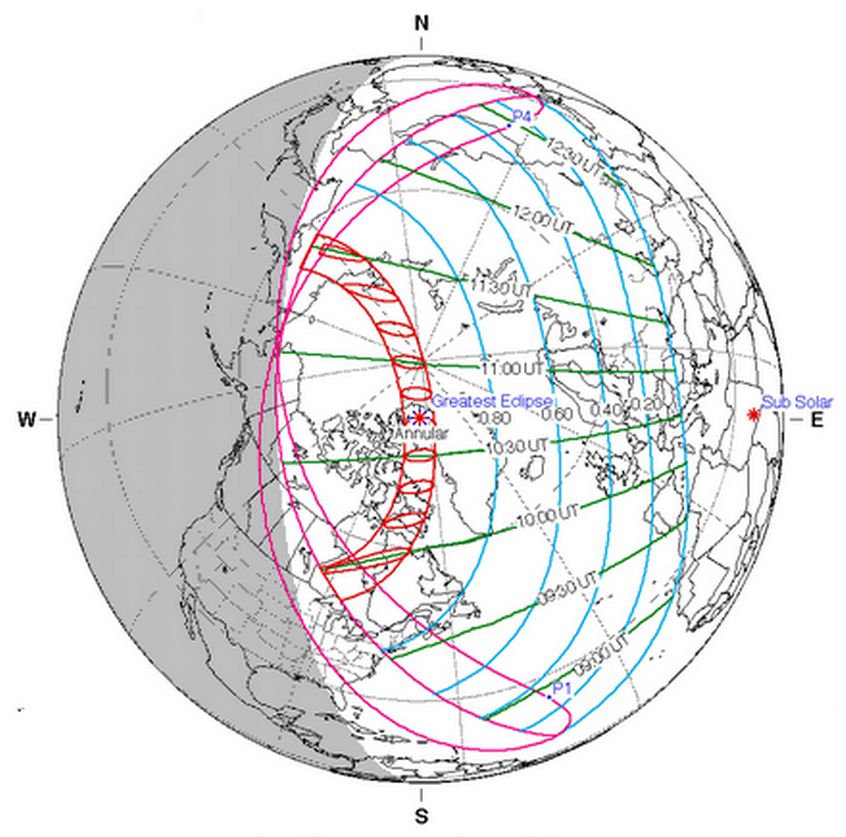
The visibility map for the June 10, 2021 annular solar eclipse. In an annular eclipse, the Moon is too far away and appears too small to cover the face of the Sun. So, at maximum, a ring of bright Sun surrounds the Moon. It’s sometimes called a ring of fire. For locations within the big red floppy figure 8, the eclipse either ends near sunrise (bottom lobe) or starts near sunset (top lobe). The double line with the ellipses in it is the path of where the ring is visible, the path of annularity. Locations within the grid on the right will see a partial eclipse. Credit: NASA/GSFC/Fred Espenak, adapted from https://eclipse.gsfc.nasa.gov/SEplot/SEplot2001/SE2021Jun10A.GIF
06/07/2021 – Ephemeris – The Little Dipper, aka Ursa Minor
This is Ephemeris for Monday, June 7th. Today the Sun will be up for 15 hours and 28 minutes, setting at 9:26, and it will rise tomorrow at 5:57. The Moon, 3 days before new, will rise at 4:54 tomorrow morning.
One of the constellations I don’t talk about much, except in passing is Ursa Minor, the Little Bear, better known as the Little Dipper. As a dipper goes, its handle is bent the wrong way. Anyway, this time of year in the evening, it’s standing on the tip of it’s handle the North Star Polaris. Polaris is pointed to by the front two stars of the Big Dipper. As dippers go they pour their contents into each other. The second and third-brightest stars of the Little Dipper are at the front of the bowl, and are Kochab and Pherkad, the Guard Stars, that is Guardians of the Pole. To the Anishinaabe native peoples of our area the Little Dipper is Maang, the Loon.
The astronomical event times given are for the Traverse City/Interlochen area of Michigan. They may be different for your location.
Addendum
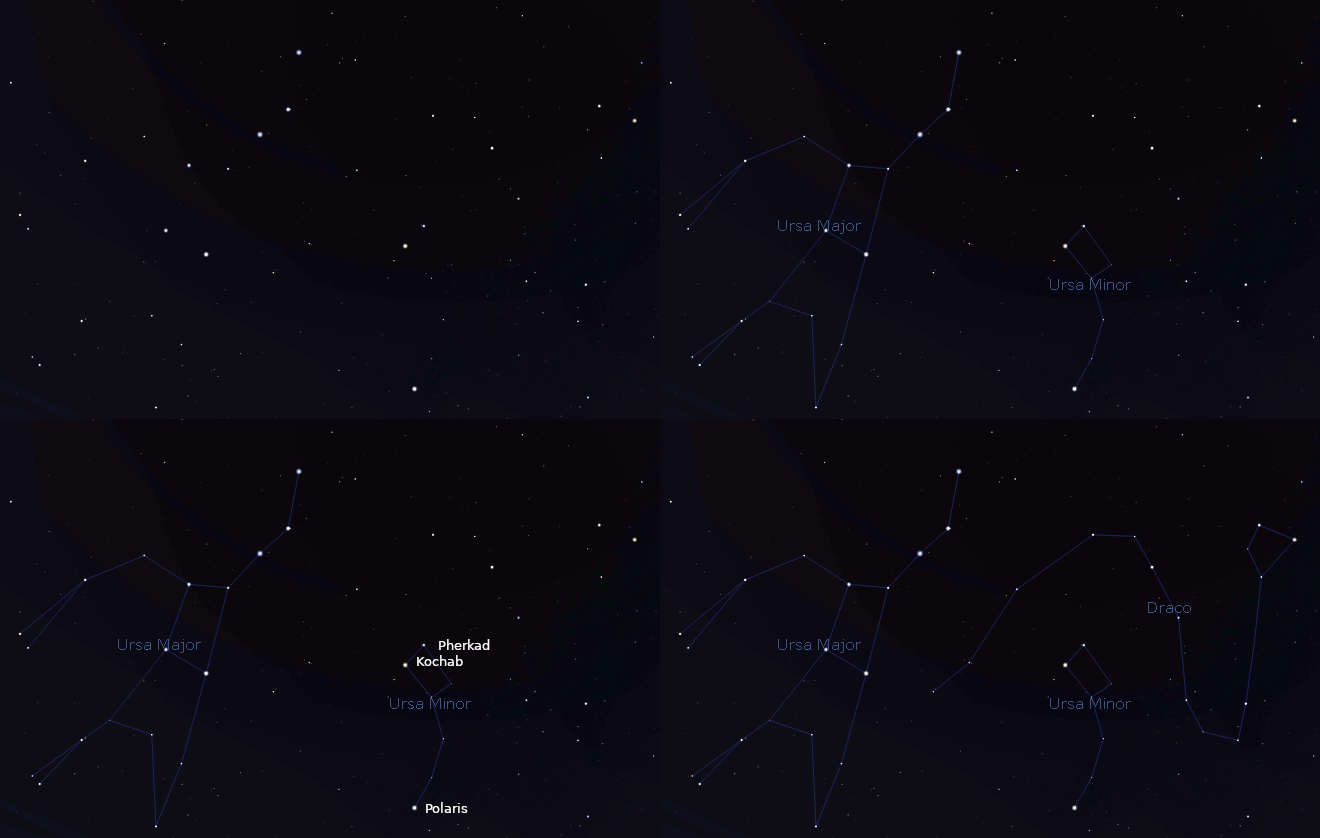
Little Dipper finder animation with bonus frame with Draco the dragon. Click on the image to enlarge. Created using Stellarium. Animation and star names added with GIMP.
06/04/2021 – Ephemeris – Zoom astronomy meeting and possible star party tonight
This is Ephemeris for Friday, June 4th. Today the Sun will be up for 15 hours and 25 minutes, setting at 9:23, and it will rise tomorrow at 5:58. The Moon, 2 days past last quarter, will rise at 3:49 tomorrow morning.
The Grand Traverse Astronomical Society hold a virtual meeting and program at 8 pm tonight via Zoom. For the program Jerry Dobek, professor of astronomy at Northwestern Michigan College will present an illustrated talk on astroimaging. The pandemic has inspired Dr. Dobek to find a solution. It turned out to be a relatively inexpensive imager for the telescope. The virtual star party will start around 9 pm, hosted by Dobek, with his imager, but only if it’s clear in Traverse City. It will feature a look at Venus to start, possibly before sunset. There will be other objects visible in the twilight such as binary stars and a pair with differing colors. Instructions to join the meeting and a link can be found on the society’s website, www.gtastro.org.
The astronomical event times given are for the Traverse City/Interlochen area of Michigan. They may be different for your location.
Addendum
Here are some images that Professor Dobek has produced during the GTAS virtual Zoom star parties that I screen captured and minimally enhanced:
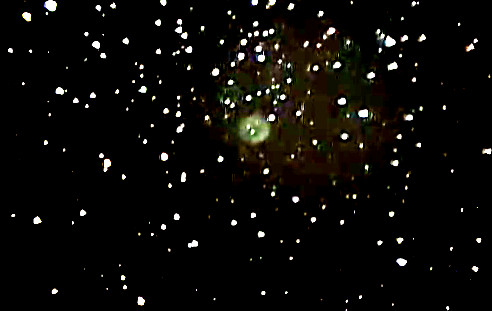
The planetary nebula that is probably within star cluster M 46 in the constellation Puppis. Created from a screen grab from an image by Jerry Dobek January 8, 2021 during the GTAS virtual star party. The image was enhanced to reduce the background and increase contrast by Bob Moler
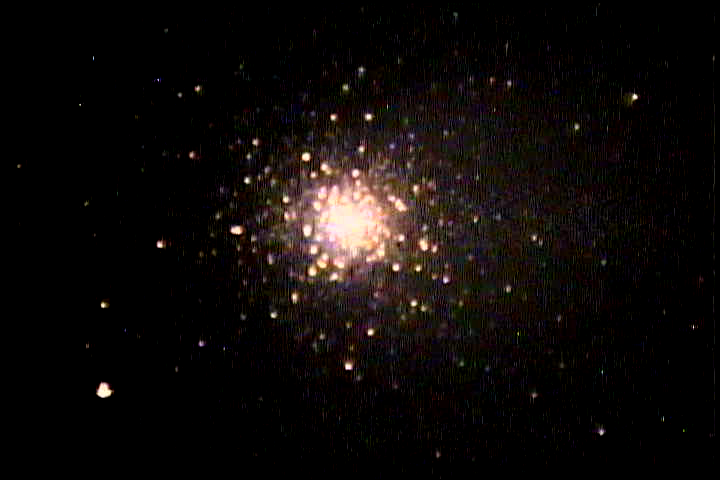
Globular star cluster M 3. Image captured by Jerry Dobek. Enhanced using GIMP (Gnu Image Manipulation Program) by Bob Moler.
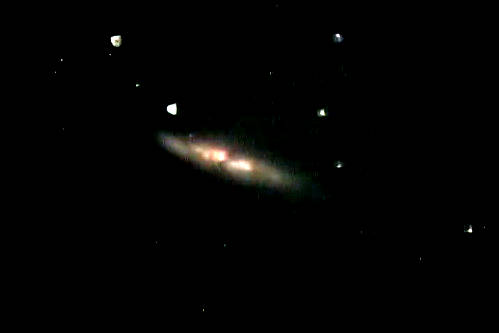
Irregular galaxy M 82 is very strange. Image created by Jerry Dobek and enhanced using GIMP.
 Bob Moler's Ephemeris Blog