Archive
04/15/2022 – Ephemeris – How the date of Easter is determined
This is Ephemeris for Good Friday, April 15th. Today the Sun will be up for 13 hours and 29 minutes, setting at 8:27, and it will rise tomorrow at 6:56. The Moon, 1 day before full, will set at 7:04 tomorrow morning.
Easter will be celebrated by Western Christian churches this Sunday. Easter is a movable feast in that it falls on a different date each year following the first full moon of spring. It’s an attempt to follow the Jewish Passover, which starts on the 15th of the month of Nisan. The Jewish calendar being a lunar calendar, the 15th is generally the night of the full moon. And since the Last Supper was a Seder, according to at least one Gospel, the Christian church wanted to link Easter with Passover as closely as possible using the Roman solar based (Julian) calendar. The months didn’t follow the cycle of the Moon anymore and where the year was 365.25 days long. Passover starts at sunset tonight. The western churches adopted the Gregorian calendar to keep in sync with the seasons. The Orthodox churches didn’t, so their Easter is a week later this year. They kept the old Julian Calendar and other considerations to calculate the date of Easter.
The astronomical event times given are for the Traverse City/Interlochen area of Michigan (EDT, UT – 4 hours). They may be different for your location.
Addendum
If you’re wondering about what all this has to do with astronomy? The answer is: Everything! Astronomy in ancient times wasn’t about the nature of planets, and stars, but about the cycles about the Sun and Moon. These cycles announced the seasons, and festival times. This is how the date of Passover is set. The Jews, at least in the Bible, only referenced the constellations of Orion and the Great Bear plus the star cluster Pleiades, that scholars have pinned down. There are two more possible references to constellations that don’t translate. These are all in the Book of Job. The only planet mentioned is Saturn, because it was thought to be closest to the firmament, the starry sphere.
04/14/2022 – Ephemeris – The Moon appears to wobble
This is Bob Moler with Ephemeris for Thursday, April 14th. Today the Sun will be up for 13 hours and 26 minutes, setting at 8:26, and it will rise tomorrow at 6:58. The Moon, 2 days before full, will set at 6:43 tomorrow morning.
Tonight’s Moon is nearly full, only two days to go. In the evening, the little dark sea on the Moon called Mare Crisium or Sea of Crises is near the top of the Moon. Now it’s real close to the top edge of the Moon, what astronomers call the limb. Ten days ago, when the Moon was a crescent, Mare Crisium was farther from the limb. This wobbling motion over the lunar month is called libration. This occurs because the Moon has an elliptical orbit of the Earth and speeds up when it’s closer and slows when it’s farther away. However, the Moon’s rotation is constant due to its angular momentum. The period of the revolution of the Moon around the Earth exactly matches its rotation. When the Moon is farthest, its rotation gets a bit ahead of its revolution around the Earth. When closest, the rotation lags a bit. So it appears to wobble over the lunar month.
The astronomical event times given are for the Traverse City/Interlochen area of Michigan (EDT, UT – 4 hours). They may be different for your location.
Addendum
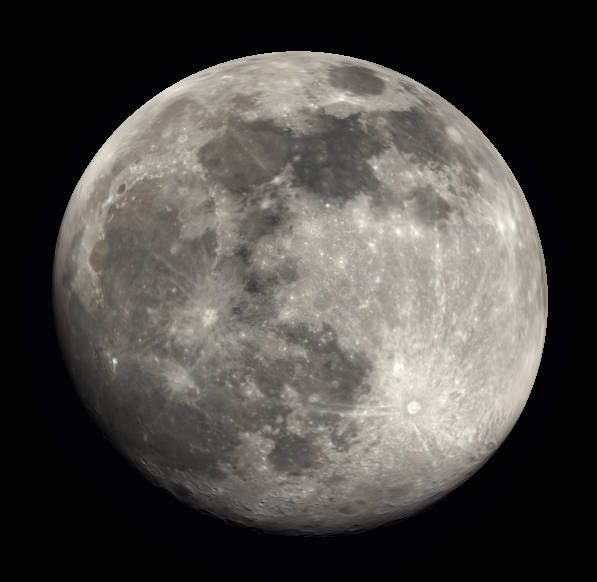
The Moon as it should appear at 10 pm tonight, April 14, 2022. Note the position, relative to the Moon’s limb, of the small lunar sea called Mare Crisium near the top of the Moon. Mare Crisium means Sea of Crises. It is quite close to the limb tonight. In the animation below, shown without the phase, the orientation of the Moon is not changed by the position in the sky or the latitude of the observer. Created using Stellarium.
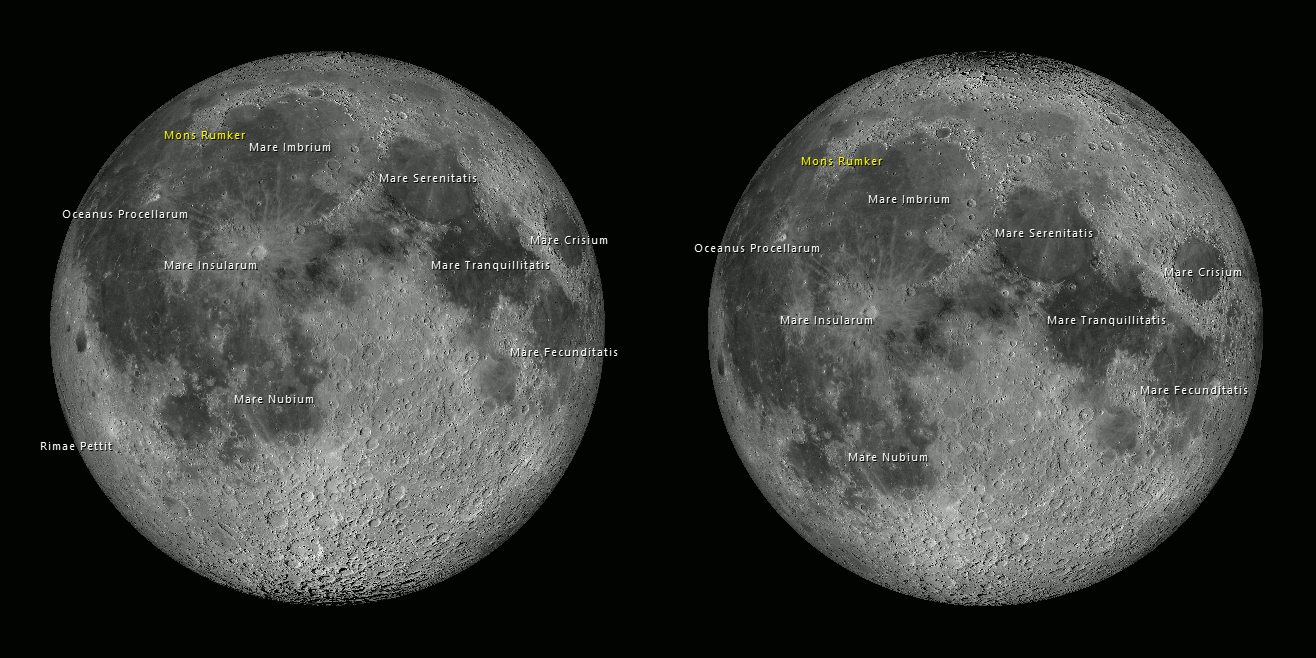
A demonstration of libration by viewing the position of Mare Crisium. Also note that there is also a libration in the Moon’s latitude, causing a north-south nodding. Another good indicator of libration is the dark floored crater called Grimaldi on the left side of the Moon, which is not visible tonight in the image at the top. But it will appear in sunlight tomorrow night. Created using Virtual Moon Atlas.
04/13/2022 – Ephemeris – Let’s search for the naked-eye planets for this week
This is Ephemeris for Wednesday, April 13th. Today the Sun will be up for 13 hours and 23 minutes, setting at 8:25, and it will rise tomorrow at 7:00. The Moon, 3 days before full, will set at 6:22 tomorrow morning.
Let’s search for the naked-eye planets for this week. There is one bright planet in the evening sky, but too close to the Sun to be seen. Mercury passed behind the Sun eleven days ago and will be visible later this month, so the planet action still shifts to the morning sky. The other 4 naked-eye planets are there, though Jupiter may be too low in the sky to be seen. By 6:15, the planets will be spread out low in the east-southeast to southeast, with brilliant Venus near the center of the four. Dim Mars will be to the right and a bit above Venus. Brighter Saturn will be right and above Mars. Jupiter will be near the horizon and left of Venus. Jupiter can be still spotted by 6:30 along with Venus and followed even closer to sunrise.
The astronomical event times given are for the Traverse City/Interlochen area of Michigan (EDT, UT – 4 hours). They may be different for your location.
Addendum
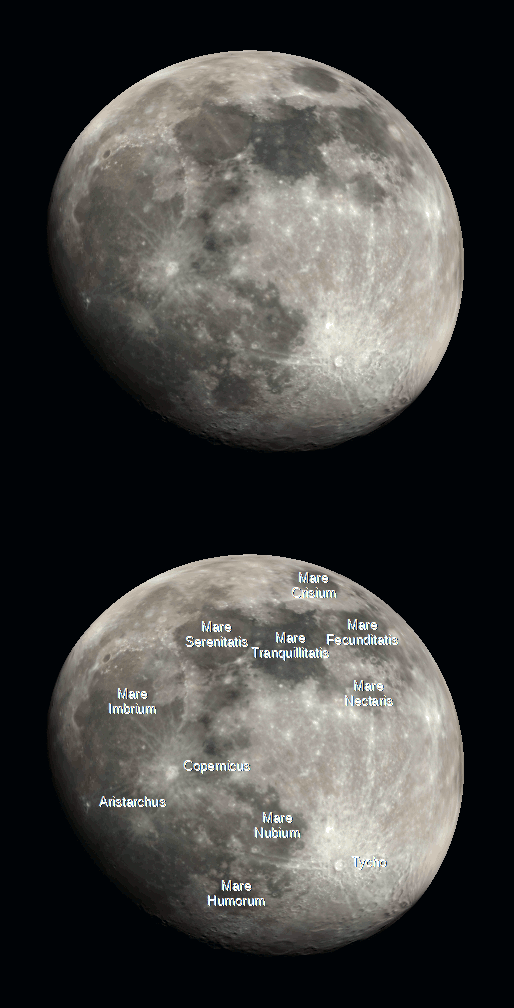
Tonight’s Moon annotated, for 10 pm, April 13, 2022, showing major formations visible in binoculars or a small telescope. Created using Stellarium.
Translations
Mare Crisium – Sea of Crises
Mare Fecunditatis – Sea of Fertility
Mare Humorum – Sea of Moisture
Mare Imbrium – Sea of Showers
Mare Nectaris – Sea of Nectar
Mare Nubium – Sea of Clouds
Mare Serenitatis – Sea of Serenity
Mare Tranquillitatis – Sea of Tranquility
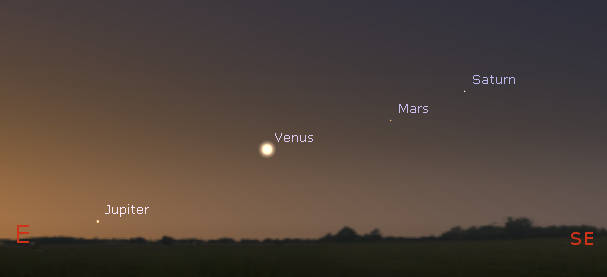
The lineup of morning planets at 6:15 am, about 45 minutes before sunrise tomorrow morning, April 14, 2022. Created using Stellarium.
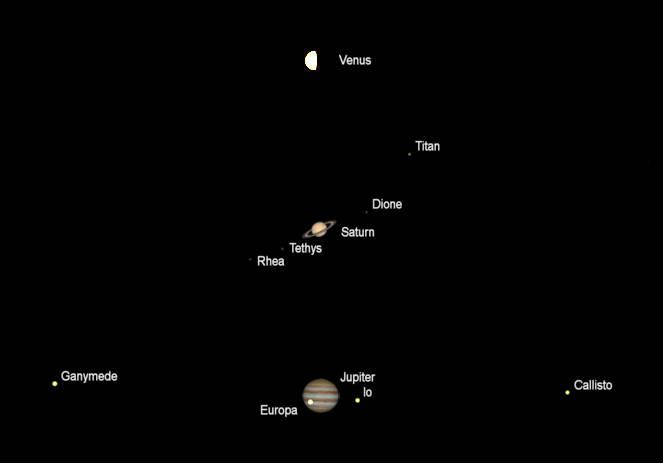
Views of Venus, Saturn, and Jupiter (north up) as they would be seen in a small telescope, with the same magnification, tomorrow morning at 6:15 am, April 14, 2022. I do not show planets less than 10 seconds of arc in diameter. Apparent diameters: Venus 19.12″, 61.2% illuminated; Saturn 16.07″, its rings 37.44″; Jupiter 33.90″. Mars is not shown, its apparent diameter is 5.43″ and is 90.7% illuminated. The moons of Jupiter and Saturn may not be visible in twilight. The ” symbol means seconds of arc (1/3600th of a degree.) Created using Cartes du Ciel (Sky Charts).
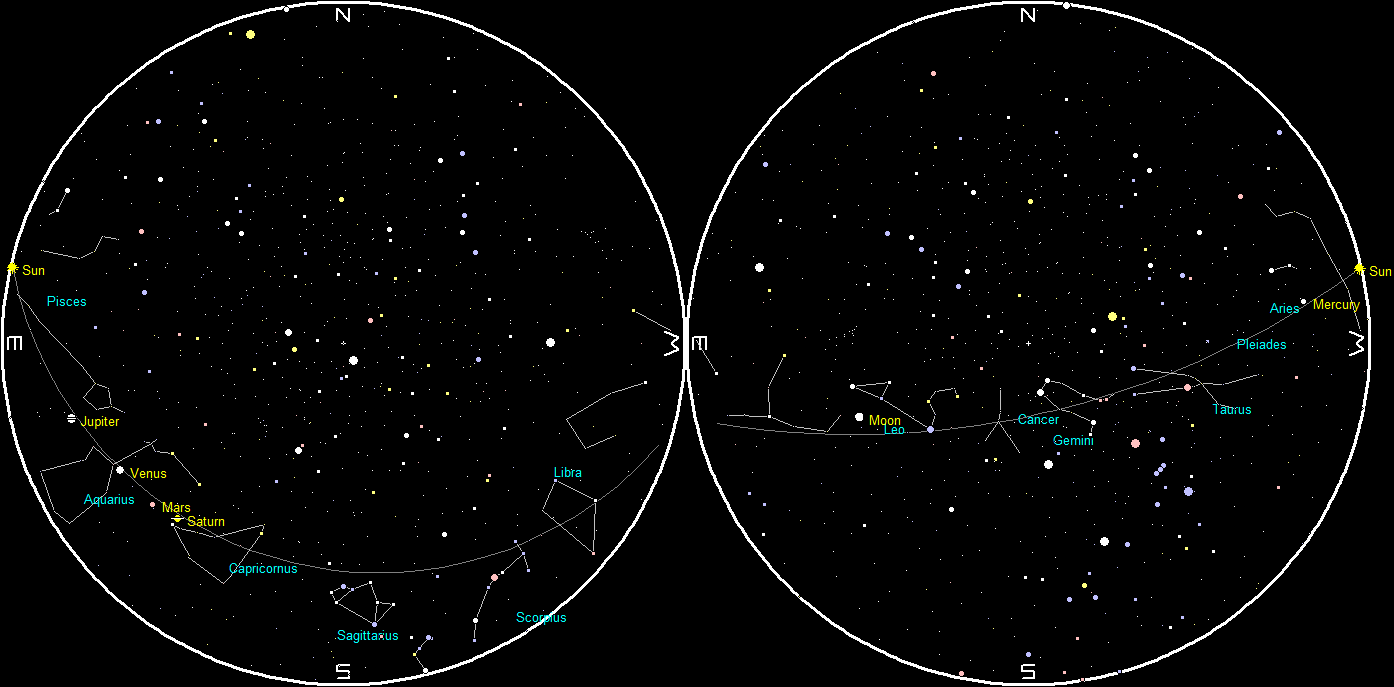
The naked-eye planets and the Moon at sunset and sunrise on a single night, starting with sunset on the right on April 13, 2022. The night ends on the left with sunrise on the 14th. Click on the image to enlarge it. Created using my LookingUp program.
04/12/2022 – Ephemeris – The Axiom-1 mission is on orbit now
This is Ephemeris for Tuesday, April 12th. Today the Sun will be up for 13 hours and 20 minutes, setting at 8:24, and it will rise tomorrow at 7:01. The Moon, 3 days past first quarter, will set at 6:01 tomorrow morning.
The four private astronauts of the Axiom Space-1 mission were launched on a SpaceX Falcon 9 rocket and Crew Dragon Capsule last Friday and are now aboard the International Space Station, or ISS for short, working on their own experiments during their eight-day stay. Around 2024 Axiom Space will attach a module to the ISS, and it will add other modules over the years. One of the last will be a solar power module, which will make their part of the station self-sustaining. By 2030 they will be able to detach their modules from the ISS to orbit free. This will allow continuous habitation in space after the ISS is deorbited in the 2031 time frame. Around that time frame, Blue Origin and Sierra Space and others hope to have their space station Orbital Reef on orbit. By then, NASA will save money by renting, rather than buying.
The astronomical event times given are for the Traverse City/Interlochen area of Michigan (EDT, UT – 4 hours). They may be different for your location.
Addendum
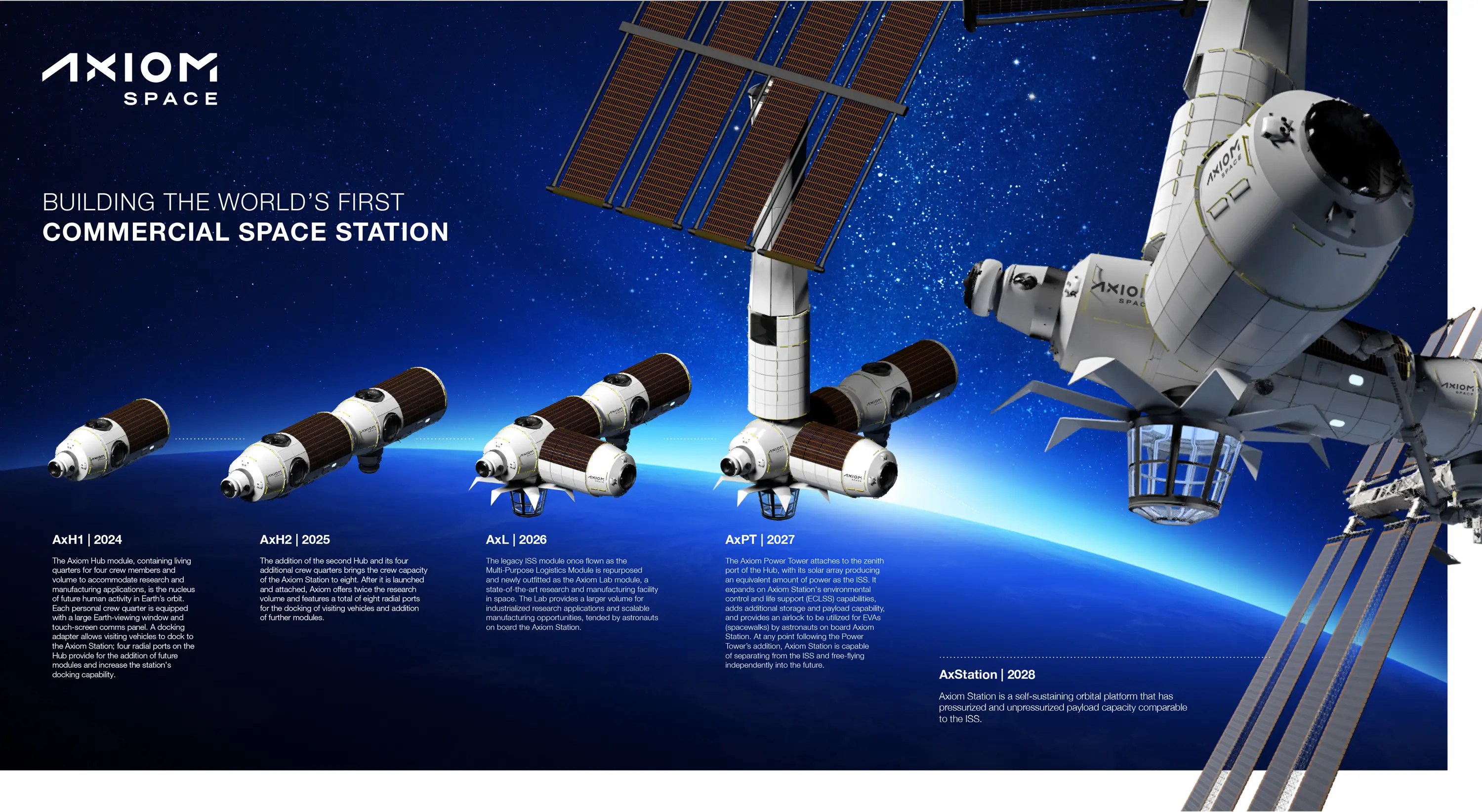
The planned evolution of the Axiom space station. It will start being a module attached to the ISS. Various modules will be attached. After the power tower containing solar panels is attached, it can be detached from the ISS to fly free. Click on the image to enlarge. Credit Axiom Space.
As far as the Artemis-1 Wet Dress Rehearsal is concerned, that was scrubbed April 2nd and again on the 3rd, but they got farther. That’s the growing pains of a new rocket and launch tower. The Wet Dress Rehearsal will pick up again this week. The next scheduling conflict will be the preparation and launch of the Crew-4 mission to the International Space Station now scheduled for April 21st. The Artemis-1 rocket is located on launch pad 39B, while SpaceX will launch Crew-4 from pad 39A, just 1.67 miles (2.69 kilometers) south of 39B.
04/11/2022 – Ephemeris – SpaceX Transporter 4’s weird launch trajectory
This is Bob Moler with Ephemeris for Monday, April 11th. Today the Sun will be up for 13 hours and 17 minutes, setting at 8:22, and it will rise tomorrow at 7:03. The Moon, 2 days past first quarter, will set at 5:37 tomorrow morning.
On April 1st SpaceX launched their Transporter 4 mission taking forty small satellites into sun synchronous orbits. Sun synchronous orbits are cool The plane of the orbit precesses 360 degrees over the period of a year so as it orbits it flies over the same part of the Earth at the same time of the day, so the sun angle on the ground is the same. This is great to see changes on the ground over time. To do that, the orbit has to have an inclination of 97 degrees. Which is hard to do launching from Cape Canaveral, the rocket must be sent toward the south-southwest, but must not cross southern Florida. So the rocket launches to the southeast and bends its path southward, keeping offshore. The second stage completes the turn to achieve the 97 degree inclination.
The astronomical event times given are for the Traverse City/Interlochen area of Michigan (EDT, UT – 4 hours). They may be different for your location.
Addendum
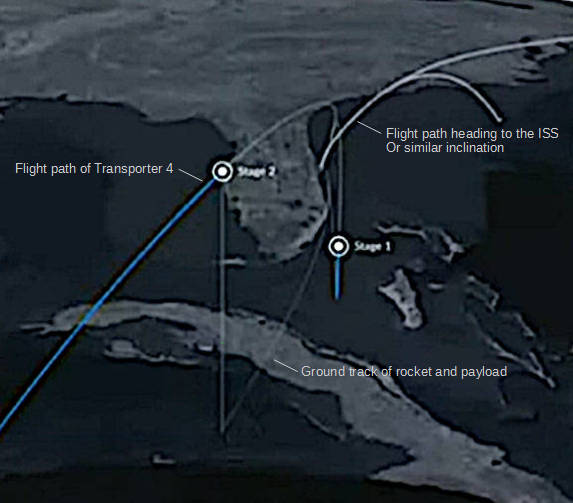
Screenshot of the animation from SpaceX launch webcast of Transporter 4. Launches of polar orbiting satellites are generally made from Vandenberg Space Force Base in California, which have a clear shot to the south and south-southeast. Curving the launch trajectory like this exacts a penalty in the amount of payload mass that can be put into orbit. Credit: SpaceX.
04/08/2022 – Ephemeris – Landing a spacecraft at the Moon’s South Pole will be a tricky prospect
This is Ephemeris for Friday, April 8th. Today the Sun will be up for 13 hours and 8 minutes, setting at 8:19, and it will rise tomorrow at 7:09. The Moon, 1 day before first quarter, will set at 3:58 tomorrow morning.
The Artemis missions are to land near the South Pole of the Moon. Unlike the Earth’s 23 and a half degree axial tilt the Moon’s is only a degree and a half, so there is little month long variation of the Sun angle, though the Sun’s direction along the horizon revolves 360 degrees over 29 and a half days, the length of its orbit of the Earth. It should make for quite a challenge to land the human lander safely near the lunar South Pole. The lander has to choose a spot in sunlight to land that’s relatively smooth. The reason for the attraction of the lunar South Pole is the presence of water ice in permanently shadowed craters near and at the pole. The Moon’s North Pole isn’t as heavily cratered, with fewer permanently shadowed craters.
The astronomical event times given are for the Traverse City/Interlochen area of Michigan (EDT, UT – 4 hours). They may be different for your location.
Addendum
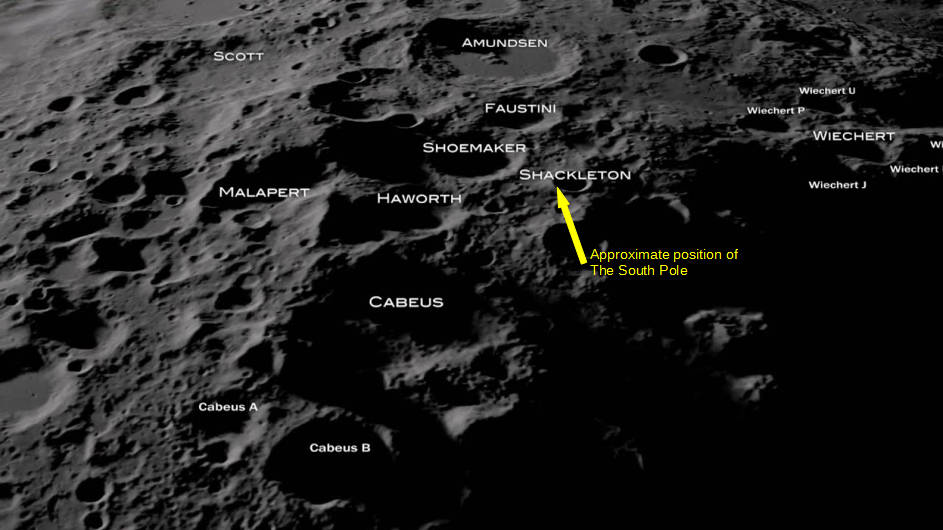
Lunar South Pole Flyover area with approximate South Pole marked based on Virtual Moon Atlas. Did you note a theme in some crater names? Click on the image to enlarge it. Credit: NASA/LRO.
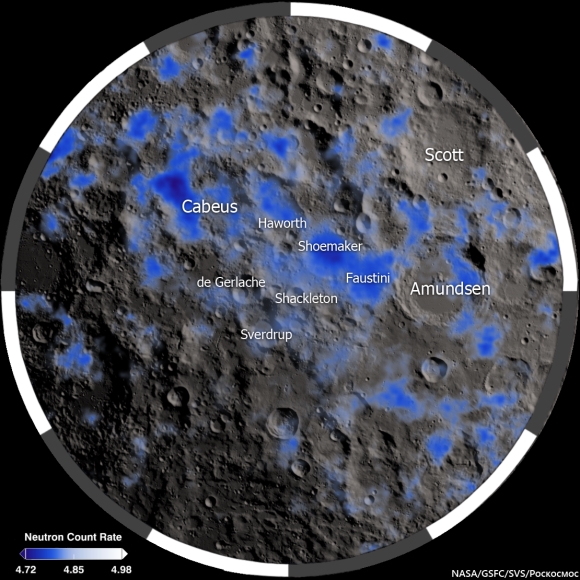
The South Pole of the Moon, where the presence of water ice is detected by the absorption of neutrons by the hydrogen atoms in the ice. Credit NASA/GSFC/SVS/Roscosmos.
04/07/2022 – Ephemeris – The Sun is getting active again
This is Ephemeris for Thursday, April 7th. Today the Sun will be up for 13 hours and 5 minutes, setting at 8:17, and it will rise tomorrow at 7:10. The Moon, 2 days before first quarter, will set at 3:11 tomorrow morning.
For the last year and a half, the Sun has entered a new sunspot cycle, solar cycle 25. It had been predicted to be a rather mild cycle with an average peak in sunspot numbers of around 120 in 2025, three years from now. Last Sunday’s daily sunspot number was 118. Sunspot numbers are not just the numbers of individual sunspots on the Sun. Groups of spots count for 10 before the individual spots are counted. These counts are averaged, from many observatories, over a month to chart the progress of the approximately 11 year sunspot cycle. The more sunspots, the more solar flares. The more flares, the more CMEs or coronal mass ejections. If CMEs are aimed toward the Earth, we get northern lights, and headaches for satellite operators and electric power companies.
The astronomical event times given are for the Traverse City/Interlochen area of Michigan (EDT, UT – 4 hours). They may be different for your location.
Addendum
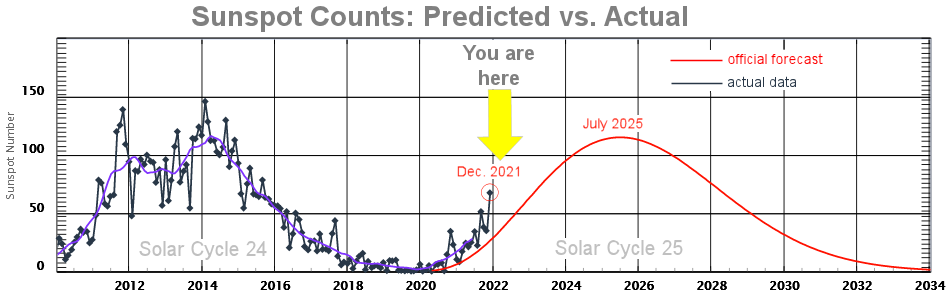
Current and last solar cycle sunspot plot. The current trend in sunspots is increasing much faster than what was predicted. Click on the image to enlarge it. Credit NOAA.
Go to spaceweather.com to keep up with what’s happening between the Sun and the Earth.
04/06/2022 – Ephemeris – Let’s search for the naked-eye planets for this week
This is Bob Moler with Ephemeris for Wednesday, April 6th. Today the Sun will be up for 13 hours and 2 minutes, setting at 8:16, and it will rise tomorrow at 7:12. The Moon, 3 days before first quarter, will set at 2:16 tomorrow morning.
Let’s search for the naked-eye planets for this week. There is one bright planet in the evening sky, but too close to the Sun to be seen. Mercury passed behind the Sun last Saturday and will be visible later this month, so the planet action still shifts to the morning sky. The other 4 naked-eye planets are there, though Jupiter is too close to the Sun to be seen. Late winter and early spring mornings aren’t the best for spotting planets close to the Sun, since they tend to lie low in the southeastern sky. Venus, Mars, and Saturn will rise within 16 minutes of each other by 5:35. By 6:30, they will be low in the east-southeast with dim Saturn to the right and a bit above Venus, and much dimmer Mars to the left and below Saturn.
The astronomical event times given are for the Traverse City/Interlochen area of Michigan (EDT, UT – 4 hours). They may be different for your location.
Addendum
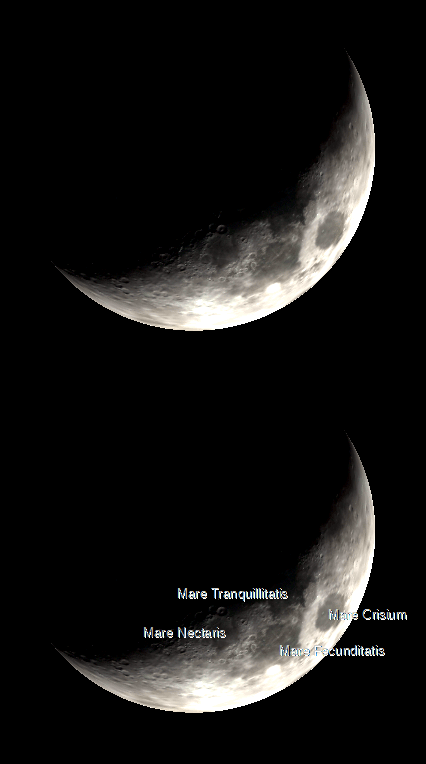
Annotated crescent Moon animation of the Moon tonight, April 6, 2022. The annotations are the official names in Latin of the seas of Tranquility, Crises, Nectar, and Fertility. Created using Stellarium.
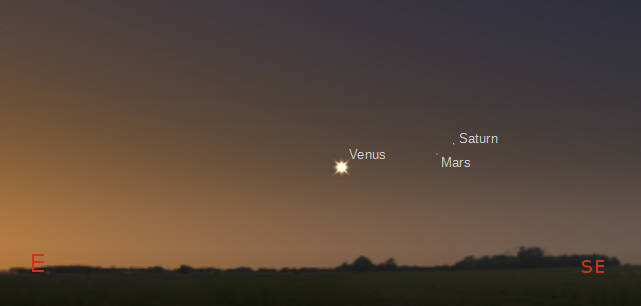
Venus, Mars and Saturn as they might be seen around 6:30 tomorrow morning, April 7, 2022. Created using Stellarium.
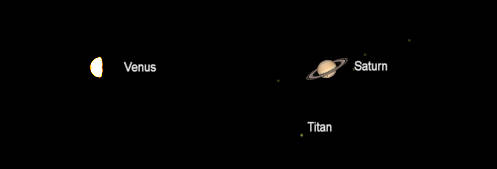
Views of Venus and Saturn (north up) as they would be seen in a small telescope, with the same magnification, tomorrow morning at 6:30 am, April 7, 2022. I do not show planets less than 10 seconds of arc in diameter. Apparent diameters: Venus 20.38″, 58.2% illuminated; Saturn 15.92″, its rings 37.08″. Mars is not shown, its apparent diameter is 5.30″ and is 91.2% illuminated. The ” symbol means seconds of arc (1/3600th of a degree.) Created using Cartes du Ciel (Sky Charts).
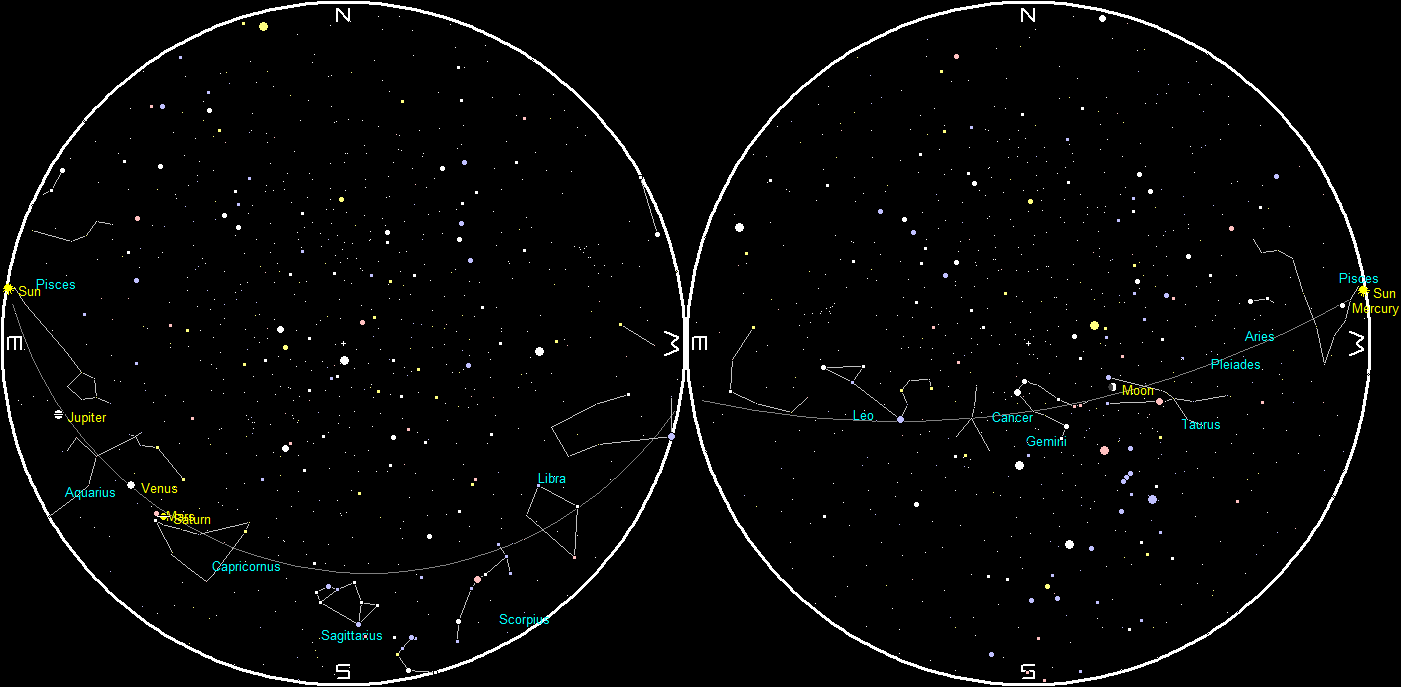
The naked-eye planets and the Moon at sunset and sunrise on a single night, starting with sunset on the right on April 6, 2022. The night ends on the left with sunrise on the 7th. Notice that all the naked-eye planets are in the morning sky now, with the Moon still hanging out in the evening sky. Click on the image to enlarge it. Created using my LookingUp program.
04/05/2022 – Ephemeris – The first Axiom Space mission to the ISS amid a busy April
This is Bob Moler with Ephemeris for Tuesday, April 5th. Today the Sun will be up for 12 hours and 59 minutes, setting at 8:15, and it will rise tomorrow at 7:14. The Moon, halfway from new to first quarter, will set at 1:15 tomorrow morning.
One of the commercial entities working to launch their own space station is Axiom Space, founded in 2016. The first Axiom mission is Ax-1, an 8-day mission to the International Space Station that, as of when I am recording this last Sunday night, is scheduled for tomorrow on a SpaceX Falcon 9/Crew Dragon from launch pad 39A at Cape Canaveral. The Artemis-1 wet dress rehearsal was halted earlier Sunday due to a pressurization problem with the mobile launch tower. That’s on pad 39B, a bit over a mile and a half away. I’m assuming that Artemis-1 has priority over the Axiom mission. Plus, there’s the SpaceX Crew-5 launch later this month to the space station, which also has president. It could be an interesting time at the Cape.
The astronomical event times given are for the Traverse City/Interlochen area of Michigan (EDT, UT – 4 hours). They may be different for your location.
Addendum
April 4, 2022: The SpaceX Axiom-1 launch is now scheduled for no earlier than Friday, April 8, for an 8-day mission to the International Space Station (ISS). The SpaceX Crew-4 launch had previously been pushed back to April 20. The Crew-3 return from the ISS was to be 5 days later.
The Artemis-1 Wet Dress Rehearsal was scrubbed April 4th with a malfunctioning vent valve. A successful test will have fuel and oxidizer loaded and all prelaunch functions completed, and counted down to a bit over 9 seconds to launch.
Axiom Space: space station plan
The planned evolution of the Axiom commercial space station. It will start being a module attached to the ISS starting in 2024, according to the current plan. Various modules will be attached. After the power tower containing solar panels is attached, it can be detached from the ISS to fly free. Click on the image to enlarge. Credit: Axiom Space.
04/04/2022 – Ephemeris – Two apparent planetary encounters tonight and tomorrow morning
This is Ephemeris for Monday, April 4th. Today the Sun will be up for 12 hours and 56 minutes, setting at 8:14, and it will rise tomorrow at 7:16. The Moon, 3 days past new, will set at 12:10 tomorrow morning. | We have action at both end of the night tonight. This evening the Pleiades, or Seven Sisters star cluster, will be seen just above and right of the three-day old crescent Moon. The cluster will be at the one o’clock position from the Moon at 9 pm. At the other side of night, at 6:30 tomorrow morning, Venus will be shining brilliantly in the east-southeast and the planets Mars and Saturn will be very close together. This type of appearance is called a conjunction. Mars will appear about three-quarters of a moon diameter below and left of the slightly brighter Saturn. Mars is getting slowly brighter as the Earth creeps up on it, to overtake it this December. It’s currently 165 million miles (266 million kilometers) away.
The astronomical event times given are for the Traverse City/Interlochen area of Michigan (EDT, UT – 4 hours). They may be different for your location.
Addendum
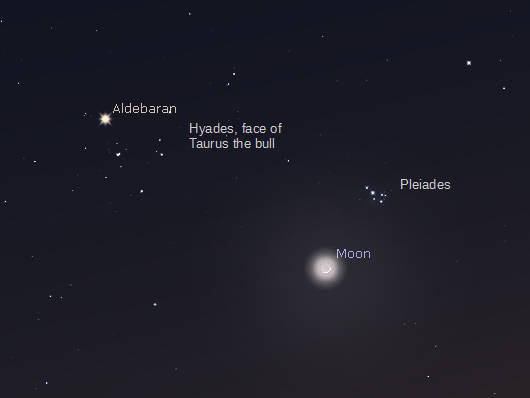
The Moon and the Pleiades and Hyades tonight at 9 pm EDT, April 4, 2022. The Moon appears near the stepsister star clusters tonight. In Greek mythology, these two star clusters were indeed stepsisters, fathered by the god Atlas with different mothers. Created using Stellarium with additional captions in LibreOffice.
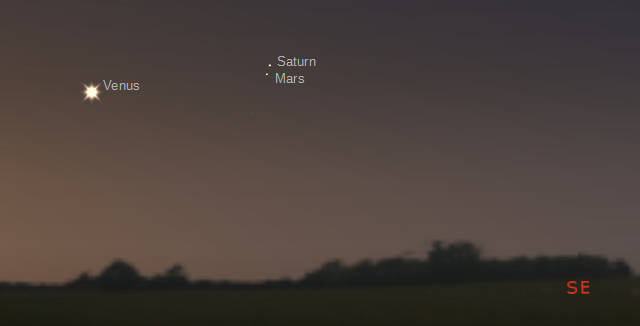
A Saturn-Mars conjunction with brilliant Venus nearby as it might look like tomorrow morning, April 5, 2022. Created using Stellarium with labels added in LibreOffice.
 Bob Moler's Ephemeris Blog