Archive
07/15/2022 – Ephemeris – How to find the constellation of Cygnus the swan
This is Ephemeris for Friday, July 15th. Today the Sun will be up for 15 hours and 14 minutes, setting at 9:25, and it will rise tomorrow at 6:12. The Moon, 2 days past full, will rise at 11:23 this evening.
Located fairly high in the east at 11 p.m. is the constellation of Cygnus the swan, flying south through the Milky Way. It is also called the Northern Cross. At the left, the tail of the swan or the head of the cross is the bright star Deneb, one of the stars of the Summer Triangle. The next star right is Sadr the intersection of the body and the wings of the swan seen in flight, or the intersection of the two pieces of the cross. There are two or three stars farther to the right that delineate the swan’s long neck or upright of the cross, that ends with the star Alberio in the beak of the swan or foot of the cross. The crosspiece of the cross extends to the stars on either side of the intersection star Sadr, while the swan’s wings extend to a couple more stars each.
The astronomical event times given are for the Traverse City/Interlochen area of Michigan (EDT, UT – 4 hours). They may be different for your location.
Addendum
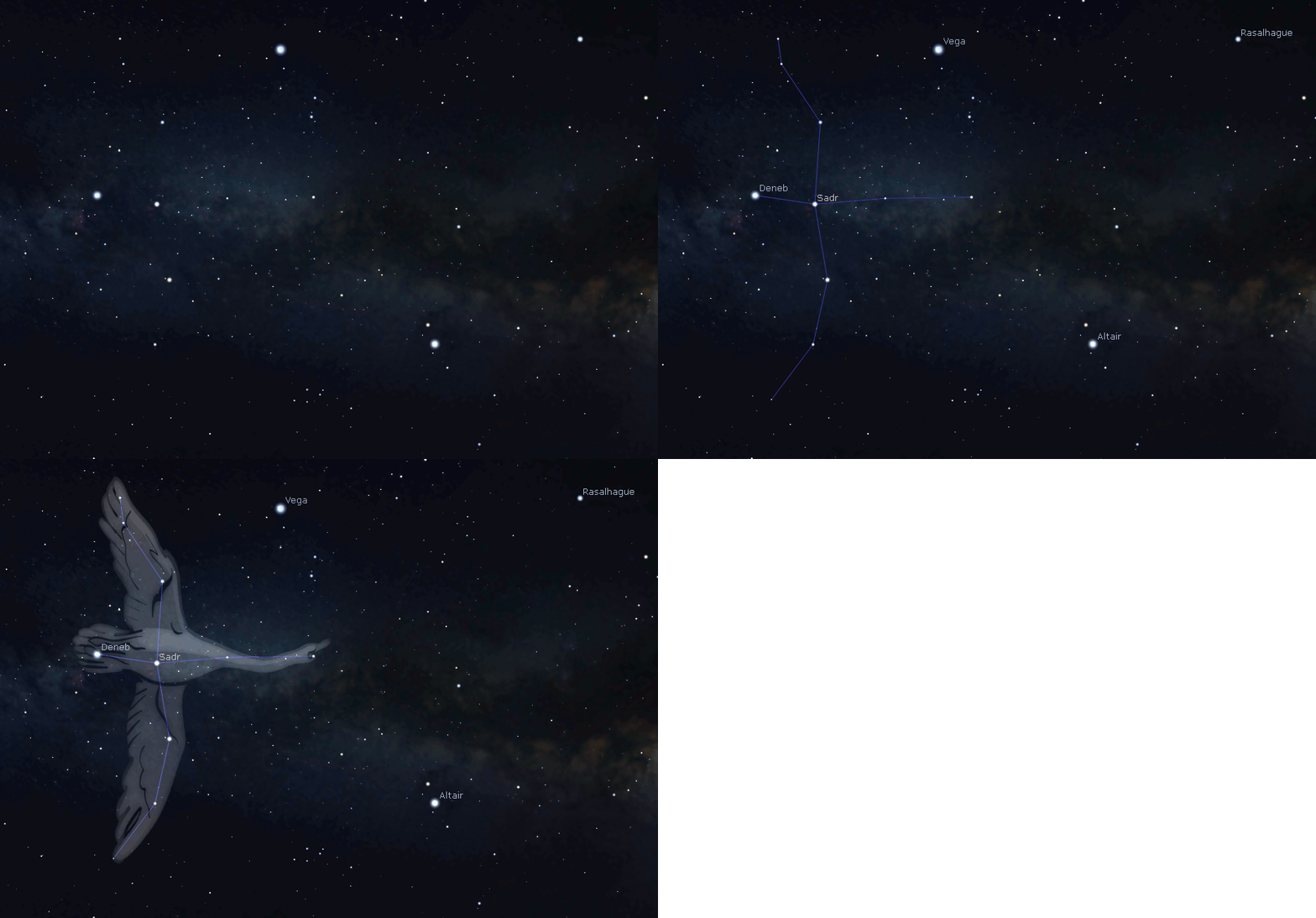
Animated Cygnus finder chart. Included also are, beside Deneb, the other stars of the Summer Triangle: Vega and Altair and their constellations Lyra the harp and Aquila. See if you can find them. Created using Stellarium.
07/14/2022 – Ephemeris – The dimmest Summer Triangle star is actually the brightest
This is Ephemeris for Thursday, July 14th. Today the Sun will be up for 15 hours and 15 minutes, setting at 9:26, and it will rise tomorrow at 6:11. The Moon, 1 day past full, will rise at 10:49 this evening.
This evening, when it gets dark enough, the bright star Deneb in Cygnus the swan will be high in the east-northeast. I’ll cover Cygnus tomorrow when the sky is darker. Deneb is the dimmest star of the summer triangle. Of the other stars of the triangle, Vega is higher in the east, while Altair is lower in the southeast. Deneb’s apparent magnitude, or brightness as seen from Earth, makes it the dimmest of the three bright stars. That’s because of its vast distance of maybe 1,550 light years, 57 times the distance of Vega. If brought as close as Vega, Deneb would be as bright, at least, as the first quarter moon. It is possibly as bright as 196 thousand Suns; and it’s a huge star, possibly as large in diameter as the orbit of the Earth. For all this, it is only 23 or so times the mass of the Sun.
The astronomical event times given are for the Traverse City/Interlochen area of Michigan (EDT, UT – 4 hours). They may be different for your location.
Addendum
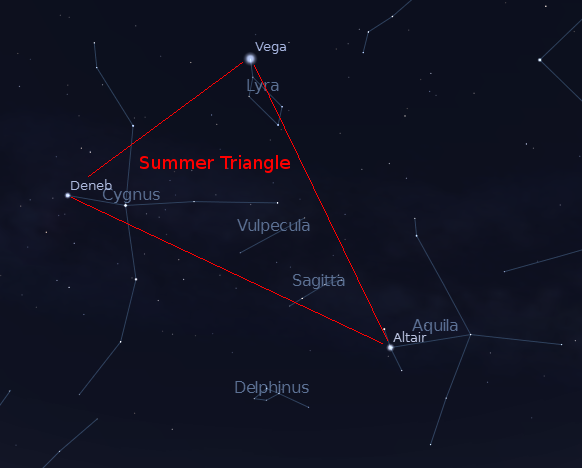
The Summer Triangle. Created using Stellarium and The Gimp.
If you put Deneb in the search box, you will find that the content of the posts, over the years, about the star are nearly identical. However, the distance estimates vary widely. It is too far away for trigonometric parallax measurements by earth based telescopes. Though in the range of ESA’s Hipparcos and Gaia satellites, it is too bright. So other less accurate measurements are used. I don’t think it involves coin flipping. The assumed distance also affects estimates of luminosity, and mass.
07/13/2022 – EPHEMERIS – Let’s search for the naked-eye planets for this week
This is Ephemeris for Wednesday, July 13th. Today the Sun will be up for 15 hours and 17 minutes, setting at 9:26, and it will rise tomorrow at 6:10. The Full Buck Moon, also a supermoon, will rise at 10:05 this evening.
Let’s search for the naked-eye planets for this week. All the naked-eye planets are in the morning sky, although Mercury is too close to the Sun to be seen. On the Saturday it will leave the morning sky crossing over to the evening sky. At 5 am tomorrow, the planets will be spread out from brilliant Venus low in the east-northeast to Saturn higher in the south-southwest. Mars will be a lot higher than Venus in the east-southeast. Jupiter is a bit higher in the southeast. Mars is dimmer than Jupiter, but is slowly getting brighter as the Earth creeps up on it. Saturn ends the line of planets in the south-southwest. Tonight, Saturn will rise about 11:03 pm, though it won’t be an official evening planet until it rises before sunset, which happens in mid-August.
The astronomical event times given are for the Traverse City/Interlochen area of Michigan (EDT, UT – 4 hours). They may be different for your location.
Addendum
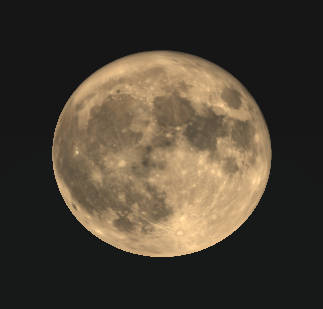
Tonight’s full supermoon shortly after it will rise at 10:30 pm July 13, 2022. Created using Stellarium.
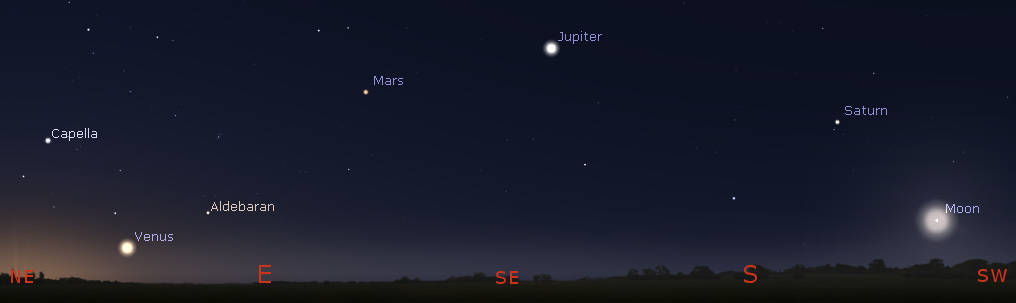
The morning planets and the Moon at 5 am tomorrow morning, July 14, 2022. The planets and Moon actually appear in a straight line in the sky, being placed along the ecliptic, or path of the Sun in the sky. The ecliptic is a great circle on the celestial sphere. Click on the image to enlarge it. The span of the planets from Venus to Saturn is 122 degrees. Two of winter’s first magnitude stars, Aldebaran and Capella, are now visible in morning twilight. Click on the image to enlarge it. Created using Stellarium.
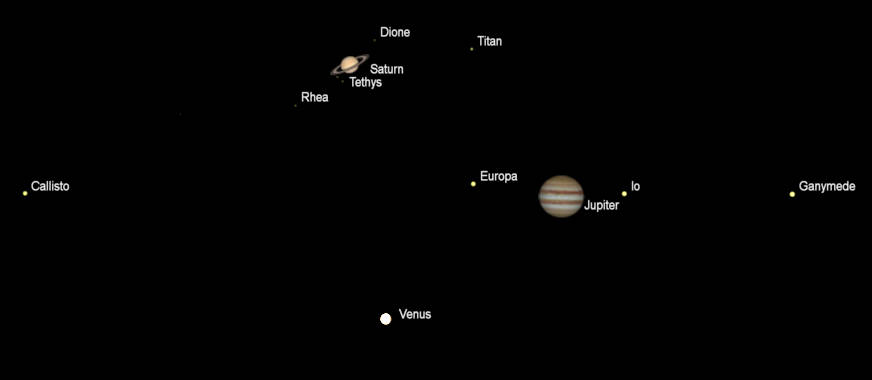
Views of Saturn, Jupiter, and Venus (north up) as they would be seen in a small telescope, with the same magnification, tomorrow morning at 5:00 am, July 14, 2022. I do not show planets less than 10 seconds of arc in diameter. Apparent diameters: Saturn 18.46″, its rings 43.01″; Jupiter 42.63″. Mars is not shown, its apparent diameter is 7.63″; Venus 11.31″. The ” symbol means seconds of arc (1/3600th of a degree.) Click on the image to enlarge it. Created using Cartes du Ciel (Sky Charts).
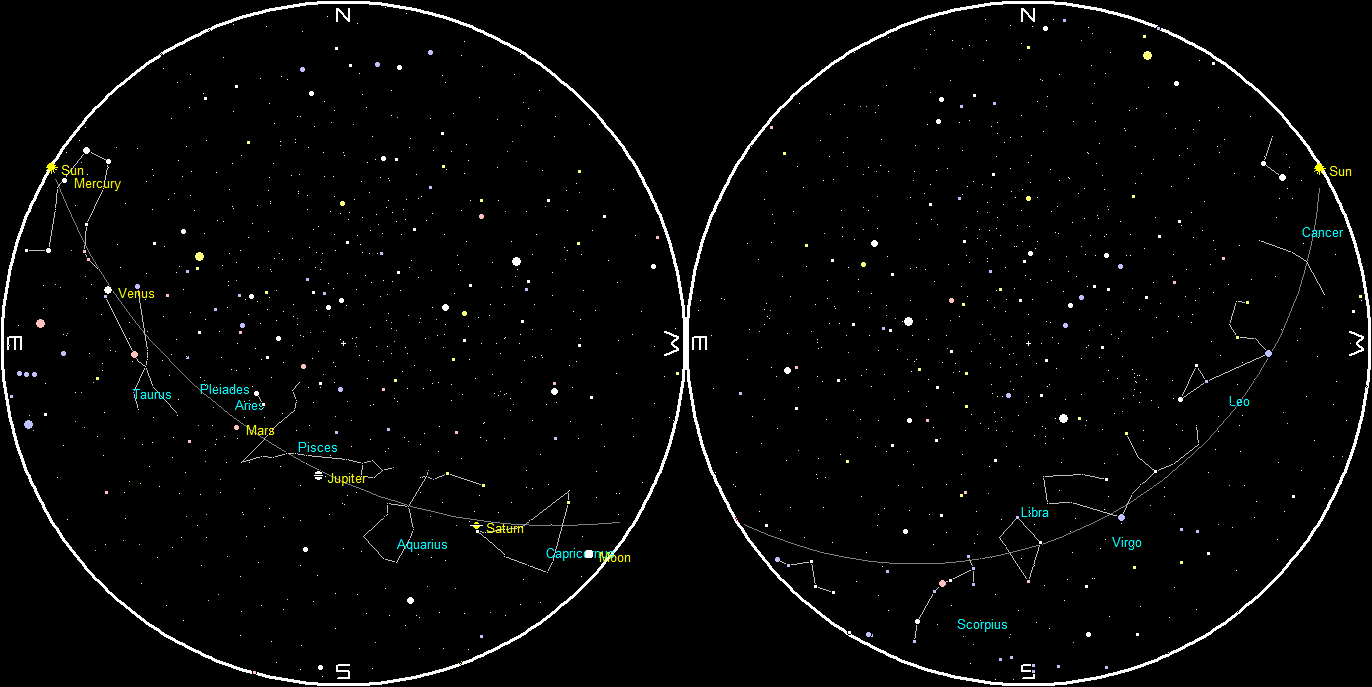
The naked-eye planets and the Moon at sunset and sunrise on a single night, starting with sunset on the right on July 13, 2022. The night ends on the left with sunrise on the 14th. Notice that all the naked-eye planets are in the morning sky now. Click on the image to enlarge it. Created using my LookingUp program.
07/12/2022 – Ephemeris – The rest of the first images and data from the James Webb Space Telescope to be released tomorrow
This is Bob Moler with Ephemeris for Tuesday, July 12th. Today the Sun will be up for 15 hours and 18 minutes, setting at 9:27, and it will rise tomorrow at 6:09. The Moon, 1 day before full, will set at 5:26 tomorrow morning.
Later today at 10:30 am, NASA and the Space Telescope Science Institute will present the first results from the James Webb Space Telescope. These will be, I believe, four multi-spectral images rendered in full color, and other data. The wavelength coverage of Webb in the infrared is greater than Hubble Space Telescope, which is mostly visible light, by several factors. The test images we’ve seen released so far are monochromatic and rendered in white, yellow, orange and red to depict a wide brightness range. There will be a Webb image release with explanations at the Milliken Auditorium of the Dennos Museum at 10:30, with doors opening at 10 am; and also at the Main Library in Traverse City. I’ll endeavor to be at the library.
The astronomical event times given are for the Traverse City/Interlochen area of Michigan (EDT, UT – 4 hours). They may be different for your location.
Addendum
Not known by me last Sunday night when I wrote and recorded today’s program was that President Biden was going to preview one of the images Monday evening. If I were the general public, I would have been underwhelmed. It wasn’t enlarged, or particularly colorful. Here it is below. Click on it for an even larger view:
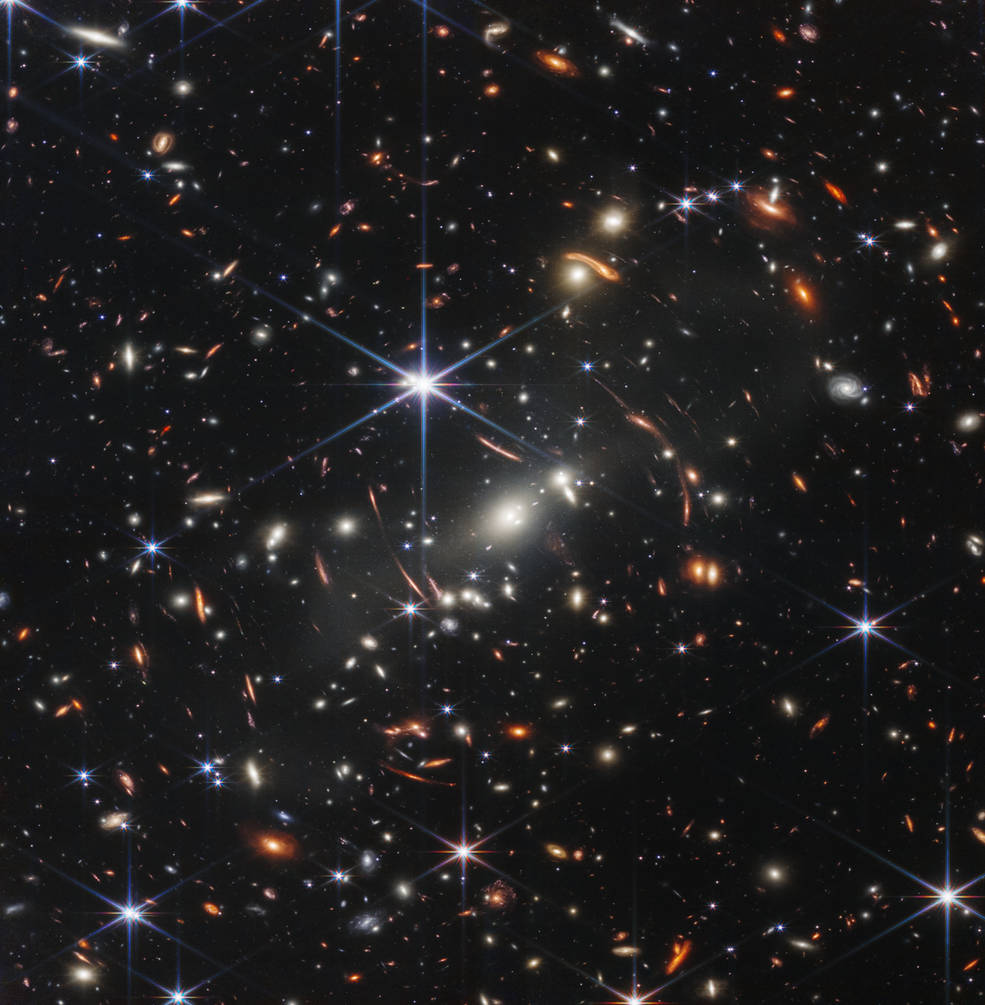
The teaser deep field image from President Biden’s July 11th presentation. Click on the image to fill your screen with it. Credit: NASA, ESA, CSA, JWST, STScI.
In the image above, anything with diffraction spikes is a star in our galaxy. Everything else is a galaxy, like the Milky Way, with billions of stars. This is a tiny piece of sky. As a rule of thumb, the redder the galaxy, the farther away it is. The light emitted by these galaxies are starlight in mostly visible wavelengths, but shifted to the infrared by their great speed of recession caused by the expansion of space between us and them. Also note that many of these galaxies are distorted into short arcs. They seem curved as if being part of a circle around the large, bright galaxy in the center. This is caused by the gravitational lensing caused by the mass of that galaxy, dark matter, and other galaxies in its cluster. This is an effect predicted by Einstein’s theory of General Relativity. I have a feeling that we are going to see a lot more gravitational lensing as the JWST probes into deeper and deeper fields.
One thing to remember about deep fields, is that because of the speed of light being finite, that the farther we look out, the farther back in time we see into an evolving universe. The farthest back we can see with electromagnetic radiation (that is gamma rays, x-rays, ultraviolet, visible, and infrared light, microwaves and radio waves) is the era of the cosmic microwave background, when the universe became transparent, about 380 thousand years after the Big Bang. After that came a period called the dark ages before galaxies formed and the first stars ignited, called the dark ages. At least that’s what I hear-tell. There are lots of questions, like the chicken and egg question: Which came first, supermassive black holes or galaxies?
We will find answers to some of our questions, I’m sure. Even more intriguing, we will be able to ask even more and deeper questions to probe the mystery and beauty of the universe.
07/11/2022 – Ephemeris – First color images from the James Webb Space Telescope will be released tomorrow
This is Ephemeris for Monday, July 11th. Today the Sun will be up for 15 hours and 20 minutes, setting at 9:28, and it will rise tomorrow at 6:08. The Moon, 2 days before full, will set at 4:19 tomorrow morning.
Tomorrow at 10:30 am, NASA and the Space Telescope Science Institute will present the first results from the James Webb Space Telescope. These will be, I believe, four multi-spectral images rendered in full color, and other data. The spectral range of Webb in the infrared is greater than Hubble Space Telescope by several factors. Hubble operates mostly in visible light and plus a bit in the ultraviolet and the near infrared. The current alignment images released are monochromatic and rendered in orange for aesthetic reasons, and to hint that these are from the long wavelength part of the spectrum. I expect the new images to look as great or better than anything the Hubble has produced. There will be a Webb image release and celebration at the Milliken Auditorium of the Dennos Museum at 10:30, with doors opening at 10 am; and also at the Main Library in Traverse City.
The astronomical event times given are for the Traverse City/Interlochen area of Michigan (EDT, UT – 4 hours). They may be different for your location.
Addendum
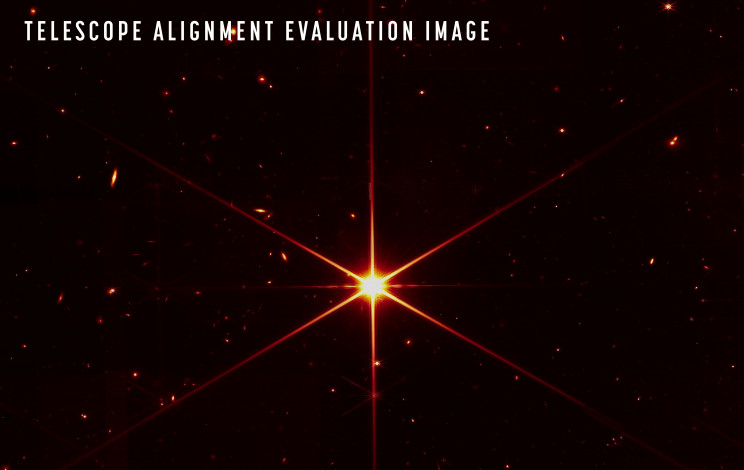
The alignment image of the James Webb Space Telescope after the 18 primary mirror segments have been aligned to act as a single mirror. Beside the alignment star showing its overexposed diffraction spikes, many faint galaxies can be seen. The alignment star, near the Big Dipper, is almost too faint to be seen in binoculars. Credit: NASA, Space Telescope Science Institute (STScI).
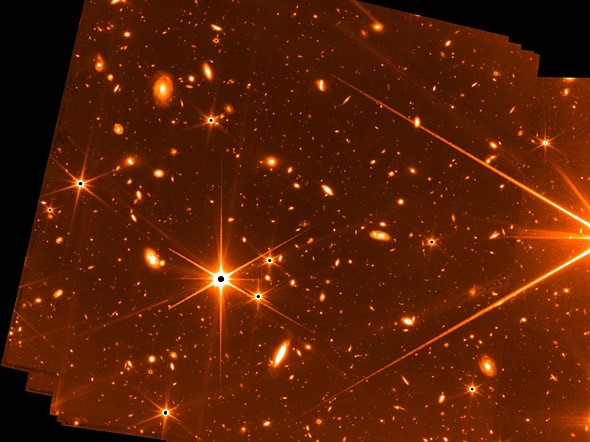
Webb Fine Guidance Sensor (FGC) test image guiding on a star for 72 exposures totaling 32 hours over 8 days. The color key to brightness is white, yellow, orange, red for bright to dim. The black cores to the stars, and at least one galaxy is due to saturating the pixels due to brightness, and are not black holes. Credits: Canadian Space Agency, NASA, FGS team. The Fine Guidance Sensor is a contribution to the James Webb Space Telescope by the Canadian Space Agency.
07/08/2022 – Ephemeris – Polaris the North Star
This is Ephemeris for Friday, July 8th. Today the Sun will be up for 15 hours and 24 minutes, setting at 9:29, and it will rise tomorrow at 6:06. The Moon, 2 days past first quarter, will set at 2:17 tomorrow morning.
The bright star Polaris is a very important star. It is also known as the North Star and the Pole Star. Its unique position is nearly directly at the zenith at the Earth’s North Pole, making it a very important navigational star. It’s about 40 minutes of arc, or about one and a third Moon diameters away from the extension of the Earth’s axis into the sky. As a rule of thumb, its angular altitude above the northern horizon is approximately one’s latitude, and it stands about at the due north compass point. Polaris is found using the Big Dipper, using the two stars at the front of the dipper bowl to point to it. It’s located at the tip of the handle of the very dim Little Dipper which, this time of year in the evening, appears to be standing on its handle.
The astronomical event times given are for the Traverse City/Interlochen area of Michigan (EDT, UT – 4 hours). They may be different for your location.
Addendum
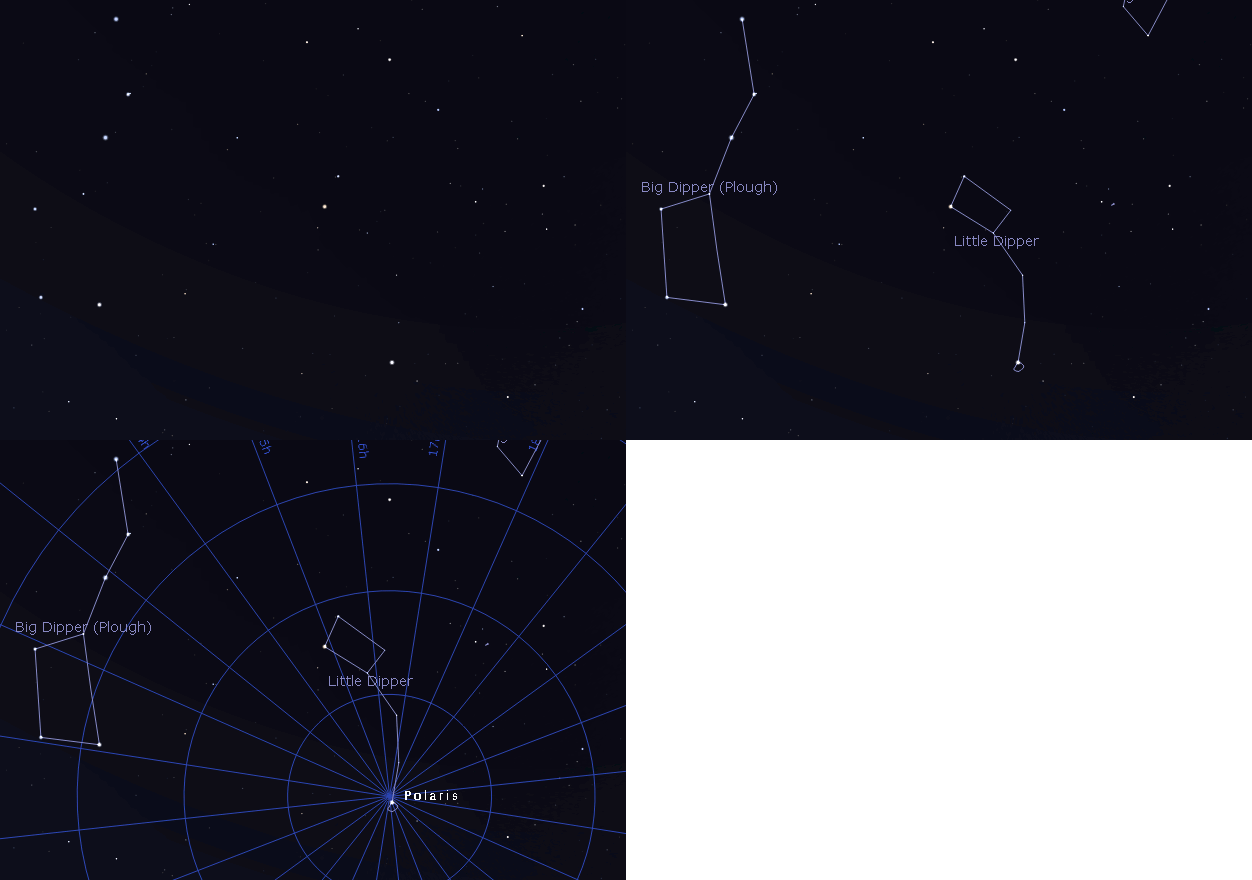
Polaris finder and location animation. Three frames: visual appearance in the sky, lines of the asterisms of the Big and Little Dippers, addition of the equatorial grid of celestial coordinates analogous to longitude and latitude on the Earth. The right ascension (like longitude) lines converge over the Earth’s North Pole, with Polaris close by. Created using Stellarium and GIMP.
The two stars at the front of the Big Dipper’s bowl, at the bottom of the dipper as it appears now in the evening, point to Polaris near the 11-hour right ascension line. Right ascension, though the same as earthly longitude, is measured in hours, rather than degrees. An hour equals 15 degrees, making 24 hours equal 360 degrees.
07/07/2022 – Ephemeris – A closer look at the bright star Vega
This is Bob Moler with Ephemeris for Thursday, July 7th. Today the Sun will be up for 15 hours and 25 minutes, setting at 9:30, and it will rise tomorrow at 6:05. The Moon, 1 day past first quarter, will set at 1:53 tomorrow morning.
Vega, in the constellation Lyra the harp, is the highest star In the east and brightest star of the Summer Triangle also rising in that direction. It is an important and much studied star, first as a standard for brightness for the magnitude scale at almost exactly zero. It also has two fields of debris orbiting it. In 1983 the Infrared Astronomy Satellite, IRAS, discovered an excess of infrared radiation coming from the star. It seems now that there are two orbiting rings, one warm, and the other cold. This is somewhat like the two disks the Sun has: The asteroid belt between Mars and Jupiter and the Kuiper belt, beyond Neptune. No planets have yet been discovered around Vega, but I wouldn’t bet against it.
The astronomical event times given are for the Traverse City/Interlochen area of Michigan (EDT, UT – 4 hours). They may be different for your location.
Addendum
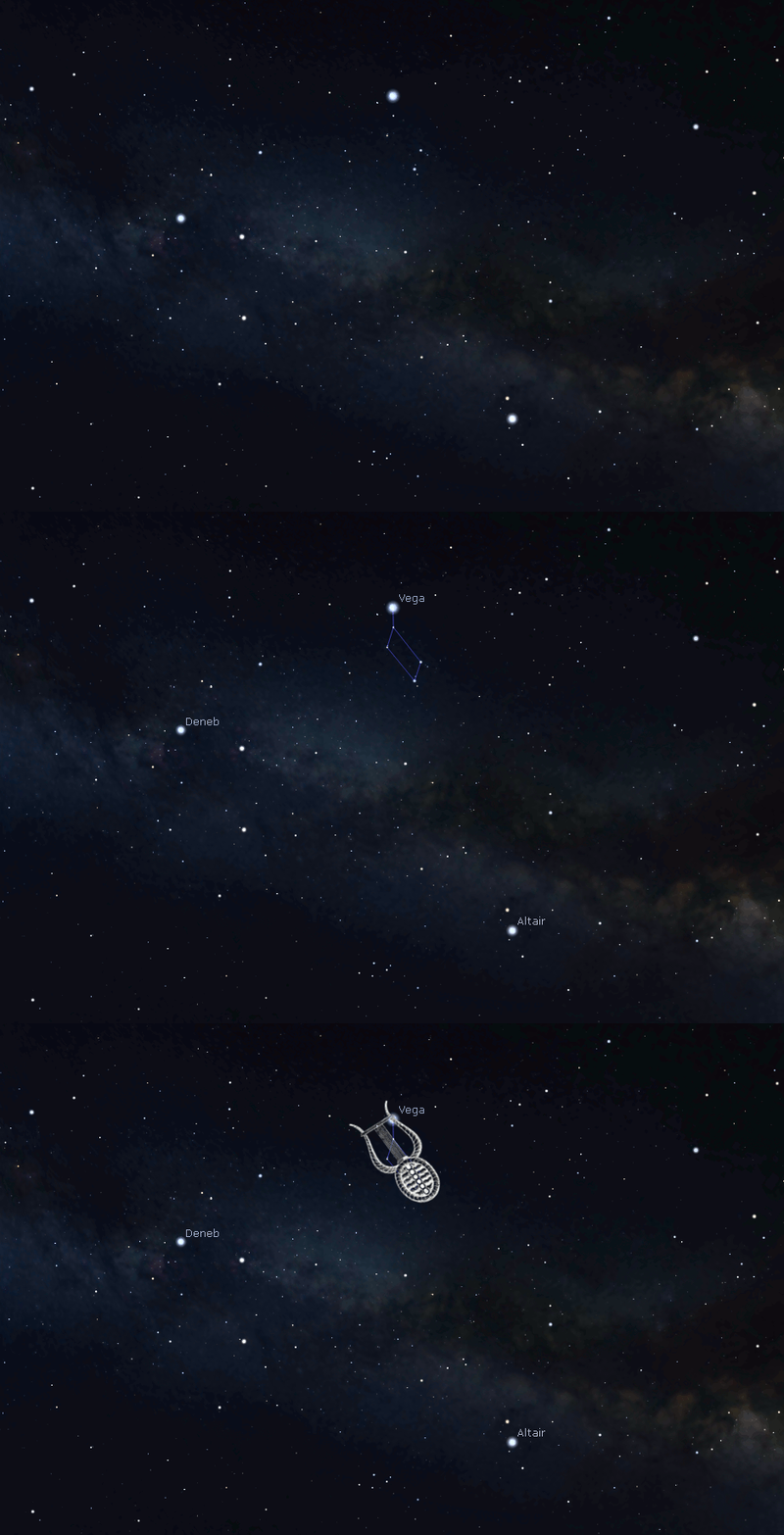
Animated Lyra finder chart. The lyre image not supplied by Stellarium but is from The World’s Earliest Music by Hermann Smith, Figure 60, A Project Gutenberg E-Book, and captioned “The Chelys or Greek Tortoiseshell Lyre”. Vega is the brightest star in Lyra, and the brightest star of the Summer Triangle. The other stars of the triangle are Deneb and Altair. Created using Stellarium.
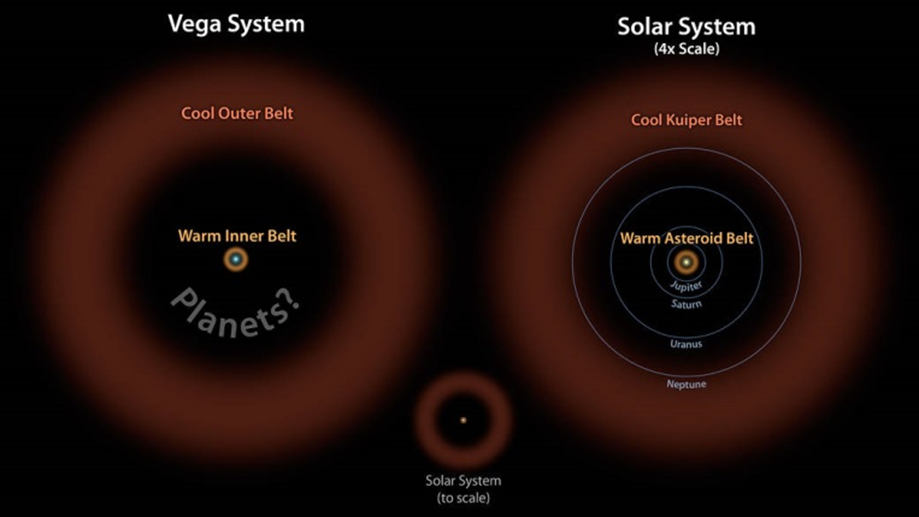
Vega possesses two debris fields, similar to our own solar system’s asteroid and Kuiper belts. Astronomers continue to hunt for planets orbiting Vega, but as of May 2020 none have been confirmed. More info: bit.ly/VegaSystem Credit: NASA/JPL-Caltech
07/06/2022 – Ephemeris – Let’s search for the naked-eye planets for this week
This is Bob Moler with Ephemeris for Wednesday, July 6th. Today the Sun will be up for 15 hours and 26 minutes, setting at 9:30, and it will rise tomorrow at 6:04. The Moon, at first quarter today, will set at 1:32 tomorrow morning.
Let’s search for the naked-eye planets for this week. All the naked-eye planets are in the morning sky, although Mercury is too close to the Sun to be seen. On the 16th, it will leave the morning sky, crossing over to the evening sky. At 5 am tomorrow, the planets will be spread out from brilliant Venus low in the east-northeast to Saturn higher in the south. To the right and above of Venus, in the east-southeast, will be the Mars. Jupiter is a bit higher in the southeast. Mars is dimmer than Jupiter, but is slowly getting brighter as the Earth creeps up on it. Saturn ends the line of planets in the south. Tonight, Saturn will rise about 11:30 pm. It won’t be an official evening planet until it rises before sunset. That won’t happen until mid-August.
The astronomical event times given are for the Traverse City/Interlochen area of Michigan (EDT, UT – 4 hours). They may be different for your location.
Addendum
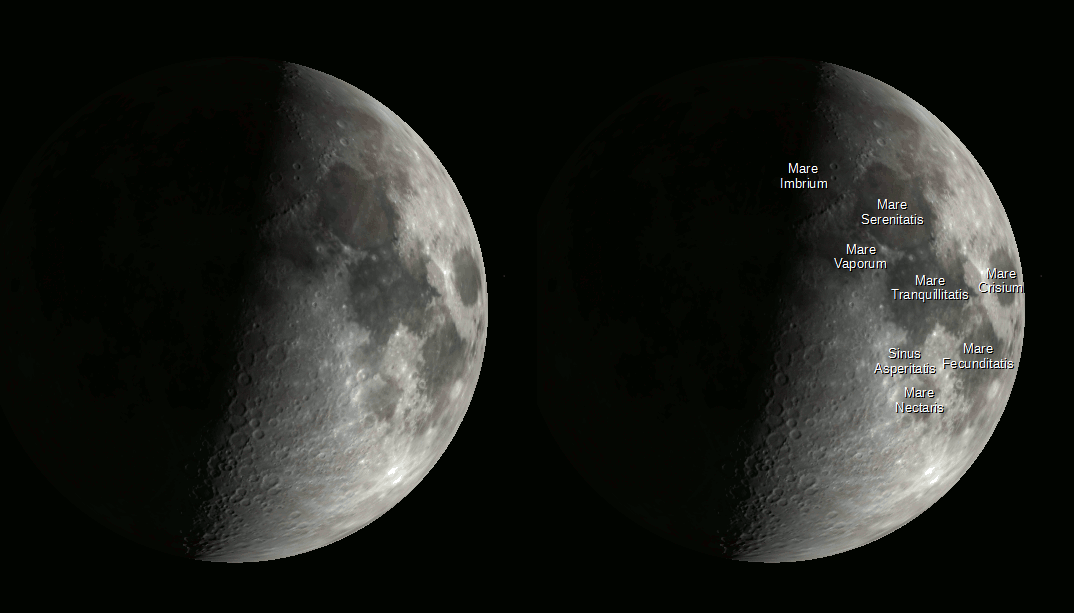
First quarter Moon tonight with prominent features labeled. Created using Stellarium, GIMP and LibreOffice.
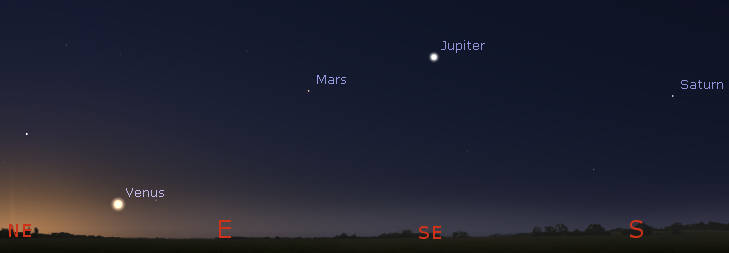
The morning planets at 5 am tomorrow morning, July 7, 2022. The planets actually appear in a straight line in the sky, being placed along the ecliptic, or path of the Sun in the sky. The ecliptic is a great circle on the celestial sphere. Click on the image to enlarge it. The span of the planets from Venus to Saturn is 113 degrees. Click on the image to enlarge it. Created using Stellarium.
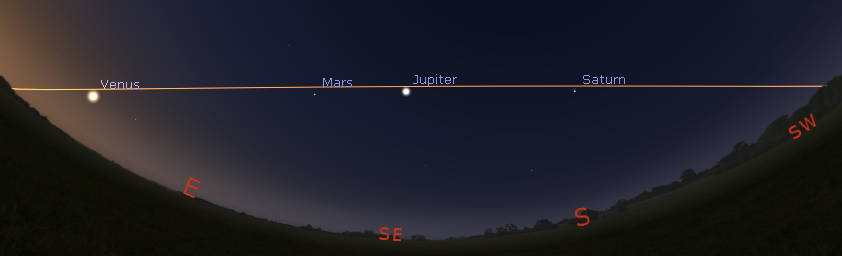
Distortions of rendering a spherical sky on a flat plane. The morning planets as seen in a stereographic view where great circles, like the ecliptic and horizon, are either circles or straight lines. In this image, the ecliptic, orange line, runs through the center of the plot, so it appears straight. In the real sky, both the planets and the horizon appear to be in straight lines. This assumes that your horizon is flat. Click on the image to enlarge it. Created using Stellarium.
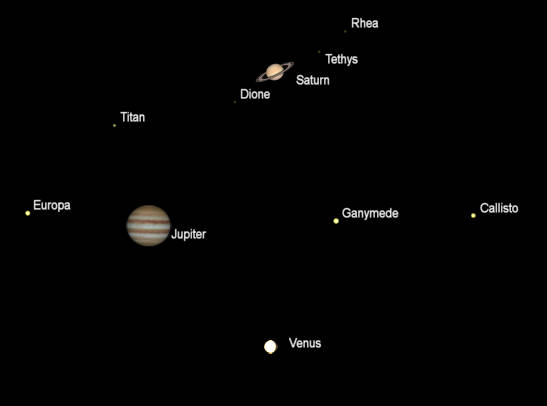
Views of Saturn, Jupiter, and Venus (north up) as they would be seen in a small telescope, with the same magnification, tomorrow morning at 5:00 am, July 7, 2022. I do not show planets less than 10 seconds of arc in diameter. Apparent diameters: Saturn 18.32″, its rings 42.68″; Jupiter 41.68″. Mars is not shown, its apparent diameter is 7.41″ and is 85.4% illuminated; Venus 11.60″, 87.5% illuminated. Jupiter’s 4th Galilean moon, Io, is missing because it is in Jupiter’s shadow. The ” symbol means seconds of arc (1/3600th of a degree.) Created using Cartes du Ciel (Sky Charts).
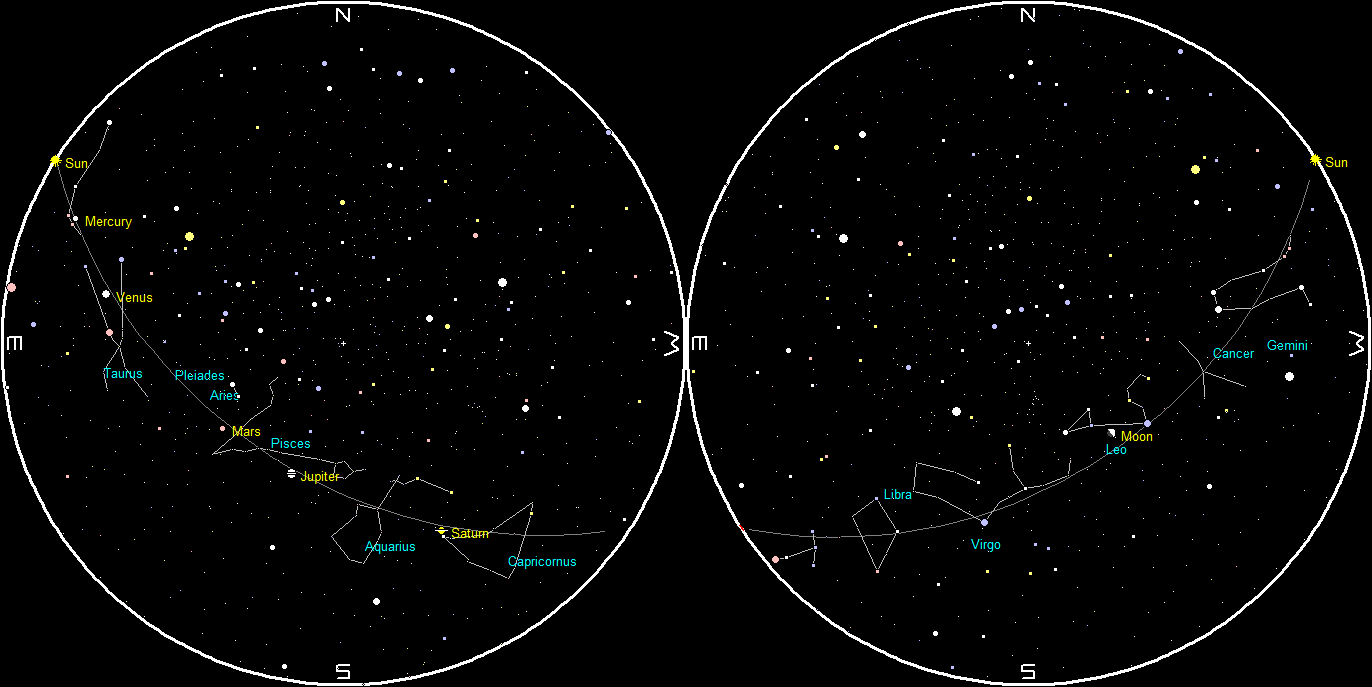
The naked-eye planets and the Moon at sunset and sunrise on a single night, starting with sunset on the right on July 6, 2022. The night ends on the left with sunrise on the 7th. Notice that all the naked-eye planets are in the morning sky now. Click on the image to enlarge it. Created using my LookingUp program.
07/05/2022 – Ephemeris – Taking a close look at Altair
This is Ephemeris for Tuesday, July 5th. Today the Sun will be up for 15 hours and 27 minutes, setting at 9:30, and it will rise tomorrow at 6:04. The Moon, 1 day before first quarter, will set at 1:12 tomorrow morning.
The southernmost star of the Summer Triangle is Altair, high in the east-southeast. The other two stars of the triangle are Vega nearly overhead in the east, and Deneb high in the east-northeast. Altair is the closest of the three at a distance of 16.7 light years away. One light year is nearly 6 trillion miles. Altair is 10 times the brightness of the Sun. If seen at Altair’s distance, the Sun would only be as bright as one of the two stars that flank it. What is rather different about Altair is its rapid rotation. While it’s almost twice the sun’s diameter, it rotates once in about 9 hours, The CHARA Interferometer at Mt. Wilson has actually imaged its squashed disk in the infrared. Our Sun’s a slow poke, taking nearly a month to rotate once.
The astronomical event times given are for the Traverse City/Interlochen area of Michigan (EDT, UT – 4 hours). They may be different for your location.
Addendum
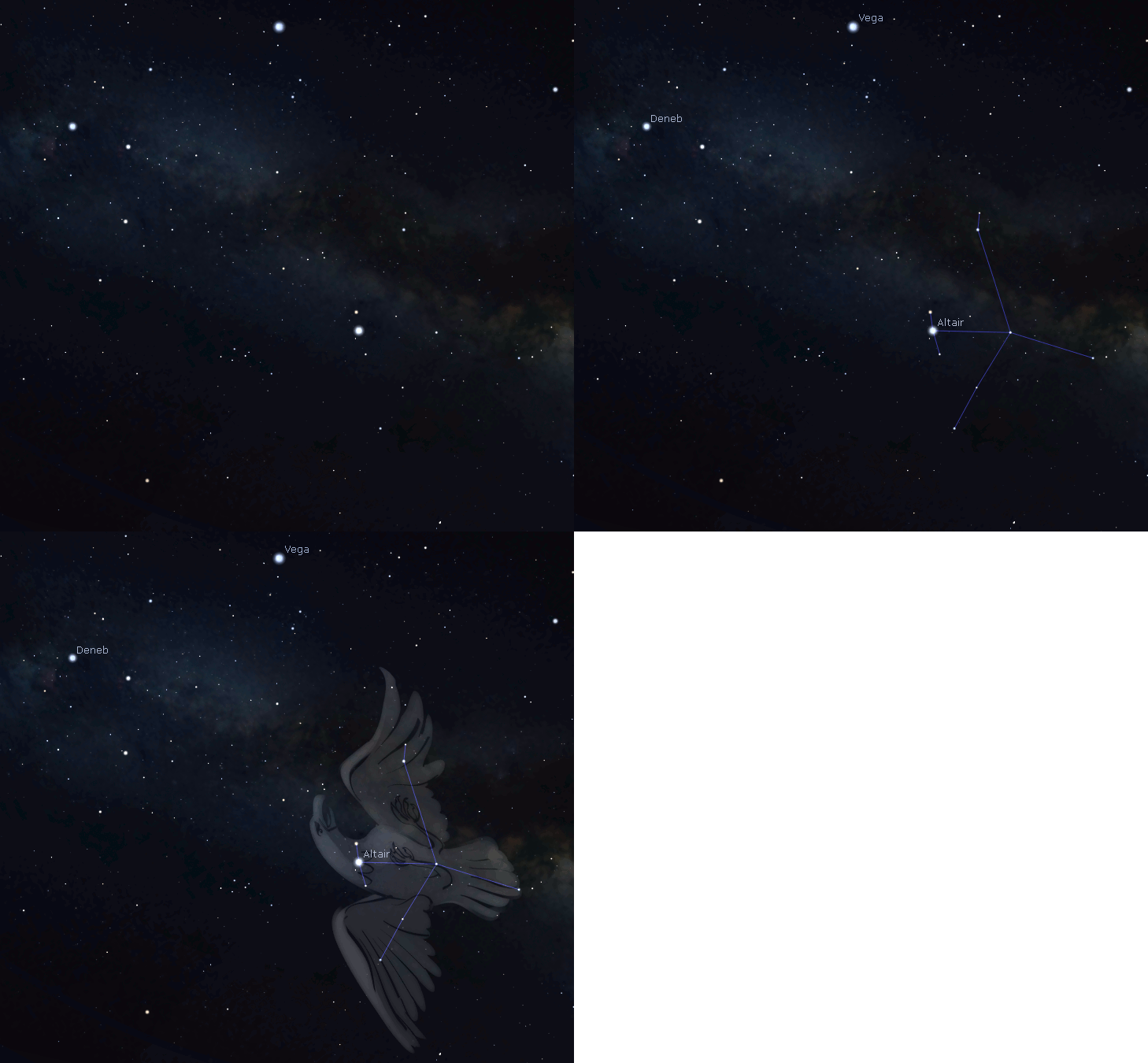
Animated Aquila finder chart with Altair as its brightest star. Also shown are the other two stars of the Summer Triangle, Vega and Deneb. Created using Stellarium.
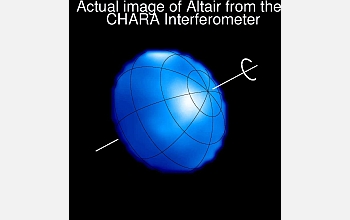
Credit: Zina Deretsky, National Science Foundation
07/04/2022 – Ephemeris – Space firsts, or attempts, on our nation’s birthday
This is Ephemeris for Independence Day, Monday, July 4th. Today the Sun will be up for 15 hours and 28 minutes, setting at 9:31, and it will rise tomorrow at 6:03. The Moon, 2 days before first quarter, will set at 12:53 tomorrow morning.
To celebrate our nation’s 200th birthday, NASA attempted to land the Viking 1 lander on the planet Mars on July 4th, 1976. The Viking was a combination orbiter and lander and had a twin spacecraft arriving almost two months later. Viking 1 entered orbit on June 19th and began to survey the prime landing area, that radar from the Earth suggested would be smooth, to land on the day of the Bicentennial. However, images from orbit showed too many obstructions, so another area was surveyed. The mission planners from JPL found a spot and sent the Viking lander down to land on Mars on another historic date, July 20, 1976, the 7th anniversary of the Apollo 11 landing on the Moon.
The astronomical event times given are for the Traverse City/Interlochen area of Michigan (EDT, UT – 4 hours). They may be different for your location.
Addendum
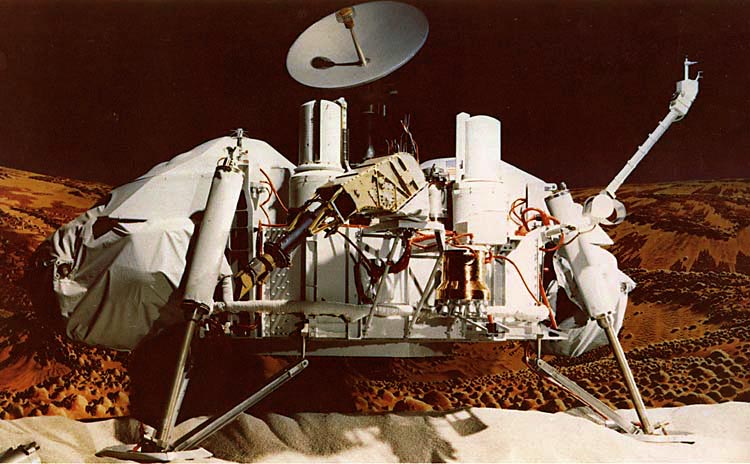
Model of the Viking lander. Credit NASA/JPL.
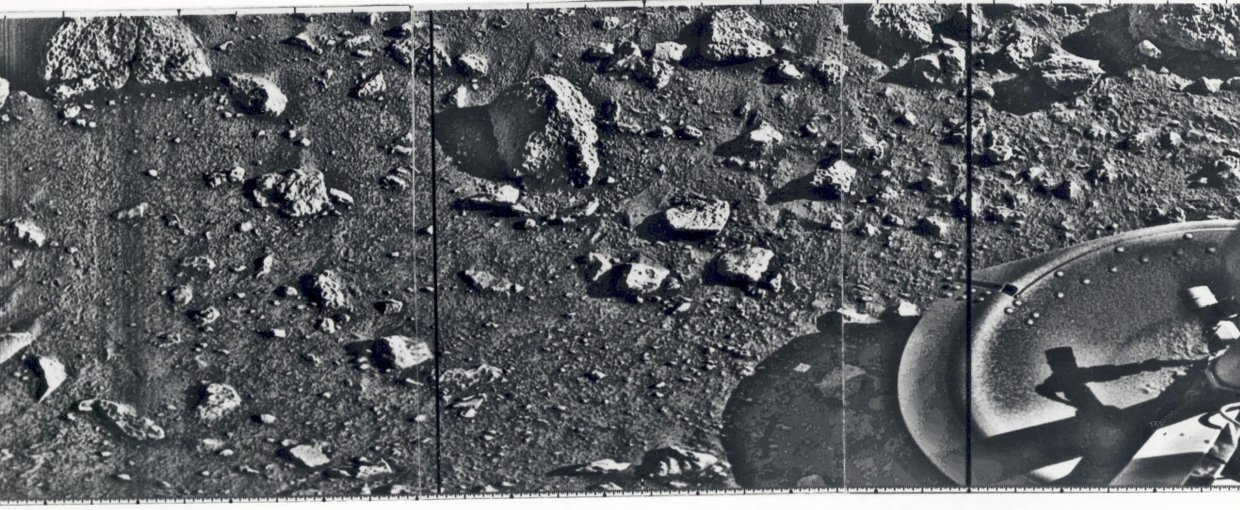
The first Mars image from the Viking 1 lander, taken moments after touchdown. The Viking landers used rockets to land, after a parachute descent, because the parachutes would not slow the lander enough in the thin Martian atmosphere. The reason to photograph the landing pad was to see how far it would sink into the surface. Credit NASA/JPL.
NASA did finally make a historic landing on July 4th,
the Mars Pathfinder mission, with the first rover to operate on Mars, the Sojourner rover, landed on July 4, 1997. It was a microwave sized rover. The mission on the surface lasted 85 days.
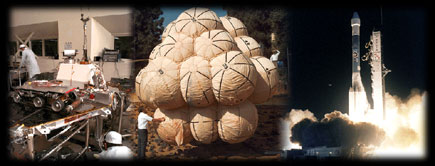
Pathfinder collage, Left to right, the collapsed Sojourner rover attached to one of the lander’s tetrahedron petals; 24 inflated airbags, attached 6 to a side of the Pathfinder tetrahedron; launch of the Delta II rocket carrying Pathfinder to Mars. Credit NASA/JPL.
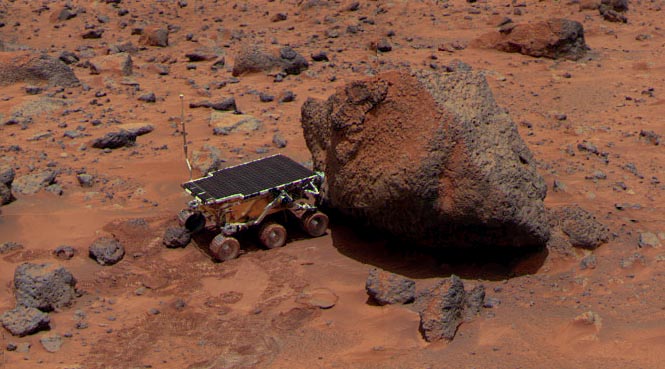
Sojourner rover investigates a rock named Yogi with its Alpha Particle X-ray Spectrometer to determine its composition. Credit NASA/JPL.
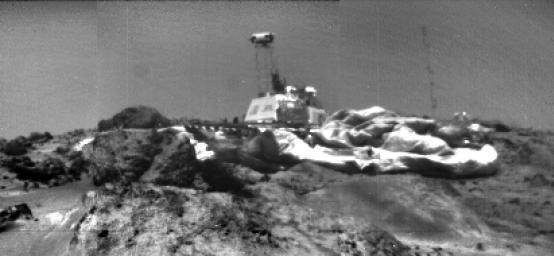
The Pathfinder Lander/Base Station and its deflated airbags from Sojourner. All communications from Sojourner to Earth is relayed through the Base Station. Credit NASA/JPL.
 Bob Moler's Ephemeris Blog