Archive
05/17/2023 – Ephemeris – Let’s find where the naked-eye planets have wandered off to this week
This is Bob Moler with Ephemeris for Wednesday, May 17th. Today the Sun will be up for 14 hours and 53 minutes, setting at 9:06, and it will rise tomorrow at 6:11. The Moon, 2 days before new, will rise at 5:30 tomorrow morning.
Let’s find where the naked-eye planets have wandered off to this week. Venus is our blazing Evening Star, seen in the west all evening. It will set after midnight. The red planet Mars has moved into Cancer, left of the namesake stars of the Gemini twins, with Pollux closest to Mars and Castor farther right. Mars is above and left of Venus by 18 degrees, or a bit less than two times the width of one’s fist held at arm’s length. Venus is closing the gap between them, but will never quite reach Mars while they are in the evening sky. The closest they will get is three and a half degrees or 7 moon diameters apart, before Venus pulls back toward the Sun faster than Mars will. In the morning, Saturn will be visible, low in the east-southeast by 5 am, rising at 3:18 am. This morning, the Moon is covering or occulting Jupiter. Daylight is making this a telescopic event.
The astronomical event times given are for the Traverse City/Interlochen area of Michigan (EDT, UT –4 hours). They may be different for your location.
Addendum
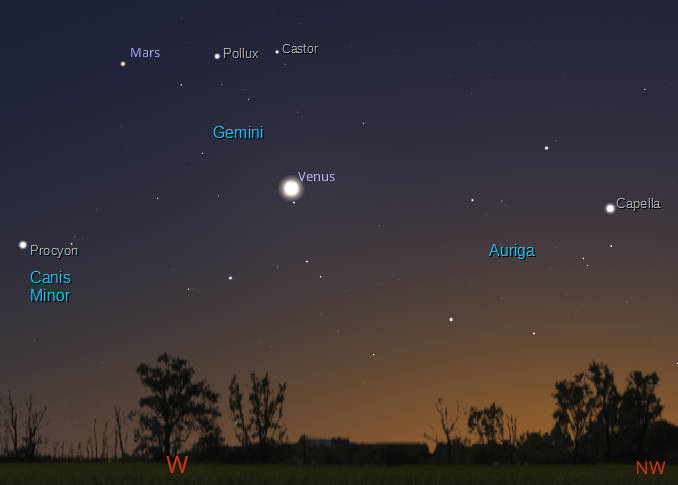
Evening planets with the stars at 10 pm tonight, May 17, 2023. Created using Stellarium and LibreOffice Draw.
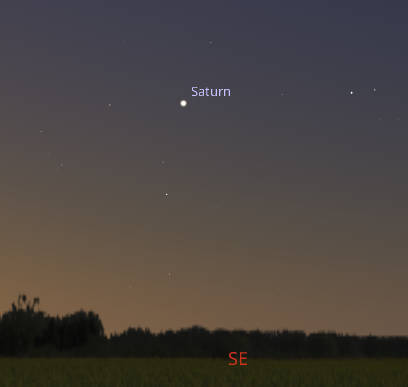
Saturn in morning twilight at 5:30 am tomorrow, May 18, 2023. Created using Stellarium.
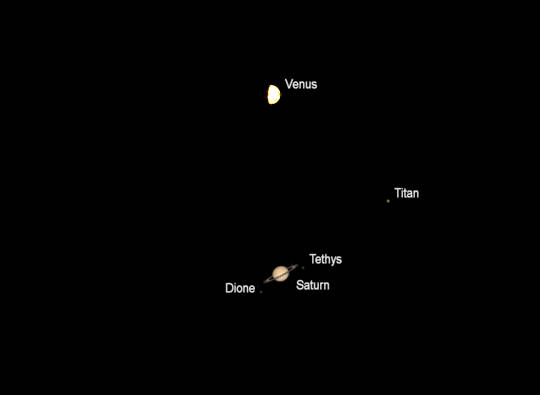
Telescopic Venus and Saturn (north up) as they would be seen in a small telescope, with the same magnification. Apparent diameters: Venus 19.65″ and is 58.9% illuminated; Saturn 16.77″, its rings 39.05″. Mars, too small to be represented here, is 4.96″ in diameter. Created using Cartes du Ciel (Sky Charts).
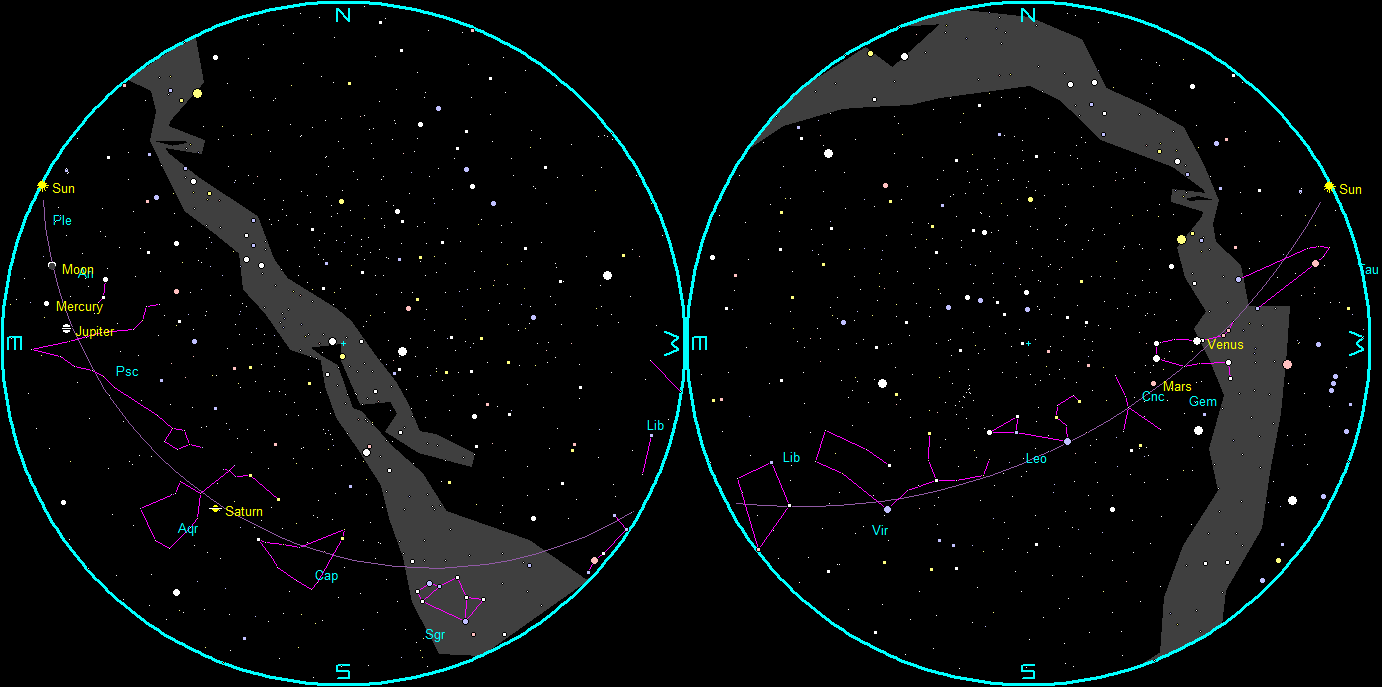
The naked-eye planets and the Moon at sunset and sunrise on a single night, starting with sunset on the right on May 17, 2023. The night ends on the left with sunrise on the 18th. Click or tap on the image to enlarge it. Created using my LookingUp app and GIMP.
05/16/2023 – Ephemeris – Regulus, the Little King Star
This is Ephemeris for Tuesday, May 16th. Today the Sun will be up for 14 hours and 51 minutes, setting at 9:05, and it will rise tomorrow at 6:12. The Moon, 3 days before new, will rise at 5:08 tomorrow morning.
Regulus is the brightest star in the constellation of Leo, the lion at the bottom of the backward question mark that is the head and mane of Leo. It’s in the southwest at 10 pm. Alluding to the lion’s status in the animal kingdom, Regulus is the little king star. It is dead last in order of brightness of the 21 brightest first magnitude stars, 1/13th the brightness of Sirius the brightest nighttime star, now lost in the evening twilight glow. To the Babylonians it was the king, the 15th of their constellations, that marked the passage of the Sun. Regulus is about 79 light years away, and 288 times the brightness of the sun. It is a rapidly spinning ellipsoid 3 times the sun’s diameter, rotating in just under 16 hours.
The astronomical event times given are for the Traverse City/Interlochen area of Michigan (EDT, UT –4 hours). They may be different for your location.
Addendum
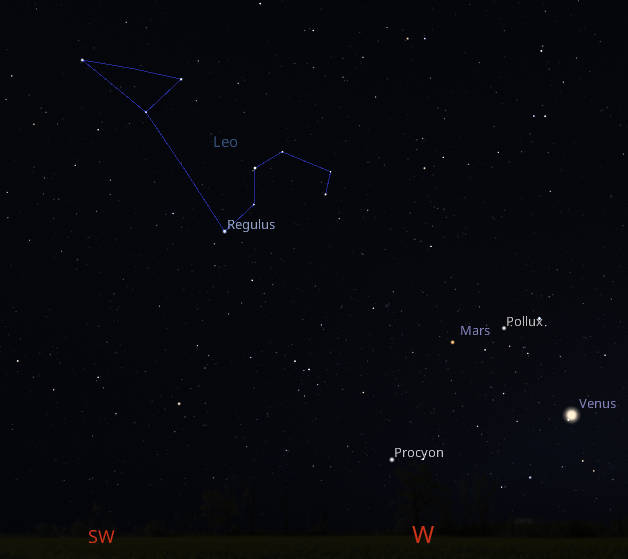
Regulus and Leo and the other stars and planets in the western sky at 11 pm, May 16, 2023. Created using Stellarium.
05/15/2023 – Ephemeris – Why are crows black?
This is Bob Moler with Ephemeris for Monday, May 15th. Today the Sun will be up for 14 hours and 49 minutes, setting at 9:04, and it will rise tomorrow at 6:13. The Moon, 3 days past last quarter, will rise at 4:47 tomorrow morning.
The small constellation of Corvus the crow is located low in the south at 10:30 this evening. It’s made of 6 dim stars, the pattern is a distinctive but distorted box with two stars in the upper left corner and two stars in the lower right corner. To the right is a fainter constellation of a thick stemmed goblet called Crater. Both appear above the long constellation of Hydra, the water snake who is slithering above the southern horizon. In Greek mythology Corvus, then white, was the god Apollo’s pet who once bid the crow to take a cup and fetch him some water. Corvus, however, dallied and waited for a green fig to ripen. Corvus then grabbed a snake and returned with a story on how the snake had delayed him. The angry Apollo saw through the story and turned the crow black.
The astronomical event times given are for the Traverse City/Interlochen area of Michigan (EDT, UT –4 hours). They may be different for your location.
Addendum
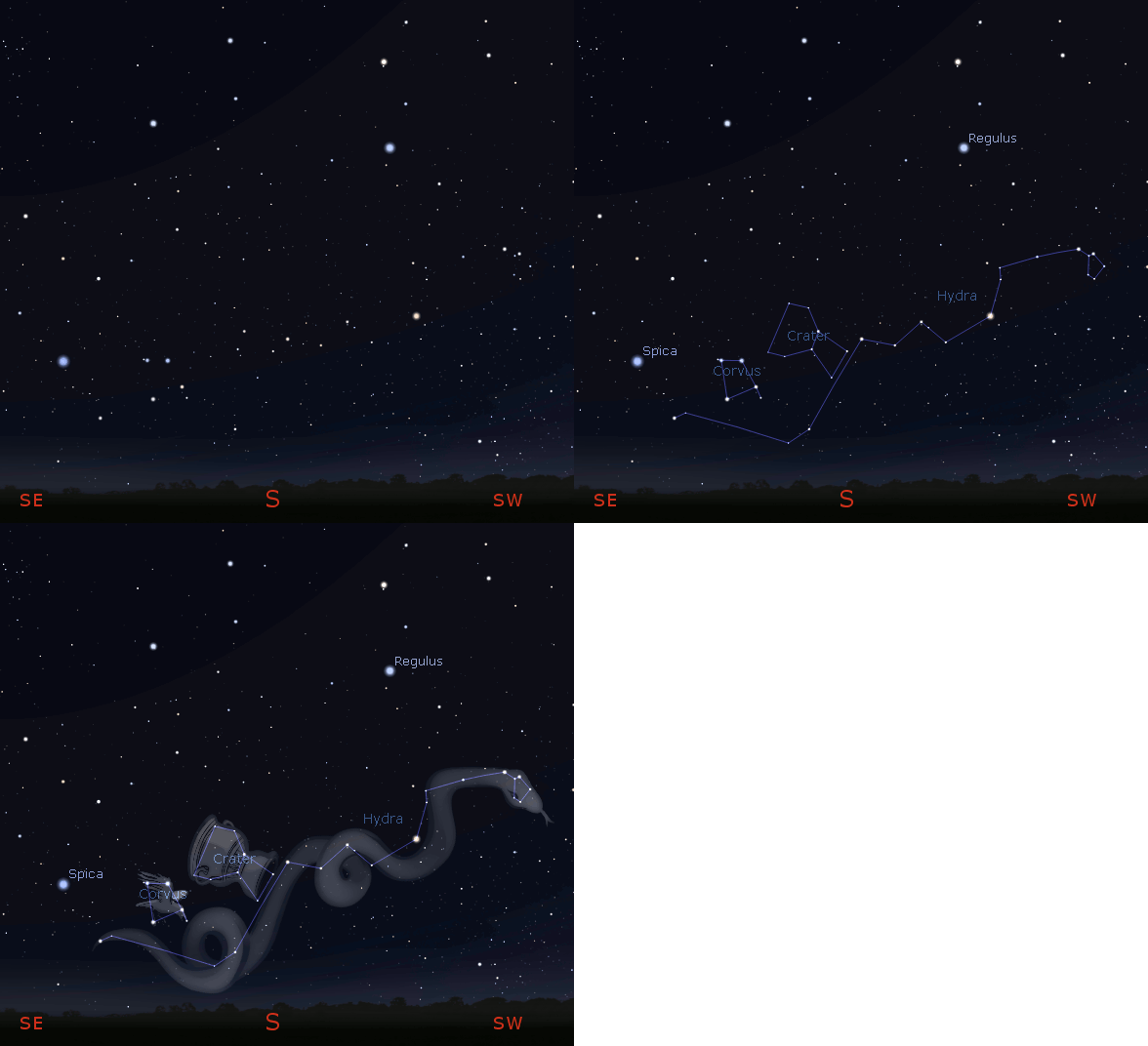
Corvus, Crater and Hydra finder chart. The chart was made for earlier in the month, so when it’s dark enough to see them, the constellations will have shifted to the west or right. Created using Stellarium and GIMP.
05/12/2023 – Ephemeris – Finding Virgo the virgin in the evening sky
This is Ephemeris for Friday, May 12th. Today the Sun will be up for 14 hours and 42 minutes, setting at 9:00, and it will rise tomorrow at 6:17. The Moon, at last quarter today, will rise at 3:44 tomorrow morning.
One of the large constellations we see in the south at 11 p.m. can be found using the Big Dipper overhead, follow the arc of the handle to the bright star Arcturus, then straighten the arc to a spike to reach Spica, a bright blue-white star in the south. Spica is the brightest star in the constellation Virgo, the virgin. She represents the goddess of the harvest, Virgo is holding a sheaf of wheat in depictions of her, and Spica is placed at the head of the sheaf. In the space between Spica and Leo the lion to her upper right is, a great cluster of thousands of galaxies just below naked eye visibility. The Virgo Cluster. Inside that cluster is galaxy M87, in whose center lies a black hole with the mass of 6.5 billion suns. The center of the cluster is at about 54 million light years away.
The astronomical event times given are for the Traverse City/Interlochen area of Michigan (EDT, UT –4 hours). They may be different for your location.
Addendum
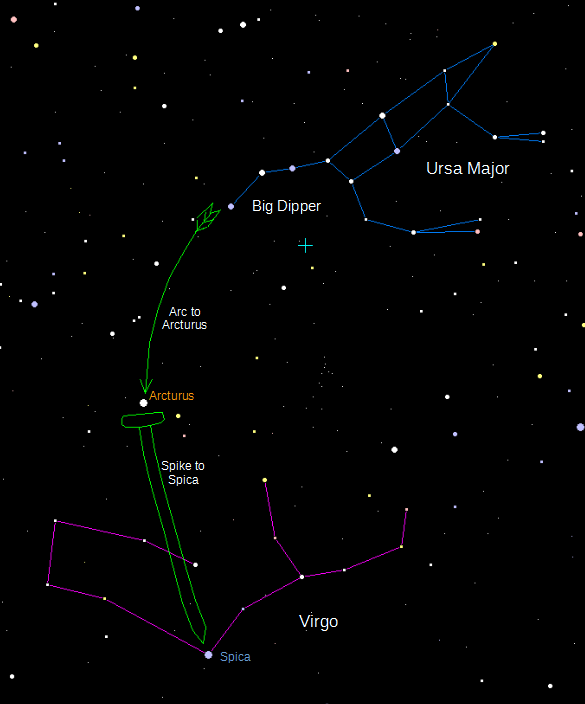
Finding Virgo from the Big Dipper at 11 pm, May 12. There are no planetary interlopers this year. The small + sign marks the zenith, and the image faces south. Created using my LookingUp app, with captions added using LibreOffice Draw.
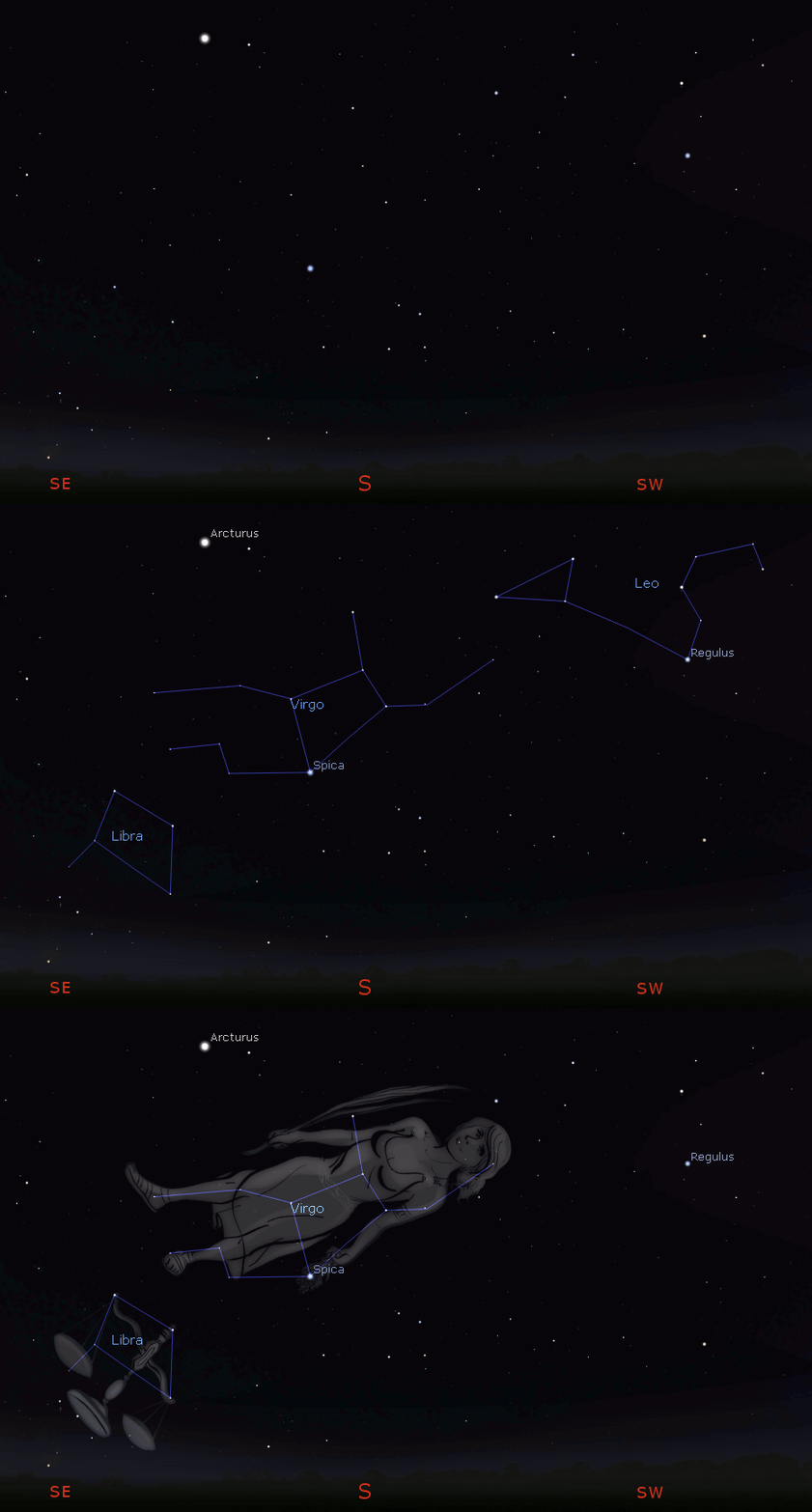
Virgo finder animation with Leo added as an aid for 11 p.m. tonight. Created using Stellarium and GIMP.
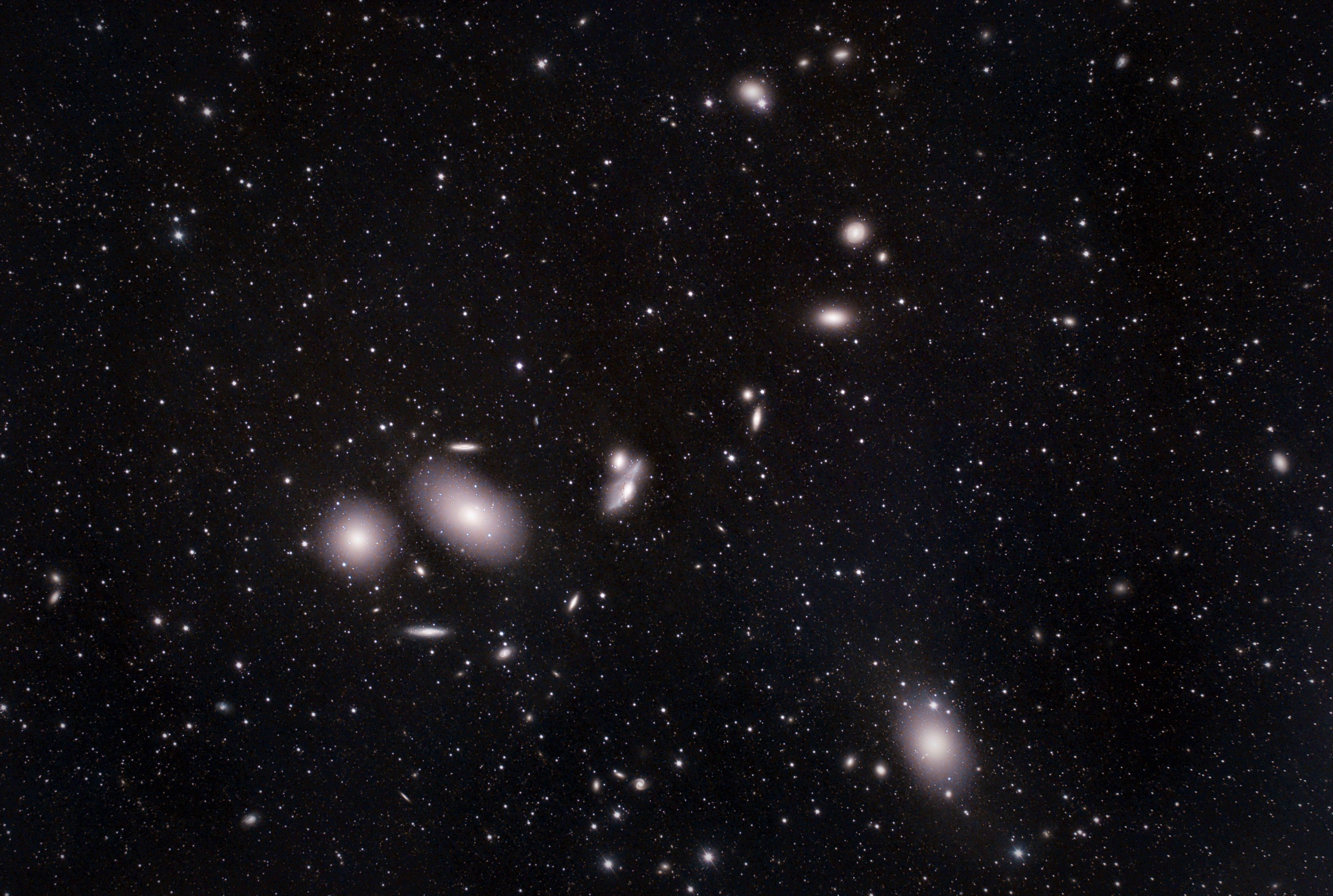
Markarian’s Chain, a small part of the Virgo Cluster of galaxies. Click or tap on the image to enlarge it. Credit: Daniel Dall’Olmo.
05/11/2023 – Ephemeris – Finding Hydra the water snake
This is Ephemeris for Thursday, May 11th. Today the Sun will be up for 14 hours and 40 minutes, setting at 8:59, and it will rise tomorrow at 6:18. The Moon, 1 day before last quarter, will rise at 3:17 tomorrow morning.
Low in the south and southwestern sky at 10 p.m. and later can be found the constellation of Hydra the water snake, the longest constellation of all. Unlike the monster of the same name, this Hydra has but one head, which is its most distinctive part. At 11 p.m. the head of Hydra is located between the bright stars Procyon in the west and Regulus in Leo the lion in the southwest. Hydra’s head is a small but distinctive group of 6 stars that make a drooping loop to the right. The rest of Hydra wends its way above the southern horizon below the bright blue star Spica in Virgo. Some delineations of Hydra have the tail tickling the constellation Libra, the balance which has just risen in the southeast.
The astronomical event times given are for the Traverse City/Interlochen area of Michigan (EDT, UT –4 hours). They may be different for your location.
Addendum
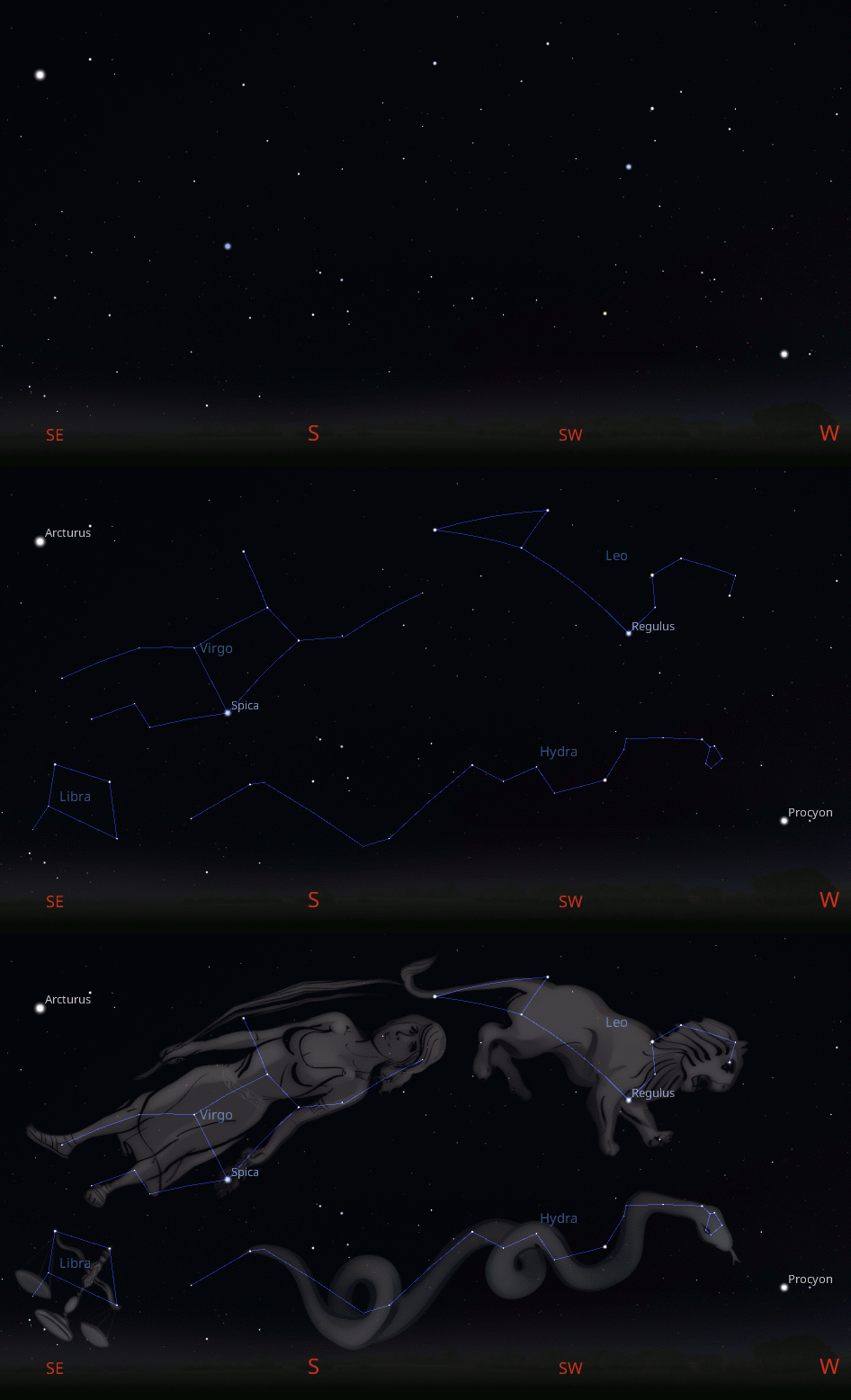
Finding Hydra, the water snake animation showing nearby constellations and stars mentioned in the program. Click or tap on the image to enlarge it. Created using Stellarium, and GIMP.
05/10/2023 – Ephemeris – Let’s find where the naked-eye planets have wandered off to this week
This is Bob Moler with Ephemeris for Wednesday, May 10th. Today the Sun will be up for 14 hours and 37 minutes, setting at 8:58, and it will rise tomorrow at 6:19. The Moon, 2 days before last quarter, will rise at 2:42 tomorrow morning.
Let’s find where the naked-eye planets have wandered off to this week. Venus is our blazing Evening Star, seen in the west all evening. It will set after midnight. The red planet Mars is in Gemini, left and a bit below Pollux, the leftmost of the namesake stars of the twins, with Castor on the right. Mars is above and left of Venus. By 20 degrees, or two times the width of one’s fist held at arm’s length. Venus is closing the gap between them, but will never quite reach Mars while they are in the evening sky. The closest they will get is three and a half degrees or 7 moon diameters apart, before Venus pulls back toward the Sun faster than Mars will. In the morning, Saturn will be visible and low in the east-southeast by 5 am, rising at 3:37 am. Both Jupiter and Mercury are too close to the direction of the Sun to be seen.
The astronomical event times given are for the Traverse City/Interlochen area of Michigan (EDT, UT –4 hours). They may be different for your location.
Addendum
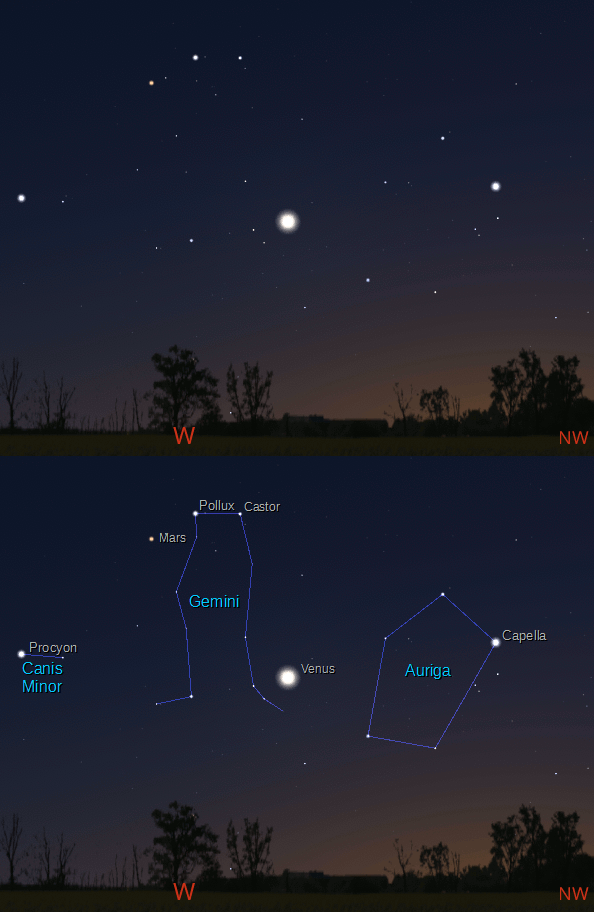
Venus and Mars among the setting winter stars at 10 pm tonight, May 10, 2023. Created using Stellarium, LibreOffice Draw and GIMP.
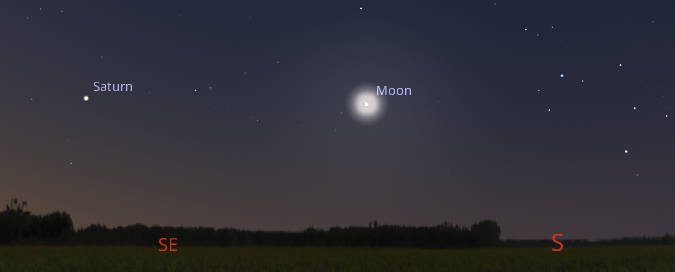
Saturn and the Moon in the morning sky at 5:30 am. Note the Sagittarius’ Teapot asterism on the right. Created using Stellarium.
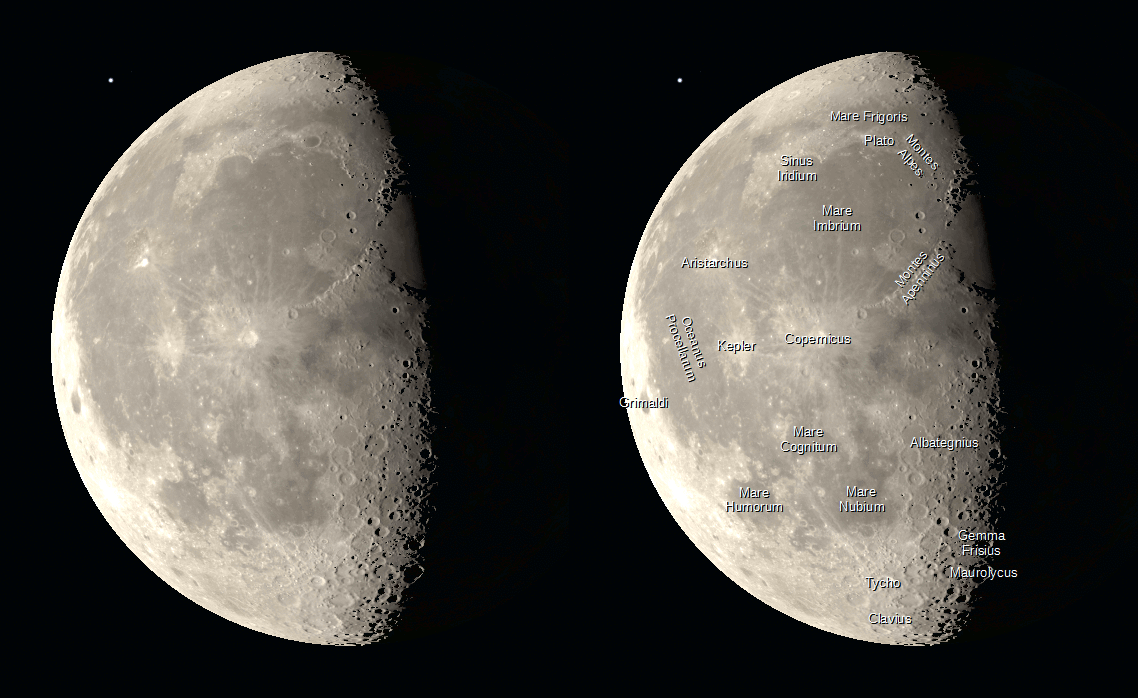
Waning gibbous Moon animation with selected features labeled. Labels are centered on their feature. Created using Stellarium, LibreOffice, and GIMP.
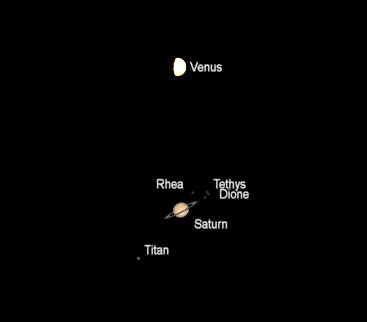
Telescopic Venus and Saturn (north up) as they would be seen in a small telescope, with the same magnification tonight, the night of May 10/11, 2023. Apparent diameters: Venus 18.45″ and is 62.1% illuminated; Saturn 16.58″, its rings 38.61″. Mars, too small to be represented here, is 5.12″ in diameter. Both Venus and Saturn are getting larger as they approach us. Created using Cartes du Ciel (Sky Charts).
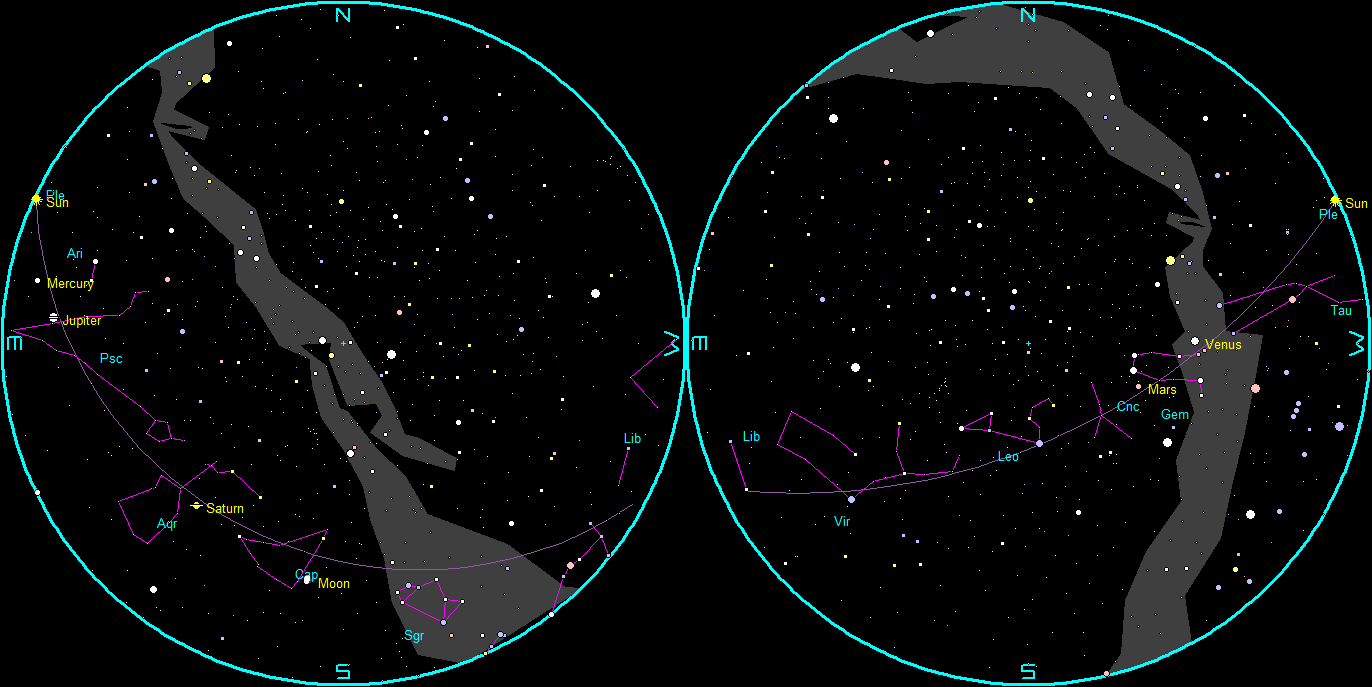
The naked-eye planets and the Moon at sunset and sunrise on a single night, starting with sunset on the right on May 10, 2023. The night ends on the left with sunrise on the 11th. Click or tap on the image to enlarge it. Created using my LookingUp app and GIMP.
05/09/2023 – Ephemeris – The planet Uranus’ rings
This is Ephemeris for Tuesday, May 9th. Today the Sun will be up for 14 hours and 35 minutes, setting at 8:57, and it will rise tomorrow at 6:20. The Moon, 3 days before last quarter, will rise at 1:56 tomorrow morning.
Today, the planet Uranus is in conjunction with the Sun. I don’t talk about Uranus that much, because it can’t be spotted in the sky with the naked eye. However, the James Webb Space Telescope observed it, and gave our clearest view of the planet since Voyager 2 flew past it in January 1986. Uranus has a system of rings, which were discovered in March 1977. Though not visible, they blocked the light of a star. Astronomers at the time were trying to get a more accurate diameter of the planet by timing the disappearance of a star behind the planet. Extra short dips in brightness before and after the main occultation revealed the existence of the rings. Uranus also has an extreme axial tilt of 98 degrees.
The astronomical event times given are for the Traverse City/Interlochen area of Michigan (EDT, UT –4 hours). They may be different for your location.
Addendum
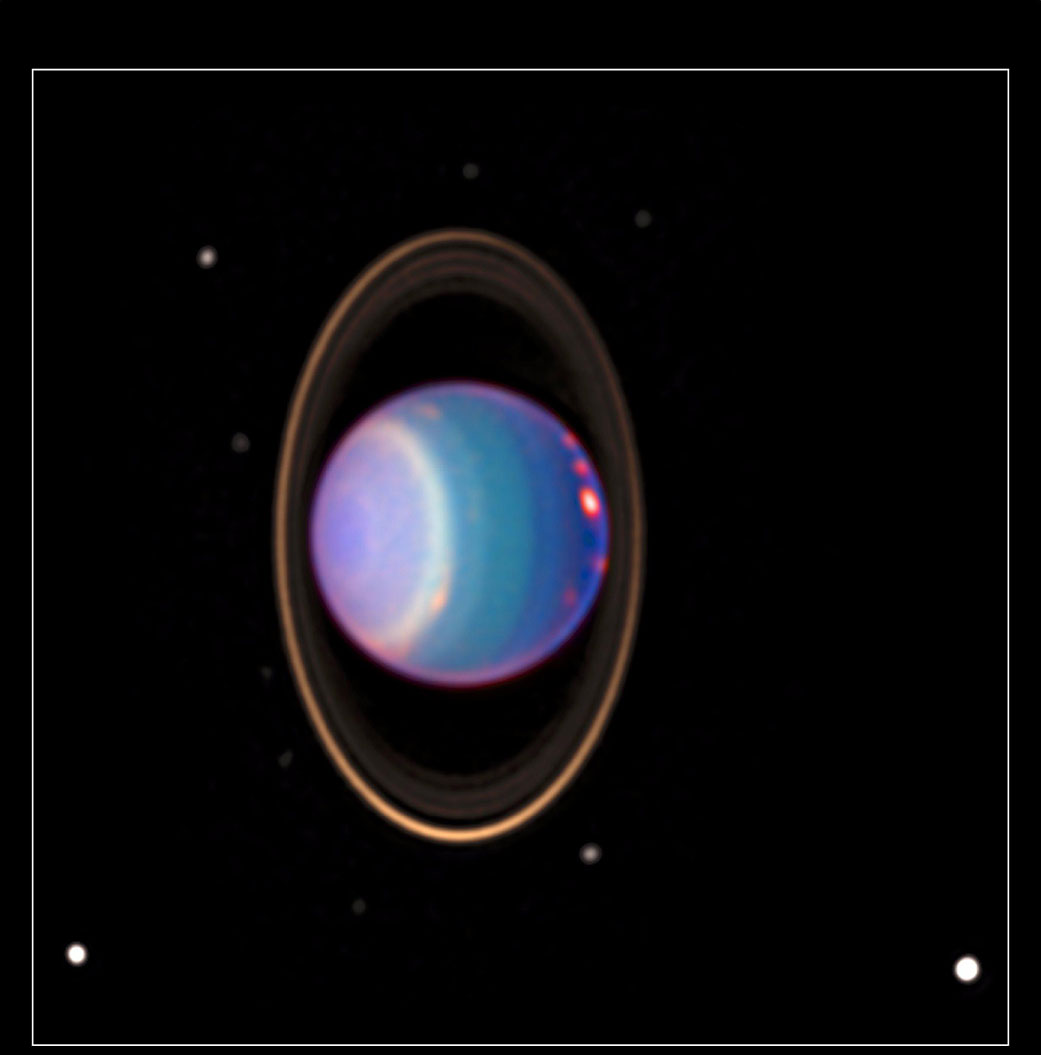
Uranus and its rings as photographed by the Hubble Space Telescope. Credit NASA/ESA.
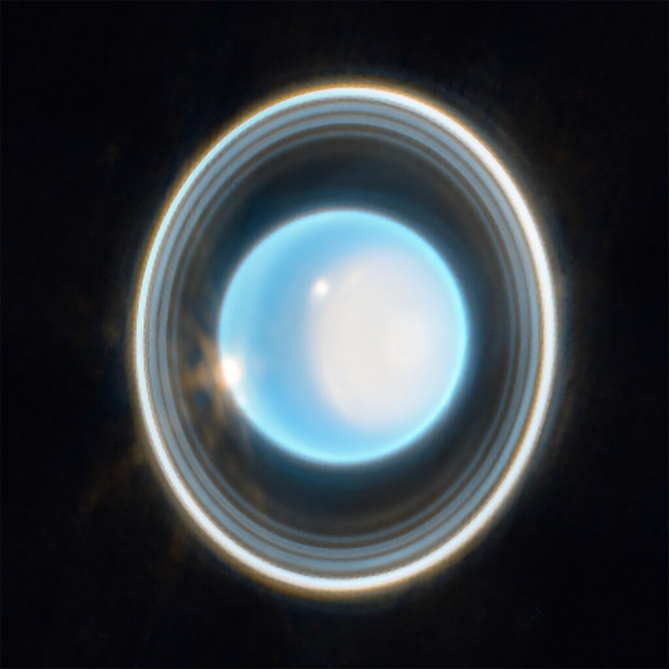
Uranus and its rings as photographed by the James Webb Space Telescope. The rings are much brighter in the infrared. Credit: NASA\CSA\ESA.
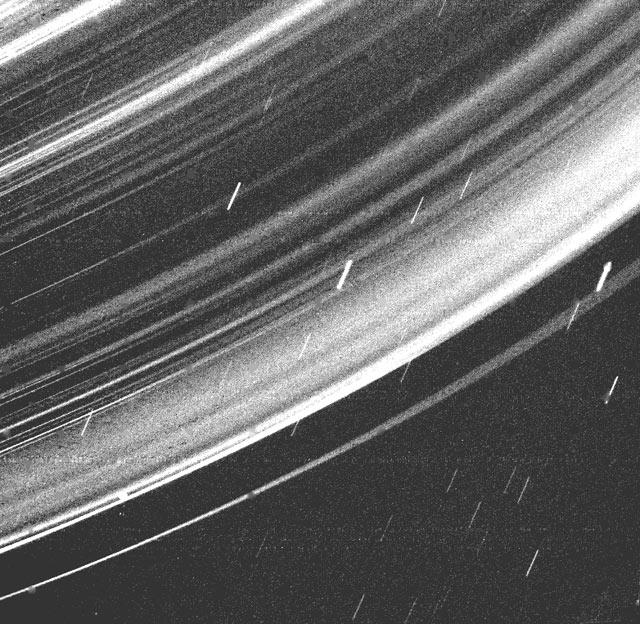
Closeup of the Uranian rings from Voyager 2. The stars are trailed due to the spacecraft turning to focus on the rings as it moves through the Uranian system in this time exposure. Credit NASA/JPL.
05/08/2023 – Ephemeris – How to find Leo the lion in the sky
This is Ephemeris for Monday, May 8th. Today the Sun will be up for 14 hours and 32 minutes, setting at 8:56, and it will rise tomorrow at 6:22. The Moon, 3 days past full, will rise at 12:57 tomorrow morning.
At 10 p.m. the spring constellation of Leo the lion will be high in the south. It can be found by locating the Big Dipper high overhead and imagining that a hole were drilled in the bottom of the bowl to let the water leak out. It would drip on the back of this giant cat. The Lion is standing or lying facing westward. His head and mane are seen in the stars as a backwards question mark. This group of stars is also called the sickle. The bright star Regulus is at the bottom, the dot at the bottom of the question mark. A triangle of stars, to the left of Regulus, is the lion’s haunches. Leo contains some nice galaxies visible in moderate sized telescopes. The stars in Leo’s part of the sky are fewer than those in the winter sky.
The astronomical event times given are for the Traverse City/Interlochen area of Michigan (EDT, UT –4 hours). They may be different for your location.
Addendum

Finding Leo the lion from the Big Dipper with no lines. The orientation is for 10 pm, May 8th. Can you find Leo? The Big Dipper? Created using Cartes du Ciel (Sky Charts).
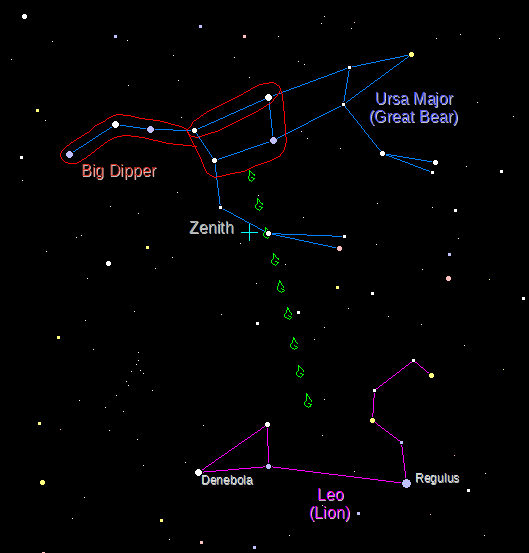
Using the Big Dipper to find Leo. The orientation is for 10 pm on May 8th. For any other time, the orientation would be different, as would the position of the zenith (overhead point). Created using my LookingUp app.
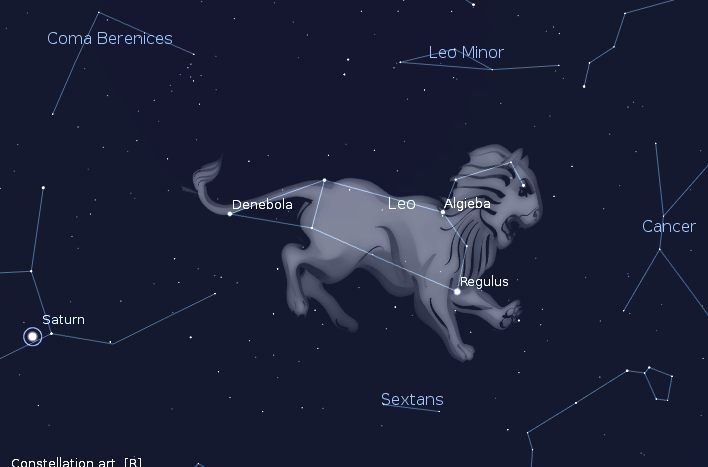
Leo, with drawing of a lion. Created using Stellarium.
Note the star at the left end of Leo is named Denebola. There are several stars that start with “Deneb”. Deneb must mean tail in Arabic because most star names are Arabic in origin. Denebola is the tail of the lion. Deneb Kaitos is the tail of the autumn constellation of Cetus the whale, and Deneb itself is the tail of the summer constellation of Cygnus the swan.
05/05/2023 – Ephemeris – Learn about the upcoming total solar eclipse tonight
This is Ephemeris for Cinco de Mayo, Friday, May 5th. Today the Sun will be up for 14 hours and 25 minutes, setting at 8:52, and it will rise tomorrow at 6:25. The Moon, at full today, will rise at 9:13 this evening.
Eleven months is not too early to plan for a total solar eclipse. On April 8th next year there will be such an eclipse whose path of totality clips the southeastern corner of Michigan. Indianapolis, Toledo and Cleveland also lie in the path of totality. The path runs from Texas to Maine. Member Dan Dall’Olmo will have all the particulars at this month’s meeting of the Grand Traverse Astronomical Society, starting at 8 pm tonight at Northwestern Michigan College’s Joseph H. Rogers Observatory. For those staying home, the Sun for this eclipse will be a bit more covered by the Moon than the 2017 August solar eclipse. We’ll also have another partial solar eclipse to practice on this October 14th.
The astronomical event times given are for the Traverse City/Interlochen area of Michigan (EDT, UT –4 hours). They may be different for your location.
Addendum
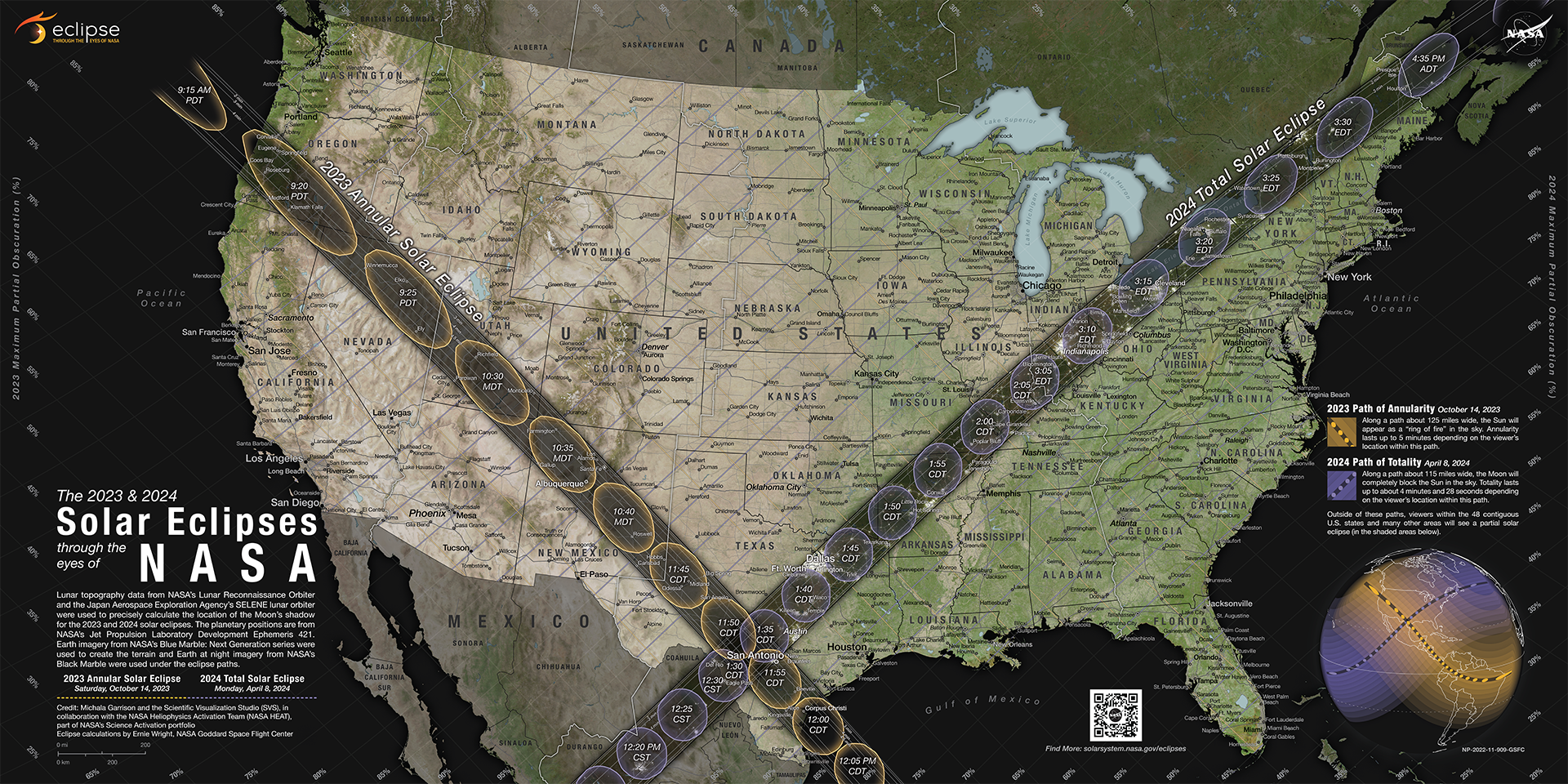
The paths of maximum eclipse of the October 14, 2023, and April 8, 2024. Click or tap on the image to enlarge it. Credit: NASA/Scientific Visualization Studio/Michala Garrison; eclipse calculations by Ernie Wright, NASA Goddard Space Flight Center.
05/04/2023 – Ephemeris – The Moon is not quite as dry as we thought
This is Ephemeris for Thursday, May 4th. Today the Sun will be up for 14 hours and 22 minutes, setting at 8:51, and it will rise tomorrow at 6:27. The Moon, 1 day before full, will set at 6:18 tomorrow morning.
The Moon appears to be bone dry. The Apollo astronauts found no rocks with any water in them, or bound to them chemically. However, remote sensing satellites and an infrared flying observatory have detected hints that water does indeed exist on the Moon. Indeed, water would be worth its weight in gold if discovered there. The South Pole of the Moon has permanently shadowed craters which seem to have water ice in them. Recently the, since decommissioned, SOFIA aircraft, sporting an infrared telescope detected water on the daytime side of the Moon, in quantities, to mix units of measurement, 12 ounces of water per cubic meter of soil in the crater Clavius. It’s a large crater in the Southern Hemisphere of the Moon, and incidentally one of my favorite craters.
Also, recently, the Chinese Chang’e 5 lunar sample return mission detected water in the tiny glass beads that were part of the soil it brought back. The beads were the result of meteorite impacts. Maybe NASA might have another look at the lunar soil the Apollo astronauts brought back.
The astronomical event times given are for the Traverse City/Interlochen area of Michigan (EDT, UT –4 hours). They may be different for your location.
Addendum
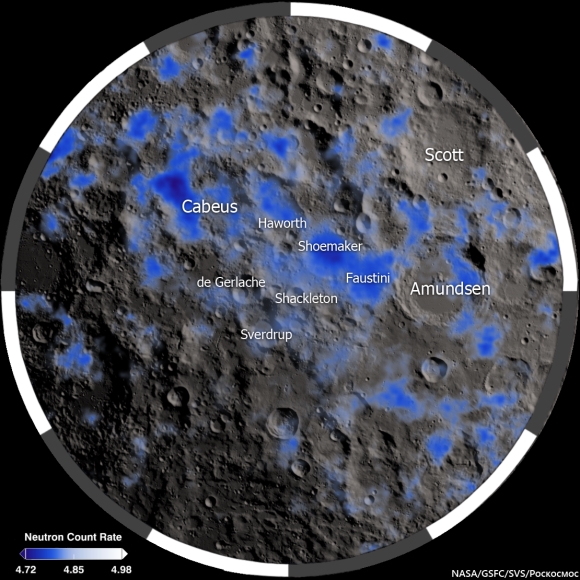
The South Pole of the Moon, where the presence of water ice is detected by the absorption of neutrons by the hydrogen atoms in the ice. Credit NASA/GSFC/SVS/Roscosmos.
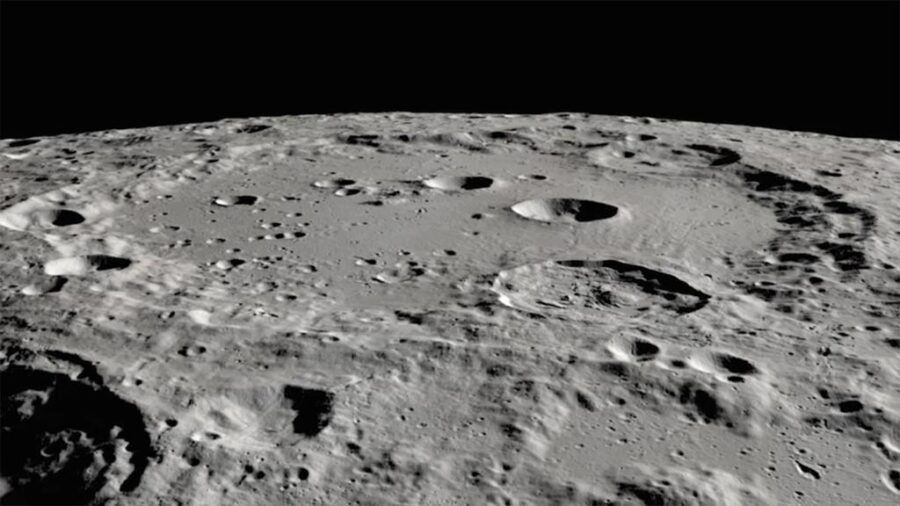
Closeup of Clavius from the Lunar Reconnaissance Orbiter. Credit: NASA/LRO.
 Bob Moler's Ephemeris Blog