Archive
Ephemeris: 09/18/2023 – Saturn the planet and the god of old age
This is Bob Moler with Ephemeris for Monday, September 18th. Today the Sun will be up for 12 hours and 23 minutes, setting at 7:48, and it will rise tomorrow at 7:26. The Moon, halfway from new to first quarter, will set at 9:14 this evening.
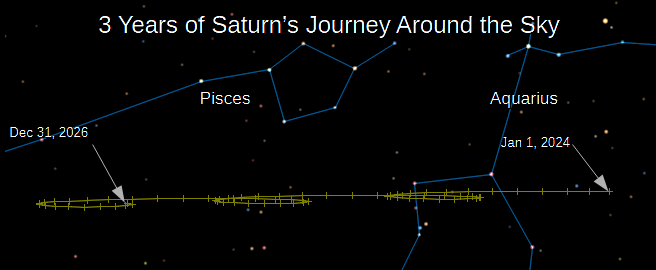
The planet Saturn is named after the Roman God of agriculture. He is often depicted as an old man with a scythe. It happens that Saturn is the most distant of the naked eye planets and as such takes nearly 30 years to totter its way around the Zodiac signifying his old age. Saturn is also depicted as Father Time at New Year’s Eve being replaced by the New Year’s baby. Saturn is the Roman Equivalent of the Greek god Cronus, where we get time related words like chronology, chronometer. The planet that is Saturn, appears to be the only planet referred to specifically in the Bible as being the closest planet to heaven. The goddess Ishtar, an equivalent of Venus, is mentioned as the “Queen of Heaven” in Jeremiah (Jer 7:18; 44:19), but not as a planet. The only mention of Venus is in its morning apparition as Lucifer, the Son of Morning, who is also equated with Satan.
The astronomical event times given are for the Traverse City/Interlochen area of Michigan (EDT, UT –4 hours). They may be different for your location.
Addendum
Ephemeris: 09/15/2023 – Rare Friday star party at the Sleeping Bear Dunes
This is Ephemeris for Friday, September 15th. Today the Sun will be up for 12 hours and 32 minutes, setting at 7:53, and it will rise tomorrow at 7:22. The Moon, 1 day past new, will set at 8:20 this evening.
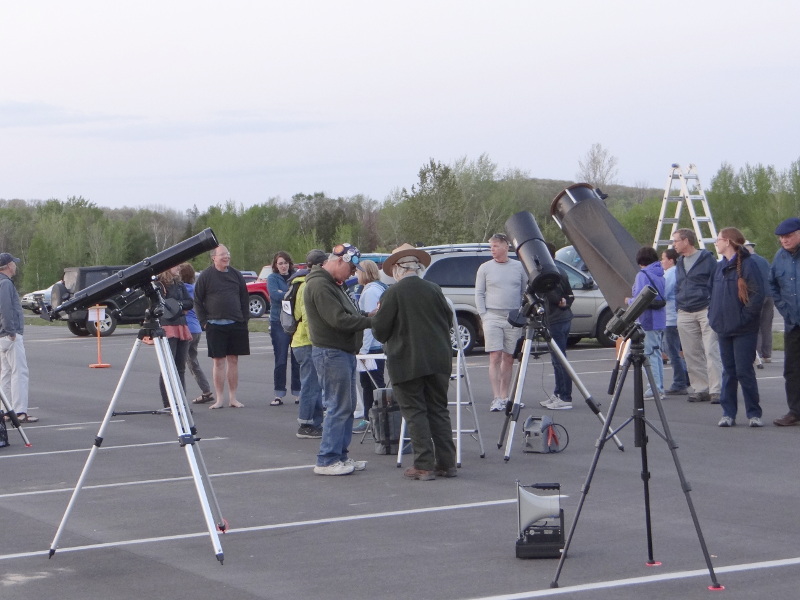
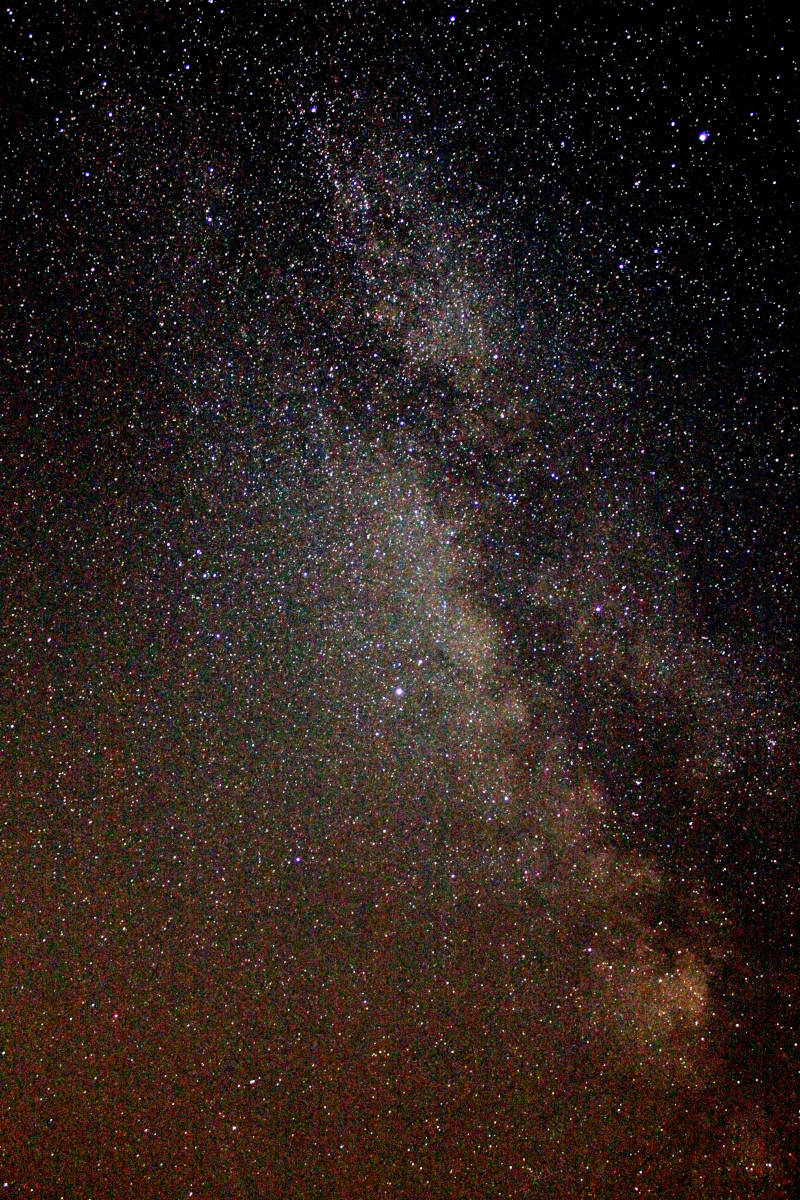
Weather permitting, a sun and star party will be held tonight at the Sleeping Bear Dunes National Lakeshore at the Dune Climb. The solar part will start at 5 pm, while the evening viewing will start around 8:30 pm. These events will be hosted by the park rangers and the Grand Traverse Astronomical Society, who will bring their telescopes to view the heavens, including the planet Saturn and the wonders of the summer Milky Way. The telescopes will be setup in the parking area closest to the dune. As twilight fades Saturn will be about the only object to view, as it gets darker more and more wonders of the Milky Way will be seen. They include star clusters and nebulae, clouds of gas and dust. And maybe we’ll get a peek at the galaxy next door, the Great Andromeda Galaxy.
The astronomical event times given are for the Traverse City/Interlochen area of Michigan (EDT, UT –4 hours). They may be different for your location.
Ephemeris: 09/14/2023 – The stars of Cygnus the swan represent a few different figures
This is Ephemeris for Thursday, September 14th. Today the Sun will be up for 12 hours and 35 minutes, setting at 7:55, and it will rise tomorrow at 7:21. The Moon is new today, and won’t be visible.
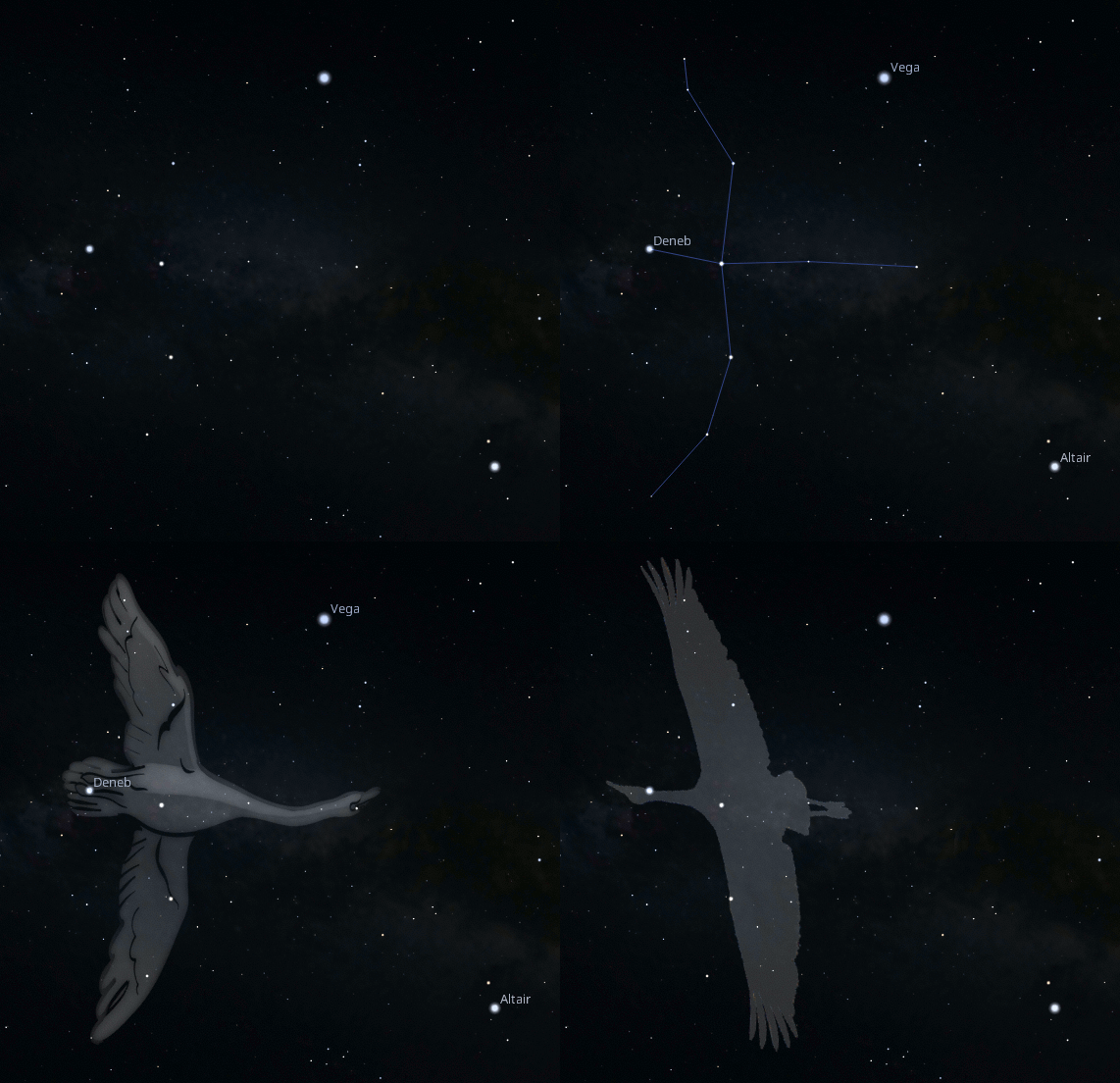
Nearly directly overhead in the evening is the bright star Deneb, part of the Summer Triangle of bright stars It’s at the top of the Northern Cross, an informal constellation or asterism. It makes a perfectly proportioned Christian cross. Deneb is also the tail of Cygnus the swan, seen flying southward through the Milky Way with its neck outstretched. Extra stars added to the Northern Cross extend the wings nicely. To the Anishinaabe native peoples of our area the stars here also represent two constellations, both are birds. The first is Ajijaak, the Sand Hill crane, The other is Bineshi Okanin, the Skeleton Bird, so named probably because the stars make a stick figure of a bird rather than an outline of one.
The astronomical event times given are for the Traverse City/Interlochen area of Michigan (EDT, UT –4 hours). They may be different for your location.
Addendum
Ephemeris: 09/13/2023 – Let’s find out where the naked-eye planets have wandered off to
This is Ephemeris for Wednesday, September 13th. Today the Sun will be up for 12 hours and 38 minutes, setting at 7:57, and it will rise tomorrow at 7:20. The Moon, 1 day before new, will rise at 6:41 tomorrow morning.
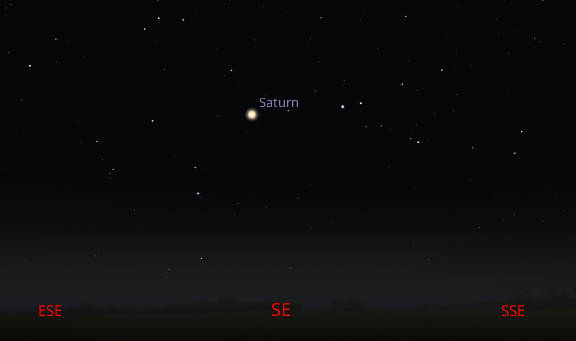
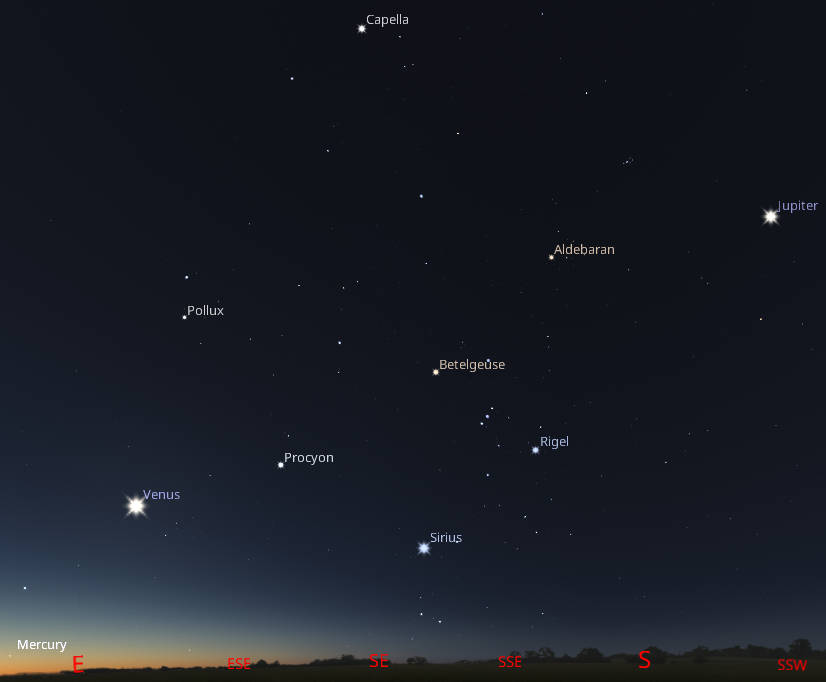
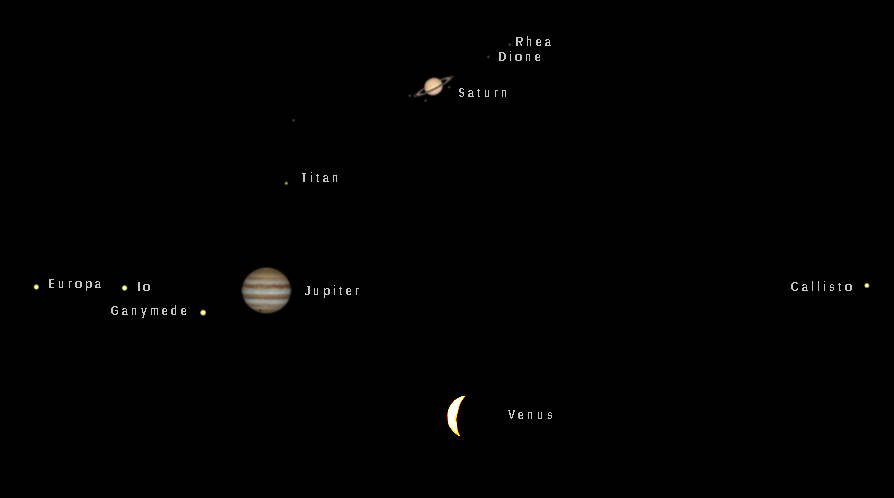
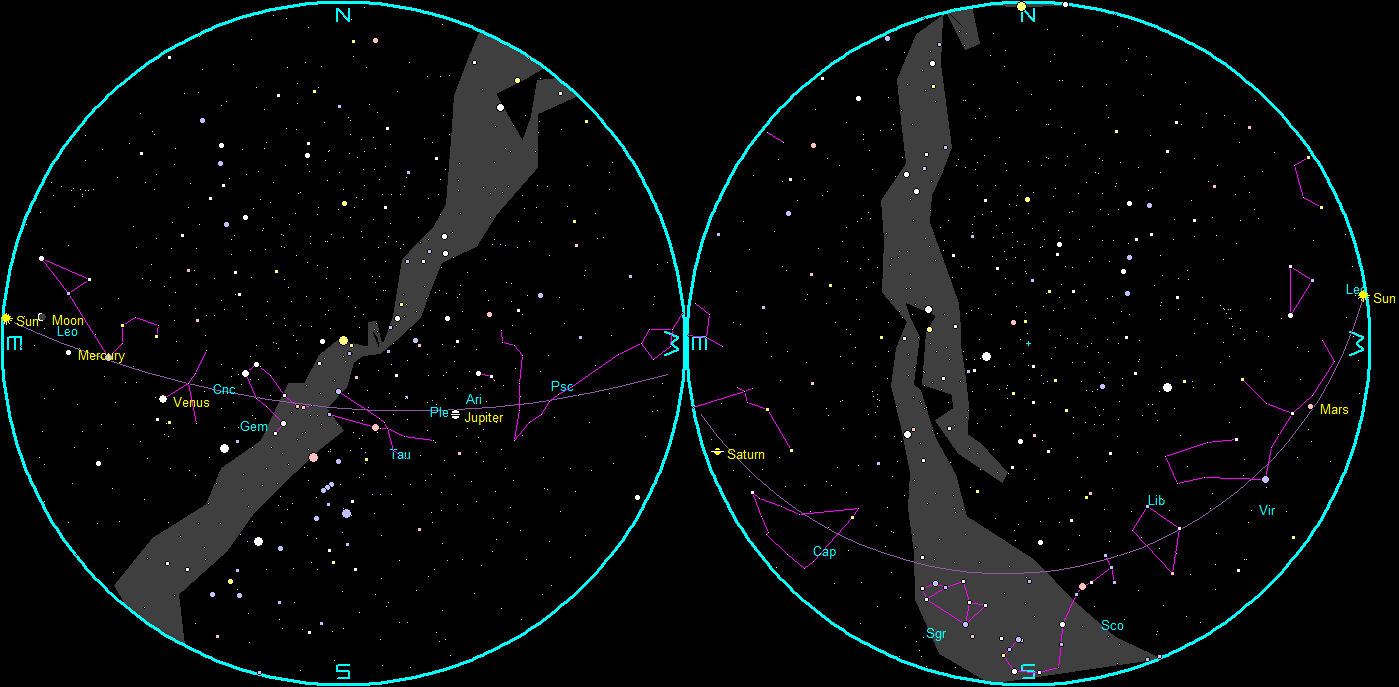
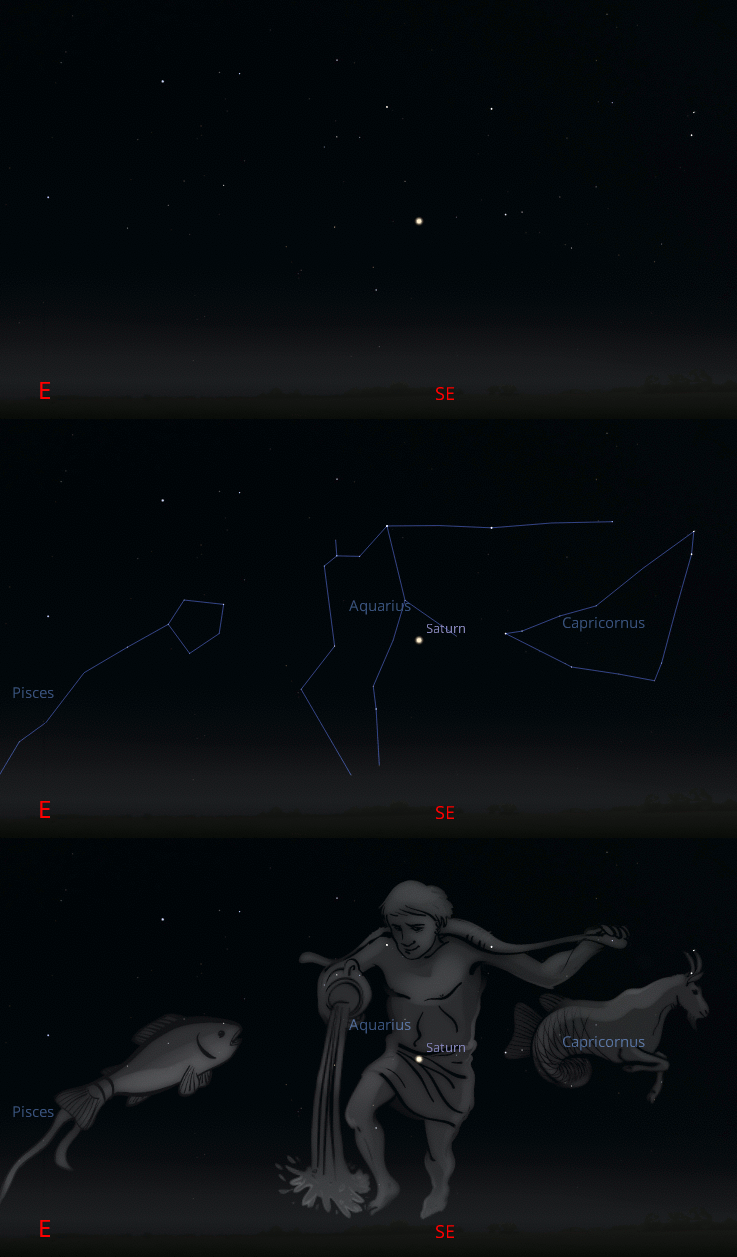
Let’s find out where the naked-eye planets have wandered off to. Three of those five planets are now visible but Mars and Mercury are too close to the Sun to be seen. Saturn is the sole evening planet visible. Mercury is now in the morning sky, and should be visible in a week. Jupiter and Venus are officially the only visible morning planets. Saturn can be spotted in the southeast in the evening. And it will still be visible throughout the morning hours morning twilight starts. Saturn is in retrograde or westward motion now, against the stars of Aquarius. Jupiter will rise at 9:59 pm. It is starting its retrograde motion now. Venus is our brilliant morning star, rising in the east-northeast at 4:21 am and be visible until about 7 am.
The astronomical event times given are for the Traverse City/Interlochen area of Michigan (EDT, UT –4 hours). They may be different for your location.
Addendum
Ephemeris: 09/12/2023 – Two small but distinctive constellations by the Summer Triangle
this is Ephemeris for Tuesday, September 12th. Today the Sun will be up for 12 hours and 41 minutes, setting at 7:59, and it will rise tomorrow at 7:19. The Moon, 2 days before new, will rise at 5:37 tomorrow morning.
There are two small constellations in and near the Summer Triangle of bright stars. Both are near Altair the bottom star of the triangle in the southeast. The first is Delphinus the dolphin to the left of Altair. Delphinus is made-up of a small squished box of stars with another star below. It does look a dolphin leaping out of the water. The legendary Greek poet Arion, according to myth, was rescued by a dolphin. Also the little squished box is an asterism called Job’s Coffin, though no one knows the origin of that name. The second constellation is above Altair, and within the Summer Triangle. It is called Sagitta the arrow. The stars do line up to look like a short arrow. It’s supposed to represent Cupid’s dart.
The astronomical event times given are for the Traverse City/Interlochen area of Michigan (EDT, UT –4 hours). They may be different for your location.
Addendum


Painting circa 1938.
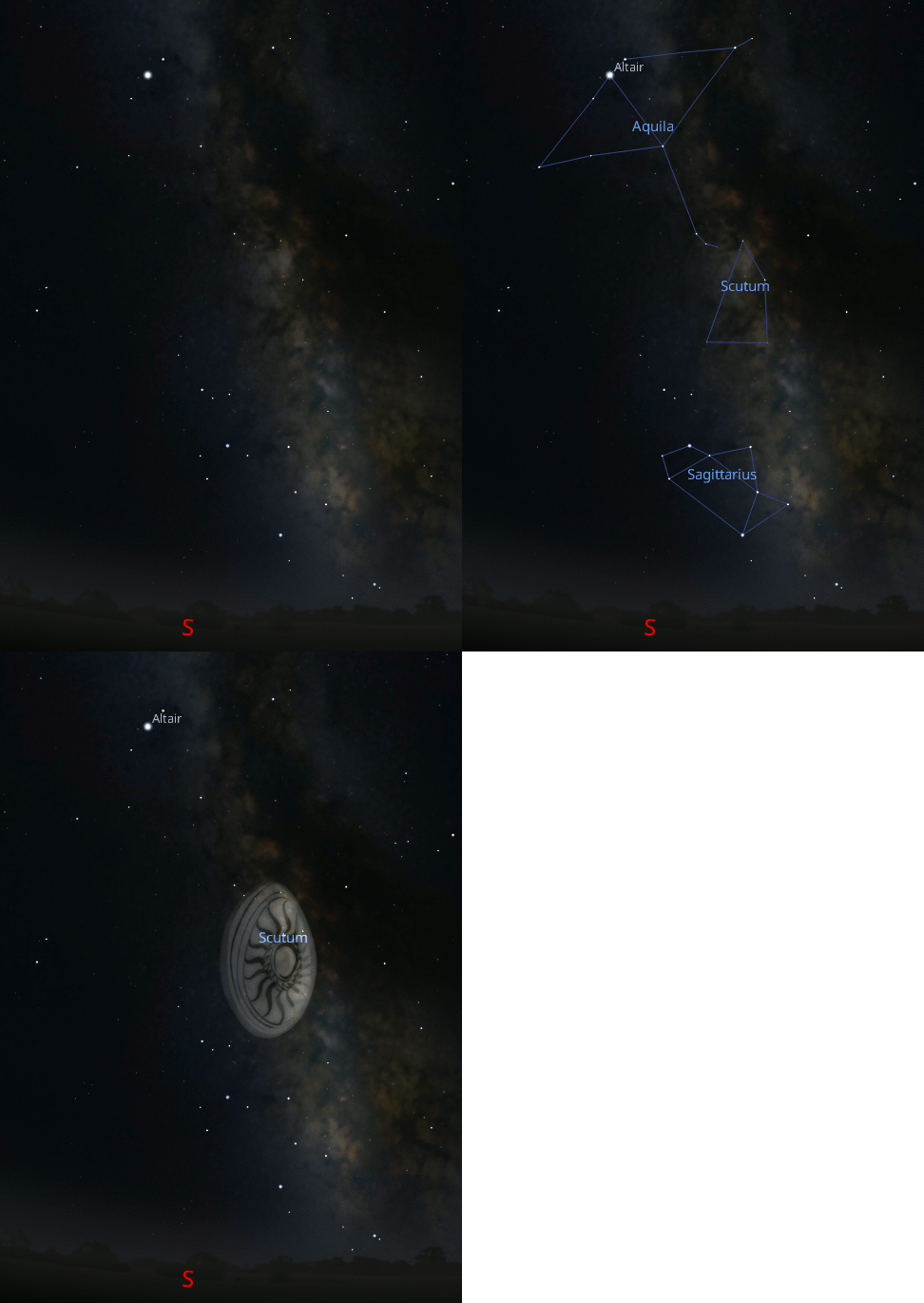
Ephemeris: 09/11/2023 – Scutum, an almost invisible constellation in the Milky Way
This is Ephemeris for Monday, September 11th. Today the Sun will be up for 12 hours and 44 minutes, setting at 8:01, and it will rise tomorrow at 7:17. The Moon, 3 days before new, will rise at 4:32 tomorrow morning.
In the southern sky between the Teapot of Sagittarius below and Aquila the Eagle above, with Altair the southernmost star of the Summer Triangle, lies Scutum the shield of John Sobieski the Polish king who stopped the advance of the Turks at Kalenberg in 1683. The Polish half of me is very proud. Scutum is one of two official constellations which are related to real persons. The other one is Coma Berenices, a hank of the Egyptian Queen Berenice’s hair. However, the stars here are so dim and embedded in the glow of the Milky Way as to be nearly impossible to discern. Scutum lies in one of the richest portions of the Milky Way, wonderful to scan with binoculars and telescopes for star clusters and nebulae, clouds of dust and gas.
The astronomical event times given are for the Traverse City/Interlochen area of Michigan (EDT, UT –4 hours). They may be different for your location.
Addendum
Ephemeris: 09/08/2023 – Comet Nishimura is getting brighter as it approaches the Sun, but also encountering brighter twilight
This is Ephemeris for Friday, September 8th. Today the Sun will be up for 12 hours and 53 minutes, setting at 8:06, and it will rise tomorrow at 7:14. The Moon, 2 days past last quarter, will rise at 1:20 tomorrow morning.
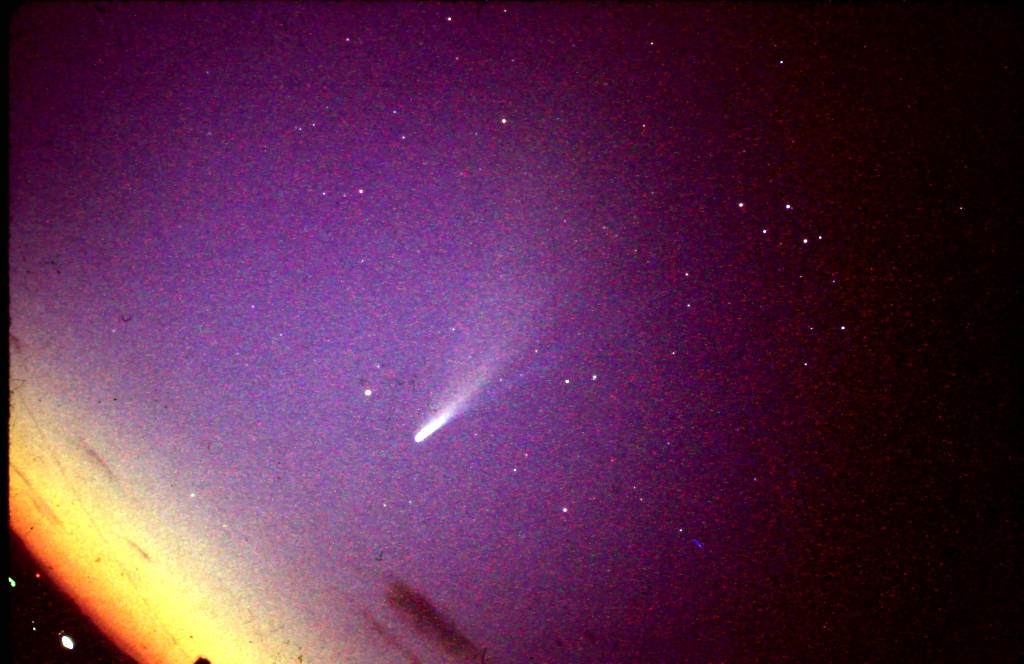
Our comet Nishimura is the third comet discovered by Japanese amateur astronomer Hideo Nishimura. Somehow the near earth asteroid detection programs missed it. I can understand why the Pan-STARRS and ATLAS search programs missed it, since they’re located on the Island of Maui, where those devastating wildfires are located. But they aren’t the only search programs. This weekend is the last chance to spot the comet. Nishimura will be rising before 5:30 am. The comet will be increasing its brightness to 4th magnitude this weekend. However, it will still be difficult to pick out without a pair of binoculars. The tail, if it has any, will be pointed just about straight up. After the 17th, its perihelion, it will be heading southward, and back out to the Oort Cloud, from where it came.
The astronomical event times given are for the Traverse City/Interlochen area of Michigan (EDT, UT –4 hours). They may be different for your location.
Addendum
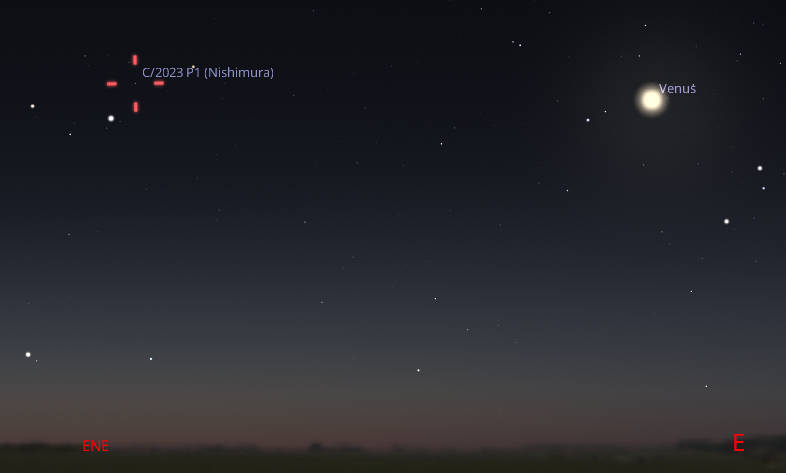
Comet Nishimura Saturday, September 9th, 6 am
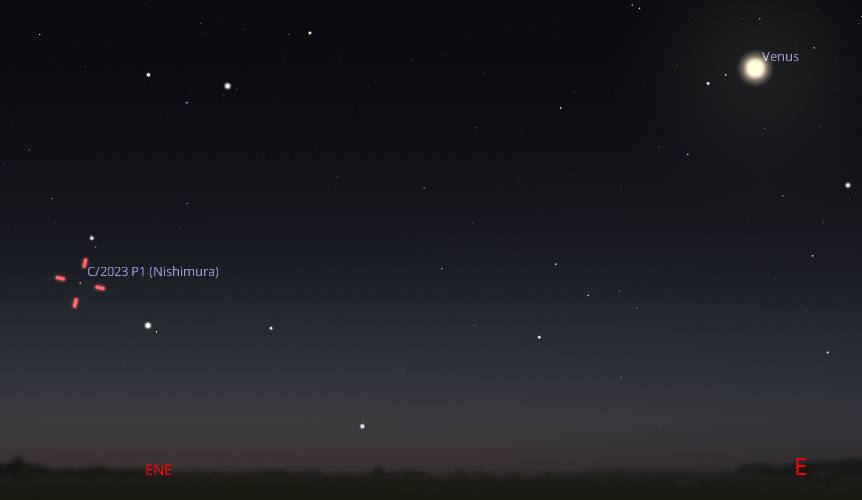
Comet Nishimura Sunday, September 10th, 6 am
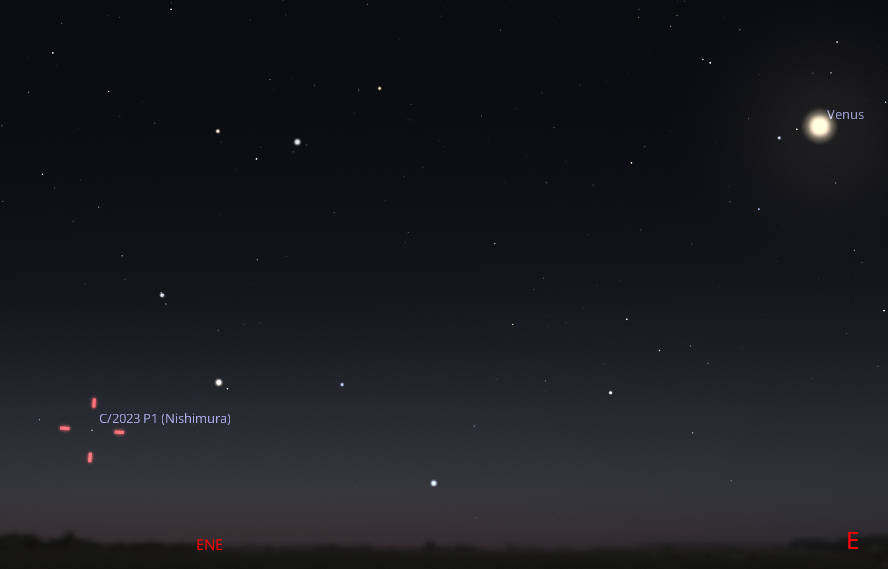
Comet Nishimura Monday, September 11th, 6:15 am
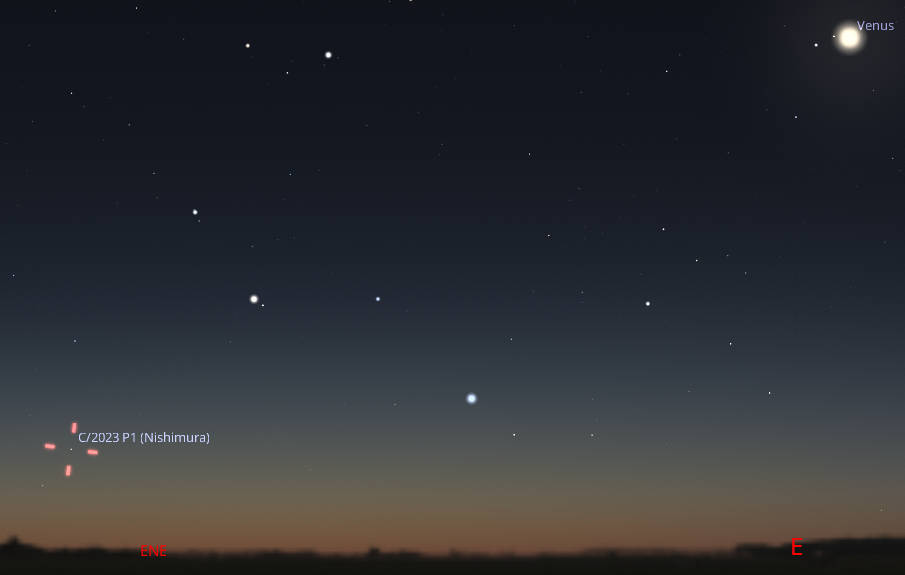
After Monday, September 11th I feel that the comet will be too close to the Sun, or in too bright a twilight to spot for our latitude. Observers farther south should have better luck after perihelion on the 17th.
Ephemeris: 09/07/2023 – Comet Nishimura is getting brighter as it approaches the Sun
This is Ephemeris for Thursday, September 7th. Today the Sun will be up for 12 hours and 56 minutes, setting at 8:08, and it will rise tomorrow at 7:13. The Moon, 1 day past last quarter, will rise at 12:26 tomorrow morning.
Comet Nishimura is brightening as it approaches the Sun. It will reach 22% of the Earth’s distance from the Sun at perihelion, its closest to the Sun on the 17th, but will be heading south of the Sun, and not be visible to us. Currently, it is in the morning sky, in the east-northeast. At 6 to 6:30 am it will appear in the east-northeast to the left of Venus. It will be probably 4.4 magnitude, which still isn’t easily spotted in a dark sky, much less in the morning twilight glow. If it does have a tail, it will be pointed vertically up from the head of the comet. A pair of binoculars will be needed to spot the comet. Nishimura appears to be a visitor from the Oort cloud of comets, a cloud that stretches about a quarter the way to the next star to the Sun.
The astronomical event times given are for the Traverse City/Interlochen area of Michigan (EDT, UT –4 hours). They may be different for your location.
Addendum
Ephemeris: 09/06/2023 – Let’s find out where the naked-eye planets and comet Nishimura have wandered off to
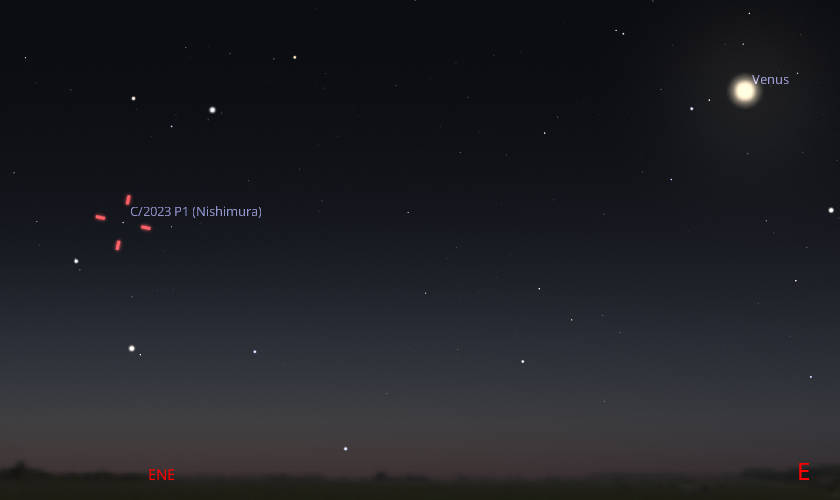
This is Ephemeris for Wednesday, September 6th. Today the Sun will be up for 12 hours and 59 minutes, setting at 8:10, and it will rise tomorrow at 7:12. The Moon, at last quarter today, will rise at 11:40 this evening.
Let’s find out where the naked-eye planets have wandered off to. Three of those five planets are now visible but Mars and Mercury are too close to the Sun to be seen. Saturn is the sole evening planet visible. Jupiter and Venus are officially the only visible morning planets. Saturn can be spotted in the southeast in the evening. And it will still be visible throughout the morning hours morning until twilight starts. Saturn is in retrograde or westward motion against the stars of Aquarius. Jupiter will rise at 10:54pm. It is slowing its eastward motion and will become stationary tomorrow. Venus is our brilliant morning star. It will rise at 4:43 tomorrow morning. Comet Nishimura is left and a bit below Venus in the east-northeast.
The astronomical event times given are for the Traverse City/Interlochen area of Michigan (EDT, UT –4 hours). They may be different for your location.
Addendum
Ephemeris: 09/05/2023 – Where is Comet Nishimura tomorrow morning the 6th
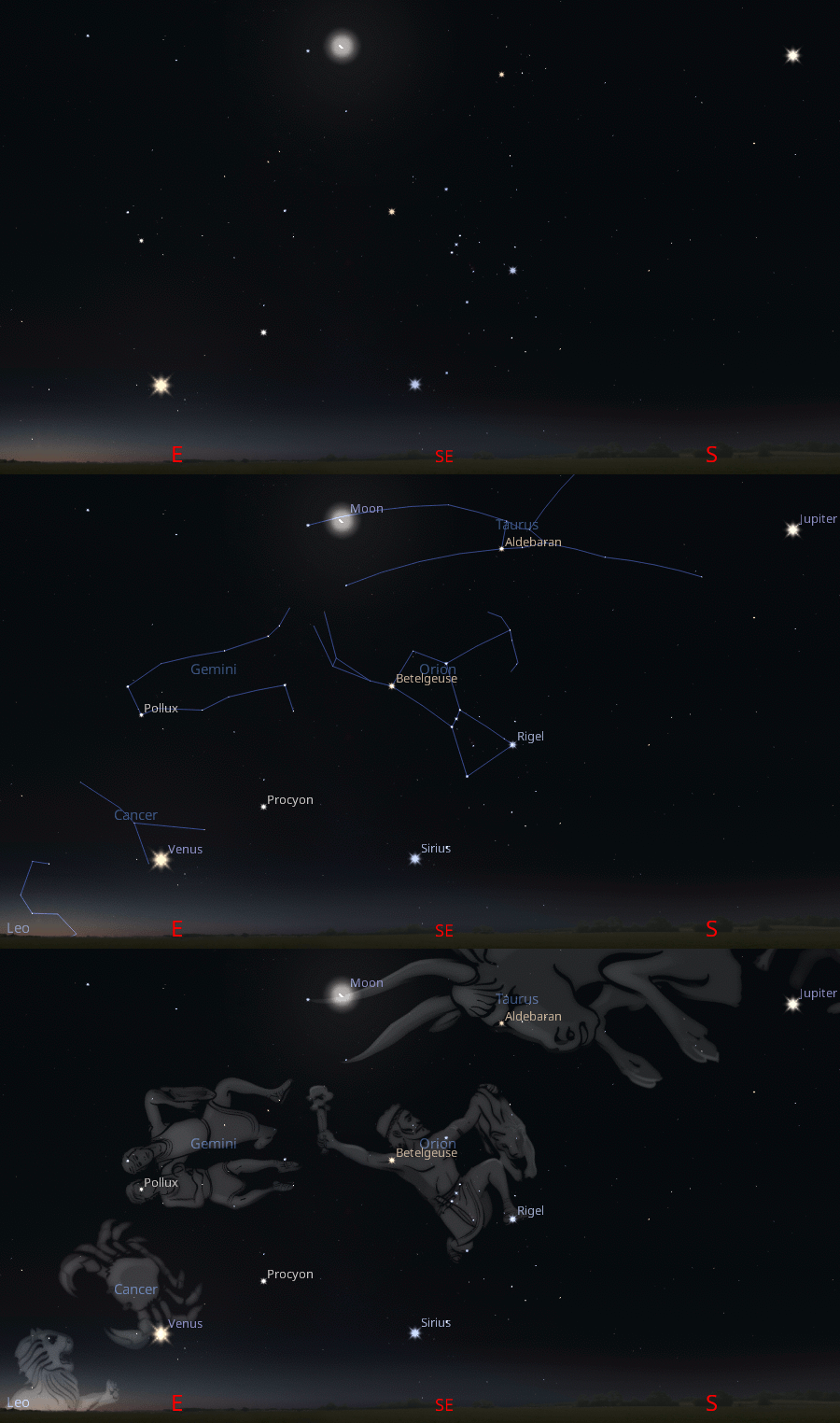
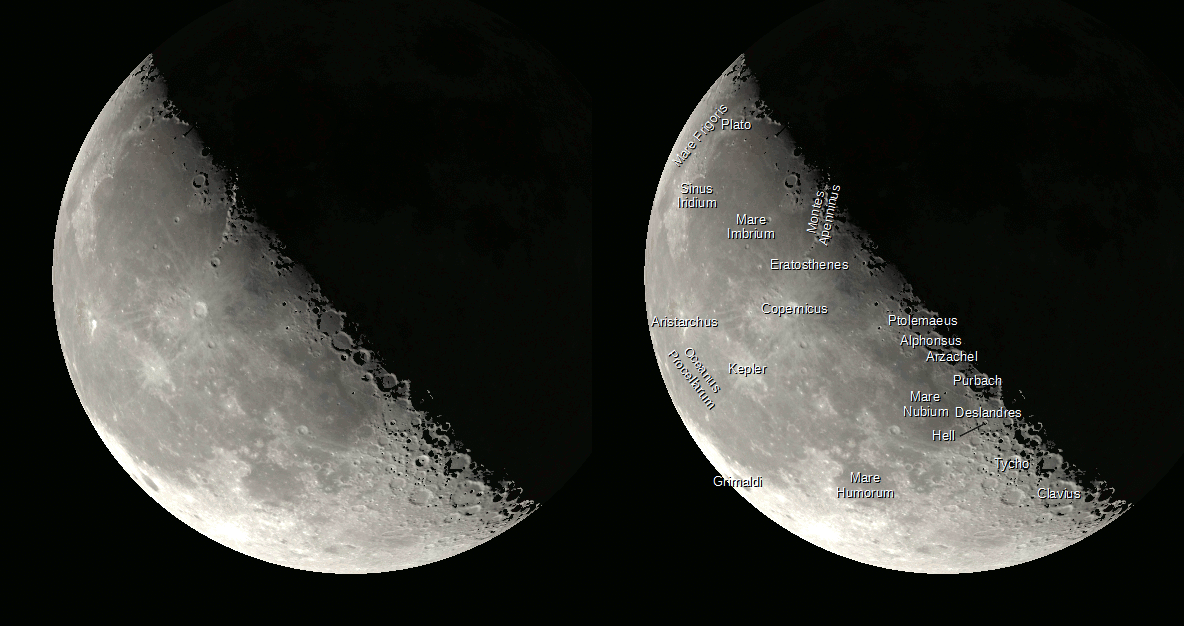
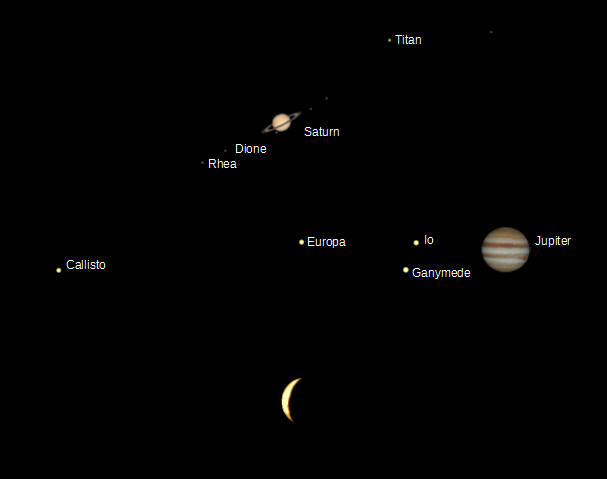
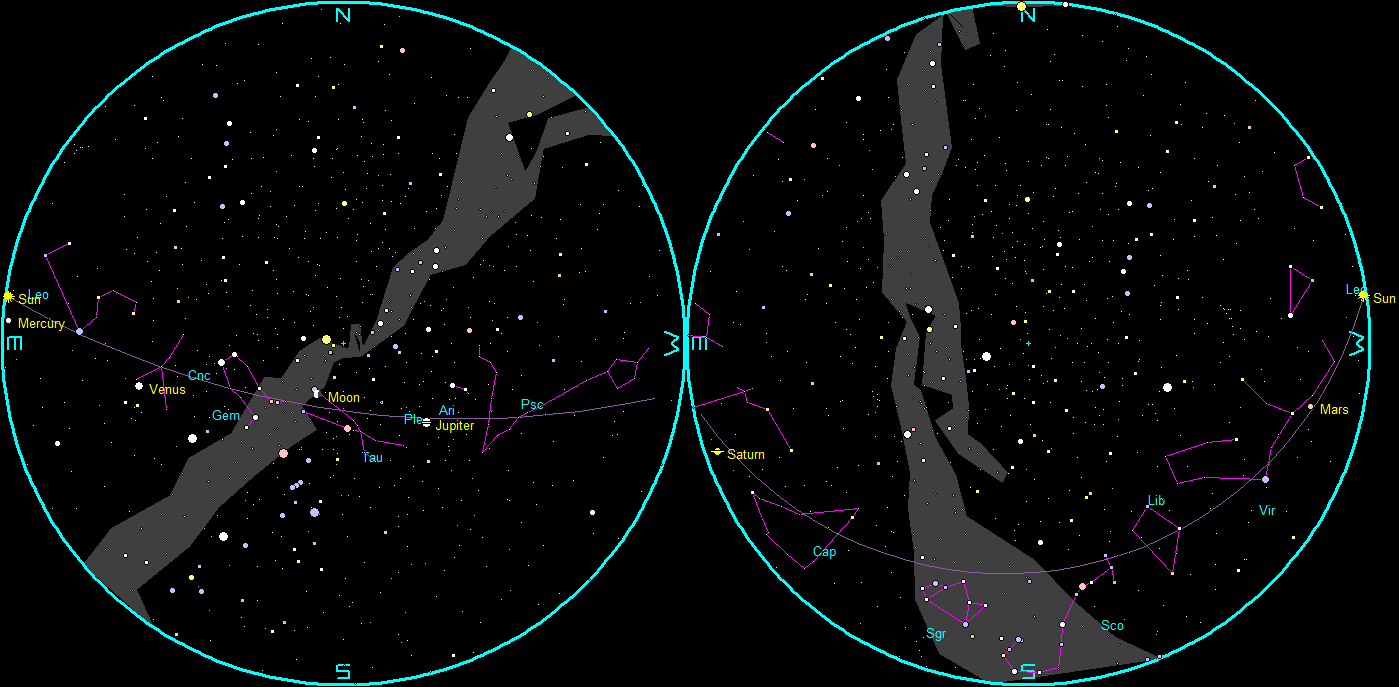
This is Bob Moler with Ephemeris for Tuesday, September 5th. Today the Sun will be up for 13 hours and 2 minutes, setting at 8:12, and it will rise tomorrow at 7:10. The Moon, 1 day before last quarter, will rise at 11:03 this evening.
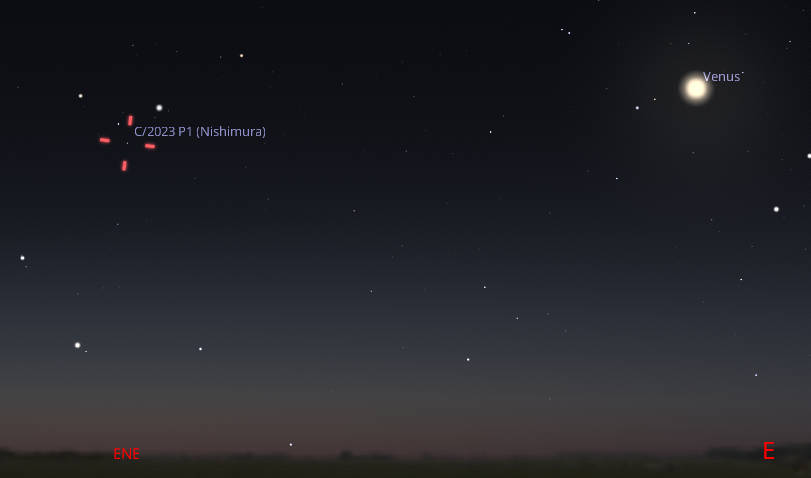
Comet Nishimura is supposedly a very dim naked-eye comet now, best found and seen in binoculars, though it will get brighter in the next few days. On Ephemeris, when I talk about things that one can observe, it must be bright enough to be spotted with the naked eye, even though it may be best appreciated with binoculars or telescope. This comet is a little dubious in that regard. Comets, to my eyes at least, appear dimmer than what their magnitudes suggest. More specific information is on my blog at bobmoler.wordpress.com, an Ephemeris Extra post for August 31st. Tomorrow morning the comet is to the left of Venus in the east northeast. Comet Nishimura will be visible for our location through next Monday.
The astronomical event times given are for the Traverse City/Interlochen area of Michigan (EDT, UT –4 hours). They may be different for your location.
Addendum
 Bob Moler's Ephemeris Blog