Archive
Ephemeris: 09/30/2024 – Andromeda’s treasure, its great galaxy
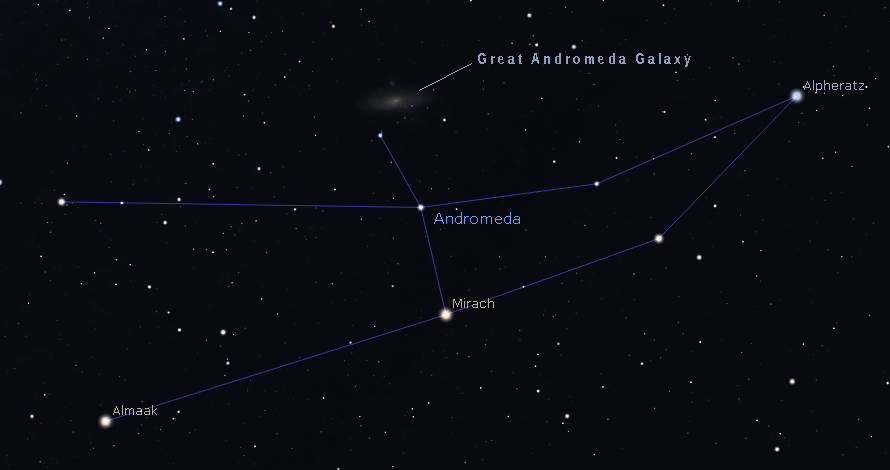
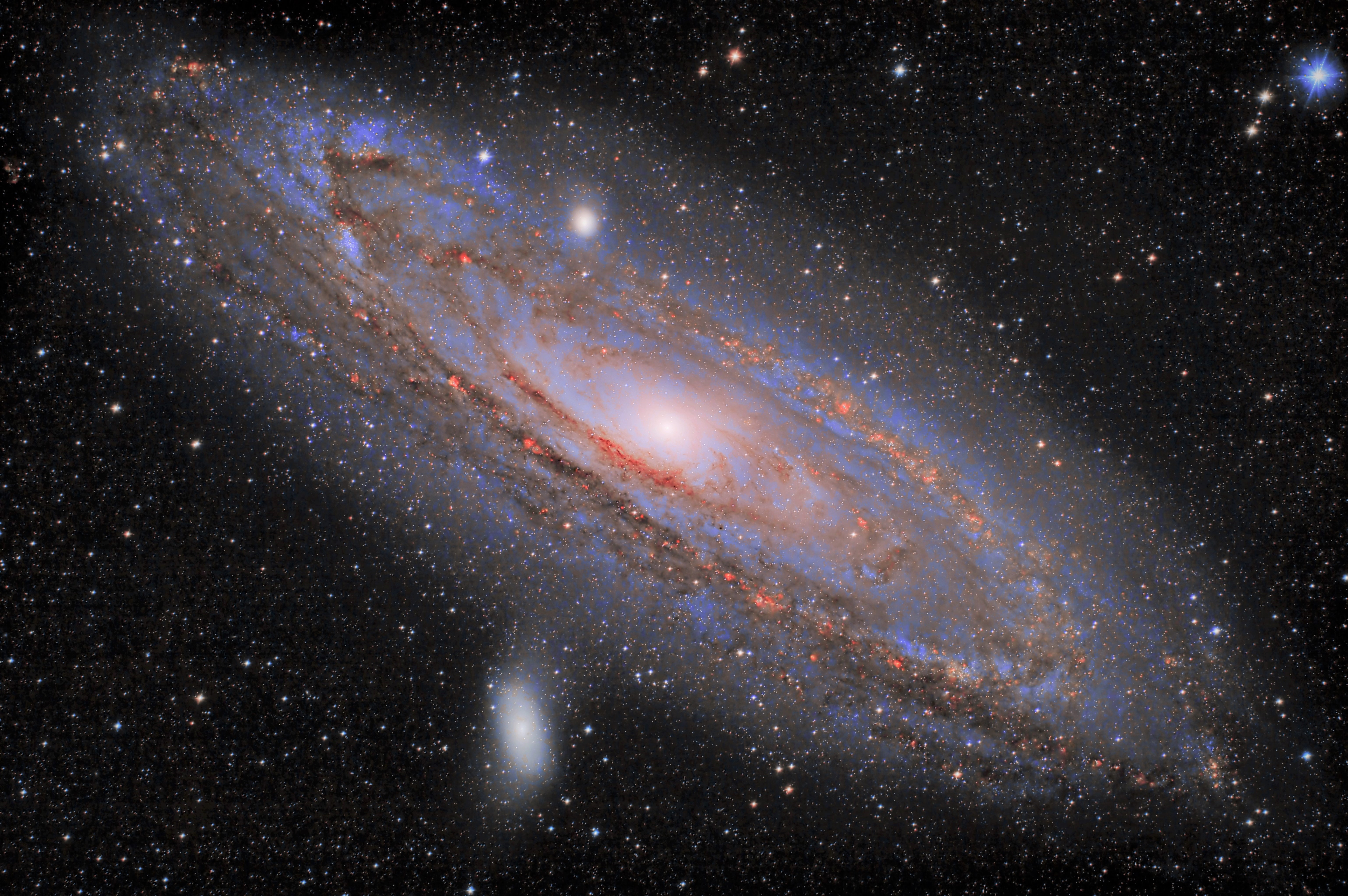
This is Bob Moler with Ephemeris for Monday, September 30th. Today the Sun will be up for 11 hours and 43 minutes, setting at 7:24, and it will rise tomorrow at 7:41. The Moon, 2 days before new, will rise at 6:27 tomorrow morning. | For at least the last thousand or so years a fuzzy spot in the constellation of Andromeda has been known. It was known as the Great Andromeda Nebula until about 100 years ago. Nebula means cloud, and it belonged to the Milky Way. At that time it was finally recognized as another Milky Way just like ours. So the word to call it was galaxy, a word that means Milky Way. It looks to be among the stars of Andromeda, but it’s far beyond the stars that we make of the constellation Andromeda. Current estimates place it at about two and a half million light years away, well beyond the stars that we see in Andromeda that range to only a few thousand light years distance. It will collide with our galaxy in about 4 billion years.
The astronomical event times given are for the Traverse City/Interlochen area of Michigan (EDT, UT – 4 hours). Times will be different for other locations.
Addendum
Ephemeris: 09/27/2024 – Finding Andromeda
This is Ephemeris for Friday, September 27th. Today the Sun will be up for 11 hours and 53 minutes, setting at 7:29, and it will rise tomorrow at 7:37. The Moon, 3 days past last quarter, will rise at 3:11 tomorrow morning.
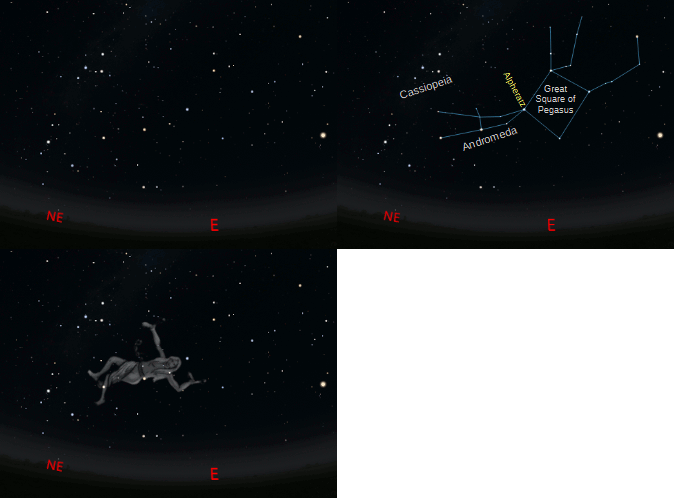
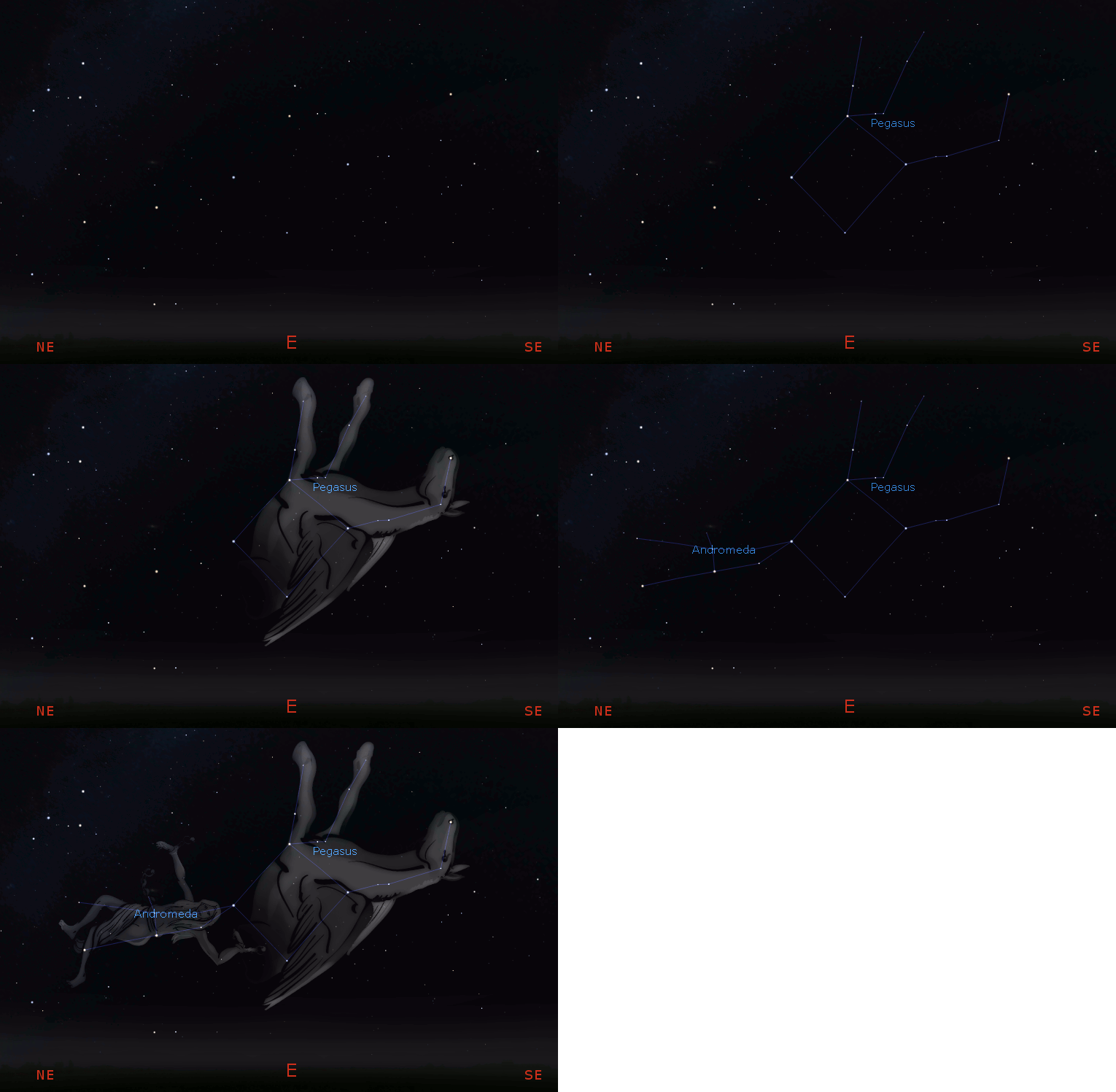
The constellation of Andromeda is famous mainly for the galaxy visible to the naked eye that is contained within it, called the Great Andromeda Galaxy, which is actually visible to the naked eye. Andromeda is found in the east northeast these evenings connected to the Great Square of Pegasus, the square of stars standing on one corner in the east. It shares a star with that square called Alpheratz, the leftmost star, and from that star two curved lines of stars are seen to the left that is the body of Andromeda. She was a Princess and daughter of Queen Cassiopeia, and was fated to be devoured by the monster Cetus. She was saved by the hero Perseus who flew in on his flying horse Pegasus.
The astronomical event times given are for the Traverse City/Interlochen area of Michigan (EDT, UT – 4 hours). Times will be different for other locations.
Addendum
Ephemeris: 09/26/2024 – Finding Cassiopeia the queen
This Ephemeris for Thursday, September 26th. Today the Sun will be up for 11 hours and 56 minutes, setting at 7:31, and it will rise tomorrow at 7:36. The Moon, 2 days past last quarter, will rise at 2:02 tomorrow morning.
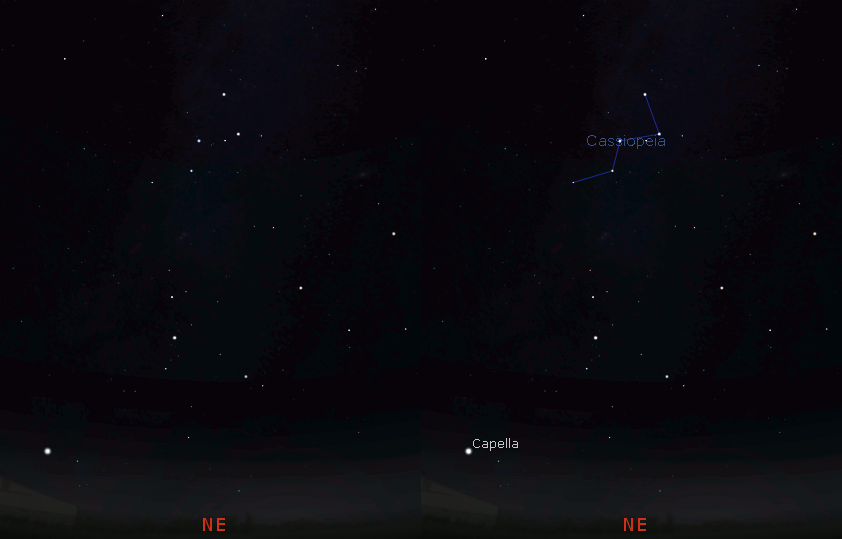
High in the northeast sky at 9:00 PM can be found the constellation of Cassiopeia the queen. Its stars make a letter W in the sky. It is circumpolar, meaning that it never sets, as it appears to move around the North Pole of the sky. In the summer it is a W low in the north. It becomes kind of an open and angular number 3 in the autumn. In the winter it is overhead and looks like an M. In springtime it looks like the Greek capital letter Sigma in the northwest. I will visit Cassiopeia later this autumn and relate her story and other autumn constellations including her daughter Andromeda, husband King Cepheus, future son-in-law Perseus and his horse Pegasus, and the sea monster, Cetus.
The astronomical event times given are for the Traverse City/Interlochen area of Michigan (EDT, UT – 4 hours). Times will be different for other locations.
Addendum
Ephemeris: 09/25/2024 – Looking for the naked-eye planets for this week
This is Ephemeris for Wednesday, September 25th. Today the Sun will be up for 11 hours and 59 minutes, setting at 7:33, and it will rise tomorrow at 7:35. The Moon, 1 day past last quarter, will rise at 12:53 tomorrow morning.
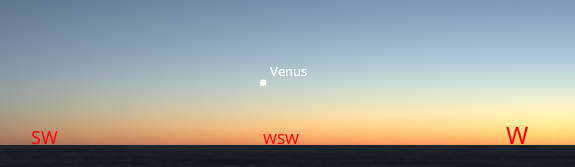
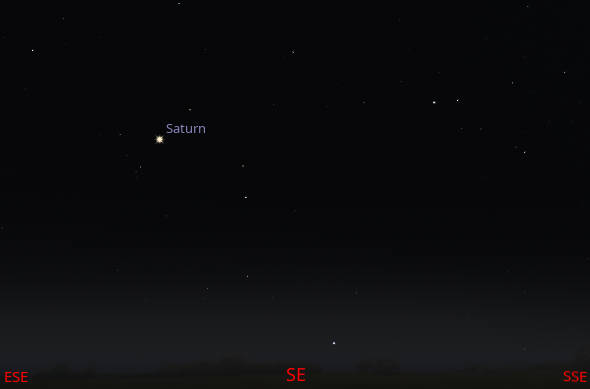
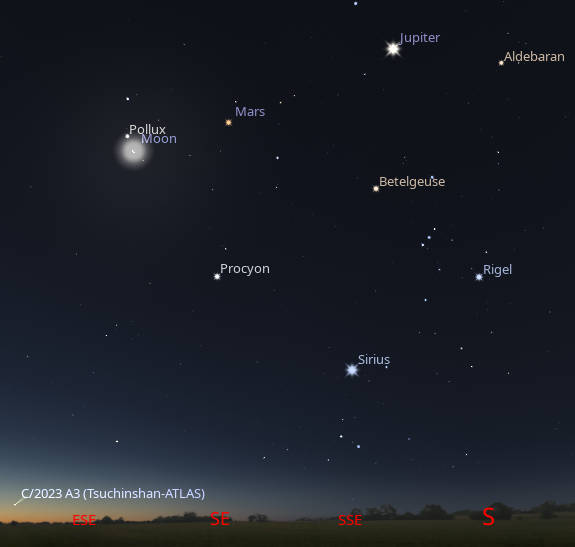
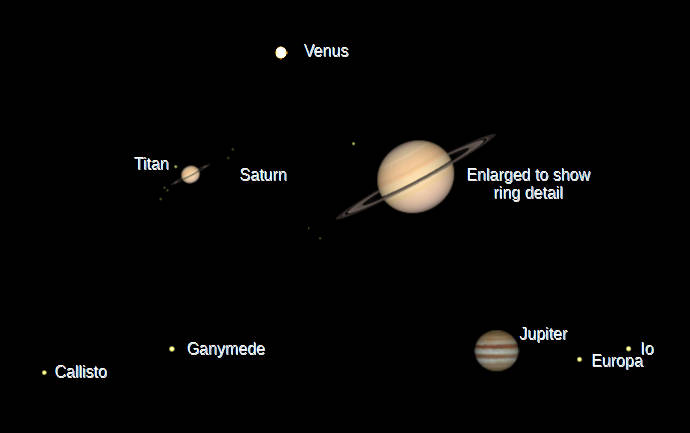
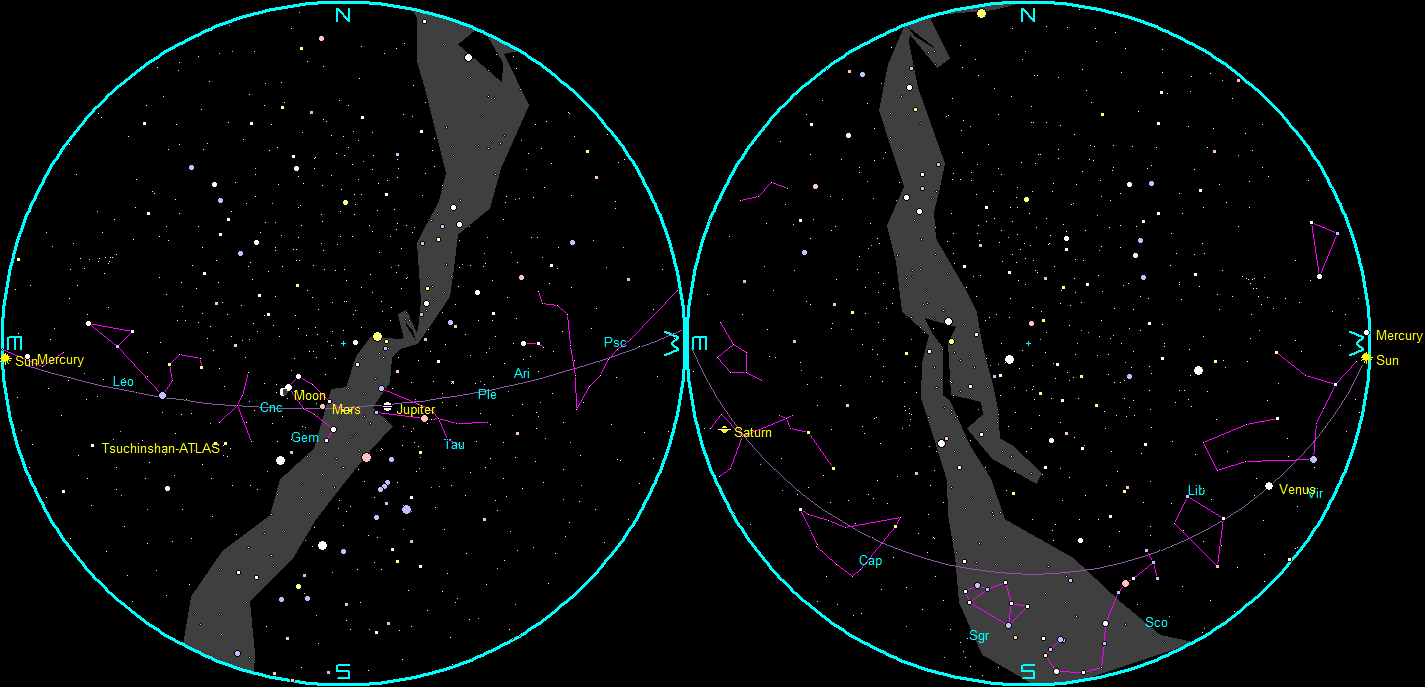
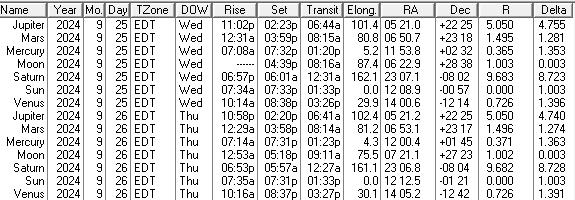
Let’s take our weekly look at the whereabouts of the naked-eye planets. Venus might be spotted in the West southwest only 6° above the horizon at 8 PM, 30 minutes after sunset. It will set at 8:38. Saturn will be low in the east-southeast at that time, but you might have to wait another half hour for it to appear. Saturn may look disappointing in telescopes this year since its rings are nearly edge on and appearing as a line through the planet like it’s stapled onto the sky. Jupiter and Mars will be up in the morning sky, with Jupiter rising about 11 PM now and by 6:30 AM tomorrow, Jupiter will be brighter than the winter stars in the south-southeast. Mars and the Moon will be left and below Jupiter.
The astronomical event times given are for the Traverse City/Interlochen area of Michigan (EDT, UT – 4 hours). Times will be different for other locations.
Addendum
Ephemeris: 09/24/2024 – Pegasus is rising on autumn evenings
This is Ephemeris for Tuesday, September 24th. Today the Sun will be up for 12 hours and 2 minutes, setting at 7:35, and it will rise tomorrow at 7:34. The Moon, at last quarter today, will rise at 11:47 this evening.
While we’ve been watching the stars and constellations of summer and the Milky Way, the constellations of autumn have been sneaking up on us from the east. About halfway up the sky in the east at 9 PM is one of the greatest constellations of autumn, Pegasus the flying horse. Her body or at least the front part of it is a large square of stars called the Great Square of Pegasus. It is an almost perfect rectangle. However, as she’s rising, it’s standing on one corner. From the upper star are her front legs, from the rightmost star her neck and head extend in the stars. And from the left star of the square are what might look like her hind legs but aren’t. Only half of her body is in the stars. It’s another constellation, Andromeda, which we’ll talk about later.
The astronomical event times given are for the Traverse City/Interlochen area of Michigan (EDT, UT – 4 hours). Times will be different for other locations.
Addendum
Ephemeris: 09/23/2024 – Scanning the Milky Way with binoculars
This is Ephemeris for Monday, September 23rd. Today the Sun will be up for 12 hours and 5 minutes, setting at 7:37, and it will rise tomorrow at 7:33. The Moon, 1 day before last quarter, will rise at 10:50 this evening.
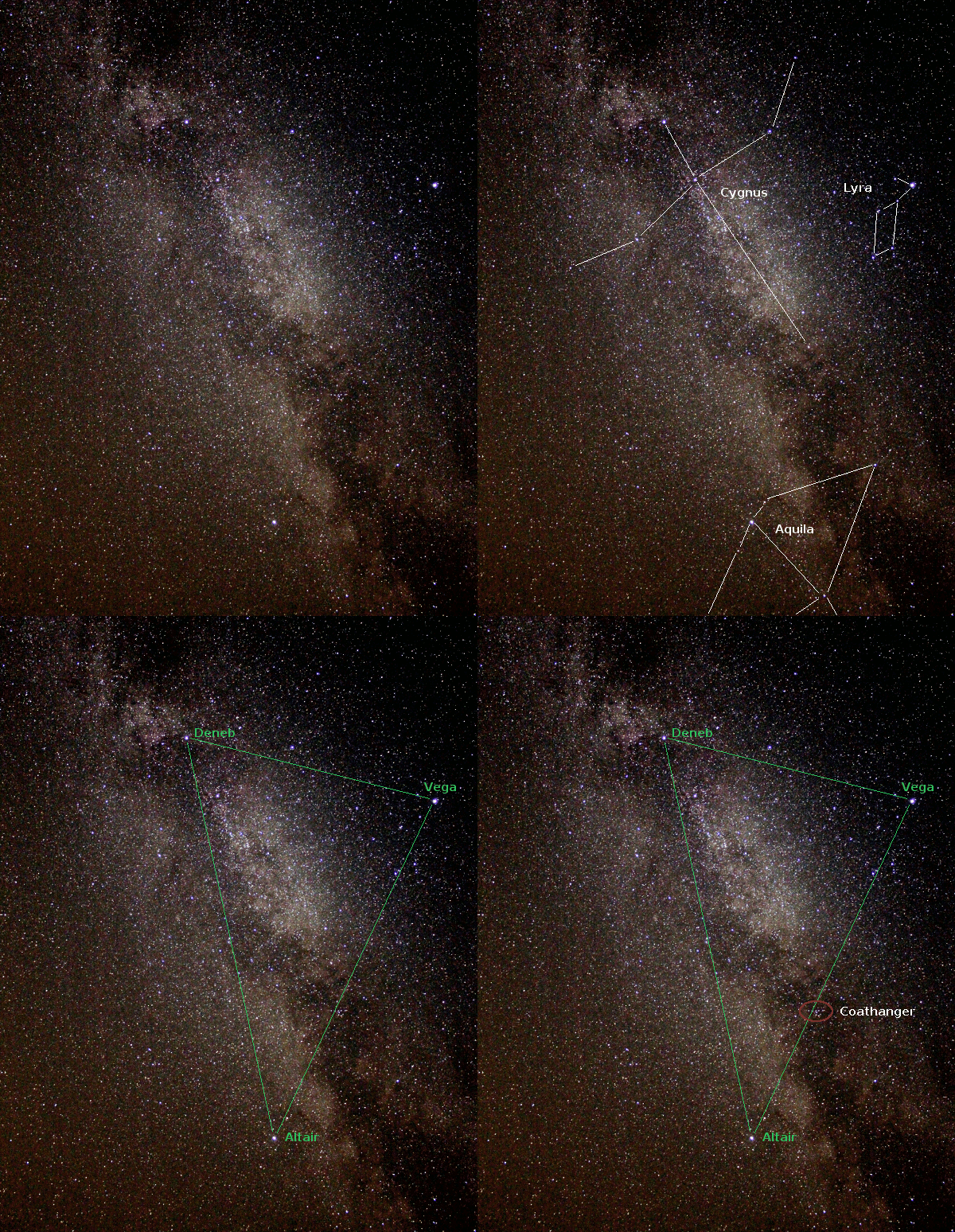
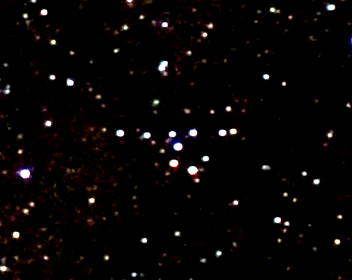
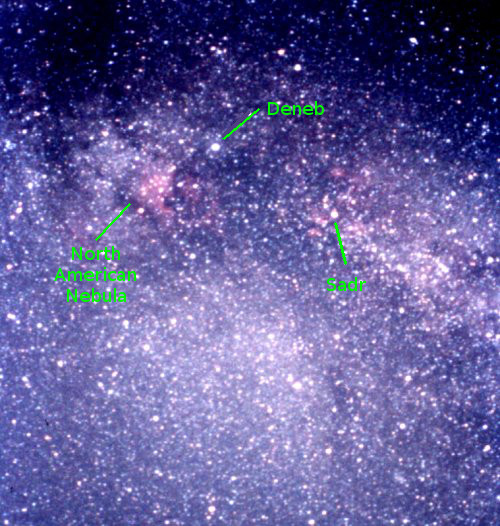
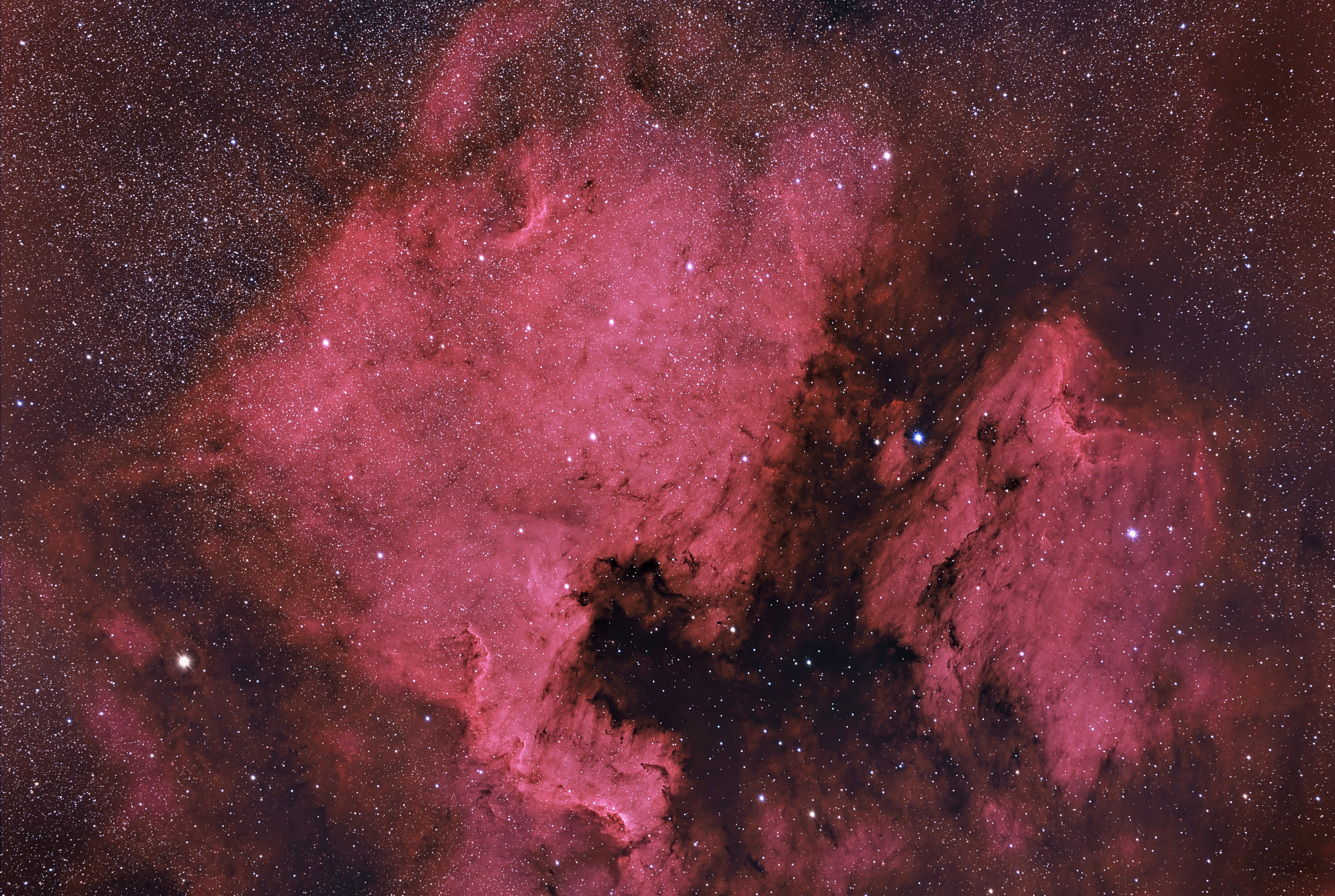
Now that the Moon has fled the early evening skies the Milky Way is showing up again, if you’re at a dark site. I’ve always said that August and September are the best times to view what I call the summer Milky Way, even now that it’s not technically summer anymore. The Teapot asterism in the constellation of Sagittarius is low in the south-southeast, pouring its tea on the horizon. It is in that direction we are looking towards the center of our Milky Way Galaxy. The Summer Triangle is high in the South with Vega and Deneb, two of its stars near the zenith. All the Milky Way is an invitation to scan it with the pair of binoculars or a very low power telescope. One doesn’t need a chart. Just wander through the Milky Way to find many star clusters, groups of stars and nebulae.
The astronomical event times given are for the Traverse City/Interlochen area of Michigan (EDT, UT – 4 hours). Times will be different for other locations.
Addendum (Some binocular wonders)
The Coathanger
The North American Nebula
Ephemeris: 09/20/2024 – Fall will fall upon us Sunday
This is Ephemeris for Friday, September 20th. Today the Sun will be up for 12 hours and 14 minutes, setting at 7:42, and it will rise tomorrow at 7:29. The Moon, 3 days past full, will rise at 8:55 this evening.
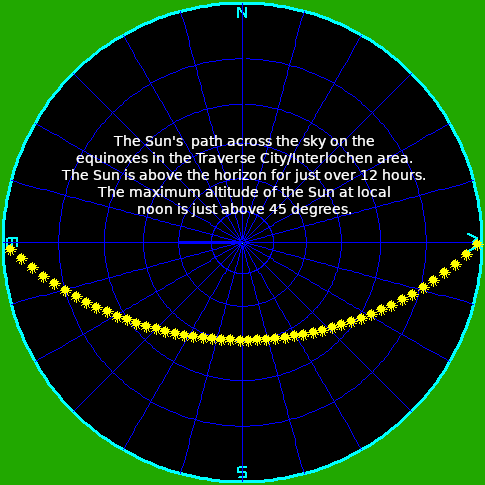
The season of fall is about to, well, fall upon us and in a few weeks so will the leaves. At 8:44 Sunday morning (12:44 UT Sunday) the Sun will cross the celestial equator heading southward. The celestial equator is an imaginary line in the sky above the earth’s equator. At that point, the Sun will theoretically set at the North Pole and rise at the South Pole. The day is called the autumnal equinox and the daylight hours of Sunday will be 12 hours and 8 minutes instead of 12 hours exactly. That’s due to our atmosphere and our definition of sunrise and sunset. The reason for the cooler weather we are heading into is that the length of daylight is shortening, and the Sun rides lower in the sky, spreading its heat over a larger area, thus diluting its intensity.
The astronomical event times given are for the Traverse City/Interlochen area of Michigan (EDT, UT – 4 hours). Times will be different for other locations.
Addendum

Ephemeris: 09/19/2024 – The Chinese Mid-Autumn Festival
This is Ephemeris for Thursday, September 19th. Today the Sun will be up for 12 hours and 17 minutes, setting at 7:44, and it will rise tomorrow at 7:28. The Moon, 2 days past full, will rise at 8:30 this evening.
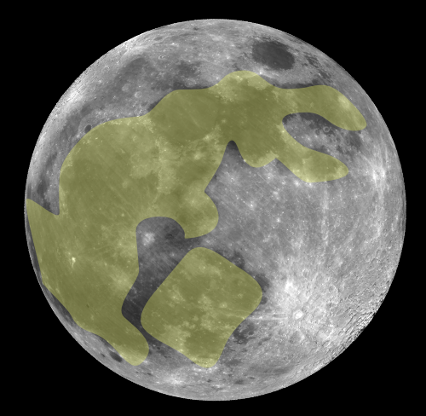
Our Harvest Moon also marks the Chinese Mid-Autumn Festival. I’ve been too busy with the lunar eclipse to cover it on Tuesday. It is to honor the Moon and the story of Chang’e a mortal woman who took an elixir and flew off to the Moon and became a goddess. Another story revolves around the Jade Rabbit pounding Medicine. I sometimes talk about the figure of a rabbit seen on the face of the Moon. He is a companion to Chang’e, and has a mortar and pestle on the Moon with him. He pounds out the medicine that makes the inhabitants of the sky immortal. The Chinese lunar probes are named Chang’e. Chang’e 3 landed on the Moon in 2013 and sent out a lunar rover named Yutu, the Jade Rabbit. They have made other landings since.
The astronomical event times given are for the Traverse City/Interlochen area of Michigan (EDT, UT – 4 hours). Times will be different for other locations.
Addendum
Ephemeris: 09/18/2024 – Checking out where the naked-eye planets are this week
This is Ephemeris for Wednesday, September 18th. Today the Sun will be up for 12 hours and 20 minutes, setting at 7:46, and it will rise tomorrow at 7:27. The Moon, 1 day past full, will rise at 8:08 this evening.
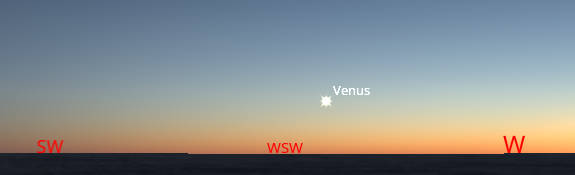
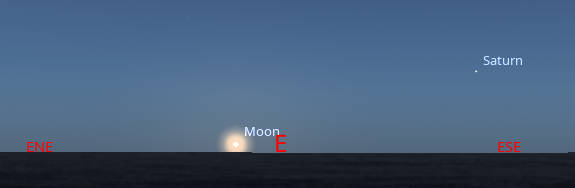
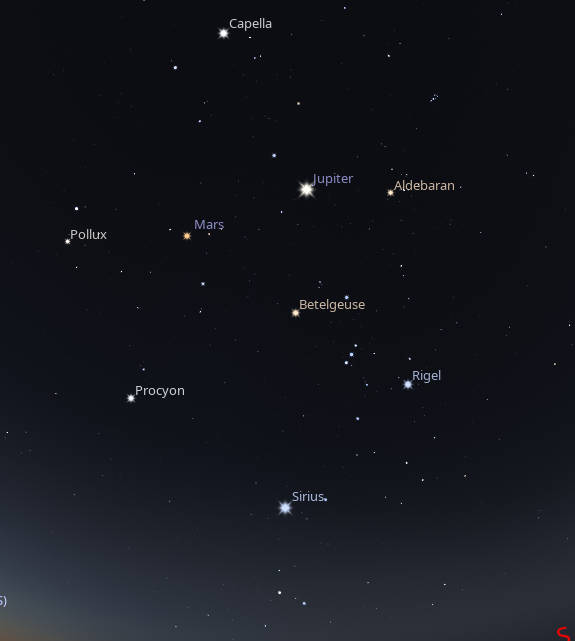
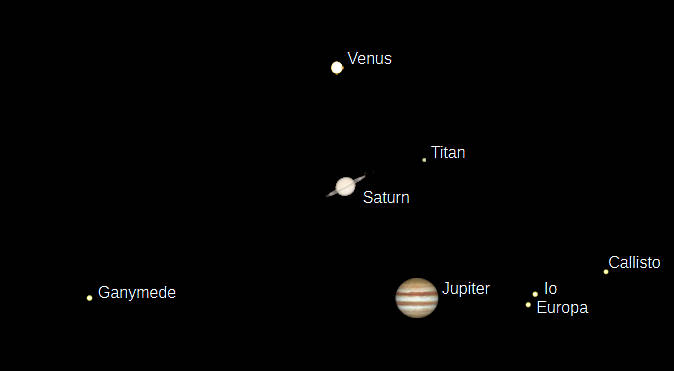
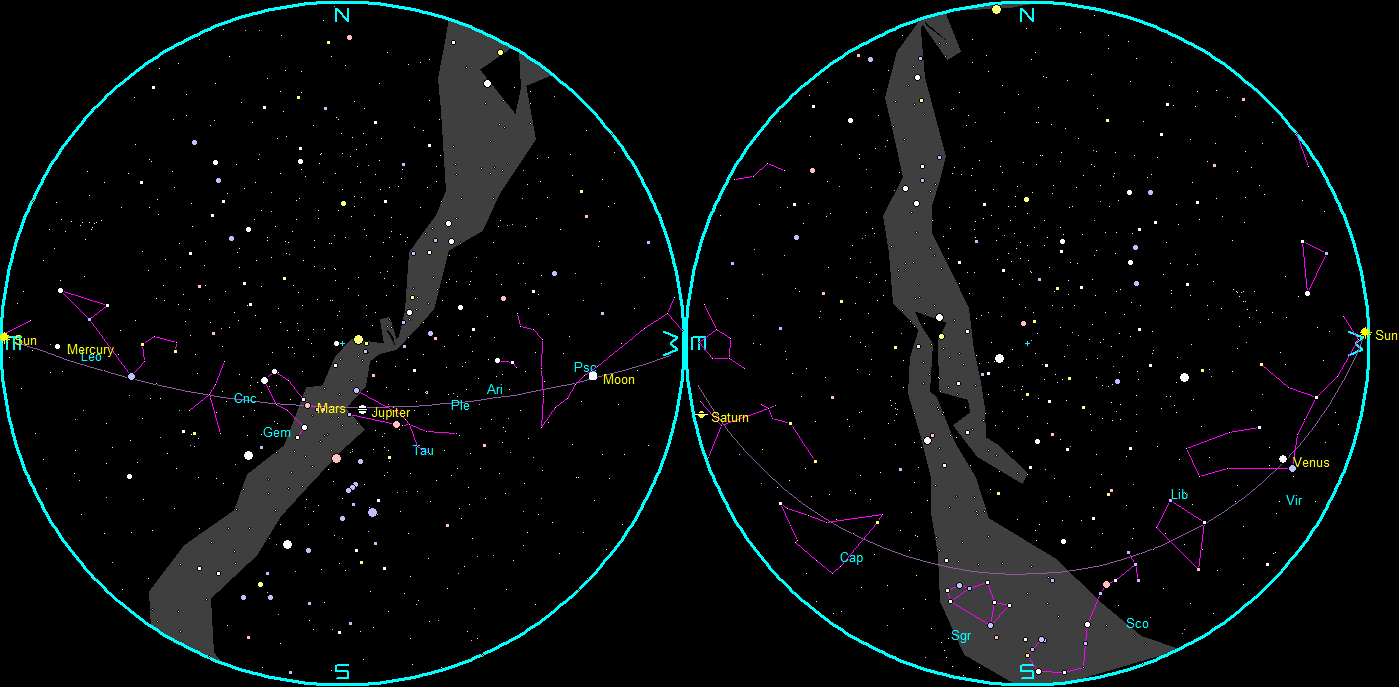
Let’s take our weekly look at the whereabouts of the naked-eye planets. Venus might be spotted in the West southwest only 5° above the horizon at 8:15 or 30 minutes after sunset. It will set at 8:48. Saturn will be low in the east-southeast at that time, with the Moon just rising in the east. Saturn may look disappointing in telescopes this year since its rings are nearly edge on and appearing as a line through the planet like it’s stapled onto the sky. Jupiter and Mars will be up in the morning sky, with Jupiter rising before midnight now and by 6:30 AM tomorrow, Jupiter will be the brightest starlike object in the sky among the winter stars in the south-southeast. Mars will be left and below Jupiter.
The astronomical event times given are for the Traverse City/Interlochen area of Michigan (EDT, UT – 4 hours). Times will be different for other locations.
Addendum
Ephemeris: 09/17/2024 – Super Harvest Moon Eclipse tonight
Note: the eclipse isn’t that super, however tonight’s full moon is a supermoon, and the Harvest Moon to boot. On with the program.
This is Ephemeris for Tuesday, September 17th. Today the Sun will be up for 12 hours and 23 minutes, setting at 7:48, and it will rise tomorrow at 7:25. The Moon, at full today, will rise at 7:47 this evening.
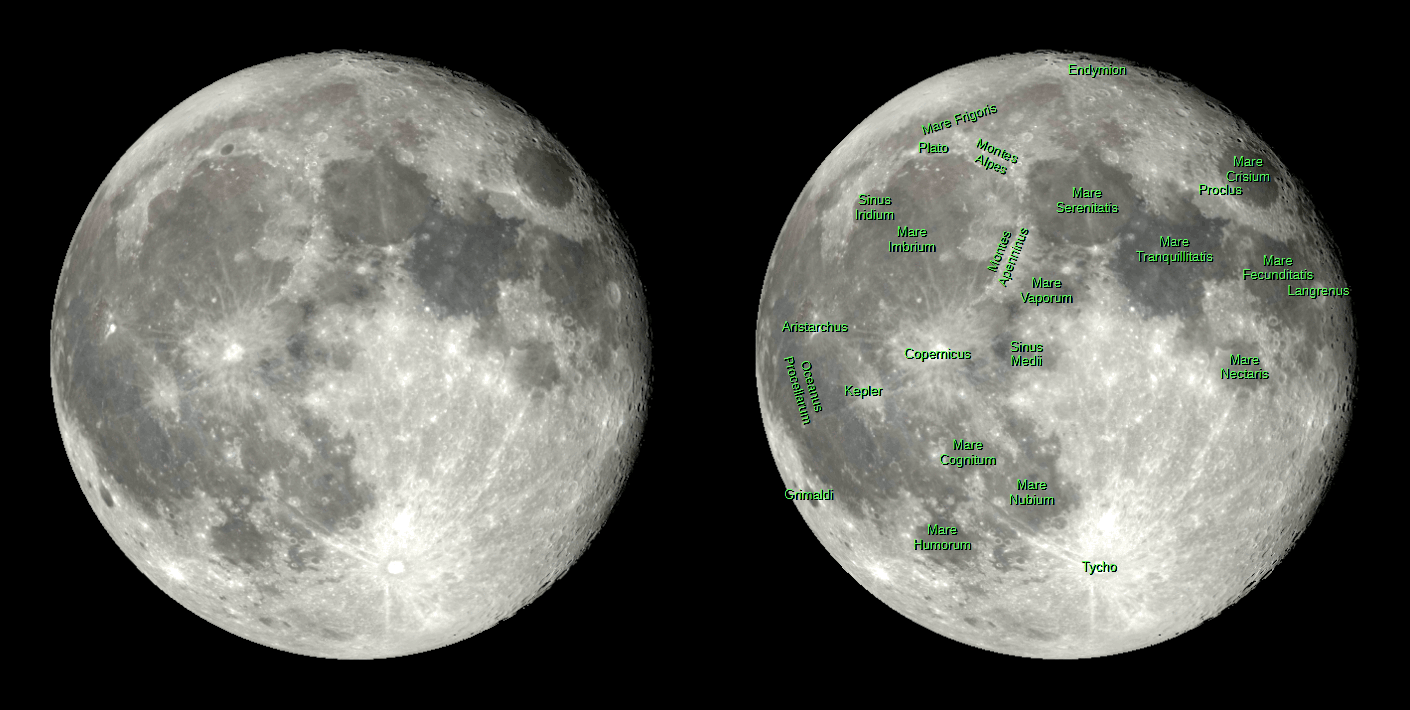
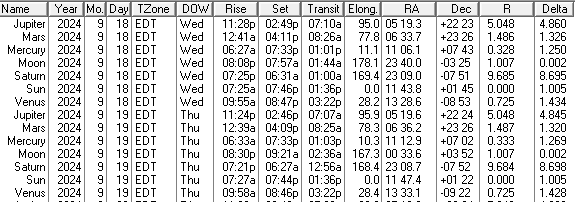
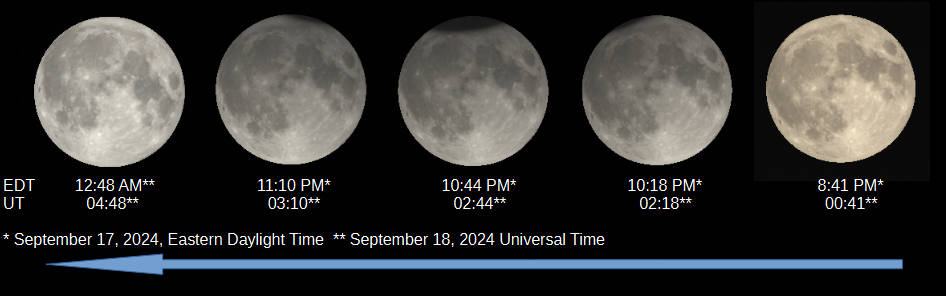
Tonight’s full Harvest Moon* is also a supermoon and on top of that it will be partially eclipsed in Earth’s shadow. The Moon will just clip the bottom or south part of the Earth’s inner shadow called the umbra between 10:13 PM and 11:15 PM. Only 8% of the Moon’s diameter will be covered by the umbra at maximum eclipse at 10:44 PM. However, the Moon will spend a fair amount of time in the Earth’s penumbra, the outer part of the shadow, where the Sun is only partially blocked. So the moon will appear dimmer than normal at its upper parts from about 9:45 to 11:45 PM or so. Viewing the moon through a pair of sunglasses will enhance the effects of the dimming of the penumbra, cutting down the Moon’s glare.
The astronomical event times given are for the Traverse City/Interlochen area of Michigan (EDT, UT – 4 hours). Times will be different for other locations.
* The Harvest Moon is the full moon nearest the date of the autumnal equinox which this year is on the 22nd of September. What makes the Harvest Moon special is the Harvest Moon Effect. Check it out this previous post where I explained more about it: Here
Addendum
 Bob Moler's Ephemeris Blog