Archive
Ephemeris: 11/14/2024 – SpaceX to deorbit the International Space Station
This is Ephemeris for Thursday, November 14th. Today the Sun will be up for 9 hours and 35 minutes, setting at 5:15, and it will rise tomorrow at 7:40. The Moon, 1 day before full, will set at 7:28 tomorrow morning.
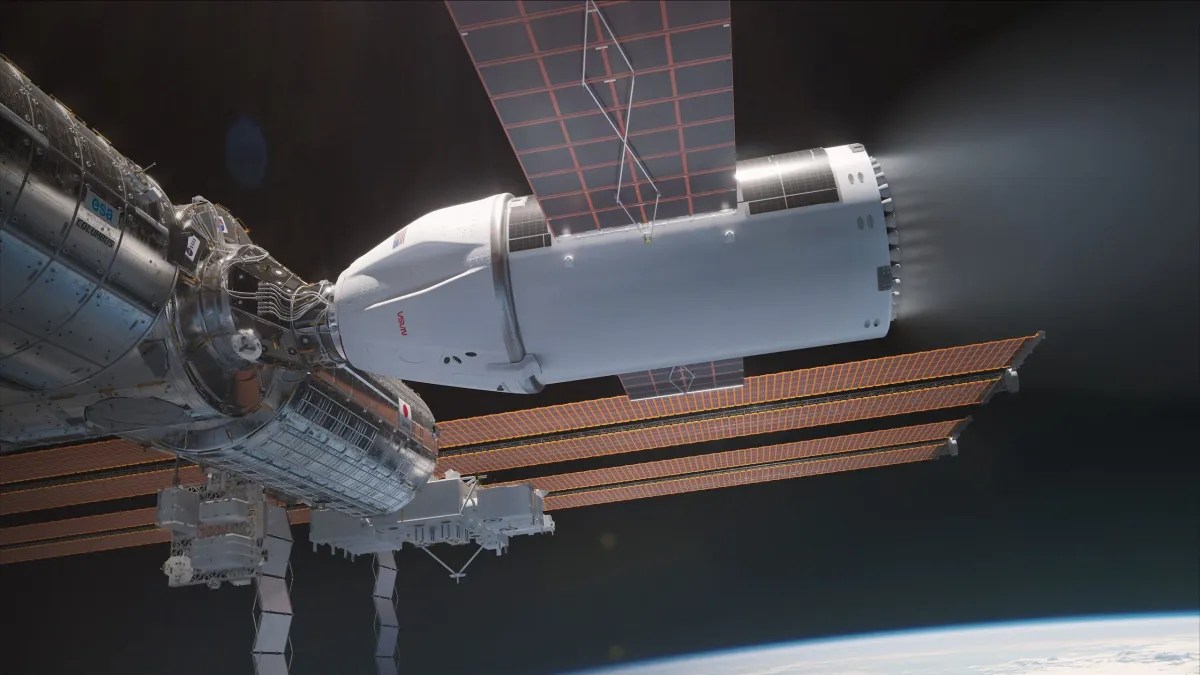
SpaceX has received a contract from NASA to deorbit the International Space Station around the year 2030. The contract is for a little bit less than a billion dollars. SpaceX will develop a special Dragon capsule with enough fuel to deorbit the space station. The idea is to drop the space station’s orbit over a period of months and guided in its final journey to a spot in the South Pacific Ocean called Point Nemo, which is the spot between New Zealand and Chile near longitude 120° W and latitude 50° South. Point Nemo is named after the captain of the fictional submarine Nautilus from the Jules Verne novel 20,000 Leagues Under the Sea. Point Nemo is the farthest point in the South Pacific Ocean from any landmass: island or continent.
The astronomical event times given are for the Traverse City/Interlochen area of Michigan (EST, UT – 5 hours). Times will be different for other locations.
Addendum
Ephemeris: 11/13/2024 – Looking for the naked-eye planets this week
This is Ephemeris for Wednesday, November 13th. Today the Sun will be up for 9 hours and 38 minutes, setting at 5:16, and it will rise tomorrow at 7:39. The Moon, 2 days before full, will set at 6:03 tomorrow morning.
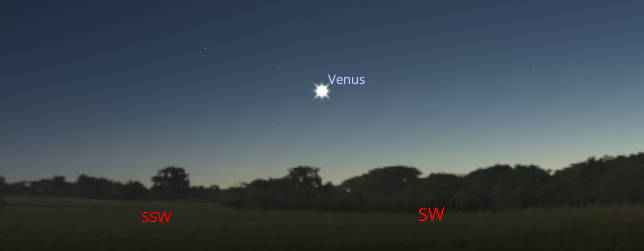
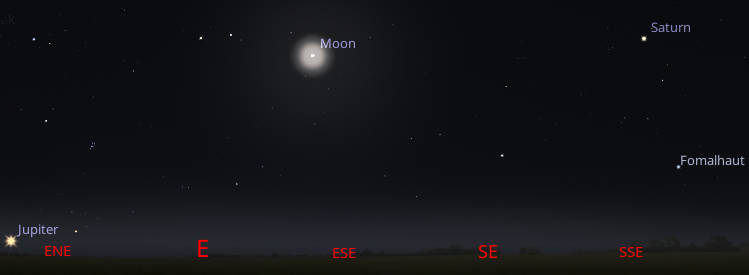
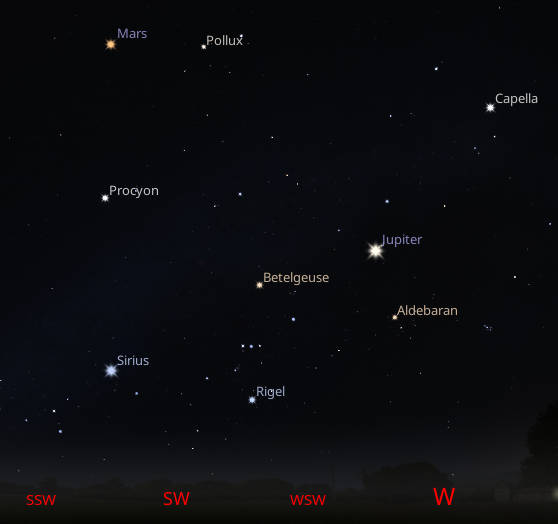
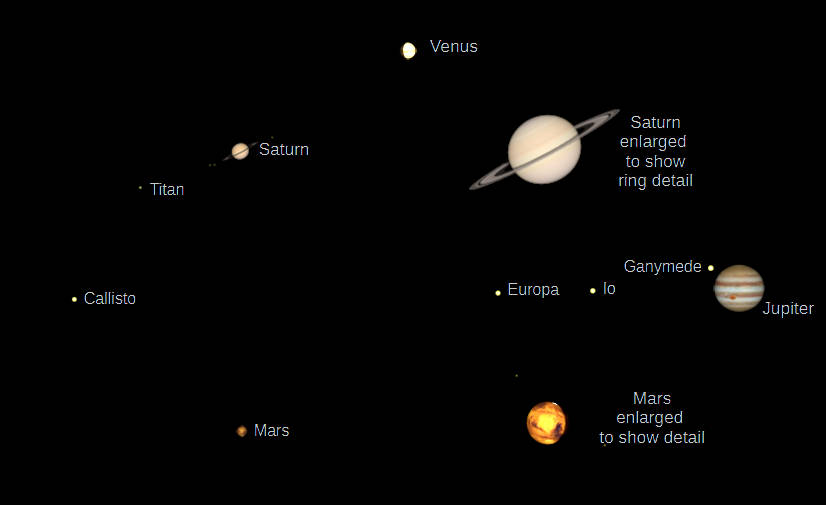
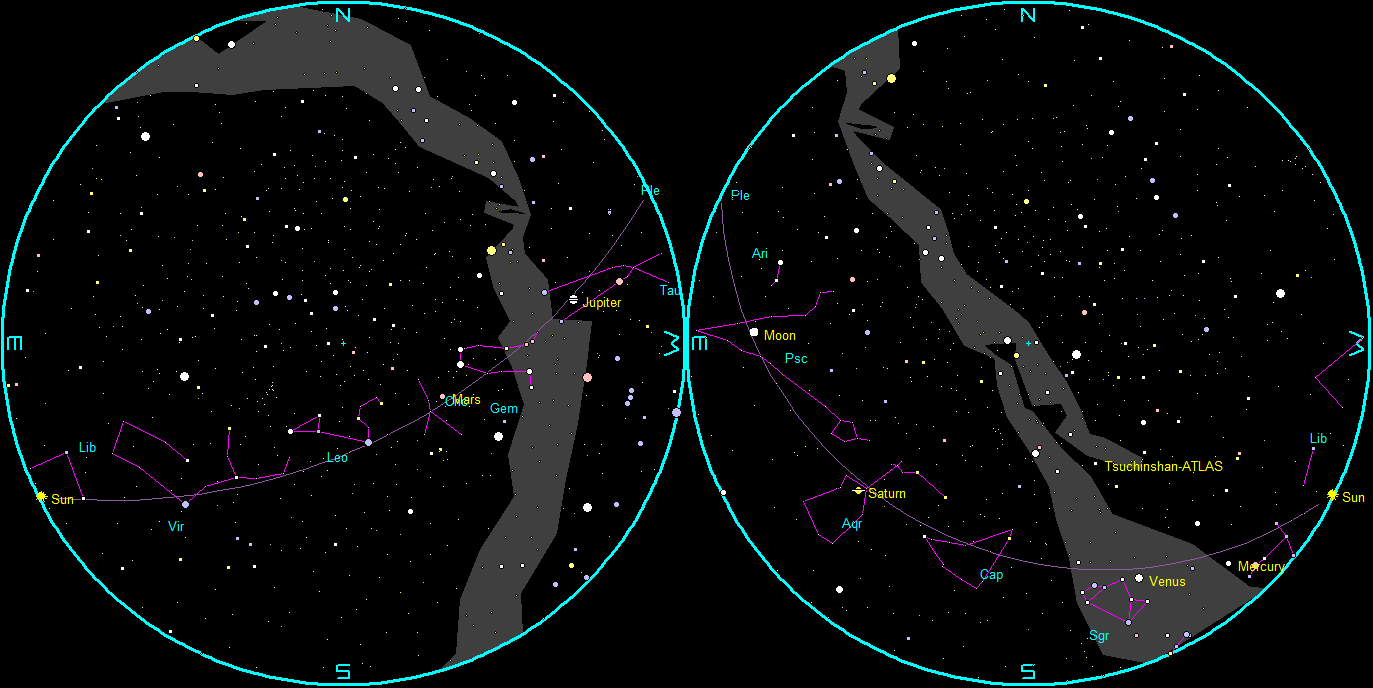
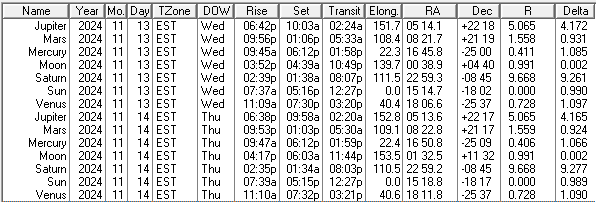
Let’s take our weekly look at the whereabouts of the naked-eye planets. Venus can be spotted low in the southwestern sky by 6 PM, about 45 minutes after sunset. It will set at 7:30. Saturn will be in the south-southeast at 7 PM. Jupiter will rise at 6:42 PM in the east northeast, and be a good object for the small telescope about an hour later. By 6:00 AM tomorrow Jupiter will be high in the west, above and right of Orion, while reddish Mars, which rises tonight near 9:56, will be high in the south-southwest. Jupiter and Saturn are good planets to view with a small telescope, while Venus and Mars will appear very small and featureless. These last two will improve next year when they move closer to us.
The astronomical event times given are for the Traverse City/Interlochen area of Michigan (EST, UT – 5 hours). Times will be different for other locations.
Addendum
Ephemeris: 11/12/2024 – SpaceX uses Cargo Dragon to change orbit of the ISS
This is Bob Moler with Ephemeris for Tuesday, November 12th. Today the Sun will be up for 9 hours and 40 minutes, setting at 5:17, and it will rise tomorrow at 7:37. The Moon, halfway from first quarter to full, will set at 4:39 tomorrow morning.
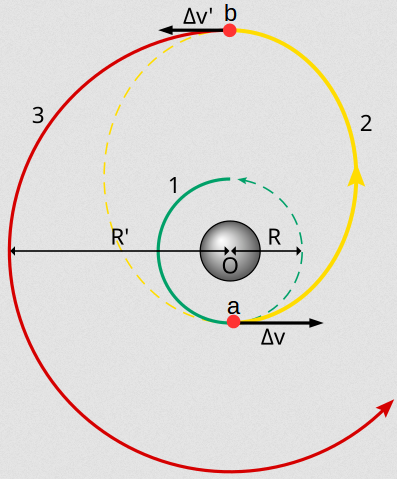
After the last SpaceX cargo mission arrived at the International Space Station, they used the thrusters on the SpaceX capsule to raise the orbital space station a little bit as a test. SpaceX capsules dock at the forward end of the space station according to direction of travel so in order to boost the station’s orbit they had to flip the station around so that the docking port was at the rear before they could apply the needed thrust. When thrust is applied to an object in orbit the effect of the change occurs mostly at the opposite side of the orbit. In order to permanently raise or lower an object’s circular orbit one must make 2 adjustments 180° away from each other. This is the essence of the Hohmann Transfer Orbit, proposed by German scientist Walter Hohmann in 1925.
The astronomical event times given are for the Traverse City/Interlochen area of Michigan (EST, UT – 5 hours). Times will be different for other locations
Addendum
Ephemeris: 11/11/2024 – Still waiting for the promised nova
This is Ephemeris for Veterans Day, Monday, November 11th. Today the Sun will be up for 9 hours and 43 minutes, setting at 5:18, and it will rise tomorrow at 7:36. The Moon, 2 days past first quarter, will set at 3:19 tomorrow morning.
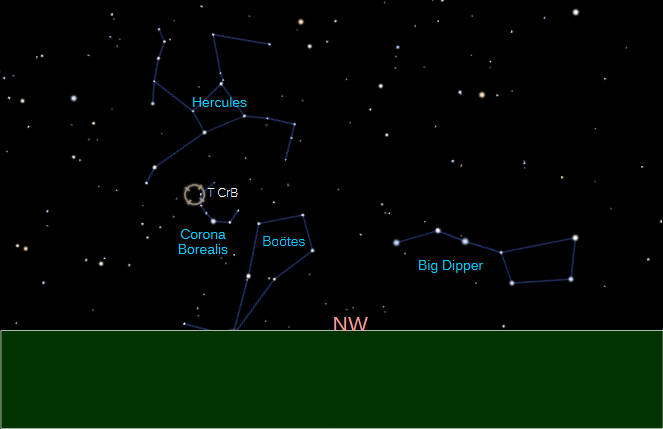
We’ve been waiting all year so far for the appearance of a nova or Blaze Star, as they called it, in the constellation of Corona Borealis. The astronomical name For it is T Coronae Borealis or T CrB for short. It last erupted in 1946 and the time before that it was 1866 an interval of 80 years. This year would be 78 years since 1946 so we could be waiting another two years. Observations of the star, which is still visible, though faint, between eruptions, were not as comprehensive in the prior 80 years, as they are today. It’s possible that observations of pre-nova activity were missed during war years preceding the 1946 outburst.
The astronomical event times given are for the Traverse City/Interlochen area of Michigan (EST, UT – 5 hours). Times will be different for other locations.
Addendum
Ephemeris: 11/08/2024 – The Jade Rabbit on the Moon
This is Bob Moler with Ephemeris for Friday, November 8th. Today the Sun will be up for 9 hours and 50 minutes, setting at 5:21, and it will rise tomorrow at 7:32. The Moon, 1 day before first quarter, will set at 11:24 this evening.
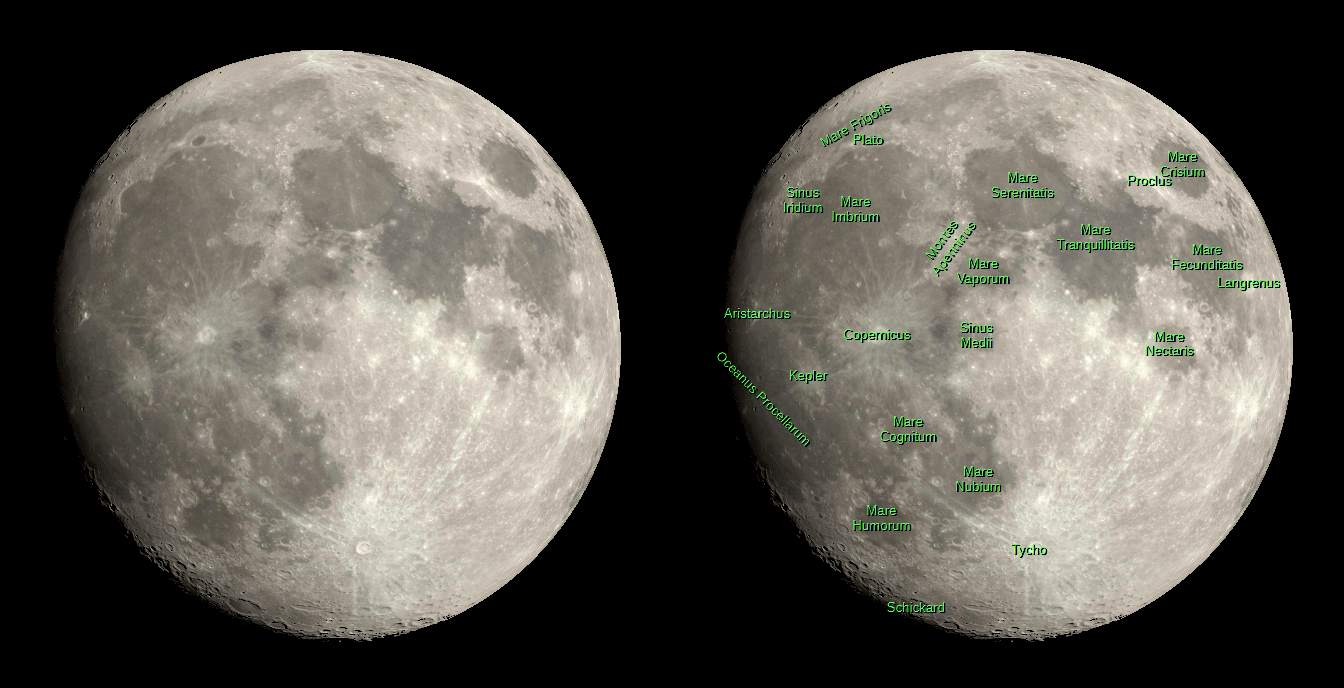
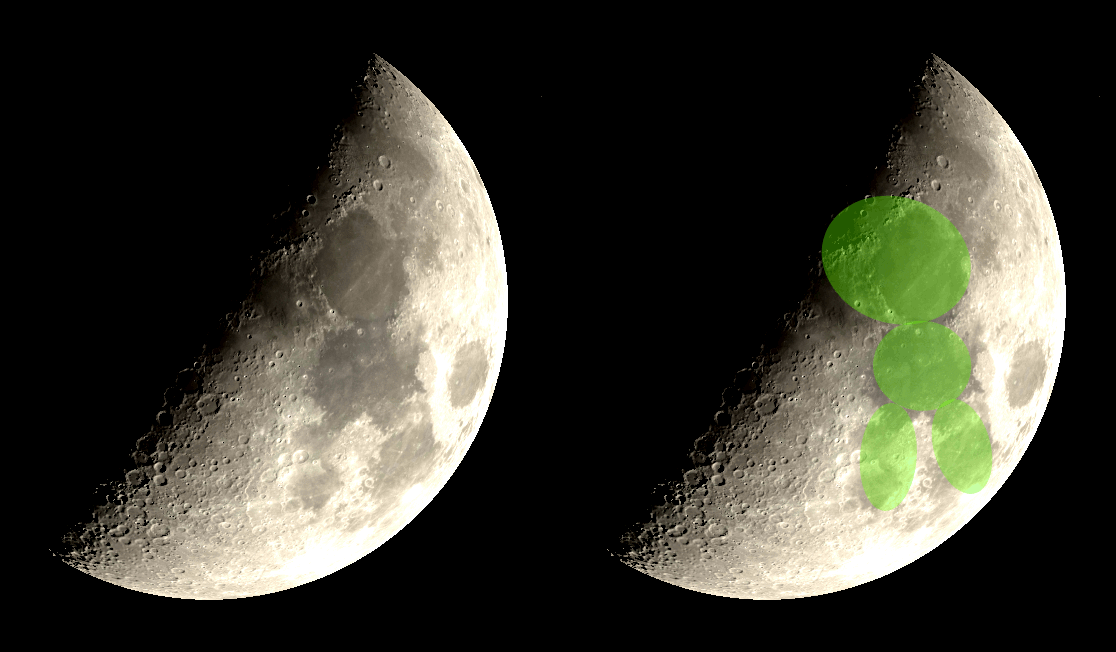
Tonight’s Moon is just a few hours before the instant of first quarter which is officially at 12:56 tomorrow morning. The ancient Chinese saw in the gray areas of the Moon, we call seas, a rabbit, a pet of Chinese moon goddess Chang’e, its name was Yutu. These have become the names of the Chinese lunar landers and rovers. The top half of that rabbit is visible in the gray areas called maria, or seas. Early telescopic astronomers thought they were actually water filled basins. It turned out to be lava plains, actually floors of huge craters, from asteroids that hit the Moon 4 billion years ago during the late heavy bombardment. The top body of the rabbit is at the top part of the moon it descends to the lower right with his head and ears. The rabbit is also known as the Jade Rabbit. The rest of him is visible when the moon is full. Yutu has a real presence on the Moon, as the names of the two Chinese rovers that landed on the Moon.
The astronomical event times given are for the Traverse City/Interlochen area of Michigan (EST, UT – 5 hours). Times will be different for other locations.
Addendum
Ephemeris: 11/07/2024 – The Moon wobbles from Earth’s point of view
This is Ephemeris for Thursday, November 7th. Today the Sun will be up for 9 hours and 53 minutes, setting at 5:22, and it will rise tomorrow at 7:31. The Moon, 2 days before first quarter, will set at 10:08 this evening.
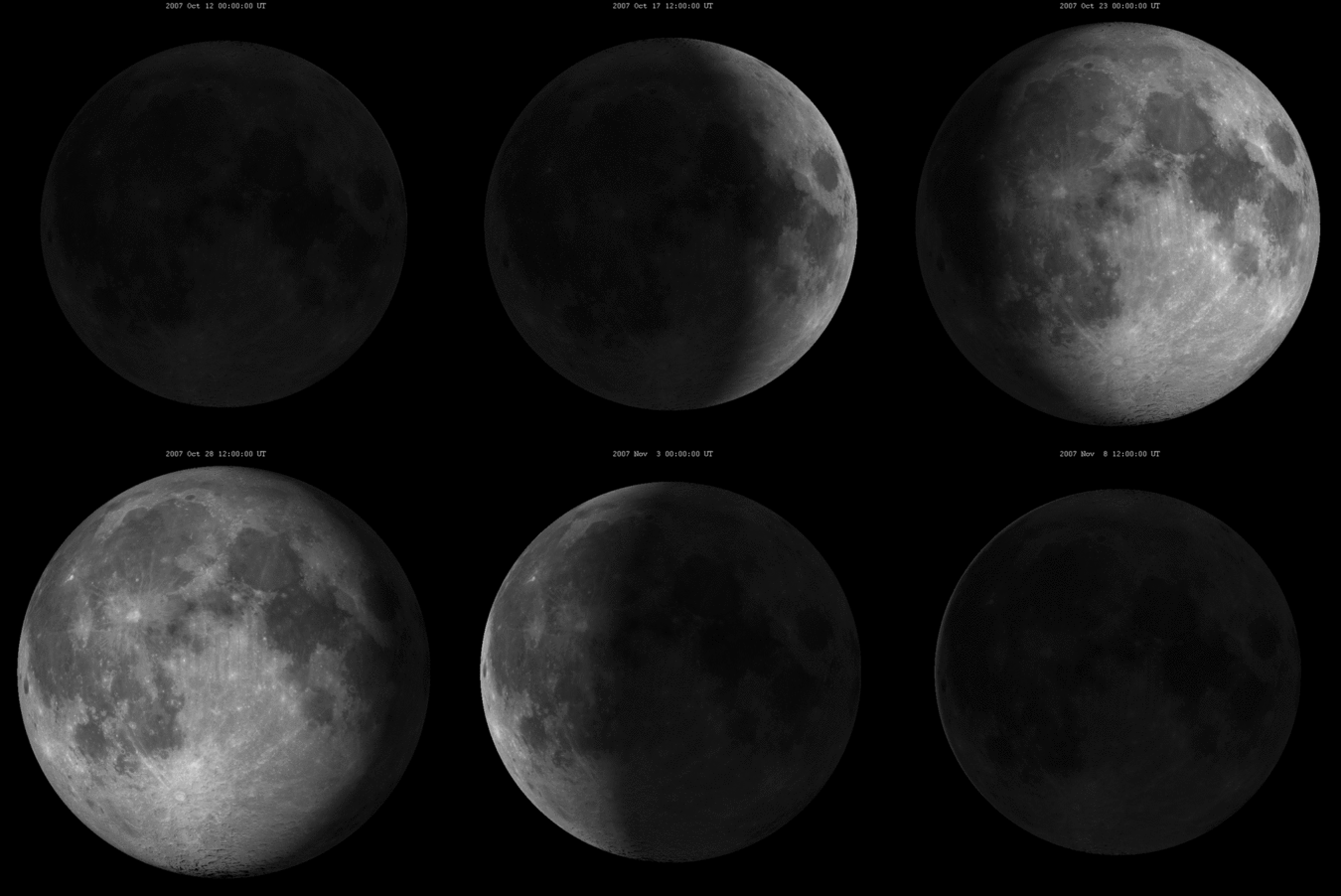
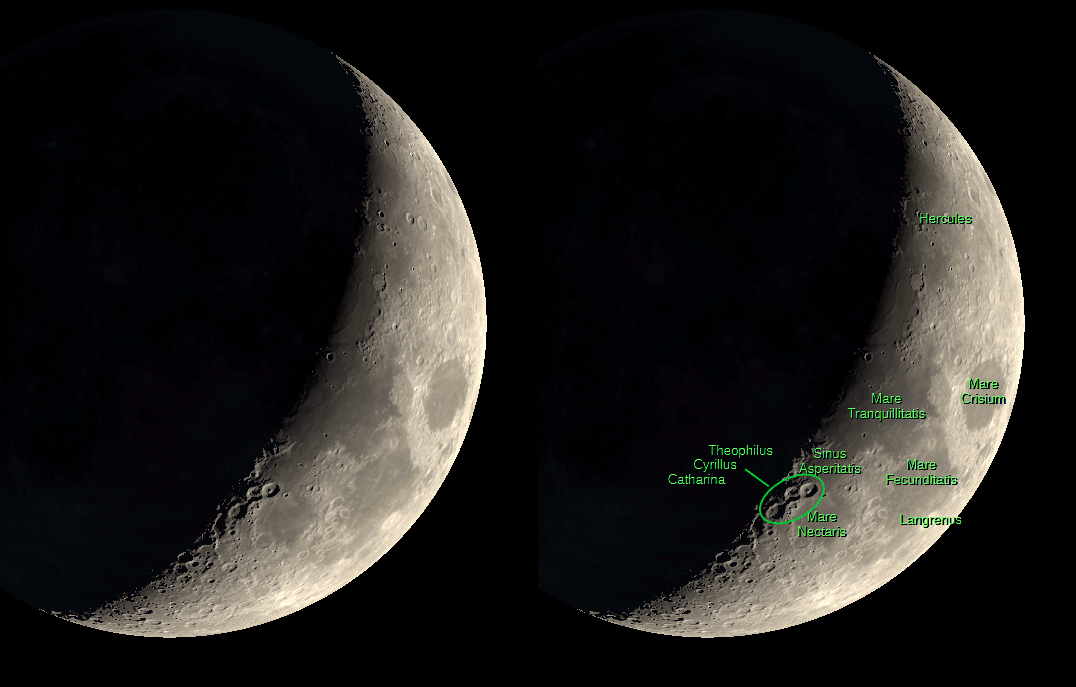
The nearly seven day old Moon appears very low in the southwestern sky tonight. It appears as a fat crescent. The small sea called Mare Crisium or Sea of Crises, near the west edge of the Moon is a good indicator of what we call libration, that is the Moon’s slow wobbling back and forth over the month as it orbits the Earth. One can judge the amount of libration by the distance of that small round sea from the edge of the Moon. This happens because the Moon’s rotation is steady while its orbital velocity around the Earth is not, because its orbit is slightly elliptical. So sometimes the rotation gets ahead of its revolution about the Earth, and sometimes it’s behind. Right now that libration is pushing that small sea towards the edge of the Moon.
The astronomical event times given are for the Traverse City/Interlochen area of Michigan (EST, UT – 5 hours). Times will be different for other locations.
Addendum
Ephemeris: 11/06/2024 – Where are the naked eye planets this week?
This is Ephemeris for Wednesday, November 6th. Today the Sun will be up for 9 hours and 55 minutes, setting at 5:24, and it will rise tomorrow at 7:29. The Moon, 3 days before first quarter, will set at 8:56 this evening.
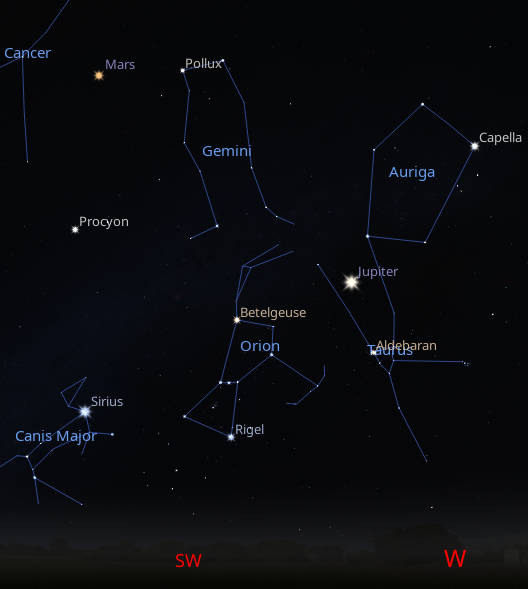
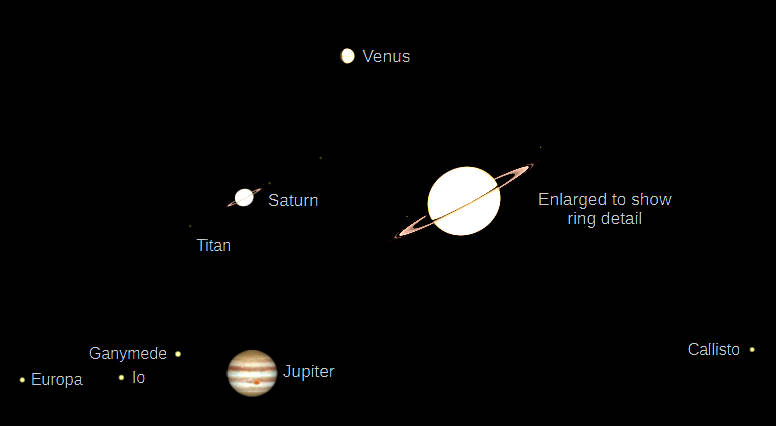
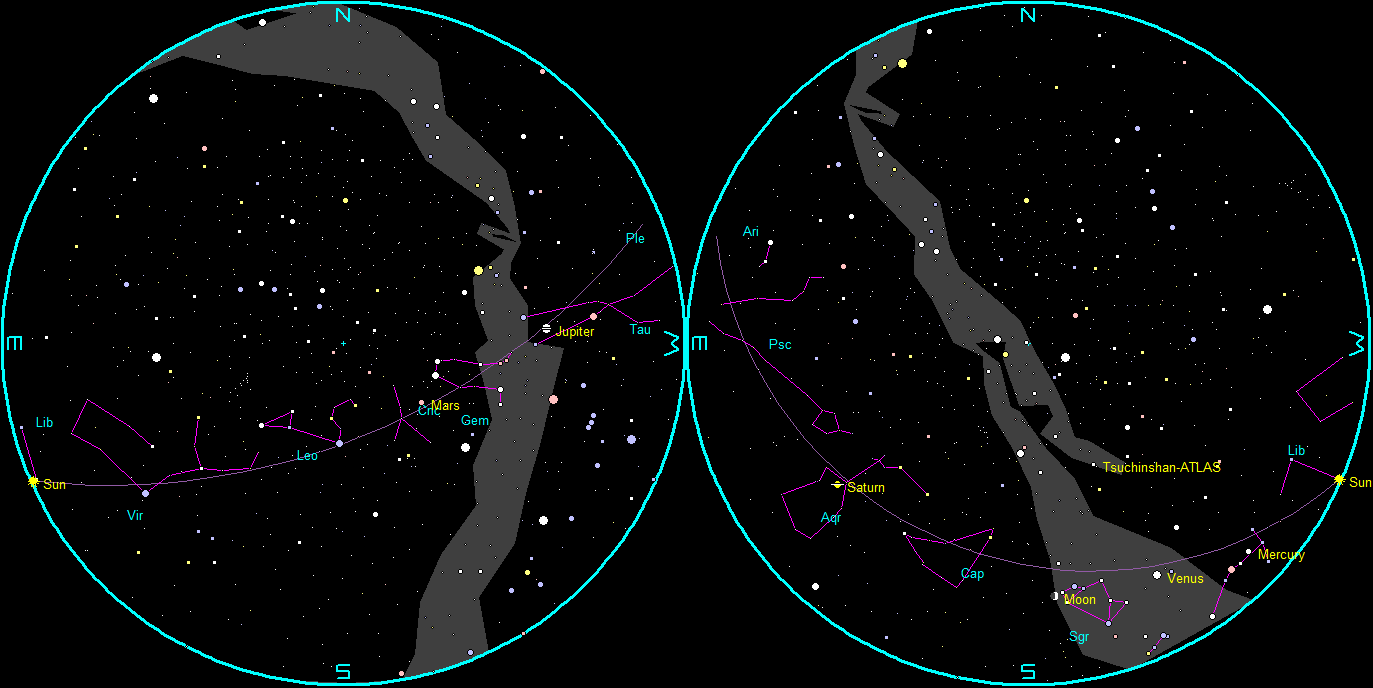
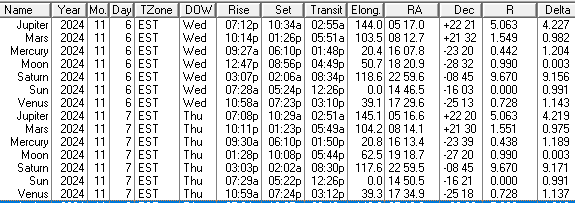
Let’s take our weekly look at the whereabouts of the naked-eye planets. Venus can be spotted low in the southwestern sky by 6 PM, about half an hour after sunset. It will set at 7:22. Saturn will be in the southeast at 7 PM. Jupiter will rise at 7:17 PM in the east northeast, and be a good object for the small telescope about an hour later. By 6:00 AM tomorrow Jupiter will be high in the west southwest, among the winter stars, while reddish Mars, which rises tonight near 10:16, will be high in the south. Jupiter and Saturn are good planets to view with a small telescope, while Venus and Mars will appear very small and featureless. These last two will improve next year when they move closer to us.
The astronomical event times given are for the Traverse City/Interlochen area of Michigan (EST, UT – 5 hours). Times will be different for other locations.
Addendum
Ephemeris: 11/05/2024 – Bright Jupiter is now seen earlier in the evening
This is Ephemeris for Election Day, Tuesday, November 5th. Today the Sun will be up for 9 hours and 58 minutes, setting at 5:25, and it will rise tomorrow at 7:28. The Moon, 4 days before first quarter, will set at 7:51 this evening.
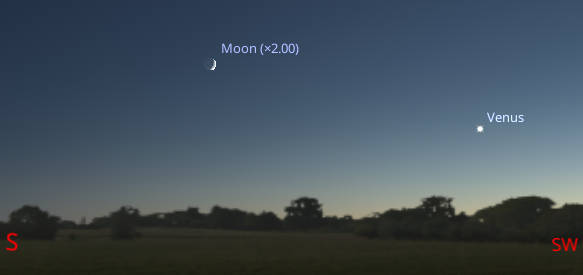
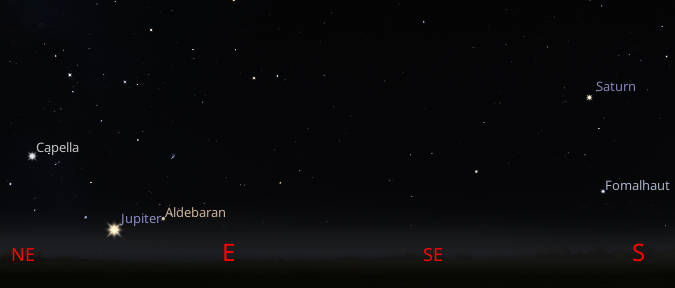
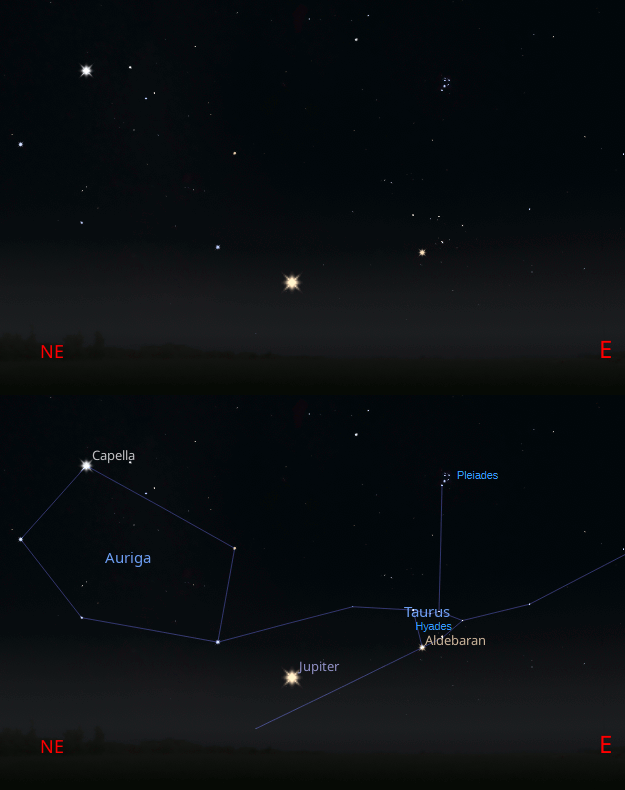
There’s a bright star in the east these evenings. It is extremely bright. If Venus wasn’t around in the evening in the southwest, one might mistake it for Venus. Well this bright star is not a star at all, but the planet Jupiter. Jupiter is the solar system’s largest planet. It is by and large the easiest planet to observe with a small telescope, which will also reveal four of its many moons, which I think is approaching 100 now. (It’s hard to keep track of them.) These four moons were the same ones discovered by Galileo over 400 years ago. Jupiter’s moons move quite rapidly compared to the Earth’s moon. From night to night Jupiter’s moons shift around. Their motions can also be detected over the period of an evening, or night.
The astronomical event times given are for the Traverse City/Interlochen area of Michigan (EST, UT – 5 hours). Times will be different for other locations.
Addendum
Ephemeris: 11/04/2024 – The Milky Way in Autumn
This is Ephemeris for Monday, November 4th. Today the Sun will be up for 10 hours and 1 minute, setting at 5:26, and it will rise tomorrow at 7:26. The Moon, 4 days past new, will set at 6:58 this evening.
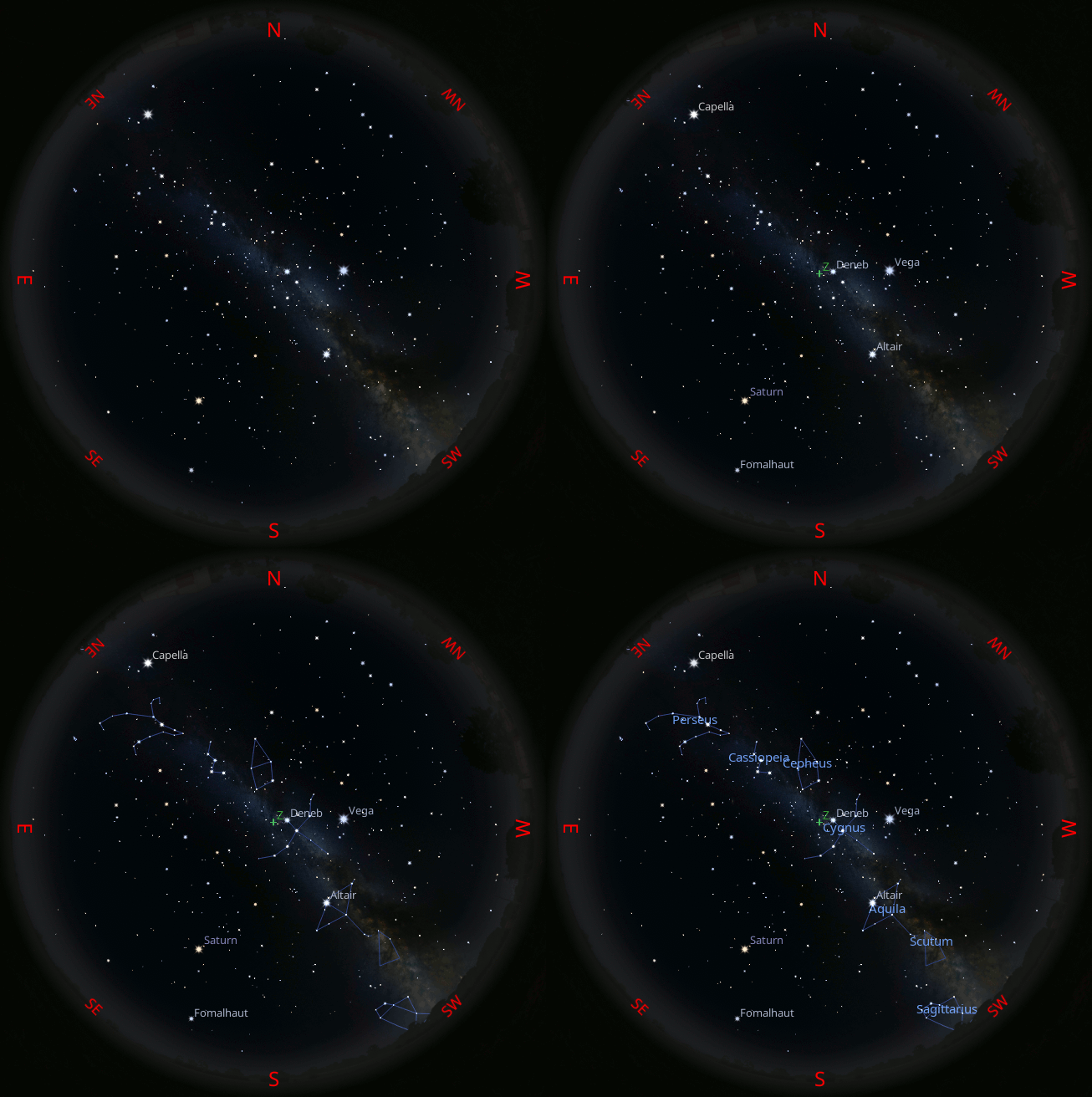
As of yesterday the sunsets and sunrises have slipped back an hour so we have darker evenings and brighter mornings, as we came back to Standard Time. It seems odd that we spend less time of the year under Standard Time than we do under Daylight Time. Anyway, looking at the evening sky we see that Venus tonight will be above the four-day-old crescent Moon in the southwest after sunset. By 7 PM the northernmost star of the Summer Triangle, Deneb in Cygnus the swan or the Northern Cross, will be almost directly overhead. And the Milky Way at that time will run from northeast, overhead to the southwestern horizon. Remember tomorrow is Election Day. Make sure you cast your ballot before the end of voting tomorrow, if you haven’t already.
The astronomical event times given are for the Traverse City/Interlochen area of Michigan (EST, UT – 5 hours). Times will be different for other locations.
Addendum
Ephemeris: 11/01/2024 – Grand Traverse Astronomical Society Meeting tonight
This is Ephemeris for Friday, November 1st. The Sun will rise at 8:21. It’ll be up for 10 hours and 9 minutes, setting at 6:30. The Moon is new today, and won’t be visible.
The Grand Traverse Astronomical Society will host its November meeting tonight at 8:00 PM at Northwestern Michigan College’s Joseph H Rogers Observatory. This will be an unstructured meeting, and a good time for anyone interested to ask knowledgeable members anything about the sky or, since Christmas is coming, about what kind of telescope to buy. Afterward, about 9 PM if it’s clear, there will be viewing of the heavens through the observatory’s telescopes, featuring Saturn, Jupiter and the wonders of the Milky Way, including nebulae, open and globular star clusters, containing hundreds to hundreds of thousands of stars. The observatory is located on Birmley Rd. South of Traverse City between Garfield and Keystone roads.
The astronomical event times given are for the Traverse City/Interlochen area of Michigan (EDT, UT – 4 hours). Times will be different for other locations.
Addendum
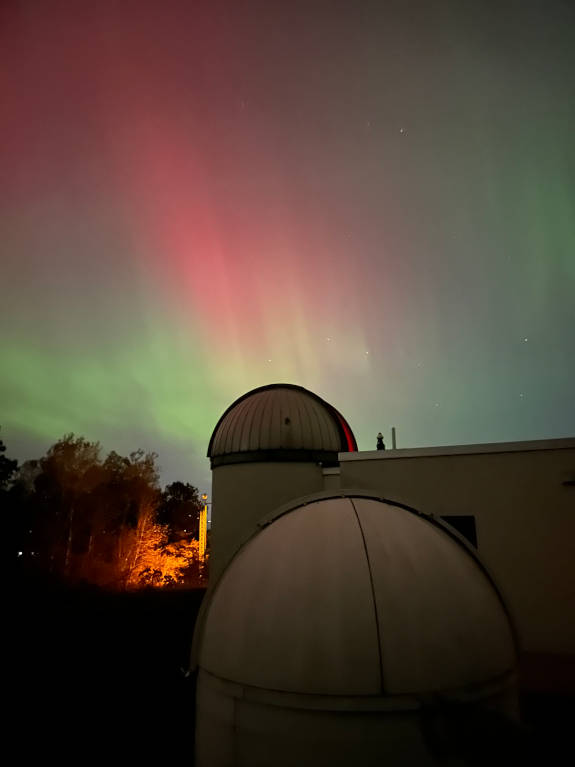
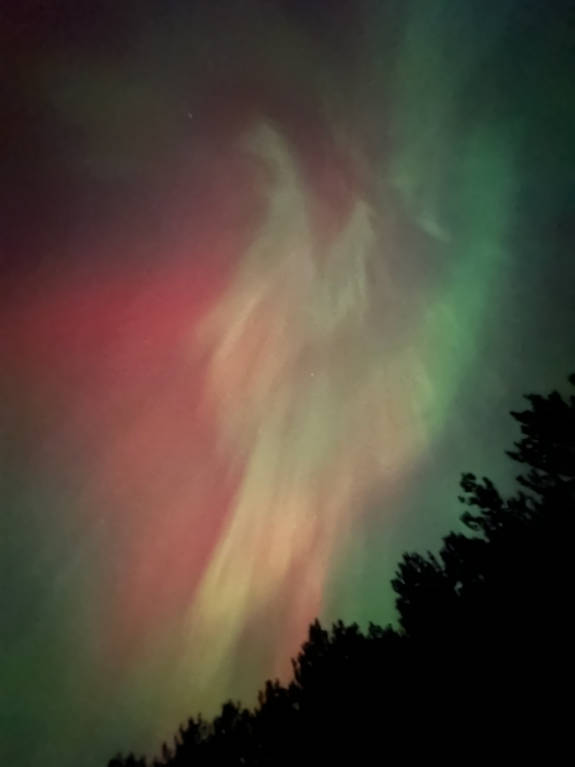
One of the discussion items will be the currently active sun in how it affects the earth.
 Bob Moler's Ephemeris Blog