Archive
Ephemeris: 11/20/2025 – Venus is disappearing from the morning sky
This is Ephemeris for Thursday, November 20th. Today the Sun will be up for 9 hours and 23 minutes, setting at 5:09, and it will rise tomorrow at 7:48. The Moon is new today, and won’t be visible.
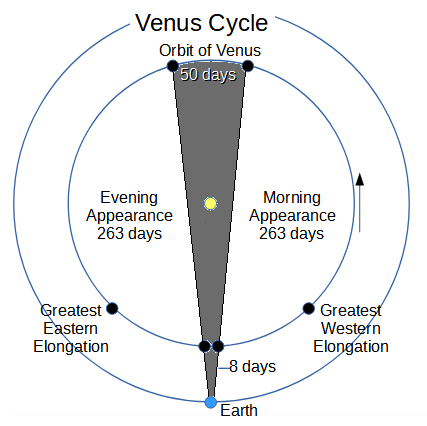
Yesterday I mentioned that Venus is getting very difficult to spot in the morning sky, rising at about 7:00 AM. It’s moving around behind the Sun, what’s called superior conjunction, so it moves slower than it would when it moves toward inferior conjunction meaning it moves between the Earth and the Sun. It’s closer to the Earth so it appears to move faster. Then it’s only gone for maybe 8 to 10 days, transitioning from the evening sky to the morning sky. However, at superior conjunction which will occur on January 6, it will disappear for 50 days or actually longer. The ancient Mayans calculated that around superior conjunction Venus would disappear for about 50 days. We at a higher latitude would see a longer disappearance, losing it until sometime in late February or early March.
The astronomical event times given in this blog are for the Traverse City/Interlochen area of Michigan (Lat 44.7° N, Long 85.7° W; EDT, UT – 4 hours) unless stated otherwise. Times will be different for other locations.
Addendum
Ephemeris: 11/19/2025 – Taking our weekly look at the whereabouts of the naked-eye planets
This is Ephemeris for Wednesday, November 19th. Today the Sun will be up for 9 hours and 25 minutes, setting at 5:10, and it will rise tomorrow at 7:46. The Moon, 1 day before new, will rise at 8:28 tomorrow morning.
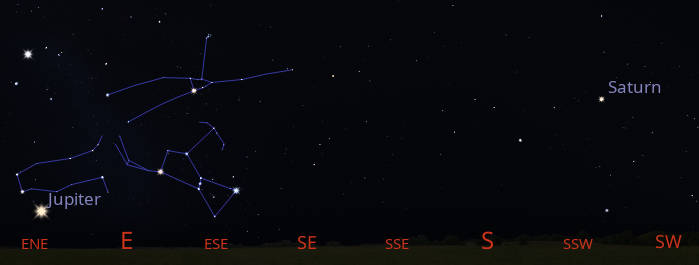
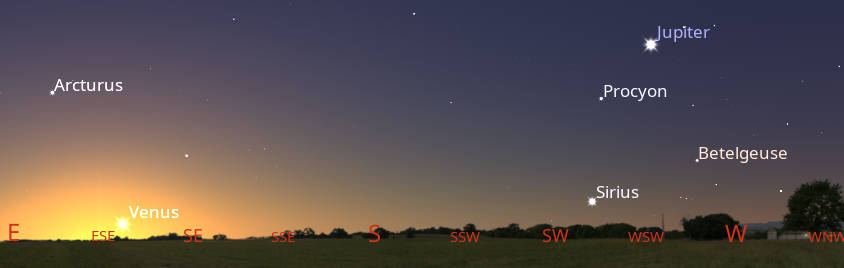
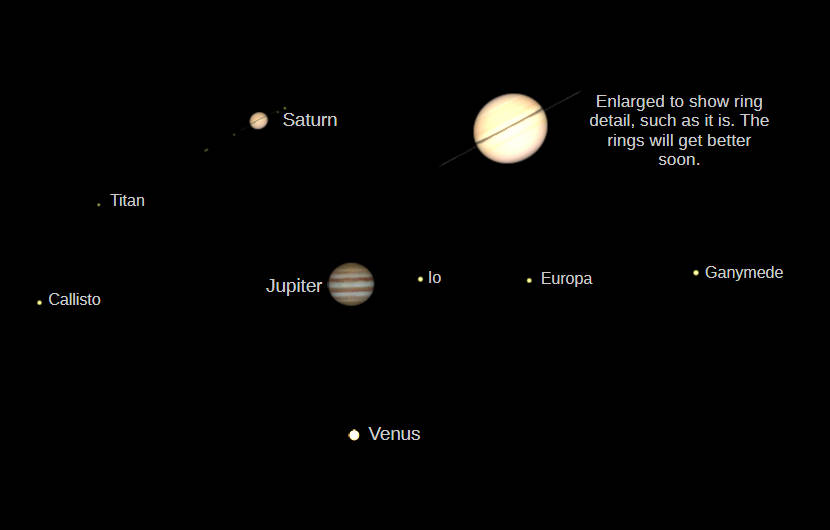
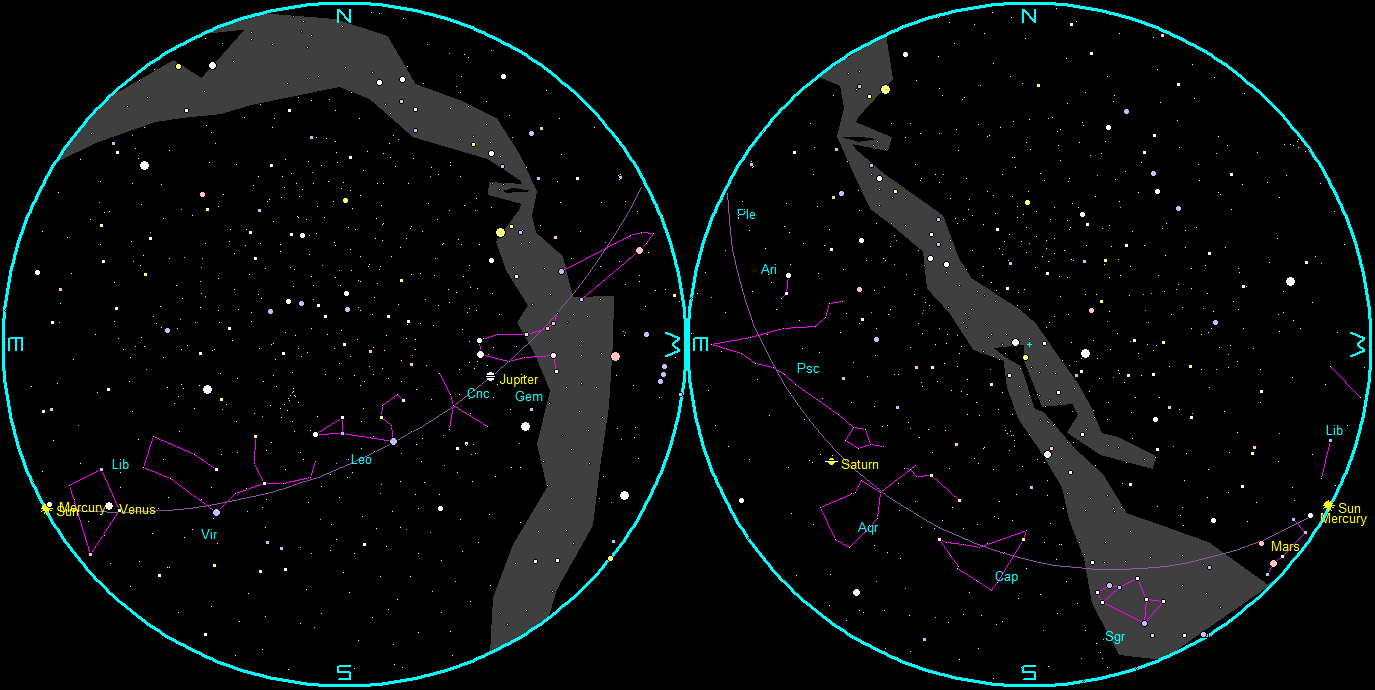
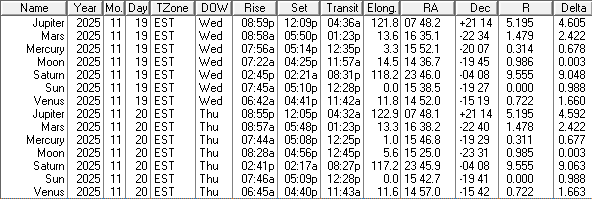
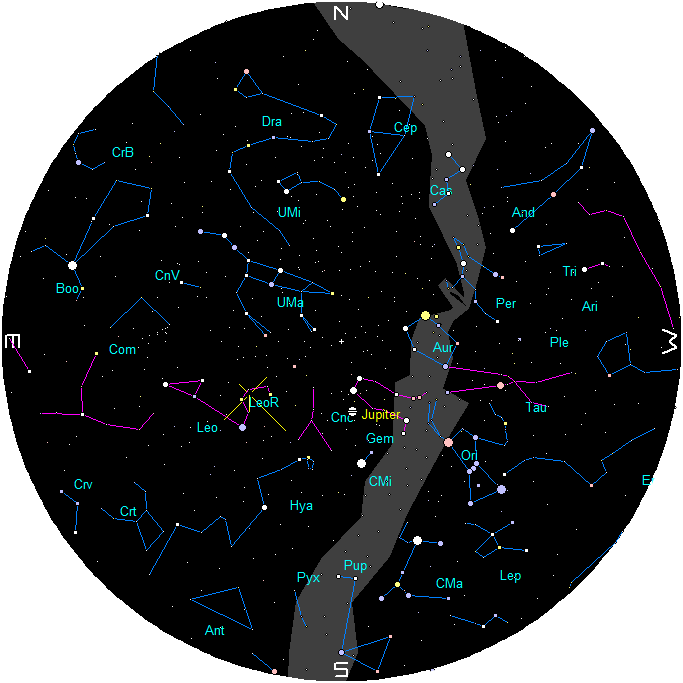
Let’s take our weekly look at the whereabouts of the naked-eye planets. Saturn is the brightest star like object in the southeastern sky as soon as it gets dark. In a telescope Saturn sports a very thin ring, 4/10ths of a degree from being edge on. In 4 days the rings will slowly start to open up. Normally, I’d say that Saturn’s rings are easy to see in a telescope. Currently, the rings appear extremely thin and can be difficult to pick up. Jupiter will rise at 8:58 PM in the east-northeast. By 6:30 AM, it will appear high in the southwest, near the stars of Gemini, with Orion and the other bright stars of winter in the southwest. Venus, which will rise at 6:48 AM will be difficult to spot in the morning twilight.
The astronomical event times given in this blog are for the Traverse City/Interlochen area of Michigan (Lat 44.7° N, Long 85.7° W; EDT, UT – 4 hours) unless stated otherwise. Times will be different for other locations.
Addendum
Ephemeris: 11/18/2025 – What other cultures see in the Pleiades
This is Ephemeris for Tuesday, November 18th. Today the Sun will be up for 9 hours and 27 minutes, setting at 5:11, and it will rise tomorrow at 7:45. The Moon, 2 days before new, will rise at 7:22 tomorrow morning.
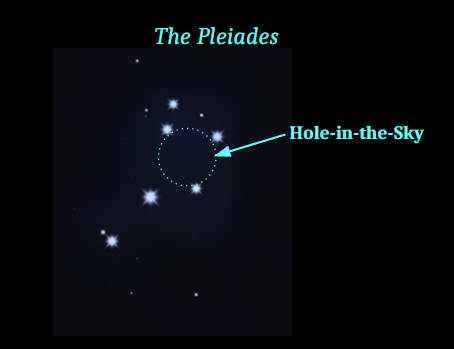
Let’s look at how some other cultures saw the Pleiades, the star cluster that is seen in the eastern sky these evenings. To the Anishinaabe native peoples around here, the Pleiades is the “Hole in the Sky” or the seven stones that are heated for the sweat lodge ceremony. To the Kiowa, these were sisters who were whisked up into the sky from the top of Devil’s Tower in Wyoming, where they were threatened by a huge bear. An Iroquoian legend has seven daughters who danced all day and were drawn into the sky, along with a black bear who danced with them. One daughter heard her mother’s call and fell back down to the Earth. In Norse mythology, these were the goddess Freya’s hens.
The astronomical event times given in this blog are for the Traverse City/Interlochen area of Michigan (Lat 44.7° N, Long 85.7° W; EDT, UT – 4 hours) unless stated otherwise. Times will be different for other locations.
Addendum
Ephemeris: 11/17/2025 – More about the Pleiades
This is Bob Moler with Ephemeris for Monday, November 17th. Today the Sun will be up for 9 hours and 29 minutes, setting at 5:12, and it will rise tomorrow at 7:44. The Moon, 3 days before new, will rise at 6:16 tomorrow morning.
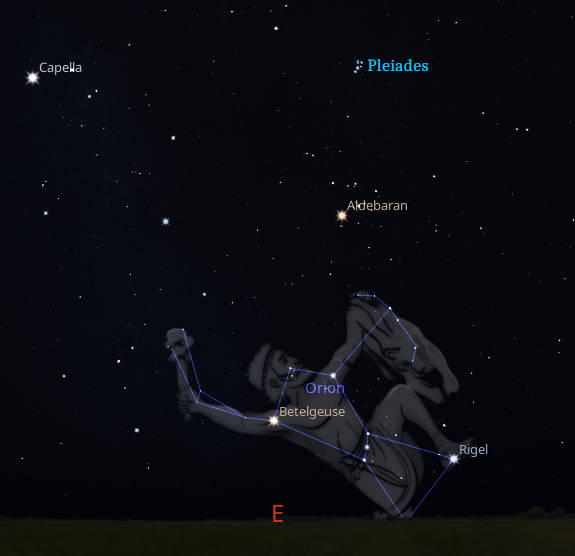
Around 8 in the evening the marvelous small star group called the Pleiades, or Seven Sisters will be in the eastern sky. Most people can see six stars, but they’re called the Seven Sisters, so the story has come up about the Lost Pleiad. It was said that her star was dimmed because she married a mere mortal. In Greek mythology the Pleiades were the daughters of the god Atlas and Pleione. By 9 PM the hunter Orion is rising in the east to chase the Pleiades across the sky until dawn. The word Pleiades is related to the Greek word for sail, and in ancient times the sailing season in the Mediterranean Sea started with the heliacal * rising of the Pleiades at dawn in mid-spring.
The astronomical event times given in this blog are for the Traverse City/Interlochen area of Michigan (Lat 44.7° N, Long 85.7° W; EDT, UT – 4 hours) unless stated otherwise. Times will be different for other locations.
* Heliacal Rising – The first appearance in the morning of a celestial body after disappearing in evening twilight.
Addendum
Ephemeris: 11/14/2025 – The Leonid meteor shower peaks Monday morning
This is Ephemeris for Friday, November 14th. Today the Sun will be up for 9 hours and 36 minutes, setting at 5:15, and it will rise tomorrow at 7:40. The Moon, 2 days past last quarter, will rise at 3:02 tomorrow morning.
This coming Monday morning after midnight we’ll see the peak of the Leonid meteor shower. It is called the Leonids because the meteors appear to come from the head of Leo the lion, which will rise about midnight. This meteor shower is mediocre most years. However, every 33 or so years it can be spectacular with thousands of meteors per hour appearing in the sky for a short time. The meteoroid particles that produce the shower come from the comet 55P/Tempel-Tuttle which comes into the vicinity of the Sun in the inner solar system every approximately 33 years. The next peak year is predicted to be 2031, though it is expected to be not as active as recent peak years.
The astronomical event times given in this blog are for the Traverse City/Interlochen area of Michigan (Lat 44.7° N, Long 85.7° W; EDT, UT – 4 hours) unless stated otherwise. Times will be different for other locations.
Addendum
Ephemeris: 11/13/2025 – Looking at the Pleiades or Seven Sisters
This is Ephemeris for Thursday, November 13th. Today the Sun will be up for 9 hours and 38 minutes, setting at 5:16, and it will rise tomorrow at 7:38. The Moon, 1 day past last quarter, will rise at 1:56 tomorrow morning.
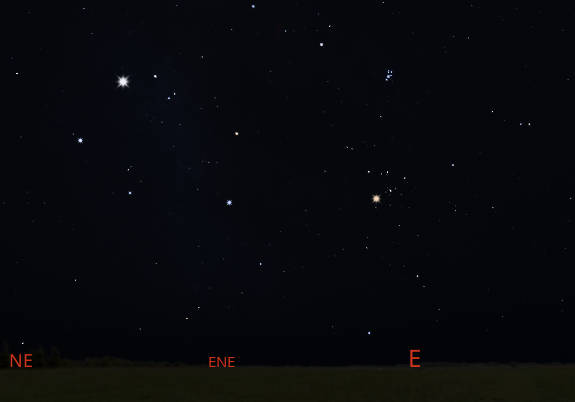
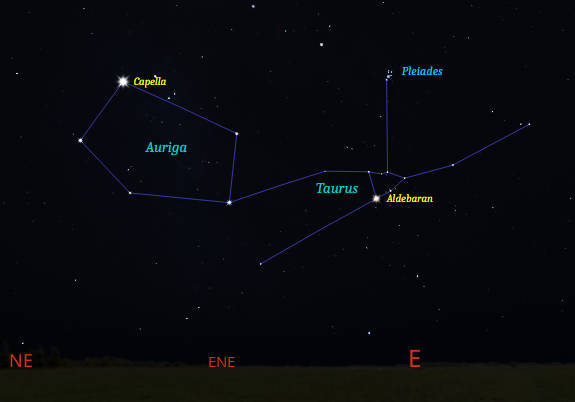
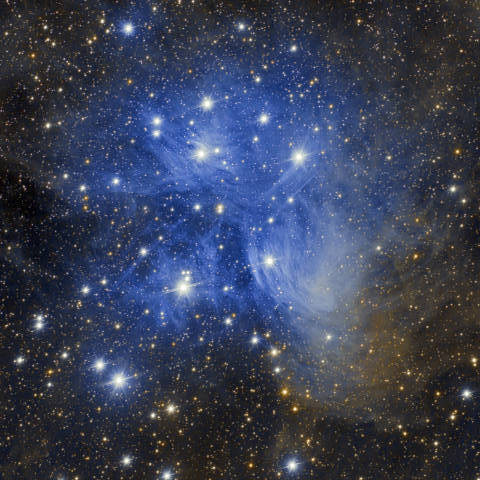
A marvelous member of the autumn skies can be found low in the east around 8 in the evening. It is the famous star cluster called the Pleiades or the Seven Sisters. I might also add the ‘Tiny Dipper’. Many people can spot a tiny dipper shape in its six or seven stars, and mistake it for the Little Dipper. With binoculars, one can see over a hundred stars that appear, along with the dipper shape of the brightest. In photographs, the Pleiades actually illuminate wisps of the dust that surround them. In Greek mythology, the sisters were daughters of the god Atlas and Pleione. The most people can only see is six stars. The reason, according to mythology, is that one of the sisters married a mortal, dimming her star.
The astronomical event times given in this blog are for the Traverse City/Interlochen area of Michigan (Lat 44.7° N, Long 85.7° W; EDT, UT – 4 hours) unless stated otherwise. Times will be different for other locations.
Addendum
Ephemeris: 11/12/2025 – Taking our weekly look at the whereabouts of the naked-eye planets
This is Bob Moler with Ephemeris for Wednesday, November 12th. Today the Sun will be up for 9 hours and 41 minutes, setting at 5:17, and it will rise tomorrow at 7:37. The Moon, at last quarter today, will rise at 12:48 tomorrow morning.
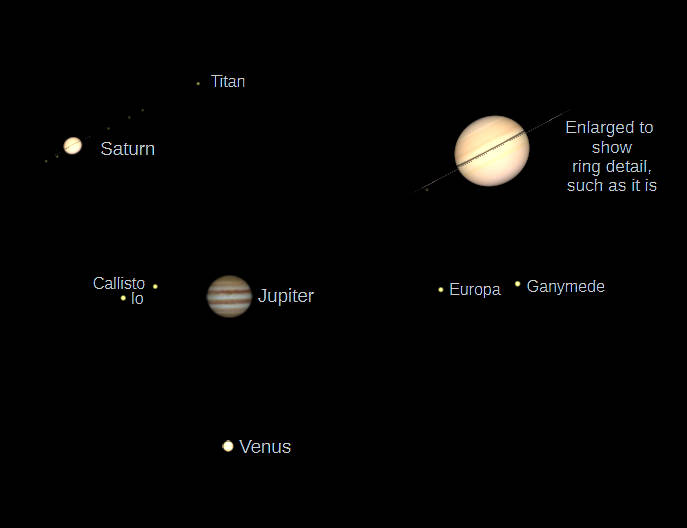
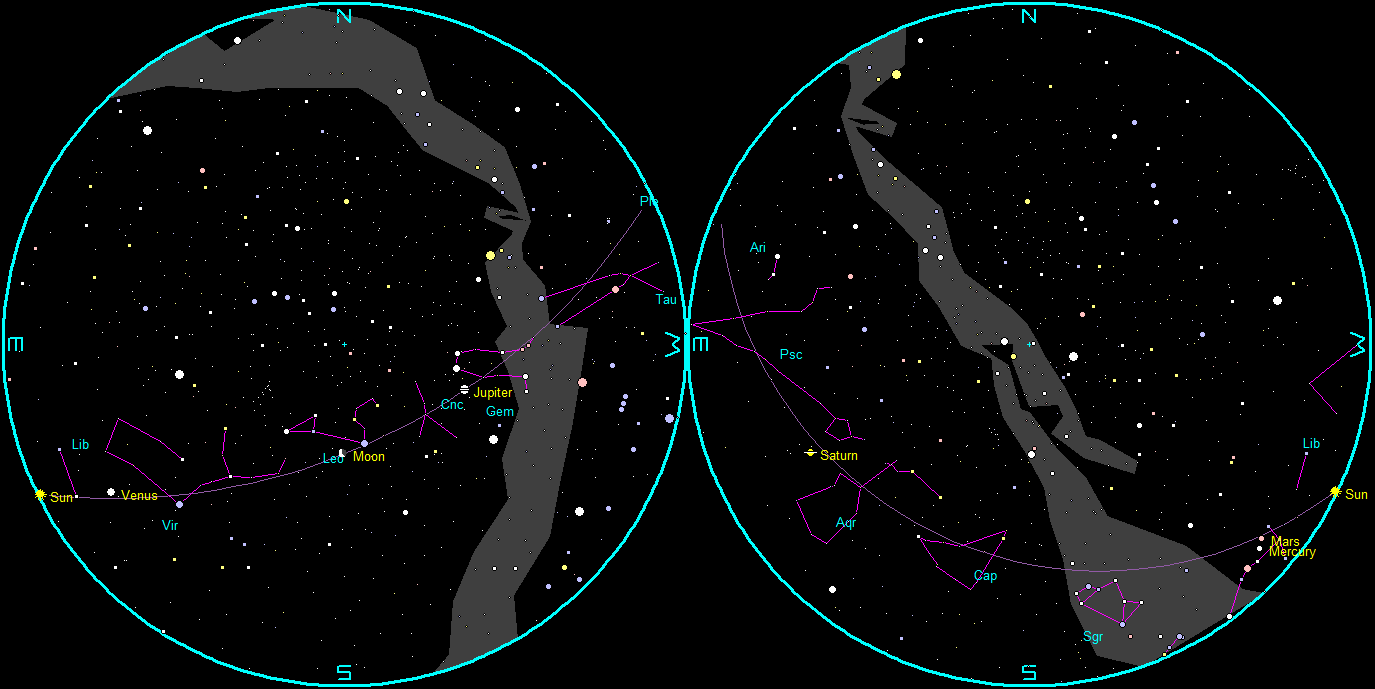
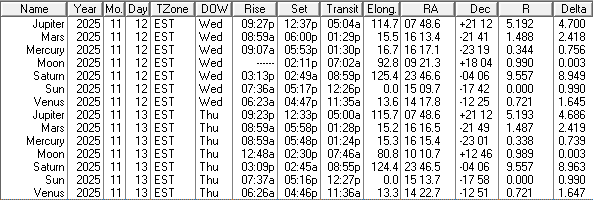
Let’s take our weekly look at the whereabouts of the naked-eye planets. Saturn is the brightest star like object in the east southeastern sky as soon as it gets dark. In a telescope Saturn sports a very thin ring, 4/10ths of a degree from being edge on. Normally, I’d say that Saturn’s rings are easy to see in a telescope. Currently, the rings appear extremely thin and can be difficult to pick up. Jupiter will rise at 9:27 PM in the east-northeast. By 6:30 AM, it will appear high in the southwest, below the stars of Gemini, with Orion and the other bright stars of winter in the southwest. Venus, which will rise at 6:26 AM will be difficult to spot in the morning twilight.
The astronomical event times given in this blog are for the Traverse City/Interlochen area of Michigan (Lat 44.7° N, Long 85.7° W; EDT, UT – 4 hours) unless stated otherwise. Times will be different for other locations.
Addendum
Ephemeris: 11/11/2025 – The difference between a nova and a Type 1a supernova
This is Bob Moler with Ephemeris for Veterans Day, Tuesday, November 11th. Today the Sun will be up for 9 hours and 43 minutes, setting at 5:18, and it will rise tomorrow at 7:36. The Moon, 1 day before last quarter, will rise at 11:37 this evening.
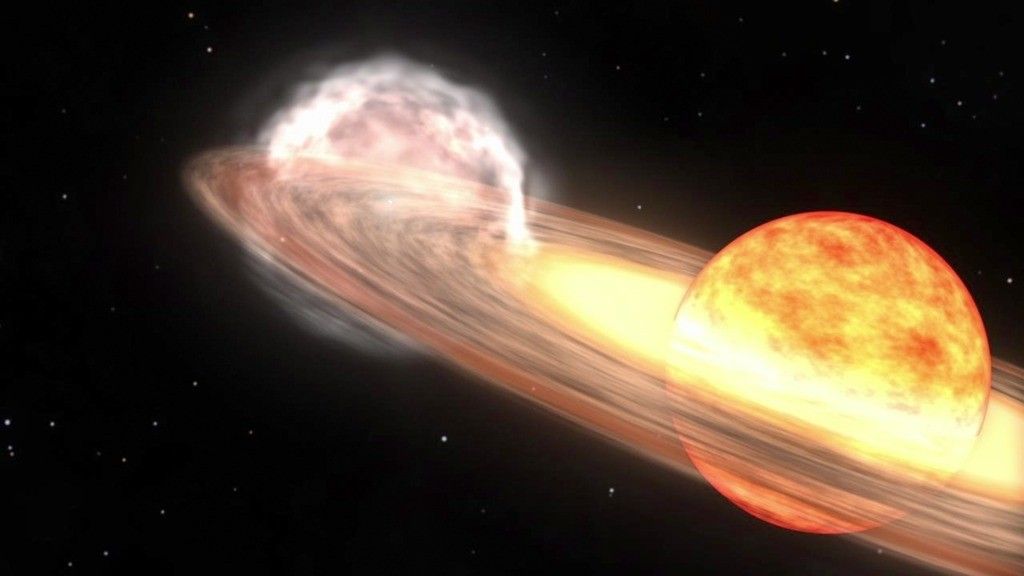
I’ve always wondered what the difference is between a nova like T Coronae Borealis, sometimes called the Blaze Star, and a Type 1a supernova. Both involve a white dwarf star and a larger star and having the mass of the larger star being drawn off onto the surface of the white dwarf until an explosion happens. If the detonation, which is a thermonuclear detonation of the hydrogen drawn off the larger star, is on the surface only, involving the outer layers of the white dwarf, the star becomes thousands of times brighter for a short period of time. The star survives. In the Type 1a supernova, the accretion of the hydrogen onto the white dwarf causes a more massive explosion involving the core of the white dwarf because its mass approaches or will surpass 1.4 times the Sun’s mass. At that point the star explodes.
The astronomical event times given in this blog are for the Traverse City/Interlochen area of Michigan (Lat 44.7° N, Long 85.7° W; EDT, UT – 4 hours) unless stated otherwise. Times will be different for other locations.
Addendum
Ephemeris: 11/10/2025 – Waiting on a stellar explosion
This is Ephemeris for Monday, November 10th. Today the Sun will be up for 9 hours and 46 minutes, setting at 5:19, and it will rise tomorrow at 7:34. The Moon, 2 days before last quarter, will rise at 10:22 this evening.
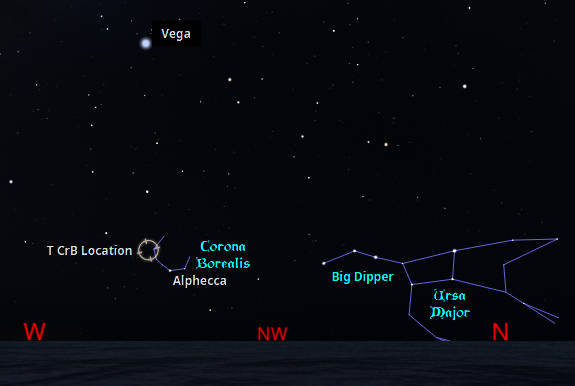
According to one astronomer, that I mentioned last Thursday, today is about the day he expects a star to erupt as a nova in the constellation Corona Borealis, the Northern Crown. In the early evening, it will appear low in the west northwest. The star is designated T Coronae Borealis (T CrB). Its appearance should make the normal news outlets, because it will be the brightest stellar outburst in a very long time. It will appear just left of the constellation Corona Borealis and be about as bright as its brightest normal star. However, it will soon fade and to be less the naked eye brightness in about a week. So we’re hoping for clear skies, if it happens. If it’s not this time, the next predicted time is June 25th, next year. Or he could be wrong, and it could go off at any time. Spaceweather.com has more information.
The astronomical event times given in this blog are for the Traverse City/Interlochen area of Michigan (Lat 44.7° N, Long 85.7° W; EDT, UT – 4 hours) unless stated otherwise. Times will be different for other locations.
Addendum
According to a paper in the Research Notes of the American Astronomical Society, Jean Schneider with the Paris Observatory predicted that the next eruption of T Coronae Borealis would be somewhere around November 10th 2025, or June 25th 2026. The first prediction of the 27th of March earlier this year turned out to not have occurred. These were tentative predictions based on the orbit around each other, of the two stars involved. The period of 80 years between eruptions is an approximation. There is an additional periodicity due to the fact that the two stars involved, a red giant and a white dwarf, have an orbital period of about 228 days which is why the predictions are 228 days apart. There have been four previous eruptions of the star observed. The first was in 1217, the next in 1787, then in 1866 and then finally in 1946. The reason for the big gap between 1217 and 1787 is unknown. Either the star didn’t erupt, or more likely, nobody observed and recorded it. The times of the first two eruptions weren’t accurately reports, but fell within what the 228-day periodicity would explain.
T Coronae Borealis is far enough north in the sky so that it is visible sometime during the night, year round. Currently, it would be best seen at the end of twilight in the west northwest. This will shift over to the morning sky, before morning twilight, after about the 25th of November, only 15 days from now in the east northeast. This star like any other star that rises and sets does so approximately 4 minutes earlier each night, or 28 minutes per week. So after the 25th the best observing opportunity will be before dawn in the morning until much later in the late winter, when it will be available also in the evening sky again.
Ephemeris: 11/07/25 – GTAS meeting tonight, topic is Fighting Light Pollution
This is Ephemeris for Friday, November 7th. Today the Sun will be up for 9 hours and 53 minutes, setting at 5:23, and it will rise tomorrow at 7:30. The Moon, 2 days past full, will rise at 6:43 this evening.
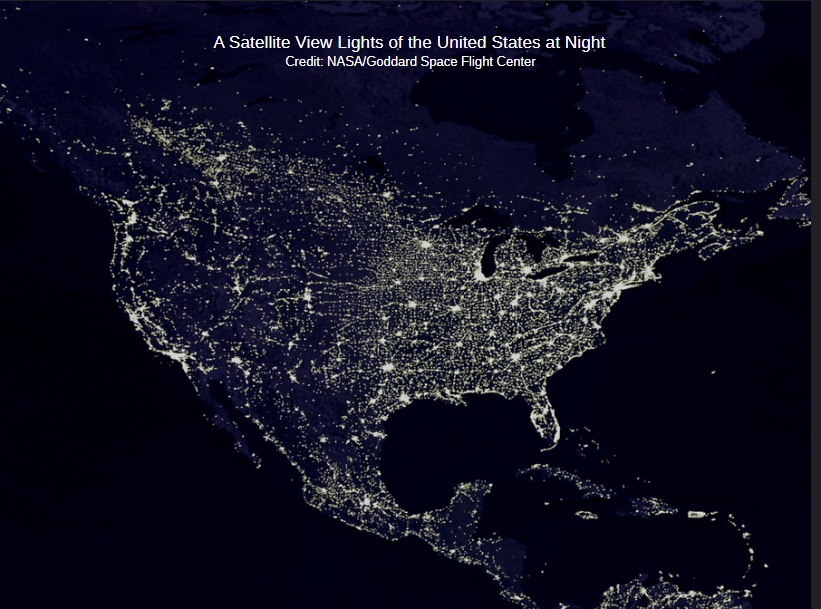
The Grand Traverse Astronomical Society will hold a special meeting and program at 7 PM tonight, a special time, at Northwestern Michigan College’s Rogers Observatory. Dr. Jerry Dobek, astronomy professor at NMC, will present an illustrated talk on Light Pollution. The focus of the talk will be on the general causes and effects of light pollution, as well as examples of proper lighting. Dr. Dobek has helped write lighting ordinances for governments here and around the nation. A star party will start around 8 pm, but only if it’s clear. The observatory is located south of Traverse City, on Birmley Road. The meeting is also available via Zoom. A link can be found on the society’s website, gtastro.org.
The astronomical event times given in this blog are for the Traverse City/Interlochen area of Michigan (Lat 44.7° N, Long 85.7° W; EDT, UT – 4 hours) unless stated otherwise. Times will be different for other locations.
Addendum
 Bob Moler's Ephemeris Blog