Archive
07/27/2015 – Ephemeris – Deneb, the dimmest of the Summer Triangle stars. But is it really?
Ephemeris for Monday, July 27th. The Sun rises at 6:23. It’ll be up for 14 hours and 51 minutes, setting at 9:14. The Moon, 3 days past first quarter, will set at 3:36 tomorrow morning.
This evening when it gets dark the bright star Deneb in Cygnus the swan will be high in the east northeast. Deneb is the dimmest star of the summer triangle. Of the other stars of the triangle, Vega is very high in the east, while Altair is lower in the southeast. While Deneb’s apparent magnitude, or brightness as seen from earth, makes it the dimmest of the three bright stars, Deneb’s vast distance of possibly 2,600 light years makes it over 100 times the distance of Vega. If brought as close as Vega, Deneb would be almost as bright as the full moon. It is as bright as two hundred thousand suns. It apparently has run out of hydrogen in its core. Once a blue super giant star, it’s currently evolving through the white supergiant stage.
Times are for the Traverse City/Interlochen area of Michigan. They may be different for your location.
Addendum
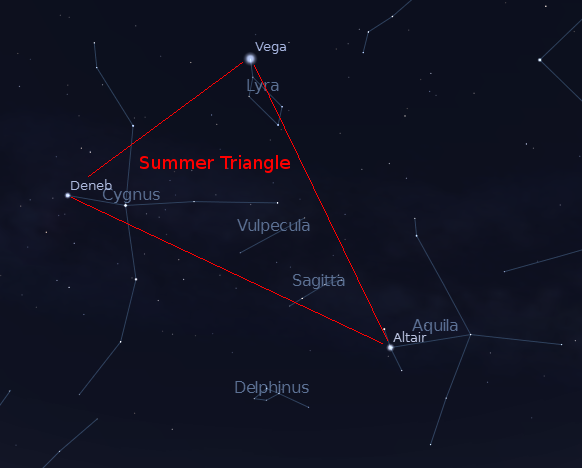
The Summer Triangle. Created using Stellarium and The Gimp.
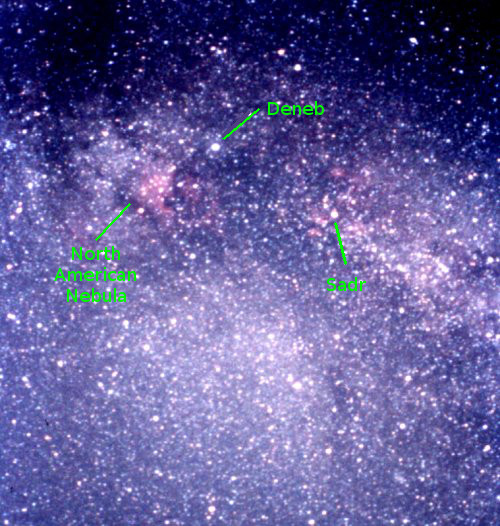
One of my old photographs of Deneb and the North American Nebula digitized from a slide.
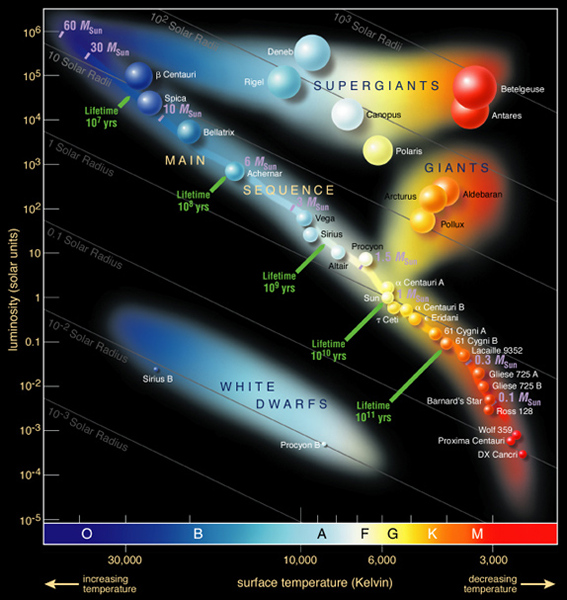
The Hertzsprung-Russell diagram of star luminosity vs. surface temperature. Note that Deneb is at the top center, while the Sun is lower on the main sequence. Credit: European Southern Observatory (ESO).
07/21/2015 – Ephemeris – Vega, the brightest star of the Summer Triangle
Ephemeris for Tuesday, July 21st. Today the Sun will be up for 15 hours and 3 minutes, setting at 9:20. The Moon, 3 days before first quarter, will set at 12:01 tomorrow morning. Tomorrow the Sun will rise at 6:17.
The bright star high in the east is Vega, one of the stars of the Summer Triangle an informal constellation called an asterism. Vega belongs to the official constellation Lyra the harp, which includes a narrow parallelogram of stars to its south. Vega was regarded by astronomers as a standard calibration star. Though a first magnitude star, its actual magnitude is 0.03 and slightly variable. It is a type A0 (A-zero) pure white star, and is 25 light years away. Astronomers however got a shock in 1983 when calibrating the Infrared Astronomy Satellite (IRAS) on it: Vega showed an excess of Infrared radiation that means the star is orbited by a disk of dust, perhaps the beginnings of a planetary system. Due to the slow wobble of the earth’s axis Vega will be our pole star in 14 thousand years.
Times are for the Traverse City/Interlochen area of Michigan. They may be different for your location.
Addendum
The Summer Triangle. Created using Stellarium and The Gimp.
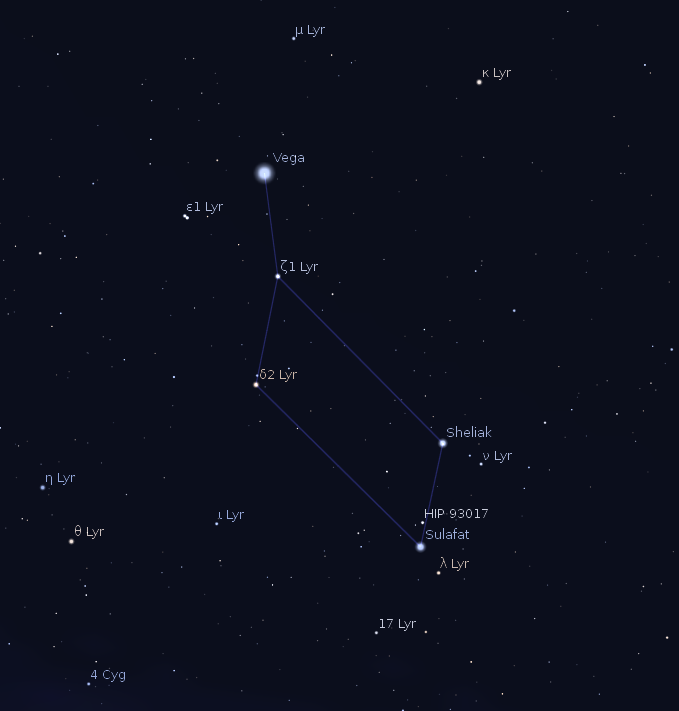
Magnified view of Lyra. Created using Stellarium.
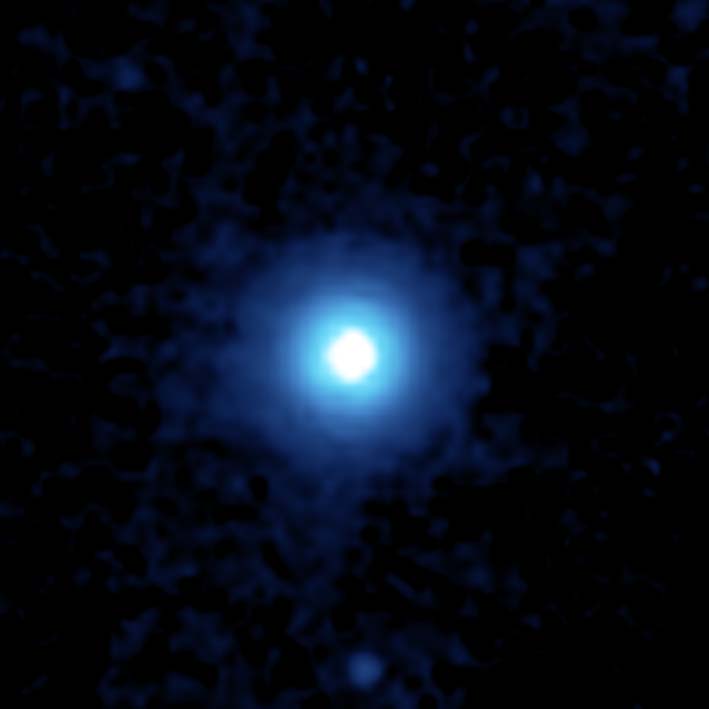
Vega in the mid-infrared from the Spitzer Infrared Satellite. Credit: NASA/JPL-Caltech/University of Arizona
07/16/2015 – Ephemeris – The Summer Triangle is the sign of the season
Ephemeris for Thursday, July 16th. Today the Sun will be up for 15 hours and 12 minutes, setting at 9:25. The Moon, 1 day past new, will set at 9:32 this evening, and tomorrow the Sun will rise at 6:13.
We’re almost a month into summer, and the asterism or informal constellation called the Summer Triangle can be seen midway up the sky in the east as it gets dark. Highest of the three bright stars is Vega in the constellation Lyra the harp, whose body is seen in a narrow parallelogram nearby. The second star of the triangle is Deneb lower and left of Vega, It appears dimmer than Vega because it is by far the most distant of the three. The third star of the Summer Triangle is seen farther below and a right of Vega. It is Altair in Aquila the eagle, and the closest. Altair is 16.5 light years away, Vega is 27 light years while Deneb is so far away that it’s distance is in some doubt and may be 2,600 light years away.
Times are for the Traverse City/Interlochen area of Michigan. They may be different for your location.
Addendum
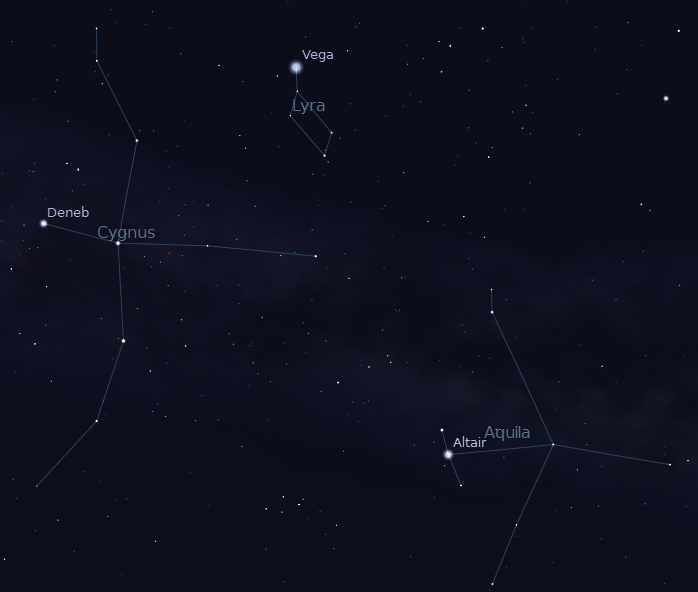
Summer Triangle. Created using Stellarium.
03/24/2015 – Ephemeris – The Moon will be passing in front of the Hyades tonight
Ephemeris for Tuesday, March 24th. The Sun will rise at 7:38. It’ll be up for 12 hours and 21 minutes, setting at 8:00. The Moon, 3 days before first quarter, will set at 1:16 tomorrow morning.
Tonight he Moon will be crossing in front of the Hyades star cluster, otherwise known as the face of the constellation Taurus the bull. The Moon will make it about half way across by the time it sets. The Moon is 2160 miles in diameter and moves about the same distance in an hour as it orbits the Earth. The International Space Station and other satellites in low Earth orbit have to travel 17,500 miles an hour to stay in orbit. But since the Earth’s gravity, or the gravitational force of any body diminishes with the square of the distance. Double the distance and the gravitational force diminishes by a factor of four. This inverse square law as it is known also works with the diminution of light with distance from its source.
Times are for the Traverse City/Interlochen area of Michigan. They may be different for your location.
Addendum
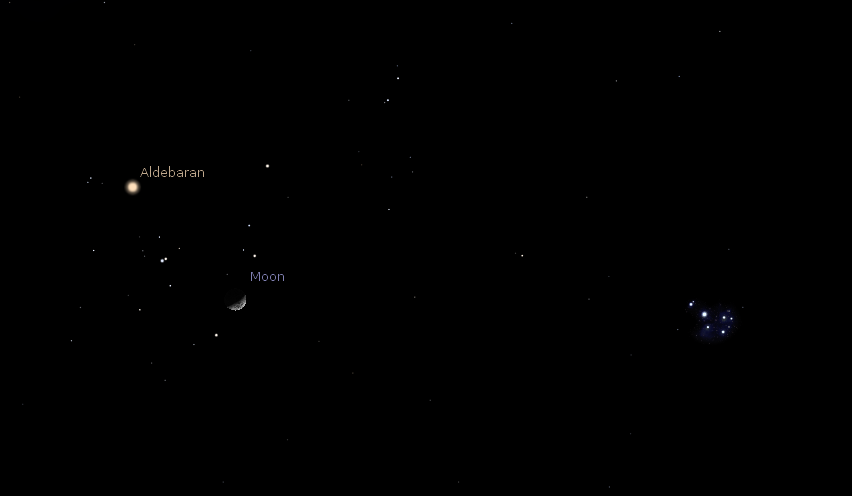
The Moon is travelling in front of the Hyades at 10 p.m. March 24, 2015. Created using Stellarium.
03/09/2015 – Ephemeris – The Big Dipper, a sign of spring
Ephemeris for Monday, March 9th. The Sun will rise at 8:06. It’ll be up for 11 hours and 34 minutes, setting at 7:40. The Moon, 4 days before last quarter, will rise at 11:43 this evening.
There’s a sign of spring appearing in the sky, rising high in the northeast. It’s the Big Dipper standing on its handle. In the native story of the Fisher Star, it’s the sign that it’s time for the maple sugar season. The Big Dipper is part of Ursa Major the great bear or a weasel-like creature called Fisher or Fisher Star. Draw a line through the bottom of the bowl of the dipper as if it leaks, and it will drip on the back of Leo the lion in the southeast. The handle of the Big Dipper will arc to Arcturus after 10 p.m. when that star rises. The most important guide that the Big Dipper provides is to point to Polaris, the north star. The two stars at the front of the bowl of the dipper point to Polaris, that alone of all the stars appears fixed in the north.
Times are for the Traverse City/Interlochen area of Michigan. They may be different for your location.
Addendum
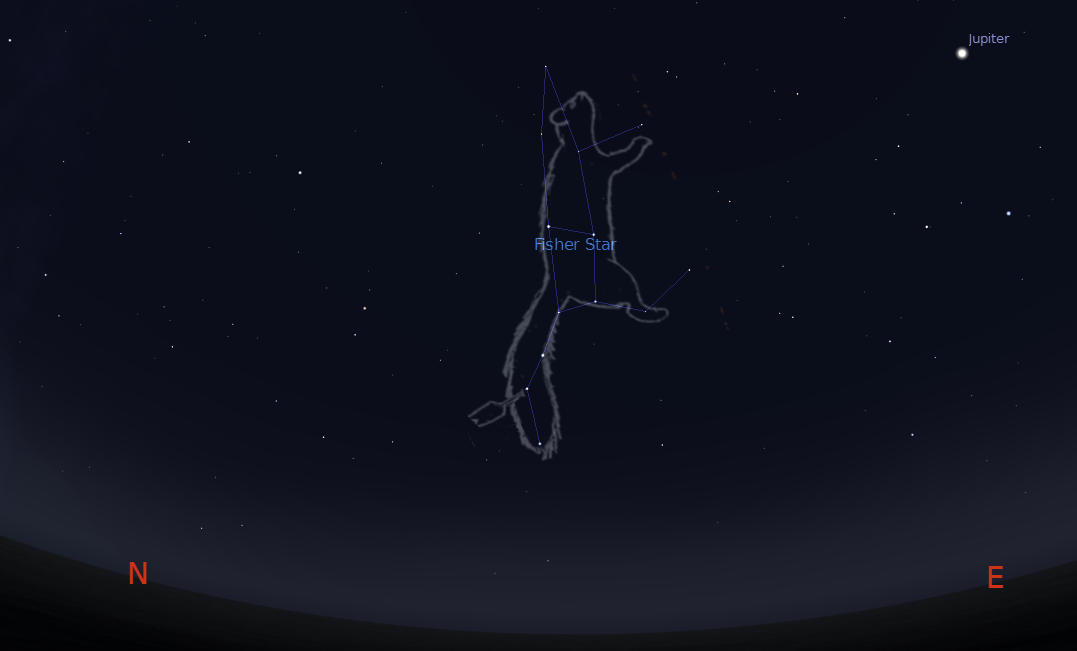
The Big Dipper, part of Ursa Major and also part of Fisher Star in the northeastern sky at 9 p.m. March 9, 2015
For the story of Fisher Star follow this link.
02/16/2015 – Ephemeris – The Winter Circle
Feb 16. This is Bob Moler with Ephemeris for President’s Day, Monday, February 16th. The sun will rise at 7:42. It’ll be up for 10 hours and 30 minutes, setting at 6:12. The moon, 2 days before new, will rise at 6:25 tomorrow morning.
The winter skies are blessed with more first magnitude stars than any other season. That’s a full one-third of the total are seen is a relatively small area. Six of these stars lie in a large circle centered on the seventh. This circle is up at 9 p.m. Starting high overhead is Capella in Auriga the charioteer. Moving down clockwise is Aldebaran in the face of Taurus the Bull. Then down to Orion’s knee we find Rigel. Down and left is the brightest star of all Sirius the Dog Star in Canis Major, lowest of these stars in the south-southeast. Moving up and left is Procyon in Canis Minor, Above Procyon is Pollux in Gemini the twins. All these are centered on Betelgeuse the bright red star in Orion’s shoulder.
Times are for the Traverse City/Interlochen area of Michigan. They may be different for your location.
Addendum
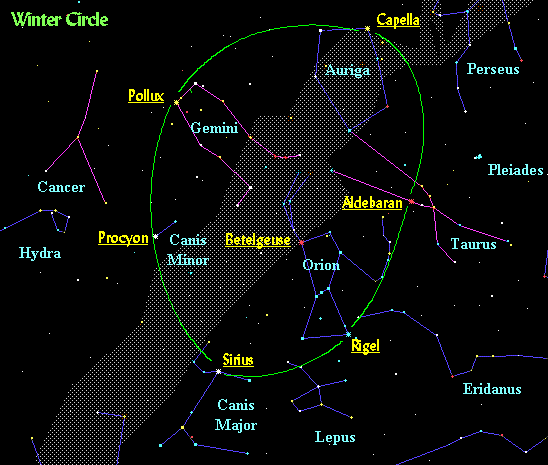
The Winter Circle of 1st magnitude stars
12/18/2014 – Ephemeris – Capella’s kids
Ephemeris for Thursday, December 18th. The sun will rise at 8:14. It’ll be up for 8 hours and 49 minutes, setting at 5:03. The moon, 3 days before new, will rise at 5:23 tomorrow morning.
Tuesday I talked about the bright star Capella in the constellation Auriga the charioteer, the brightest star in the eastern sky until Jupiter rises around 9:30. I mentioned a slim triangle of stars called the Kids, offspring of the mama goat Capella. The star at the tip of that slim triangle is designated by the Greek letter epsilon and so in known as Epsilon Aurigae. It was discovered to be variable in brightness in 1821. It turns out to be an eclipsing binary, where stars eclipse each other. Only the period between eclipses is 27 years, and the eclipses last about 2 years. Typical eclipsing binary stars have periods of days and the eclipses last hours. The eclipsing star has a large debris ring around it that’s also eclipsing the other star.
Times are for the Traverse City/Interlochen area of Michigan. They may be different for your location.
Addendum
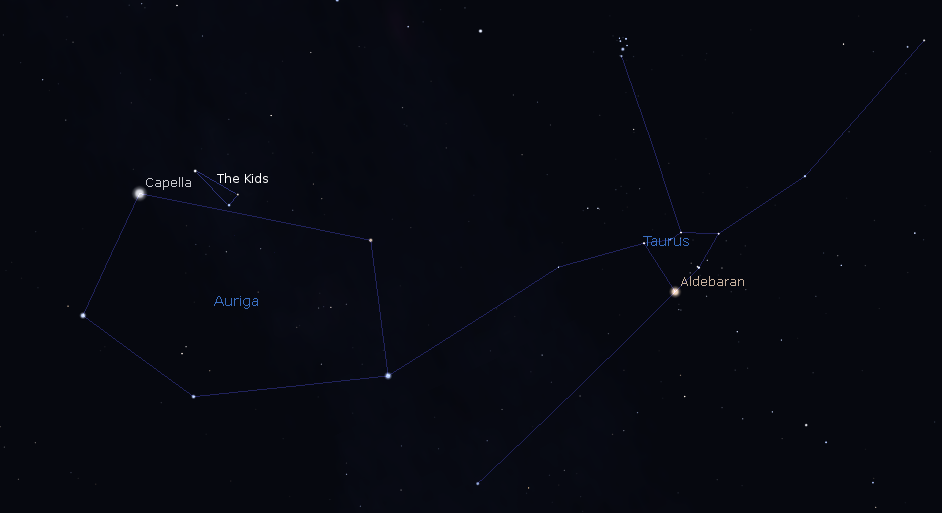
Capella and her kids. at 9 p.m. December 18, 2014. Created using Stellarium.
11/24/2014 – Ephemeris – The Summer Triangle is still with us
Ephemeris for Monday, November 24th. The sun will rise at 7:50. It’ll be up for 9 hours and 16 minutes, setting at 5:07. The moon, 2 days past new, will set at 7:29 this evening.
Well it’s almost Thanksgiving and about time that the Summer Triangle of bright summer stars finally set. Except it won’t go just yet. The stars Vega, Altair and Deneb are still hanging around in the west. The bright summer part of the Milky Way is gone. The constellations the three stars are in are Altair in Aquila the Eagle, now flying vertically up, Deneb in Cygnus the swan flying vertically down, and Vega in Lyre the harp, lying on its side. Altair the southernmost of these three will set first, later Vega will also set. What happens to Deneb depends on your location in the Interlochen Public Radio area. It you are north of Traverse City, Deneb will not actually set over Lake Michigan’s northern horizon.
Times are for the Traverse City/Interlochen area of Michigan. They may be different for your location.
Addendum
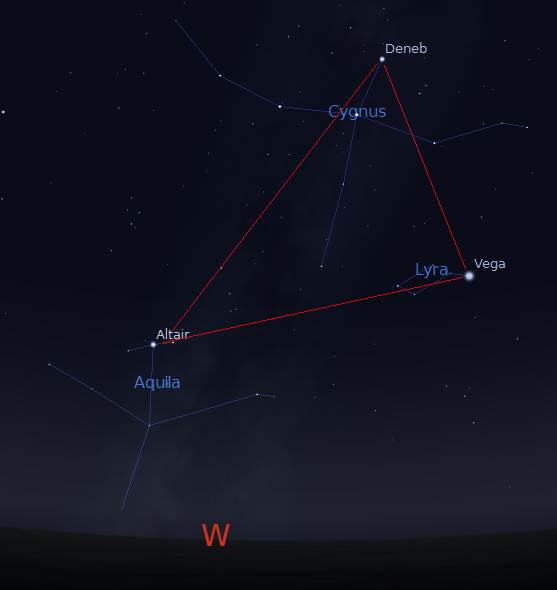
The Summer Triangle at 9 p.m. on November 24, 2014. Created using Stellarium.
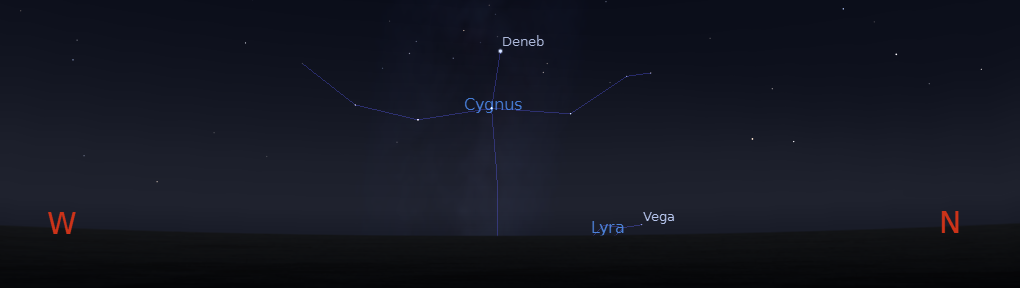
Vega near its setting point at 11:07 p.m. p.m. on November 24, 2014. Created using Stellarium.
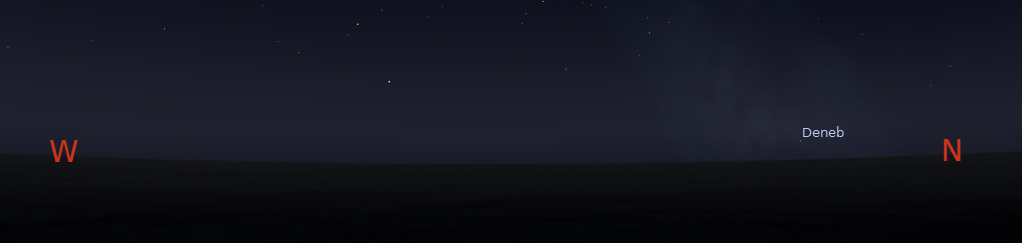
Deneb near its setting point at 5:05 a.m. p.m. on November 25, 2014. Created using Stellarium.
But will Deneb really set for Traverse City. Geometrically it will. However with a flat northern horizon looking northward over the bays to a clean Lake Michigan horizon, atmospheric refraction will bend the light from Deneb making it appear higher in the sky than it really is, so it won’t actually set. On the other side atmospheric extinction, the dimming of stars close to the horizon due to the filtering effect of looking through so much atmosphere would make Deneb impossible to see without a telescope. It might be an interesting challenge to spot.
10/27/2014 – Ephemeris – The Pleiades in Greek and Native American mythology
Ephemeris for Monday, October 27th. The sun will rise at 8:13. It’ll be up for 10 hours and 25 minutes, setting at 6:38. The moon, 3 days before first quarter, will set at 9:38 this evening.
Visible low in the east at 10 in the evening sky can be spotted a small group of stars. It’s called the Pleiades or Seven Sisters. The Pleiades are really spectacular when seen in binoculars. It is remarkable that both the Greeks and the American Plains Indians saw this group as female stars fleeing from danger. In the former case they were fleeing the constellation Orion the giant hunter of the winter sky who will soon rise over the eastern horizon, and in the latter case a giant bear. Legend has it that the maidens fled to the top of Devils Tower in Wyoming. It’s said that the claw marks of this bear are seen in the walls of the tower. The maidens were then spirited from the top of the tower to the heavens, where we see them today. Whichever story you like the Pleiades is worth searching for.
Times are for the Traverse City/Interlochen area of Michigan. They may be different for your location.
Addendum
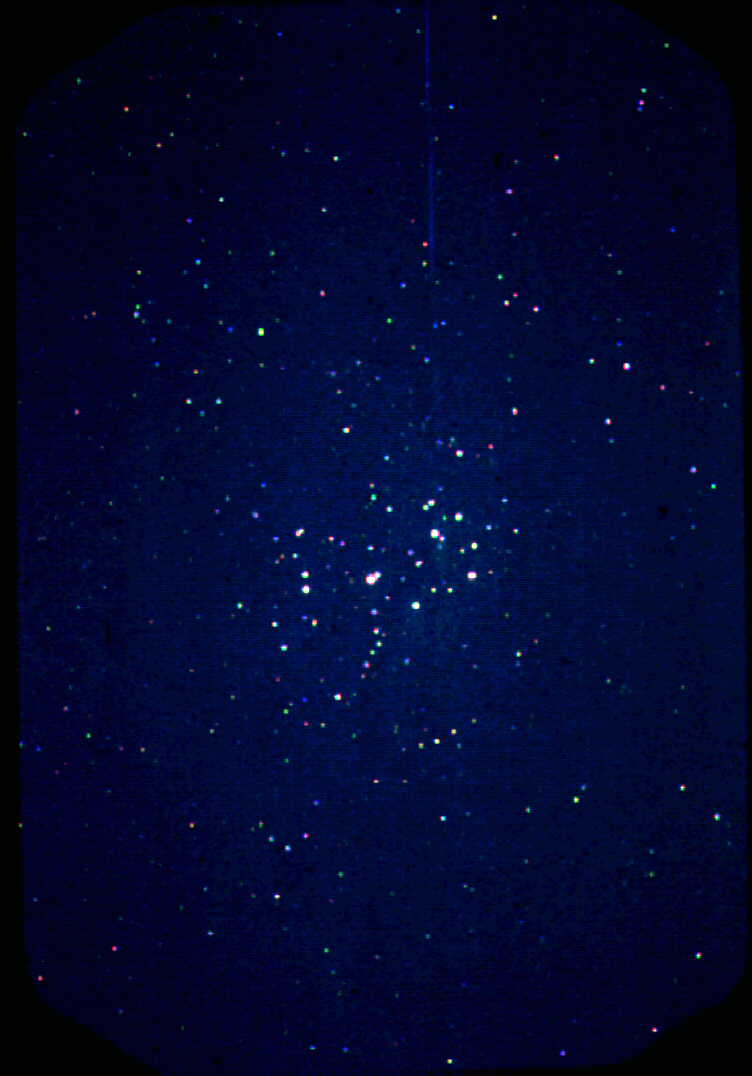
The Pleiades, about what you’d see in binoculars.
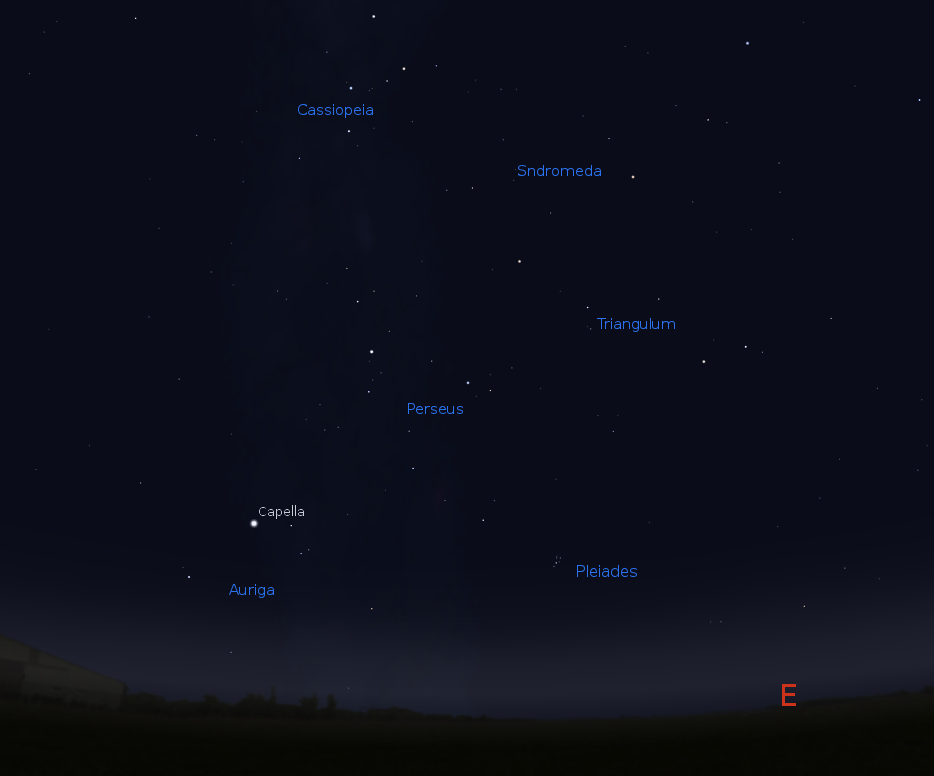
Looking to the east northeast at the Pleiades: 9 p.m. on October 27th. Created using Stellarium,
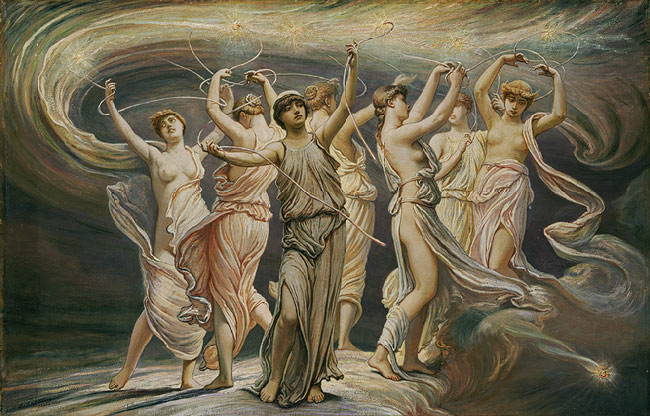
The Greek Pleiades a painting by Elihu Vedder in the Metropolitan Museum of Art, New York City. Public Domain.

Legend of Devils Tower Credit: Indian Country Today Media Network
This is the illustration from http://indiancountrytodaymedianetwork.com/article/the-legend-of-devils-tower-3273
06/23/2014 – Ephemeris – It’s summer, so where is the Summer Triangle?
Ephemeris for Monday, June 23rd. Today the sun will be up for 15 hours and 33 minutes, setting at 9:31. The moon, half way from last quarter to new, will rise at 4:09 tomorrow morning. Tomorrow the sun will rise at 5:58.
Now that it’s summer it’s time to look for the Summer Triangle in the sky. It’s seen rising in the east as it gets dark. Highest of the three bright stars is Vega in the constellation Lyra the harp, whose body is seen in a narrow parallelogram nearby. The second star of the triangle is Deneb lower and left of Vega, It appears dimmer than Vega because it is by far the most distant of the three. The third star of the Summer Triangle is seen farther below and a right of Vega. It is Altair in Aquila the eagle, and the closest. Altair is 16.5 light years away, Vega is 27 light years while Deneb actually one of the brighter stars known, is a whopping 2600 light years away, give or take. It’s distance is not well-known. (24 08:54 Venus 1.3°N of Moon)
Times are for the Traverse City/Interlochen area of Michigan. They may be different for your location.
Addendum
The Summer Triangle. Created using Stellarium and The Gimp.
 Bob Moler's Ephemeris Blog