Archive
09/18/2015 – Ephemeris – Saturn and the Moon together tonight and tomorrow a big day for the GTAS – It starts with the Leland Heritage Celebration
Ephemeris for Friday, September 18th. The Sun will rise at 7:24. It’ll be up for 12 hours and 23 minutes, setting at 7:48. The Moon, 3 days before first quarter, will set at 10:40 this evening.
Tonight the planet Saturn will appear left of and a bit below the crescent Moon. Saturn will be visible in the evening sky for 2 and a half more months with about a month where it’s high enough to see clearly in telescopes. There are two local astronomical events tomorrow. Tomorrow the Leland Heritage Celebration will take place from 11 a.m. to 4 p.m. at Fish Town in Leland. The Grand Traverse Astronomical Society will be there to show the Sun through member’s telescopes and give out NASA items for the kids. Then a few hours later the crew will be on Front Street in Traverse City for the International Observe the Moon Night starting at 7 p.m. Both events are weather dependent. Rain will affect the Leland event and clouds the evening one.
Times are for the Traverse City/Interlochen area of Michigan. They may be different for your location.
Addendum
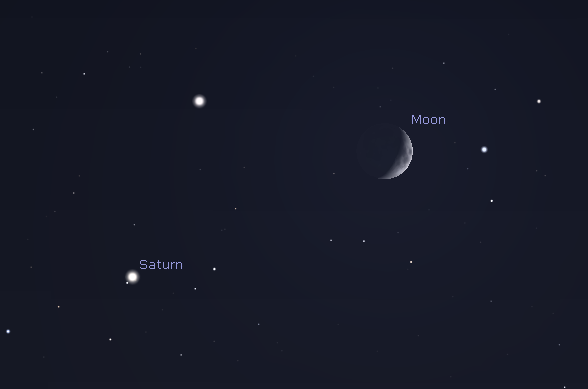
Saturn and the Moon at 9 p.m. September 18 from Northern Michigan. Created using Stellarium.
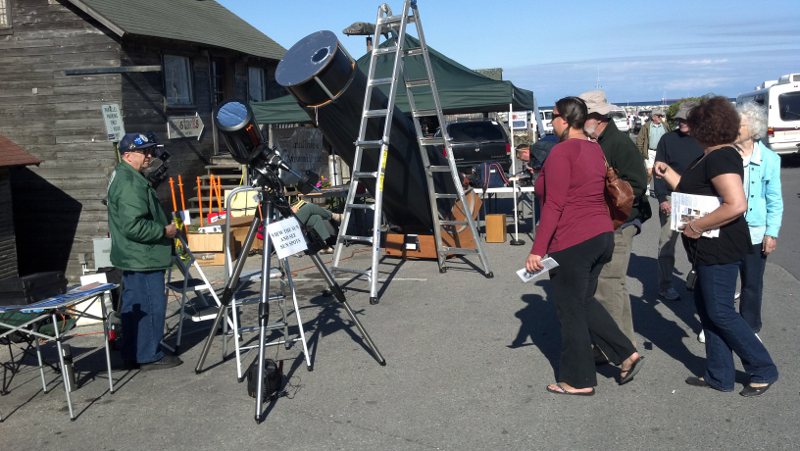
GTAS telescopes at Leland Heritage Celebration in 2011.
07/17/2015 – Ephemeris – The constellation of the harp now and Venus and the Moon tomorrow night.
Ephemeris for Friday, July 17th. Today the Sun will be up for 15 hours and 11 minutes, setting at 9:24. The Moon, 2 days past new, will set at 10:07 this evening, and tomorrow the Sun will rise at 6:14.
High in the east at 11 p.m. can be found a bright star just above a small, narrow, but very distinctive parallelogram of stars. They are the stars of the constellation Lyra the harp. The bright star is Vega, one of the twenty one brightest stars, called first magnitude stars. Vega is actually the 5th brightest night time star. The harp, according to Greek mythology, was invented by the god Hermes. The form of the harp in the sky, is as he had invented it: by stretching strings across a tortoise-shell. Hermes gave it to his half-brother Apollo, who in turn gave it to the great musician Orpheus.
Looking westward tomorrow night the planet Venus will appear about 2 moon widths above the crescent Moon.
Times are for the Traverse City/Interlochen area of Michigan. They may be different for your location.
Addendum
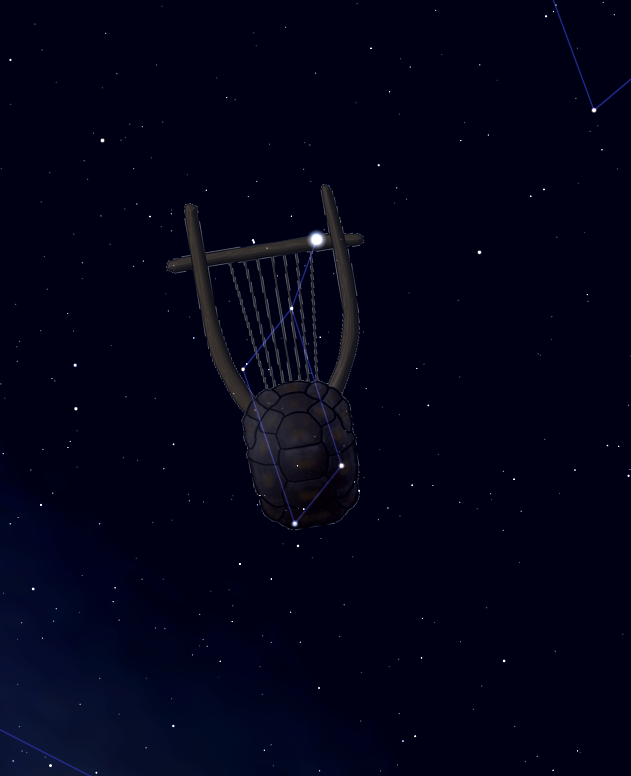
Lyra as a tortoise-shell harp. Created using Stellarium and free clip art.
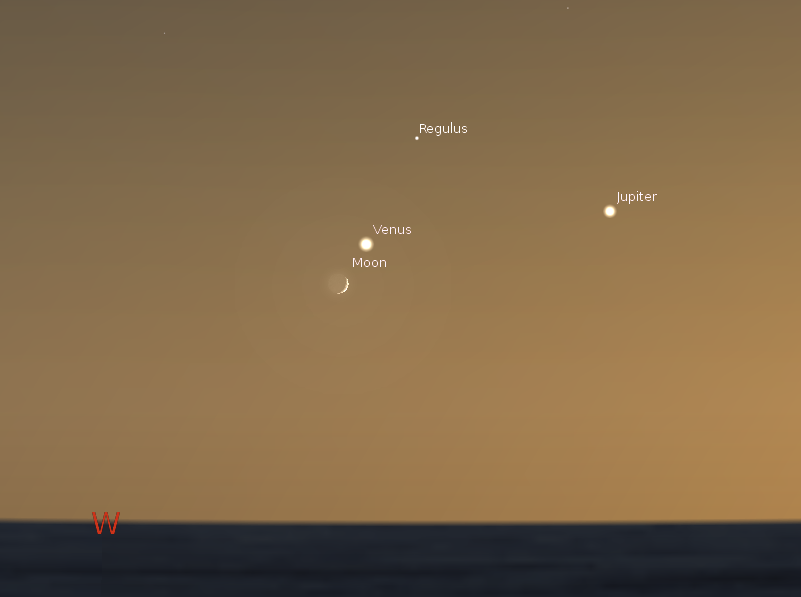
Venus appears above the thin crescent moon with Jupiter to the right at 10 p.m. Saturday July 18, 2015. Created using Stellarium.
06/30/2015 – Ephemeris – Tonight’s close conjunction of Jupiter and Venus will be visible in the west after sunset
Ephemeris for Tuesday, June 30th. Today the Sun will be up for 15 hours and 31 minutes, setting at 9:32. The Moon, 1 day before full, will set at 5:49 tomorrow morning and tomorrow the Sun will rise at 6:00.
Tonight the planets Venus and Jupiter will appear at their closest in the western sky after sunset. Dimmer Jupiter will appear just above Venus by 20 minutes of arc or two-thirds of the width of the Moon. They can both be seen in the same telescope field using low power. It’s interesting that Jupiter, is over 11 times the diameter of Venus, but because Venus is so much closer to us, it now appears to be the same size as Jupiter, and it will continue to grow. It’s 48 million miles away and closing to 27 million on August 15th when it passes between the Earth and the Sun. Astrologers think a conjunction like this means something, while astronomers like me see two bright planets which happen to be beautifully aligned along our line of sight.
Times are for the Traverse City/Interlochen area of Michigan. They may be different for your location.
Addendum
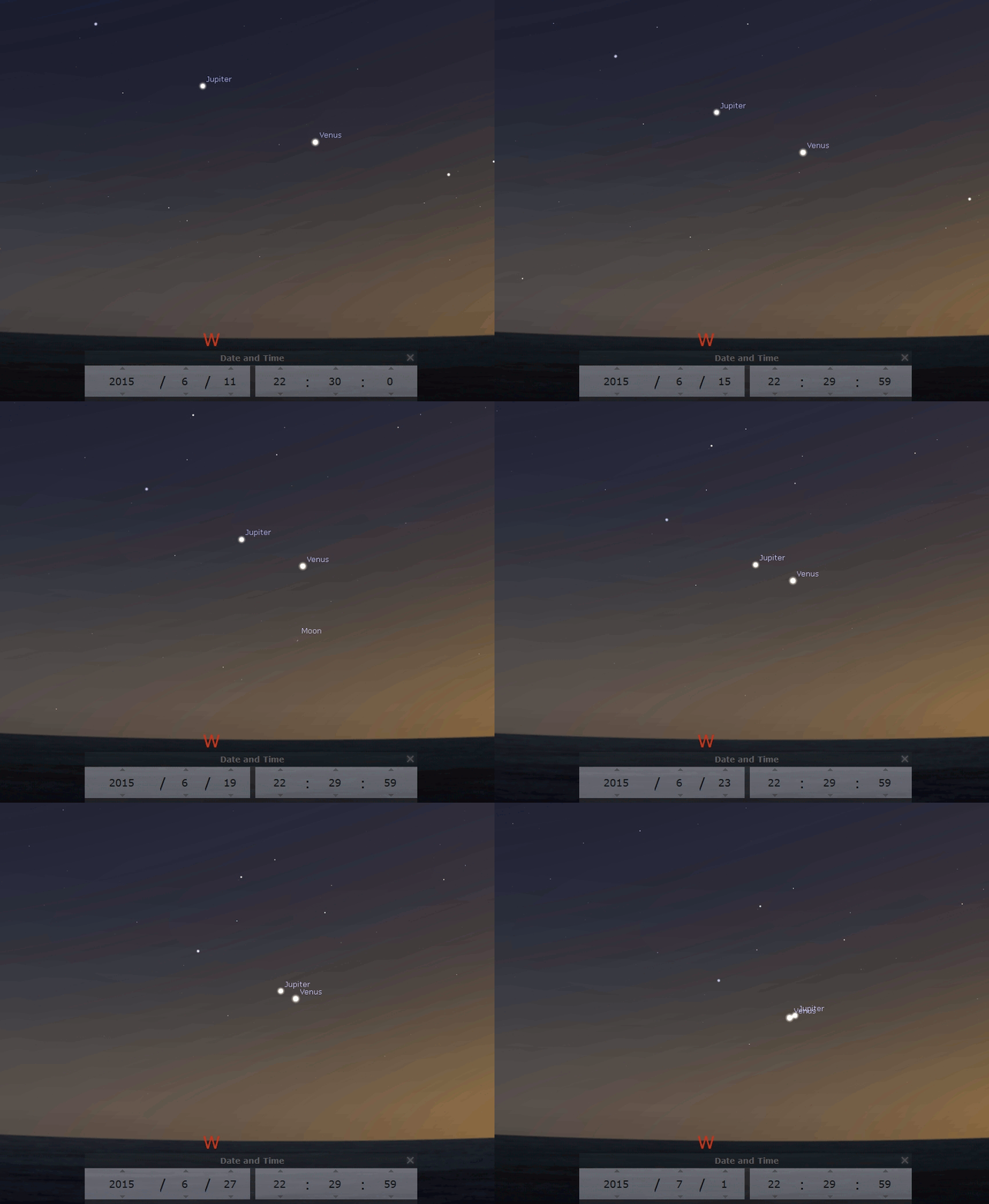
Jupiter-Venus approach animation June 11 to July 1, 2015 at 10:30 p.m. Created using Stellarium and GIMP. Click on image to enlarge.
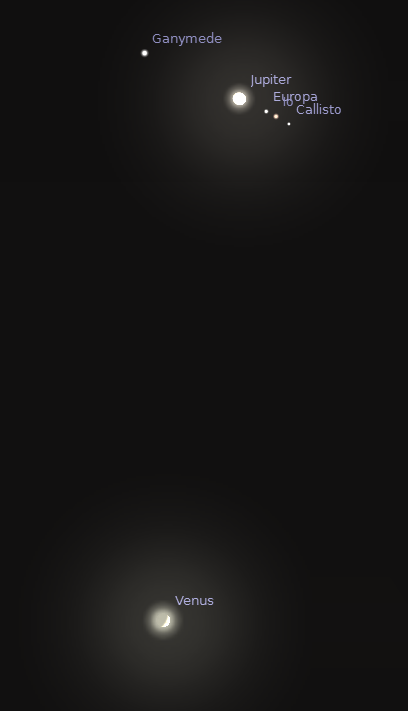
A telescopic view of what we expect the positions of Jupiter and Venus at 10:30 p.m. EDT June 30, 2015 (2:20 UT July 1, 2015). Created using Stellarium.
06/29/2015 – Ephemeris – Did tomorrow’s conjunction between Venus and Jupiter happen before?
Ephemeris for Monday, June 29th. Today the Sun will be up for 15 hours and 32 minutes, setting at 9:32. The Moon, 2 days before full, will set at 4:56 tomorrow morning and tomorrow the Sun will rise at 6:00.
Tonight the planet Jupiter will be a bit more than the width of the Moon away from Venus. Tomorrow that distance will be cut in half as Jupiter will pass directly above Venus. This is a second of two conjunctions that are a near repeat of two conjunctions that some, including myself have speculated as being what the Magi reported as the Star of Bethlehem in 3 and 2 BC. On August 12th 3 BC in the predawn sky Jupiter and Venus were a third of a moon width apart, Then on June 17th 2 BC they were in conjunction again but even closer . Last year we had a close conjunction of the two on August, 18th and the two will be in conjunction, and again tomorrow. Neither are as close as they were in 3 and 2 BC.
Times are for the Traverse City/Interlochen area of Michigan. They may be different for your location.
Addendum
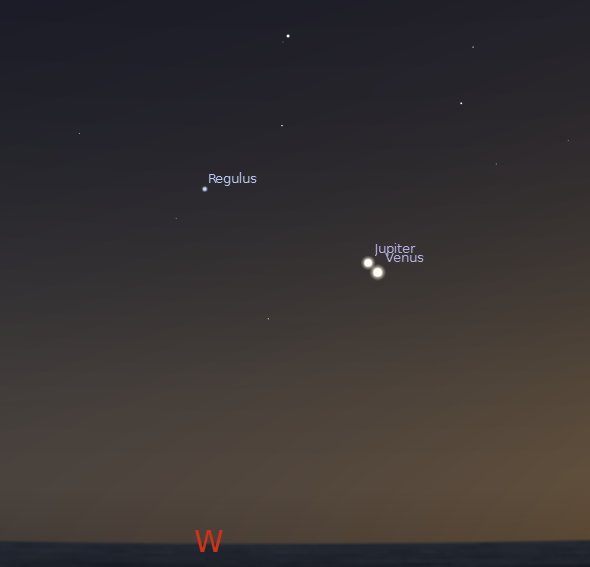
Jupiter and Venus at 10:30 tonight June 29, 2015, one day before their conjunction. Created using Stellarium.
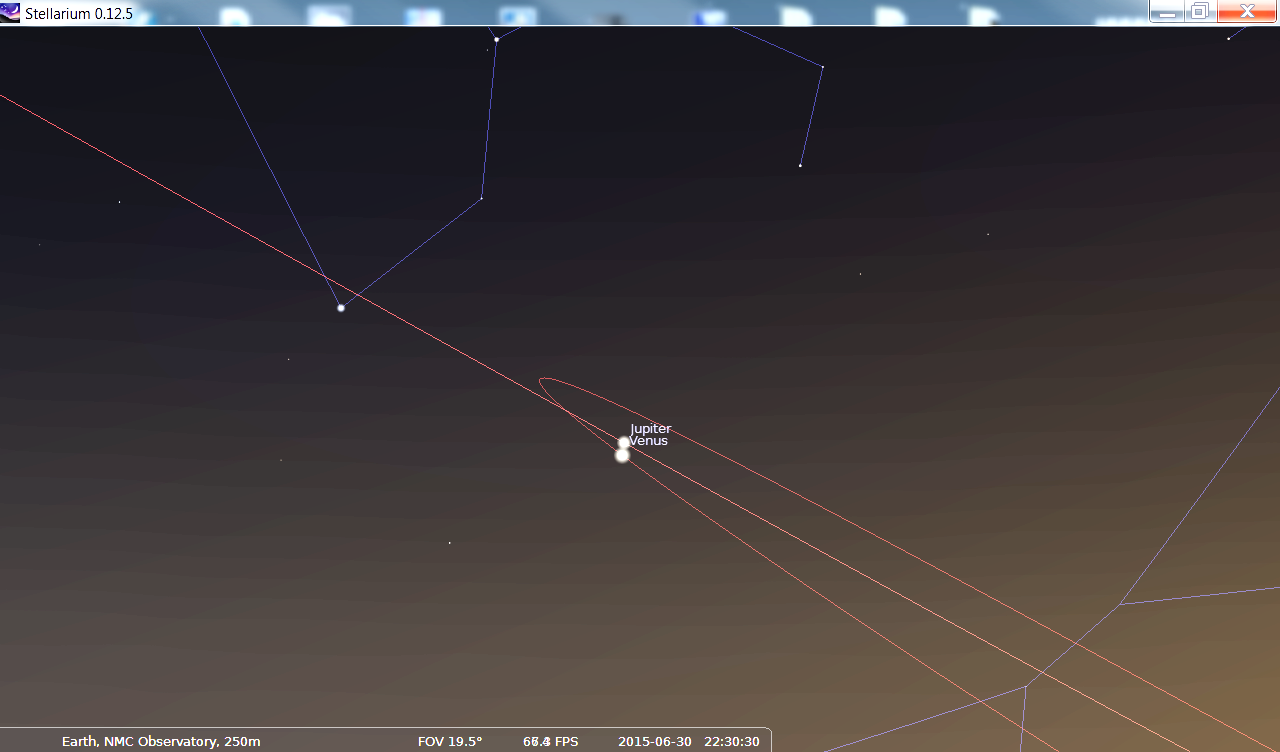
The orbits of Venus and Jupiter for the conjunction of June 30, 2015. The bright star to the upper left is Regulus. Created using Stellarium.
A telescopic view of what we expect the positions of Jupiter and Venus at 10:30 p.m. EDT June 30, 2015 (2:20 UT July 1, 2015). Created using Stellarium.
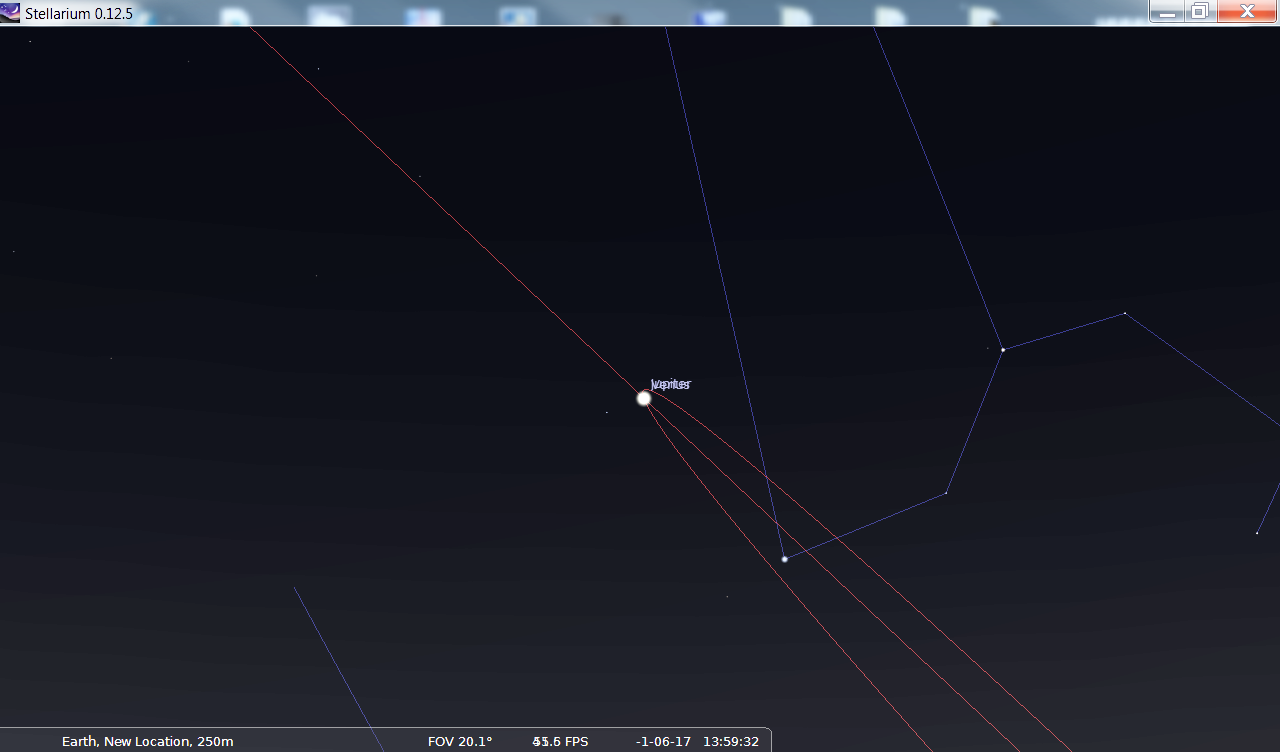
The orbits of Venus and Jupiter for the conjunction of June 17, 2 BC. The bright star to the lower right is Regulus. Created using Stellarium.
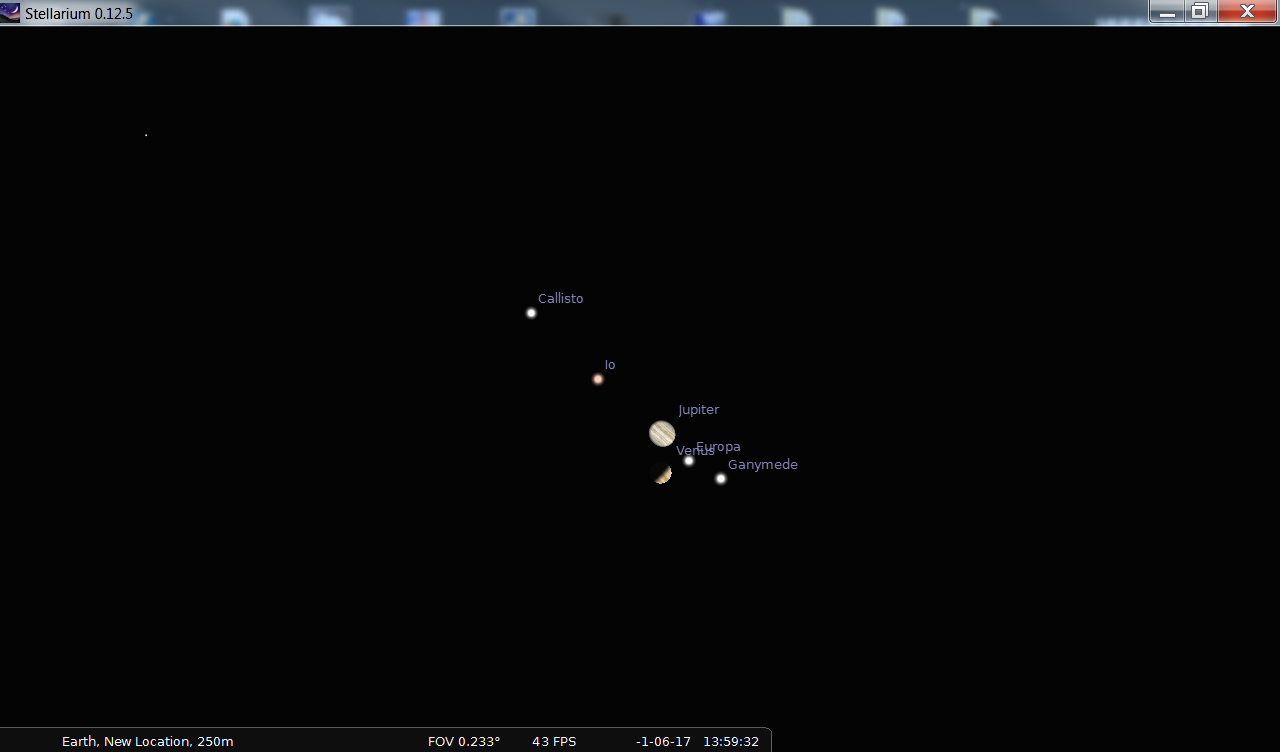
Venus appeared among Jupiter’s moons on August 12, 3 BC. Of course no one had a telescope back then. Created using Stellarium.
I’ve written about the Jupiter-Venus conjunctions of 3 and 2 BC. You can see it here from my Ephemeris website..
06/11/2015 – Ephemeris – Jupiter and Venus continue to appear to approach each other during this month
Thursday, June 11th. Today the Sun will be up for 15 hours and 31 minutes, setting at 9:28. The Moon, 2 days past last quarter, will rise at 3:27 tomorrow morning. Tomorrow the Sun will rise at 5:56.
In the western sky at sunset can be seen the brilliant evening star Venus and the bright but dimmer Jupiter. Jupiter is slowly moving eastward against the stars of the constellation Leo, but is losing the battle with the Earth’s own motion around the Sun. and is setting about 4 minutes earlier each night. Venus is moving faster eastward against the stars, setting only 2 minutes earlier each night. On June 30th it will only be two thirds of the Moon’s diameter south of Jupiter. However Venus will finally surrender to the Sun and will pass Jupiter again on August 3rd, being 7 degrees or 14 moon widths south of Jupiter. Venus will pass the Sun first on August 15th, followed by Jupiter on the 26th, both entering the morning sky.
Times are for the Traverse City/Interlochen area of Michigan. They may be different for your location.
Addendum
Jupiter-Venus approach animation June 11 to July 1, 2015 at 10:30 p.m. Created using Stellarium and GIMP. Click on image to enlarge.
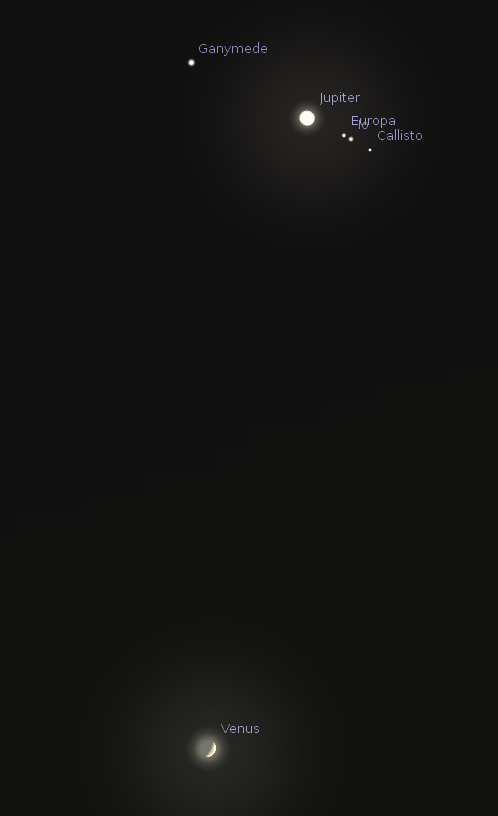
Conjunction of Jupiter and Venus at low power. They will be 20′ apart at 10:30 p.m. EDT June 30, 2015 (2:30 UT July 1, 2015). Created using Stellarium.
Later this month I will have a post showing that this conjunction and a similar conjunction of August last year are a near repeat of two Jupiter-Venus Conjunctions of 3 and 2 BC. which are candidates for the Star of Bethlehem.
05/25/2015 – Ephemeris – Venus will appear to approach Jupiter throughout June
Ephemeris for Memorial Day, Monday, May 25th. Today the Sun will be up for 15 hours and 9 minutes, setting at 9:14. The Moon, at first quarter today, will set at 2:34 tomorrow morning, and tomorrow the Sun will rise at 6:04.
In a telescope the planet Venus is itself near a half phase. Of course, Venus orbits the sun, not the Earth. It will appear about at half illuminated when it’s at its greatest apparent distance from the sun. Right now Venus is about half the apparent size of Jupiter, but it’s heading our way, so it will grow in apparent size. On June 30th Venus will pass Jupiter, by then it will appear the same size as Jupiter, and appear less than the diameter of the Moon apart. There is a coincidence between this conjunction and one over 2,000 years ago, and I’ll be investigating that in another month. I’ll have hints at the June 5th meeting of the Grand Traverse Astronomical Society.
Times are for the Traverse City/Interlochen area of Michigan. They may be different for your location.
Addendum
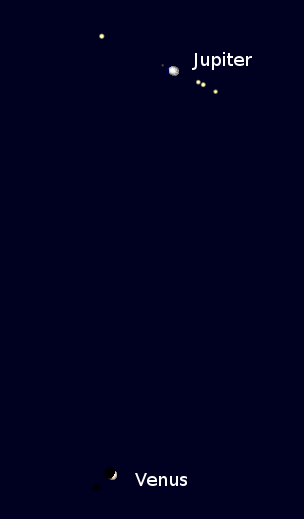
Telescopic view of Jupiter and Venus at 10:30 p.m. June 30, 2015. The two planets will appear two thirds the width of the Moon apart. Both will fit easily in the field of a 50 power eyepiece. Created using Cartes du Ceil (Sky Charts).
04/21/2015 – Ephemeris – The Moon will pass the Hyades star cluster today to pass near Venus tonight
Apr 21. This is Bob Moler with Ephemeris for Tuesday, April 21st. Today the Sun will be up for 13 hours and 46 minutes, setting at 8:35. The Moon, 3 days past new, will set at midnight. Tomorrow the Sun will rise at 6:47.
The moon, which was new last Saturday passed the face of the constellation Taurus the bull earlier today. The face of Taurus is a letter V shape of stars which is the star cluster called the Hyades. There’s a bright orange star that appears at the left tip of the V called Aldebaran, which actually doesn’t belong to the cluster. At 9:30 the crescent Moon will have also just passed the brilliant planet Venus. By then they will be nearly 8 degrees apart, which is a bit less than the width of a fist held at arm’s length. The Moon, Venus and all the planets move very close along the path of the Sun in the sky, called the ecliptic. Even so the Moon is now about 5 degrees south of the ecliptic and Venus about 2 degrees north of it.
Times are for the Traverse City/Interlochen area of Michigan. They may be different for your location.
Addendum
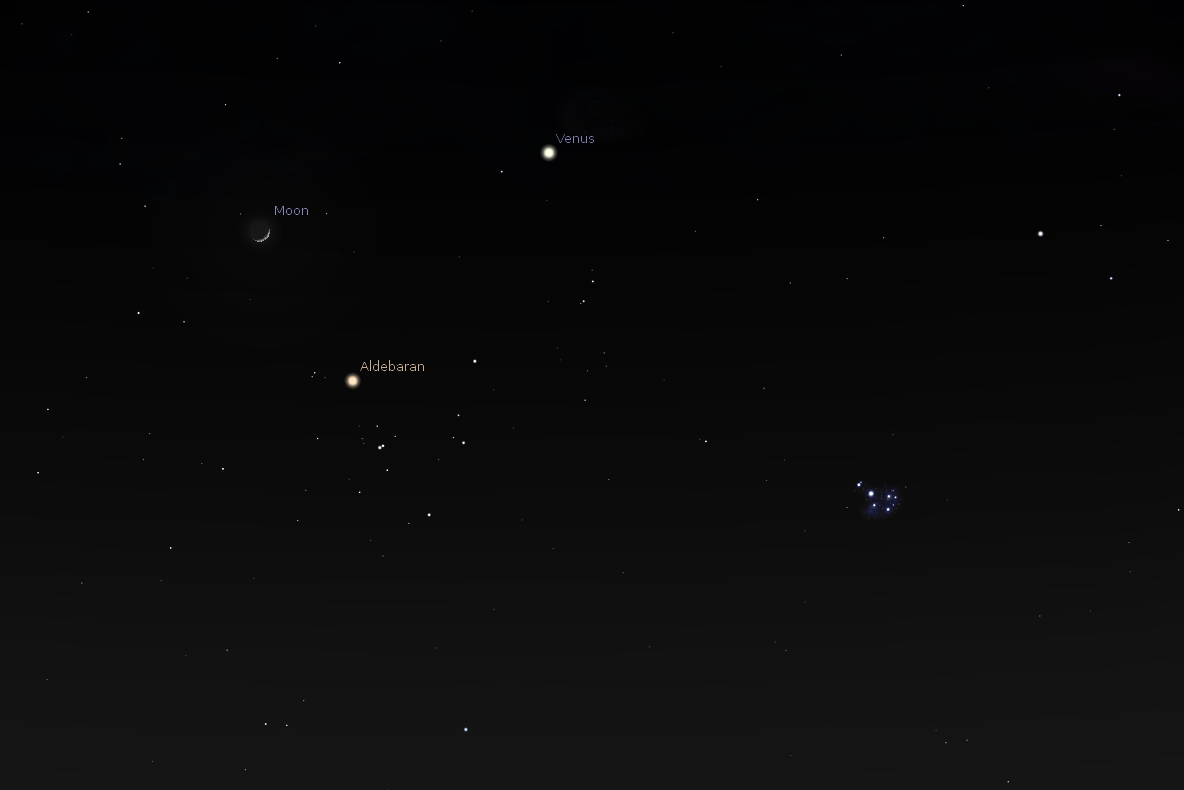
The Moon with Venus and the Hyades at 9:30 p.m. April 21, 2015. Note the Pleiades on the right. Created using Stellarium.
04/10/2015 – Ephemeris – Venus will pass the Pleiades tomorrow evening
Ephemeris for Friday, April 10th. The Sun will rise at 7:07. It’ll be up for 13 hours and 13 minutes, setting at 8:21. The Moon, 1 day before last quarter, will rise at 2:22 tomorrow morning.
Tomorrow evening, that’s Saturday the 11th, Venus will pass the Pleiades. Venus will appear below and left of that famous Seven Sisters star cluster by about 5 moon widths, or about a quarter of the width of your fist held at arm’s length. Venus is moving rapidly eastward against the stars and will be approaching Jupiter for the next two and a half months. It will catch up with Jupiter and on June 30th it will be only half of a degree away, the width of the full moon. Jupiter look really bright when seen away from Venus, but to compare them close together, Jupiter can’t hold a candle to Venus. This also the part of the sky, in Leo that one of the planetary events between these two planets occurred that could have been part of the Star of Bethlehem.
Times are for the Traverse City/Interlochen area of Michigan. They may be different for your location.
Addendum
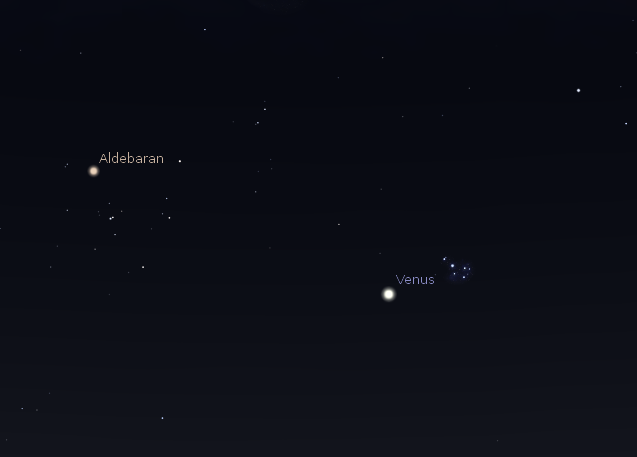
Venus passing the Pleiades at 10 p.m. on April 10, 2015. The Hyades, head of the constellation Taurus the bull, is to the left. Created using Stellarium.
04/07/2015 – Ephemeris – The Moon will pass Saturn tomorrow morning
Ephemeris for Tuesday, April 7th. The Sun will rise at 7:13. It’ll be up for 13 hours and 4 minutes, setting at 8:17. The Moon, 3 days past full, will rise at 11:36 this evening.
The planet Saturn is now rising shortly after midnight. However it is still best seen in the early morning. The Moon will be near Saturn when it rises and will get closer as the morning progresses. By 6 a.m. the Moon will be about four of its widths above and right of Saturn. The Moon will get its closest about 10 a.m., but by then it will be daylight and both will have set. Every week Saturn will rise, and set about a half hour earlier. That’s about an hour every two weeks, and two hours a month. This works for the stars and is pretty close for slow-moving planets like Jupiter and Saturn. So next month at this time Saturn will rise about 10 p.m., and in another month 9 p.m. By then it will be in the sky at sunset, and visible all night.
Times are for the Traverse City/Interlochen area of Michigan. They may be different for your location.
Addendum
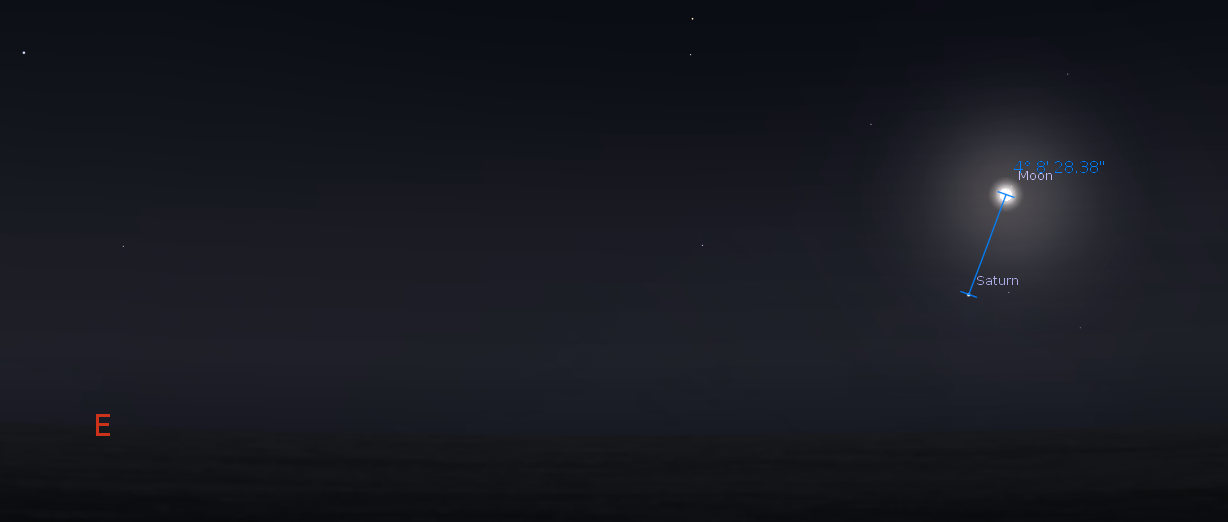
Saturn and the Moon shortly after rising. 12:44 a.m., April 8, 2015. Created using Stellarium.
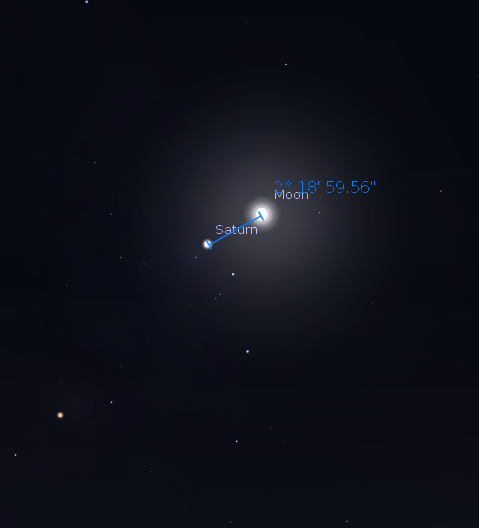
Saturn and the Moon shortly after twilight starts. 5:30 a.m., April 8, 2015. Created using Stellarium.
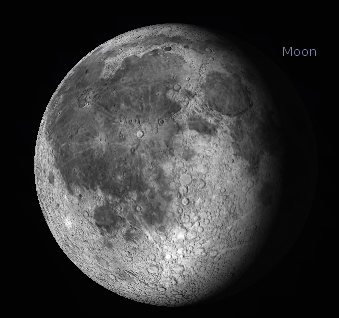
The Moon as it might appear in binoculars at 5:30 a.m. April 8, 2015. Created using Stellarium.
Some Rules of Thumb about the rotation of the earth and its revolution around the Sun.
These are approximate:
Stars rise or set 4 minutes earlier each night.
That’s about a half hour every week, and
It’s about 2 hours every month.
2 hours times 12 months = 24h hours, one rotation of the Earth
As far as viewing the stars and Constellations goes, that’s why we see the constellations in the same positions every year at the same time.
02/20/2015 – Ephemeris – The Moon joins Venus and Mars in the west tonight
Ephemeris for Friday, February 20th. The sun will rise at 7:35. It’ll be up for 10 hours and 42 minutes, setting at 6:17. The moon, 2 days past new, will set at 8:49 this evening.
Tonight the two day old moon will be seen in the west in a tight triangle with Venus and Mars. They will become visible about 7 o’clock. The planets will be to the left of the Moon with much dimmer Mars above Venus. The formation is tight enough that the motion of the moon will be evident between 7 and when the Moon sets at 8:49. The moon moves its own diameter in about an hour. The moon will also exhibit earthshine, the reflection of the bright earth in the moon’s sky on the night side of the Moon itself. The earthshine lit part of the moon shows a ghostly man in the moon image we are familiar with at full moon. This earthshine is visible on the Moon for a few days before new moon to a few days after new moon.
Times are for the Traverse City/Interlochen area of Michigan. They may be different for your location.
Addendum
Views of the Venus, Mars, Moon grouping from three locations.
Appearance of the grouping from northern Michigan, US
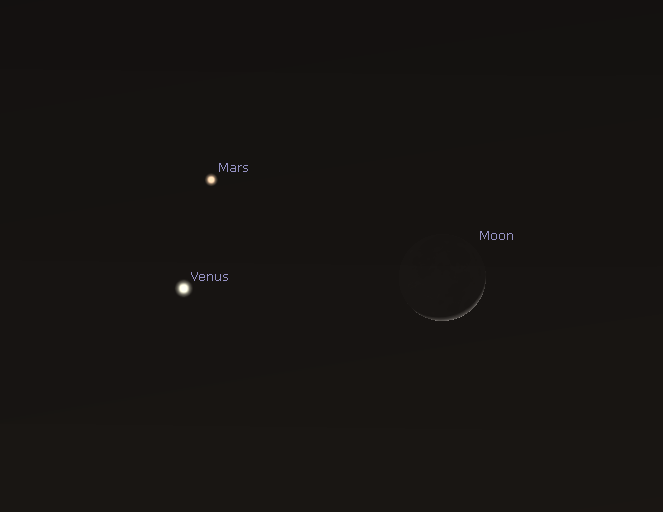
Venus and Mars with the Moon at 7 p.m. EST on February 20, 2015. This is for northern Michigan. Created using Stellarium.
Appearance of the grouping from Los Angeles, CA
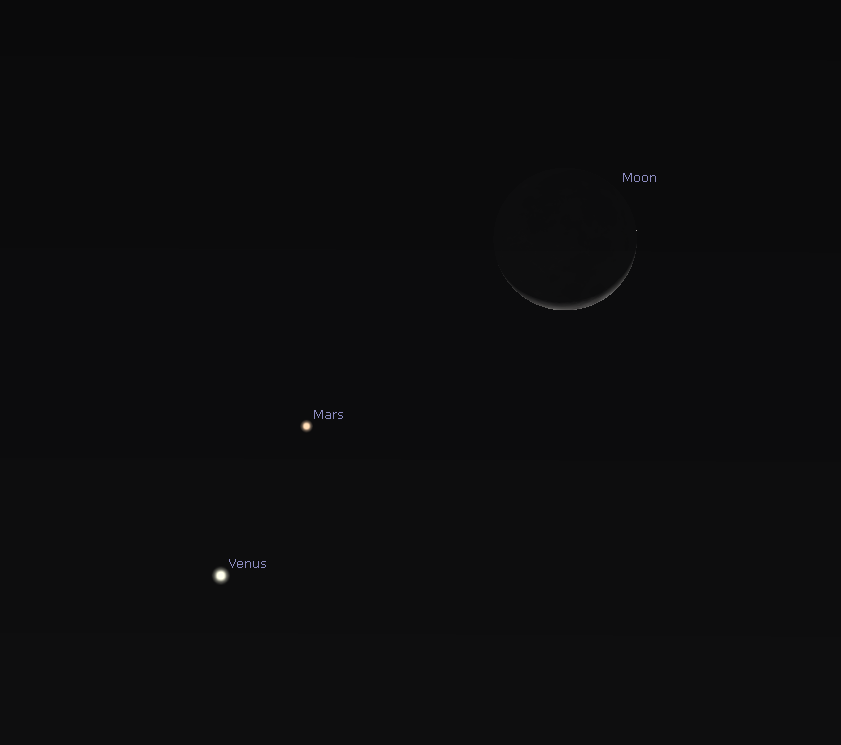
Venus and Mars with the Moon at 8 p.m. PST on February 20, 2015. This is for Los Angeles, CA. Created using Stellarium.
Appearance of the grouping from London, UK
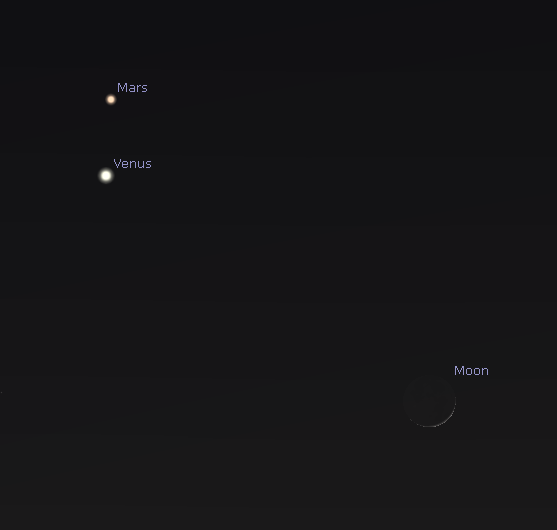
Venus and Mars with the Moon at 20:28 GMT on February 20, 2015. This is for London, UK. Created using Stellarium.
 Bob Moler's Ephemeris Blog