Archive
02/19/2015 – Ephemeris – What’s a conjunction?
Ephemeris for Thursday, February 19th. The sun will rise at 7:37. It’ll be up for 10 hours and 39 minutes, setting at 6:16. The moon, 1 day past new, will set at 7:32 this evening.
Saturday night* Venus will be in conjunction with Mars. To me the best sight will be tomorrow night when the thin crescent moon will join the two planets in a very picturesque triangle. Conjunctions are terms shared between astronomers and astrologers and why shouldn’t they be, astrology is, in my opinion, astronomy’s illegitimate parent. To astronomers conjunctions are when two solar system objects are directly north and south of each other (the same right ascension). Astrologers have the conjunction on the same date, but most will say it’s occurring in Aries. Astronomers in the other hand can see that the two planets are now seen against the stars of western Pisces. Most astrologers don’t recognize the precession of the earth’s axis, it’s 26,000 year wobble in their calculations.
Times are for the Traverse City/Interlochen area of Michigan. They may be different for your location.
* As reported in the radio program it was Sunday. However the two planets appear closest Saturday night. 7 p.m. EST ( UT – 5 hr) on the 21st is actually 0 hr UT on the 22nd (Sunday).
Addendum
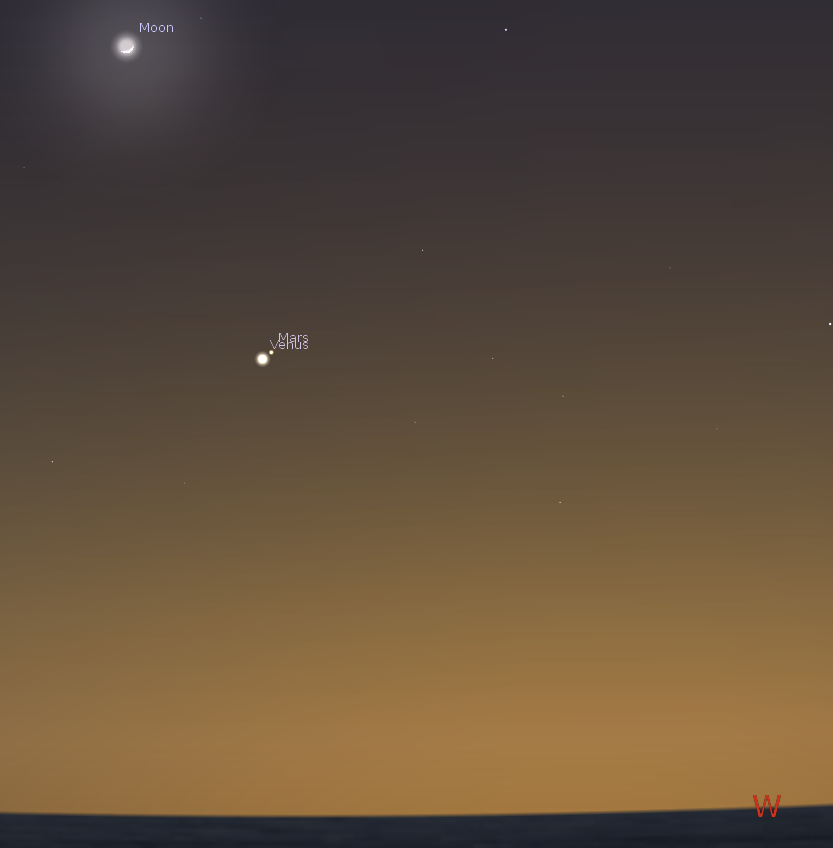
Venus and Mars in conjunction at 7 p.m. EST February 21, 2015. Created using Stellarium.
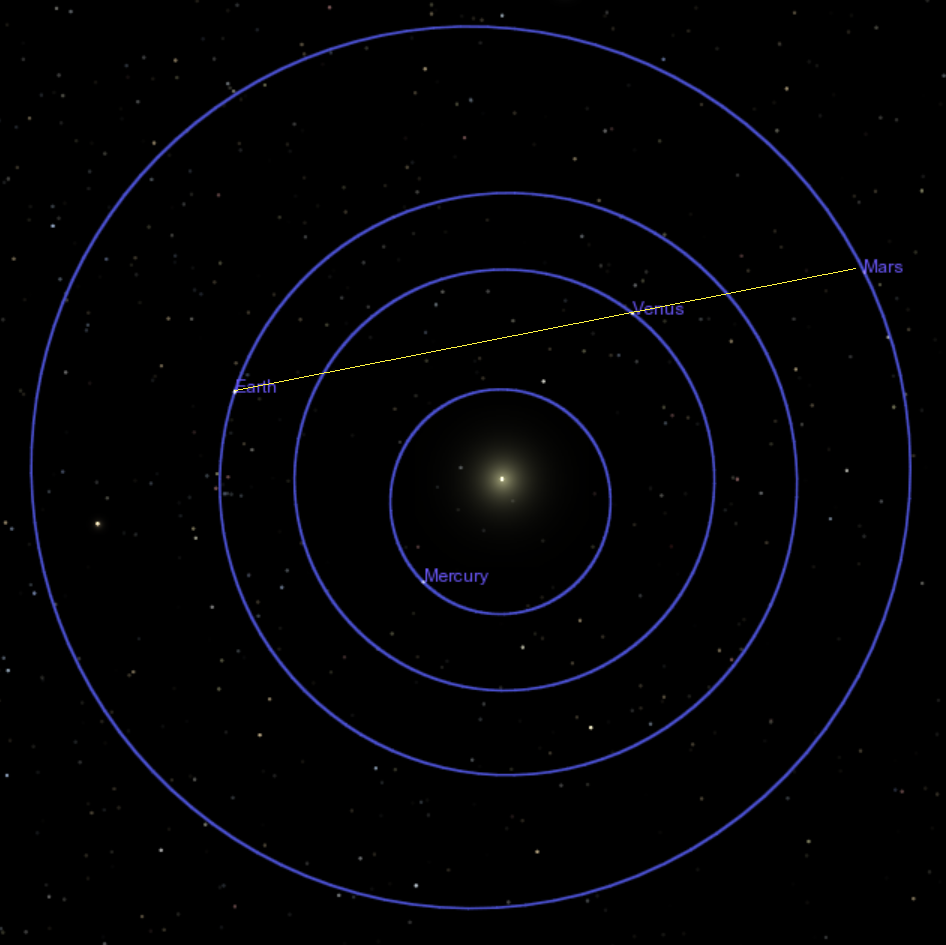
The big picture: In a conjunction planets simply happen to appear along a line of sight from the Earth. They have nothing to do with each other. This is the location of the planets Earth, Venus and Mars on February 22, 2015. Created using Celestia.
Below see the shift of the vernal equinox or first point of Aries, as it’s sometimes called has shifted from 150 CE in Ptolemy’s day to today.
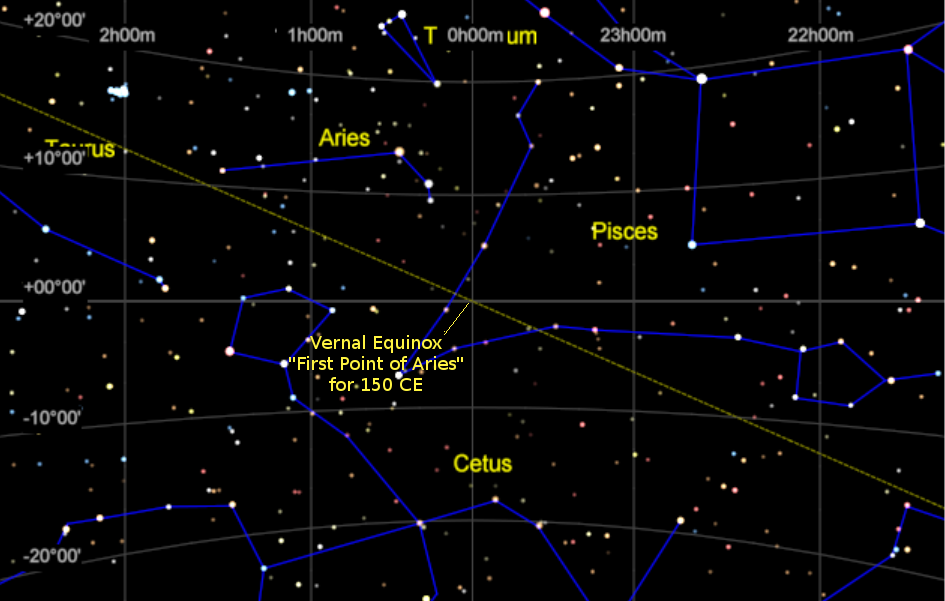
The vernal equinox in 150 CE. Note that Aries to the left. The Sun travels on the ecliptic line (The diagonal line) from right to left. Created using Cartes du Ciel (Sky Charts).
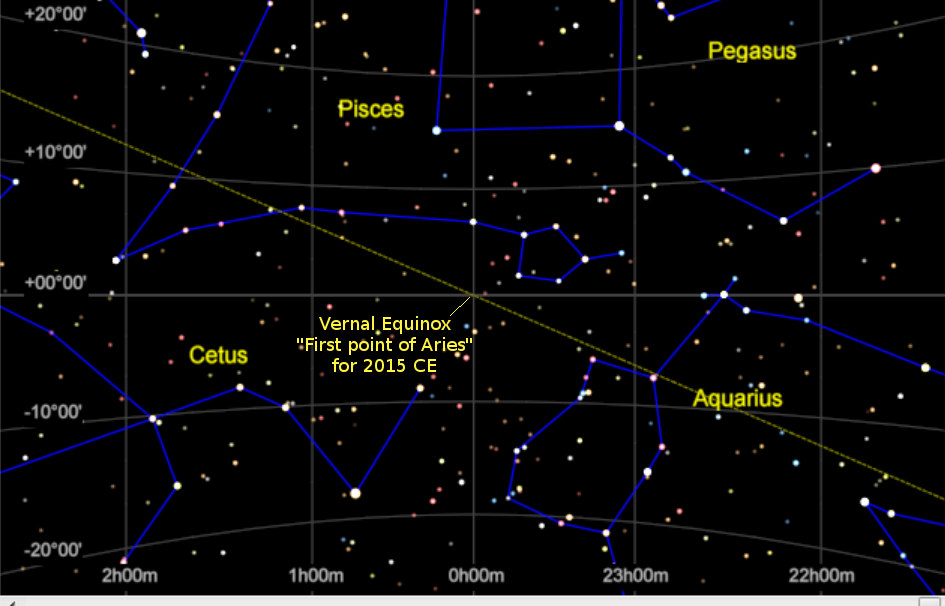
The vernal equinox today, in 2015 CE. Note that Aries has slid off to the left. The Sun travels on the ecliptic line (The diagonal line) from right to left. Created using Cartes du Ciel (Sky Charts).
Here’s your chance to find Neptune – tonight only
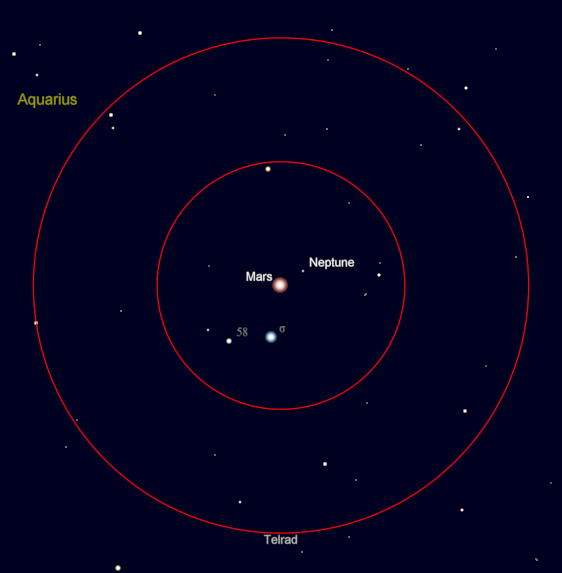
Mars and Neptune tonight only. Here is where Cartes du Ceil (Sky Charts) puts them at 7 p.m. January 19, 2015. They will be low in the southwest. Mars is second magnitude, Neptune is 8th.
The outer red circle matches that of the popular Telrad telescope finder and is a bit smaller (4º) than 7 or 10 power binoculars. The smaller circle is a 2° circle. It will take binoculars at least and a clear sky to spot this outermost planet.
Galileo actually recorded Neptune with his primitive telescope when Jupiter passed it. But to Galileo it was simply a background star.
Note: The 7 p.m. time in the caption is local to western lower Michigan. My location is 43 minutes behind Eastern Standard Time. If you are near your time meridian the time is more likely 6:15 p.m. This normally isn’t a big deal, but These planets are close to setting.
01/09/2015 – Ephemeris – Tomorrow Mercury almost makes a conjunction with Venus but falls back
Ephemeris for Friday, January 9th. The sun will rise at 8:19. It’ll be up for 9 hours and 1 minute, setting at 5:20. The Moon, 4 days before last quarter, will rise at 10:06 this evening.
Low in the southwest just after sunset, say around 6 to 6:15 in the evening Venus and Mercury can be seen seeming to flirt with one another. Venus has been moving away from the Sun in the evening sky for a couple of month’s not, but hasn’t been all that visible. Mercury, named after the messenger of the gods is fleet of orbit and is almost about to catch up with Venus. Except it can’t, not this time. Tomorrow evening Mercury will appear closest to Venus about 0.6 angular degrees away, a bit more than the width of the Moon. So for another day the two planets will appear close. But after tomorrow night they will separate with Mercury not able to keep up. Next Tuesday it will reach its greatest elongation or separation from the sun and fall back.
Times are for the Traverse City/Interlochen area of Michigan. They may be different for your location.
Addendum
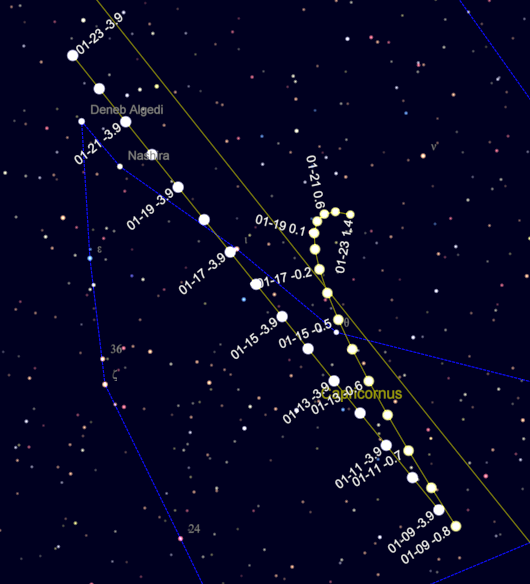
Venus, the straight track, and Mercury are shown for every evening from yesterday 1/08/15 to 01/23/15. The planets are marked for every night at 6 p.m. and tagged every other day. with month-day and magnitude. The higher the magnitude value the dimmer it is. Created using Cartes du Ceil (Sky Charts).
01/08/2015 – Ephemeris -Venus and Mercury quasi-conjunction Saturday – I
Ephemeris for Thursday, January 8th. The sun will rise at 8:19. It’ll be up for 9 hours even, setting at 5:19. The moon, 4 days past full, will rise at 9:08 this evening.
The planets Venus and Mercury are closing their positions in the southwest in the early evening. They will appear their closest Saturday. For the last few years these two planets without natural satellites have hosted an artificial satellite each. Venus is orbited by the European Space Agency’s Venus Express spacecraft since 2006. Just a few weeks ago it’s fuel tanks ran dry, so it could no longer point its solar panels toward the sun and antenna toward the earth. It will soon plunge into Venus’ thick atmosphere. A like fate will also befall the MESSENGER spacecraft now orbiting close to Mercury. It took 7 years to get to Mercury and so far orbited it for nearly 4 years. It too is running out of fuel and will soon crash on the planet.
Times are for the Traverse City/Interlochen area of Michigan. They may be different for your location.
Addendum
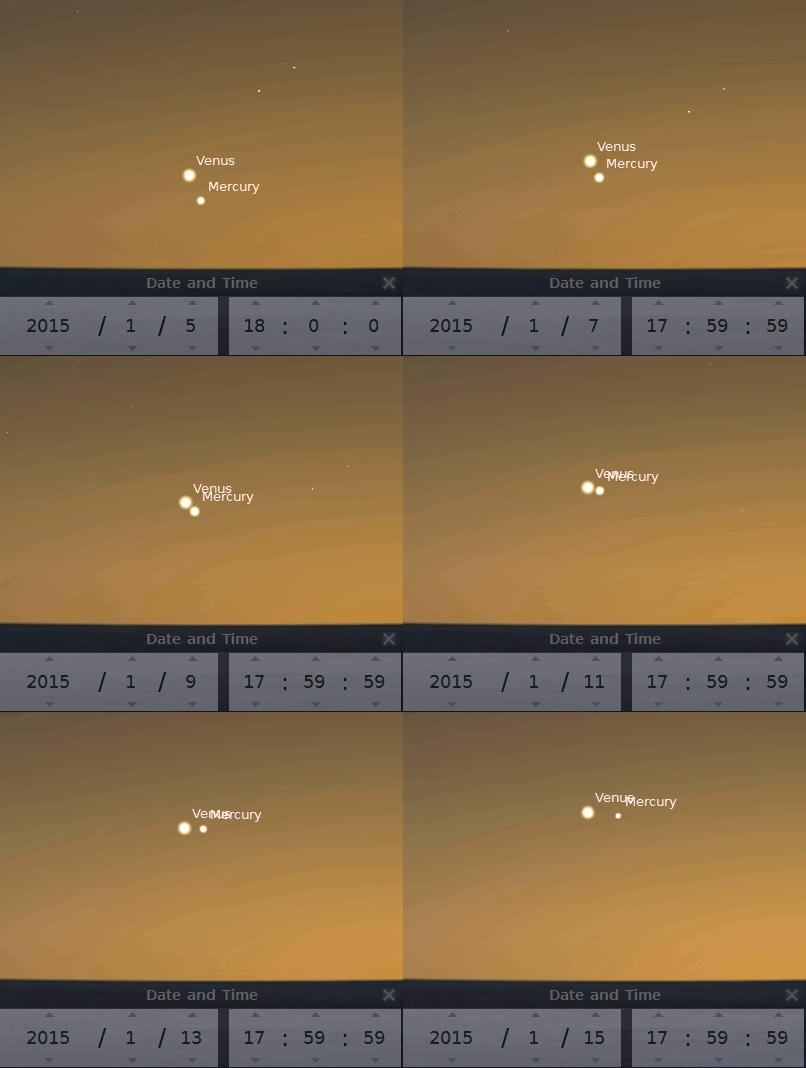
Animation of the Quasi-conjunction of Venus and Mercury. Time span 1/05/2015 to 1/15/2015 at 7 p.m. Created by Bob Moler using Stellarium and GIMP.
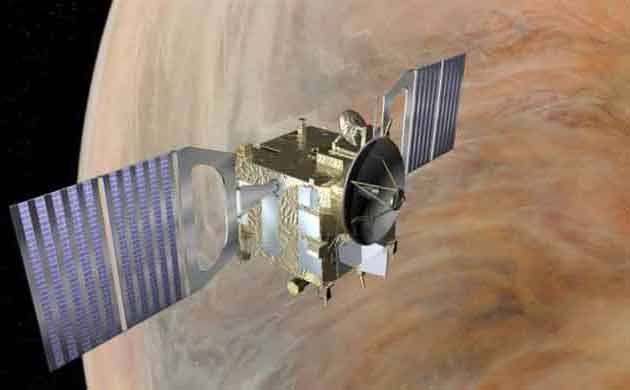
Artist rendition of Venus Express at Venus. Credit: ESA/AP.
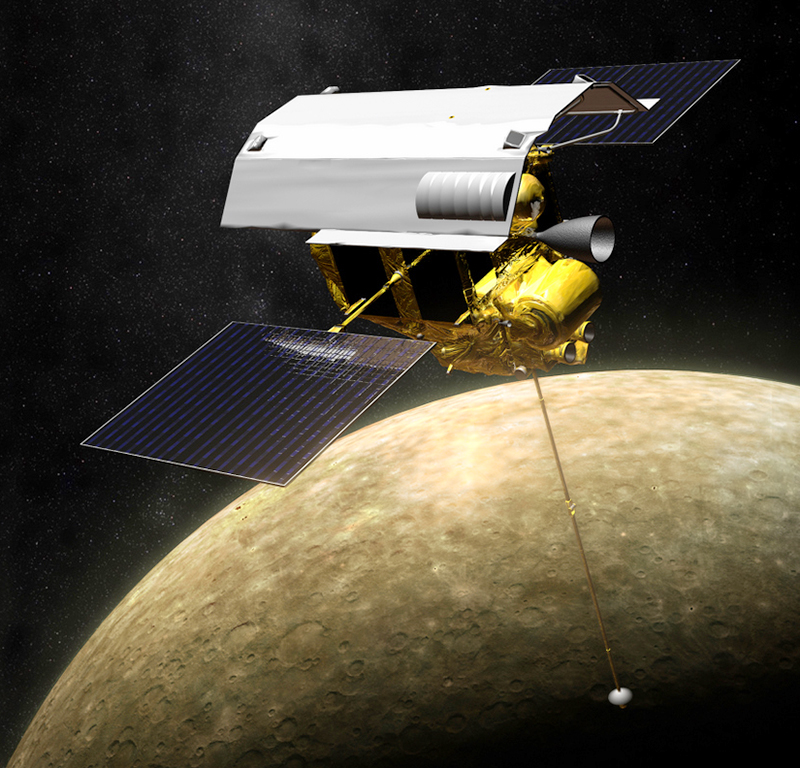
MESSENGER spacecraft at Mercury an artist’s concept. Credit NASA/JPL/APL.
01/01/2015 – Ephemeris – Happy New Year – a look at January
Ephemeris for New Years Day, Thursday, January 1st. The sun will rise at 8:20. It’ll be up for 8 hours and 52 minutes, setting at 5:12. The moon, 3 days before full, will set at 5:43 tomorrow morning.
Happy New Year. Let’s preview the month of January. We’re a day from the latest sunrise at about the same time as today, 8:20 a.m. and will back down to 8:02 by the 31st. Sunset times are currently increasing by a minute a day from 5:12 p.m. today to 5:49 at month’s end. Listeners near the shore of Lake Michigan will have about the same sunrise time in Ludington, Interlochen/Traverse City, Petoskey and Mackinaw City, but the sunset times will vary markedly. The Quadrantid meteor shower whose radiant is near the end of the Big Dipper’s handle will reach peak on the 3rd, but it will have interference from the full moon,. On the 4th the Earth will be its closest to the sun of the entire year.
Times are for the Traverse City/Interlochen area of Michigan. They may be different for your location.
Addenda
Monthly Star Chart
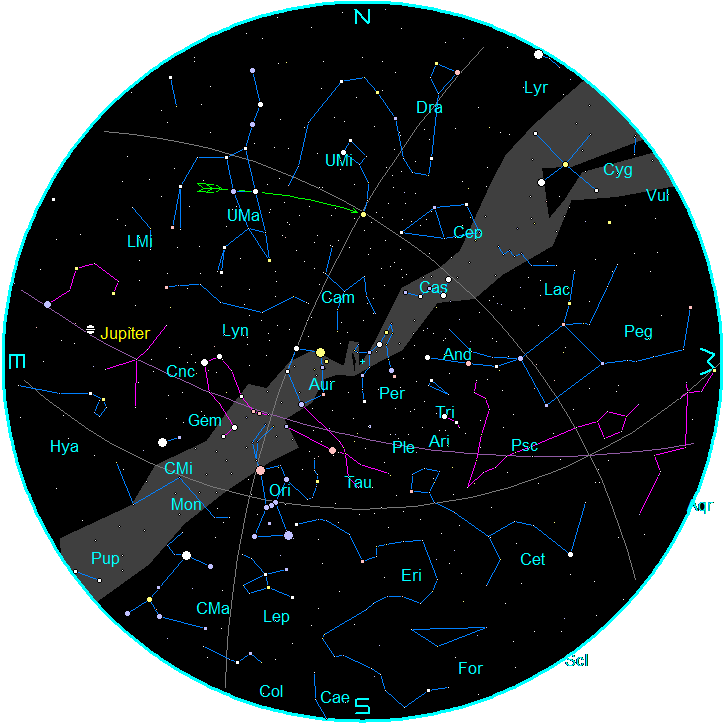
Star Chart for January 2015. Created using my LookingUp program.
The Moon is not plotted. The planets and stars are plotted for the 15th at 9 p.m. That is chart time.
Evening astronomical twilight ends at 6:58 p.m. on January 1st, and increasing to 7:30 p.m. on the 31st.
Morning astronomical twilight starts at 6:34 a.m. on January 1st, and decreasing to 6:22 a.m. on the 31st.
Add a half hour to the chart time every week before the 15th and subtract and hour for every week after the 15th.
For a list of constellation names to go with the abbreviations click here.
The green pointer from the Big Dipper is the pointer stars at the front of the bowl of the Big Dipper that point to Polaris the North Star.
The Quadrantid meteor shower
The moon will interfere with the meteor shower, so only the brightest will be visible. The radiant will rise from the northeast. The radiant will be nearly overhead at the start of twilight. On a dark night up to 120 meteors per hour may be seen according to the International Meteor Organization.
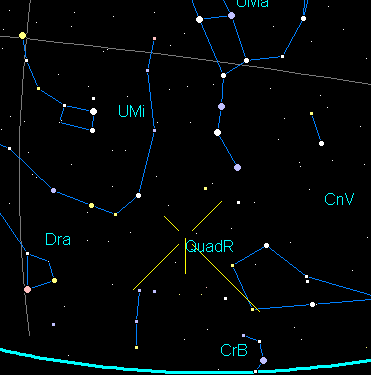
Quadrantid meteor shower radiant at 1:30 a.m.
The Earth at Perihelion
This is the closest the Earth gets to the Sun in its orbit this year. The Sun will be 91,402,000 miles or 147,096,000 kilometers away at around 1 a.m. January 4th, 2015 EST or 6 hr UT January 5th 2015. It makes winter the shortest season because the Earth is moving its fastest during perihelion. It’s only by a few days. And in northern Michigan where it seems that winter overlaps half of fall and spring besides, that few days difference is buried under snow.
Quasi-conjunction between Venus and Mercury on the evening of January 10th.
A quasi-conjunction. Conjunctions occur when two solar system bodies have the same right ascension. Mercury will get to within 0.6 degrees of Venus before retreating back sun-ward.
Animation of the Quasi-conjunction of Venus and Mercury. Time span 1/05/2015 to 1/15/2015 at 7 p.m. Created by Bob Moler using Stellarium and GIMP.
Comet C/2014 Q2 (Lovejoy)
Here is a finder chart for 9 p.m. for January. Every other position is marked with the month-day and predicted magnitude. Recently the comet has shown to be brighter than predicted by up to one magnitude. Note that magnitudes in astronomy are like golf scores – the lower the number, the brighter the object. So the comet should reach 4th magnitude.
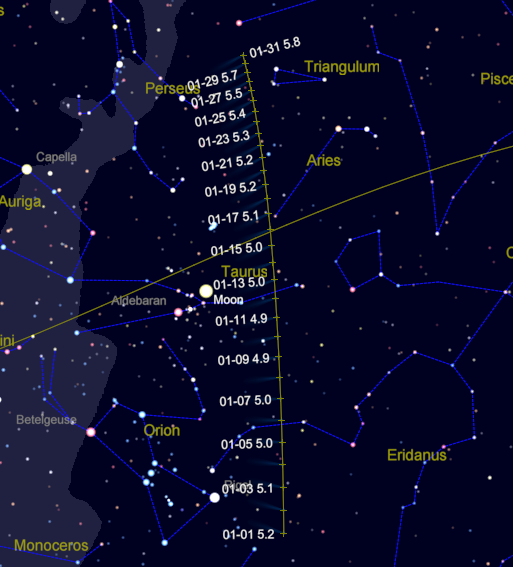
Nightly plot of Comet Lovejoy (C/2014 Q2) for the month of January, 2015 at 9 p.m.
Created using Cartes du Ceil (Sky Charts).
10/24/2014 -Ephemeris – Venus will pass superior conjunction with the Sun tomorrow
Ephemeris for Friday, October 24th. The sun will rise at 8:09. It’ll be up for 10 hours and 33 minutes, setting at 6:43. The moon, 1 day past new, will set at 7:20 this evening.
Tomorrow’s event will not be visible. Venus will pass behind the Sun, though not directly behind it. Venus can be viewed from the SOHO spacecraft go to http://spaceweather.com/, at the bottom click the link for Solar and Heliospheric Observatory, Click on the Sun Now, then LASCO C2. The event is called a superior conjunction, meaning the Venus is beyond the Sun. It will be moving from west of the Sun to the east, from the morning side of the Sun to the evening side. Venus has been in the morning sky since January 11th. So it is a morning planet for about 9 months and moves to the evening sky for another 9 months. In a month or so, Venus will appear low in the southwestern sky shortly after sunset. It will be our super bright evening star next spring.
Times are for the Traverse City/Interlochen area of Michigan. They may be different for your location.
Addendum
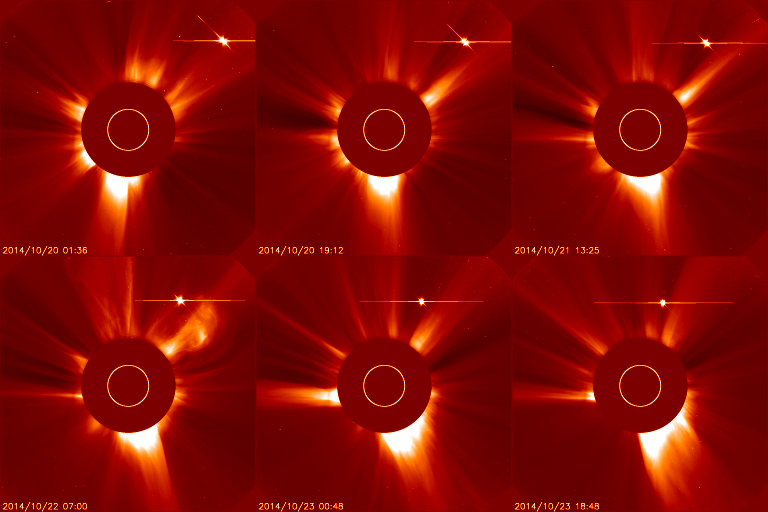
Venus approaching superior conjunction 10/20/2014 to 10/23/2014. Credit NASA – SOHO LASCO C2.
09/29/2014 – Ephemeris – The Moon, Mars and Antares will line up tonight
Ephemeris for Monday, September 29th. The sun will rise at 7:37. It’ll be up for 11 hours and 48 minutes, setting at 7:26. The moon, 2 days before first quarter, will set at 10:49 this evening.
Tonight we’ll still have Mars hanging around the star Antares. However we’ll have the Moon joining the party. The three will nearly be in line at 9 p.m. with the fat crescent Moon on top, Mars below it and Antares below Mars. They will be in a straighter line but the Sun out makes them impossible to see. With binoculars or a small telescope the lunar seas visible, kind of in order from the Moon’s sunlit edge are Crises, Fertility, Nectar, Tranquility and half of Serenity. If you’re looking for the Man in the Moon, you’ll have to wait until the Moon is nearly full to completely discern his face. However most of the upside down rabbit is visible. The seas of Fertility and Nectar make up his ears, Tranquility, his head, and Serenity his body.
Times are for the Traverse City/Interlochen area of Michigan. They may be different for your location.
Addendum
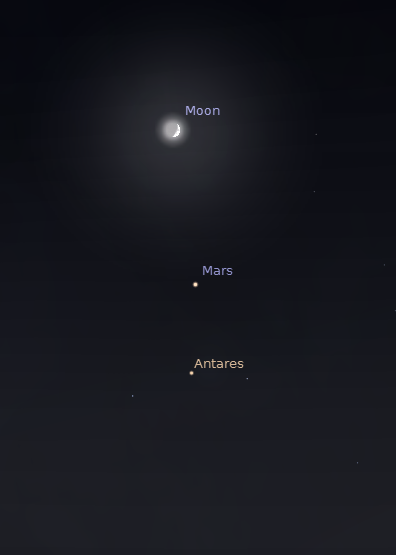
The Moon, Mars and the bright red star Antares line up on the evening of September 29, 2014. Created using Stellarium.
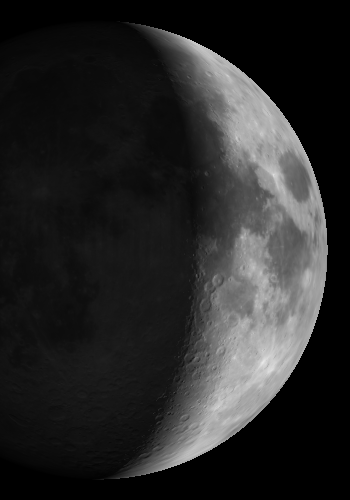
The moon tonight September 29, 2014. Created using Virtual Moon Atlas.
09/19/2014 – Ephemeris – Astronomical events for Saturday local and far off
Ephemeris for Friday, September 19th. The sun will rise at 7:26. It’ll be up for 12 hours and 19 minutes, setting at 7:45. The moon, 4 days past last quarter, will rise at 3:59 tomorrow morning.
Saturday will be a big day for astronomical viewing, if it’s clear. Tomorrow’s events start early with the planet Jupiter just above and right of the thin crescent moon. They will be visible by 6 a.m. During the day the Grand Traverse Astronomical Society will be at the Leland Heritage Celebration. That runs from 9 a.m. to 5 p.m. on River Street in Leland. Weather permitting the Sun will be in view with some giveaway items for the kids even if it’s cloudy. At night starting at 9 p.m. will be a star party at Northwestern Michigan’s Rogers Observatory. Being the dark of the moon the wonders of the summer Milky Way will be in view if it’s clear. An alternate program will be presented if it’s cloudy.
Times are for the Traverse City/Interlochen area of Michigan. They may be different for your location.
Addendum
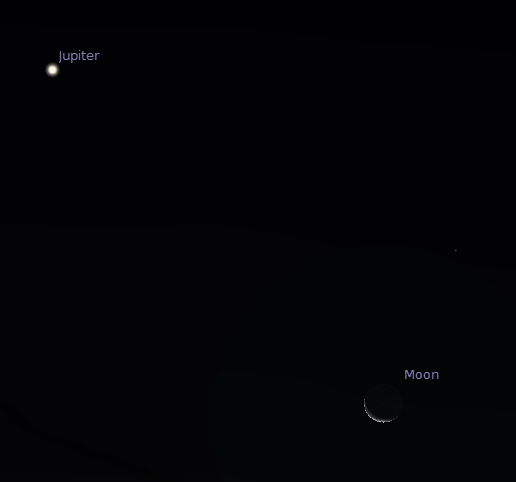
Jupiter and the moon at 6 a.m. Saturday September 20, 2014. Created using Stellarium.
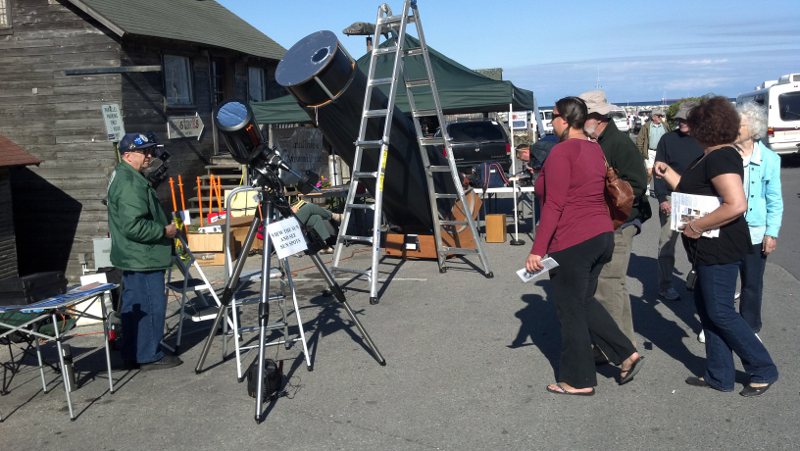
GTAS telescopes at Leland Heritage Celebration in 2011.
Arrrr! Today is Talk Like a Pirate Day mateys. Just in time for the Schooner tall ship Festival in Traverse City this weekend.
08/27/2014 – Ephemeris – Where are the bright planets for this week?
Ephemeris for Wednesday, August 27th. The sun will rise at 6:59. It’ll be up for 13 hours and 28 minutes, setting at 8:27. The moon, 2 days past new, will set at 9:12 this evening.
Let’s take our weekly look at the bright planets. Reddish Mars is in the constellation of Libra the scales, skirting below, left of Saturn in the southwest as darkness falls. It is in conjunction with Saturn today, as it passes due south of the ringed planet. Mars will set at 11:07 p.m. Saturn will set at 11:23 p.m. Saturn viewing with a telescope will suffer because it’s getting close to the horizon but it’s still possible to see those fabulous rings and its large moon Titan. Brilliant Jupiter will rise in the east-northeast at 4:44 a.m. tomorrow, followed by the brighter Venus, which will rise at 5:37 a.m. Jupiter is increasing its distance from the sun, while Venus is retreating toward the Sun from our point of view.
Times are for the Traverse City/Interlochen area of Michigan. They may be different for your location.
Addendum
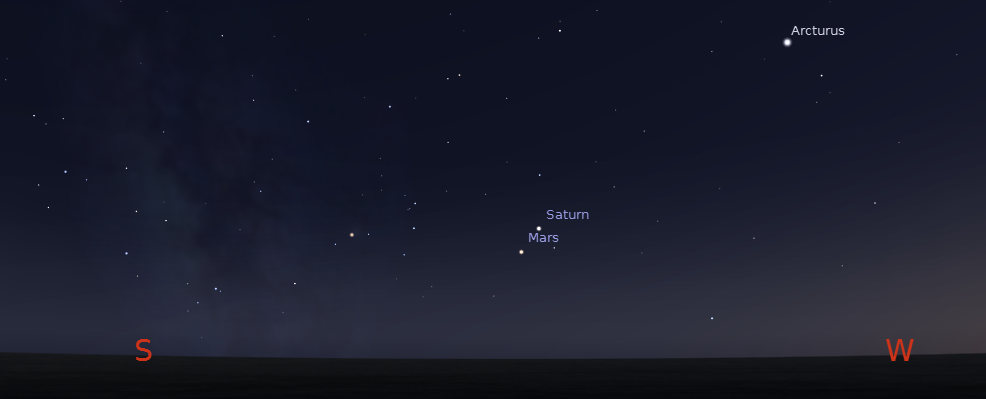
Saturn and Mars in conjunction at 9:30 p.m., August 27, 2014. Created using Stellarium.
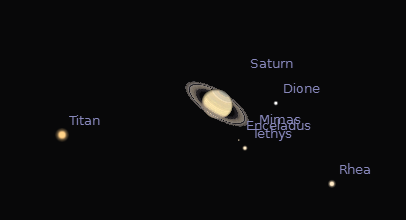
Telescopic Saturn. Do not expect to spot any other of Saturn’s moon other than Titan. 9:30 p.m., August 27, 2014. Created using Stellarium.
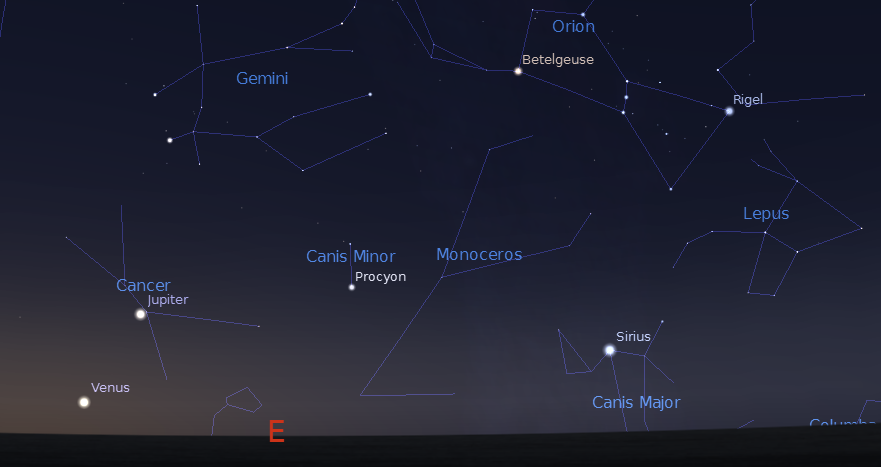
Jupiter and Venus and the rising winter constellations at 6 a.m. August 28, 2014. Created using Stellarium.
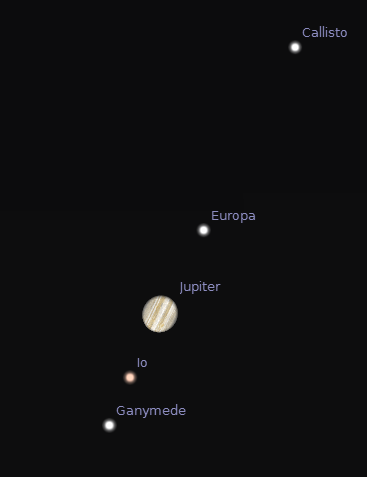
Telescopic view of Jupiter and its 4 Galilean moons at 6 a.m. on August 28, 2014. Created using Stellarium.
08/15/2014 – Ephemeris – Jupiter and Venus will appear to cross paths Monday morning
Ephemeris for Friday, August 15th. The sun rises at 6:45. It’ll be up for 14 hours and 2 minutes, setting at 8:47. The moon, 2 days before last quarter, will rise at 11:33 this evening.
Over this weekend the planets Venus and Jupiter will be seen to approach each other. In reality Jupiter is five times the Earth’s distance behind the sun, while Venus is about 70 percent of Earth’s distance behind the sun. Most of the motion against what stars can be seen after 5:30 a.m. will be Venus, being dragged by the sun plus its own orbital motion toward the east. Jupiter is moving eastward too, but is taking its sweet time of 12 years to orbit the sun. The planets will cross, or be in conjunction at about midnight Monday morning, before they rise. By the time they will rise around 5:12 a.m. the two planets will be half the width of the Moon apart, slightly farther apart than they were at midnight.
Times are for the Traverse City/Interlochen area of Michigan. They may be different for your location.
Addendum
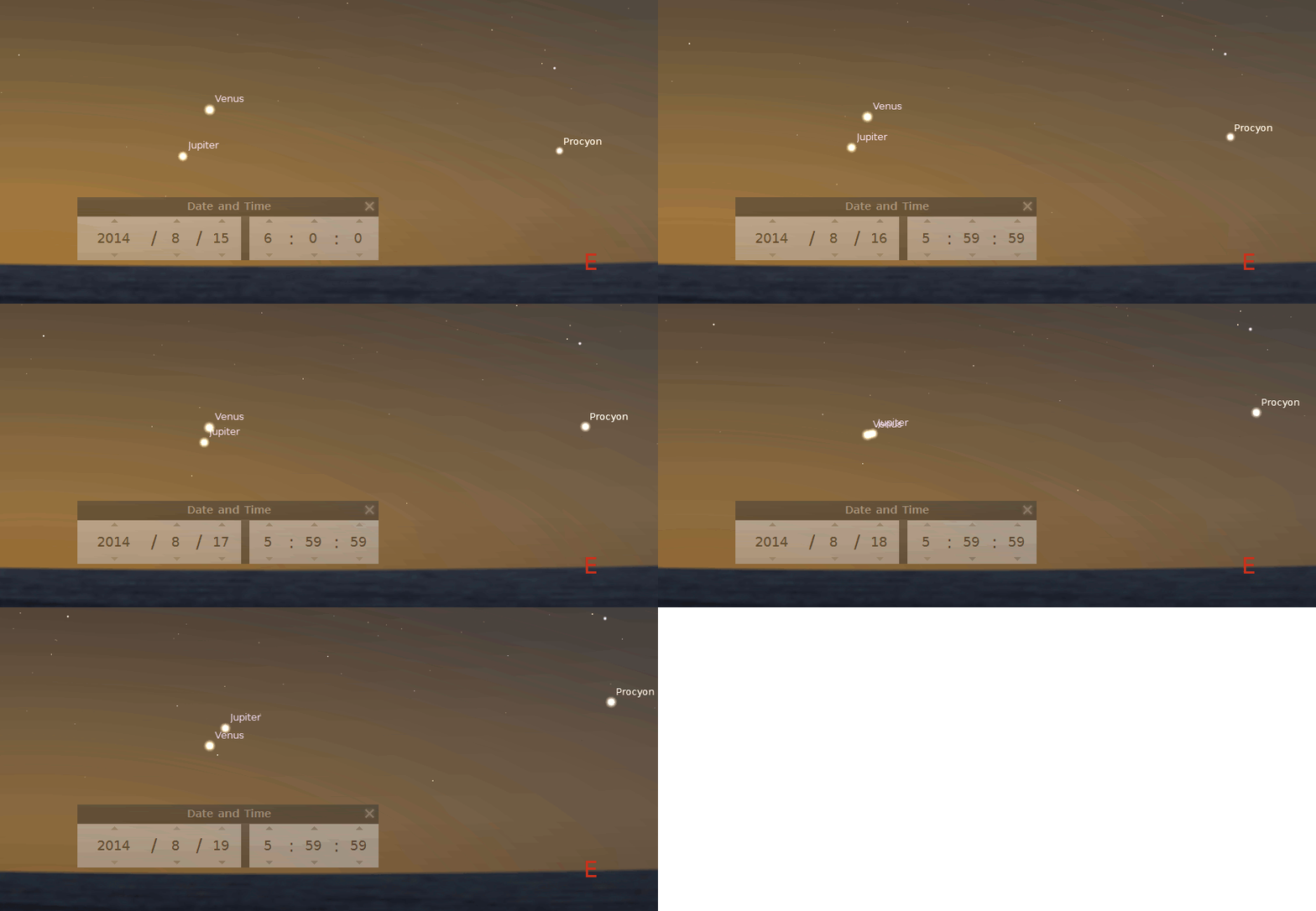
Watch Jupiter and Venus approach each other and separate. From August 15 to August 18, 2018. Created using Stellarium and GIMP.
 Bob Moler's Ephemeris Blog