Archive
01/11/2016 – Ephemeris – Gemini, the half-brothers that are twins
Ephemeris for Monday, January 11th. The Sun will rise at 8:18. It’ll be up for 9 hours and 4 minutes, setting at 5:22. The Moon, 2 days past new, will set at 7:36 this evening.
Before the Moon brightens the evening sky, lets look at another of the winter constellations. The constellation Gemini, the Twins is visible high in the east-southeast, above and left of Orion the hunter at 9 p.m. The namesake stars of the two lads, will be at the left end of Gemini, vertically aligned. Castor is on top, while Pollux is below. From them come two lines of stars extending toward Orion that outline the two. In Greek mythology the lads were half brothers, Castor was fathered by a mere mortal, while Pollux was fathered by Zeus in the famous Leda and the swan affair, but were born together. When Castor was killed during the quest for the Golden Fleece, Pollux pleaded with Zeus to let him die also, so both appear together in the sky forever.
Times are for the Traverse City/Interlochen area of Michigan. They may be different for your location.
Addendum
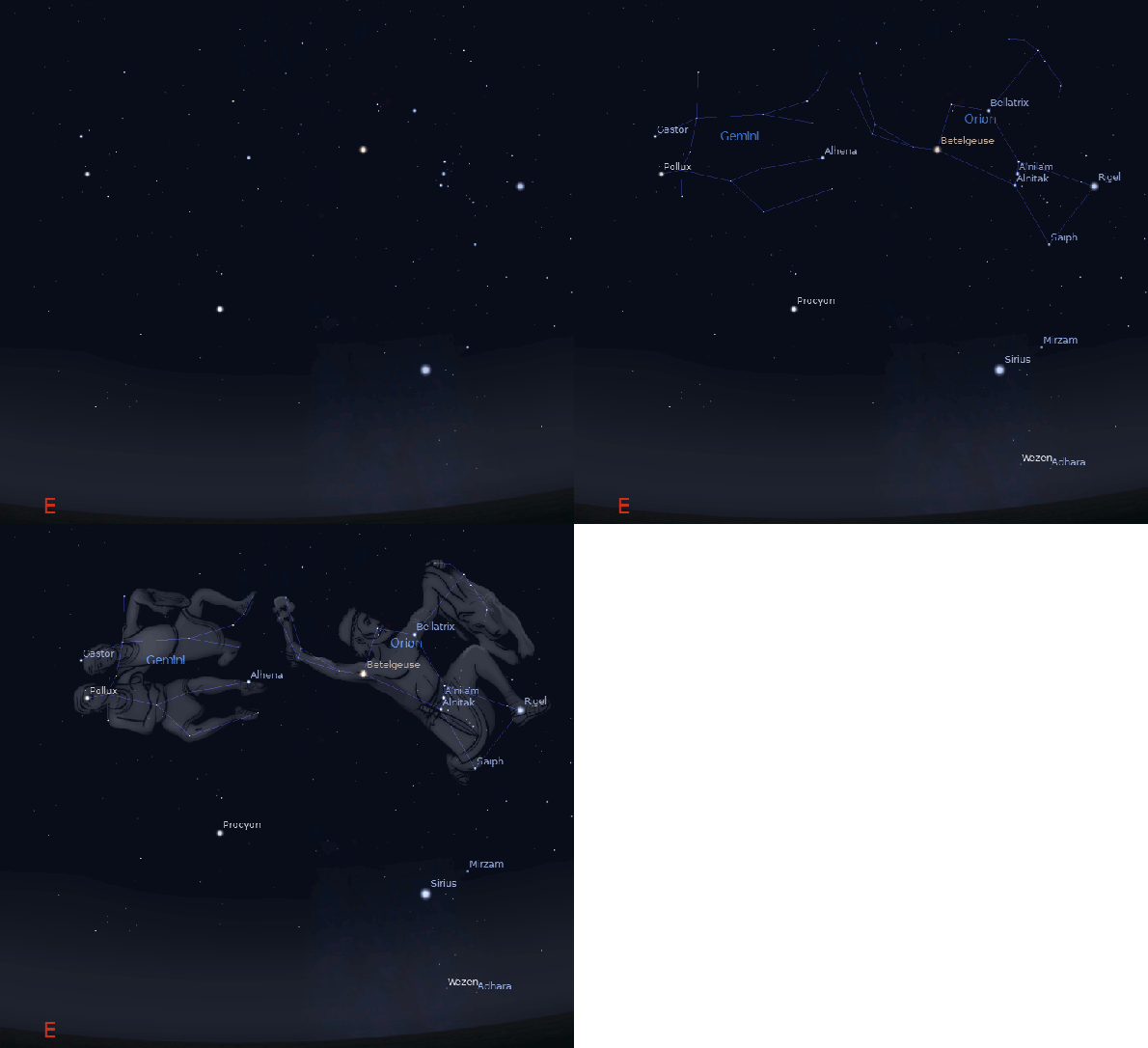
Gemini revealed by animation. Created using Stellarium and GIMP.
12/08/2015 – Ephemeris – The hard charging Taurus the bull
Ephemeris for Tuesday, December 8th. The Sun will rise at 8:07. It’ll be up for 8 hours and 55 minutes, setting at 5:02. The Moon, 3 days before new, will rise at 6:03 tomorrow morning.
Low in the east at 9 p.m. is the constellation of Orion the giant hunter . Above him is Taurus the bull. His face is a letter V shape of stars lying on its side with the bright orange-red star Aldebaran at the bottom left tip of the V as its angry blood-shot eye. Orion is depicted in the sky facing with club in one hand and a shield in the other the approaching and in some depictions charging Taurus. The V of stars is a star cluster called the Hyades. The Pleiades are in his shoulder above. Taurus in Greek mythology was the guise the god Zeus when he carried off the maiden Europa. Europa’s still with him, sort of, as the intriguing satellite orbiting Zeus’ Roman equivalent Jupiter. In fact the moons around the planet Jupiter are generally named for Jupiter’s lovers and friends. His wife is missing from the entourage, and will be until the NASA spacecraft Juno reaches Jupiter next year.
Times are for the Traverse City/Interlochen area of Michigan. They may be different for your location.
Addendum
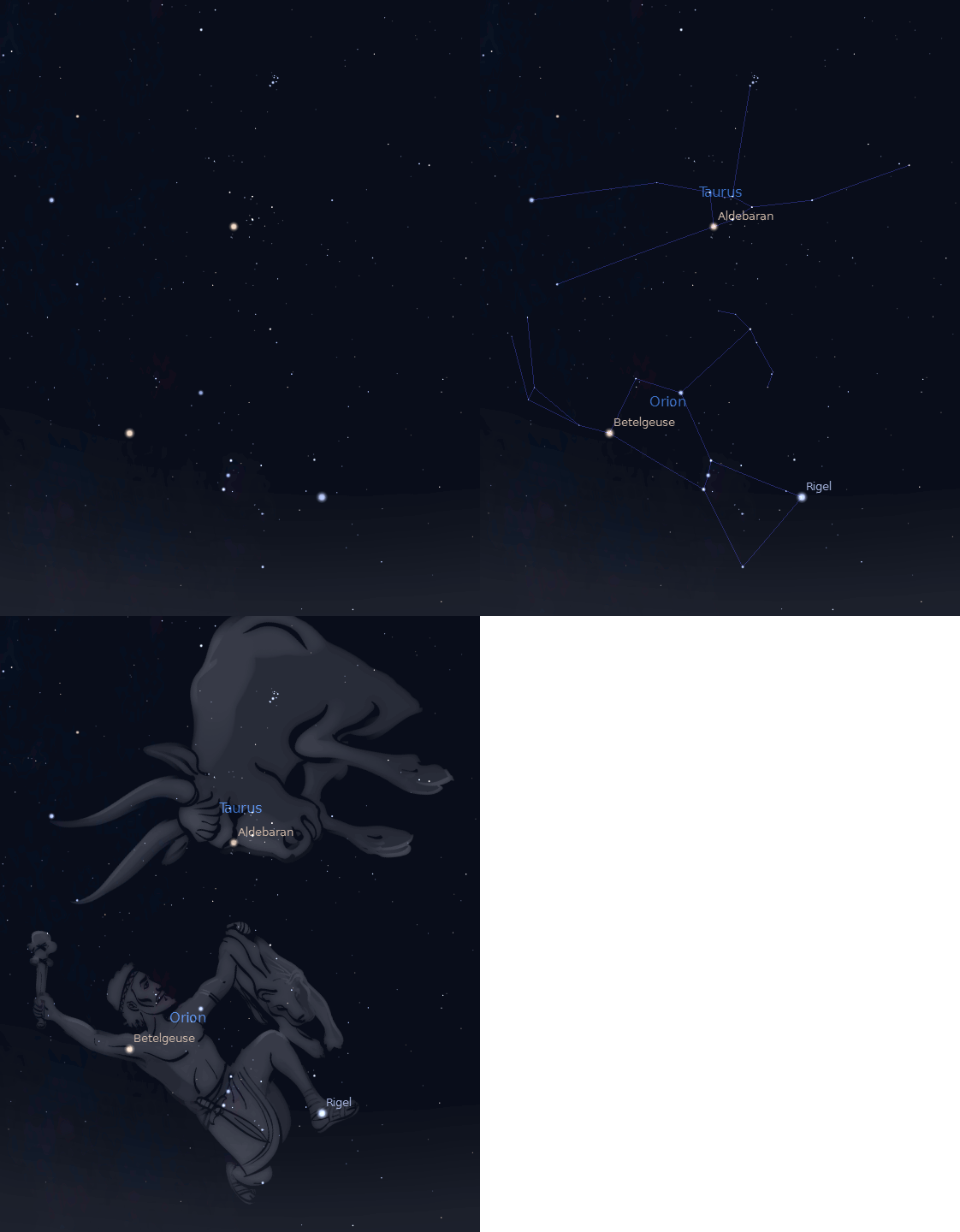
Three views of Taurus the bull and Orion the hunter for 9 p.m. on December 8, 2015. Created using Stellarium and GIMP.
10/30/2015 – Ephemeris – The spookiest star
Ephemeris for Friday, October 30th. The Sun will rise at 8:17. It’ll be up for 10 hours and 16 minutes, setting at 6:34. The Moon, 3 days past full, will rise at 9:33 this evening.
Tomorrow night is the spookiest night of the year, so lets look at the spookiest star of all. It’s Algol, from Ghoul Star or Demon Star. The Chinese had a name for it that meant ‘piled up corpses’. It’s the second brightest star in the constellation Perseus the hero, rising in the northeast this evening. The star is located where artists have drawn the severed head of Medusa, whom he had slain. Medusa was so ugly that she turned all who gazed upon her to stone. Algol is her still glittering eye. Astronomers finally found out what was wrong with Algol. It does a slow 6 hour wink every two days 21 hours, because it is two stars that eclipse each other. It winked this morning and it will again centered on 11:45 p.m. Sunday night.
Times are for the Traverse City/Interlochen area of Michigan. They may be different for your location.
Addendum
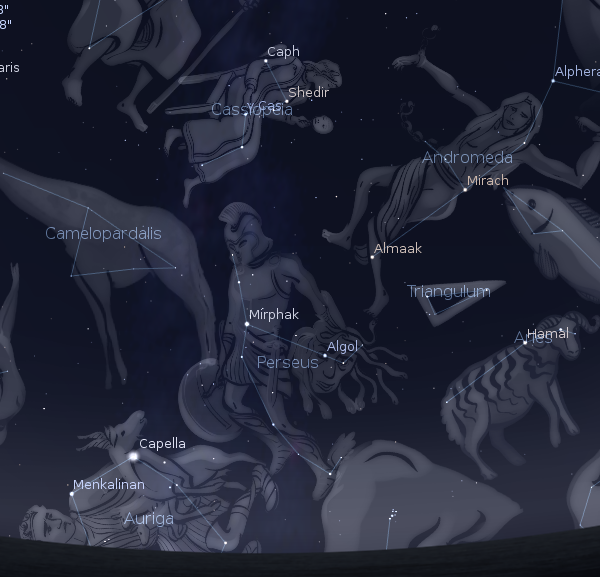
Algol at 7:30 p.m. on Halloween, in a modern portrayal. Created using Stellarium.
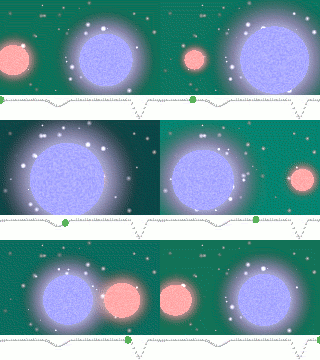
Animation of an eclipsing binary star like Algol. Credit: Wikimedia Commons h/t Earth and Sky
09/10/2015 – Ephemeris – Andromeda the chained maiden
Ephemeris for Thursday, September 10th. The Sun will rise at 7:15. It’ll be up for 12 hours and 47 minutes, setting at 8:03. The Moon, 3 days before new, will rise at 5:40 tomorrow morning.
In the east at 10 this evening can be found a large square of stars, the Great Square of Pegasus the flying horse. The square is standing on one corner. What look like its hind legs stretching to the left from the left corner star is another constellation, Andromeda the chained maiden. She is seen in the sky as two diverging curved strings of stars that curve upward. She was rescued by the hero Perseus, a nearby constellation, riding his steed Pegasus. Andromeda’s claim to astronomical fame is the large galaxy seen with the unaided eye just above the upper line of stars. The Great Andromeda Galaxy is two and a half million light years away. To the unaided eye the galaxy appears as a small smudge of light. In binoculars the galaxy is a delicate spindle of light. The galaxy is known as M31, the 31st object on Charles Messier’s list of fuzzy objects that aren’t comets.
Times are for the Traverse City/Interlochen area of Michigan. They may be different for your location.
Addendum
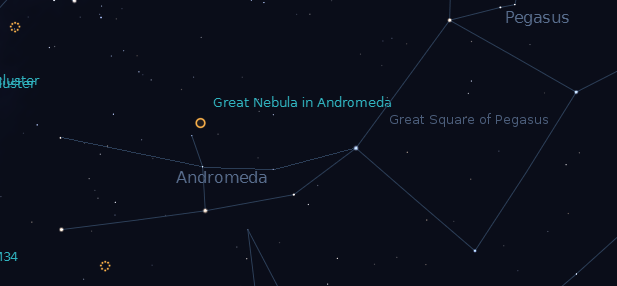
Andromeda at 10 p.m. with the Great Andromeda Galaxy. Created using Stellarium.
09/07/2015 – Ephemeris – Small summer constellations
Ephemeris for Labor Day*, Monday, September 7th. The Sun will rise at 7:11. It’ll be up for 12 hours and 56 minutes, setting at 8:08. The Moon, 2 days past last quarter, will rise at 2:47 tomorrow morning.
Located below the eastern edge of the Summer Triangle of three of the brightest stars in the sky, which is overhead in our sky at 10 p.m., is the tiny constellation of Delphinus the dolphin. Delphinus’ 6 stars in a small parallelogram with a tail, really does look like a dolphin leaping out of the water. The parallelogram itself has the name Job’s Coffin. The origin of this asterism or informal constellation is unknown. Of the dolphin itself: the ancient Greeks told stories of dolphins rescuing shipwrecked sailors. There’s another tiny constellation to the right of Delphinus, Sagitta the arrow a small thin group of 5 stars, which represents Cupid’s dart. Behind Sagitta binoculars will find a little star group called the Coat hanger.
Times are for the Traverse City/Interlochen area of Michigan. They may be different for your location.
Addendum
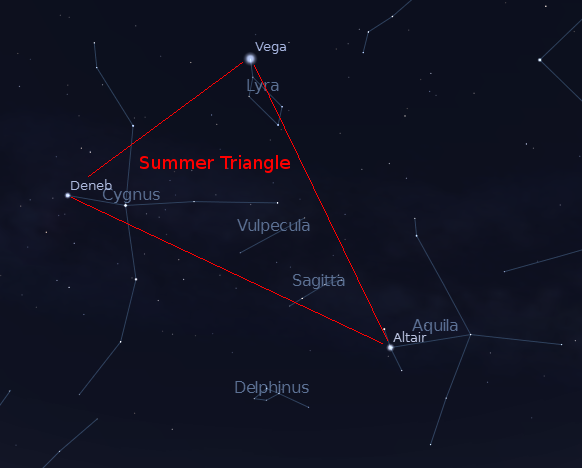
The Summer Triangle. Created using Stellarium and The Gimp.
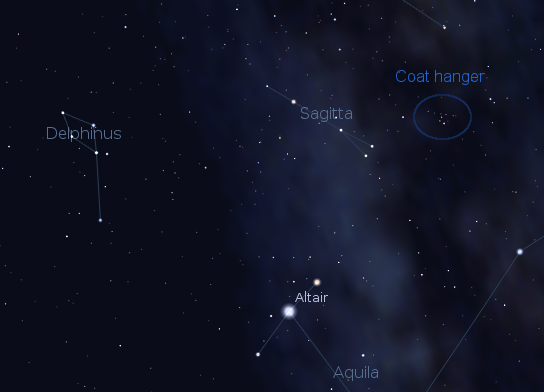
Delphinus, Sagitta and the Coat hanger. Diagram created using Stellarium.
* In the US Labor Day is celebrated on the first Monday in September and is considered the unofficial end of summer. The weather generally agrees. Last week we had a preview of fall weather. This week, except for today has been hot. The outlook for next week is looking decidedly cooler. Most schools in Michigan start the day after Labor Day. and end after June 1st. The unofficial start of summer is Memorial day, the last Monday in May.
08/17/2015 – Ephemeris – The celestial snake handler
Ephemeris for Monday, August 17th. The Sun rises at 6:47. It’ll be up for 13 hours and 58 minutes, setting at 8:45. The Moon, 3 days past new, will set at 10:04 this evening.
The planet Saturn and the red star Antares shine in the south-southwest at 10:30 p.m. In the and around constellation of Scorpius. In the area of sky above it lies a large constellation of faint stars called Ophiuchus, the serpent bearer. The constellation shape is like a large bell, which reminds me of the head, shoulders and arms of a fellow that’s holding the snake-like a weight lifter pulling up a heavy bar bell. The serpent he’s holding is Serpens, the only two part constellation in the heavens. The head rises to Ophiuchus’ right and the tail extends up to the left. In legend Ophiuchus was a great physician, educated by the god Apollo, and the centaur Chiron, also found in the stars as Sagittarius, below and left of him.
Times are for the Traverse City/Interlochen area of Michigan. They may be different for your location.
Addendum
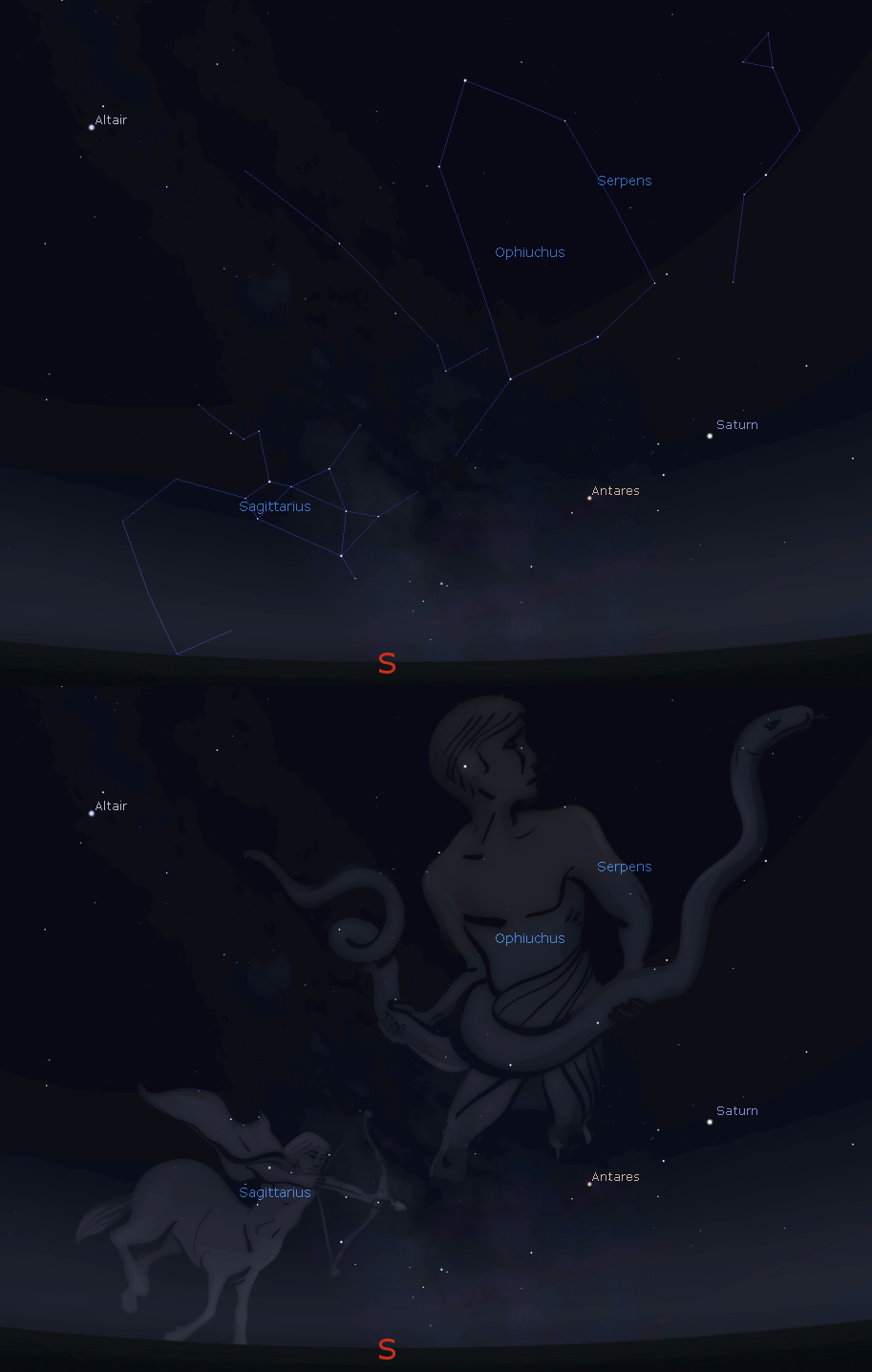
Ophiuchus, Serpens and Sagittarius with Saturn and Antares on August 17, at 10 p.m. Created using Stellarium.
08/13/2015 – Ephemeris – The constellation Sagittarius, toward the heart of the Milky Way
Thursday, August 13th. The Sun rises at 6:42. It’ll be up for 14 hours and 9 minutes, setting at 8:52. The Moon, 1 day before new, will rise at 6:48 tomorrow morning.
The Milky Way runs from north to south through the heavens at 11 p.m. You’ll notice that the Milky Way is brighter and broader just above the horizon in the south. In that glow in the south is a star pattern that looks like the stout little teapot of the children’s song, with a the Milky way like steam rising from the spout, which faces the west. This pattern of stars is the major part of the constellation called Sagittarius. According to Greek mythology Sagittarius is a centaur with a bow and arrow poised to shoot Scorpius the scorpion to the right. This centaur is called Chiron, the most learned of the breed, centaurs usually being a rowdy bunch. The center of the pin wheel of our galaxy lies hidden beyond the stars above the spout of the teapot.
Times are for the Traverse City/Interlochen area of Michigan. They may be different for your location.
Addendum
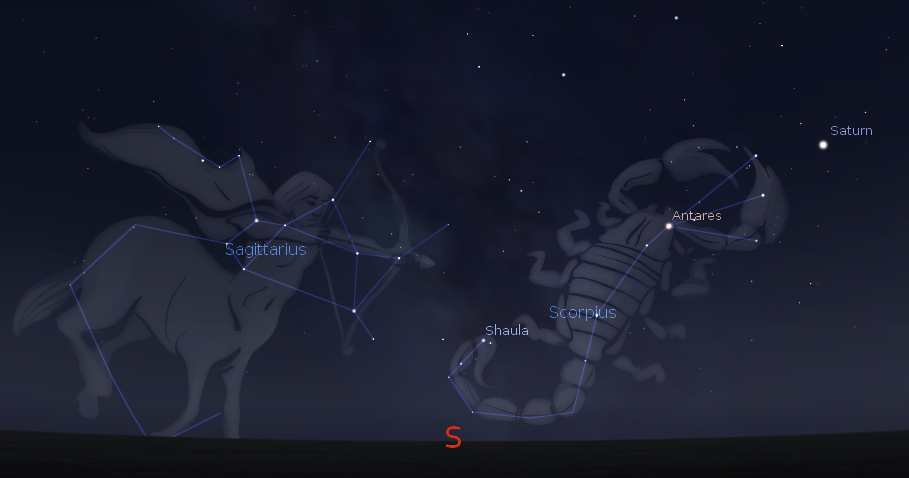
Sagittarius and Scorpius mythological view 10 p.m. August 13, 2015. Created using Stellarium.
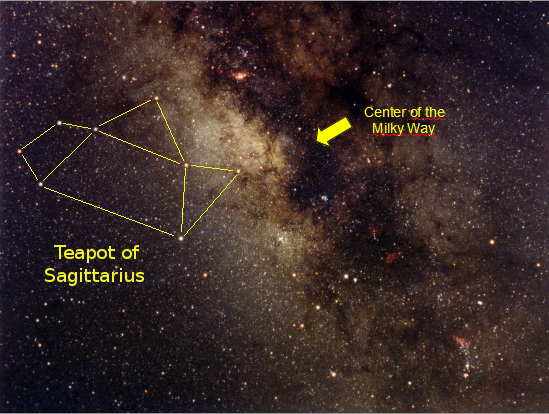
Location of the center of the Milky Way and the Teapot of Sagittarius.
08/06/2015 – Ephemeris – There’s an eagle in the stars
Ephemeris for Thursday, August 6th. The Sun rises at 6:34. It’ll be up for 14 hours and 27 minutes, setting at 9:02. The Moon, at last quarter today, will rise at 12:46 tomorrow morning.
The southernmost star in the Summer Triangle of three bright stars is Altair, high in the south-southeast in the evening. It’s in the head of the constellation Aquila the Eagle. Altair is flanked by two stars, the eagle’s shoulders, and farther out are the wing tips. Other stars to the lower right are in its body and a last three in its tail. Near the tail binoculars will show a fuzzy spot that telescopes show as a compact star cluster, sometimes called the Wild Duck Cluster for its nearly triangular shape. Aquila is flying northeastward through the Milky Way, where it is split in two by a cloud of gas and dust. According to mythology the Trojan boy Ganymede was taken to heaven at the behest of the god Zeus by this eagle.
Times are for the Traverse City/Interlochen area of Michigan. They may be different for your location.
Addendum
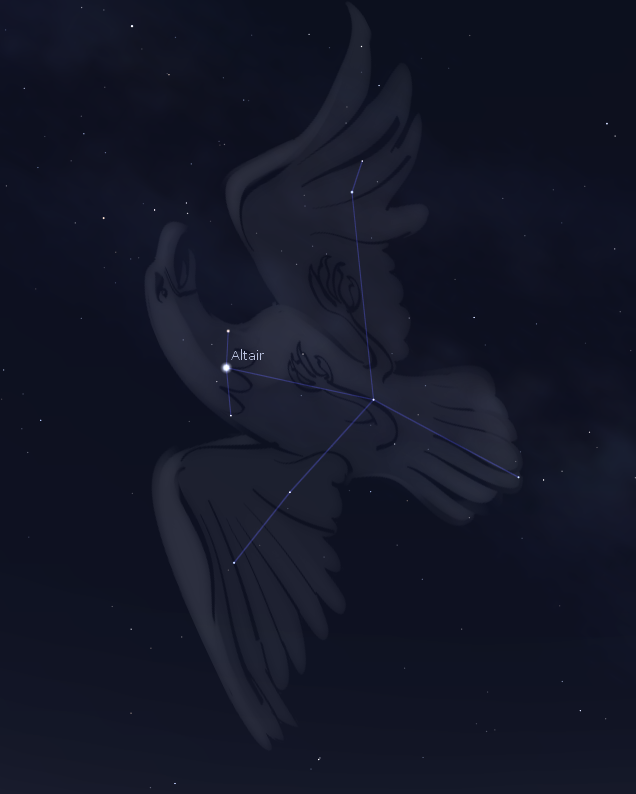
Aquila the Eagle in the southeastern sky. Created using Stellarium.
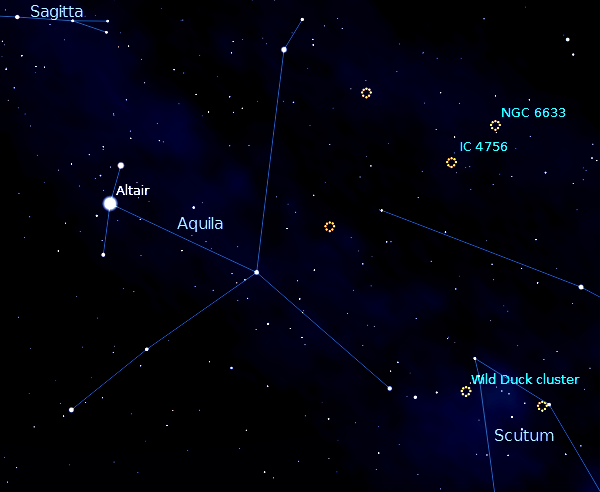
Finder chart for M11, the Wild Duck Cluster, Created using Stellarium.
08/04/2015 – Ephemeris – Is it a swan or a cross?
Ephemeris for Tuesday, August 4th. The Sun rises at 6:32. It’ll be up for 14 hours and 32 minutes, setting at 9:04. The Moon, 2 days before last quarter, will rise at 11:33 this evening.
High in the east northeast as it gets dark flies the constellation of Cygnus the swan. This constellation is also known as the Northern Cross. The cross is seen lying on its side with the bright star Deneb at the head of the cross to the left. The rest of the cross is delineated in the stars to the right. As a swan, Deneb is the tail, the stars of the crosspiece of the cross are part of the leading edges of the wings as Cygnus flies south through the Milky Way. There are faint stars that also define the tips and trailing edges of its wings. It is a very good portrayal of a flying swan, like the mute swans we see on the wing in our area. This is the form the Greek god Zeus took to seduce the maiden Leda in the Leda and the swan affair, out of whose union Pollux was born, who was the twin of Castor, both of whom are also in the stars as the constellation Gemini. In Cygnus we are looking toward the direction that the Sun and the Earth are traveling as we orbit the center of the Milky Way.
Times are for the Traverse City/Interlochen area of Michigan. They may be different for your location.
Addendum
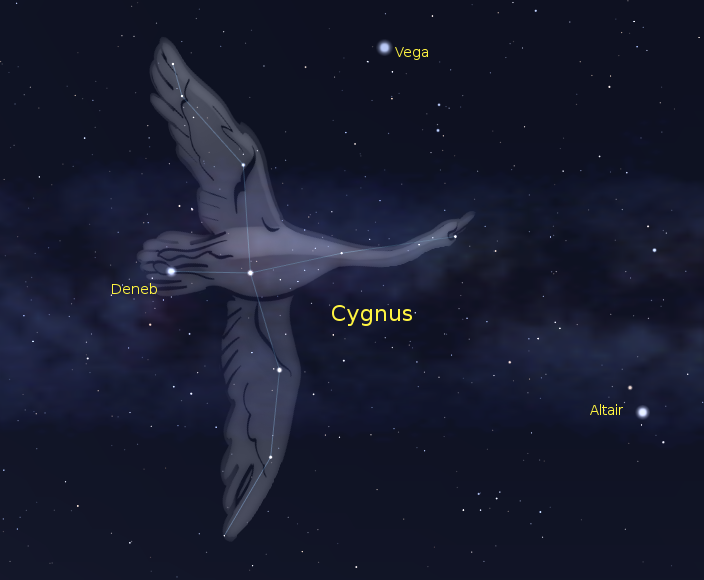
Cygnus The Swan Created using Stellarium.
Note for telescope owners: The star that appears in the eye of the swan image above is Alberio (β Cygni), which splits into a beautiful binary star, whose component stars are blue and gold. It takes a bit more magnification than a pair of binoculars provides.
Note also the mythological citation in the program was omitted from the broadcast version due to time constraints.
07/17/2015 – Ephemeris – The constellation of the harp now and Venus and the Moon tomorrow night.
Ephemeris for Friday, July 17th. Today the Sun will be up for 15 hours and 11 minutes, setting at 9:24. The Moon, 2 days past new, will set at 10:07 this evening, and tomorrow the Sun will rise at 6:14.
High in the east at 11 p.m. can be found a bright star just above a small, narrow, but very distinctive parallelogram of stars. They are the stars of the constellation Lyra the harp. The bright star is Vega, one of the twenty one brightest stars, called first magnitude stars. Vega is actually the 5th brightest night time star. The harp, according to Greek mythology, was invented by the god Hermes. The form of the harp in the sky, is as he had invented it: by stretching strings across a tortoise-shell. Hermes gave it to his half-brother Apollo, who in turn gave it to the great musician Orpheus.
Looking westward tomorrow night the planet Venus will appear about 2 moon widths above the crescent Moon.
Times are for the Traverse City/Interlochen area of Michigan. They may be different for your location.
Addendum
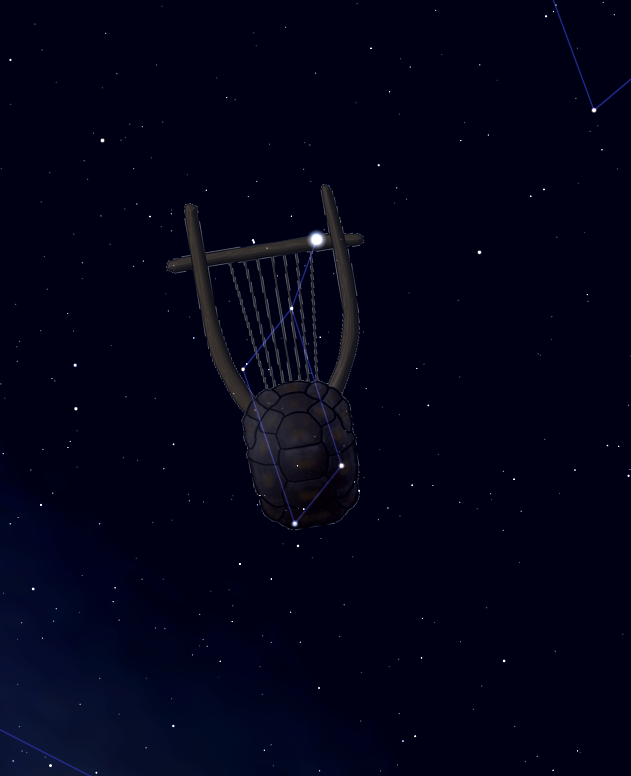
Lyra as a tortoise-shell harp. Created using Stellarium and free clip art.
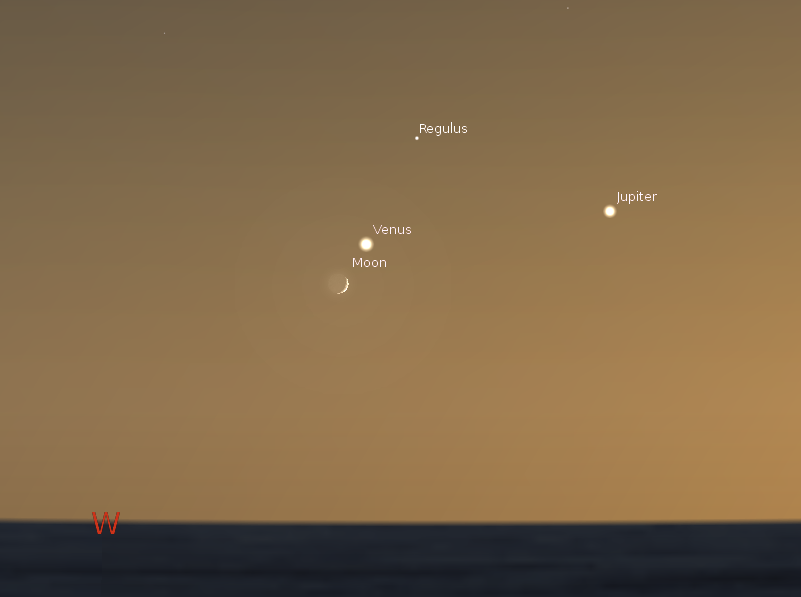
Venus appears above the thin crescent moon with Jupiter to the right at 10 p.m. Saturday July 18, 2015. Created using Stellarium.
 Bob Moler's Ephemeris Blog