Archive
08/16/2022 – Ephemeris – Scanning Sagittarius with binoculars
This is Bob Moler with Ephemeris for Tuesday, August 16th. Today the Sun will be up for 14 hours to the minute, setting at 8:46, and it will rise tomorrow at 6:47. The Moon, 3 days before last quarter, will rise at 11:15 this evening.
The Moon has left the evening sky, so let’s take another look at the constellation of Sagittarius. Its bright stars make a follow the dots image of a stout little teapot. In, around and above the teapot is a wealth of nebulae, which are clouds of gas and dust and clusters of stars. Stars are born in bunches from a cloud of gas. When enough stars are born, their stellar winds blow away the nebulosity leaving a star cluster. Use a pair of binoculars or a very low power telescope and just wander around and above the teapot, including and especially the spout on the right side. In binoculars, star clusters appear fuzzy like nebulae, however a small telescope with magnification of 20 times should resolve most of them.
The astronomical event times given are for the Traverse City/Interlochen area of Michigan (EDT, UT – 4 hours). They may be different for your location.
Addendum
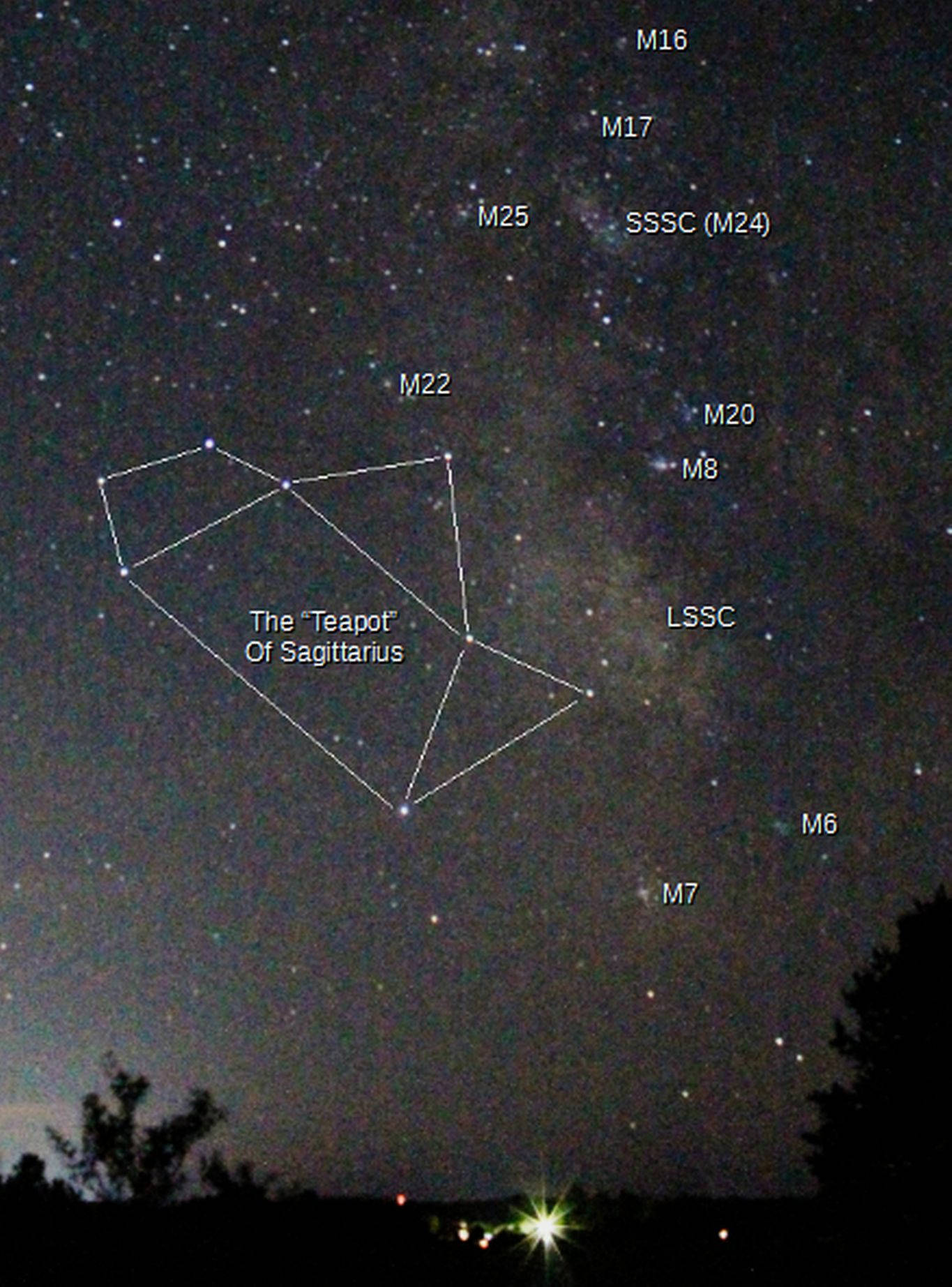
Sagittarius in a short time exposure with added annotations. The “M” designations are objects in Charles Messier’s catalog created in the latter half of the 18th century. LSSC is the Large Sagittarius Star Cloud, SSSC is the Small Sagittarius Star Cloud. Labels are to the right of the objects they name. Credit Bob Moler.
This is the short radio program version of the August 8, 2022, Ephemeris Extra post Wandering through Sagittarius
Ephemeris Extra – Wandering through Sagittarius
Sagittarius in a short time exposure with added annotations. The “M” designations are objects in Charles Messier’s catalog created in the latter half of the 18th century. LSSC is the Large Sagittarius Star Cloud, SSSC is the Small Sagittarius Star Cloud. Credit Bob Moler.
Sagittarius is seen low in the south in August. It’s between Scorpius to the west, and Capricornus, rising in the southeast. The name Sagittarius simply means archer. It doesn’t describe the fact that the archer isn’t just any old bloke with a bow and arrow, but is, indeed, a centaur, one of the two in the list of constellations. The other, Centaurus, is too far south to be seen from Michigan. And whose brightest star, Alpha Centauri, is in the closest star system to our solar system.
Centaurs, as a rule, were a rowdy bunch, the ancient Greek equivalent to a modern motorcycle gang. However, the centaur depicted by Sagittarius can be thought to be Chiron, though it can also be ascribed to Centaurus. Chiron was learned, a teacher and physician. I’ve noticed that in some artist’s depictions of Chiron, he is teaching Achilles how to use the bow and arrow. He also taught medicine to Asclepius, the great physician, who is seen in the heavens as the constellation Ophiuchus, above and right of Sagittarius.
What most of us see in the stars here is maybe a bow drawn to shoot at the heart of Scorpius, or a stout little teapot as in the children’s song. It even has the Milky Way seeming to rise from the spout like steam. The teapot rises in the southeast as if standing upright, and as the night wears on, it rises and move westward, slowly tilting to pour out its tea on the southwestern horizon.
The area of Sagittarius and the Milky Way is a fantastic part of the sky to explore with binoculars or a low power telescope on moonless nights. At the head of this post is a photograph of Sagittarius and the Milky Way taken from my home, with lines and labels. It’s somewhat spoiled by the sky glow from Chum’s Corner, a small commercial center 3.6 miles away, from the lower left. Most binoculars will show open or galactic star clusters as fuzzy spots like nebulae, which are fuzzy because they are clouds. The older globular star clusters require larger amateur telescopes to resolve.
I’ve only pointed out one in the image, that’s M22, whose designation, we have fun with at star parties at the Sleeping Bear Dunes National Lakeshore, since the road M22 runs through the park. Which came first? That’s easy, Charles Messier cataloged his 22nd object before Michigan was a state or even had roads. Well, maybe there were a few, around Detroit and Sault Ste. Marie, back when the major “roads” were the Great Lakes, and the rest Indian trails.
A telescope, even a small one, will resolve open clusters, showing individual stars. Telescopes will show the shapes of nebulae if they are bright enough.
One nebula with a distinctive shape is M17. The descriptive name I first knew it as was the Omega Nebula, and also the Horseshoe Nebula. To me, it never looked like either. It looked like a check mark, or a somewhat short necked swan. And it also goes by those names too. The planetarium program I use a lot, Stellarium, also calls it the Lobster nebula. I’m not much for seafood, but it doesn’t look like a lobster, or maybe I’m not hungry enough.
M16, is the Eagle Nebula. It has an associated star cluster. My eyes are drawn to the star cluster. The nebulosity is very faint, and I usually can’t see it. Part of the nebula was famously photographed by the Hubble Space Telescope and called the Pillars of Creation. In actuality, they are the Pillars of Destruction as they are being blown away by the stellar winds of the star cluster.
M8 is the Lagoon Nebula, it also has an associated star cluster. In telescopes, it is crossed by a narrow dust cloud suggestive of a lagoon. Nearby M20 is the Trifid nebula, which has a low surface brightness and can easily be missed. It is crossed by three narrow dust clouds dividing it into three, or on closer inspection, four wedges.
These just scratch the surface. So with or without optical aid wander through the celestial wonders and star clouds of Sagittarius. You have August and September to do it in the evening before they set for another year.
Based on an article I wrote for the August 2022 issue of the Stellar Sentinel, the Newsletter of the Grand Traverse Astronomical Society.
07/19/2022 – Ephemeris – How to find the constellations of the man with the snake
This is Ephemeris for Tuesday, July 19th. Today the Sun will be up for 15 hours and 7 minutes, setting at 9:22, and it will rise tomorrow at 6:16. The Moon, 1 day before last quarter, will rise at 12:52 tomorrow morning.
The red star Antares shines in the south at 11 pm, in the constellation of Scorpius. In the area of sky above lies a large constellation of faint stars called Ophiuchus, the serpent bearer. The constellation shape is like a large tilted bell, which reminds me of the head, shoulders and arms of a fellow that’s holding the snake, like a weight lifter pulling up a heavy barbell. The serpent he’s holding is Serpens, the only two-part constellation in the heavens. The head rises to Ophiuchus’ right, and the tail extends up to the left. In Greek legend Ophiuchus represents a great physician, educated by the god Apollo, and the centaur Chiron, who is also found in the stars as Sagittarius, now rising in the south-southeast below and left of him.
The astronomical event times given are for the Traverse City/Interlochen area of Michigan (EDT, UT – 4 hours). They may be different for your location.
Addendum
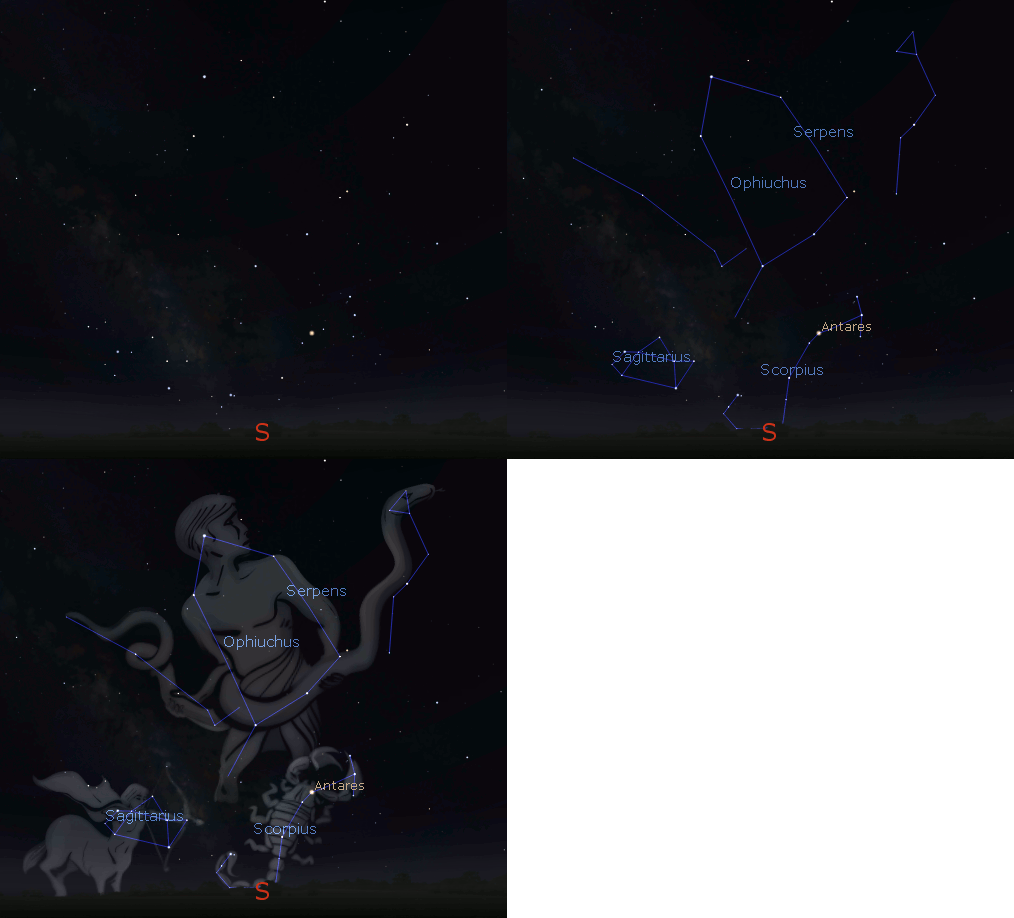
Ophiuchus finder animation for mid-July at 11 pm. Created using Stellarium and GIMP.
07/18/2022 – Ephemeris – How to find the celestial eagle
This is Bob Moler with Ephemeris for Monday, July 18th. Today the Sun will be up for 15 hours and 8 minutes, setting at 9:23, and it will rise tomorrow at 6:15. The Moon, 2 days before last quarter, will rise at 12:33 tomorrow morning.
Aquila the eagle is a constellation that lies in the Milky Way. It’s in the southeastern sky as it gets dark. Its brightest star, Altair, is one of the stars of the Summer Triangle, a group of three bright stars that dominate the eastern sky in the evening now. Altair, in the head of the eagle, is flanked by two slightly dimmer stars, the shoulders of the eagle. The eagle is flying northeastward through the Milky Way. Its wings are seen in the wing tip stars. A curved group of stars to the lower right of Altair is its tail. Within Aquila, the Milky Way shows many dark clouds as part of the Great Rift that splits it here. The other summer bird is Cygnus the swan above and left of Aquila, flying toward the eagle.
The astronomical event times given are for the Traverse City/Interlochen area of Michigan (EDT, UT – 4 hours). They may be different for your location.
Addendum
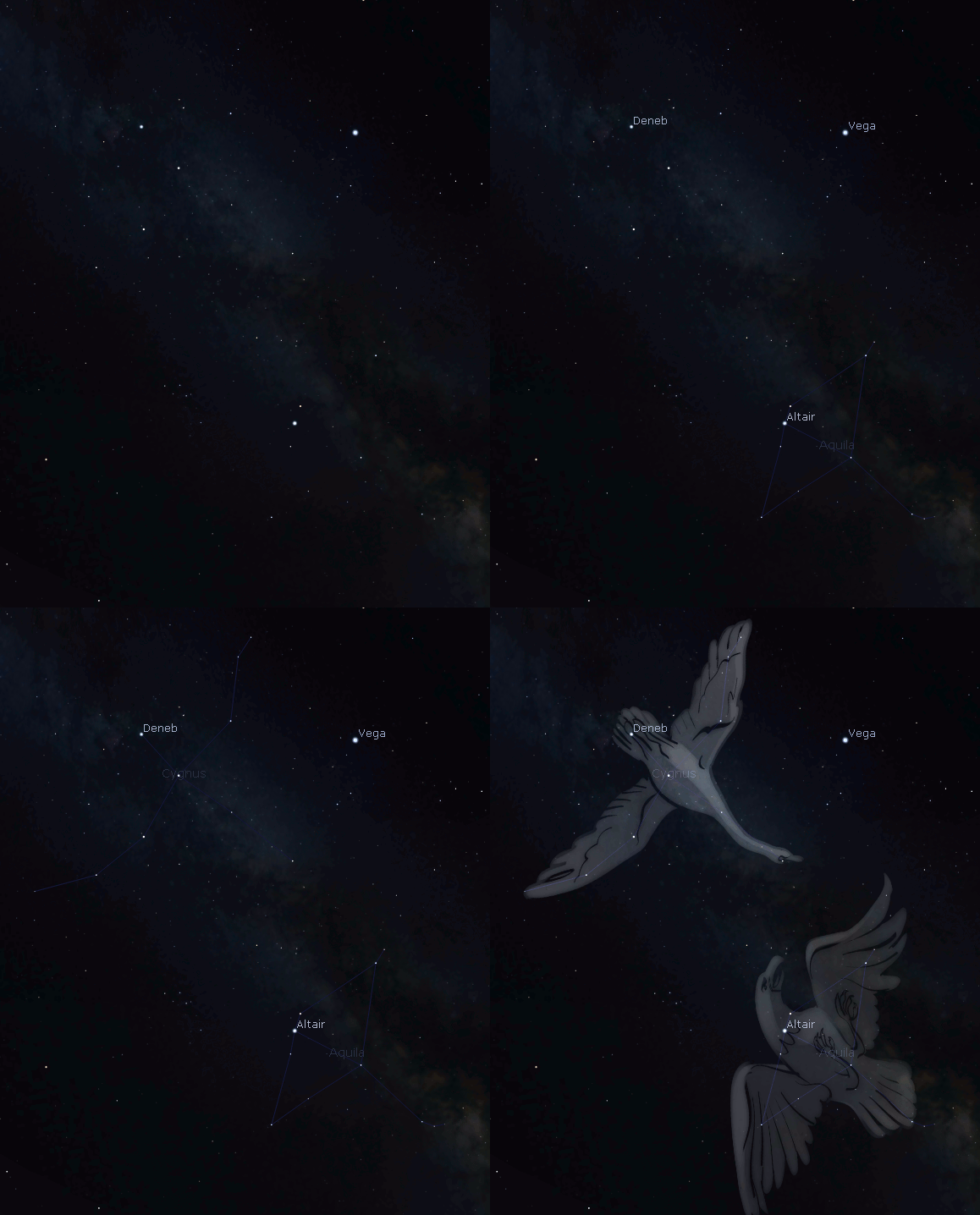
Animated Aquila finder chart, also showing Cygnus the swan. The named stars are the stars of the Summer Triangle. Created using Stellarium.
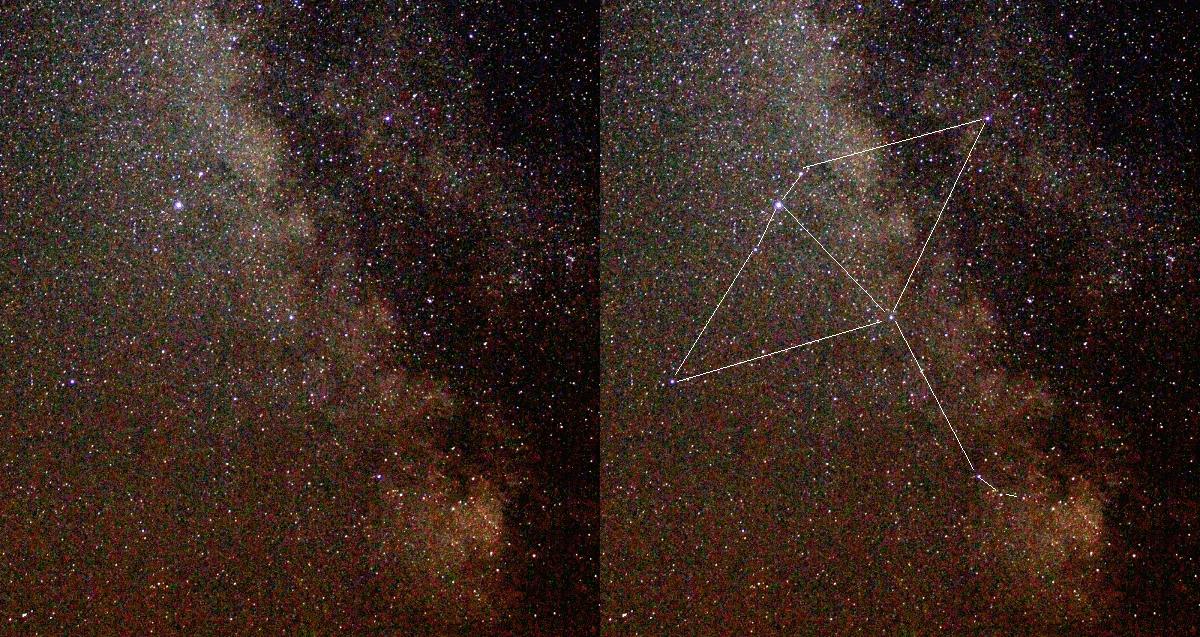
Annotated and animated photograph taken of Aquila August 13, 2018 during the Perseid meteor shower. Alas, no Perseids in this photograph. The clouds of the Great Rift are easily visible. The red tinge of the image was due to the smoke haze from the wildfires in the western states. Taken by me and processed using Registax and GIMP.
07/15/2022 – Ephemeris – How to find the constellation of Cygnus the swan
This is Ephemeris for Friday, July 15th. Today the Sun will be up for 15 hours and 14 minutes, setting at 9:25, and it will rise tomorrow at 6:12. The Moon, 2 days past full, will rise at 11:23 this evening.
Located fairly high in the east at 11 p.m. is the constellation of Cygnus the swan, flying south through the Milky Way. It is also called the Northern Cross. At the left, the tail of the swan or the head of the cross is the bright star Deneb, one of the stars of the Summer Triangle. The next star right is Sadr the intersection of the body and the wings of the swan seen in flight, or the intersection of the two pieces of the cross. There are two or three stars farther to the right that delineate the swan’s long neck or upright of the cross, that ends with the star Alberio in the beak of the swan or foot of the cross. The crosspiece of the cross extends to the stars on either side of the intersection star Sadr, while the swan’s wings extend to a couple more stars each.
The astronomical event times given are for the Traverse City/Interlochen area of Michigan (EDT, UT – 4 hours). They may be different for your location.
Addendum
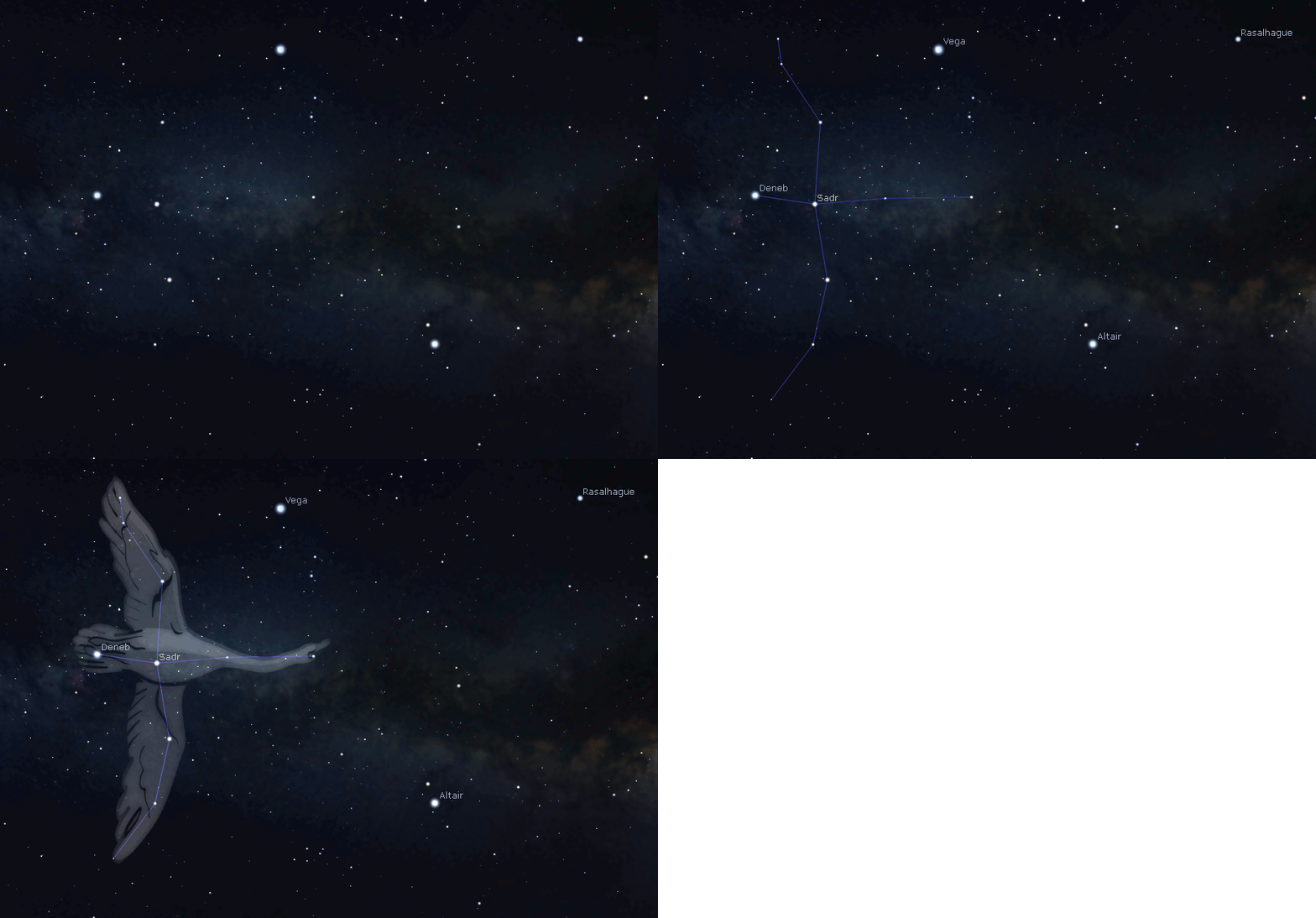
Animated Cygnus finder chart. Included also are, beside Deneb, the other stars of the Summer Triangle: Vega and Altair and their constellations Lyra the harp and Aquila. See if you can find them. Created using Stellarium.
06/28/2022 – Ephemeris – Finding the celestial harp
This is Ephemeris for Tuesday, June 28th. Today the Sun will be up for 15 hours and 32 minutes, setting at 9:32, and it will rise tomorrow at 6:00. The Moon is new today, and won’t be visible.
High in the east at 11 p.m. can be found a bright star just above a small, narrow, but very distinctive parallelogram of stars. They are the stars of the constellation Lyra the harp. The bright star is Vega, the 4th or 5th brightest nighttime star*, and currently the topmost star of the Summer Triangle. To the Romans, the star Vega represented a falling eagle or vulture. Apparently they never made the distinction between the two species. It is a pure white star and serves as a calibration star for color and brightness. In the evening, it is the top-most star of the Summer Triangle. The harp, according to Greek mythology, was invented by the god Hermes. The form of the harp, in the sky, is as he had invented it: by stretching strings across a tortoise shell. Hermes gave it to his half-brother Apollo, who in turn gave it to the legendary musician Orpheus.
The astronomical event times given are for the Traverse City/Interlochen area of Michigan (EDT, UT – 4 hours). They may be different for your location.
*Vega’s rival for the fourth spot on the brightness list is Arcturus to it’s west. Wikipedia’s source says that Arcturus is slightly brighter. Stellarium’s source says Vega is brighter. The difference is a few hundredths of a magnitude. However, they are of different colors. Vega is pure white, while Arcturus is yellow-orange because it has a cooler surface temperature than Vega. Check them out for yourself.
Addendum
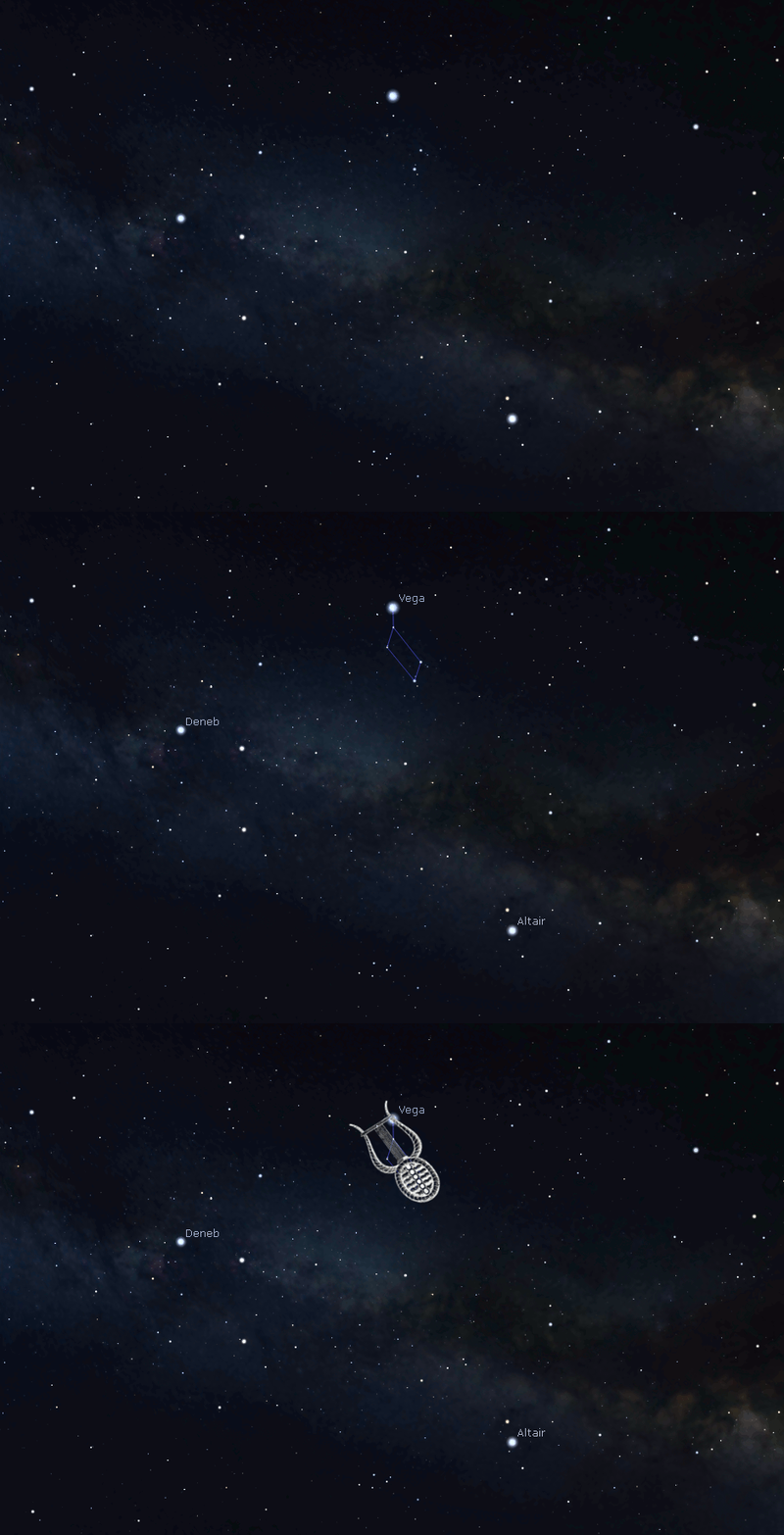
Animated Lyra finder chart. The lyre image not supplied by Stellarium but is from The World’s Earliest Music by Hermann Smith, Figure 60, A Project Gutenberg E-Book, and captioned “The Chelys or Greek Tortoiseshell Lyre”. The three names stars are the stars of the Summer Triangle in the eastern sky these evenings of late June. Created using Stellarium.
06/27/2022 – Ephemeris – Finding the Summer Triangle
This is Ephemeris for Monday, June 27th. Today the Sun will be up for 15 hours and 33 minutes, setting at 9:32, and it will rise tomorrow at 5:59. The Moon, 1 day before new, will rise at 5:13 tomorrow morning.
We’re nearly a week into summer, and the asterism or informal constellation called the Summer Triangle can be seen rising in the east as it gets dark. Highest of the three bright stars is Vega in the constellation Lyra the harp, whose body is seen in a narrow parallelogram nearby. The second star of the triangle is Deneb, in Cygnus the swan, lower and left of Vega, It appears dimmer than Vega because it is by far the most distant of the three. The third star of the Summer Triangle is seen farther below and a right of Vega. It is Altair in Aquila the eagle, and the closest. Altair is 16.5 light years away, Vega is 27 light years, while Deneb may be a whopping 2,600 light years away. One light year is 6 trillion miles (9 trillion kilometers).
The astronomical event times given are for the Traverse City/Interlochen area of Michigan (EDT, UT – 4 hours). They may be different for your location.
Addendum
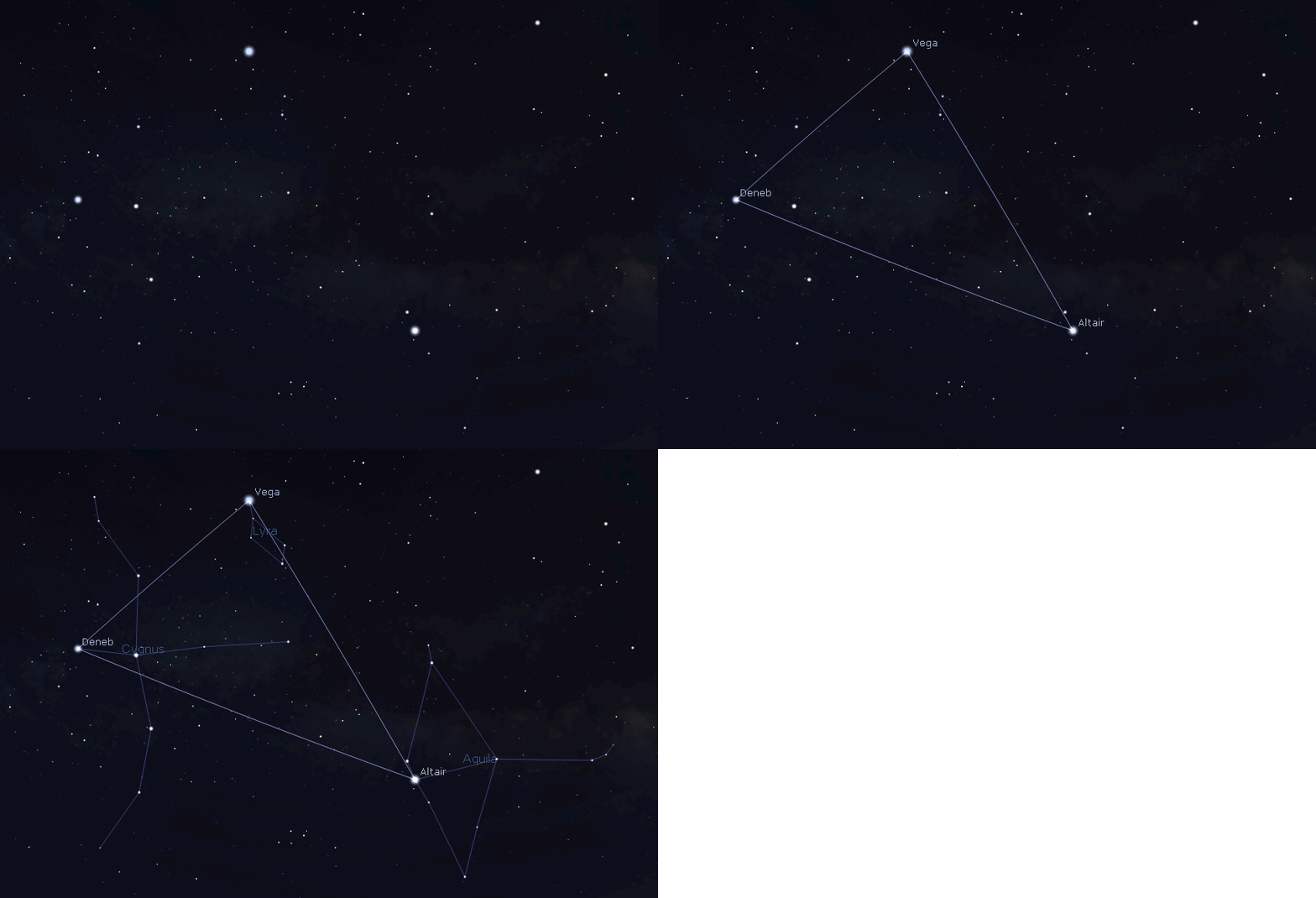
The Summer Triangle finder animation showing first the unlabeled sky, Then the Summer Triangle with the stars labeled, then the constellations of those stars. Created using Stellarium and GIMP.
06/24/2022 – Ephemeris – Finding the greatest celestial hero: Hercules
This is Ephemeris for Friday, June 24th. Today the Sun will be up for 15 hours and 34 minutes, setting at 9:32, and it will rise tomorrow at 5:58. The Moon, halfway from last quarter to new, will rise at 3:31 tomorrow morning.
Orion, the hard luck mythical Greek hunter, gets a splashy constellation in the winter sky, but the greatest hero of all, Hercules, gets a dim group of stars on the border between the spring and summer stars. At 11 p.m. Hercules is high in the southeast. It is located right of the bright star Vega, in the east. Hercules’ central feature is a keystone shaped box of stars, called, of course, the Keystone of Hercules tilted to the left, which represents the old boy’s shorts. From the top and left corner stars extend lines of stars that are his legs, from the bottom and right stars, the rest of his torso and arms extend. So in one final indignity, he’s upside down in our sky. For those with a telescope, Hercules contains the beautiful globular star cluster Messier 13.
The astronomical event times given are for the Traverse City/Interlochen area of Michigan (EDT, UT – 4 hours). They may be different for your location.
Addendum
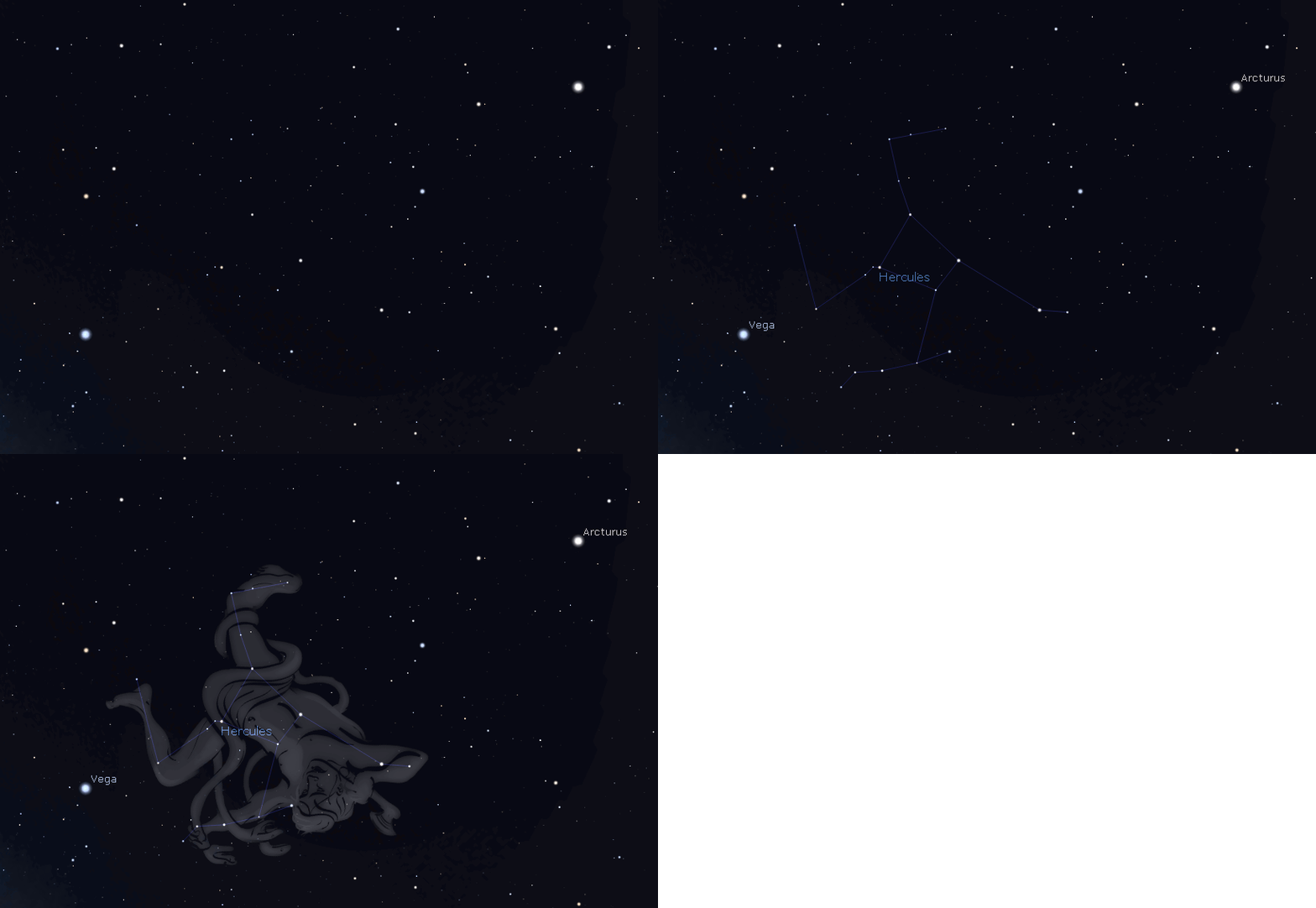
Hercules animation showing neighboring stars at 11 p.m. for mid-June. Click on image to enlarge. Created using Stellarium.
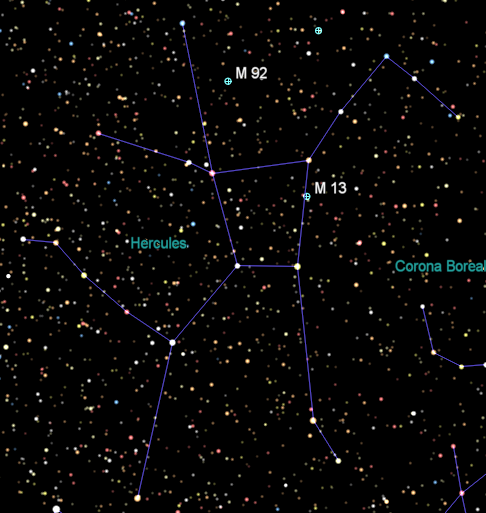
Hercules with all the stars visible in binoculars and its two globular star clusters: M13 and M92. M13 is almost bright enough to be spotted with the naked eye. It is easily visible in binoculars as a tiny fuzzy spot. It takes a telescope with an aperture of 6 – 8″ or 150 – 200 mm to begin to see some individual stars. M92 is dimmer and harder to resolve. Created using Cartes du Ciel (Sky Charts).
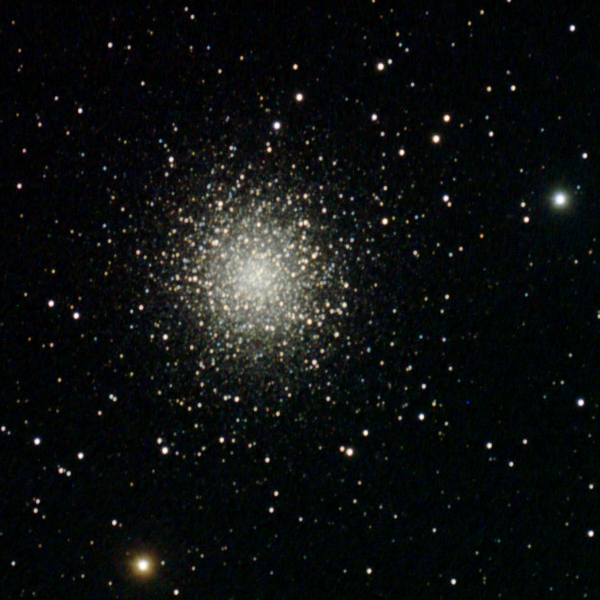
M 13, the Great Globular Star Cluster in Hercules. Credit: Scott Anttila.
06/23/2022 – Ephemeris – Corona Borealis, the Northern Crown
This is Ephemeris for Thursday, June 23rd. Today the Sun will be up for 15 hours and 34 minutes, setting at 9:32, and it will rise tomorrow at 5:58. The Moon, 3 days past last quarter, will rise at 3:08 tomorrow morning.
High in the south at 11 this evening can be seen a small nearly circular constellation of Corona Borealis, the Northern Crown. It is just left of Boötes, the kite shaped constellation off the handle of the Big Dipper. According to Greek myth, the crown was given by the gods to the princess Ariadne, daughter of King Minos of Crete. The crown is more like a tiara with the bright star Alphecca at the front. To the Anishinaabe people, who are native to our region, it is the Sweat Lodge. Part of what we call Hercules next to it is the Exhausted Bather, who is lying on the ground after the ceremony. The seven stones that are heated for the Sweat Lodge ceremony are the Pleiades, now close to Venus in the morning twilight.
The astronomical event times given are for the Traverse City/Interlochen area of Michigan (EDT, UT – 4 hours). They may be different for your location.
Addendum
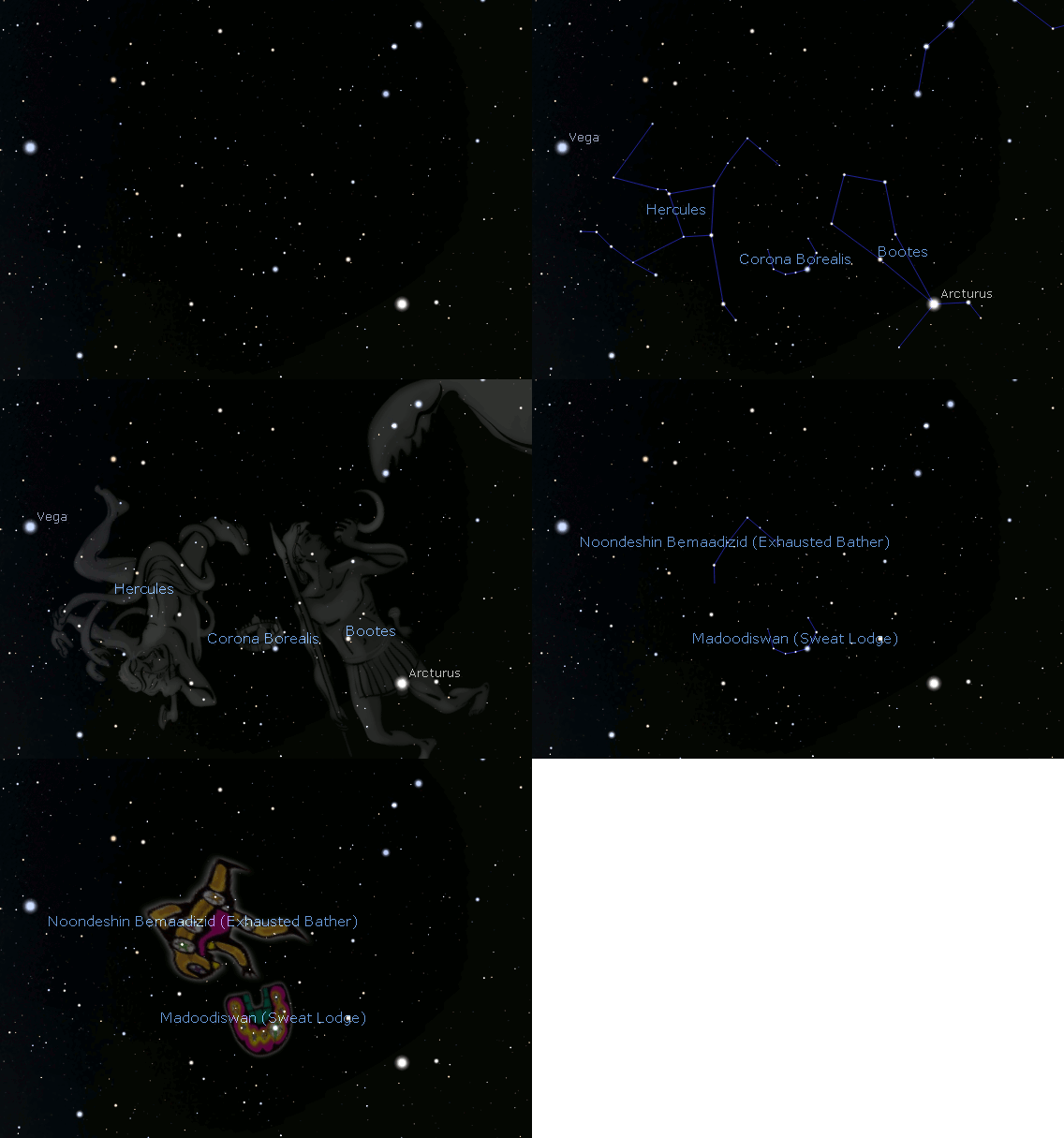
Corona Borealis and Sweat Lodge finder animation. Looking high in the south at 11 pm, June 23rd. The tail of Ursa Major or the handle of the Big Dipper is in the upper right. Created using Stellarium and GIMP. Both star lore images are embedded in Stellarium. The Anishinaabe images are embedded in Stellarium and is from Ojibwe Giizhig Anung Masinaaigan – Ojibiwe Sky Star Map created by A. Lee, W. Wilson, and C. Gawboy.
05/20/2022 – Ephemeris – Spring constellations: Corvus the crow
This is Bob Moler with Ephemeris for Friday, May 20th. Today the Sun will be up for 15 hours even, setting at 9:09, and it will rise tomorrow at 6:08. The Moon, 2 days before last quarter, will rise at 2:23 tomorrow morning.
The small constellation of Corvus the crow is located low in the south at 10:30 this evening. It’s made of 6 dim stars, but the pattern is a distinctive but distorted box with two stars at the upper left marking that corner, and another two marking the lower right corner. I usually don’t notice the extra star at these corners, which denote the wings of this crow in flight to the upper right. To me the box is distinctive enough. It’s pretty much alone below Virgo and its bright star Spica, left an above it. I don’t see a crow here, but the box is distinctive in that no two sides are parallel. In the US we call the shape a trapezium, the British call it a trapezoid. Anyway it is a very memorable shape, at least to me.
The astronomical event times given are for the Traverse City/Interlochen area of Michigan (EDT, UT – 4 hours). They may be different for your location.
Addendum
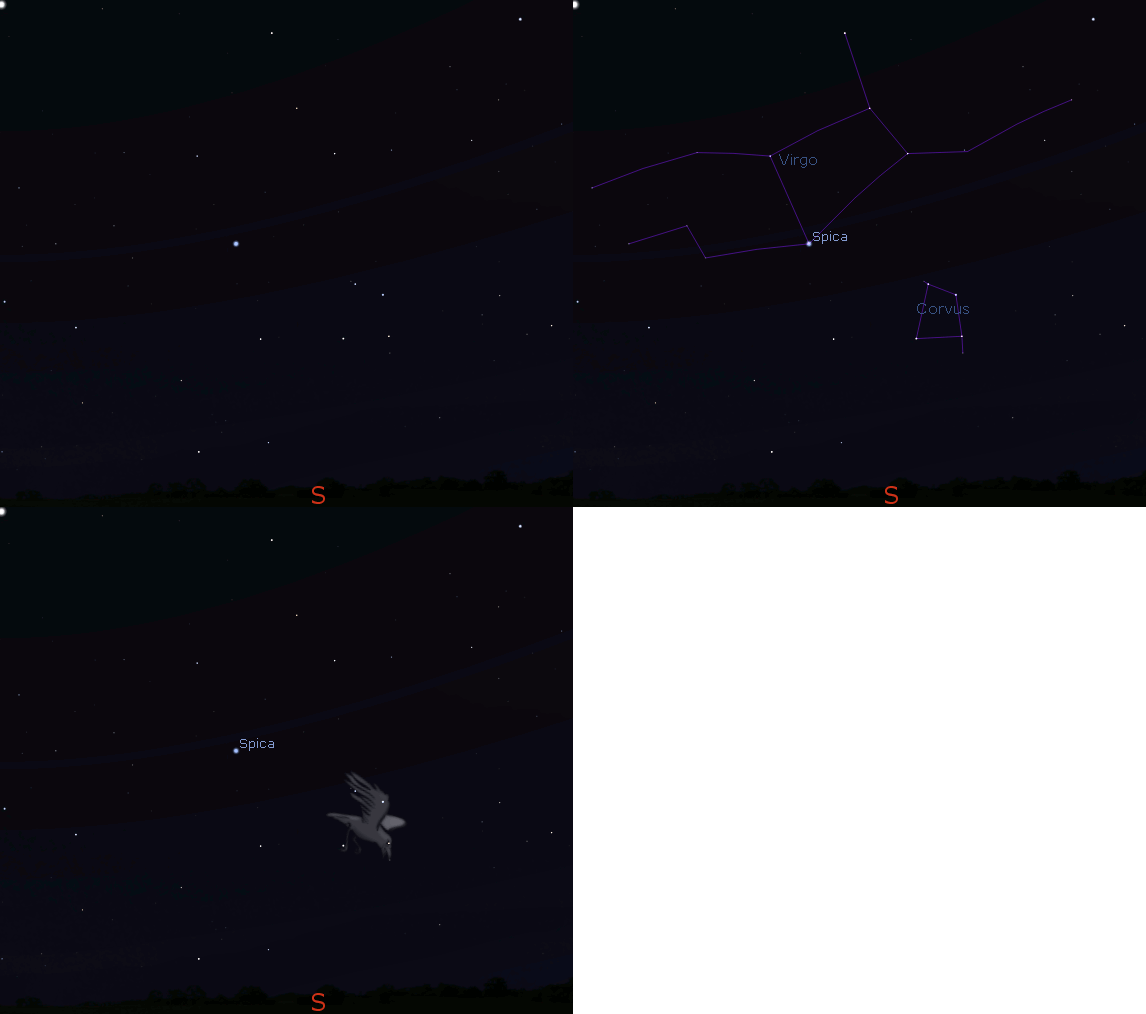
Corvus the crow finder animation for 10:30 pm, May 20th. My visualization of the crow flying to the upper right doesn’t match the one the artist drew in this depiction. There’s no right or wrong. Created using Stellarium and GIMP.
 Bob Moler's Ephemeris Blog