Archive
01/25/2019 – Ephemeris – Let’s find Orion’s hunting dogs
Ephemeris for Friday, January 25th. Today the Sun will be up for 9 hours and 32 minutes, setting at 5:41, and it will rise tomorrow at 8:08. The Moon, 2 days before last quarter, will rise at 11:27 this evening.
The great winter constellation or star group Orion the Hunter, is located in the south-southeastern sky at 9 p.m. His elongated rectangle of a torso is tilting toward the vertical. In the center of the rectangle are three stars in a line that make his belt. As a hunter, especially one of old, he has two hunting dogs. The larger, Canis Major can be found by following the three belt stars of Orion down and to the left. There lies the brilliant star called Sirius, also known as the Dog Star. It’s in the heart of a stick figure dog low in the southeast facing Orion that appears to be begging. Canis Minor is just two stars found by extending Orion’s shoulder stars eastward where we find bright Procyon, the little dog star.
The times given are for the Traverse City/Interlochen area of Michigan. They may be different for your location.
Addendum
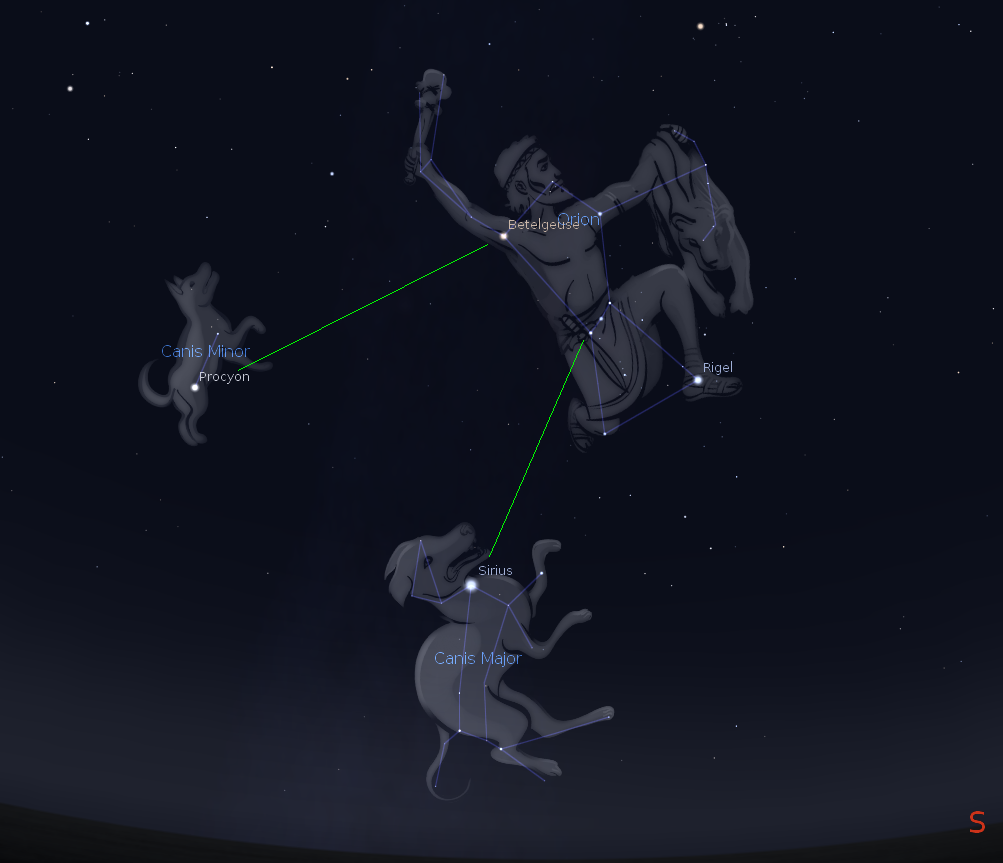
Orion and his hunting dogs with pointers as seen at 9 p.m. in late January . Created using Stellarium.
01/24/2019 – Ephemeris – Taurus the bull
Ephemeris for Thursday, January 24th. Today the Sun will be up for 9 hours and 29 minutes, setting at 5:40, and it will rise tomorrow at 8:09. The Moon, half way from full to last quarter, will rise at 10:14 this evening.
Midway up the sky in the southeast at 8 p.m. is the constellation of the giant hunter Orion. Above him, to the right is Taurus the bull. His face is a letter V shape of stars lying on its side, the star cluster Hyades, with the bright orange-red star Aldebaran at one tip of the V as its angry blood-shot eye, but actually about half way between us and the cluster. Orion is depicted in the sky facing, with club in one hand and a shield in the other, the charging Taurus. The Pleiades star cluster is in his shoulder. Taurus in Greek mythology was the form the god Zeus when he carried off the maiden Europa. Europa’s still with him as the intriguing satellite orbiting Zeus’ Roman equivalent the planet Jupiter.
The times given are for the Traverse City/Interlochen area of Michigan. They may be different for your location.
Addendum
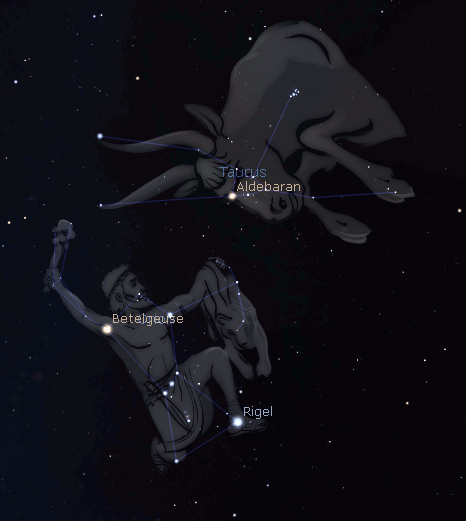
Taurus and Europa at 8 p.m. January 24, 2019. Created using Stellarium.
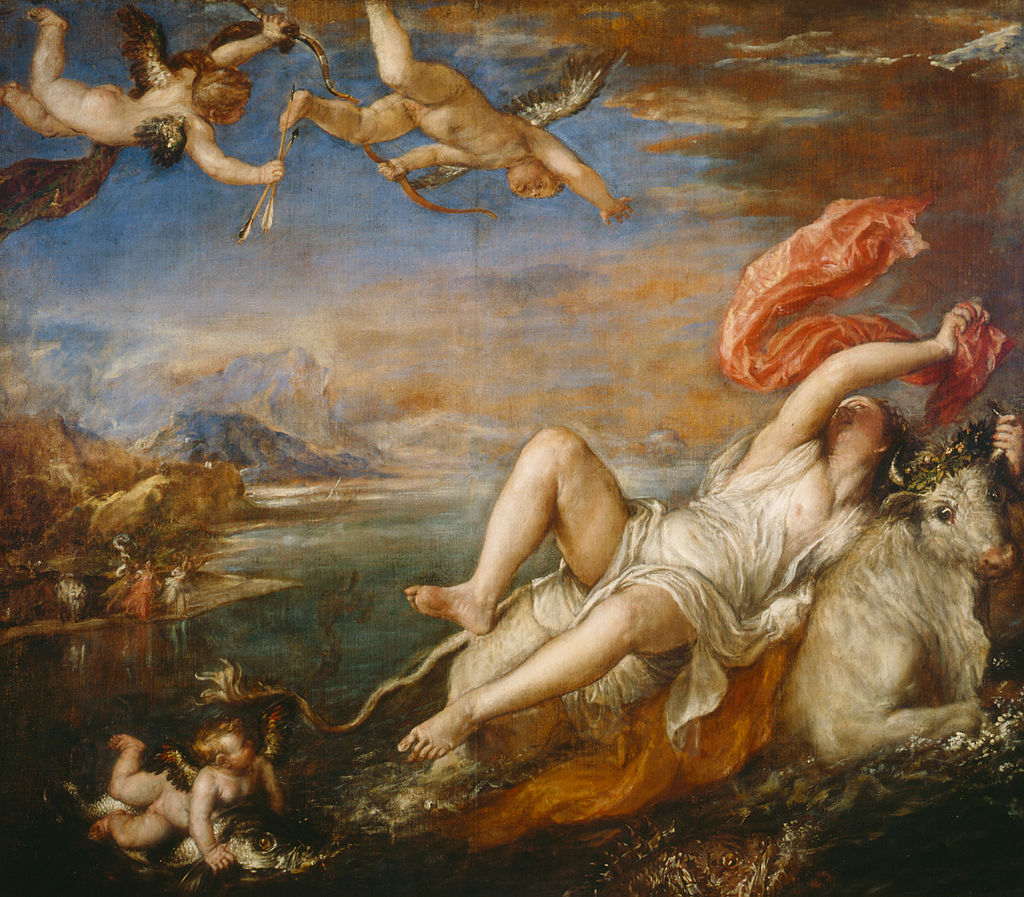
The Rape of Europa by Titian. According to the story Zeus as a bull abducted Europa and swam to Crete, where she became the first queen of that island, and bore him three sons. Other paintings of this subject are by Rembrandt and de Troy. This painting belongs to the Isabella Stewart Gardener Museum in Boston, MA. Click on the image to enlarge.
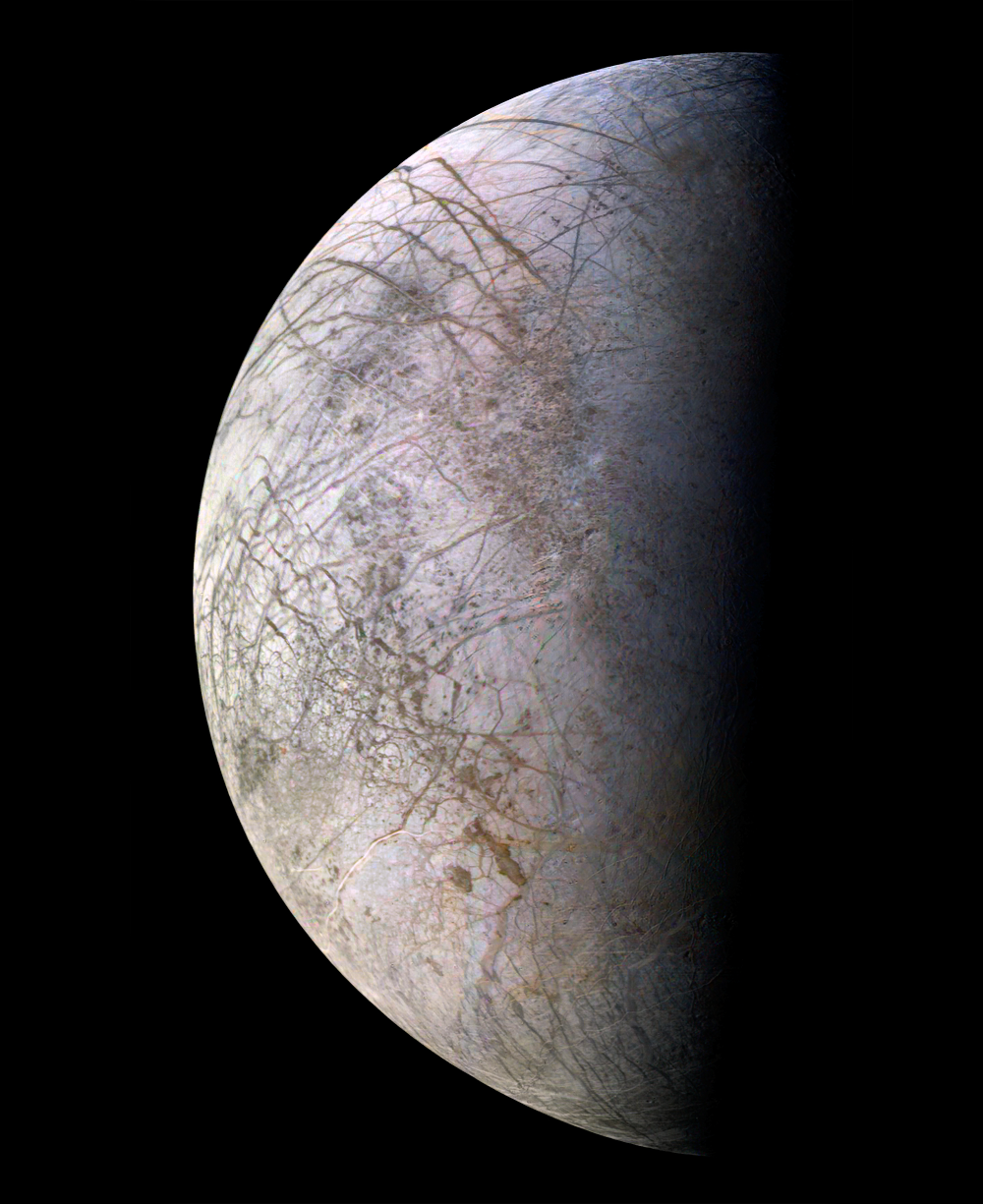
Jupiter’s satellite Europa, slightly smaller than the Earth’s moon, has a fresh ice surface with very little cratering. The ice floats on a deep water ocean supposedly containing more water than all the Earth’s oceans. Click on the image to enlarge. This is a place NASA will send a spacecraft to look for the chemistry of life. Credit NASA/JPL, Ted Stryk.
01/11/2019 – Ephemeris – The bright star in Orion’s knee: Rigel
Ephemeris for Friday, January 11th. The Sun will rise at 8:18. It’ll be up for 9 hours and 4 minutes, setting at 5:23. The Moon, 3 days before first quarter, will set at 10:55 this evening.
Yesterday I talked about the star Betelgeuse the bright red star in the top left of Orion’s upright rectangle. Orion is seen in the southeast at 9 in the evening. The blue-white star in Orion’s opposite corner is usually brighter. It is Rigel whose longer Arabic name of which Rigel is the first part means “Left Leg of the Giant”. Rigel is a giant itself, actually a super giant star, which is more a measure of its mass than its size, that of 23 solar masses. Its surface temperature is more than twice as hot as the sun. It is 120 thousand times as bright as the sun and 100 times its diameter. Its distance is around 860 light years. Those with telescopes might be able to spot a close companion star to Rigel, just at the edge of the bright arc light image of Rigel itself.
The times given are for the Traverse City/Interlochen area of Michigan. They may be different for your location.
Addendum
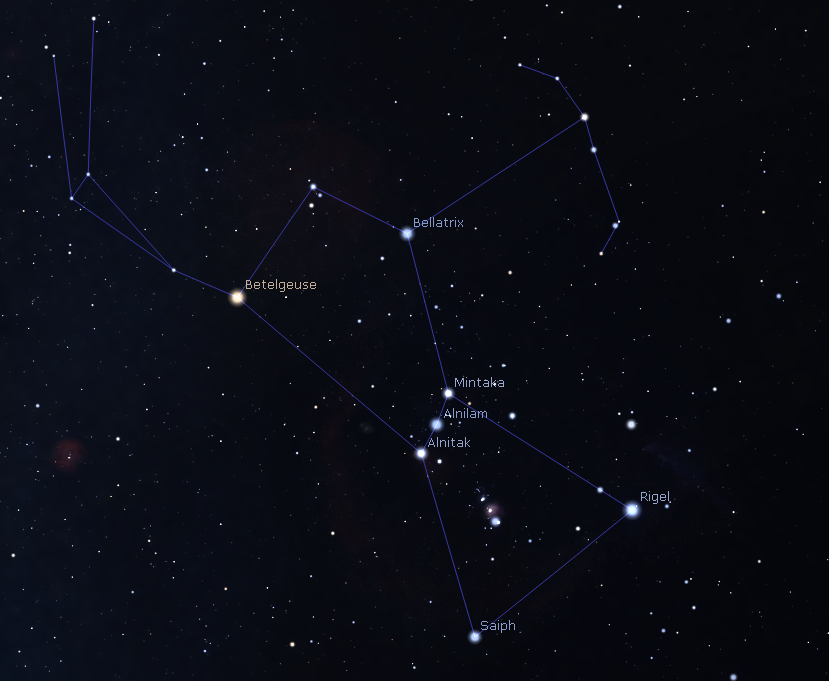
Orion’s brightest stars with their names for 9 p.m. January 7, 2019. Click on the image to make Orion a giant hunter. Created using Stellarium..
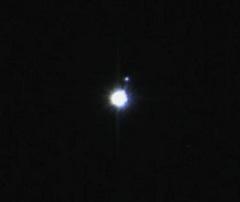
Rigel with its companion star as photographed through a telescope. No attribution. Source: http://washedoutastronomy.com/content/urban-orion?page=1
01/10/2018 – Ephemeris – Betelgeuse the red giant star in the giant hunter Orion’s shoulder
Ephemeris for Thursday, January 10th. The Sun will rise at 8:18. It’ll be up for 9 hours and 3 minutes, setting at 5:22. The Moon, 4 days before first quarter, will set at 9:55 this evening.
The bright red star at the upper left corner of the constellation Orion, high in the southeast at 9 p.m. is Betelgeuse. The name is a contraction of an Arabic phrase that means “Armpit of the Central One”. Betelgeuse is a huge star with a diameter four times that of the earth’s orbit of the sun. It is throwing of gas and creating a nebula around itself. It’s distance from us isn’t accurately known, since it doesn’t have a companion star. It’s about 640 light years away, give or take 148 light years or so. Betelgeuse is about 18 times the mass of the sun and 140 thousand times brighter. It is in the latter stages of its short life,of 10 million year so far. Within another million years or so it will probably explode in a supernova.
The times given are for the Traverse City/Interlochen area of Michigan. They may be different for your location.
Addendum
Orion’s brightest stars with their names for 9 p.m. January 7, 2019. Click on the image to make Orion a giant hunter. Created using Stellarium..
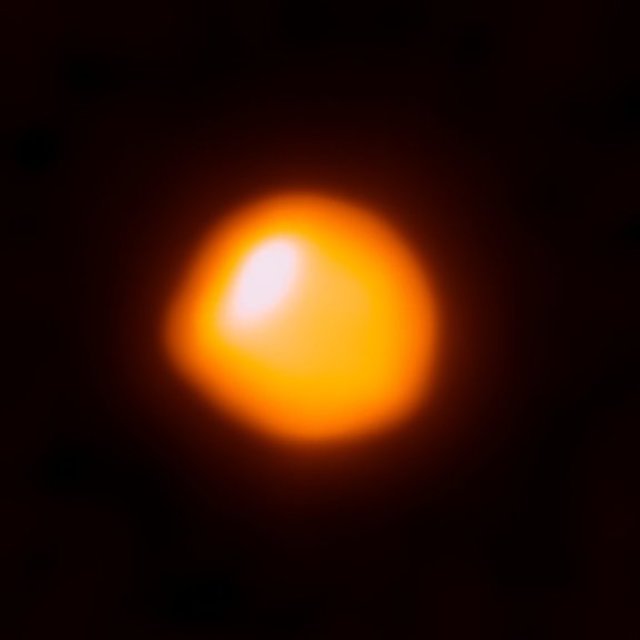
This is the disk of the star Betelgeuse in Orion. It is not an image from an optical telescope of an image created in submillimeter microwaves by the Atacama Large Millimeter/submillimeter Array (ALMA) in Chile. Credit: ALMA (ESO/NAOJ/NRAO)/E. O’Gorman/P. Kervella
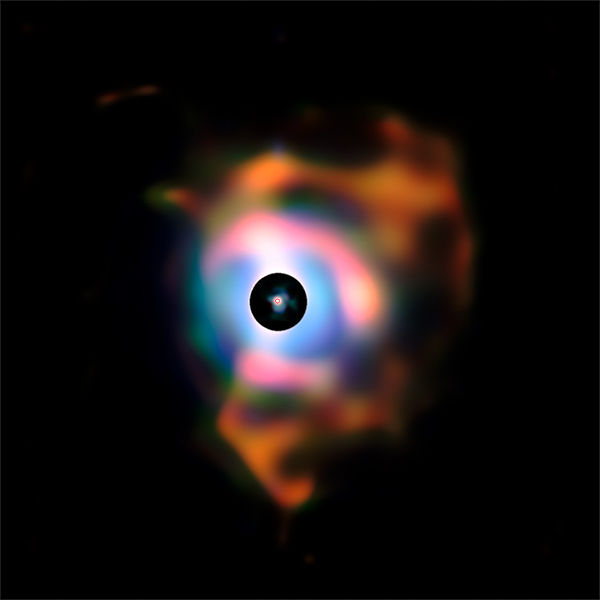
Betelgeuse (inset) and its nebula. From ESO’s Very Large Telescope.
01/08/2019 – Ephemeris – The river at Orion’s feet
Ephemeris for Tuesday, January 8th. The Sun will rise at 8:19. It’ll be up for 9 hours exactly, setting at 5:19. The Moon, 3 days past new, will set at 7:55 this evening.
One of the more obscure constellations around is Eridanus, which depicts a river. The river starts near the lower right corner of Orion, near the bright star Rigel and flows to the right then down near the southwestern horizon, then it meanders along the horizon to the south before turning below the horizon. One has to travel to the far south to see the southern terminus of the river, the bright star Achernar. Writers over the ages have seen here the Nile and the earth circling river Ocean of the flat earth days. Achernar is actually two stars, the brightest was discovered to be the flattest star, due to its rapid spin. The dimensions of Achernar A has been determined to be twice as wide across its equator than from pole to pole. It’s 139 light years away.
The times given are for the Traverse City/Interlochen area of Michigan. They may be different for your location.
Addendum
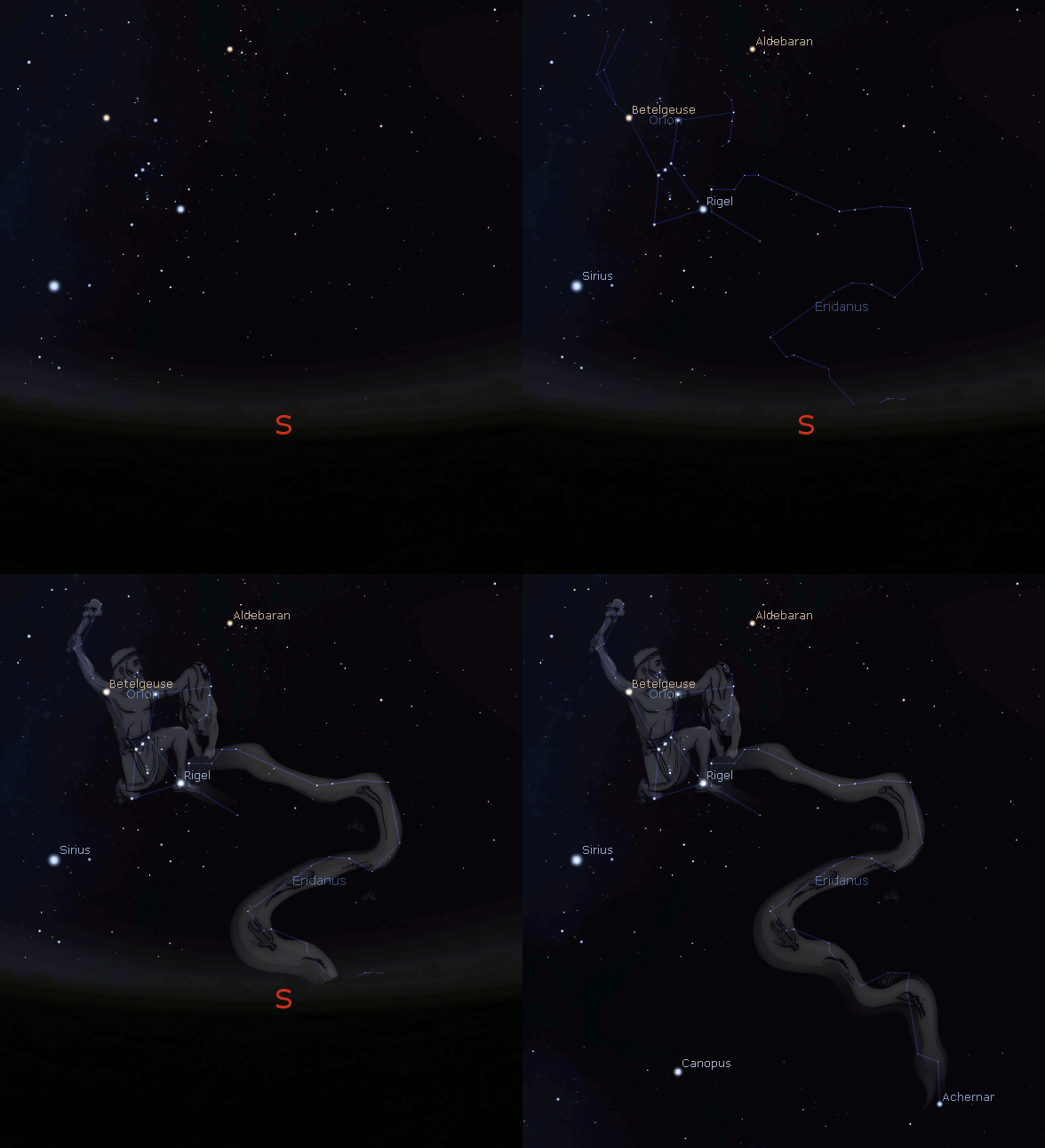
An animation of the constellation Eridanus which is a river that flows from Rigel in Orion to the star Achernar below our southern horizon at latitude 45 degrees north. Create using Stellarium and GIMP.
01/07/2019 – Ephemeris – The stars of Orion
Ephemeris for Monday, January 7th. The Sun will rise at 8:19. It’ll be up for 8 hours and 59 minutes, setting at 5:18. The Moon, 2 days past new, will set at 6:57 this evening.
The seven bright stars of Orion now shine in the southeastern sky in the evening. Two shoulder stars, Betelgeuse, and Bellatrix, Two knee stars Saiph, and Rigel, In between are the three belt stars in a row, Alnitak, Alnilam, and Mintaka. Betelgeuse and Rigel are first magnitude stars, among the brightest in the sky, while the others are second magnitude. As far as brightness goes it puts the Big Dipper to shame with its six second magnitude and one third magnitude stars. Of course we in northern Michigan have the Big Dipper always, because it never sets. Orion, only about six months. Due to its position straddling the equator of the sky, Orion is seen by all the people of the world. Parts of him are even seen at the north and south poles.
The times given are for the Traverse City/Interlochen area of Michigan. They may be different for your location.
Addendum
Orion’s brightest stars with their names for 9 p.m. January 7, 2019. Click on the image to make Orion a giant hunter. Created using Stellarium..
12/04/2018 – Ephemeris – Auriga the Charioteer
Ephemeris for Tuesday, December 4th. The Sun will rise at 8:03. It’ll be up for 8 hours and 59 minutes, setting at 5:02. The Moon, 3 days before new, will rise at 6:03 tomorrow morning.
The constellation Auriga the charioteer is half way up the sky in the east northeast at 9 p.m. It is a pentagon of stars, with the brilliant star Capella at the upper left of its corners. Capella represents a mama goat he’s carrying. A narrow triangle of stars just right of Capella are her kids, that is her baby goats. The Kids is an informal constellation or asterism. The Milky Way runs through Auriga, but it’s not very bright here. We are looking away from the center of the Milky Way to the more sparse outer parts. Within and near that pentagon, one can sweep with binoculars and low power telescopes to find several star clusters, groups of hundreds of stars born in the clump we still see them in. These star clusters will appear as fuzzy spots in binoculars.
The times given are for the Traverse City/Interlochen area of Michigan. They may be different for your location.
Addendum
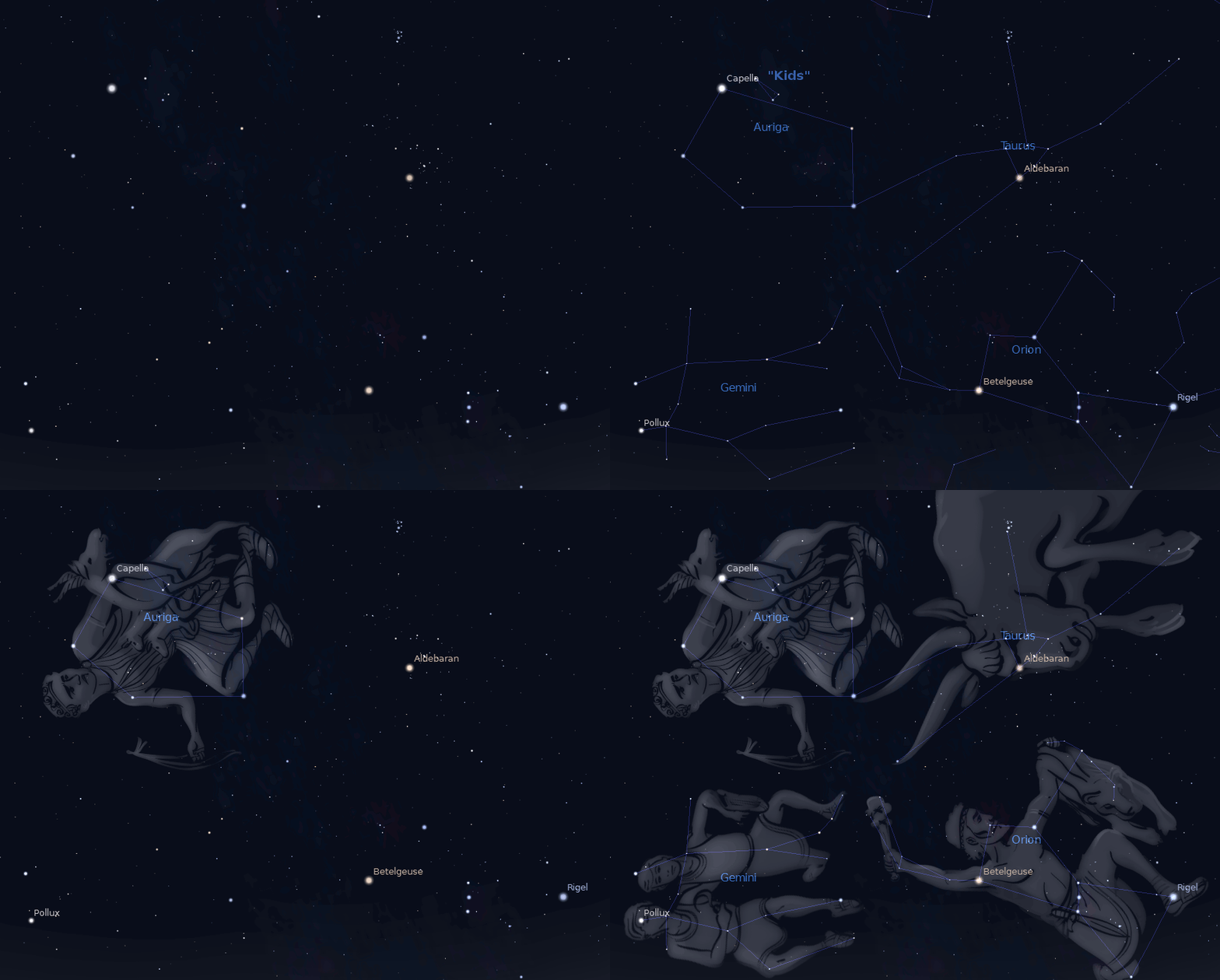
Auriga and neighboring constellations for 9 p.m. in early December. Created using Stellarium and GIMP.
11/22/2018 – Ephemeris – The little goat star, Capella
Ephemeris for Thanksgiving Day, Thursday, November 22nd. The Sun will rise at 7:49. It’ll be up for 9 hours and 19 minutes, setting at 5:08. The Moon, 1 day before full, will set at 7:59 tomorrow morning.
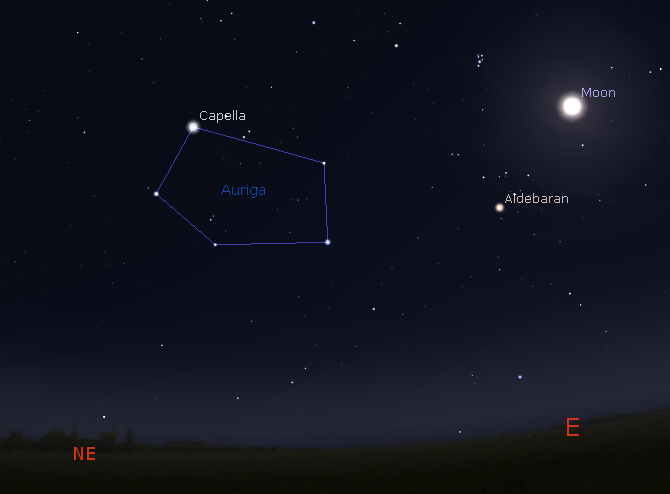
Capella is the northernmost first magnitude stars. Tonight it shines in the northeastern sky. First magnitude stars are the 21 brightest stars in the night sky. Capella is the 6th brightest. The name Capella means little goat, though I’ve always known it as the little she goat. Her three Kids are represented by a narrow triangle of stars positioned to the right of her in tonight’s evening sky, though they may be overpowered by the bright Moon tonight. Capella is in the topmost corner of the pentagonal constellation of Auriga the Charioteer. Capella is actually a system of four stars only 43 light years away. And never sets for listeners in the Interlochen Public Radio transmission area, though all bets are off if you’re listening over the Internet from somewhere else.
The times given are for the Traverse City/Interlochen area of Michigan. They may be different for your location.
Addendum
11/12/2018 – Ephemeris – Orion is rising
Ephemeris for Veterans Day Observed, Monday, November 12th. The Sun will rise at 7:35. It’ll be up for 9 hours and 41 minutes, setting at 5:17. The Moon, 3 days before first quarter, will set at 9:25 this evening.
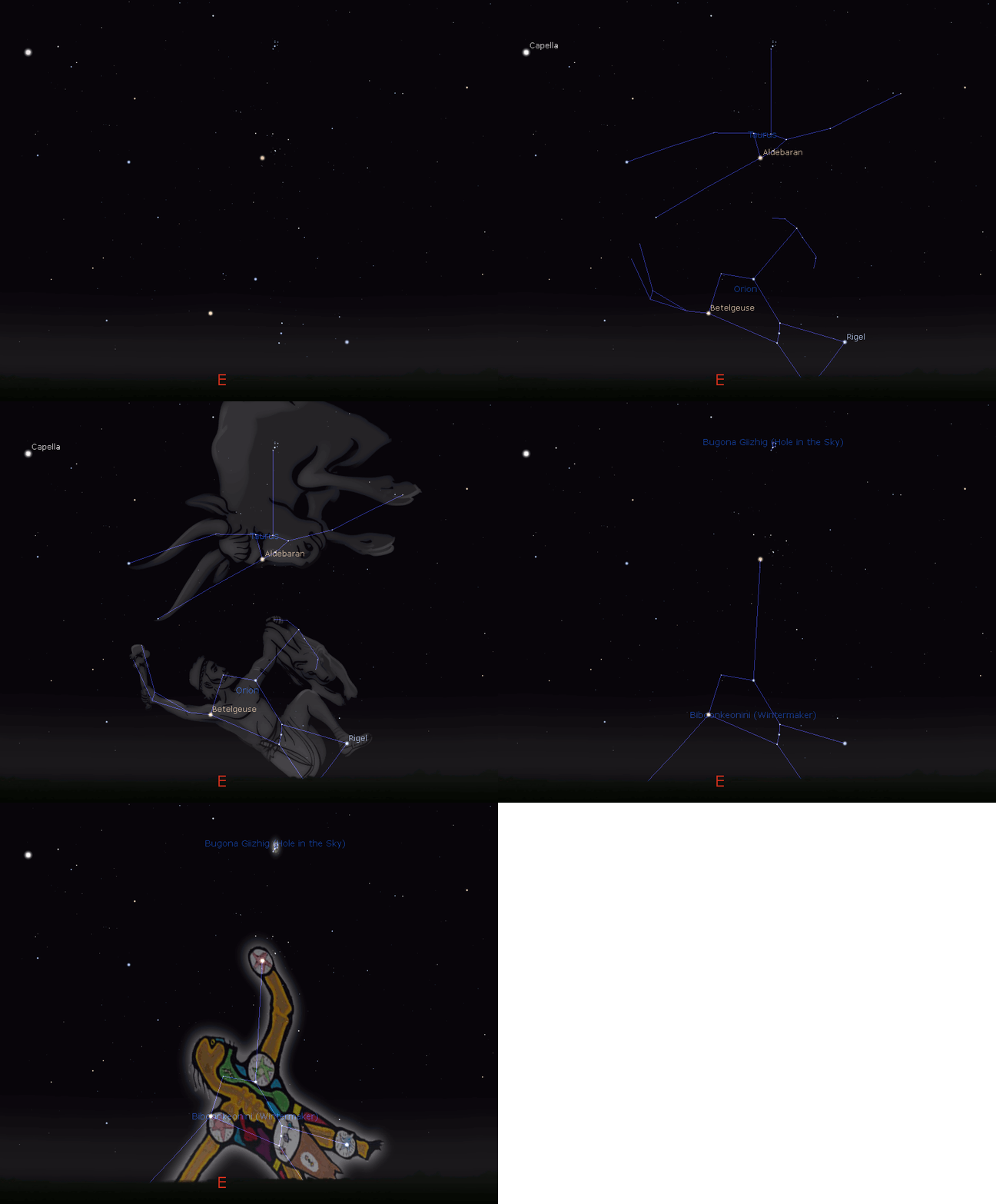
Just after the Moon sets tonight winter’s most dazzling constellation will be rising, Orion the hunter of Greek myth. The stars of his torso are in a rectangle leaning to the left. Orion’s belt of three stars in a straight line in the center of the rectangle is nearly vertical. The Anishinaabe peoples whose region we live in see the constellation of the Wintermaker rather than Orion. It uses Orion’s torso and belt stars, but his arms are spread wide from Aldebaran in the face of Taurus the bull to the west to Procyon in Canis Minor, which won’t rise until 11 p.m. to the east. The Wintermaker’s arms are wide enough to embrace the entire winter sky. Its name in Anishinaabemowin, which is Biboonikeonini, means “North Wind”.
The times given are for the Traverse City/Interlochen area of Michigan. They may be different for your location.
11/08/2018 – Ephemeris – More constellations of autumn: Andromeda, Triangulum and Aries
Ephemeris for Thursday, November 8th. The Sun will rise at 7:30. It’ll be up for 9 hours and 51 minutes, setting at 5:22. The Moon, 1 day past new, will set at 6:26 this evening.
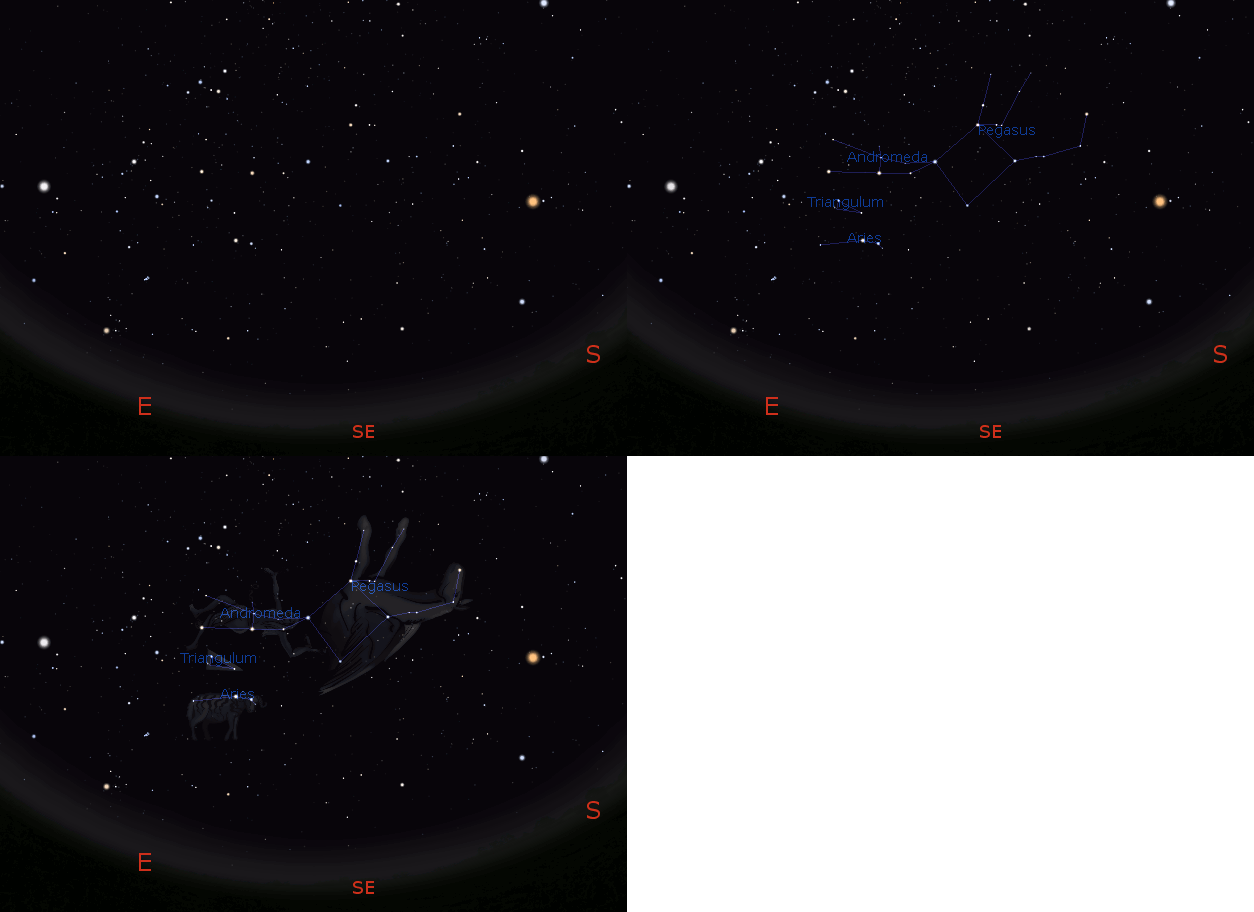
High in the south at 9 p.m. can be seen the Great Square of Pegasus. From the top left star of the square diverge two curved lines of stars that is Andromeda the chained princess. Just below and left of Andromeda is a slender triangle of stars, none particularly bright. It has a name you can easily see in the stars, Triangulum, the triangle. Early Christians saw it as the Mitre of Saint Peter or the Trinity. Another small constellation seen below Triangulum is the much better known constellation Aries the ram, a small hockey stick of a constellation, not that hard to spot. It is the first constellation of the Zodiac, where the Sun is supposed to enter on the first day of spring. Due to the wobble of the Earth’s axis over the millenia, that honor is now given to Pisces.
The times given are for the Traverse City/Interlochen area of Michigan. They may be different for your location.
Addendum
 Bob Moler's Ephemeris Blog