Archive
01/12/2022 – Ephemeris – Let’s search for the naked-eye planets for this week
This is Bob Moler with Ephemeris for Wednesday, January 12th. Today the Sun will be up for 9 hours and 6 minutes, setting at 5:24, and it will rise tomorrow at 8:17. The Moon, 3 days past first quarter, will set at 4:45 tomorrow morning.
Let’s search for the naked-eye planets for this week. There are three planets left in the evening sky now. Jupiter will be visible in the southwest by 6:15 pm. Saturn should appear below and right of it, much closer to the Horizon, with the slightly brighter Mercury a bit below and right of it. Mercury is a bit brighter than Saturn, but in brighter twilight. Finding Saturn and Mercury might take a pair of binoculars. Mercury will set at 6:55 pm, Saturn at 7:07, and Jupiter at 8:52 pm. In the morning sky, Mars is now visible by 7:15 am low in the southeast. Mars’ rival in color and brightness, the red giant star Antares, is to its right and a bit higher. Another bright star is low in the east at that time, the summer time evening star Altair.
The astronomical event times given are for the Traverse City/Interlochen area of Michigan (EST, UT – 5 hours). They may be different for your location.
Addendum
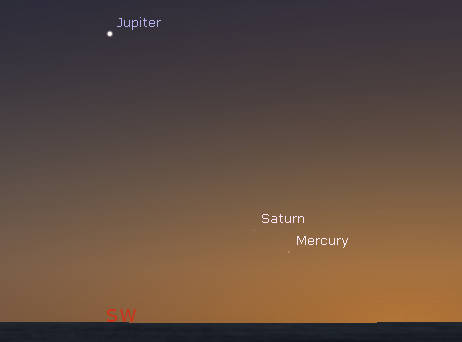
The three planets in evening twilight at 6:15 pm tonight, January 12, 2022. Created using Stellarium.
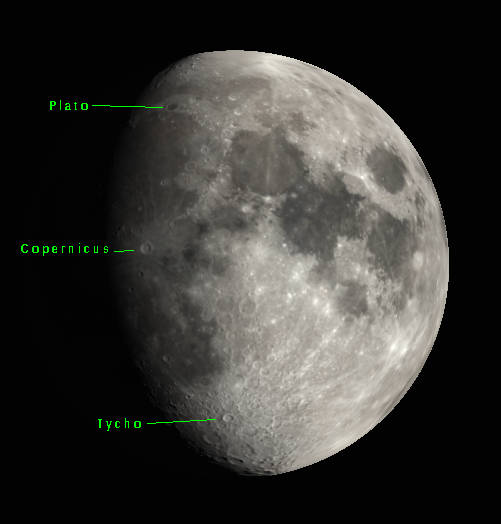
The waxing gibbous Moon, seen at 9 pm tonight, January 12, 2022. The easily spotted craters of Plato, Copernicus and Tycho are labeled. Created using Stellarium.
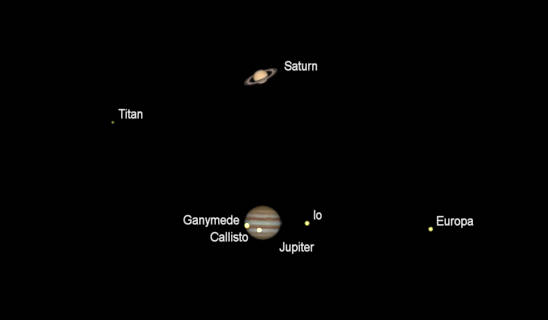
Telescopic views of the bright planets and their brighter moons (north up) as they would be seen in a small telescope, with the same magnification, this evening at 7 pm, January 12, 2022. I do not show planets less than 10 seconds of arc in diameter. Apparent diameters: Saturn 15.34″, its rings 35.74″; Jupiter, 34.59″. Mercury is not shown, its apparent diameter is 4.12″ and is 34.1% illuminated. Mars also is not shown, its apparent diameter is 4.12″. Jupiter is showing two of its moons transiting its face. They will actually be invisible. Ganymede’s start of transit will be at 6:50 pm and should be visible before then. The ” symbol means seconds of arc (1/3600th of a degree). Created using Cartes du Ciel (Sky Charts).
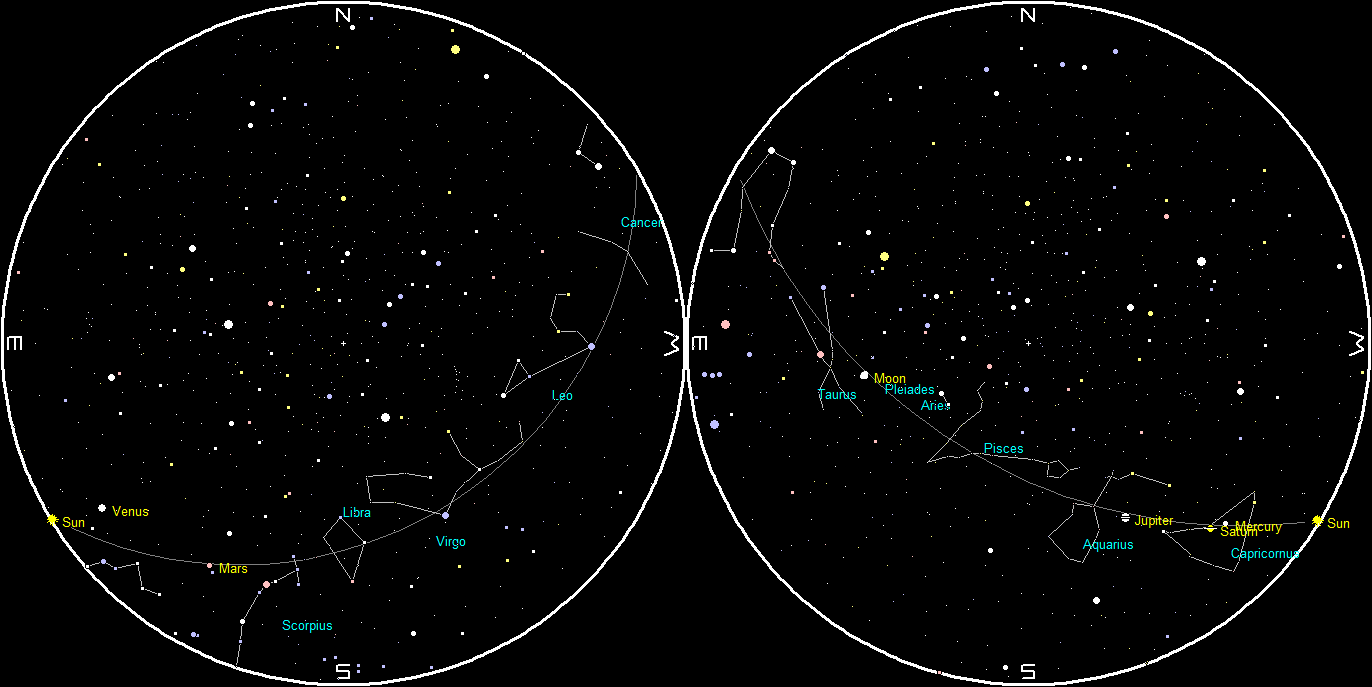
The naked-eye planets and the Moon at sunset and sunrise on a single night, starting with sunset on the right on January 12, 2022. The night ends on the left with sunrise on the 13th. Click on the image to enlarge it. Created using my LookingUp program.
01/11/2022 – Ephemeris – The James Webb Space Telescope has been unfolded but more work is needed
This is Ephemeris for Tuesday, January 11th. Today the Sun will be up for 9 hours and 5 minutes, setting at 5:23, and it will rise tomorrow at 8:17. The Moon, 2 days past first quarter, will set at 3:41 tomorrow morning.
As of Sunday night, when I’m recording this program, the James Webb Space Telescope is nearly 700 thousand miles (1,100 million kilometers) from Earth, more than two thirds the way to the L2 Lagrange point., and slowing down. It doesn’t want to overshoot the mark. The telescope is fully deployed except for the alignment of all the mirrors. 18 of which make up the 6.4 meter primary mirror. They have to be adjusted to act like a monolithic mirror with millionths of an inch tolerance. That may take 5 months. Sometime around the end of that we may get to see the First Light image from the telescope, an image of something other than the calibration stars they were using for the previous months to get all the mirrors aligned.
The astronomical event times given are for the Traverse City/Interlochen area of Michigan (EST, UT – 5 hours). They may be different for your location.
Addendum
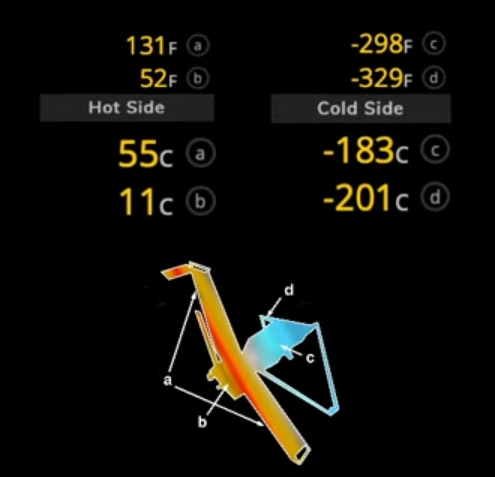
James Webb Space Telescope temperatures 16 days after launch. It looks like the cold side temperatures are dropping by 1 or 2 degrees Celsius a day. Credit: James Webb Tracker by The Launch Pad YouTube Channel. Data from NASA.
01/10/2022 – Ephemeris – Venus starts a new cycle in the morning sky
This is Ephemeris for Monday, January 10th. Today the Sun will be up for 9 hours and 3 minutes, setting at 5:22, and it will rise tomorrow at 8:18. The Moon, 1 day past first quarter, will set at 2:36 tomorrow morning.
Two days ago, Venus passed between the Earth and the Sun in an event called an inferior conjunction. Inferior has nothing to due to quality, but denotes the fact that Venus is passing between the Earth and the Sun. The other Venus conjunction is the superior conjunction when Venus passes the Sun on the far side. We should be able to spot Venus rather suddenly in the late 7 to 8 am hour in a few days. Its appearance seems sudden and is sometimes reported as a UFO. It sometimes surprises airport control tower officials, because it may look like an airplane coming in with its landing lights on. But it never lands. In its morning appearance, Venus is sometimes called the Morning Star or Lucifer.
The astronomical event times given are for the Traverse City/Interlochen area of Michigan (EST, UT – 5 hours). They may be different for your location.
Addendum
The Mayans of pre-Columbian Central America were meticulous observers of Venus, as is seen in one of their surviving books, the Dresden Codex. A Venus Cycle lasts 584 days, from first appearance in the morning sky, its heliacal rising, through its morning appearance, disappearance behind the Sun, through its evening appearance and disappearance on front of the Sun to the next heliacal rising. Astronomers call that it’s synodic period. Five Synodic periods equal almost exactly 8 years.
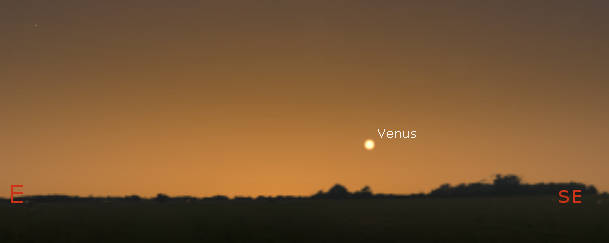
Venus, 9 days after Inferior conjunction, next Monday morning. Venus will be just under 5 degrees above an unobstructed horizon at 7:30 am in northwest lower Michigan. Created using Stellarium.
01/06/2022 – Ephemeris – The named stars of Orion
This is Ephemeris for Thursday, January 6th. Today the Sun will be up for 8 hours and 58 minutes, setting at 5:18, and it will rise tomorrow at 8:19. The Moon, 3 days before first quarter, will set at 10:07 this evening.
Orion is still on an angle, leaning to the left, at 8 to 9 pm in the southeastern sky. It’s seven brightest stars have names from antiquity, and some of them are familiar. Starting from the top left, the bright reddish star is famous Betelgeuse. The top right star is Bellatrix, a name familiar to Harry Potter fans. The three stars of his belt, from bottom to top, are Alnilam, Alnitak, and Mintaka. The final bottom two stars from left to right are Saiph, pronounced “safe”. And blue-white Rigel, usually the brightest star of the constellation. These are the stars of Orion’s shoulders, belt and knees. He has other stars that delineate an arm with an upraised club and an arm holding a lion skin shield and a sword hanging from his belt.
The astronomical event times given are for the Traverse City/Interlochen area of Michigan (EST, UT – 5 hours). They may be different for your location.
Addendum
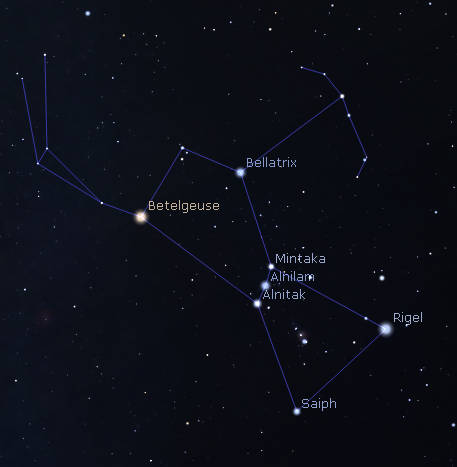
Orion’s named stars. Betelgeuse means “Armpit”. Bellatrix means “Female warrior”. The names of Orion’s belt stars refer to belt or girdle, Rigel refers to Orion’s foot. Saiph means sword, however Orion’s sword is the line of three stars below the belt stars. In binoculars, there’s more than three stars here. Around the second “star” of the sword is the Great Orion Nebula, barely visible here. Created using Stellarium.
01/05/2022 – Ephemeris – Let’s search for the naked-eye planets for this week
This is Bob Moler with Ephemeris for Wednesday, January 5th. Today the Sun will be up for 8 hours and 57 minutes, setting at 5:16, and it will rise tomorrow at 8:19. The Moon, 3 days past new, will set at 8:53 this evening.
Let’s search for the naked-eye planets for this week. Venus is three days from passing between the Earth and the Sun in what is called an inferior conjunction. It really isn’t visible in the bright evening twilight. It will emerge later this month in the morning sky. Jupiter might be visible in the southwest by 6 pm, above the 3-day-old crescent Moon. Saturn should appear a bit later, halfway between Jupiter and the horizon, but on an angle to the lower right. Mercury might be spotted again halfway to the horizon from Saturn to the lower right of it. This isn’t the best appearance of Mercury in the evening this year, the one in early April will be better. Mercury will set at 6:48 pm, Saturn at 7:30, and Jupiter at 9:11 pm.
The astronomical event times given are for the Traverse City/Interlochen area of Michigan (EST, UT – 5 hours). They may be different for your location.
Addendum
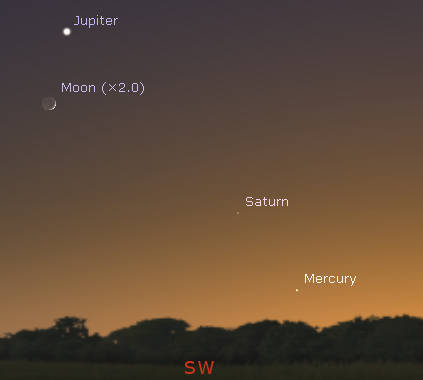
Three Evening planets and the Moon at 6 pm on the southwest horizon tonight, January 5, 2022. Created using Stellarium.
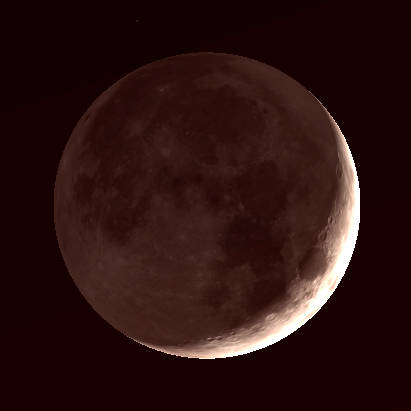
Three day old Moon with earth shine as it might look like in binoculars tonight, January 5, 2022. Created using Stellarium.
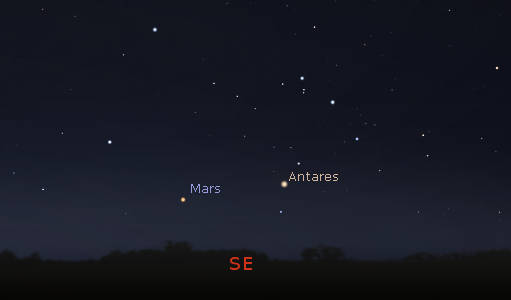
Mars and Antares at 7:00 tomorrow morning, January 6, 2022. The name Antares means “Rival of Mars”, Ares being the Greek equivalent to the Roman Ares. Created using Stellarium.
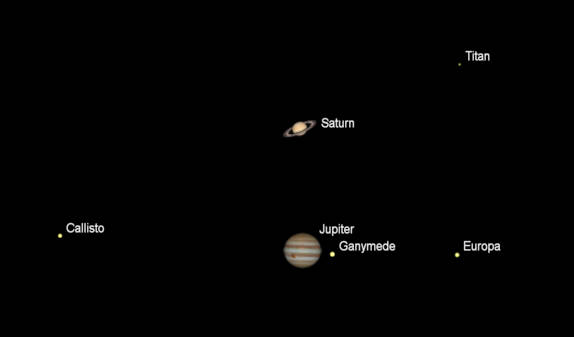
Telescopic views of the bright planets and their brighter moons (north up) as they would be seen in a small telescope, with the same magnification, this evening at 7 pm, January 5, 2022. I do not show planets less than 10 seconds of arc in diameter. Apparent diameters: Saturn 15.41″, its rings 35.89″; Jupiter, 35.05″. Mercury is not shown, its apparent diameter is 6.67″ and is 64.2% illuminated. Mars also is not shown, its apparent diameter is 4.05″. Jupiter is showing 3 of its 4 bright moons. Io is in front of the planet. The ” symbol means seconds of arc (1/3600th of a degree.) Created using Cartes du Ciel (Sky Charts).
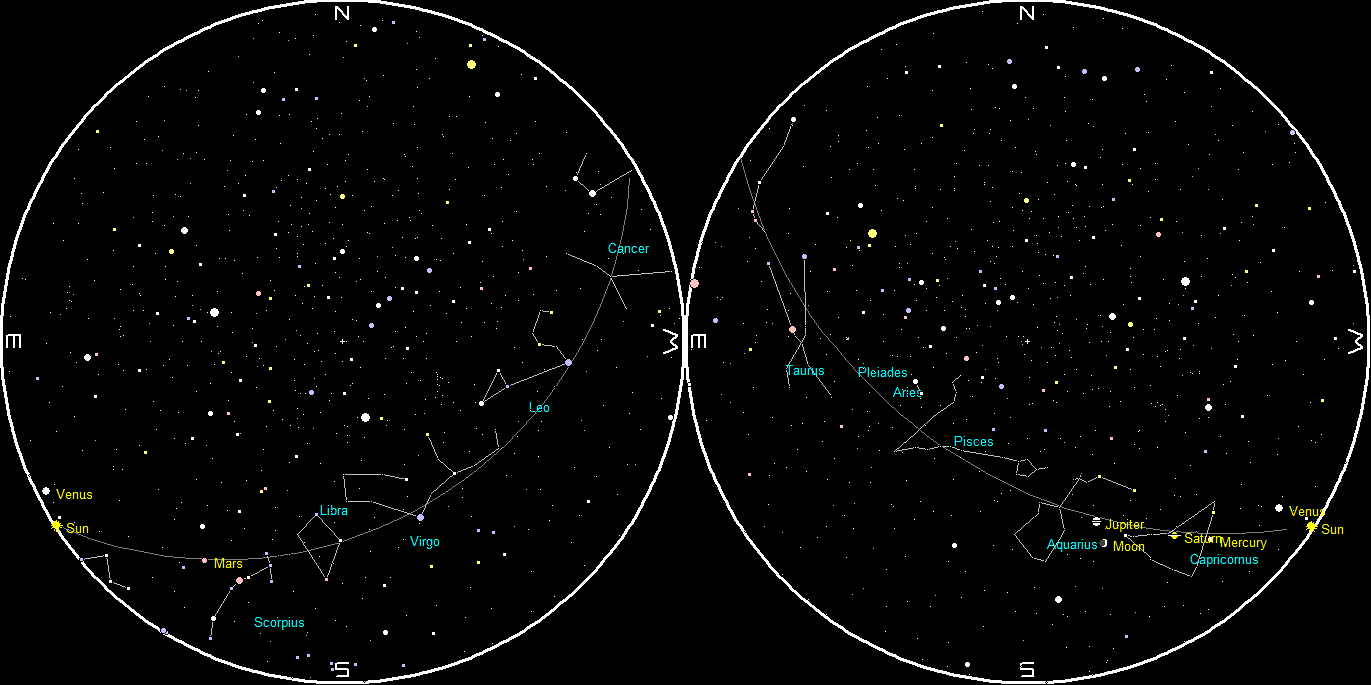
The naked-eye planets and the Moon at sunset and sunrise on a single night, starting with sunset on the right on January 5, 2022. The night ends on the left with sunrise on the 6th. Click on the image to enlarge it. Created using my LookingUp program.
01/04/2022 – Ephemeris – Planet show in the evening twilight tonight
This is Bob Moler with Ephemeris for Tuesday, January 4th. The Sun will rise at 8:20. It’ll be up for 8 hours and 55 minutes, setting at 5:15. The Moon, 2 days past new, will set at 7:34 this evening.
Tonight, if it’s clear, there’s a chance that one could spot four planets, plus the Moon, in the southwestern evening twilight. However, not all at the same time. Venus should make an appearance at about 5:45 very low in the west-southwest, only 3 degrees or 6 moon-widths above a lake horizon. Jupiter might be visible then or in a few more minutes much higher in the southwest. The two-day-old Moon might be visible then, about halfway between Jupiter and Venus. By 6 pm, Mercury might be visible halfway between the Moon and where Venus was, because Venus will be setting at that time. By this time, too, Saturn will appear just above right of the Moon. This is the last chance to spot Venus in the evening sky until the last months of this year.
The astronomical event times given are for the Traverse City/Interlochen area of Michigan (EST, UT – 5 hours). They may be different for your location.
Addendum
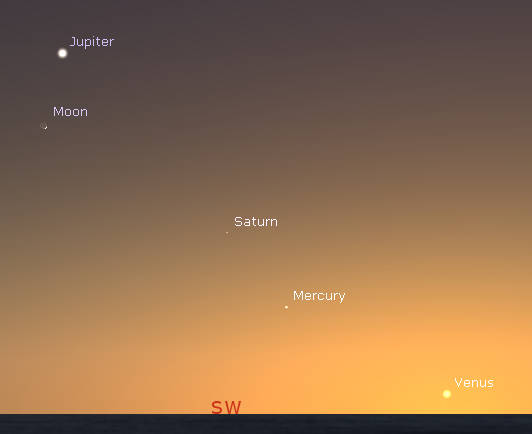
Four Evening planets and the Moon at 5:45 pm on a flat horizon at 5:45 pm tonight, January 4, 2022. Venus, because it is so low on the horizon, and Saturn, the dimmest of the four planets, may not be visible. Created using Stellarium.
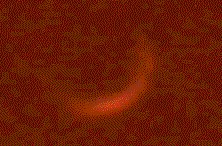
Venus is only 4 days away from inferior conjunction. Back in 1969 I took this photo of Venus then only 4 days from inferior conjunction from the Grand Rapids Amateur Astronomical Society’s Veen Observatory outside of Lowell, MI.
Venus was low in the sky, and the atmosphere made it very fuzzy.
01/03/2022 – Ephemeris – We’re the closest we get to the Sun of the whole year today
This is Bob Moler with Ephemeris for Monday, January 3rd, 2022. The Sun will rise at 8:20. It’ll be up for 8 hours and 54 minutes, setting at 5:14. The Moon, 1 day past new, will set at 6:14 this evening.
Today we are as close to the Sun as we’ll get for the rest of the year. The Earth will reach the perihelion point in its orbit at 7:59 this evening, at only 91.4 million miles. Since this is only a million and a half miles closer than average, it doesn’t affect the amount of heat the Earth as a whole gets from the Sun. But, since the Earth moves faster at perihelion than at any other time of the year, it makes winter the shortest season. Winter at 89 days is nearly 4 days shorter than the longest season, summer. I know, it doesn’t seem like it, but we live in Northern Michigan, and seemingly long winters come with the territory. January’s only major meteor shower, the Quadrantids, reaches peak at about 4 pm today. It reaches and falls off-peak rapidly, so we won’t have an impressive Quadrantid meteor shower this year.
The astronomical event times given are for the Traverse City/Interlochen area of Michigan (EST, UT – 5 hours). They may be different for your location.
Addendum
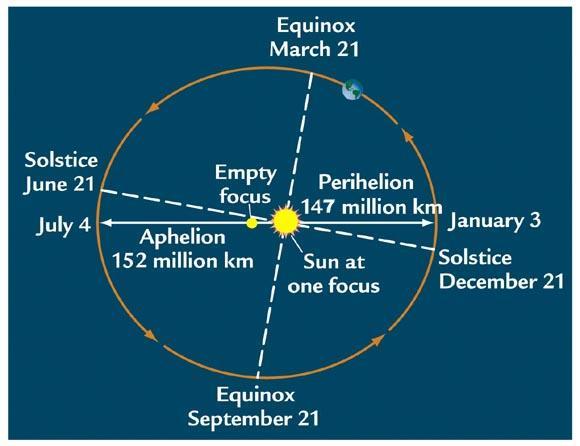
The Earth’s orbit, somewhat exaggerated, showing perihelion and the seasons. Credit: “Starts with a Bang” blog by Ethan Siegel.
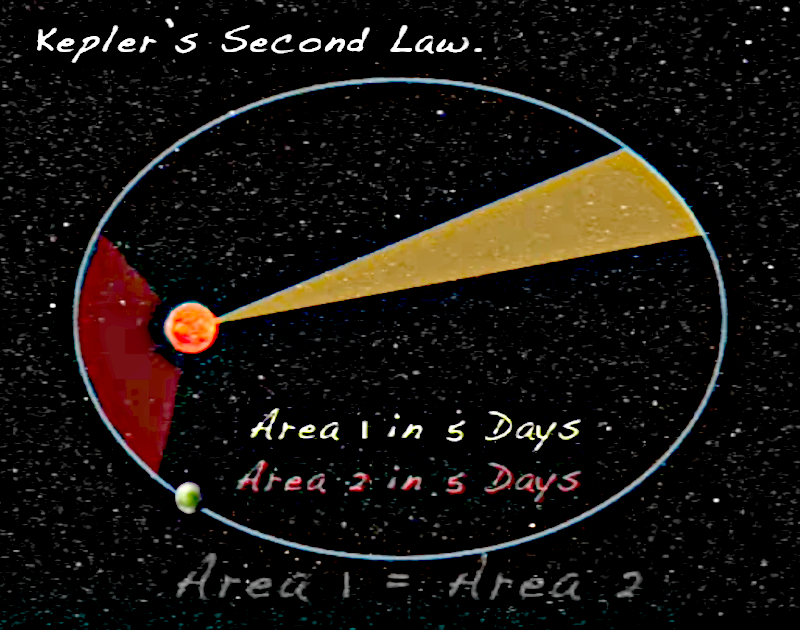
Kepler’s Second Law of Planetary Motion: the imaginary line joining a planet and the Sun sweeps equal areas of space during equal time intervals as the planet orbits. Credit: NASA, a screen capture from a video Solar Systems Dynamics-Orbits and Kepler’s Laws.
A note on the naming of the Quadrantid meteor shower. Meteor showers get their names from the constellation or nearby star where the meteor seem to come from at their peak. That point is called the radiant. The Quadrantids were named because they came from a constellation called the Mural Quadrant, back when the shower was discovered. The Mural Quadrant didn’t make the modern list of 88 constellations. The area where the Mural Quadrant resided is an area between northern Boötes, Draco and the handle of the Big Dipper.
12/31/2021 – Ephemeris – January 2022 preview
This is Ephemeris for New Year’s Eve, Friday, December 31st. The Sun will rise at 8:20. It’ll be up for 8 hours and 52 minutes, setting at 5:12. The Moon, 1 day before new, will rise at 7:20 tomorrow morning.
Tomorrow starts the new year of 2022. The daylight hours are slowly getting longer and will accelerate during the month. Daylight hours will increase from 8 hours and 52 minutes tomorrow to 9 hours and 47 minutes on the 31st. The sunrise time will decrease from 8:20 tomorrow to 8:02 at month’s end. The sunset times will increase from 5:13 tomorrow to 5:50 on the 31st. Along with that, the altitude of the sun at noon will increase from 22 degrees tomorrow to nearly 28 degrees at month’s end. It will be a degree lower for folks in the Straits area because they are a degree of latitude farther north. Local noon, by the way, for Interlochen and Traverse City is about 12:51 p.m. in January. Here’s wishing you a Happy New Year.
The astronomical event times given are for the Traverse City/Interlochen area of Michigan (EST, UT – 5 hours). They may be different for your location.
Addendum
Updated to replace twilight table at 5:07 pm.
January Evening Star Chart
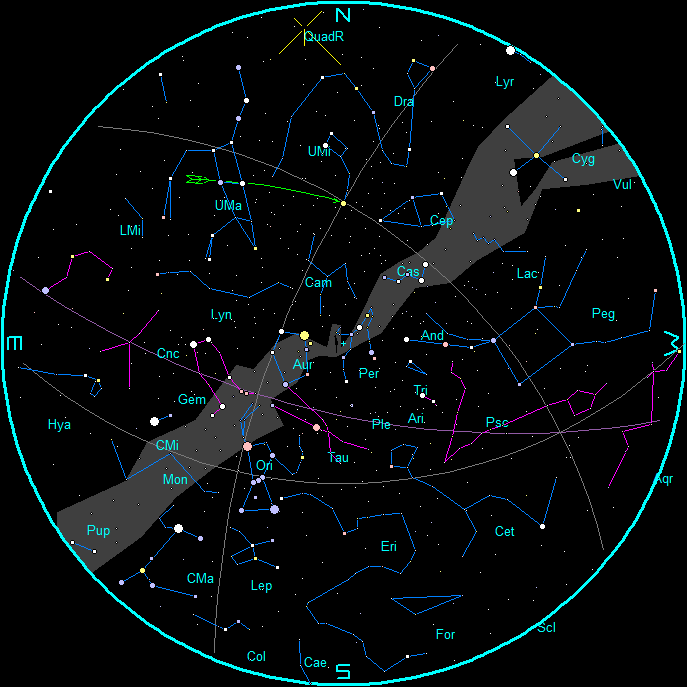
Star Chart for January 2022 evenings, based on 9 p.m. EST, January 15, 2022. Click on image to enlarge. Created using my LookingUp program.
January Morning Star Chart
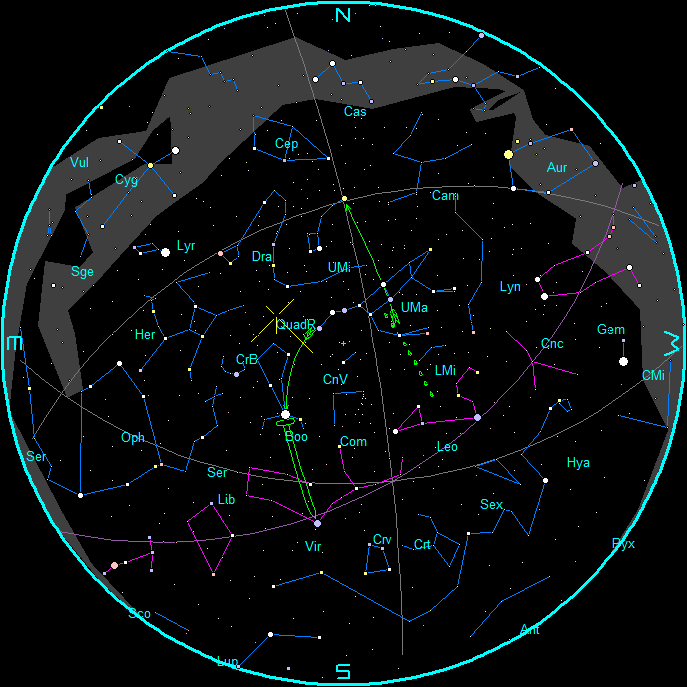
Star Chart for January 2022 mornings, based on 6 a.m. EST, January 15, 2022. Click on image to enlarge. Created using my LookingUp program.
Note that Traverse City is located approximately 45 minutes behind our time meridian, West 75° longitude. (An hour 45 minutes behind our daylight saving time meridian during EDT). For a list of constellation names to go with the abbreviations, click here.
The planets are also plotted for the 15th. For a check on the current whereabouts of the five naked eye planets, see the Wednesday post most weeks.
- Pointer stars at the front of the bowl of the Big Dipper point to Polaris, the North Star.
- The leaky bowl of the Big Dipper drips on Leo.
- Follow the arc of the handle of the Big Dipper to the star Arcturus, then
- Follow the spike to Spica.
- QuadR on the star charts is the radiant of the Quadrantid meteor shower, which peaks on the 3rd, but is best seen in the early morning hours of the 3rd or 4th.
Twilight Limits, Nautical and Astronomical
| EST | |||||||
| Morning | Twilight | Evening | Twilight | Dark | Night | Moon | |
| Date | Astro. | Nautical | Nautical | Astro. | Start | End | Illum. |
| 2022-01-01 | 6h35m | 7h11m | 18h22m | 18h57m | 18h57m | 6h35m | 0 |
| 2022-01-02 | 6h35m | 7h11m | 18h23m | 18h58m | 18h58m | 6h35m | 0 |
| 2022-01-03 | 6h35m | 7h11m | 18h24m | 18h59m | 18h59m | 6h35m | 0.03 |
| 2022-01-04 | 6h35m | 7h11m | 18h25m | 19h00m | 19h35m | 6h35m | 0.08 |
| 2022-01-05 | 6h35m | 7h11m | 18h26m | 19h01m | 20h53m | 6h35m | 0.16 |
| 2022-01-06 | 6h35m | 7h11m | 18h26m | 19h02m | 22h08m | 6h35m | 0.25 |
| 2022-01-07 | 6h35m | 7h11m | 18h27m | 19h03m | 23h19m | 6h35m | 0.35 |
| 2022-01-08 | 6h35m | 7h10m | 18h28m | 19h04m | – | 6h35m | 0.45 |
| 2022-01-09 | 6h35m | 7h10m | 18h29m | 19h05m | 0h27m | 6h35m | 0.55 |
| 2022-01-10 | 6h35m | 7h10m | 18h30m | 19h06m | 1h32m | 6h35m | 0.64 |
| 2022-01-11 | 6h35m | 7h10m | 18h31m | 19h07m | 2h37m | 6h35m | 0.73 |
| 2022-01-12 | 6h35m | 7h10m | 18h33m | 19h08m | 3h41m | 6h35m | 0.81 |
| 2022-01-13 | 6h34m | 7h09m | 18h34m | 19h09m | 4h45m | 6h34m | 0.88 |
| 2022-01-14 | 6h34m | 7h09m | 18h35m | 19h10m | 5h48m | 6h34m | 0.93 |
| 2022-01-15 | 6h34m | 7h08m | 18h36m | 19h11m | – | – | 0.97 |
| 2022-01-16 | 6h33m | 7h08m | 18h37m | 19h12m | – | – | 0.99 |
| 2022-01-17 | 6h33m | 7h08m | 18h38m | 19h13m | – | – | 1 |
| 2022-01-18 | 6h32m | 7h07m | 18h39m | 19h14m | – | – | 0.99 |
| 2022-01-19 | 6h32m | 7h07m | 18h40m | 19h15m | 19h15m | 19h15m | 0.95 |
| 2022-01-20 | 6h31m | 7h06m | 18h41m | 19h16m | 19h16m | 20h23m | 0.9 |
| 2022-01-21 | 6h31m | 7h05m | 18h43m | 19h17m | 19h17m | 21h32m | 0.83 |
| 2022-01-22 | 6h30m | 7h05m | 18h44m | 19h18m | 19h18m | 22h41m | 0.75 |
| 2022-01-23 | 6h29m | 7h04m | 18h45m | 19h20m | 19h20m | 23h51m | 0.65 |
| 2022-01-24 | 6h29m | 7h03m | 18h46m | 19h21m | 19h21m | – | 0.54 |
| 2022-01-25 | 6h28m | 7h03m | 18h47m | 19h22m | 19h22m | 1h04m | 0.43 |
| 2022-01-26 | 6h27m | 7h02m | 18h49m | 19h23m | 19h23m | 2h19m | 0.32 |
| 2022-01-27 | 6h27m | 7h01m | 18h50m | 19h24m | 19h24m | 3h37m | 0.21 |
| 2022-01-28 | 6h26m | 7h00m | 18h51m | 19h25m | 19h25m | 4h56m | 0.13 |
| 2022-01-29 | 6h25m | 6h59m | 18h52m | 19h27m | 19h27m | 6h11m | 0.06 |
| 2022-01-30 | 6h24m | 6h58m | 18h54m | 19h28m | 19h28m | 6h24m | 0.01 |
| 2022-01-31 | 6h23m | 6h57m | 18h55m | 19h29m | 19h29m | 6h23m | 0 |
Twilight calendar was generated using Cartes du Ciel (Sky Charts).
See my blog post: Twilight Zone for the definitions of the different periods of twilight here: https://bobmoler.wordpress.com/2018/09/27/.
NASA Calendar of Planetary Events
    Date     Time     Event
Jan  1  Sa            Venus: 12.4° E
     1  Sa   6:00 pm  Moon Perigee: 358000 km
     2  Su   8:35 am  Moon South Dec.: 26.3° S
     2  Su   1:33 pm  New Moon
     3  Mo   3:56 pm  Quadrantid Shower: ZHR = 120
     3  Mo   7:59 pm  Perihelion: 0.9833 AU
     4  Tu  11:50 am  Moon-Saturn: 4.2° N
     5  We   7:09 pm  Moon-Jupiter: 4.5° N
     7  Fr   5:59 am  Mercury Elongation: 19.2° E
     8  Sa   7:50 pm  Venus Inferior Conj.
     9  Su   1:11 pm  First Quarter
    12  We  11:17 pm  Mercury-Saturn: 3.4° N
    12  We  11:19 pm  Moon Ascending Node
    14  Fr   4:27 am  Moon Apogee: 405800 km
    16  Su   5:16 am  Moon North Dec.: 26.3° N
    17  Mo  10:37 am  Moon-Pollux: 2.9° N
    17  Mo   6:48 pm  Full Moon
    18  Tu  11:33 am  Moon-Beehive: 3.5° S
    23  Su   5:25 am  Mercury Inferior Conj.
    25  Tu   8:41 am  Last Quarter
    27  Th   1:14 am  Moon Descending Node
    29  Sa  10:05 am  Moon-Mars: 2.4° N
    29  Sa   6:26 pm  Moon South Dec.: 26.4° S
    30  Su   2:09 am  Moon Perigee: 362300 km
Feb  1  Tu            Venus: 32° W
All event times are given for UTC-5 Eastern Standard Time.
Sky Events Calendar by Fred Espenak and Sumit Dutta (NASA’s GSFC),
http://eclipse.gsfc.nasa.gov/SKYCAL/SKYCAL.html.
If you go to the above site you can print out a list like the above for the entire year or calendar pages for your time zone.
Sun and Moon Rising and Setting Events
LU                  Ephemeris of Sky Events for Interlochen/TC
January, 2022    Local time zone: EST
+-----------------------------------------------------------------------+
| DATE |  SUN     SUN  DAYLIGHT|   TWILIGHT*    |MOON  RISE OR    ILLUM |
|      |  RISE    SET    HOURS |  END    START  |PHASE SET** TIME FRACTN|
+=======================================================================+
|Sat  1| 08:20a  05:13p  08:52 | 06:23p  07:09a |      Rise 08:33a    1%|
+------+-----------------------+----------------+-----------------------+
|Sun  2| 08:20a  05:13p  08:53 | 06:24p  07:09a |New   Set  04:59p    0%|
|Mon  3| 08:20a  05:14p  08:54 | 06:25p  07:09a |      Set  06:14p    2%|
|Tue  4| 08:20a  05:15p  08:55 | 06:25p  07:10a |      Set  07:34p    7%|
|Wed  5| 08:19a  05:16p  08:57 | 06:26p  07:10a |      Set  08:53p   14%|
|Thu  6| 08:19a  05:18p  08:58 | 06:27p  07:09a |      Set  10:07p   23%|
|Fri  7| 08:19a  05:19p  08:59 | 06:28p  07:09a |      Set  11:18p   32%|
|Sat  8| 08:19a  05:20p  09:00 | 06:29p  07:09a |      Set  12:26a   42%|
+------+-----------------------+----------------+-----------------------+
|Sun  9| 08:19a  05:21p  09:02 | 06:30p  07:09a |F Qtr Set  01:32a   52%|
|Mon 10| 08:18a  05:22p  09:03 | 06:31p  07:09a |      Set  02:36a   62%|
|Tue 11| 08:18a  05:23p  09:05 | 06:32p  07:09a |      Set  03:41a   71%|
|Wed 12| 08:17a  05:24p  09:06 | 06:33p  07:08a |      Set  04:45a   79%|
|Thu 13| 08:17a  05:26p  09:08 | 06:34p  07:08a |      Set  05:47a   86%|
|Fri 14| 08:17a  05:27p  09:10 | 06:36p  07:08a |      Set  06:47a   92%|
|Sat 15| 08:16a  05:28p  09:11 | 06:37p  07:07a |      Set  07:41a   96%|
+------+-----------------------+----------------+-----------------------+
|Sun 16| 08:15a  05:29p  09:13 | 06:38p  07:07a |      Set  08:27a   99%|
|Mon 17| 08:15a  05:31p  09:15 | 06:39p  07:06a |Full  Rise 05:04p  100%|
|Tue 18| 08:14a  05:32p  09:17 | 06:40p  07:06a |      Rise 06:07p   99%|
|Wed 19| 08:13a  05:33p  09:19 | 06:41p  07:05a |      Rise 07:15p   96%|
|Thu 20| 08:13a  05:34p  09:21 | 06:42p  07:05a |      Rise 08:23p   91%|
|Fri 21| 08:12a  05:36p  09:23 | 06:44p  07:04a |      Rise 09:31p   85%|
|Sat 22| 08:11a  05:37p  09:25 | 06:45p  07:04a |      Rise 10:41p   76%|
+------+-----------------------+----------------+-----------------------+
|Sun 23| 08:10a  05:39p  09:28 | 06:46p  07:03a |      Rise 11:51p   67%|
|Mon 24| 08:09a  05:40p  09:30 | 06:47p  07:02a |      Rise 01:03a   56%|
|Tue 25| 08:09a  05:41p  09:32 | 06:48p  07:01a |L Qtr Rise 02:19a   45%|
|Wed 26| 08:08a  05:43p  09:35 | 06:50p  07:01a |      Rise 03:37a   34%|
|Thu 27| 08:07a  05:44p  09:37 | 06:51p  07:00a |      Rise 04:56a   24%|
|Fri 28| 08:06a  05:45p  09:39 | 06:52p  06:59a |      Rise 06:10a   14%|
|Sat 29| 08:05a  05:47p  09:42 | 06:53p  06:58a |      Rise 07:15a    7%|
+------+-----------------------+----------------+-----------------------+
|Sun 30| 08:04a  05:48p  09:44 | 06:55p  06:57a |      Rise 08:07a    2%|
|Mon 31| 08:02a  05:50p  09:47 | 06:56p  06:56a |      Rise 08:48a    0%|
+-----------------------------------------------------------------------+
* Nautical Twilight
** Moonrise or moonset, whichever occurs between sunrise and sunset
Generated using my LookingUp for DOS program.
12/30/2021 – Ephemeris – Looking forward to some space events in 2022
This is Ephemeris for Thursday, December 30th. Today the Sun will be up for 8 hours and 51 minutes, setting at 5:11, and it will rise tomorrow at 8:20. The Moon, 2 days before new, will rise at 6 tomorrow morning.
If you thought 2021 was an active one in space, 2022 looks to be as exciting. The James Webb Space Telescope will continue to deploy itself as it journeys to reach it’s L2 halo orbit. It should become operational by mid-year. The launch of the uncrewed Artemis-1 mission to, and around the Moon, has been pushed back a month to no earlier than March 12th, because of having to swap out a control computer for one of its main engines. The launch of the Psyche probe to the mostly metallic asteroid of the same name will occur in August by a SpaceX Falcon Heavy rocket on a four-year journey to orbit this unique asteroid. And NASA’s DART spacecraft is scheduled to crash into the tiny Dimorphos asteroid to test a deflection method in late September.
The astronomical event times given are for the Traverse City/Interlochen area of Michigan (EST, UT – 5 hours). They may be different for your location.
Addendum
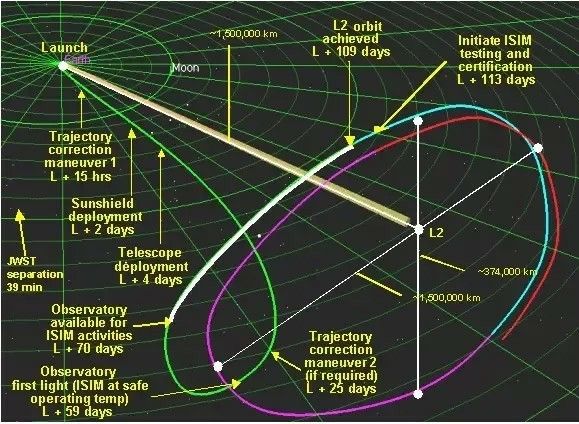
James Webb Space Telescope trajectory to L2 with some milestones of deployment. “ISIM” stands for Integrated Scientific Instruments Module. Credit: Space Telescope Science Institute (STScI).
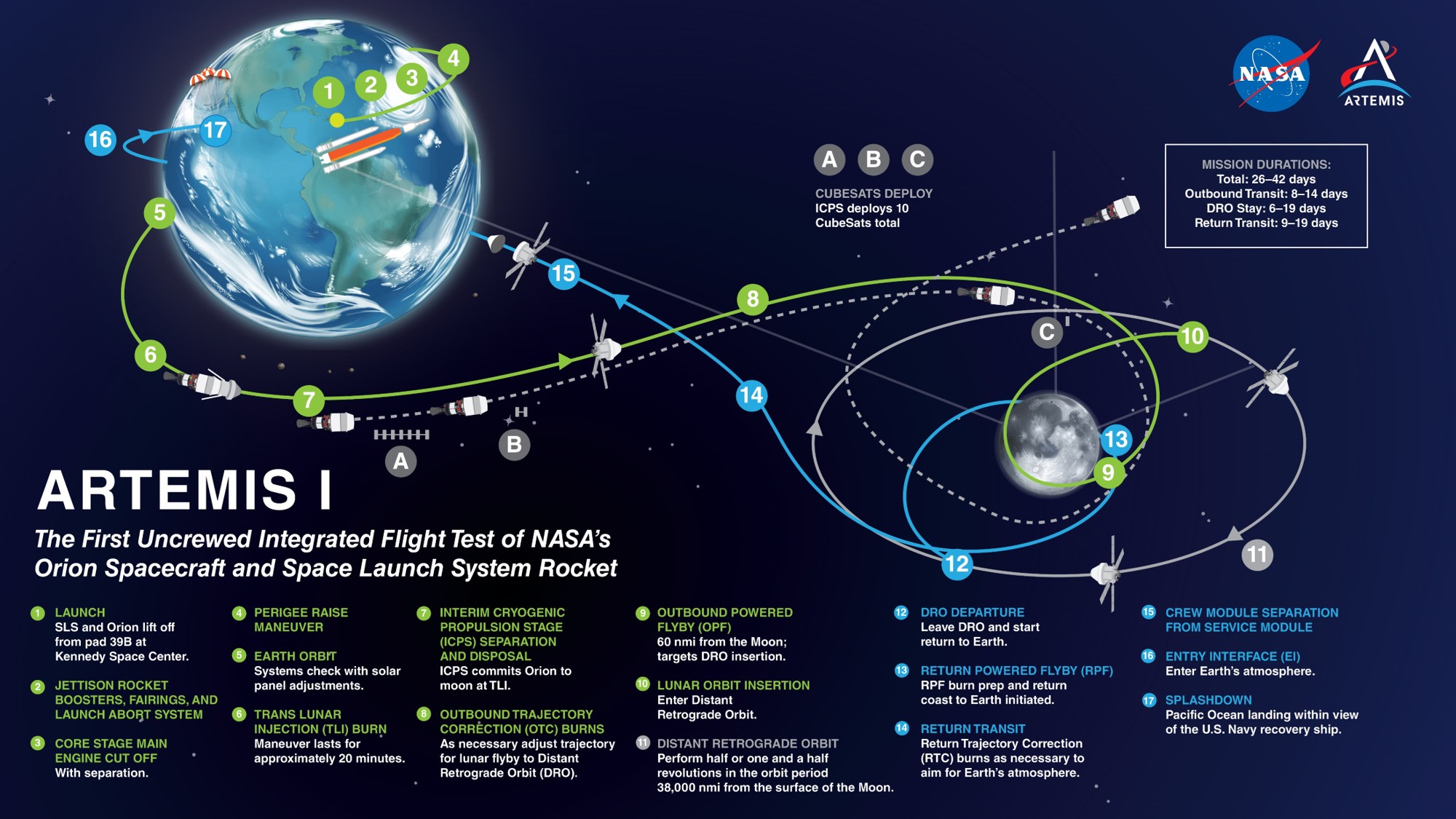
Artemis-1 orbital plan. Click on the image to enlarge it. Credit NASA.
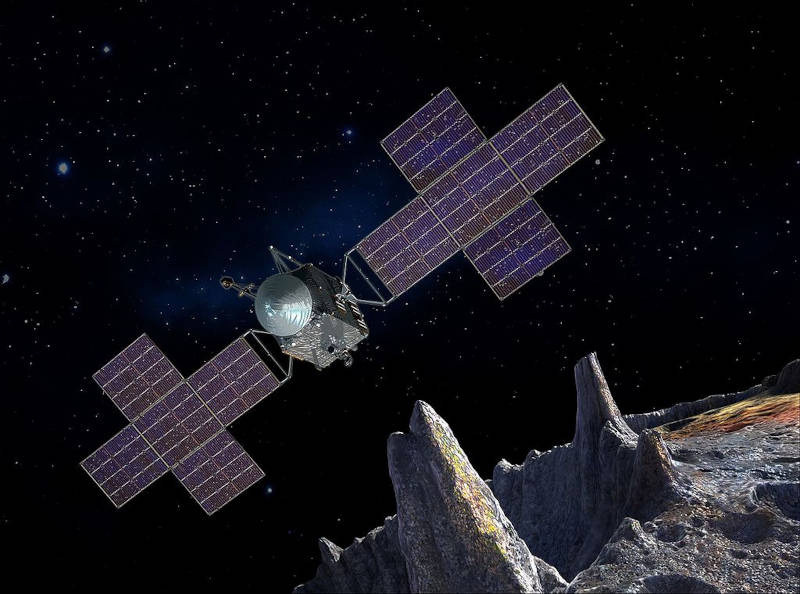
Psyche spacecraft at the asteroid Psyche. Credit: NASA.
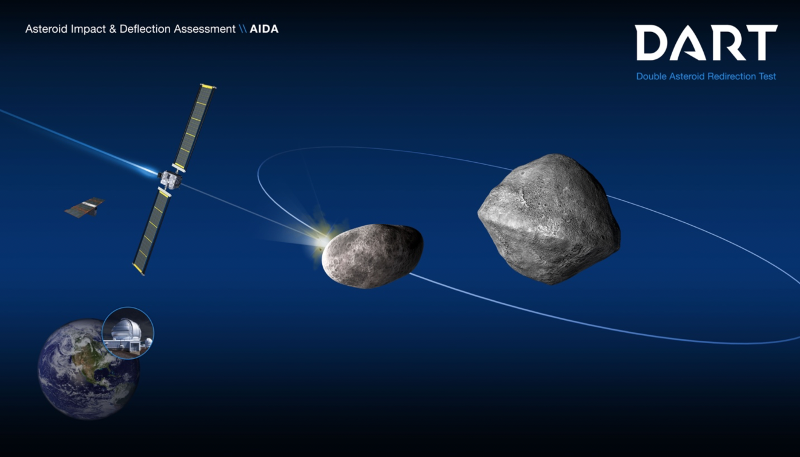
Schematic of the DART mission shows the impact on the moonlet of asteroid (65803) Didymos. Post-impact observations from Earth-based optical telescopes and planetary radar would, in turn, measure the change in the moonlet’s orbit about the parent body.
Credits: NASA/Johns Hopkins Applied Physics Lab

