Archive
12/29/2021 – Ephemeris – Let’s search for the naked-eye planets for this week
This is Bob Moler with Ephemeris for Wednesday, December 29th. Today the Sun will be up for 8 hours and 50 minutes, setting at 5:10, and it will rise tomorrow at 8:19. The Moon, halfway from last quarter to new, will rise at 4:37 tomorrow morning.
Let’s search for the naked-eye planets for this week. Venus will be visible in the southwestern evening twilight by 6:00 tonight. It’s a crescent in telescopes, and even binoculars now. It is moving closer to us, and now appears larger than Jupiter in telescopes. Venus will set at 6:35 pm, 31 minutes earlier than it set a week ago, which means that the Sun is catching up with it faster and faster. It has only 10 days left in the evening sky, Mercury might be spotted just below left of Venus. By 5:45 pm, both Jupiter and Saturn should be able to be spotted in the southwestern sky. Saturn will be dimmer, and to its lower right, halfway between Jupiter and Venus. Saturn will set at 7:35 pm, with Jupiter setting later at 9:31 pm.
The astronomical event times given are for the Traverse City/Interlochen area of Michigan (EST, UT – 5 hours). They may be different for your location.
Addendum
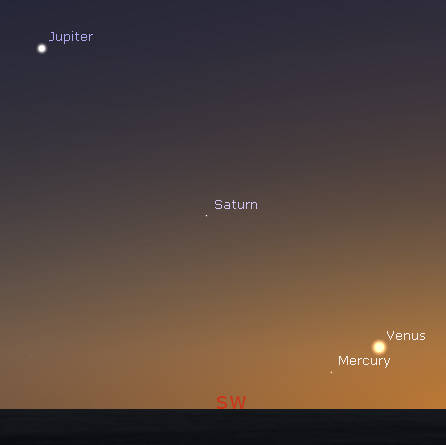
The evening planets in the southwest at 6 pm tonight, December 29, 2021. Created using Stellarium.
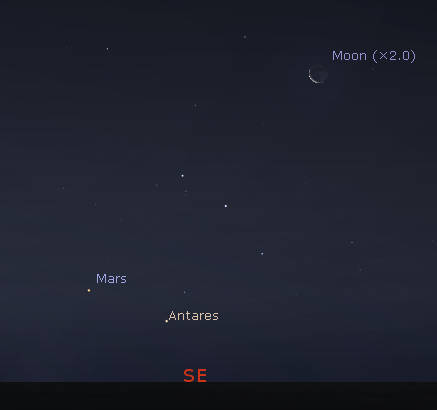
Mars and the Moon in the southeast at 7 am, tomorrow morning, December 30, 2021. Note that Mars is near its rival in color, the red giant star Antares in Scorpius the scorpion. Sometimes Mars is dimmer than Antares, sometime it’s brighter. It depends on Mars’s distance. Currently, it’s quite far away, at 218 million miles (352 million kilometers). The Moon is shown at twice its actual size to better show its thin crescent phase. Created using Stellarium.
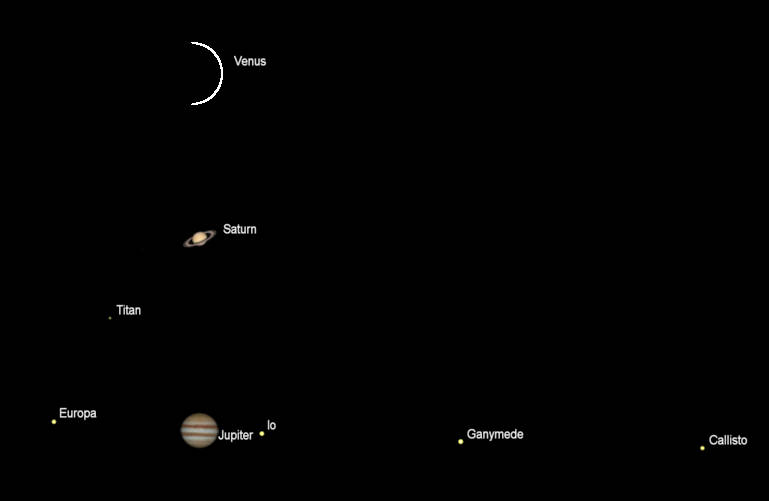
Telescopic views of the bright planets and their brighter moons (north up) as they would be seen in a small telescope, with the same magnification, this evening at 7 pm, December 29, 2021. Apparent diameters: Venus, 59.89″, 3.7% illuminated; Saturn 15.49″, its rings 36.09″; Jupiter, 35.57″. Mercury is not shown, its apparent diameter is 5.68″ and is 82.4% illuminated. Mars also is not shown, its apparent diameter is 3.99″. The ” symbol means seconds of arc (1/3600th of a degree.) Created using Cartes du Ciel (Sky Charts).
In the above chart, I don’t show any planet that’s less than 10 seconds of arc in diameter due to the limitations of scale of what I can show that would be appropriate or small telescopes.
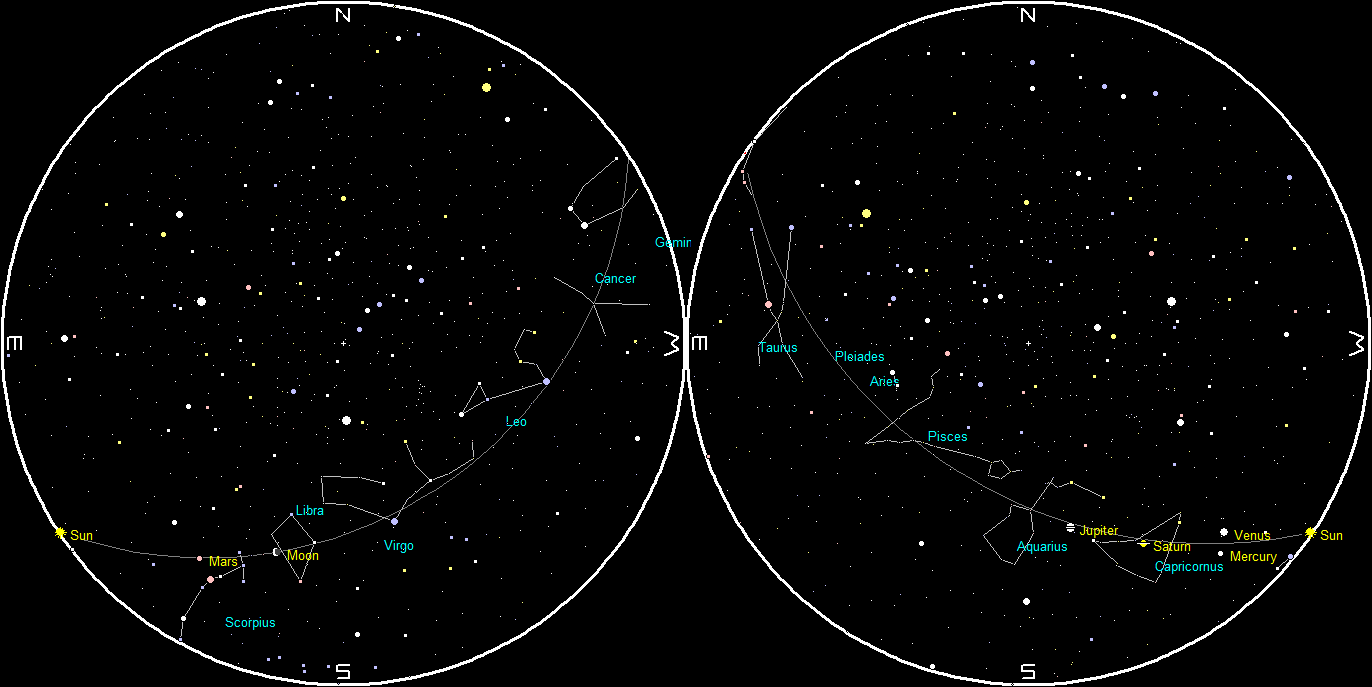
The naked-eye planets and the Moon at sunset and sunrise on a single night, starting with sunset on the right on December 29, 2021. The night ends on the left with sunrise on the 30th. Click on the image to enlarge it. Created using my LookingUp program.
12/28/2021 – Ephemeris – The James Webb Telescope is on its way to L2
This is Ephemeris for Tuesday, December 28th. Today the Sun will be up for 8 hours and 50 minutes, setting at 5:09, and it will rise tomorrow at 8:19. The Moon, 2 days past last quarter, will rise at 3:18 tomorrow morning.
The James Webb Space Telescope was launched Christmas morning and is heading out past the Moon’s orbit. It was launched from the European Space Agency’s Spaceport in Kourou, French Guiana on the northeast coast of South America, as part of their contribution to the project. It will orbit a point called Lagrange Point 2, or L2 for short, over four times the Moon’s distance in a direction opposite of the Sun. It will take the telescope 29 days to unfold itself. First order of business was to unfold the solar panels to obtain power, then to deploy its high gain antenna for communications with the Earth. Next to begin to deploy a 5 layer, tennis court sized sun shield. After that, the telescope will be unfolded.
The astronomical event times given are for the Traverse City/Interlochen area of Michigan (EST, UT – 5 hours). They may be different for your location.
Addendum
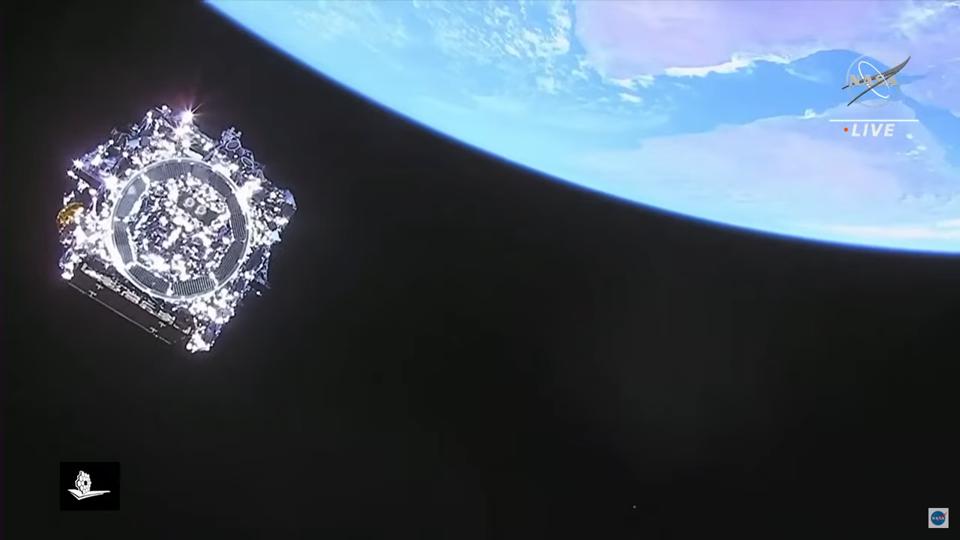
The last view of Webb as it separated from the Ariane 5 launch vehicle. Credit: NASA.
12/27/2021 – Ephemeris – Where did Earth’s water come from?
This is Ephemeris for Monday, December 27th. Today the Sun will be up for 8 hours and 49 minutes, setting at 5:08, and it will rise tomorrow at 8:19. The Moon, 1 day past last quarter, will rise at 2:02 tomorrow morning.
The element hydrogen has two stable forms: Ordinary hydrogen with a single proton as its nucleus, and deuterium with a proton and a neutron as its nucleus. Both can combine with oxygen to form water. Deuterium and oxygen make heavy water. Water of any kind would not have survived Earth’s formation. Astronomers have long thought that collisions of asteroids and comet brought water to the Earth. Comets, however, have an overabundance of deuterium. Asteroids are close, also dust particles exposed to the solar wind have an under abundance of deuterium. Apparently, about a 50-50 mixture of dust and asteroids appear the right combination to fill the Earth’s with the right ratio of normal and heavy water.
The astronomical event times given are for the Traverse City/Interlochen area of Michigan (EST, UT – 5 hours). They may be different for your location.
Addendum
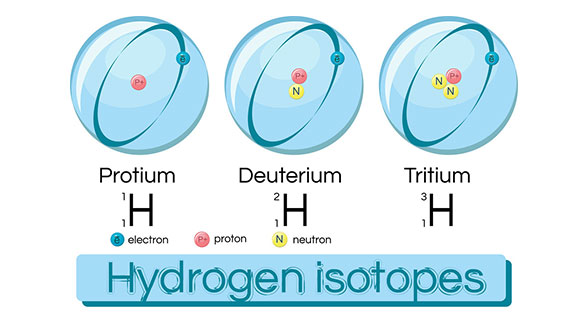
The three isotopes of hydrogen: protium, or ordinary hydrogen; deuterium; and tritium. Protium and deuterium are stable, while tritium is unstable and decays into helium 3 and an electron. Tritium has a half-life of 12.32 years.
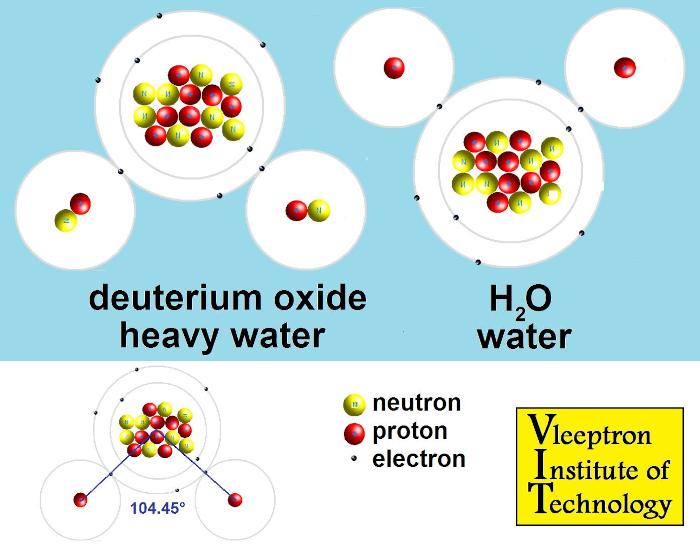
Heavy water D2O vs. normal water H2O. Heavy water is about 11% heavier than water. A heavy water ice cube would sink in a glass of water.
12/24-25/2021 – Ephemeris – Another possible solution of the mystery of the Star of Bethlehem
This is Ephemeris for Christmas Eve and Christmas Day, December 24th & 25th. The Sun will be up for 8 hours and 48 minutes, setting at 5:06, and it will rise tomorrow at 8:18. The Moon, 2 days before last quarter, will rise at 10:31 this evening.
The brilliant planets Venus and Jupiter are our Christmas Stars in the evening sky now. And perhaps they were part of the Star of Bethlehem. Back in August of 3 BCE, the planet Jupiter and Venus appeared to come very close to one another. The term for such an apparent close approach is called a conjunction. Astrologers make a big deal out of such a chance alignment. It’s like a trick photo of someone in the foreground appearing to hold up or leaning on a more distant object. Anyway, 10 months later in June of 2 BCE, Jupiter again appeared to join Venus, this time so close they could not be separated by the human eye. This all occurred against the constellation of Leo the lion which, in Genesis, was the symbol of Judah.
The astronomical event times given are for the Traverse City/Interlochen area of Michigan (EST, UT – 5 hours). They may be different for your location.
Merry Christmas!
Addendum
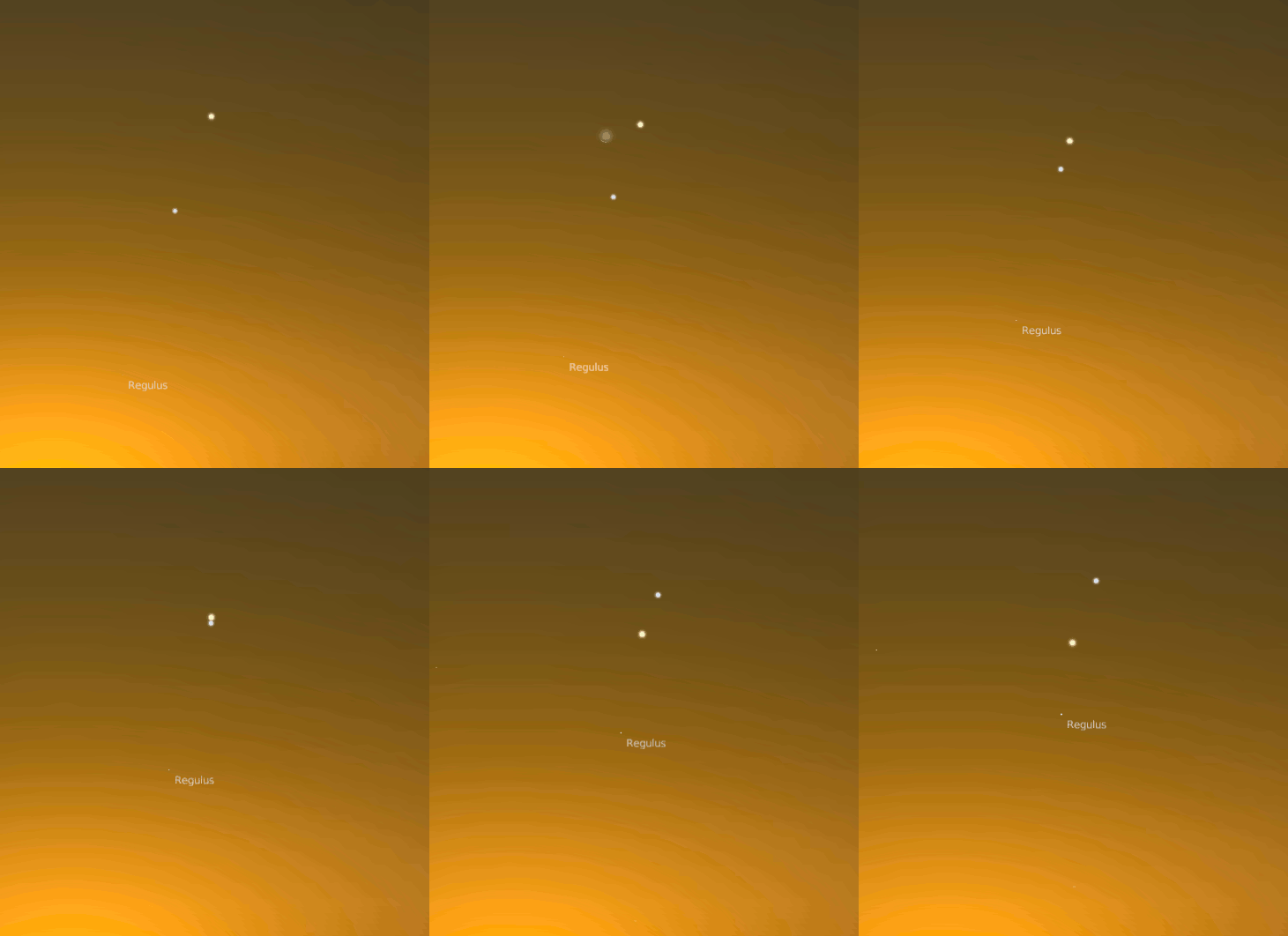
Here is an animation created using Stellarium of Jupiter and Venus, the brighter of the two seeming to coalesce on August 12, 3 BCE in the early morning twilight.
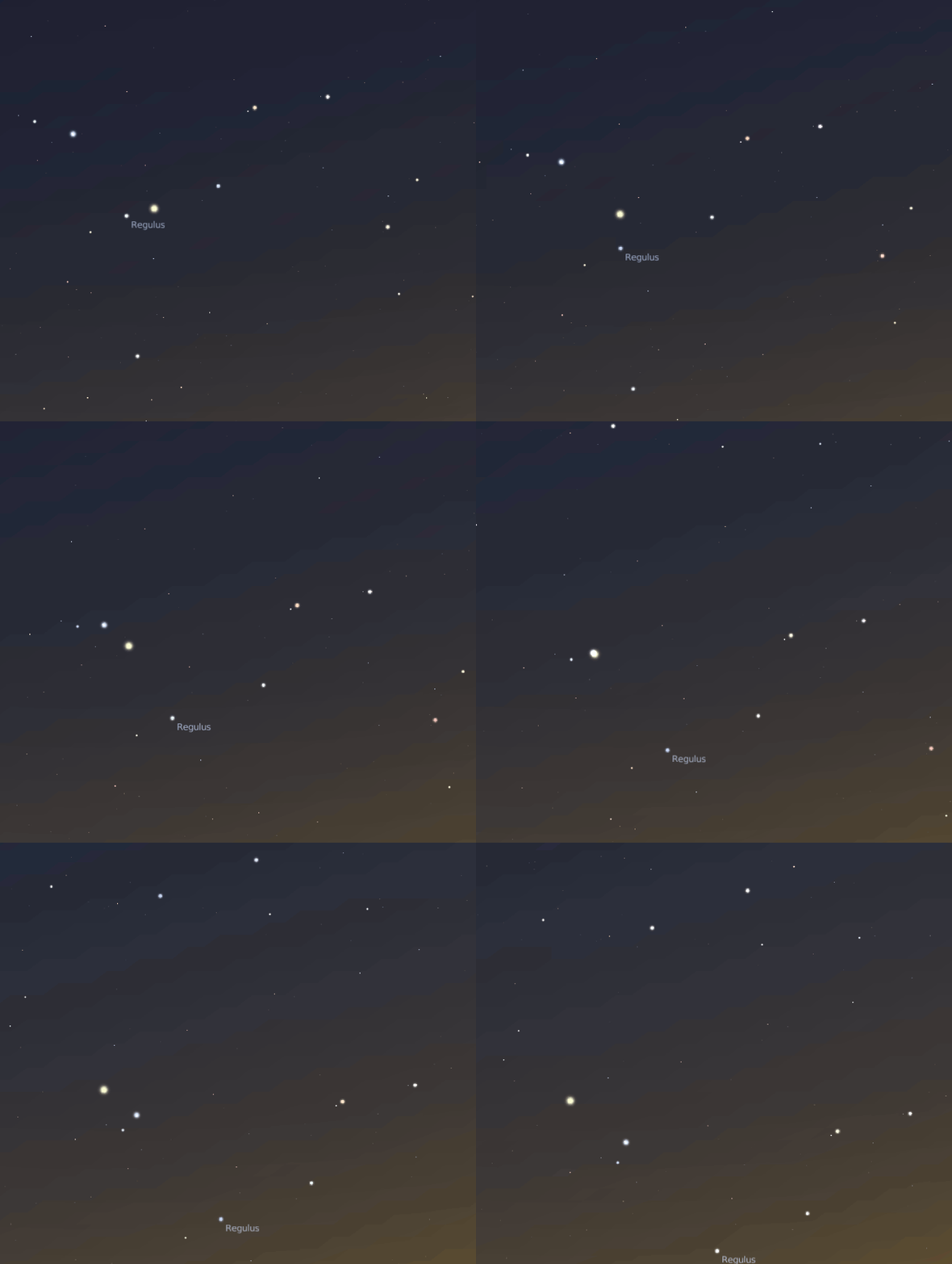
On June 16th 2 BCE, this time in the evening, Venus and Jupiter seem to coalesce as one, at least to the naked eye.
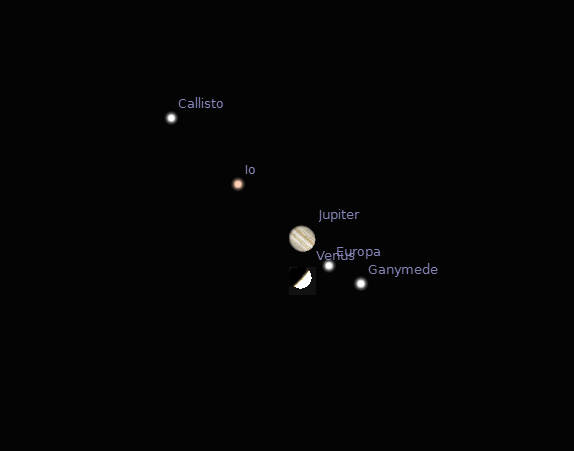
Venus appeared among Jupiter’s moons on June 16, 2 BCE. Of course, no one had a telescope back then. The telescope wouldn’t be invented for another 1,600 years. Stellarium cannot create the real brightness difference between Jupiter and Venus. Venus would be simply dazzling compared to Jupiter. Created using Stellarium.
12/23/2021 – Ephemeris – The James Webb Space Telescope to launch Real Soon Now
This is Ephemeris for Thursday, December 23rd. Today the Sun will be up for 8 hours and 48 minutes, setting at 5:06, and it will rise tomorrow at 8:18. The Moon, 3 days before last quarter, will rise at 9:23 this evening.
One of the problems in recording a week’s worth of programs at once is: one, not having the freshest news; and two, talking about an imminent space launch that gets canceled a day or two before scheduled launch. As of Sunday night, when I’m recording this, the often delayed James Webb Space Telescope is scheduled to be launched at 7:20 (am EST) tomorrow morning* from the European Space Agency’s Spaceport in Kourou, French Guiana on the northeast coast of South America. It will be launched on an Ariane 5 rocket into an orbit that will take the telescope a million miles away, opposite of the direction of the Sun to a gravitational somewhat stable L2 Lagrange point, which it will lazily orbit.
The astronomical event times given are for the Traverse City/Interlochen area of Michigan (EST, UT – 5 hours). They may be different for your location.
* See? Delayed again, this time for bad weather. The launch is rescheduled for not earlier than 7:20 am EST Christmas Day. This is why I hate to talk about spacecraft launches before they happen, except in a general way.
Addendum
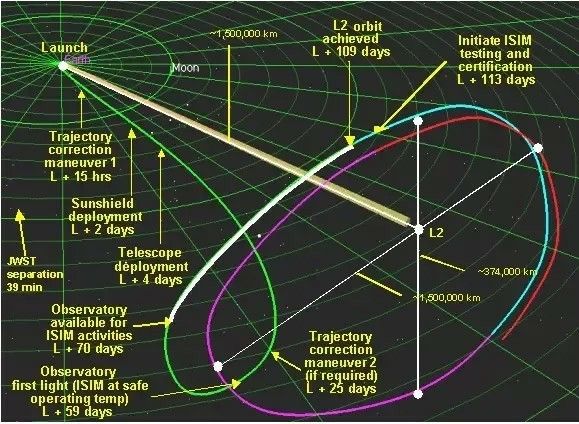
James Webb Space Telescope trajectory to L2 with some milestones of deployment. “ISIM” stands for Integrated Scientific Instruments Module. Credit: Space Telescope Science Institute (STScI).
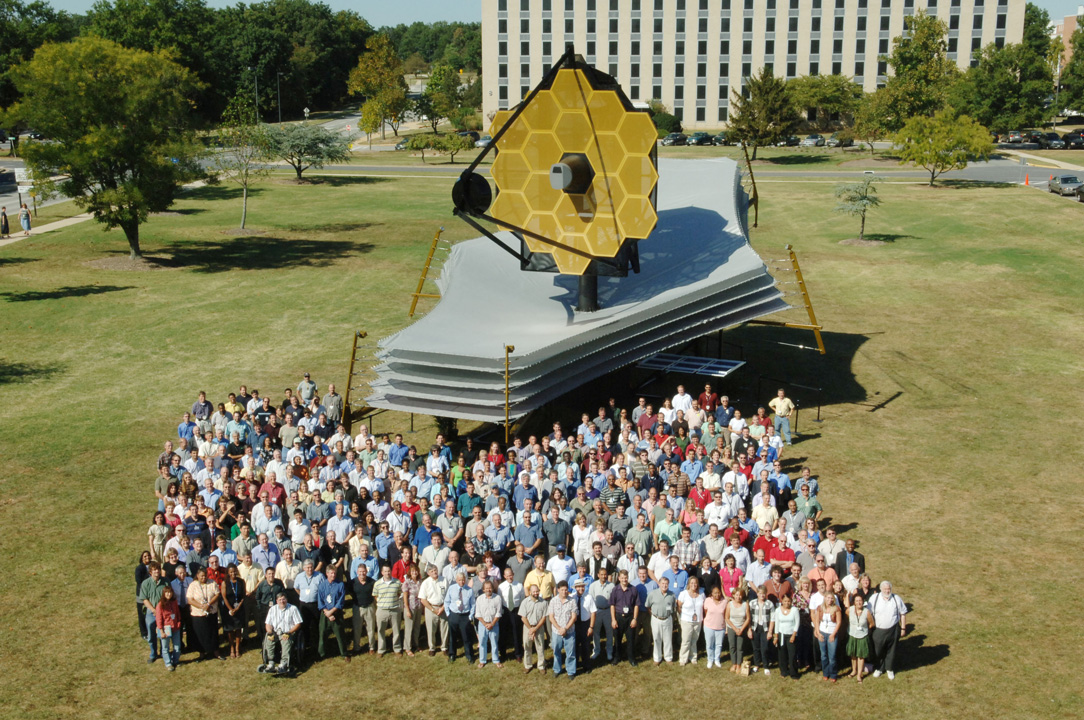
Full scale model of the James Webb Space Telescope at Goddard Space Flight Center. Note its scale, with the people who worked on it the foreground.
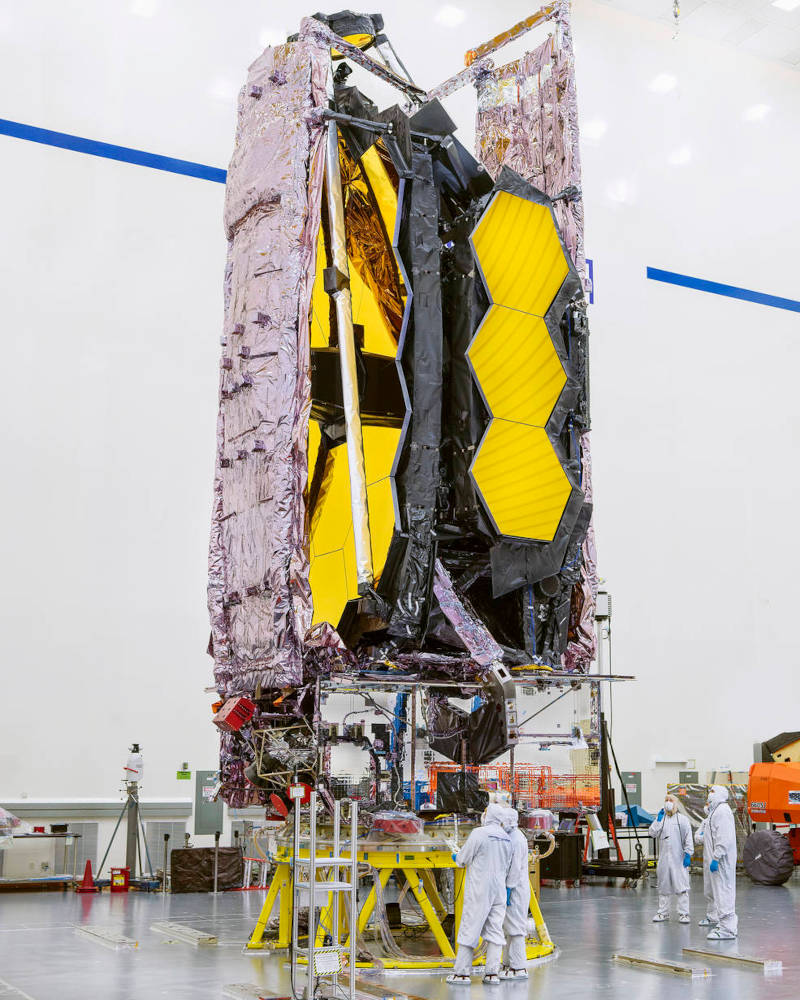
James Webb Space Telescope, folded and ready to be placed atop the Ariane 5 Rocket. After launch and on its way to L2 begins “29 Days of Terror” as various parts of the telescope deploy, including the five layer, tennis court sized, sun shade. Any failure could doom the 10 billion dollar telescope.
12/22/2021 – Ephemeris – Let’s search for the naked-eye planets for this week
This is Ephemeris for Wednesday, December 22nd. Today the Sun will be up for 8 hours and 48 minutes, setting at 5:05, and it will rise tomorrow at 8:18. The Moon, halfway from full to last quarter, will rise at 8:16 this evening.
Let’s search for the naked-eye planets for this week. Venus will be visible in the southwestern evening twilight by 5:30 tonight. It’s a crescent in telescopes, and even binoculars now. It is moving closer to us, and now appears larger than Jupiter in telescopes. Venus will set at 7:06 pm, 21 minutes earlier than it set a week ago, which means that the Sun is catching up with it faster and faster. It has only 17 days left in the evening sky, It’s now pulling away from Jupiter and Saturn. By 5:45 pm, both Jupiter and Saturn should be able to be spotted in the southwestern sky. Saturn will be dimmer, and to its lower right, halfway between it and Venus. Saturn will set at 8:17 pm, with Jupiter following an hour and a half later at 9:51 pm.
The astronomical event times given are for the Traverse City/Interlochen area of Michigan (EST, UT – 5 hours). They may be different for your location.
Addendum
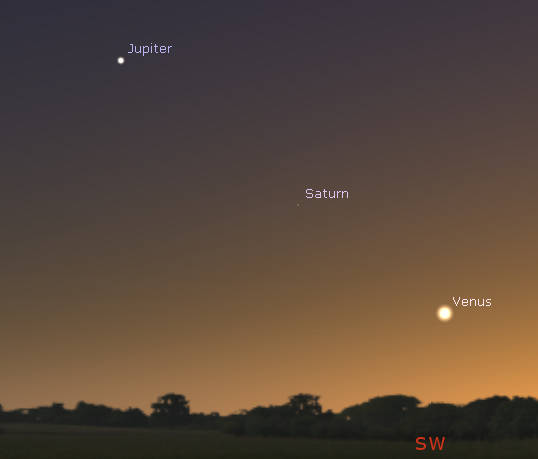
The evening planets, Venus, Saturn and Jupiter in the southwestern at 5:45 pm Tonight, December 22, 2021. Created using Stellarium.
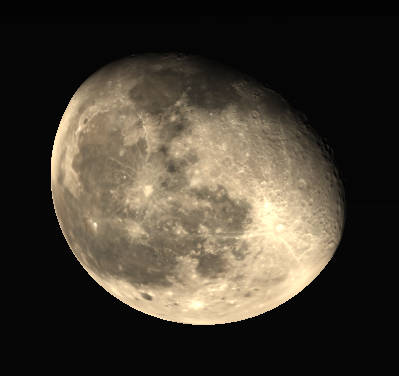
The Moon as it might appear in binoculars or small telescope low in the east northeast, tonight at 9 pm, December 22, 2021. Created using Stellarium.
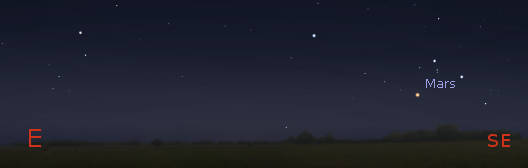
Mars, low in the southeast at 7 am tomorrow morning, December 22, 2021. Created using Stellarium.
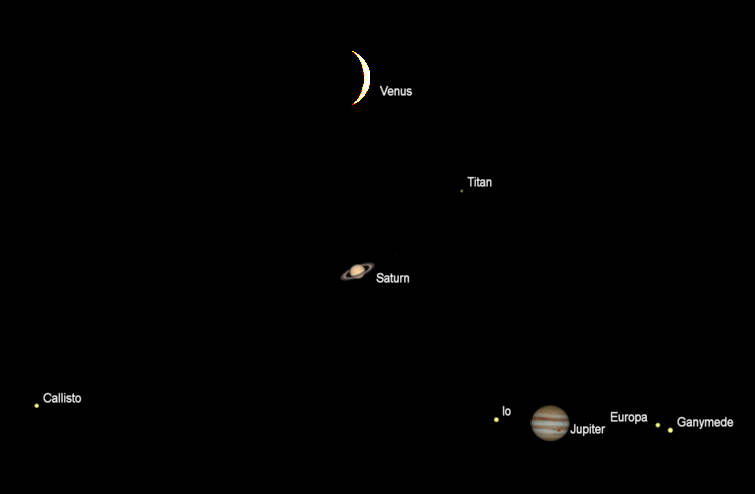
Telescopic views of the bright planets and their brighter moons (north up) as they would be seen in a small telescope, with the same magnification, this evening at 7 pm, December 22, 2021. Apparent diameters: Venus, 55.10″, 9.1% illuminated; Saturn 15.59″, its rings 36.32″; Jupiter, 36.16″. Mars is not shown, its apparent diameter is 3.93″. The ” symbol means seconds of arc (1/3600th of a degree.) Created using Cartes du Ciel (Sky Charts).
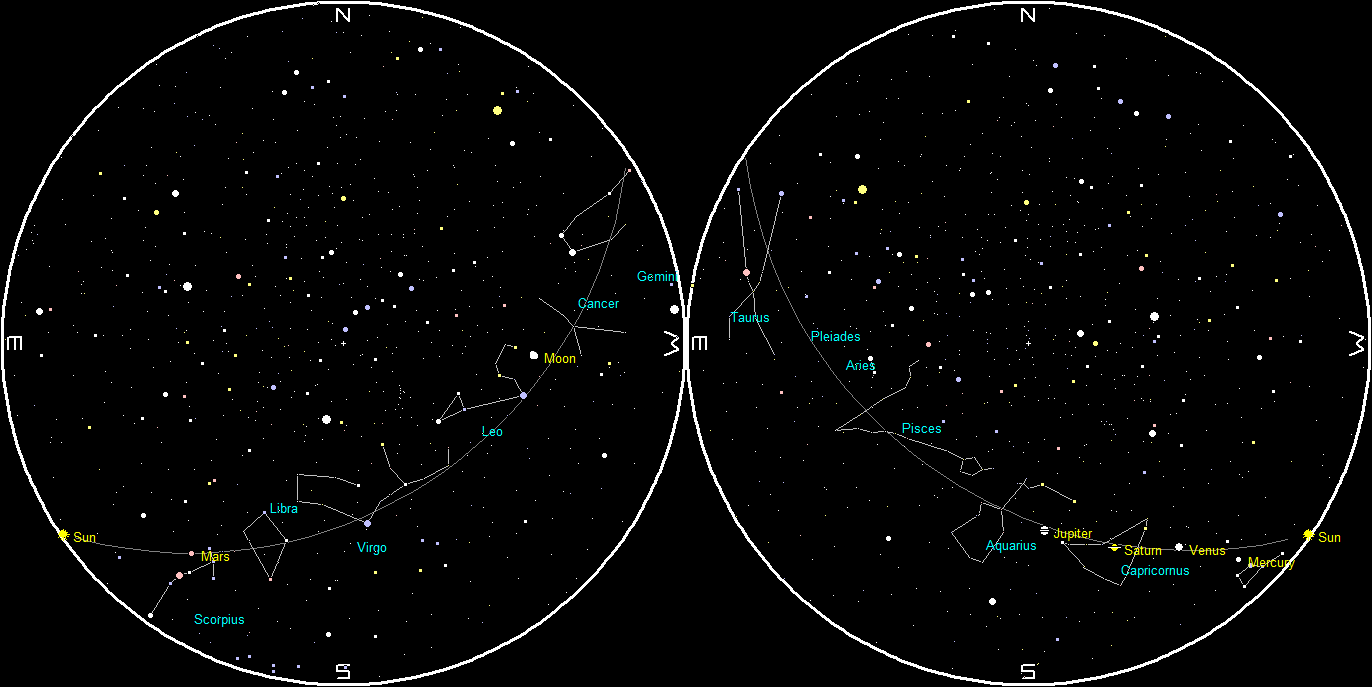
The naked-eye planets and the Moon at sunset and sunrise on a single night, starting with sunset on the right on December 22, 2021. The night ends on the left with sunrise on the 23rd. Click on the image to enlarge it. Created using my LookingUp program.
12/21/2021 – Ephemeris – Winter starts today as the Sun starts coming back up north
This is Ephemeris for Tuesday, December 21st. Today the Sun will be up for 8 hours and 48 minutes, setting at 5:05, and it will rise tomorrow at 8:17. The Moon, 3 days past full, will rise at 7:11 this evening.
The thermometer and snowfall tell us that winter ought to be here. Well, it will be at 10:59 this morning. At that point, the Sun will be directly over the Tropic of Capricorn at 23 ½ degrees south latitude. It’s an odd name because 2,000 years ago the Sun was in indeed entering Capricornus. Now it’s entering Sagittarius, right above the spout of the teapot asterism we know so well in summer. From then on the Sun will be climbing up the sky each noon until June 21st next year when summer will start. To which I say Go Sun Go! The Sun will almost make it up to 22 degrees above the southern horizon at local noon, which is 12:40 pm, in Interlochen and be out for only 8 hours and 48 minutes. If it stayed that low all year, we’d be in a deep freeze, possibly colder than Antarctica.
The astronomical event times given are for the Traverse City/Interlochen area of Michigan (EST, UT – 5 hours). They may be different for your location.
Addendum
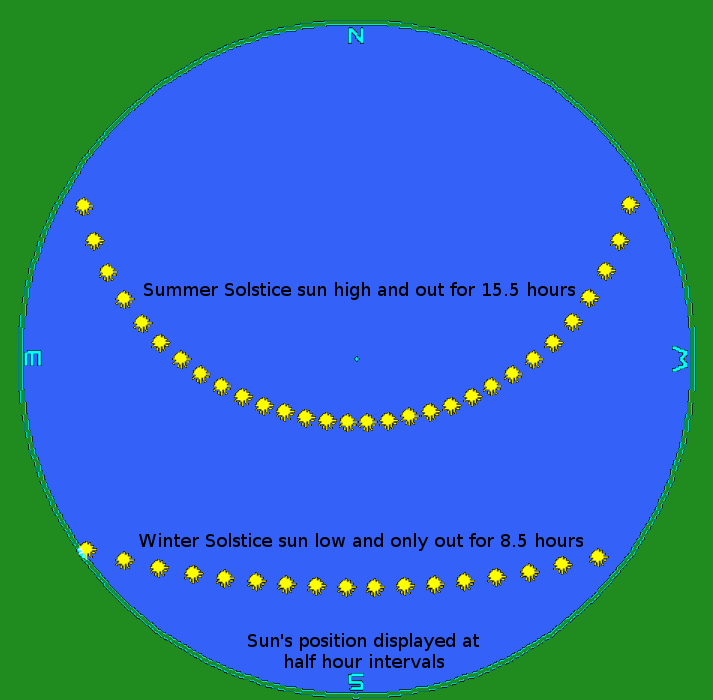
Comparing the sun’s path at the summer and winter solstices in Traverse City, MI, located near 45 degrees north latitude. This is a stereographic representation of the whole sky, which distorts the sky and magnifies the size of the sun’s path near the horizon.
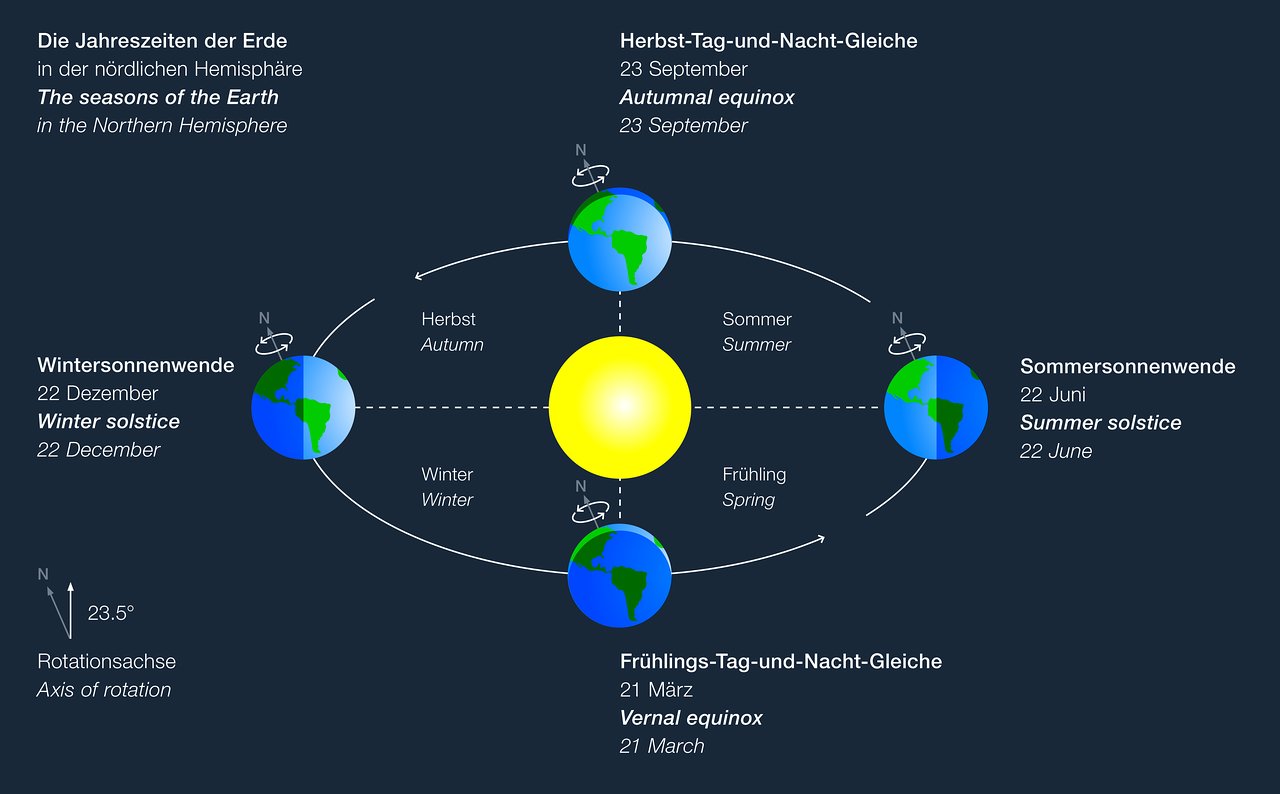
Earth’s position at the solstices and equinoxes. This is a not to scale oblique look at the Earth’s orbit, which is nearly circular. The Earth is actually farthest from the Sun on July 4th, and closest on January 3, next year. Click on the image to enlarge. Credit: ESO (European Southern Observatory), which explains the captions in German and English.
Of course, the winter solstice for us is the summer solstice for folks in the Southern Hemisphere. Solstice is “Sun stand still”. The Sun has been moving southward in the sky at noon since June, and today has stopped, and will now start heading northward again.
12/20/2021 – Ephemeris – Could the Star of Bethlehem have been a triple conjunction of Jupiter and Saturn in 7 BCE?
This is Ephemeris for Monday, December 20th. Today the Sun will be up for 8 hours and 48 minutes, setting at 5:04, and it will rise tomorrow at 8:17. The Moon, 2 days past full, will rise at 6:12 this evening.
This year we have two bright evening Christmas stars, Venus and Jupiter. But what about the one described in the Bible, in the Gospel of Matthew? We will look today at the first of two events that may have been recorded as the Star of Bethlehem. In 7 BCE there was a rare event over 6 months when three times the planet Jupiter passed Saturn against the stars of the constellation Pisces. Could the Persian astrologer priests, called Magi, have read into the event enough significance to start the journey to Jerusalem in search of the newborn King of the Jews? It was the scribe’s readings that sent them to Bethlehem. Jupiter, Saturn and Pisces all may have had significance to the Magi.
The astronomical event times given are for the Traverse City/Interlochen area of Michigan (EST, UT – 5 hours). They may be different for your location.
Addendum
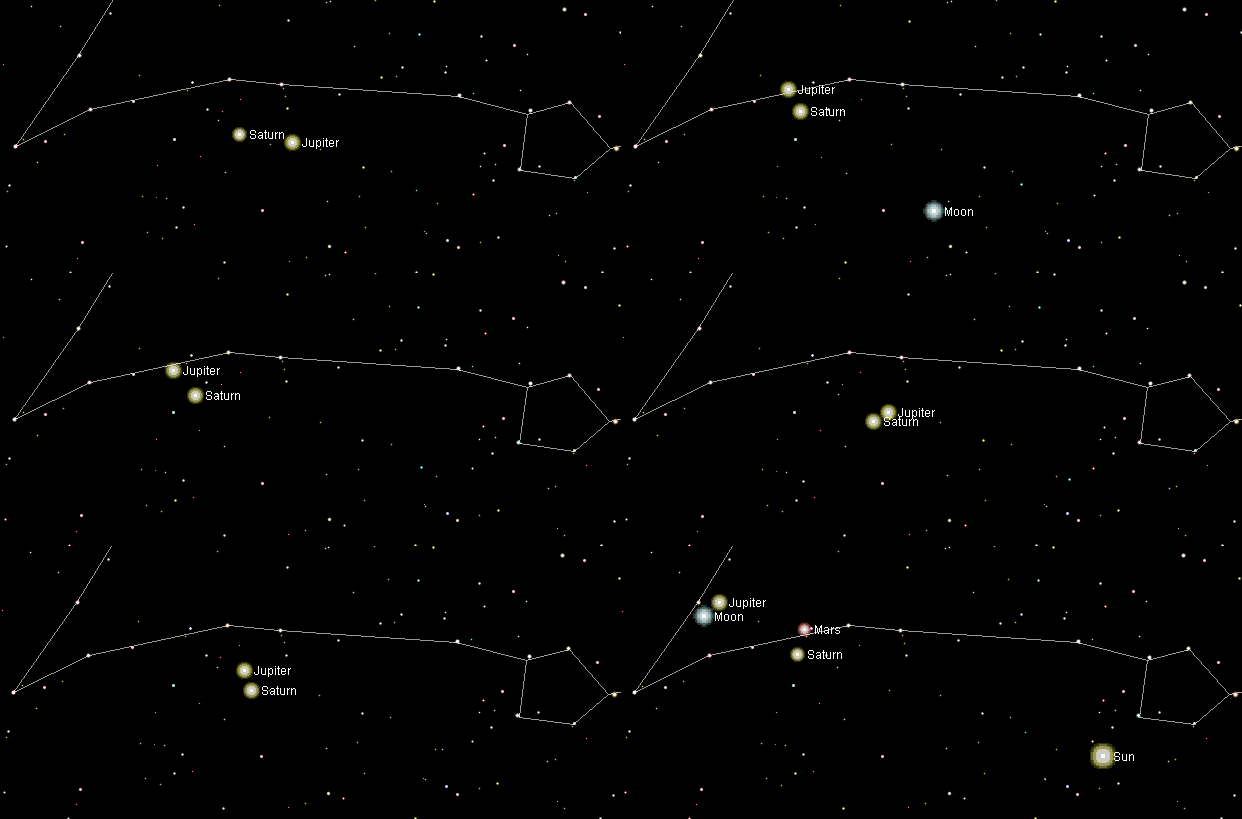
Jupiter and Saturn pass each other three times from May to December in 7 BC. Created using Cartes du Ciel (Sky Charts) and GIMP.
This timing of the Star is based on the Jewish historian Josephus, dating the death of Herod the Great just before a lunar eclipse. The eclipse most historians accept was the one on March 13, 4 BCE. So Jesus could have been born in 6 BCE.
I have been giving a presentation to the Grand Traverse Astronomical Society every other December since the 1980s on the Star of Bethlehem, tweaking it each time, and completely rewriting it a few times. Below is my script from my 2020 program In Search of the Star of Bethlehem for the Grand Traverse Astronomical Society. It has small thumbnails of the slides. The name says notes, but it evolved into a complete script, and is laid out to be read that way.
Star of Bethlehem 2020 Notes (PDF)
In the presentation, I cover another possibility for the “Star”, which I happen to like more. I’ll talk about that on Christmas Eve. If you can’t wait, check out the PDF, or a prior December program in the Archives.
12/17/2021 – Ephemeris – Artemis-1 mission may launch in less than 2 months
This is Ephemeris for Friday, December 17th. Today the Sun will be up for 8 hours and 48 minutes, setting at 5:03, and it will rise tomorrow at 8:15. The Moon, 1 day before full, will set at 7:56 tomorrow morning.
In a little less than two months, a fifteen-day launch window opens up to launch Artemis one, the first and hopefully only uncrewed Artemis mission to the Moon in the NASA’s program to land the next man and first woman on the Moon. The uncrewed Orion capsule and the ESA contributed Service Module will orbit the Moon in a very elongated distant orbit of the Moon, retreating out to 38,000 miles (61,000 kilometers) further than the Moon once or twice before heading within 60 miles of the Moon’s surface on its way back to the Earth. The upper stage, that sends Orion on its way to the Moon, will release some CubeSats as it follows Orion to the Moon, where it will whip around the Moon to orbit the Sun.
The astronomical event times given are for the Traverse City/Interlochen area of Michigan (EST, UT – 5 hours). They may be different for your location.
Addendum
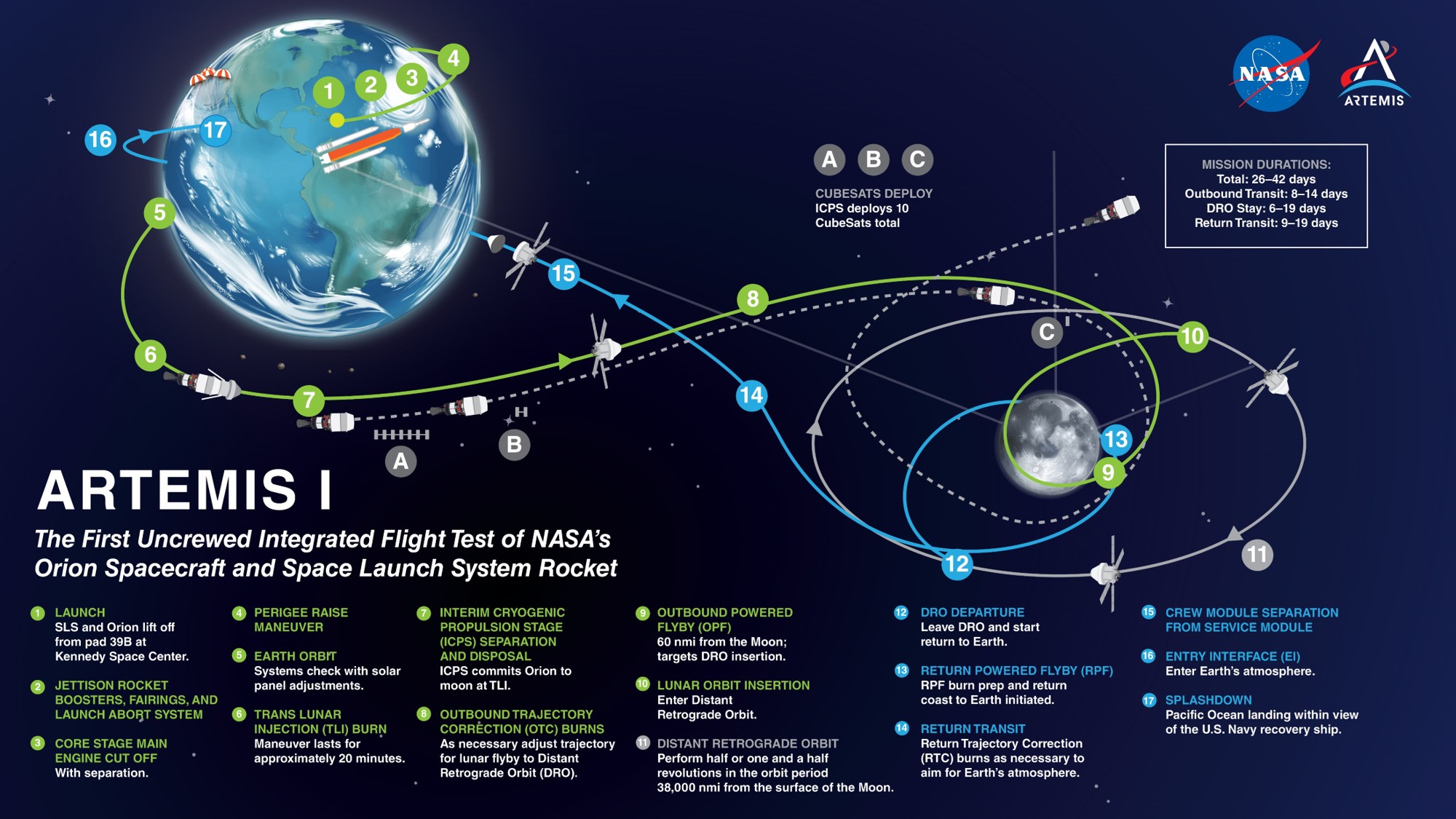
Artemis-1 orbital plan. Click on the image to enlarge it. Credit NASA.

The Earth and Moon to scale. Source Wikipedia.
12/16/2021 – Ephemeris – The brightest spot on the Moon
This is Ephemeris for Thursday, December 16th. Today the Sun will be up for 8 hours and 49 minutes, setting at 5:03, and it will rise tomorrow at 8:14. The Moon, 2 days before full, will set at 6:53 tomorrow morning.
The Moon tonight is bright. The sunrise line or terminator on the moon is crossing the large gray plain called Oceanus Procellarum, the largest of the moon’s seas. These seas were figments of the first telescopic observers imagination. They are really huge impact basins into which interior lava flowed. On the upper left edge of the moon near the terminator is a bright spot visible in binoculars. In a telescope, it is a crater called Aristarchus. It is a fairly new crater, probably less than a billion years old. As a rule the brighter the crater the newer it is. Aristarchus is the brightest spot on the moon. Over the years, visual astronomers have seen hazes and bright spots from time to time in and near Aristarchus. Their cause is still a mystery.
The astronomical event times given are for the Traverse City/Interlochen area of Michigan (EST, UT – 5 hours). They may be different for your location.
Addendum
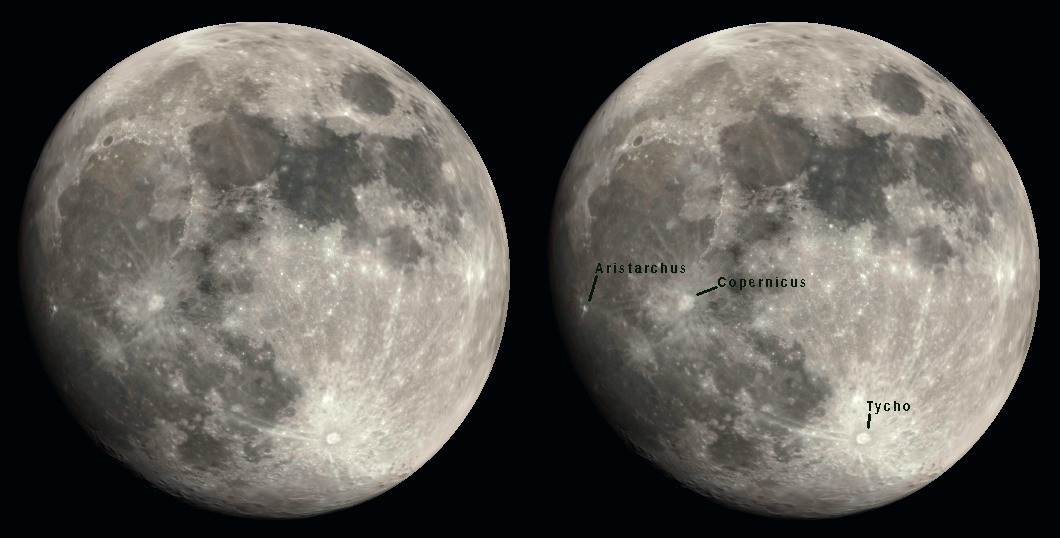
The brightest spots on the Moon as they might appear tonight, December 16, 2021. This is not a photograph. But created using Stellarium, presumably from lunar satellite photographs that simulate the phase and shadows.
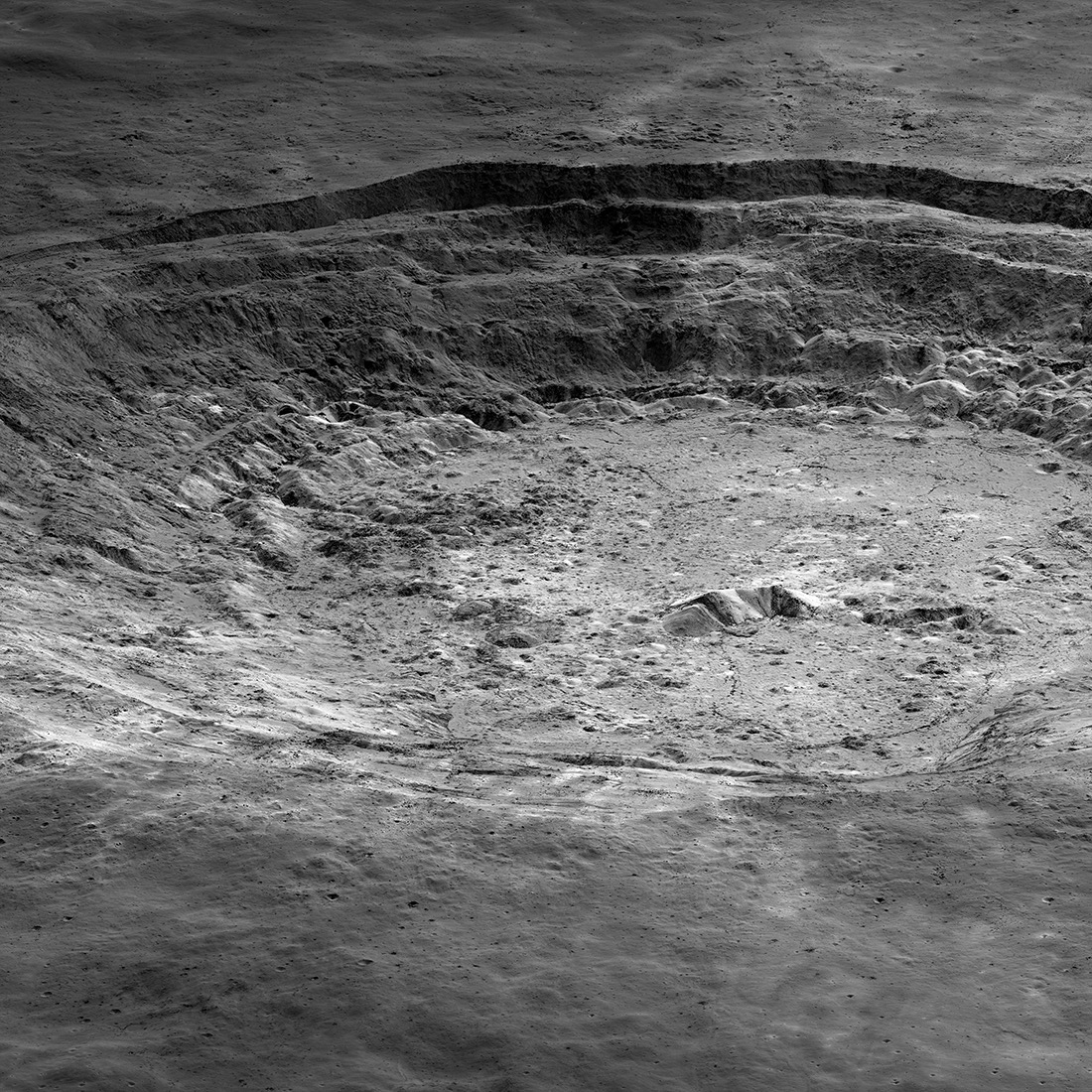
Oblique view of the crater Aristarchus from a lunar orbiting satellite. Credit: NASA/GSFC/Arizona State University.

