Archive
11/25/2020 – Ephemeris – Let’s look for the naked-eye planets for this week
This is Ephemeris for Wednesday, November 25th. Today the Sun will be up for 9 hours and 12 minutes, setting at 5:06, and it will rise tomorrow at 7:54. The Moon, 4 days past first quarter, will set at 3:58 tomorrow morning.
Let’s look for the naked-eye planets for this week. Jupiter and Saturn are both low in the southwestern sky from 7 to 8 pm. Jupiter is the very bright one. Above and left will be dimmer Saturn. They are slowly closing, so they will cross paths on the evening of December 21st and be seen in the same telescope field that evening. Jupiter will set first tonight at 8:41 with Saturn following at 8:56. Off in the southeast at that hour will be Mars above the bright gibbous Moon tonight. Mars’ distance is increasing to 55.6 million miles (89.6 million kilometers) away. Mars will set at 3:47 tomorrow morning. Brilliant Venus will rise at 5:21 am in the east-southeast as it retreats slowly toward, but actually around the back of the Sun.
The event times given are for the Traverse City/Interlochen area of Michigan. They may be different for your location.
Addendum
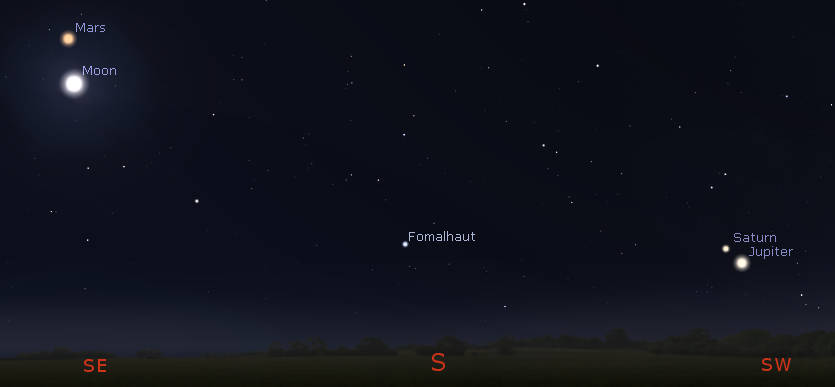
Evening planets and the Moon for 7 pm tonight November 25, 2020. Click on the image to enlarge. Created using Stellarium.
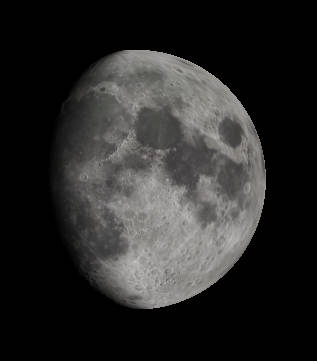
The gibbous Moon as it might be seen in binoculars this evening at 7 pm November 25, 2020. Created using Stellarium.
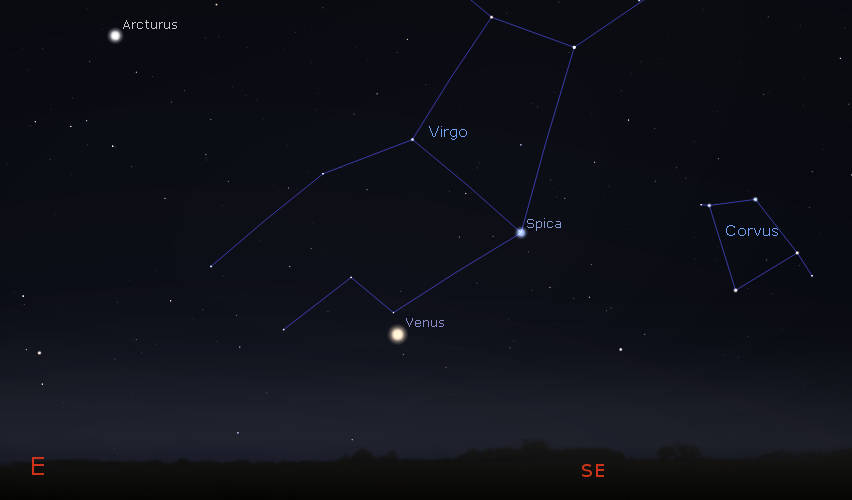
Venus and the morning constellations at 6:30 am tomorrow November 26, 2020. Created using Stellarium.
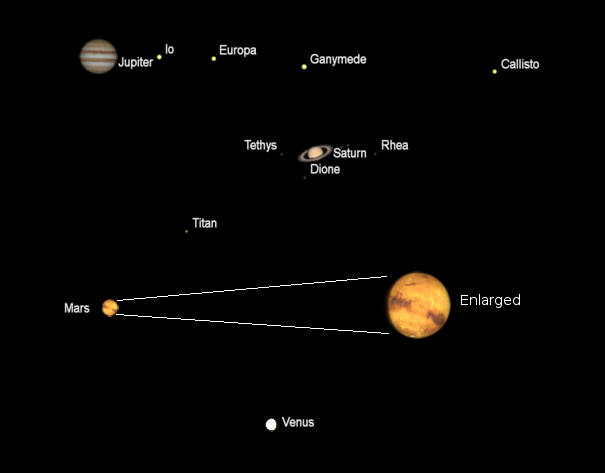
The planets as seen in a telescope (north up) with the same magnification for the night of November 25/26, 2020. Times of the display are: Jupiter and Saturn, 7 pm; Mars, 10 pm; Venus, 6:30 am. Apparent diameters: Jupiter, 34.76″; Saturn, 15.76″, rings, 36.72″; Mars, 15.45″, and Venus 11.85″. Mars also displays an enlargement showing surface detail. Mars was closest to the Earth this go-a-round on October 6. The ” symbol means seconds of arc (1/3600th of a degree.) Created using Cartes du Ciel (Sky Charts).
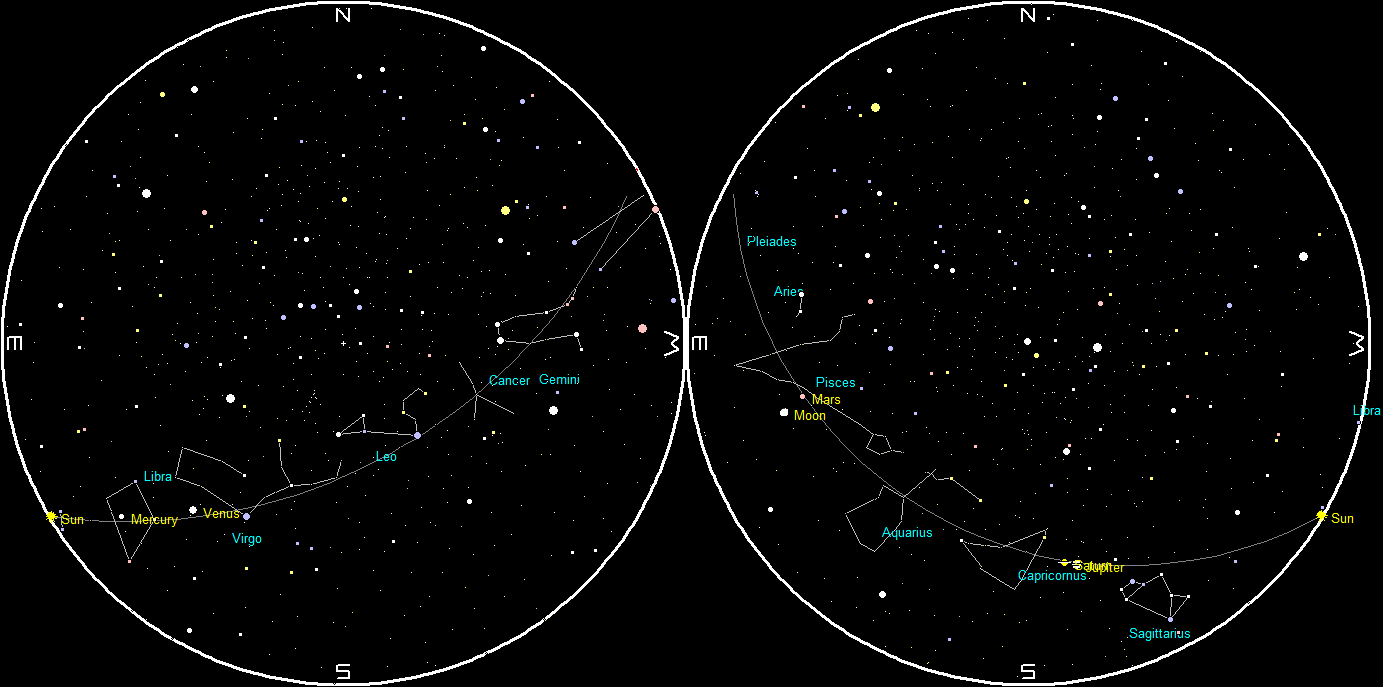
Planets and the Moon at sunset and sunrise of a single night starting with sunset on the right on November 25, 2020. The night ends on the left with sunrise on the 26th. I’m afraid that the labels for Jupiter and Saturn will overlap, since the planets are getting very close. Click on the image to enlarge. Created using my LookingUp program.
11/24/2020 – Ephemeris – Next month’s conjunction of Jupiter and Saturn
This is Ephemeris for Tuesday, November 24th. Today the Sun will be up for 9 hours and 14 minutes, setting at 5:06, and it will rise tomorrow at 7:53. The Moon, 3 days past first quarter, will set at 2:57 tomorrow morning.
Over the next 27 days Jupiter and Saturn will draw together to be in conjunction. I don’t know what that means astrologically, since I don’t believe in that stuff. It just means that Jupiter and Saturn lie near the same line of sight from the Earth. Though they will be almost as close as they get to each other, that won’t be that close. They were closest to each other earlier this month, at about 450 million miles (724 million kilometers). Jupiter is now about 525 million miles (845 million kilometers) away from us. Both, of course, are on the other side of the Sun from us. Jupiter, in its nearly 12 year orbit of the Sun laps the slower Saturn in it’s nearly 30 year orbit about every 20 years. It will do so again on November 5th of 2040.
The event times given are for the Traverse City/Interlochen area of Michigan. They may be different for your location.
Addendum
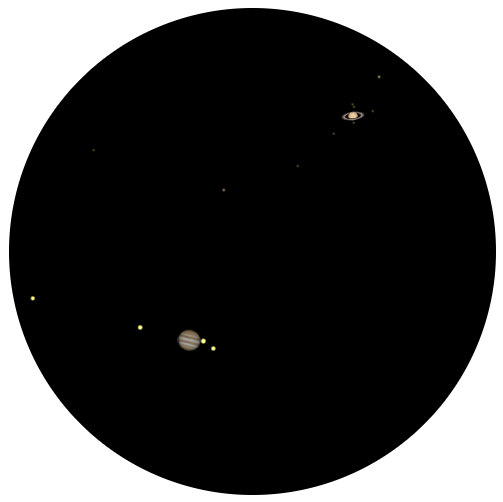
Possible telescopic view of Jupiter-Saturn conjunction 6 pm, December 21, 2020. Created using Cartes du Ciel (Sky Charts).
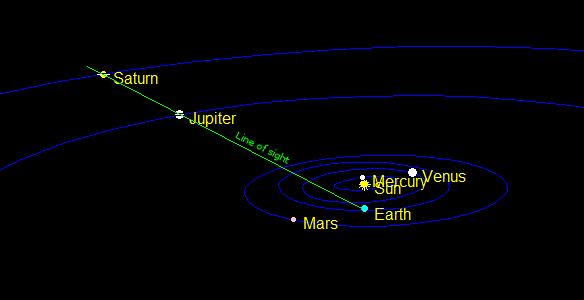
Jupiter and Saturn along the same line of sight from the Earth on December 21, 2020. Created using my LookingUp program.
11/23/2020 – Ephemeris – Our Moon is different
This is Bob Moler with Ephemeris for Monday, November 23rd. Today the Sun will be up for 9 hours and 16 minutes, setting at 5:07, and it will rise tomorrow at 7:52. The Moon, 2 days past first quarter, will set at 1:55 tomorrow morning.
The Earth’s Moon is different from most other moons. First it is very big when compared to the Earth. The Moon is a bit more than quarter the Earth’s diameter. Only Pluto’s moon Charon is larger compares to its primary, being half the size of Pluto. Most big moons orbit over their planet’s equator. Our Moon orbits the Earth close to the plane of Earth’s orbit of the Sun. That’s why the Moon is seen passing the planets each month. The Moon is too big to have been captured by the Earth in a chance flyby. The moon rocks brought back during Apollo showed that the Moon was made of the same crustal material as the Earth, so the impact theory was put forth that the Moon was the result of a collision of the Earth and a Mars sized body soon after they were formed.
The event times given are for the Traverse City/Interlochen area of Michigan. They may be different for your location.
Addendum
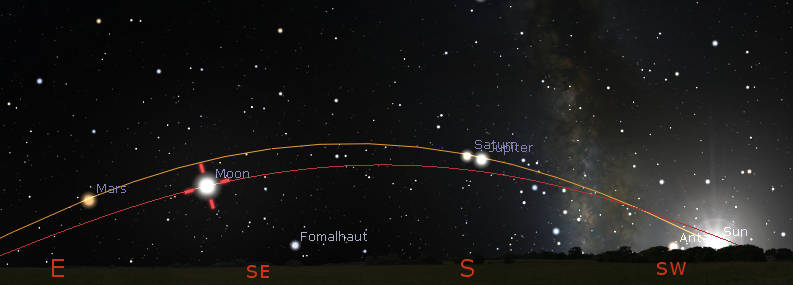
The Moon’s orbit (red) vs the ecliptic or plane of the Earth’s orbit (orange). The Moon’s orbit is tilted to the Earth’s orbit by 5 degrees. This is for 4:30 pm or a little more than a half hour before sunset. The black sky is due to removing atmospheric scattering in the program. Click on the image to enlarge. Created using Stellarium.
In the image note that the Moon’s orbit crosses the ecliptic just east of the Sun’s position. That crossing point is called the Moon’s descending node, since the Moon’s eastward motion will take it from north of the ecliptic to south of it. When the Sun is close to a node eclipses can occur. The ascending node is at the opposite side of the ecliptic so both solar and lunar eclipses occur in an eclipse season that lasts about a month.
An indeed there will be a penumbral eclipse of the Moon on the 30th, and a total solar eclipse for Chile and Argentina December 14th. The nodes don’t stay in one place, but they move westward, making one rotation around the ecliptic in 18.61 years. Since the nodes are moving westward it is called the regression of the nodes. So eclipse seasons occur about every 5 2/3 months, moving backwards in the calendar.
11/20/2020 – Ephemeris – Martian Trojan asteroid may have come from our Moon
This is Ephemeris for Friday, November 20th. Today the Sun will be up for 9 hours and 22 minutes, setting at 5:09, and it will rise tomorrow at 7:48. The Moon, 1 day before first quarter, will set at 10:39 this evening.
The way gravity works there are several gravitational sweet spots called Lagrangian points between orbital bodies. Two of those points, 60 degrees ahead of and behind a planet in its orbit, are called L4 and L5. Bodies at these points are called Trojan asteroids. Because the first ones found in Jupiter’s orbit were named after warriors of the Trojan War. What was discovered recently was that one of the planet Mars’ L5 Trojans is not like the others. It has a different composition as analyzed by a spectrograph. It reflects light like the Earth’s Moon, while the others appear to have come from Mars itself. Perhaps an ejected piece of the Moon made it out to Mars orbit. We know small meteoroids can make it planet to planet, maybe huge chunks can make it too.
The event times given are for the Traverse City/Interlochen area of Michigan. They may be different for your location.
Addendum
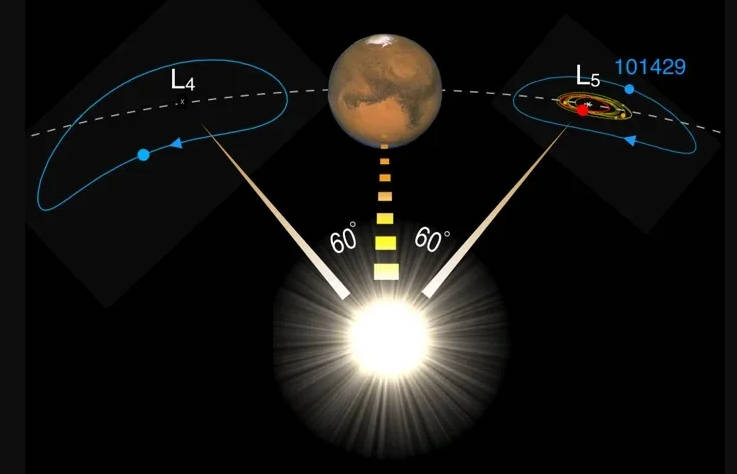
Mars and its Trojan asteroids including 101429 the asteroid that is spectroscopicly like the Moon. The other Trojans appear to have come from Mars itself. I tend to be a stickler for image accuracy: The Mars image is upside down and reversed, while the rest of the diagram is essentially correct other than being way out of scale. Credit Armagh Observatory and Planetarium (AOP) in Northern Ireland.
11/17/2020 – Ephemeris – Let’s look for the naked-eye planets for this week
This is Bob Moler with Ephemeris for Wednesday, November 18th. Today the Sun will be up for 9 hours and 26 minutes, setting at 5:11, and it will rise tomorrow at 7:45. The Moon, halfway from new to first quarter, will set at 8:24 this evening.
Let’s look for the naked-eye planets for this week. Jupiter and Saturn are both low in the southwestern sky 7 to 8 pm. Jupiter is the very bright one. Above and left it will be the somewhat dimmer Saturn. They are near the Moon tonight. They are slowly closing, so they will cross paths on December 21st and be seen in the same telescope field that evening. Jupiter will set first tonight at 9:02 with Saturn following at 9:21. Off in the southeast at that hour will be Mars. Its distance is increasing to 51.5 million miles (82.9 million kilometers) away. Mars will set at 4:10 tomorrow morning. Brilliant Venus will rise at 5:03 am in the east-southeast as it retreats slowly toward the Sun. Close to ending its morning appearance now is Mercury which will rise at 6:15 am in the east.
The event times given are for the Traverse City/Interlochen area of Michigan. They may be different for your location.
Addendum
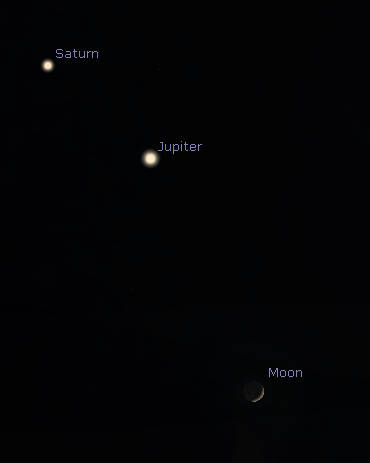
Jupiter, Saturn and Moon low in the southwest at 7:30 pm tonight, November 18, 2020. Created using Stellarium.
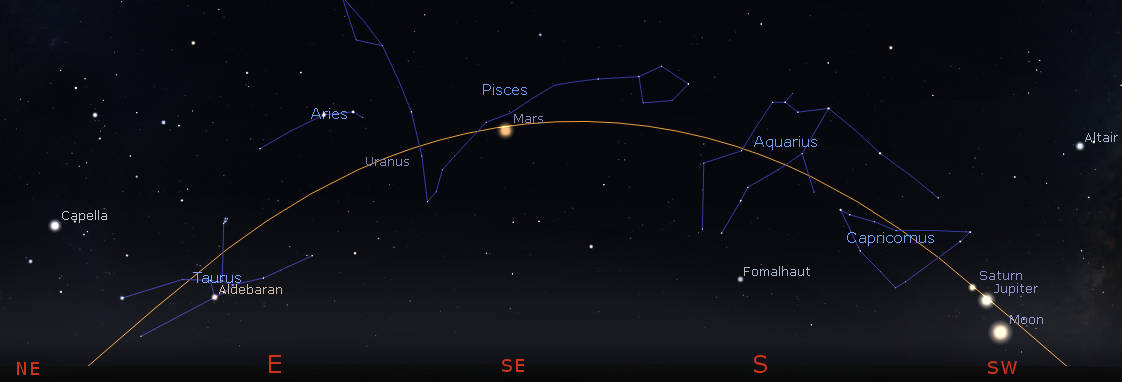
Evening planets, Moon, ecliptic and zodiac at 7:30 pm tonight November 18, 2020. Click on the image to enlarge. Created using Stellarium.
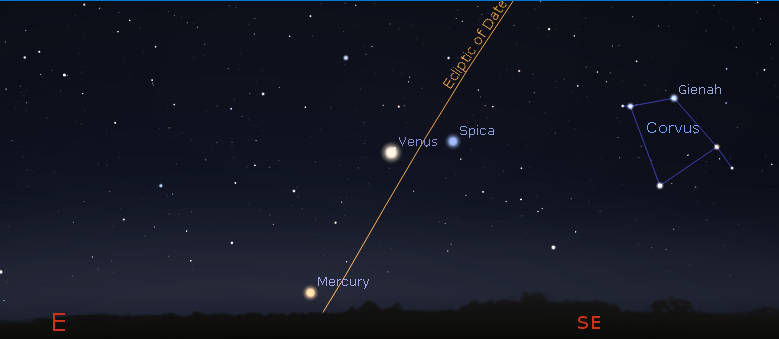
Venus and Mercury with the star Spica, the ecliptic (path of the Sun) and the constellation Corvus at 6:30 tomorrow morning November 19, 2020. Created using Stellarium.
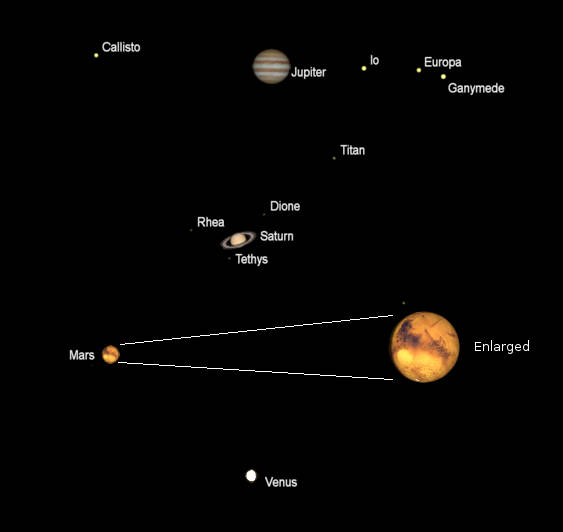
The planets as seen in a telescope (north up) with the same magnification for the night of November 18/19, 2020. Times of the display are: Jupiter and Saturn, 7:30 pm; Mars, 10 pm; Venus, 6:30 am. Apparent diameters: Jupiter, 35.30″; Saturn, 15.91″, rings, 37.06″; Mars, 16.72″, and Venus 12.15″. Mars also displays an enlargement showing surface detail. Mars was closest to the Earth this go-a-round on October 6. The ” symbol means seconds of arc (1/3600th of a degree.) Created using Cartes du Ciel (Sky Charts).
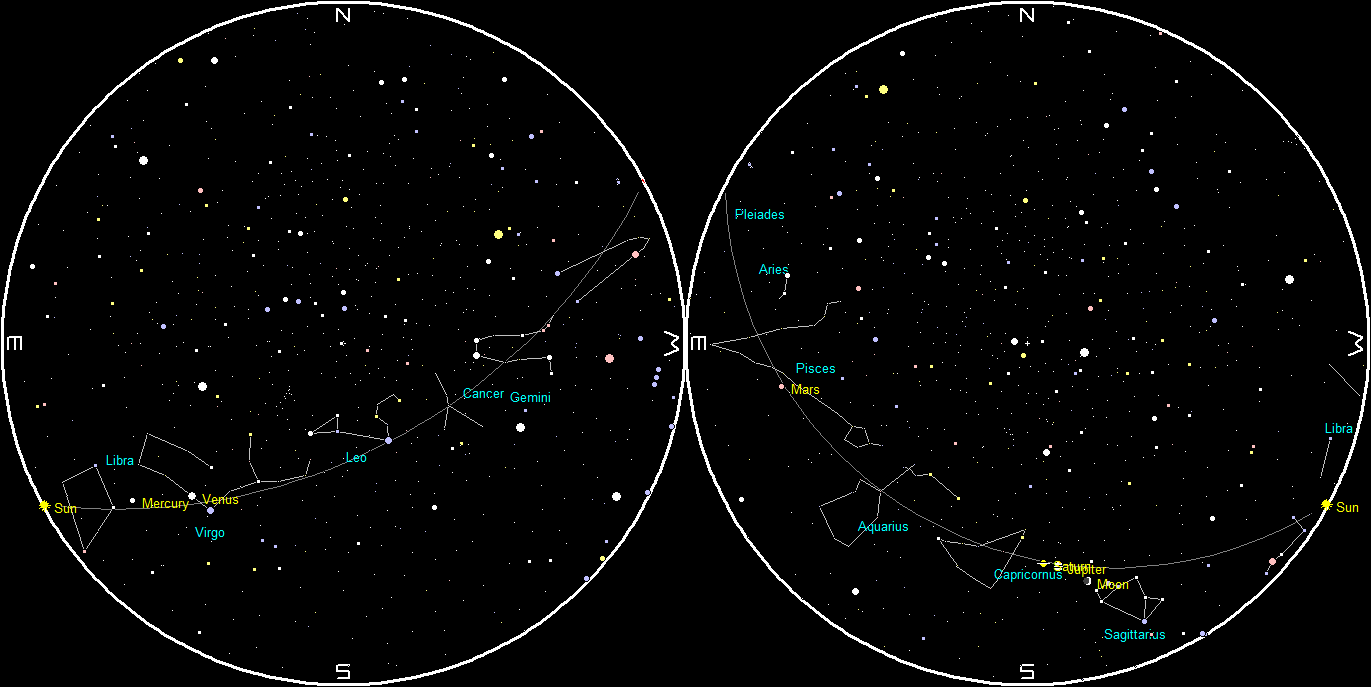
Planets and the Moon at sunset and sunrise of a single night starting with sunset on the right on November 18, 2020. The night ends on the left with sunrise on the 19th. I’m afraid that the labels for Jupiter and Saturn will overlap, since the planets are getting very close. Click on the image to enlarge. Created using my LookingUp program.
11/17/2020 – Ephemeris – The Pleiades in legends from different cultures
This is Ephemeris for Tuesday, November 17th. Today the Sun will be up for 9 hours and 29 minutes, setting at 5:12, and it will rise tomorrow at 7:44. The Moon, 2 days past new, will set at 7:23 this evening.
Let’s look at how some other cultures saw the Pleiades, the star cluster that is seen in the eastern sky these evenings. To the Anishinaabe native peoples around here the Pleiades is the “Hole in the Sky” or the seven stones that are heated for the sweat lodge ceremony. To the Kiowa these were sister stars that had been whisked into the sky from the top of Devils Tower in Wyoming where they were threatened by a huge bear. In Norse mythology these were the goddess Freya’s hens. The name we know them by has rather misty origins. Some think the Greek name is from the mother of the seven sisters, Pleione. The Greek word for sail is similar to Pleiades, and it seems the appearance of the Pleiades in the morning sky saw the best sailing weather in the Mediterranean.
The event times given are for the Traverse City/Interlochen area of Michigan. They may be different for your location.
Addendum

Seven maidens being attacked by a giant bear, having fled to the top of Devil’s Tower in Wyoming. Painting by Herbert Collins, https://www.nps.gov/deto.
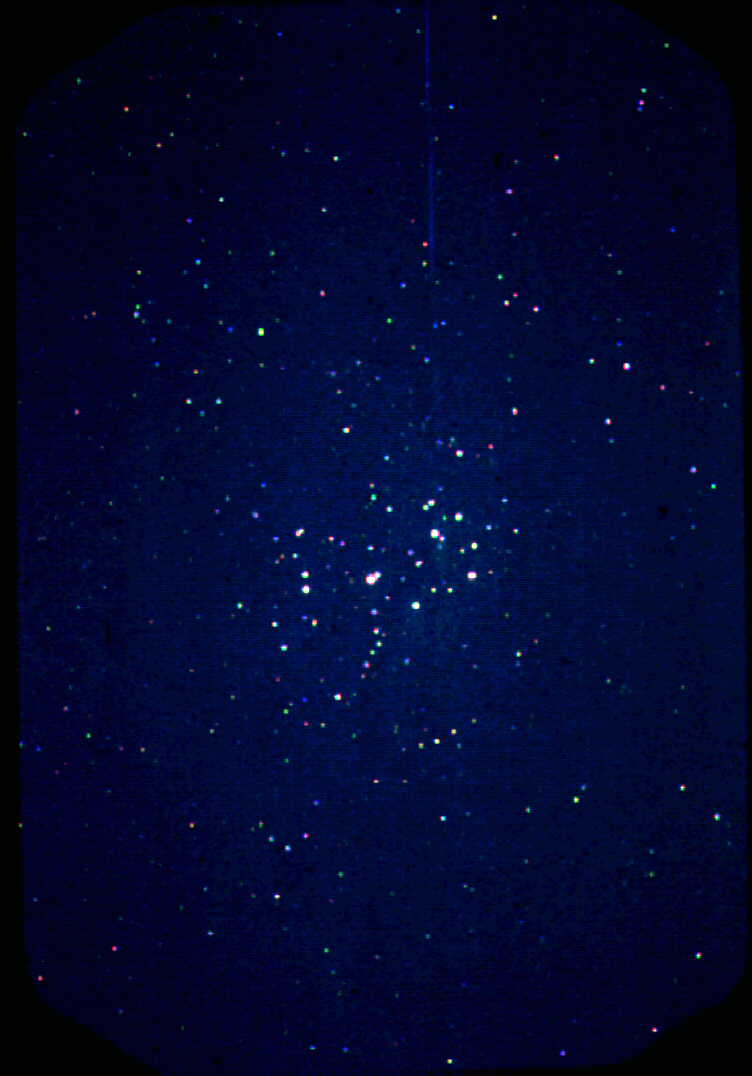
The Pleiades, about what you’d see in binoculars, more than the 6 or 7 stars visible to the naked eye. The brighter stars are Freya’s Hens and also the Seven Sisters and Indian maidens. Credit Bob Moler.
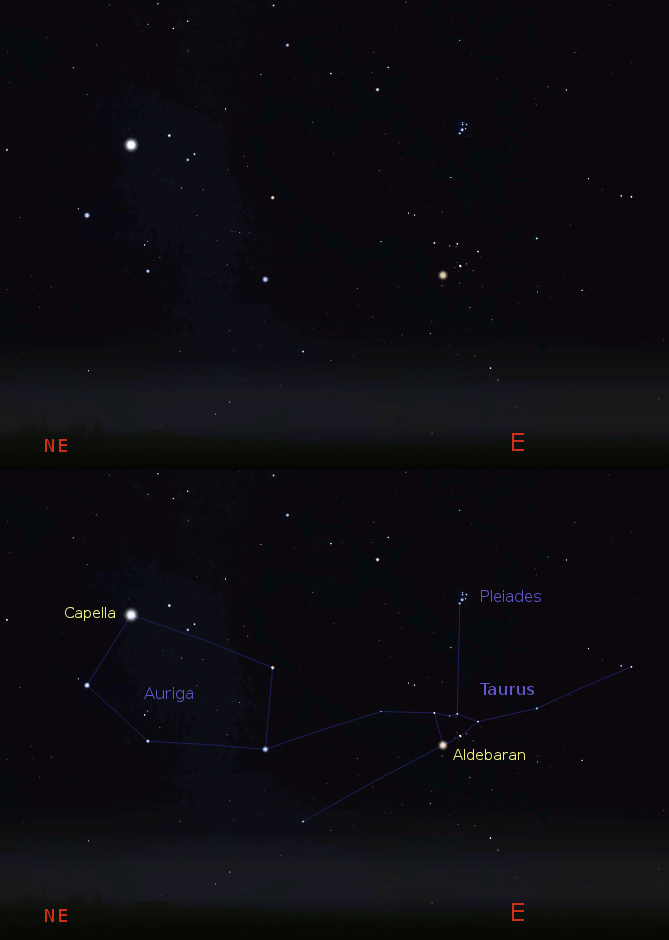
Pleiades finder animation looking east about 8 pm in mid-November. Created using Stellarium.
11/16/2020 – Ephemeris – How to find the Pleiades or Seven Sisters
This is Ephemeris for Monday, November 16th. Today the Sun will be up for 9 hours and 31 minutes, setting at 5:13, and it will rise tomorrow at 7:43. The Moon, 1 day past new, will set at 6:31 this evening.
A marvelous member of the autumn skies can be found low in the east after 8 in the evening. It is the famous star cluster called the Pleiades or the Seven Sisters. I might also add the ‘Tiny Dipper’. Many people can spot a tiny dipper shape in its six or seven stars, and mistake it for the Little Dipper. When I was nearsighted*, though corrected, I never had been able to see more than a few stars and a bit of fuzz. However, with binoculars, even I could see over a hundred stars appear along with the dipper shape of the brightest. The fuzz I saw was unresolved stars, but in photographs the Pleiades actually contain wisps of the gas and dust they are currently passing through. In Greek mythology the sisters were daughters of the god Atlas. I’ll be revisiting the Pleiades several times this autumn, winter, and as they disappear in the west in evening twilight next spring.
The event times given are for the Traverse City/Interlochen area of Michigan. They may be different for your location.
*My vision was corrected with cataract surgery a few years ago. The Pleiades now have a granular appearance now.
Addendum
Pleiades finder animation looking east at 8 pm, November 16th. Click on the image to enlarge. Created using Stellarium.
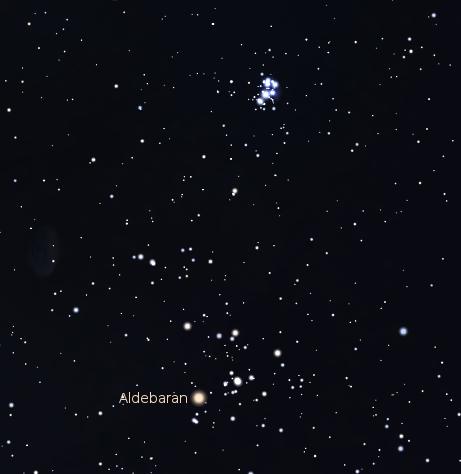
Aldebaran in the ‘V’ shape of the Hyades (The face of Taurus the bull) with the Pleiades above. Created using Stellarium.
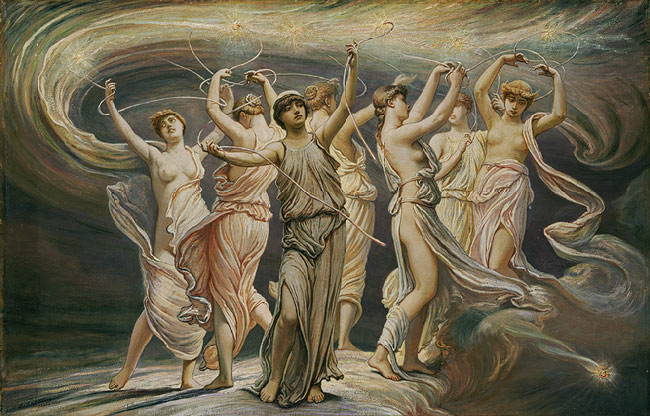
The Greek Pleiades a painting by Elihu Vedder in the Metropolitan Museum of Art, New York City. Public Domain.
11/13/2020 – Ephemeris – Finding Perseus the hero in the stars
This is Ephemeris for Friday, November 13th. Today the Sun will be up for 9 hours and 38 minutes, setting at 5:16, and it will rise tomorrow at 7:39. The Moon, 2 days before new, will rise at 6:41 tomorrow morning.
About a third the way from the east northeastern horizon to the zenith at 8 p.m. and below the letter W shaped constellation of Cassiopeia the queen is Perseus the hero. It’s kind of an odd shape for a hero, To me it looks kinda like the cartoon roadrunner. To those who’re mathematically inclined its shape is also like the Greek letter pi on its side. It’s two brightest stars are Mirfak and Algol the demon star, the still winking eye of Medusa. Look at the area around Mirfak with binoculars and a large group of stars just below naked eye visibility will appear. It’s called the Alpha Persei Association. That’s because Mirfak is also known as Alpha Persei. The group is about 560 light years away, which means, though close, are farther away than the Pleiades, which is below and to the right of them.
The event times given are for the Traverse City/Interlochen area of Michigan. They may be different for your location.
Addendum
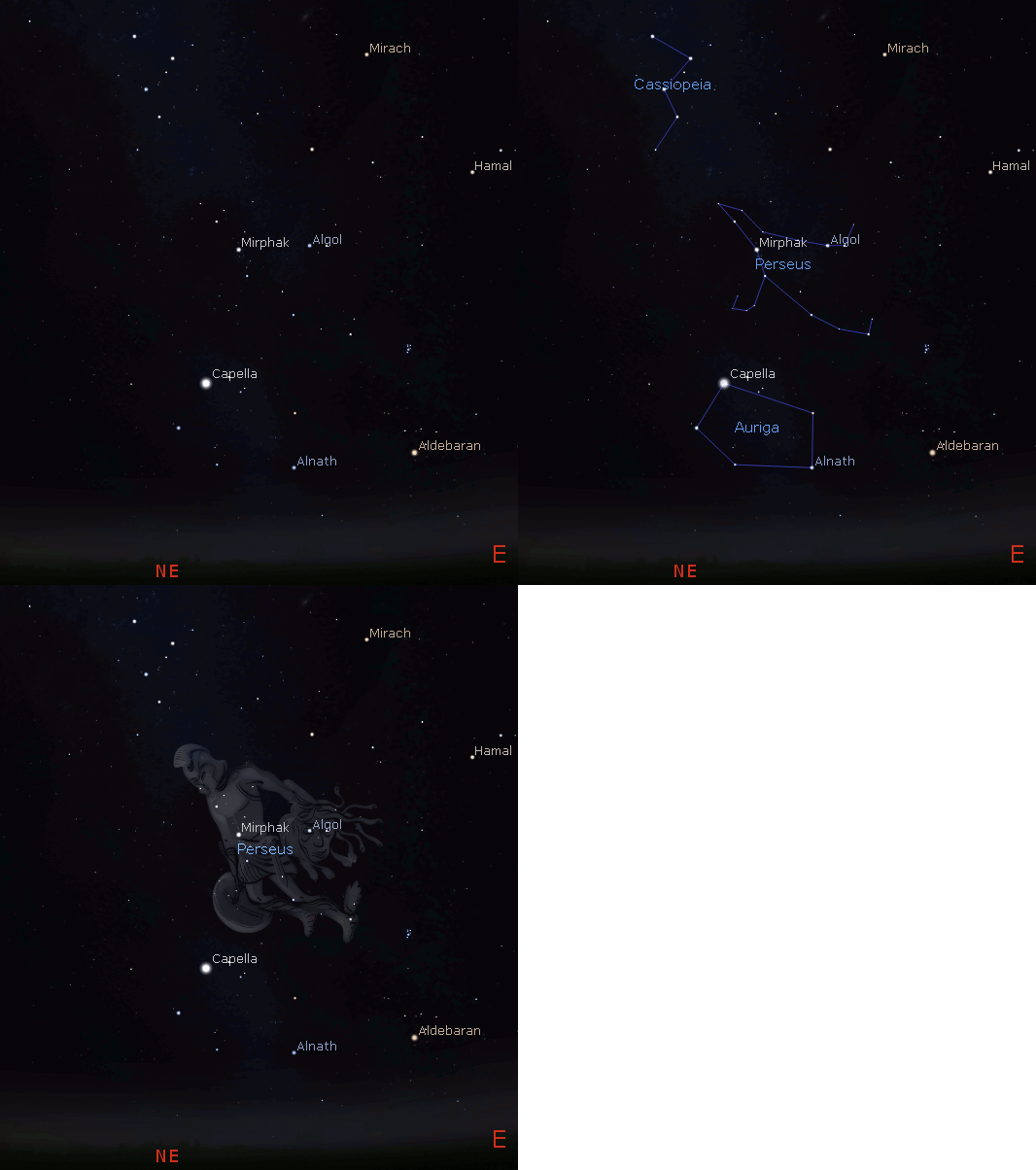
Perseus finder animation for 8 pm November 13, 2020. The star Mirphak in the image is generally spelled Mirfak and is also designated Alpha Persei.
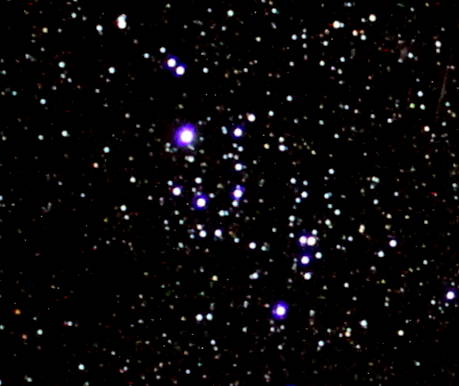
The Alpha Persei Association. The brightest star is Mirfak (Alpha Persei). This a an extreme crop from a photograph taken February 18, 2017, Canon EOS Rebel T5, 121 seconds, f/3.5, 18mm fl., ISO 3200. Credit Bob Moler.
11/12/2020 – Ephemeris – The Northern Taurid meteor shower is at its peak
This is Ephemeris for Thursday, November 12th. Today the Sun will be up for 9 hours and 40 minutes, setting at 5:17, and it will rise tomorrow at 7:37. The Moon, 3 days before new, will rise at 5:19 tomorrow morning.
The official peak of the North Taurid meteor shower is here. It’s a broad peak with a low per hour count that appears to be estimated from 5 to 15 meteors per hour. As such it doesn’t hold a candle to the Perseid meteor shower of August or the Geminids of December. However the Northern Taurid shower appears to have quite a few fireballs or really bright meteors. They seem to be most numerous at seven year intervals and the next peak year for fireballs is 2022. The Taurids will appear to come from Taurus the bull near the Pleiades star cluster low in the east in the early evening. Meteors are the streaks in the sky caused by tiny bits of rock hitting the atmosphere at interplanetary speeds and disintegrating.
The event times given are for the Traverse City/Interlochen area of Michigan. They may be different for your location.
Addendum
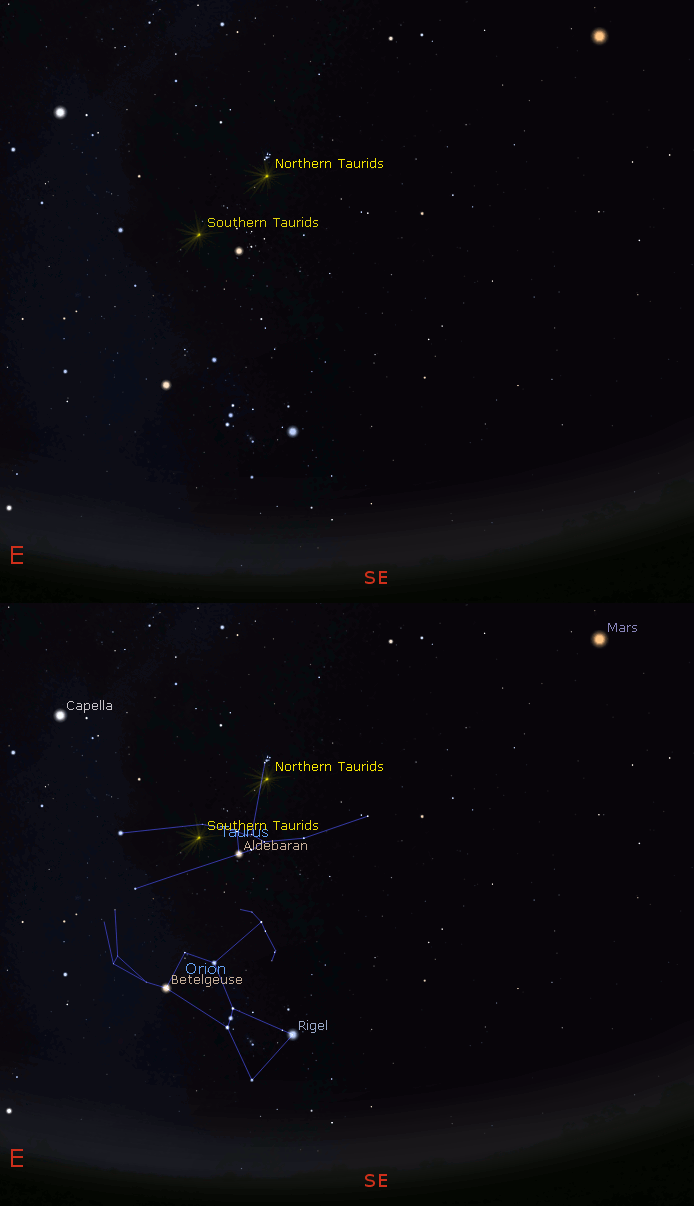
Finder chart for the radiants of the two Taurid meteor shower for about 11 pm for mid November. The Southern Taurids are ending, but a few may be spotted, while the Northern Taurids are near peak. The peak rate for the Northern Taurids has been estimated by various sources as being 5 to 15 meteors per hour. The Pleiades appears just above the Northern Taurid radiant. Compared to other meteor showers the Taurids appear to be a lot slower. Created using Stellarium and GIMP.
11/11/2020 – Ephemeris – Let’s look for the naked-eye planets for this week
This is Ephemeris for Veteran’s Day, Wednesday, November 11th. Today the Sun will be up for 9 hours and 43 minutes, setting at 5:18, and it will rise tomorrow at 7:36. The Moon, 3 days past last quarter, will rise at 4:00 tomorrow morning.
Let’s look for the naked-eye planets for this week. Jupiter and Saturn are both low in the southwestern sky at 8 pm. Jupiter is the very bright one. Above and left it will be the somewhat dimmer Saturn. They are closing slowly, so they will cross paths on December 21st and be seen in the same telescope field that evening. Jupiter will set first tonight at 9:24 with Saturn following at 9:46. Off in the southeast at that hour will be Mars. Its distance is increasing to 47.7 million miles (76.9 million km) away. Mars will set at 4:35 tomorrow morning. Brilliant Venus will rise at 4:46 am in the east as it retreats slowly toward the Sun. Making a morning appearance this week is Mercury which will rise at 5:52 am in the east.
The event times given are for the Traverse City/Interlochen area of Michigan. They may be different for your location.
Addendum
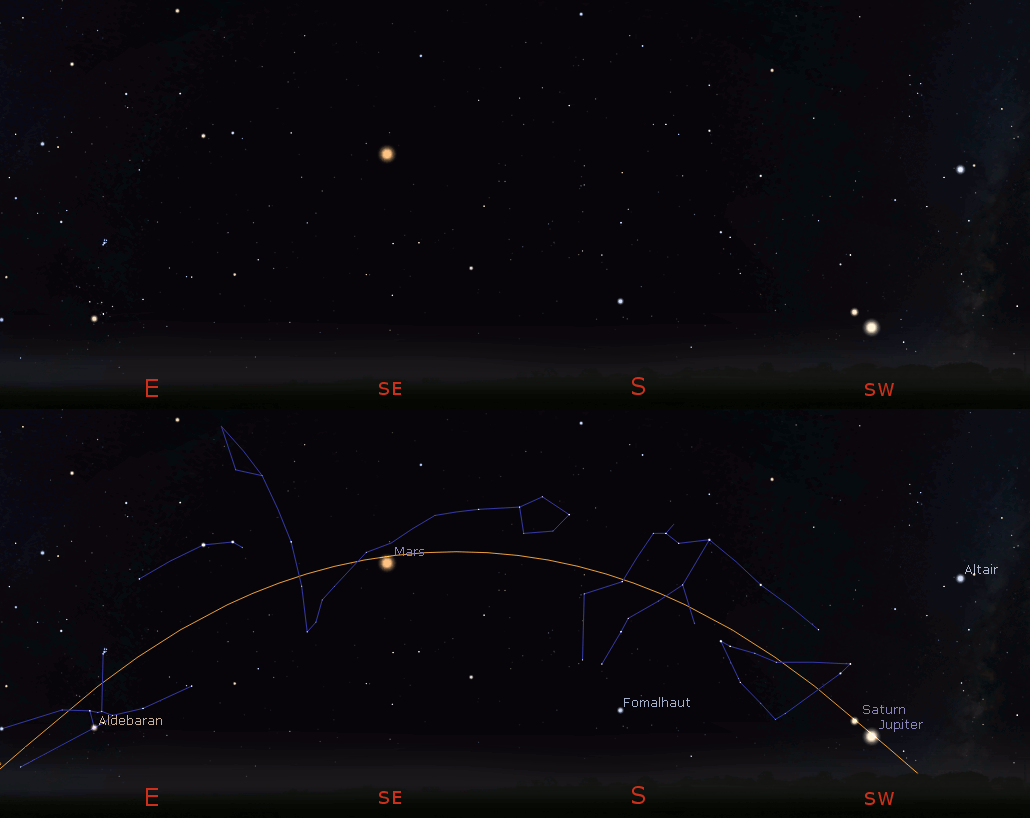
Evening planet finder animation for 8 pm November 11, 2020. The orange line is the ecliptic, the plane of the Earth’s orbit projected on the sky, and the path of the Sun through the year. All the planets can be found near that line. The zodiacal constellations from Taurus on the left to Capricornus on the right are shown without labels. Click on the image to enlarge. Created using Stellarium and GIMP.
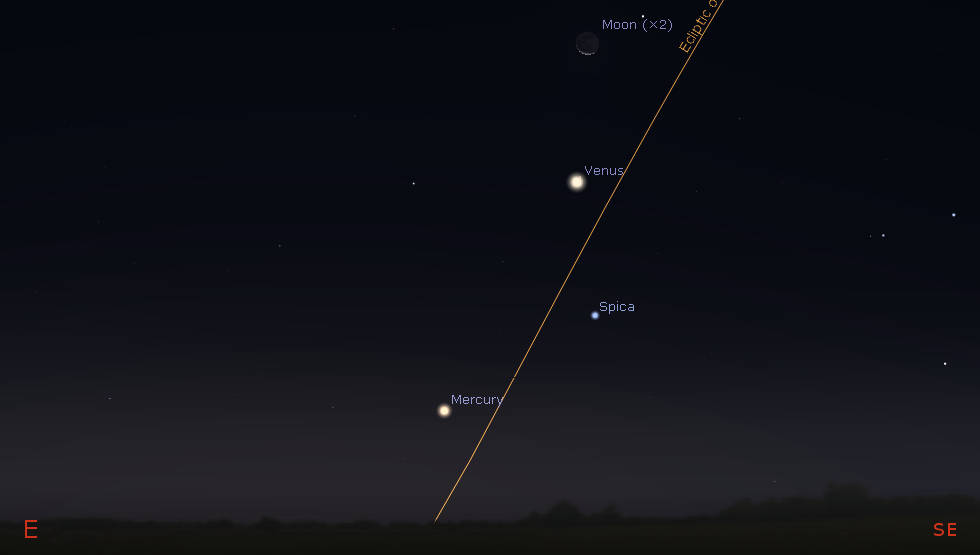
Mercury, Venus, and the Moon tomorrow morning November 12, 2020 at 6:30 am. The orange line is the ecliptic, the plane of the Earth’s orbit. It is the path of the Sun in the sky, The Moon is a crescent, and displayed at twice its apparent size. Over the next week Venus and Mercury will slide downward along the ecliptic in relation to the stars. Created using Stellarium.
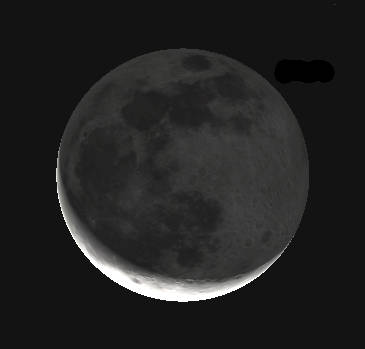
The thin crescent Moon as it might appear in binoculars with earthshine at 6:30 am, November 12, 2020. The very dark crater visible is Grimaldi a 134 mile or 222 kilometer diameter crater named after Francesco Grimaldi a 17th century Jesuit astronomer and physicist. Created using Stellarium.
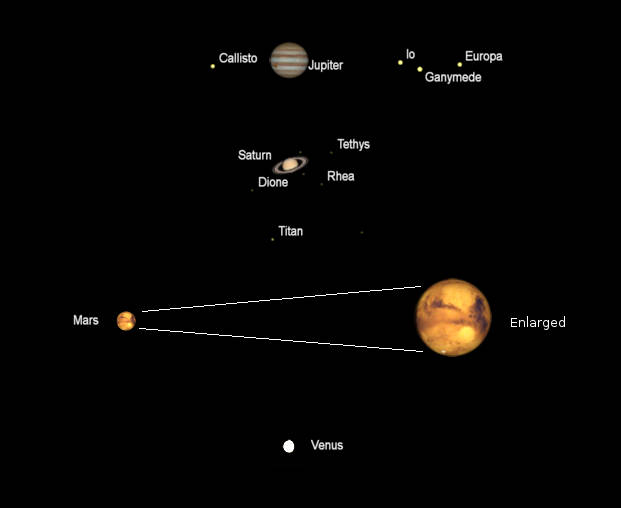
The planets as seen in a telescope (north up) with the same magnification for the night of November 11/12, 2020. Times of the display are: Jupiter and Saturn, 8 pm; Mars, 11 pm; Venus, 6:30 am. Apparent diameters: Jupiter, 35.90″; Saturn, 16.07″, rings, 37.43″. Mars, 18.04″, and Venus 12.49″. Mars also displays an enlargement showing surface detail. Mars was closest to the Earth this go round on October 6. The ” symbol means seconds of arc (1/3600th of a degree.) Created using Cartes du Ciel (Sky Charts).
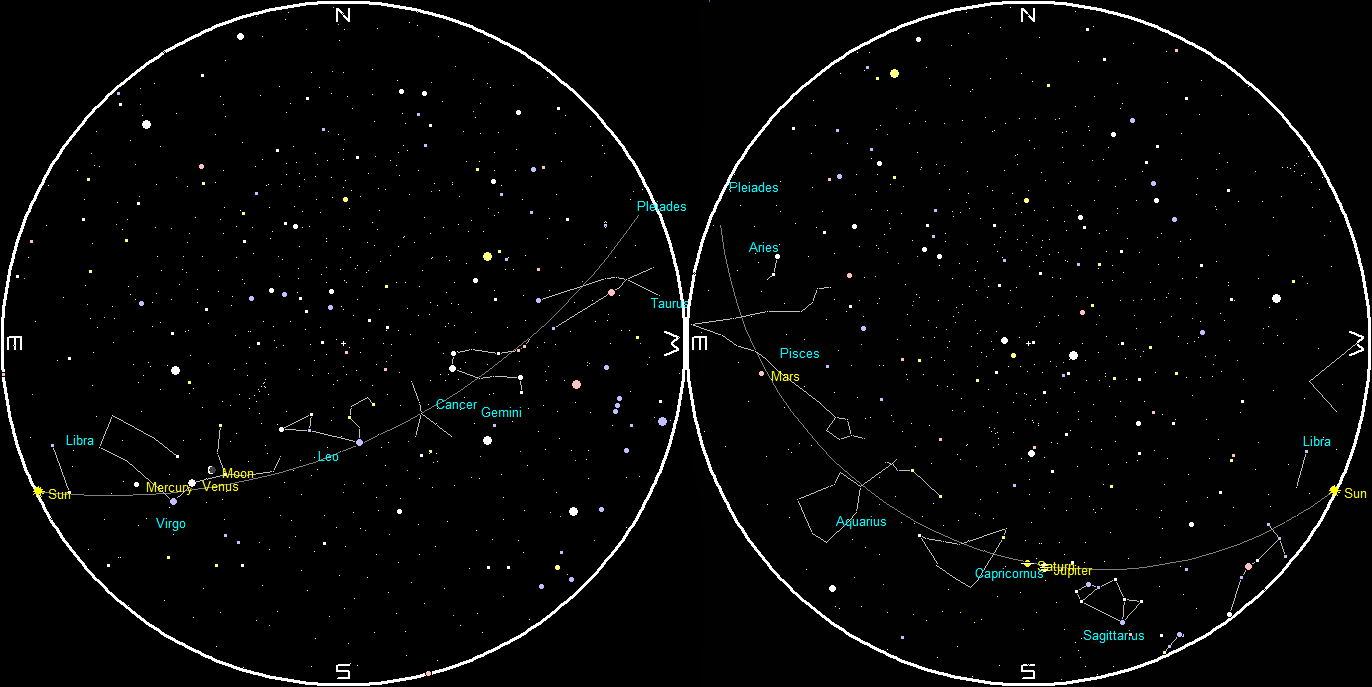
Planets and the Moon at sunset and sunrise of a single night starting with sunset on the right on November 11, 2020. The night ends on the left with sunrise on 12th. Click on the image to enlarge. Created using my LookingUp program.

