Archive
10/13/2020 – Ephemeris – Mars at opposition and Ada Lovelace Day
This is Bob Moler with Ephemeris for Ada Lovelace Day, Tuesday, October 13th. Today the Sun will be up for 11 hours and 4 minutes, setting at 7:00, and it will rise tomorrow at 7:57. The Moon, 3 days before new, will rise at 4:50 tomorrow morning.
Mars will be in opposition from the Sun this afternoon and will officially enter the evening sky and begin rising before sunset. Ada Lovelace or more properly Augusta Ada King, Countess of Lovelace was the daughter of Lord Byron and worked for Charles Babbage, and is considered the first computer programmer, even though Babbage was unable to build his mechanical computer the Analytic Engine in the mid 1800s. This day is set aside to celebrate the accomplishments of women of science, technology, engineering and math, STEM. This year three women were awarded Nobel Prizes: Two in chemistry, and one shared with two men in physics. The computer language Ada was created for the US Department of Defense.
The event times given are for the Traverse City/Interlochen area of Michigan. They may be different for your location.
Addenda
Mars Opposition
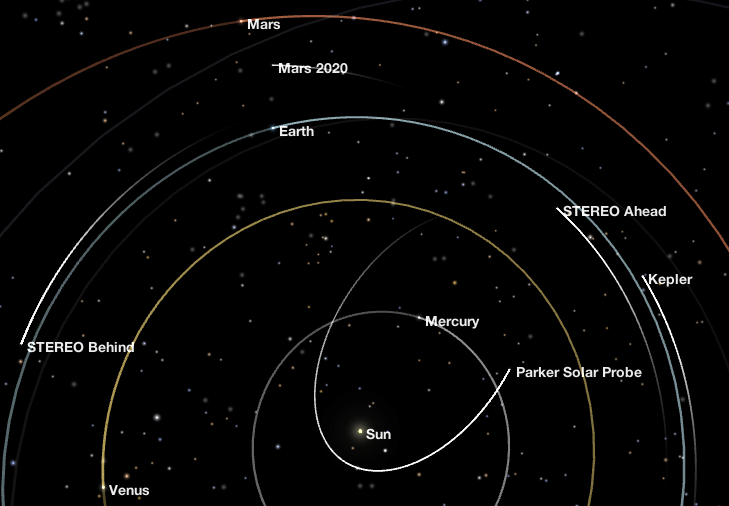
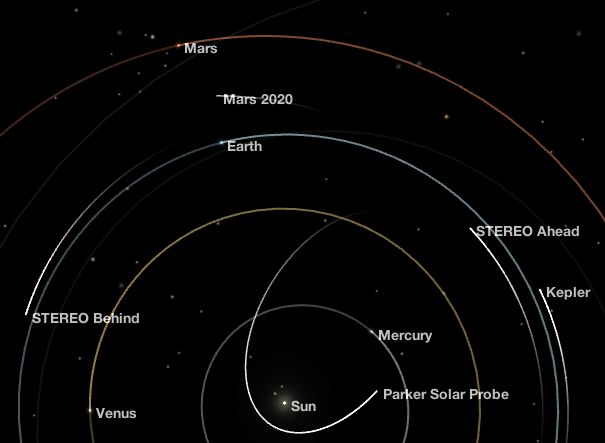
Inner solar system on October 13, 2020 showing Mars at opposition from the Sun. The Sun, Earth and Mars are in a straight line. Note the motion of the planets and space probes are counterclockwise. Mars was closest to the Earth a week ago. It is moving away from the Sun in its orbit. Its closest point to the Sun, called perihelion, at about the 2 o’clock point in its orbit. The Mars 2020 Rover “Percy” has a bit more than 4 months to go to reach Mars. Credit: NASA Eyes App https://eyes.nasa.gov/.
Don’t worry, that the Mars 2020 is behind both the Earth and Mars. In being sent to Mars, it is now moving slower than the Earth, but faster than Mars, which it will reach on February 18, 2021.
Ada Lovelace

Ada, Countess of Lovelace (1815-1852) considered the first computer programmer, even though the machine she wrote code for was never built. Credit: Science & Society Picture Library

Trial model of a part of the Analytical Engine, built by Charles Babbage, as displayed at the Science Museum (London). By Bruno Barral (ByB), CC BY-SA 2.5.
Women winning the Nobel Prizes in Chemistry and Physics
The 59 second program length of Ephemeris prevented me from naming the Nobel prize winners. Here they are.
Emmanuelle Charpentier and Jennifer A. Doudna won the 2020 Nobel Prize in Chemistry for their work on CRISPR-Cas9 as a way to edit genomes. Andrea Ghez shared the Physics Prize with Roger Penrose who got half the prize for discovering that black holes were a prediction of Einstein’s general theory of relativity, and Reinhard Genzel for the discovery of the supermassive black hole in our Milky Way galaxy. Ghez and Genzel shared the other half of the prize.
10/12/2020 – Ephemeris – Columbus’ lucky mistake
This is Ephemeris for Columbus Day or Indigenous Peoples Day, Monday, October 12th. Today the Sun will be up for 11 hours and 7 minutes, setting at 7:02, and it will rise tomorrow at 7:56. The Moon, 3 days past last quarter, will rise at 3:32 tomorrow morning.
Columbus has become a controversial person in recent years mainly on how he treated the indigenous peoples and the havoc subsequent Europeans wrought on them and their culture for the last 600 plus years. I maintain that he was also bad at geography. That the Earth was round was not an issue among the educated of his day. The Earth’s size, however, was. The Earth’s circumference accepted by most scholars of that day was pretty close to the modern value of about 25 thousand miles. Columbus thought it was about 7 thousand miles less putting the Orient that much closer by sailing west from Europe. This was a minority opinion, but he convinced the king and queen of Spain to finance his venture based on it.
The event times given are for the Traverse City/Interlochen area of Michigan. They may be different for your location.
Addendum
Wikipedia entry for Eratosthenes who calculated the circumference of the Earth in the 3rd century BCE.
10/09/2020 – Ephemeris – There’s a virtual star party tonight via Zoom
This is Ephemeris for Friday, October 9th. Today the Sun will be up for 11 hours and 16 minutes, setting at 7:07, and it will rise tomorrow at 7:52. The Moon, at last quarter today, will rise at 12:03 tomorrow morning.
The Grand Traverse Astronomical Society will host a virtual star party at 8 pm tonight. It is via the Zoom app for the smart phone, tablet or computer at zoom (dot) us. Instructions and a link can be found on the society’s website gtastro.org. It will be hosted by Dr. Jerry Dobek, astronomy professor at Northwestern Michigan College with commentary by yours truly and other society members. During a virtual star party the images are produced real time or near real time using a telescope mounted CCD camera. That is if it’s clear. Featured celestial objects will be Jupiter, Saturn, and Mars at its closest. Images of dimmer objects like star clusters or nebulae, what we call DSOs or deep sky objects may take exposures of several seconds or minutes to build up an image. But have the advantage of being in color. If cloudy we’ll have a virtual, virtual star party using recently acquired images. Dr. Dobek has used for his classes.
The event times given are for the Traverse City/Interlochen area of Michigan. They may be different for your location.
10/08/2020 – Ephemeris – A lady with a not so hidden jewel
This is Ephemeris for Thursday, October 8th. Today the Sun will be up for 11 hours and 19 minutes, setting at 7:09, and it will rise tomorrow at 7:51. The Moon, 1 day before last quarter, will rise at 11:09 this evening.
The stars of the constellations Andromeda the chained princess look like they’re supposed to be the hind legs of Pegasus the flying horse which is high in the southern sky above Mars at 9 p.m. Andromeda is high in the southeast She is seen in the sky as two diverging curved strings of stars that curve to the left and up from the upper leftmost star of the Great Square of Pegasus. Her predicament was caused by her boastful mother Cassiopeia, and the wrath of the god Poseidon. She was rescued by the hero Perseus, a nearby constellation, riding his steed Pegasus. Andromeda’s claim to astronomical fame is the large galaxy barely visible to the unaided eye just above the upper line of stars, the Great Andromeda Galaxy 2.5 million light years away.
The event times given are for the Traverse City/Interlochen area of Michigan. They may be different for your location.
Addendum
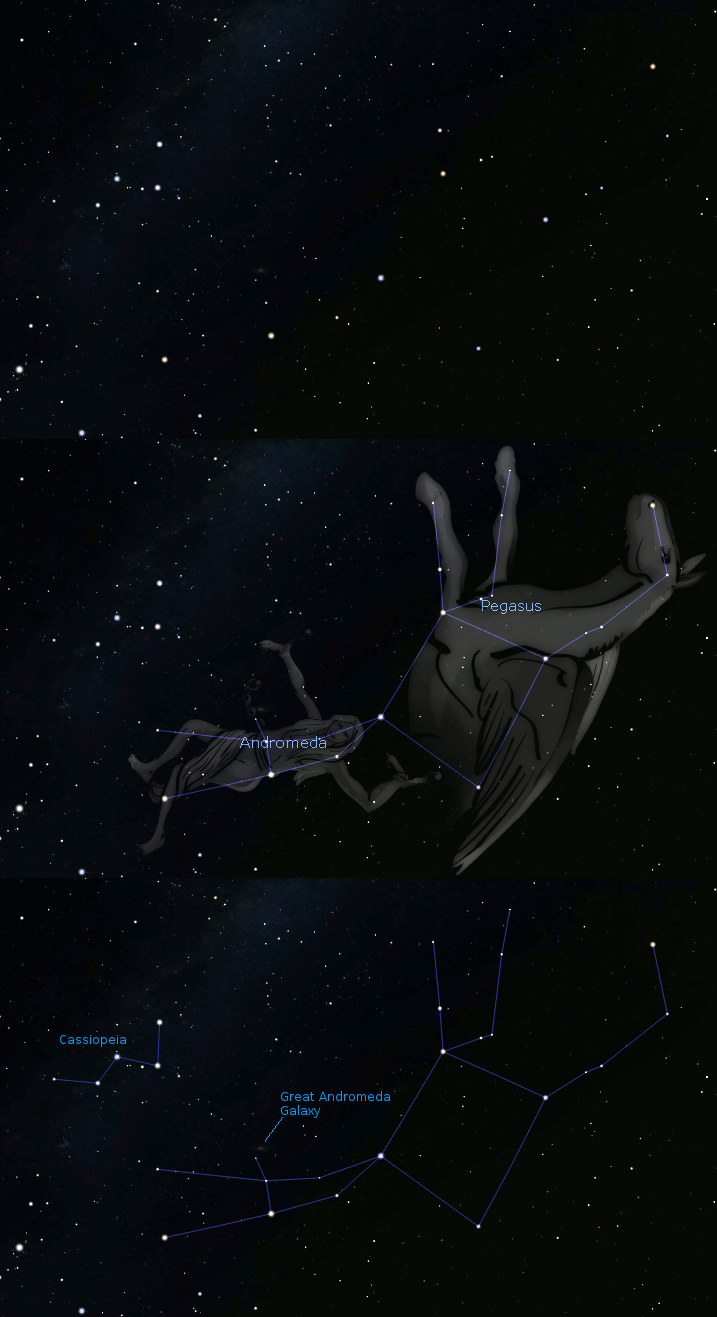
Andromeda animated finder, including the Great Andromeda Galaxy. I’ve added Cassiopeia that some folks use to find the galaxy. I start with the leftmost star of the Great Square of Pegasus that connects to Andromeda. I count off two star on the lower curve because they are brighter than the upper curve. Then count two stars up. Next to that top star is a little smudge. That is the core of the Great Andromeda Galaxy. Created using Stellarium and GIMP.
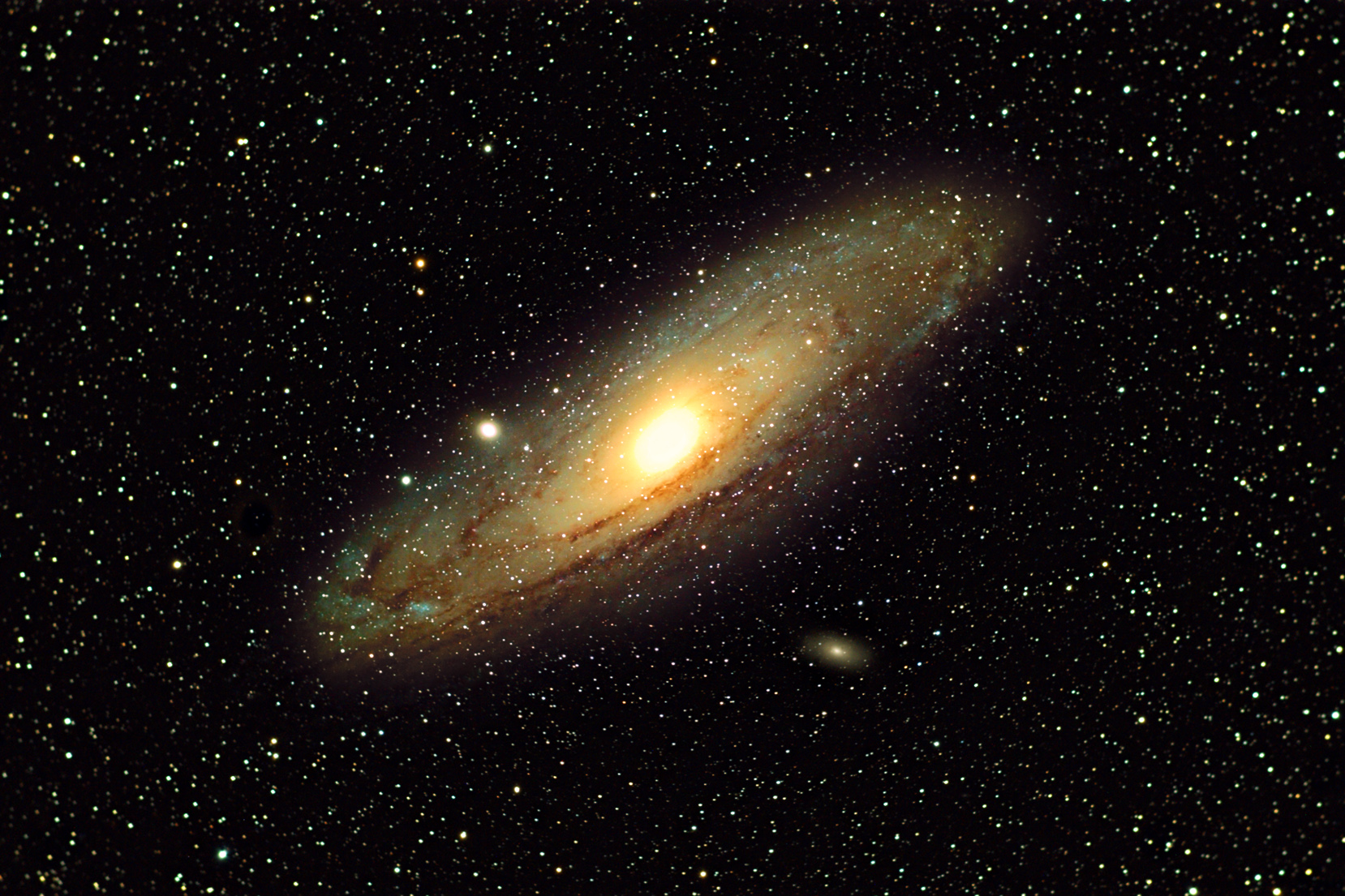
The Great Andromeda Galaxy (M31) and two of its satellite galaxies M31 (left) and M110. Image taken by Scott Anttila.
10/07/2020 – Ephemeris – Let’s look for the naked-eye planets for this week
This is Ephemeris for Wednesday, October 7th. Today the Sun will be up for 11 hours and 22 minutes, setting at 7:11, and it will rise tomorrow at 7:50. The Moon, 2 days before last quarter, will rise at 10:23 this evening.
Let’s look for the naked-eye planets for this week. Jupiter and Saturn are both low in the southern sky at 9 pm. Jupiter is the very bright one. To the left of it will be the somewhat dimmer Saturn which is just about due south at that hour. They are closing slowly, so they will cross paths on December 21st. Jupiter will set first at 12:23 tomorrow morning with Saturn following at 1 am. Off in the east will be Mars which will rise at 7:33 pm. It’s now down to 38.6 million miles (62.1 million km) away, as the Earth is about to overtake it. Brilliant Venus will rise at 4:24 am as it retreats slowly toward the Sun. It looks like a tiny featureless gibbous moon in telescopes. Its clouds of sulfuric acid are quite featureless in visible light.
The event times given are for the Traverse City/Interlochen area of Michigan. They may be different for your location.
Addendum
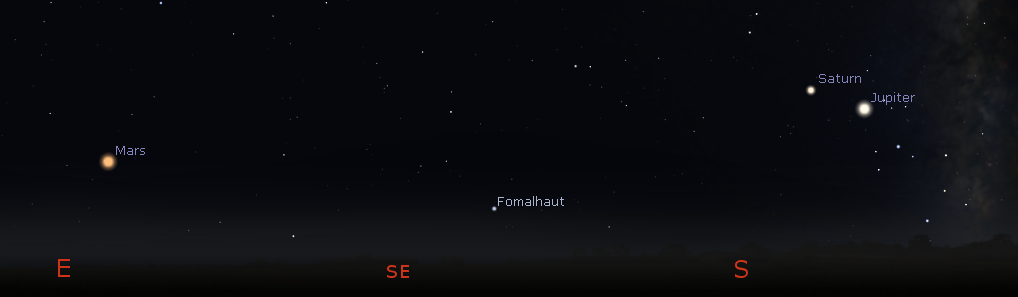
Jupiter, Saturn, and Mars arrayed from south-southwest to east at 9 pm tonight October 7, 2020. Click on the image to enlarge. Created using Stellarium.
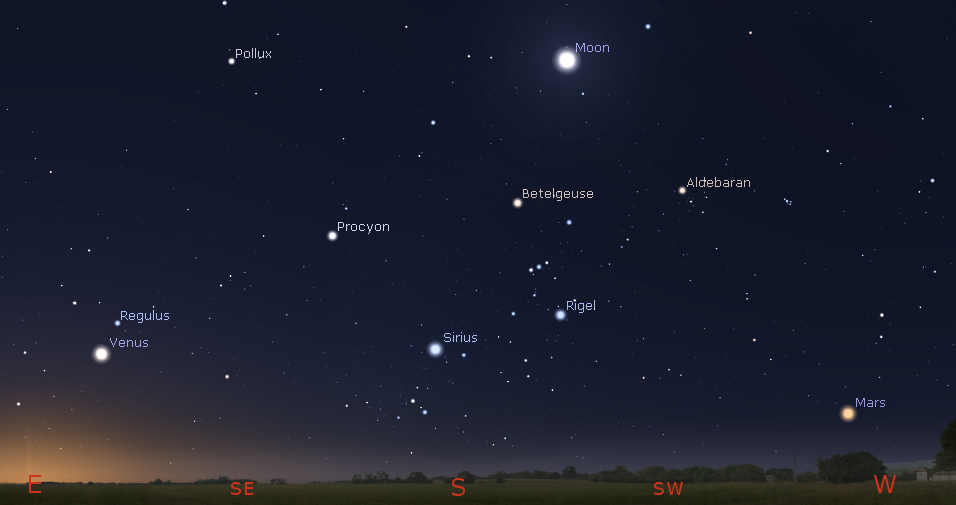
Venus, the Moon and Mars among the stars of winter but at 7 am October 8, 2020. Click on the image to enlarge. Created using Stellarium.
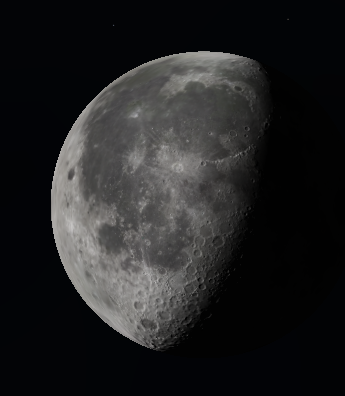
The waning gibbous Moon as it might be seen in binoculars at 7 am tomorrow October 8, 2020. Created using Stellarium.
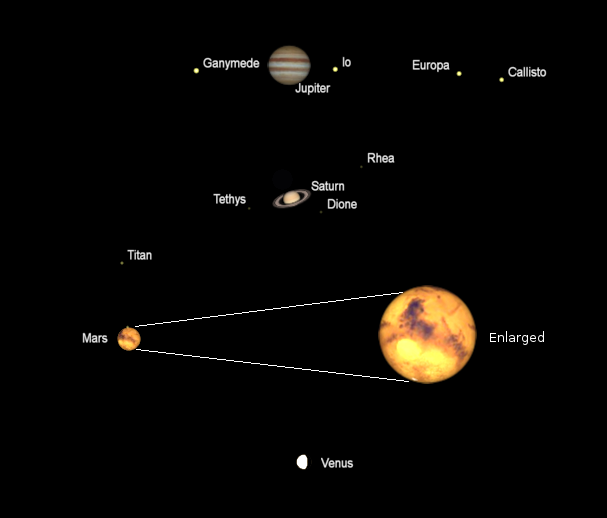
The planets as seen in a telescope (north up) with the same magnification for the night of October 7/8, 2020. Times of the display are: Jupiter and Saturn, 9 pm; small Mars, 9 pm; enlarged Mars, 11 pm, Venus, 7 am. Apparent diameters: Jupiter, 39.64″; Saturn, 17.00″, rings, 39.60″. Mars, 22.56″, and Venus 14.86″. Mars also displays an enlargement showing surface detail. On the Mars enlargement the large dark feature to the upper left of center is Syrtis Major, and the bright area below it is the Hellas Basin. Mars was closest to the Earth this go-a-round on October 6. The ” symbol means seconds of arc (1/3600th of a degree.) Created using Cartes du Ciel (Sky Charts).
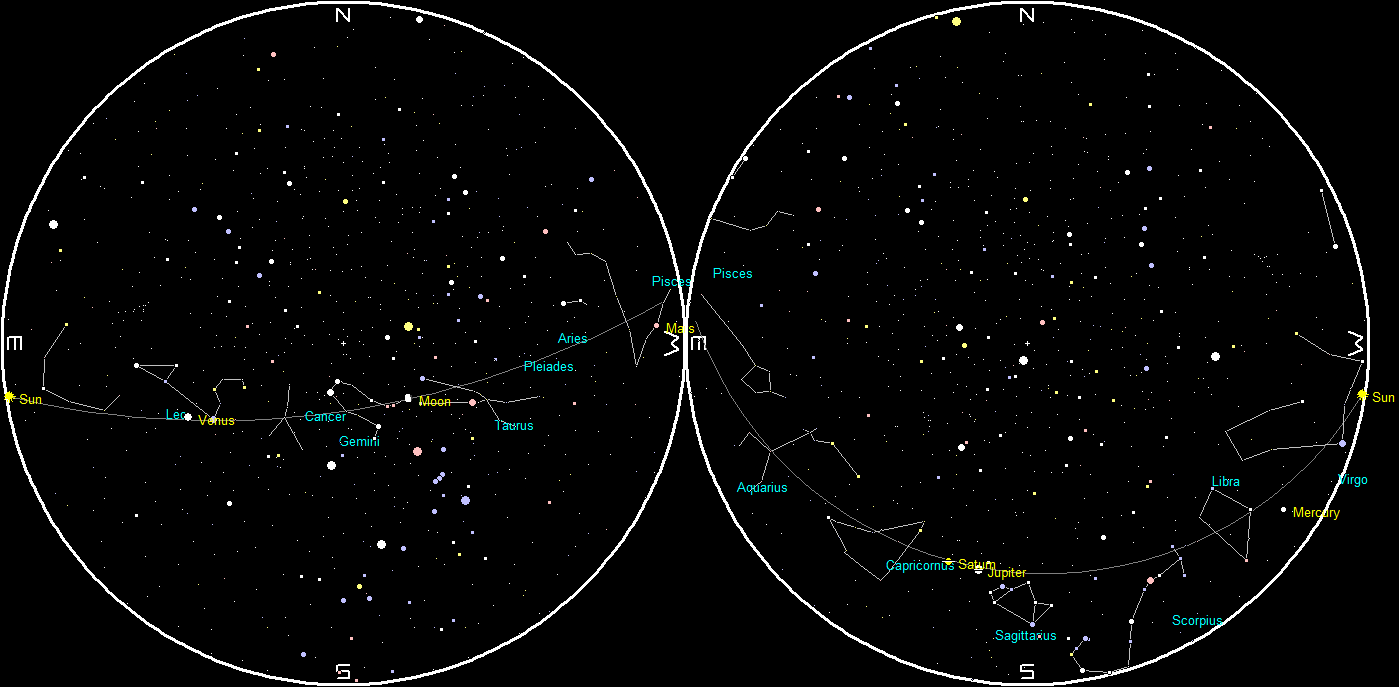
Planets and the Moon at sunset and sunrise of a single night starting with sunset on the right on October 7, 2020. The night ends on the left with sunrise on 8th. Click on the image to enlarge. Created using my LookingUp program.
10/06/2020 – Ephemeris – Mars is closest today, also the Draconid meteors are at peak
This is Ephemeris for Tuesday, October 6th. Today the Sun will be up for 11 hours and 25 minutes, setting at 7:13, and it will rise tomorrow at 7:48. The Moon, 3 days before last quarter, will rise at 9:46 this evening.
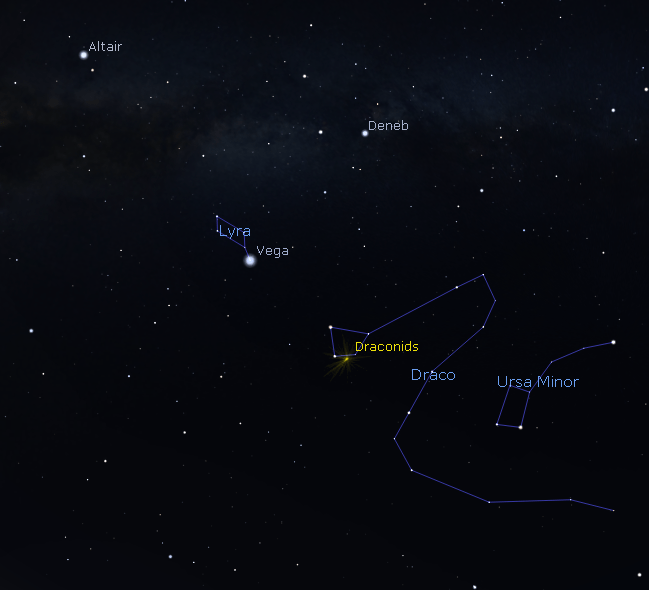
Today Mars is at its closest to the Earth of this close approach, what astronomers call an apparition. The last close approach was at the end of July two years ago. It is still pretty small in telescopes. However being this close, 38.6 million miles (62.1 million kilometers) away, it is actually slightly brighter than Jupiter. Check them out. Mars is the bright orange tinged star in the east while Jupiter is in the south-southwest at 9 pm tonight. It’s still a week before Mars lines up with the Earth and Sun in opposition. Mars is closer now because it is moving away from the Sun in its orbit. We are at the peak of a weak meteor shower most years. It’s the Draconids, which appear to come from the head of Draco the dragon near the bright star Vega, nearly overhead in the evening.
The event times given are for the Traverse City/Interlochen area of Michigan. They may be different for your location.
Addenda
Mars
Draconid Meteor Shower
10/02/2020 – Ephemeris – The rocket that will take NASA crews to the Moon
This is Ephemeris for Friday, October 2nd. Today the Sun will be up for 11 hours and 37 minutes, setting at 7:20, and it will rise tomorrow at 7:43. The Moon, 1 day past full, will rise at 8:05 this evening.
While we’re looking at the nearly full Moon tonight lets look at the rocket that will take crews to the Moon or as NASA says first woman and next man to the Moon in the Artemis program. It’s called the Space Launch System or SLS, which has been in development for a very long time. The core stage looks the color of the Space Shuttle main tank, because it uses the same insulation. At its bottom are four shuttle main engines. These will not be reused. Strapped to the sides will be two shuttle derived solid rocket boosters or SRBs, with 5 segments, rather than 4, and are upgraded for extra thrust. These will also be discarded, rather than reused. The second stage now is an interim stage to be replaced after a few flights with a more powerful stage. To top it off will be the service module and Orion capsule with an escape tower.
The event times given are for the Traverse City/Interlochen area of Michigan. They may be different for your location.
Addendum
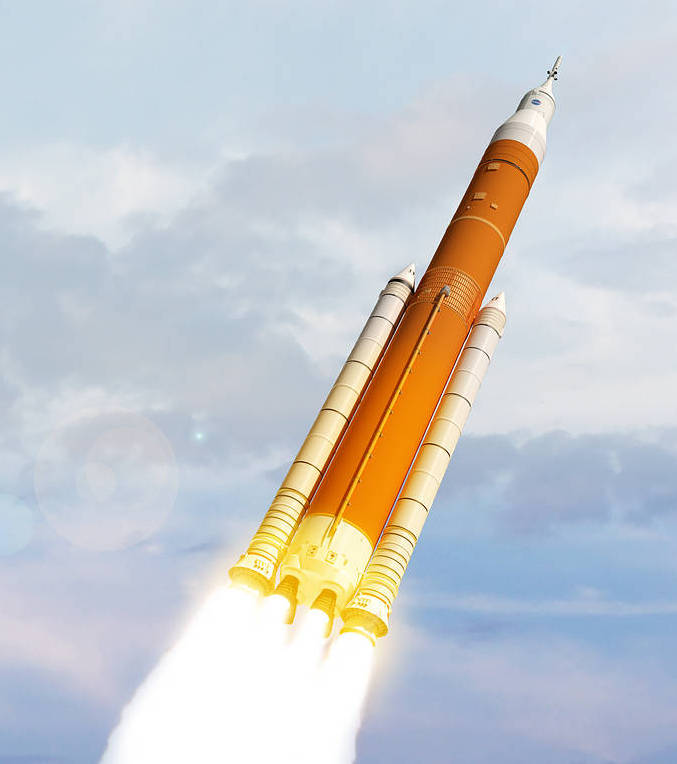
The Block 1b version of the Space Launch System (SLS) which uses elongated Space Shuttle boosters and a core stage with 4 Space Shuttle main engines for the first stage. At lift-off the core stage and the boosters will ignite. The boosters will burn for two minutes and 6 seconds 7,2000,000 pounds (32,000 kN) of thrust. The core stage contributes 1,670,000 pounds (7,440 kN) of thrust and will burn for 8 minutes, nearly achieving orbit. The Interim Cryogenic Propulsion Stage and later the Exploration Upper Stage will place the payload first into orbit, and then to send it to the Moon, or interplanetary destination. Credit NASA.
Note that the rocket configuration does not contain a lunar lander craft like the Saturn V of Apollo. The lander, a commercially developed craft will be sent up before the astronauts by a commercial company like SpaceX or Blue Origin and be waiting in lunar orbit or at the Lunar Gateway satellite.
10/01/2020 – Ephemeris – Previewing October Skies
This is Ephemeris for Thursday, October 1st. Today the Sun will be up for 11 hours and 40 minutes, setting at 7:22, and it will rise tomorrow at 7:42. The Moon, at full today, the Harvest Moon, will rise at 7:45 this evening.
Let’s look at the skies for the month of October. The Sun will still be moving south rapidly. Daylight hours in the Interlochen/Traverse City area and will drop from 11 hours and 40 minutes today to 10 hours, 11 minutes at month’s end. The altitude of the Sun above the southern horizon at local noon will be 42 degrees today, and will descend to 31 degrees on Halloween, also in the Interlochen area. The Straits area will have the Sun a degree lower. Local noon, when the Sun is due south will be about 1:30 p.m. Sunrise times will increase from 7:41 today all the way to 8:20 a.m. in Interlochen and Traverse City on the 31st. Sunset times will decrease from 7:22 p.m. today to 6:32 on Halloween.
The event times given are for the Traverse City/Interlochen area of Michigan. They may be different for your location.
Addendum
October Evening Star Chart
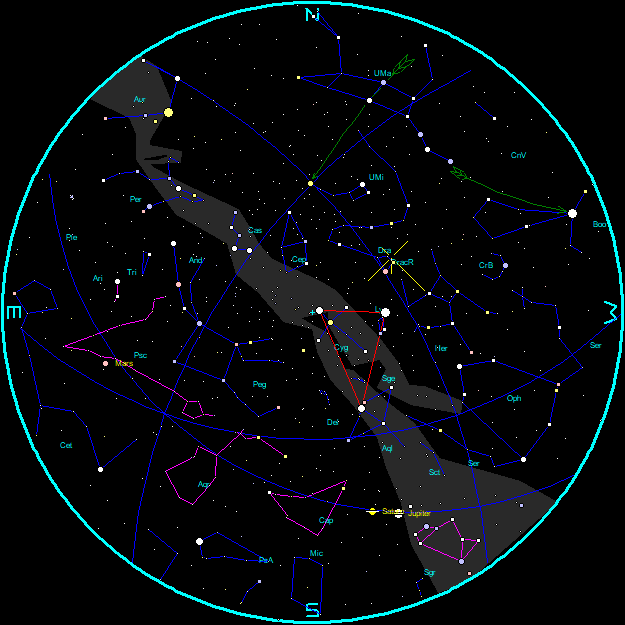
Star Chart for October 2020 (9 p.m. EDT October 15, 2020). Click on image to enlarge.Created using my LookingUp program. Click on image to enlarge.
The planets and stars are plotted for the 15th at 9 p.m. EDT in the evening and 6 a.m. for the morning chart. These are the chart times. Note that Traverse City is located approximately 45 minutes behind our time meridian, West 75° longitude. (An hour 45 minutes behind our daylight saving time meridian during EDT). To duplicate the star positions on a planisphere you may have to set it to 1 hour 45 minutes earlier than the current time.
October Morning Star Chart
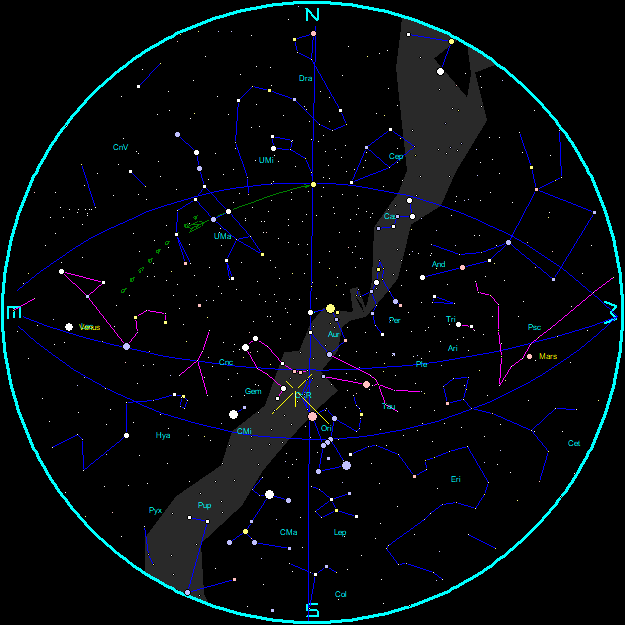
Star Chart for October mornings 2020 (6 a.m. EDT October 15, 2020). Click on image to enlarge. Created using my LookingUp program.
For a list of constellation names to go with the abbreviations click here.
- Pointer stars at the front of the bowl of the Big Dipper point to Polaris the North Star.
- Leaky dipper drips on Leo.
- Follow the arc of the handle of the Big Dipper to the star Arcturus.
- The Summer Triangle is in red.
- DracR – Draconid Radiant – Peak 7/8th – Zenithal Hourly Rate = 10+
- OriR – Orionid Radiant – Peak 22nd – Zenithal Hourly Rate = 20
Twilight Limits, Nautical and Astronomical
| EDT | |||||||
| Traverse City, MI |
Morning twilight | Evening twilight | Dark night | Moon | |||
| Date | Astro. | Nautical | Nautical | Astro. | Start | End | Illum. |
| 2020-10-01 | 6h09m | 6h43m | 20h28m | 21h02m | – | – | 1 |
| 2020-10-02 | 6h10m | 6h45m | 20h26m | 21h01m | – | – | 1 |
| 2020-10-03 | 6h12m | 6h46m | 20h25m | 20h59m | – | – | 0.98 |
| 2020-10-04 | 6h13m | 6h47m | 20h23m | 20h57m | – | – | 0.95 |
| 2020-10-05 | 6h14m | 6h48m | 20h21m | 20h55m | 20h55m | 21h15m | 0.9 |
| 2020-10-06 | 6h15m | 6h49m | 20h19m | 20h53m | 20h53m | 21h46m | 0.83 |
| 2020-10-07 | 6h17m | 6h51m | 20h17m | 20h51m | 20h51m | 22h23m | 0.75 |
| 2020-10-08 | 6h18m | 6h52m | 20h15m | 20h49m | 20h49m | 23h09m | 0.66 |
| 2020-10-09 | 6h19m | 6h53m | 20h14m | 20h48m | 20h48m | – | 0.56 |
| 2020-10-10 | 6h21m | 6h54m | 20h12m | 20h46m | 20h46m | 0h03m | 0.45 |
| 2020-10-11 | 6h22m | 6h56m | 20h10m | 20h44m | 20h44m | 1h06m | 0.34 |
| 2020-10-12 | 6h23m | 6h57m | 20h09m | 20h42m | 20h42m | 2h17m | 0.24 |
| 2020-10-13 | 6h24m | 6h58m | 20h07m | 20h41m | 20h41m | 3h32m | 0.15 |
| 2020-10-14 | 6h25m | 6h59m | 20h05m | 20h39m | 20h39m | 4h50m | 0.07 |
| 2020-10-15 | 6h27m | 7h00m | 20h03m | 20h37m | 20h37m | 6h10m | 0.02 |
| 2020-10-16 | 6h28m | 7h02m | 20h02m | 20h36m | 20h36m | 6h28m | 0 |
| 2020-10-17 | 6h29m | 7h03m | 20h00m | 20h34m | 20h34m | 6h29m | 0.01 |
| 2020-10-18 | 6h30m | 7h04m | 19h59m | 20h32m | 20h32m | 6h30m | 0.06 |
| 2020-10-19 | 6h32m | 7h05m | 19h57m | 20h31m | 20h58m | 6h32m | 0.13 |
| 2020-10-20 | 6h33m | 7h07m | 19h55m | 20h29m | 21h45m | 6h33m | 0.22 |
| 2020-10-21 | 6h34m | 7h08m | 19h54m | 20h28m | 22h39m | 6h34m | 0.33 |
| 2020-10-22 | 6h35m | 7h09m | 19h52m | 20h26m | 23h41m | 6h35m | 0.44 |
| 2020-10-23 | 6h37m | 7h10m | 19h51m | 20h25m | – | 6h37m | 0.55 |
| 2020-10-24 | 6h38m | 7h12m | 19h49m | 20h23m | 0h46m | 6h38m | 0.65 |
| 2020-10-25 | 6h39m | 7h13m | 19h48m | 20h22m | 1h52m | 6h39m | 0.75 |
| 2020-10-26 | 6h40m | 7h14m | 19h47m | 20h20m | 2h58m | 6h40m | 0.83 |
| 2020-10-27 | 6h41m | 7h15m | 19h45m | 20h19m | 4h01m | 6h41m | 0.89 |
| 2020-10-28 | 6h43m | 7h16m | 19h44m | 20h18m | 5h04m | 6h43m | 0.95 |
| 2020-10-29 | 6h44m | 7h18m | 19h42m | 20h16m | 6h05m | 6h44m | 0.95 |
| 2020-10-30 | 6h45m | 7h19m | 19h41m | 20h15m | – | – | 0.98 |
| 2020-10-31 | 6h46m | 7h20m | 19h40m | 20h14m | – | – | 1 |
Twilight calendar was generated using Cartes du Ciel (Sky Charts).
See my blog post: Twilight Zone for the definitions of the different periods of twilight here: https://bobmoler.wordpress.com/2018/09/27/.
NASA Calendar of Planetary Events
Oct 1  Th            Venus: 40.3° W
    1  Th  11:59 am  Mercury Greatest Elongation: 25.8° E
    1  Th  05:05 pm  Full Moon
    2  Fr  01:09 pm  Venus-Regulus: 0.1° S
    2  Fr  11:21 pm  Moon-Mars: 0.8° N
    3  Sa  01:22 pm  Moon Apogee: 406,300 km
    6  Tu  10:19 am  Mars nearest: 62,070,000 km
    6  Tu  09:25 pm  Draconid 1704 trail
    6  Tu  09:57 pm  Draconid 1711 trail
    7  We  08:29 pm  Moon Ascending Node
    8  Th  08:30 am  Draconid Meteor Shower: ZHR 10+
    9  Fr  09:07 am  Moon North Dec.: 24.6° N
    9  Fr  08:39 pm  Last Quarter
   11  Su  08:27 am  Moon-Beehive: 2.2° S
   13  Tu  07:10 pm  Mars Opposition
   13  Tu  07:57 pm  Moon-Venus: 4.4° S
   16  Fr  03:31 pm  New Moon
   16  Fr  07:46 pm  Moon Perigee: 356,900 km
   20  Tu  11:53 am  Moon Descending Node
   21  We  01:21 am  Orionid Meteor Shower: ZHR = 20
   21  We  10:00 pm  Moon South Dec.: 24.7° S
   22  Th  01:10 pm  Moon-Jupiter: 2.1° N
   22  Th  11:49 pm  Moon-Saturn: 2.7° N
   23  Fr  09:23 am  First Quarter
   25  Su  01:14 pm  Mercury Inferior Solar Conjunction
   29  Th  11:13 am  Moon-Mars: 3.3° N
   30  Fr  01:46 pm  Moon Apogee: 406,400 km
   31  Sa  09:49 am  Full Moon
   31  Sa  11:05 am  Uranus Opposition
Nov 1  Su            Venus: 34.2° W
All event times are given for UTC-4 hr: Eastern Daylight Saving Time.
Sky Events Calendar (with some tweaks) by Fred Espenak and Sumit Dutta (NASA’s GSFC),
http://eclipse.gsfc.nasa.gov/SKYCAL/SKYCAL.html.
If you go to the above site you can print out a list like the above for the entire year or calendar pages for your time zone.
Sun and Moon Rising and Setting Events
LU                  Ephemeris of Sky Events for Interlochen/TC
October, 2020    Local time zone: EDT
+-----------------------------------------------------------------------+
| DATE |  SUN     SUN  DAYLIGHT|   TWILIGHT*    |MOON  RISE OR    ILLUM |
|      |  RISE    SET    HOURS |  END    START  |PHASE SET** TIME FRACTN|
+=======================================================================+
|Thu  1| 07:41a  07:22p  11:40 | 08:25p  06:38a |Full  Rise 07:45p  100%|
|Fri  2| 07:42a  07:20p  11:37 | 08:23p  06:39a |      Rise 08:05p   99%|
|Sat  3| 07:43a  07:18p  11:34 | 08:21p  06:40a |      Rise 08:26p   96%|
+------+-----------------------+----------------+-----------------------+
|Sun  4| 07:45a  07:16p  11:31 | 08:19p  06:42a |      Rise 08:49p   91%|
|Mon  5| 07:46a  07:14p  11:28 | 08:17p  06:43a |      Rise 09:15p   85%|
|Tue  6| 07:47a  07:13p  11:25 | 08:16p  06:44a |      Rise 09:46p   78%|
|Wed  7| 07:48a  07:11p  11:22 | 08:14p  06:45a |      Rise 10:23p   70%|
|Thu  8| 07:50a  07:09p  11:19 | 08:12p  06:47a |      Rise 11:09p   60%|
|Fri  9| 07:51a  07:07p  11:16 | 08:10p  06:48a |L Qtr Rise 12:03a   50%|
|Sat 10| 07:52a  07:05p  11:13 | 08:08p  06:49a |      Rise 01:06a   40%|
+------+-----------------------+----------------+-----------------------+
|Sun 11| 07:53a  07:04p  11:10 | 08:07p  06:50a |      Rise 02:17a   30%|
|Mon 12| 07:55a  07:02p  11:07 | 08:05p  06:51a |      Rise 03:32a   20%|
|Tue 13| 07:56a  07:00p  11:04 | 08:03p  06:53a |      Rise 04:50a   12%|
|Wed 14| 07:57a  06:58p  11:01 | 08:02p  06:54a |      Rise 06:10a    5%|
|Thu 15| 07:58a  06:57p  10:58 | 08:00p  06:55a |      Rise 07:30a    1%|
|Fri 16| 08:00a  06:55p  10:55 | 07:58p  06:56a |New   Set  07:16p    0%|
|Sat 17| 08:01a  06:53p  10:52 | 07:57p  06:58a |      Set  07:45p    2%|
+------+-----------------------+----------------+-----------------------+
|Sun 18| 08:02a  06:52p  10:49 | 07:55p  06:59a |      Set  08:19p    7%|
|Mon 19| 08:04a  06:50p  10:46 | 07:54p  07:00a |      Set  08:58p   14%|
|Tue 20| 08:05a  06:48p  10:43 | 07:52p  07:01a |      Set  09:44p   24%|
|Wed 21| 08:06a  06:47p  10:40 | 07:50p  07:02a |      Set  10:39p   34%|
|Thu 22| 08:08a  06:45p  10:37 | 07:49p  07:04a |      Set  11:41p   44%|
|Fri 23| 08:09a  06:44p  10:34 | 07:47p  07:05a |F Qtr Set  12:46a   55%|
|Sat 24| 08:10a  06:42p  10:31 | 07:46p  07:06a |      Set  01:52a   65%|
+------+-----------------------+----------------+-----------------------+
|Sun 25| 08:12a  06:40p  10:28 | 07:45p  07:07a |      Set  02:57a   74%|
|Mon 26| 08:13a  06:39p  10:26 | 07:43p  07:09a |      Set  04:01a   82%|
|Tue 27| 08:14a  06:37p  10:23 | 07:42p  07:10a |      Set  05:04a   88%|
|Wed 28| 08:16a  06:36p  10:20 | 07:40p  07:11a |      Set  06:05a   94%|
|Thu 29| 08:17a  06:34p  10:17 | 07:39p  07:12a |      Set  07:06a   98%|
|Fri 30| 08:18a  06:33p  10:14 | 07:38p  07:13a |      Set  08:08a  100%|
|Sat 31| 08:20a  06:32p  10:11 | 07:36p  07:15a |Full  Rise 06:53p  100%|
+-----------------------------------------------------------------------+
* Nautical Twilight
** Moonrise or moonset, whichever occurs between sunrise and sunset
Generated using my LookingUp for DOS program.
09/29/2020 – Ephemeris – Let’s look for the naked-eye planets for this week
This is Ephemeris for Wednesday, September 30th. Today the Sun will be up for 11 hours and 43 minutes, setting at 7:24, and it will rise tomorrow at 7:41. The Moon, 1 day before full, will set at 7:11 tomorrow morning.
Let’s look for the naked-eye planets for this week. Jupiter and Saturn are both low in the southern sky at 9 pm. Jupiter is the very bright one. To the left of it will be the somewhat dimmer Saturn which is just about due south at that hour. They are now seemly to close a tiny bit, and they will cross paths on December 21st. Jupiter will set first at 12:48 tomorrow morning with Saturn following at 1:27 am. The next planet visible will be Mars which will rise at 8:12 pm. It’s now down to 38.8 million miles (62.5 million km) away, as the Earth very slowly overtook it by 1.0 million miles (1.5 million km) last week as the Mars will be at its closest in 7 days. Brilliant Venus will rise at 4:07 am as it retreats slowly toward the Sun.
The event times given are for the Traverse City/Interlochen area of Michigan. They may be different for your location.
Addendum
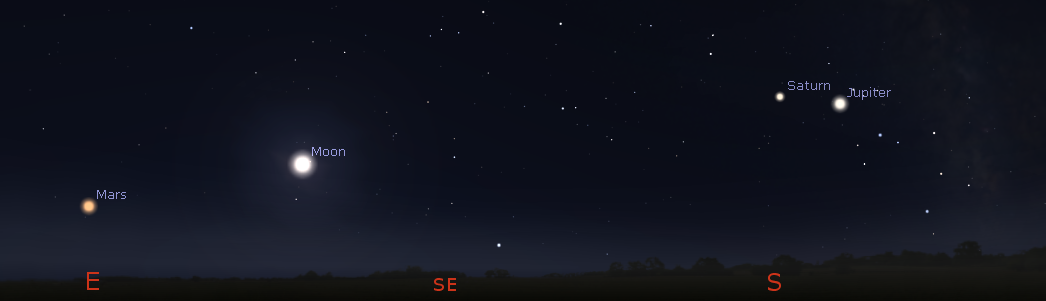
Jupiter, Saturn, the Moon and Mars arrayed from south-southwest to east at 9 pm tonight September 30, 2020. Click on the image to enlarge. Created using Stellarium.
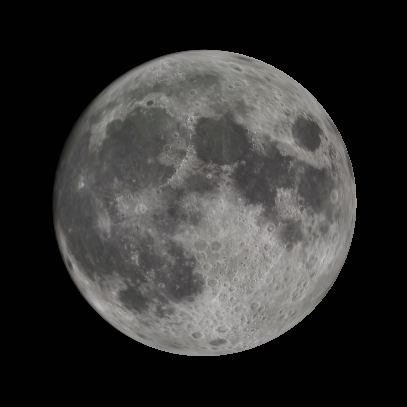
The Moon as it might appear in binoculars or a small telescope tonight at 9 pm, September 30, 2020. Created using Stellarium.
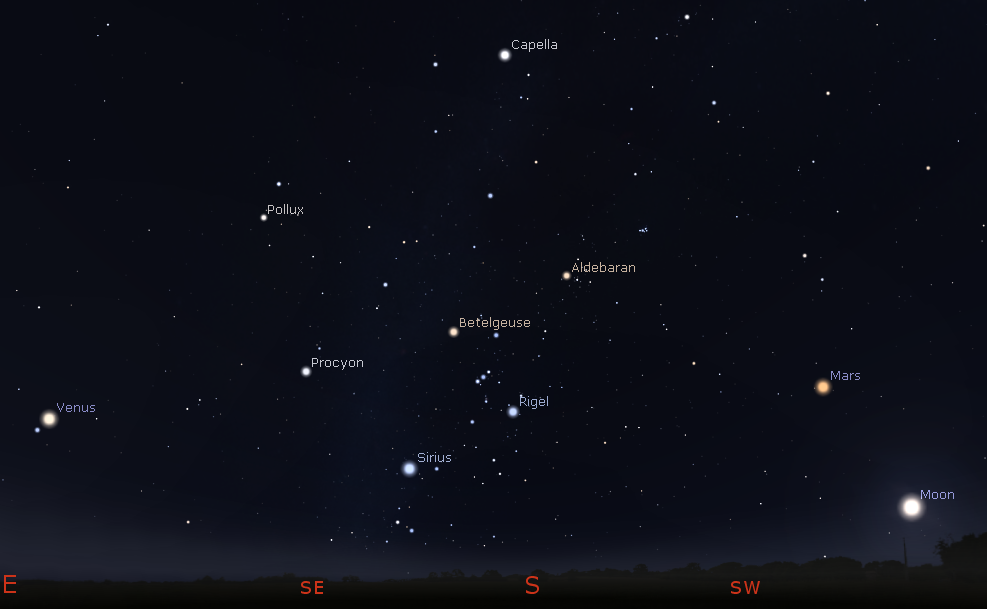
Venus, Mars, the Moon and the stars of winter but at 6 am October 1, 2020. The bright star under Venus is Regulus in Leo the lion. Click on the image to enlarge. Created using Stellarium.
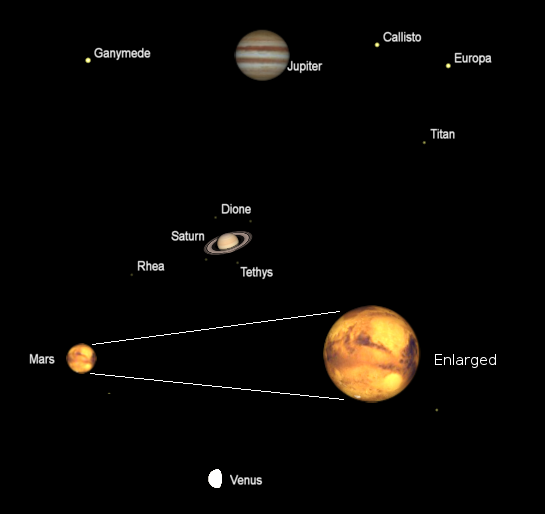
The planets as seen in a telescope (north up) with the same magnification for the night of September 30/October 1, 2020. Times of the display are: Jupiter and Saturn, 9 pm; Mars, Midnight; Venus, 6 am. Apparent diameters: Jupiter, 40.53″; Saturn, 17.20″, rings, 40.07″. Mars, 22.45″, and Venus 15.52″. Jupiter’s moon Io is behind the planet and will reappear at 12:02 am. Mars also displays an enlargement showing surface detail. Mars will be closest to the Earth this go-a-round on October 6. The ” symbol means seconds of arc (1/3600th of a degree.) Created using Cartes du Ciel (Sky Charts).
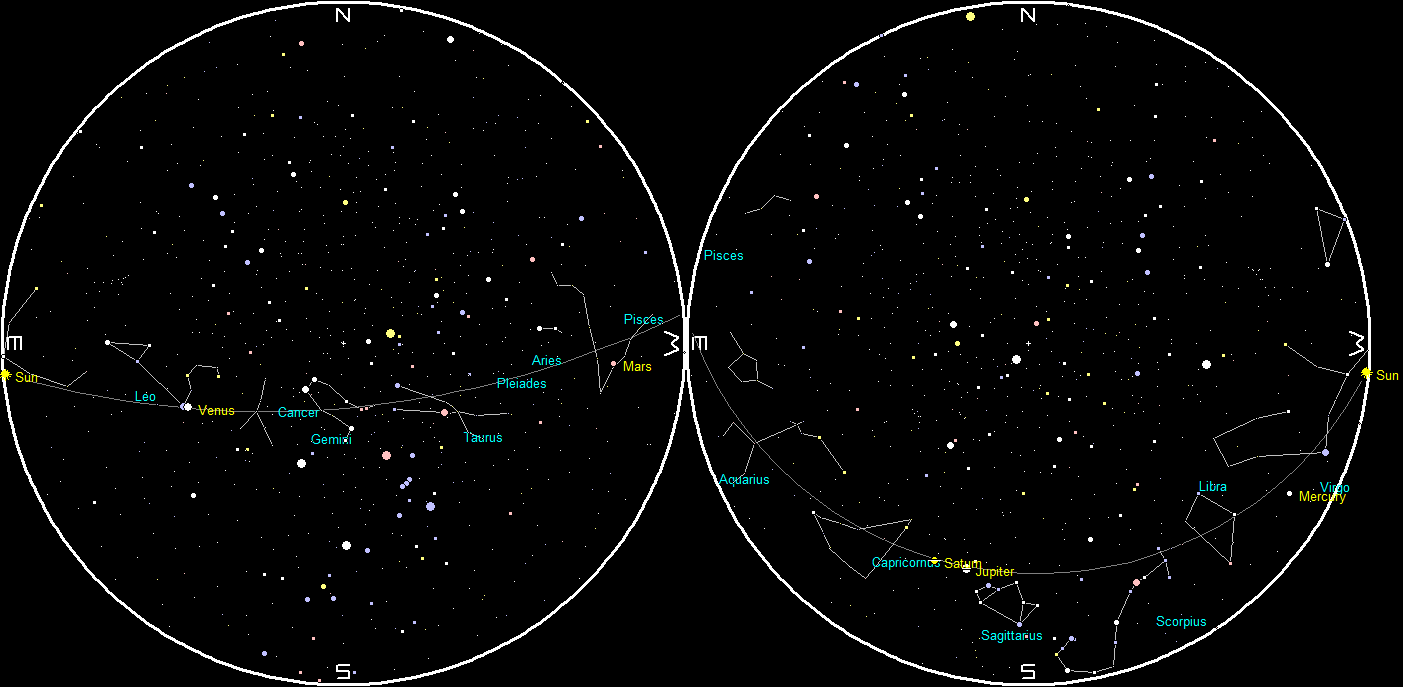
Planets and the Moon at sunset and sunrise of a single night starting with sunset on the right on September 30, 2020. The night ends on the left with sunrise on October 1st. Click on the image to enlarge. Created using my LookingUp program.
09/29/2020 – Ephemeris – The Harvest Moon is in two days
This is Ephemeris for Tuesday, September 29th. Today the Sun will be up for 11 hours and 47 minutes, setting at 7:26, and it will rise tomorrow at 7:40. The Moon, 2 days before full, will set at 6:09 tomorrow morning.
This upcoming full moon is the Harvest Moon. It is the most famous of the named full moons, and was very useful in the days before electric lights. The reason is that the Moon, around the time it is full now doesn’t advance its rising time very much from night to night effectively extending the light of twilight to allow more time to gather in crops. This is because the Moon is moving north as well as eastward. The farther north it is the longer it stays up and retards the advance in rise times. On average the Moon rises 50 minutes later each night. This week the interval is down near 20 minutes advance in moonrise times per day extending twilight and the time each day to harvest the crops for a few more days.
The event times given are for the Traverse City/Interlochen area of Michigan. They may be different for your location.
Addendum
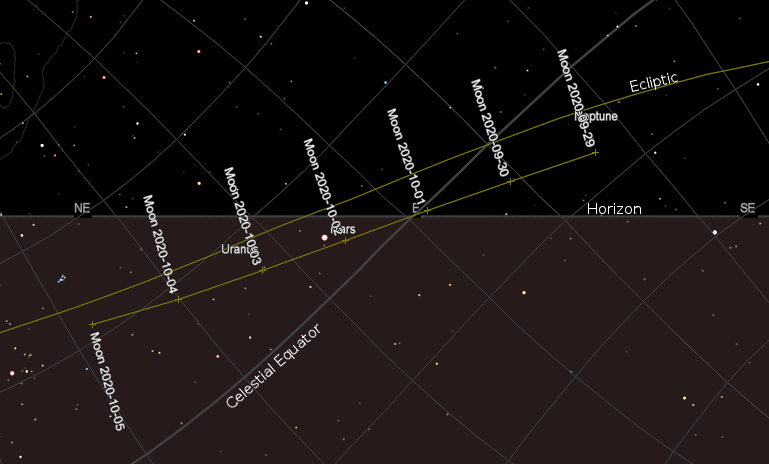
The motion of the moon from tonight through next Monday night. This is looking east at where the Moon will rise, and we’re able to see below the horizon. The celestial equator, a projection of the Earth’s equator on the sky, crosses the horizon at an angle equal to 90 minus one’s latitude. Around my location that’s 45.5 degrees. The Moon and stars will rise parallel to the celestial equator. Its daily orbital motion is at the shallow angle of 5 degrees to the ecliptic, the apparent path of the Sun. So the advance in rise times starts off at 20 minutes later each night, rather than the average 50 minutes.

