Archive
07/10/2019 – Ephemeris – A look at the bright planets for this week
Ephemeris for Wednesday, July 10th. Today the Sun will be up for 15 hours and 21 minutes, setting at 9:28, and it will rise tomorrow at 6:07. The Moon, 1 day past first quarter, will set at 2:26 tomorrow morning.
Let’s look at the planets for this week. Mercury is now too close to the Sun to be seen. Mars itself is difficult to spot low in the west-northwest, setting at 10:29 p.m. Bright Jupiter will be in the southern sky by 10:30 p.m. With steadily held binoculars a few of the 4 largest satellites of Jupiter can be seen. All four of Jupiter’s largest satellites can be spotted in telescopes. Tonight they will be all arrayed on one side of the planet. Also at 10:30 Saturn will be lower down in the southeast, the brightest star-like object in that direction, but significantly dimmer than Jupiter. The only bright planet left in the morning sky is Venus, which is too close to the Sun to be spotted.
The times given are for the Traverse City/Interlochen area of Michigan. They may be different for your location.
Addendum
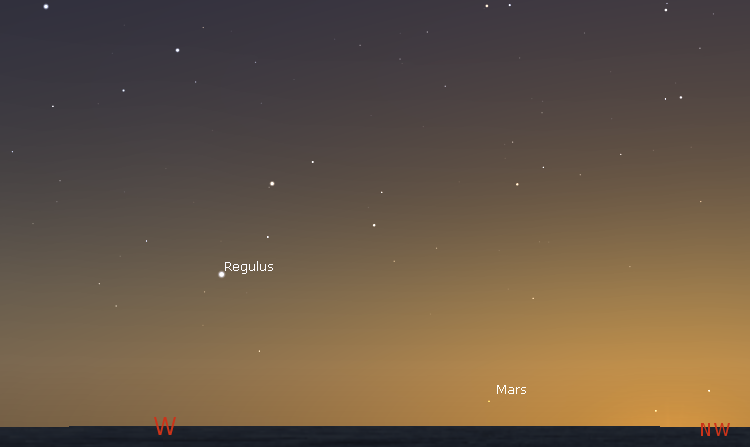
Mars about to set, seen at 10:15 p.m. July 10, 2019. Mars and the stars have been brightened. Created by Stellarium.
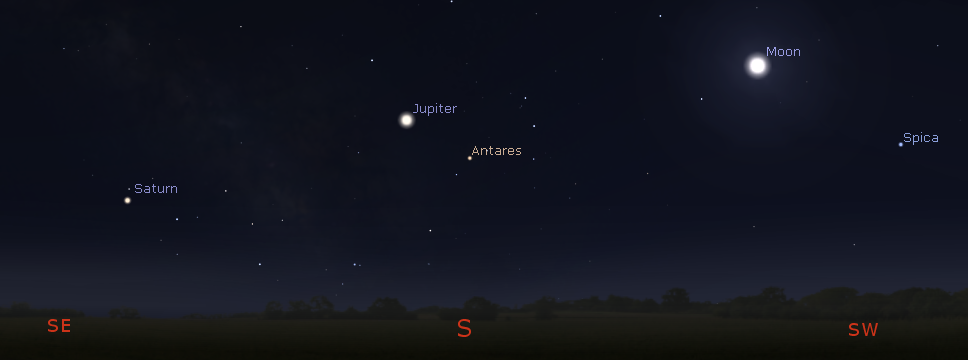
The Moon, Jupiter and Saturn in the southern sky at 11 p.m., July 10, 2019. Click on the image to enlarge. Created using Stellarium.
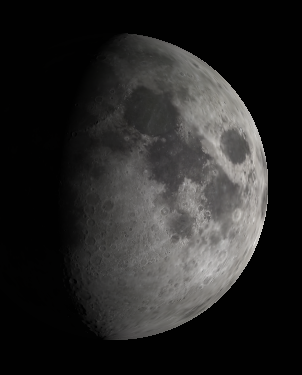
The gibbous Moon as it might appear in binoculars or a small telescope tonight at 11 p.m. July 10, 2019. Created using Stellarium.
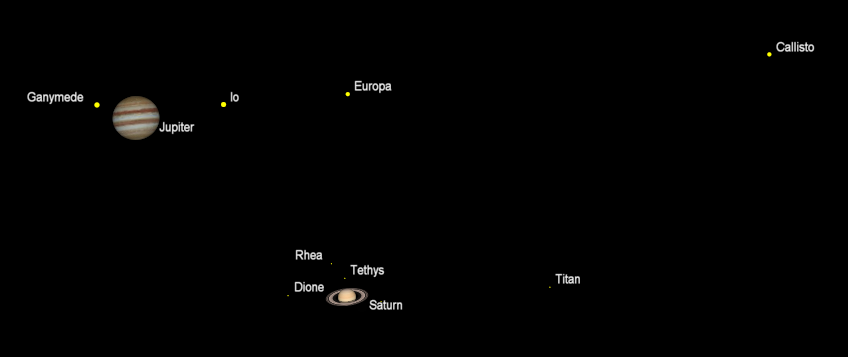
Jupiter and Saturn with the same magnification at 11p.m. July 10, 2019. Created using Cartes du Ciel (Sky Charts).
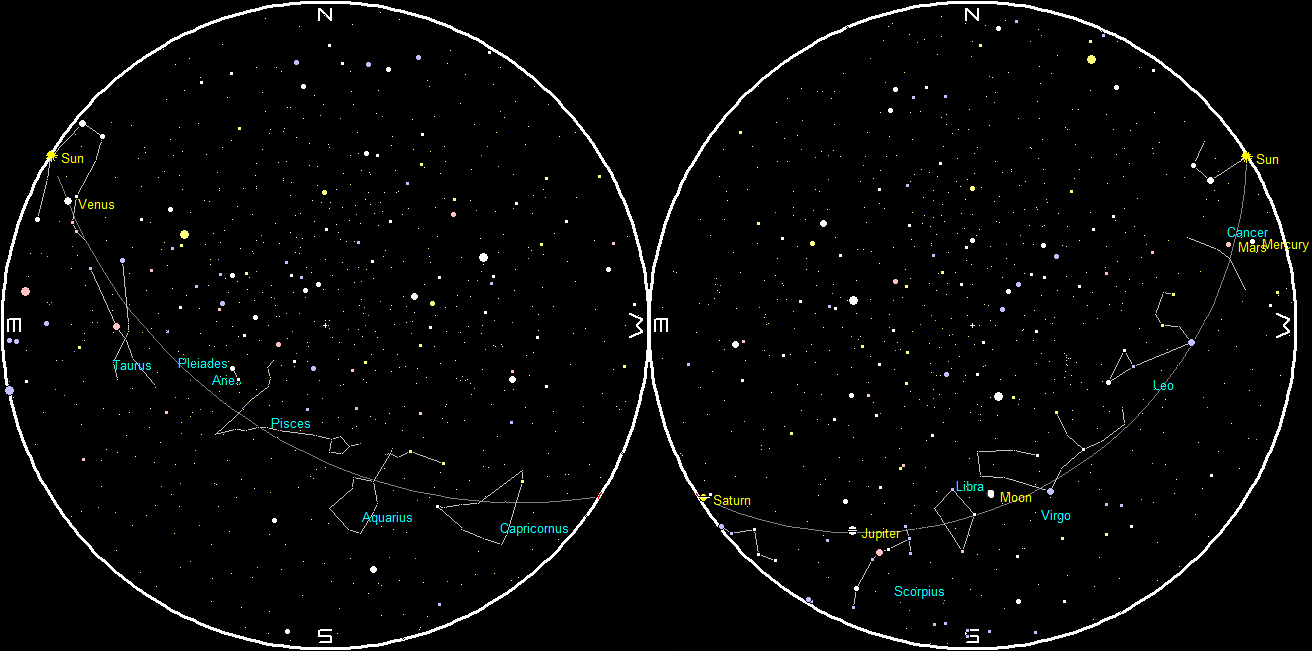
Planets and the Moon at sunset and sunrise of a single night starting with sunset on the right on July 10, 2019. The night ends on the left with sunrise on the 11th. Click on the image to enlarge. Created using my LookingUp program.
07/09/2019 – Ephemeris – Saturn is opposite the Sun in the sky today
Ephemeris for Tuesday, July 9th. Today the Sun will be up for 15 hours and 23 minutes, setting at 9:29, and it will rise tomorrow at 6:07. The Moon, at first quarter today, will set at 1:58 tomorrow morning.
Today Saturn will pass in opposition from the Sun at 12:12 p.m. It’s a time when Saturn will rise as the Sun sets, being opposite the Sun in the sky, and a time near its closest to the Earth at 841 million miles (1.354 billion km). Saturn orbits the Sun at a distance of 10 times the Earth’s distance, so Saturn’s distance from the Earth varies from 9 times to 11 times the Earth’s distance from the Sun. So it doesn’t change much in size in telescopes. This is unlike Mars which has a greater range of distances from the Earth. In telescopes the rings are the first one sees, with the planet nestled in the center. In small telescopes, it is a tiny but magnificent sight. It’s largest moon Titan is visible nearby.
The times given are for the Traverse City/Interlochen area of Michigan. They may be different for your location.
Addendum
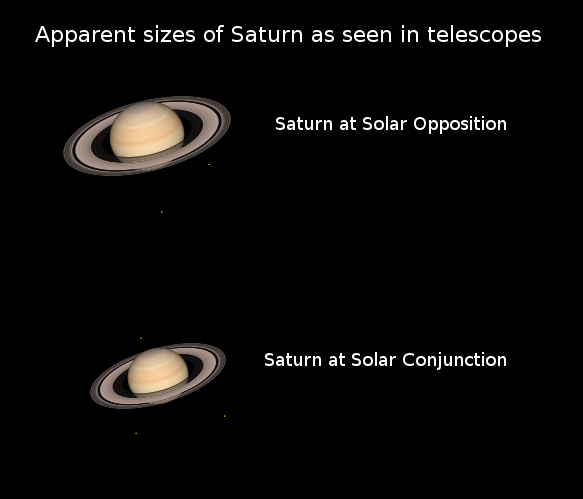
Here’s the extremes in the apparent size of Saturn from solar opposition to conjunction. Created using Cartes du Ciel.
07/08/2019 – Ephemeris – The bright star Vega
Ephemeris for Monday, July 8th. Today the Sun will be up for 15 hours and 24 minutes, setting at 9:29, and it will rise tomorrow at 6:06. The Moon, 1 day before first quarter, will set at 1:31 tomorrow morning.
The bright star high in the east is Vega, one of the stars of the Summer Triangle an informal constellation called an asterism. Vega belongs to the official constellation Lyra the harp, which includes a narrow parallelogram of stars to its south. Vega is regarded by astronomers as a standard calibration star. Though a first magnitude star, its actual magnitude is 0.03. It is a type A0 a pure white star, and is 25 light years away. Astronomers however got a shock in 1983 when calibrating the Infrared Astronomy Satellite (IRAS) on it: Vega showed an excess of Infrared radiation which means the star is orbited by a disk of dust, perhaps a Kuiper belt of its own. Due to the slow wobble of the earth’s axis Vega will become our pole star in about 14 thousand years.
The times given are for the Traverse City/Interlochen area of Michigan. They may be different for your location.
Addendum
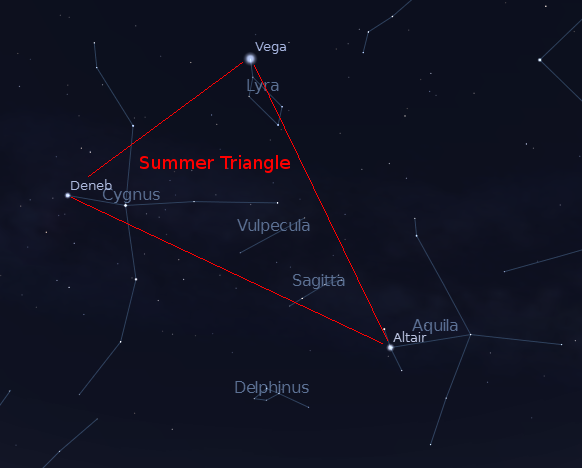
The Summer Triangle. Created using Stellarium.
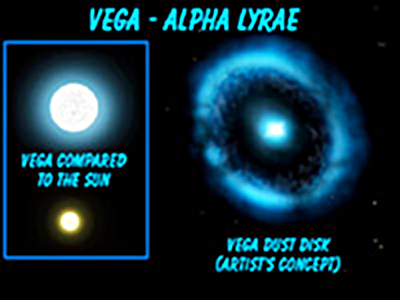
Vega: Comparison to the Sun and its dust ring. Credit Orange County Astronomers.
07/05/2019 – Ephemeris – Apollo 11 memories tonight and a Sun ‘n Star Party tomorrow
Ephemeris for Friday, July 5th. Today the Sun will be up for 15 hours and 27 minutes, setting at 9:31, and it will rise tomorrow at 6:04. The Moon, 3 days past new, will set at 11:59 this evening.
Tonight the Grand Traverse Astronomical Society will invite all those who are old enough to have seen the Apollo 11 launch and Moon landing as it happened to relate their experiences at the NMC Rogers Observatory at 8 p.m. Tomorrow afternoon and evening will be what we call a Sun & Star Party at the Sleeping Bear Dunes National Lakeshore Dune Climb hosted by the society and the rangers and volunteers of the park. From 4 to 6 p.m., the Sun will be featured with special solar telescopes. Starting at 9 p.m. will be a star party, actually mostly a planet party, viewing the planets Jupiter and Saturn, plus the Moon. There will be other celestial wonders visible in the deepening twilight. If cloudy one or both Dunes events can be canceled.
The times given are for the Traverse City/Interlochen area of Michigan. They may be different for your location.
Addendum
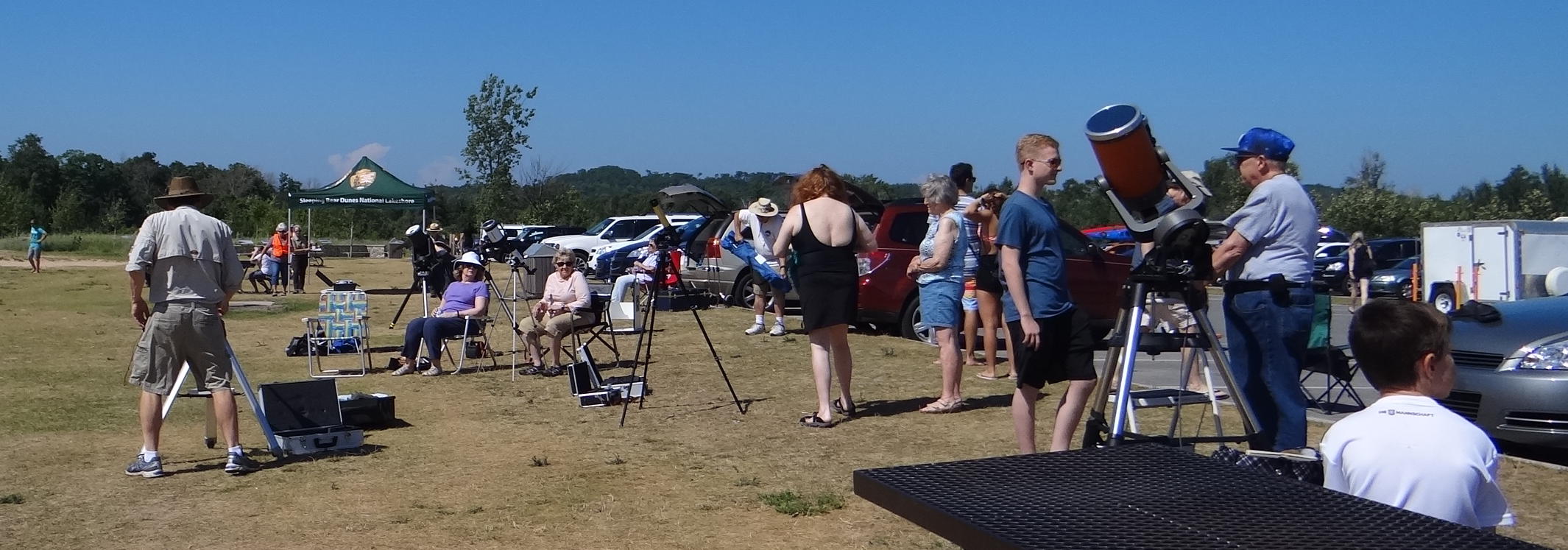
A Sun Party at the Dune Climb. Credit: Eileen Carlisle.

See the Stars from Sleeping Bear Dunes National Lakeshore Poster by Tyler Nordgren.
07/04/2019 – Ephemeris – Happy Independence Day, at our farthest from the Sun
Ephemeris for Independence Day, Thursday, July 4th. Today the Sun will be up for 15 hours and 28 minutes, setting at 9:31, and it will rise tomorrow at 6:03. The Moon, 2 days past new, will set at 11:20 this evening.
Today, Independence Day the Earth is at its greatest distance, aphelion, from the sun or about 94.5 million miles (152.2 million km) from the Sun. It doesn’t do much to weaken the strength of sunlight, as you will find out when you go to the beach. But, occurring in summer, it makes summer the longest season by a several days over winter. Our calendar tries to keep up with the seasonal or tropical year, while the Earth’s revolution from its farthest or aphelion point to the next is slightly longer. Back in 1776, at the founding of our nation, the Earth was farthest from the Sun on June 30th. As we go more centuries into the future our summer will even get a bit longer. But remember the poor Australians, and others in the southern hemisphere, whose winter will also get longer.
The times given are for the Traverse City/Interlochen area of Michigan. They may be different for your location.
Addendum
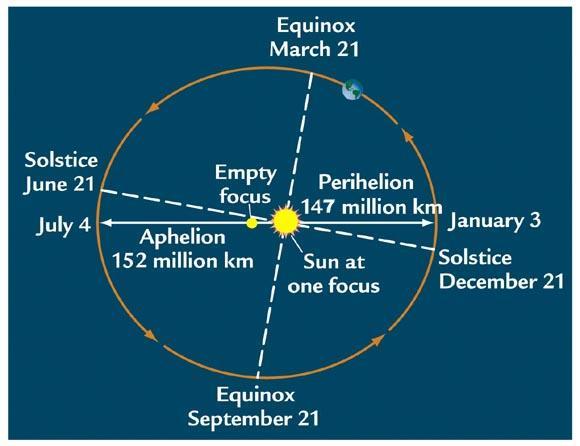
The Earth’s elliptical orbit, somewhat exaggerated, showing perihelion, aphelion and the seasons. Credit “Starts with a Bang” blog by Ethan Siegel.
07/03/2019 – Ephemeris – Our weekly look at the bright planets
Ephemeris for Wednesday, July 3rd. Today the Sun will be up for 15 hours and 29 minutes, setting at 9:31, and it will rise tomorrow at 6:02. The Moon, 1 day past new, will set at 10:33 this evening.
Let’s look at the planets for this week. Mars, Mercury and the Moon will be low in the west-northwestern sky to the left of the star Pollux. Mercury and Mars are now slightly dimmer than Pollux tonight. Mercury is moving below Mars now. Mercury will set at 10:35 p.m., with Mars following 9 minutes later. Jupiter will start the evening low in the southeast. It’s far brighter than any star and will be visible just about all night, setting at 4:24 a.m. It’s in Ophiuchus the serpent bearer now, just above Scorpius the scorpion. Though still officially a morning planet, Saturn will rise at 9:42 p.m., in the east-southeast. It will be up the rest of the night. It’s in Sagittarius the archer. Venus remains too close to the Sun to be seen.
The times given are for the Traverse City/Interlochen area of Michigan. They may be different for your location.
Addendum
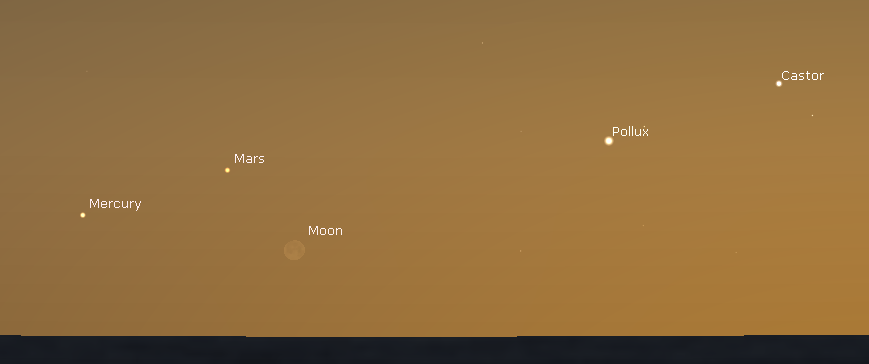
Mars, Mercury and the Moon near the west-northwestern horizon at 10:15 p.m., July 3, 2019. Click on the image to enlarge. Created using Stellarium. Stellarium cannot render the crescent on the day old Moon.
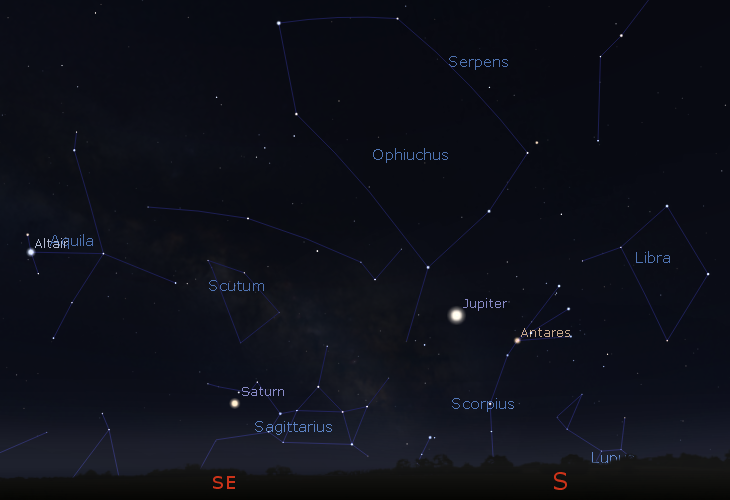
Jupiter Saturn and evening constellations for 11 p.m. July 3, 2019. Created using Stellarium.
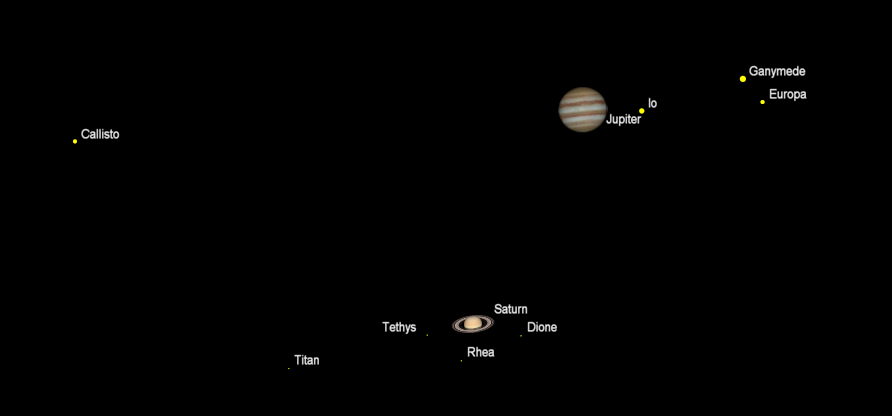
Jupiter and Saturn with the same magnification at 11p.m. (3:00 UT), July 3, 2019. Io will disappear behind Jupiter at 12:42 a.m. (4:42 UT) and will reappear from Jupiter’s shadow on the other side at 3:26 a.m. (7:26 UT). Created using Cartes du Ciel (Sky Charts).
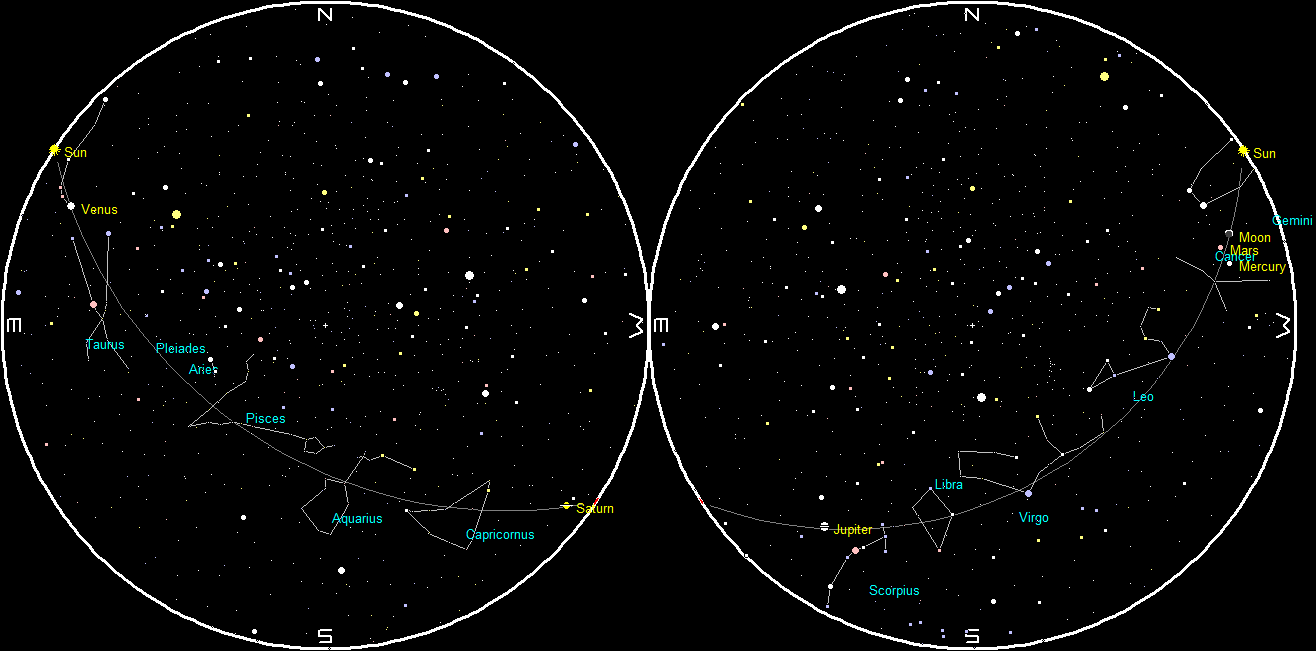
Planets and the Moon at sunset and sunrise of a single night starting with sunset on the right on July 3, 2019. The night ends on the left with sunrise on the 4th. Click on the image to enlarge. Created using my LookingUp program.
07/02/2019 – Ephemeris – Looking for Draco the Dragon
Ephemeris for Tuesday, July 2nd. Today the Sun will be up for 15 hours and 30 minutes, setting at 9:31, and it will rise tomorrow at 6:02. The Moon is new today, and won’t be visible.
Later today Chile and Argentina will experience a total solar eclipse. High in the northern sky at 11 p.m. lies the twisted constellation, that of Draco the dragon. This dragon is more like the snakelike Chinese dragon than the dinosaur-like dragon of European legend. I find it better to start at the tail of Draco, to trace him out in the stars. Draco’s tail starts between the bowl of the Big Dipper and the Little Dipper. The Dragon is seen in a line of stars that extends parallel to the handle of the Big Dipper before curving around the bowl of the Little Dipper then bends back toward the southeast. The head of Draco is an odd box of stars above the bright star Vega, high in the east. Though not made up of very bright stars, Draco has an easy shape to trace.
The times given are for the Traverse City/Interlochen area of Michigan. They may be different for your location.
Addendum
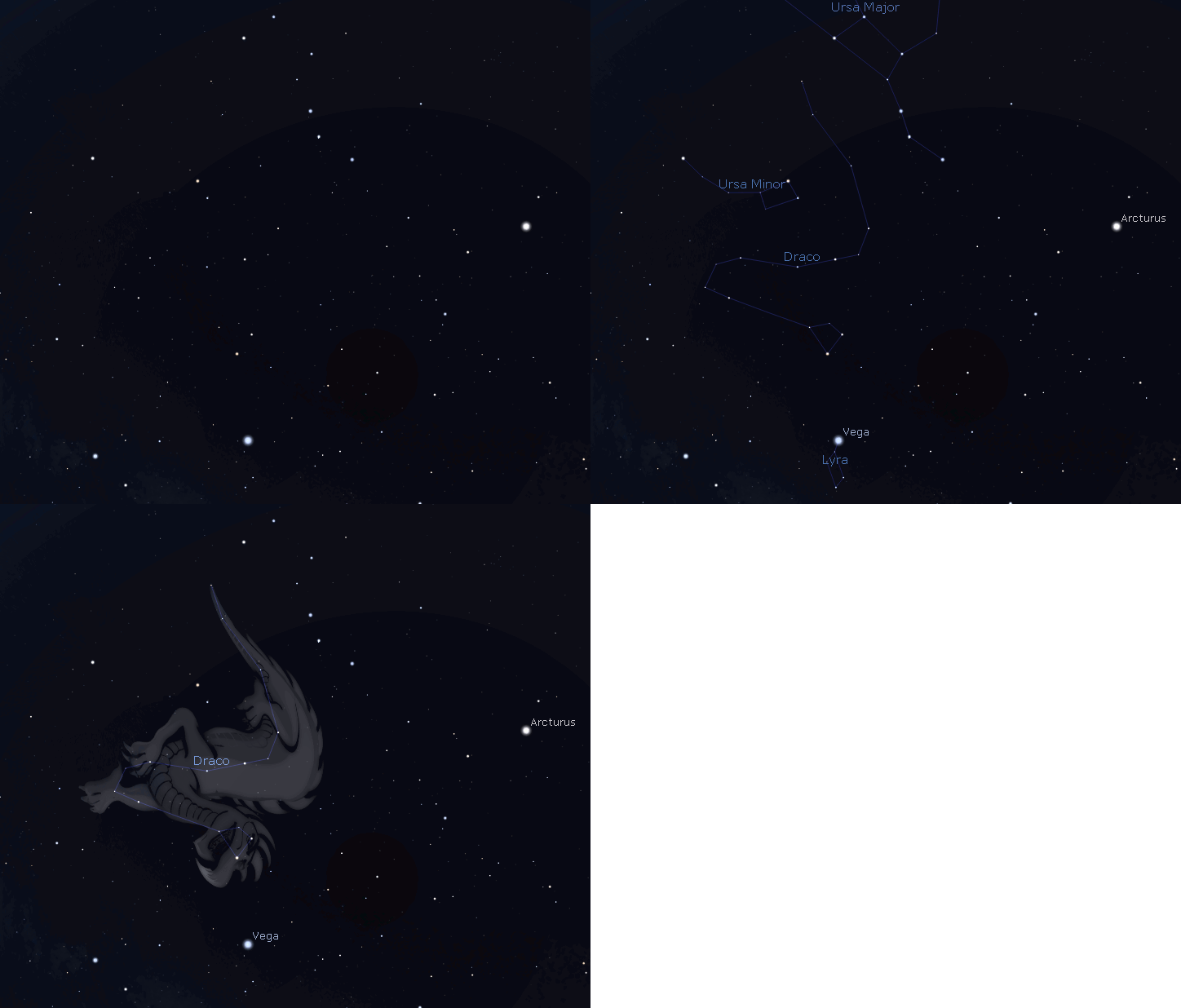
Draco finder animation for 11 p.m. July 2. Click on the image to enlarge. Created using Stellarium and GIMP.
07/01/2019 – Ephemeris – Previewing July skies
Ephemeris for Monday, July 1st. Today the Sun will be up for 15 hours and 31 minutes, setting at 9:32, and it will rise tomorrow at 6:01. The Moon, 1 day before new, will rise at 5:49 tomorrow morning.
Lets preview July’s skies. The Sun, having reached its northern solstice, is beginning to slide southward again, at first imperceptibly, then with greater speed. The daylight hours will decrease from 15 hours and 31 minutes today to 14 hours 42 minutes at month’s end. The daylight hours will be slightly shorter south of Interlochen, and slightly longer to the north. The altitude of the Sun at local noon, when it is due south will decrease from 68 degrees now to 63 degrees at month’s end. The Sun will be a degree lower in the Straits area. Despite the warmth, the Earth will reach its greatest distance from the Sun this Friday the 5th. On that day the Earth will reach 94.5 million miles (152.1 million km) from the Sun.
The times given are for the Traverse City/Interlochen area of Michigan. They may be different for your location.
Addendum
July Evening Star Chart
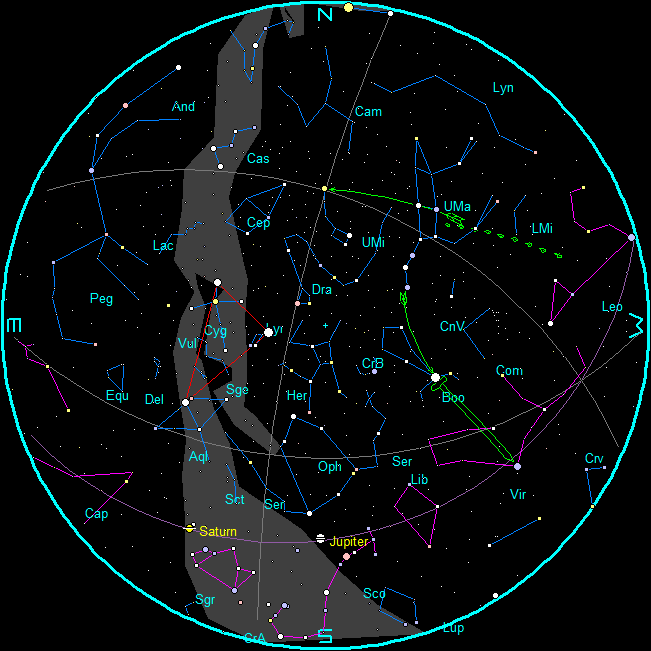
Star Chart for July 2019 (11 p.m. EDT July 15, 2019). Created using my LookingUp program. Click on image to enlarge.
The planets and stars are plotted for the 15th at 11 p.m. EDT in the evening and 4:30 a.m. for the morning chart. These are the chart times. Note that Traverse City is located approximately 45 minutes behind our time meridian, West 75° longitude. (An hour 45 minutes behind our daylight saving time meridian during EDT). To duplicate the star positions on a planisphere you may have to set it to 1 hour 45 minutes earlier than the current time.
Note the chart times are for the 15th. For each week before the 15th add ½ hour (28 minutes if you’re picky). For each week after the 15th subtract ½ hour. The planet positions are updated each Wednesday on this blog. For planet positions on dates other than the 15th.
July Morning Star Chart
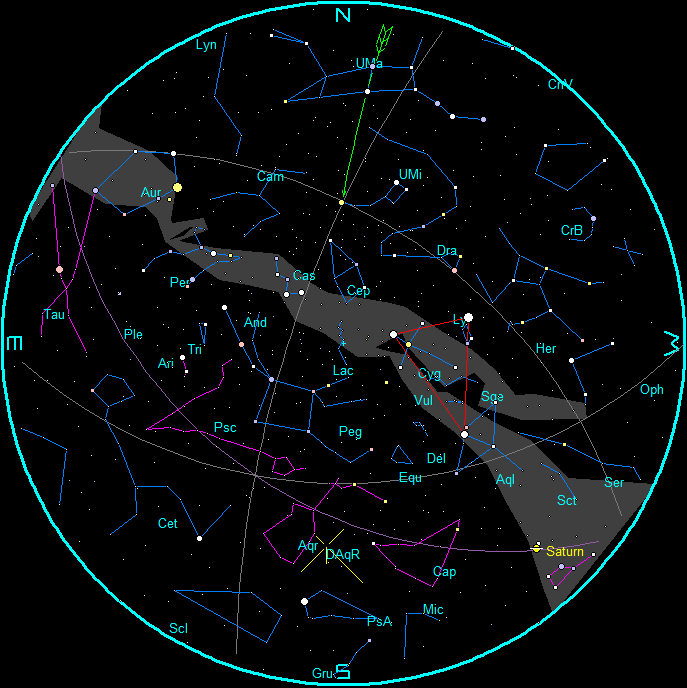
Star Chart for July mornings 2019 (4:30 a.m. EDT July 15, 2019). Created using my LookingUp program. Click on image to enlarge.
For a list of constellation names to go with the abbreviations click here.
- Pointer stars at the front of the bowl of the Big Dipper point to Polaris the North Star.
- Leaky dipper drips on Leo.
- Follow the arc of the handle of the Big Dipper to the star Arcturus, and
- Extend like a spike to Spica.
- The Summer Triangle is in red.
- DAqR is the radiant of the South Delta Aquariid meteor shower (Peaks on the 30th)
Twilight Limits, Nautical and Astronomical
| EDT | |||||||
| Traverse City |
Morning twilight | Evening twilight | Dark night | Moon | |||
| Date | Astro. | Nautical | Nautical | Astro. | Start | End | Illum. |
| 2019-07-01 | 3h37m | 4h40m | 23h00m | 0h03m | 0h03m | 3h37m | 0.02 |
| 2019-07-02 | 3h38m | 4h41m | 23h00m | 0h02m | 0h02m | 3h38m | 0 |
| 2019-07-03 | 3h40m | 4h42m | 22h59m | 0h02m | 0h02m | 3h40m | 0.01 |
| 2019-07-04 | 3h41m | 4h43m | 22h59m | 0h01m | 0h01m | 3h41m | 0.06 |
| 2019-07-05 | 3h42m | 4h44m | 22h58m | 0h00m | 0h00m | 3h42m | 0.13 |
| 2019-07-06 | 3h43m | 4h45m | 22h58m | 23h59m | – | 3h43m | 0.22 |
| 2019-07-07 | 3h45m | 4h46m | 22h57m | 23h58m | 0h34m | 3h45m | 0.33 |
| 2019-07-08 | 3h46m | 4h47m | 22h56m | 23h57m | 1h03m | 3h46m | 0.45 |
| 2019-07-09 | 3h48m | 4h48m | 22h56m | 23h55m | 1h31m | 3h48m | 0.56 |
| 2019-07-10 | 3h49m | 4h49m | 22h55m | 23h54m | 1h58m | 3h49m | 0.67 |
| 2019-07-11 | 3h51m | 4h50m | 22h54m | 23h53m | 2h26m | 3h51m | 0.77 |
| 2019-07-12 | 3h52m | 4h51m | 22h53m | 23h52m | 2h57m | 3h52m | 0.86 |
| 2019-07-13 | 3h54m | 4h52m | 22h52m | 23h50m | 3h32m | 3h54m | 0.92 |
| 2019-07-14 | 3h56m | 4h53m | 22h51m | 23h49m | – | – | 0.92 |
| 2019-07-15 | 3h58m | 4h54m | 22h50m | 23h47m | – | – | 0.97 |
| 2019-07-16 | 3h59m | 4h56m | 22h49m | 23h46m | – | – | 1 |
| 2019-07-17 | 4h01m | 4h57m | 22h48m | 23h44m | – | – | 1 |
| 2019-07-18 | 4h03m | 4h58m | 22h47m | 23h42m | – | – | 0.98 |
| 2019-07-19 | 4h05m | 5h00m | 22h46m | 23h41m | – | – | 0.95 |
| 2019-07-20 | 4h07m | 5h01m | 22h44m | 23h39m | 23h39m | 23h40m | 0.89 |
| 2019-07-21 | 4h08m | 5h02m | 22h43m | 23h37m | 23h37m | – | 0.83 |
| 2019-07-22 | 4h10m | 5h04m | 22h42m | 23h35m | 23h35m | 0h04m | 0.75 |
| 2019-07-23 | 4h12m | 5h05m | 22h41m | 23h33m | 23h33m | 0h27m | 0.66 |
| 2019-07-24 | 4h14m | 5h06m | 22h39m | 23h32m | 23h32m | 0h50m | 0.56 |
| 2019-07-25 | 4h16m | 5h08m | 22h38m | 23h30m | 23h30m | 1h14m | 0.46 |
| 2019-07-26 | 4h18m | 5h09m | 22h36m | 23h28m | 23h28m | 1h40m | 0.36 |
| 2019-07-27 | 4h20m | 5h11m | 22h35m | 23h26m | 23h26m | 2h11m | 0.26 |
| 2019-07-28 | 4h22m | 5h12m | 22h33m | 23h24m | 23h24m | 2h48m | 0.16 |
| 2019-07-29 | 4h24m | 5h14m | 22h32m | 23h22m | 23h22m | 3h34m | 0.09 |
| 2019-07-30 | 4h26m | 5h15m | 22h30m | 23h20m | 23h20m | 4h26m | 0.03 |
| 2019-07-31 | 4h28m | 5h17m | 22h29m | 23h18m | 23h18m | 4h28m | 0 |
Twilight calendar was generated using Cartes du Ciel (Sky Charts).
See my blog post: Twilight Zone for the definitions of the different periods of twilight here: https://bobmoler.wordpress.com/2018/09/27/.
NASA Calendar of Planetary Events
Jul	1	Mo		        Venus: 12° W
 	2	Tu	 3:16 pm	New Moon
 	2	Tu	 3:23 pm	Total Solar Eclipse
                                        S Pacific, Chile, Argentina
 	2	Tu	 6:02 pm	Moon North Dec.: 22.4° N
 	3	We	 2:53 am	Moon Ascending Node
 	4	Th	 4:34 am	Moon-Mercury: 3.3° S
 	4	Th	 8:53 am	Mercury-Beehive: 4.6° S
 	4	Th	11:02 am	Moon-Beehive: 0.2° S
 	4	Th	 2:59 pm	Aphelion: 1.0168 AU
 	5	Fr	12:54 am	Moon Perigee: 363700 km
 	5	Fr	 7:18 pm	Mercury-Mars: 3.8° N
 	9	Tu	 6:55 am	First Quarter
 	9	Tu	12:12 pm	Saturn Opposition
 	13	Sa	 3:06 am	Mars-Beehive: 0.4° S
 	13	Sa	 3:43 pm	Moon-Jupiter: 2.5° S
 	15	Mo	 6:49 pm	Moon South Dec.: 22.4° S
 	16	Tu	 3:27 am	Moon-Saturn: 0.2° N
 	16	Tu	 5:05 am	Moon Descending Node
 	16	Tu	 5:31 pm	Partial Lunar Eclipse
                                        S America, most of E Hemisphere
 	16	Tu	 5:38 pm	Full Moon
 	20	Sa	 8:01 pm	Moon Apogee: 405500 km
 	21	Su	 8:32 am	Mercury Inferior Conj.
 	24	We	 9:18 pm	Last Quarter
 	27	Sa	 8:47 pm	Moon-Aldebaran: 2.4° S
 	28	Su	10:59 am	Delta Aquarid Shower: ZHR = 20
                                        Intl. Meteor Org. has the peak on the 30th.
 	30	Tu	 4:10 am	Moon North Dec.: 22.4° N
 	30	Tu	 1:02 pm	Moon Ascending Node
 	31	We	11:12 pm	New Moon
Aug	1	Th		        Venus: 3.6° W
All event times are given for UTC-4 hr: Eastern Daylight Saving Time.
Sky Events Calendar by Fred Espenak and Sumit Dutta (NASA’s GSFC),
http://eclipse.gsfc.nasa.gov/SKYCAL/SKYCAL.html.
If you go to the above site you can print out a list like the above for the entire year or calendar pages for your time zone.
Sun and Moon Rising and Setting Events
     LU                  Ephemeris of Sky Events for Interlochen/TC
     July, 2019    Local time zone: EDT
     +-----------------------------------------------------------------------+
     | DATE |  SUN     SUN  DAYLIGHT|   TWILIGHT*    |MOON  RISE OR    ILLUM |
     |      |  RISE    SET    HOURS |  END    START  |PHASE SET** TIME FRACTN|
     +=======================================================================+
     |Mon  1| 06:00a  09:32p  15:31 | 10:57p  04:35a |      Rise 05:49a    1%|
     |Tue  2| 06:01a  09:31p  15:30 | 10:57p  04:36a |New   Set  09:37p    0%|
     |Wed  3| 06:02a  09:31p  15:29 | 10:56p  04:36a |      Set  10:33p    2%|
     |Thu  4| 06:02a  09:31p  15:28 | 10:56p  04:37a |      Set  11:20p    7%|
     |Fri  5| 06:03a  09:31p  15:27 | 10:55p  04:38a |      Set  11:59p   14%|
     |Sat  6| 06:04a  09:30p  15:26 | 10:55p  04:39a |      Set  12:33a   23%|
     +------+-----------------------+----------------+-----------------------+
     |Sun  7| 06:04a  09:30p  15:25 | 10:54p  04:40a |      Set  01:03a   34%|
     |Mon  8| 06:05a  09:29p  15:24 | 10:53p  04:41a |      Set  01:31a   45%|
     |Tue  9| 06:06a  09:29p  15:23 | 10:52p  04:42a |F Qtr Set  01:58a   56%|
     |Wed 10| 06:07a  09:28p  15:21 | 10:52p  04:43a |      Set  02:26a   67%|
     |Thu 11| 06:07a  09:28p  15:20 | 10:51p  04:44a |      Set  02:57a   77%|
     |Fri 12| 06:08a  09:27p  15:19 | 10:50p  04:45a |      Set  03:32a   85%|
     |Sat 13| 06:09a  09:27p  15:17 | 10:49p  04:46a |      Set  04:11a   92%|
     +------+-----------------------+----------------+-----------------------+
     |Sun 14| 06:10a  09:26p  15:16 | 10:48p  04:48a |      Set  04:57a   96%|
     |Mon 15| 06:11a  09:25p  15:14 | 10:47p  04:49a |      Set  05:48a   99%|
     |Tue 16| 06:12a  09:25p  15:12 | 10:46p  04:50a |Full  Rise 09:30p  100%|
     |Wed 17| 06:13a  09:24p  15:11 | 10:45p  04:51a |      Rise 10:10p   99%|
     |Thu 18| 06:14a  09:23p  15:09 | 10:44p  04:53a |      Rise 10:45p   96%|
     |Fri 19| 06:15a  09:22p  15:07 | 10:42p  04:54a |      Rise 11:14p   91%|
     |Sat 20| 06:16a  09:21p  15:05 | 10:41p  04:55a |      Rise 11:40p   85%|
     +------+-----------------------+----------------+-----------------------+
     |Sun 21| 06:17a  09:20p  15:03 | 10:40p  04:57a |      Rise 12:04a   78%|
     |Mon 22| 06:18a  09:19p  15:01 | 10:39p  04:58a |      Rise 12:27a   69%|
     |Tue 23| 06:19a  09:18p  14:59 | 10:37p  04:59a |      Rise 12:50a   60%|
     |Wed 24| 06:20a  09:17p  14:57 | 10:36p  05:01a |L Qtr Rise 01:14a   51%|
     |Thu 25| 06:21a  09:16p  14:55 | 10:34p  05:02a |      Rise 01:40a   41%|
     |Fri 26| 06:22a  09:15p  14:53 | 10:33p  05:04a |      Rise 02:11a   31%|
     |Sat 27| 06:23a  09:14p  14:51 | 10:32p  05:05a |      Rise 02:48a   21%|
     +------+-----------------------+----------------+-----------------------+
     |Sun 28| 06:24a  09:13p  14:49 | 10:30p  05:07a |      Rise 03:34a   13%|
     |Mon 29| 06:25a  09:12p  14:47 | 10:29p  05:08a |      Rise 04:30a    6%|
     |Tue 30| 06:26a  09:11p  14:44 | 10:27p  05:09a |      Rise 05:37a    2%|
     |Wed 31| 06:27a  09:10p  14:42 | 10:25p  05:11a |New   Set  09:10p    0%|
     +-----------------------------------------------------------------------+
     * Nautical Twilight
     ** Moonrise or moonset, whichever occurs between sunrise and sunset
06/28/2019 – Ephemeris – Arcturus, just passing thru!
Ephemeris for Friday, June 28th. Today the Sun will be up for 15 hours and 33 minutes, setting at 9:32, and it will rise tomorrow at 5:59. The Moon, 3 days past last quarter, will rise at 3:42 tomorrow morning.
Arcturus is an orange-colored giant star, 37 light years away. We see it high in the south-southwest and pointed to by following the arc of the handle of the Big Dipper. Arcturus is a rapidly moving star. It’s velocity is about 76 miles per second (122 km/s). It’s almost at its nearest to the Sun now. In the next 1,500 years it will move about one degree, twice the width of the Moon toward Spica. Arcturus may have been part of a dwarf galaxy being assimilated by the Milky Way which may account to its rapid motion. Arcturus is thought to be close to 8% more massive than the Sun and about 6 to 8 ½ billion years old. It has entered its red giant stage after running out of hydrogen in its core. It may be a glimpse of what the Sun will look like in 5 billion years.
The times given are for the Traverse City/Interlochen area of Michigan. They may be different for your location.
Addendum
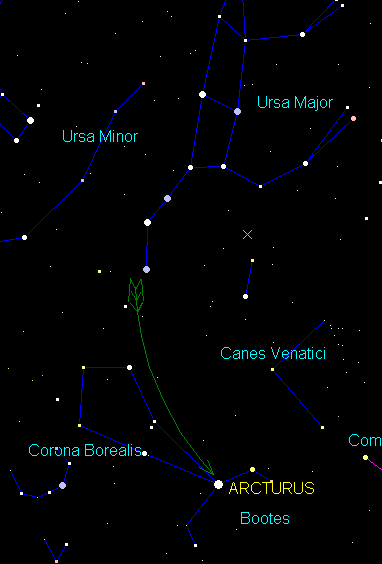
Bootes and the Big Dipper, a finder chart for Arcturus.
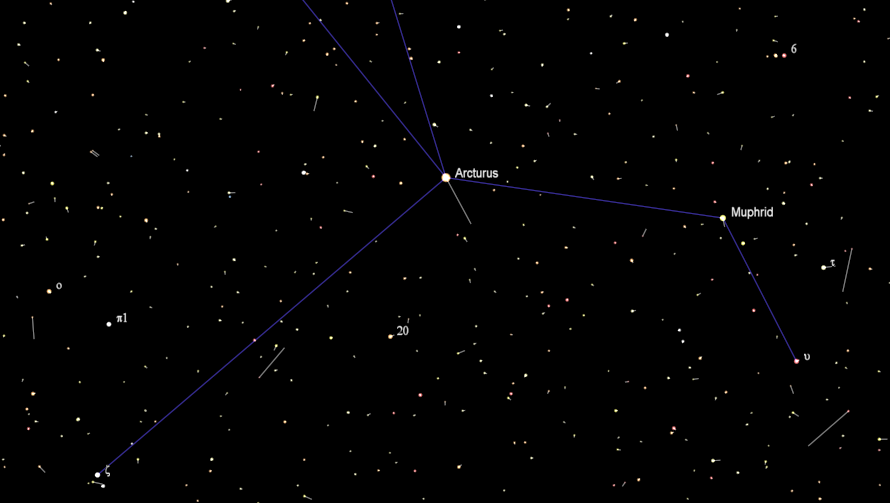
Closeup of the region around Arcturus. The short line toward 5 o’clock is the distance Arcturus will travel in the next 1,500 years. Note there are other stars, which are nearby like Arcturus, with comparable proper motions. Click on the image to enlarge. Created using Cartes du Ciel (Sky Charts).
06/27/2019 – Ephemeris – The constellation of Lyra the lyre or harp
Ephemeris for Thursday, June 27th. Today the Sun will be up for 15 hours and 33 minutes, setting at 9:32, and it will rise tomorrow at 5:59. The Moon, 2 days past last quarter, will rise at 3:13 tomorrow morning.
High up in the eastern sky at 11 p.m. can be found a bright star just north of a small, narrow, but very distinctive parallelogram of stars. They are the stars of the constellation Lyra the harp. The bright star is Vega, one of the twenty one brightest first magnitude stars. Vega is actually the 4th brightest night-time star. The harp, according to Greek mythology, was invented by the Greek god Hermes. The form of the harp in the sky, is as he had invented it: by stretching strings across a tortoise shell. Hermes gave it to his half-brother Apollo, who in turn gave it to the great musician Orpheus. The Sun has a motion with respect to most stars around it. Its direction is towards the vicinity of Lyra.
The times given are for the Traverse City/Interlochen area of Michigan. They may be different for your location.
Addendum
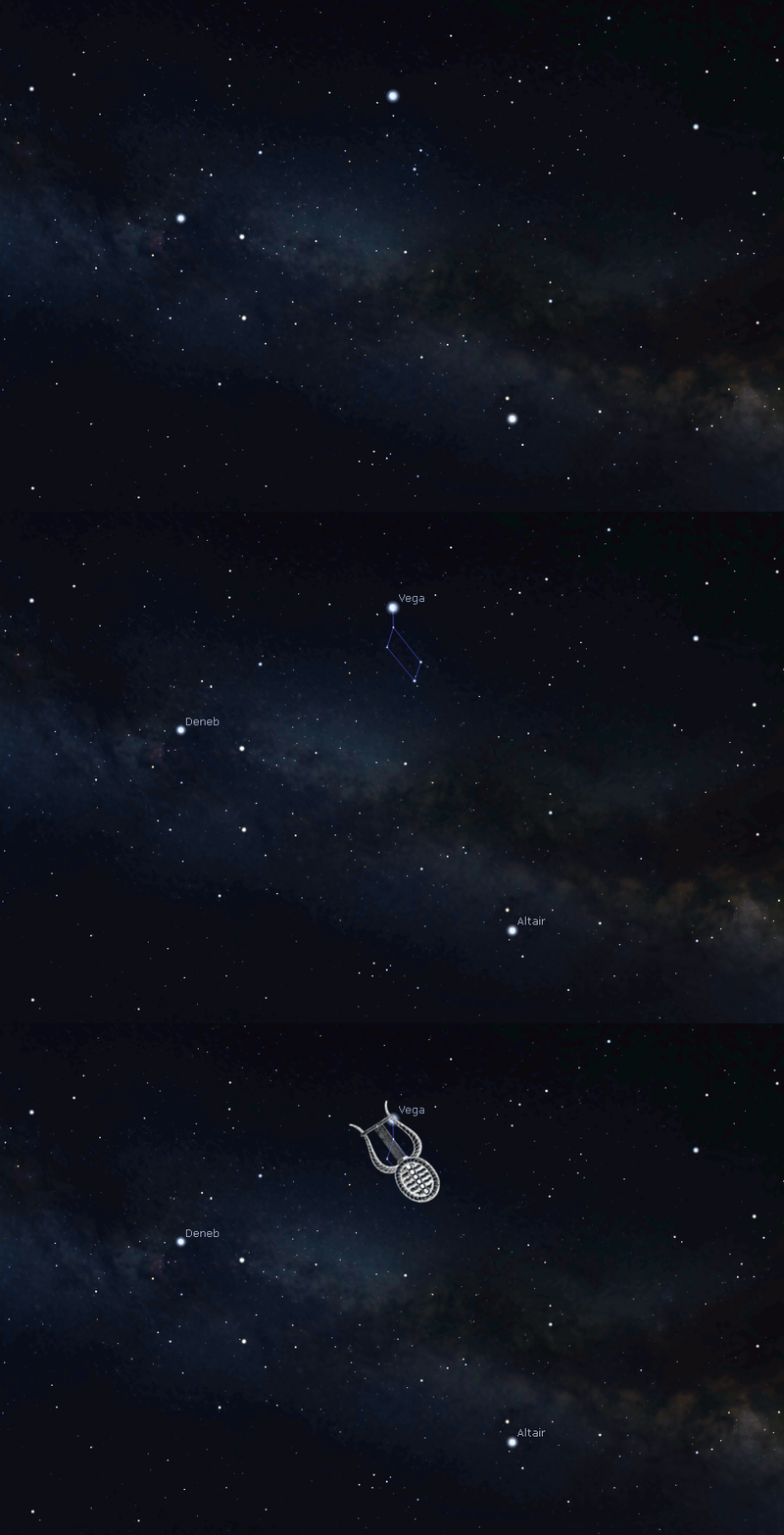
Animated Lyra finder chart. The lyre image not supplied by Stellarium but is from The World’s Earliest Music by Hermann Smith, Figure 60, A Project Gutenberg eBook, and captioned “The Chelys or Greek Tortoiseshell Lyre”. Click on the image to enlarge. Created using Stellarium.

