Archive
05/29/2019 – Ephemeris – Looking at the bright planets tonight
Ephemeris for Wednesday, May 29th. Today the Sun will be up for 15 hours and 16 minutes, setting at 9:18, and it will rise tomorrow at 6:01. The Moon, 3 days past last quarter, will rise at 4:21 tomorrow morning.
Let’s look at the planets for this week. Mars will be low in the west-northwestern sky this evening, in Gemini crawling up Castor’s leg. It will set at 11:42 p.m. In the morning sky we have Jupiter, in Ophiuchus, which will actually rise at 10:02 tonight in the east-southeast. Jupiter won’t be considered an evening planet until it rises before sunset, which will occur after June 10th. Saturn will be next to rise at 12:11 a.m., also in the east-southeast. It’s in Sagittarius. Both planets are easily visible in as morning twilight grows. Venus will rise 53 minutes before the Sun in the east northeast. It will remain in our morning sky, though too close to the rising Sun to be easily glimpsed. In August it will pass behind the Sun to enter the evening sky.
The times given are for the Traverse City/Interlochen area of Michigan. They may be different for your location.
Addendum
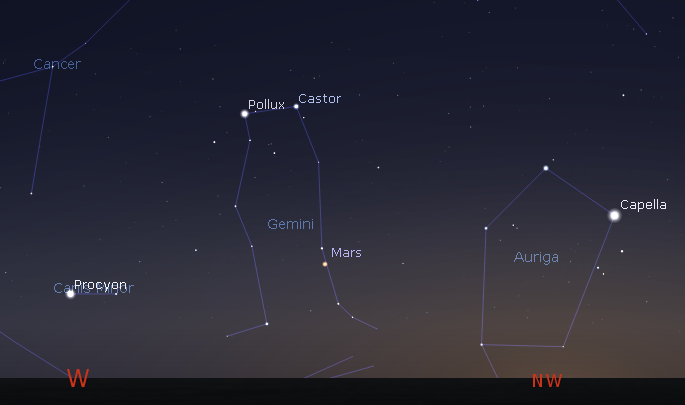
Mars in the evening in Gemini tonight at 10:30 p.m. May 29, 2019. Click on the image to enlarge. Created using Stellarium.
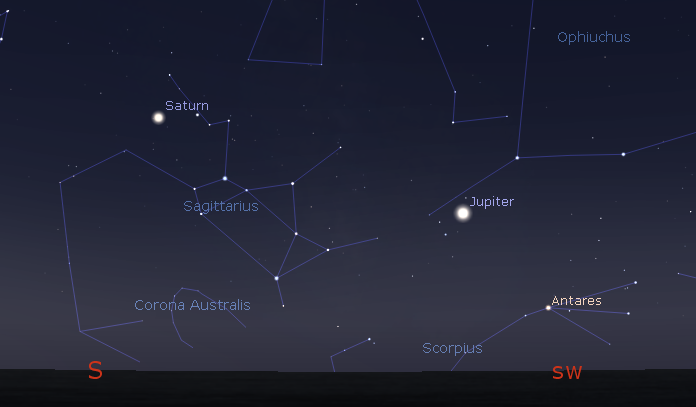
Jupiter and Saturn at 5 a.m. May30, 2019. Click on the image to enlarge. Created using Stellarium.
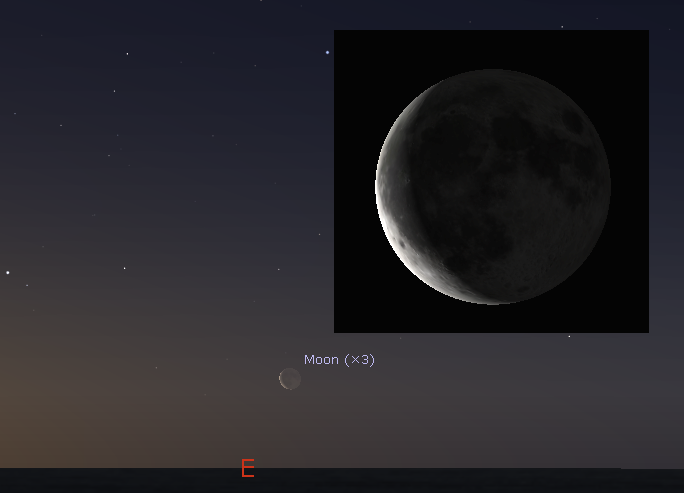
The Moon, enlarged 3 times, is only 6 degrees above the eastern horizon at 5 a.m. on May 30, 2019. The inset is the binocular view. Created using Stellarium.
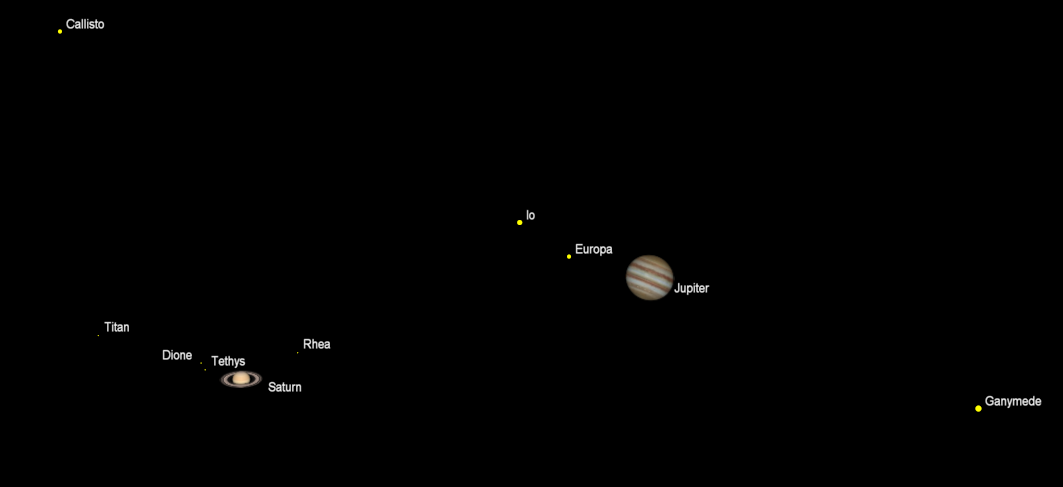
Jupiter and Saturn with the same magnification at 5 a.m. tomorrow morning May 30, 2019. Click on the image to enlarge. Created using Cartes du Ciel (Sky Charts).
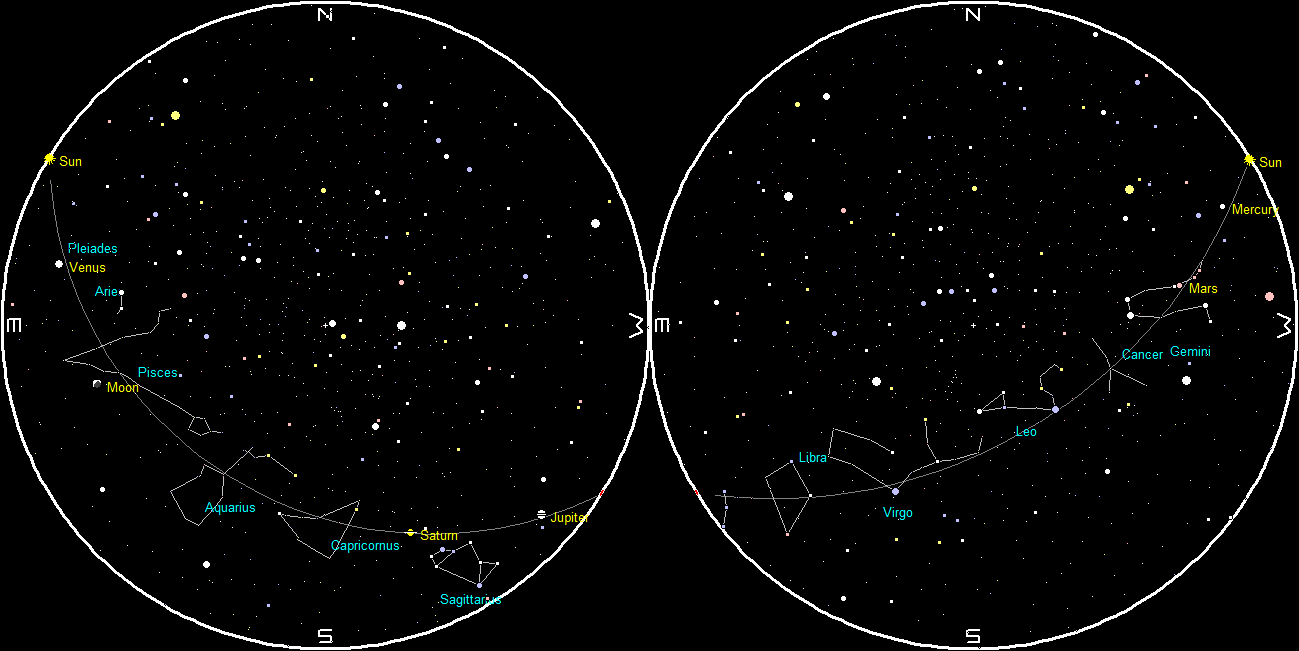
Planets and the Moon at sunset and sunrise of a single night starting with sunset on the right on May 29, 2019. The night ends on the left with sunrise on the 30th. Click on the image to enlarge. Created using my LookingUp program.
05/28/2019 – Ephemeris – A new satellite phenomenon was visible last Saturday night.
Ephemeris for Tuesday, May 28th. Today the Sun will be up for 15 hours and 14 minutes, setting at 9:17, and it will rise tomorrow at 6:02. The Moon, 2 days past last quarter, will rise at 3:57 tomorrow morning.
Last Saturday night at the star party at the Sleeping Bear Dunes National Lake shore we saw an amazing sight. After 10 p.m. we saw a ghostly line in the sky. It looked like a jet contrail at first, but there was no jet making it, and besides at that altitude the Sun wouldn’t be shining on it. It reminded me of the tail of Comet Hale-Bopp that graced our skies 22 years ago, But the ghostly line was moving to the northward. It dawned on us that these were the 60 Starlink satellites SpaceX launched two days before. It was the first 60 of a planned 12,000 satellites that will launch in Elon Musk’s Internet satellite venture. The satellites, each too faint to be seen with the naked eye will soon spread out along their orbit.
The times given are for the Traverse City/Interlochen area of Michigan. They may be different for your location.
Addendum
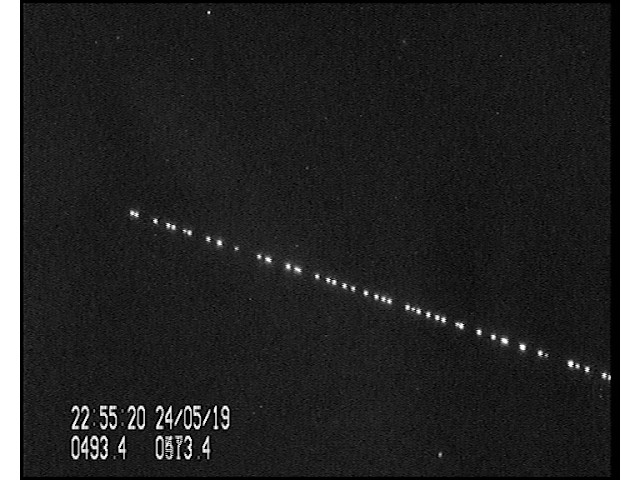
The train of Starlink satellites the night after launch from the Netherlands by Marco Langbroek from his video on EarthSky.com.
I went out during the writing of this week’s Ephemeris programs at 11:45 p.m. and saw three of them. This time they went almost overhead. There were three satellites close together in line. According to Heavens-Above the train is really getting spread out, so I may have been seeing only some of them. I didn’t see any fainter ones in between. Overhead the three were quite bright.
Links:
An article about the Starlink satellite train: https://earthsky.org/space/wow-photo-video-spacex-starlink-satellite-train
Here’s a place (Heavens Above) to get predictions of the passage of the satellite train for your location: https://heavens-above.com/main.aspx. They also have predictions for the International Space Station.
Scott Manley’s YouTube video – Will Starlink & Other Satellite Networks Ruin The Night Sky For Astronomers?: https://www.youtube.com/watch?v=GEuMFJSZmpc
YouTube video of the Starlink launch: https://www.youtube.com/watch?time_continue=3&v=riBaVeDTEWI
05/27/2019 – Ephemeris – The bright star Spica
Ephemeris for Memorial Day, Monday, May 27th. Today the Sun will be up for 15 hours and 13 minutes, setting at 9:16, and it will rise tomorrow at 6:03. The Moon, 1 day past last quarter, will rise at 3:34 tomorrow morning.
Just about due south at 10:30 p.m. is the bright star Spica which can be found from all the way back overhead to the Big Dipper. Follow the arc of the handle of the Big Dipper to the bright star Arcturus high in the south-southeast. Then straighten the curve of the arc to a straight spike which points to Spica the brightest star in the zodiacal constellation of Virgo the virgin. Arcturus is much brighter than Spica and has an orange tint to Spica’s bluish hue. In fact Spica is the bluest of the 21 first magnitude stars. That means that it is hot. Actually Spica is really two blue stars orbiting each other every 4 days. Spica is 250 light years away, which is reasonably close. Spica was an important star to the ancient Greeks. One temple was built, and aligned to its setting point.
The times given are for the Traverse City/Interlochen area of Michigan. They may be different for your location.
Addendum
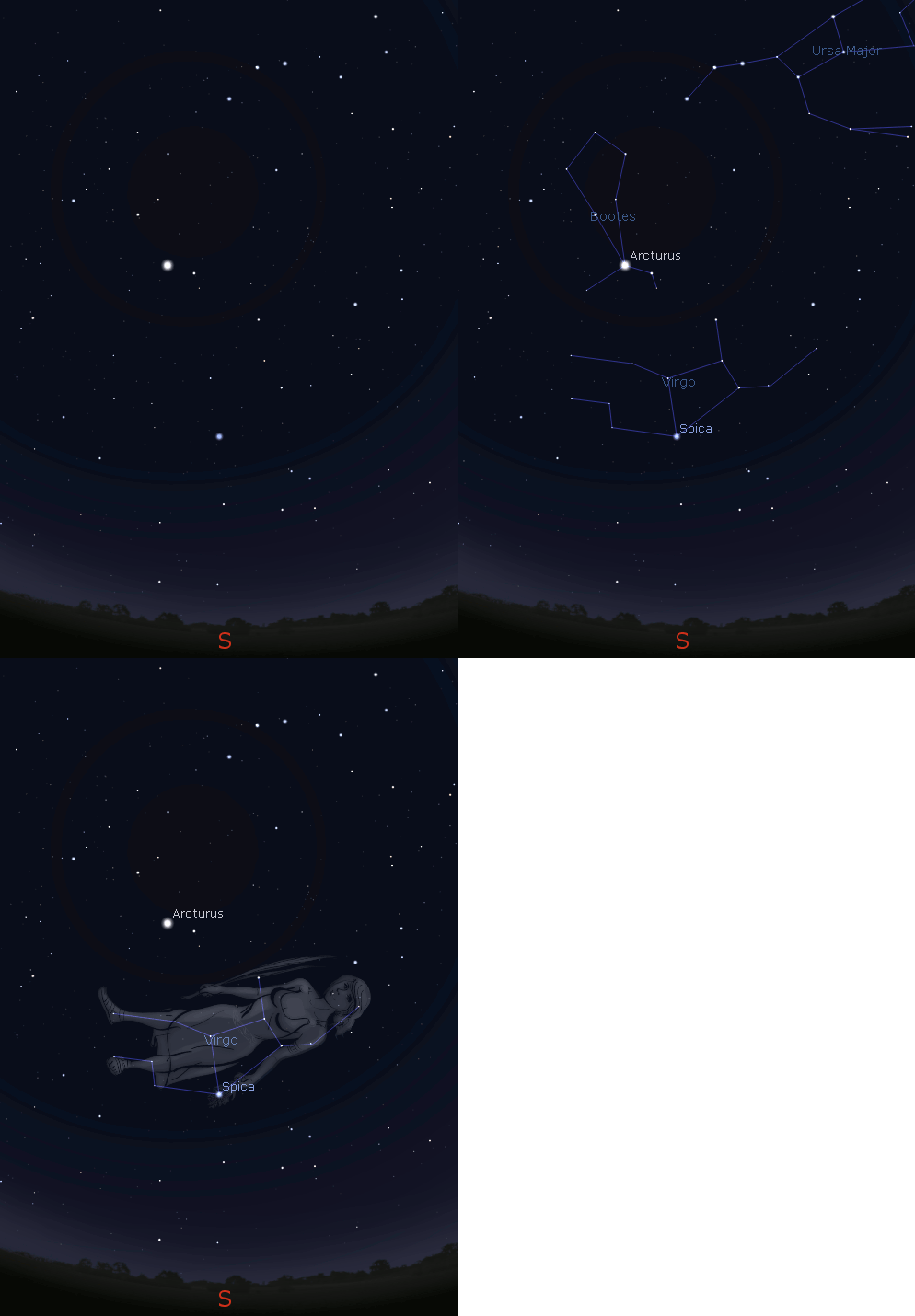
Spica finder animation for 10:30 p.m., May 27th. Click on the image to enlarge. Created using Stellarium and GIMP.
05/24/2019 – Ephemeris – Star party at the Sleeping Bear Dunes National Lake Shore tomorrow night
Ephemeris for Friday, May 24th. Today the Sun will be up for 15 hours and 7 minutes, setting at 9:13, and it will rise tomorrow at 6:05. The Moon, 2 days before last quarter, will rise at 2:13 tomorrow morning.
Tomorrow evening the Grand Traverse Astronomical Society will be at the Sleeping Bear Dunes National Lakeshore for observations of the heavens in what we call a star party. The location on Saturday will be the Dune Climb. Hazy or partly cloudy skies are acceptable. The night will start at 9 p.m. with an introduction by the rangers and a twilight talk by a member of the society of what will be visible and why the Sun sets so late now. As the stars appear in the twilight telescopes will be pointed to them to see their colors and what they mean. By 10:30 the constellations will be visible enough to view the wonders they contain and the ancient stories they represent.
The times given are for the Traverse City/Interlochen area of Michigan. They may be different for your location.
Addendum
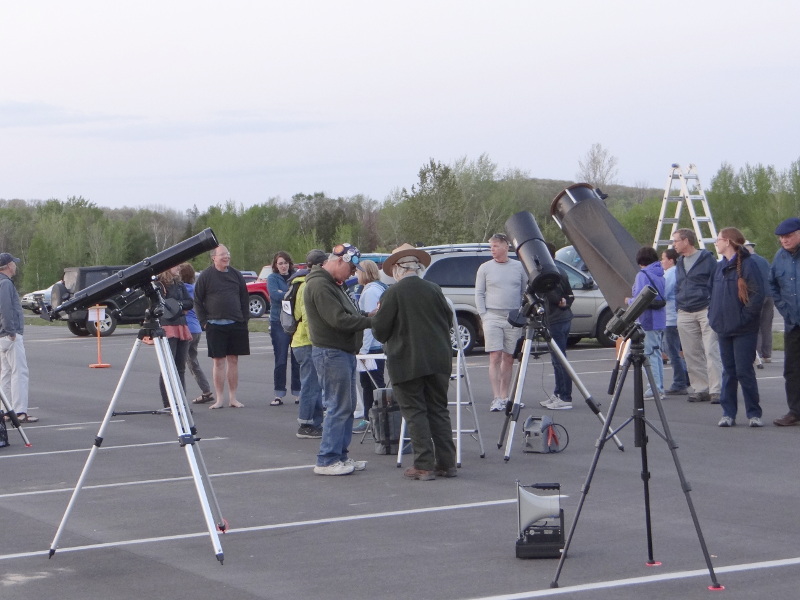
Preparing to start the May star party 3 years ago at the Dune Climb. A few of the telescopes are visible including the GTAS 25″ “Emmettron” telescope at the far right in the background. Credit: Eileen Carlisle.
05/23/2019 – Ephemeris – A look at the constellation of Corona Borealis
Ephemeris for Thursday, May 23rd. Today the Sun will be up for 15 hours and 5 minutes, setting at 9:12, and it will rise tomorrow at 6:06. The Moon, 3 days before last quarter, will rise at 1:37 tomorrow morning.
High in the east-southeast at 11 this evening can be seen a small nearly circular constellation of Corona Borealis, the Northern Crown. It is just below Boötes, the kite shaped constellation off the handle of the Big Dipper. According to Greek myth the crown was given by the gods to the princess Ariadne, daughter of King Minos of Crete. The crown is more like a tiara with the bright star Alphecca at the front. To the Anishinaabe people, who are natives of our region it is the Sweat Lodge. Part of what we call Hercules next to it is the Exhausted Bather, who is lying on the ground after the ceremony. The seven stones that are heated for the Sweat Lodge are the Pleiades, now too close to the Sun to be seen.
The times given are for the Traverse City/Interlochen area of Michigan. They may be different for your location.
Addendum

Animated Corona Borealis Finder Chart looking to the east-southeast at 11 p.m. May 23rd Click on the image to enlarge. Created using Stellarium and GIMP.
05/22/2019 – Ephemeris – Where are the bright planets for this week
Ephemeris for Wednesday, May 22nd. Today the Sun will be up for 15 hours and 3 minutes, setting at 9:11, and it will rise tomorrow at 6:06. The Moon, half way from full to last quarter, will rise at 12:56 tomorrow morning.
Let’s look at the planets for this week. Mars will be low in the west-northwestern sky this evening, entering Gemini near Castor’s foot. It will set at 11:52 p.m. In the morning sky we have Jupiter, in Ophiuchus, which will actually rise at 10:38 tonight in the east-southeast. Jupiter won’t be considered an evening planet until it rises before sunset, which will occur after June 10th. Saturn will be next to rise at 12:40 a.m., also in the east-southeast. It’s in Sagittarius. Both planets are easily visible in as morning twilight grows. Venus will rise 53 minutes before the Sun in the east northeast. It will remain in our morning sky, though too close to the rising Sun to be easily glimpsed. In August it will pass behind the Sun to enter the evening sky.
The times given are for the Traverse City/Interlochen area of Michigan. They may be different for your location.
Addendum
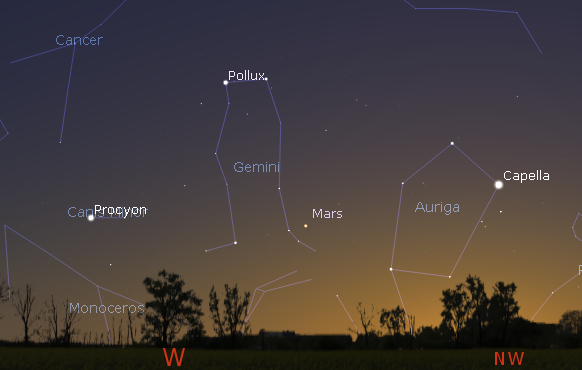
Mars and the setting winter stars tonight at 10 p.m. May 22, 2019. Click on the image to enlarge. Created using Stellarium.
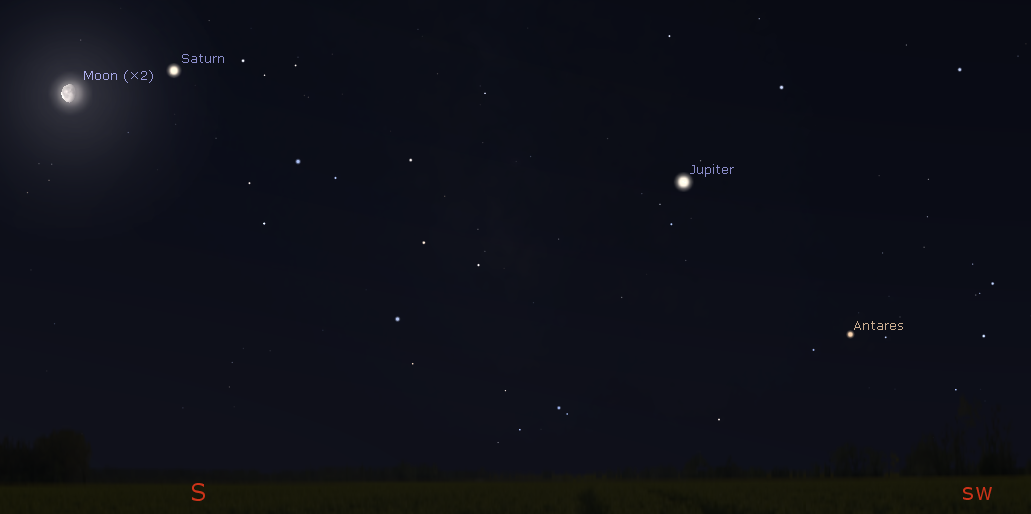
Jupiter, Saturn and the Moon at 5 a.m. May23, 2019. Click on the image to enlarge. Created using Stellarium.
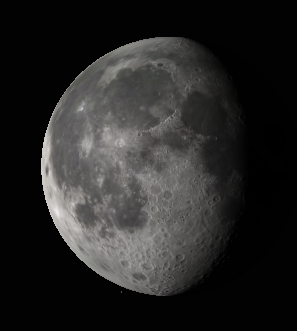
The waning gibbous Moon at 5 a.m. May 23, 2019. Created using Stellarium.
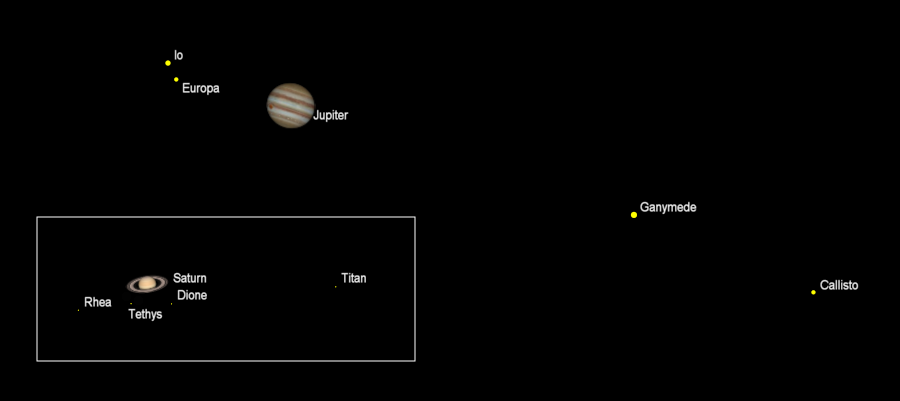
Jupiter and Saturn with the same magnification at 5 a.m. tomorrow morning May 23, 2019. Created using Cartes du Ciel (Sky Charts).
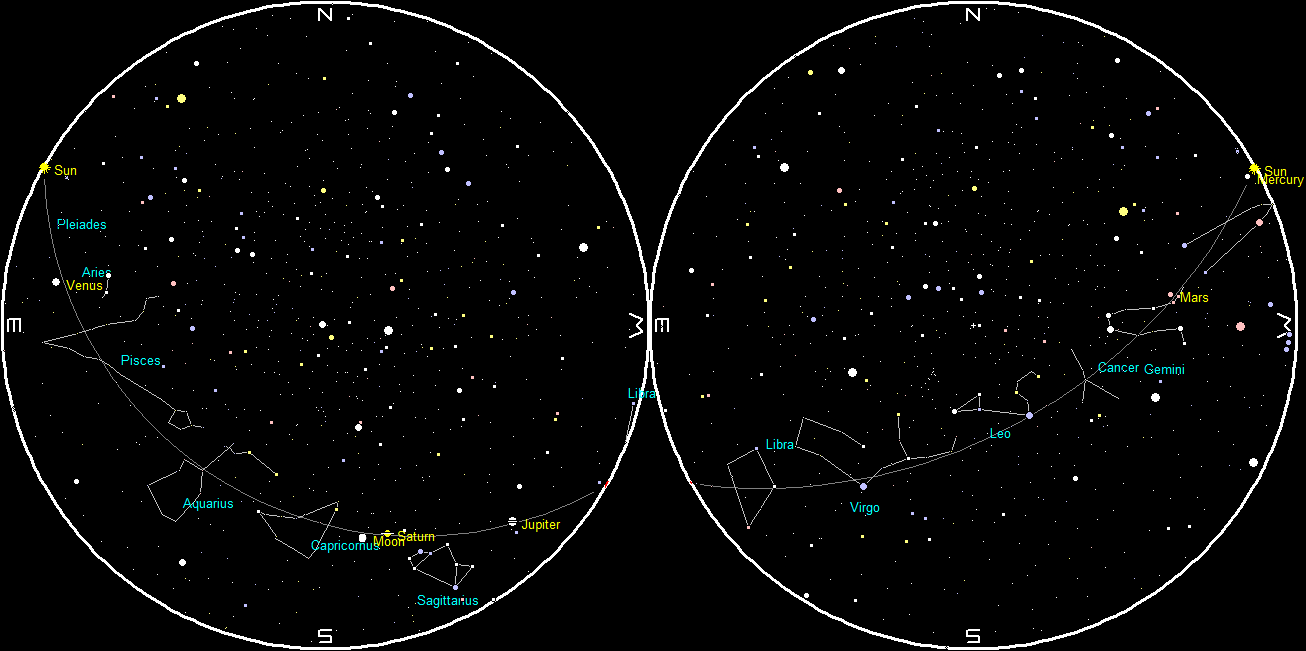
Planets and the Moon at sunset and sunrise of a single night starting with sunset on the right on May 22, 2019. The night ends on the left with sunrise on the 23rd. Click on the image to enlarge. Created using my LookingUp program.
05/21/2019 – Ephemeris – The bright star Arcturus
Ephemeris for Tuesday, May 21st. Today the Sun will be up for 15 hours and 2 minutes, setting at 9:10, and it will rise tomorrow at 6:07. The Moon, 3 days past full, will rise at 12:07 tomorrow morning.
Let’s take a look at the star Arcturus, which with its pointer, the curve of the Big Dipper’s handle is very high in the southeastern sky at 11 p.m. Arcturus, one of the first stars to appear after sunset, is the 4th brightest night time star, though some think the star Vega, low in the northeast is brighter. They are different colors because Arcturus is orange, while Vega is whiter than the Sun. Arcturus is a preview of what the Sun will become in four or five billion years from now. It is only 10% more massive than the Sun and is that much older than the Sun, so it is turning into its red giant stage, after running out of hydrogen to turn into helium in its core to produce energy. The helium is now compressing and heating up, bloating size of the star.
The times given are for the Traverse City/Interlochen area of Michigan. They may be different for your location.
Addendum
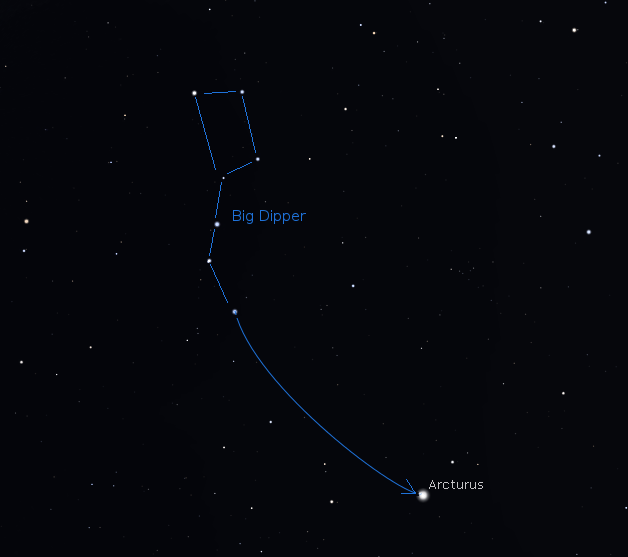
Look high in the southeast on a spring evening to follow the arc of the big Dipper handle to Arcturus. Created using Stellarium.
Another post of interest on Arcturus: Arcturus: Just passing through
05/20/2019 – Ephemeris – Dark evening skies again and a look at Virgo
Ephemeris for Monday, May 20th. Today the Sun will be up for 15 hours even, setting at 9:09, and it will rise tomorrow at 6:08. The Moon, 2 days past full, will rise at 11:10 this evening.
One of the large constellations we see in the south at 11 p.m. can be found using the Big Dipper overhead, follow the arc of the handle to the bright star Arcturus, the straighten the arc to a spike to reach Spica, a bright blue-white star in the south. Spica is the brightest star in the constellation Virgo the virgin. She represents the goddess of the harvest, Virgo is holding a sheaf of wheat in depictions of her, and Spica is placed at the head of the sheaf. In the space between Spica and Leo the lion to her upper right is, a great cluster just below naked eye visibility. The Virgo cluster of galaxies. Inside that cluster is galaxy M87 in whose center lies a black hole with the mass of 6.5 billion suns that was imaged last month.
The times given are for the Traverse City/Interlochen area of Michigan. They may be different for your location.
Addendum
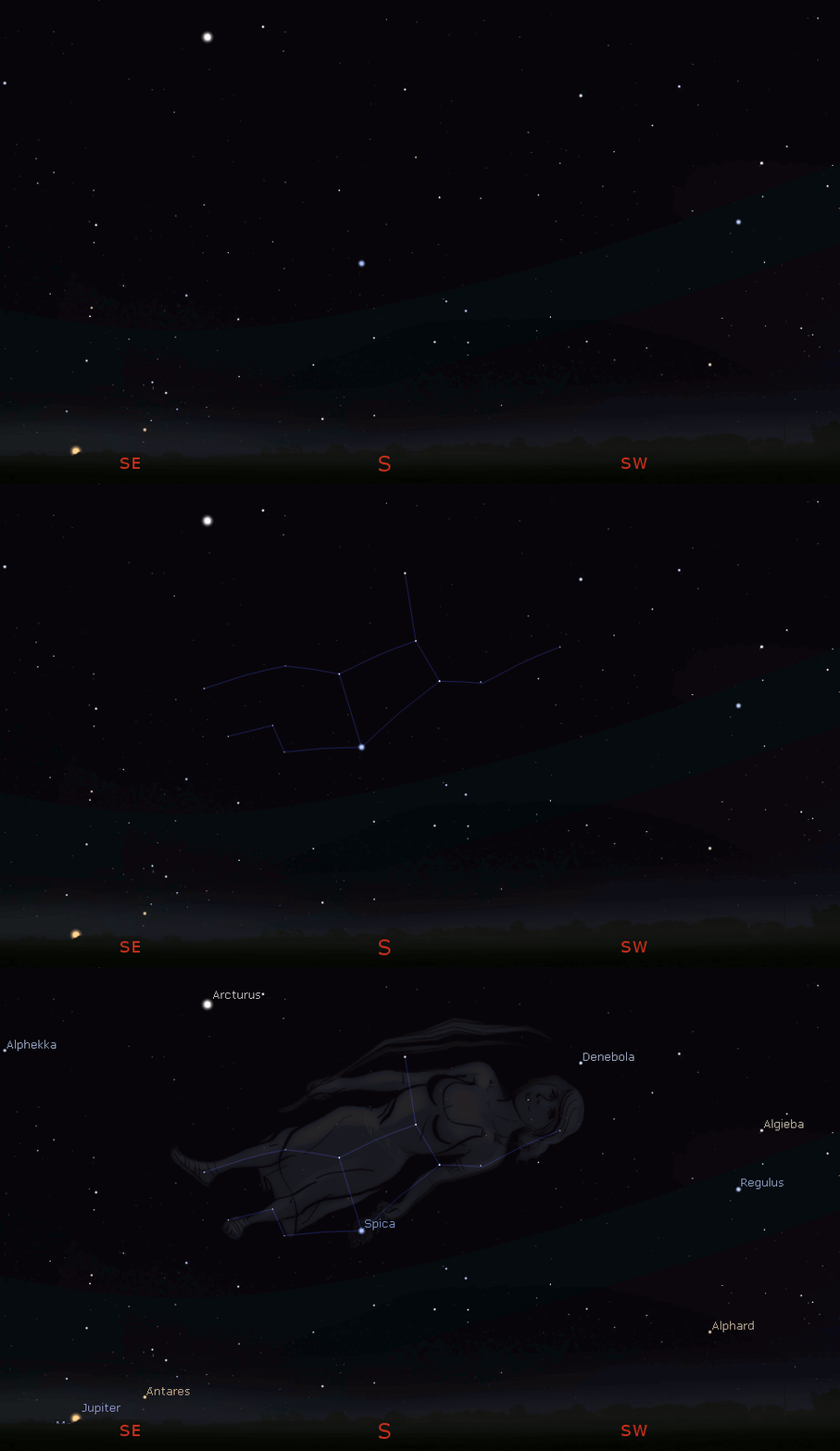
Virgo finder animation for 11 p.m. May 20, 2019. Click on the image to enlarge. Created using Stellarium.
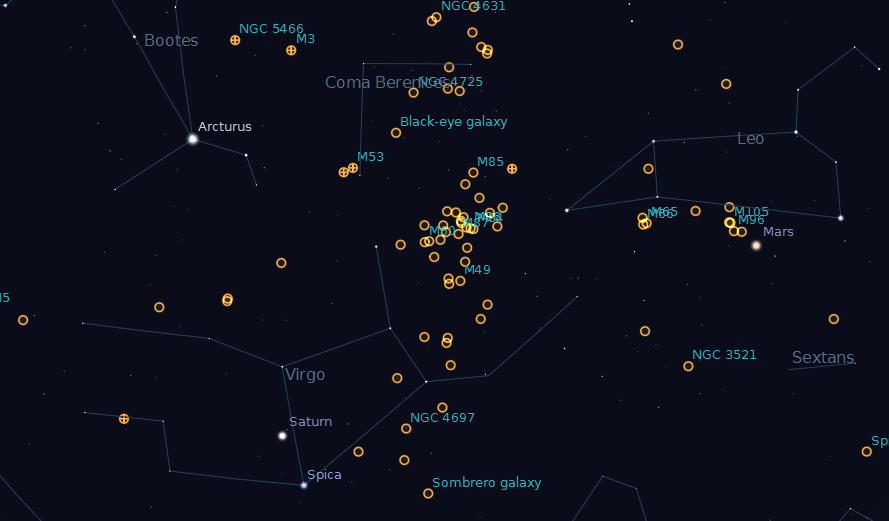
Brighter members of the Virgo Cluster. Created using Stellarium. Open circles are galaxies, circles with crosses are globular star clusters, outlying members of our Milky Way galaxy. M87 is just above center in that knot of galaxies. Created using Stellarium.
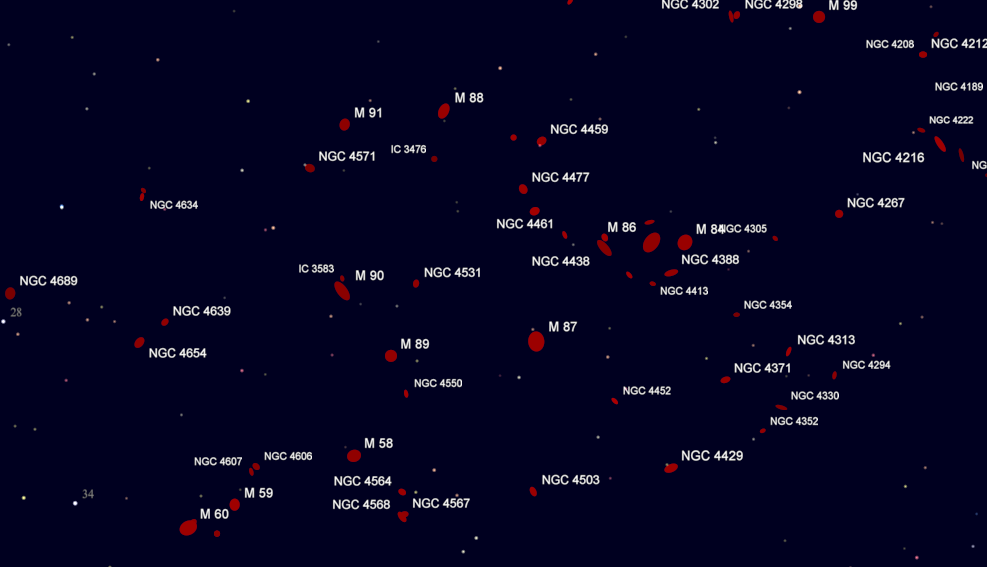
A closer look at some of the galaxies in the heart of the Virgo Cluster. M87 is near the center. Created with Cartes du Ciel (Sky Charts).
05/15/2019 – Ephemeris – The bright planets this week
Ephemeris for Wednesday, May 15th. Today the Sun will be up for 14 hours and 49 minutes, setting at 9:04, and it will rise tomorrow at 6:13. The Moon, 3 days before full, will set at 5:22 tomorrow morning.
Let’s look at the planets for this week. Mars will be in the western sky this evening, entering Gemini near Castor’s foot. It will set at 12:04 a.m. In the morning sky we have Jupiter, in Ophiuchus, which will actually rise at 11:09 tonight in the east-southeast. Jupiter won’t be considered an evening planet until it rises before sunset, which will occur after June 10th. Saturn will be next to rise at 1:04 a.m., also in the east-southeast. It’s in Sagittarius. Both planets are easily visible in as morning twilight grows. Venus will rise 53 minutes before the Sun in the east. It will remain in our morning sky, though too close to the rising Sun to be easily glimpsed. In August it will pass behind the Sun to enter the evening sky.
The times given are for the Traverse City/Interlochen area of Michigan. They may be different for your location.
Addendum
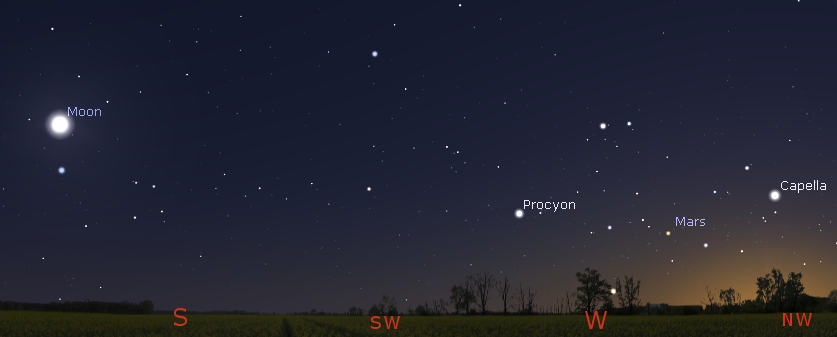
Mars and the Moon tonight at 10 p.m. May 15, 2019. Click on the image to enlarge. Created using Stellarium.
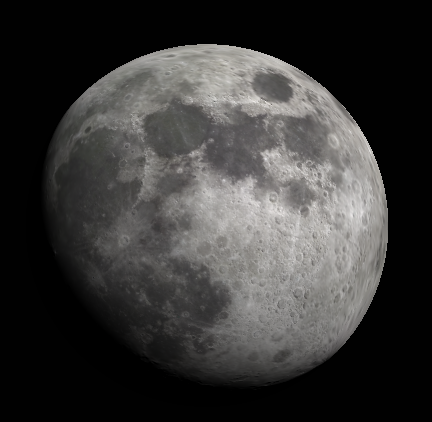
The waxing gibbous nearly full Moon at 10 p.m. May 15, 2019. Created using Stellarium.
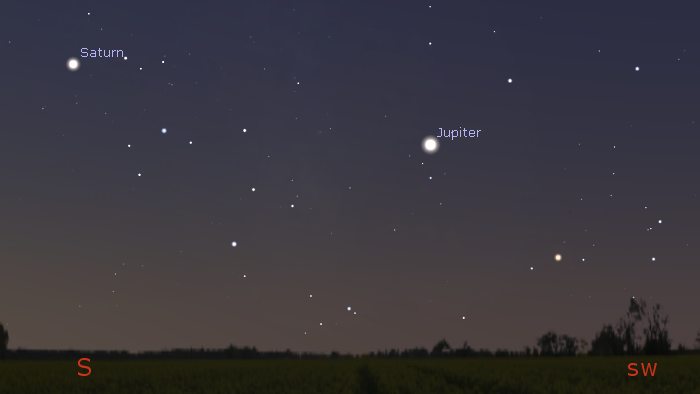
Morning planets at 5:30 a.m. May 16, 2019. Click on the image to enlarge. Created using Stellarium.
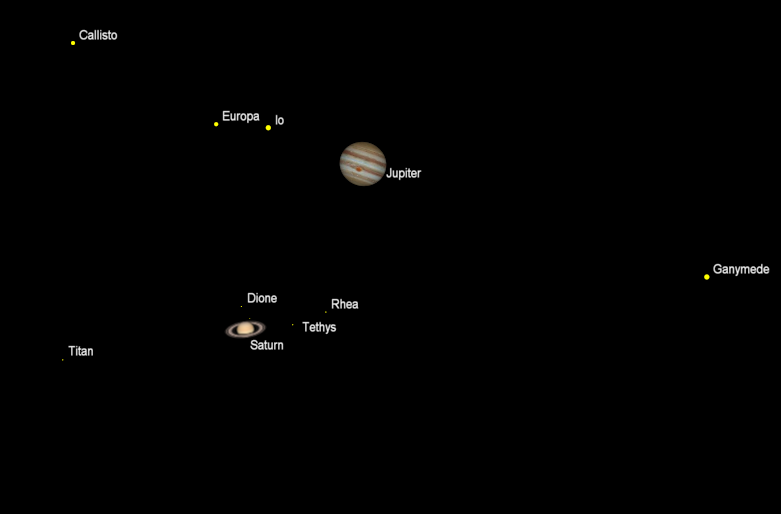
Jupiter and Saturn with the same magnification at 5:30 a.m. tomorrow morning May 16, 2019. Created using Cartes du Ciel (Sky Charts).
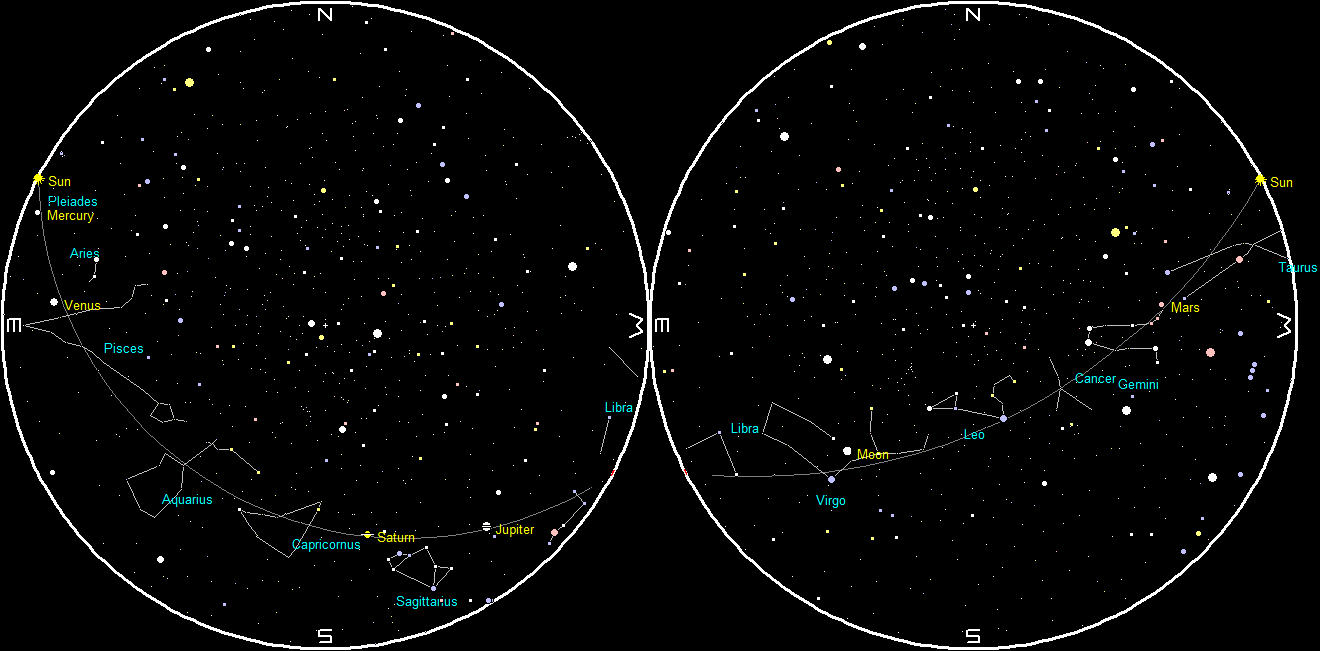
Planets and the Moon at sunset and sunrise of a single night starting with sunset on the right on May 15, 2019. The night ends on the left with sunrise on the 16th. Click on the image to enlarge. Created using my LookingUp program.

