Archive
04/04/2019 – Ephemeris – A very hairy constellation
Ephemeris for Thursday, April 4th. Today the Sun will be up for 12 hours and 55 minutes, setting at 8:13, and it will rise tomorrow at 7:16. The Moon, 1 day before new, will rise at 7:51 tomorrow morning.
Midway up the sky in the east-southeast at 10 p.m. is a tiny sprinkle of faint stars arrayed to look like several strands of hair. It’s the constellation of Coma Berenices, or Berenice’s hair. The whole group will fit in the field of a pair of binoculars, which is the best way to see it, and will also show more stars. The cluster contains about 50 stars and lies at a distance of 280 light years from us, which makes it the second closest star cluster. The closest being the Hyades, that is the face of Taurus the bull now about to set in the west. The star cluster appears to be about 480 million years old. It is an open or galactic star cluster, born along the plane of the Milky Way. It appears away from the milky band due to its closeness to us.
The times given are for the Traverse City/Interlochen area of Michigan. They may be different for your location.
Addendum
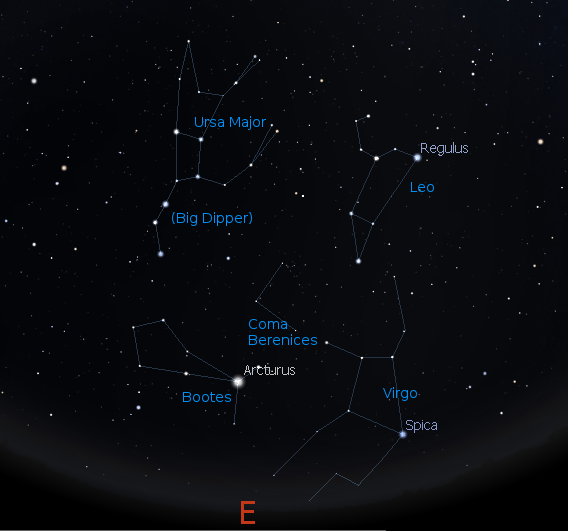
Coma Berenices finder chart 10 p.m., April 4th. Created using Stellarium.
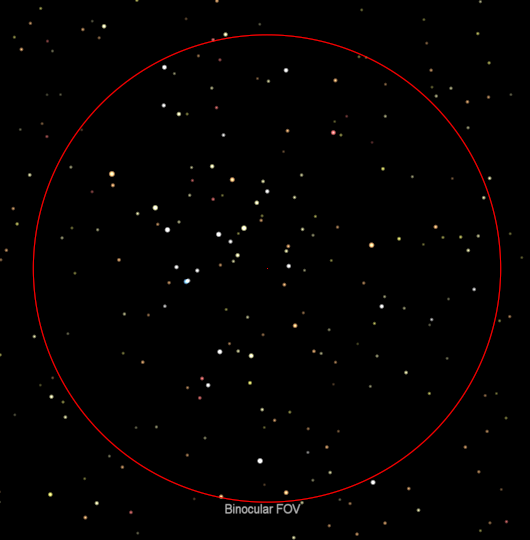
Approximate 7 power binocular field of view of the Coma Berenices Cluster. Created using Cartes du Ciel (Sky Charts).
04/03/2019 – Ephemeris – Let’s check out the bright planets for this week
Ephemeris for Wednesday, April 3rd. Today the Sun will be up for 12 hours and 52 minutes, setting at 8:12, and it will rise tomorrow at 7:18. The Moon, 2 days before new, will rise at 7:27 tomorrow morning.
Let’s look at the planets for this week. Mars will be in the western sky this evening, to the right of the V shaped stars of the face of Taurus the bull. It will set at 12:31 a.m. In the morning sky we have Jupiter which will rise tomorrow at 2:02 a.m. in the east-southeast. It is second to Venus in brightness. Saturn will be next to rise at 3:48 a.m., also in the east-southeast. Venus will rise at 6:13 a.m. again in the east-southeast. By 7 in the morning they will be strung out from the southeast to the south. Venus will remain in our morning sky until August when it passes behind the Sun. It will emerge to become a bright addition to our winter and spring evening skies later this year and next. Mercury will be
The times given are for the Traverse City/Interlochen area of Michigan. They may be different for your location.
Addendum
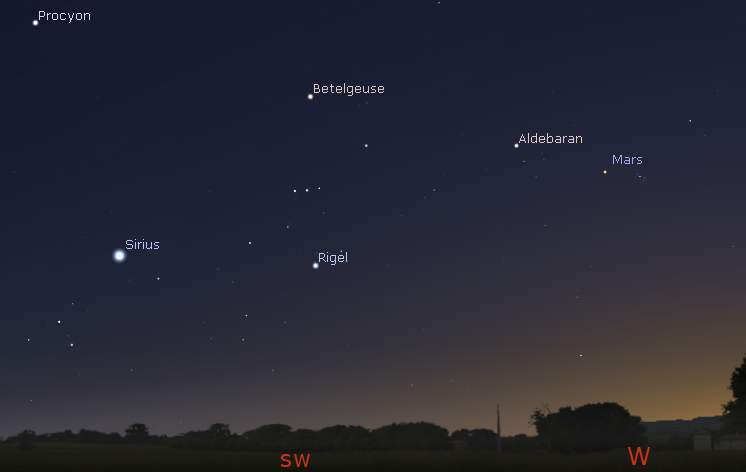
Mars in the evening at 9 p.m. April 3, 2019. Click on the image to enlarge. Created using Stellarium.
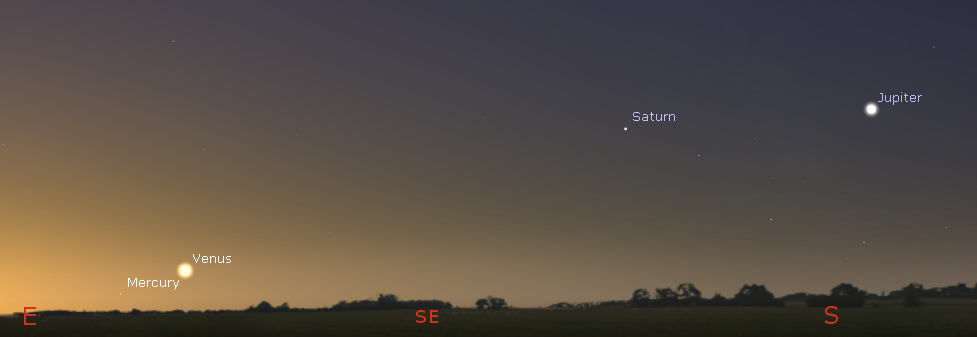
Morning planets at 6:45 a.m. April 4, 2019. Click on the image to enlarge. Created using Stellarium.
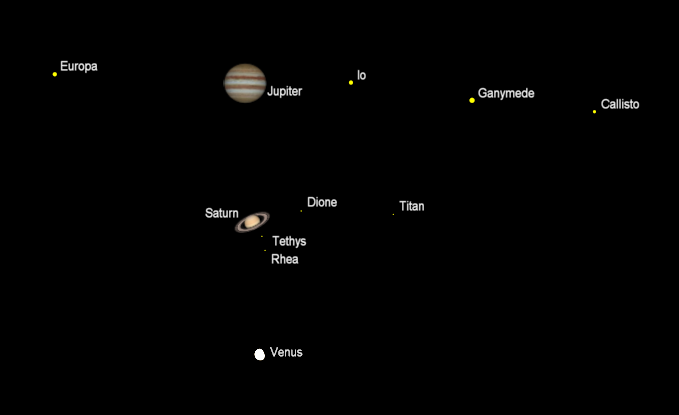
Jupiter, Saturn and Venus with the same magnification at 6:45 a.m. tomorrow morning April 4, 2019. Created using Cartes du Ciel (Sky Charts).
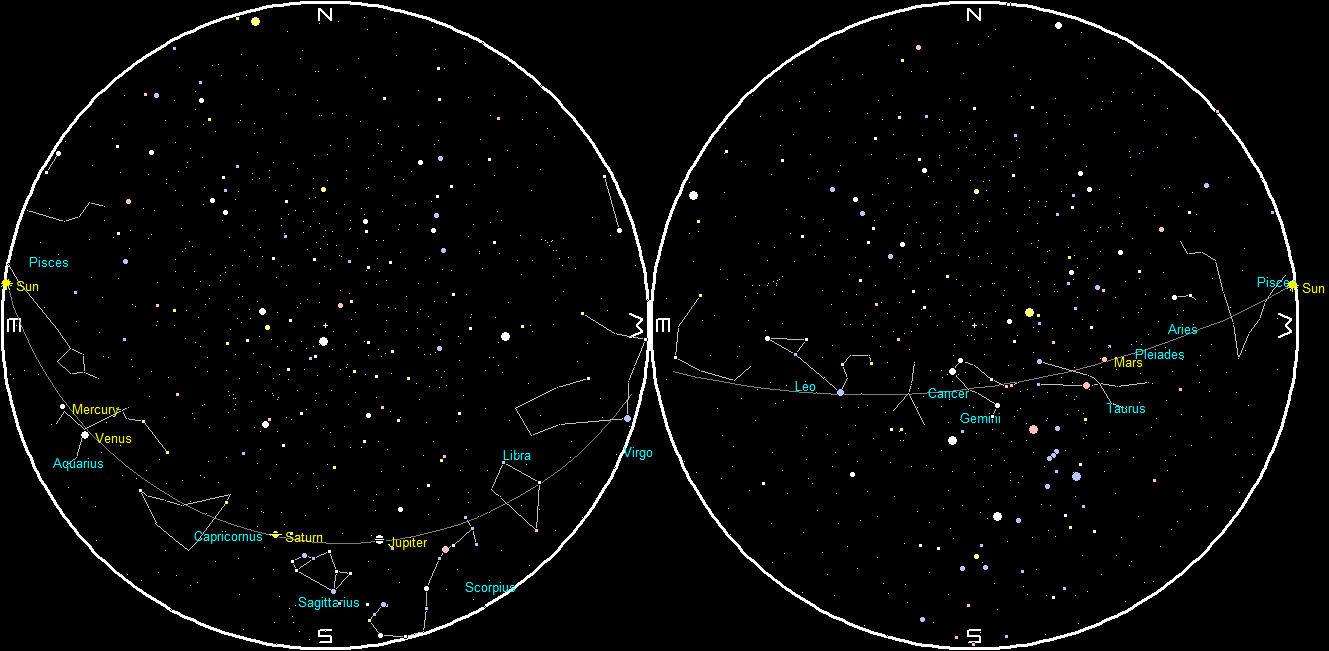
Planets and the Moon at sunset and sunrise of a single night starting with sunset on the right on April 3, 2019. The night ends on the left with sunrise on the 4th. Click on the image to enlarge. Created using my LookingUp program.
04/02/2019 – Ephemeris – Hydra the longest constellation
Ephemeris for Tuesday, April 2nd. Today the Sun will be up for 12 hours and 49 minutes, setting at 8:11, and it will rise tomorrow at 7:20. The Moon, 3 days before new, will rise at 7:03 tomorrow morning.
In the south and southeastern sky at 10 p.m. can be found the constellation of Hydra the water snake. Unlike the monster of the same name this Hydra has but one head, which is its most distinctive part. At 10 p.m. look to the south. The head of Hydra is located below a line from the constellation Leo the Lion in the south and Gemini high in the west-southwest, and directly below Cancer the crab. Hydra’s head is a small but distinctive group of 6 stars that make a drooping loop to the right. The rest of Hydra wends its way diagonally to the southeastern horizon below the bright blue star Spica in Virgo. Some delineations of Hydra have the tail tickling the constellation Libra which is just about to rise at that time.
The times given are for the Traverse City/Interlochen area of Michigan. They may be different for your location.
Addendum
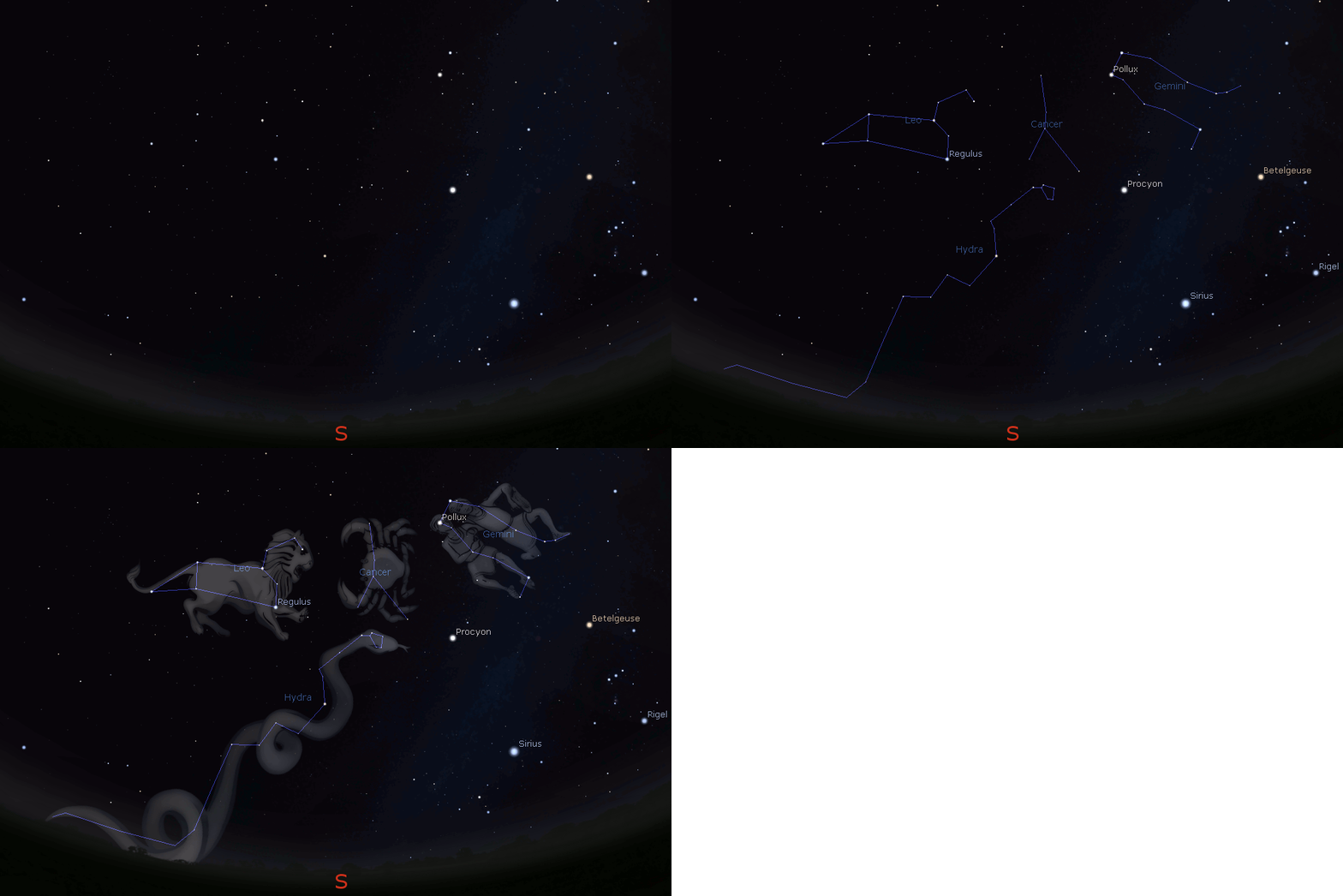
Hydra the water snake finder animation for 10 p.m. April 2nd.. Hydra is the longest of all the constellations. Click on the image to enlarge. Created using Stellarium and GIMP.
04/01/2019 – Ephemeris – Previewing April skies
Ephemeris for April Fools Day, Monday, April 1st. Today the Sun will be up for 12 hours and 46 minutes, setting at 8:10, and it will rise tomorrow at 7:22. The Moon, half way from last quarter to new, will rise at 6:37 tomorrow morning.
Last year we were fooled by an abundance of snow in April. Hopefully we won’t be tricked again. Daylight hours in the Interlochen/Traverse City area and will increase from 12 hours and 46 minutes today to 14 hours 11 minutes on the 30th. The altitude, or angle, of the Sun above the southern horizon at local noon will ascend from 50 degrees today to 60 degrees on the 30th. The altitude of the Sun in the Straits area will be a degree lower, but their daylight hours will be a bit longer. The actual time of local apparent noon this month for the Interlochen/Traverse City area, when the Sun passes due south, will be about 1:43 p.m. This month Mars will be our only evening planet.
The times given are for the Traverse City/Interlochen area of Michigan. They may be different for your location.
Addendum
April Evening Star Chart
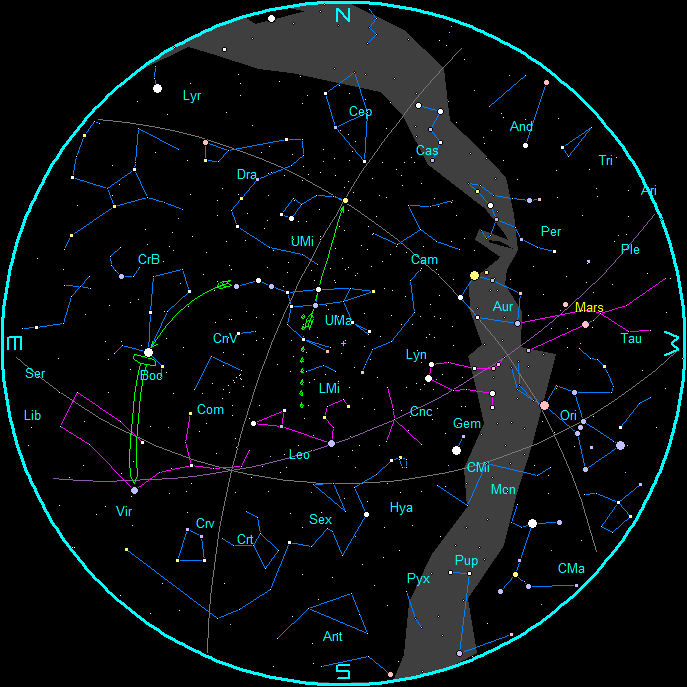
Star Chart for April 2019 (10 p.m. EDT April 15, 2019). Created using my LookingUp program. Click on image to enlarge.
The planets and stars are plotted for the 15th at 10 p.m. EST in the evening and 6 a.m. for the morning chart. These are the chart times. Note that Traverse City is located approximately 45 minutes behind our time meridian, West 75° longitude. (An hour 45 minutes behind our daylight saving time meridian during EDT). To duplicate the star positions on a planisphere you may have to set it to 1 hour 45 minutes earlier than the current time.
Note the chart times of 10 p.m. and 5 a.m. are for the 15th. For each week before the 15th add ½ hour (28 minutes if you’re picky). For each week after the 15th subtract ½ hour. The planet positions are updated each Wednesday on this blog. For planet positions on dates other than the 15th, check the Wednesday planet posts on this blog.
April Morning Star Chart
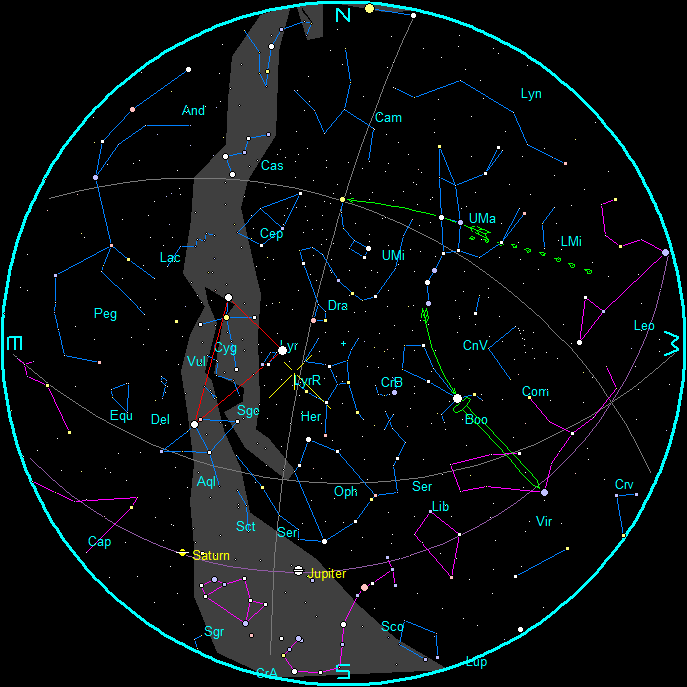
Star Chart for April mornings 2019 (5 a.m. EST April 15, 2019). Created using my LookingUp program. Click on image to enlarge.
For a list of constellation names to go with the abbreviations click here.
- Pointer stars at the front of the bowl of the Big Dipper point to Polaris the North Star.
- Leaky dipper drips on Leo
- Follow the arc of the handle of the Big Dipper to the star Arcturus, and
- Extend like a spike to Spica,
- The Summer Triangle is in red.
- LyrR is the radiant of the Lyrid meteor shower that peaks on the 22nd.
Twilight Limits, Nautical and Astronomical
| EDT | |||||||
| Traverse City |
Morning twilight | Evening twilight | Dark night | Moon | |||
| Date | Astro. | Nautical | Nautical | Astro. | Start | End | Illum. |
| 2019-04-01 | 5h47m | 6h24m | 21h17m | 21h53m | 21h53m | 5h47m | 0.13 |
| 2019-04-02 | 5h45m | 6h22m | 21h18m | 21h55m | 21h55m | 5h45m | 0.07 |
| 2019-04-03 | 5h43m | 6h20m | 21h20m | 21h57m | 21h57m | 5h43m | 0.03 |
| 2019-04-04 | 5h41m | 6h18m | 21h21m | 21h58m | 21h58m | 5h41m | 0 |
| 2019-04-05 | 5h38m | 6h16m | 21h22m | 22h00m | 22h00m | 5h38m | 0 |
| 2019-04-06 | 5h36m | 6h14m | 21h24m | 22h01m | 22h01m | 5h36m | 0.02 |
| 2019-04-07 | 5h34m | 6h12m | 21h25m | 22h03m | 22h48m | 5h34m | 0.06 |
| 2019-04-08 | 5h32m | 6h10m | 21h27m | 22h05m | 23h54m | 5h32m | 0.12 |
| 2019-04-09 | 5h30m | 6h08m | 21h28m | 22h06m | – | 5h30m | 0.2 |
| 2019-04-10 | 5h27m | 6h06m | 21h30m | 22h08m | 1h00m | 5h27m | 0.3 |
| 2019-04-11 | 5h25m | 6h04m | 21h31m | 22h10m | 2h04m | 5h25m | 0.41 |
| 2019-04-12 | 5h23m | 6h02m | 21h33m | 22h11m | 3h03m | 5h23m | 0.53 |
| 2019-04-13 | 5h21m | 6h00m | 21h34m | 22h13m | 3h55m | 5h21m | 0.64 |
| 2019-04-14 | 5h19m | 5h58m | 21h36m | 22h15m | 4h40m | 5h19m | 0.75 |
| 2019-04-15 | 5h16m | 5h56m | 21h37m | 22h16m | – | – | 0.85 |
| 2019-04-16 | 5h14m | 5h54m | 21h39m | 22h18m | – | – | 0.93 |
| 2019-04-17 | 5h12m | 5h52m | 21h40m | 22h20m | – | – | 0.93 |
| 2019-04-18 | 5h10m | 5h50m | 21h42m | 22h22m | – | – | 0.98 |
| 2019-04-19 | 5h07m | 5h48m | 21h43m | 22h24m | – | – | 1 |
| 2019-04-20 | 5h05m | 5h46m | 21h45m | 22h25m | – | – | 0.99 |
| 2019-04-21 | 5h03m | 5h44m | 21h46m | 22h27m | 22h27m | 23h19m | 0.96 |
| 2019-04-22 | 5h01m | 5h42m | 21h48m | 22h29m | 22h29m | – | 0.9 |
| 2019-04-23 | 4h59m | 5h40m | 21h49m | 22h31m | 22h31m | 0h24m | 0.82 |
| 2019-04-24 | 4h56m | 5h38m | 21h51m | 22h33m | 22h33m | 1h24m | 0.74 |
| 2019-04-25 | 4h54m | 5h36m | 21h52m | 22h34m | 22h34m | 2h16m | 0.64 |
| 2019-04-26 | 4h52m | 5h35m | 21h54m | 22h36m | 22h36m | 3h01m | 0.54 |
| 2019-04-27 | 4h50m | 5h33m | 21h55m | 22h38m | 22h38m | 3h39m | 0.45 |
| 2019-04-28 | 4h48m | 5h31m | 21h57m | 22h40m | 22h40m | 4h12m | 0.35 |
| 2019-04-29 | 4h45m | 5h29m | 21h58m | 22h42m | 22h42m | 4h41m | 0.26 |
| 2019-04-30 | 4h43m | 5h27m | 22h00m | 22h44m | 22h44m | 4h43m |
0.18 |
Twilight calendar was generated using Cartes du Ciel (Sky Charts).
See my blog post: Twilight Zone for the definitions of the different periods of twilight here: https://bobmoler.wordpress.com/2018/09/27/.
NASA Calendar of Planetary Events
   Date			Local Time	Event
Apr	1	Mo		        Venus: 34.6° W
 	2	Tu	12:17 AM	Moon-Venus: 3° N
 	2	Tu	07:01 PM	Moon-Mercury: 4° N
 	5	Fr	04:50 AM	New Moon
 	9	Tu	02:40 AM	Moon-Mars: 5° N
 	9	Tu	11:43 AM	Moon-Aldebaran: 2.2° S
 	11	Th	02:59 PM	Mercury Elongation: 27.7° W
 	11	Th	07:59 PM	Moon North Dec.: 22° N
 	12	Fr	02:08 PM	Moon Ascending Node
 	12	Fr	03:06 PM	First Quarter
 	13	Sa	04:12 PM	Moon-Beehive: 0.2° N
 	14	Su	08:08 PM	Mars-Aldebaran: 6.5° N
 	15	Mo	04:22 AM	Moon-Regulus: 2.7° S
 	16	Tu	02:03 PM	Mercury-Venus: 4.3° N
 	16	Tu	06:02 PM	Moon Perigee: 364200 km
 	19	Fr	07:12 AM	Full Moon
 	22	Mo	07:58 PM	Lyrid Shower: ZHR = 20
 	22	Mo	08:06 PM	Uranus Conjunction
 	23	Tu	07:36 AM	Moon-Jupiter: 1.8° S
 	24	We	05:22 PM	Moon South Dec.: 22.1° S
 	25	Th	10:38 AM	Moon-Saturn: 0.4° N
 	25	Th	11:02 AM	Moon Descending Node
 	26	Fr	06:18 PM	Last Quarter
 	28	Su	02:20 PM	Moon Apogee: 404600 km
May	1	We		        Venus: 27.8° W
All event times are given for UTC-5 hr: Eastern Standard or UTC-4 hr: Daylight Saving Time starting April 10th.

Sky Events Calendar by Fred Espenak and Sumit Dutta (NASA’s GSFC),
http://eclipse.gsfc.nasa.gov/SKYCAL/SKYCAL.html.

If you go to the above site you can print out a list like the above for the entire year or calendar pages for your time zone.
Sun and Moon Rising and Setting Events
Ephemeris of Sky Events for NMC Observatory |
||||||||||
|
April, 2019 – Local time zone: EDT |
||||||||||
|---|---|---|---|---|---|---|---|---|---|---|
|
Date |
Sun |
Twilight* |
Moon |
Illum |
||||||
|
Rise |
Set |
Hours |
End |
Start |
Phase |
R/S** |
Time |
Fractn |
||
|
Mon |
1 |
07:23a |
08:09p |
12:45 |
09:14p |
06:19a |
Rise |
06:37a |
10% |
|
|
Tue |
2 |
07:21a |
08:10p |
12:49 |
09:15p |
06:17a |
Rise |
07:02a |
5% |
|
|
Wed |
3 |
07:20a |
08:12p |
12:52 |
09:17p |
06:15a |
Rise |
07:26a |
2% |
|
|
Thu |
4 |
07:18a |
08:13p |
12:55 |
09:18p |
06:13a |
Rise |
07:50a |
0% |
|
|
Fri |
5 |
07:16a |
08:14p |
12:58 |
09:19p |
06:11a |
New |
Set |
08:37p |
1% |
|
Sat |
6 |
07:14a |
08:15p |
13:01 |
09:21p |
06:09a |
Set |
09:41p |
3% |
|
|
Sun |
7 |
07:12a |
08:17p |
13:04 |
09:22p |
06:07a |
Set |
10:47p |
7% |
|
|
Mon |
8 |
07:11a |
08:18p |
13:07 |
09:24p |
06:05a |
Set |
11:53p |
13% |
|
|
Tue |
9 |
07:09a |
08:19p |
13:10 |
09:25p |
06:03a |
Set |
12:59a |
21% |
|
|
Wed |
10 |
07:07a |
08:20p |
13:13 |
09:27p |
06:01a |
Set |
02:03a |
31% |
|
|
Thu |
11 |
07:05a |
08:22p |
13:16 |
09:28p |
05:59a |
Set |
03:02a |
41% |
|
|
Fri |
12 |
07:03a |
08:23p |
13:19 |
09:30p |
05:57a |
F Qtr |
Set |
03:54a |
52% |
|
Sat |
13 |
07:02a |
08:24p |
13:22 |
09:31p |
05:55a |
Set |
04:39a |
64% |
|
|
Sun |
14 |
07:00a |
08:25p |
13:25 |
09:33p |
05:53a |
Set |
05:18a |
74% |
|
|
Mon |
15 |
06:58a |
08:27p |
13:28 |
09:34p |
05:51a |
Set |
05:52a |
84% |
|
|
Tue |
16 |
06:57a |
08:28p |
13:31 |
09:35p |
05:49a |
Set |
06:23a |
91% |
|
|
Wed |
17 |
06:55a |
08:29p |
13:34 |
09:37p |
05:47a |
Set |
06:52a |
97% |
|
|
Thu |
18 |
06:53a |
08:30p |
13:37 |
09:38p |
05:45a |
Set |
07:22a |
100% |
|
|
Fri |
19 |
06:51a |
08:32p |
13:40 |
09:40p |
05:43a |
Full |
Rise |
08:55p |
99% |
|
Sat |
20 |
06:50a |
08:33p |
13:43 |
09:42p |
05:41a |
Rise |
10:08p |
97% |
|
|
Sun |
21 |
06:48a |
08:34p |
13:45 |
09:43p |
05:39a |
Rise |
11:18p |
92% |
|
|
Mon |
22 |
06:46a |
08:35p |
13:48 |
09:45p |
05:38a |
Rise |
12:24a |
85% |
|
|
Tue |
23 |
06:45a |
08:37p |
13:51 |
09:46p |
05:36a |
Rise |
01:23a |
77% |
|
|
Wed |
24 |
06:43a |
08:38p |
13:54 |
09:48p |
05:34a |
Rise |
02:15a |
68% |
|
|
Thu |
25 |
06:42a |
08:39p |
13:57 |
09:49p |
05:32a |
Rise |
03:00a |
59% |
|
|
Fri |
26 |
06:40a |
08:40p |
14:00 |
09:51p |
05:30a |
L Qtr |
Rise |
03:38a |
49% |
|
Sat |
27 |
06:39a |
08:41p |
14:02 |
09:52p |
05:28a |
Rise |
04:11a |
40% |
|
|
Sun |
28 |
06:37a |
08:43p |
14:05 |
09:54p |
05:26a |
Rise |
04:40a |
31% |
|
|
Mon |
29 |
06:36a |
08:44p |
14:08 |
09:55p |
05:24a |
Rise |
05:06a |
23% |
|
|
Tue |
30 |
06:34a |
08:45p |
14:11 |
09:57p |
05:23a |
Rise |
05:30a |
15% |
|
|
* Nautical Twilight |
||||||||||
|
** Moonrise or moonset, whichever occurs between sunset and sunrise |
||||||||||
03/29/2019 – Ephemeris – The Stars Mizar and Alcor in the Big Dipper
Ephemeris for Friday, March 29th. Today the Sun will be up for 12 hours and 36 minutes, setting at 8:06, and it will rise tomorrow at 7:27. The Moon, 1 day past last quarter, will rise at 5:03 tomorrow morning.
The most interesting star in the Big Dipper is Mizar and its dim companion Alcor. It is the second star from the end of the handle, where the bend in the handle takes place. Folks with good vision can see the dimmer star right next to Mizar. In ancient times it was used as an eye test for visual acuity for warriors. As such it was known as the “Horse and the Rider”. Mizar is second magnitude, in the second rank of star brightness invented by the Greek astronomer Hipparchus in the 2nd century BC. He ranked stars in 6 classes, from first magnitude for the brightest to 6th for the dimmest visible to the naked eye. Alcor comes in at 4th magnitude. It does suffer a bit by being very close to Mizar which is 6 times brighter.
The times given are for the Traverse City/Interlochen area of Michigan. They may be different for your location.
03/28/2019 – Ephemeris – The Big Dipper as seen by some other countries
Ephemeris for Thursday, March 28th. Today the Sun will be up for 12 hours and 33 minutes, setting at 8:05, and it will rise tomorrow at 7:29. The Moon, at last quarter today, will rise at 4:21 tomorrow morning.
The Big Dipper is climbing up the northeastern sky at 9:30 in the evening, it’s seven stars shining brightly. The Big Dipper is not an actual constellation, recognized internationally. It’s part, the hind part, of Ursa Major, the great bear. The Big Dipper is an asterism or informal constellation. It is a distinctly North American constellation. For fugitive slaves, fleeing the southern states in the days before the Civil War, the Drinking Gourd, as they called it, showed the direction north to freedom. In England the dipper stars become the Plough, or Charles’ Wain (Charlemagne’s Wagon). In France, known for culinary delights it was the saucepan, or the cleaver. Many cultures saw what was familiar to them in these seven bright stars.
The times given are for the Traverse City/Interlochen area of Michigan. They may be different for your location.
Addendum
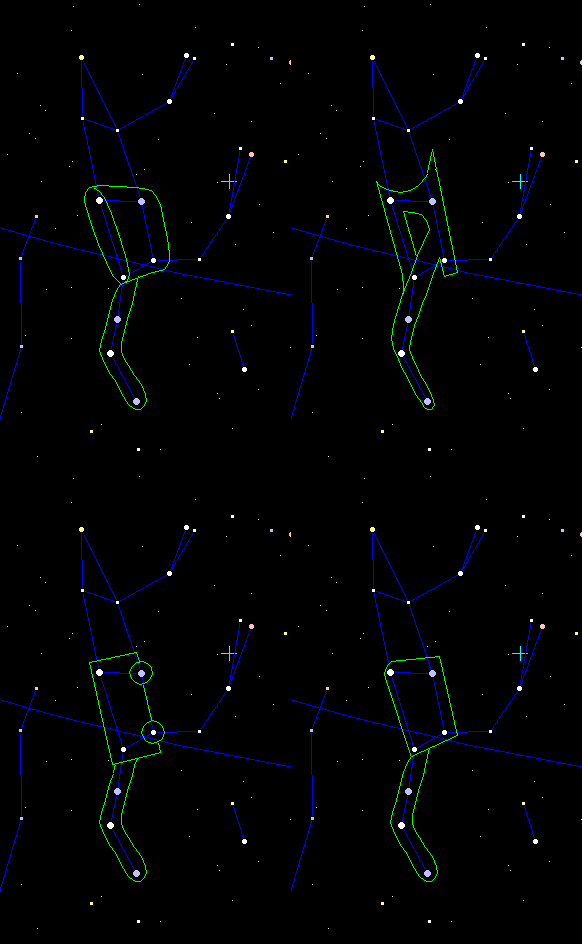
Cultural views of the Big Dipper as an Animation: Big Dipper/Sauce Pan, Plough (plow), Charle’s Wain (Charlemagne’s wagon), Cleaver.
03/27/2019 – Ephemeris – Looking for and at the bright planets for this week
Ephemeris for Wednesday, March 27th. Today the Sun will be up for 12 hours and 30 minutes, setting at 8:03, and it will rise tomorrow at 7:31. The Moon, 1 day before last quarter, will rise at 3:33 tomorrow morning.
Let’s look at the planets for this week. Mars will be in the western sky this evening, below the Pleiades, or Seven Sisters, star cluster. It will pass to the left of the Pleiades Saturday night. Tonight, however, it will set at 12:34 a.m. In the morning sky we have Jupiter which will rise tomorrow at 2:29 a.m. in the east-southeast. It is second to Venus in brightness. Saturn will be next to rise at 4:14 a.m., also in the east-southeast. Venus will rise at 6:20 a.m. also in the east-southeast. By 7 in the morning they will be strung out from the southeast to the south, with the last quarter Moon between Jupiter and Saturn. The Moon will pass Saturn early Friday morning before it rises and will be seen then to the left of Saturn.
The times given are for the Traverse City/Interlochen area of Michigan. They may be different for your location.
Addendum
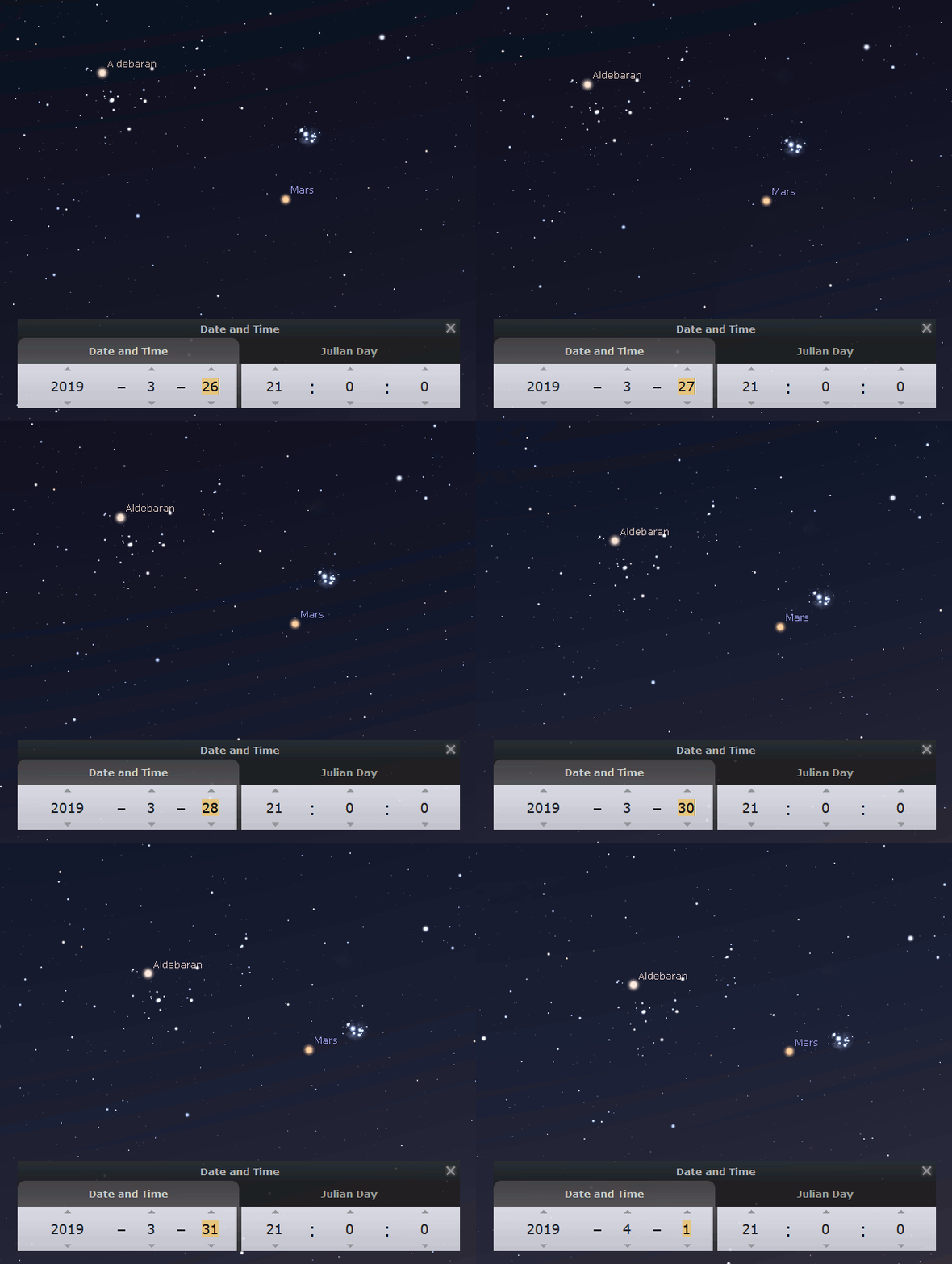
Mars tiptoeing past the Pleiades nightly from March 26th to April 1st, 2019. Looking west. Created using Stellarium and GIMP.
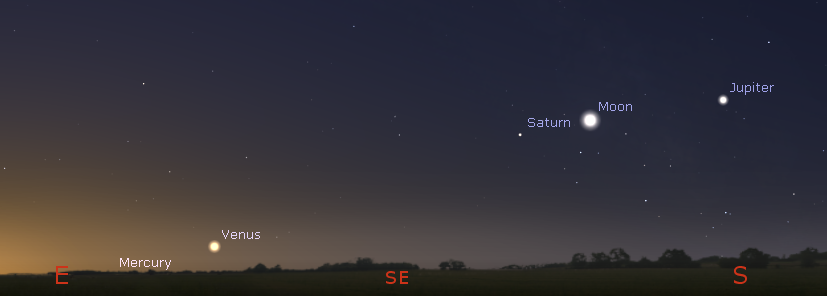
Morning planets and the Moons at 6:45 a.m. tomorrow March 28, 2019. Click on the image to enlarge. Created using Stellarium.
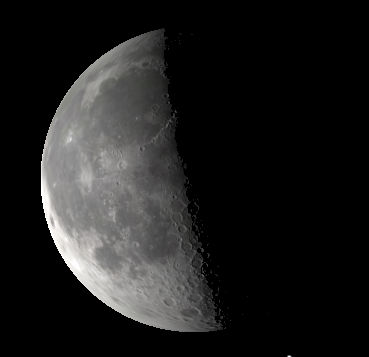
The moon as it might appear in binoculars tomorrow morning, March 28, 2019. Created using Stellarium.
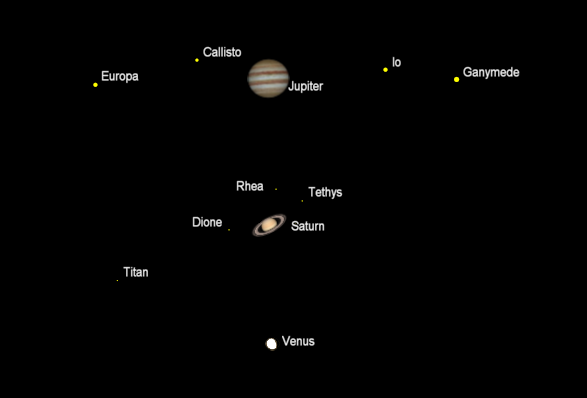
Jupiter, Saturn and Venus with the same magnification at 6:45 a.m. tomorrow morning March 28, 2019. Created using Cartes du Ciel (Sky Charts).
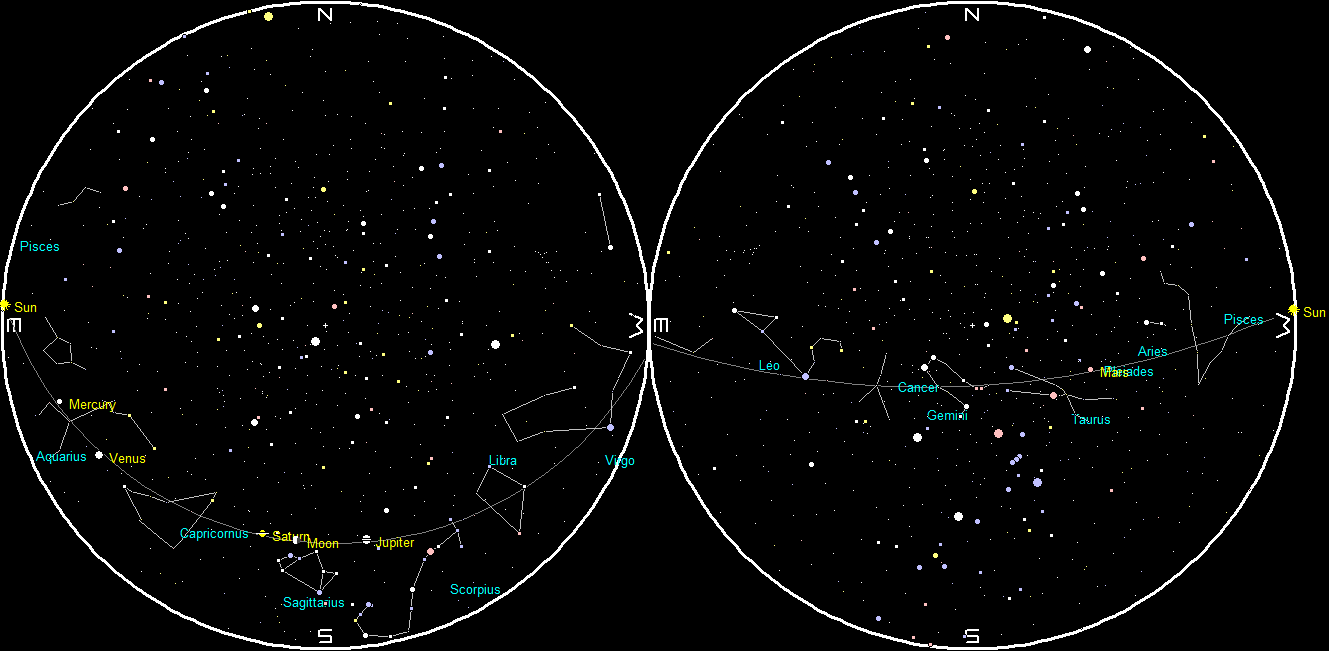
Planets and the Moon at sunset and sunrise of a single night starting with sunset on the right on March 27, 2019. The night ends on the left with sunrise on the 28th. Click on the image to enlarge. Created using my LookingUp program.
03/26/2019 – Ephemeris – Mars is approaching the Pleiades this week
Ephemeris for Tuesday, March 26th. Today the Sun will be up for 12 hours and 27 minutes, setting at 8:02, and it will rise tomorrow at 7:33. The Moon, 2 days before last quarter, will rise at 2:38 tomorrow morning.
Daylight time and spring time are catching up with us with the Sun setting now just after 8 p.m. By 9 p.m. tonight the brighter stars appear and most of the well known constellations will be recognizable. Looking off to the west at that time the famous star group of the Pleiades, or Seven Sisters will appear. Folks with good eyesight can see six or maybe even seven of its stars. Tonight, right below the Pleiades is a bright reddish star. It would be the 22nd of the first magnitude stars, except it’s not a star. It’s a wanderer, according to the ancient Greeks, one of seven*. They called it Ares the god of war. The Romans turned it into Mars. Over the week Mars will be closing in and passing by the Pleiades this weekend.
The times given are for the Traverse City/Interlochen area of Michigan. They may be different for your location.
Addendum
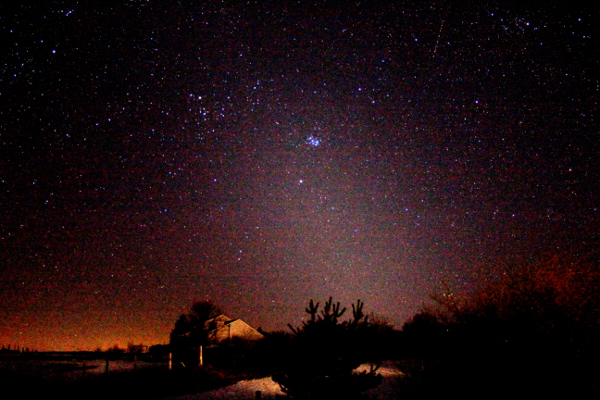
The western sky at 10:22 last night March 25, 2019. Mars appears below the Pleiades in zodiacal light. Credit, mine – Canon EOS Rebel T5 18mm f.l., f/3.5, 8 sec. ISO 12,800.
Mars tiptoeing past the Pleiades nightly from March 26th to April 1st, 2019 at 9 p.m. Looking west. Created using Stellarium and GIMP.
The letter V of stars to the left of the Pleiades is the Hyades, in mythology the half sisters to the Pleiades. It is also the face of Taurus the bull.
* We get the word planet from the Greek planētes meaning wander. Five are the classical planets, Mercury, Venus, Mars, Jupiter, and Saturn. The other two are the Sun and Moon. The other celestial objects were the fixed stars. Other things that appear in the sky, like comets, novae and meteors were thought to be in the Earth’s atmosphere.
03/25/2019 – Ephemeris – Zodiacal light is visible in the west again
Ephemeris for Monday, March 25th. Today the Sun will be up for 12 hours and 24 minutes, setting at 8:01, and it will rise tomorrow at 7:35. The Moon, 3 days before last quarter, will rise at 1:37 tomorrow morning.
With the bright moon out of the sky for nearly two weeks it’s time to look for the zodiacal light. It’s is a faint but towering glow that can be seen after the end of astronomical twilight on moonless nights. It is seen in the west in the evening in late winter and early spring and in the east in the morning in late summer and early autumn. The axis of the glow is the ecliptic, the apparent annual path of the Sun in the sky, along which lie the constellations of the zodiac. Right now the end of astronomical twilight is about 9:45 p.m. and advancing at a rate of a minute or two each night. Go to a spot with a dark western sky, no big cities or towns out that way. Zodiacal light is caused by dust spread out around the Sun.
The times given are for the Traverse City/Interlochen area of Michigan. They may be different for your location.
Addendum
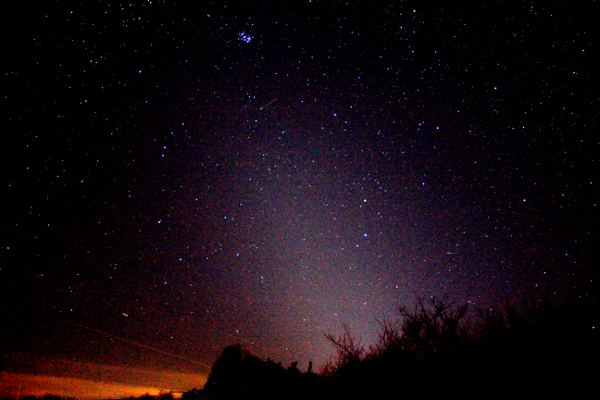
Much enhanced Zodiacal Light from the my back yard at 9:31 p.m. March 16, 2018, 5 minutes after the official end of astronomical twilight. Note the Pleiades top left of center and the constellation of Ares below and right of center. Canon EOS Rebel T5 18mm f.l., f/3.5, 6 sec. ISO 12,800 . The clouds on the left appear to be illuminated by the lights of the towns of Beulah and Frankfort 20+ miles away.
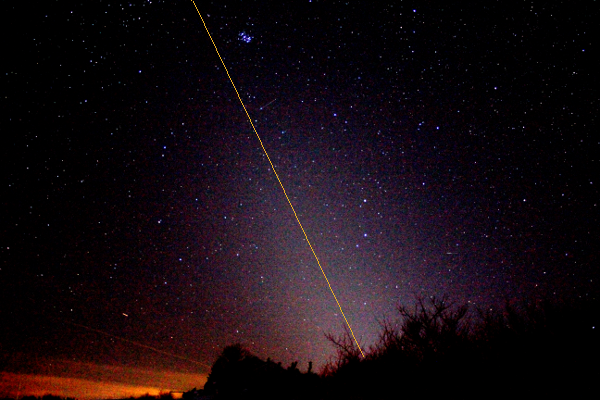
I’ve added the approximate ecliptic line from a Stellarium view of the same date and time.
03/22/2019 – Ephemeris – The Great Underwater Panther
Ephemeris for Friday, March 22nd. Today the Sun will be up for 12 hours and 14 minutes, setting at 7:57, and it will rise tomorrow at 7:40. The Moon, 2 days past full, will rise at 10:07 this evening.
The Anishinabe peoples of the Great Lakes Region, which includes the Ottawa, Chippewa and Ojibwe Indians have one constellation of winter I know of. It is The Winter Maker which uses many of Orion’s stars and whose arms stretch from Aldebaran in Taurus the bull to Procyon the Little Dog Star, embracing the whole of the winter sky. Now that spring is here he is sinking into the west. The first constellation of spring is Curly Tail, or the Great Underwater Panther. Which uses the stars of Leo the lion’s backward question mark as its tail and the small knot of stars that are the head of Hydra the water snake below Cancer the crab as its head. Keep off the thinning ice or break through and be snatched by the great panther that lives below.
The times given are for the Traverse City/Interlochen area of Michigan. They may be different for your location.
Addendum
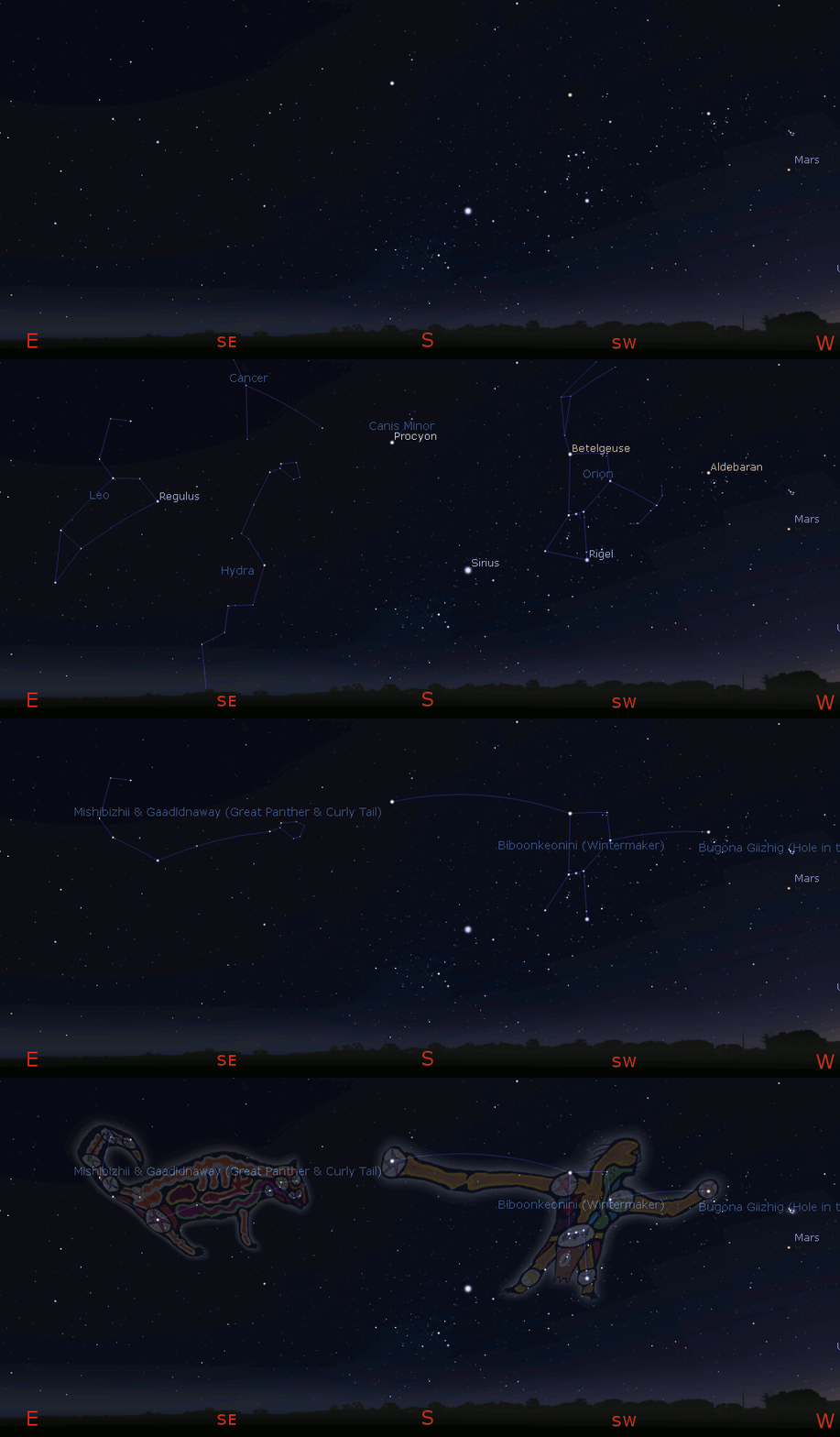
Great Underwater Panther finder animation relating western to Anishinaabe constellations for 9 p.m. March 22, 2019. Click on the image to enlarge. Created using Stellarium.
The constellation art is part of the latest versions of Stellarium. Ojibwe (Anishinaabe) constellation art by Annette S Lee and William Wilson from Ojibwe Sky Star Map Constellation Guide, by A. Lee, W Wilson, C Gawboy, J. Tibbetts. ISBN 978-0-615-98678-4.

