Archive
01/09/2019 – Ephemeris – Where are the planets tonight?
Ephemeris for Wednesday, January 9th. The Sun will rise at 8:19. It’ll be up for 9 hours and 1 minute, setting at 5:20. The Moon, 4 days past new, will set at 8:55 this evening.
Let’s look at the planets for this week. Our only evening planet Mars will be in the southwestern sky this evening and will set at 11:59 p.m. It’s too far away to see much detail in a small telescope. In the morning sky we have Venus rising at 4:40 a.m. tomorrow and this morning is prominent in the southeastern sky as our morning star. In small telescopes it is half illuminated, having its greatest western elongation last Saturday. Its phase will now grow to be gibbous as its size shrinks as it continues its long journey around behind the Sun. Jupiter will rise tomorrow at 5:43 a.m. It is second to Venus in brightness, but second to no planet in size. Binoculars can see some of its biggest moons. Telescopes can see all four.
The times given are for the Traverse City/Interlochen area of Michigan. They may be different for your location.
Addendum
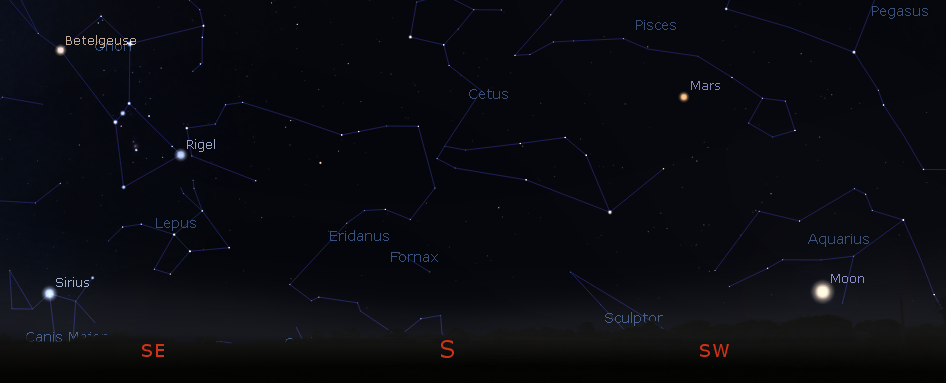
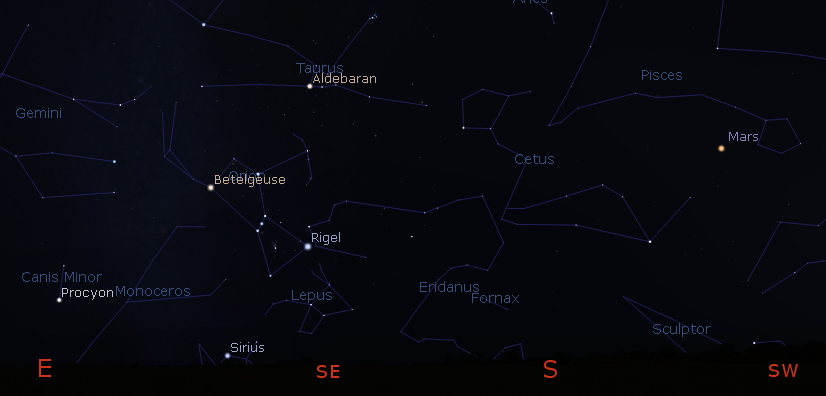
Mars and the Moon with the evening constellations tonight at 8 p.m. January 9, 2019. Click on the image to enlarge. Created using Stellarium.
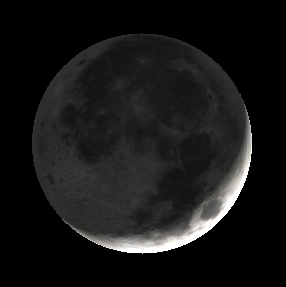
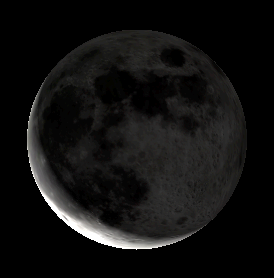
The Moon as it might appear in binoculars including earthshine this evening. Created using Stellarium.
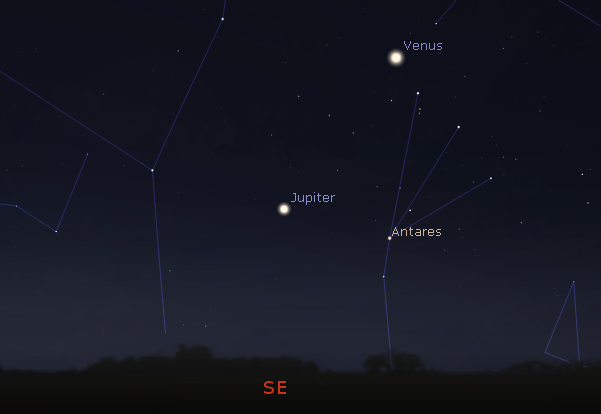
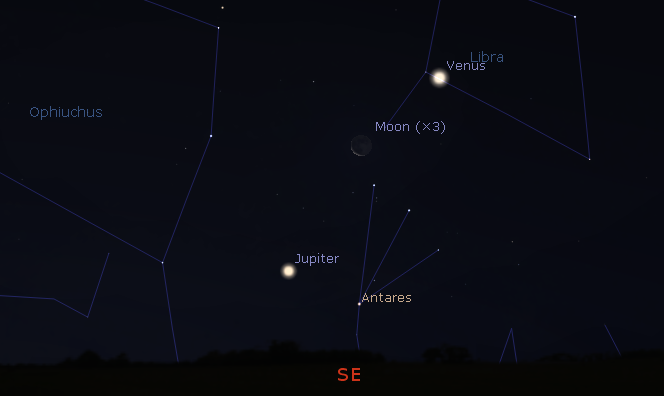
Venus and Jupiter in the morning at 7 a.m. tomorrow morning January 10, 2019. Created using Stellarium.
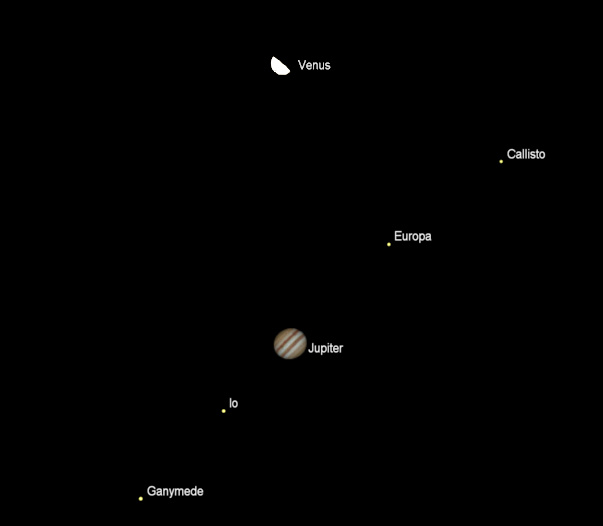
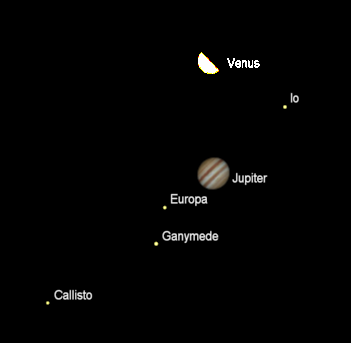
Venus and Jupiter with the same magnification at 7 a.m. tomorrow morning January 10, 2019. Created using Cartes du Ciel (Sky Charts).
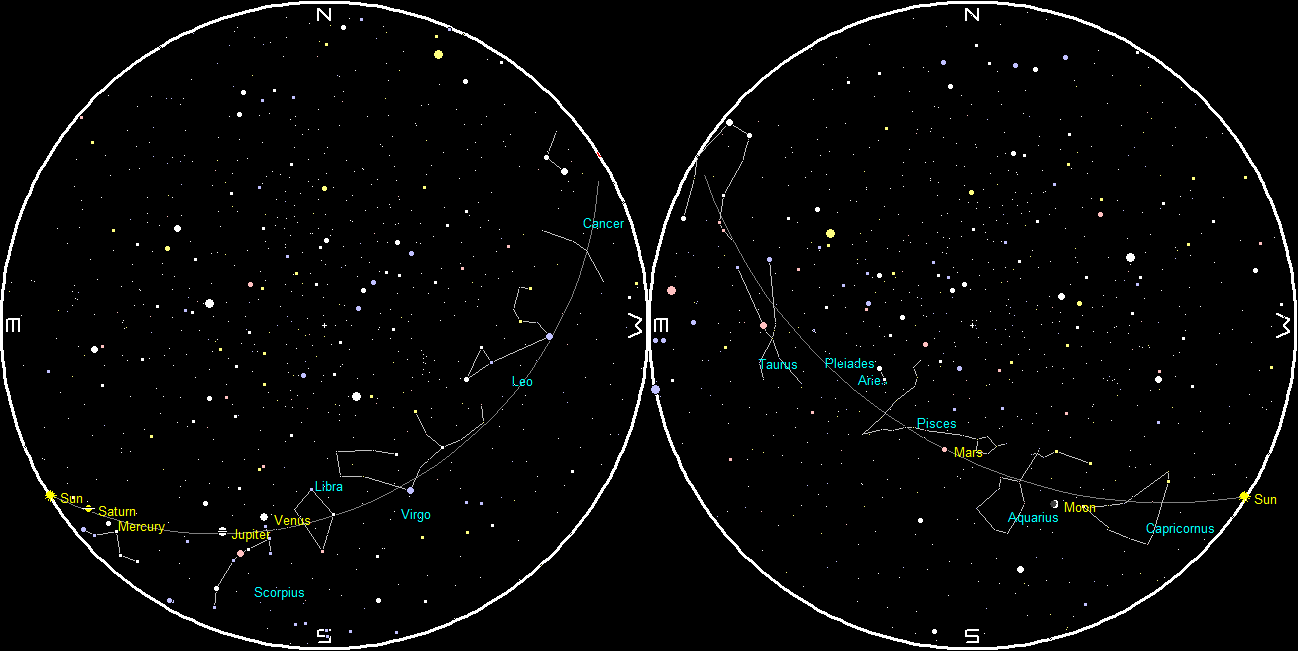
Planets and the Moon at sunset and sunrise of a single night starting with sunset on the right on January 9, 2019. The night ends on the left with sunrise on the 10th. Click on the image to enlarge. Created using my LookingUp program.
01/08/2019 – Ephemeris – The river at Orion’s feet
Ephemeris for Tuesday, January 8th. The Sun will rise at 8:19. It’ll be up for 9 hours exactly, setting at 5:19. The Moon, 3 days past new, will set at 7:55 this evening.
One of the more obscure constellations around is Eridanus, which depicts a river. The river starts near the lower right corner of Orion, near the bright star Rigel and flows to the right then down near the southwestern horizon, then it meanders along the horizon to the south before turning below the horizon. One has to travel to the far south to see the southern terminus of the river, the bright star Achernar. Writers over the ages have seen here the Nile and the earth circling river Ocean of the flat earth days. Achernar is actually two stars, the brightest was discovered to be the flattest star, due to its rapid spin. The dimensions of Achernar A has been determined to be twice as wide across its equator than from pole to pole. It’s 139 light years away.
The times given are for the Traverse City/Interlochen area of Michigan. They may be different for your location.
Addendum
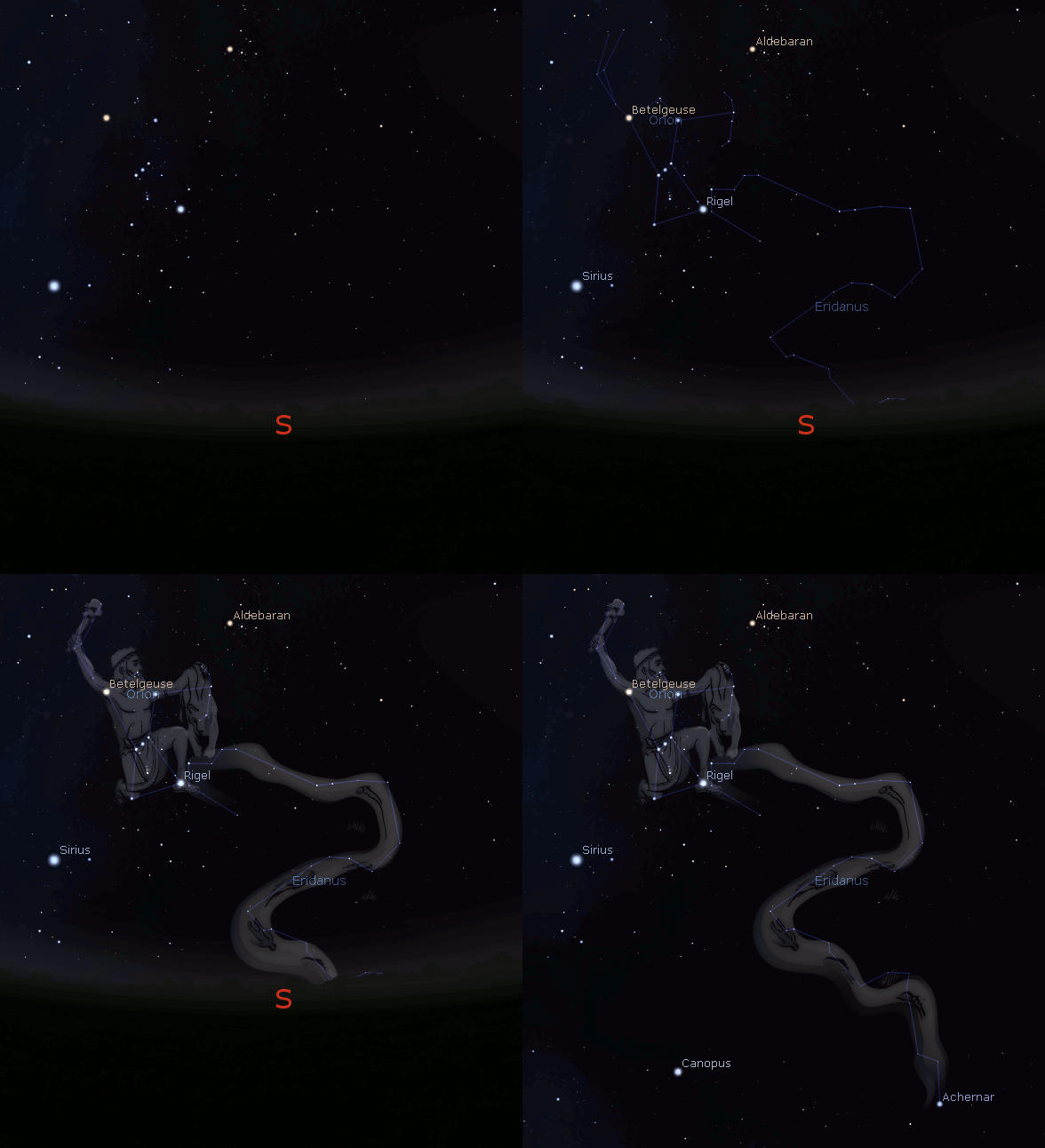
An animation of the constellation Eridanus which is a river that flows from Rigel in Orion to the star Achernar below our southern horizon at latitude 45 degrees north. Create using Stellarium and GIMP.
01/07/2019 – Ephemeris – The stars of Orion
Ephemeris for Monday, January 7th. The Sun will rise at 8:19. It’ll be up for 8 hours and 59 minutes, setting at 5:18. The Moon, 2 days past new, will set at 6:57 this evening.
The seven bright stars of Orion now shine in the southeastern sky in the evening. Two shoulder stars, Betelgeuse, and Bellatrix, Two knee stars Saiph, and Rigel, In between are the three belt stars in a row, Alnitak, Alnilam, and Mintaka. Betelgeuse and Rigel are first magnitude stars, among the brightest in the sky, while the others are second magnitude. As far as brightness goes it puts the Big Dipper to shame with its six second magnitude and one third magnitude stars. Of course we in northern Michigan have the Big Dipper always, because it never sets. Orion, only about six months. Due to its position straddling the equator of the sky, Orion is seen by all the people of the world. Parts of him are even seen at the north and south poles.
The times given are for the Traverse City/Interlochen area of Michigan. They may be different for your location.
Addendum
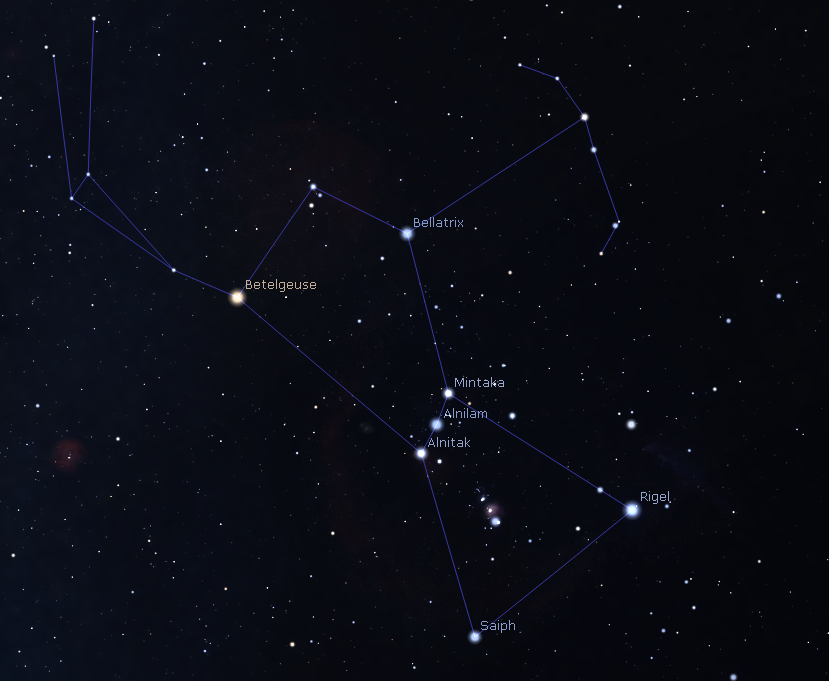
Orion’s brightest stars with their names for 9 p.m. January 7, 2019. Click on the image to make Orion a giant hunter. Created using Stellarium..
01/04/2019 – Ephemeris – A talk about astrophotography tonight at the GTAS by Dan Dall’olmo
Ephemeris for Friday, January 4th. The Sun will rise at 8:20. It’ll be up for 8 hours and 55 minutes, setting at 5:15. The Moon, 1 day before new, will rise at 7:55 tomorrow morning.
Tonight’s first meeting of the year of the Grand Traverse Astronomical Society at Northwestern Michigan College’s Rogers Observatory starting at 8 p.m. will feature an illustrated talk by Dan Dall’olmo who has been quite successful in the field of astrophotography, or photography of the heavens. My own introduction to astrophotography was as a teenager in the day of file and darkroom chemicals. Things have changed a lot since then. Starting at 9 p.m. if it’s clear there will be a star party featuring the dark winter sky wonders including the Great Orion Nebula, a star nursery. Our next meeting, February first will be our annual telescope clinic to help new and otherwise frustrated telescope owners understand and use their telescopes.
The times given are for the Traverse City/Interlochen area of Michigan. They may be different for your location.
Addendum

From a time lapse video by Dan Dall’olmo showing the comet motion as it passed by the Earth the weekend of December 14-16, 2018.
The video is on YouTube here: https://youtu.be/W4GvtPZOE9g
01/03/2019 – Ephemeris – The Quadrantid meteor shower will reach its peak this evening
Ephemeris for Thursday, January 3rd. The Sun will rise at 8:20. It’ll be up for 8 hours and 54 minutes, setting at 5:14. The Moon, 2 days before new, will rise at 7:01 tomorrow morning.
Of the three most active meteor showers, year after year, the Quadrantids of January, Perseids of August, and Geminids of December, only the Quadrantids are not affected by a bright Moon this year. The Quadrantids, which will reach peak at 9:20 this evening have their radiant about due north at that time, only a few degrees above the horizon. The peak is rather narrow, 4 hours to achieve at least half maximum, which is 120 meteors an hour if the radiant was overhead. The radiant, from which the meteors will come from is very low, so will be the numbers. However a low radiant means that the meteor streaks all over the sky will be longer as the meteoroids strike the atmosphere overhead at a shallow angle.
The times given are for the Traverse City/Interlochen area of Michigan. They may be different for your location.
Addendum
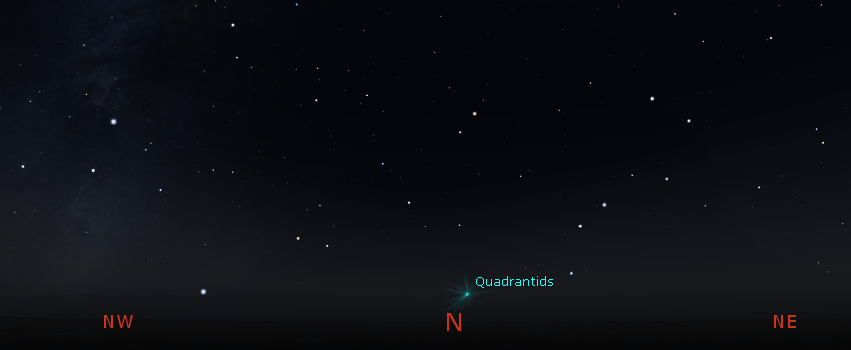
The location of the Quadrantid radiant, off the handle of the Big Dipper, at 9:20 p.m. January 3, 2019 for the peak of the meteor shower. Click on the image to enlarge. Created using Stellarium.
01/02/2019 – Ephemeris – The first look at the bright planets for the new year
Ephemeris for Wednesday, January 2nd. The Sun will rise at 8:20, the latest sunrise. It’ll be up for 8 hours and 53 minutes, setting at 5:13. The Moon, 3 days before new, will rise at 6:02 tomorrow morning.
Let’s look at the planets for this week. We start with the Earth which will reach perihelion, its closest to the Sun of the year at 4:49 tomorrow morning at 91.3 million miles (147.1 million kilometers). Mars will be in the southwestern sky this evening and will set at 11:59 p.m. It’s too far away to see much detail in a small telescope. In the morning sky we have Venus rising at 4:31 a.m. tomorrow and this morning is prominent in the southeastern sky as our morning star. In small telescopes it is a fat crescent. Jupiter will rise tomorrow at 6:04 a.m. will be to the right of the Moon then. Mercury and Saturn are not visible, though the latter passed behind the Sun yesterday to become a morning planet.
The times given are for the Traverse City/Interlochen area of Michigan. They may be different for your location.
Addendum
Mars and the constellations at 8 p.m. tonight January 2, 2019. Click on the image to enlarge. Created using Stellarium.
Morning planets Venus and Jupiter this morning, January 2, 2019, at 7 a.m.. Created using Stellarium.
The waning crescent Moon as it should appear this morning with earthshine in binoculars. Created using Stellarium.
Venus and Jupiter with the same magnification at 7 a.m. this morning January 2, 2019. Created using Cartes du Ciel (Sky Charts).
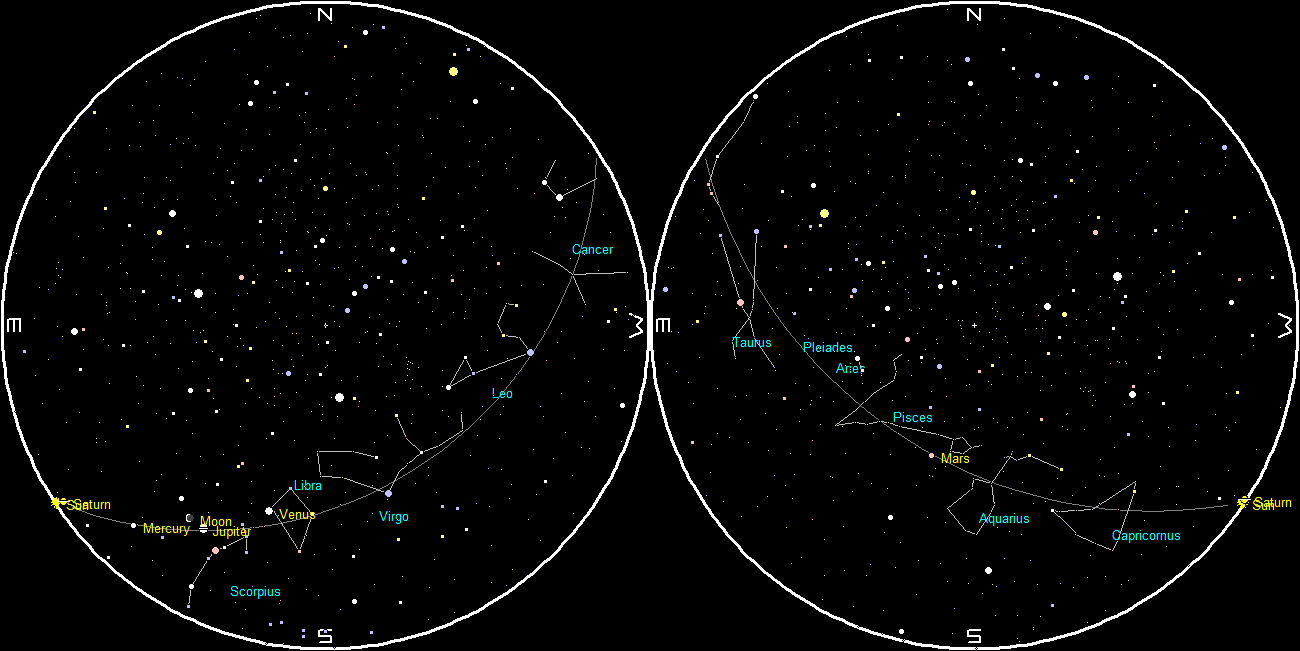
Planets and the Moon at sunset and sunrise of a single night starting with sunset on the right on January 2, 2019. The night ends on the left with sunrise on the 3rd. Click on the image to enlarge. Created using my LookingUp program.
01/01/2019 – Ephemeris – Previewing the month of January 2019
Ephemeris for New Years Day, Tuesday, January 1st. The Sun will rise at 8:20. It’ll be up for 8 hours and 52 minutes, setting at 5:12. The Moon, 3 days past last quarter, will rise at 4:59 tomorrow morning. | Happy New Year. Let’s preview the month of January. We’re a day from the latest sunrise at about the same time as today, 8:20 a.m. and will back down to 8:03 by the 31st. Sunset times are currently increasing by a minute a day from 5:12 p.m. today to 5:49 at month’s end. Listeners will have about the same sunrise time in Ludington, Interlochen/Traverse City, Petoskey and Mackinaw City, but the sunset times will vary markedly with the sunset times earlier in the north than the south. The Quadrantid meteor shower will reach peak on the 3rd in the evening. Also on the 3rd the Earth will be its closest to the Sun for the entire year. And on the 20th there will be a total lunar eclipse in the evening.
The times given are for the Traverse City/Interlochen area of Michigan. They may be different for your location.
Addenda
January Evening Star Chart
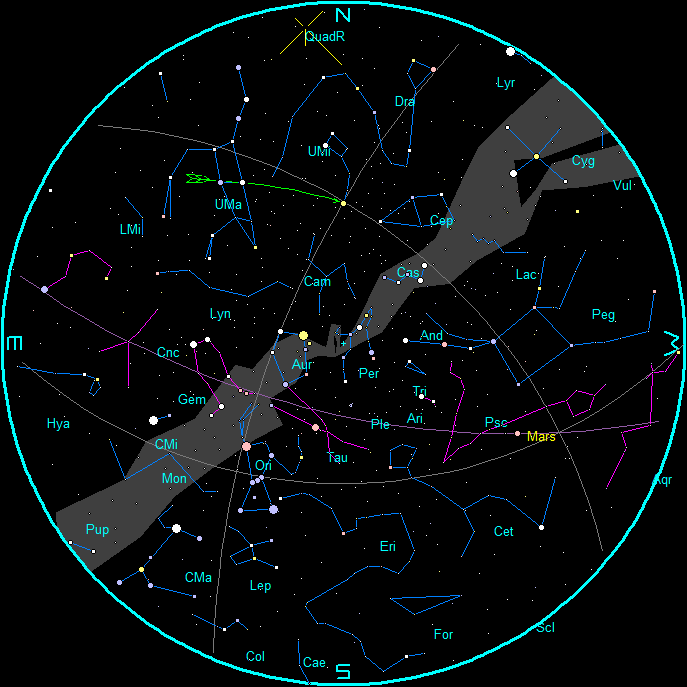
Star Chart for January 2019 (9 p.m. EST January 15, 2019). Created using my LookingUp program. Click on image to enlarge.
The planets and stars are plotted for the 15th at 9 p.m. EST in the evening and 6 a.m. for the morning chart. These are the chart times. Note that Traverse City is located approximately 45 minutes behind our time meridian. (An hour 45 minutes behind our daylight saving time meridian during EDT). To duplicate the star positions on a planisphere you may have to set it to 1 hour 45 minutes earlier than the current time.
Note the chart times of 9 p.m. and 6 a.m. are for the 15th. For each week before the 15th add ½ hour (28 minutes if you’re picky). For each week after the 15th subtract ½ hour. The planet positions are updated each Wednesday on this blog. For planet positions on dates other than the 15th, check the Wednesday planet posts on this blog.
January Morning Star Chart
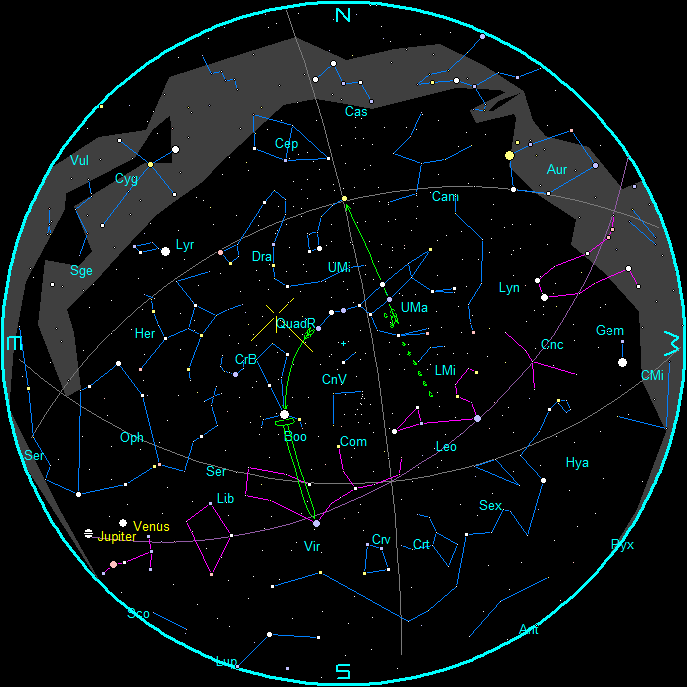
Star Chart for January mornings 2019 (6 a.m. EST January 15, 2019). Created using my LookingUp program. Click on image to enlarge.
For a list of constellation names to go with the abbreviations click here.
- Pointer stars at the front of the bowl of the Big Dipper point to Polaris the North Star.
- Follow the arc of the handle of the Big Dipper to the star Arcturus, and
- Extend like a spike to Spica,
- The Summer Triangle is in red.
- Quadr on the evening and morning star charts is the radiant of the Quadrantid meteor shower which peaks at 9:20 p.m. on the evening of the 3rd.
Twilight
| Traverse City | EST | ||||||
| Morning twilight | Evening twilight | Dark night | Moon | ||||
| Date | Astro. | Nautical | Nautical | Astro. | Start | End | Illum. |
| 2019-01-01 | 6h35m | 7h10m | 18h21m | 18h57m | 18h57m | 3h54m | 0.19 |
| 2019-01-02 | 6h35m | 7h10m | 18h22m | 18h58m | 18h58m | 4h59m | 0.11 |
| 2019-01-03 | 6h35m | 7h11m | 18h23m | 18h58m | 18h58m | 6h02m | 0.05 |
| 2019-01-04 | 6h35m | 7h11m | 18h24m | 18h59m | 18h59m | 6h35m | 0.02 |
| 2019-01-05 | 6h35m | 7h11m | 18h25m | 19h00m | 19h00m | 6h35m | 0 |
| 2019-01-06 | 6h35m | 7h11m | 18h26m | 19h01m | 19h01m | 6h35m | 0 |
| 2019-01-07 | 6h35m | 7h10m | 18h27m | 19h02m | 19h02m | 6h35m | 0.03 |
| 2019-01-08 | 6h35m | 7h10m | 18h28m | 19h03m | 19h56m | 6h35m | 0.07 |
| 2019-01-09 | 6h35m | 7h10m | 18h29m | 19h04m | 20h55m | 6h35m | 0.12 |
| 2019-01-10 | 6h35m | 7h10m | 18h30m | 19h05m | 21h55m | 6h35m | 0.2 |
| 2019-01-11 | 6h35m | 7h10m | 18h31m | 19h06m | 22h56m | 6h35m | 0.28 |
| 2019-01-12 | 6h34m | 7h09m | 18h32m | 19h07m | 23h57m | 6h34m | 0.37 |
| 2019-01-13 | 6h34m | 7h09m | 18h33m | 19h08m | – | 6h34m | 0.47 |
| 2019-01-14 | 6h34m | 7h09m | 18h34m | 19h09m | 0h59m | 6h34m | 0.57 |
| 2019-01-15 | 6h34m | 7h08m | 18h35m | 19h10m | 2h04m | 6h34m | 0.68 |
| 2019-01-16 | 6h33m | 7h08m | 18h36m | 19h11m | 3h11m | 6h33m | 0.78 |
| 2019-01-17 | 6h33m | 7h08m | 18h37m | 19h12m | 4h21m | 6h33m | 0.87 |
| 2019-01-18 | 6h32m | 7h07m | 18h38m | 19h13m | 5h31m | 6h32m | 0.94 |
| 2019-01-19 | 6h32m | 7h07m | 18h40m | 19h14m | – | – | 0.98 |
| 2019-01-20 | 6h31m | 7h06m | 18h41m | 19h15m | – | – | 0.98 |
| 2019-01-21 | 6h31m | 7h05m | 18h42m | 19h17m | – | – | 1 |
| 2019-01-22 | 6h30m | 7h05m | 18h43m | 19h18m | 19h18m | 19h41m | 0.98 |
| 2019-01-23 | 6h29m | 7h04m | 18h44m | 19h19m | 19h19m | 20h59m | 0.93 |
| 2019-01-24 | 6h29m | 7h03m | 18h46m | 19h20m | 19h20m | 22h15m | 0.86 |
| 2019-01-25 | 6h28m | 7h03m | 18h47m | 19h21m | 19h21m | 23h28m | 0.76 |
| 2019-01-26 | 6h27m | 7h02m | 18h48m | 19h22m | 19h22m | – | 0.66 |
| 2019-01-27 | 6h27m | 7h01m | 18h49m | 19h24m | 19h24m | 0h38m | 0.55 |
| 2019-01-28 | 6h26m | 7h00m | 18h50m | 19h25m | 19h25m | 1h46m | 0.44 |
| 2019-01-29 | 6h25m | 6h59m | 18h52m | 19h26m | 19h26m | 2h52m | 0.33 |
| 2019-01-30 | 6h24m | 6h58m | 18h53m | 19h27m | 19h27m | 3h56m | 0.24 |
| 2019-01-31 | 6h23m | 6h57m | 18h54m | 19h28m | 19h28m | 4h55m | 0.16 |
Twilight calendar was generated using Cartes du Ciel (Sky Charts).
See my blog post: Twilight Zone for the definitions of the different periods of twilight here: https://bobmoler.wordpress.com/2019/09/27/
NASA Calendar of Planetary Events
| Date | Time | Event | ||
| Jan | 1 | Tu | Venus: 46.9° W | |
| 1 | Tu | 04:50:00 PM | Moon-Venus: 1.4° S | |
| 1 | Tu | 11:53:00 PM | Saturn Conjunction | |
| 3 | Th | 02:37:00 AM | Moon-Jupiter: 3.4° S | |
| 3 | Th | 04:59:00 AM | Perihelion: 0.9833 AU | |
| 3 | Th | 09:28:00 PM | Quadrantid Shower: ZHR = 120 | |
| 5 | Sa | 01:46:00 PM | Moon South Dec.: 21.6° S | |
| 5 | Sa | 08:28:00 PM | New Moon | |
| 5 | Sa | 08:41:00 PM | Partial Solar Eclipse* | |
| 5 | Sa | 11:59:00 PM | Venus Elongation: 47° W | |
| 6 | Su | 07:08:00 PM | Moon Descending Node | |
| 8 | Tu | 11:29:00 PM | Moon Apogee: 406100 km | |
| 14 | Mo | 01:46:00 AM | First Quarter | |
| 17 | Th | 01:20:00 PM | Moon-Aldebaran: 1.6° S | |
| 19 | Sa | 06:20:00 PM | Moon North Dec.: 21.5° N | |
| 20 | Su | 05:48:00 PM | Moon Ascending Node | |
| 21 | Mo | 12:12:00 AM | Total Lunar Eclipse | |
| 21 | Mo | 12:16:00 AM | Full Moon | |
| 21 | Mo | 10:32:00 AM | Moon-Beehive: 0.6° N | |
| 21 | Mo | 02:58:00 PM | Moon Perigee: 357300 km | |
| 22 | Tu | 10:10:00 AM | Venus-Jupiter: 2.4° N | |
| 22 | Tu | 08:41:00 PM | Moon-Regulus: 2.5° S | |
| 27 | Su | 04:11:00 PM | Last Quarter | |
| 29 | Tu | 09:46:00 PM | Mercury Superior Conj. | |
| 30 | We | 06:54:00 PM | Moon-Jupiter: 3° S | |
| 31 | Th | 12:36:00 PM | Moon-Venus: 0.1° S | |
| Feb | 1 | Fr | Venus: 45.1° W | |
* Eclipse affects east Asia and the north Pacific
All event times are given for UTC-5:00: Eastern Standard or Daylight Time
Sky Events Calendar by Fred Espenak and Sumit Dutta (NASA’s GSFC),
http://eclipse.gsfc.nasa.gov/SKYCAL/SKYCAL.html
If you go to the above site you can print out a list like the above for the entire year or calendar pages for your time zone.
Sun and Moon Rising and Setting Events
| Ephemeris of Sky Events for NMC Observatory | ||||||||||
| January 2019 – Local time zone: EST | ||||||||||
| Date | Sun | Twilight* | Moon | Illum | ||||||
| Rise | Set | Hours | End | Start | Phase | R/S** | Time | Fractn | ||
| Tue | 1 | 08:20a | 05:12p | 8:52 | 06:23p | 07:09a | Rise | 04:59a | 15 | |
| Wed | 2 | 08:20a | 05:13p | 8:53 | 06:23p | 07:09a | Rise | 06:02a | 9 | |
| Thu | 3 | 08:20a | 05:14p | 8:54 | 06:24p | 07:09a | Rise | 07:01a | 4 | |
| Fri | 4 | 08:20a | 05:15p | 8:55 | 06:25p | 07:10a | Rise | 07:55a | 1 | |
| Sat | 5 | 08:19a | 05:16p | 8:56 | 06:26p | 07:10a | New | Set | 05:08p | 0 |
| Sun | 6 | 08:19a | 05:17p | 8:57 | 06:27p | 07:09a | Set | 06:01p | 1 | |
| Mon | 7 | 08:19a | 05:18p | 8:59 | 06:28p | 07:09a | Set | 06:57p | 3 | |
| Tue | 8 | 08:19a | 05:19p | 9:00 | 06:29p | 07:09a | Set | 07:55p | 8 | |
| Wed | 9 | 08:19a | 05:20p | 9:01 | 06:30p | 07:09a | Set | 08:55p | 13 | |
| Thu | 10 | 08:18a | 05:22p | 9:03 | 06:31p | 07:09a | Set | 09:55p | 20 | |
| Fri | 11 | 08:18a | 05:23p | 9:04 | 06:32p | 07:09a | Set | 10:55p | 28 | |
| Sat | 12 | 08:18a | 05:24p | 9:06 | 06:33p | 07:08a | Set | 11:56p | 37 | |
| Sun | 13 | 08:17a | 05:25p | 9:08 | 06:34p | 07:08a | Set | 12:59a | 47 | |
| Mon | 14 | 08:17a | 05:26p | 9:09 | 06:35p | 07:08a | F Qtr | Set | 02:04a | 57 |
| Tue | 15 | 08:16a | 05:28p | 9:11 | 06:36p | 07:07a | Set | 03:11a | 67 | |
| Wed | 16 | 08:16a | 05:29p | 9:13 | 06:38p | 07:07a | Set | 04:20a | 77 | |
| Thu | 17 | 08:15a | 05:30p | 9:15 | 06:39p | 07:07a | Set | 05:31a | 86 | |
| Fri | 18 | 08:14a | 05:31p | 9:17 | 06:40p | 07:06a | Set | 06:39a | 93 | |
| Sat | 19 | 08:14a | 05:33p | 9:19 | 06:41p | 07:06a | Set | 07:41a | 98 | |
| Sun | 20 | 08:13a | 05:34p | 9:21 | 06:42p | 07:05a | Set | 08:36a | 100 | |
| Mon | 21 | 08:12a | 05:35p | 9:23 | 06:43p | 07:04a | Full | Rise | 06:23p | 99 |
| Tue | 22 | 08:11a | 05:37p | 9:25 | 06:44p | 07:04a | Rise | 07:41p | 95 | |
| Wed | 23 | 08:11a | 05:38p | 9:27 | 06:46p | 07:03a | Rise | 08:59p | 89 | |
| Thu | 24 | 08:10a | 05:40p | 9:29 | 06:47p | 07:02a | Rise | 10:14p | 80 | |
| Fri | 25 | 08:09a | 05:41p | 9:32 | 06:48p | 07:02a | Rise | 11:27p | 70 | |
| Sat | 26 | 08:08a | 05:42p | 9:34 | 06:49p | 07:01a | Rise | 12:38a | 60 | |
| Sun | 27 | 08:07a | 05:44p | 9:36 | 06:51p | 07:00a | L Qtr | Rise | 01:46a | 49 |
| Mon | 28 | 08:06a | 05:45p | 9:39 | 06:52p | 06:59a | Rise | 02:52a | 38 | |
| Tue | 29 | 08:05a | 05:46p | 9:41 | 06:53p | 06:58a | Rise | 03:55a | 29 | |
| Wed | 30 | 08:04a | 05:48p | 9:44 | 06:54p | 06:57a | Rise | 04:55a | 20 | |
| Thu | 31 | 08:03a | 05:49p | 9:46 | 06:56p | 06:56a | Rise | 05:50a | 13 | |
| * Nautical Twilight | ||||||||||
| * Moonrise or moonset, whichever occurs between sunset and sunrise | ||||||||||
12/31/2018 – Ephemeris – New Year 2019 – A new solar system body is being explored right now!
Ephemeris for New Years Eve, Monday, December 31st. The Sun will rise at 8:20. It’ll be up for 8 hours and 51 minutes, setting at 5:11. The Moon, 2 days past last quarter, will rise at 3:54 tomorrow morning.
Later tonight the New Horizons spacecraft, which flew by Pluto and its retinue of moons, will fly by Kuiper Belt Object (KBO) 2014 MU69, nicknamed Ultima Thule. It’s probably an odd looking contact binary body with lobes 12 ½ and 11 miles (20 & 18 km) in diameter. That’s the guess as of a week ago. It will pass this body by 1,366 miles (2200 km), traveling at over 32 thousand miles an hour (52,000 kph). The spacecraft will pass closest approach at 33 minutes after the ball drops in Times Square. Nearly 4 hours later it will phone home. We won’t receive that message here on Earth until 10:28 a.m. due to the over 6 hours of time it takes the radio signal to reach Earth. We should get the first images by tomorrow night. The New Horizons spacecraft was built and is flown by Johns Hopkins Applied Physics Laboratory (JHAPL) is collaboration with NASA and the Southwest Research Institute (SwRI).
The times given are for the Traverse City/Interlochen area of Michigan. They may be different for your location.
Addendum
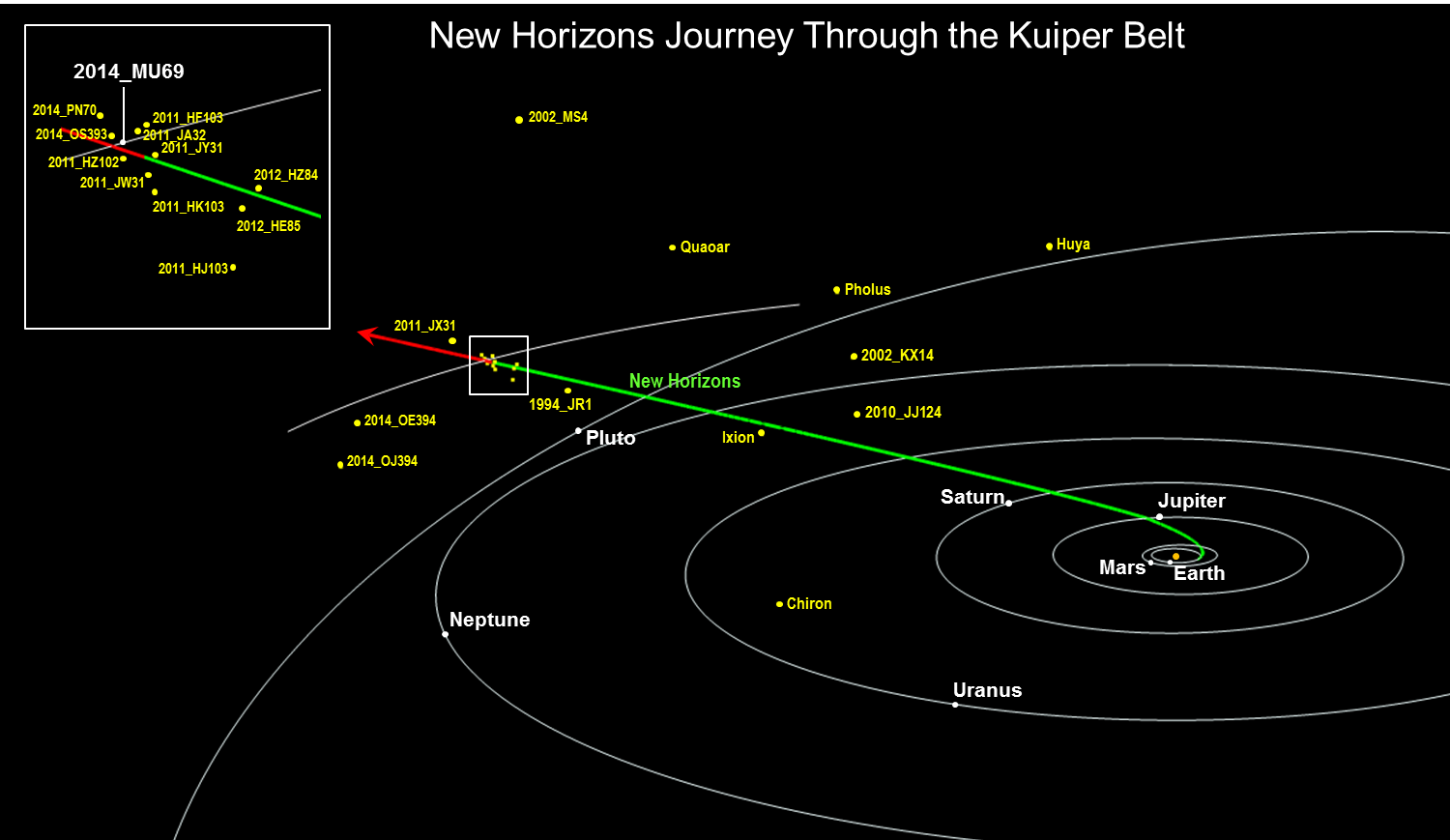
The Trajectory and position of New Horizons as it approached 2014 MU69 two months ago showing some of the KBOs recently discovered near its path. Credit JHAPL.
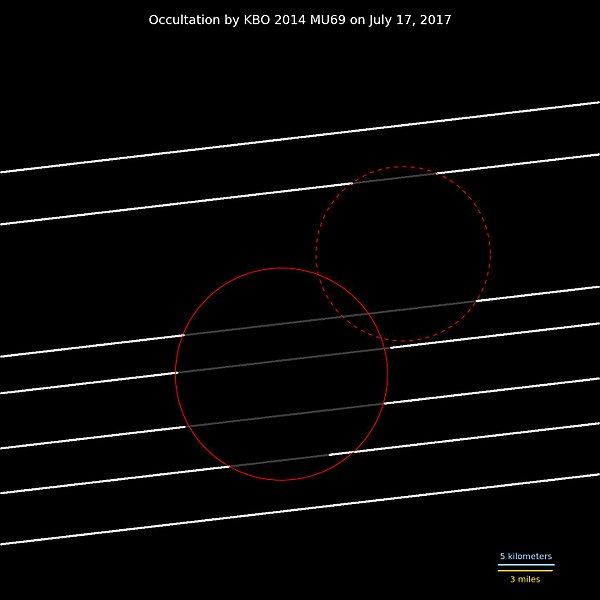
Silhouette of KBO 2014 MU69 (Ultima Thule) created by occultation timings on July 17, 2017 from southern Argentina. Credit NASA/JHUAPL/SwRI/Alex Parker.
Links to information can be found here: http://pluto.jhuapl.edu/News-Center/Where-to-Watch.php.
A cool app to follow New Horizons in real-time or to preview its passage of Ultima Thule is NASA’s Eyes: https://eyes.nasa.gov/.
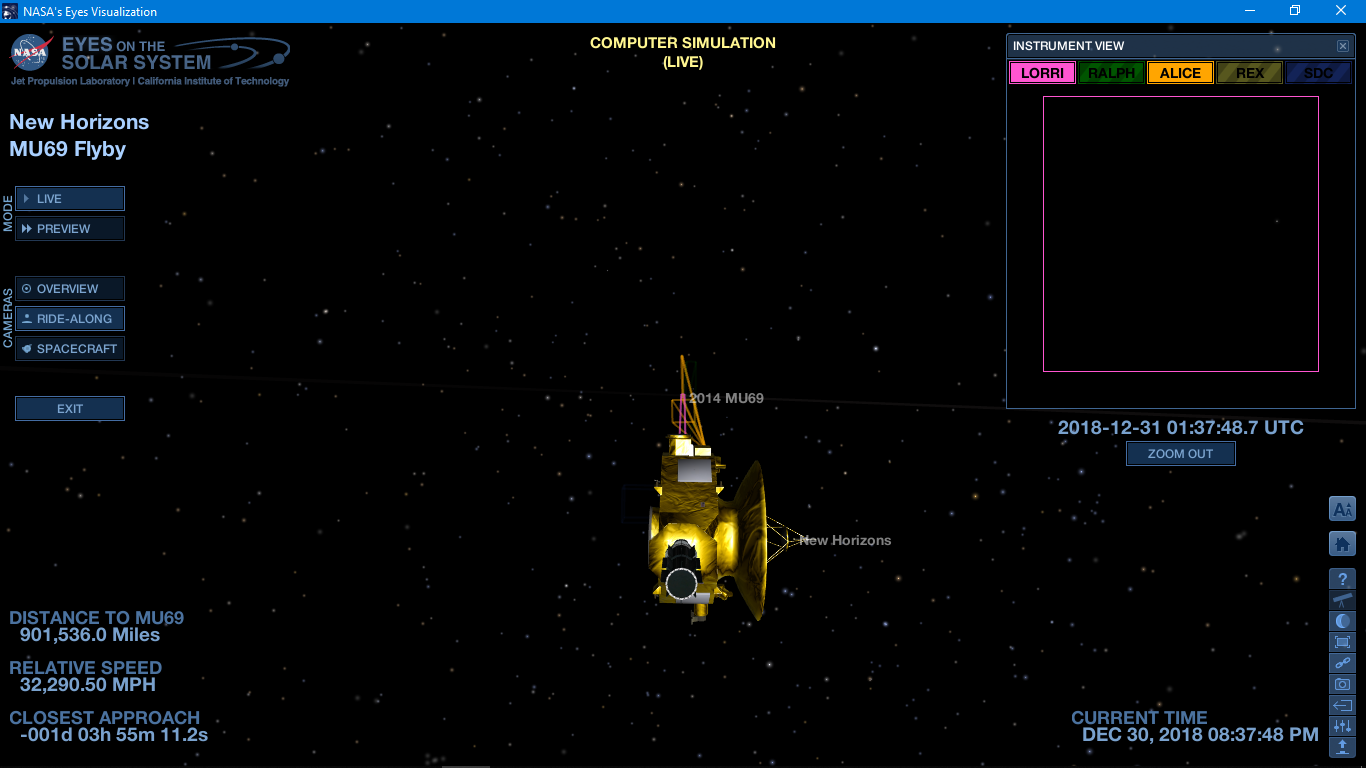
NASA’s Eyes screen Captured as a real-time simulation as I write this post. At this time two instruments are active, LORRI the long-range imager and ALICE the Ultraviolet imaging spectrometer. Click on the image to enlarge. Credit NASA/JPL
12/28/2018 – Ephemeris – Preview of space and astronomical events for 2019
Ephemeris for Friday, December 28th. The Sun will rise at 8:19. It’ll be up for 8 hours and 49 minutes, setting at 5:09. The Moon, 1 day before last quarter, will rise at 12:30 tomorrow morning.
Lets look at some astronomical and space events for 2019. Right off the bat on January 1st the New Horizons space craft will encounter the Kuiper Belt Object 2014 MU69 nick named Ultima Thule. I’ll have more on that Monday. January 20th overnight will see a total lunar eclipse lasting from 10:34 p.m. to 1:51 a.m. November 11th will see the planet Mercury cross the face of the Sun, a transit of Mercury from a couple of minutes after sunrise until 1:04 p.m. Among the space launches next year are several SpaceX Falcon Heavy launches, and the first launch of a uncrewed Dragon 2 capsule to fly up to the International Space Station. Boeing’s first Starliner uncrewed capsule test will occur in 2020.
The times given are for the Traverse City/Interlochen area of Michigan. They may be different for your location.
Addenda
New Horizons encounter of 2014 MU69 (Ultima Thule)
Due to the fact that NASA is affected by the partial shutdown we will probably not get much immediate information from them. However the New Horizons spacecraft is being run by Johns Hopkins Applied Physics Laboratory (JHAPL) and not NASA and it is a critical mission, it will not be affected. All news will flow from JHAPL, rather than NASA. NASA-TV appears to be operating, but on autopilot.
From JHAPL, Where to watch, timeline and links: http://pluto.jhuapl.edu/News-Center/Where-to-Watch.php.
The Planetary Society has lots of information and links to follow the encounter: http://www.planetary.org/blogs/emily-lakdawalla/2018/new-horizons-approaching-mu69-ultima-thule.html.
There is also a Planetary Society page of the time line of events for the spacecraft and the reception of data on the Earth : http://www.planetary.org/blogs/emily-lakdawalla/2018/what-to-expect-new-horizons-mu69-ultima-thule.html.
I’ll have much more Monday, less than 24 hours before the fly by.
Lunar Eclipse January 20-21, 2019
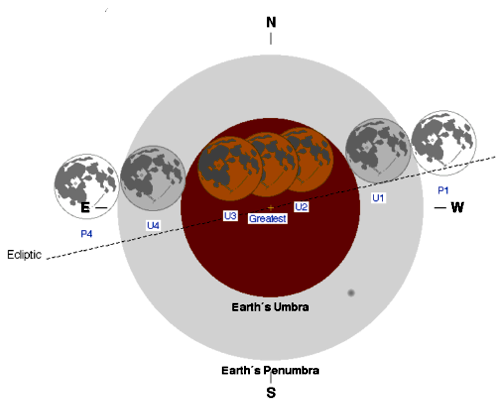
The Moon’s passage through the Earth’s shadow January 20-21, 2019. P1 and P4 events are invisible. Credit Fred Espenak, NASA/GSFC.
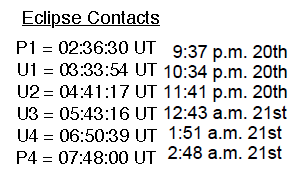
UT times are for January 21st. EST times are te nearest minute.
Transit of Mercury November 11, 2019
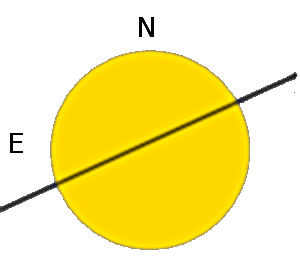
Mercury will travel from lower left to upper right across the face of the Sun. Credit Occult4.
The transit will run from about 7:34 a.m. EST
(2:34 UT) to 1:04 p.m. (8:04 UT).
12/27/2018 – Ephemeris – A look back at some space events of 2018
Ephemeris for Thursday, December 27th. The Sun will rise at 8:19. It’ll be up for 8 hours and 49 minutes, setting at 5:08. The Moon, 2 days before last quarter, will rise at 11:18 this evening.
Lets take a look at some highlights and a low light in space and astronomy from this year. In space on February 6th SpaceX launched their much touted Falcon Heavy rocket on its maiden flight. It was a success and we now have a Tesla orbiting the Sun. The Japanese Hyabusa2 reached its asteroid Ryugu and dropped some robot hoppers on its surface, months later NASA’s OSIRIS-REx encountered its asteroid Bennu. Both spacecraft will orbit their asteroids for a year and retrieve samples for return to Earth. On October 11th A Soyuz rocket carrying a Russian and an American had a failure at launch. The capsule escaped and the two men were rescued unharmed down range. On July 31st Mars came closer to the Earth than at any time since 2003.
The times given are for the Traverse City/Interlochen area of Michigan. They may be different for your location.
Addendum
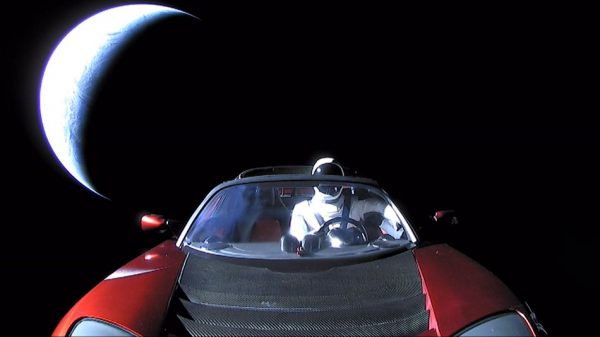
The Falcon Heavy had to launch a dummy mass. Instead of a chunk of iron or a block of concrete, Elon Musk launched his used Tesla roadster with a mannequin dressed in a SpaceX spacesuit. It has a 557 day orbit of the Sun that extends past the orbit of Mars. Credit SpaceX.
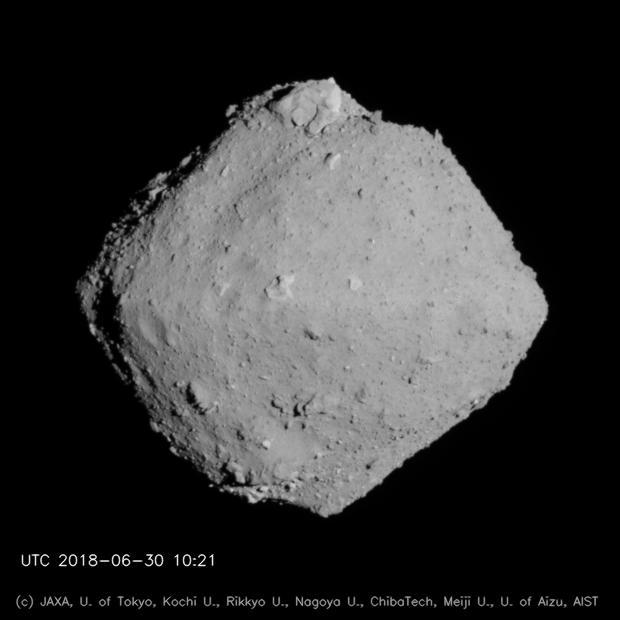
The asteroid Ryugu now orbited by the Japanese Hayabusa2 spacecraft. Ryugu is 3,707 feet (1.13 kilometers) in diameter. It is a Cg carbonaceous asteroid, a rare type. Credit JAXA.
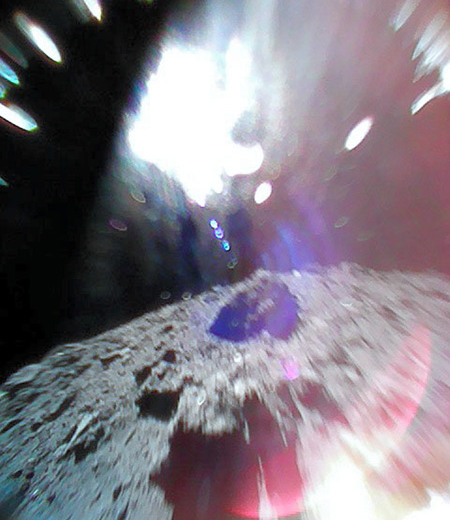
A Hayabusa2 rover captured the surface of Ryugu mid-hop. The motive power for the Hayabusa rovers operated the same way as Mexican jumping beans, by swinging an internal weight. Credit: JAXA.
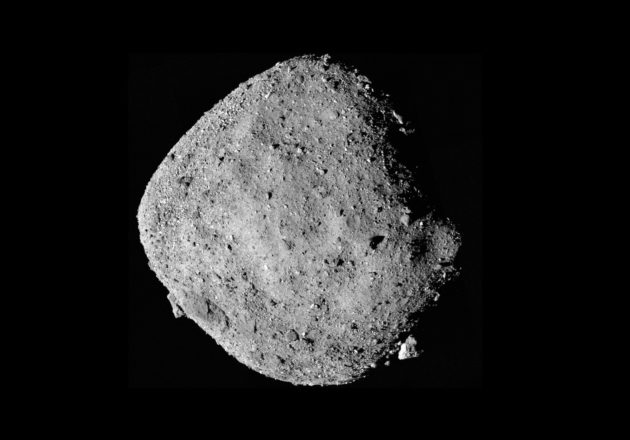
The asteroid Bennu is 861 feet (226.5 meters) in diameter. It is a carbonaceous asteroid. OSIRIS-REx has already discovered water bearing clays on its surface. Credit NASA
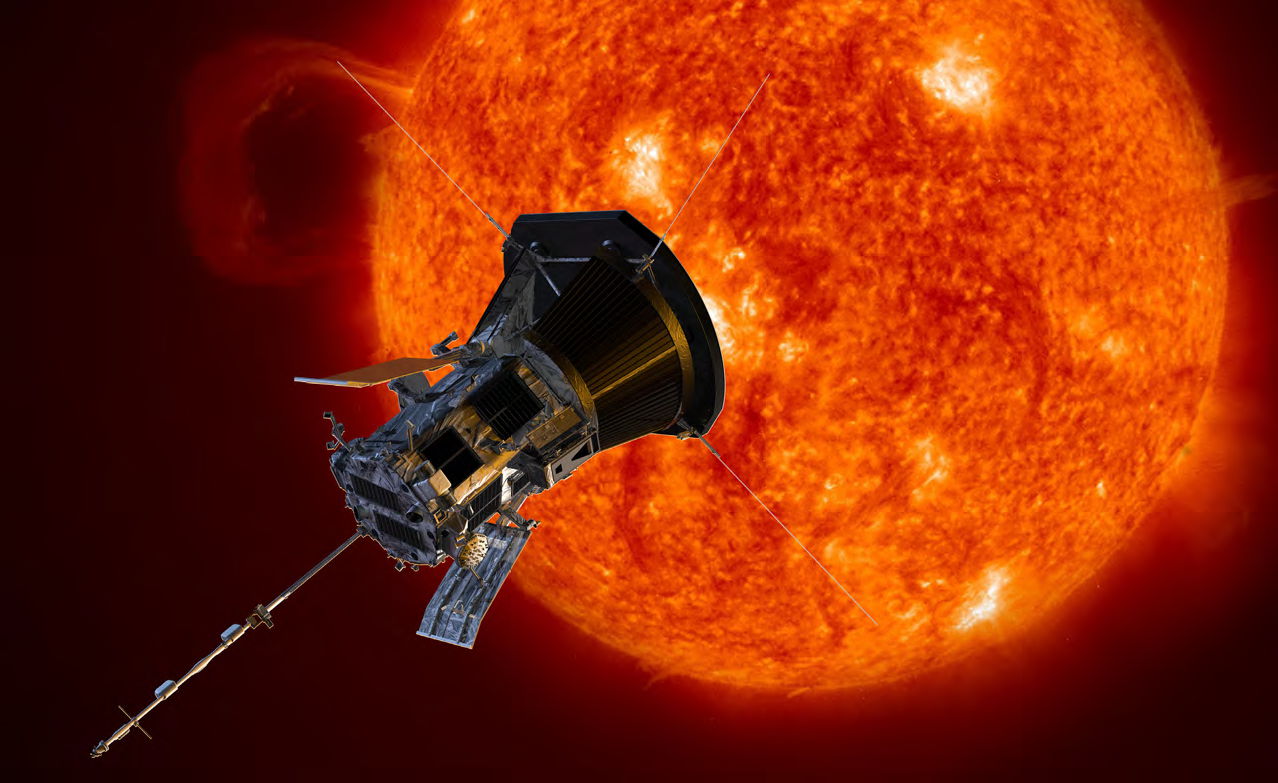
Not mentioned in this program was the Parker Solar Probe., which was launched August 12th. After passing Venus to lose speed, it dropped to 15.4 million miles (24.8 million kilometers) from the center of the Sun on November 6th. It will orbit he Sun two more times until it can catch Venus again to lower its perihelion again. Over 7 years it will use Venus 6 more times to drop its perihelion to only 4.29 million miles (6.9 million kilometers) from the center of the Sun Artist’s visualization credit: NASA Johns Hopkins APL.-Steve Gribben
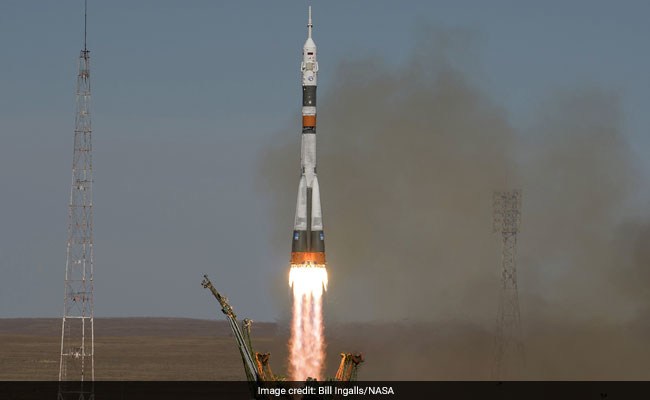
This is the launch of Soyuz MS-10 spacecraft. When the stage 1 boosters were jettisoned, one of the hit the core stage. The Soyuz performed an abort, saving the crew of a Russian and an American. Credit Bill Ingalls / NASA.
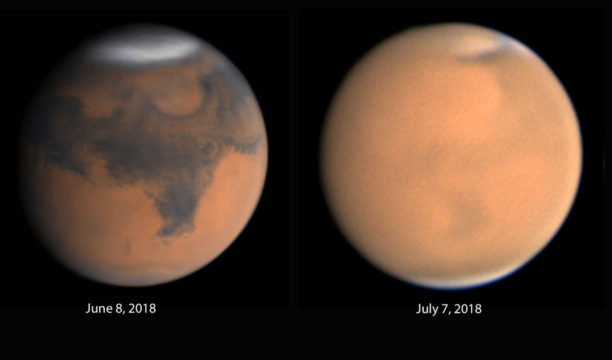
The viewing of Mars at its closest approach to the Earth on July 31st, the closest since the record-breaking close approach in 2003 was hampered by a global dust storm. It has apparently killed the solar powered Opportunity rover, which had been operating on the Martian surface since 2004. Credit: Damian Peach / Chilescope team (left), Christophe Pellier.

