Archive
12/26/2018 – Ephemeris – Looking at the bright planets for the last time in 2018
Ephemeris for Wednesday, December 26th. The Sun will rise at 8:19. It’ll be up for 8 hours and 48 minutes, setting at 5:08. The Moon, 3 days before last quarter, will rise at 10:05 this evening.
Let’s look at the bright planets for the last time in 2018. In the evening sky we have Mars still visible, but Saturn is lost in the bright twilight. It will pass conjunction with the Sun on New Years day. Mars will be due south at 6:09 p.m., and it will set at 12:05 a.m. Mars is moving eastward, crossing the constellation of Pisces. Comet Wirtanen is moving northward and to the lower left of Capella, in dark skies again in the early evening, but is fading as it moves away from both the Earth and Sun. It should be visible in binoculars as a faint fuzzy spot. Venus, our brilliant morning star, will rise at 4:24 a.m. in the east-southeast. Jupiter will rise at 6:24 a.m. also in the east-southeast.
The times given are for the Traverse City/Interlochen area of Michigan. They may be different for your location.
Addenda
Planets and the Moon
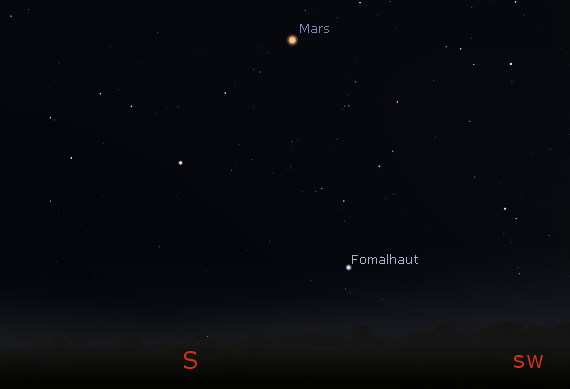
Mars at 7 p.m. tonight December 26, 2018. Created using Stellarium.
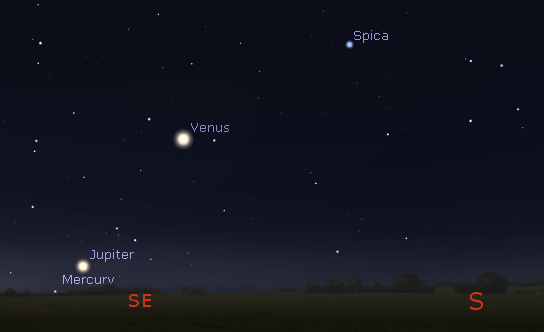
Morning planets Venus Jupiter this morning, December 26, 2018, at 7 a.m.. Created using Stellarium.
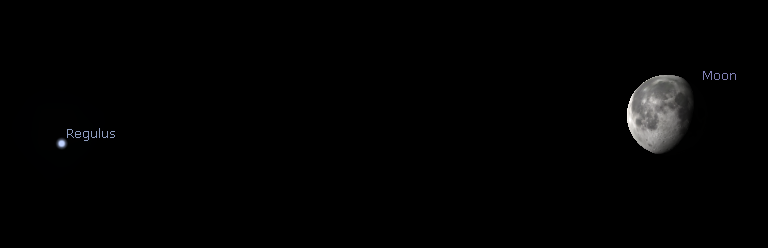
The Moon with the bright star Regulus in Leo the lion at 7 this morning, December 26, 2018.
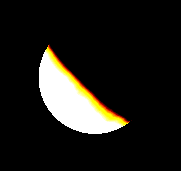
Telescopic view of Venus this morning December 26, 2018. Created using Stellarium.
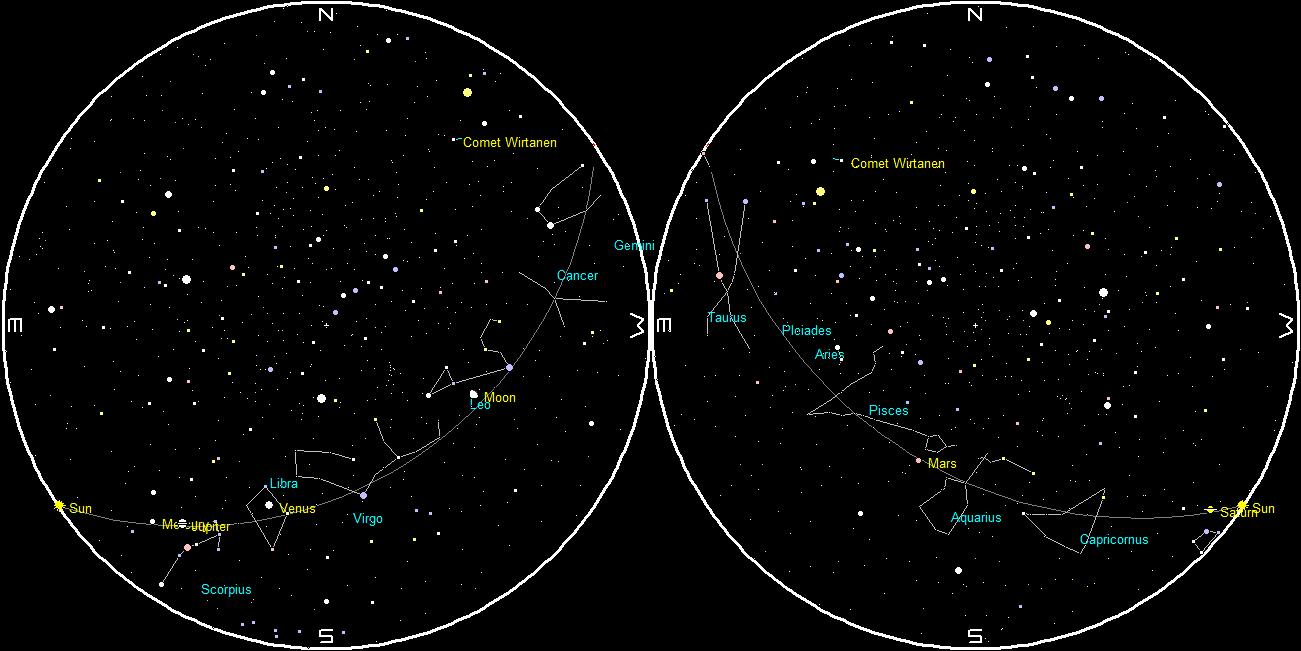
Planets, a comet and the Moon at sunset and sunrise of a single night starting with sunset on the right on December 20, 2018. The night ends on the left with sunrise on the 27th. Click on the image to enlarge. Created using my LookingUp program.
Comet Wirtanen
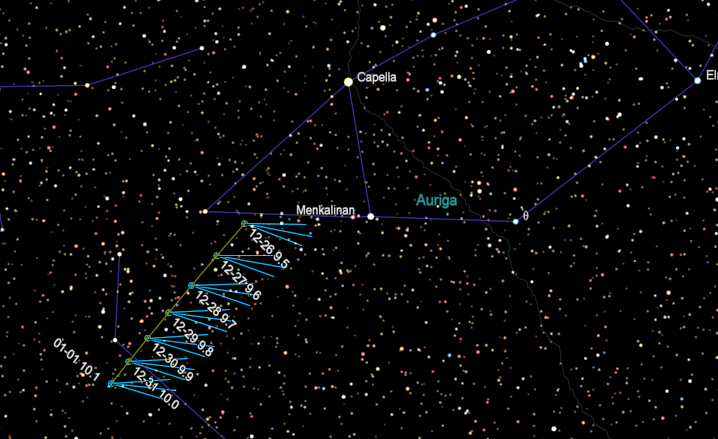
Comet 46P/Wirtanen positions for the next week. Positions are marked with month-date and magnitude. The observations are about 5 magnitudes brighter than shown here. Star field position is for 9 p.m. on the 26th. The comet is circumpolar, so it will not set overnight. Click on the image to enlarge. Created using Cartes du Ciel (Sky Charts).
12/25/2018 – Ephemeris – Our Christmas Star is in the morning sky
Ephemeris for Christmas Day, Tuesday, December 25th. The Sun will rise at 8:18. It’ll be up for 8 hours and 48 minutes, setting at 5:07. The Moon, 3 days past full, will rise at 8:49 this evening.
The Christmas star this year is Venus, seen this morning in the southeast if we are privileged enough to have clear skies this morning. Rising about 6:30 this morning we also have Jupiter, the second brightest planet after Venus. It might be high enough to spot by 7 this morning, in the southeast also, but near the horizon and to the left of Venus. The two extremely close conjunctions of these two planets in 3 and again in 2 BC are my favorite candidate for the appearances of the Star of Bethlehem that the Magi saw. One of the great things about the morning sky this time of year is that the stars out are those of April evenings and the seed catalogs I’m getting in the mail, make the promise that winter, only four days old will pass.
The times given are for the Traverse City/Interlochen area of Michigan. They may be different for your location.
Addendum
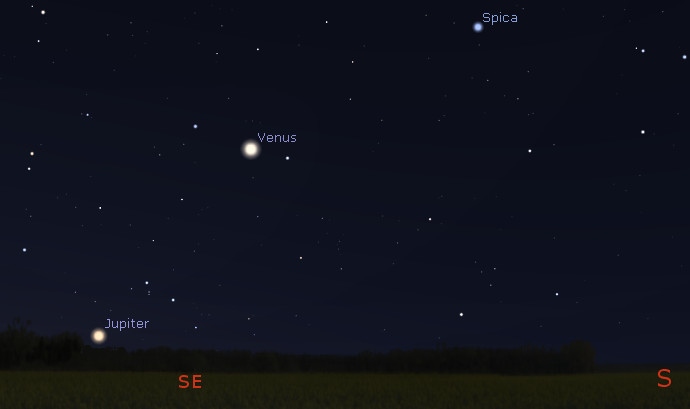
The Christmas morning sky at 7 a.m. looking to the south-southeast. Created using Stellarium.
12/24/2018 – Ephemeris – The Star of Bethlehem a possible solution
Ephemeris for Christmas Eve, Monday, December 24th. The Sun will rise at 8:18. It’ll be up for 8 hours and 48 minutes, setting at 5:06. The Moon, 2 days past full, will rise at 7:35 this evening.
Last Thursday I talked about the timing of Jesus’ birth being just before Herod the Great’s death, which I suggested was in 1 BC due to a lunar eclipse. So the Star of Bethlehem could appear several years later than the triple conjunction of Jupiter and Saturn in 7 BC that’s been popular. In 3 and again in 2 BC there were star-like conjunctions or apparent joinings of the planets Jupiter and Venus against the backdrop of constellation of Leo the Lion. A lion is related to Judah,, son of Jacob by a blessing the latter gave his 12 sons in Genesis. The first conjunction occurred in August of 3 BC in the morning sky. In June the next year the two planets got together again, this time in the evening sky, a month or more after Jesus would have been born in the lambing season of spring.
The times given are for the Traverse City/Interlochen area of Michigan. They may be different for your location.
Addendum
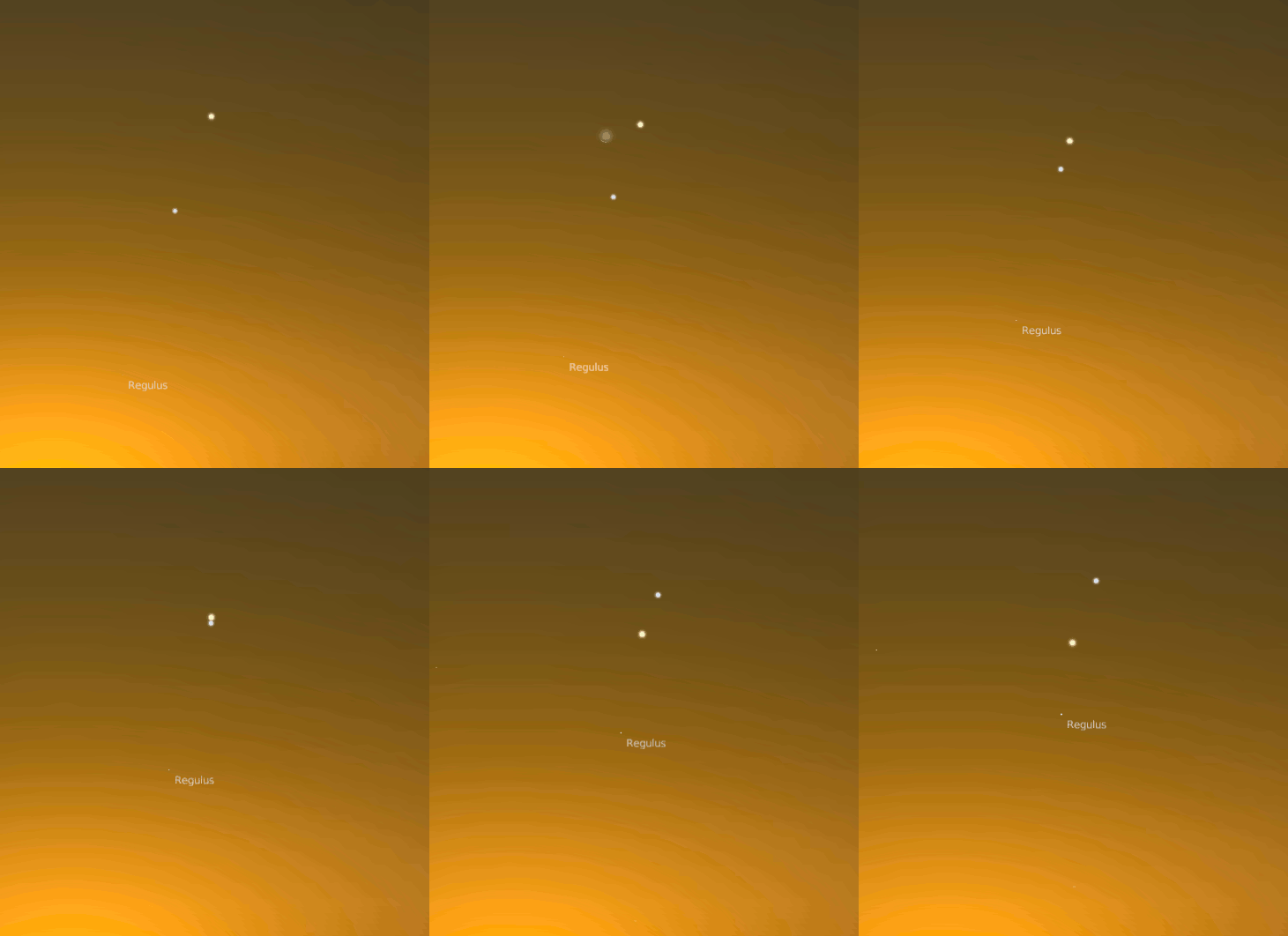
Here is an animation created using Stellarium of Jupiter and Venus, the brighter of the two seeming to pass very close on August 12, 3 BC in the early morning twilight. Regulus is the brightest star in Leo.
The above conjunction would occur near Jupiter’s heliacal rising, its first appearance in the morning sky after having left the evening sky. An event signifying beginnings or birth in many cultures. 10 months later they again conjoin, this time much closer.
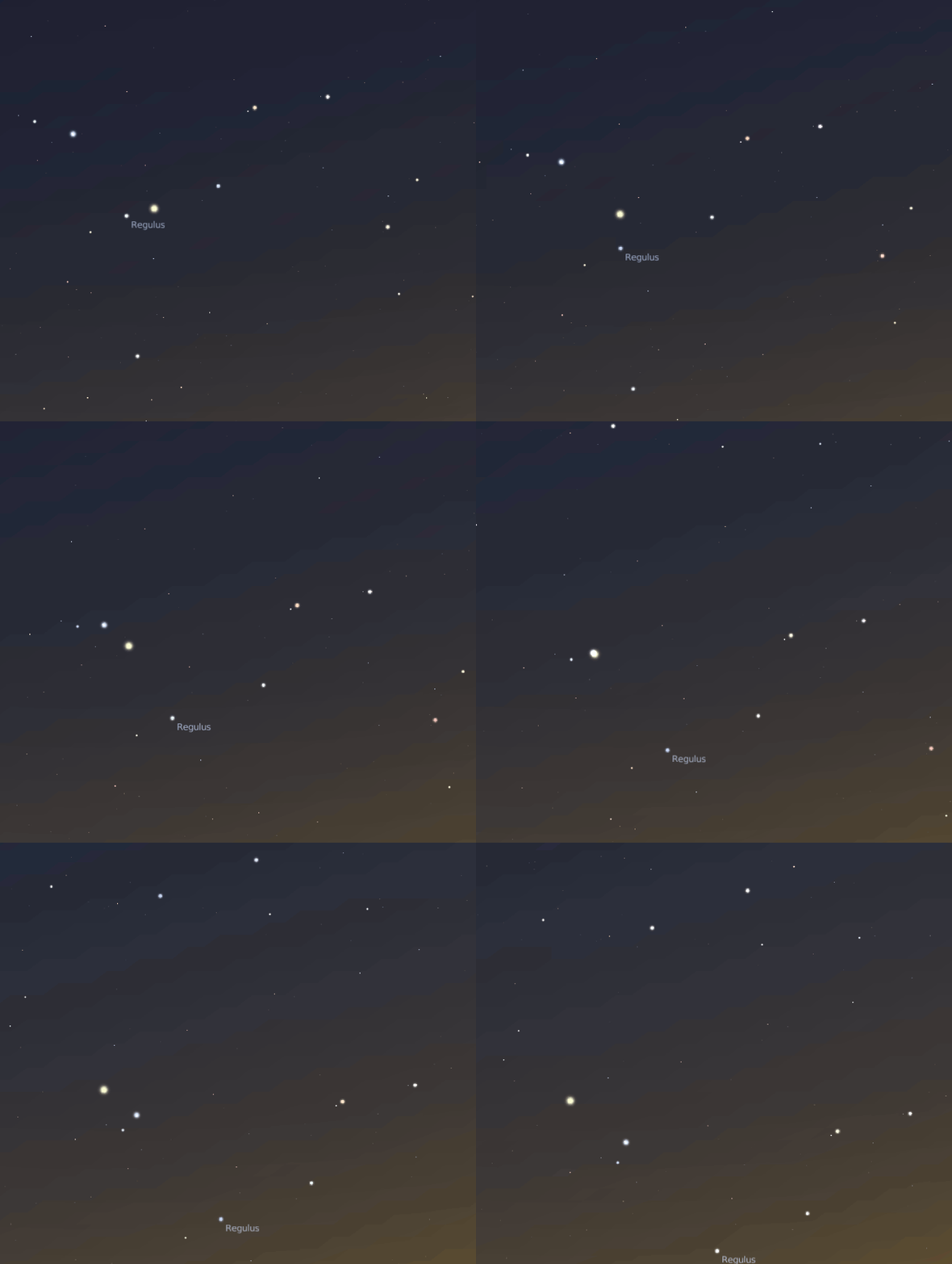
On June 16th 2 BC, this time in the evening, Venus and Jupiter seem to coalesce as one, at least to the naked eye. Created using Stellarium.
I’ll add in the triple conjunction of 7 BC just to cover all bases.
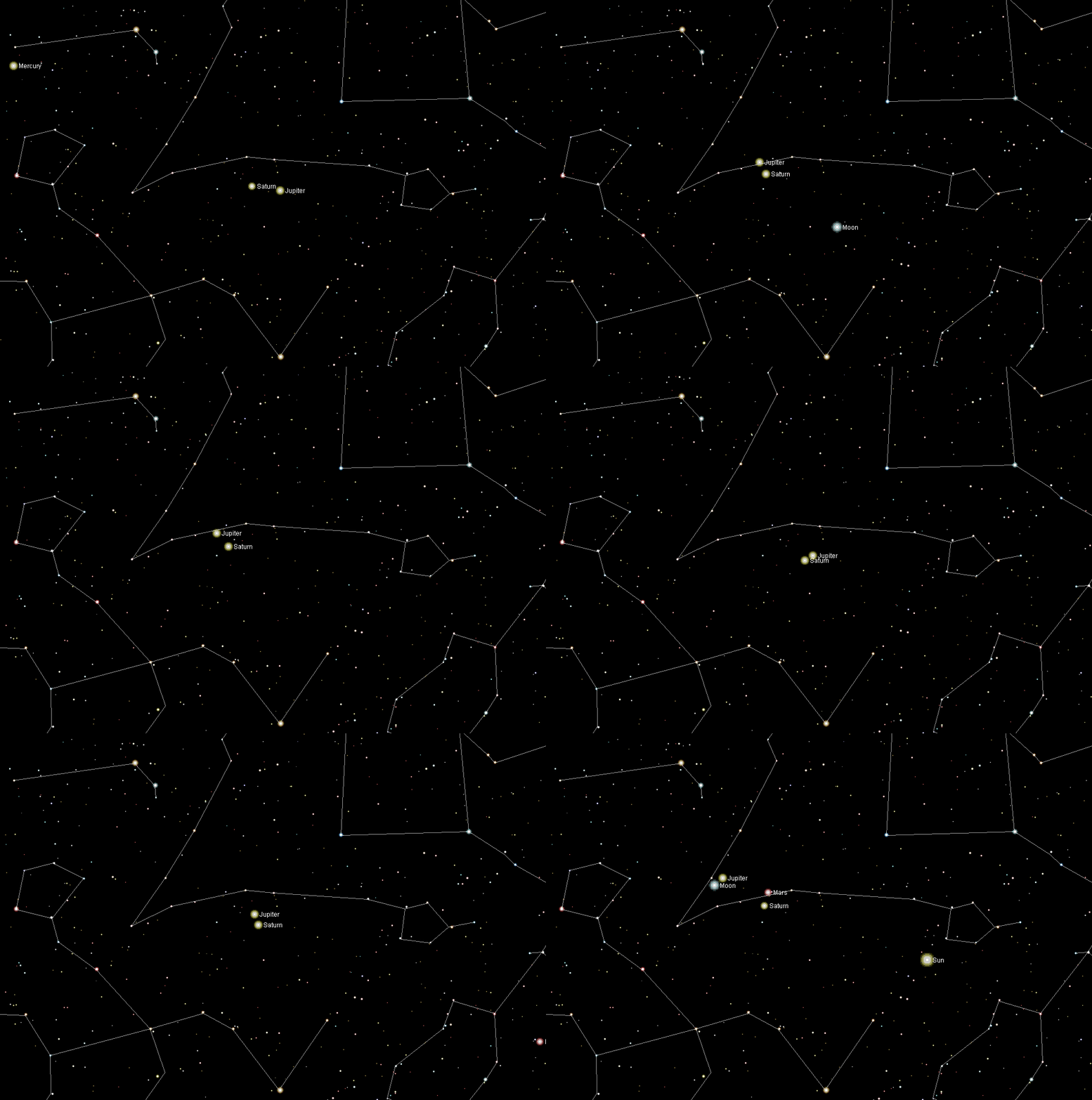
The Jupiter-Saturn triple conjunction of 7 BC. This animation is at 5 day intervals. The Moon will be popping in and out of the view. It end in February of 6 BC when Mars and the Moon enter\s the picture. Click on the image to enlarge. Created using Cartes du Ciel.
To the problem i mentioned in my December 20th post is if Herod died in 1 BC the flight to Egypt of the Holy Family would have lasted, maybe 9 months or a year. The traditional length of the flight to Egypt is 2 years. If we gave Herod, according to Josephus, 16 months between the lunar eclipse in January of 1 BC and Passover of AD 1 when Herod died, then the Flight to Egypt could be 2 years in keeping with tradition. My December 20th post is here: https://bobmoler.wordpress.com/2018/12/20/.
So was the Star the triple conjunction of 7 BC, the two conjunctions of 3 and 2 BC, a miraculous event outside of nature, or a bit of mythology tucked into Matthew’s Gospel. We will probably never know.
Have a very merry and safe Christmas.
12/21/2019 – Ephemeris – Winter starts today
Ephemeris for Friday, December 21st. The Sun will rise at 8:16. It’ll be up for 8 hours and 48 minutes, setting at 5:05. The Moon, 1 day before full, will set at 7:56 tomorrow morning.
Today is the shortest day of the year, well in daylight hours. The Sun will be up for only 8 hours and 48 minutes in the Interlochen/Traverse City area, 8 hours 53 minutes in Ludington, and 8 hours 40 minutes at the Straits. This is because the northern end of the Earth’s axis is pointing some 23 and a half degrees away from the Sun. Or it will at 5:22 this afternoon, the instant of winter solstice, when winter will begin. To find how high the Sun will get in the south at local noon take 90 minus your latitude and subtract also 23 and a half degrees. For Interlochen that’s 21.8 degrees above the southern horizon. We’re not getting much heat from the Sun. But as winter progresses the rising Sun will slow the cooling and begin to warm us up before spring.
The times given are for the Traverse City/Interlochen area of Michigan. They may be different for your location.
Addendum
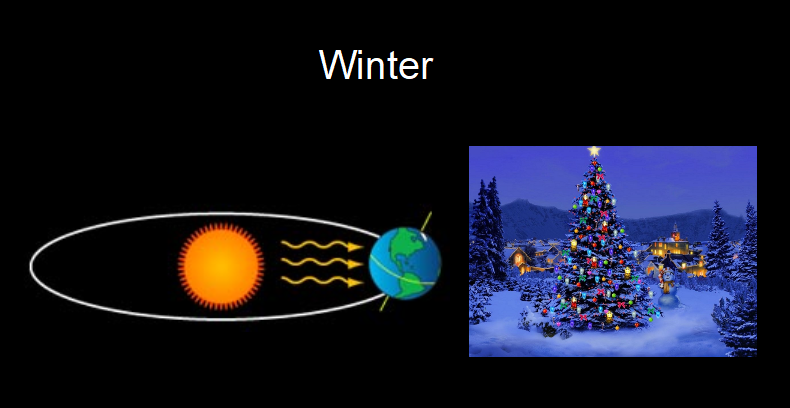
The Earth and its axis on the first day of winter, the winter solstice. From my Sun and the Earth talk slides.

DSCOVR satellite’s Earth Polychromatic Camera image of the Earth at 18:09 UTC (1:09 p.m.) December 19, 2017. We’re way up at the top just under the clouds at the top. It was actually partly cloudy that day. The DSCOVR satellite was in a halo orbit about the Earth-Sun Lagrange L1 point, 934,498 miles (1,503,929 km) toward the Sun from Earth.
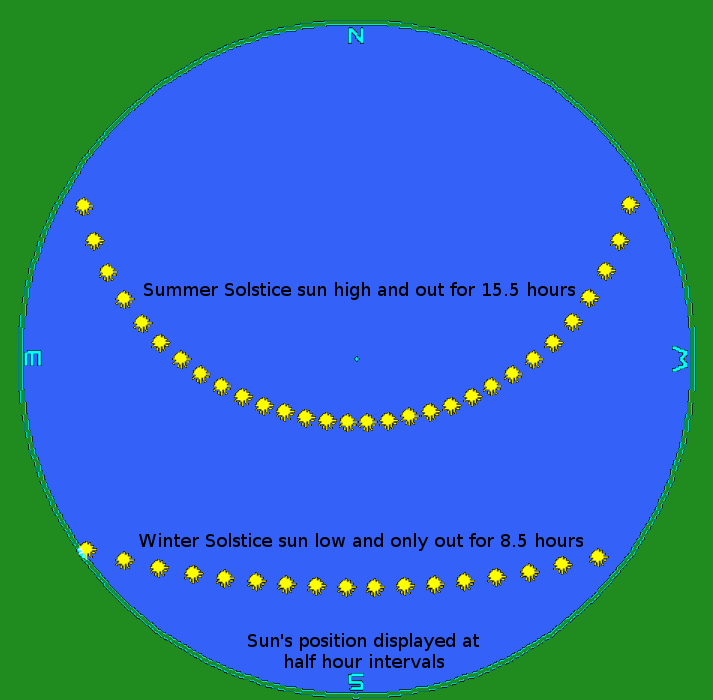
Comparing the sun’s path at the summer and winter solstices for Interlochen/Traverse City. This is a stereographic representation of the whole sky which distorts the sky and magnifies the size of the sun’s path near the horizon.
12/20/2019 – Ephemeris – The Star of Bethlehem, the problem of when
Ephemeris for Thursday, December 20th. The Sun will rise at 8:16. It’ll be up for 8 hours and 48 minutes, setting at 5:04. The Moon, 2 days before full, will set at 6:46 tomorrow morning.
In looking at the possible origin of the Star of Bethlehem, the latest Jesus could have been born is before the death of Herod the Great. The Jewish historian Josephus says that Herod died between a lunar eclipse and Passover, with most Star investigators pointing to the partial eclipse of March 13, 4 BC, one month before Passover that year. Problem is that Josephus devotes 4 chapters of the 17th book of Jewish Antiquities to the events in that span. I think they chose that eclipse to fit in with the triple conjunction of Jupiter and Saturn in 7 BC that was the big favorite for the star. There is another, better total lunar eclipse on January 10, 1 BC that is 3 months before Passover that would better fit Josephus’ narrative and a different Star possibility. More Monday.
The times given are for the Traverse City/Interlochen area of Michigan. They may be different for your location.
Addendum
The passage about Herod’s death from the eclipse of the Moon to Passover is in Josephus’ Antiquities of the Jews is in Book 17, Chapter 6, Paragraph 4 through Chapter 9, paragraph 3.
In doing some additional research since recording the program, the footnotes in William Whiston’s translation suggests a period between the eclipse and Passover at 13 months. Antiquities of the Jews can be found here: https://www.gutenberg.org/files/2848/2848-h/2848-h.htm. Of course I could extend the time frame of Herod’s death for the 1 BC eclipse to the Passover 16 months later. That would solve one of the problems I had with the timing of the visit of the Magi. But you’ll have to wait until Monday to find out what that is.
12/19/2018 -Ephemeris – The Bright planets and a departing comet for this week
Ephemeris for Wednesday, December 19th. The Sun will rise at 8:15. It’ll be up for 8 hours and 48 minutes, setting at 5:04. The Moon, 3 days before full, will set at 5:34 tomorrow morning.
Let’s look at the bright planets for tonight. In the evening sky we have Mars still visible, but Saturn is lost in the bright twilight. It will pass conjunction with the Sun on New Years day. Mars will be due south at 6:19 p.m., and it will set at 12:08 a.m. Mars is moving eastward, crossing the constellation of Aquarius until the 21st, when it enters Pisces. Comet Wirtanen is moving northward, to the left of the Pleiades and fading as the moonlight gets brighter. On the 23rd at 9 p.m. it will be a degree and a half, that’s 3 moon widths below and a bit left of the star Capella. Venus, our brilliant morning star, will rise at 4:20 a.m. in the east-southeast. The planets Jupiter and Mercury will be low on the southeastern horizon by 7 a.m. tomorrow..
The times given are for the Traverse City/Interlochen area of Michigan. They may be different for your location.
Addenda
Bright planets and the Moon
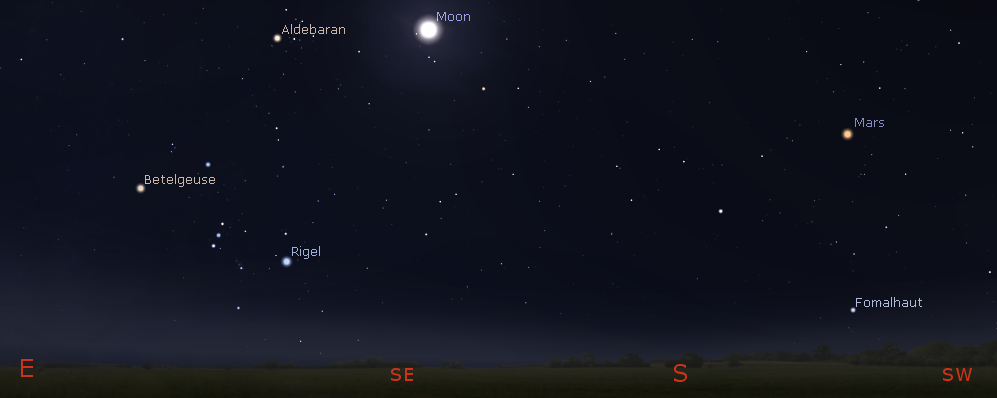
Mars, and the Moon at 8 p.m. tonight December 19, 2018. Click on image to enlarge. Created using Stellarium.
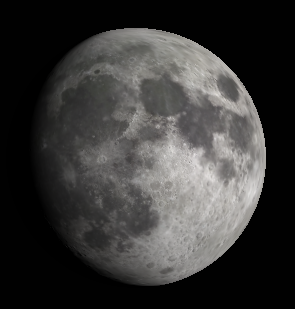
The waxing gibbous Moon as it should appear tonight in binoculars. Created using Stellarium.
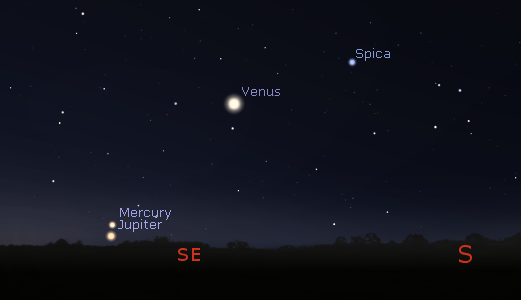
Morning planets Venus, Mercury and Jupiter on December 20, 2018, 7 a.m.. Created using Stellarium.
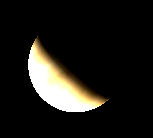
Telescopic view of Venus tomorrow morning December 20, 2018. Created using Stellarium.
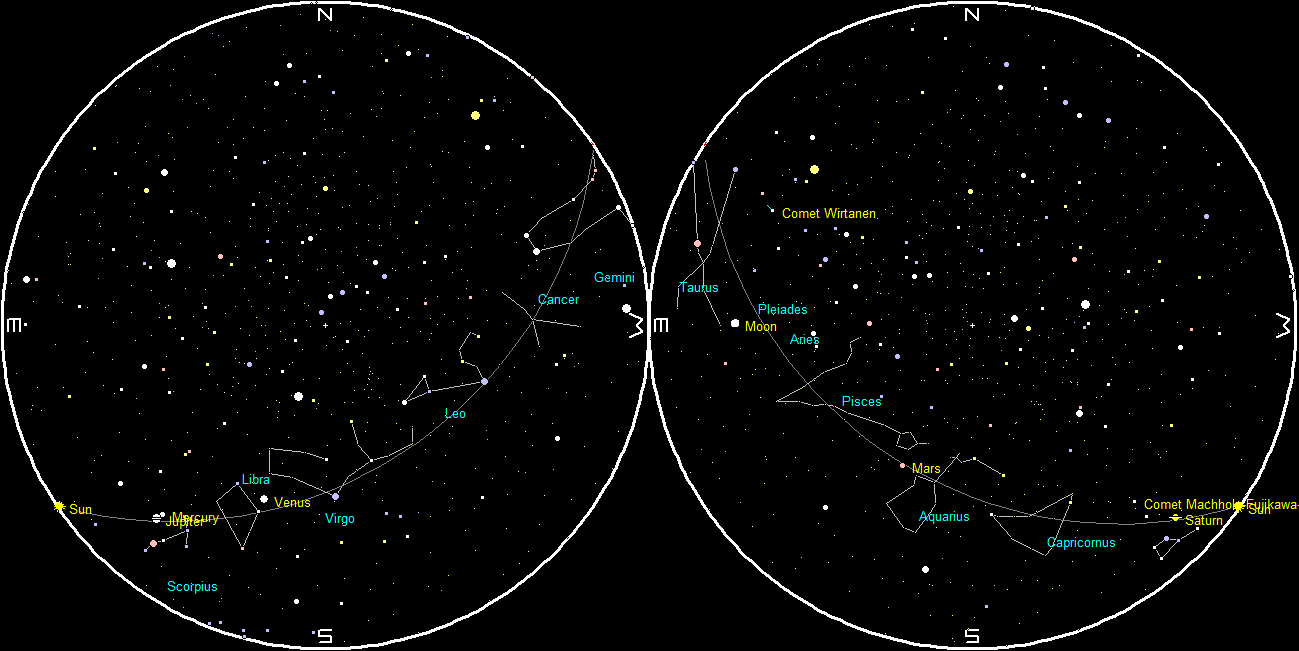
Planets, two comets and the Moon at sunset and sunrise of a single night starting with sunset on the right on December 19, 2018. The night ends on the left with sunrise on the 20th. Click on the image to enlarge. Created using my LookingUp program.
Comets
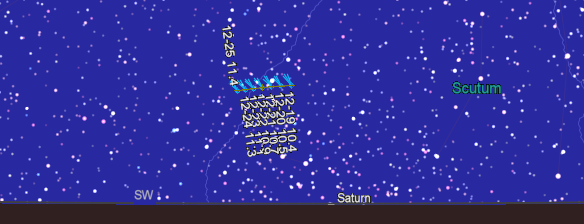
Comet C/2018 V1 (Machholz-Fijikawa-Iwamoto) in twilight starting tonight December 19, 2018. This comet is basically invisible in the evening twilight of 6 p.m. on the rest of the nights because the stars in the field will set 4 minutes earlier each successive evening. The latest magnitude observed is two magnitudes brighter than shown here. Created using Cartes du Ciel (Sky Charts).
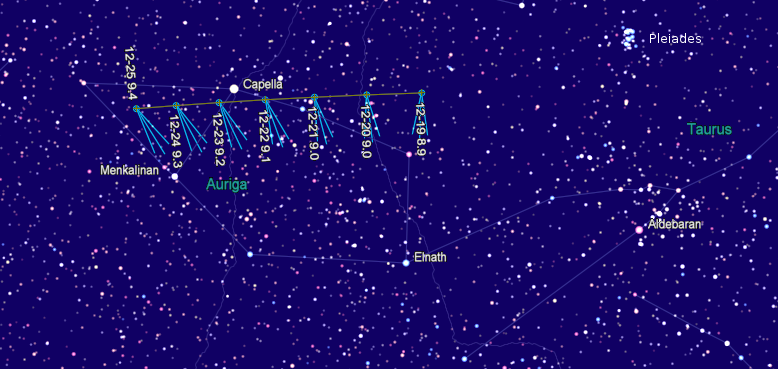
Comet 46P/Wirtanen positions for the next week in a bright moonlit sky. Positions are marked with month-date and magnitude. The observations are about 5.5 magnitudes brighter than shown here. Star field position is for 9 p.m. on the 19th. Click on the image to enlarge. Created using Cartes du Ciel (Sky Charts).
12/18/2018 – Ephemeris – My observations and what to expect from Comet Wirtanen
Ephemeris for Tuesday, December 18th. The Sun will rise at 8:15. It’ll be up for 8 hours and 48 minutes, setting at 5:03. The Moon, 3 days past first quarter, will set at 4:23 tomorrow morning.
This past weekend the skies finally cleared so I could see and photograph Comet Wirtanen at its brightest and closest to the Earth. The Moon was interfering and will be making the sky brighter until this next weekend. Also the Moon will be moving toward the comet, coming closest to it on the 20th. The comet is rapidly moving away from the Earth, so its brightness is dropping as the skies brighten. Last weekend I could not say that I saw it with the naked eye. It was visible in my 10X50 binoculars as a faint smudge. The comet had no discernible tail. Even though it’s living up to its magnitude estimates, the problem is that the comet’s brightness is spread over a large area, making its surface brightness so much less than a star of the same magnitude.
The times given are for the Traverse City/Interlochen area of Michigan. They may be different for your location.
Addendum
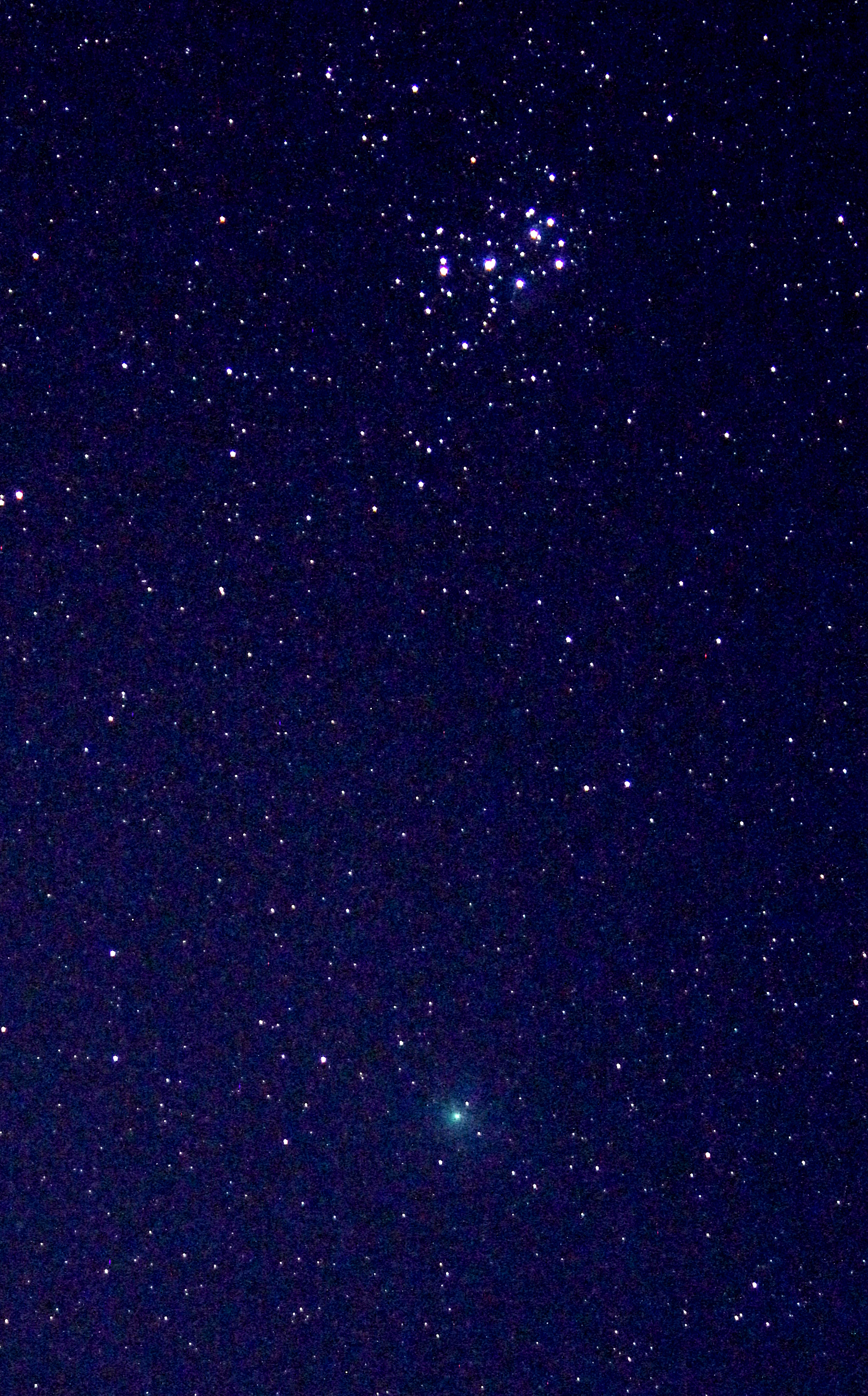
Comet Wirtanen below and the Pleiades above at 9:24 p.m. EST, December 14, 2018. Canon EOS Rebel T5, f/5.5, 30 second., ISO 3200, fl 55mm, tracking. I processed this image with GIMP. increasing the contrast and removing some of the moonlight. The greenish coma (head) is due to carbon (C2) emissions common in comets.
For more comet photographs go to http://spaceweather.com/.
12/17/2017 – Ephemeris – What is a Lagrange Point?
Ephemeris for Monday, December 17th. The Sun will rise at 8:14. It’ll be up for 8 hours and 48 minutes, setting at 5:03. The Moon, 2 days past first quarter, will set at 3:15 tomorrow morning. |
Newton’s law of gravitation allows for some gravitational equilibrium points around two bodies that orbit each other. Discovered in th 18th century by Leonhard Euler and Joseph-Louis Lagrange these are known as Lagrange or L points. There are five. L1 is between the two bodies. The L1 point between the Earth and Sun is a million miles sun-ward of the Earth, where we station solar observation satellites. L2 is a million miles in the other direction, where there are astronomy satellites looking anywhere but the Sun. The James Webb telescope will join them there. L3 is point on the other side of the Sun, for which no use has yet been found. L4 and L5 are 60 degrees ahead of and behind the Earth’s position in its orbit. These are quite stable. Jupiter has thousands of asteroids in its L4 and L5 locations called Trojan asteroids.
The times given are for the Traverse City/Interlochen area of Michigan. They may be different for your location.
Addendum
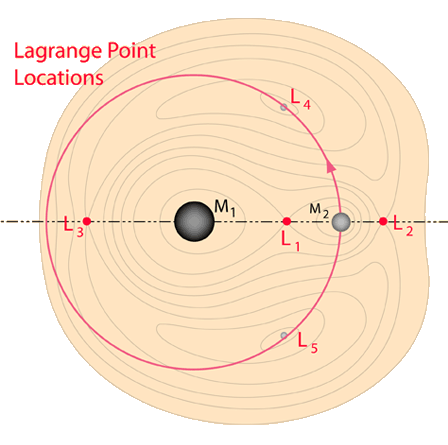
The 5 Lagrange points about two bodies M1 and M2 orbiting each other. Credit Georgia State University.
12/14/2018 – Ephemeris – Bright Comet Wirtanen will be easy to find this weekend
Ephemeris for Friday, December 14th. The Sun will rise at 8:12. It’ll be up for 8 hours and 50 minutes, setting at 5:02. The Moon, 1 day before first quarter, will set at 12:06 tomorrow morning.
This weekend is the best time to spot Comet Wirtanen. Not only is near its brightest, but it will be passing just to the left of the beautiful star cluster the Pleiades from below. Comet Wirtanen will appear as a fuzzy spot, possibly to the naked eye, but is best seen in binoculars. The near first quarter Moon will be a bother, and make the comet harder to spot. On the 12th the comet passed its closest to the Sun, called perihelion, about 4.6 million miles outside the Earth’s orbit. On the 16th, Sunday, it will pass closest to the Earth at 7.2 million miles, as the 10th closest comet passage in modern times. Wirtanen is a member of the Jupiter family of comets captured by and orbit maintained by the planet Jupiter.
The times given are for the Traverse City/Interlochen area of Michigan. They may be different for your location.
Addendum
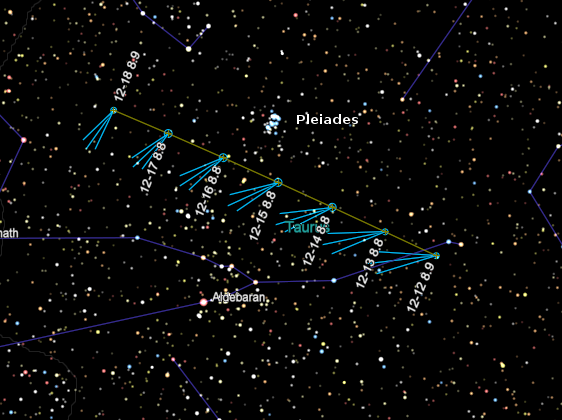
Comet 46P/Wirtanen positions for the next week. Positions are marked with month-date and magnitude. The latest magnitude prediction for December 15th is 3.3, 5.5 magnitudes brighter than shown here. Star field position is for 9 p.m. on the 12th. Click on the image to enlarge. Created using Cartes du Ciel (Sky Charts).
12/13/2018 – Ephemeris – The Geminid meteors will reach their peak numbers overnight
Ephemeris for Thursday, December 13th. The Sun will rise at 8:11. It’ll be up for 8 hours and 50 minutes, setting at 5:02. The Moon, 2 days before first quarter, will set at 11:05 this evening.
Tonight through the morning hours we will have the chance to see the peak of the Geminid meteor shower. The meteors will be most numerous tomorrow morning. This shower is currently besting the Perseid meteor shower of August with a predicted 120 meteors per hour at the peak. The problems for us in viewing this fabulous shower are the cold temperatures and usually cloudy skies. However the Moon will be a problem until it sets after 11 p.m. The source of the Geminids was discovered in 1983. It is a burnt out comet with the asteroid designation (3200) Phaethon which swoops down to only 13 million miles of the Sun, but last year passed only 6.4 million miles from Earth. The Geminids were first seen in 1862.
The times given are for the Traverse City/Interlochen area of Michigan. They may be different for your location.
Addendum
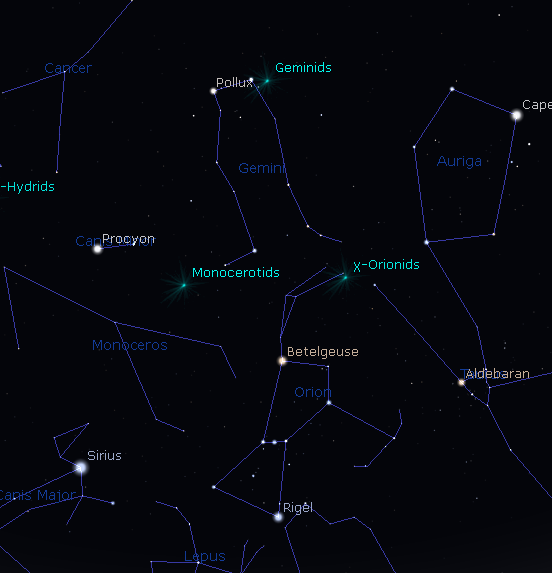
The area of the Geminid meteor shower radiant near the star Castor at 4 a.m. December 14, 2018. There are other very minor radiants that provide only a handful of meteors per hour. The Geminids will provide up to 120 meteors per hour. Created using Stellarium.

