Archive
11/28/2018 – Ephemeris – Bright planets and comets tonight
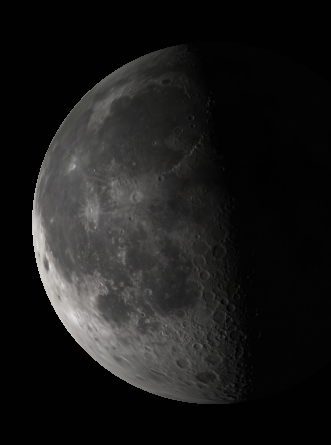
Ephemeris for Wednesday, November 28th. The Sun will rise at 7:56. It’ll be up for 9 hours and 8 minutes, setting at 5:04. The Moon, 1 day before last quarter, will rise at 11:05 this evening.
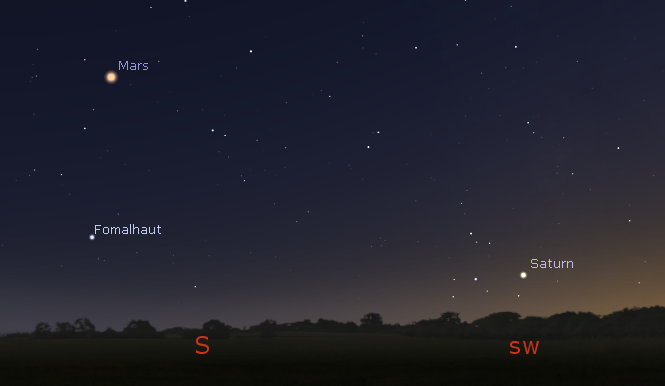
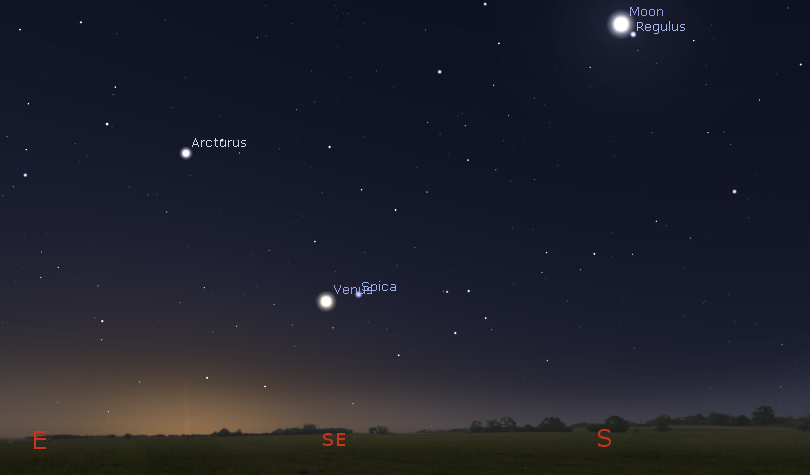
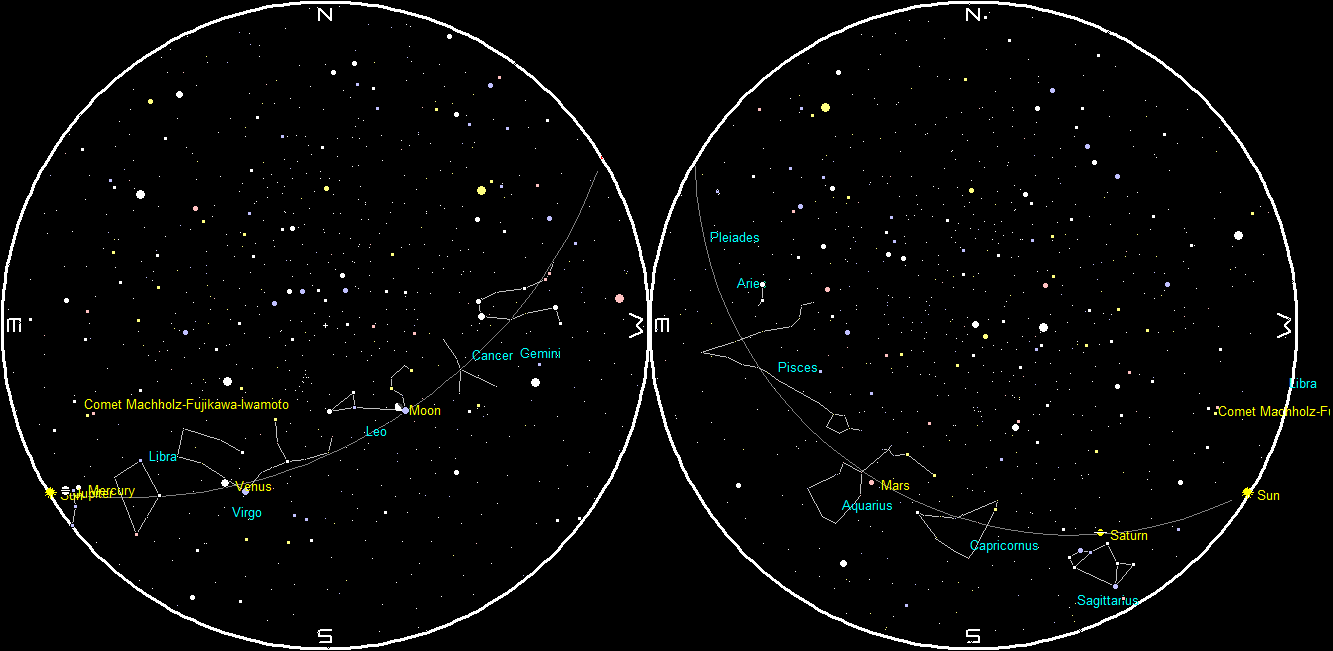
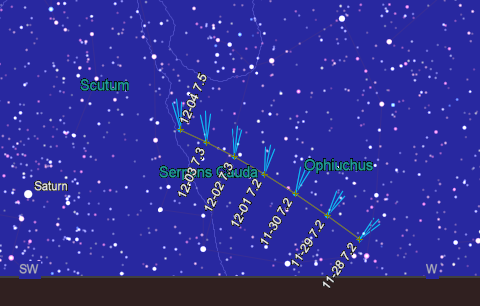
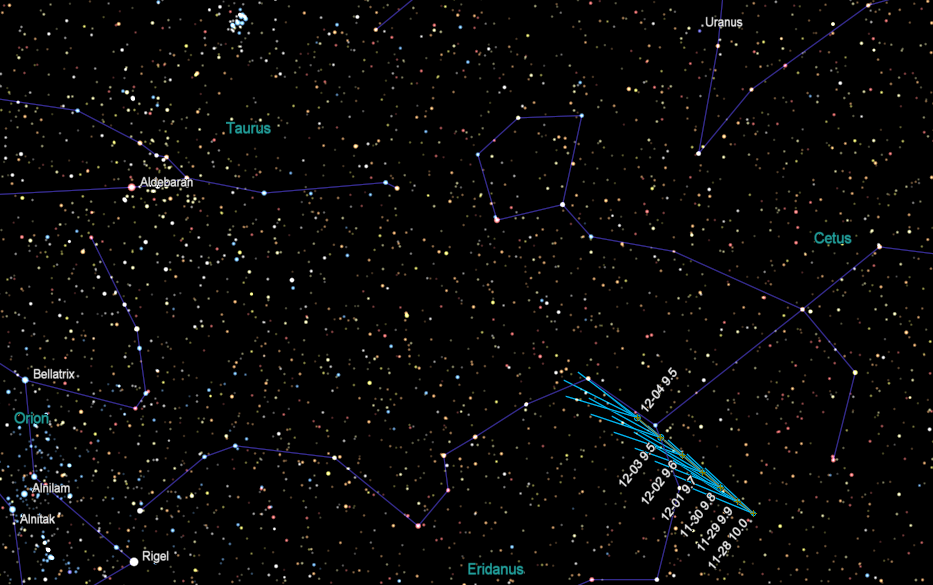
Let’s look at the bright planets for tonight. Two of them are visible in the evening sky. Saturn will be briefly visible very low in the southwestern sky and from about 6 p.m. and will set at 7:10 p.m. Mars will be in the south as the skies darken tonight. Mars will be due south at 6:52 p.m., and it will set at 12:17 a.m. Mars is moving eastward, crossing the constellation of Aquarius this month. It’s currently about midway through Aquarius, moving eastward and northward, so its setting time won’t change much over this month. Venus, our brilliant morning star, will rise at 4:33 a.m. in the east southeast. The blue-white star Spica is still to the right and a bit above it. There are two comets entering our sky. More on that tomorrow.
The times given are for the Traverse City/Interlochen area of Michigan. They may be different for your location.
Addenda
Planets and the Moon
Bright comets
11/27/2018 – Ephemeris – The beautiful Pleiades or Seven Sisters
Ephemeris for Tuesday, November 27th. The Sun will rise at 7:55. It’ll be up for 9 hours and 10 minutes, setting at 5:05. The Moon, 2 days before last quarter, will rise at 9:52 this evening.
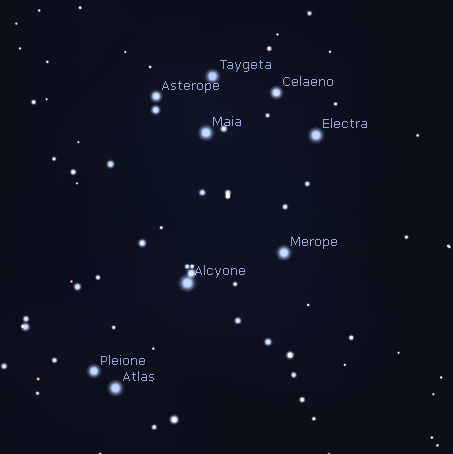
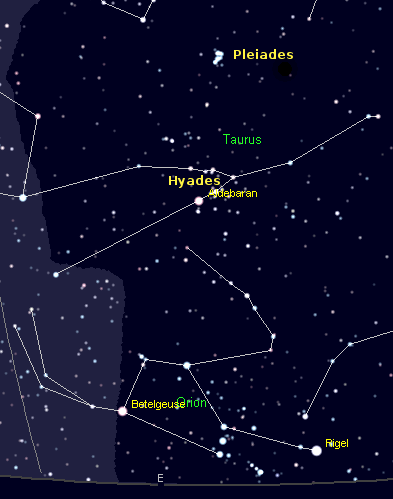
While I’ve mentioned the Pleiades with regard to its neighboring constellations several times this autumn I haven’t looked at this beautiful star cluster itself. The Pleiades appears as a group of six or seven stars visible to the naked eye, out of over a hundred stars, and is also known as the Seven Sisters. Some also mistake it for the Little Dipper, due to the little bowl shape in the center of the cluster. I call it the “tiny dipper”. The real Little Dipper is now hanging off Polaris in the north. There are a lot of stories about the Pleiades from many different cultures. From the Greek and Roman cultures we get our best known stories of them, that the seven sisters were the daughters of the god Atlas and Pleione. The 9 brightest stars bear the names of the sisters and their parents.
The times given are for the Traverse City/Interlochen area of Michigan. They may be different for your location.
Addendum
11/26/2018 – Ephemeris – NASA’s InSight spacecraft lands on Mars this afternoon
Ephemeris for Monday, November 26th. The Sun will rise at 7:54. It’ll be up for 9 hours and 11 minutes, setting at 5:05. The Moon, half way from full to last quarter, will rise at 8:43 this evening.
This afternoon NASA’s InSight spacecraft will land on Mars. It will drill into the martial soil to place a temperature probe to measure Mars’ heat flow to determine the interior temperature of Mars. It will also deploy a seismometer to detect marsquakes and seismic waves generated by meteorite impacts to ascertain the interior structure of the planet. The entry, decent and landing or EDL as it’s called begins at 2:47 p.m. Eastern Standard Time, with landing 6 minutes, 45 seconds later. The Jet Propulsion Laboratory calls it Seven Minutes of Terror. The spacecraft is on its own so everything has to go right. Mars is 8 light minutes away. The spacecraft will be on the ground one way or the other for over a minute by the time we get word that the spacecraft has entered the atmosphere of Mars. NASA-TV, available on the Internet, starts its coverage at 2 p.m. Eastern Standard Time.
The times given are for the Traverse City/Interlochen area of Michigan. They may be different for your location.
Addendum
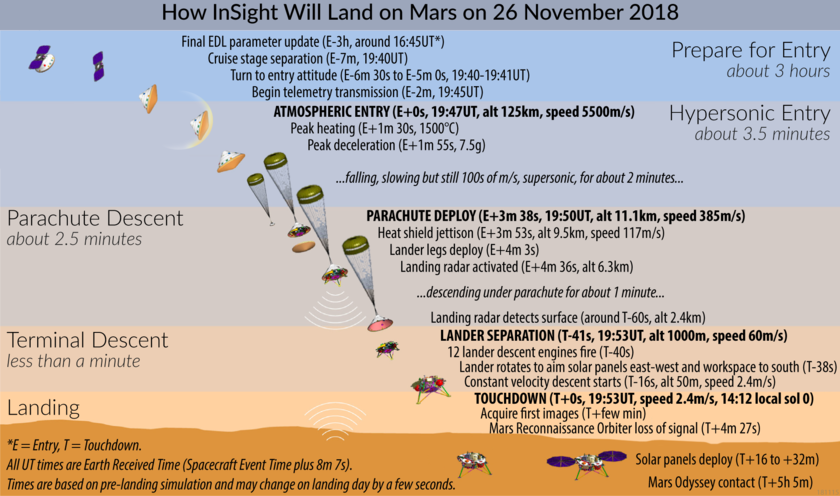
To see Emily’s post with a lot more information, click on this URL: http://www.planetary.org/blogs/emily-lakdawalla/2018/mars-insight-landing-preview.html. The post has a link to NASA’s 68 page pdf Mars InSight Landing Press Kit, which covers all aspects of entry, descent and landing, the Mars Insight components, and science instruments, and what they expect to learn about Mars’ interior.
11/23/2018 – Ephemeris – The Moon and Aldebaran
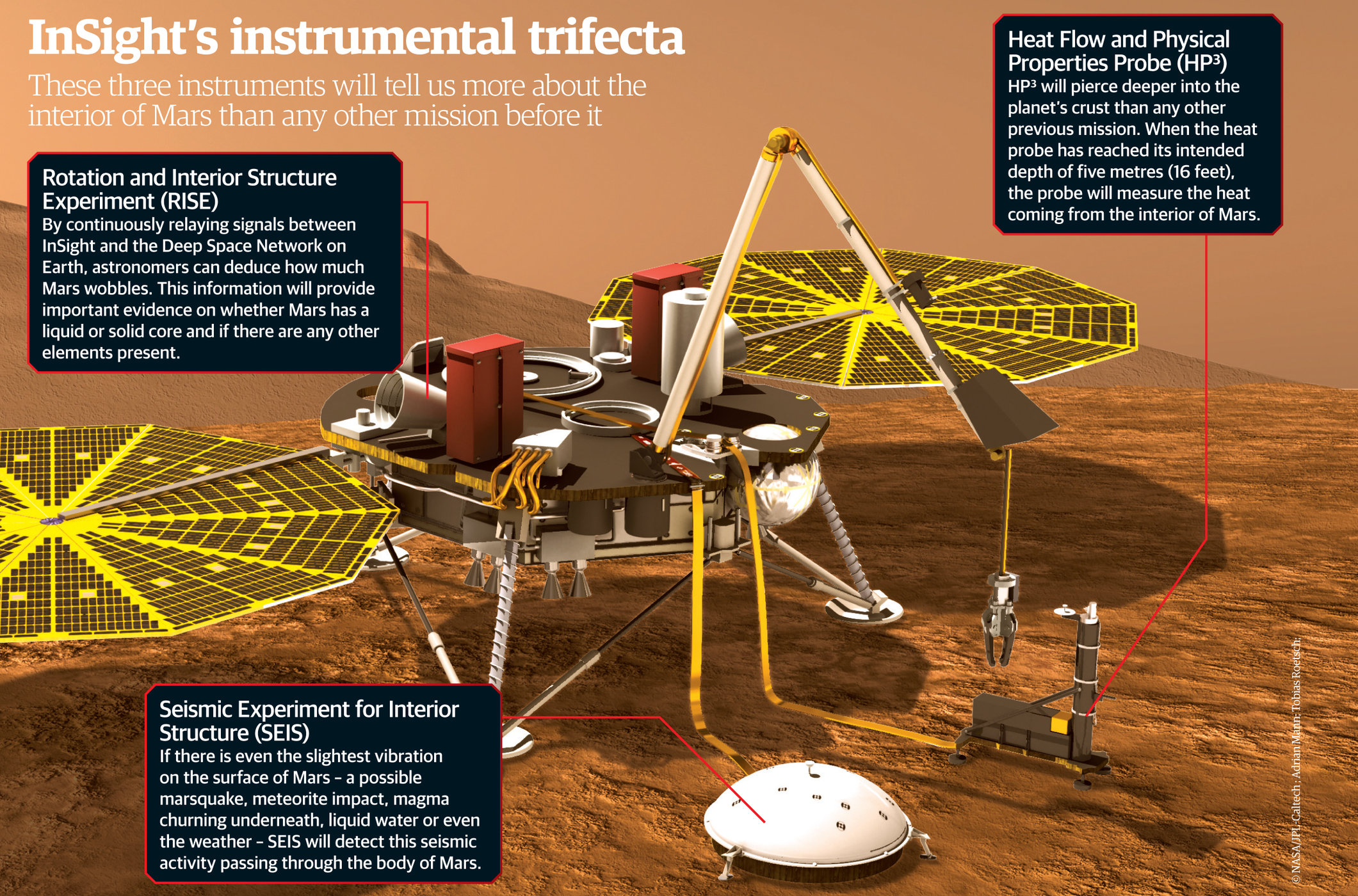
Ephemeris for Friday, November 23rd. The Sun will rise at 7:50. It’ll be up for 9 hours and 17 minutes, setting at 5:07. The Moon, at full today, will rise at 5:55 this evening.
Tonight’s full Moon will be accompanied by the bright star Aldebaran, the angry red eye of the constellation Taurus the Bull. Earlier this year we had the last of nearly two years of the Moon every month passing in front of Aldebaran. The tilt of the Moon’s orbit with respect to the Earth’s own orbit of the Sun slides slowly westward with time, so The Moon won’t pass in front of Aldebaran for those of us on Earth again until 2033. This sliding of the Moon’s orbit is called regression of the nodes. A node is where the Moon’s orbital plane crosses the Earth’s. These are places eclipses of the Sun and Moon occur if lined up with the full or new moons. Why regression? The nodal points are moving westward, backward of most motions in the solar system.
The times given are for the Traverse City/Interlochen area of Michigan. They may be different for your location.
Addendum
11/22/2018 – Ephemeris – The little goat star, Capella
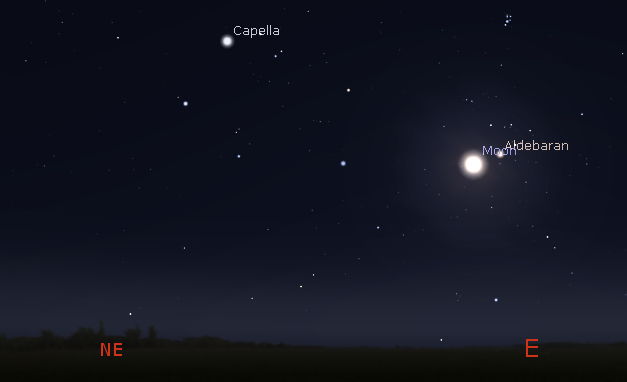
Ephemeris for Thanksgiving Day, Thursday, November 22nd. The Sun will rise at 7:49. It’ll be up for 9 hours and 19 minutes, setting at 5:08. The Moon, 1 day before full, will set at 7:59 tomorrow morning.
Capella is the northernmost first magnitude stars. Tonight it shines in the northeastern sky. First magnitude stars are the 21 brightest stars in the night sky. Capella is the 6th brightest. The name Capella means little goat, though I’ve always known it as the little she goat. Her three Kids are represented by a narrow triangle of stars positioned to the right of her in tonight’s evening sky, though they may be overpowered by the bright Moon tonight. Capella is in the topmost corner of the pentagonal constellation of Auriga the Charioteer. Capella is actually a system of four stars only 43 light years away. And never sets for listeners in the Interlochen Public Radio transmission area, though all bets are off if you’re listening over the Internet from somewhere else.
The times given are for the Traverse City/Interlochen area of Michigan. They may be different for your location.
Addendum
11/21/2018 – Ephemeris – The bright planets and two comets for this week
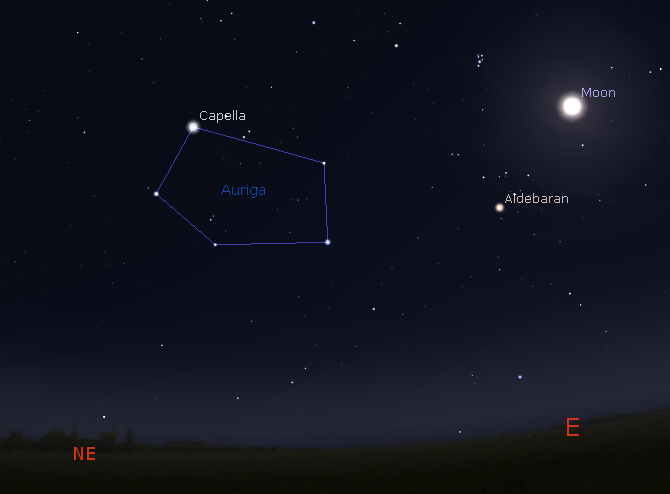
Ephemeris for Wednesday, November 21st. The Sun will rise at 7:47. It’ll be up for 9 hours and 21 minutes, setting at 5:09. The Moon, 2 days before full, will set at 6:47 tomorrow morning.
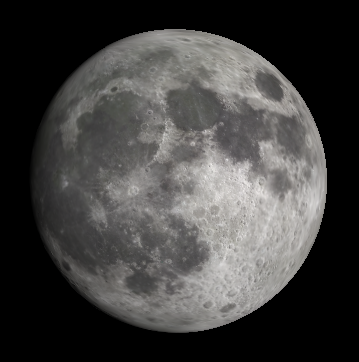
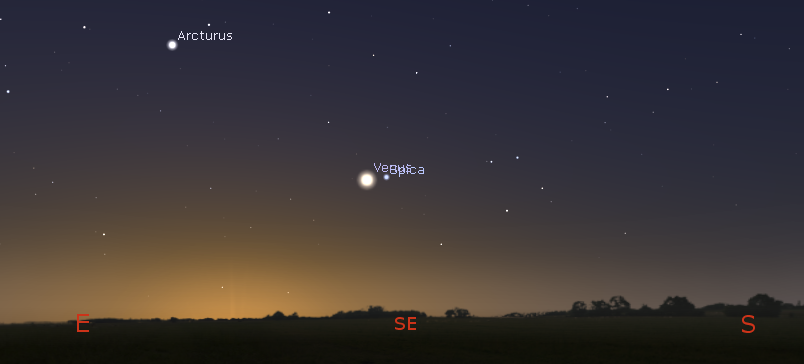
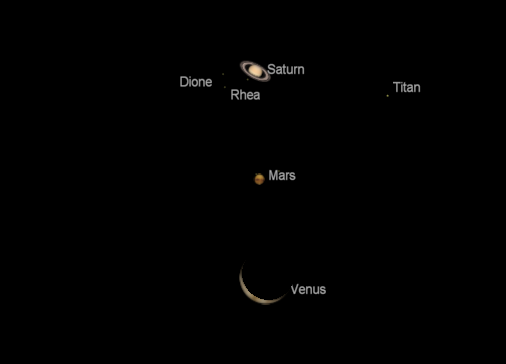
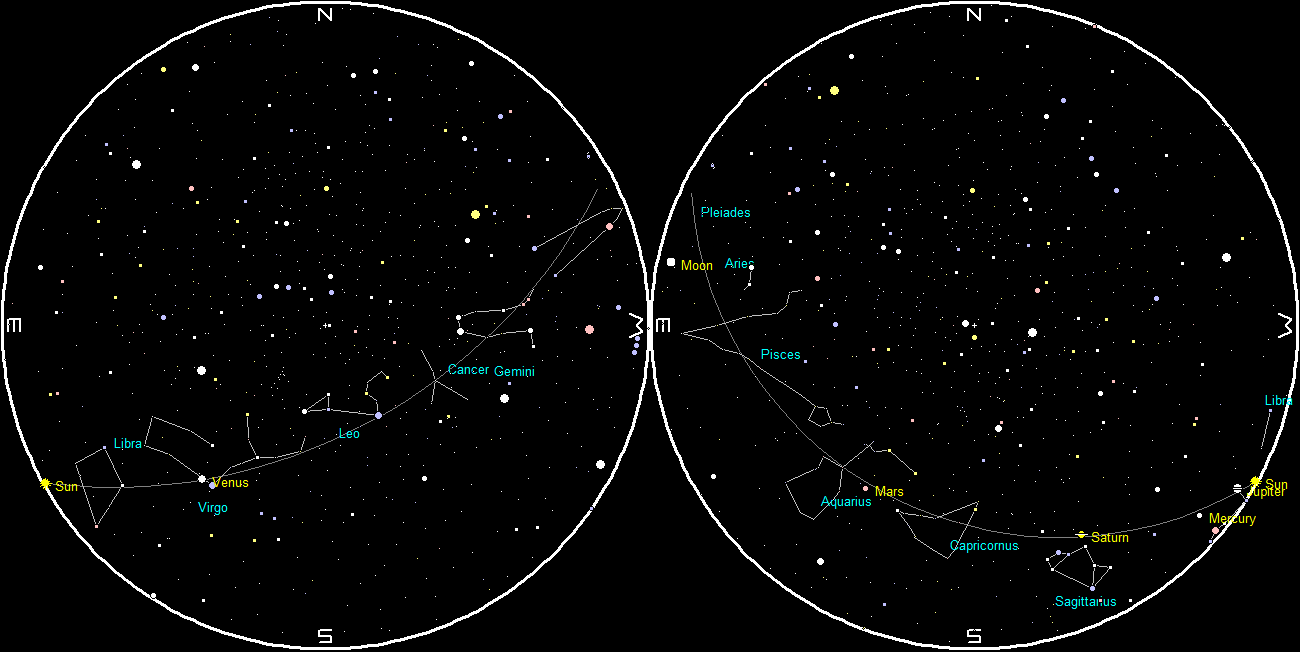
Let’s look at the bright planets for tonight. Two of them are visible in the evening sky. Jupiter is 5 days from passing behind the Sun, and will officially be a morning planet next Monday. Saturn, the ringed planet, will start the evening low in the southwestern sky and will set at 7:35 p.m. Mars will be in the south as the skies darken tonight. Mars will be due south at 7:03 p.m., and it will set at 12:20 a.m. Mars is moving eastward, crossing the constellation of Aquarius this month. It’s currently about midway through Aquarius, moving eastward and northward, so its setting time won’t change much over this month. Venus, our brilliant morning star, will rise at 4:50 a.m. in the east southeast. The blue-white star Spica is to the right and a bit above it.
The times given are for the Traverse City/Interlochen area of Michigan. They may be different for your location.
Addenda
Planets and the Moon
Click on images to enlarge
Current relatively bright comets
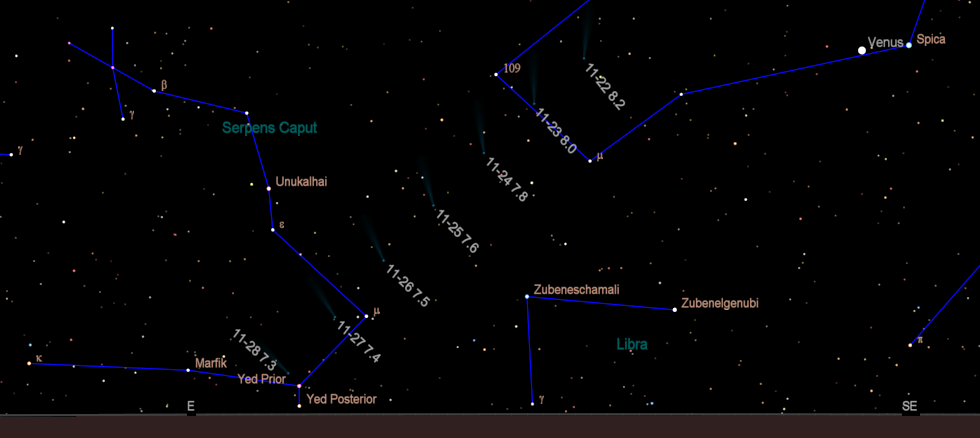
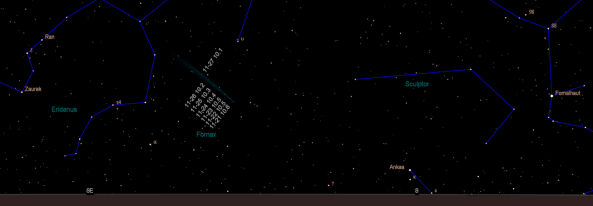
The new magnitude estimates are from Seiichi Yoshida’s website and his Weekly Information about Bright Comets: http://www.aerith.net/comet/weekly/current.html
11/20/2018 – Ephemeris – Barnard’s Star has a planet
Ephemeris for Tuesday, November 20th. The Sun will rise at 7:46. It’ll be up for 9 hours and 23 minutes, setting at 5:10. The Moon, 3 days before full, will set at 5:37 tomorrow morning.
One of the most fascinating stars in the sky is Barnard’s Runaway Star. That’s how I first knew it. It’s now simply Barnard’s Star. It has the largest motion of any star across the sky (proper motion) of 10.3 arcseconds per year. That’s about the current width of Mars right now in telescopes. The Sun and Moon are about eighteen hundred arcseconds in diameter. It was announced last week, that a planet has been discovered orbiting that star. The planet designated with a lower case b orbits the red dwarf star at a distance comparable to Mercury in our solar system with a period of 233 days. It is three and a quarter times the Earth’s mass. It was found because it changes the velocity of the stars’ approach by the human walking speed in those 233 days.
The times given are for the Traverse City/Interlochen area of Michigan. They may be different for your location.
Addendum
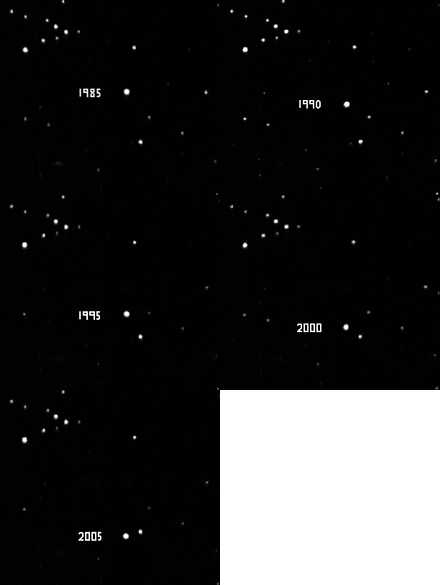
I recall back in the 1960’s astronomer Peter van de Kamp announced the discovery of a planet around Barnard’s Star. His technique was to spot little wiggles in the star’s path through the sky. Current methods to detect wiggles of the star use the Doppler method detecting the tiny change in the star’s radial velocity towards or away from us. Barnard’s Star b does not fit what van de Camp thought he detected.
The star gets its name from Edward Emerson Barnard ( 1857-1923) who discovered the star’s rapid proper motion.
On a local note Barnard’s great photographic work A Photographic Atlas of Selected Regions of the Milky Way was republished by my friend Gerold O. Dobek, Professor of Astronomy, Northwestern Michigan College and Director of its Joseph H. Rogers Observatory.
11/19/2018 – Ephemeris – The Leonids’ comet 55P/Tempel-Tuttle
Ephemeris for Monday, November 19th. The Sun will rise at 7:45. It’ll be up for 9 hours and 25 minutes, setting at 5:10. The Moon, half way from first quarter to full, will set at 4:29 tomorrow morning.
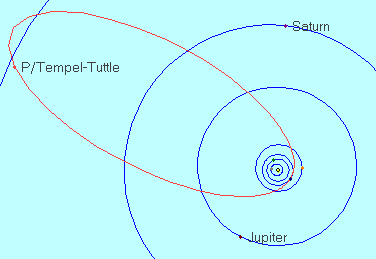
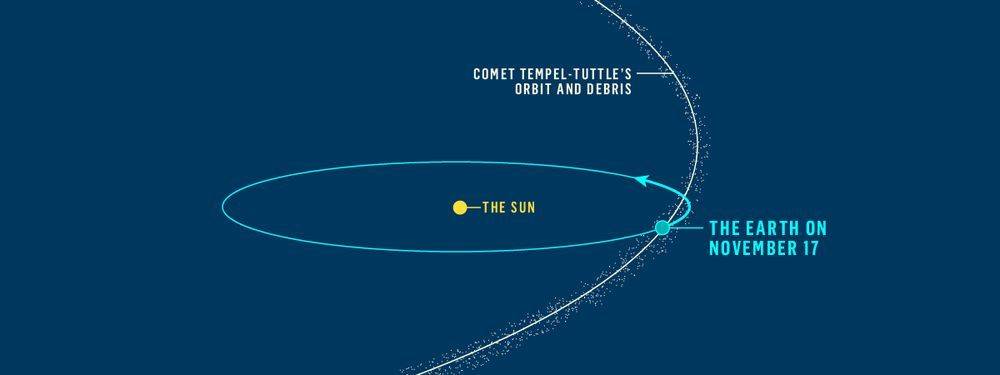
We have another day in this year’s extended Leonid meteor peak. In past years, usually every 33 years the Leonid meteors have a super peak, called a meteor storm, where thousands of meteors streak through the skies. These appear for a brief period over a rather small geographic area. In 1966 it occurred principally over the Rocky Mountains. The comet responsible is Comet Tempel Tuttle, independently discovered by two astronomers Tempel and Tuttle in 1865 & 1866. The comet had a 33 year orbit of the Sun, and its orbit crosses very close to the Earth’s orbit. Comets are notorious litter bugs, shedding gas, dust and pebble sized debris as they come close to the warming rays of the Sun.
The times given are for the Traverse City/Interlochen area of Michigan. They may be different for your location.
Addendum
11/16/2018 – Ephemeris – The Leonid meteor shower will have several peaks in the next few days
Ephemeris for Friday, November 16th. The Sun will rise at 7:41. It’ll be up for 9 hours and 32 minutes, setting at 5:13. The Moon, 1 day past first quarter, will set at 1:19 tomorrow morning.
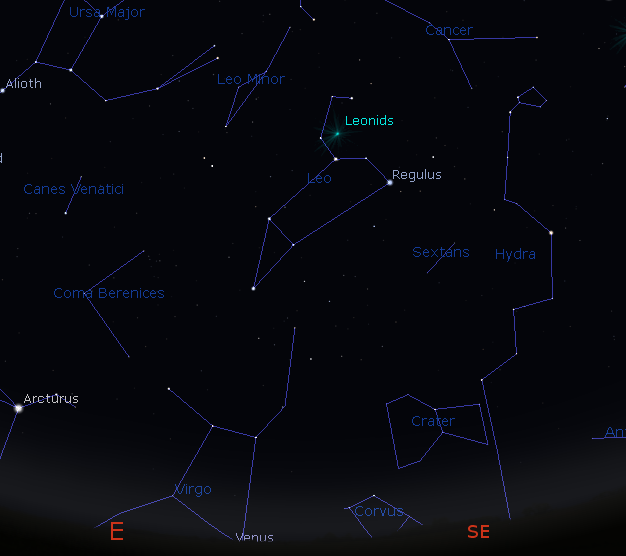
We are coming into an extended period where the Leonid meteor shower will be at its peak, or rather there is a chance of up to maybe four peaks as the Earth passes through the debris left by Comet Tempel-Tuttle on past trips through the inner solar system. We are having a pretty bright Moon now, but the best displays of the meteors are going to be occurring in the early morning hours after the Moon sets. The meteors will appear to come from the top of a backward question mark that is the head of the constellation Leo the lion. They will be seen all over the sky, but can be traced back to that point, if it’s a Leonid meteor. The Leonids are most numerous about every 33 years, which is about 15 years from now. Otherwise we get about 15 meteors an hour at peak.
The times given are for the Traverse City/Interlochen area of Michigan. They may be different for your location.
Addendum
11/15/2018 – Ephemeris – Last year’s interstellar visitor was acting funny
Ephemeris for Thursday, November 15th. The Sun will rise at 7:39. It’ll be up for 9 hours and 34 minutes, setting at 5:14. The Moon, at first quarter today, will set at 12:18 tomorrow morning.
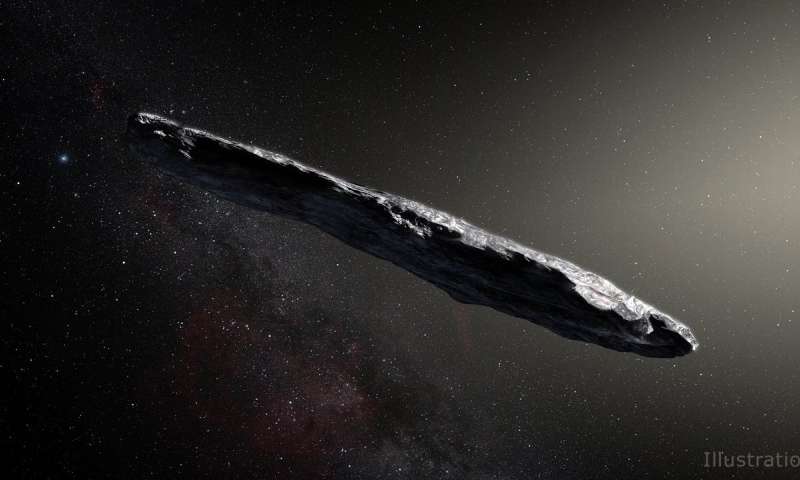
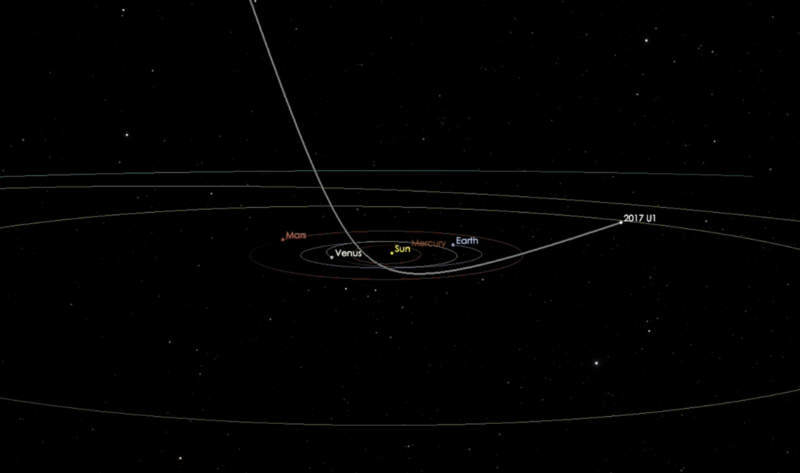
Last year about this time a fast moving asteroid with an odd cigar shape passed through the inner solar system. It’s velocity was such that it didn’t come from around here, meaning our solar system. It was named ‘Oumuamua by its discoverers in Hawai’i. It was spotted as it was heading out, away from the Sun. As it does so, it decelerates as the Sun’s gravitational pull tries to pull it back in. After studying its motion, astronomers noticed that it wasn’t decelerating as fast as it should if it was on a simple ballistic trajectory. Something about it was accelerating it, or causing it to not decelerate as fast as it should. Despite rampant speculation that it’s an interstellar craft on social media ‘Omuamua’s acceleration is well within that possible for comets.
The times given are for the Traverse City/Interlochen area of Michigan. They may be different for your location.
Addendum