Archive
11/14/2018 – Ephemeris – The bright planets this week
Ephemeris for Wednesday, November 14th. The Sun will rise at 7:38. It’ll be up for 9 hours and 37 minutes, setting at 5:15. The Moon, 1 day before first quarter, will set at 11:18 this evening.
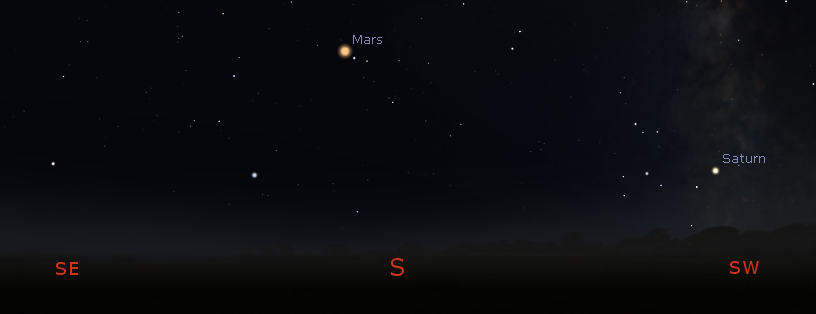
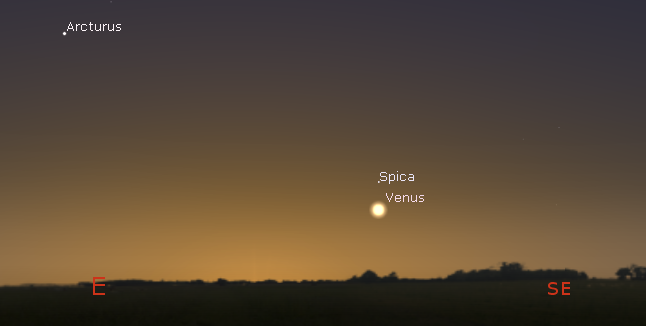
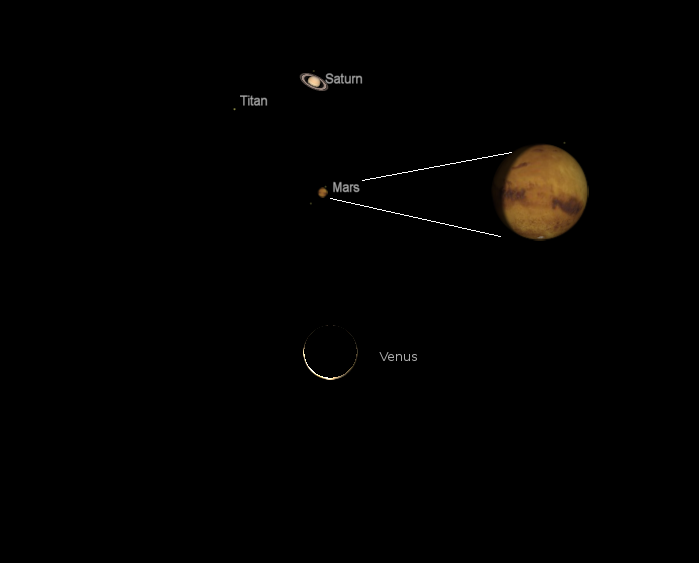
Let’s look at the bright planets for tonight. Two of them are visible in the evening sky. Jupiter will set too soon after sunset to be seen. It will set only 29 minutes after the Sun. Saturn, the ringed planet, will start the evening low in the southwestern sky and will set at 7:59 p.m. Mars will be low in the south as the skies darken tonight. Mars will be due south at 7:15 p.m., and it will set at 12:24 a.m. Mars is moving eastward, crossing the constellation of Aquarius this month. It’s currently at the western edge of Aquarius, moving eastward and northward, so its setting time won’t change much over this month. Venus, our brilliant morning star, will rise at 5:15 a.m. in the east southeast. The blue-white star Spica is just above and right of it now.
The times given are for the Traverse City/Interlochen area of Michigan. They may be different for your location.
Addenda
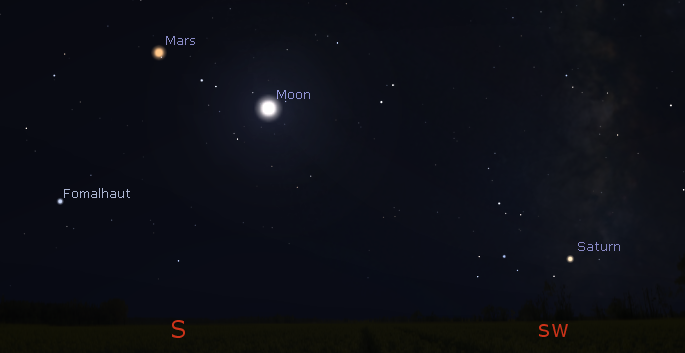
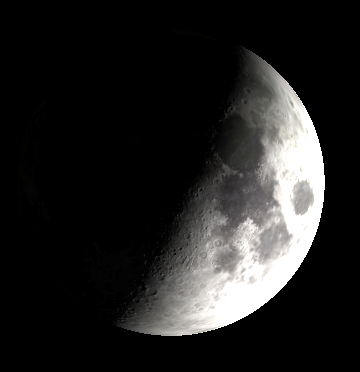
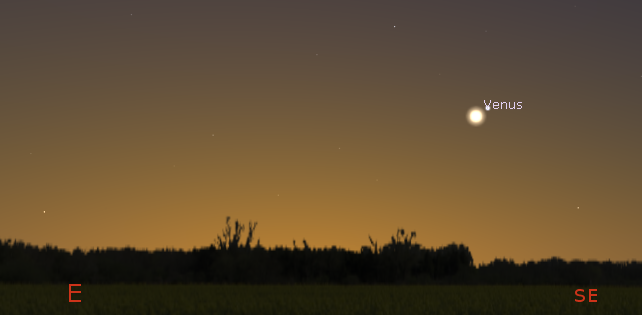
Comet Notes
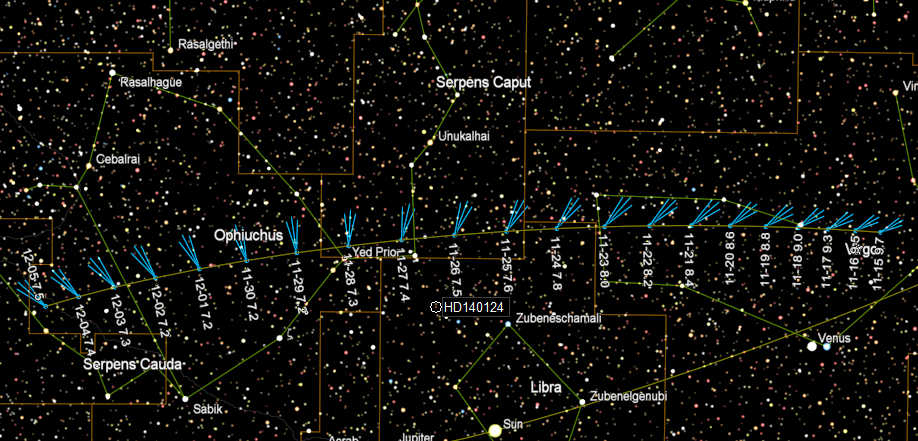
Two comets will be flirting with naked eye visibility later this month and next month. Newly discovered C/2018 V1 Machholz-Fujikawa-Iwamoto. It will be a morning object in mid-December and be its brightest at the end of this month or early December when it will be cruising through Ophiuchus.
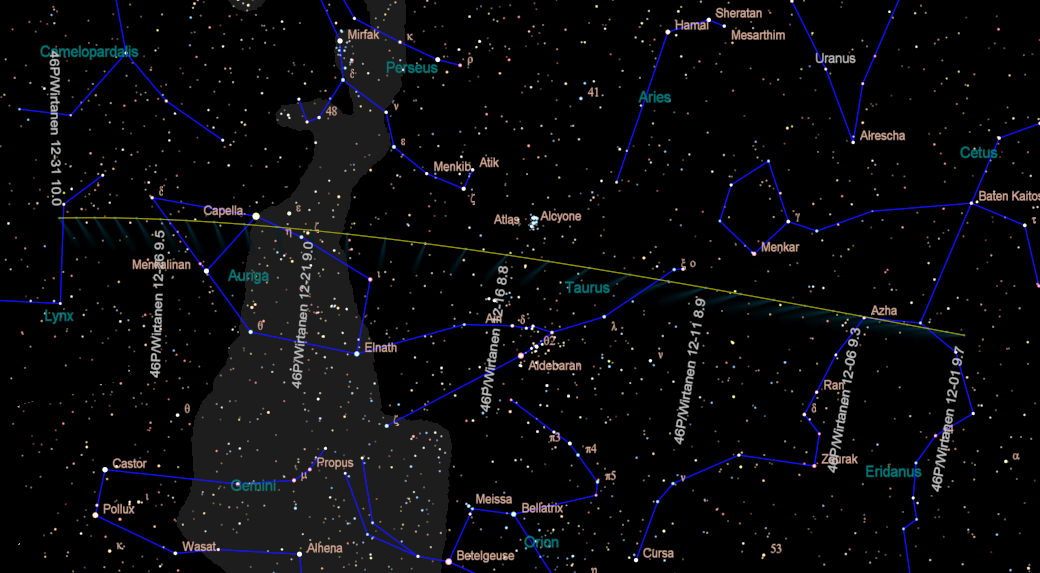
Periodic comet 46P/Wirtanen is moving up from the south and is an evening object. It will pass close to the Pleiades in mid-December and will appear near the bright star Capella around Christmas time.
11/13/2018 – Ephemeris – The Summer Triangle in autumn
Ephemeris for Tuesday, November 13th. The Sun will rise at 7:37. It’ll be up for 9 hours and 39 minutes, setting at 5:16. The Moon, 2 days before first quarter, will set at 10:20 this evening.
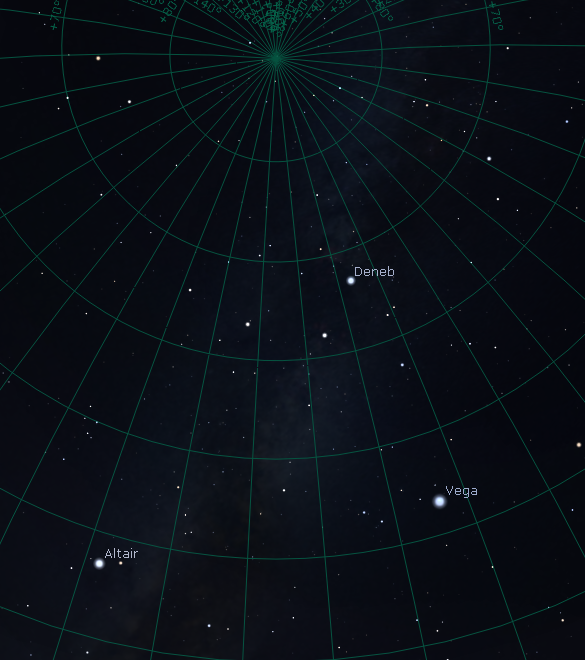
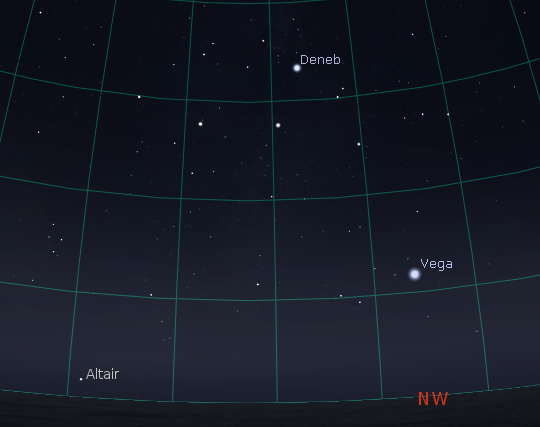
The Summer Triangle is still in the sky at 9 p.m., even though it’s November. These three bright stars that straddle the Milky Way are high in the east for most of the summer, move overhead and begin to slide to the west in autumn. We will lose Altair, the southernmost of the three stars at 9 p.m. on the winter solstice, December 21st. We’ll lose the brightest, Vega in January. For the northern half of the IPR listening area the northernmost of the triangle stars, Deneb won’t quite set below a north Lake Michigan horizon. Next spring we’ll be waiting and watching for these three stars to rise, reclaim the skies, and bring again the warm summer skies. The winter skies do however have more bright stars than the summer sky.
The times given are for the Traverse City/Interlochen area of Michigan. They may be different for your location.
Addendum
11/12/2018 – Ephemeris – Orion is rising
Ephemeris for Veterans Day Observed, Monday, November 12th. The Sun will rise at 7:35. It’ll be up for 9 hours and 41 minutes, setting at 5:17. The Moon, 3 days before first quarter, will set at 9:25 this evening.
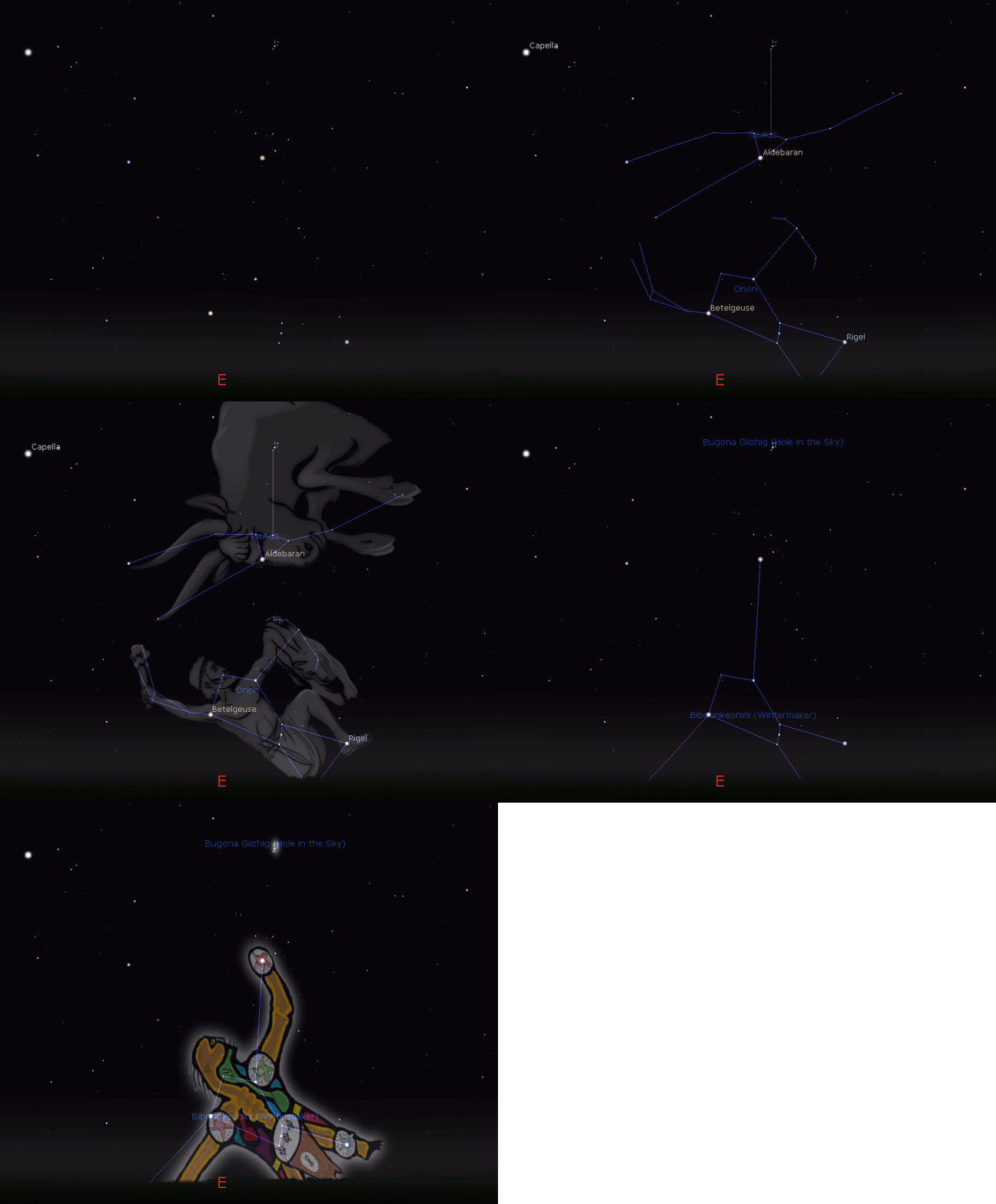
Just after the Moon sets tonight winter’s most dazzling constellation will be rising, Orion the hunter of Greek myth. The stars of his torso are in a rectangle leaning to the left. Orion’s belt of three stars in a straight line in the center of the rectangle is nearly vertical. The Anishinaabe peoples whose region we live in see the constellation of the Wintermaker rather than Orion. It uses Orion’s torso and belt stars, but his arms are spread wide from Aldebaran in the face of Taurus the bull to the west to Procyon in Canis Minor, which won’t rise until 11 p.m. to the east. The Wintermaker’s arms are wide enough to embrace the entire winter sky. Its name in Anishinaabemowin, which is Biboonikeonini, means “North Wind”.
The times given are for the Traverse City/Interlochen area of Michigan. They may be different for your location.
11/09/2018 – Ephemeris – The Great Andromeda Galaxy
Ephemeris for Friday, November 9th. The Sun will rise at 7:31. It’ll be up for 9 hours and 49 minutes, setting at 5:21. The Moon, 2 days past new, will set at 7:03 this evening.
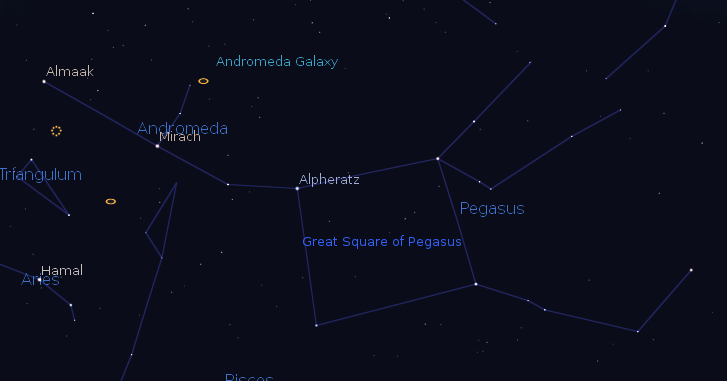
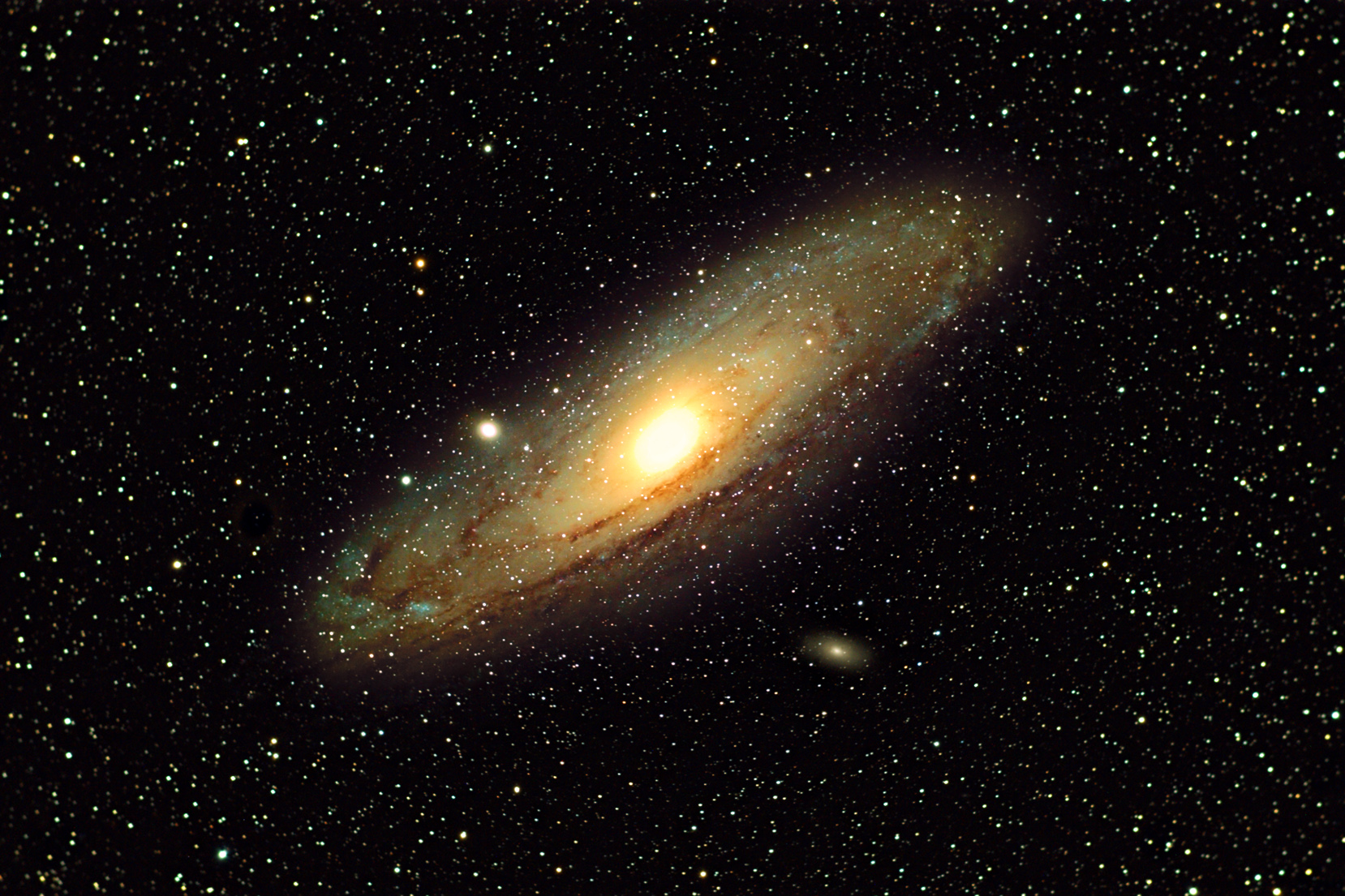
In the south at 9, this evening can be found a large square of stars, the Great Square of Pegasus the flying horse, flying upside down to the right. What looks like its hind legs stretching to the left from the upper left corner star is another constellation, Andromeda the chained princess. She is seen in the sky as two diverging curved strings of stars that curve upward. She was rescued by the hero Perseus, a nearby constellation, riding Pegasus. Andromeda’s claim to astronomical fame is the large galaxy seen with the unaided eye just above the upper line of stars. The Great Andromeda Galaxy is 2.5 million light years away. To the naked eye the galaxy appears as a small smudge of light. In binoculars the galaxy is a delicate spindle of light.
The times given are for the Traverse City/Interlochen area of Michigan. They may be different for your location.
Addendum
11/08/2018 – Ephemeris – More constellations of autumn: Andromeda, Triangulum and Aries
Ephemeris for Thursday, November 8th. The Sun will rise at 7:30. It’ll be up for 9 hours and 51 minutes, setting at 5:22. The Moon, 1 day past new, will set at 6:26 this evening.
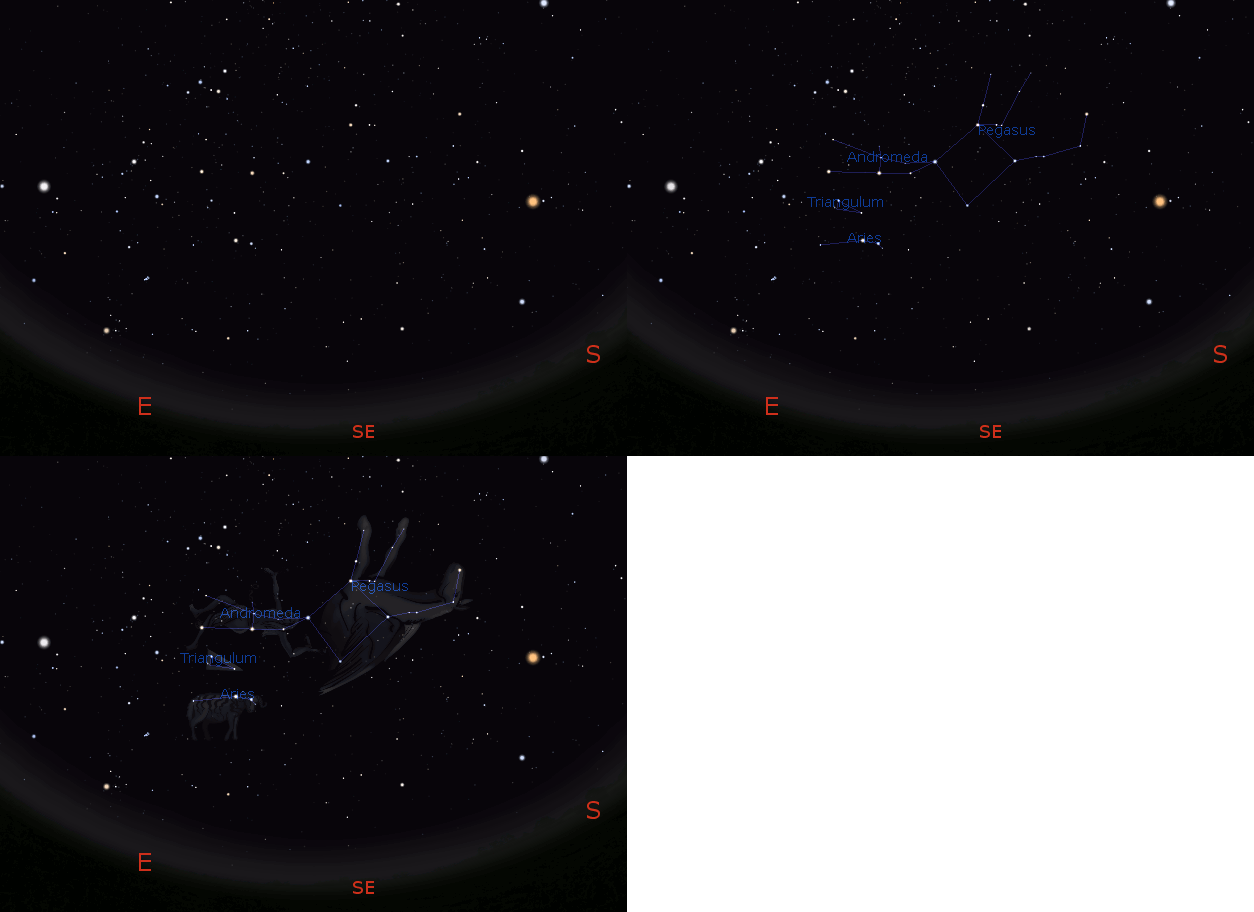
High in the south at 9 p.m. can be seen the Great Square of Pegasus. From the top left star of the square diverge two curved lines of stars that is Andromeda the chained princess. Just below and left of Andromeda is a slender triangle of stars, none particularly bright. It has a name you can easily see in the stars, Triangulum, the triangle. Early Christians saw it as the Mitre of Saint Peter or the Trinity. Another small constellation seen below Triangulum is the much better known constellation Aries the ram, a small hockey stick of a constellation, not that hard to spot. It is the first constellation of the Zodiac, where the Sun is supposed to enter on the first day of spring. Due to the wobble of the Earth’s axis over the millenia, that honor is now given to Pisces.
The times given are for the Traverse City/Interlochen area of Michigan. They may be different for your location.
Addendum
11/07/2018 – Ephemeris – Two Two evening planets and a morning planet visible now
Ephemeris for Wednesday, November 7th. The Sun will rise at 7:28. It’ll be up for 9 hours and 54 minutes, setting at 5:23. The Moon is new today, and won’t be visible.
Let’s look at the bright planets for tonight. Two of them are visible in the evening sky. Jupiter will set too soon after sunset to be seen. It will set only 44 minutes after the Sun. Saturn, the ringed planet, will start the evening low in the southwestern sky and will set at 8:24 p.m. Mars will be low in the south as the skies darken tonight. and is now 77.8 million miles (125.2 million km) away. Mars will be due south at 7:26 p.m., and it will set at 12:28 a.m. Mars is moving eastward, crossing the constellation of Aquarius this month. It’s currently at the western edge of Aquarius. Venus, now the brilliant morning star, will rise at 5:57 in the east southeast. It will grace our morning skies through next spring.
The times given are for the Traverse City/Interlochen area of Michigan. They may be different for your location.
Addendum
11/06/2018 – Ephemeris – The Taurid meteor showers
Ephemeris for Election Day, Tuesday, November 6th. The Sun will rise at 7:27. It’ll be up for 9 hours and 57 minutes, setting at 5:24. The Moon, 1 day before new, will rise at 7:09 tomorrow morning.
We are in the midst of two showers of meteors that seen to come from the constellation of Taurus the bull. These are the Southern and Northern Taurids respectively. They only produce a handful of meteors per hour, but there seems to be some discrepancy in their peak dates. The International Meteor Organization has the Southern group peak October 10th. Other sources have it peak November 5th. The Northern group peaks on the 10th or 12th of November depending on the source. Anyway these are bits shed by Comet 2P/Encke, which has only a 3 year orbit of the Sun. Encke’s orbit also comes close to the Earth’s orbit where the Earth is at the end of June. I’ve always wondered if it was a piece of Encke’s nucleus that hit Siberia on June 30, 1908?
The times given are for the Traverse City/Interlochen area of Michigan. They may be different for your location.
Addendum
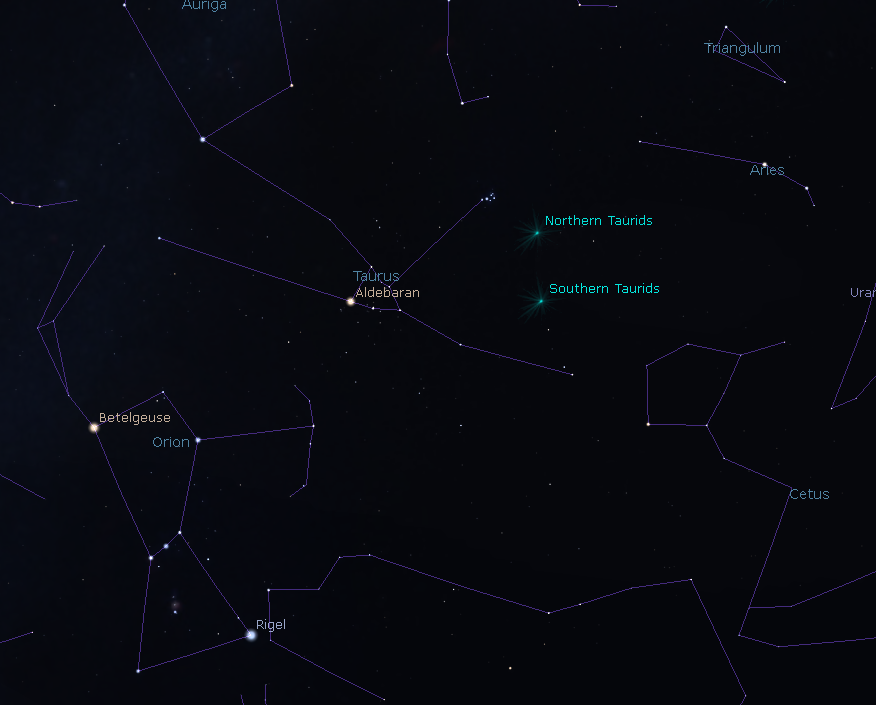
The radiants are not as nearly defined as shown here
11/05/2018 – Ephemeris – Cassiopeia the Queen
Ephemeris for Monday, November 5th. The Sun will rise at 7:26. It’ll be up for 9 hours and 59 minutes, setting at 5:26. The Moon, 2 days before new, will rise at 6:00 tomorrow morning.
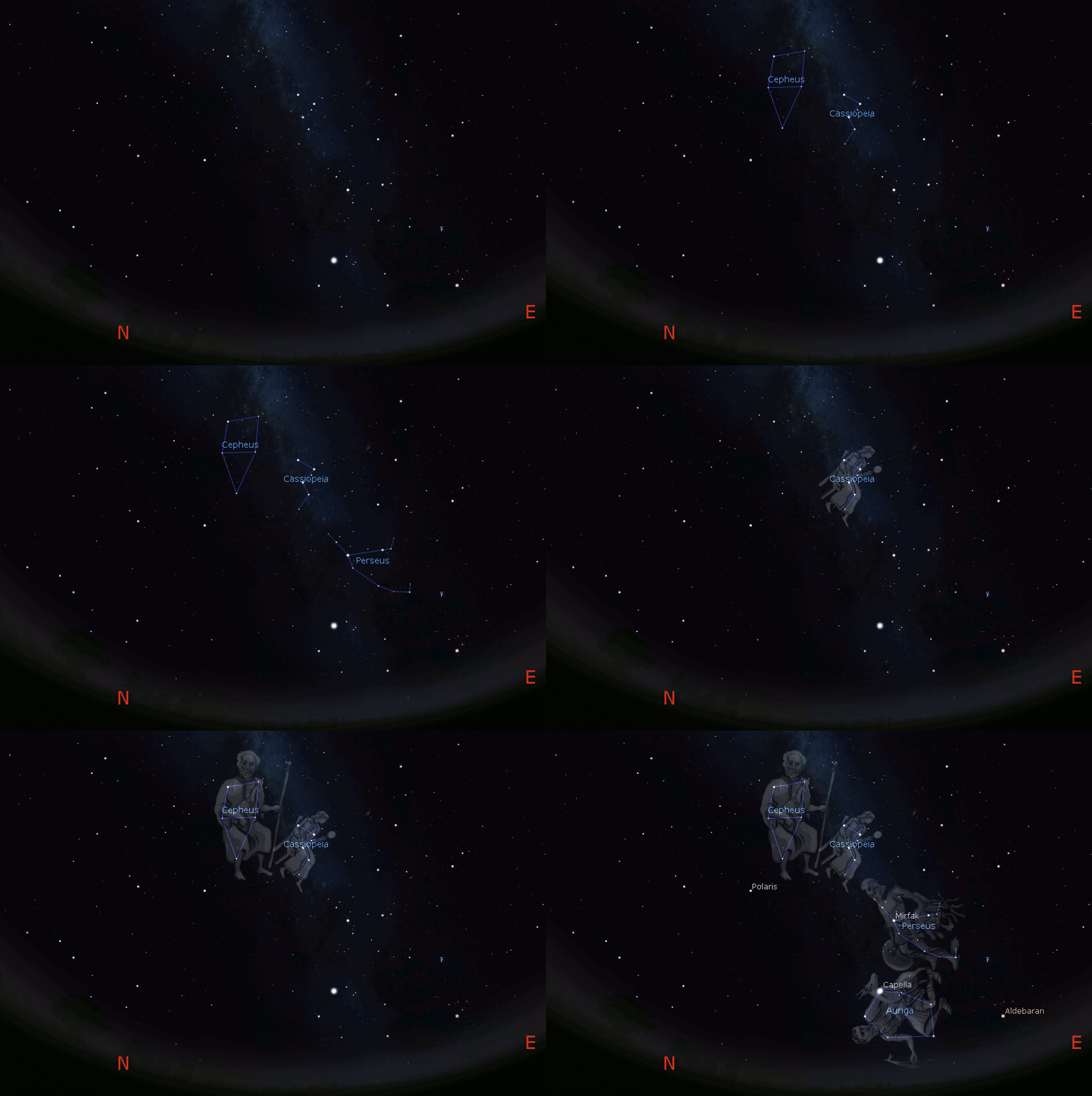
The stars of the autumn skies are replacing the summer stars from the east. Look in the northeastern sky by 7 p.m. and you can find the W shaped constellation of Cassiopeia the queen. Cassiopeia is so far north that it never sets for us in Michigan. It is opposite the pole star Polaris from the Big Dipper. There’s a dim star that appears above the middle star of the W which turns it into a very crooked backed chair, Cassiopeia’s throne. Above and left of Cassiopeia is a dim upside down church steeple shaped constellation of Cepheus the king, her husband. The Milky Way flows through Cassiopeia toward the northeastern horizon and through the constellation of Perseus the hero, which kind of looks, to me anyway, like the cartoon roadrunner.
The times given are for the Traverse City/Interlochen area of Michigan. They may be different for your location.
Addendum
11/02/2018 – Ephemeris – Back to basics tonight at the GTAS meeting
Ephemeris for Friday, November 2nd. The Sun will rise at 8:22. It’ll be up for 10 hours and 7 minutes, setting at 6:30. The Moon, 2 days past last quarter, will rise at 3:27 tomorrow morning.
Tonight at this month’s meeting of the Grand Traverse Astronomical Society at 8 p.m. at Northwestern Michigan College’s Rogers observatory we will get back to basics for anyone wondering about the skies visible from one’s backyard. Learn the constellations by building your own star finder that shows where the stars are any night of the year. We’ll also show you how to use it. We will let you experiment with moon-balls, that will show the light and shadow of the Moon’s phases. Afterward, if it’s clear you’ll have a chance to use those star finders during the observation period starting around 9 p.m. The observatory is south of Traverse City, on Birmley Road, between Garfield and Keystone roads.
The times given are for the Traverse City/Interlochen area of Michigan. They may be different for your location.
11/01/2018 – Ephemeris – November preview
Ephemeris for Thursday, November 1st. The Sun will rise at 8:20. It’ll be up for 10 hours and 10 minutes, setting at 6:31. The Moon, 1 day past last quarter, will rise at 2:14 tomorrow morning.
Let’s look ahead at the skies for the month of November. The Sun is still moving south rapidly. Daylight hours in the Interlochen/Traverse City area and will drop from 10 hours and 10 minutes today to 9 hours 5 minutes on the 30th. The altitude, or angle, of the Sun above the southern horizon at local noon will be at 30 degrees today and will descend to 23 and a half degrees on the 30th. The altitude of the Sun in the Straits area will be a degree lower. Local noon, this month, will be about 12:30 p.m. once we’re on standard time. The Leonid meteor shower will reach multiple peaks from the 16th through the 21st and is expected to be lackluster and may only produce 10 to 15 meteors per hour. But the Leonids can be surprising.
The times given are for the Traverse City/Interlochen area of Michigan. They may be different for your location.
Addendum
November Evening Star Chart
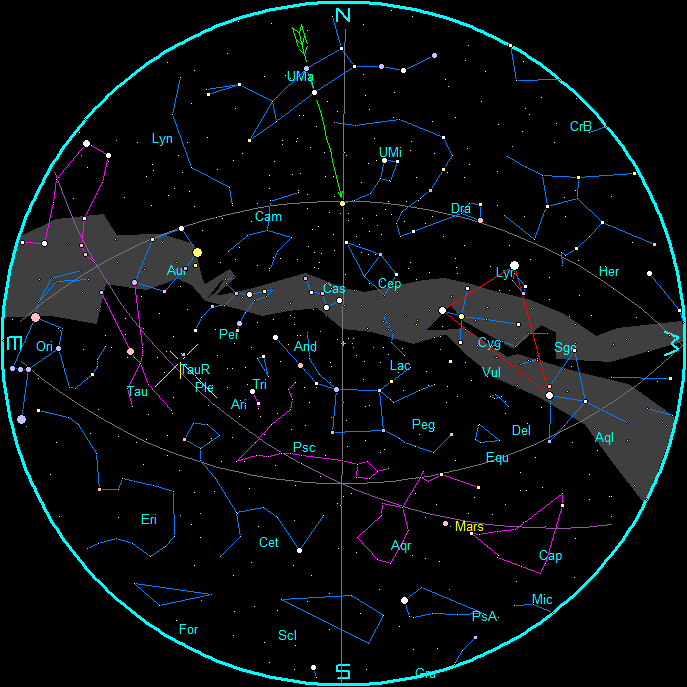
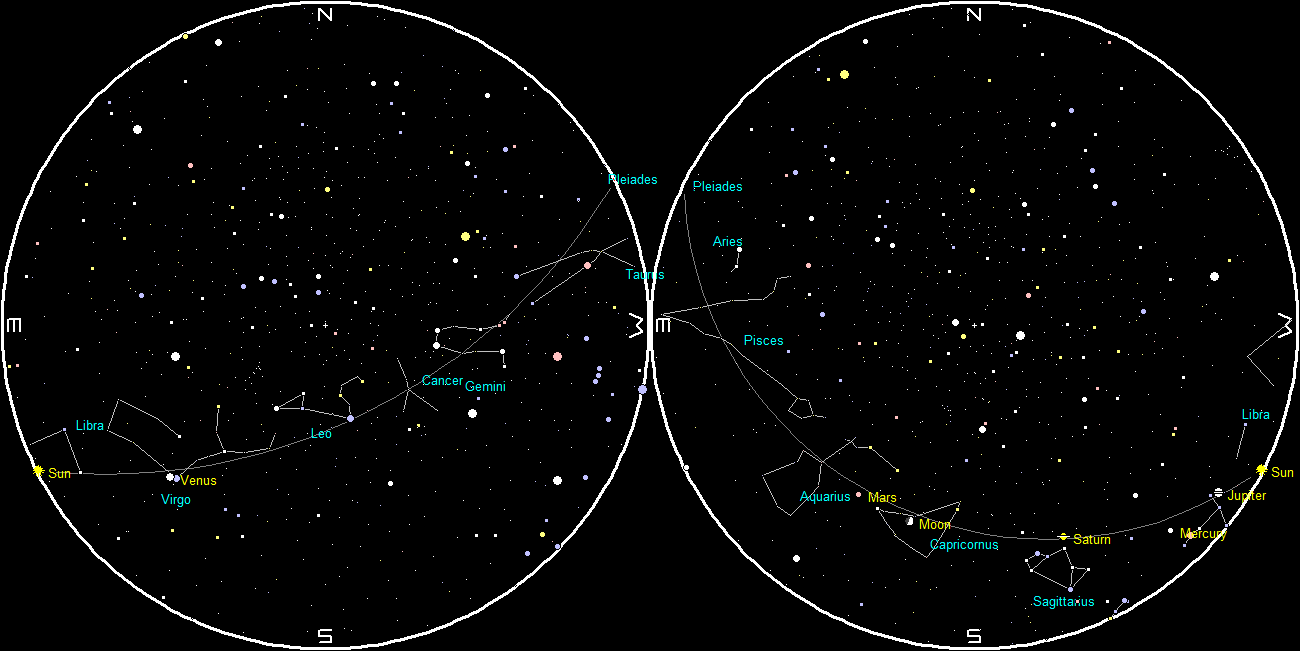
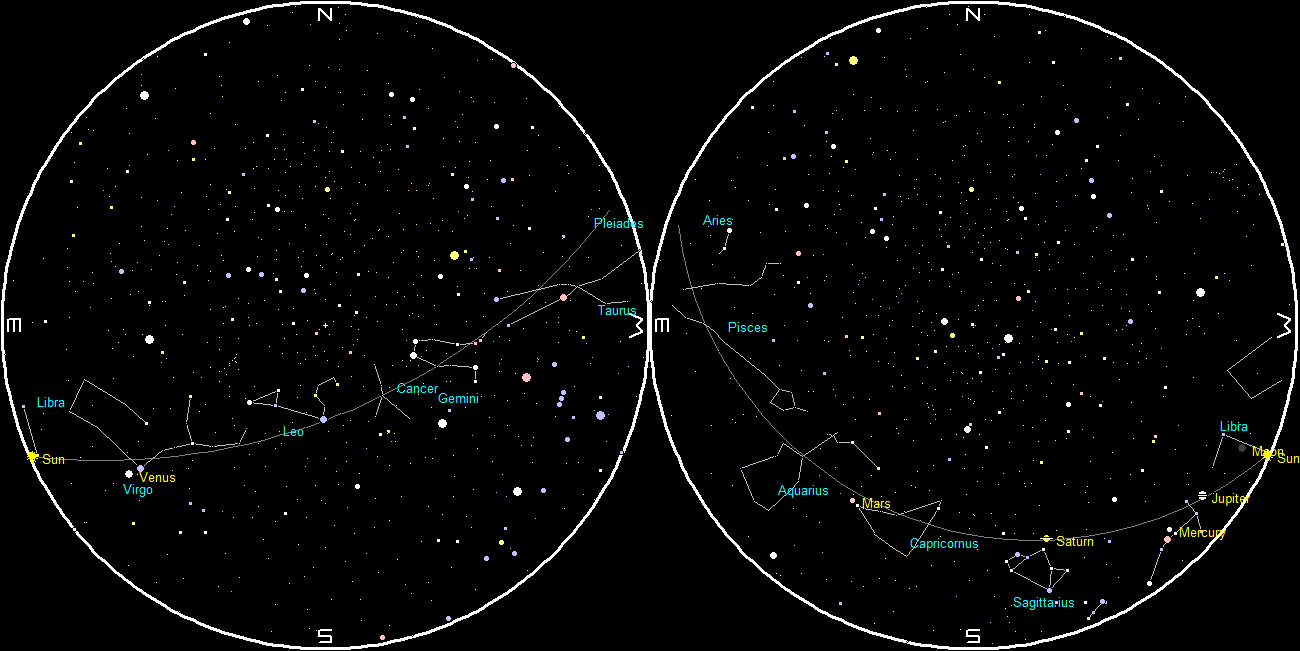
The planets and stars are plotted for the 15th at 9 p.m. EST in the evening and 6 a.m. for the morning chart. These are the chart times. Note that Traverse City is located approximately 45 minutes behind our time meridian. (An hour 45 minutes behind our daylight saving time meridian during EDT). To duplicate the star positions on a planisphere you may have to set it to 1 hour 45 minutes earlier than the current time.
Note the chart times of 9 p.m. and 6 a.m. are for the 15th. For each week before the 15th add ½ hour (28 minutes if you’re picky). For each week after the 15th subtract ½ hour. The planet positions are updated each Wednesday on this blog. For planet positions on dates other than the 15th, check the Wednesday planet posts on this blog.
November Morning Star Chart
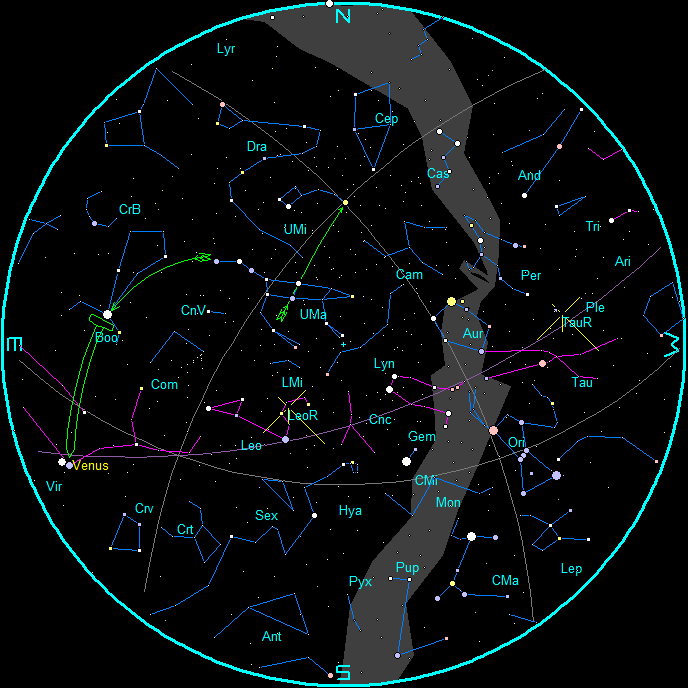
Star Chart for November moprnings 2018 (6 a.m. EST November 15, 2018). Created using my LookingUp program. Click on image to enlarge. The original morning chart uploaded November 1st was outdated. This corrected chart was uploaded November 6th.
For a list of constellation names to go with the abbreviations click here.
- Pointer stars at the front of the bowl of the Big Dipper point to Polaris the North Star.
- Follow the arc of the handle of the Big Dipper to the star Arcturus
- The Summer Triangle is in red.
- TauR on the evening star chart can be used as the radiant for the North and South Taurid meteor showers.
- LeoR on the morning star chart is the radiant of the Leonid meteor shower which peaks between the 16th to 21st.
Twilight
| Time zone=EDT | |||||||
| Morning twilight | Evening twilight | Dark night | Moon | ||||
| Date | Astronomical | Nautical | Nautical | Astronomical | Start | End | Illum. |
| 2018-11-01 | 6h47m | 7h21m | 19h39m | 20h13m | 20h13m | 1h02m | 0.41 |
| 2018-11-02 | 6h48m | 7h22m | 19h38m | 20h12m | 20h12m | 2h14m | 0.29 |
| 2018-11-03 | 6h49m | 7h23m | 19h37m | 20h11m | 20h11m | 3h27m | 0.19 |
| 2018-11-04 | 5h50m | 6h24m | 18h36m | 19h10m | 19h10m | 3h39m | 0.11 |
| 2018-11-05 | 5h52m | 6h26m | 18h34m | 19h08m | 19h08m | 4h50m | 0.05 |
| 2018-11-06 | 5h53m | 6h27m | 18h33m | 19h07m | 19h07m | 5h53m | 0.01 |
| 2018-11-07 | 5h54m | 6h28m | 18h32m | 19h06m | 19h06m | 5h54m | 0.00 |
| 2018-11-08 | 5h55m | 6h29m | 18h31m | 19h05m | 19h05m | 5h55m | 0.01 |
| 2018-11-09 | 5h56m | 6h30m | 18h30m | 19h04m | 19h04m | 5h56m | 0.05 |
| 2018-11-10 | 5h57m | 6h32m | 18h29m | 19h03m | 19h46m | 5h57m | 0.10 |
| 2018-11-11 | 5h59m | 6h33m | 18h28m | 19h02m | 20h33m | 5h59m | 0.17 |
| 2018-11-12 | 6h00m | 6h34m | 18h27m | 19h01m | 21h25m | 6h00m | 0.26 |
| 2018-11-13 | 6h01m | 6h35m | 18h26m | 19h00m | 22h20m | 6h01m | 0.35 |
| 2018-11-14 | 6h02m | 6h36m | 18h25m | 19h00m | 23h18m | 6h02m | 0.44 |
| 2018-11-15 | 6h03m | 6h38m | 18h24m | 18h59m | – | 6h03m | 0.54 |
| 2018-11-16 | 6h04m | 6h39m | 18h24m | 18h58m | 0h18m | 6h04m | 0.63 |
| 2018-11-17 | 6h05m | 6h40m | 18h23m | 18h57m | 1h19m | 6h05m | 0.73 |
| 2018-11-18 | 6h07m | 6h41m | 18h22m | 18h57m | 2h21m | 6h07m | 0.81 |
| 2018-11-19 | 6h08m | 6h42m | 18h21m | 18h56m | 3h24m | 6h08m | 0.89 |
| 2018-11-20 | 6h09m | 6h43m | 18h21m | 18h55m | 4h30m | 6h09m | 0.95 |
| 2018-11-21 | 6h10m | 6h45m | 18h20m | 18h55m | 5h38m | 6h10m | 0.99 |
| 2018-11-22 | 6h11m | 6h46m | 18h19m | 18h54m | – | – | 0.99 |
| 2018-11-23 | 6h12m | 6h47m | 18h19m | 18h54m | – | – | 1.00 |
| 2018-11-24 | 6h13m | 6h48m | 18h18m | 18h53m | – | – | 0.99 |
| 2018-11-25 | 6h14m | 6h49m | 18h18m | 18h53m | 18h53m | 19h38m | 0.94 |
| 2018-11-26 | 6h15m | 6h50m | 18h17m | 18h52m | 18h52m | 20h43m | 0.88 |
| 2018-11-27 | 6h16m | 6h51m | 18h17m | 18h52m | 18h52m | 21h52m | 0.79 |
| 2018-11-28 | 6h17m | 6h52m | 18h16m | 18h51m | 18h51m | 23h05m | 0.68 |
| 2018-11-29 | 6h18m | 6h53m | 18h16m | 18h51m | 18h51m | – | 0.56 |
| 2018-11-30 | 6h19m | 6h54m | 18h16m | 18h51m | 18h51m | 0h17m | 0.44 |
| 2018-10-31 | 6h45m | 7h19m | 19h40m | 20h14m | 20h14m | – | 0.53 |
Twilight calendar was generated using Cartes du Ciel (Sky Charts).
See my blog post: Twilight Zone for the definitions of the different periods of twilight here: https://bobmoler.wordpress.com/2018/09/27/
NASA Calendar of Planetary Events
| Time | ||||
| Nov | 1 | Th | Venus: 10.6° W | |
| 1 | Th | 11:16:00 PM | Moon-Regulus: 2.1° S | |
| 5 | Mo | 12:31:00 PM | South Taurid Shower: ZHR = 10 | |
| 6 | Tu | 09:59:00 AM | Mercury Elongation: 23.3° E | |
| 7 | We | 11:02:00 AM | New Moon | |
| 8 | Th | 11:56:00 PM | Mercury-Antares: 1.8° N | |
| 11 | Su | 10:46:00 AM | Moon-Saturn: 1.6° S | |
| 11 | Su | 09:21:00 PM | Moon South Dec.: 21.4° S | |
| 12 | Mo | 11:48:00 AM | North Taurid Shower: ZHR = 15 | |
| 13 | Tu | 09:04:00 AM | Moon Descending Node | |
| 14 | We | 10:57:00 AM | Moon Apogee: 404300 km | |
| 14 | We | 06:23:00 PM | Venus-Spica: 1.5° S | |
| 15 | Th | 09:54:00 AM | First Quarter | |
| 15 | Th | 11:16:00 PM | Moon-Mars: 1.1° N | |
| 17 | Sa | 06:05:00 PM | Leonid Shower: ZHR = 15 | |
| 23 | Fr | 12:39:00 AM | Full Moon | |
| 23 | Fr | 04:11:00 PM | Moon-Aldebaran: 1.7° S | |
| 25 | Su | 08:48:00 PM | Moon North Dec.: 21.5° N | |
| 26 | Mo | 01:25:00 AM | Jupiter Conjunction | |
| 26 | Mo | 07:10:00 AM | Moon Perigee: 366600 km | |
| 27 | Tu | 12:18:00 AM | Moon Ascending Node | |
| 27 | Tu | 04:10:00 AM | Mercury Inferior Conj. | |
| 27 | Tu | 03:57:00 PM | Moon-Beehive: 0.8° N | |
| 29 | Th | 04:27:00 AM | Moon-Regulus: 2.4° S | |
| 29 | Th | 07:19:00 PM | Last Quarter | |
| All event times are given for UTC-5:00: Eastern Standard or Daylight Time | ||||
Sky Events Calendar by Fred Espenak and Sumit Dutta (NASA’s GSFC),
http://eclipse.gsfc.nasa.gov/SKYCAL/SKYCAL.html
If you go to the above site you can print out a list like the above for the entire year
or calendar pages for your time zone.
Sun and Moon Rising and Setting Events
| Ephemeris of Sky Events for Interlochen/TC | ||||||||||
| November 2018 – Local time zone: EDT/EST | ||||||||||
| Date | Sun | Twilight* | Moon | Illum | ||||||
| Rise | Set | Hours | End | Start | Phase | R/S** | Time | Fract | ||
| Thu | 1 | 08:20a | 06:31p | 10:11 | 07:36p | 07:15a | Rise | 02:14a | 35 | |
| Fri | 2 | 08:21a | 06:29p | 10:08 | 07:34p | 07:16a | Rise | 03:27a | 25 | |
| Sat | 3 | 08:22a | 06:28p | 10:05 | 07:33p | 07:17a | Rise | 04:39a | 16 | |
| *** Time Change – EST – Time Change *** | ||||||||||
| Sun | 4 | 07:24a | 05:27p | 10:02 | 06:32p | 06:19a | Rise | 04:50a | 9 | |
| Mon | 5 | 07:25a | 05:25p | 10:00 | 06:31p | 06:20a | Rise | 06:00a | 3 | |
| Tue | 6 | 07:27a | 05:24p | 09:57 | 06:30p | 06:21a | Rise | 07:09a | 1 | |
| Wed | 7 | 07:28a | 05:23p | 09:55 | 06:29p | 06:22a | New | Set | 05:52p | 0 |
| Thu | 8 | 07:29a | 05:22p | 09:52 | 06:28p | 06:23a | Set | 06:26p | 2 | |
| Fri | 9 | 07:31a | 05:21p | 09:49 | 06:26p | 06:25a | Set | 07:03p | 6 | |
| Sat | 10 | 07:32a | 05:19p | 09:47 | 06:25p | 06:26a | Set | 07:46p | 11 | |
| Sun | 11 | 07:33a | 05:18p | 09:44 | 06:25p | 06:27a | Set | 08:33p | 18 | |
| Mon | 12 | 07:35a | 05:17p | 09:42 | 06:24p | 06:28a | Set | 09:25p | 26 | |
| Tue | 13 | 07:36a | 05:16p | 09:40 | 06:23p | 06:29a | Set | 10:20p | 35 | |
| Wed | 14 | 07:37a | 05:15p | 09:37 | 06:22p | 06:31a | Set | 11:18p | 44 | |
| Thu | 15 | 07:39a | 05:14p | 09:35 | 06:21p | 06:32a | F Qtr | Set | 12:18a | 54 |
| Fri | 16 | 07:40a | 05:13p | 09:33 | 06:20p | 06:33a | Set | 01:18a | 63 | |
| Sat | 17 | 07:41a | 05:12p | 09:30 | 06:19p | 06:34a | Set | 02:20a | 72 | |
| Sun | 18 | 07:43a | 05:11p | 09:28 | 06:19p | 06:35a | Set | 03:24a | 80 | |
| Mon | 19 | 07:44a | 05:10p | 09:26 | 06:18p | 06:36a | Set | 04:29a | 88 | |
| Tue | 20 | 07:45a | 05:10p | 09:24 | 06:17p | 06:38a | Set | 05:37a | 94 | |
| Wed | 21 | 07:47a | 05:09p | 09:22 | 06:17p | 06:39a | Set | 06:47a | 98 | |
| Thu | 22 | 07:48a | 05:08p | 09:20 | 06:16p | 06:40a | Set | 07:58a | 100 | |
| Fri | 23 | 07:49a | 05:07p | 09:18 | 06:15p | 06:41a | Full | Rise | 05:55p | 99 |
| Sat | 24 | 07:50a | 05:07p | 09:16 | 06:15p | 06:42a | Rise | 06:42p | 96 | |
| Sun | 25 | 07:52a | 05:06p | 09:14 | 06:14p | 06:43a | Rise | 07:39p | 90 | |
| Mon | 26 | 07:53a | 05:06p | 09:12 | 06:14p | 06:44a | Rise | 08:43p | 82 | |
| Tue | 27 | 07:54a | 05:05p | 09:10 | 06:14p | 06:45a | Rise | 09:52p | 72 | |
| Wed | 28 | 07:55a | 05:04p | 09:09 | 06:13p | 06:46a | Rise | 11:05p | 61 | |
| Thu | 29 | 07:56a | 05:04p | 09:07 | 06:13p | 06:47a | L Qtr | Rise | 12:17a | 50 |
| Fri | 30 | 07:58a | 05:04p | 09:06 | 06:13p | 06:48a | Rise | 01:28a | 39 | |
| * Nautical Twilight | ||||||||||
| ** Rise or set whichever occurs between sunset and sunrise | ||||||||||

