Archive
12/12/2018 – Ephemeris – The bright planets and a comet this week
Ephemeris for Wednesday, December 12th. The Sun will rise at 8:10. It’ll be up for 8 hours and 51 minutes, setting at 5:02. The Moon, 3 days before first quarter, will set at 10:05 this evening.
Let’s look at the bright planets for tonight. In the evening sky we have Mars still visible, but Saturn is all but lost in the bright twilight, setting at 6:22 p.m. It will pass conjunction with the Sun on New Years day. Mars will be due south at 6:30 p.m., and it will set at 12:10 a.m. Mars is moving eastward, crossing the constellation of Aquarius until the 21st, when it enters Pisces. Comet Wirtanen is moving northward, to the right of the V of stars that’s the head of Taurus the bull, and should be an excellent binocular object. On the 15th and 16th it will pass to the left of the Pleiades or Seven Sisters. Venus, our brilliant morning star, will rise at 4:19 a.m. in the east-southeast. The elusive planet Mercury will be seen below and left of Venus after it rises at 6:20 a.m.
The times given are for the Traverse City/Interlochen area of Michigan. They may be different for your location.
Addenda
Planets and the Moon
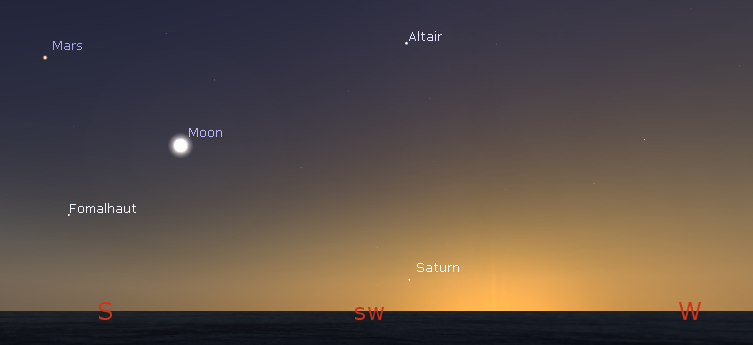
Mars, and Saturn over a Lake Michigan horizon seen at 5:45 p.m. tonight December 12, 2018. Created using Stellarium.
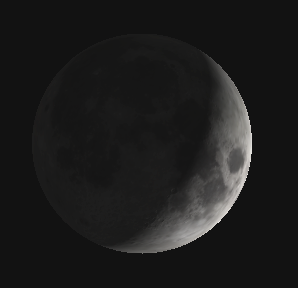
The waxing crescent Moon as it should appear tonight in binoculars. Created using Stellarium.
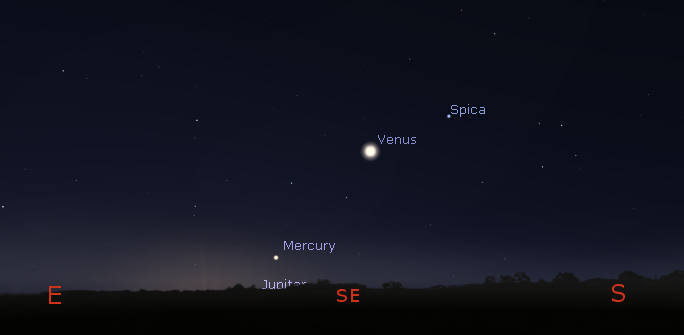
Morning planets Venus and Mercury. Jupiter is rising. December 13, 2018, 7:15 a.m.. Created using Stellarium.
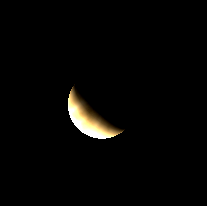
Telescopic view of Venus tomorrow morning December 13, 2018. Created using Stellarium.
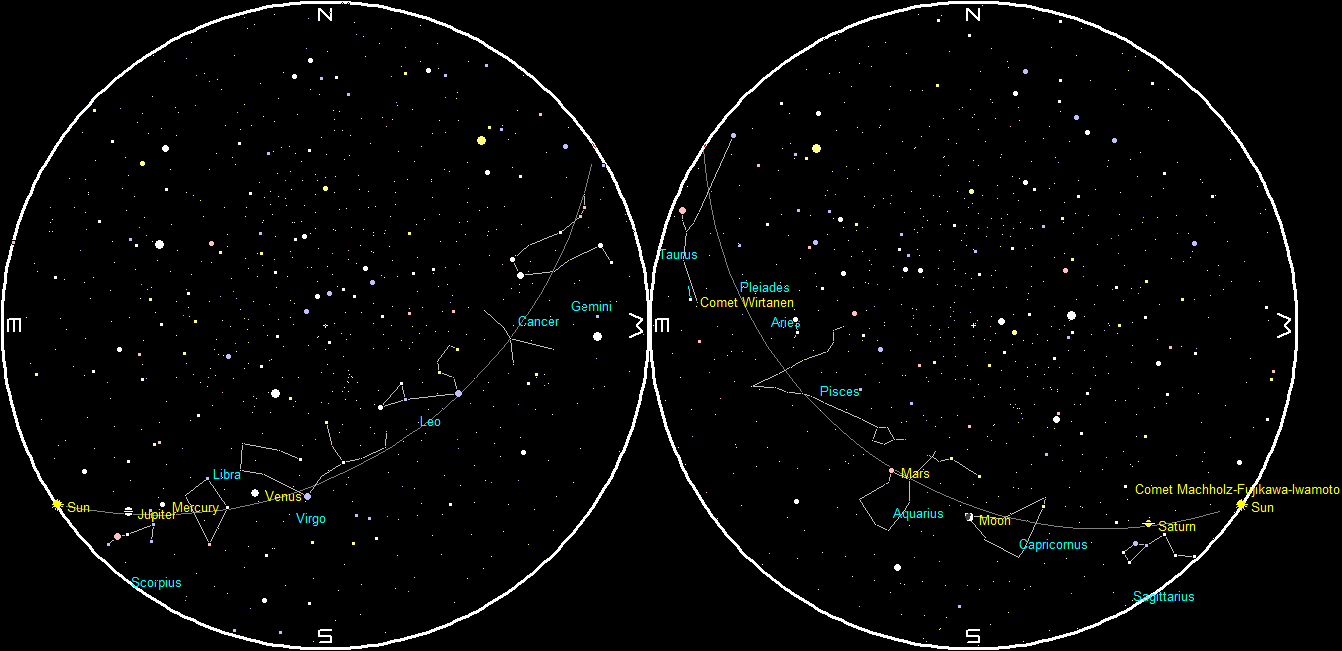
Planets, two comets and the Moon at sunset and sunrise of a single night starting with sunset on the right on December 12, 2018. The night ends on the left with sunrise on the 13th. Click on the image to enlarge. Comet Wirtanen is very close to opposition and to the south, so it rises after sunset and sets before sunrise. Created using my LookingUp program.
Two comets
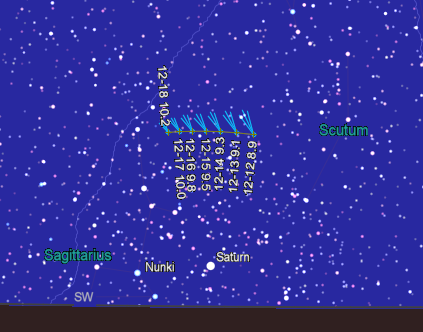
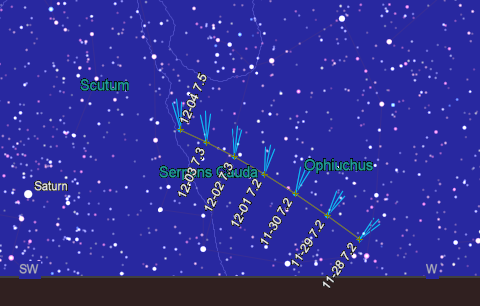
Comet C/2018 V1 (Machholz-Fijikawa-Iwamoto) in twilight starting tonight December 12, 2018. The comet won’t climb that dramatically at 6 p.m. on the rest of the nights because the stars in the field will set 4 minutes earlier each successive evening. The latest magnitude estimate of the comet on December 15 is 7.3, two magnitudes brighter than shown here. It is just about impossible to spot in twilight. Created using Cartes du Ciel (Sky Charts).
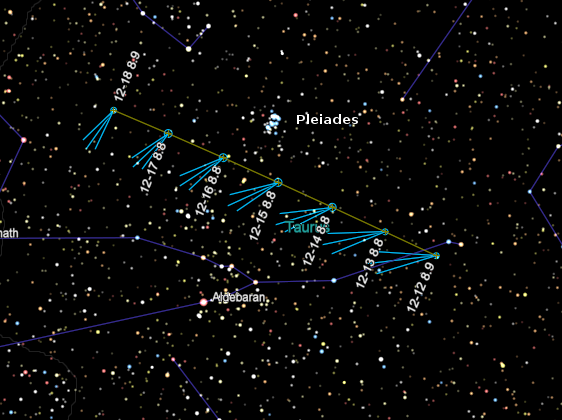
Comet 46P/Wirtanen positions for the next week. Positions are marked with month-date and magnitude. The latest magnitude prediction for December 15th is 3.3, 5.5 magnitudes brighter than shown here. Star field position is for 9 p.m. on the 12th. Click on the image to enlarge. Created using Cartes du Ciel (Sky Charts).
12/11/2018 – Ephemeris – The Chinese just launched a spacecraft to land on the far side of the Moon
Ephemeris for Tuesday, December 11th. The Sun will rise at 8:10. It’ll be up for 8 hours and 52 minutes, setting at 5:02. The Moon, half way from new to first quarter, will set at 9:06 this evening.
Last Friday the Chinese launched their Chang’e 4 spacecraft to land on the far side of the Moon in January. That side of the Moon has been mistakenly called the dark side. It actually gets more sunlight than the near, Earth facing, side. This will be an extraordinary feat. So how can they tell what’s happening on the other side? In preparation for this landing attempt the Chinese put a communications relay satellite in a halo orbit about the Earth-Moon L2 Lagrange point 38 thousand miles (61 thousand km) beyond the Moon. It is a kind of a gravitational point of equilibrium behind the Moon. One of five, and they are very useful. The satellite will lazily orbit that point, in view of the lander and the Earth for continuous communication between the Earth and the lander.
The times given are for the Traverse City/Interlochen area of Michigan. They may be different for your location.
Addendum
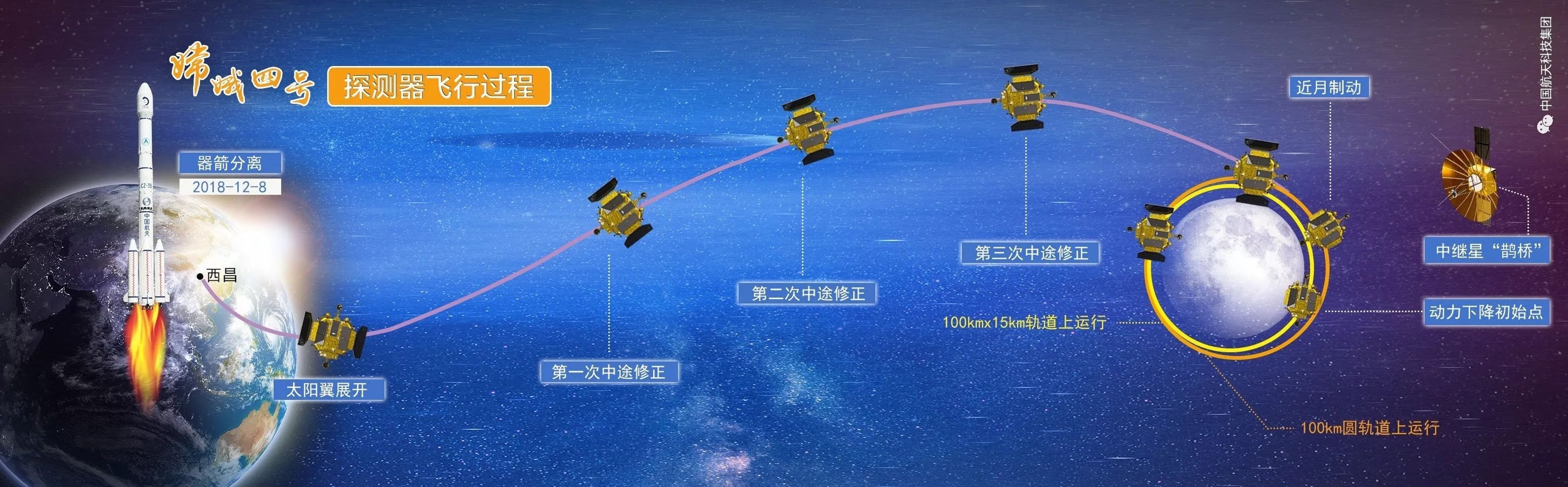
Chinese mission to land a lander and rover on the far side of the Moon. Click on the image to enlarge. It’s in Chinese except the numbers. Credit China Aerospace Science and Technology Corporation via Space.com.
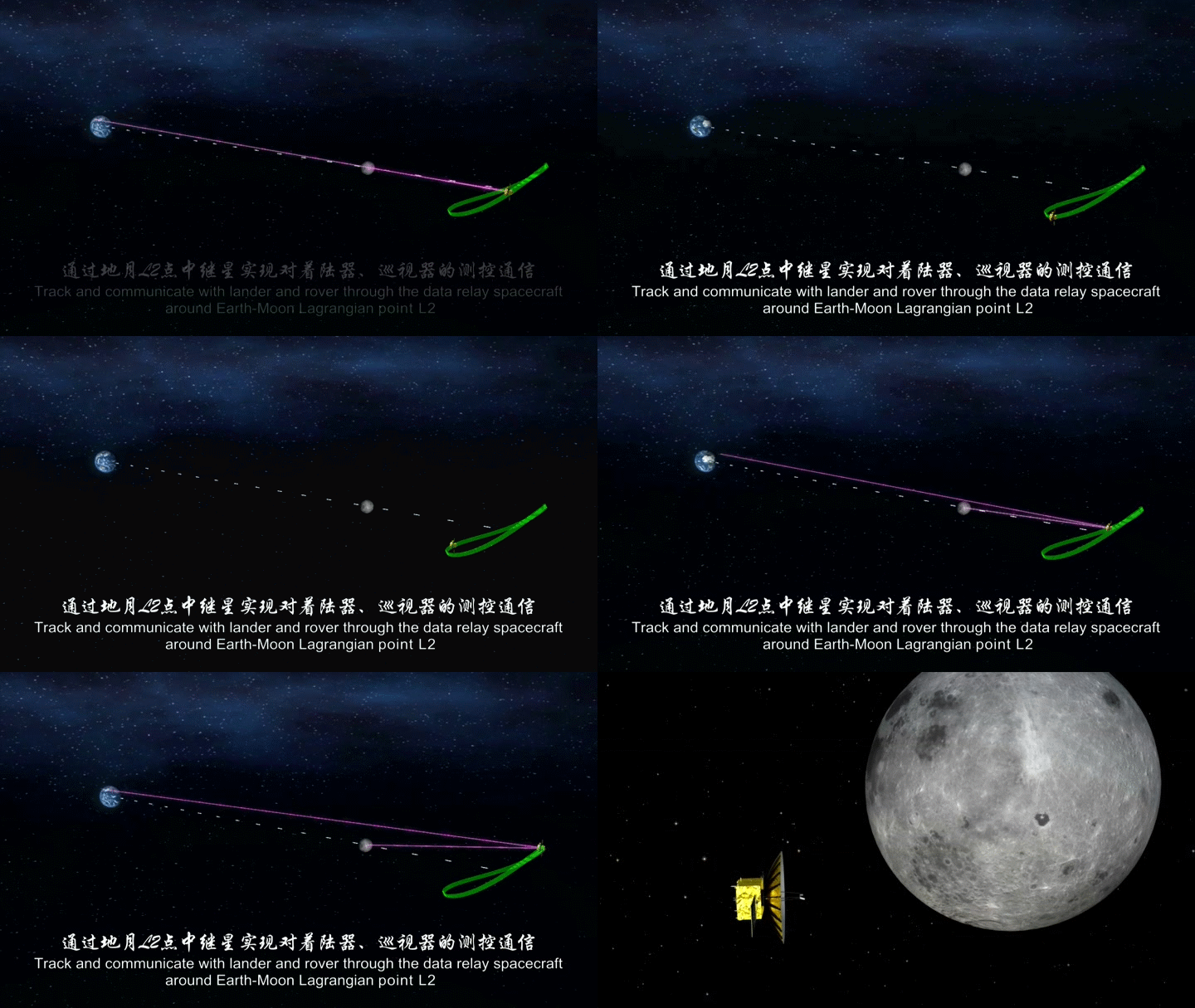
How Queuiao, the lunar communications satellite orbiting L2 performs its relay function. Click on image to enlarge. Credit CNSA via gbtimes.com.
Note: Next Monday’s program will be about Lagrangian points.
12/10/2018 – Ephemeris – How the star Procyon got its name
Ephemeris for Monday, December 10th. The Sun will rise at 8:09. It’ll be up for 8 hours and 53 minutes, setting at 5:02. The Moon, 3 days past new, will set at 8:09 this evening.
Visible low in the east at 9 p.m. or a little after will appear the star Procyon, sometimes called the little Dog Star. It’s in the constellation of Canis Minor, the little dog. It will rise at 8:40 p.m. for the Traverse City Interlochen area. Yet to rise at that time is the Dog Star itself, Sirius, the brightest night-time star. It won’t rise until 9:15 p.m., 35 minutes later even though Sirius is west of Procyon. I bring this up because the name Procyon means Before the Dog. At our latitude Procyon rises before any part of Canis Major, the big dog that Sirius is in the heart of. This is sensitive to one’s latitude. At the equator, say in Ecuador. Sirius would rise first due to its westerly position by 54 minutes. You see Procyon is also north of Sirius and that makes all the difference.
Note at 31 degrees north latitude they will rise together. Explain that, flat-earthers!
The times given are for the Traverse City/Interlochen area of Michigan. They may be different for your location.
Addendum
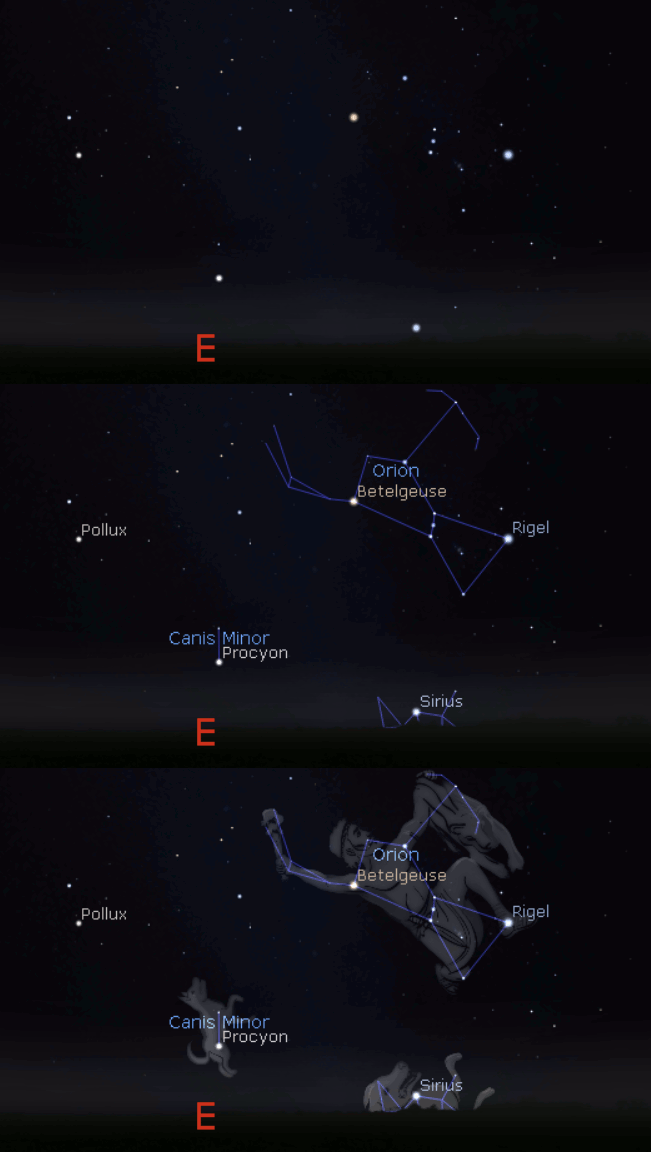
Stars and constellations in the east at 9:30 p.m., about 4 hours after sunset, on December 10th. This only works for locations above 30 degrees north latitude. Created using Stellarium.
12/07/2018 – Ephemeris – The Star of Bethlehem: natural event, miracle, or myth? I’ll be following the clues tonight
Ephemeris for Friday, December 7th. The Sun will rise at 8:06. It’ll be up for 8 hours and 55 minutes, setting at 5:02. The Moon is new today, and won’t be visible.
Tonight at 8 p.m. I will be giving a talk investigating what the Star of Bethlehem may have been. This will be at Northwestern Michigan College’s Rogers Observatory located south of Traverse City on Birmley Road. The talk is a scientific treatment of the matter, rather than a religious one. We’ll look at the usual suspects for what the star was. We’ll see what the Gospel writers may have gotten right and possibly wrong. We’ll look at historical writings and recorded Chinese observations of the heavens around that time. I will be augment this by computer simulations of what might be important celestial events visible around that time. There is no admission charge. There will be viewing of the skies afterward if it’s clear.
The times given are for the Traverse City/Interlochen area of Michigan. They may be different for your location.
12/06/2018 – Ephemeris – Tomorrow I’m going to present a talk about the Star of Bethlehem
Ephemeris for Thursday, December 6th. The Sun will rise at 8:05. It’ll be up for 8 hours and 57 minutes, setting at 5:02. The Moon, 1 day before new, will rise at 8:10 tomorrow morning.
Tomorrow evening at 8 p.m. I will be giving a talk investigating the origin of the Star of Bethlehem. This will be at Northwestern Michigan College’s Rogers Observatory located south of Traverse City on Birmley Road. The talk is a scientific treatment of the subject, rather than a religious one. We’ll look at the usual suspects for the star. We’ll see what the Gospel writers may have gotten right and possibly wrong. We’ll look at historical writings and oriental observations of the heavens around that time. This will be augmented by computer simulations of what might be important celestial events visible around that time. There is no admission charge. There will be viewing of the skies afterward if it’s clear.
The times given are for the Traverse City/Interlochen area of Michigan. They may be different for your location.
12/05/2018 – Ephemeris – The bright planets and a comet tonight
Wednesday, December 5th. The Sun will rise at 8:04. It’ll be up for 8 hours and 58 minutes, setting at 5:02. The Moon, 2 days before new, will rise at 7:08 tomorrow morning.
Let’s look at the bright planets for tonight. In the evening sky we have Mars, but are about to lose Saturn. Saturn will be briefly visible very low in the southwestern sky from about 5:45 p.m. until it sets at 6:46 p.m. Mars will be in the south as the skies darken tonight. Mars will be due south at 6:41 p.m., and it will set at 12:13 a.m. Mars is moving eastward, crossing the constellation of Aquarius until the 21st, then it enters Pisces. Comet Wirtanen is moving northward, below and right of the V of stars that’s the head of Taurus the bull, and should be an excellent binocular object. Venus, our brilliant morning star, will rise at 4:24 a.m. in the east-southeast. The blue-white star Spica is still off to the right and a bit above it. Mercury will rise at 6:31 a.m. and might be spotted after that. Jupiter is near the Moon tomorrow morning, rising at 7:24 only 40 minutes before the Sun.
The times given are for the Traverse City/Interlochen area of Michigan. They may be different for your location.
Addenda
The planets
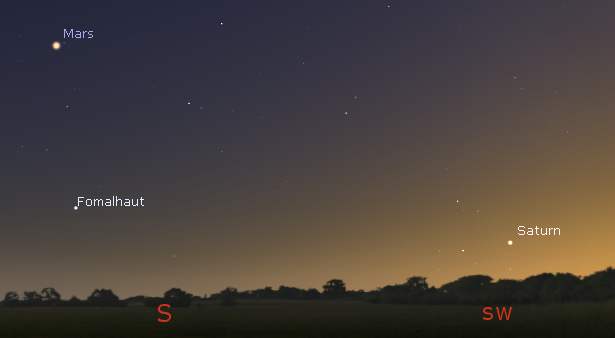
Mars, and Saturn seen at 5:45 p.m. tonight December 5, 2018. Created using Stellarium.
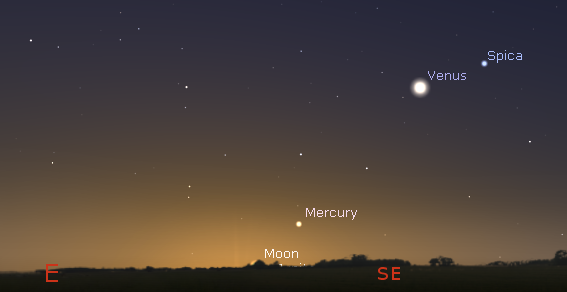
Morning planets Venus and Mercury. Jupiter is about to rise at 7:15 a.m. December 6, 2018. Created using Stellarium.
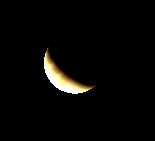
Telescopic view of Venus tomorrow morning December 6, 2018. Created using Stellarium.
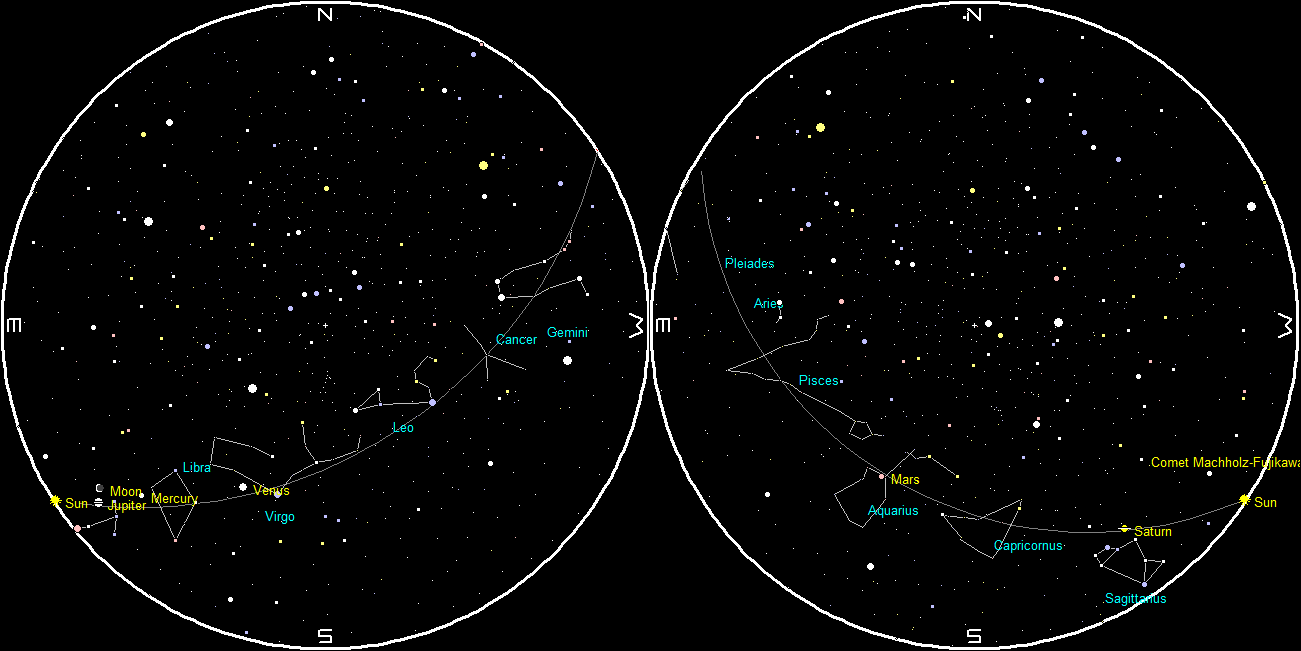
Planets, one comet and the Moon at sunset and sunrise of a single night starting with sunset on the right on December 5, 2018. The night ends on the left with sunrise on the 6th. Click on the image to enlarge. Comet Wirtanen is very close to opposition and to the south, so it rises after sunset and sets before sunrise. Created using my LookingUp program.
Bright comets
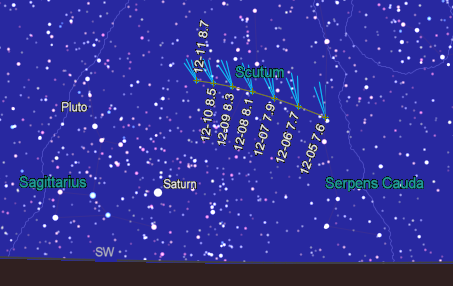
Comet C/2018 V1 (Machholz-Fijikawa-Iwamoto) in twilight starting tonight November 28, 2018. The comet won’t climb that dramatically at 6 p.m. on the rest of the nights because the stars in the field will set 4 minutes earlier each successive evening. The latest magnitude estimate of the comet on December 8 is 5.9, two magnitudes brighter than shown here. Created using Cartes du Ciel (Sky Charts).
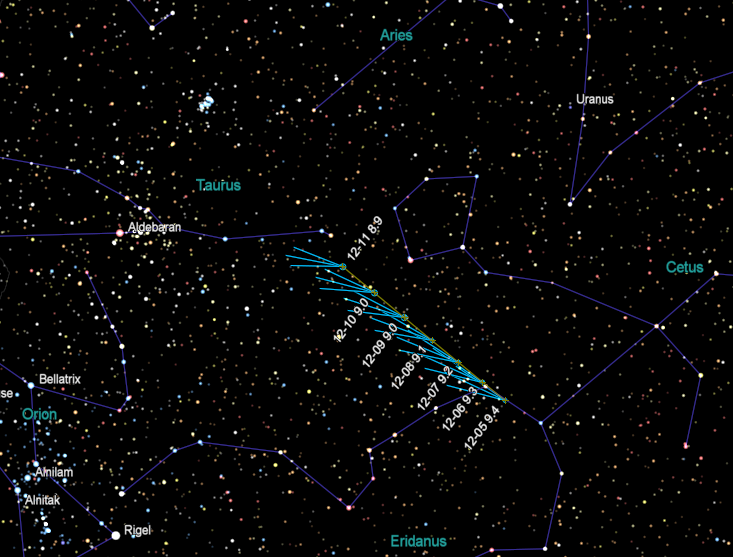
Comet 46P/Wirtanen positions for the next week. Positions are marked with month-date and magnitude. The latest magnitude prediction for December 1st is 3.7, 5.4 magnitudes brighter than shown here. The comet may make magnitude 3 by mid-December. Star field position is for 9 p.m. on the 28th. Click on the image to enlarge. Created using Cartes du Ciel (Sky Charts).
12/04/2018 – Ephemeris – Auriga the Charioteer
Ephemeris for Tuesday, December 4th. The Sun will rise at 8:03. It’ll be up for 8 hours and 59 minutes, setting at 5:02. The Moon, 3 days before new, will rise at 6:03 tomorrow morning.
The constellation Auriga the charioteer is half way up the sky in the east northeast at 9 p.m. It is a pentagon of stars, with the brilliant star Capella at the upper left of its corners. Capella represents a mama goat he’s carrying. A narrow triangle of stars just right of Capella are her kids, that is her baby goats. The Kids is an informal constellation or asterism. The Milky Way runs through Auriga, but it’s not very bright here. We are looking away from the center of the Milky Way to the more sparse outer parts. Within and near that pentagon, one can sweep with binoculars and low power telescopes to find several star clusters, groups of hundreds of stars born in the clump we still see them in. These star clusters will appear as fuzzy spots in binoculars.
The times given are for the Traverse City/Interlochen area of Michigan. They may be different for your location.
Addendum

Auriga and neighboring constellations for 9 p.m. in early December. Created using Stellarium and GIMP.
12/03/2018 – Ephemeris – Comet Wirtanen should be bright enough for the naked eye or binoculars this month
Ephemeris for Monday, December 3rd. The Sun will rise at 8:02. It’ll be up for 9 hours and 1 minute, setting at 5:03. The Moon, half way from last quarter to new, will rise at 4:56 tomorrow morning.
Beside Comet Machholz-Fujikawa-Iwamoto which I talked about last Thursday and should be at peak brightness about now in the western twilit sky, we have another comet, this one Comet 46P/Wirtanen is brightening in the east in the evening. Wirtanen is a member of the Jupiter family of comets, whose 5.44 year orbit of the Sun takes it from just outside the Earth’s orbit to just inside Jupiter’s orbit. This time around it will come as close as 7.1 million miles of the Earth. As of Thanksgiving the comet was 100 times brighter than its nominal expected brightness. I don’t know if it will stay that way. It has a history of outbursts. If it keeps it up Wirtanen could be as bright as the Pleiades stars when it passes them on the 16th.
The times given are for the Traverse City/Interlochen area of Michigan. They may be different for your location.
Addendum
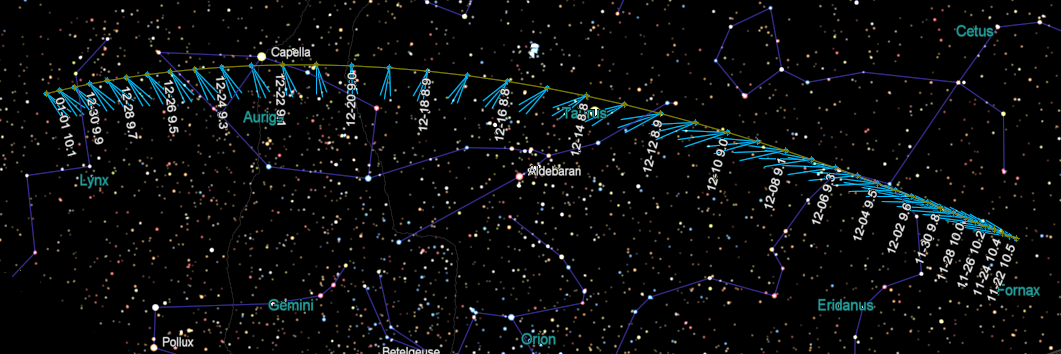
The path of Comet 46P/Wirtanen from November 21, 2018, to January 1, 2019. The labels are month, date, and expected magnitude. Click on the image to enlarge. Created using Cartes du Ciel (Sky Charts).
Check back every Wednesday at least where Comet Wirtanen will be past of the planet report. I’ll be covering the comet on other days throughout the month. Also check Seiichi Yoshida’s Weekly Information about Bright Comets: http://www.aerith.net/comet/weekly/current.html
11/30/2018 – Ephemeris – Previewing December skies
Bob Moler with Ephemeris for Friday, November 30th. The Sun will rise at 7:58. It’ll be up for 9 hours and 5 minutes, setting at 5:04. The Moon, 1 day past last quarter, will rise at 1:29 tomorrow morning.
Let’s preview December’s skies. Winter will officially arrive on the 21st at 5:22 p.m., the winter solstice. The noontime sun will dip from 23 ½ degrees to a bit less than 22 degrees above the southern horizon on that day. There will be little movement in the sunset times: In the Traverse City/Interlochen area this will be from 5:03 tomorrow, down to 5:02 and then advancing to 5:11 at the end of the month. The sunrise times will advance from 7:58 tomorrow to 8:20 on the 31st. The big event in December will be the Geminid meteor shower whose maximum is on the morning of the 14th. An old comet will make a close pass of the Earth and may be quite bright by mid-month. Watch for Comet Wirtanen.
The times given are for the Traverse City/Interlochen area of Michigan. They may be different for your location.
Addenda
December Evening Star Chart
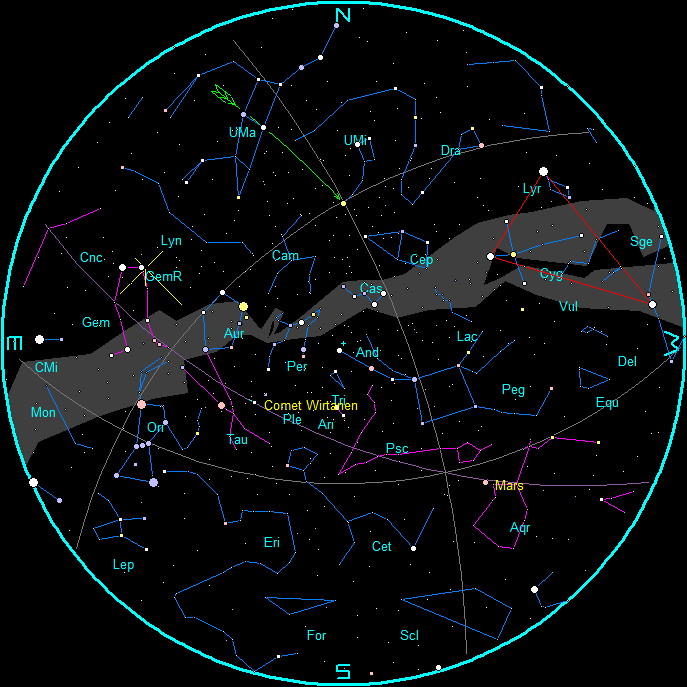
The planets and stars are plotted for the 15th at 9 p.m. EST in the evening and 6 a.m. for the morning chart. These are the chart times. Note that Traverse City is located approximately 45 minutes behind our time meridian. (An hour 45 minutes behind our daylight saving time meridian during EDT). To duplicate the star positions on a planisphere you may have to set it to 1 hour 45 minutes earlier than the current time.
Note the chart times of 9 p.m. and 6 a.m. are for the 15th. For each week before the 15th add ½ hour (28 minutes if you’re picky). For each week after the 15th subtract ½ hour. The planet positions are updated each Wednesday on this blog. For planet positions on dates other than the 15th, check the Wednesday planet posts on this blog.
December Morning Star Chart
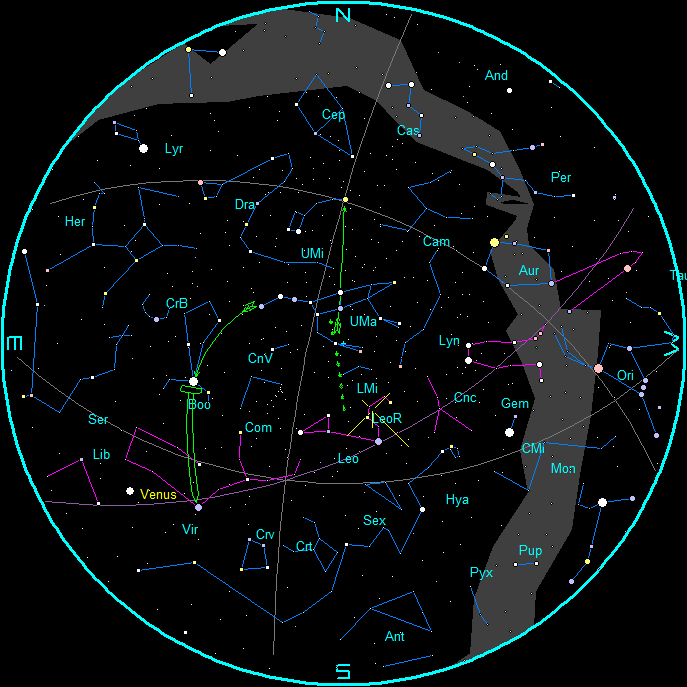
For a list of constellation names to go with the abbreviations click here.
- Pointer stars at the front of the bowl of the Big Dipper point to Polaris the North Star.
- Follow the arc of the handle of the Big Dipper to the star Arcturus, and
- Extend like a spike to Spica,
- The Summer Triangle is in red.
- GemR on the evening and morning star charts is the radiant of the Geminid meteor shower which peaks on the morning of the 14th,
Twilight
| Time zone=EDT | |||||||
| Morning twilight | Evening twilight | Dark night | Moon | ||||
| Date | Astronomical | Nautical | Nautical | Astronomical | Start | End | Illum. |
| 2018-12-01 | 6h20m | 6h55m | 18h16m | 18h51m | 18h51m | 1h29m | 0.33 |
| 2018-12-02 | 6h21m | 6h56m | 18h15m | 18h50m | 18h50m | 2h39m | 0.23 |
| 2018-12-03 | 6h22m | 6h57m | 18h15m | 18h50m | 18h50m | 3h48m | 0.14 |
| 2018-12-04 | 6h23m | 6h58m | 18h15m | 18h50m | 18h50m | 4h56m | 0.07 |
| 2018-12-05 | 6h24m | 6h59m | 18h15m | 18h50m | 18h50m | 6h03m | 0.03 |
| 2018-12-06 | 6h25m | 7h00m | 18h15m | 18h50m | 18h50m | 6h25m | 0.00 |
| 2018-12-07 | 6h26m | 7h01m | 18h15m | 18h50m | 18h50m | 6h26m | 0.00 |
| 2018-12-08 | 6h26m | 7h02m | 18h15m | 18h50m | 18h50m | 6h26m | 0.02 |
| 2018-12-09 | 6h27m | 7h03m | 18h15m | 18h50m | 19h15m | 6h27m | 0.06 |
| 2018-12-10 | 6h28m | 7h04m | 18h15m | 18h50m | 20h09m | 6h28m | 0.12 |
| 2018-12-11 | 6h29m | 7h04m | 18h15m | 18h50m | 21h06m | 6h29m | 0.19 |
| 2018-12-12 | 6h30m | 7h05m | 18h15m | 18h51m | 22h05m | 6h30m | 0.27 |
| 2018-12-13 | 6h30m | 7h06m | 18h15m | 18h51m | 23h05m | 6h30m | 0.36 |
| 2018-12-14 | 6h31m | 7h07m | 18h16m | 18h51m | – | 6h31m | 0.45 |
| 2018-12-15 | 6h32m | 7h07m | 18h16m | 18h51m | 0h06m | 6h32m | 0.55 |
| 2018-12-16 | 6h32m | 7h08m | 18h16m | 18h52m | 1h07m | 6h32m | 0.65 |
| 2018-12-17 | 6h33m | 7h09m | 18h16m | 18h52m | 2h11m | 6h33m | 0.75 |
| 2018-12-18 | 6h30m | 7h05m | 18h13m | 18h48m | 3h16m | 6h30m | 0.84 |
| 2018-12-19 | 6h30m | 7h06m | 18h13m | 18h49m | 4h24m | 6h30m | 0.91 |
| 2018-12-20 | 6h31m | 7h06m | 18h14m | 18h49m | 5h34m | 6h31m | 0.97 |
| 2018-12-21 | 6h31m | 7h07m | 18h14m | 18h50m | – | – | 0.97 |
| 2018-12-22 | 6h32m | 7h07m | 18h15m | 18h50m | – | – | 1.00 |
| 2018-12-23 | 6h32m | 7h08m | 18h15m | 18h51m | – | – | 1.00 |
| 2018-12-24 | 6h33m | 7h08m | 18h16m | 18h51m | 18h51m | 19h35m | 0.97 |
| 2018-12-25 | 6h33m | 7h09m | 18h16m | 18h52m | 18h52m | 20h49m | 0.91 |
| 2018-12-26 | 6h34m | 7h09m | 18h17m | 18h53m | 18h53m | 22h05m | 0.82 |
| 2018-12-27 | 6h34m | 7h09m | 18h18m | 18h53m | 18h53m | 23h19m | 0.72 |
| 2018-12-28 | 6h34m | 7h10m | 18h18m | 18h54m | 18h54m | – | 0.61 |
| 2018-12-29 | 6h34m | 7h10m | 18h19m | 18h55m | 18h55m | 0h30m | 0.49 |
| 2018-12-30 | 6h35m | 7h10m | 18h20m | 18h55m | 18h55m | 1h40m | 0.38 |
| 2018-12-31 | 6h35m | 7h10m | 18h21m | 18h56m | 18h56m | 2h48m | 0.28 |
Twilight calendar was generated using Cartes du Ciel (Sky Charts).
See my blog post: Twilight Zone for the definitions of the different periods of twilight here: https://bobmoler.wordpress.com/2018/09/27/
NASA Calendar of Planetary Events
| Date | Local | Event | ||
| Time | ||||
| Dec | 1 | Sa | Venus: 39.9° W | |
| 3 | Mo | 01:42:00 PM | Moon-Venus: 3.8° S | |
| 7 | Fr | 02:20:00 AM | New Moon | |
| 9 | Su | 12:30:00 AM | Moon-Saturn: 1.2° S | |
| 9 | Su | 06:12:00 AM | Moon South Dec.: 21.5° S | |
| 10 | Mo | 12:57:00 PM | Moon Descending Node | |
| 12 | We | 07:25:00 AM | Moon Apogee: 405200 km | |
| 14 | Fr | 07:16:00 AM | Geminid Shower: ZHR = 120 | |
| 14 | Fr | 06:21:00 PM | Moon-Mars: 3.9° N | |
| 15 | Sa | 05:59:00 AM | Mercury Elongation: 21.3° W | |
| 15 | Sa | 06:49:00 AM | First Quarter | |
| 21 | Fr | 02:31:00 AM | Moon-Aldebaran: 1.7° S | |
| 21 | Fr | 02:49:00 PM | Mercury-Jupiter: 0.8° N | |
| 21 | Fr | 05:22:00 PM | Winter Solstice | |
| 22 | Sa | 03:03:00 AM | Mercury-Antares: 6° N | |
| 22 | Sa | 10:08:00 AM | Jupiter-Antares: 5.2° N | |
| 22 | Sa | 12:49:00 PM | Full Moon | |
| 22 | Sa | 04:00:00 PM | Ursid Shower: ZHR = 10 | |
| 23 | Su | 06:48:00 AM | Moon North Dec.: 21.6° N | |
| 24 | Mo | 04:52:00 AM | Moon Perigee: 361100 km | |
| 24 | Mo | 06:54:00 AM | Moon Ascending Node | |
| 24 | Mo | 11:52:00 PM | Moon-Beehive: 0.6° N | |
| 26 | We | 11:06:00 AM | Moon-Regulus: 2.5° S | |
| 29 | Sa | 04:34:00 AM | Last Quarter | |
All event times are given for UTC-5:00: Eastern Standard or Daylight Time
Sky Events Calendar by Fred Espenak and Sumit Dutta (NASA’s GSFC),
http://eclipse.gsfc.nasa.gov/SKYCAL/SKYCAL.html
If you go to the above site you can print out a list like the above for the entire year or calendar pages for your time zone.
Sun and Moon Rising and Setting Events
| Ephemeris of Sky Events for NMC Observatory | ||||||||||
| December, 2018 – Local time zone: EST | ||||||||||
| Date | Sun | Twilight* | Moon | Illum | ||||||
| Rise | Set | Hours | End | Start | Phase | R/S** | Time | Fractn | ||
| Sat | 1 | 07:59a | 05:03p | 09:04 | 06:12p | 06:49a | Rise | 02:38a | 29.00% | |
| Sun | 2 | 08:00a | 05:03p | 09:03 | 06:12p | 06:50a | Rise | 03:47a | 19.00% | |
| Mon | 3 | 08:01a | 05:03p | 09:01 | 06:12p | 06:51a | Rise | 04:55a | 12.00% | |
| Tue | 4 | 08:02a | 05:02p | 09:00 | 06:12p | 06:52a | Rise | 06:02a | 6.00% | |
| Wed | 5 | 08:03a | 05:02p | 08:59 | 06:12p | 06:53a | Rise | 07:07a | 2.00% | |
| Thu | 6 | 08:04a | 05:02p | 08:57 | 06:12p | 06:54a | Rise | 08:10a | 0.00% | |
| Fri | 7 | 08:05a | 05:02p | 08:56 | 06:12p | 06:55a | New | Set | 05:40p | 1.00% |
| Sat | 8 | 08:06a | 05:02p | 08:55 | 06:12p | 06:56a | Set | 06:25p | 3.00% | |
| Sun | 9 | 08:07a | 05:02p | 08:54 | 06:12p | 06:57a | Set | 07:15p | 7.00% | |
| Mon | 10 | 08:08a | 05:02p | 08:53 | 06:12p | 06:58a | Set | 08:09p | 12.00% | |
| Tue | 11 | 08:09a | 05:02p | 08:52 | 06:12p | 06:59a | Set | 09:06p | 19.00% | |
| Wed | 12 | 08:10a | 05:02p | 08:52 | 06:12p | 06:59a | Set | 10:05p | 27.00% | |
| Thu | 13 | 08:10a | 05:02p | 08:51 | 06:12p | 07:00a | Set | 11:05p | 36.00% | |
| Fri | 14 | 08:11a | 05:02p | 08:50 | 06:13p | 07:01a | Set | 12:05a | 45.00% | |
| Sat | 15 | 08:12a | 05:02p | 08:50 | 06:13p | 07:02a | F Qtr | Set | 01:07a | 55.00% |
| Sun | 16 | 08:13a | 05:03p | 08:49 | 06:13p | 07:02a | Set | 02:10a | 65.00% | |
| Mon | 17 | 08:13a | 05:03p | 08:49 | 06:13p | 07:03a | Set | 03:15a | 74.00% | |
| Tue | 18 | 08:14a | 05:03p | 08:49 | 06:14p | 07:03a | Set | 04:23a | 83.00% | |
| Wed | 19 | 08:15a | 05:04p | 08:49 | 06:14p | 07:04a | Set | 05:33a | 90.00% | |
| Thu | 20 | 08:15a | 05:04p | 08:48 | 06:15p | 07:05a | Set | 06:45a | 96.00% | |
| Fri | 21 | 08:16a | 05:05p | 08:48 | 06:15p | 07:05a | Set | 07:56a | 99.00% | |
| Sat | 22 | 08:16a | 05:05p | 08:48 | 06:16p | 07:06a | Full | Rise | 05:22p | 100.00% |
| Sun | 23 | 08:17a | 05:06p | 08:49 | 06:16p | 07:06a | Rise | 06:25p | 98.00% | |
| Mon | 24 | 08:17a | 05:06p | 08:49 | 06:17p | 07:07a | Rise | 07:35p | 93.00% | |
| Tue | 25 | 08:17a | 05:07p | 08:49 | 06:17p | 07:07a | Rise | 08:49p | 85.00% | |
| Wed | 26 | 08:18a | 05:08p | 08:49 | 06:18p | 07:07a | Rise | 10:05p | 76.00% | |
| Thu | 27 | 08:18a | 05:08p | 08:50 | 06:19p | 07:08a | Rise | 11:18p | 66.00% | |
| Fri | 28 | 08:18a | 05:09p | 08:50 | 06:19p | 07:08a | Rise | 12:30a | 54.00% | |
| Sat | 29 | 08:19a | 05:10p | 08:51 | 06:20p | 07:08a | L Qtr | Rise | 01:39a | 43.00% |
| Sun | 30 | 08:19a | 05:11p | 08:51 | 06:21p | 07:08a | Rise | 02:47a | 33.00% | |
| Mon | 31 | 08:19a | 05:12p | 08:52 | 06:22p | 07:09a | Rise | 03:53a | 24.00% | |
* Nautical Twilight
** Moonrise or moonset, whichever occurs between sunset and sunrise
11/29/2018 – Ephemeris – A potentially bright comet was discovered earlier this month
Ephemeris for Thursday, November 29th. The Sun will rise at 7:57. It’ll be up for 9 hours and 6 minutes, setting at 5:04. The Moon, at last quarter today, will rise at 12:17 tomorrow morning.
Three amateur astronomers Don Machholz of the US and by Shigehisa Fujikawa and Masayuki Iwamoto of Japan independently discovered a comet November 7th that bears their names. Now through next week or so ,it will be visible in the western sky in evening twilight. The comet has been rapidly brightening, much more rapidly than expected. It could theoretically be bright enough to spot with the naked eye by Sunday or Monday, but it must compete with evening twilight low in the western to southwestern sky. Comets are unpredictable in their brightness and appearance. As David Levy of Comet Shoemaker-Levy 9 fame once said: “Cats and comets have tails and do exactly what they want”. Check here for updates.
The times given are for the Traverse City/Interlochen area of Michigan. They may be different for your location.
Addendum