Archive
05/08/2018 – Ephemeris – Jupiter at opposition
Ephemeris for Tuesday, May 8th. The Sun rises at 6:23. It’ll be up for 14 hours and 33 minutes, setting at 8:56. The Moon, 1 day past last quarter, will rise at 3:45 tomorrow morning.
At 8:10 p.m. Jupiter will be in opposition, that is opposite the Sun in the sky. Thursday at 8 a.m. it will be its closest to the Earth at 408.9 million miles away, and its biggest in telescopes at 44.8 arc seconds. The Moon averages about 1,800 arc seconds in diameter. So the Moon appears 40 times larger in diameter, meaning you could put 40 Jupiters across the diameter of the moon. Jupiter’s disk is visible in binoculars, along with several of its moons. The moons change position from night to night. Most computer planetarium programs will show the moons for any time past and future. Telescopes will reveal that Jupiter’s face is crossed by bands of contrasting colors of clouds, and the famous Great Red Spot.
The times given are for the Traverse City/Interlochen area of Michigan. They may be different for your location.
Addendum
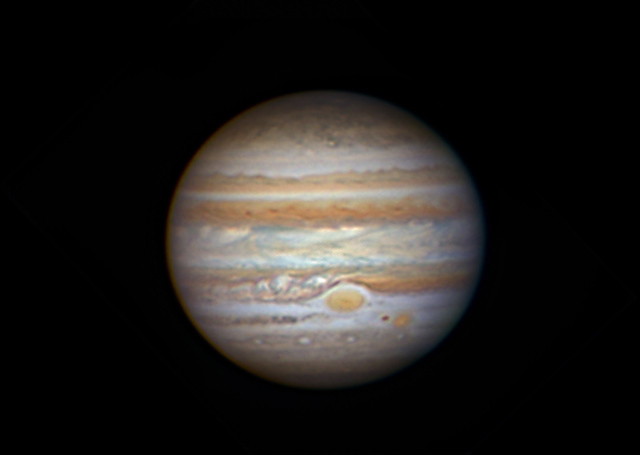
Jupiter with its Great Red Spot November 18, 2012 by Scott Anttila.
05/07/2018 – Ephemeris – Twilight
Note: Sorry for the delay. I was hit with a fast developing cold Sunday. So I was unable to post this at my normal time, and was unable to record my next Tuesday through Monday programs.
Ephemeris for Monday, May 7th. The Sun rises at 6:24. It’ll be up for 14 hours and 30 minutes, setting at 8:55. The Moon, at last quarter today, will rise at 3:14 tomorrow morning.
We are in the time of year when it appears that twilight doesn’t seem to end. There are three definitions of twilight, Civil, Nautical and Astronomical. Each ends in the evening when the Sun is 6, 12, and 18 degrees below the horizon respectively. Astronomers don’t really care about civil twilight, the sky is too bright. Sailors using a sextant for star positions can usually see the horizon for star sighting up to the end of nautical twilight. Astronomers consider the skies dark at the end of astronomical twilight, barring he Moon being up. The brightest stars and planets become visible a half hour after sunset. We begin to pick out constellations at the end of nautical twilight. For instance, for tonight, nautical twilight ends at 10:10 p.m., while astronomical twilight ends at 10:57.
The times given are for the Traverse City/Interlochen area of Michigan. They may be different for your location.
05/04/2018 – Ephemeris – Tonight I present Venus from the mists of time to today
Ephemeris for Friday, May 4th. The Sun rises at 6:28. It’ll be up for 14 hours and 23 minutes, setting at 8:51. The Moon, 3 days before last quarter, will rise at 1:15 tomorrow morning.
The planet Venus is our evening star now. I’ve been talking about it on this program lately. Want to hear and see more? Tonight at 8 p.m. at the May meeting of the Grand Traverse Astronomical Society at Northwestern Michigan College’s Rogers Observatory, I will be giving an illustrated talk: Venus from the mists of time to today. To the early Greeks it was two planets. To the Maya it was a calendar. In the 18th century it was a way to measure the size of the solar system. Today, it could be what our future looks like. After the meeting, at 9 p.m. the society will host a star party to view the planets Venus and Jupiter. The observatory is located south of Traverse City on Birmley Road between Garfield and Keystone roads.
The times given are for the Traverse City/Interlochen area of Michigan. They may be different for your location.
Addendum
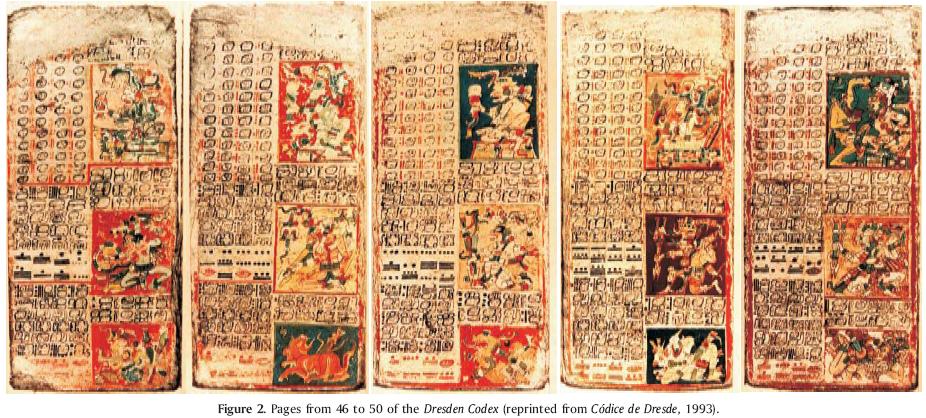
5 Pages of the Dresden Codex produced by the Maya tracking Venus’ appearances in the skies over the Yucatan. for 104 years. The Dresden Codex is one of only 4 surviving Mayan Codices.
05/03/2018 – Ephemeris – The Eta Aquariid meteor shower is coming
Ephemeris for Thursday, May 3rd. The Sun rises at 6:29. It’ll be up for 14 hours and 20 minutes, setting at 8:50. The Moon, half way from full to last quarter, will rise at 12:26 tomorrow morning.
Saturday morning at about 3 a.m. is the predicted peak of the Eta Aquariid Meteor Shower. The bright Moon will interfere with all but the brightest, however something interesting is afoot. I download the International Meteor Organization Meteor Calendar every year. An Internet search for the name will get you to it. It seems that the Maya had recorded the shower’s appearance along with other meteor showers. There are other peaks to this shower on the mornings possibly through the 6th. Meteors of this shower, are caused by particles released by Halley’s Comet on past swings through the inner solar system. The meteors will appear to come from low in the southeastern sky. They will be seen after 3:30 a.m.
The times given are for the Traverse City/Interlochen area of Michigan. They may be different for your location.
Addendum
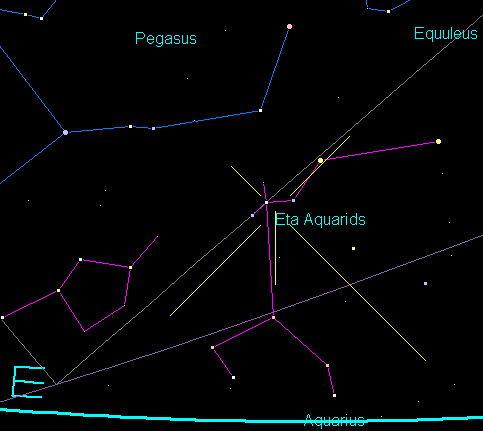
The Eta Aquariid radiant at the peak of the shower. The radiant moves slowly to the east with time. Credit: Bob Moler’s LookingUp program.
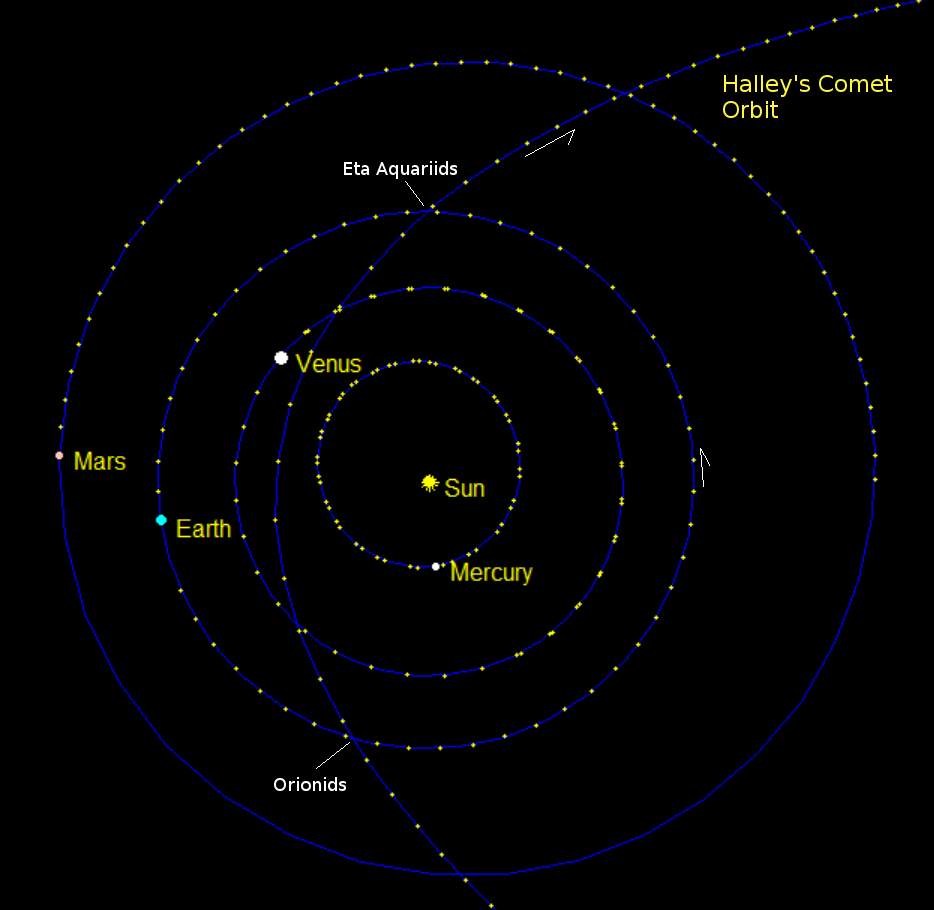
We get two meteor showers from Halley’s Comet. The Orionids, when Halley is approaching the inner solar system, and the Eta Aquariids when it’s leaving. Credit my LookingUp program.
05/02/2018 – Ephemeris – We’re taking our weekly look at the bright planets
Ephemeris for Wednesday, May 2nd. The Sun rises at 6:31. It’ll be up for 14 hours and 17 minutes, setting at 8:49. The Moon, 3 days past full, will rise at 11:31 this evening.
It’s Wednesday again and time to look for the bright planets. One bright planet is in the evening sky, the brightest, Venus. It will be visible low in the western twilight from about 9:10 p.m. until it sets at 11:15. The star Aldebaran will be seen below and left of Venus tonight. Jupiter will rise this evening at 9:11 p.m. That doesn’t make it an evening planet. It has to rise before sunset to be an evening planet, which it will be next Wednesday. Saturn will rise at 1:09 a.m., while Mars will rise at 2:18 a.m.
At 5:30 tomorrow morning these three planets will be strung across the southern sky. Bright Jupiter will be in the southwest, dimmer Mars and Saturn will be in the south, with Mars to the left of Saturn with the Moon between Jupiter and Saturn.
The times given are for the Traverse City/Interlochen area of Michigan. They may be different for your location.
Addendum
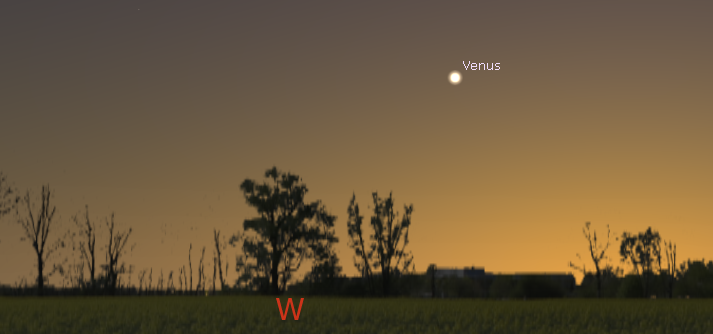
Venus in evening twilight at 9:15 p.m, tonight May 2, 2018. Click on the image to enlarge. Created using Stellarium.
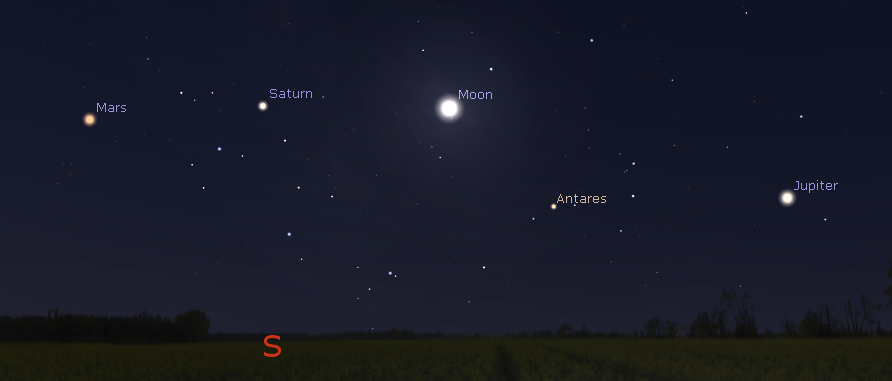
The morning planets at 5:30 a.m. May 3, 2018. Click on the image to enlarge. Created using Stellarium.
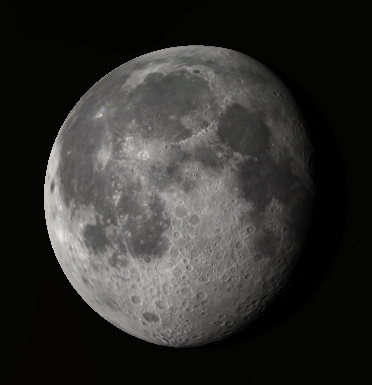
The waning gibbous Moon at 5:30 a.m. May 3, 2018. Created using Stellarium.
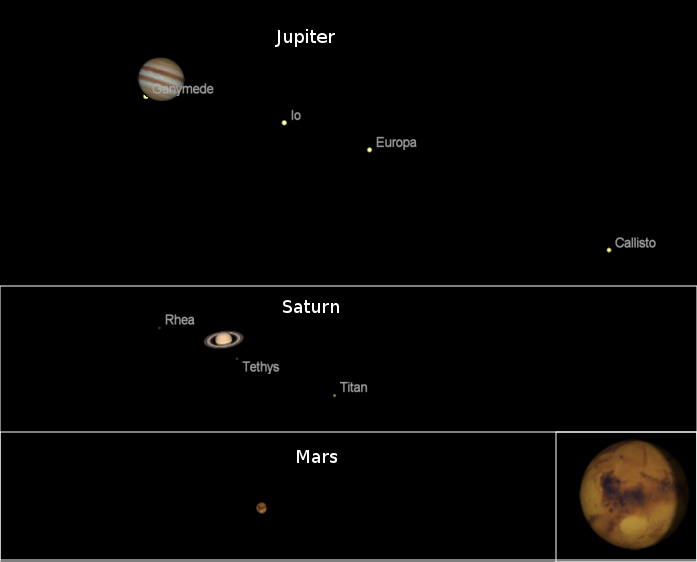
The morning planets as seen in a telescope using the same magnification at 5:30 a.m. May 3, 2018. A magnified image of Mars is inset showing some of the features that may be visible under higher magnification. Created using Cartes du Ciel (Sky Charts).
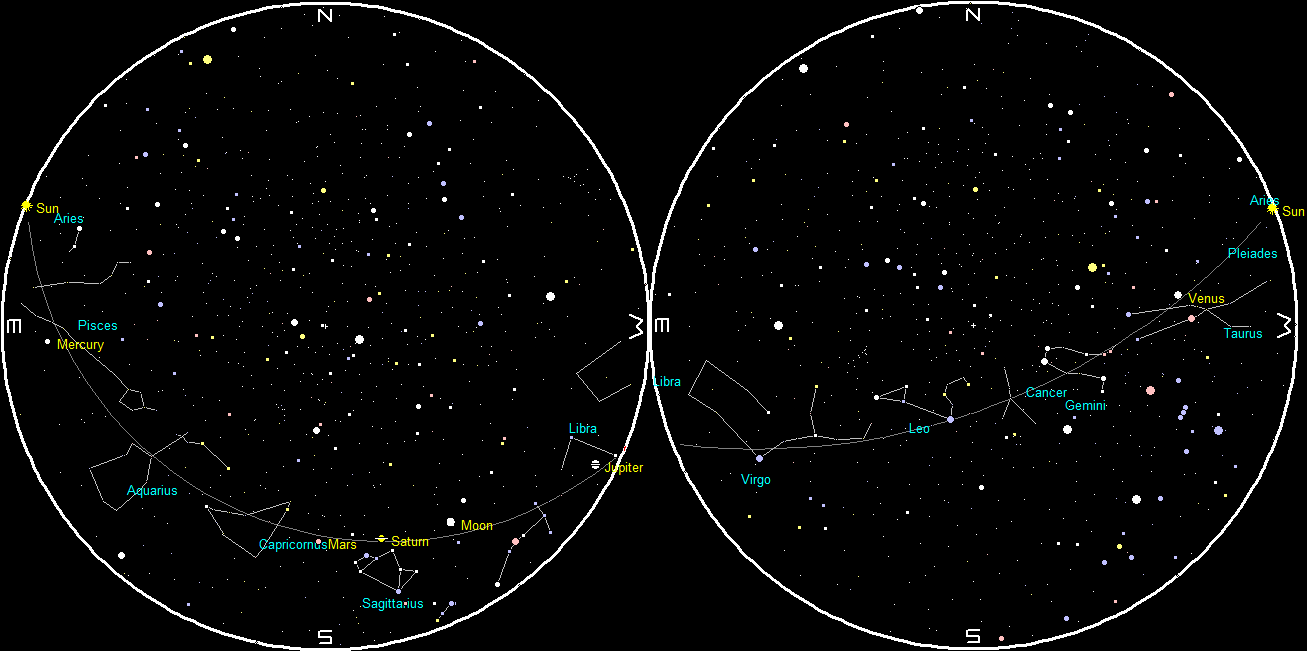
Planets and the Moon at sunset and sunrise of a single night starting with sunset on the right on May 2, 2018. The night ends on the left with sunrise on the 3rd. Click on the image to enlarge. Created using my LookingUp program.
05/01/2018 – Ephemeris – Previewing May Skies
Ephemeris for Tuesday, the first day of May. The Sun rises at 6:32. It’ll be up for 14 hours and 15 minutes, setting at 8:47. The Moon, 2 days past full, will rise at 10:32 this evening.
They say April showers bring May flowers, but I don’t think they meant snow showers. Daylight hours in the Interlochen/Traverse City area will increase from 14 hours and 15 minutes today to 15 hours 19 minutes on May 31st. The altitude, or angle, of the sun above the southern horizon at local noon will ascend from 60 degrees today to 67 degrees at month’s end. The altitude of the sun in the Straits area will be a degree lower than that but your length of daylight will be a few minutes longer. Local apparent noon this month, when the sun passes due south, will be about 1:38 p.m. The Eta Aquariid meteor shower will reach its peak about 3 a.m. this Saturday morning the 5th, but the bright morning Moon will interfere.
The times given are for the Traverse City/Interlochen area of Michigan. They may be different for your location.
Addendum
May Evening Sky Chart
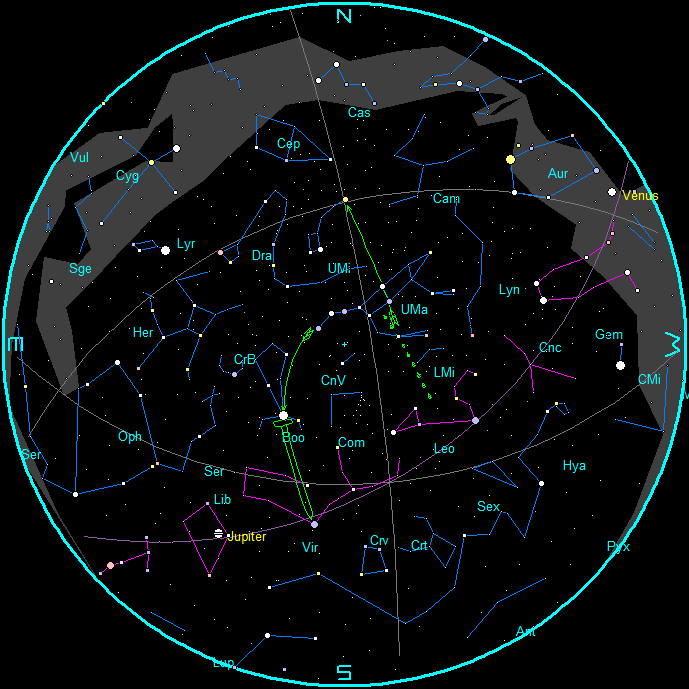
Star Chart for May 2018 (11 p.m. EDT May 15, 2018). Created using my LookingUp program. Click on image to enlarge.
The planets and stars are plotted for the 15th at 11 p.m. EDT in the evening and 5 a.m. for the morning chart. These are the chart times. Note that Traverse City is located approximately 45 minutes behind our time meridian. (An hour 45 minutes behind our daylight saving time meridian during EDT and 45 minutes behind our daylight standard time meridian. during EST). To duplicate the star positions on a planisphere you may have to set it to 1 hour 45 minutes (Daylight Time) or 45 minutes (Standard Time) earlier than the current time.
Note the chart times of 11 p.m. and 5 a.m. are for the 15th. For each week before the 15th add ½ hour (28 minutes if you’re picky). For each week after the 15th subtract ½ hour. The planet positions are updated each Wednesday on this blog. For planet positions on dates other than the 15th, check the Wednesday planet posts on this blog.
May Morning Star Chart
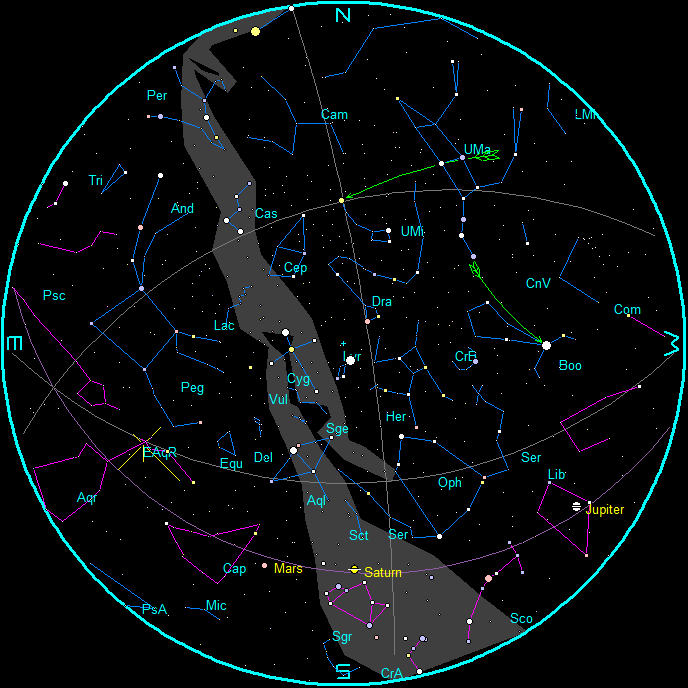
Star Chart for May 2018 mornings based on 5 a.m. May 15th. Created using my LookingUp program. Click on image to enlarge.
For a list of constellation names to go with the abbreviations click here.
Star chart annotations
- Pointer stars at the front of the bowl of the Big Dipper point to Polaris the North Star.
- Leaky Big Dipper drips on Leo.
- Follow the arc of the handle of the Big Dipper to the star Arcturus and
- Continue with a spike to Spica.
- The Summer Triangle is in red.
- EAqr is the Eta Aquariid meteor shower radiant. This shower will be plagued by a waning gibbous moon. It will be addressed in the May 3rd program. This is a shower of bits from Halley’s Comet.
Twilight
Evening nautical twilight ends at 10:02 p.m. EDT on the 1st, increasing to 10:44 p.m. EDT on the 31st.
Evening astronomical twilight ends at 10:46 p.m. EDT on the 1st, increasing to 11:42 p.m. EDT on the 31st.
Morning astronomical twilight starts at 4:40 a.m. EDT on the 1st, and decreasing to 3:45 a.m. EDT on the 31st.
Morning nautical twilight starts at 5:25 a.m. EDT on the 1st, and decreasing to 4:44 a.m. EDT on the 31st.
NASA Calendar of Planetary Events
    Date    Time    Event
May 01  Tu          Venus: 27.2° E
    02  We  9:24 am Venus-Aldebaran: 6.4° N
    04  Fr  4:31 pm Moon-Saturn: 1.9° S
    04  Fr  7:00 pm Moon South Dec.: 20.6° S
    05  Sa  3:03 am Eta Aquarid Shower: ZHR = 60
    05  Sa  8:35 pm Moon Apogee: 404500 km
    06  Su  3:24 am Moon-Mars: 3° S
    07  Mo  6:24 am Moon Descending Node
    07  Mo 10:09 pm Last Quarter
    08  Tu  8:10 pm Jupiter Opposition
    13  Su  1:21 pm Moon-Mercury: 2.5° N
    15  Tu  7:48 am New Moon
    17  Th  2:11 pm Moon-Venus: 4.8° N
    17  Th  5:06 pm Moon Perigee: 363800 km
    18  Fr 11:02 am Moon North Dec.: 20.7° N
    20  Su  7:57 am Moon-Beehive: 1.7° N
    20  Su  9:13 am Moon Ascending Node
    21  Mo  8:53 pm Moon-Regulus: 1.5° S
    21  Mo 11:49 pm First Quarter
    27  Su  1:39 pm Moon-Jupiter: 4.3° S
    29  Tu 10:20 am Full Moon
    31  Th  9:20 pm Moon-Saturn: 1.8° S
Jun 01  Fr          Venus: 34.5° E
Sky Events Calendar by Fred Espenak and Sumit Dutta (NASA’s GSFC),
http://eclipse.gsfc.nasa.gov/SKYCAL/SKYCAL.html
If you go to the above site you can print out a list like the above for the entire year
or calendar pages for your time zone.
Sun and Moon Rising and Setting Events
     LU                  Ephemeris of Sky Events for Interlochen/TC
     May, 2018    Local time zone: EDT
     +-----------------------------------------------------------------------+
     | DATE |  SUN     SUN  DAYLIGHT|   TWILIGHT*    |MOON  RISE OR    ILLUM |
     |      |  RISE    SET    HOURS |  END    START  |PHASE SET** TIME FRACTN|
     +=======================================================================+
     |Tue  1| 06:32a  08:47p  14:15 | 10:00p  05:20a |      Rise 10:32p   96%|
     |Wed  2| 06:31a  08:49p  14:17 | 10:01p  05:18a |      Rise 11:31p   91%|
     |Thu  3| 06:29a  08:50p  14:20 | 10:03p  05:17a |      Rise 12:26a   85%|
     |Fri  4| 06:28a  08:51p  14:23 | 10:04p  05:15a |      Rise 01:15a   78%|
     |Sat  5| 06:27a  08:52p  14:25 | 10:06p  05:13a |      Rise 02:00a   69%|
     +------+-----------------------+----------------+-----------------------+
     |Sun  6| 06:25a  08:53p  14:28 | 10:07p  05:12a |      Rise 02:39a   60%|
     |Mon  7| 06:24a  08:55p  14:30 | 10:09p  05:10a |L Qtr Rise 03:14a   51%|
     |Tue  8| 06:23a  08:56p  14:33 | 10:11p  05:08a |      Rise 03:45a   41%|
     |Wed  9| 06:21a  08:57p  14:35 | 10:12p  05:06a |      Rise 04:14a   32%|
     |Thu 10| 06:20a  08:58p  14:38 | 10:14p  05:05a |      Rise 04:42a   23%|
     |Fri 11| 06:19a  08:59p  14:40 | 10:15p  05:03a |      Rise 05:09a   15%|
     |Sat 12| 06:18a  09:00p  14:42 | 10:17p  05:02a |      Rise 05:38a    8%|
     +------+-----------------------+----------------+-----------------------+
     |Sun 13| 06:16a  09:02p  14:45 | 10:18p  05:00a |      Rise 06:09a    3%|
     |Mon 14| 06:15a  09:03p  14:47 | 10:20p  04:59a |      Rise 06:45a    1%|
     |Tue 15| 06:14a  09:04p  14:49 | 10:21p  04:57a |New   Set  09:20p    1%|
     |Wed 16| 06:13a  09:05p  14:52 | 10:23p  04:56a |      Set  10:32p    3%|
     |Thu 17| 06:12a  09:06p  14:54 | 10:24p  04:54a |      Set  11:40p    9%|
     |Fri 18| 06:11a  09:07p  14:56 | 10:26p  04:53a |      Set  12:41a   17%|
     |Sat 19| 06:10a  09:08p  14:58 | 10:27p  04:51a |      Set  01:33a   26%|
     +------+-----------------------+----------------+-----------------------+
     |Sun 20| 06:09a  09:09p  15:00 | 10:29p  04:50a |      Set  02:17a   37%|
     |Mon 21| 06:08a  09:10p  15:02 | 10:30p  04:49a |F Qtr Set  02:55a   48%|
     |Tue 22| 06:07a  09:12p  15:04 | 10:32p  04:47a |      Set  03:27a   59%|
     |Wed 23| 06:06a  09:13p  15:06 | 10:33p  04:46a |      Set  03:56a   70%|
     |Thu 24| 06:05a  09:14p  15:08 | 10:34p  04:45a |      Set  04:24a   79%|
     |Fri 25| 06:05a  09:15p  15:09 | 10:36p  04:44a |      Set  04:52a   87%|
     |Sat 26| 06:04a  09:16p  15:11 | 10:37p  04:43a |      Set  05:20a   93%|
     +------+-----------------------+----------------+-----------------------+
     |Sun 27| 06:03a  09:16p  15:13 | 10:38p  04:42a |      Set  05:51a   97%|
     |Mon 28| 06:02a  09:17p  15:15 | 10:39p  04:41a |      Set  06:24a   99%|
     |Tue 29| 06:02a  09:18p  15:16 | 10:41p  04:40a |Full  Rise 09:21p  100%|
     |Wed 30| 06:01a  09:19p  15:18 | 10:42p  04:39a |      Rise 10:18p   98%|
     |Thu 31| 06:00a  09:20p  15:19 | 10:43p  04:38a |      Rise 11:10p   95%|
     +-----------------------------------------------------------------------+
     * Nautical Twilight
     ** Moonrise or moonset, whichever occurs between sunset and sunrise
04/30/2018 – Ephemeris – Venus-Earth resonances, and Jupiter & the Moon tonight
Ephemeris for Monday, April 30th. The Sun rises at 6:34. It’ll be up for 14 hours and 12 minutes, setting at 8:46. The Moon, 1 day past full, will rise at 9:30 this evening.
Jupiter will be near the moon tonight. The gravitational force between the planets produces some interesting resonances in their orbital periods. Venus has three different kinds with the Earth. First, Venus orbits the Sun 13 times in the same time it takes the Earth to orbit the Sun 8 times. This is a 13 to 8 resonance. This sets up the 5 Venus Cycles equaling 8 years resonance the Mayan’s discovered. A Venus cycle of 584 days takes Venus to go from Morning Star to Evening Star and back again. The next one wasn’t discovered until we started to bounce radar signals off Venus. We found it rotates backwards, and very slowly at that. Its rotation with respect to the stars is longer than its year. And it so happens that every passage near the Earth the same side of Venus is facing us.
The times given are for the Traverse City/Interlochen area of Michigan. They may be different for your location.
Addendum
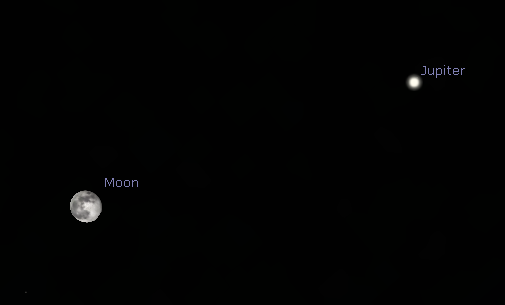
The Moon and Jupiter at 10 p.m. tonight, April 30, 2018. Created using Stellarium.
04/27/2018 – Ephemeris – The Mayan special relationship to Venus
Ephemeris for Arbor Day, Friday, April 27th. The Sun rises at 6:38. It’ll be up for 14 hours and 4 minutes, setting at 8:42. The Moon, 2 days before full, will set at 6:20 tomorrow morning.
The Mayans of Mesoamerica a thousand years ago diligently observed Venus and discovered Venus’ unique cycles that they used to correct their calendars. The first was the Venus Cycle, the period we’d say that Venus passes between the Earth and the Sun to enter the morning sky to the next time it does it. That was 584 days. Its appearance in the morning sky would last 263 days, Then it would disappear near the Sun, actually behind it for 50 days. It would reappear in the evening sky for another 263 days before again disappearing near the Sun, this time for only 8 days. These are the 4 phases of a Venus cycle. Five of these cycles equals almost exactly 8 years, called a sequence. 13 sequences equal 104 years, a Venus Round.
The times given are for the Traverse City/Interlochen area of Michigan. They may be different for your location.
Addendum
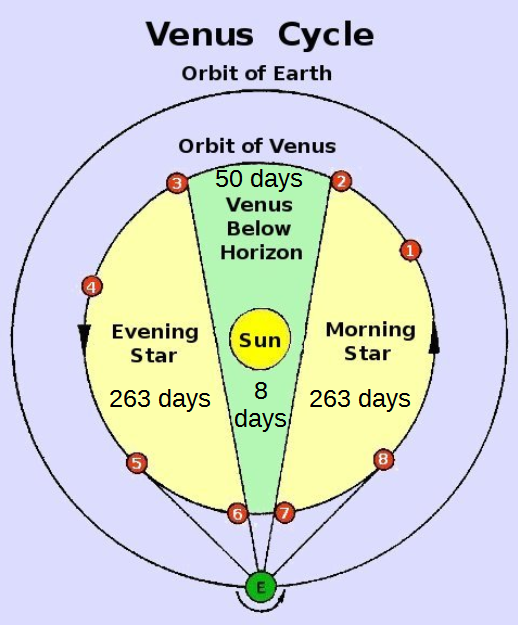
Venus Cycle derived from John P Pratt who has another purpose for the diagram and annotated by me to include the number of days in each phase. For my purposes ignore points 1 and 4. The Mayan cycle starts with 7, the first appearance of Venus during the morning. Points 8 and 5 are the points where Venus is at greatest elongation from the Sun. Credit John P Pratt.
04/26/2018 – Ephemeris – When the Greeks thought Venus was two separate planets
Ephemeris for Thursday, April 26th. The Sun rises at 6:40. It’ll be up for 14 hours and 1 minute, setting at 8:41. The Moon, 3 days before full, will set at 5:52 tomorrow morning.
For the next three programs I’m going to take a look at Venus through the eyes of the ancient, or pre-telescopic cultures. It’s a teaser for the program I’m presenting at the NMC Observatory May 4th. Venus from the mists of time to today. We call Venus’ appearance in the morning the Morning Star and its evening appearance, the Evening Star. The very ancient Greeks thought they were two separate planets. The morning planet was Phosphorus, and the evening planet was Hesperus. Somewhere around the 4th or 3rd century BC someone figured the when Hesperus was out in the evening Phosphorus was not out the next morning, and vice versa. The then single planet was named Aphrodite, by whose Roman name, Venus, we still call it by today.
The times given are for the Traverse City/Interlochen area of Michigan. They may be different for your location.
Addendum
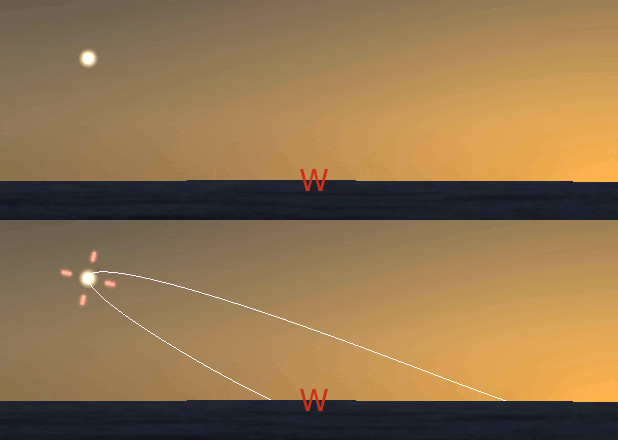
Venus (Hesperus) at its evening eastern greatest elongation on August 18, 2018 showing the part of its orbit that’s above the horizon. Created using Stellarium and GIMP.
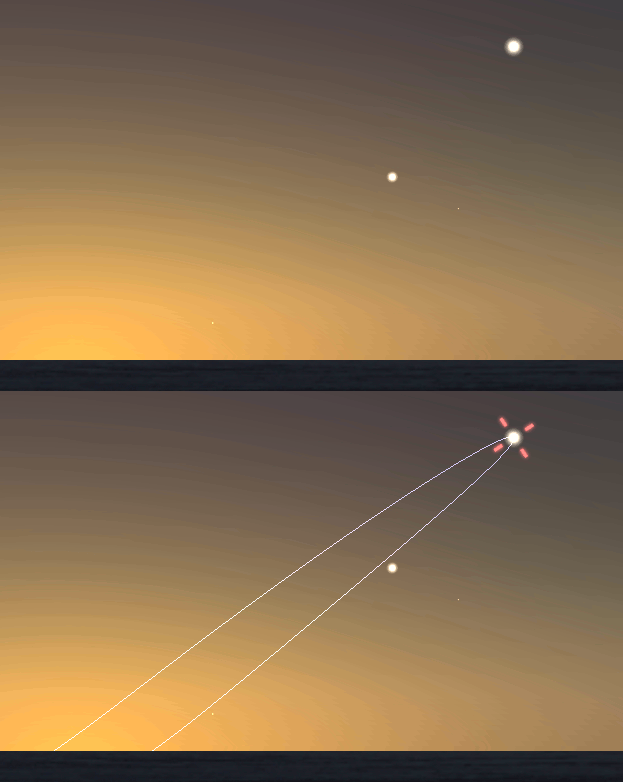
Venus (Phosphorus) at its morning western greatest elongation on January 6, 2019 showing the part of its orbit that’s above the horizon. Jupiter is the other planet visible. Created using Stellarium and GIMP.
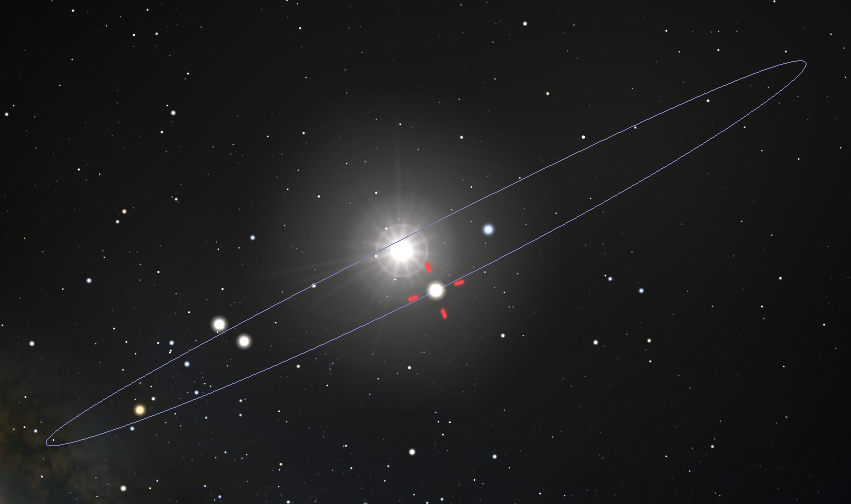
Venus at inferior conjunction on October 27, 2018 showing its entire orbit on a smaller scale than the images above from the Earth’s perspective. The far part of the orbit goes behind the Sun. The planets Mercury and Jupiter are seen left of the Sun. Created using Stellarium.
04/25/2018 – Ephemeris – It’s bright planet Wednesday
Ephemeris for Wednesday, April 25th. The Sun rises at 6:41. It’ll be up for 13 hours and 58 minutes, setting at 8:40. The Moon, 3 days past first quarter, will set at 5:22 tomorrow morning.
It’s Wednesday again and time to look for the bright planets. One bright planet is in the evening sky, the brightest, Venus. It will be visible low in the western twilight from about 9:10 p.m. until it sets at 10:58. Venus is blindingly bright in binoculars or a small telescope. Jupiter will rise this evening at 9:42 p.m. That doesn’t make it an evening planet. It has to rise before sunset to be an evening planet. Give it a couple of weeks. Saturn will rise at 1:37 a.m., while Mars will rise at 2:33 a.m.
At 6 tomorrow morning these three planets will be strung across the southern sky. Bright Jupiter will be in the southwest, dimmer Mars and Saturn will be in the south, with Mars to the left of Saturn in the morning twilight.
The times given are for the Traverse City/Interlochen area of Michigan. They may be different for your location
Addendum
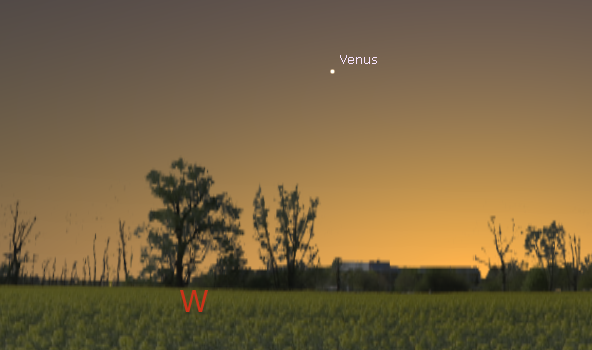
Venus in evening twilight at 9 p.m, tonight April 25, 2018. Created using Stellarium.
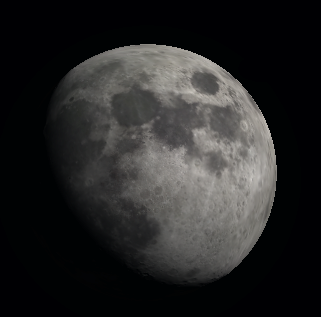
The Gibbous Moon tonight at 10 p.m., April 25, 2018. Created using Stellarium.
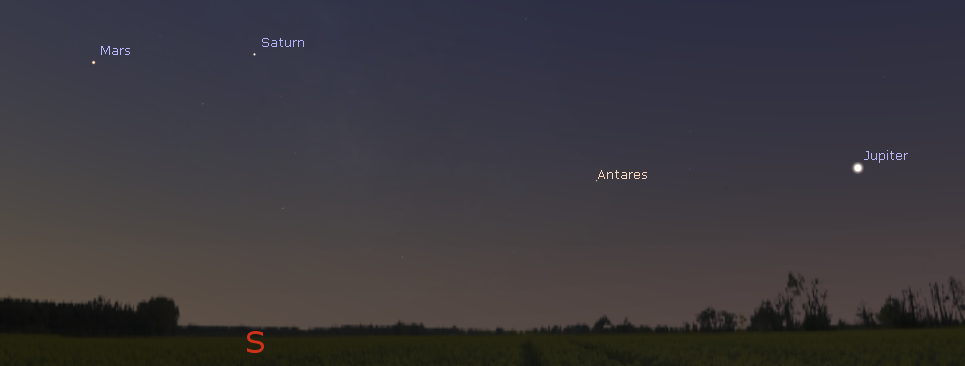
The morning planets at 6 a.m. April 26, 2018. Click on the image to enlarge. Created using Stellarium.
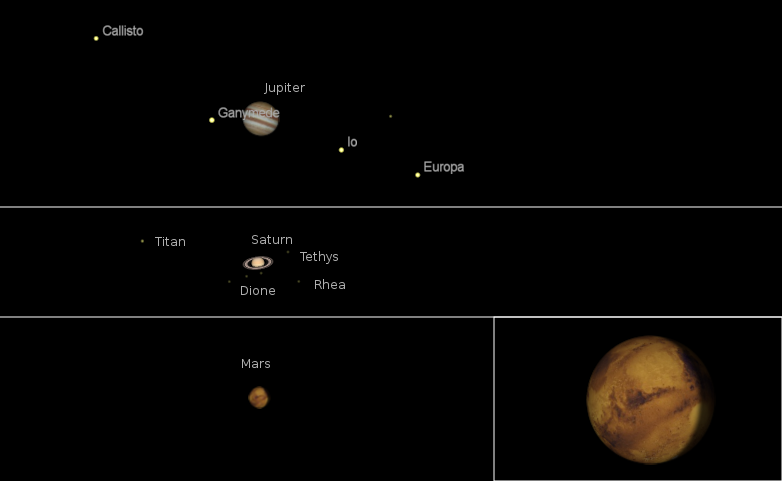
The morning planets as seen in a telescope using the same magnification. A magnified image of Mars is inset showing some of the features that may be visible under higher magnification. Created using Cartes du Ciel (Sky Charts).
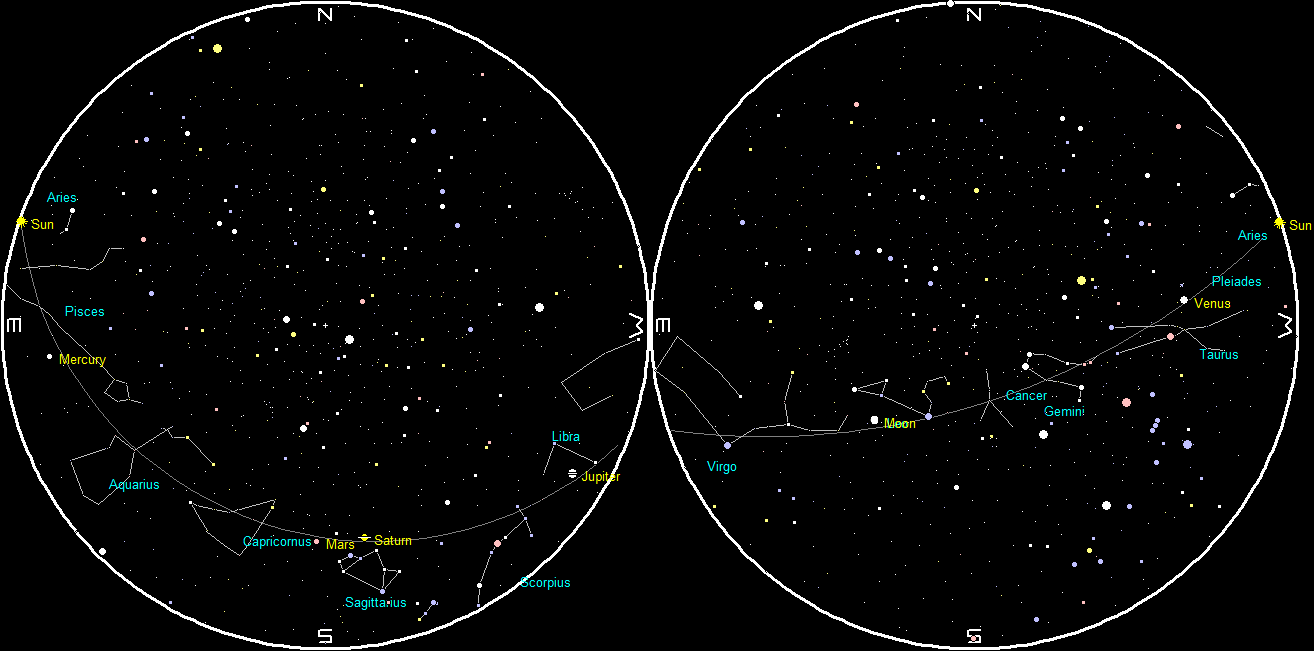
Planets and the Moon at sunset and sunrise of a single night starting with sunset on the right on April 25, 2018. The night ends on the left with sunrise on the 26th. Click on the image to enlarge. Created using my LookingUp program.

