Archive
05/22/2018 – Ephemeris – Seeing detail on the face of Jupiter with a small telescope
Ephemeris for Tuesday, May 22nd. Today the Sun will be up for 15 hours and 4 minutes, setting at 9:12, and it will rise tomorrow at 6:06. The Moon, 1 day past first quarter, will set at 3:27 tomorrow morning.
Even in small telescopes Jupiter shows some detail. The larger the telescope in diameter the more detail can be seen. It also depends on what astronomers call seeing, or the steadiness of the atmosphere. The easiest detail to spot are the parallel brown and cream-colored cloud bands. These run in the direction that Jupiter’s moons move, since the four Galilean moons orbit over Jupiter’s equator. Jupiter, 11 time’s the Earth’s diameter, rotates on its axis in a bit less than 10 hours, though the clouds at the equator rotate faster than those at higher latitudes. It also gives Jupiter a slightly squashed appearance., enhanced by the horizontal stripes. Embedded in one of the dark stripes is the famous Great Red Spot.
The times given are for the Traverse City/Interlochen area of Michigan. They may be different for your location.
Addendum
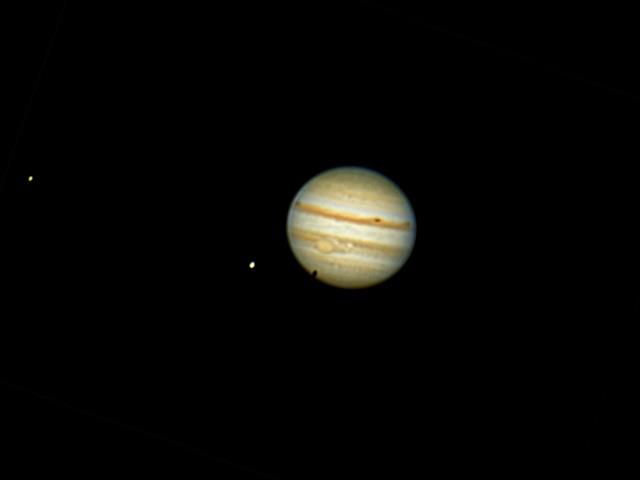
Scott Anttila image of Jupiter from November 14, 2011.
05/21/2018 – Ephemeris – 408 years ago Galileo discovered that Jupiter had moons
Ephemeris for Monday, May 21st. Today the Sun will be up for 15 hours and 2 minutes, setting at 9:10, and it will rise tomorrow at 6:07. The Moon, at first quarter today, will set at 2:55 tomorrow morning.
Jupiter is the bright star-like object in the southeast in the evening. In telescopes and even in binoculars the observer can spot up to four stars nearby. These aren’t stars, but moons or satellites of Jupiter. Galileo discovered them 408 years ago with his small telescope. Jupiter has 69 satellites in all at last count, but the rest are tiny objects. Of the four ‘Galilean’ satellites all but one is larger than the Moon. They are, in order from Jupiter Io, a volcano riddled world which is constantly resurfacing itself. Next is Europa an icy moon with a good probability of a salty ocean beneath. Giant Ganymede is next, larger than Mercury, it is also icy with the possibility of an ocean. Last is Callisto a dark moon with bright craters.
The times given are for the Traverse City/Interlochen area of Michigan. They may be different for your location.
Addendum
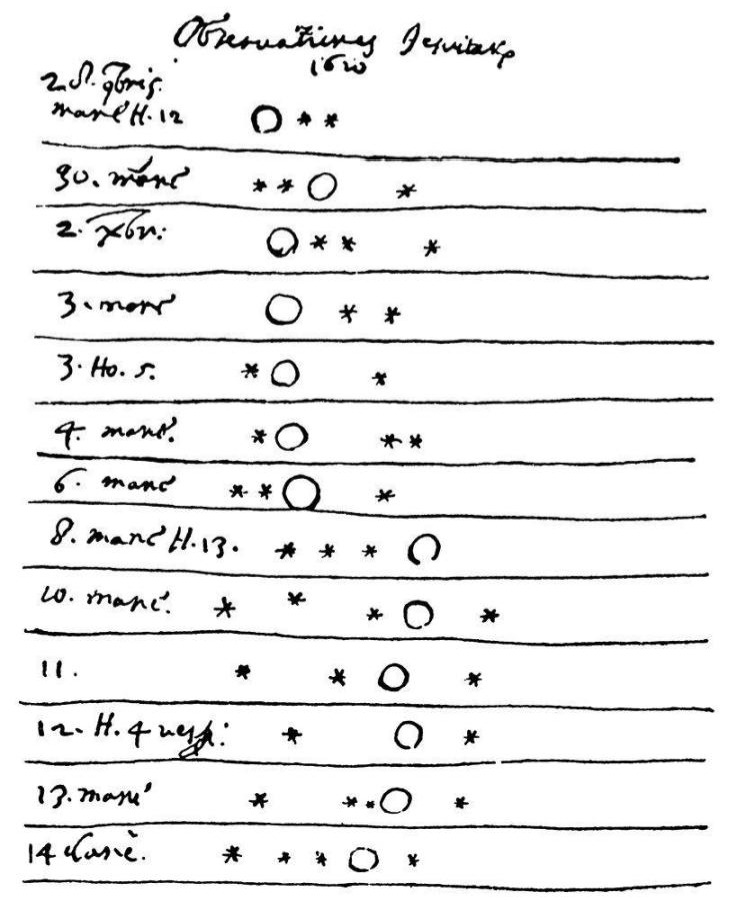
Multiple night sightings of Jupiter’s moons by Galileo.
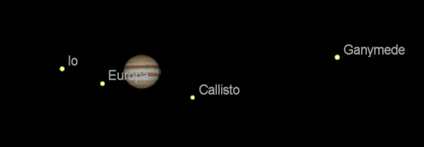
Jupiter and its moons tonight, May 21, 2018. Created using Cartes du Ciel (Sky Charts).
05/17/2018 – Ephemeris – Venus and the Moon tonight and viewing Venus in the daytime
Ephemeris for Thursday, May 17th. Today the Sun will be up for 14 hours and 54 minutes, setting at 9:06, and it will rise tomorrow at 6:11. The Moon, 2 days past new, will set at 11:40 this evening.
This afternoon at 2:11 the Moon will appear to pass Venus. This will be impossible to see since the Moon is going to be much dimmer than Venus. Venus can indeed be seen in the daylight. I’ve seen it many times with binoculars or a telescope, but only once with the naked eye. The latter time was not long before sunset. It is essential that to spot Venus in the daytime by any of these means that one is in the shade, by putting the Sun behind a building, and knowing where Venus is supposed to be using a program on a smart phone. By tonight the Moon will have moved eastward past Venus by up to 13 of its diameters and will also be displaying earthshine, the reflection of the Earth off its night side.
The times given are for the Traverse City/Interlochen area of Michigan. They may be different for your location.
Addendum
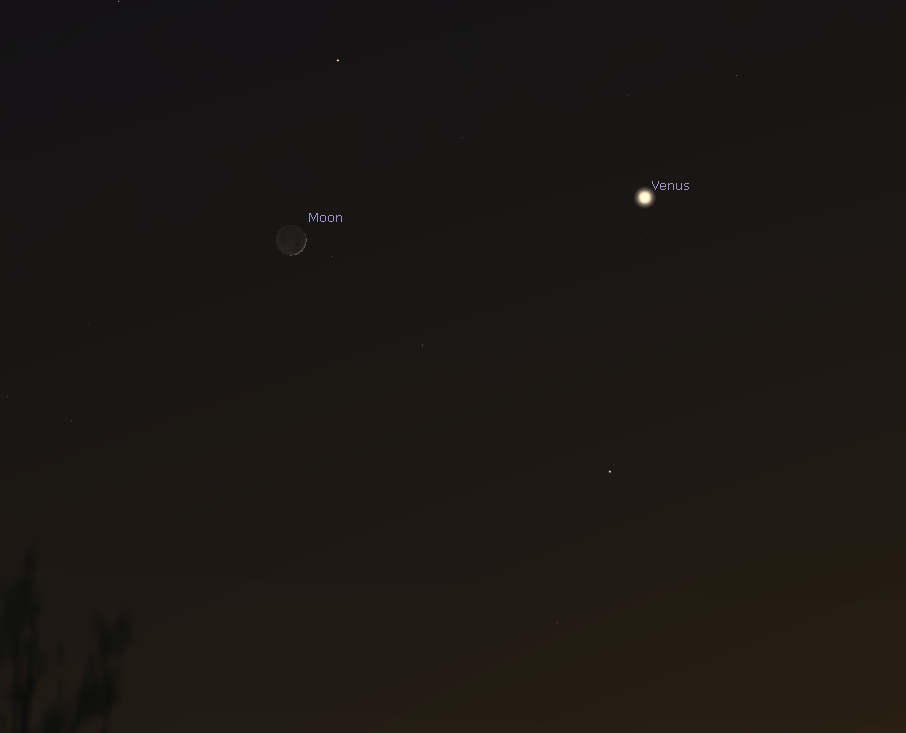
Venus and the Moon at 10 p.m. May 17, 2018. Created using Stellarium.
05/16/2018 – Ephemeris – Let’s check out the whereabouts of the bright planets
Ephemeris for Wednesday, May 16th. Today the Sun will be up for 14 hours and 52 minutes, setting at 9:05, and it will rise tomorrow at 6:12. The Moon, 1 day past new, will set at 10:32 this evening.
It’s Wednesday again and time to look for the bright planets. Two of them are in the evening sky. The brilliant beacon of Venus will be visible in the western twilight from about 9:25 p.m. until it sets at 11:44. Jupiter will be low in the southeast as it gets dark. Jupiter is only out shown by Venus and the Moon. And after Venus sets will have the night to itself as the brightest star-like object. Binoculars will show it to be not quite star-like in size, that is it will appear as a tiny orb. It will be accompanied by several satellites which will shift positions night to night. Saturn will rise at 12:12 a.m. in the east-southeast. Mars will rise at 1:46 a.m. and is now outshining Saturn, and will, this summer even outshine Jupiter.
The times given are for the Traverse City/Interlochen area of Michigan. They may be different for your location.
Addendum
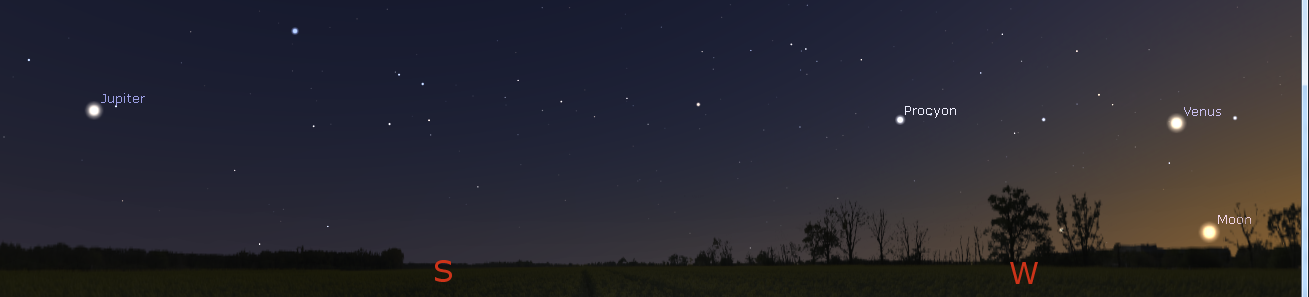
Jupiter and Venus at 10 p.m. May `6, 2018. Click on image to enlarge. Created using Stellarium.
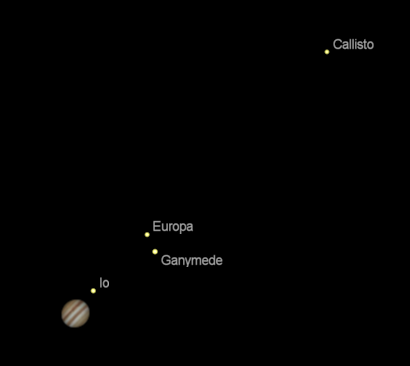
Jupiter and its moons at 10:30. May 16, 2018. Created using Cartes du Ciel (Sky Charts).
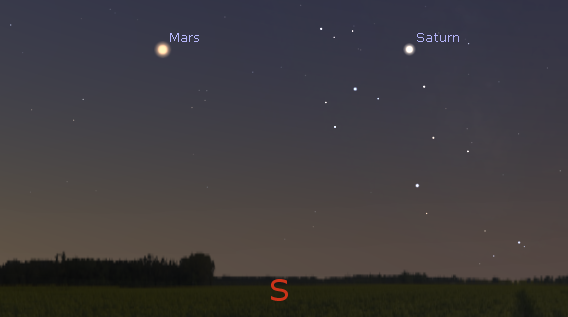
Morning planets at 5:30 a.m. May 17, 2017. Created using Stellarium.
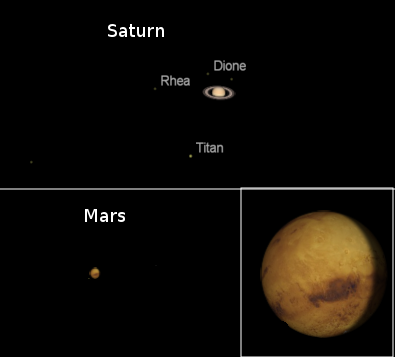
Telescopic Saturn and Mars with the same magnification at 5:30 a.m. May 17, 2018. Inset shows Mars at higher magnification. Created using Cartes du Ciel (Sky Charts).
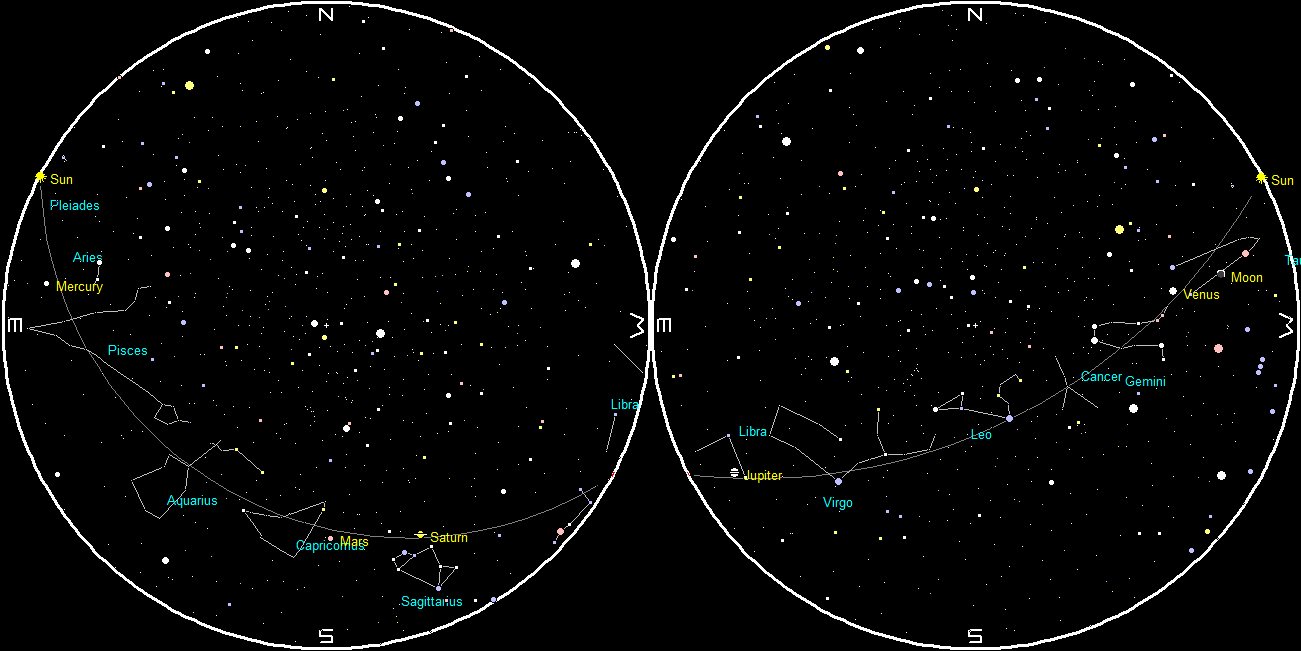
Planets and the Moon at sunset and sunrise of a single night starting with sunset on the right on May 16, 2018. The night ends on the left with sunrise on the 17th. Click on the image to enlarge. Created using my LookingUp program.
5/15/2018 – Ephemeris – Two thirds thru spring
Ephemeris for Tuesday, May 15th. Today the Sun will be up for 14 hours and 49 minutes, setting at 9:04, and it will rise tomorrow at 6:13. The Moon is new today, and won’t be visible.
Here we are at the middle of May, nearly two-thirds through spring and in the west only a few winter stars remain. Castor and Pollux of Gemini are horizontal in the west, Procyon the Little Dog Star is below and left of them, Capella in Auriga is in the northwest, but for most of the IPR listening area it will never quite set. At 10:30 Betelgeuse in Orion the hunter will be setting, chased from the skies by Scorpius the scorpion, which is rising in the southeast. In one story it is the sting of this scorpion that killed him. Already at that time two-thirds of the stars of the summer Triangle are up. Bright Vega in Lyra the harp, and Deneb in Cygnus the swan. The Big Dipper reigns overhead as spring is in full bloom.
The times given are for the Traverse City/Interlochen area of Michigan. They may be different for your location.
Addendum
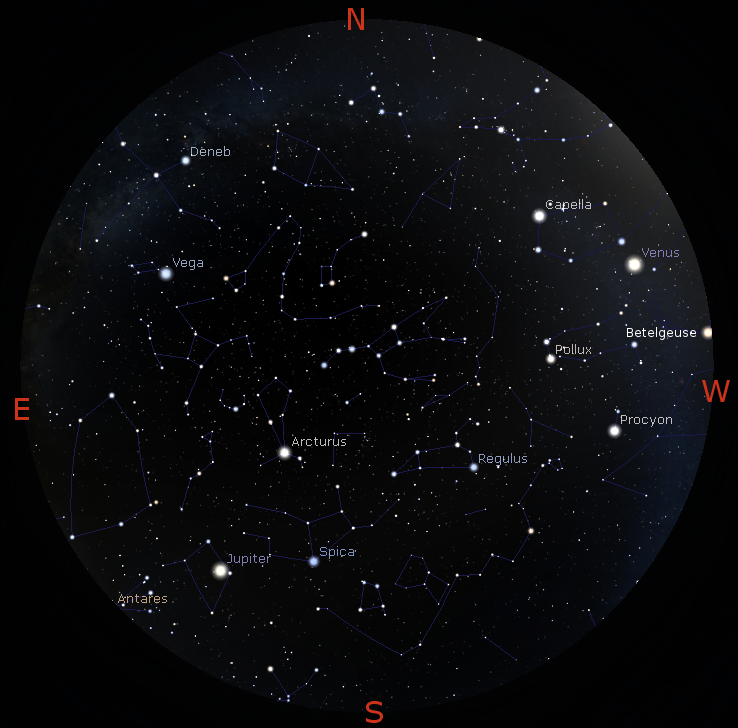
The sky dome for 10:30 p.m. May 15, 2018 showing the stars and constellations. It may not work for any latitude or time, but it works for our location, near 45 degrees north. Created using Stellarium.
05/14/2018 – Ephemeris – Big Dipper: Pointer to the Stars
Ephemeris for Monday, May 14th. Today the Sun will be up for 14 hours and 47 minutes, setting at 9:03, and it will rise tomorrow at 6:14. The Moon, 1 day before new, will rise at 6:45 tomorrow morning.
The Big Dipper points to other stars and constellations. Right now the Big Dipper is nearly overhead. The front bowl stars point to Polaris, the North Star which never seems to move in the sky. The handle can be used to find two stars. First follow the arc of the handle away from the bowl to find the fourth brightest night-time star Arcturus in the base of the kite shaped constellation of Boötes. Straighten the arc to a spike and continue to the south and you will come to the bright blue-white star Spica in Virgo the virgin. You can remember these stars with the phrase “Follow the arc of the handle to Arcturus and then spike to Spica” or if you prefer the alternate pronunciation of the latter star “Speak to Speeka”.
The times given are for the Traverse City/Interlochen area of Michigan. They may be different for your location.
Addendum
As can be seen below, there was one pointer function that didn’t make it into the program: A leaky dipper drips on Leo.
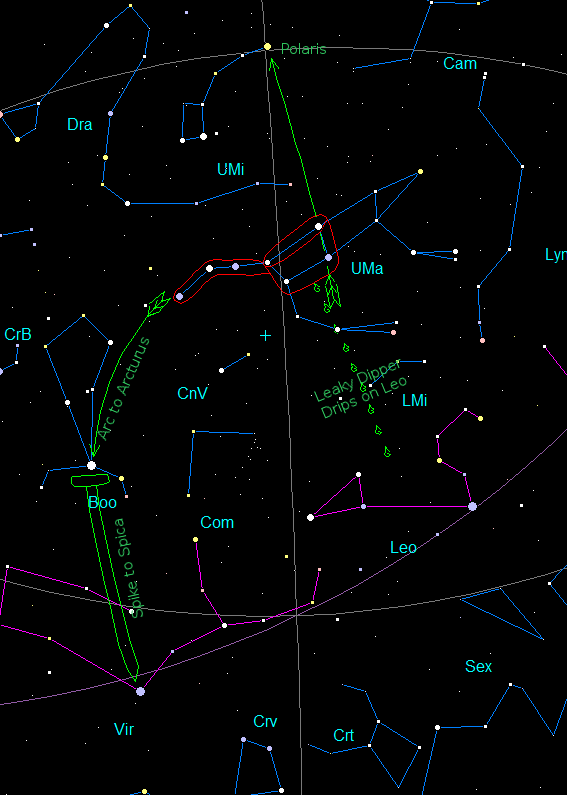
Using the Big Dipper as a pointer to other stars. The pointers to Polaris could be life saving, since it is always north. The view is southward. The cross displayed near the center is the zenith. One might want to lay down to take all this in. Created using my LookingUp program.
05/11/2018 – Ephemeris – Corvus, Crater, Hydra and a fig
Ephemeris for Friday, May 11th. The Sun rises at 6:19. It’ll be up for 14 hours and 40 minutes, setting at 8:59. The Moon, half way from last quarter to new, will rise at 5:09 tomorrow morning.
The small constellation of Corvus the crow is located low in the south at 10:30 this evening. It’s made of 5 dim stars, but the pattern is a distinctive distorted box with two stars at the upper left marking that corner. To the right is a fainter constellation of a thick stemmed goblet called Crater. Both appear above the long constellation of Hydra the water snake who is slithering above the southern horizon. In Greek mythology Corvus, then white, was the god Apollo’s pet. He once bid Corvus to take a cup and fetch him some water. Corvus however dallied and waited for a green fig to ripen. Corvus then grabbed a snake and returned with a story on how the snake had delayed him. The angry Apollo turned the crow and all crows black to this day.
The times given are for the Traverse City/Interlochen area of Michigan. They may be different for your location.
Addendum
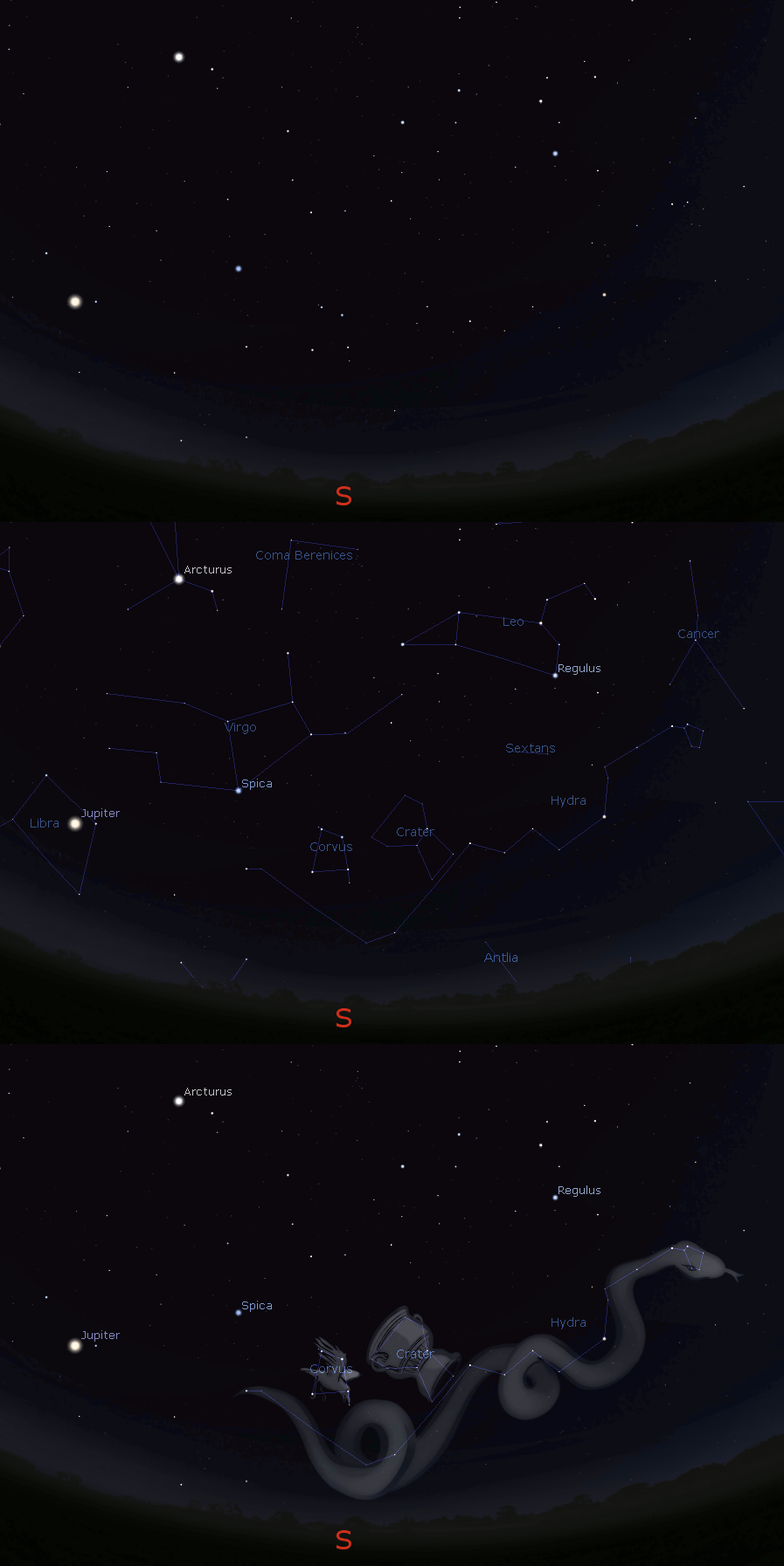
Corvus, Crater and Hydra finder chart for 10:30 p.m. May 11, 2017. Apollo is not in the night sky, and is presumably resting after guiding the Sun’s (Helios) chariot across the daytime sky. The fig? Corvus ate it. Click on the image to enlarge. Created using Stellarium and GIMP.
05/10/2018 – Ephemeris – Berenice’s Hair
Ephemeris for Thursday, May 10th. The Sun rises at 6:20. It’ll be up for 14 hours and 38 minutes, setting at 8:58. The Moon, 3 days past last quarter, will rise at 4:42 tomorrow morning.
High in the southeast at 10 p.m. is a tiny and faint constellation of Coma Berenices, or Berenice’s hair. In it are lots of faint stars arrayed to look like several strands of hair. The whole group will fit in the field of a pair of binoculars, which will also show many more stars. The hank of hair was supposed to belong to Berenice, Queen of Egypt, of the 3rd century BCE. Coma Berenices is the second closest star cluster to us at only 250 light years away, after the Hyades, the face of Taurus the bull now setting in the west. It’s in an odd spot for a galactic star cluster, that’s supposed to lie in the plane of the Milky Way. It actually lies at the galactic pole. That’s an illusion because it’s so close to us. It’s still really in the plane of the Milky Way.
The times given are for the Traverse City/Interlochen area of Michigan. They may be different for your location.
Addendum
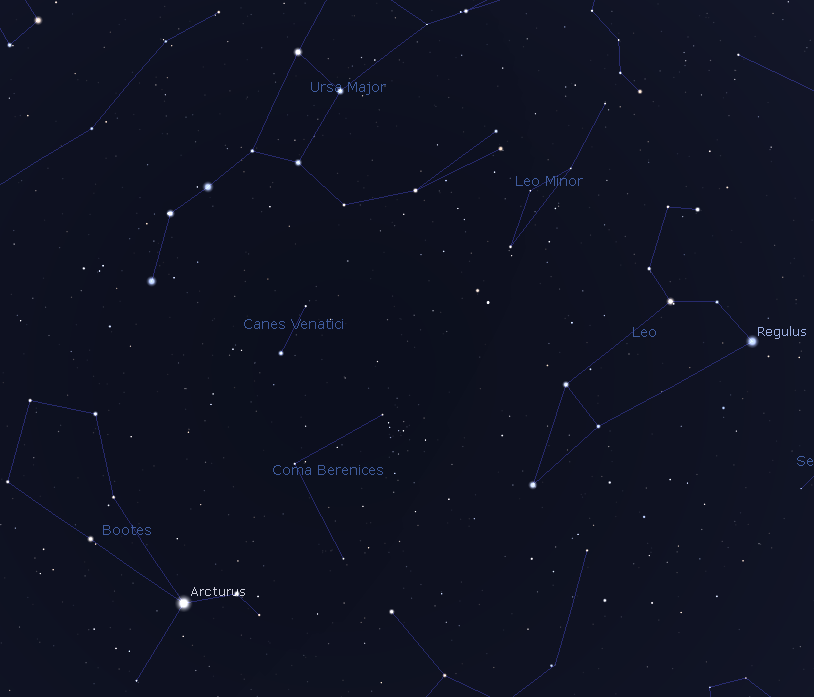
Coma Berenices finder chart for 10 p.m. May 10, 2018. Created using Stellarium.
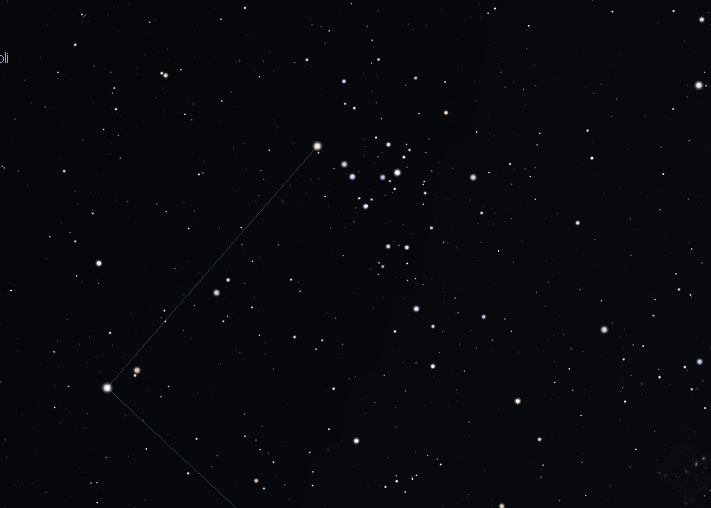
Coma Berenices as it might look in a pair of binoculars. Telescopes are too powerful. Created using Stellarium.
05/09/2018 – Ephemeris – We’ve got two evening planets now
Ephemeris for Wednesday, May 9th. The Sun rises at 6:21. It’ll be up for 14 hours and 35 minutes, setting at 8:57. The Moon, 2 days past last quarter, will rise at 4:14 tomorrow morning.
It’s Wednesday again and time to look for the bright planets. Tada! We now have a second planet in the evening sky. More on that in a moment. Venus will be visible low in the western twilight from about 9:15 p.m. until it sets at 11:29. Jupiter is up before sunset in the southeast. Which makes it an evening planet. It is at its closest and its brightest at magnitude -2.5. Venus is at magnitude -3.9. Magnitudes are like golf scores, the lower the magnitude the brighter the object. Saturn will rise at 12:49 a.m., while Mars will rise at 2:05 a.m. At 5:30 tomorrow morning these three planets will be strung across the southern sky. Bright Jupiter will be in the southwest, dimmer Mars and Saturn will be in the south, with Mars to the left of Saturn.
The times given are for the Traverse City/Interlochen area of Michigan. They may be different for your location.
Sorry, no graphics this time. I’m still fighting the flu bug. It’s not a cold as I reported with Monday’s post but a full blown case of the flu.

