Archive
04/10/2018 – Ephemeris – How Boötes and the Great Bear got into the sky
Ephemeris for Tuesday, April 10th. The Sun will rise at 7:07. It’ll be up for 13 hours and 14 minutes, setting at 8:21. The Moon, 2 days past last quarter, will rise at 5:14 tomorrow morning.
Appearing mid way up the sky in the east at 10 p.m. is the kite shaped constellation of Boötes the herdsman. The bright star Arcturus is at the bottom-right of the kite, pointed to by the arc of the handle of the Big Dipper, above it. In one Greek myth Boötes represents a young hunter named Arcas, son of Callisto, a beautiful young lady who had the misfortune of being loved by Zeus the chief of the Greek gods. Zeus’ wife Hera, found out about the affair, and since she couldn’t punish Zeus, turned the poor woman into an ugly bear. Arcas, unaware of the events surrounding his mother’s disappearance in his youth was about to kill the bear when Zeus intervened and placed them both in the sky to save her. To this day Boötes continues to chase the great bear Ursa Major around the pole of the sky each night.
The times given are for the Traverse City/Interlochen area of Michigan. They may be different for your location.
Addendum

Arcas about to slay the bear by the 17th century artist Baur. Source: University of Virginia Electronic Text Center
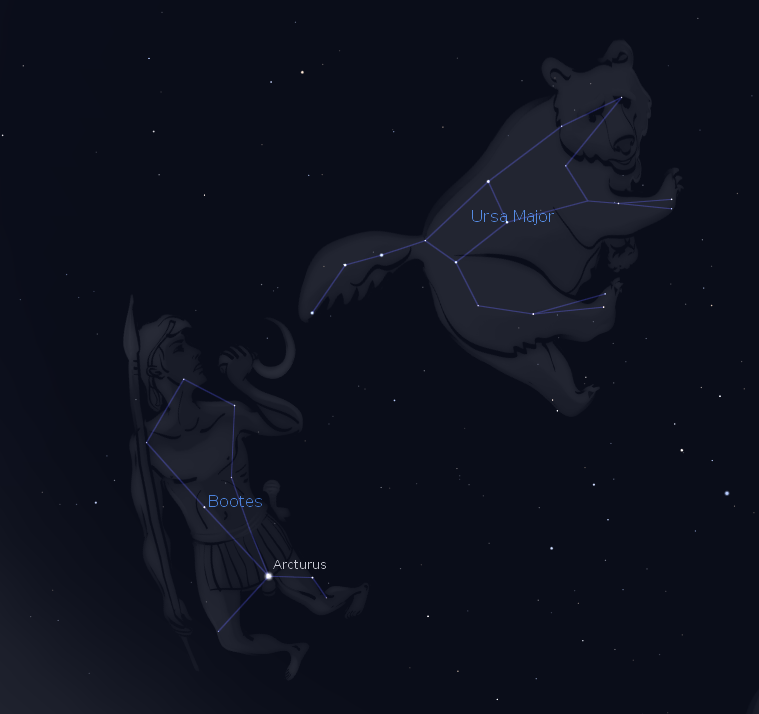
Bootes and Ursa Major aka Arcas chasing Callisto around the pole of the sky. Created using Stellarium.
04/06/2018 – Ephemeris – Marking the passage of 13 hours of daylight
Ephemeris for Friday, April 6th. The Sun will rise at 7:14. It’ll be up for 13 hours and 2 minutes, setting at 8:16. The Moon, 2 days before last quarter, will rise at 2:33 tomorrow morning.
Tomorrow morning early, the crescent Moon will pass Saturn and Mars. These planets will be below the Moon in the dark early morning hours. The dark night hours will be increasingly more inaccessible as summer approaches. Today we’ve broached 13 hours of daylight. By the summer solstice on June 21st the Sun will be out just a bit over 15 and a half hours. Meaning that the Sun will be down for only eight and a half hours, with only three and a half hours of really dark sky, Moon permitting, between the end of evening astronomical twilight and the beginning of morning astronomical twilight. Twilight is really long around the summer solstice because the Sun sets at a shallow angle.
The times given are for the Traverse City/Interlochen area of Michigan. They may be different for your location.
Addendum
Definitions
End or start of Civil Twilight: Sun is 6° below the horizon
Brighter planets become visible
End or start of Nautical Twilight: Sun is 12° below the horizon
Brighter deep sky objects can be found for public star parties
End or start of astronomical twilight: Sun is 18° below the horizon
On moonless nights, the twilight glow is gone and the sky is dark
04/05/2018 – Ephemeris – Hydra, a constellation for all of spring
Ephemeris for Thursday, April 5th. The Sun will rise at 7:16. It’ll be up for 12 hours and 59 minutes, setting at 8:15. The Moon, 3 days before last quarter, will rise at 1:41 tomorrow morning.
In the southern evening sky can be found the constellation of Hydra the water snake. Unlike the monster of the same name this Hydra has but one head, which is its most distinctive part. At 10 p.m. look to the south. The head of Hydra is located below a line from Gemini and Leo. It is directly below Cancer the crab, and left of the star Procyon. Hydra’s head is a small distinctive group of 6 stars that make a loop and the snake’s slightly drooping head. At that time the sinuous body of Hydra sinks below the horizon in the southeast. As it gets later in the evening the rest of Hydra will wend its way to eventually end beneath Libra the scales. This can also be seen in the next few months as Hydra slithers across the southern horizon.
The times given are for the Traverse City/Interlochen area of Michigan. They may be different for your location.
Addendum
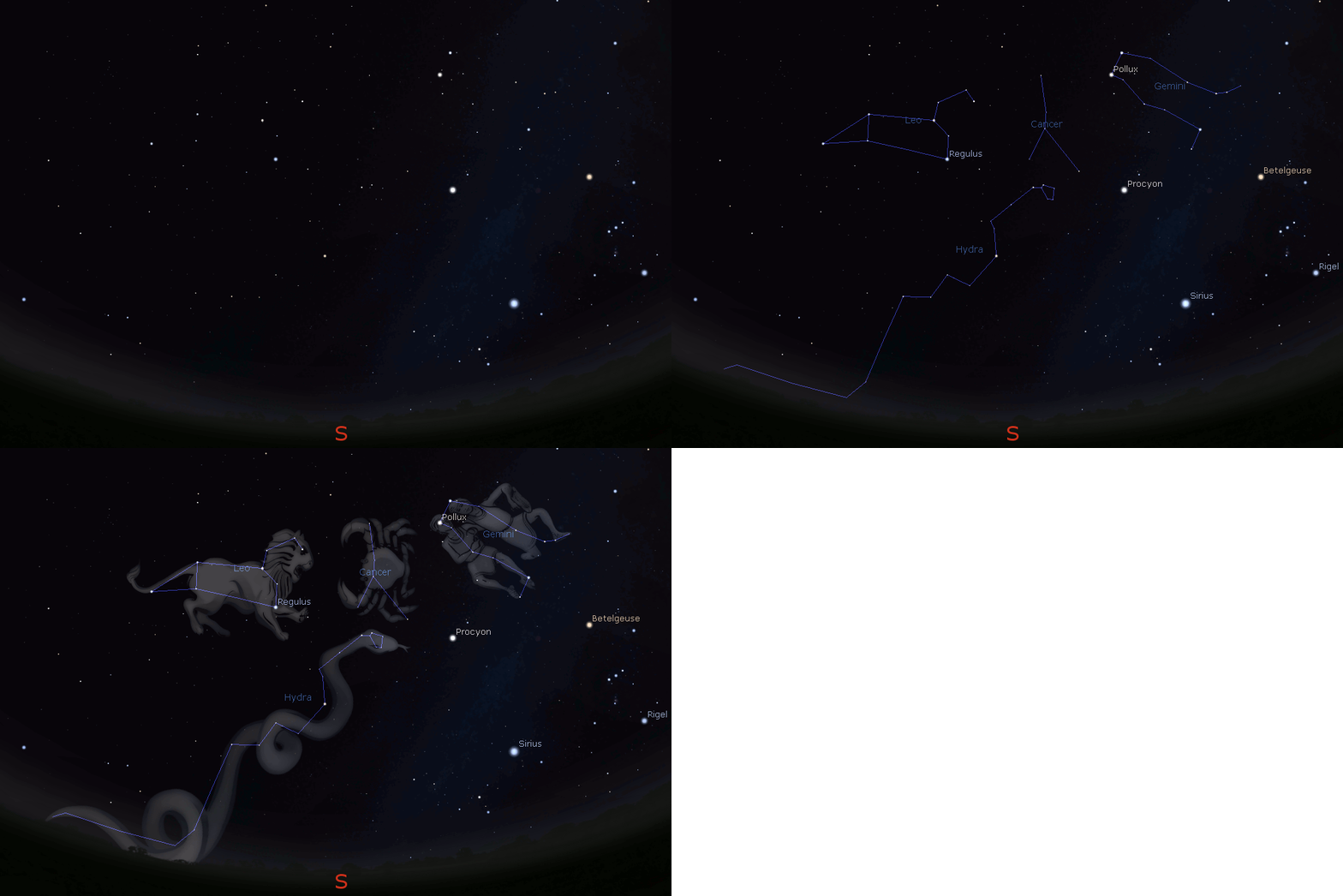
Hydra the water snake finder animation for 10 p.m. April 5th.. Hydra is the longest of all the constellations. Click on image to enlarge. Created using Stellarium and GIMP.
04/04/2018 – Ephemeris – Wednesday is bright planet day on Ephemeris
Wednesday, April 4th. The Sun will rise at 7:18. It’ll be up for 12 hours and 56 minutes, setting at 8:14. The Moon, half way from full to last quarter, will rise at 12:44 tomorrow morning.
Let’s take our weekly look at the bright planets. We’re down to 4 the naked eye planets are visible now. One is in the evening sky. Venus will be visible low in the Western twilight from about 8:40 p.m. until it sets at 10:01. Mercury is in the morning sky, but too close to the Sun to be seen by anybody. Jupiter will rise late this evening at 11:16 p.m. That doesn’t make it an evening planet. It has to rise before sunset to be an evening planet. Saturn will rise at 2:59 a.m., while Mars will rise 14 minutes later at 3:13 a.m. At 6 tomorrow morning these three planets will be strung across the southern sky. Bright Jupiter will be in the southwest, dimmer Mars and Saturn will be in the south-southeast, with Mars below Saturn.
The times given are for the Traverse City/Interlochen area of Michigan. They may be different for your location.
Addendum
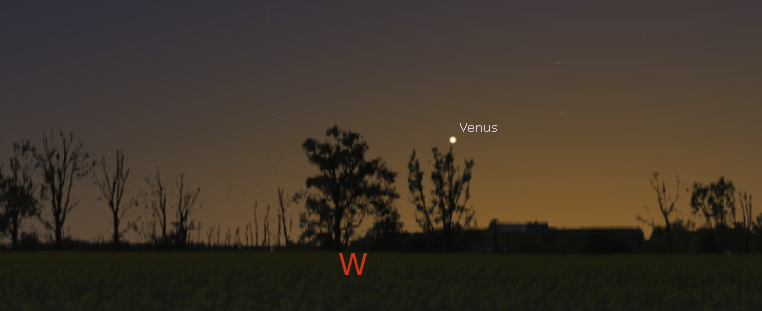
Venus in evening twilight at 9 p.m, tonight April 4, 2018. Click on the image to enlarge. Created using Stellarium.
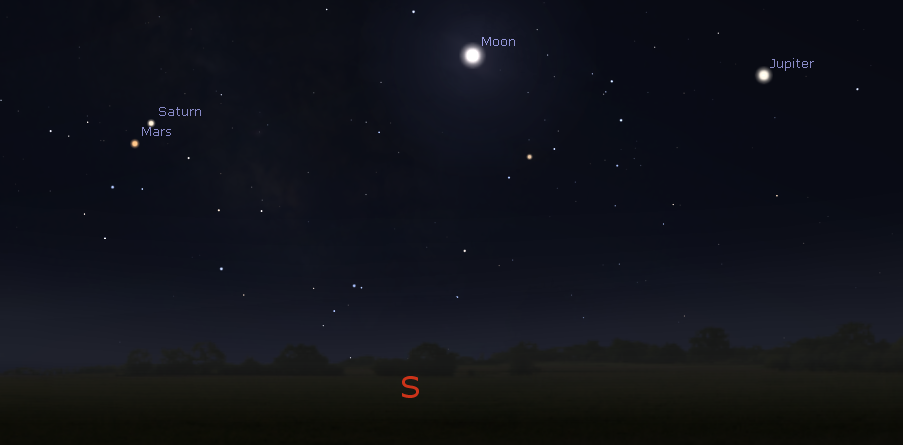
The morning planets and the Moon at 6 a.m. April 5, 2018. Click on the image to enlarge. Created using Stellarium.
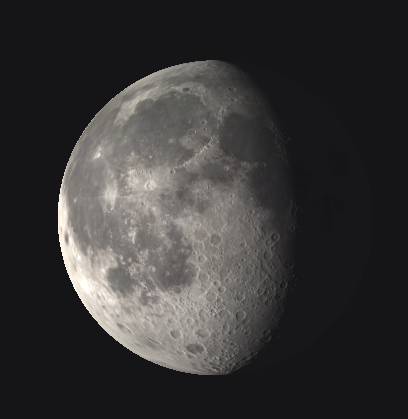
The waning gibbous Moon at 6 a.m. April 5, 2018 as it might be seen in binoculars.
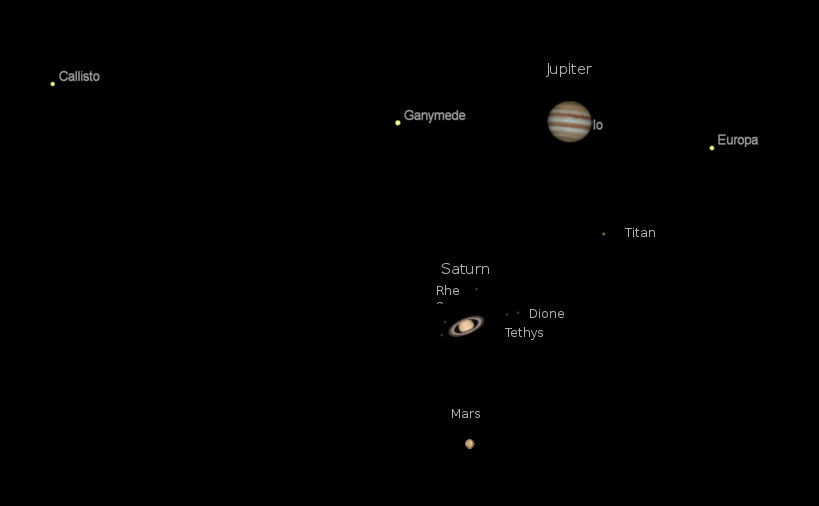
The morning planets as seen by a telescope using the same magnification for all at 6 a.m. April 5, 2018. a.m. Jupiter’s moon Io is in the planet’s shadow. See the table below from Project Pluto. Created using Cartes du Ciel (Sky Charts).
Moon Event             Date     Universal Time   Local time
Io : Eclipse start     5 Apr 2018  9:04 UT        5:04 EDT
Io : Occultation end   5 Apr 2018 11:57 UT        7:57 EDT (unseen)
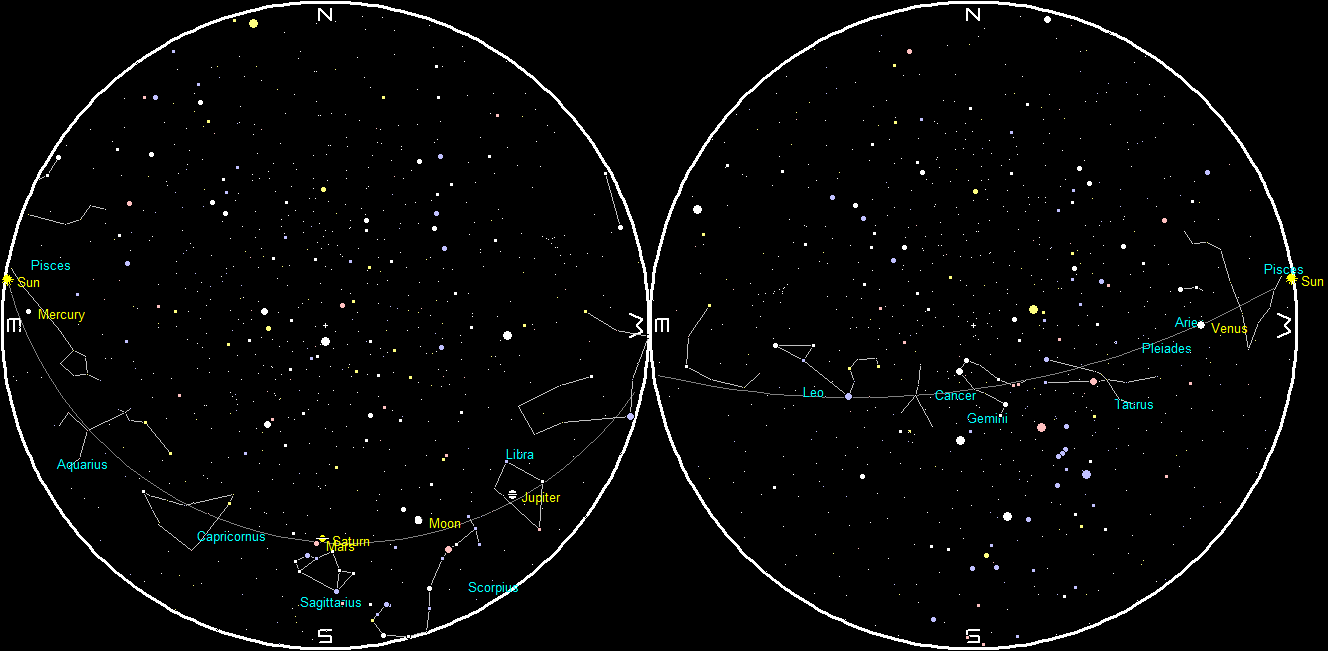
Planets and the Moon at sunset and sunrise of a single night starting with sunset on the right on April 4, 2018. The night ends on the left with sunrise on the 5th. Click on the image to enlarge. Created using my LookingUp program.
04/03/2018 – Ephemeris – How to spot Zodiacal Light
Ephemeris for Tuesday, April 3rd. The Sun will rise at 7:19. It’ll be up for 12 hours and 53 minutes, setting at 8:12. The Moon, 3 days past full, will rise at 11:44 this evening.
Zodiacal light is a faint but towering glow that can be seen after the end of astronomical twilight on a moonless night. It is seen in the west in the evening in late winter and early spring and in the east in the morning in late summer and early autumn. The axis of the glow is the ecliptic, the plane of the Earth’s orbit, indeed that of all the planets, along which lie the constellations of the zodiac. Right now the end of twilight is about 10 p.m. and advancing at a rate of a minute or two each night. The cause of zodiacal light is dust, micron sized dust from comets and asteroids. Most of these lie in the plane of the solar system, which is why zodiacal light is centered on the ecliptic and the constellations of the zodiac and increases in brightness and width toward the Sun. Spotting Zodiacal Light takes dark adapted eyes, time and patience.
The times given are for the Traverse City/Interlochen area of Michigan. They may be different for your location.
Addendum
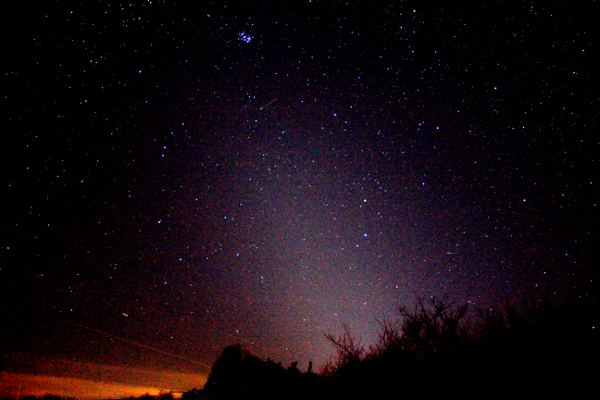
Much enhanced Zodiacal Light from the my back yard at 9:31 p.m. March 16, 2018, 5 minutes after the official end of astronomical twilight. Canon EOS Rebel T5 18mm f.l., f/3.5, 6 sec. ISO 12,800 . The clouds on the left appear to be illuminated by the lights of the towns of Beulah and Frankfort 20+ miles away. Note the Pleiades at the top of the image.
04/02/2018 -Ephemeris – Mars is appearing to pass Saturn in the morning
Ephemeris for Monday, April 2nd. The Sun will rise at 7:21. It’ll be up for 12 hours and 49 minutes, setting at 8:11. The Moon, 2 days past full, will rise at 10:40 this evening.
At 3:02 this afternoon the planet Mars will pass the planet Saturn. The event is called a conjunction, which simply means they are on nearly the same line of sight from the Earth, and nothing more. It will make a pretty sight tomorrow morning before the sky gets too bright with reddish Mars being just below Saturn, by a bit less than 3 moon widths. Conjunctions of these two planets occur at intervals of two years give or take, since it involves the orbital motions of Mars and Saturn while viewing them from a third planet also orbiting the Sun.
Currently both planets are moving eastward against the stars. Saturn will slow and stop its motion on April 18th, while Mars will continue until June 28th. They will track westward for a while. This is because the Earth will be passing these planets this summer, which is called opposition (from the Sun). Saturn will reach opposition on June 27th, Mars on July 27th. Mars closest approach will occur four days later at a distance of 35.76 million miles (57.59 million kilometers). This is Mars’ closest approach to the Earth since August 27th, 2003. Expect the return of the Mars hoax emails this summer.
The times given are for the Traverse City/Interlochen area of Michigan. They may be different for your location.
Addendum
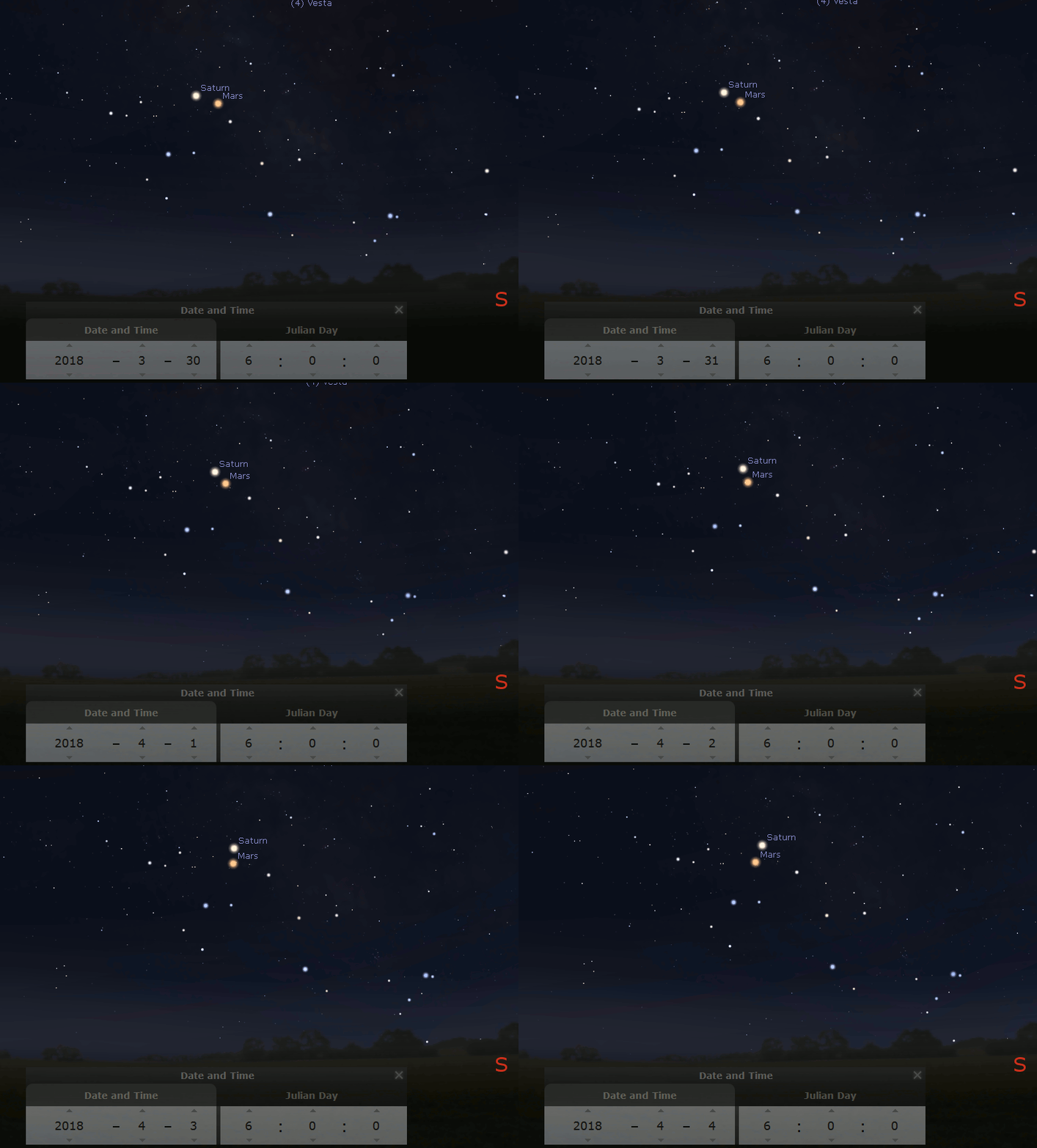
Conjunction animation of Mars passing Saturn at daily intervals at 6 a.m. for March 30 to April 4, 2018. This will occur above the Teapot asterism of the constellation of Sagittarius. Created using Stellarium and GIMP.
I covered the Mars hoax 5 years ago here on an August 27th when Mars was nowhere close to us.
03/30/2018 – Ephemeris – Previewing April skies
Ephemeris for Good Friday, Friday, March 30th. The Sun will rise at 7:27. It’ll be up for 12 hours and 40 minutes, setting at 8:07. The Moon, 1 day before full, will set at 7:50 tomorrow morning.
The 4th month of the year begins on Sunday. Daylight hours in the Interlochen/Traverse City area and will increase from 12 hours and 46 minutes Sunday to 14 hours 12 minutes on April 30th. The altitude, or angle, of the Sun above the southern horizon at local noon will be 50 degrees Sunday and will ascend to 60 degrees on April 30th. The altitude of the Sun in the Straits area will be a degree lower. The actual time of local apparent noon when the sun passes due south, will be about 1:43 p.m. The Lyrid meteor shower will reach it’s peak on the early afternoon of the 22nd. So the early morning hours between 3 and 5 a.m. are the best time to see it when the Moon has set and the radiant is high in the sky.
Addendum
April Evening Sky Chart
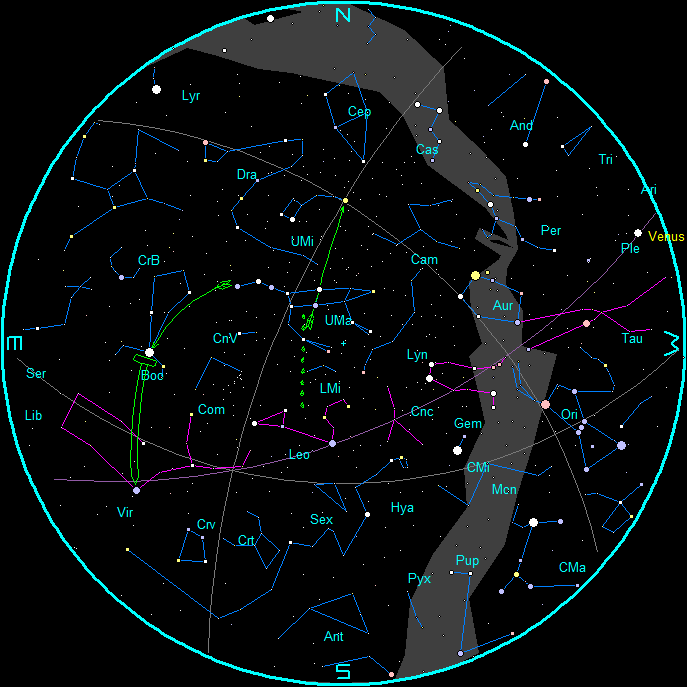
Star Chart for April 2018 (10 p.m. EDT April 15, 2018). Created using my LookingUp program. Click on image to enlarge.
The planets and stars are plotted for the 15th at 9 p.m. EDT in the evening and 5 a.m. for the morning chart. These are the chart times. Note that Traverse City is located approximately 45 minutes behind our time meridian. (An hour 45 minutes behind our daylight saving time meridian during EDT and 45 minutes behind our daylight standard time meridian. during EST). To duplicate the star positions on a planisphere you may have to set it to 1 hour 45 minutes (Daylight Time) or 45 minutes (Standard Time) earlier than the current time.
Note the chart times of 10 p.m. and 5 a.m. are for the 15th. For each week before the 15th add ½ hour (28 minutes if you’re picky). Watch out for the time change. For each week after the 15th subtract ½ hour. The planet positions are updated each Wednesday on this blog. For planet positions on dates other than the 15th, check the Wednesday planet posts on this blog.
April Morning Star Chart
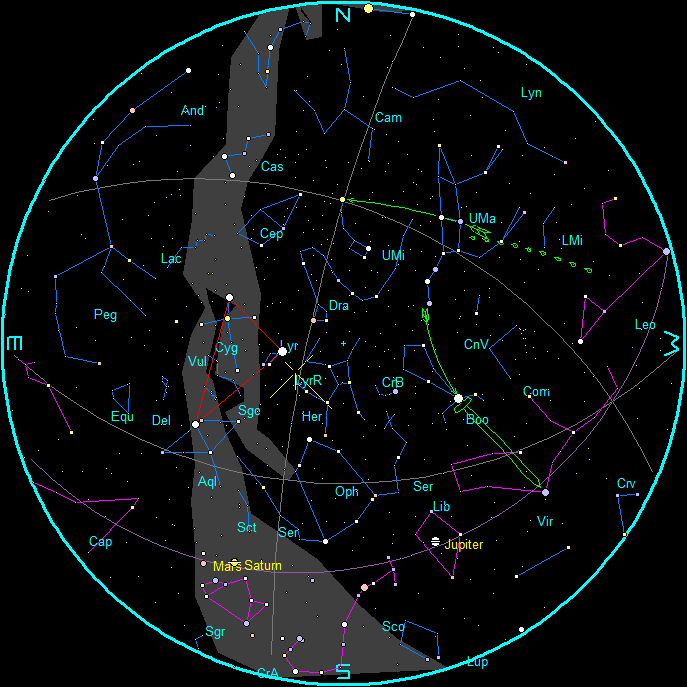
Star Chart for April 2018 mornings based on 5 a.m. April 15th. Created using my LookingUp program. Click on image to enlarge.
For a list of constellation names to go with the abbreviations click here.
Star chart annotations
- Pointer stars at the front of the bowl of the Big Dipper point to Polaris the North Star.
- Leaky Big Dipper drips on Leo.
- Follow the arc of the handle of the Big Dipper to the star Arcturus and
- Continue with a spike to Spica.
- The Summer Triangle is in red.
- LyrR is the Lyrid meteor shower radiant. The Lyrid meteor shower will reach its peak for us on the morning of the 22nd. The actual peak time is variable for this shower and can occur as early as 6 a.m. to as late as 5 p.m. Also the peak numbers of meteors are variable. Best time to observe without the Moon is between 3 a.m. and the start of twilight.
Twilight
Evening nautical twilight ends at 9:17 p.m. EDT on the 1st, increasing to 10:00 p.m. EDT on the 30th.
Evening astronomical twilight ends at 9:54 p.m. EDT on the 1st, increasing to 10:44 p.m. EDT on the 30th.
Morning astronomical twilight starts at 5:47 a.m. EDT on the 1st, and decreasing to 4:43 a.m. EDT on the 30th.
Morning nautical twilight starts at 6:23 a.m. EDT on the 1st, and decreasing to 5:27 a.m. EDT on the 30th.
NASA Calendar of Planetary Events
    Date    Time    Event
Apr 01  Su          Venus: 19.9° E
    01  Su  1:47 pm Mercury Inferior Conj.
    02  Mo  3:02 pm Mars-Saturn: 1.3° N
    03  Tu 10:14 am Moon-Jupiter: 4.2° S
    07  Sa  8:50 am Moon-Saturn: 2.1° S
    07  Sa 10:37 am Moon South Dec.: 20.3° S
    07  Sa  2:15 pm Moon-Mars: 3.5° S
    08  Su  1:32 am Moon Apogee: 404100 km
    08  Su  3:18 am Last Quarter
    10  Tu  4:09 am Moon Descending Node
    15  Su  9:57 pm New Moon
    17  Tu  3:29 pm Moon-Venus: 5.5° N
    18  We 10:35 am Uranus Conjunction
    19  Th 12:45 am Moon-Aldebaran: 1.1° S
    20  Fr 10:44 am Moon Perigee: 368700 km
    21  Sa  3:38 am Moon North Dec.: 20.4° N
    22  Su  1:49 pm Lyrid Shower: ZHR = 20
    22  Su  5:46 pm First Quarter
    23  Mo  2:17 am Moon-Beehive: 2° N
    23  Mo  8:19 am Moon Ascending Node
    24  Tu 12:47 pm Venus-Pleiades: 3.5° S
    24  Tu  3:39 pm Moon-Regulus: 1.2° S
    29  Su  1:59 pm Mercury Elongation: 27° W
    29  Su  8:58 pm Full Moon
    30  Mo  1:16 pm Moon-Jupiter: 4.1° S
May 01  Tu          Venus: 27.2° E
Sky Events Calendar by Fred Espenak and Sumit Dutta (NASA’s GSFC),
http://eclipse.gsfc.nasa.gov/SKYCAL/SKYCAL.html
If you go to the above site you can print out a list like the above for the entire year
or calendar pages for your time zone.
Sun and Moon Rising and Setting Events
     LU                  Ephemeris of Sky Events for Interlochen/TC
     April, 2018    Local time zone: EDT
     +-----------------------------------------------------------------------+
     | DATE |  SUN     SUN  DAYLIGHT|   TWILIGHT*    |MOON  RISE OR    ILLUM |
     |      |  RISE    SET    HOURS |  END    START  |PHASE SET** TIME FRACTN|
     +=======================================================================+
     |Sun  1| 07:23a  08:10p  12:46 | 09:15p  06:19a |      Rise 09:35p   97%|
     |Mon  2| 07:21a  08:11p  12:49 | 09:16p  06:17a |      Rise 10:40p   93%|
     |Tue  3| 07:19a  08:12p  12:53 | 09:18p  06:15a |      Rise 11:44p   87%|
     |Wed  4| 07:18a  08:14p  12:56 | 09:19p  06:13a |      Rise 12:44a   80%|
     |Thu  5| 07:16a  08:15p  12:59 | 09:20p  06:11a |      Rise 01:41a   71%|
     |Fri  6| 07:14a  08:16p  13:02 | 09:22p  06:09a |      Rise 02:33a   62%|
     |Sat  7| 07:12a  08:17p  13:05 | 09:23p  06:07a |      Rise 03:20a   53%|
     +------+-----------------------+----------------+-----------------------+
     |Sun  8| 07:10a  08:19p  13:08 | 09:25p  06:05a |L Qtr Rise 04:03a   43%|
     |Mon  9| 07:09a  08:20p  13:11 | 09:26p  06:03a |      Rise 04:40a   34%|
     |Tue 10| 07:07a  08:21p  13:14 | 09:28p  06:01a |      Rise 05:14a   25%|
     |Wed 11| 07:05a  08:22p  13:17 | 09:29p  05:59a |      Rise 05:45a   17%|
     |Thu 12| 07:03a  08:24p  13:20 | 09:31p  05:57a |      Rise 06:14a   11%|
     |Fri 13| 07:01a  08:25p  13:23 | 09:32p  05:55a |      Rise 06:42a    5%|
     |Sat 14| 07:00a  08:26p  13:26 | 09:34p  05:53a |      Rise 07:10a    2%|
     +------+-----------------------+----------------+-----------------------+
     |Sun 15| 06:58a  08:27p  13:29 | 09:35p  05:51a |New   Set  08:05p    0%|
     |Mon 16| 06:56a  08:29p  13:32 | 09:37p  05:49a |      Set  09:16p    1%|
     |Tue 17| 06:55a  08:30p  13:35 | 09:38p  05:47a |      Set  10:27p    5%|
     |Wed 18| 06:53a  08:31p  13:38 | 09:40p  05:45a |      Set  11:38p   11%|
     |Thu 19| 06:51a  08:32p  13:41 | 09:41p  05:43a |      Set  12:47a   19%|
     |Fri 20| 06:50a  08:34p  13:44 | 09:43p  05:41a |      Set  01:50a   29%|
     |Sat 21| 06:48a  08:35p  13:47 | 09:44p  05:39a |      Set  02:46a   40%|
     +------+-----------------------+----------------+-----------------------+
     |Sun 22| 06:46a  08:36p  13:49 | 09:46p  05:37a |F Qtr Set  03:34a   51%|
     |Mon 23| 06:45a  08:37p  13:52 | 09:47p  05:35a |      Set  04:15a   62%|
     |Tue 24| 06:43a  08:39p  13:55 | 09:49p  05:33a |      Set  04:51a   73%|
     |Wed 25| 06:41a  08:40p  13:58 | 09:50p  05:31a |      Set  05:22a   82%|
     |Thu 26| 06:40a  08:41p  14:01 | 09:52p  05:29a |      Set  05:52a   90%|
     |Fri 27| 06:38a  08:42p  14:04 | 09:53p  05:28a |      Set  06:20a   95%|
     |Sat 28| 06:37a  08:44p  14:06 | 09:55p  05:26a |      Set  06:48a   99%|
     +------+-----------------------+----------------+-----------------------+
     |Sun 29| 06:35a  08:45p  14:09 | 09:57p  05:24a |Full  Rise 08:25p  100%|
     |Mon 30| 06:34a  08:46p  14:12 | 09:58p  05:22a |      Rise 09:30p   99%|
     +-----------------------------------------------------------------------+
     * Nautical Twilight
     ** Moonrise or moonset, whichever occurs between sunset and sunrise
The times given are for the Traverse City/Interlochen area of Michigan. They may be different for your location.
03/29/2018 – Ephemeris – The Easter date is set by the first full moon of spring and a developing conjunction
Ephemeris for Thursday, March 29th. The Sun will rise at 7:29. It’ll be up for 12 hours and 37 minutes, setting at 8:06. The Moon, 2 days before full, will set at 7:21 tomorrow morning.
This Sunday, April 1st will be Easter for western churches. Because it falls on the first Sunday after the first full moon since March 21st. The Full Moon is Saturday the 31st. It happens that Passover begins at sundown the 31st. Orthodox churches will celebrate Easter on April 8th, a week later. It’s going to be a somewhat busy weekend in the sky also. Sunday Mercury will pass from the evening sky to the morning sky in an event called an inferior conjunction of the Sun. It is not visible, but folks in the southern hemisphere will easily spot Mercury late in April. In the morning sky Mars will pass below Saturn between the mornings of the 2nd and 3rd. They are close to the same brightness, but Mars is distinctly redder.
The times given are for the Traverse City/Interlochen area of Michigan. They may be different for your location.
Addendum
Conjunction animation of Mars passing Saturn at daily intervals at 6 a.m. for March 30 to April 4, 2018. This will occur above the Teapot asterism of the constellation of Sagittarius. Created using Stellarium ans GIMP.
03/28/2018 – Ephemeris – Four bright planets are visible
Ephemeris for Wednesday, March 28th. The Sun will rise at 7:31. It’ll be up for 12 hours and 34 minutes, setting at 8:05. The Moon, 3 days before full, will set at 6:49 tomorrow morning.
Let’s take our weekly look at the bright planets. We’re down to 4 the naked eye planets are visible now. One is in the evening sky. Venus will be visible low in the Western twilight from about 8:30 p.m. until before it sets at 9:43. Mercury is heading between the Earth and the Sun, not directly but will enter the morning sky Sunday. It’s morning appearance later next month will not be a good one for us in the northern hemisphere. Late this evening Jupiter will rise at 11:46. Mars will rise at 3:23 a.m. Saturn will end the procession, rising 3 minutes later. At 6 tomorrow morning these three planets will be strung across the southern sky. Bright Jupiter will be in the south-southwest, dimmer Mars will be in the south-southeast, just right of and a bit below Saturn.
The times given are for the Traverse City/Interlochen area of Michigan. They may be different for your location.
Addendum
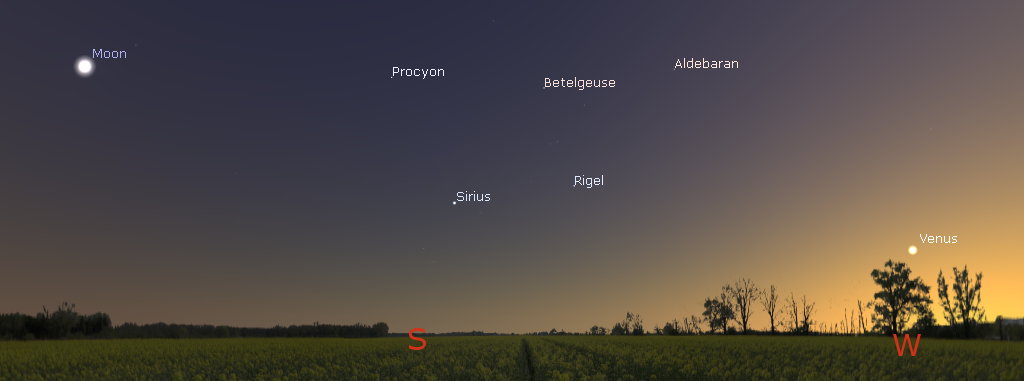
Venus, the bright winter stars and the Moon at 8:30 p.m. tonight March 28, 2018. Click on the image to enlarge. Created using Stellarium.
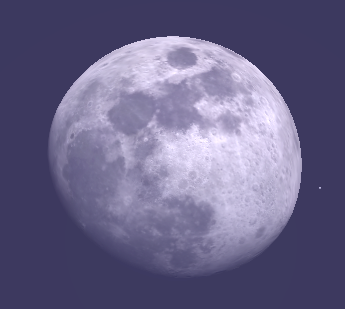
The Gibbous Moon tonight at 8:30 p.m., March 28, 2018. Created using Stellarium.
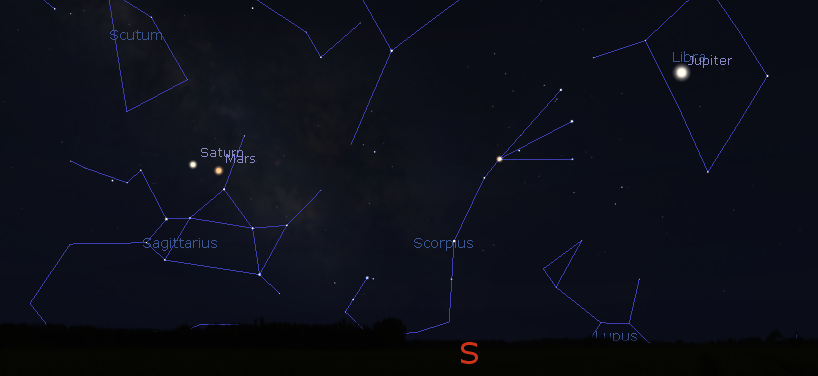
The morning planets and constellations at 6 a.m. March 29, 2018. Click on the image to enlarge. Created using Stellarium
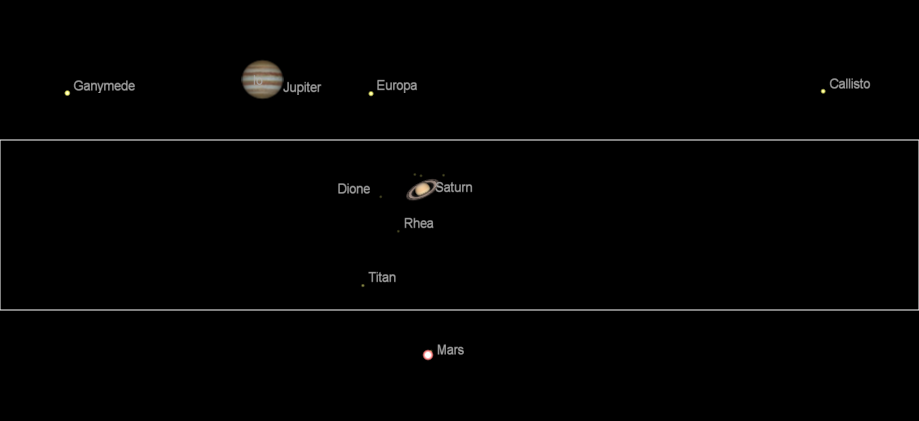
The morning planets as seen by a telescope using the same magnification for all at 6 a.m. March 29, 2018. At 6 a.m. Jupiter’s moon Io is behind the planet. See the table below for Io events in the morning. Click on the image to enlarge. Created using Cartes du Ciel (Sky Charts).
Moon  Event            Date        Time      Local Time
Io:   Eclipse start:   29 Mar 2018  7:10 UT  3:10 a.m. EDT
Io:   Occultation end: 29 Mar 2018 10:11 UT  6:11 a.m. EDT
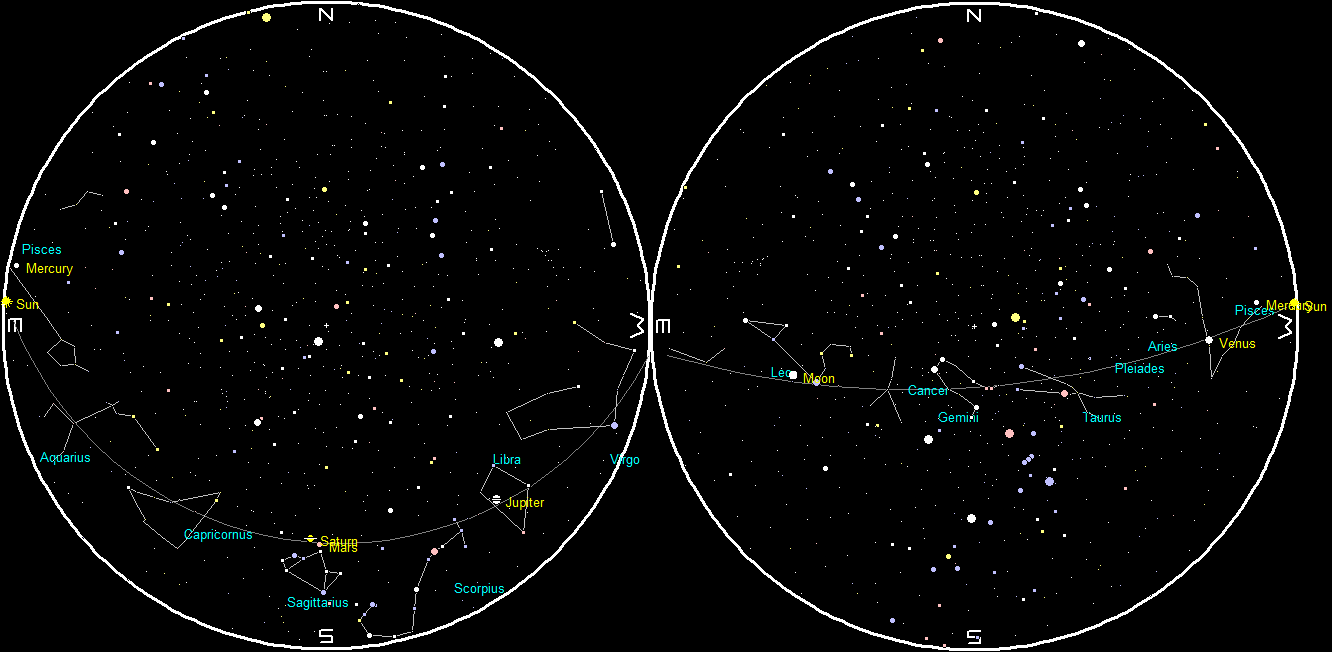
Planets and the Moon at sunset and sunrise of a single night starting with sunset on the right on March 28, 2018. The night ends on the left with sunrise on the 29th. Click on the image to enlarge. Created using my LookingUp program.
03/27/2018 – Ephemeris – Chinese first space lab will reenter the Earth’s atmosphere in a few days
Ephemeris for Tuesday, March 27th. The Sun will rise at 7:32. It’ll be up for 12 hours and 31 minutes, setting at 8:04. The Moon, 3 days past first quarter, will set at 6:14 tomorrow morning.
The first Chinese space lab Tiangong-1 is estimated to reenter the atmosphere and mostly burn up in the latter days of this week or early next week. There may be parts that will survive the fiery entry into the Earth’s atmosphere. The space lab was launched in 2011, and has been visited by one robotic and two crewed spacecraft. However the Chinese lost control of it in 2016 and cannot control it’s reentry location. It was launched with an inclination of 42.8 degrees, so it flies between 42.8 north and south latitudes, so it won’t land on anybody in the IPR listening area. When NASA’s Skylab space station made an uncontrolled entry in 1979, a piece fell in Australia. They sued the United States $400 for littering according to Space.com.
The times given are for the Traverse City/Interlochen area of Michigan. They may be different for your location.
Addendum

The Tiangong-1 space lab. Source: Space.com, Chinese space agency photo.
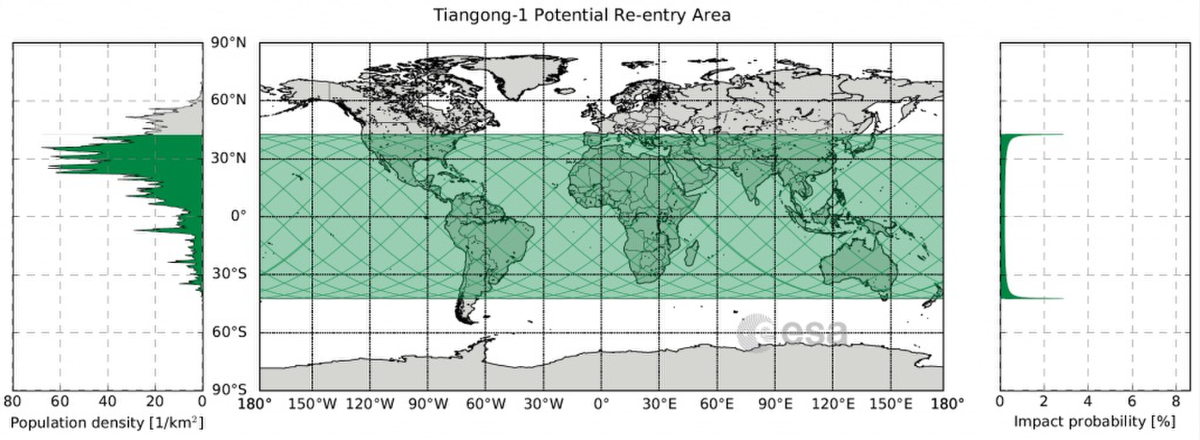
Tiangong-1 Potential Re-entry area. Click on image to enlarge. Source Space.com, European Space Agency data.

