Archive
10/02/2017 – Ephemeris – Looking ahead at October skies
Ephemeris for Monday, October 2nd. The Sun will rise at 7:41. It’ll be up for 11 hours and 38 minutes, setting at 7:20. The Moon, 3 days before full, will set at 5:04 tomorrow morning.
Let’s look at the skies for this month of October. The sun will still be moving south rapidly. Daylight hours in the Interlochen/Traverse City area will drop from 11 hours and 38 minutes today to 10 hours 13 minutes on the 31st. The altitude of the sun above the southern horizon at local noon will be 42 degrees today, and will descend to 31 degrees on Halloween, also in the Interlochen/Traverse City area. The Straits area will have the sun a degree lower. Local noon, when the sun is due south will be about 1:30 p.m. in Interlochen/Traverse City.
Later this month Jupiter will cross from the evening sky to the morning. Saturn will become lower in the southwest in the evening sky. And bits of Halley’s comet will return later in the month as the Orion meteor shower.
The times given are for the Traverse City/Interlochen area of Michigan. They may be different for your location.
Addenda
October Evening Sky Chart
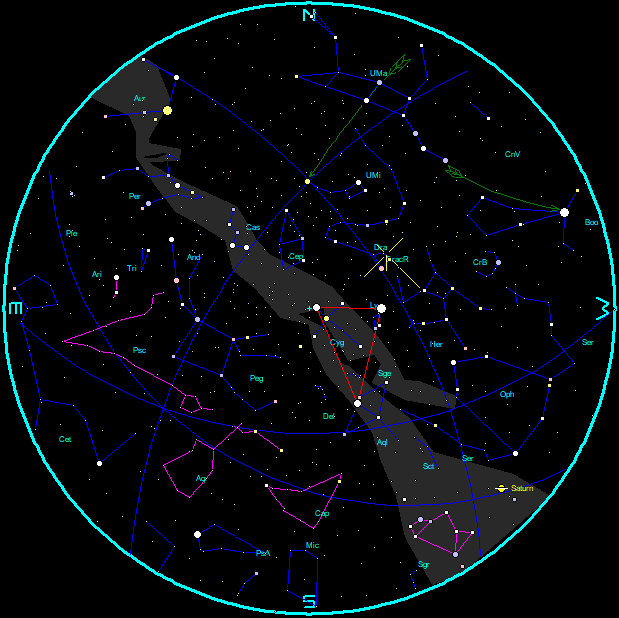
Star Chart for October 2017 (9 p.m. October 15, 2017). Created using my LookingUp program. Click on image to enlarge.
The planets and stars are plotted for the 15th at 9 p.m. EDT in the evening and 6 a.m. for the morning chart. These are the chart times. Note that Traverse City is located approximately 45 minutes behind our time meridian. (An hour 45 minutes behind our daylight saving time meridian. during EDT and 45 minutes behind our daylight standard time meridian. during EST). To duplicate the star positions on a planisphere you may have to set it to 1 hour 45 minutes (Daylight Time) or 45 minutes (Standard Time) earlier than the current time if you are near your time meridian.
Note the chart times of 9 p.m. and 6 a.m. are for the 15th. For each week before the 15th add ½ hour. For each week after the 15th subtract ½ hour. The planet positions are updated each Wednesday on this blog. For planet positions on dates other than the 15th, check the Wednesday planet posts on this blog.
October Morning Star Chart
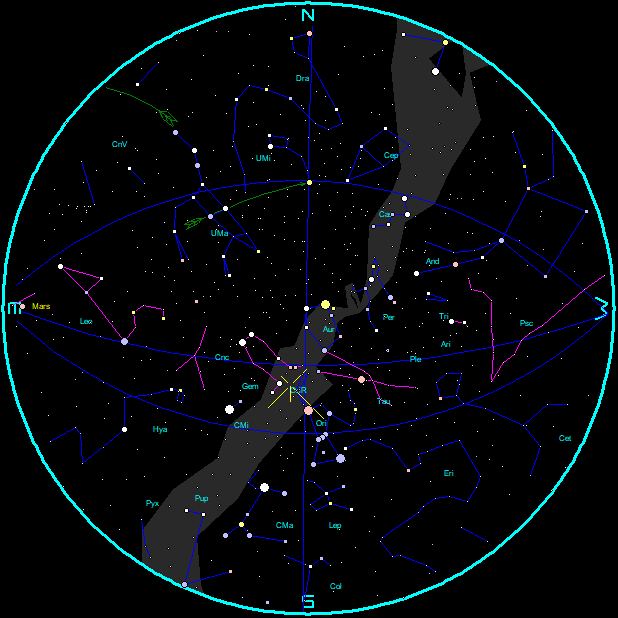
Star Chart for October 2017 mornings based on 6 a.m. October 15th. Created using my LookingUp program. Click on image to enlarge.
For a list of constellation names to go with the abbreviations click here.
- Pointer stars at the front of the bowl of the Big Dipper point to Polaris the North Star.
- Leaky Big Dipper drips on Leo.
- Follow the arc of the handle of the Big Dipper to the star Arcturus.
- The Summer Triangle is in red
- DraR is the Draconid meteor shower radiant. Peaks on October 8th, but the Moon will interfere this year.
- OriR is the Orionid meteor shower radiant. Peaks on October 21st with a zenithal hourly rate (ZHR) of 20
Twilight
Evening nautical twilight ends at 8:29 p.m. EDT on the 1st, decreasing to 7:40 p.m. EDT on the 31st.
Evening astronomical twilight ends at 9:03 p.m. EDT on the 1st, decreasing to 8:14 p.m. EDT on the 31st.
Morning astronomical twilight starts at 6:09 a.m. EDT on the 1st, and increasing to 6:07 a.m. EDT on the 31st.
Morning nautical twilight starts at 6:43 a.m. EDT on the 1st, and increasing to 6:42 a.m. EDT on the 31st.
NASA Calendar of Planetary Events
Oct 01  Su          Venus: 24.5° W
    01  Su 10:05 pm Moon Descending Node
    05  Th 12:15 pm Venus-Mars: 0.2° N
    05  Th  2:40 pm Full Moon (Harvest Moon)
    08  Su  4:33 pm Mercury Superior Conjunction with the Sun
    09  Mo  1:51 am Moon Perigee: 366,900 km
    09  Mo  2:05 pm Moon-Aldebaran: 0.6° S
    11  We  2:21 pm Moon North Dec.: 19.6° N
    12  Th  8:25 am Last Quarter
    13  Fr  4:29 pm Moon-Beehive: 3° N
    14  Sa  6:10 pm Moon Ascending Node
    15  Su  6:54 am Moon-Regulus: 0.2° S
    17  Tu  6:04 am Moon-Mars: 1.9° S
    17  Tu  8:21 pm Moon-Venus: 2.1° S
    19  Th  1:24 pm Uranus Opposition from the Sun
    19  Th  3:12 pm New Moon
    21  Sa  6:54 am Orionid Shower: ZHR = 20
    24  Tu  7:54 am Moon-Saturn: 3.6° S
    24  Tu 10:25 pm Moon Apogee: 405,200 km
    25  We  2:13 pm Moon South Dec.: 19.7° S
    26  Th  2:02 pm Jupiter Conjunction with the Sun
    27  Fr  6:22 pm First Quarter
    29  Su  2:41 pm Moon Descending Node
Nov 01  We          Venus: 16.8° W
Sky Events Calendar by Fred Espenak and Sumit Dutta (NASA’s GSFC),
http://eclipse.gsfc.nasa.gov/SKYCAL/SKYCAL.html
If you go to the above site you can print out a list like the above for the entire year
or calendar pages for your time zone.
Sun and Moon Rising and Setting Events
LU                  Ephemeris of Sky Events for Interlochen/TC
October, 2017    Local time zone: EDT
+-----------------------------------------------------------------------+
| DATE |  SUN     SUN  DAYLIGHT|   TWILIGHT*    |MOON  RISE OR    ILLUM |
|      |  RISE    SET    HOURS |  END    START  |PHASE SET** TIME FRACTN|
+=======================================================================+
|Sun  1| 07:41a  07:22p  11:41 | 08:25p  06:38a |      Set  04:00a   84%|
|Mon  2| 07:42a  07:20p  11:38 | 08:23p  06:39a |      Set  05:05a   91%|
|Tue  3| 07:43a  07:19p  11:35 | 08:22p  06:40a |      Set  06:12a   96%|
|Wed  4| 07:44a  07:17p  11:32 | 08:20p  06:41a |      Set  07:21a   99%|
|Thu  5| 07:45a  07:15p  11:29 | 08:18p  06:42a |Full  Rise 07:38p  100%|
|Fri  6| 07:47a  07:13p  11:26 | 08:16p  06:44a |      Rise 08:10p   98%|
|Sat  7| 07:48a  07:11p  11:23 | 08:14p  06:45a |      Rise 08:45p   93%|
+------+-----------------------+----------------+-----------------------+
|Sun  8| 07:49a  07:10p  11:20 | 08:12p  06:46a |      Rise 09:25p   86%|
|Mon  9| 07:50a  07:08p  11:17 | 08:11p  06:47a |      Rise 10:09p   77%|
|Tue 10| 07:52a  07:06p  11:14 | 08:09p  06:49a |      Rise 11:01p   67%|
|Wed 11| 07:53a  07:04p  11:11 | 08:07p  06:50a |      Rise 11:59p   56%|
|Thu 12| 07:54a  07:02p  11:08 | 08:05p  06:51a |L Qtr Rise 01:02a   45%|
|Fri 13| 07:56a  07:01p  11:05 | 08:04p  06:52a |      Rise 02:08a   34%|
|Sat 14| 07:57a  06:59p  11:02 | 08:02p  06:54a |      Rise 03:16a   24%|
+------+-----------------------+----------------+-----------------------+
|Sun 15| 07:58a  06:57p  10:59 | 08:00p  06:55a |      Rise 04:23a   15%|
|Mon 16| 07:59a  06:56p  10:56 | 07:59p  06:56a |      Rise 05:30a    8%|
|Tue 17| 08:01a  06:54p  10:53 | 07:57p  06:57a |      Rise 06:35a    4%|
|Wed 18| 08:02a  06:52p  10:50 | 07:56p  06:58a |      Rise 07:39a    1%|
|Thu 19| 08:03a  06:50p  10:47 | 07:54p  07:00a |New   Set  07:14p    0%|
|Fri 20| 08:05a  06:49p  10:44 | 07:52p  07:01a |      Set  07:43p    2%|
|Sat 21| 08:06a  06:47p  10:41 | 07:51p  07:02a |      Set  08:14p    5%|
+------+-----------------------+----------------+-----------------------+
|Sun 22| 08:07a  06:46p  10:38 | 07:49p  07:03a |      Set  08:49p   10%|
|Mon 23| 08:09a  06:44p  10:35 | 07:48p  07:05a |      Set  09:27p   16%|
|Tue 24| 08:10a  06:42p  10:32 | 07:46p  07:06a |      Set  10:09p   24%|
|Wed 25| 08:11a  06:41p  10:29 | 07:45p  07:07a |      Set  10:56p   32%|
|Thu 26| 08:13a  06:39p  10:26 | 07:44p  07:08a |      Set  11:48p   41%|
|Fri 27| 08:14a  06:38p  10:23 | 07:42p  07:09a |F Qtr Set  12:44a   51%|
|Sat 28| 08:15a  06:36p  10:21 | 07:41p  07:11a |      Set  01:43a   60%|
+------+-----------------------+----------------+-----------------------+
|Sun 29| 08:17a  06:35p  10:18 | 07:39p  07:12a |      Set  02:45a   70%|
|Mon 30| 08:18a  06:33p  10:15 | 07:38p  07:13a |      Set  03:51a   79%|
|Tue 31| 08:19a  06:32p  10:12 | 07:37p  07:14a |      Set  04:58a   87%|
+-----------------------------------------------------------------------+
* Nautical Twilight
** Moonrise or moonset, whichever occurs between sunset and sunrise
09/29/2017 – Ephemeris – Last festival of the year for the GTAS – Acme Fall Fest tomorrow
Ephemeris for Friday, September 29th. The Sun will rise at 7:38. It’ll be up for 11 hours and 47 minutes, setting at 7:26. The Moon, 2 days past first quarter, will set at 1:59 tomorrow morning.
The Grand Traverse Astronomical Society will be at the Acme Fall Festival tomorrow, that’s Saturday September 30th from 10 to 4 p.m. It will be held at Flintfields Horse Park on Bates Road, north of M 72. The society members will bring their telescopes which will be used to view the sun if it’s clear. There will also be exhibits of astronomical photos from NASA, professional and our own amateur astronomers. As the festival and star party year winds down and the school year begins members of the society can bring astronomy and space to the classroom. Plus the society is beginning to plan for next year. Contact the Grand Traverse Astronomical Society via email at info@gtastro.org for information or to set up a date and topic.
The times given are for the Traverse City/Interlochen area of Michigan. They may be different for your location.
09/28/2017 – Ephemeris – View the Moon and Saturn tonight at the library
Ephemeris for Thursday, September 28th. The Sun will rise at 7:37. It’ll be up for 11 hours and 51 minutes, setting at 7:28. The Moon, 1 day past first quarter, will set at 1:05 tomorrow morning.
Tonight the Grand Traverse Astronomical Society will set up their telescopes at the Traverse Area District Library Central Library on Woodmere Avenue in Traverse City from 7 to 9 p.m. weather permitting for a star party, though it won’t actually feature stars. It will feature the Moon in its gibbous phase and the planet Saturn probably after 8 p.m. We might also catch a glimpse of the Sun, since the event starts before sunset. The Sun’s sunspot activity has picked up a bit in the last month or so, since just before August’s solar eclipse. We’ve had a pretty sunspot-less early summer.
There will be a visible pass of the International Space Station, which will be high in the south at 8:30 p.m. It will rise above the southwestern horizon at 8:25, and disappear into earth’s shadow at 8:33 p.m. in the south-southeast. It will be visible from anywhere in Michigan, though the times may vary by a minute or so. It’s traveling at 5 miles per second (8 km/s).
The library has a telescope, donated by the society and Enerdyne that they lend out, which has been in heavy demand. See the library for details.
The times given are for the Traverse City/Interlochen area of Michigan. They may be different for your location.
09/27/2017 – Ephemeris – Where are the naked eye planets tonight
Ephemeris for Wednesday, September 27th. The Sun will rise at 7:35. It’ll be up for 11 hours and 54 minutes, setting at 7:29. The Moon, at first quarter today, will set at 12:16 tomorrow morning.
Let’s take our weekly look at the bright planets. Jupiter is really low in the west-southwest after sunset setting in bright twilight at 8:22 p.m. Saturn can be seen low in the southwest tonight. The reddish star Antares is below and right of Saturn before it sets at 9:50 p.m. Saturn’s rings are spectacular in telescopes. With the demise of the Cassini spacecraft orbiting Saturn for the last 13 years, there is no telescope closer to Saturn than yours. The planet will set at 11:09 p.m. In the morning sky, brilliant Venus will rise at 5:23 a.m. in the east-northeast. Much dimmer Mars will rise in the east-northeast at 5:46 a.m. Mars will brighten greatly as it approaches us in the next 10 months. Mercury is too close to the glare of the Sun to be spotted.
The times given are for the Traverse City/Interlochen area of Michigan. They may be different for your location.
Addendum
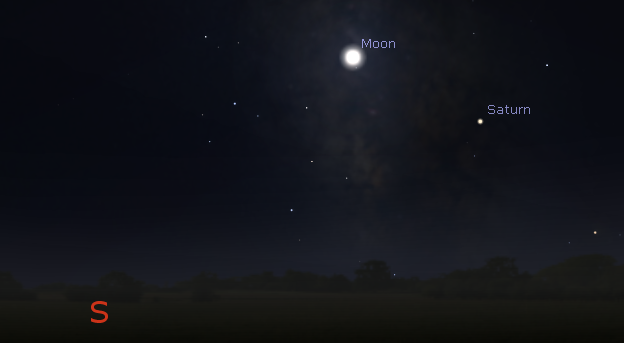
Saturn and the Moon tonight at 9 p.m., September 27, 2017. Created using Stellarium.
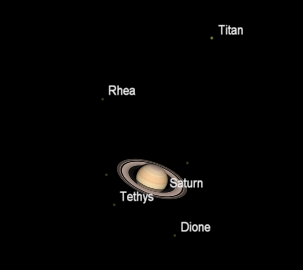
Saturn and its brightest moons overnight September 27/28, 2017. Created using Cartes du Ciel (Sky Charts).
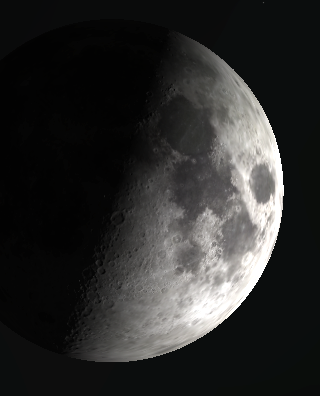
The Moon as it might be seen in binoculars, 9 p.m. September 27, 2017. Created using Stellarium.
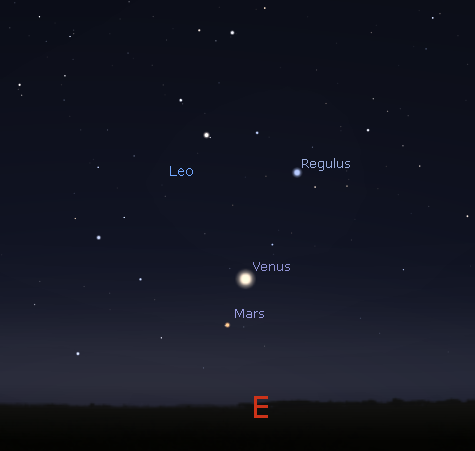
Venus and Mars close up at 6:30 a.m. September 27, 2017. Created using Stellarium.
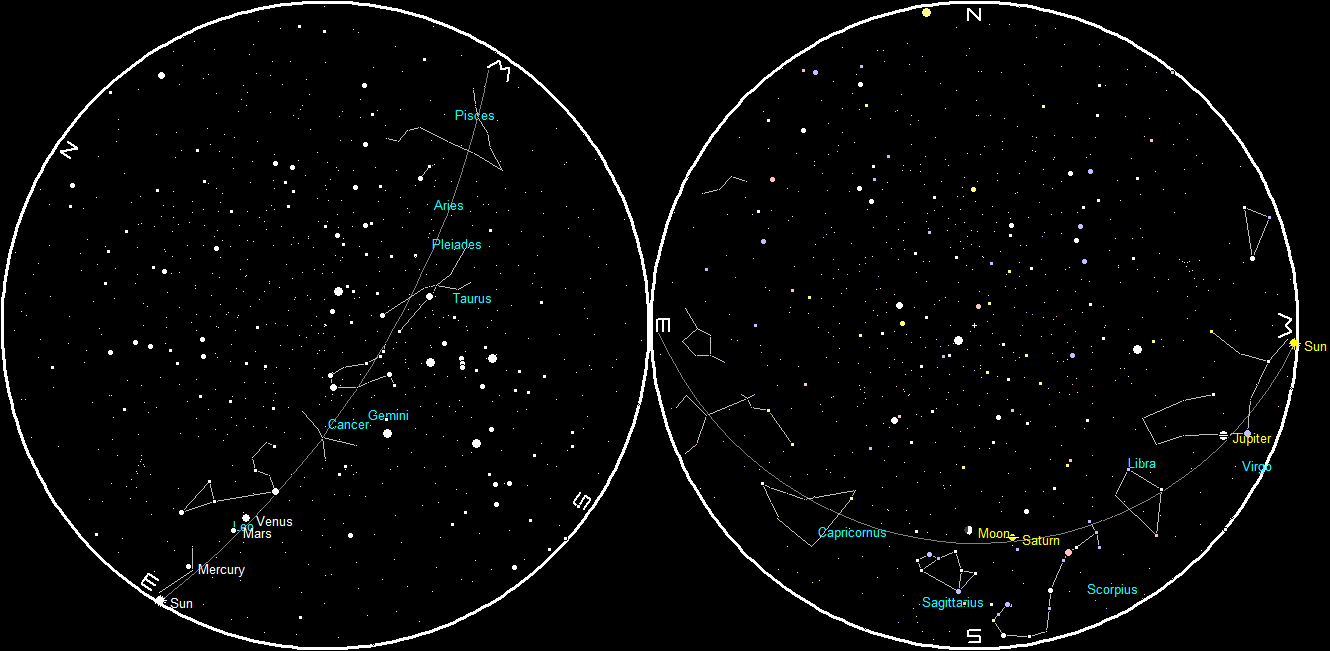
Planets at sunset and sunrise of a single night starting with sunset on the right on September 27, 2017. The night ends on the left with sunrise on the 28th. I’ve rotated the sunrise plot so the planet labels wouldn’t overlap. Click on the image to enlarge. Created using my LookingUp program.
09/26/2017 – Ephemeris – Saturn appears near the Moon tonight
Ephemeris for Tuesday, September 26th. The Sun will rise at 7:34. It’ll be up for 11 hours and 57 minutes, setting at 7:31. The Moon, 1 day before first quarter, will set at 11:32 this evening.
Tonight the Moon will to be near the planet Saturn. At 9 p.m. the ringed planet will be seen below the crescent Moon. It’s a good way to spot Saturn if you’ve never be able to figure out which of those “stars” in the sky is Saturn. It’s easy to confirm with a small telescope. Even in binoculars Saturn is not quite a star-like point. Saturn’s rings begin to show distinctly with 20 power magnification. The Moon too is great to view at low power, even binoculars. A new sea has appeared since last night. It is the Sea of Serenity above the center of the Moon. The lunar seas are really large nearly circular lava filled craters that appear to have been the result of asteroid impacts about 3.8 or so billion years ago.
The times given are for the Traverse City/Interlochen area of Michigan. They may be different for your location.
Addendum
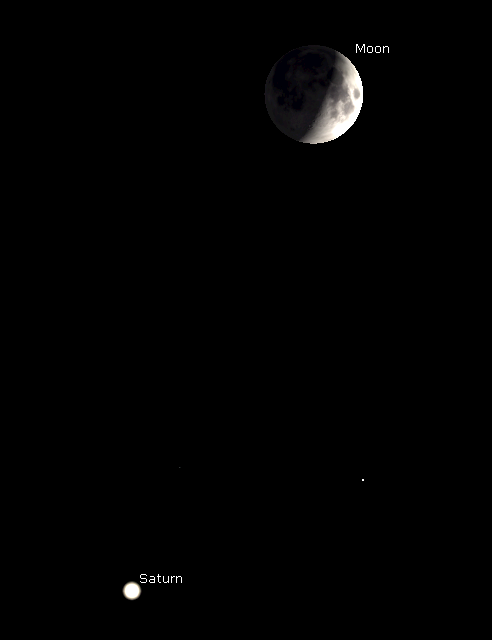
Saturn and the Moon tonight, 9 p.m. September 26, 2017. Created using Stellarium.
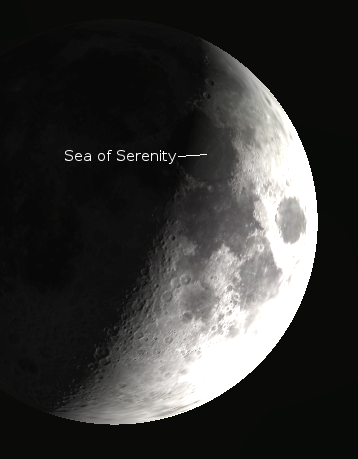
The Moon as it might be seen in binoculars, 9 p.m. September 26, 2017. Created using Stellarium.
Compare with last night’s Moon.
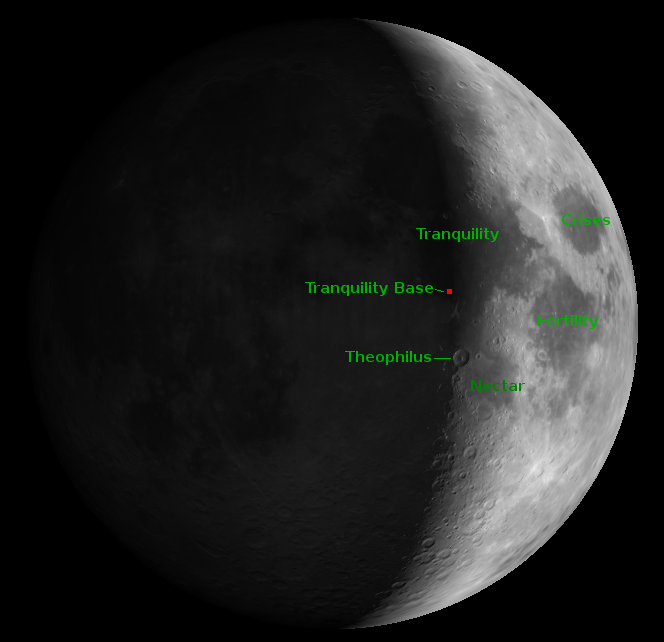
The annotated crescent moon tonight, September 25, 2017. Created using Virtual Moon Atlas.
09/25/2017 – Ephemeris – Lets look at the Moon tonight
Ephemeris for Monday, September 25th. The Sun will rise at 7:33 a.m. It’ll be up for 12 hours exactly, setting at 7:33 p.m. The Moon, 2 days before first quarter, will set at 10:52 this evening.
Let’s take a look at the crescent Moon tonight. It will be fairly low in the southwestern sky this evening. Four of the gray lava plains called seas are now visible in binoculars or small telescopes. Nearest the right limb of the Moon is the Sea of Crises, next nearest if the Sea of Fertility. A small sea next to that is the Sea of Nectar. Above that, mostly exposed to sunlight is the Sea of Tranquility. The Sun is just rising at Tranquility Base, where Apollo 11 landed, where the Lunar Module’s descent stage still lies, forlorn and empty. Below that is the beautiful crater Theophilus with its central peak. It is 61 miles (101 km) in diameter, and its crater walls rise over 13,000 feet (4,400 meters) above the crater floor.
The times given are for the Traverse City/Interlochen area of Michigan. They may be different for your location.
Addendum
The annotated crescent moon tonight, September 25, 2017. Created using Virtual Moon Atlas. Click on the image to enlarge.
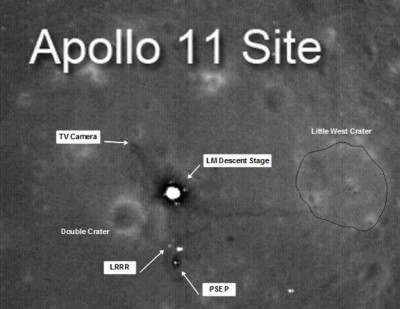
The Apollo 11 landing site in one photograph by the Lunar Reconnaissance Orbiter. There are many with varying Sun angles in the Internet. Search for: Apollo 11 LRO images. Credit NASA.
09/22/2017 – Ephemeris – September star party at Sleeping Bear Dunes National Lakeshore tomorrow night
Ephemeris for Friday, September 22nd. The Sun will rise at 7:29. It’ll be up for 12 hours and 9 minutes, setting at 7:39. The Moon, 2 days past new, will set at 9:14 this evening.
Autumn starts at 4:02 this afternoon.
The first star party of autumn will be held at the Sleeping Bear Dunes National Lakeshore tomorrow evening starting at 9 p.m. at the Dune Climb if it’s clear. It will be hosted by the Park Rangers and the Grand Traverse Astronomical Society. The society invites all to come, especially those with telescopes willing to share the wonders of the Milky Way, which will span the skies from horizon to horizon, and the planet Saturn. The park has one of the darkest skies in the Lower Peninsula, and the Milky Way is especially impressive in late summer and early autumn.
Please call 231-326-4700, ext. 5005 if in doubt about weather conditions. A decision will be made by 2 hours before the event.
The times given are for the Traverse City/Interlochen area of Michigan. They may be different for your location.
09/21/2017 – Ephemeris – Summer ends and autumn begins tomottow
Ephemeris for Thursday, September 21st. The Sun will rise at 7:28. It’ll be up for 12 hours and 12 minutes, setting at 7:41. The Moon, 1 day past new, will set at 8:45 this evening.
Enjoy the last full day of summer. Summer will last until 4:02 p.m. (20:02 UTC) tomorrow when the center of the Sun will cross the celestial equator, an imaginary line above the Earth’s equator, heading southward. At that instant autumn will begin. Shortly the Sun will be up less than half the day. The day and the point in the sky that the Sun crosses is called the autumnal equinox. The word equinox means equal night, implying that day and light are of equal length. Geometrically that’s true, but the Earth’s atmosphere and the definition of sunrise and sunset, prolong daylight by a few minutes. The amount of heat we are getting and will get from the Sun cannot sustain our current temperatures, and it will get a lot colder before it gets warmer again.
The times given are for the Traverse City/Interlochen area of Michigan. They may be different for your location.
Addendum
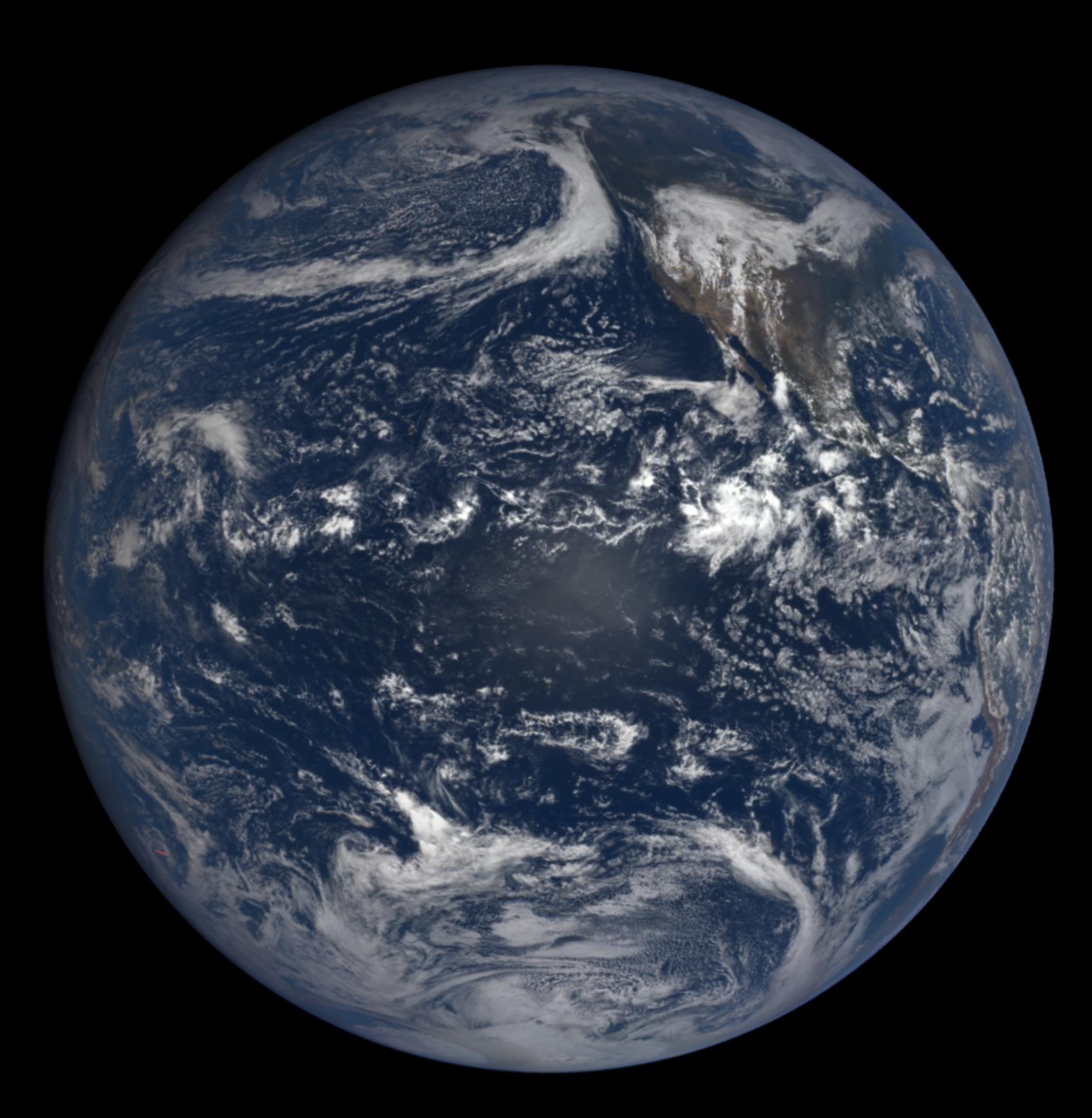
Image from the Earth Polychromatic Imaging Camera (EPIC) on NOAA’s DSCOVR satellite in halo orbit around the Earth-Sun L-1 point 1 million miles sunward from the Earth last autumnal equinox (2016) at about the same time the autumnal equinox will occur this year.
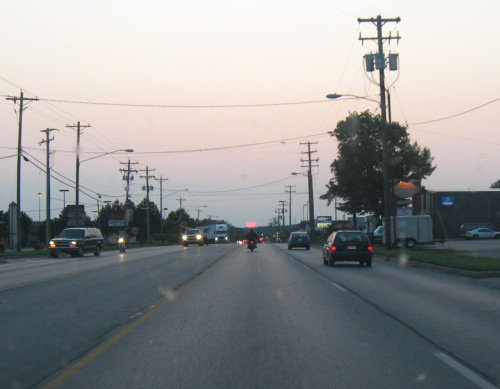
That is not a pumpkin on the head of the motorcyclist. That’s the Sun rising as I’m traveling east on South Airport Road south of Traverse City Mi. on the autumnal equinox. This is the east-west section of the road. The Sun is rising over the hills some 6 miles to the east. Credit: Bob Moler.
09/20/2017 – Ephemeris – Looking for the bright planets
Ephemeris for Wednesday, September 20th. The Sun will rise at 7:27. It’ll be up for 12 hours and 15 minutes, setting at 7:43. The Moon is new today, and won’t be visible.
Let’s take our weekly look at the bright planets. Jupiter is really low in the west-southwest after sunset setting in twilight at 8:47 p.m. Saturn can be seen low in the southwest tonight. The reddish star Antares is below and right of Saturn before it sets at 10:18 p.m. Saturn’s rings are spectacular in telescopes. With the demise of the Cassini spacecraft orbiting Saturn for the last 13 years, there is no telescope closer to Saturn than yours. The planet will set at 11:35 p.m. In the morning sky, brilliant Venus will rise at 5:03 a.m. in the east-northeast. The first magnitude star Regulus in Leo the lion will be to the upper right of it. Dim Mars will rise in the east-northeast at 5:50 a.m. followed by the brighter Mercury which will rise at 6:12 a.m.
The times given are for the Traverse City/Interlochen area of Michigan. They may be different for your location.
Addendum
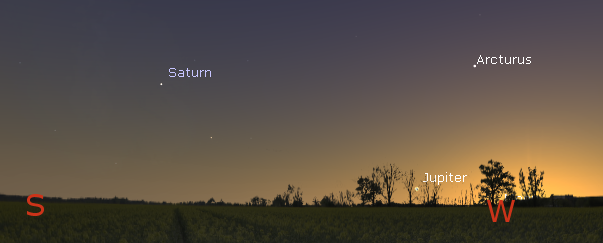
The setting Jupiter and Saturn at 8:15 p.m., September 20, 2017. Created using Stellarium. Click on the image to enlarge.
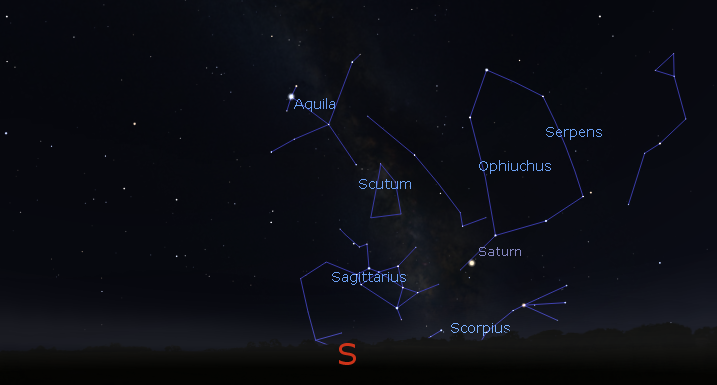
Saturn and constellations in dark skies at 9 p.m. September 20, 2017. Created using Stellarium. Click on the image to enlarge.
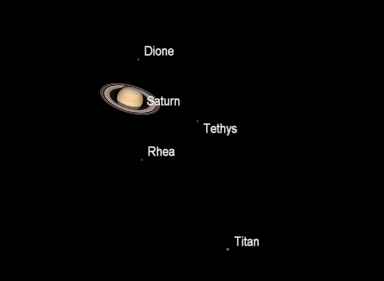
Saturn and its brightest moons overnight September 20/21, 2017. Created using Cartes du Ciel (Sky Charts).
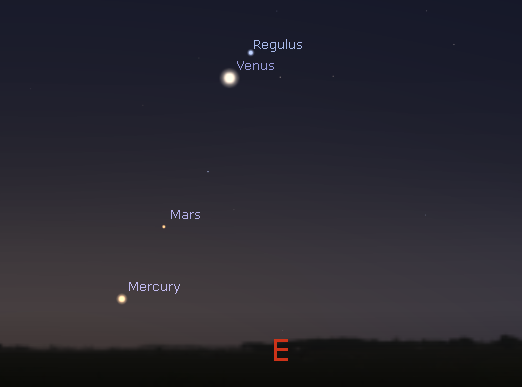
Morning planets close up at 6:30 a.m. September 21, 2017. Created using Stellarium.
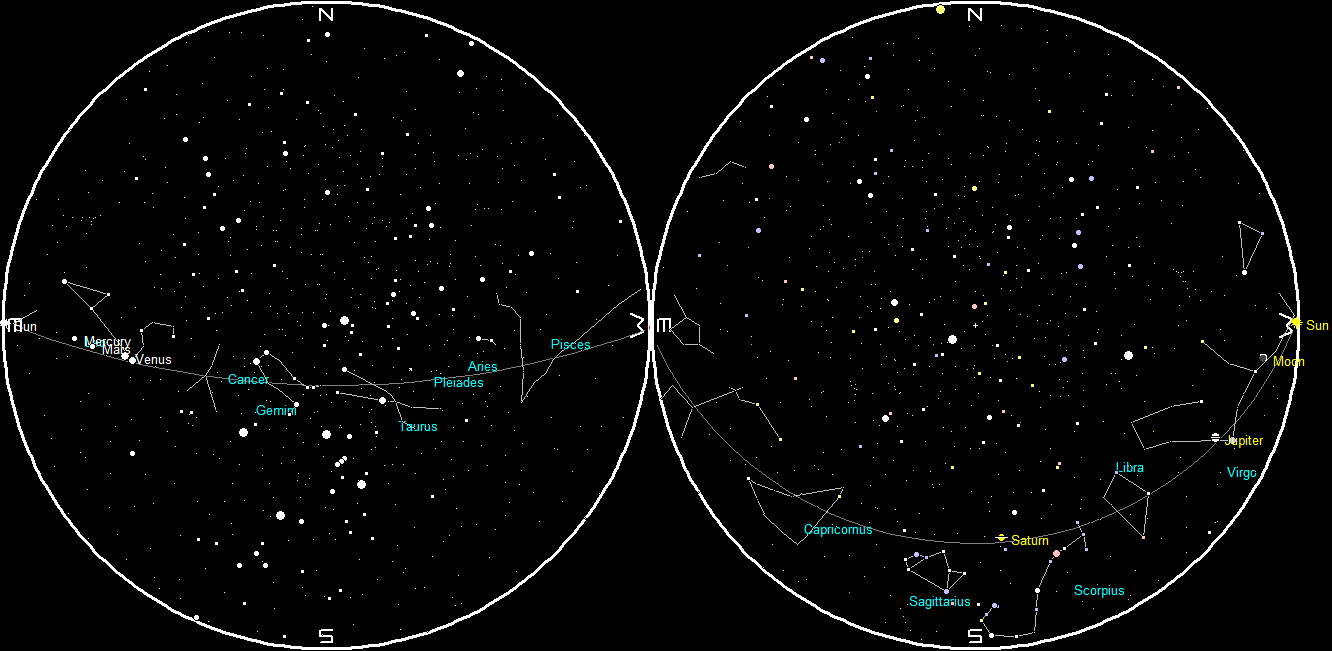
Planets at sunset and sunrise of a single night starting with sunset on the right on September 20, 2017. The night ends on the left with sunrise on the 21st. Click on the image to enlarge. Created using my LookingUp program.
09/19/2017 – Ephemeris – The Great Rift
Ephemeris for Tuesday, September 19th. The Sun will rise at 7:26. It’ll be up for 12 hours and 18 minutes, setting at 7:45. The Moon, 1 day before new, will rise at 7:43 tomorrow morning.
High overhead the Milky Way is seen passing through the Summer Triangle of three bright stars. Here we find the Milky Way split into two sections. The split starts in the constellation of Cygnus the Swan or Northern Cross very high in the east. The western part of the Milky Way ends southwest of the Aquila the eagle. This dark dividing feature is called the Great Rift. Despite the lack of stars seen there, it doesn’t mean that there are fewer stars there than in the brighter patches of the Milky Way. The rift is a great dark cloud that obscures the light of the stars behind it. Sometimes binoculars can be used to find the edges of the clouds of the rift, as stars numbers drop off suddenly. This is especially easy to spot in Aquila the eagle.
The times given are for the Traverse City/Interlochen area of Michigan. They may be different for your location.
Addendum
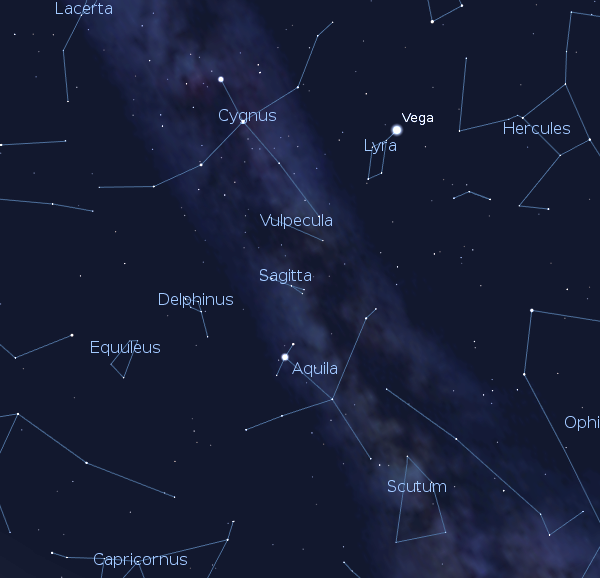
The Great Rift in the Milky Way. Created using Stellarium.

