Archive
11/07/2016 – Ephemeris – Standard time returns for a few months
Ephemeris for Monday, November 7th. The Sun will rise at 7:29. It’ll be up for 9 hours and 53 minutes, setting at 5:22. The Moon, at first quarter today, will set at 12:09 tomorrow morning.
In these programs I usually talk about the evening sky. Now with the Sun rising later the morning sky is also accessible. Of course I have to mention it a day after sunrise was jerked back an hour by falling back to standard time, However sunrise will advance back to near what it was last week by Christmas time. The sky we’re seeing in the morning now is what we would see in the evening in late March or early April. In the morning we seen nearly in the opposite direction as in the evening, which is why we would see the stars as the will look nearly six months from now, as we orbit the Sun. In the morning, as we orbit the Sun we are looking to where we’re going on this nearly circular race track. We see Jupiter move away from the Sun as we start to overtake it. So in the evening sky we’re looking to where we’ve been, seeing Saturn falling behind, and Venus slowly overtaking us from the rear.
Times are for the Traverse City/Interlochen area of Michigan. They may be different for your location.
Addendum
Check out my November 1st post for the morning star chart.
Also check out my Ephemeris Calendar for how the time change affects the rising and setting events of the Sun and Moon.
11/03/2016 – Ephemeris – Capricornus, a very strange goat
Ephemeris for Thursday, November 3rd. The Sun will rise at 8:24. It’ll be up for 10 hours and 3 minutes, setting at 6:28. The Moon, half way from new to first quarter, will set at 9:25 this evening.
The planet Mars is just to the right of the stars of Capricornus, one of the constellations of the zodiac. Astronomers and others who draw the constellations by drawing lines between stars like a dot to dot puzzle have a hard time getting a sea-goat emerge from its stars. The sea-goat has the front part of a goat and the back half like a fishes tail. Kind of like a mergoat, instead of a mermaid. To me, the constellation looks like a large sagging triangle, just above-left of Mars right now. It will take Mars only to mid December to cross Capricornus to enter Aquarius, just east of it. A couple of thousand years ago Capricornus was the location of the winter solstice point in the sky, for which the Tropic of Capricorn was named. That point is now on the Ophiuchus-Sagittarius border.
Times are for the Traverse City/Interlochen area of Michigan. They may be different for your location.
Addendum
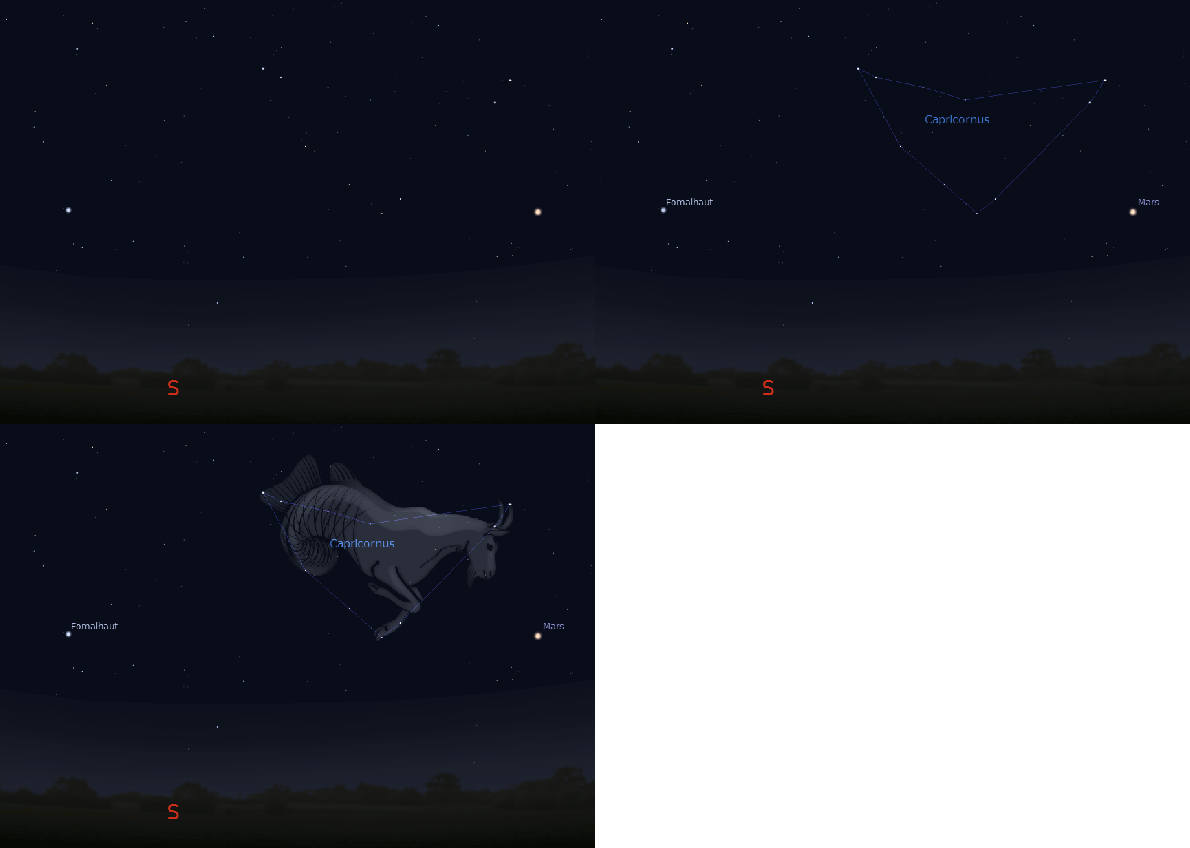
Animated GIF of Capricornus in the sky. Time 9 p.m. November 3, 2016. Created using Stellarium ans GIMP.
11/02/2016 – Ephemeris – Venus, Saturn and the Moon make a tight triangle in the southwest tonight
Ephemeris for Wednesday, November 2nd. The Sun will rise at 8:22. It’ll be up for 10 hours and 6 minutes, setting at 6:29. The Moon, 3 days past new, will set at 8:42 this evening.
Low in the east this morning at 7 Jupiter can be glimpsed in the twilight. Jupiter rose this morning at 5:48 a.m. Venus, Saturn and Mars are in the evening sky. Venus, Saturn and the Moon will appear together tonight with Saturn to the right of the much brighter Venus. The thin crescent Moon will appear above Saturn. Venus will set at 8:18 p.m. and Saturn a minute later. Venus continues to move southward and will still be hugging the southwestern horizon for the next week, but it’s high enough to spot with a reasonably low horizon. Mars can be seen in the darkened sky after Venus and Saturn set. The Red Planet will enter the constellation of Capricornus in a week and moves into the southwest by 8 p.m. Mars will set at 11:07 p.m.
Times are for the Traverse City/Interlochen area of Michigan. They may be different for your location.
Addendum
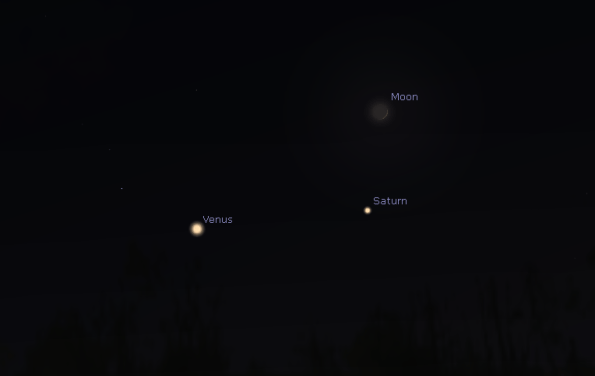
The Moon, Saturn and Venus low in the southwest tonight at 7:30 p.m., November 2, 2016. Created using Stellarium.
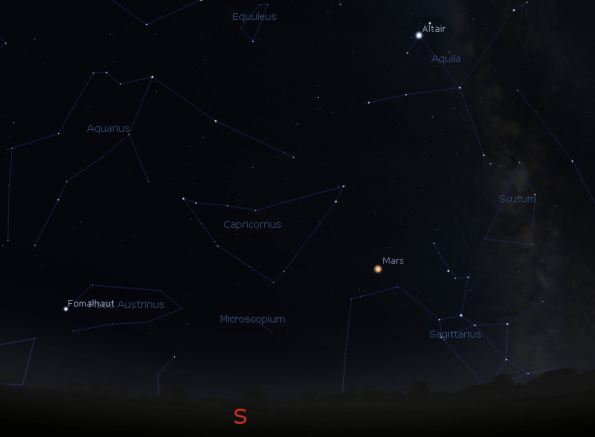
Mars and the evening constellations tonight at 8 p.m., November 2, 2016. Created using Stellarium.
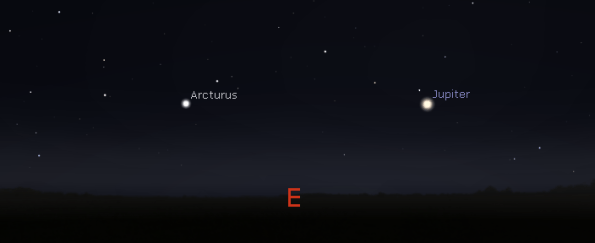
Jupiter rising in the morning sky this morning at 7 a.m. November 2, 2016. Created using Stellarium.
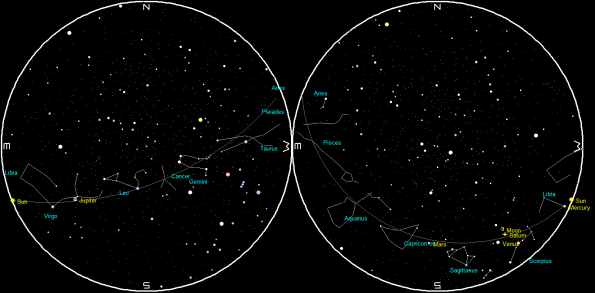
Planets and Moon at sunset and sunrise of a single night starting with sunset on the right on November 2, 2016. The night ends on the left with sunrise on November 3. If you are using Firefox right-click on the image and select View Image to enlarge the image. That goes for all the large images. Created using my LookingUp program.
Bob King has an excellent article in Universe Today about the planet and Moon grouping in the southwest tonight: http://www.universetoday.com/131700/november-opens-splendid-gathering-moon-planets/
11/01/2016 – Ephemeris – Previewing November evening and morning skies
Ephemeris for Tuesday, November 1st. The Sun will rise at 8:21. It’ll be up for 10 hours and 9 minutes, setting at 6:30. The Moon, 2 days past new, will set at 8:03 this evening.
The month of November is one early sunsets, especially with the return to standard time next Sunday, and shortening of day light hours. Daylight hours will decrease from 10 hours 9 minutes today to 9 hours 4 minutes at month end. The altitude of the sun above the southern horizon at local noon, which will drop from 31 degrees to 23½ degrees over the month. Apparent local noon this month will be around 12:30 p.m. once the time change happens. The sunset time on the 30th will be only 2 minutes later than the earliest sunset of the year. The sunrise time on the 30th will have 22 minutes to go to the latest sunrise. The Leonid meteor shower will have a peak on the 17th, but the bright Moon will interfere with it.
Times are for the Traverse City/Interlochen area of Michigan. They may be different for your location.
Addendum
November Star Charts
Evening
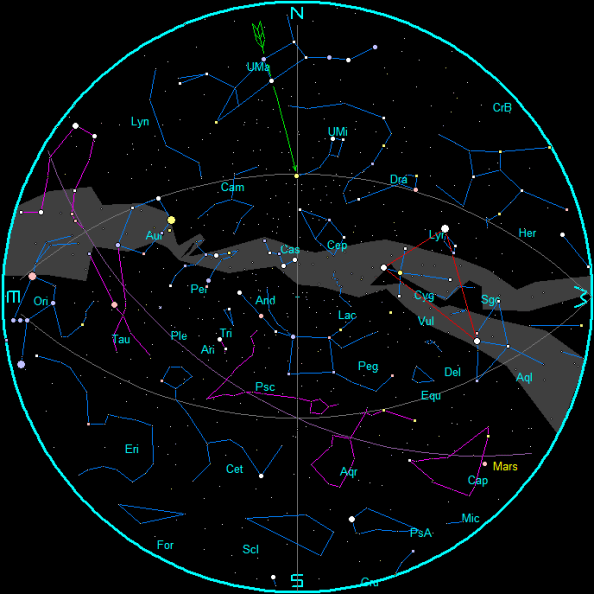
Evening Star Chart for November 2016. Created using my LookingUp program. To enlarge in Firefox right-click on image then click View image.
Morning
Since the night time hours are lengthening I’ve decided to add a morning star chart .
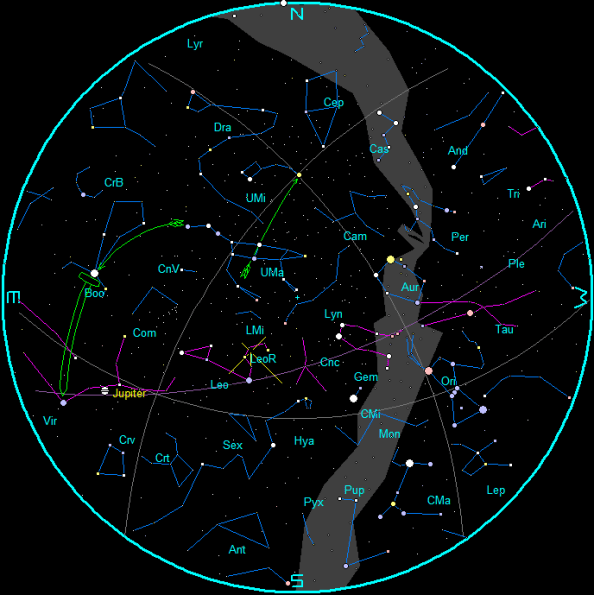
Morning Star Chart for November 2016. Created using my LookingUp program. To enlarge in Firefox right-click on image then click View image.
The planets and stars are plotted for the 15th at 9 p.m. EST, and again at 6 a.m. Those are chart times. Note, Traverse City is located approximately 45 minutes behind our time meridian. (An hour 45 minutes behind our daylight saving time meridian. during EDT and 45 minutes behind our daylight standard time meridian. during EST). We start the month on daylight time (UT – 4 hours) then fall back to standard time (UT – 5 hours) on the 6th at 2 a.m. To duplicate the star positions on a planisphere you may have to set it to 1:45 or 0:45 earlier than the current time if you were near your time meridian.
Evening nautical twilight ends at 7:35 p.m. EDT on the 1st, decreasing to 6:13 p.m. EST on the 30th.
Morning nautical twilight starts at 7:16 a.m. EDT on the 1st, and drops an hour on the 6th, and then increases again to 6:50 a.m. EST on the 30th.
Add a half hour to the chart time every week before the 15th and subtract a half hour for every week after the 15th.
For a list of constellation names to go with the abbreviations click here.
- Pointer stars at the front of the bowl of the Big Dipper point to Polaris the North Star
- Follow the arc of the handle of the Big Dipper to the star Arcturus, and
- Straighten to a spike to Spica
- The Summer Triangle is outlined in red. Vega in Lyra (Lyr), Deneb in Cygnus (Cyg) and Altair in Aquila (Aql).
Calendar of Planetary Events
Credit: Sky Events Calendar by Fred Espenak and Sumit Dutta (NASA’s GSFC)
To generate your own calendar go to http://eclipse.gsfc.nasa.gov/SKYCAL/SKYCAL.html
Times are Eastern Time.
    Date    Time    Event
 Nov 01 Tu          Venus: 37.7° E
    02 We  2:38 pm Moon-Saturn: 4.1° S
    04 Fr  8:04 am Moon South Dec.: 18.7° S
    05 Sa 12:13 am South Taurid Shower: ZHR = 10
    06 Su  2:00 am Eastern Standard Tim starts
    07 Mo  2:51 pm First Quarter
    09 We 10:57 am Moon Descending Node
    11 Fr 11:29 pm North Taurid Shower: ZHR = 15
    14 Mo  6:23 am Moon Perigee: 356500 km
    14 Mo  8:52 am Full Moon (Super Moon)
    15 Tu 11:50 am Moon-Aldebaran: 0.4° S
    17 Th  4:32 am Moon North Dec.: 18.8° N
    17 Th  5:47 am Leonid Shower: ZHR = 15
    21 Mo  3:33 am Last Quarter
    21 Mo  5:08 am Moon-Regulus: 1.4° N
    21 Mo  9:48 pm Moon Ascending Node
    23 We  1:48 pm Mercury-Saturn: 3.4° N
    24 Th  8:47 pm Moon-Jupiter: 2.1° S
    27 Su  3:08 pm Moon Apogee: 406600 km
    29 Tu  7:18 am New Moon
Dec 01 Th          Venus: 43.2° E
10/31/2016 – Ephemeris – What’s a Halloween sky without the Ghoul Star
Ephemeris for Halloween, Monday, October 31st. The Sun will rise at 8:20. It’ll be up for 10 hours and 12 minutes, setting at 6:32. The Moon, 1 day past new, will set at 7:28 this evening.
Not all the ghosts and goblins out tonight will be children. One is out every night, because it’s a star. Its name is Algol, from the Arabic for Ghoul Star or Demon Star. The Chinese had a name for it that meant ‘piled up corpses’. It’s the second brightest star in the constellation Perseus the hero, rising in the northeast this evening. The star is located where artists have drawn the severed head of Medusa, whom he had slain. Medusa was so ugly that she turned all who gazed upon her to stone. Algol is her still glittering eye. Astronomers finally found out what was wrong with Algol. It does a slow 6 hour wink every 2 days 21 hours because it is two very close stars that eclipse each other in that period. It did so this morning at 5:53 a.m.
Times are for the Traverse City/Interlochen area of Michigan. They may be different for your location.
Addendum
To run an app to calculate times for the minima of Algol click here: http://www.skyandtelescope.com/observing/celestial-objects-to-watch/the-minima-of-algol/ courtesy of Sky and Telescope Magazine.
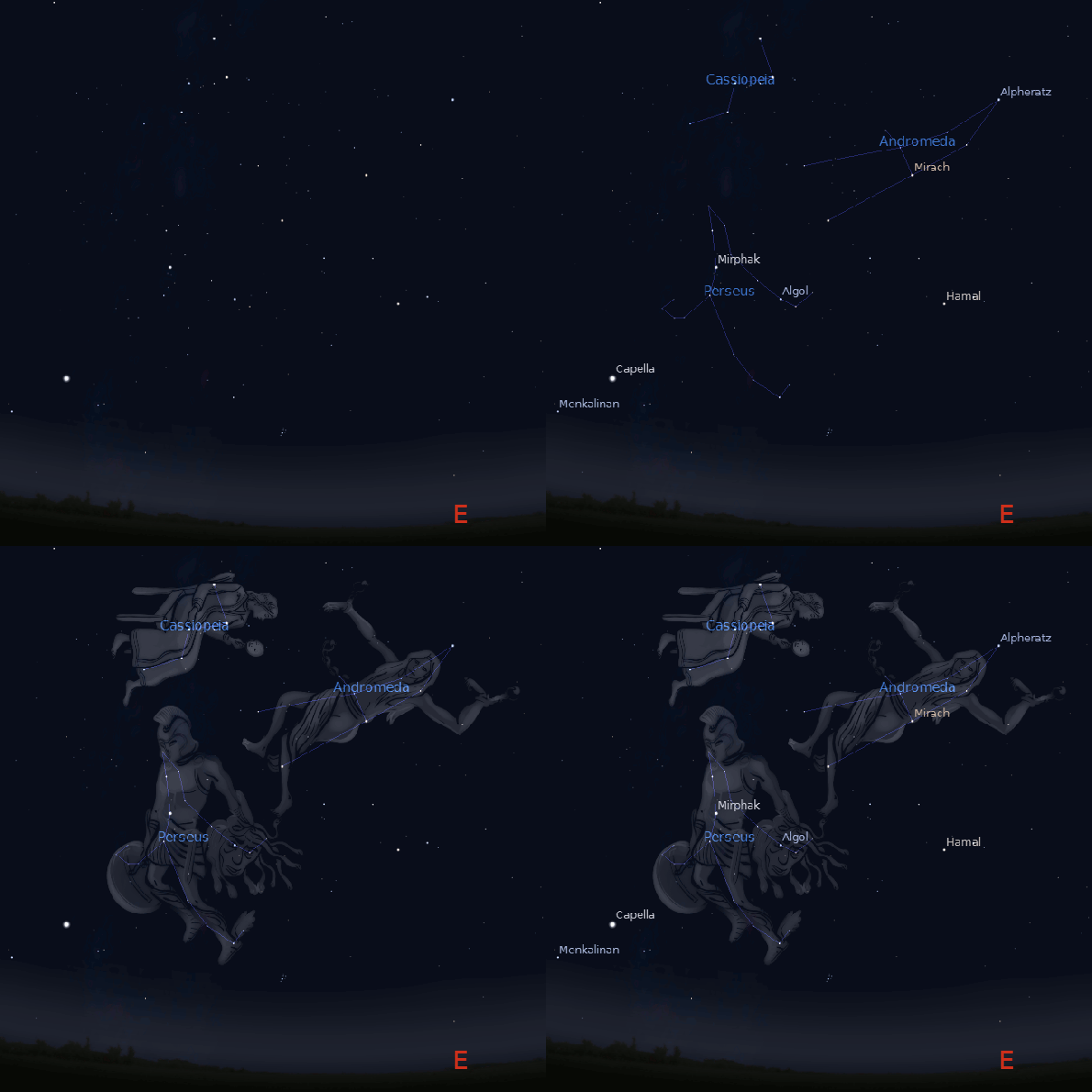
Perseus with Cassiopeia and Andromeda in the northeast at 8:30 p.m. on Halloween. Created using Stellarium and GIMP.
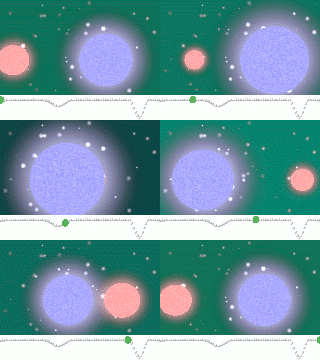
Animation of an eclipsing binary star like Algol. Credit: Wikimedia Commons h/t Earth and Sky
10/28/2016 – Ephemeris – The Moon will hang by Jupiter this morning
Ephemeris for Friday, October 28th. The Sun will rise at 8:16. It’ll be up for 10 hours and 20 minutes, setting at 6:36. The Moon, 2 days before new, rose this morning at 6:02 and will rise at 7:01 tomorrow morning.
This morning the planet Jupiter and the Moon will appear close together in the morning sky. Jupiter rose at 6:03 a.m. After that until twilight becomes too bright both will appear together with Jupiter to the right of the thin waning crescent Moon. They passed each other at 4:18 (8:18 UT) this morning. Jupiter will appear to move farther from the Sun in the coming months, more the Sun moving away from it caused by the Earth’s motion around the Sun. Jupiter will enter the evening sky in April next year, passing in front of the zodiacal constellation of Virgo. By then we will have lost Venus as our Evening Star, so Jupiter will have no competition when it arrives from the east.
Times are for the Traverse City/Interlochen area of Michigan. They may be different for your location.
Addendum
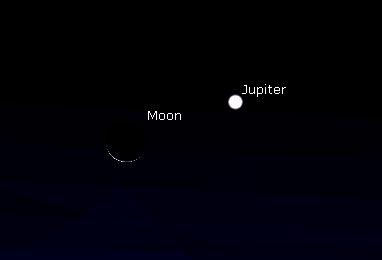
The Moon and Jupiter at 7 a.m. EDT (11:00 UT) this morning October 28, 2016. Stellarium and any other planetarium program cannot display the dynamic range of he sky. The sliver of the moon should be a lot brighter, including earthshine on its night side. I had to delete a star that was showing way too bright when it should be barely visible. Created using Stellarium and GIMP.
For observers in the UK and Europe the Moon will appear above Jupiter. As a rule of thumb, the Moon moves its own diameter in an hour against the stars. In the sky in the east just before sunrise the Moon will be moving down and to the left in relation to Jupiter.
10/27/2016 – Ephemeris – Finding the Great Andromeda Galaxy
Ephemeris for Thursday, October 27th. The Sun will rise at 8:14. It’ll be up for 10 hours and 23 minutes, setting at 6:37. The Moon, 3 days before new, will rise at 6:02 tomorrow morning.
The closest large galaxy to our Milky Way galaxy is the Great Andromeda Galaxy seen in the eastern sky when it gets dark. It is barely visible to the naked eye. To locate it first find the Great Square of Pegasus high in the east, standing on one corner. The left star of the square is the head of the constellation Andromeda. Follow two stars to the left and a bit downward, then two stars straight up. The galaxy is near that last star as a small smudge of light. Binoculars are the best way to see it as a thin spindle of light. A telescope can see only the bright nucleus of the galaxy, that spans 6 Moon diameters in photographs. M31 is its first catalog designation and it is two and a half million light years away.
Times are for the Traverse City/Interlochen area of Michigan. They may be different for your location.
Addendum
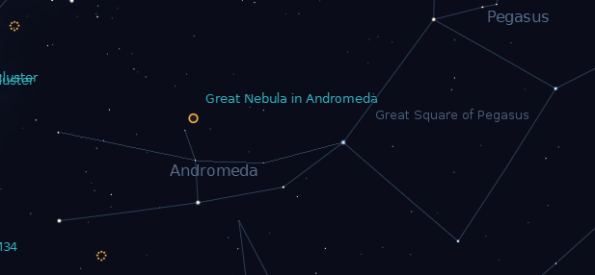
Andromeda in the evening with the Great Andromeda Galaxy. Astronomers called it a nebula before the discovered it was a galaxy like the Milky Way. Created using Stellarium.
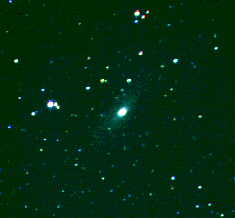
The Great Andromeda Galaxy (M31) as seen in binoculars. Visually even in a telescope the hub of this galaxy is all that is seen. However it also can be seen with the naked eye. My photograph.
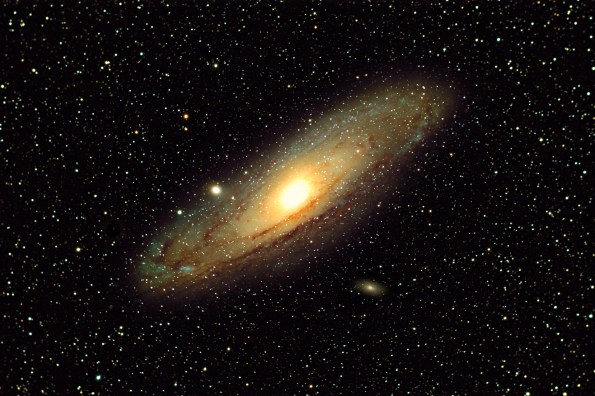
The Great Andromeda Galaxy (M31). Image taken by Scott Anttila.
10/26/2016 – Ephemeris – Bright planet count: 1 in the morning, 3 in the evening, 1 behind the Sun
Ephemeris for Wednesday, October 26th. The Sun will rise at 8:13. It’ll be up for 10 hours and 26 minutes, setting at 6:39. The Moon, half way from last quarter to new, will rise at 5:03 tomorrow morning.
Low in the east this morning at 7 Jupiter can be glimpsed in the twilight. Jupiter’s rose this morning at 6:09 a.m. Venus, Saturn and Mars are in the evening sky. Venus is briefly visible after sunset, low in the west-southwest. It will set at 8:16 p.m. Venus is still moving a bit southward and will still be hugging the southwestern horizon for the next month or so, but it’s high enough to spot with a reasonably low horizon. Saturn is above and left of Venus, It will set at 8:44 p.m. Mars can be seen in the darkened sky after Venus sets. Mars is way out to the left of Saturn, above and left of the setting Teapot of Sagittarius at 9 p.m. in the southwest. Mars will set at 11:08 p.m. Mercury will pass behind the Sun tomorrow.
Times are for the Traverse City/Interlochen area of Michigan. They may be different for your location.
Addendum
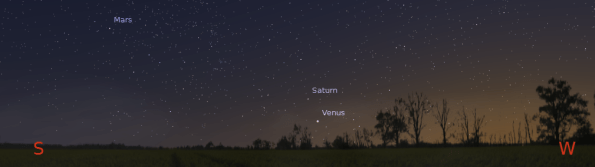
The evening planets in twilight at 7:30 p.m. Venus and Mars are easily spotter, but Saturn is problematic. Created using Stellarium.
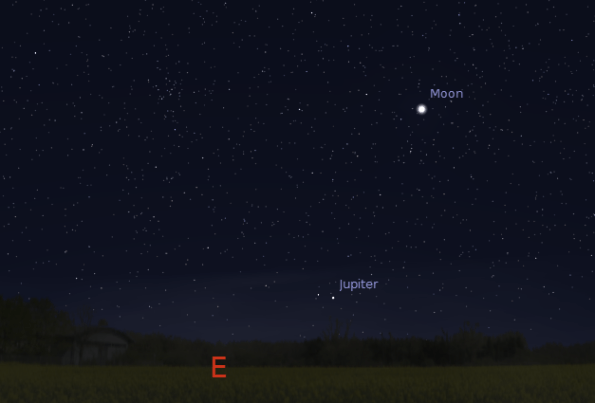
Jupiter and the Moon at 7 a.m. this morning, October 26, 2016. Created using Stellarium.
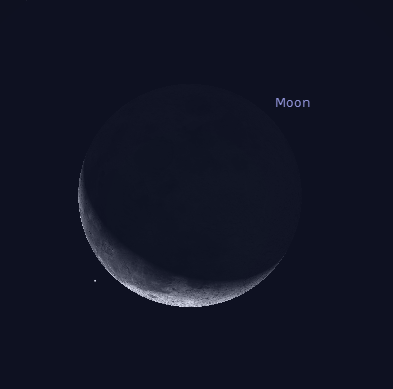
The Moon as it might appear in binoculars at 7 a.m. this morning, October 26, 2016. The Mood will also show a faint earthshine on its normally hidden light side to the right of the crescent. Created using Stellarium.
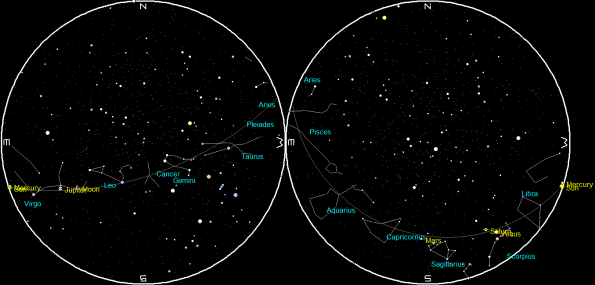
Planets and Moon at sunset and sunrise of a single night starting with sunset on the right on October 26, 2016. The night ends on the left with sunrise on October 27. If you are using Firefox right-click on the image and select View Image to enlarge the image. That goes for all the large images. Created using my LookingUp program.
10/25/2016 – Ephemeris – Venus is becoming more visible after sunset
Ephemeris for Tuesday, October 25th. The Sun will rise at 8:12. It’ll be up for 10 hours and 28 minutes, setting at 6:40. The Moon, 3 days past last quarter, will rise at 4:02 tomorrow morning.
Venus is becoming quite visible low in the southwest after sunset as the Evening Star. As such it is a beautiful addition to our autumn and winter skies. As seen in telescopes it is a tiny gibbous disc, 79% illuminated by the sun. It’s beauty is only cloud-top deep. For a planet that appears to be nearly Earth’s twin at 95% the Earth’s size, it can be said to be Earth’s evil twin. Its bright white cloud-tops aren’t made of water but sulfuric acid, and it gets worse the farther down you go. The farther one goes down in Venus’ carbon dioxide atmosphere, the hotter and higher the atmospheric pressure gets. At the surface the temperature is over 850 degrees Fahrenheit (460º C) and the atmospheric pressure is nearly 100 times that of Earth. Venus’ surface temperature is actually hotter than Mercury the closest planet to the Sun, a hellish runaway greenhouse effect.
Times are for the Traverse City/Interlochen area of Michigan. They may be different for your location.
Addendum
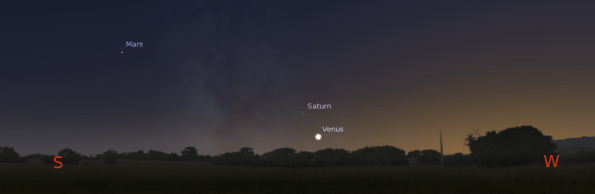
Venus and the other evening planets at 7:30 p.m. Created using Stellarium.

Venus as it might appear in a telescope minus all the atmospheric effects of being close to the horizon. It is 13.6 ‘ in diameter. Created using Stellarium.
10/24/2016 – Ephemeris – Fomalhaut, the loneliest star in the sky
Ephemeris for Monday, October 24th. The Sun will rise at 8:10. It’ll be up for 10 hours and 31 minutes, setting at 6:42. The Moon, 2 days past last quarter, will rise at 3:01 tomorrow morning.
There’s a bright star that appears for only seven and a half hours on autumn evenings. It’s appearance, low in the south at 10 p.m., is a clear indication of the autumn season. The star’s name is Fomalhaut, which means fish’s mouth. That’s fitting because it’s in the constellation of Piscis Austrinus, the southern fish. At our latitude it’s kind of the fish that got away, because Fomalhaut appears to be quite alone low in the sky. The dimness of the constellation’s other stars and location close to the horizon make the faint stars hard to spot. The earth’s thick atmosphere near the horizon reduces their brightness by a factor of two or more, so Fomalhaut, one of the brightest stars in the sky, keeps a lonely vigil in the south.
Times are for the Traverse City/Interlochen area of Michigan. They may be different for your location.
Addendum
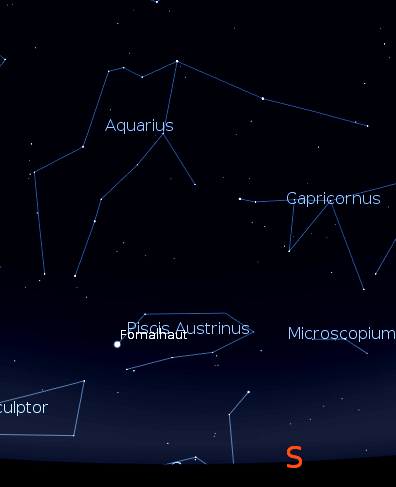
Aquarius and Fomalhaut as visualized by Stellarium.

