Archive
10/21/2016 – Ephemeris – Last star party of the year at Sleeping Bear Dunes
Ephemeris for Friday, October 21st. The Sun will rise at 8:06. It’ll be up for 10 hours and 40 minutes, setting at 6:47. The Moon, 1 day before last quarter, will rise at 11:54 this evening.
Tonight if it’s clear the Grand Traverse Astronomical Society will join the rangers at the Sleeping Bear Dunes National Lakeshore for their 46th anniversary celebration with a star party at Stop number 3, the Dunes Overlook on the Pierce Stocking Scenic Drive, though park at Picnic Mountain, just before it. The event will run from 8 to 10 p.m. featuring the wonders still visible among the northern summer wonders along with those appearing in the autumn skies, such as the Great Andromeda Galaxy and the famous Double Cluster. To get a heads up on the status of the star party call 231-326-4700, extension. 5005, for a message after 4 p.m. if the weather looks doubtful. Despite being October we’ve had pretty good luck with getting clear skies for this event.
Times are for the Traverse City/Interlochen area of Michigan. They may be different for your location.
Addendum
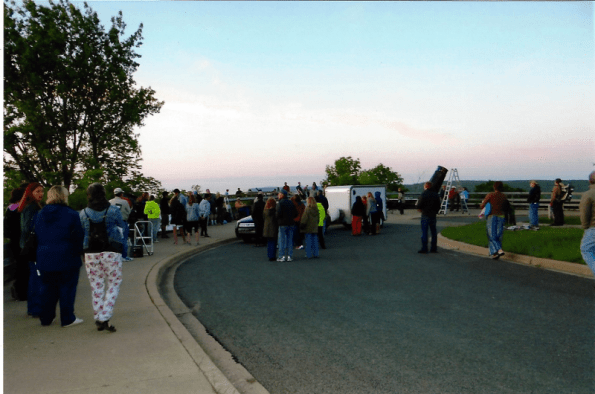
Star Party at the Dunes Overlook. Credit: Eileen Carlisle
10/20/2016 – Ephemeris – Perseus: Is it a hero or a chicken?
Ephemeris for Thursday, October 20th. The Sun will rise at 8:05. It’ll be up for 10 hours and 43 minutes, setting at 6:48. The Moon, 2 days before last quarter, will rise at 10:54 this evening.
Positioned below the W shaped constellation of Cassiopeia half way up the sky in the northeast at 9 p.m. is the constellation of Perseus the hero of Greek myth who slew Medusa and rescued and married Andromeda represented in the constellation above and right of him. Rather than a hero the star pattern seems to look like a chicken or perhaps Big Bird. At least, that’s how I see it. In the back of the chicken is its brightest star Mirfak (Mirphak). Binoculars will show a beautiful group of stars near Mirfak just below unaided eye visibility called the Alpha Persei Association. Tomorrow morning will see the peak of the Orionid meteor shower, though all but the brightest meteors will be overwhelmed by waning gibbous Moon.
Times are for the Traverse City/Interlochen area of Michigan. They may be different for your location.
Addendum
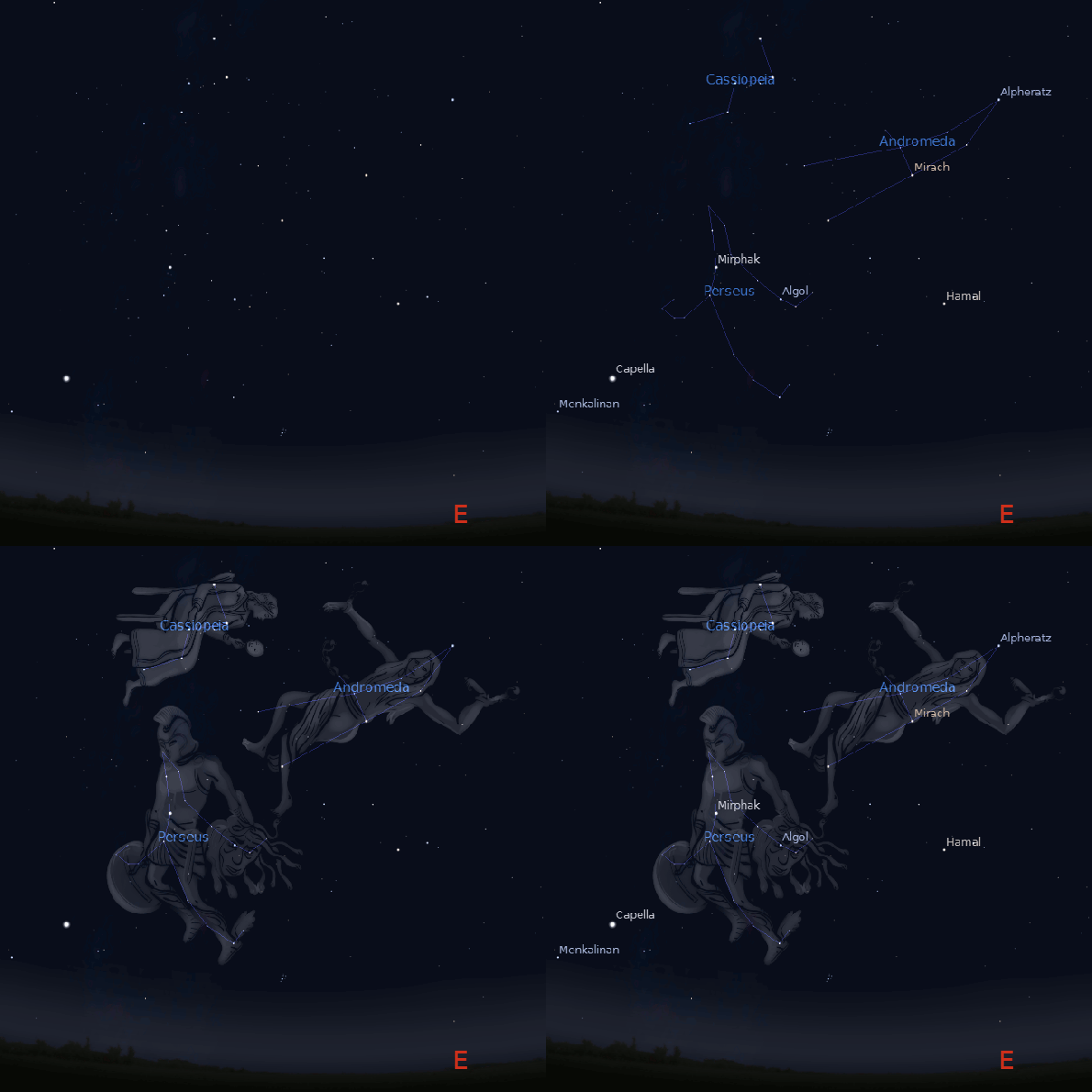
Perseus with Cassiopeia and Andromeda in the northeast at 9 p.m. October 20, 2016. Created using Stellarium and GIMP.
10/19/2016 – Ephemeris – Jupiter is in morning twilight, Venus in evening twilight
Ephemeris for Wednesday, October 19th. The Sun will rise at 8:04. It’ll be up for 10 hours and 46 minutes, setting at 6:50. The Moon, half way from full to last quarter, will rise at 9:58 this evening.
Low in the east this morning at 7:15 Jupiter might be glimpsed in the twilight. Jupiter’s rise time is at 6:28 a.m. Venus, Saturn and Mars are in the evening sky. Venus is briefly visible after sunset, low in the west-southwest. It will set at 8:16 p.m., following the Sun’s earlier setting times. Venus is still moving a bit southward and will still be hugging the southwestern horizon for the next month or so, but it’s high enough to spot with a reasonably low horizon. Mars and Saturn can be seen in the darkened sky after Venus sets. Mars is way out to the left of Saturn passing above the Teapot of Sagittarius. Saturn, spectacular in telescopes with its rings, will set at 9:09 p.m. Mars will set at 11:11 p.m,
Times are for the Traverse City/Interlochen area of Michigan. They may be different for your location.
Addendum
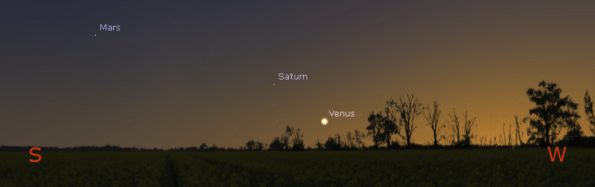
Venus, Saturn and Mars at 7:30 p.m. October 19, 2016. Last night I saw Venus and Mars, but not Saturn with the naked eye at that hour. Created using Stellarium.
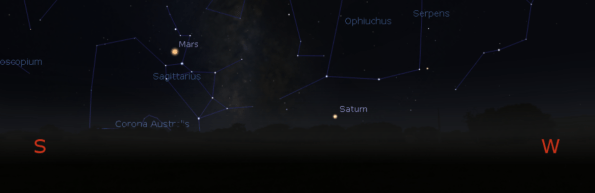
Saturn and Mars at 8:30 p.m. October 19, 2016. Created using Stellarium.

Jupiter rising at 7 a.m. this morning, October 19, 2016. Created using Stellarium.
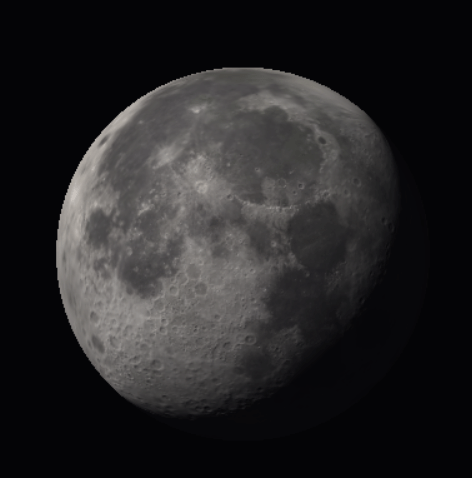
The Moon as it might be seen in binoculars at 7 a.m. this morning, October 19, 2016. Created using Stellarium.
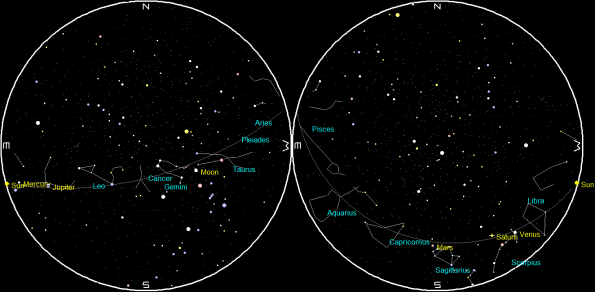
Planets and Moon at sunset and sunrise of a single night starting with sunset on the right on October 19, 2016. The night ends on the left with sunrise on October 20. If you are using Firefox right-click on the image and select View Image to enlarge the image. That goes for all the large images. Created using my LookingUp program.
10/17/2016 – Ephemeris – Europe’s ExoMars satellite and lander will reach Mars Tomorrow
Ephemeris for Tuesday, October 18th. The Sun will rise at 8:02. It’ll be up for 10 hours and 49 minutes, setting at 6:52. The Moon, 2 days past full, will rise at 9:07 this evening.
You’ve probably haven’t heard of the ExoMars mission before or even recently. That’s the way Mars missions go, due to their long cruise phase. It was launched by the Europeans and Russians back in March. ExoMars is an orbiter with an attached lander. The lander named Schiaparelli after the famed 19th century astronomer, separated from the Trace Gas Orbiter two days ago to land on Mars. A few hours later the orbiter made a thruster burn to miss Mars and not follow the lander into Mars’ atmosphere. The lander will hit Mars’ atmosphere at about 10:52 a.m. tomorrow, with landing 5 minutes later. The Schiaparelli lander will operate on batteries only with a lifetime of a few days. It will take a few images as it lands, but will not take images from the surface.
Times are for the Traverse City/Interlochen area of Michigan. They may be different for your location.
Addendum
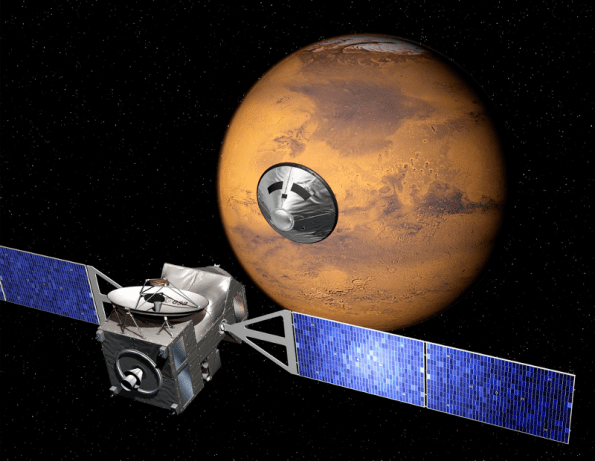
Artist’s visualization of releasing the Schiaparelli lander. Credit ESA.
Planetary Society’s Emily Lakdawalla’s blog post showing the ExoMars Mars arrival timeline: http://www.planetary.org/blogs/emily-lakdawalla/2016/10140937-exomars-timeline.html
10/17/2016 – Ephemeris – Elon Musk’s vision of how he’ll colonize Mars
Ephemeris for Monday, October 17th. The Sun will rise at 8:01. It’ll be up for 10 hours and 52 minutes, setting at 6:53. The Moon, 1 day past full, will rise at 8:21 this evening.
On September 27th Elon Musk announced his plans to send people to Mars, hopefully by 2024. He explained in detail how he would do it. He made an hour-long presentation at the International Astronautical Congress meeting in Mexico, which can be seen on the Internet at spacex.com. Also there is a shorter animation of how he expects to do it. He expects to send hundreds of people at a time into Earth orbit. The booster would return to the launch pad and another second stage with fuel loaded on top of it to be launched again on the next orbit to refuel the manned stage before sending it to Mars. Robotic missions would be sent before to set up the infrastructure for the Mars Base. I’m somewhat skeptical, but all great adventures start with a dream.
Times are for the Traverse City/Interlochen area of Michigan. They may be different for your location.
Addendum

New colonists looking out at the Martian landscape. Credit: Screen cap from SpaceX video.
Short 5 minute video: https://youtu.be/0agVZwux1Hs
Full address to the International Astronautical Congress meeting: https://youtu.be/IAZ-Xbn5hr0
10/13/2016 – Ephemeris – Europa appears to have water geysers like Enceladus
Ephemeris for Thursday, October 13th. The Sun will rise at 7:56. It’ll be up for 11 hours and 4 minutes, setting at 7:00. The Moon, 3 days before full, will set at 5:48 tomorrow morning.
On September 26th NASA announced that the Hubble Space Telescope has confirmed earlier observations that Europa, Jupiter’s second large moon is venting water vapor. It is pretty much known that Europa has a moon girdling ocean many tens of miles below its icy surface. The surface is devoid of craters, showing that there is some interaction with the ocean below and the cracks we see on the surface. Having plumes or geysers will allow spacecraft and landers to sample the ocean below without having to drill down to the ocean. NASA has okayed a mission to Europa. This could change the mission and instruments and maybe add a lander to probe the geysers, though first the have to find them.
Times are for the Traverse City/Interlochen area of Michigan. They may be different for your location.
Addendum
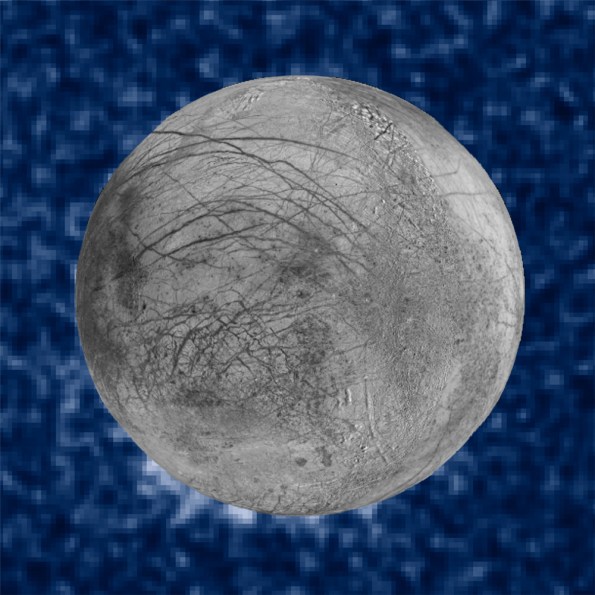
Composite photograph of plumes at the bottom of Europa with a Galileo image of Europa. Credit: NASA/Hubble/Galileo.
10/12/2016 – Ephemeris – Jupiter joins Mercury in the morning sky22
Ephemeris for Wednesday, October 12th. The Sun will rise at 7:55. It’ll be up for 11 hours and 7 minutes, setting at 7:02. The Moon, 3 days past first quarter, will set at 4:35 tomorrow morning.
Low in the east this morning at 7:15 both Mercury and Jupiter might be glimpsed, with Mercury just below Jupiter which is a bit brighter. Jupiter will rise at 6:38 a.m. and Mercury will rise at 6:47 a.m. Venus, Saturn and Mars are in the evening sky. Venus is briefly visible after sunset, low in the west. It will set at 8:20 p.m., following the Sun’s earlier setting times. Venus is still moving a bit southward and will still be hugging the southwestern horizon for the next month or so. Mars and Saturn can be seen in the darkened sky after Venus sets. Mars is way out to the left of Saturn passing above the Teapot of Sagittarius. Saturn, spectacular in telescopes with its rings, will set at 9:35 p.m. Mars will set at 11:14 p.m.
Times are for the Traverse City/Interlochen area of Michigan. They may be different for your location.
Addendum
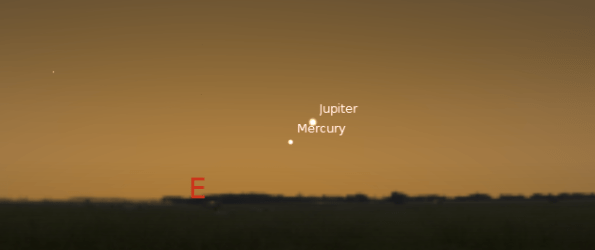
Jupiter and Mercury at 7:15 a.m. low in the east today October 12, 2016. Created using Stellarium.
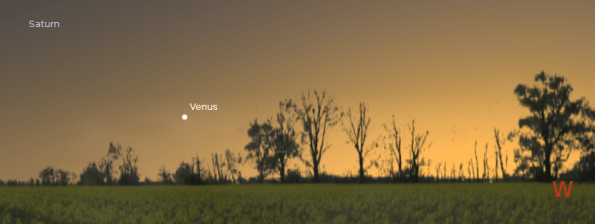
Venus and Saturn at 7:22 p.m. tonight October 12, 2016, looking to the southwest. I doubt if you could spot Saturn at this time. Created using Stellarium.
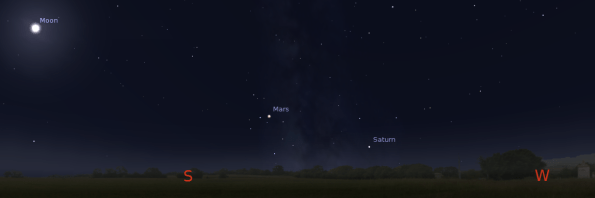
Saturn, Mars and the Moon at 8:30 p.m. October 12, 2016. Created using Stellarium.
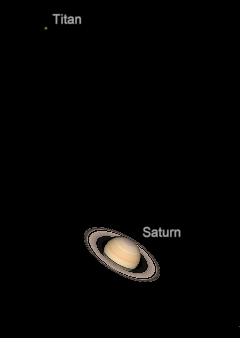
Saturn and moon as it might be seen in a telescope. at 8:30 p.m. October 12, 2016. More than likely only the satellite Titan would be seen with Saturn. Created using Cartes du Ciel (Sky Charts).
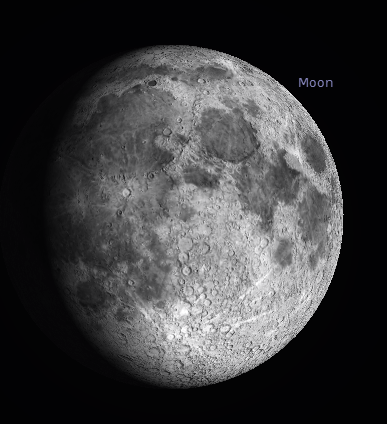
The Moon as it might be seen with binoculars tonight at 8:30 p.m. October 12, 2016. Created using Stellarium.
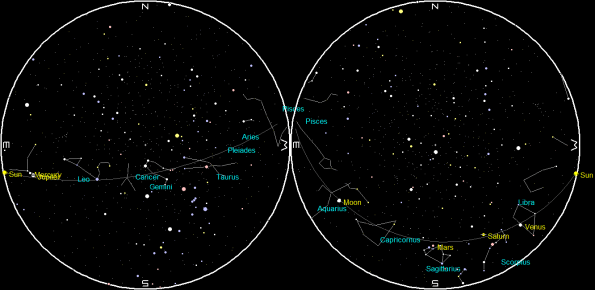
Planets and Moon at sunset and sunrise of a single night starting with sunset on the right on October 12, 2016. The night ends on the left with sunrise on October 13. If you are using Firefox right-click on the image and select View Image to enlarge the image. That goes for all the large images. Created using my LookingUp program.
10/11/2016 – Ephemeris – Looking at the Moon tonight
Ephemeris for Tuesday, October 11th. The Sun will rise at 7:53. It’ll be up for 11 hours and 10 minutes, setting at 7:04. The Moon, 2 days past first quarter, will set at 3:26 tomorrow morning.
We looked at the Moon in the last program, now 24 hours later the sunrise terminator has moved farther west, our east uncovering more landscape. The Moon rotates once in about 29 ½ days in relation with the Sun. This is the same time it orbits the Earth from new Moon to the next. We call that a lunation or lunar month. Near the upper left corner of the Moon is what looks like a half crater. It’s called Sinus Iridium, the Bay of Rainbows. It’s at the edge of Mare Imbrium or Sea of Showers. To the south cut by the terminator is Oceanus Procellarum, the flat Ocean of Storms. South of that is the small Mare Humorum, the Sea of Vapors. Between then is a distinctive crater Gassendi. South of all that is the odd shaped crater Schiller.
Times are for the Traverse City/Interlochen area of Michigan. They may be different for your location.
Addendum
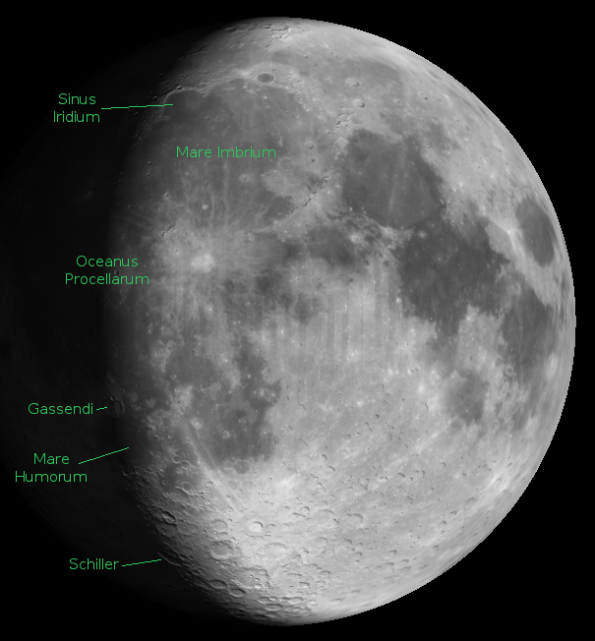
The Moon at 9 p.m. October 11, 2016. Created using Virtual Moon Atlas.
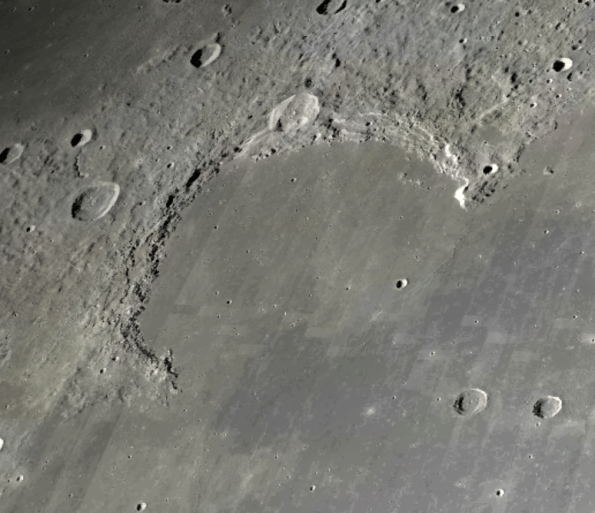
Sinus Iridium photographed by the Lunar Reconnaissance Orbiter as texture mapped on the globe of the Virtual Moon Atlas.
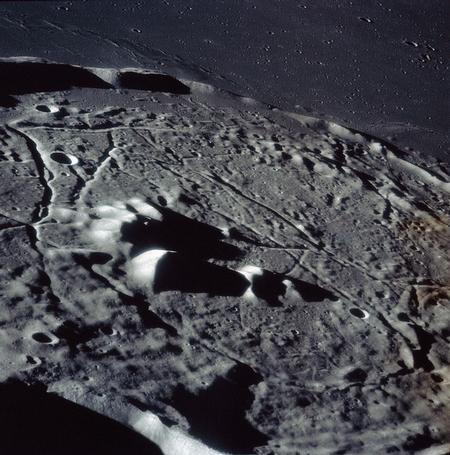
The crater Gassendi from Apollo 16 – NASA
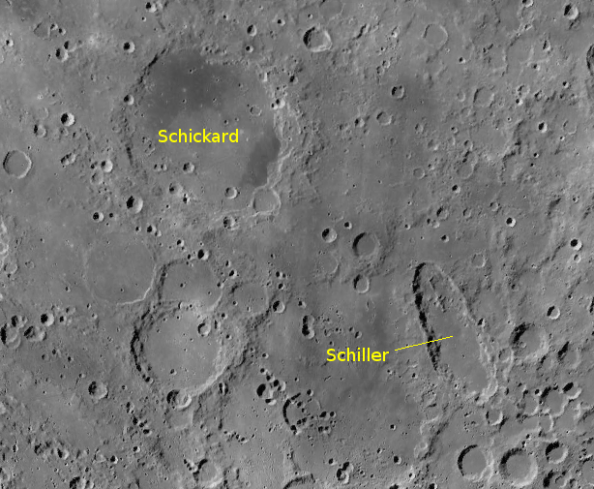
The craters Schickard and Schiller as seen from above from the Lunar Reconnaissance Orbiter. The Sun will start to rise on Schickard tomorrow night. Credit NASA from Virtual Moon Atlas.
10/10/2016 – Ephemeris – Checking out the gibbous Moon tonight
Ephemeris for Indigenous Peoples Day*, Monday, October 10th. The Sun will rise at 7:52. It’ll be up for 11 hours and 13 minutes, setting at 7:06. The Moon, 1 day past first quarter, will set at 2:20 tomorrow morning.
The Moon is beginning to dominate the evening sky. So it’s time to get out that telescope or powerful binoculars. The terminator which now is the sunrise line will be cutting through the Sea of Showers, also known as Mare Imbrium. Just south of it is the large crater Copernicus, 56 miles (93 km) in diameter. Copernicus, near the Moon’s equator hit a flat lunar sea, so it’s quite conspicuous. Another crater near the Moon’s south pole is conspicuous because it’s so big. It’s Clavius, with an arc of diminishing sized craters within. It is 136 miles (225 km) in diameter. In the book and movie 2001: A Space Odyssey, it is the location of the US Moon Base, with the monolith in the distinctive crater Tycho north of it.
Times are for the Traverse City/Interlochen area of Michigan. They may be different for your location.
Addendum
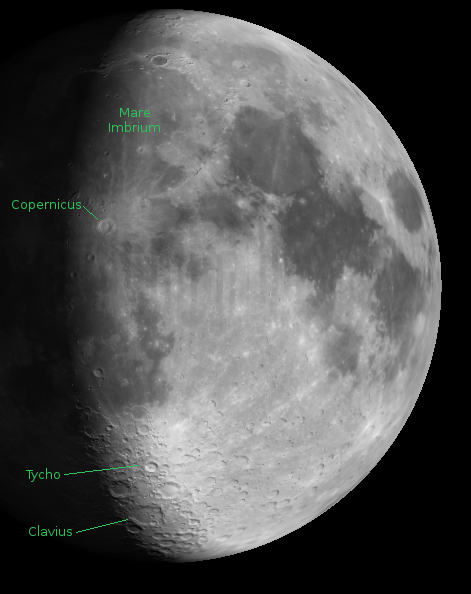
The Moon at 9 p.m. October 10, 2016, with the landmarks described in the text above,
* Indigenous Peoples Day – This is officially the Columbus Day holiday in the United States, which commemorates the landing of Christopher Columbus possibly on Plana Cay, which he named San Salvador. While in his four voyages he visited some Caribbean islands, Central and South America. He never made it to North America. Columbus was appointed the Viceroy and Governor of the Indies. He was accused of torture and other crimes. And the treatment of the Indigenous peoples as been horrific then and ever since, so pardon them if they don’t celebrate Columbus Day. This person of European ancestry tends to agree with them.
10/07/2016 – Ephemeris – Busy astronomical weekend in Traverse City
Ephemeris for Friday, October 7th. The Sun will rise at 7:48. It’ll be up for 11 hours and 22 minutes, setting at 7:11. The Moon, 2 days before first quarter, will set at 11:30 this evening.
This is another busy weekend for the Grand Traverse Astronomical Society. Tonight there will be a general meeting of the society at 8 p.m. followed by a star party at 9 p.m. at Northwestern Michigan College’s Rogers Observatory, located on Birmley Road south of Traverse City, to which all are welcome. The featured speaker for the meeting will be Randy Leach presenting Astrophotography for the Average Guy. Photographing the sky without spending big bucks. Tomorrow evening members of the society will be on the north side of the 200 block of East Front street in Traverse City with their telescopes for the International Observe the Moon Night. We’ll start at 7 p.m. if it’s clear.
Times are for the Traverse City/Interlochen area of Michigan. They may be different for your location.
Addendum
Substitute speaker: Yours truly: Personal recollections of 4 total solar eclipses and a look ahead at next year’s eclipse.

