Archive
08/24/2016 – Ephemeris – Planets gather into two groups this evening
Ephemeris for Wednesday, August 24th. The Sun rises at 6:56. It’ll be up for 13 hours and 36 minutes, setting at 8:32. The Moon, at last quarter today, will rise at 12:31 tomorrow morning.
Tonight we still have all the bright classical planets in the evening sky, barely. Mercury, Venus and Jupiter are very low in the west and will set at 9:08, 9:24 and 9:29 p.m. respectively. Saturday evening, right after sunset, Venus will be passing very close to Jupiter while they are low in the west, well within a low power telescope field. Mars, Saturn and the star Antares start the evening in the southwestern sky in a nearly perfect line. Antares, whose name means Rival of Mars is On the bottom with brighter Mars just above it, with Saturn above. Mars, moving rapidly to the east against the stars will set at 12:15 a.m. Saturn, spectacular in telescopes with its rings, will set at 12:39 a.m.
Times are for the Traverse City/Interlochen area of Michigan. They may be different for your location.
Addenda
The Planets Tonight
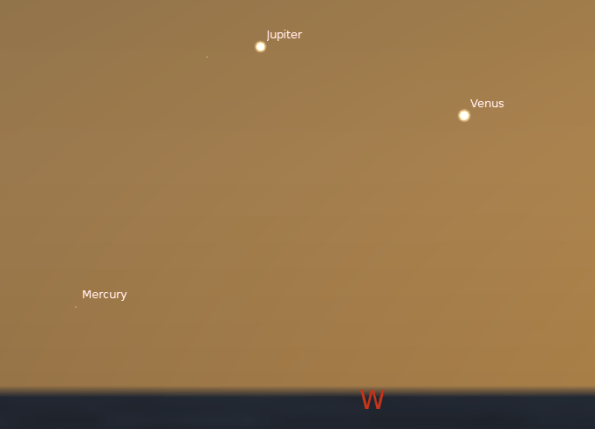
Looking very low in the west at 9 p.m., 28 minutes after sunset, August 24, 2016. For scale, Jupiter is a bit less than 5 degrees above the horizon, Mercury a bit lass than 2. Created using Stellarium.
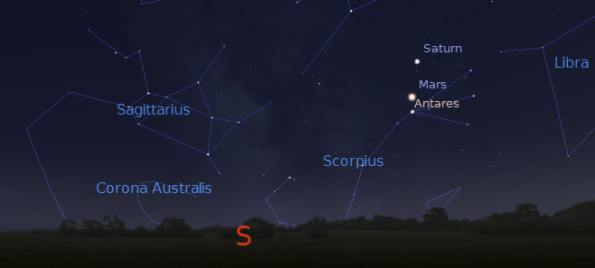
Mars breaks out the Saturn-Antares lineup at 9:30 p.m., August 24, 2016. Created by Stellarium.using Stellarium.
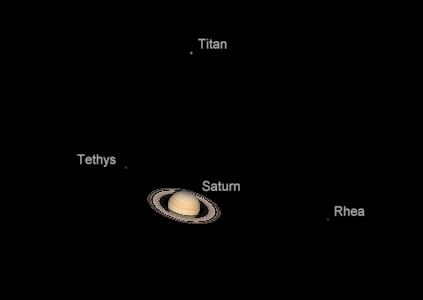
Saturn and some of its moons at 9:30 p.m. August 24, 2016. Created using Cartes du Ciel (Sky Charts).
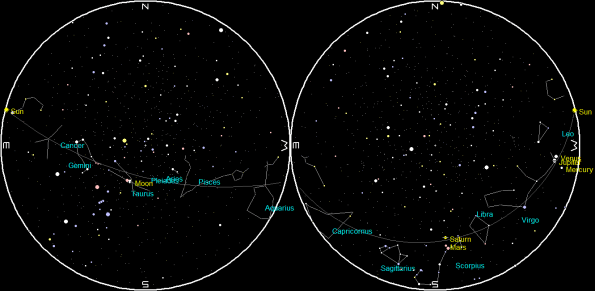
Planets at sunset and sunrise of a single night starting with sunset on the right on August 24, 2016. The night ends on the left with sunrise on August 25. Actually all the naked eye planets are in the evening sky. If you are using Firefox right-click on the image and select View Image to enlarge the image. That goes for all the large images. Created using my LookingUp program.
Mars, Antares and Saturn Last Night
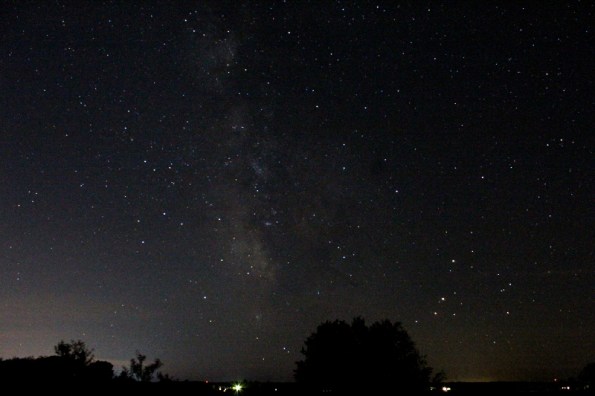
Saturn, Mars and Antares and the setting Scorpius to the right of the tree, and the Sagittarius Teapot with the Milky Way boiling out of the spout at 11:03 p.m. EDT, August 24, 2016. Credit Bob Moler from my back yard.
08/23/2016 – Ephemeris – Mars, Antares and Saturn line up
Ephemeris for Tuesday, August 23rd. The Sun rises at 6:55. It’ll be up for 13 hours and 39 minutes, setting at 8:34. The Moon, 1 day before last quarter, will rise at 11:49 this evening.
Tonight if you look out to the southwest, you will see a nearly perfect, nearly vertical line of bright stars. But two of these are planets. The brightest is the red planet Mars. Below is it’s rival, the red giant star Antares. Above is the ringed planet Saturn. Tonight Mars will be just to the right of the Saturn Antares line. After they set tonight and before we see them tomorrow night Mars will have moves to be just out of the line to the left. I hope it’s clear tonight so I can get a picture of them. A digital camera on a tripod with a low f-stop, and a high ISO speed with a shutter open for maybe 15 seconds ought to do it. Manually focus on infinity. Dark skies confuse auto focusers. And turn the flash off. Try it again tomorrow night.
Times are for the Traverse City/Interlochen area of Michigan. They may be different for your location.
Addendum
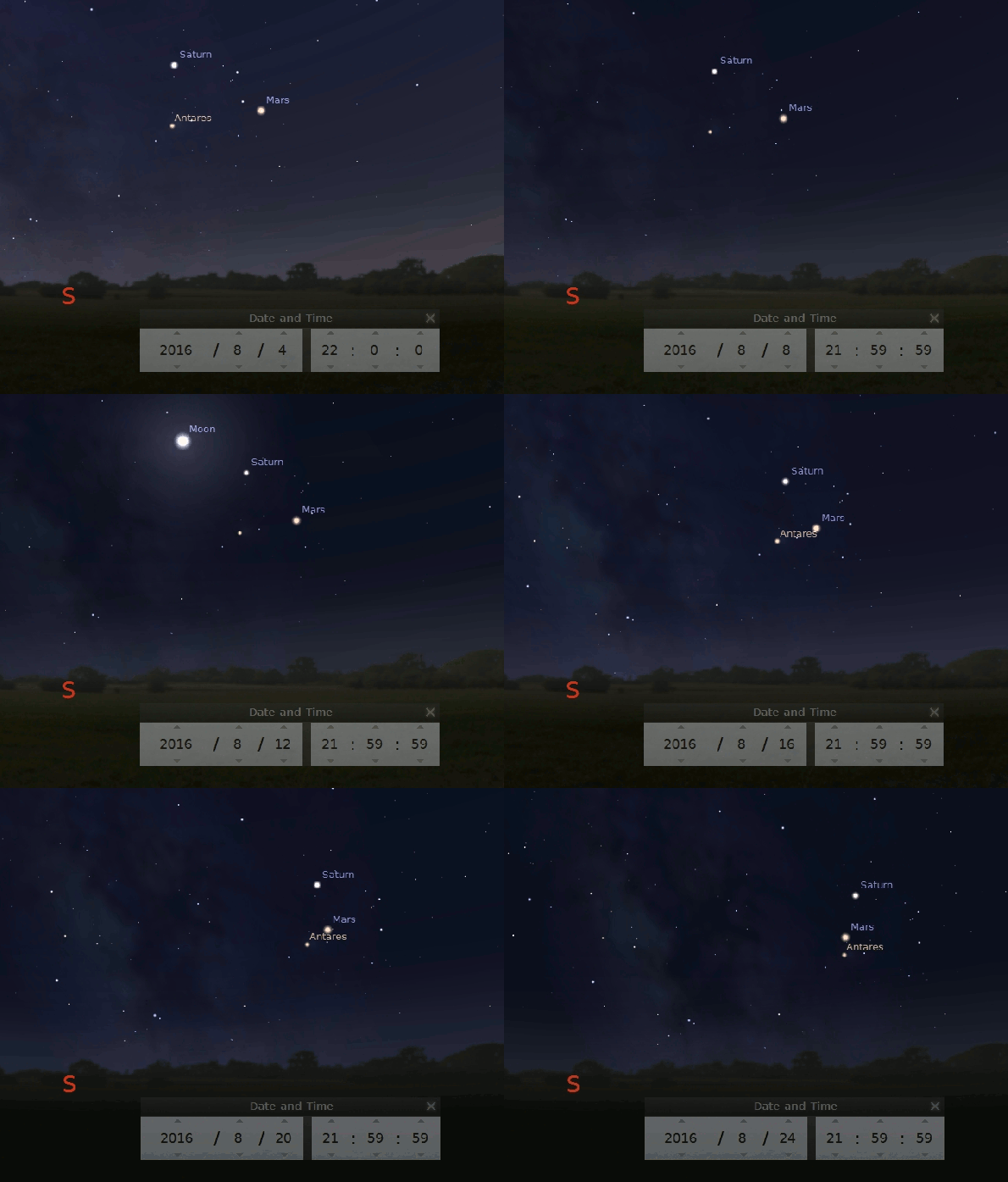
Animation of Mars approaching Antares from August 4 to the 24th, 2016 at 10 p.m. Created using Stellarium and GIMP.
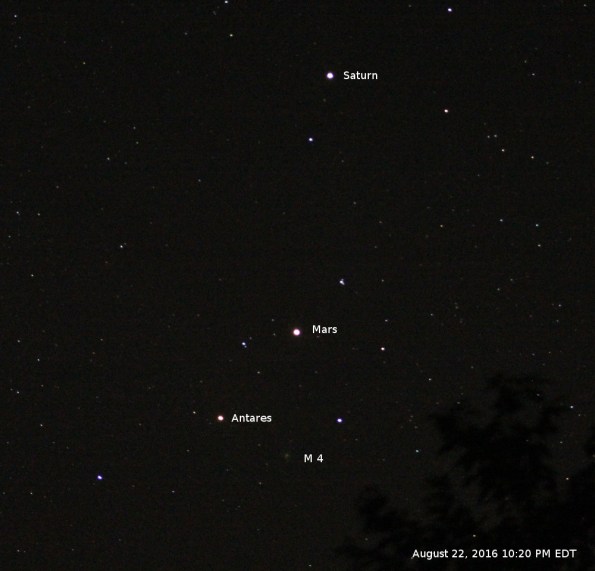
The lineup is forming. Saturn, Mars and Antares at 10:20 p.m., August 22, 2016. The globular cluster M 4 is also barely visible. Credit: Bob Moler.
75 mm focal length, 5 Seconds, F/4, ISO 6400
08/22/2016 – Ephemeris – The glorious summer Milky Way
Ephemeris for Monday, August 22nd. The Sun rises at 6:54. It’ll be up for 13 hours and 42 minutes, setting at 8:36. The Moon, 2 days before last quarter, will rise at 11:11 this evening.
We’ll get a bit of darkness tonight, but it will be the start of about two weeks of the best sky viewing of the year. Now is the time the summer Milky Way is displayed to its fullest to the southern horizon. City folk come to our area and are sometimes fooled by the brightness and expanse of the Milky Way and think it’s clouding up. Yes those are clouds indeed, but they are star clouds. Binoculars will begin to show them to be millions of stars, each too faint to be seen by themselves to the unaided eye, but whose combined glow give the impression of a luminous cloud. Binoculars are the ideal tool to begin to explore the Milky Way. Objects still too fuzzy can be checked out with a telescope to reveal their true nature.
Times are for the Traverse City/Interlochen area of Michigan. They may be different for your location.
Addendum
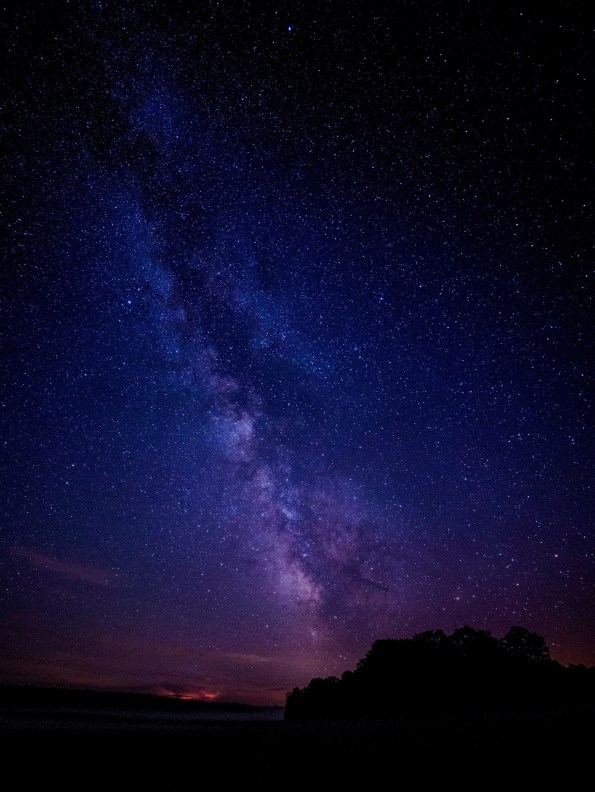
The Milky Way from the Sleeping Bear Dunes last August by Mark Stewart.
Note that this photo shows the Milky Way as brighter and with more stars than you’d see with the naked eye.
08/19/2016 – Ephemeris – Two astronomy outreach events tonight and tomorrrow
Friday, August 19th. The Sun rises at 6:50. It’ll be up for 13 hours and 50 minutes, setting at 8:41. The Moon, 1 day past full, will rise at 9:29 this evening.
August is a busy month for the Grand Traverse Astronomical Society with events every weekend. Tonight the society members will bring their telescopes to downtown Traverse City and Friday Night Live, staying after to view the planets Saturn and Mars if it’s clear. Saturn’s rings are, of course , spectacular. Tomorrow night society members will be at the Kingsley Library for a twilight talk beginning at 8 p.m. followed by a star party in their parking lot. The twilight talk will introduce the telescope that’s being donated to the library by the society. The telescope is a small, simple to use table top model with a four and a half-inch aperture, great for viewing the Moon, bright planets and the wonders of the deep sky.
Times are for the Traverse City/Interlochen area of Michigan. They may be different for your location.
Addendum

Viewing the Sun with a while light filter at Friday Night Live using Ron Uthe’s telescope at Friday Night Live. Credit Bob Moler
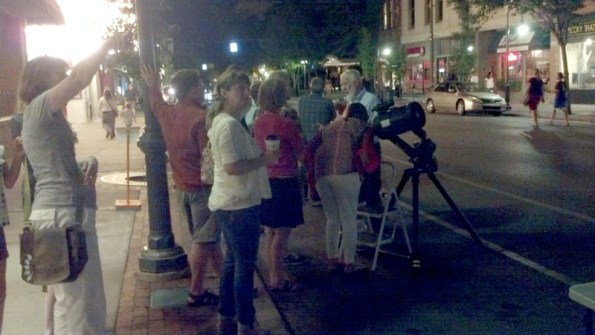
Ron Uthe (with the beard) explains that his telescope is pointed to Saturn in the 2013 Friday Night Live. Credit mine.
08/18/2016 – Ephemeris – Viewing the full Moon tonight
Ephemeris for Thursday, August 18th. The Sun rises at 6:49. It’ll be up for 13 hours and 53 minutes, setting at 8:42. The Moon, at full today, will rise at 8:54 this evening.
The full moon, contrary to what you’d think is a poor time to observe it. The moon is essentially gray on gray. And at full moon we are looking at the moon from about the same perspective as the sun, so there are no shadows to delineate its fine features. Since the actual instant of full moon occurred at 5:27 this morning, some shadows will be creeping in on the moon’s upper right face as it is seen in the evening. Full moon is the best time to see the maria or lunar seas, the dark areas that make up the man in the moon. In binoculars can be seen the bright rays* emanating from the crater Tycho near the south end of the moon. Other craters have rays too, but none so long and distinctive. Night by night for the next two weeks the moon’s illuminated landscape will wane.
Times are for the Traverse City/Interlochen area of Michigan. They may be different for your location.
* Rays are caused by the ejecta from the impact that created the crater. They are thought to be small craters themselves which show up best at full moon because they have no shadows in them.
Addendum
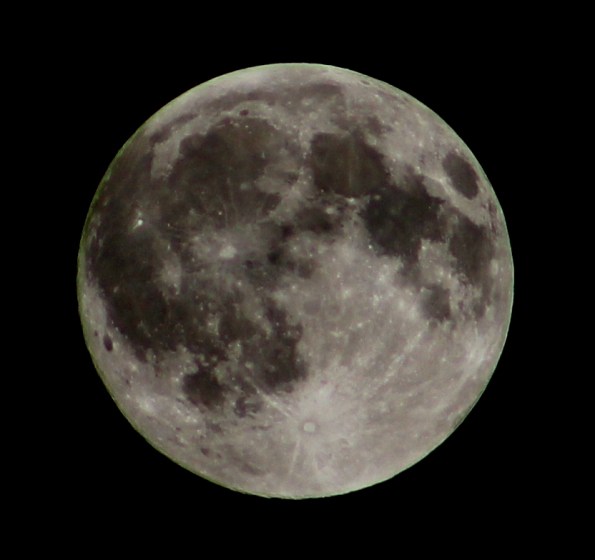
The full Moon taken last night, 7 hours before to was officially full. The contrast was greatly enhanced to bring out Tycho’s ray system. Credit Bob Moler.
08/17/2016 – Ephemeris – Two groups of evening planets are visible
Ephemeris for Wednesday, August 17th. The Sun rises at 6:48. It’ll be up for 13 hours and 56 minutes, setting at 8:44. The Moon, 1 day before full, will set at 7:01 tomorrow morning.
Tonight we still have all the bright classical planets in the evening sky. Mercury, Venus and Jupiter are very low in the west and will set at 9:32, 9:34 and 9:51 p.m. respectively. Jupiter is above Mercury with Venus to the right or Mercury in the evening twilight. Mars, Saturn and the star Antares start the evening in the south-southwestern sky as a tightening triangle, moving to the southwest during the evening. Antares, whose name means Rival of Mars is below Saturn with brighter Mars to the right and closing in on Antares. In 6 days Mars will pass just above Antares with Saturn above all in a nearly straight line. Mars, moving rapidly to the east against the stars will set at 12:30 a.m. Saturn, is spectacular in telescopes, with its rings. It will set at 1:06 a.m.
Times are for the Traverse City/Interlochen area of Michigan. They may be different for your location.
Addendum
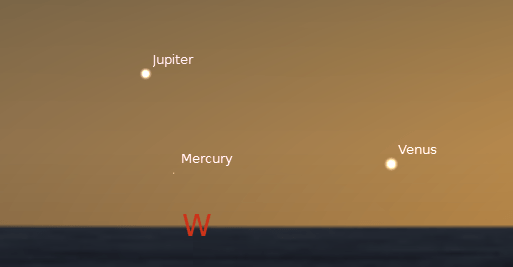
Venus, Mercury and Jupiter at 9:18 p.m. (30 minutes after sunset), August 17, 2016. Created using Stellarium.
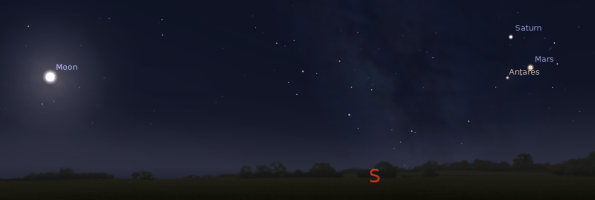
The planets, and Moon at 10 p.m., August 17, 2016. Created using Stellarium.
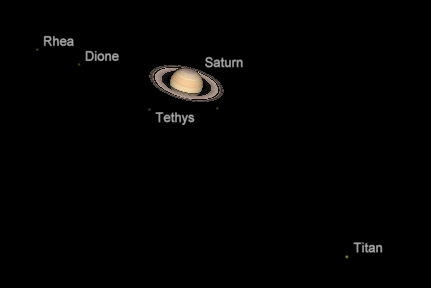
Saturn and some of its moons at 10 p.m. August 17, 2016. Created using Cartes du Ciel (Sky Charts).
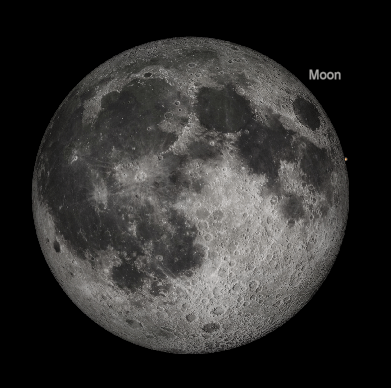
The Moon as it might appear in binoculars tonight, August 17, 2016 at 10 p.m. Tonight the Moon is only a bit more than 7 hours from being full. Created using Cartes du Ciel (Sky Charts).
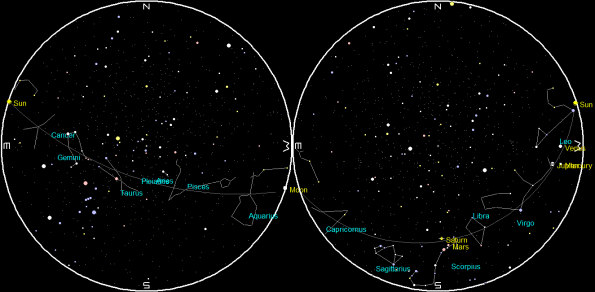
Planets at sunset and sunrise of a single night starting with sunset on the right on August 17, 2016. The night ends on the left with sunrise on August 18. Actually all the naked eye planets are in the evening sky. If you are using Firefox right-click on the image and select View Image to enlarge the image. That goes for all the large images. Created using my LookingUp program.
08/16/2016 – Ephemeris – Does Proxima Centauri have a planet? Also some information for southern observers about Mercury
Ephemeris for Tuesday, August 16th. The Sun rises at 6:46. It’ll be up for 13 hours and 59 minutes, setting at 8:46. The Moon, 2 days before full, will set at 5:53 tomorrow morning.
Proxima Centauri is the closest star to our solar system. It is a red dwarf star, and a distant third member of the Alpha Centauri star system. Recently the German weekly Der Spiegel announced that astronomers at the La Silla Observatory in Chile have detected a possible Earth-like planet at a distance that water may be liquid on its surface around this tiny star. Other than this one leak, no one is talking, and the European Southern Observatory is mum on the subject. There may be some kind of announcement at the end of the month. If true, this means that the closest earth-like planet orbits the closest star, only four and a quarter light years away. That’s nearly 25 trillion miles, and hundreds of years travel time with our current technology.
Times are for the Traverse City/Interlochen area of Michigan. They may be different for your location.
Addendum
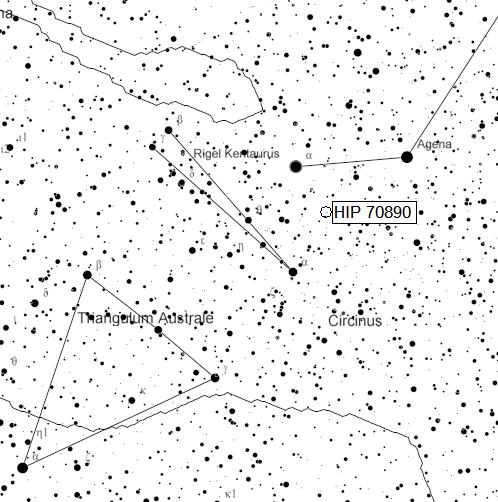
Chart showing the location of Proxima Centauri, labeled here HIP 70890. Alpha Centauri is labeled Rigel Kentaurus. Alpha Centauri is actually a catalog name in the style of Johann Bayer’s 1603 star atlas. Note also the alpha (α) Greek letter next to the star. Created using Cartes du Ciel (Sky Charts).
Note also the star labeled Agena. That is the more distant Beta (β) Centauri also known as Hadar.
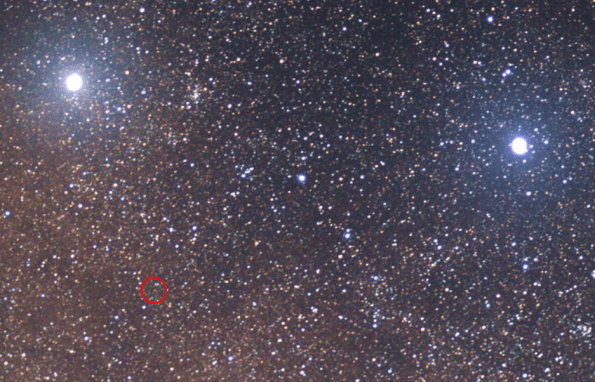
A section of a photograph of part of the field of view of the chart above. Credit: Wikipedia user Skatebiker.
Extra
For our southern observers: Today Mercury reaches its greatest eastern elongation of 27 degrees. So it’s visible in the west with Venus and Jupiter.
07/15/2016 – Ephemeris – The end is near for ESA’s Rosetta spacecraft
Ephemeris for Monday, August 15th. The Sun rises at 6:45. It’ll be up for 14 hours and 1 minute, setting at 8:47. The Moon, 3 days before full, will set at 4:49 tomorrow morning.
In a month and a half the European Space Agency’s Rosetta spacecraft will end its mission to comet 67/P Churyumov-Gerasimenko or just 67/P for short. The end will come as the Rosetta spacecraft will make a slow crash onto the comet. A week ago the spacecraft shut down its link to the Philae lander, which itself didn’t stick its landing and bounced three times and found itself between ice and a hard place with no way for the Sun to reach it to recharge its batteries, and so had an abbreviated science mission before the batteries failed. The comet was closest to the Sun a year ago, and is heading back out to near the orbit of Jupiter. Last time it was out this far Rosetta had just been woken up out of a three-year slumber. This time though it will sleep forever after a job well done.
Times are for the Traverse City/Interlochen area of Michigan. They may be different for your location.
Addendum
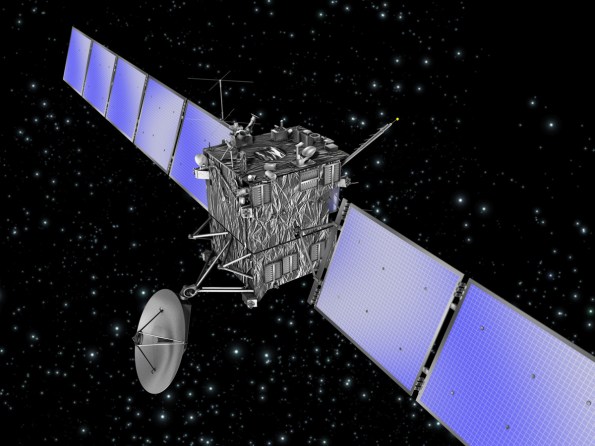
An artist’s illustration of the European Space Agency’s comet-chasing Rosetta spacecraft. Credit: ESA – C. Carreau
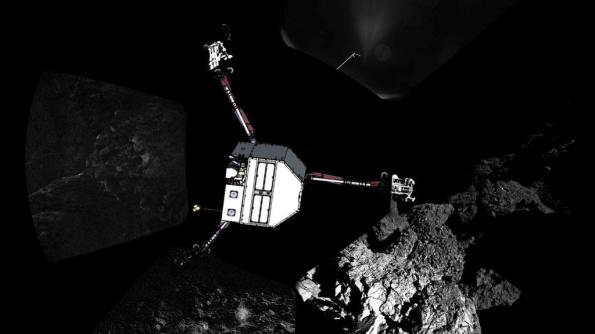
An image of the Philae lander superimposed on its panorama photographs where it was wedged between ice and a hard place in the shadows November 2014. Credit: ESA/Rosetta.
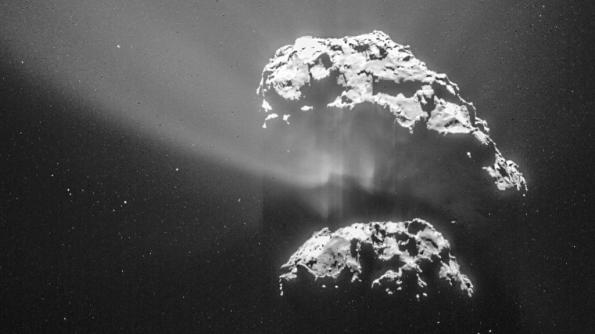
Comet 67P and jets of dust, carried by sublimating ices. Credit: ESA/Rosetta
08/12/2016 – Ephemeris – Two events this weekend
Ephemeris for Friday, August 12th. The Sun rises at 6:42. It’ll be up for 14 hours and 10 minutes, setting at 8:52. The Moon, 2 days past first quarter, will set at 2:12 tomorrow morning.
Tomorrow the Grand Traverse Astronomical Society will close out the Port Oneida Fair which is held by and at the Sleeping Bear Dunes National Lakeshore. It will be held at the Thoreson Farm on South Thoreson Road off M22, just west of Port Oneida road. From 4 to 6 p.m. there will be observation of the Sun through white-light filtered telescopes and a hydrogen-alpha filtered solar telescope. Then from 9 to 11 p.m. there will be viewing of the Moon and the bright planets including Mars and Saturn, and depending on sky condition, Jupiter, Venus and Mercury. There may be a few bright stragglers of the Perseid Meteor Shower to be seen. All this requires clear skies, so if in doubt check with the park at 231-326-4700, ext. 5005 for a voicemail message.
Times are for the Traverse City/Interlochen area of Michigan. They may be different for your location.
Addendum
Also tonight if weather permits the Grand Traverse Astronomical Society will participate in Friday Night Live on Front Street in downtown Traverse City. The society will be in its usual spot, in front of Orvis Streamside, a few stores west of the State Theater. The event will be from 5:30 to 9 p.m. where we will have exhibits and solar viewing if it’s clear. Telescopes will be available for viewing the Moon and Saturn after 9 p.m. if skies permit.

Star Party at the Sleeping Bear Dunes National Lakeshore, Thoreson Farm August 2013. Credit Eileen Carlisle.
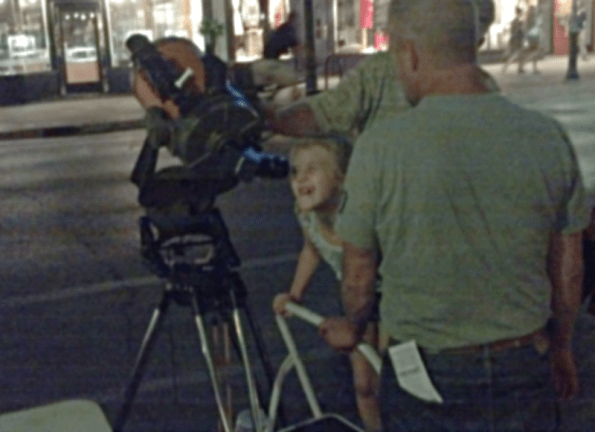
Looking at the Moon. Friday Night Live after hours.
08/11/2016 – Ephemeris – The Perseid meteors will peak tonight!
Ephemeris for Thursday, August 11th. The Sun rises at 6:41. It’ll be up for 14 hours and 12 minutes, setting at 8:53. The Moon, 1 day past first quarter, will set at 1:31 tomorrow morning.
This evening and tomorrow morning we should see the peak of the Perseid Meteor Shower. There is the expected broad peak of the shower which for us is after sunrise. However the meteoroid stream isn’t monolithic. Each pass of the comet in the inner solar system superimposes its debris on the general stream, so we will have increased activity all night tonight and even into Saturday morning. In general Perseid meteors will be seen to come from the northeast. The evening view will be hampered by the Moon which will drown out the dimmer meteors. The best time to view is after the Moon sets at 1:31 tomorrow morning until morning twilight becomes noticeable around 5 a.m. when over 100 meteors might be spotted an hour.
Times are for the Traverse City/Interlochen area of Michigan. They may be different for your location.
Addendum
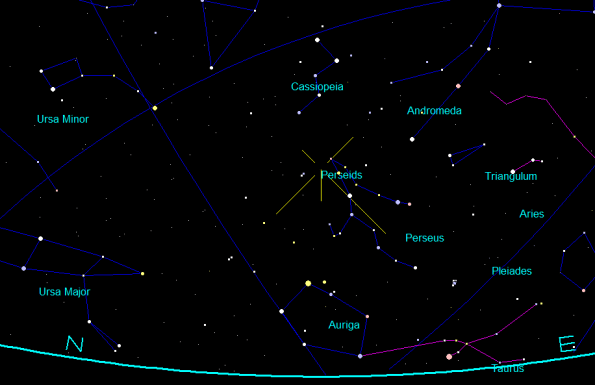
The Perseid meteor shower radiant a about 2 a,m, during the period of the shower. Created using my LookingUp program.
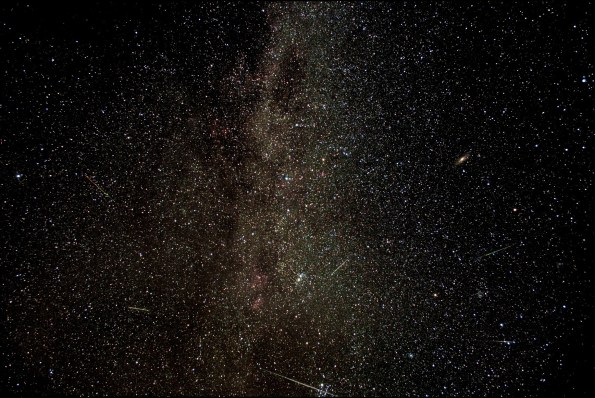
Here are some meteors seen in the 2007 Perseid meteor shower taken by Scott Anttila. The image is centered on Cassiopeia. The radiant is low and a bit left of center in the image. The Double Cluster is seen below center and the Great Andromeda Galaxy is seen on the right just above center.
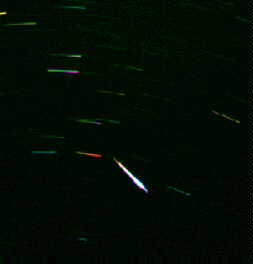
My best Perseid photo. From the 70’s.

