Archive
09/07/2016 – Ephemeris – Then there was one in the west and two in the southwest
Ephemeris for Wednesday, September 7th. The Sun will rise at 7:12. It’ll be up for 12 hours and 54 minutes, setting at 8:07. The Moon, 2 days before first quarter, will set at 11:29 this evening.
Tonight we still have all the bright classical planets in the evening sky, barely. Venus, Mercury, Jupiter are very low in the west, but only Venus is briefly visible after sunset. It will set at 9:03 p.m. Later this month Mercury and Jupiter will pass the Sun to become visible in the morning sky. Venus alone will remain in the evening sky, slowly pulling away from the Sun. Mars, Saturn and the star Antares start the evening in the southwestern sky in a triangle, with Saturn on top, Mars below and to the left, and Antares below and right of Mars. Saturn, spectacular in telescopes with its rings, will set at 11:45 p.m. And Mars, moving rapidly to the east against the stars will set at 11:50 p.m.
Times are for the Traverse City/Interlochen area of Michigan. They may be different for your location.
Addendum
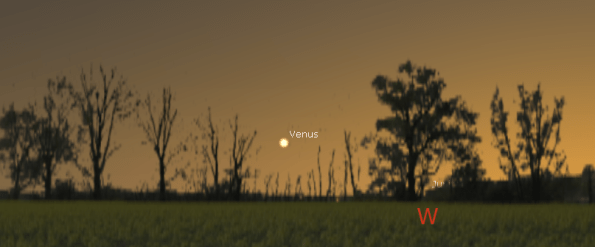
Looking very low in the west at 8:30 p.m., 20 minutes after sunset, September 7, 2016. Created using Stellarium.
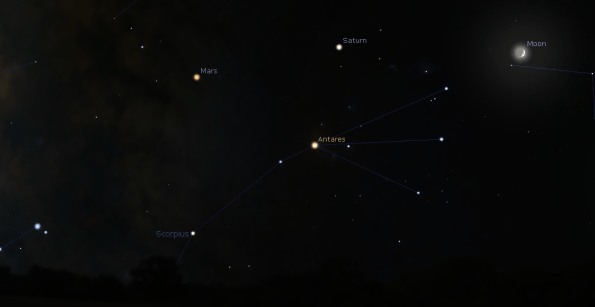
The Moon and the Mars-Saturn-Antares triangle at 9:30 p.m., September 7, 2016. Created using Stellarium.
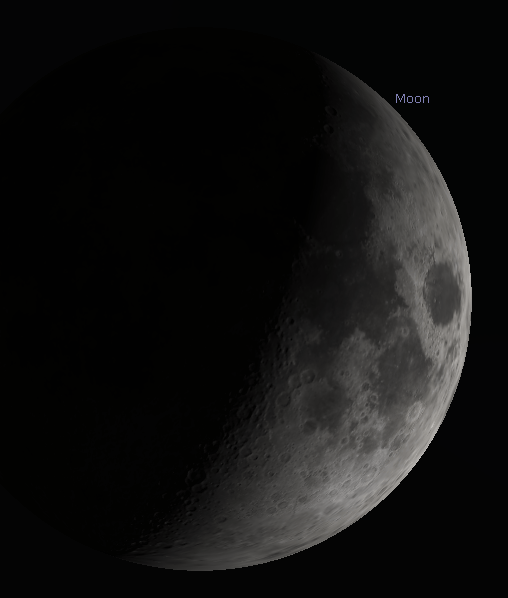
The Moon tonight as it might be seen in binoculars at 9:30 p.m. September 7, 2016. Created using Stellarium.
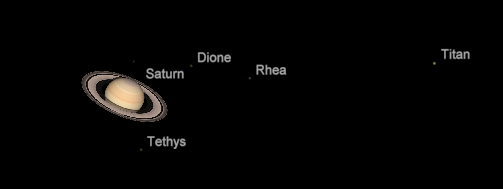
Saturn and some of its moons at 9:30 p.m. September 7, 2016. Created using Cartes du Ciel (Sky Charts).
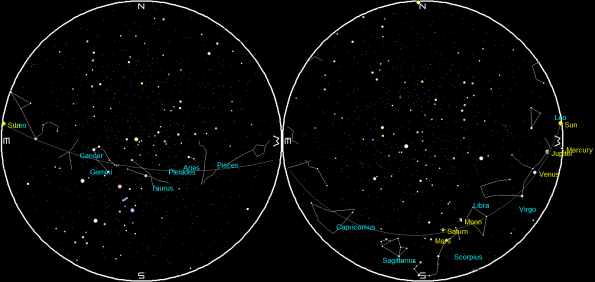
Planets and Moon at sunset and sunrise of a single night starting with sunset on the right on September 7, 2016. The night ends on the left with sunrise on September 8. Actually all the naked eye planets are in the evening sky. If you are using Firefox right-click on the image and select View Image to enlarge the image. That goes for all the large images. Created using my LookingUp program.
09/06/2016 – Ephemeris – The prominent lunar crater Theophilus
Ephemeris for Tuesday, September 6th. The Sun will rise at 7:11. It’ll be up for 12 hours and 57 minutes, setting at 8:09. The Moon, 3 days before first quarter, will set at 10:55 this evening.
The Moon’s terminator, the sunrise line, is half-way across the Sea of Tranquility on our satellite’s equator. Below that is a distinctive crater just coming into light. It’s prominent enough to spot in binoculars. It’s name is Theophilus. The name is familiar with those familiar with the New Testament of the Bible, as the person that the Gospel of Luke and Acts of the Apostles is addressed to. However that isn’t who the crater is named for, but for the Patriarch of Alexandria of the late 4th century. The two other large craters south of Theophilus that will be visible tomorrow are named for two other Orthodox saints of Alexandria. They were named by Giovanni Riccioli a 17th century astronomer and priest, who named many other craters.
Times are for the Traverse City/Interlochen area of Michigan. They may be different for your location.
Addendum
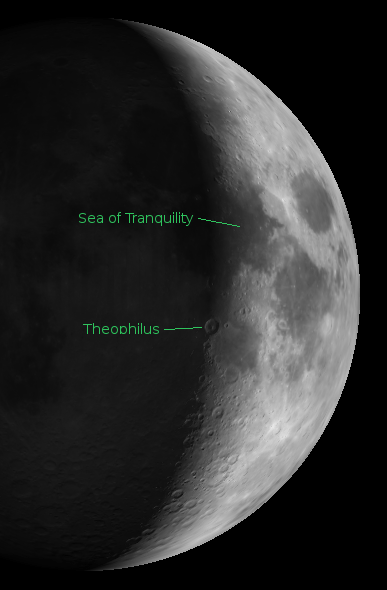
The Moon at 9 p.m. September 6, 2016 showing the crater Theophilus. Created using the Virtual Moon Atlas.
When Theophilus is on the terminator as it is tonight the Sun may touch the crater rim and the central peaks, while the crater floor is still in shadow. It’s a cool sight.
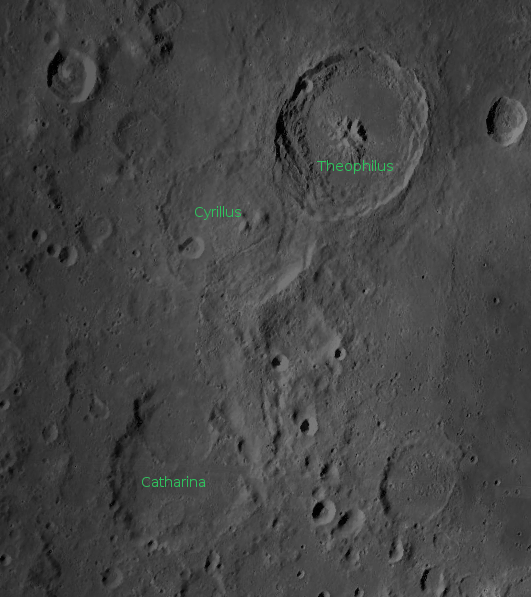
Three Alexandrian saints, Theophilus, Cyrillus, and Catharina (St Catherine) immortalized on the Moon. Created using the Lunar Reconnaissance Orbiter texture on the Virtual Moon Atlas.
Note that Cyrillus has very low crater walls and is hard to see unless the sun angle is low near lunar sunrise of sunset.
09/05/2016 – Ephemeris – Anticipating summer’s end
Ephemeris for Labor Day, Monday, September 5th. The Sun will rise at 7:10. It’ll be up for 13 hours and 0 minutes, setting at 8:11. The Moon, half way from new to first quarter, will set at 10:24 this evening.
Even though we have 17 more days officially, of summer, according to the actual seasons, today seems like it, the end of summer. Summer seems to be defined or confined to between the time that the kids get out of school, to Labor Day, after which the kids go back to school. Schools in other locales have been back for almost two weeks now. As far as the summer sky goes, the summer Milky Way will stick around until October, until we lose the Teapot of Sagittarius over the southwestern horizon. The Summer Triangle of bright summer stars, won’t leave the sky until December, as they move ever westward. However in the east the autumn stars are even now rising, pushing the Milky Way to the west.
Times are for the Traverse City/Interlochen area of Michigan. They may be different for your location.
Addendum
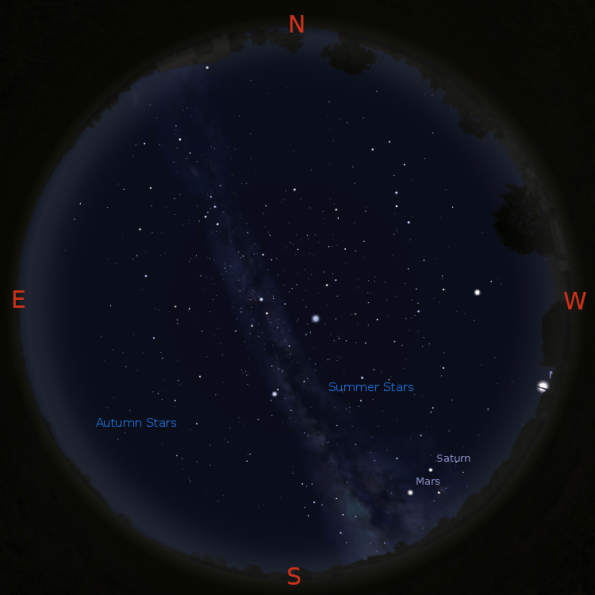
The transitional skies of 10 p.m. tonight 9/5/2016. Created using Stellarium.
08/02/2016 – Ephemeris – Two events for the Grand Traverse Astronomical Society this weekend
Ephemeris for Friday, September 2nd. The Sun will rise at 7:06. It’ll be up for 13 hours and 9 minutes, setting at 8:16. The Moon, 1 day past new, will set at 9:00 this evening.
This is another busy weekend for the Grand Traverse Astronomical Society. Tonight there will be a general meeting of the society at 8 p.m. followed by a star party at 9 p.m. at Northwestern Michigan College’s Rogers Observatory, located on Birmley Road south of Traverse City, to which all are welcome. The featured speaker for the meeting will be Dr. David Penney who will talk about Late Pleistocene Fauna and Extinction and its possible astronomical cause. Saturday there will be a star party at Sleeping Bear Dunes National Lakeshore’s Dune Climb starting at 9 p.m. Both star parties will feature the star clusters and nebulae found in the Milky Way, and views of Saturn and Mars. The dunes are the darkest spot around.
Times are for the Traverse City/Interlochen area of Michigan. They may be different for your location.
09/01/2016 – Ephemeris – Previewing the pivotal month of September’s skies
Ephemeris for Thursday, September 1st. The Sun will rise at 7:05. It’ll be up for 13 hours and 12 minutes, setting at 8:18. The Moon is new today, and won’t be visible.
There’s an eclipse of the Sun in progress now for parts of the southern hemisphere centered on southern Africa. Today is also has the first of two new Moons this month, the second being called the Black Moon. Let’s look at the skies for September. The sun is moving at its greatest speed in its retreat to the south. Daylight hours in the Interlochen/Traverse City area and will drop from 13 hours and 12 minutes today to 11 hours 44 minutes on the 30th. The altitude of the sun above the southern horizon at local noon will be 54 degrees today, and will descend to 42 degrees on the 30th. The official season of summer is getting short too, so enjoy it while you can. Summer ends and autumn begins at 10:21 a.m. on September 22nd.
Times are for the Traverse City/Interlochen area of Michigan. They may be different for your location.
Addendum
September Star Chart
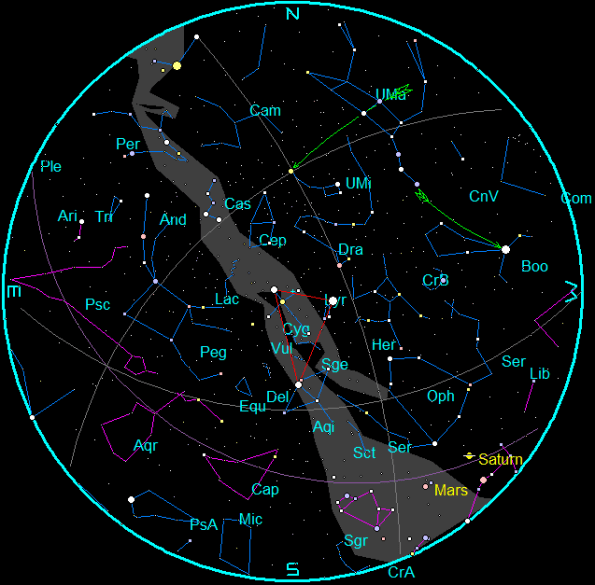
Star Chart for September 2016. Created using my LookingUp program. To enlarge in Firefox right-click on image then click View image.
The planets and stars are plotted for the 15th at 10 p.m. EDT. That is chart time. Note, Traverse City is located approximately 45 minutes behind our time meridian. (An hour 45 minutes behind our daylight saving time meridian.) To duplicate the star positions on a planisphere you may have to set it to 1:45 earlier than the current time if you are near your time meridian.
Evening nautical twilight ends at 9:24 p.m. EDT on the 1st, increasing to 8:27 p.m. EDT on the 30th.
Morning nautical twilight starts at 5:59 a.m. EDT on the 1st, and decreasing to 6:37 a.m. EDT on the 30th.
Add a half hour to the chart time every week before the 15th and subtract a half hour for every week after the 15th.
For a list of constellation names to go with the abbreviations click here.
- Pointer stars at the front of the bowl of the Big Dipper point to Polaris the North Star
- Follow the arc of the handle of the Big Dipper to the star Arcturus
- The Summer Triangle is outlined in red. Vega in Lyra (Lyr), Deneb in Cygnus (Cyg) and Altair in Aquila (Aql).
Calendar of Planetary Events
Credit: Sky Events Calendar by Fred Espenak and Sumit Dutta (NASA’s GSFC)
To generate your own calendar go to http://eclipse.gsfc.nasa.gov/SKYCAL/SKYCAL.html
Times are Eastern Time.
    Date    Time    Event
Sep 01  Th          Venus: 23.5° E
    01  Th  5:03 am New Moon
    01  Th  5:08 am Annular Solar Eclipse (Atlantic, Africa, Indian Ocean)
    01  Th 11:27 am Moon Ascending Node
    02  Fr 11:16 am Neptune Opposition
    03  Sa  6:33 am Moon-Venus: 1.2° S
    04  Su  8:03 pm Saturn-Antares: 6.1° N
    06  Tu  2:44 pm Moon Apogee: 405100 km
    08  Th  5:23 pm Moon-Saturn: 4.2° S
    09  Fr  7:49 am First Quarter
    10  Sa  6:05 am Moon South Dec.: 18.5° S
    12  Mo  7:38 am Mercury Inferior Solar Conjunction (Will enter the
                    morning sky)
    15  Th  7:55 pm Moon Descending Node
    16  Fr  2:56 pm Penumbral Lunar Eclipse (Not visible in MI)
    16  Fr  3:05 pm Full Harvest Moon
    18  Su 11:12 am Venus-Spica: 2.4° N
    18  Su  1:00 pm Moon Perigee: 361900 km
    21  We  6:13 pm Moon-Aldebaran: 0.2° S
    22  Th 10:21 am Autumnal Equinox (Summer ends and autumn starts)
    23  Fr  5:56 am Last Quarter
    23  Fr 12:44 pm Moon North Dec.: 18.5° N
    26  Mo  2:19 am Jupiter Solar Conjunction (Will enter the morning sky)
    27  Tu  6:32 pm Moon-Regulus: 1.8° N
    28  We  2:59 pm Mercury Greatest Elongation: 17.9° W
    28  We  6:06 pm Moon Ascending Node
    30  Fr  8:12 pm New Moon (Second new Moon this month)
Oct 01  Sa          Venus: 30.9° E
08/31/2016 – Ephemeris – Two of the evening planets are easily visible, the other three, not so much
Ephemeris for Wednesday, August 31st. The Sun will rise at 7:04. It’ll be up for 13 hours and 15 minutes, setting at 8:20. The Moon, 1 day before new, will rise at 7:17 tomorrow morning.
Tonight we still have all the bright classical planets in the evening sky, barely. Mercury, Jupiter and Venus are very low in the west and will set at 9:02, 9:05 and 9:13 p.m. respectively. They are all but invisible. Next month Mercury and Jupiter will pass the Sun to become visible in the morning sky. Venus alone will remain in the evening sky, slowly pulling away from the Sun. Mars, Saturn and the star Antares start the evening in the southwestern sky in a triangle, with Saturn on tip, Mars below and to the left, and Antares below and right of Mars. Mars, moving rapidly to the east against the stars will set at 12:15 a.m. Saturn, spectacular in telescopes with its rings, will set at 12:39 a.m.
Times are for the Traverse City/Interlochen area of Michigan. They may be different for your location.
Addendum
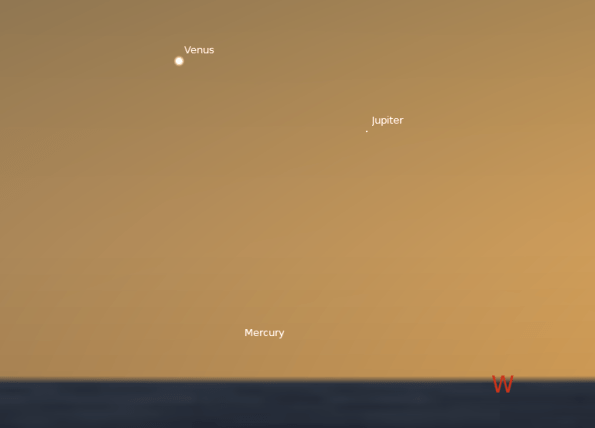
Looking very low in the west at 8:40 p.m., 20 minutes after sunset, August 31, 2016. Created using Stellarium.
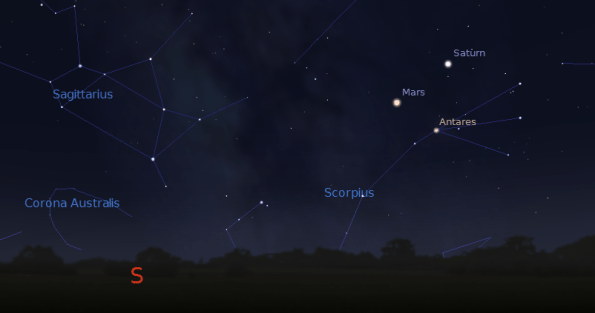
Mars-Saturn-Antares triangle at 9:30 p.m., August 31, 2016. Created using Stellarium.
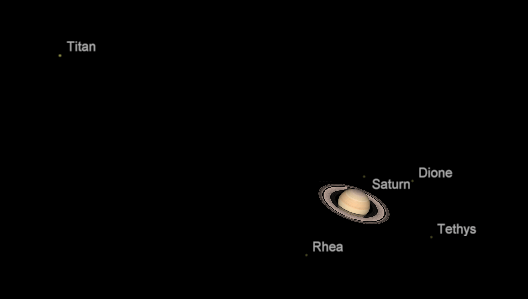
Saturn and some of its moons at 9:30 p.m. August 31, 2016. Created using Cartes du Ciel (Sky Charts).
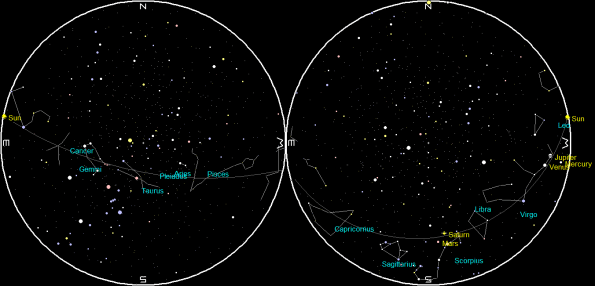
Planets at sunset and sunrise of a single night starting with sunset on the right on August 31, 2016. The night ends on the left with sunrise on September 1. Actually all the naked eye planets are in the evening sky. If you are using Firefox right-click on the image and select View Image to enlarge the image. That goes for all the large images. Created using my LookingUp program.
08/30/2016 – Ephemeris – One of the many wonders in the steam from the Teapot
Ephemeris for Tuesday, August 30th. The Sun will rise at 7:03. It’ll be up for 13 hours and 18 minutes, setting at 8:22. The Moon, 2 days before new, will rise at 6:14 tomorrow morning.
Yesterday I talked about the Teapot pattern of stars low in the south these evenings that’s better represented in the stars for us moderns than a centaur with a bow and arrow called Sagittarius. The teapot, spout to the right is appearing to begin to pour its contents on the southern horizon, with steam appearing above the spout. That steam is the Milky Way. In that steam, above the spout is a small horizontal line of light. Binoculars or a telescope will reveal a star cluster there and more haze. That haze is the Lagoon Nebula, also known to astronomers as M8, that spawned that star cluster. This is the brightest nebula of the summer sky, and is 5 to 6 thousand light years away, in the next spiral arm inward in our Milky Way galaxy.
Times are for the Traverse City/Interlochen area of Michigan. They may be different for your location.
Addendum
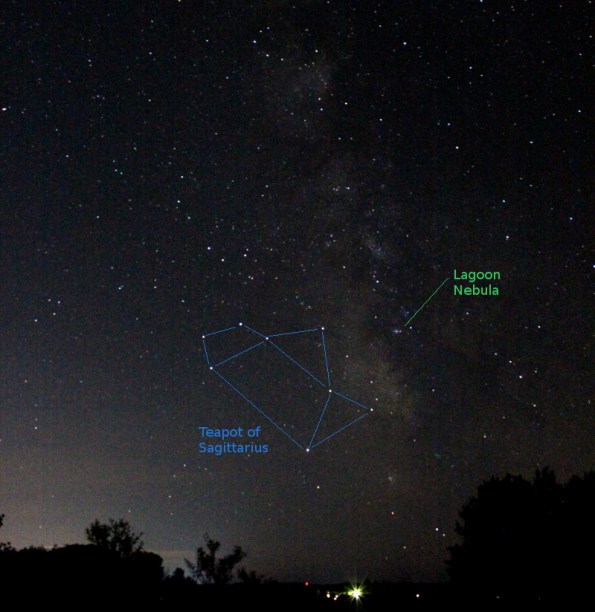
The Sagittarius Teapot showing the location of the Lagoon Nebula that is visible to the naked eye. Photo Credit Bob Moler.
Objects designated by the letter M are known as Messier objects, from a list made by Charles Messier who was an astronomer at the Paris Observatory at about the time of the American Revolution. Messier was interested in discovering comets, which when the first become visible are fuzzy blobs without tails. A comet makes itself known by moving against the stars. The objects on the list don’t move against the stars, being with the stars or beyond, which we call deep sky objects. So it’s a list of objects not to bother with, because they aren’t comets. Today we use his list or catalog of objects as some of the finest objects in the heavens.
08/29/2016 – Ephemeris – The celestial teapot
Ephemeris for Monday, August 29th. The Sun will rise at 7:02. It’ll be up for 13 hours and 21 minutes, setting at 8:23. The Moon, 3 days before new, will rise at 5:11 tomorrow morning.
If the ancient Greeks had teapots the constellation we call Sagittarius might have been Teapotius or something. It’s low in the south at 11 p.m. with the Milky Way rising like steam from its spout. Sagittarius is supposed to be a centaur with a bow and arrow. However to us the dearth of centaurs around outside of Harry Potter books, and there being lots of teapots around, and that great children’s song which perfectly describes the Sagittarius teapot. So the teapot is an asterism, like the Big Dipper, not one of the official constellations. A pair of binoculars is all you need to spot many fuzzy objects in and around Sagittarius. Pay special attention to that steam of the Milky way above the teapot’s spout for many fuzzy objects.
Times are for the Traverse City/Interlochen area of Michigan. They may be different for your location.
Addendum
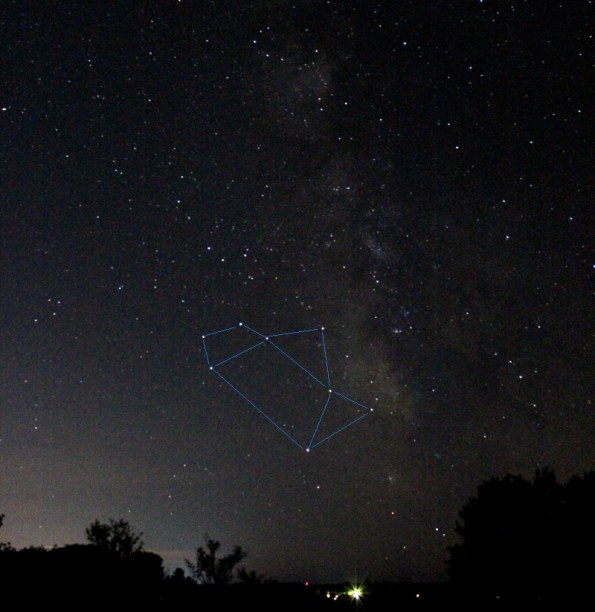
Sagittarius star field showing the Teapot. Credit Bob Moler.
08/26/2016 – Ephemeris – Friday Night Live tonight, Star Party tomorrow
Ephemeris for Friday, August 26th. The Sun rises at 6:58. It’ll be up for 13 hours and 30 minutes, setting at 8:29. The Moon, 2 days past last quarter, will rise at 2:10 tomorrow morning.
The Grand Traverse Astronomical Society finishes off August with another busy weekend. Tonight the society members will bring their telescopes to downtown Traverse City and Friday Night Live, staying after to view the planets Saturn and Mars if it’s clear. Saturn’s rings are, of course, spectacular. Tomorrow night society members will be at Northwestern Michigan College’s Rogers Observatory beginning at 9 p.m. for a star party viewing of the planets, especially Saturn. That later as it gets really dark, the summer Milky Way will appear with its great telescopic treasures. Tomorrow, right after sunset the planets Venus and Jupiter will appear very close together. Observers far south of us will have a better shot at it than we do.
Times are for the Traverse City/Interlochen area of Michigan. They may be different for your location.
Addendum
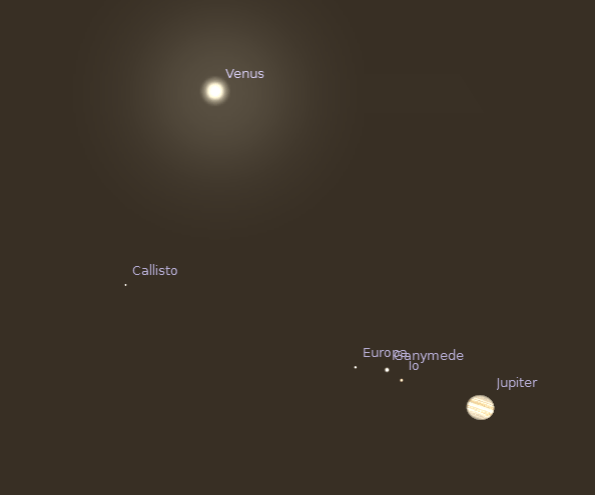
Venus near Jupiter at 9 p.m., or a half hour after sunset, August 27, 2016. I doubt if you could see the Jovian satellites against the bright twilight. It all but requires a big lake or ocean horizon, or a location far south of northern Michigan to raise these planets higher in the sky. Created using Stellarium.
08/25/2016 – Ephemeris – Sagittarius, a very strange archer
Ephemeris for Thursday, August 25th. The Sun rises at 6:57. It’ll be up for 13 hours and 33 minutes, setting at 8:31. The Moon, 1 day past last quarter, will rise at 1:18 tomorrow morning.
Low in the south at 11 p.m. lies the constellation of Sagittarius. The name means archer, but this isn’t just any old fellow with a bow and arrow. It’s a centaur with a bow and arrow. These half man half horse creatures were a rowdy bunch; kind of the ancient Greek counterpart of a motorcycle gang. The one exception is this centaur, Chiron by name. He was highly educated, and learned medicine from the great physician Aesculapius, whom we see in the sky to the upper right as the constellation Ophiuchus. His drawn bow and arrow can also be seen in the stars here, pointing to Scorpius the scorpion’s heart. If it’s hard seeing a Centaur here don’t be disappointed. To most of us the constellation looks like a stout little teapot.
Times are for the Traverse City/Interlochen area of Michigan. They may be different for your location.
Addendum
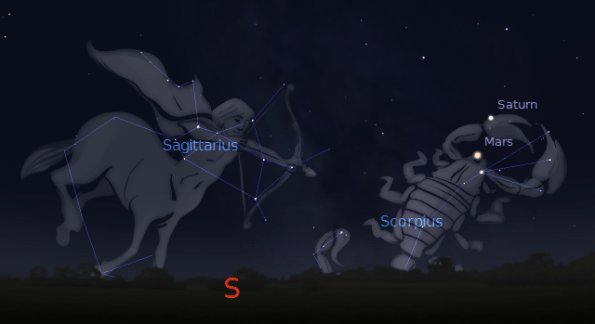
Sagittarius taking aim at Scorpius with Mars and Saturn at 10 p,m. August 25, 2016. Created using Stellarium.
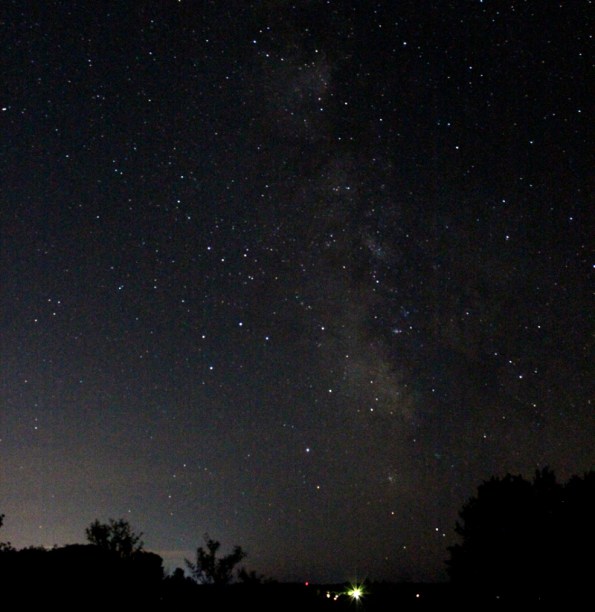
Actual Sagittarius star field where the Teapot is easily seen. Credit Bob Moler.
“I’m a little teapot short and stout…” Children’s song.

