Archive
07/12/2016 – Ephemeris – The Lanphier Observatory is open twice a week during the a summer
Ephemeris for Tuesday, July 12th. Today the Sun will be up for 15 hours and 18 minutes, setting at 9:27, and it will rise tomorrow at 6:10. The Moon, 1 day past first quarter, will set at 1:53 tomorrow morning.
There’s an observatory on the shores of Sleeping Bear Bay near Glen Arbor that is open to the public twice a week on clear nights. It’s the Leelanau School’s Lanphier Observatory, which is open Wednesday and Thursday evenings weather permitting from 10 p.m. to midnight until Labor Day. The Leelanau School is located at 1 Old Homestead Road, off M22. The Observatory is behind the Student Center and across the Crystal River. The observatory dome contains a 14 inch telescope on a computerized mount, and smaller telescopes may be available on the observatory deck. The observatory is run by Norm Wheeler, recently retired instructor. Get there early to enjoy the sunset on Lake Michigan.
Times are for the Traverse City/Interlochen area of Michigan. They may be different for your location.
Addendum

The Lanphier Observatory. From the Leelanau School website.

The dome interior with the 14 inch telescope and the computerized mount. From the Leelanau School website.
07/11/2016 – Ephemeris – Checking out a crack on the Moon
Ephemeris for Monday, July 11th. Today the Sun will be up for 15 hours and 19 minutes, setting at 9:27, and it will rise tomorrow at 6:09. The Moon, at first quarter today, will set at 1:24 tomorrow morning.
Mostly when discussing the features visible on the Moon, I talk about craters. This feature, visible close to the terminator, the sunrise line on the moon is a rille or what appears as a long meandering groove. It’s called the Hyginus Rille, a 133 mile (220 km) long, 2 mile (4 km) wide groove with a small crater near the center named Hyginus. The crater doesn’t look like a normal collision caused crater. It has no raised crater walls. The best guess as to what the Hyginus Rille is a collapsed lava tube. Parts of the lava tube may be intact as the groove devolves into a line of craters. Lava tubes may be used as lunar bases since they can serve as protection from meteoroids, radiation and temperature swings of the lunar day/night cycle.
Times are for the Traverse City/Interlochen area of Michigan. They may be different for your location.
Addendum
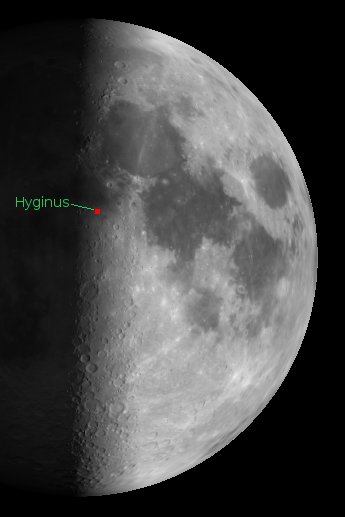
The Moon at 10:30 p.m. July 11, 2016 with the location of the Hyginus Rille located. Created using the Virtual Moon Atlas.
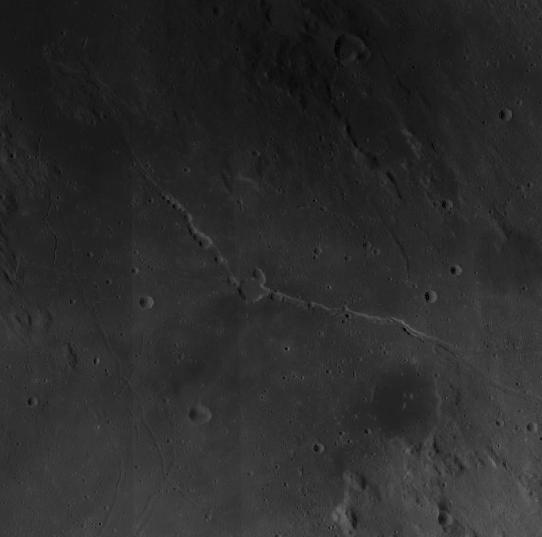
Closeup of the Hyginus Rille using the Lunar Reconnaissance Orbiter texture on the Virtual Moon Atlas.
07/08/2016 – Ephemeris – Star party tomorrow night
Ephemeris for Friday, July 8th. Today the Sun will be up for 15 hours and 23 minutes, setting at 9:29, and it will rise tomorrow at 6:06. The Moon, 3 days before first quarter, will set at 12:01 tomorrow morning.
Last Friday there was a wonderful star party at the Northwestern Michigan College’s Rogers Observatory. Tomorrow night starting at 9 p.m. the Grand Traverse Astronomical Society and the NMC Astronomy Club will strive for a repeat, featuring Jupiter, Mars and Saturn however this time adding the fat crescent Moon. Toward the end of the evening as darkness finally falls the telescopes will also seek out the brighter deep sky wonders among the stars. The observatory is located south of Traverse City, on Birmley Road. To keep up with all the astronomical events hosted by the Grand Traverse group and the Sleeping Bear Dunes National Lakeshore check out gtastro.org on the Internet.
Times are for the Traverse City/Interlochen area of Michigan. They may be different for your location.
07/07/2016 – Ephemeris – The snake handler in the sky
Ephemeris for Thursday, July 7th. Today the Sun will be up for 15 hours and 24 minutes, setting at 9:30, and it will rise tomorrow at 6:06. The Moon, 3 days past new, will set at 11:31 this evening.
Saturn and the red star Antares shine in the south at 11 p.m. In the area of sky above it lies a large constellation of faint stars called Ophiuchus, the serpent bearer. Ophiuchus represent the legendary physician Aesculapius. The constellation shape is like a large bell, which reminds me of the head, shoulders and arms of a fellow that’s holding the snake-like a weight lifter struggling to pull up a heavy barbell. Serpens, the constellation of the serpent is in the sky in two sections. The front end lies to the right as Serpens Caput, and wends its way up towards Corona Borealis, the Northern Crown. Serpens Cauda, the tail rises to the left of Ophiuchus. It’s a rewarding sight, and not that hard to spot.
Times are for the Traverse City/Interlochen area of Michigan. They may be different for your location.
Addendum
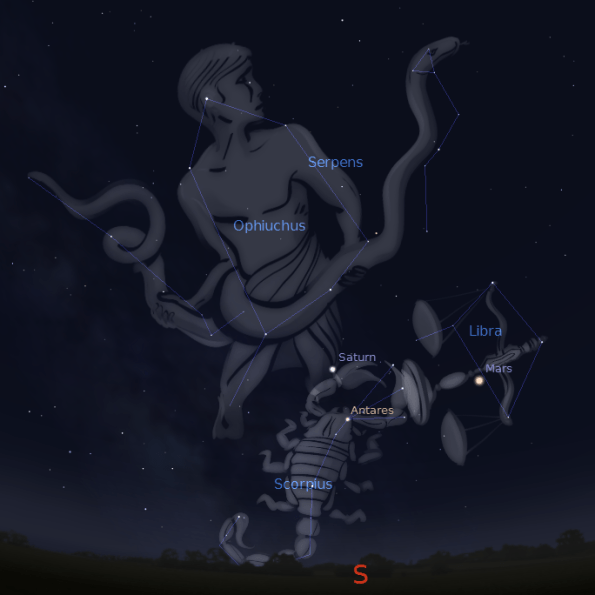
The figure of Ophiuchus with Saturn and Mars nearby at 11 p.m. July 7, 2016. Created using Stellarium.
07/06/2016 – Ephemeris – The three bright evening planets are heading westward
Jul 6. This is Bob Moler with Ephemeris for Wednesday, July 6th. Today the Sun will be up for 15 hours and 25 minutes, setting at 9:30, and it will rise tomorrow at 6:05. The Moon, 2 days past new, will set at 10:56 this evening.
Let’s see what the bright naked eye planets are up to. Jupiter is in the west in the evening. It will set at 12:24 a.m. It’s below the stars of Leo this year. Binoculars can make out some of Jupiter’s moons, but a telescope is required to see all four bright moons and Jupiter’s cloud features. Mars starts the evening in the southern sky. It’s above and right of its dimmer look-a-like star Antares, whose name means Rival of Mars. Mars will move due south at 10:01 p.m. and will set at 2:34 a.m. The Earth is pulling ahead of Mars so it’s now 55 million miles away and very small in telescopes. Saturn is low in the south-southeast. It’s left of Mars. Saturn will pass due south at 11:19 p.m. and will set at 3:56 a.m. It’s a wonderful telescopic sight.
Times are for the Traverse City/Interlochen area of Michigan. They may be different for your location.
Addendum
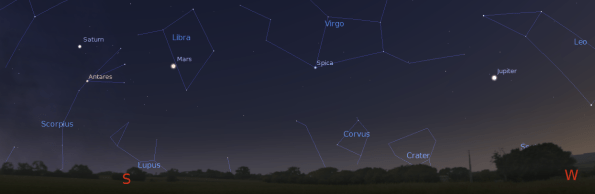
The evening planets and constellations at 10:30 p.m., July 6, 2016. Created using Stellarium.
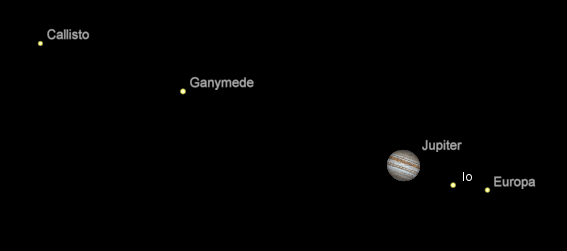
Jupiter and its Galilean moons at 10:30 p.m. July 6, 2016. Jupiter’s apparent diameter will be 33.8″. Created using Cartes du Ciel (Sky Charts).
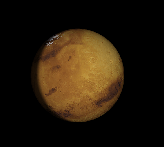
Mars as it might be seen in a large telescope with high power at 10:30 p.m. July 6, 2016. Mars apparent diameter is 15.7″. The central meridian will be 162.44 degrees. Created using Cartes du Ciel (Sky Charts).
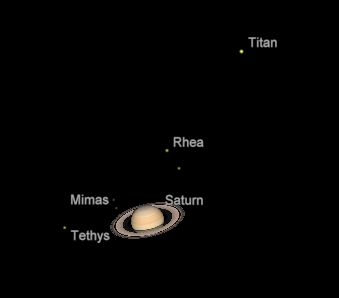
Saturn and its moons at 10:30 p.m. July 6, 2016. The apparent diameter of the planet will be 18.1″, larger than Mars’ disk. The rings span 42.2″, larger than the apparent diameter of Jupiter. Created using Cartes du Ciel (Sky Charts).
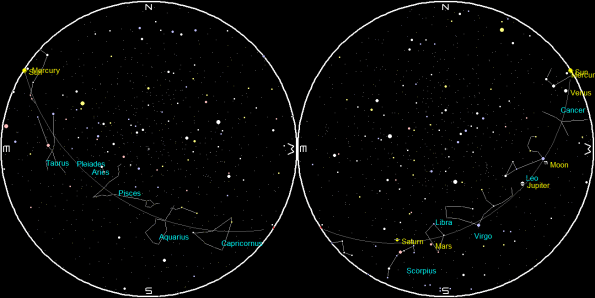
Planets at sunset and sunrise of a single night starting with sunset on the right on July 6, 2016. The night ends on the left with sunrise on July 7. If you are using Firefox right-click on the image and select View Image to enlarge the image. That goes for all the large images.
07/05/2016 – Ephemeris – Poor Hercules
Ephemeris for Tuesday, July 5th. Today the Sun will be up for 15 hours and 26 minutes, setting at 9:30, and it will rise tomorrow at 6:04. The Moon, 1 day past new, will set at 10:17 this evening.
Orion, an obscure Greek hero gets a splashy constellation in the winter sky, but the greatest hero of all, Hercules, gets a dim group of stars on the border between the spring and summer stars. At 11 p.m. Hercules is high and nearly overhead. It’s located above and right of the bright star, Vega, high in the east. Hercules’ central feature is a keystone shaped box of stars, called the Keystone, which represents the old boy’s shorts. From each top corner extend lines of stars that are his legs, from the bottom stars, the rest of his torso and arms extend. So in one final indignity he’s upside down in our sky. Some see him crouched down, club upraised holding the multi-headed Hydra about to throttle it.
Times are for the Traverse City/Interlochen area of Michigan. They may be different for your location.
Addendum
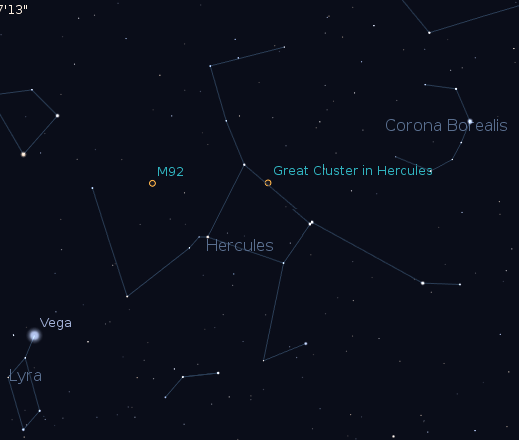
The constellation Hercules and his neighbors. Created with Stellarium.
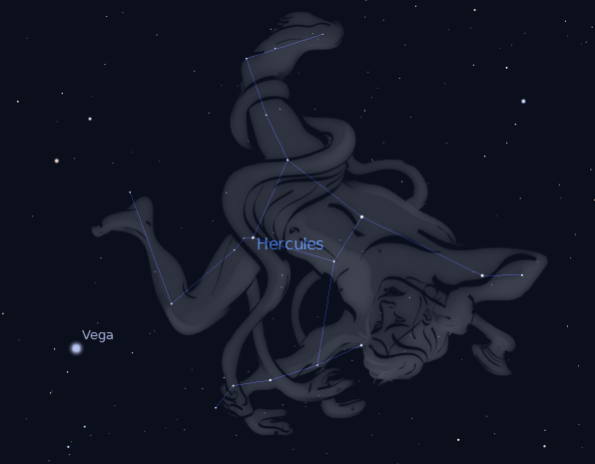
Hercules, visualized by Johan Meuris of the Stellarium development team.
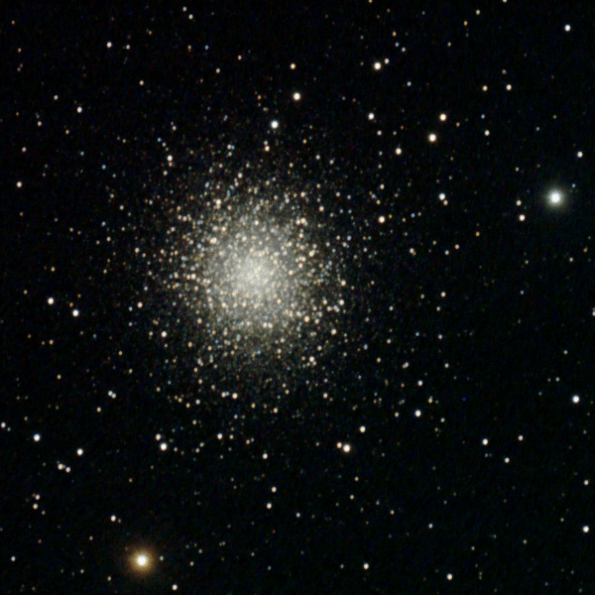
M13, the Great Globular Star Cluster in Hercules. Credit: Scott Anttila.
07/04/2016 – Ephemeris – NASA’s going to light off fireworks at Jupiter tonight
Ephemeris for Independence Day, Monday, July 4th. Today the Sun will be up for 15 hours and 27 minutes, setting at 9:31, and it will rise tomorrow at 6:03. The Moon is new today, and won’t be visible.
There are two astronomical highlights for your Independence Day enjoyment. The first comes at 11:59 this morning (15:59 UT) when the Earth is at its very farthest from the Sun this year. Some 1.7% farther than average. You’re still gonna need your sun screen anyway. Later this evening, a half billion miles from Earth NASA’s Juno spacecraft will fire it’s rocket engine for 35 minutes to begin to decelerate over the north pole of Jupiter to drop into a long elliptical orbit of that planet. NASA TV will begin broadcasting the event at 10:30 p.m. (2:30 UT, July 5) The 35 minute engine burn will start at 11:18 p.m. (3:18 UT, July 5) What we’ll see is a real-time graph of the Doppler signal from the spacecraft as it slows down to drop into orbit of Jupiter.
Times are for the Traverse City/Interlochen area of Michigan. They may be different for your location.
Addendum
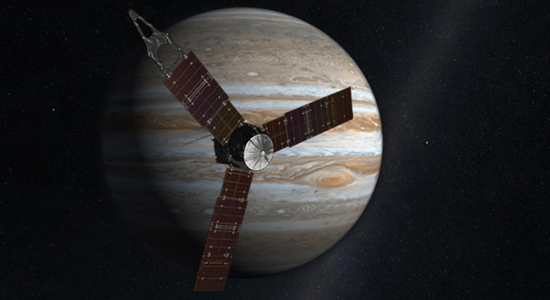
The Juno spacecraft. Credit: NASA.
The Planetary Society’s Emily Lakdawalla has more information on How to watch Juno’s orbit insertion at http://www.planetary.org/blogs/emily-lakdawalla/2016/07011514-how-to-watch-junos-orbit.html.
NASA also has an application in which you can see simulations of Juno’s orbital insertion. It’s called NASA’s Eyes and can be downloaded from http://eyes.nasa.gov/.
07/01/2016 – Ephemeris – Local astronomy event tonight
Ephemeris for Friday, July 1st. Today the Sun will be up for 15 hours and 30 minutes, setting at 9:31, and it will rise tomorrow at 6:01. The Moon, 3 days before new, will rise at 4:36 tomorrow morning.
This evening the Grand Traverse Astronomical Society will host it’s monthly meeting at Northwestern Michigan College’s Rogers Observatory at 8 p.m. On tap will be yours truly with a program about the last 100 years of developments in astronomy. A most exciting century that I can only hope to touch the highlights. This happens to coincide with the 100th anniversary of the National Park Service. This is my out of town tryout before I give the same talk on the 23rd at the Visitors Center of the Sleeping Bear Dunes National Lakeshore. At 9 p.m. there will be a star party at the observatory with the viewing of Jupiter, Mars and Saturn plus some of the brighter deep sky objects of summer after 10:30. The observatory is on Birmley road south of Traverse City.
Times are for the Traverse City/Interlochen area of Michigan. They may be different for your location.
06/30/2016 – Ephemeris – Previewing July’s skies
Ephemeris for Thursday, June 30th. Today the Sun will be up for 15 hours and 31 minutes, setting at 9:32, and it will rise tomorrow at 6:01. The Moon, 3 days past last quarter, will rise at 3:49 tomorrow morning.
Lets preview July’s skies. The sun, having reached its northern solstice, is beginning to slide southward again, at first imperceptibly, then with greater speed. The daylight hours will decrease from 15 hours and 30 minutes tomorrow to 14 hours 40 minutes at month’s end. The daylight hours will be slightly shorter south of Interlochen, and slightly longer to the north. The altitude of the sun at local noon, when the sun is due south will decrease from 68 degrees tomorrow to 63 degrees at month’s end. Despite the warmth, the earth will reach its greatest distance from the Sun on Monday the 4th where the fireworks will begin in earnest when the Juno spacecraft lights its rocket engine to enter orbit Jupiter.
Times are for the Traverse City/Interlochen area of Michigan. They may be different for your location.
Addendum
July Star Chart
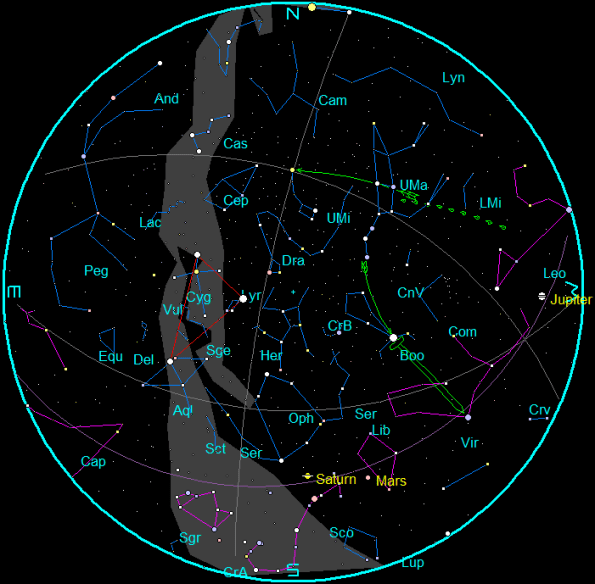
Star Chart for July 2016. Created using my LookingUp program. To enlarge in Firefox right-click on image then click View image.
Star Chart for July 2016. Created using my LookingUp program. To enlarge in Firefox Right-click on image then click View image.
The planets and stars are plotted for the 15th at 11 p.m. EDT. That is chart time. Note, Traverse City is located approximately 45 minutes behind our time meridian. (An hour 45 minutes behind our daylight saving time meridian.) To duplicate the star positions on a planisphere you may have to set it to 1:45 earlier than the current time if you are near your time meridian.
Evening nautical twilight ends at 10:57 p.m. EDT on the 1st, increasing to 10:24 p.m. EDT on the 31st.
Morning nautical twilight starts at 4:35 a.m. EDT on the 1st, and decreasing to 5:2 a.m. EDT on the 31st.
Add a half hour to the chart time every week before the 15th and subtract a half hour for every week after the 15th. Before the 13th also subtract an hour for Standard Time.
For a list of constellation names to go with the abbreviations click here.
- Pointer stars at the front of the bowl of the Big Dipper point to Polaris the North Star
- A leaky Big Dipper drips on Leo
- Follow the arc of the handle of the Big Dipper to the star Arcturus
- Extend the arc to a spike to point to Spica.
- The Summer Triangle is outlined in red. Vega in Lyra (Lyr), Deneb in Cygnus (Cyg) and Altair in Aquila (Aql).
Calendar of Planetary Events
Credit: Sky Events Calendar by Fred Espenak and Sumit Dutta (NASA’s GSFC)
To generate your own calendar go to http://eclipse.gsfc.nasa.gov/SKYCAL/SKYCAL.html
Times are Eastern Time. Some additions made to aid clarity.
    Date    Time      Event
Jul 01  Fr            Venus: 6.8° E
    01  Fr  2:45 a.m. Moon Perigee: 366000 km
    01  Fr 11:58 p.m. Moon-Aldebaran: 0.4° S
    03  Su  4:06 p.m. Moon North Dec.: 18.6° N
    04  Mo  7:01 a.m. New Moon
    04  Mo 11:59 a.m. Aphelion: 1.0168 AU
    06  We 11:12 p.m. Mercury Superior Conj.
    07  Th  7:33 p.m. Moon-Regulus: 1.9° N
    08  Fr  9:42 p.m. Moon Ascending Node
    09  Sa  6:08 a.m. Moon-Jupiter: 0.9° N
    11  Mo  8:52 p.m. First Quarter
    13  We  1:24 a.m. Moon Apogee: 404300 km
    16  Sa  1:11 a.m. Moon-Saturn: 3.8° S
    17  Su 11:41 p.m. Moon South Dec.: 18.6° S
    19  Tu  6:57 p.m. Full Moon
    23  Sa  3:49 a.m. Moon Descending Node
    26  Tu  7:00 p.m. Last Quarter
    27  We  7:25 a.m. Moon Perigee: 369700 km
    27  We  4:32 p.m. Delta Aquarid Shower: ZHR = 20
    29  Fr  6:53 a.m. Moon-Aldebaran: 0.3° S
    30  Sa 11:55 a.m. Mercury-Regulus: 0.3° N
    31  Su 12:52 a.m. Moon North Dec.: 18.5° N
Aug 01  Mo            Venus: 15.3° E
06/29/2016 – Ephemeris – Three planets of the evening
Ephemeris for Wednesday, June 29th. Today the Sun will be up for 15 hours and 32 minutes, setting at 9:32, and it will rise tomorrow at 6:00. The Moon, 2 days past last quarter, will rise at 3:08 tomorrow morning.
Let’s see what the bright naked eye planets are up to. Jupiter is in the west in the evening. It will set at 12:50 a.m. It’s below the stars of Leo this year. Binoculars can make out some of Jupiter’s moons, but a telescope is required to see all four bright moons and Jupiter’s cloud features. The moon Io on the western edge of Jupiter will disappear behind the planet at 11:09 p.m. (3:09 UT, the 30th) tonight. Mars starts the evening in the southern sky. It’s above and right of its dimmer look-a-like star Antares, whose name means Rival of Mars. Mars will move due south at 10:28 p.m. and will set at 3:01 a.m. Saturn is low in the south-southeast. It’s left of Mars. Saturn will pass due south at 11:48 p.m. and will set at 4:25 a.m. It’s a wonderful telescopic sight.
Times are for the Traverse City/Interlochen area of Michigan. They may be different for your location.
Addendum
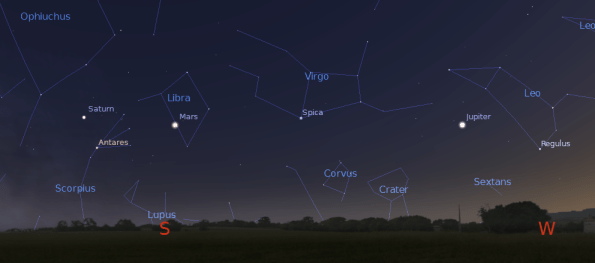
The evening planets and constellations at 10:30 p.m., June 29, 2016. Created using Stellarium.
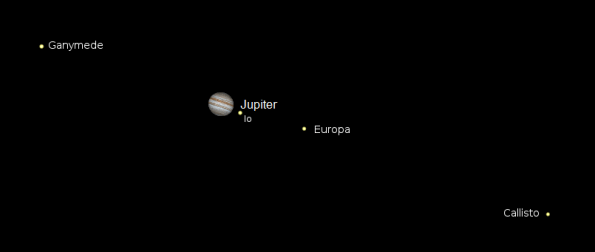
Jupiter and its Galilean moons at 10:30 p.m. June 22, 2016. Jupiter’s apparent diameter will be 34.4″. Io is about to be occulted by Jupiter at 11:09 p.m. a.m. (3:09 UT, June 30th). Created using Cartes du Ciel (Sky Charts).
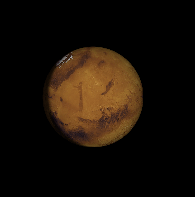
Mars as it might be seen in a large telescope with high power at 10:30 p.m. June 29, 2016. Mars apparent diameter is 16.5″. The central meridian will be 226.63 degrees. Created using Cartes du Ciel (Sky Charts).
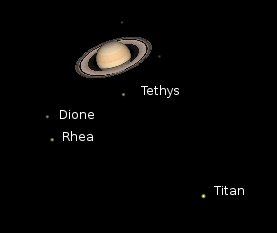
Saturn and its moons at 10:30 p.m. June 29, 2016. The apparent diameter of the planet will be 18.2″, larger than Mars’ disk. The rings span 42.5″, larger than the apparent diameter of Jupiter. Created using Cartes du Ciel (Sky Charts).
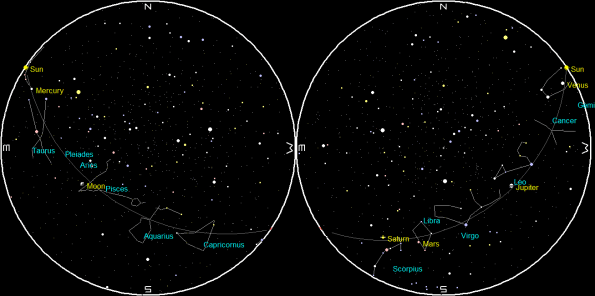
Planets at sunset and sunrise of a single night starting with sunset on the right on June 29, 2016. The night ends on the left with sunrise on June 30. If you are using Firefox right-click on the image and select View Image to enlarge the image. That goes for all the large images.

