Archive
06/28/2016 – Ephemeris – Corona Borealis, the Northern Crown
Ephemeris for Tuesday, June 28th. Today the Sun will be up for 15 hours and 32 minutes, setting at 9:32, and it will rise tomorrow at 6:00. The Moon, 1 day past last quarter, will rise at 2:31 tomorrow morning.
High in the south at 11 p.m. can be found a small but easily spotted constellation of Corona Borealis, the Northern Crown. It is located just east or left of the kite shaped constellation of Boötes, with its bright star Arcturus at the bottom. The Northern Crown is a three-quarters circle of stars, like a tiara, with a brighter star Alphecca or Gemma at the bottom. Alphecca in Arabic means “Bright star of the broken ring of stars”. Gemma could mean gem or a bud or blossom, so Corona Borealis could represent a floral crown. According to Greek mythology it belonged to Princess Ariadne, daughter of King Minos of Crete who helped Theseus escape from the Labyrinth of the Minotaur, only to be abandoned by him on an island.
Times are for the Traverse City/Interlochen area of Michigan. They may be different for your location.
Addendum
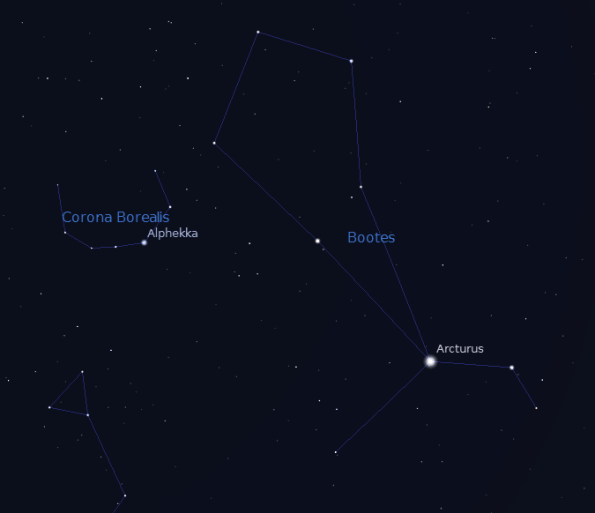
Corona Borealis tonight, June 28, 2016. Alphekka is the alternate spelling, European, of Alphecca. Created using Stellarium.
06/27/2016 – Ephemeris – Astronomical twilight lasts till after midnight… Bummer!
Ephemeris for Monday, June 27th. Today the Sun will be up for 15 hours and 33 minutes, setting at 9:32, and it will rise tomorrow at 5:59. The Moon, at last quarter today, will rise at 1:57 tomorrow morning.
Here we are a week into summer and we find that the latest sunset was already last night. That means that the last vestiges of twilight* don’t end until just after midnight. It wouldn’t be so bad if the Sun was in the south at noon instead of 1:43 in the afternoon, due to being in the extreme western part of the eastern time zone and the imposition of daylight time. For latitudes north of 48 ½ degrees, twilight currently doesn’t end. That latitude will move northward as the Sun heads south. As it is now we in the Grand Traverse region are currently getting only 4 ½ hours of darkness Moon willing. And it won’t for the next few days at least. Our darkness situation will start to get better in about a month from now.
Times are for the Traverse City/Interlochen area of Michigan. They may be different for your location.
*Astronomical twilight begins and ends when the Sun is 18° below the horizon.
06/24/2016 – Ephemeris – View the planets tonight from Betsie Valley District Library, Thompsonville
Ephemeris for Friday, June 24th. Today the Sun will be up for 15 hours and 34 minutes, setting at 9:32, and it will rise tomorrow at 5:58. The Moon, 3 days before last quarter, will rise at 12:18 tomorrow morning.
Tonight the Grand Traverse Astronomical Society will host a star party… well a planet party at the Betsie Valley District Library in Thompsonville, MI. It starts at 9 p.m. With what I like to call a twilight talk by yours truly, the subject of which will be the planets, especially the ones that will be visible tonight. In June with twilight seeming to last forever, we are fortunate to have the bright planets Jupiter, Mars and Saturn well placed for viewing, so we don’t need to have very dark skies. The twilight talk part will go ahead even if it’s cloudy. However forecast is for clear skies. Twilight talks at the library also involves a slide or planetarium-like presentation, so if it’s cloudy we’ll also explore the starry nights of summer. So come out rain or shine.
Times are for the Traverse City/Interlochen area of Michigan. They may be different for your location.
Addendum
Photos from prior events
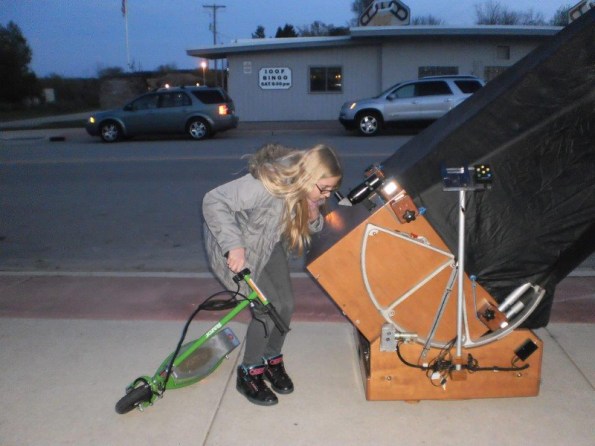
Scooter girl checking out the view through the rear finder of the society’s 25″ “Dobinator”. Credit staff of the Betsie Valley District Library.
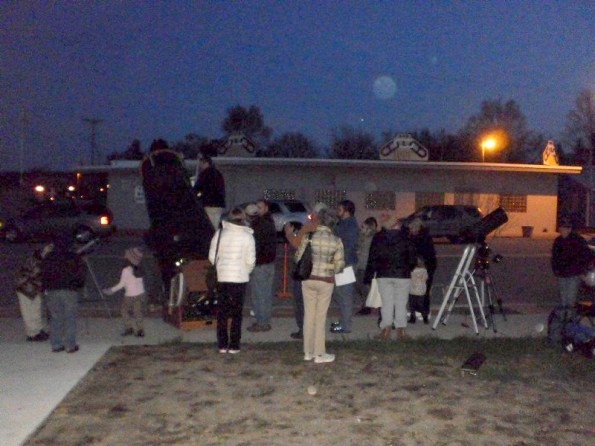
A group of folks out to see the planets with the member’s and society’s telescopes. Credit staff of the Betsie Valley District Library. Note: The blob isn’t the Moon or a UFO, but an out of focus bug caught in the flash.
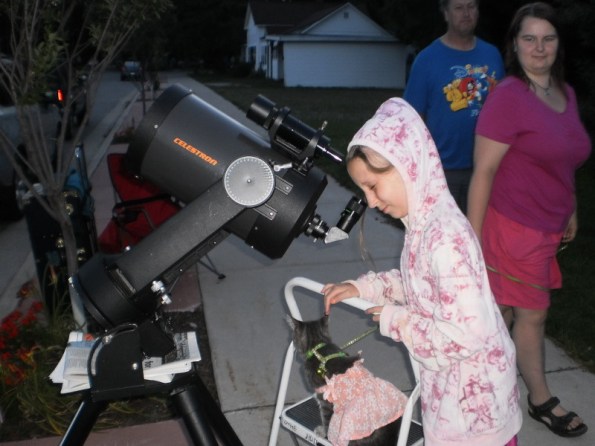
Youngster looking at a planet through a member’s telescope. Credit staff of the Betsie Valley District Library.
06/23/2016 – Ephemeris – Tis the season to view the Summer Triangle
Ephemeris for Thursday, June 23rd. Today the Sun will be up for 15 hours and 34 minutes, setting at 9:32, and it will rise tomorrow at 5:58. The Moon, 3 days past full, will rise at 11:43 this evening.
Now that summer is here, the asterism or informal constellation called the Summer Triangle can be seen in the east as it gets dark. Highest of the three bright stars is Vega in the constellation Lyra the harp, whose body is seen in a narrow parallelogram nearby. The second star of the triangle is Deneb lower and left of Vega, It appears dimmer than Vega because its is by far the most distant of the three. The third star of the Summer Triangle is seen farther below and right of Vega. It is Altair in Aquila the eagle, and the closest. Altair is 16.7 light years away, Vega is 25 light years while Deneb may be a whopping 2600 light years away. With a light year at 6 trillion miles. That’s mind boggling to think in miles at least.
Times are for the Traverse City/Interlochen area of Michigan. They may be different for your location.
Addendum
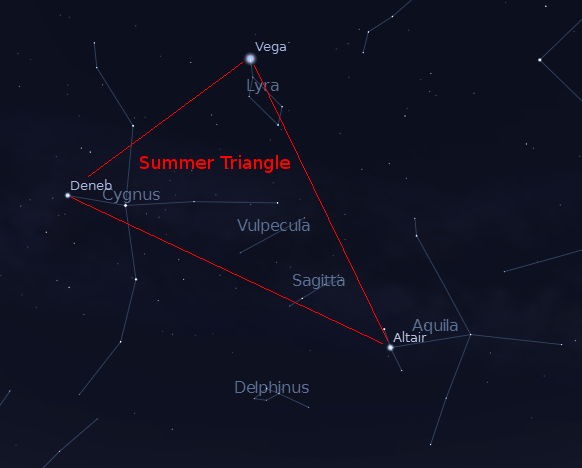
The Summer Triangle. Created using Stellarium and The Gimp.
06/22/2016 – Ephemeris – The evening planet parade
Ephemeris for Wednesday, June 22nd. Today the Sun will be up for 15 hours and 34 minutes, setting at 9:32, and it will rise tomorrow at 5:57. The Moon, 2 days past full, will rise at 11:03 this evening.
Let’s see what the bright naked eye planets are up to. Jupiter is in the southwest in the early evening, moving to the west-southwest. It will set at 1:15 a.m. It’s below the stars of Leo this year. Binoculars can make out some of Jupiter’s moons, but a telescope is required to see all four bright moons and Jupiter’s cloud features. Mars starts the evening in the southeast. It’s above and right of its look-a-like star Antares, whose name means Rival of Mars. Mars will move due south at 10:53 p.m. and will set at 3:30 a.m. Saturn is low in the east-southeast. It’s below and to the left of Mars. Saturn will pass due south at 12:18 a.m. and will set at 4:54 a.m. It’s a wonderful telescopic sight.
Times are for the Traverse City/Interlochen area of Michigan. They may be different for your location.
Addendum
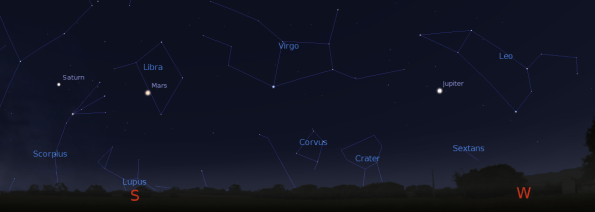
The evening planets and constellations at 11 p.m., June 22, 2016. Created using Stellarium.

Jupiter and its Galilean moons at 11 p.m. June 22, 2016. Jupiter’s apparent diameter will be 35.0″. Io is eclipsed in Jupiter’s shadow until 12:40 a.m. (4:40 UT) where it will reappear a small distance away from the planet on Ganymede’s side. Created using Cartes du Ciel (Sky Charts).
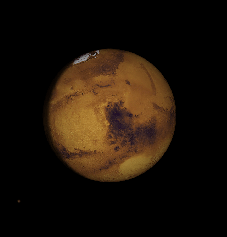
Mars as it might be seen in a large telescope with high power at 11 p.m. June 22, 2016. Mars apparent diameter is 17.2″. The central meridian will be 297.51 degrees. The large feature visible is Syrtis Major. Created using Cartes du Ciel (Sky Charts).
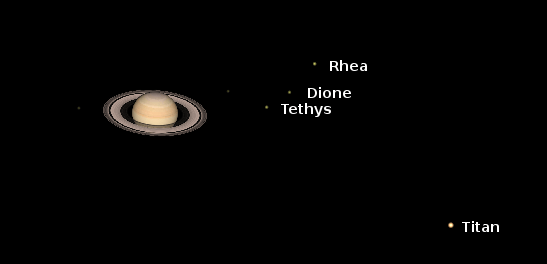
Saturn and its moons at 11 p.m. June 22, 2016. The apparent diameter of the planet will be 18.3″. The rings span 42.7″, larger than the apparent diameter of Jupiter. Created using Cartes du Ciel (Sky Charts).
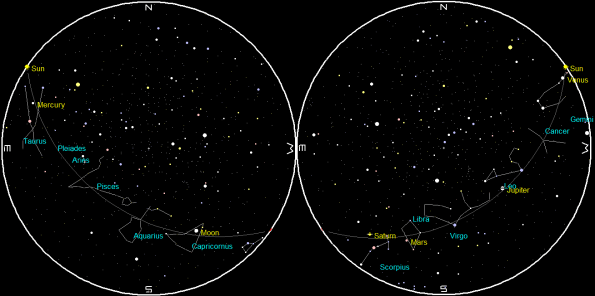
Planets at sunset and sunrise of a single night starting with sunset on the right on June 22, 2016. The night ends on the left with sunrise on June 23. If you are using Firefox right-click on the image and select View Image to enlarge the image. That goes for all the large images.
06/21/2016 – Ephemeris – Saturn’s rings are opened about their widest
Ephemeris for Tuesday, June 21st. Today the Sun will be up for 15 hours and 34 minutes, setting at 9:32, and it will rise tomorrow at 5:57. The Moon, 1 day past full, will rise at 10:20 this evening.
The planet Saturn, when viewed with anything more powerful than binoculars will see its rings open up to their maximum extent, where the planet itself cannot be seen beyond narrowest part of the rings. As Saturn moves away from its solar opposition point the shadows of the ring on the planet and planet on the rings becomes more pronounced. Saturn takes nearly 30 years to orbit the Sun, and like the Earth has an axial tilt. In Saturn’s case it’s nearly 27 degrees. Saturn’s north pole star is Polaris like the Earth, except for Saturn it’s 6½ degrees from Saturn’s actual pole. As Saturn orbits the Sun we seen the rings open up in 7½ years, then close down for another 7½ years, to where they disappear, and then open up again.
Times are for the Traverse City/Interlochen area of Michigan. They may be different for your location.
Addendum
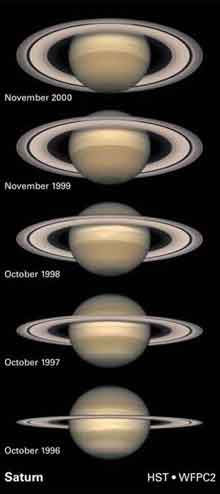
Saturn’s Rings over time as they opened the last time. Credit NASA/HST/WFPC2
06/20/2016 – Ephemeris – Summer will start later today
Ephemeris for Monday, June 20th. Today the Sun will be up for 15 hours and 34 minutes, setting at 9:31, and it will rise tomorrow at 5:57. The Moon, at full today, will rise at 9:32 this evening.
Well, this is it, the last 12 hours of spring. Summer will begin at 6:35 this evening. In the southern hemisphere the season of winter will begin, and the south pole of the Earth will begin* is in the middle of its six months of darkness. The north above 66 ½ degrees north latitude is the land of the midnight Sun. Over summer that line will creep northward as the Sun heads southward. The seasons are caused by the tilt of the Earth’s axis, not by the Earth’s change in distance from the Sun. In fact we are approaching our farthest distance from the Sun, of about 94.5 million miles (152 million km) on the fourth of July called aphelion. The greater than normal distance makes summer the longest season at 93.7 days, winter being the shortest at 89 days.
Times are for the Traverse City/Interlochen area of Michigan. They may be different for your location.
* Thanks to Jeff Silagy for spotting the error.
Addendum
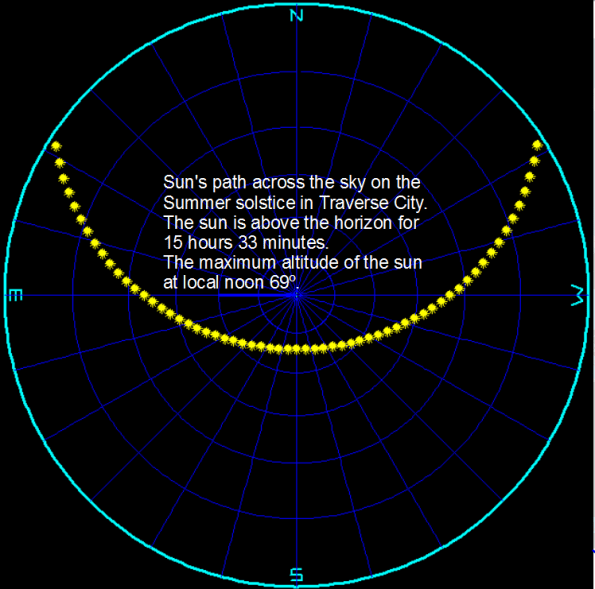
The sun’s daily path through the sky from horizon to horizon on the first day of summer, the summer solstice. Credit My LookingUp program.
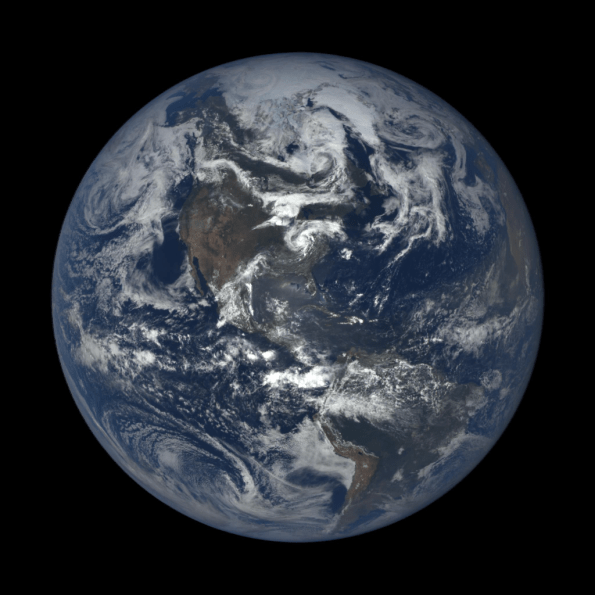
Earth from the DSCOVR satellite at the June solstice 2015. Credit NOAA.
06/17/2016 – Ephemeris – Sun & Star Party Saturday at the Sleeping Bear Dunes
Ephemeris for Friday, June 17th. Today the Sun will be up for 15 hours and 34 minutes, setting at 9:31, and it will rise tomorrow at 5:56. The Moon, 3 days before full, will set at 4:58 tomorrow morning.
Tomorrow afternoon and evening will be what we call a Sun & Star Party at the Sleeping Bear Dunes National Lakeshore. This event will be at the Dune Climb. From 4 to 6 p.m., the Sun will be featured using two types of telescopes, one showing the sun’s photosphere in what we call white light, and another showing the chromosphere above it in the light of hydrogen giving a completely different view. Starting at 9 p.m. will be a star party, actually really a planet party, viewing the planets Jupiter, Mars and Saturn, plus the nearly full Moon. A twilight talk will be given at 9 p.m. on how astronomy has been changed in the last 100 years by Einstein’s Theory of General Relativity, for the 100th anniversary of the National Park Service.
Times are for the Traverse City/Interlochen area of Michigan. They may be different for your location.
Addendum
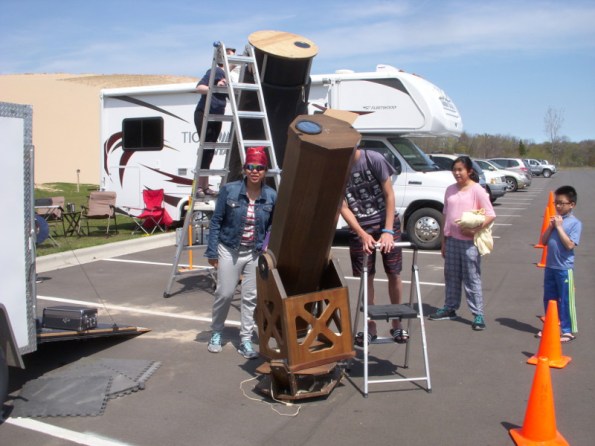
Two of the telescopes that will be used at the Sleeping Bear Dunes star party Saturday night. Taken at the transit of Mercury by Emmett Holmes, whose telescope is in the foreground.
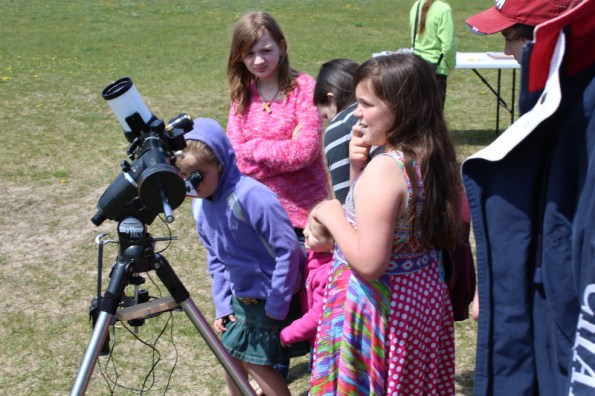
Kids viewing the transit through the society’s Lunt hydrogen alpha solar telescope.
06/16/2016 – Ephemeris – The Moon tonight
Ephemeris for Thursday, June 16th. Today the Sun will be up for 15 hours and 34 minutes, setting at 9:30, and it will rise tomorrow at 5:56. The Moon, half way from first quarter to full, will set at 4:23 tomorrow morning.
The Moon is bright as it moves toward full. In binoculars, the brightest spot on the Moon is visible on the left edge of the Moon at 10 p.m. In telescopes it becomes a crater named Aristarchus. The sea below Aristarchus where the terminator, the sunrise line cuts across is Oceanus Procellarum, the Ocean of Storms. Below that is the small circular sea called Mare Humorum, the Sea of Moisture. Below that we’re back in the lunar highlands with lots of large craters, rather to many
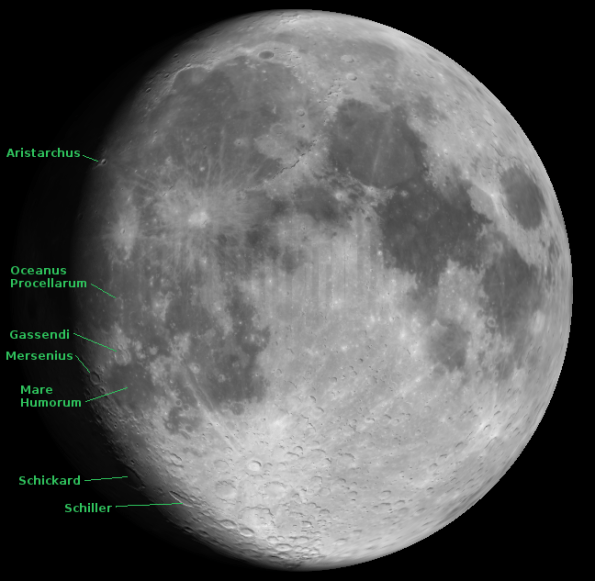
The Gibbous Moon at 10 p.m., June 16, 2016 showing some interesting features near the terminator.
to mention here. The transcripts of these programs with illustrations are available at bobmoler.wordpress.com. That’s Moler spelled simply M-O-L-E-R. The Moon illustration will point out the features I’ve discussed.
Times are for the Traverse City/Interlochen area of Michigan. They may be different for your location.
Addendum
06/15/2016 – Ephemeris – Three bright planets still reign in the evening sky
Ephemeris for Wednesday, June 15th. Today the Sun will be up for 15 hours and 33 minutes, setting at 9:30, and it will rise tomorrow at 5:56. The Moon, 3 days past first quarter, will set at 3:51 tomorrow morning.
Let’s see what the bright naked eye planets are up to. Jupiter is in the southwest in the early evening, moving to the west-southwest. It will set at 1:41 a.m. It’s below the stars of Leo this year. Binoculars can make out some of Jupiter’s moons, but a telescope is required to see all four bright moons and Jupiter’s cloud features. Mars starts the evening in the southeast. It’s above and right of its look-a-like star Antares, whose name means Rival of Mars. Mars will move due south at 11:29 p.m. and will set at 4:02 a.m. Saturn is low in the east-southeast. It’s below and to the left of Mars. Saturn will pass due south at 12:47 a.m. and will set at 5:23 a.m. It’s a wonderful telescopic sight.
Times are for the Traverse City/Interlochen area of Michigan. They may be different for your location.
Addendum
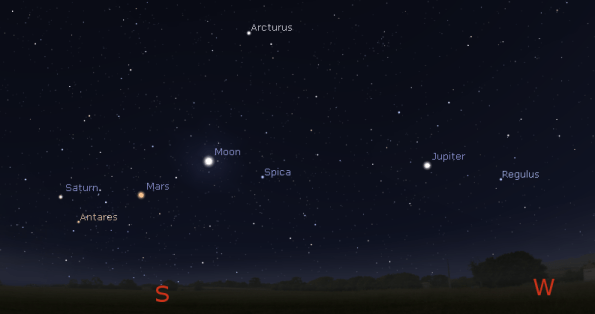
The Moon and the evening planets at 11 p.m., June 15, 2016. The Moon is too small to show the crescent, but see below. Created using Stellarium.
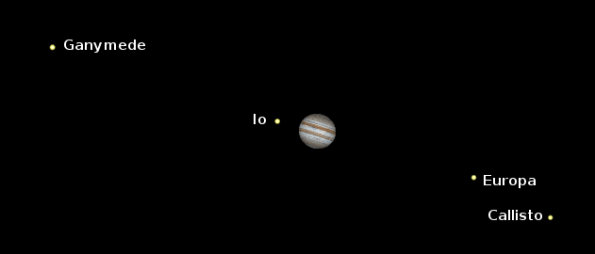
Jupiter and its Galilean moons at 11 p.m. June 15, 2016. Jupiter’s apparent diameter will be 35.7″. Created using Cartes du Ciel (Sky Charts).
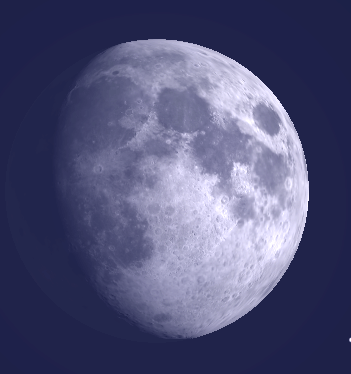
The Moon as it might appear in binoculars tonight, June 15, 2016 at 11 p.m. Created using Stellarium.
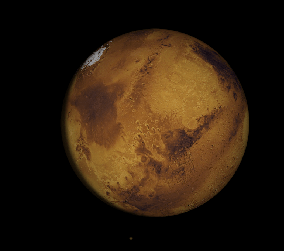
Mars as it might be seen in a large telescope with high power at 11 p.m. June 15, 2016. Mars apparent diameter is 17.9″. The central meridian will be 0.45 degrees. Created using Cartes du Ciel (Sky Charts).
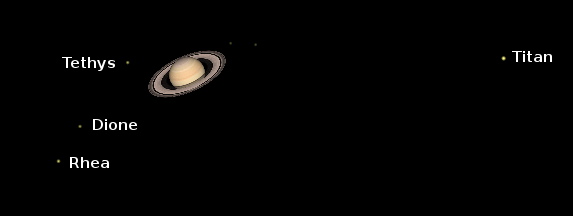
Saturn and its moons at 11 p.m. June 15, 2016. The apparent diameter of the planet will be 18.4″. The rings span 42.8″, larger than the apparent diameter of Jupiter. Created using Cartes du Ciel (Sky Charts).
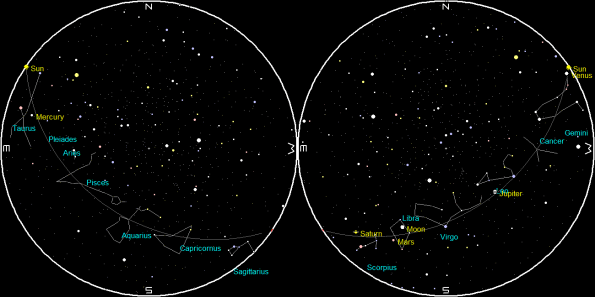
Planets at sunset and sunrise of a single night starting with sunset on the right on June 15, 2016. The night ends on the left with sunrise on June 16. If you are using Firefox right-click on the image and select View Image to enlarge the image. That goes for all the large images.

