Archive
06/14/2016 – Ephemeris – Tomorrow is the earliest sunrise of the year
Ephemeris for Flag Day, Tuesday, June 14th. Today the Sun will be up for 15 hours and 33 minutes, setting at 9:30, and it will rise tomorrow at 5:56. The Moon, 2 days past first quarter, will set at 3:22 tomorrow morning.
Tomorrow morning’s sunrise is the earliest sunrise of the year. Sunrises of the next few days will stay within the same minute. The bottoming out of the earliest sunrise is a slow affair, but the advance of the sunrise times will accelerate in the coming weeks. We are still nearly two weeks from the latest sunset on the 26th. That means that the summer solstice, the first day of summer is near, on the 20th. The reason for the uneven sunrise and sunset peaks is due to a combination of the Earth’s axial tilt and the Earth’s elliptical orbit which is too complicated to explain here. These times of sunrise and sunset are for the Traverse City/Interlochen area. I have a link for other locations and times on bobmoler.wordpress.com.
Times are for the Traverse City/Interlochen area of Michigan. They may be different for your location.
Addendum
Here is the link to the calendar page on my Ephemeris website.
06/13/2016 – Ephemeris – Two early astronomers honored by prominent craters on the Moon
Ephemeris for Monday, June 13th. Today the Sun will be up for 15 hours and 32 minutes, setting at 9:29, and it will rise tomorrow at 5:56. The Moon, 1 day past first quarter, will set at 2:54 tomorrow morning.
The Moon tonight sports two craters, named for important astronomers near the south end of the of our satellite. The first, the smaller of the two sticks out for its sharp edges and dark shadows. It is Tycho, which at full moon exhibits moon encircling rays. It’s 52 miles (86 km) in diameter. Named for Tycho Brahe that last great naked eye astronomer in the 16th century, whose precise positions of Mars allowed Johannes Kepler to formulate his Three Laws of Planetary Motion. Clavius is a large crater south and closer to the terminator, the sunrise line, than Tycho. It has a curious arc of several smaller craters on its floor. Clavius is 136 miles (225 km) in diameter. Clavius completed work on the Gregorian calendar.
Times are for the Traverse City/Interlochen area of Michigan. They may be different for your location.
Addendum
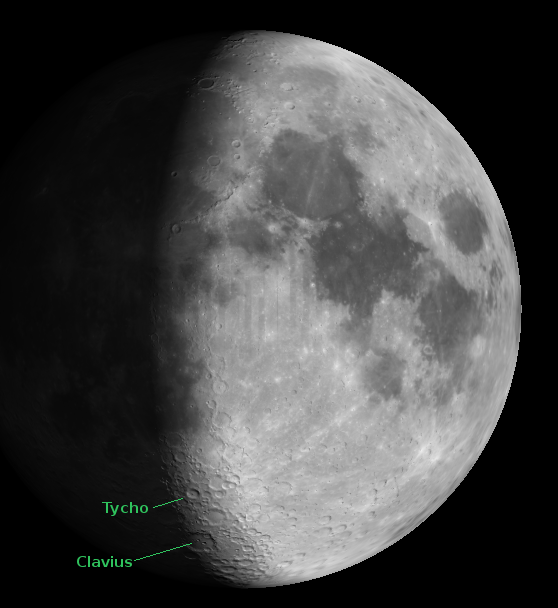
The Moon at 10 p.m. June 13, 2016 featuring the craters Tycho and Clavius. Created using Virtual Moon Atlas.
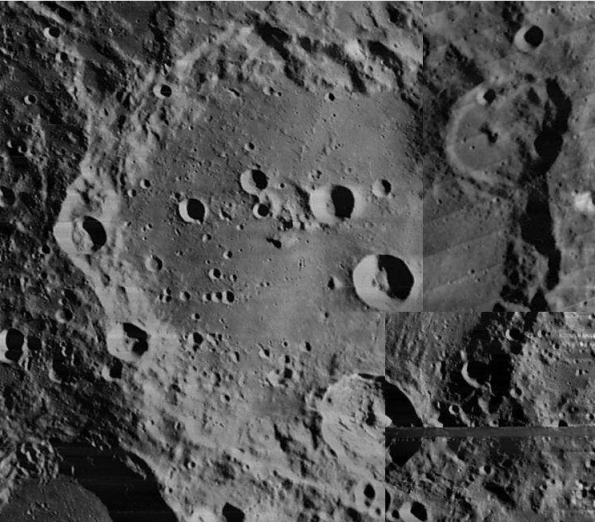
Clavius as photographed by one of the Lunar Orbiter spacecraft in the 1960s From Digital Lunar Orbital Photographic Atlas. Credit Jeff Gillis, Lunar and Planetary Institute.
06/09/2016 – Ephemeris – Waiting for the first stars to appear
Ephemeris for Thursday, June 9th. Today the Sun will be up for 15 hours and 30 minutes, setting at 9:27, and it will rise tomorrow at 5:56. The Moon, 3 days before first quarter, will set at 12:59 tomorrow morning.
Lets look at the first stars and planets to appear tonight as it gets dark. The first object to appear will be the fat crescent Moon in the southwest. The planet Jupiter will be the next to appear after sunset left and above the Moon. Mars, low in the southeast will appear reddish, shortly thereafter. Looking very high in the southeast, the fourth brightest nighttime star will appear. This will be Arcturus with an orange hue. Saturn should appear to the left and below Mars. Soon other stars will appear including the Big Dipper overhead. Other bright stars will appear, the summer star Vega low in the northeast. Regulus between Jupiter and the Moon and Spica between Jupiter and Mars.
Times are for the Traverse City/Interlochen area of Michigan. They may be different for your location.
Addendum
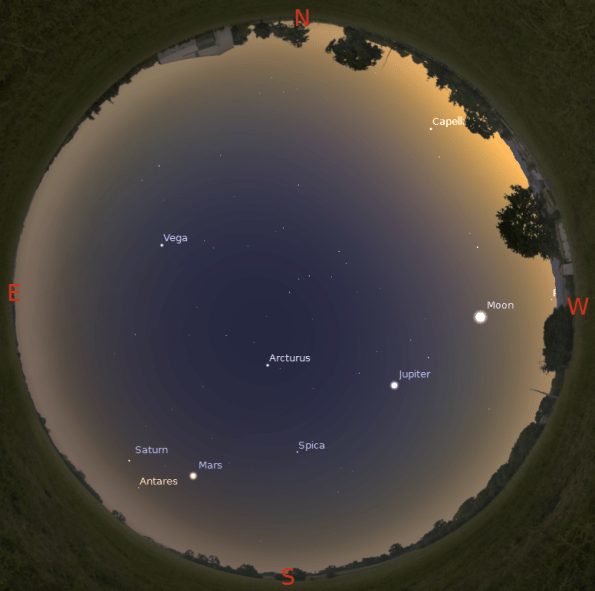
The sky at about 10 p.m. or a little later, watching the first stars and planets appear. Created using Stellarium. If viewing using Firefox right-click on the image and select View Image to enlarge.
06/08/2016 – Ephemeris – Jupiter, Mars and Saturn rule the evening sky
Ephemeris for Wednesday, June 8th. Today the Sun will be up for 15 hours and 29 minutes, setting at 9:26, and it will rise tomorrow at 5:57. The Moon, half way from new to first quarter, will set at 12:23 tomorrow morning.
Let’s see what the bright naked eye planets are up to. Jupiter is in the south-southwest in the early evening, moving to the west-southwest. It will set at 2:07 a.m. It’s below the stars of Leo this year. Binoculars can make out some of Jupiter’s moons, but a telescope is required to see all four bright moons and Jupiter’s cloud features. Mars starts the evening in the southeast. It’s above and right of its look-a-like star Antares, whose name means Rival of Mars. Mars will move due south at 11:58 p.m. and will set at 4:35 a.m. Saturn is low in the east-southeast. It’s below and to the left of Mars.
Times are for the Traverse City/Interlochen area of Michigan. They may be different for your location.
Addendum
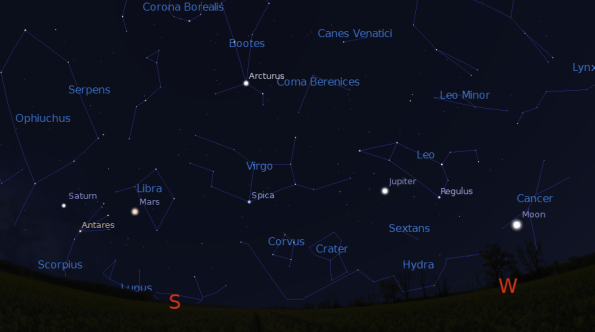
The Moon and the evening planets with the stars and constellations at 11 p.m., June 8, 2016. The Moon is too small to show the crescent, but see below. Created using Stellarium.
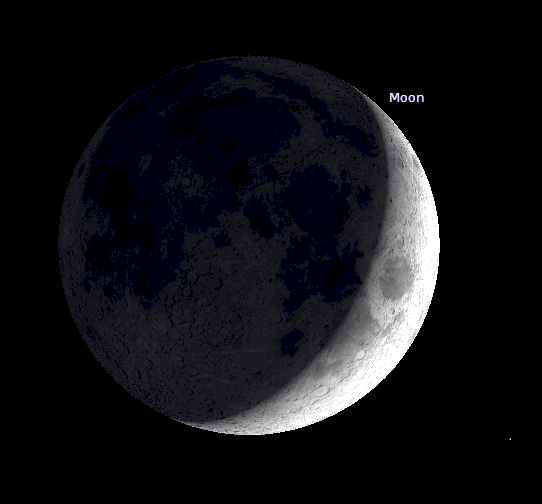
The Moon as it might appear in binoculars tonight, June 8, 2016 at 11 p.m. Created using Stellarium.
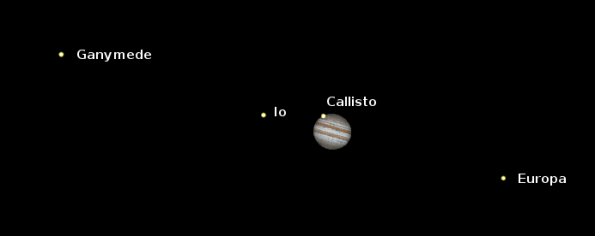
Jupiter and its Galilean moons at 11 p.m. June 8, 2016. Jupiter’s apparent diameter will be 36.3″. Note that Callisto began a transit across the face of Jupiter at 10:59 p.m. (02:59 UT) It will be hard to spot since the satellites appear here much brighter in relation to the planet than they actually are. The transit will end at 2:14 a.m. (06:14 UT) just after it sets here. Created using Cartes du Ciel (Sky Charts).
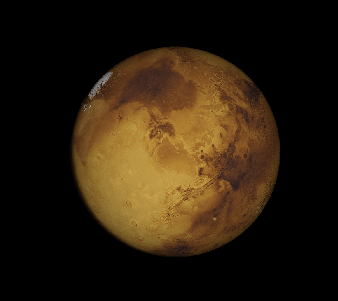
Mars as it might be seen in a large telescope with high power at 11 p.m. June 8, 2016. Mars apparent diameter is 18.3″. The central meridian will be 62.82 degrees. Created using Cartes du Ciel (Sky Charts).
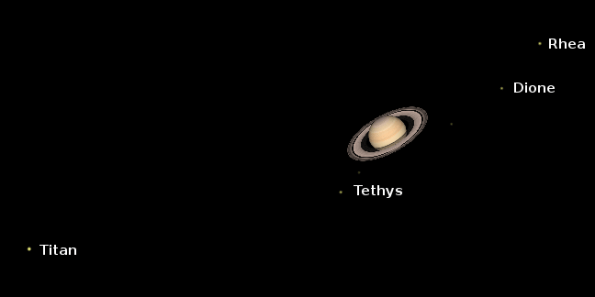
Saturn and its moons at 11 p.m. June 8, 2016. The apparent diameter of the planet will be 18.4″. The rings span 42.9″, larger than the apparent diameter of Jupiter. Created using Cartes du Ciel (Sky Charts).
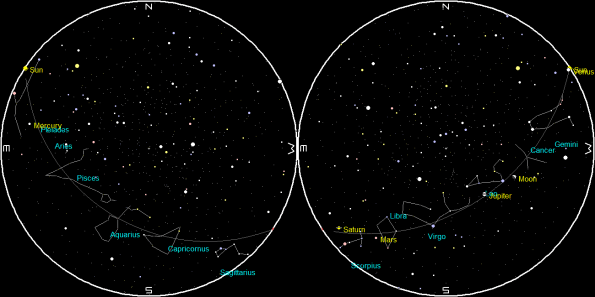
Planets at sunset and sunrise of a single night starting with sunset on the right on June 8, 2016. The night ends on the left with sunrise on June 9. If you are using Firefox right-click on the image and select View Image to enlarge the image. That goes for all the large images.
06/07/2016 – Ephemeris – The Moon reappears in the evening sky
Ephemeris for Tuesday, June 7th. Today the Sun will be up for 15 hours and 28 minutes, setting at 9:26, and it will rise tomorrow at 5:57. The Moon, 3 days past new, will set at 11:41 this evening.
The Moon tonight is a thin crescent with the night side faintly illuminated by the Earth. The effect is called earthshine. The small dark sea of Crises, or Mare Crisium, near the right edge of the moon will be cut in half by the moon’s terminator, its sunrise line. Venus, which passed behind the Sun yesterday, though now an official evening planet probably won’t become easily visible till near the end of summer. The evening sky now through mid July is a time where it seems that twilight never ends. However for almost the next two weeks, we have the bright planets Jupiter, Mars and Saturn plus the Moon to help us forget the seemingly forever twilight blues. After that we’ll have just the planets. Not a bad deal.
Times are for the Traverse City/Interlochen area of Michigan. They may be different for your location.
Addendum
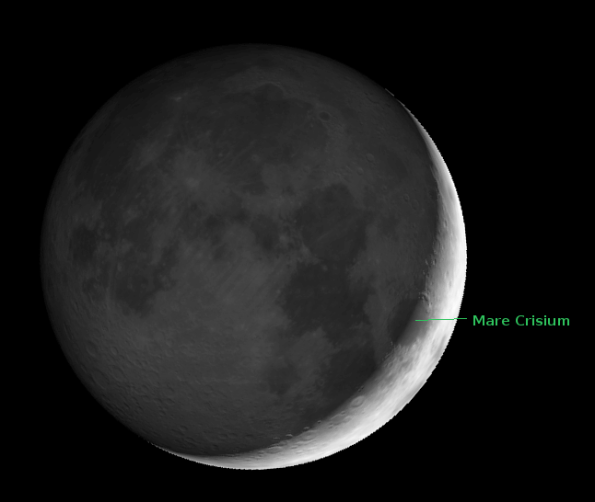
The Moon showing earthshine at 10:30 p.m. June 7, 2016. Created using Virtual Moon Atlas.
Note: The image, from Virtual Moon Atlas, has been rotated to show the approximate appearance in the sky of the Moon low in the southwest. I didn’t attempt to add the sky brightness and color.
06/06/2016 – Ephemeris – Venus passes behind the Sun today
Ephemeris for Monday, June 6th. Today the Sun will be up for 15 hours and 27 minutes, setting at 9:25, and it will rise tomorrow at 5:57. The Moon, 2 days past new, will set at 10:52 this evening.
Today the planet Venus will be in superior conjunction with the Sun, and indeed will pass directly behind the Sun. That event will be completely unobservable due to the Sun’s brilliance. Fours years ago we observed the transit of Venus across the Sun. June 6, 2012. It got me thinking. Transits of Venus occur in pairs 8 years apart followed by a very long interval of over 100 years. It turns out the Venus orbits the Sun 13 times in approximately the same time that the earth orbits the Sun 8 times. In 4 years Venus goes around the Sun 6 ½ times and put’s Venus behind the Sun 4 years after 2012. Today to be precise. In another 4 years we’ll have Venus between the Earth and the Sun again, except Venus will be a bit too far north to transit the Sun.
Times are for the Traverse City/Interlochen area of Michigan. They may be different for your location.
Addendum
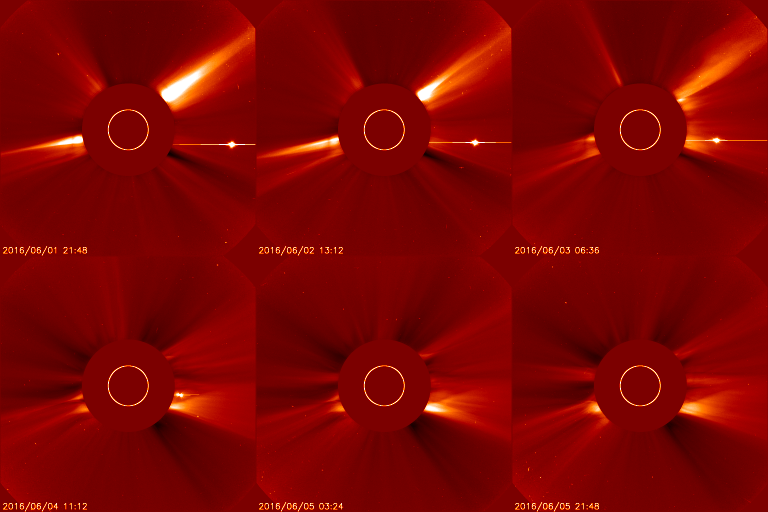
SOlar and Heliospheric Observatory (SOHO) stationed at the Earth-Sun Lagrangian point 1 (L1) a million miles sunward of the Earth. Sent back this animated GIF of Venus approaching the Sun in the last few days. In the LASCO C2 coronagraph the large disk at the center blocks the brightest part of the Sun’s image. The white circle represents the Sun’s disk size. Credit ESA/NASA.
06/03/2019 – Ephemeris – Two local astronomical events on tap for this weekend
Ephemeris for Friday, June 3rd. Today the Sun will be up for 15 hours and 24 minutes, setting at 9:23, and it will rise tomorrow at 5:58. The Moon, 1 day before new, will rise at 5:56 tomorrow morning.
There are two local astronomical events this weekend, starting this evening with the Grand Traverse Astronomical Society’s meeting tonight starting at 8 p.m. at Northwestern Michigan College’s Rogers Observatory. The program will be by Becky Shaw about some current female astronomers. At 9 p.m. will be a star party. Tomorrow night, the 4th society members will be in the town of Arcadia for a star party at the ball field starting at 9 p.m. Turn right from Oak St off M22 to North Ridgewood Drive. The townships around the Arcadia Dunes are in the process of applying for International Dark Skies Community status. Though it won’t get dark until late, the planets Jupiter, Mars and Saturn will be featured.
Times are for the Traverse City/Interlochen area of Michigan. They may be different for your location.
06/02/2016 – Ephemeris – Saturn at opposition
Ephemeris for Thursday, June 2nd. Today the Sun will be up for 15 hours and 22 minutes, setting at 9:22, and it will rise tomorrow at 5:59. The Moon, 2 days before new, will rise at 5:11 tomorrow morning.
In the wee morning hours tomorrow Saturn will be in opposition from the Sun. It is a time Saturn will rise at sunset and set at sunrise. It is also a time that Saturn is closest to the Earth, so it will appear its largest in our telescopes. Saturn’s variance of apparent size over its appearance in our skies isn’t as dramatic as much closer and smaller Mars. For Saturn which orbits the Sun at nearly 10 times the Earth’s distance from the Sun varies in apparent size plus or minus 10% over it’s synodic period of 12½ months. The synodic period is the interval between oppositions or conjunctions of the Sun. One benefit of being in opposition is that Saturn and its glorious rings will be up all night.
Times are for the Traverse City/Interlochen area of Michigan. They may be different for your location.
Addendum
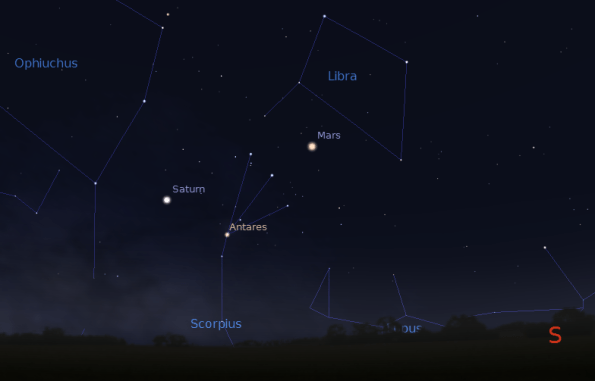
Saturn finder chart. Looking low in the south-southwest at 11 p.m., June 2, 2016. Created using Stellarium.
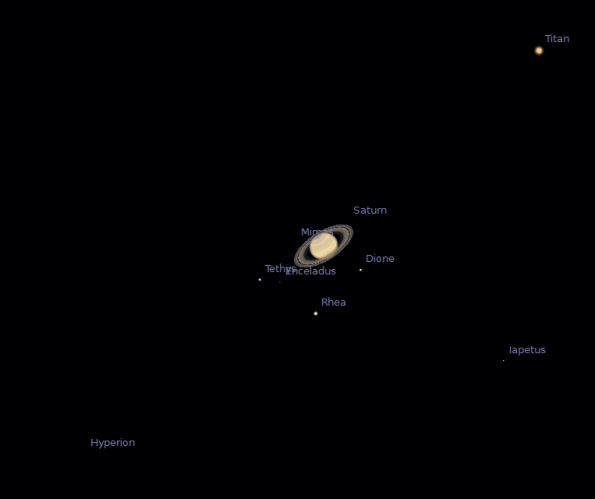
Saturn and some of its 63 moons at 11 p.m., June 2, 2016. Created using Stellarium.
06/01/2016 – Ephemeris – There’s about to be 3 official evening planets
Ephemeris for Wednesday, June 1st. Today the Sun will be up for 15 hours and 21 minutes, setting at 9:21, and it will rise tomorrow at 5:59. The Moon, half way from last quarter to new, will rise at 4:31 tomorrow morning.
Let’s see what the bright naked eye planets are up to. Jupiter is in the south in the early evening, moving to the southwest. It will set at 2:34 a.m. It’s below the stars of Leo this year. Binoculars can make out some of Jupiter’s moons, but a telescope is required to see all four bright moons and Jupiter’s cloud features. Mars starts the evening low in the southeast. It’s above and right of its look-a-like star Antares, whose name means Rival of Mars. Mars will move due south at 12:40 a.m. and will set at 5:11 a.m. Saturn will rise at 9:11 p.m. in the east-southeast. It’s to the left of Mars. It will be in opposition from the Sun Friday, something I’ll explore tomorrow.
Times are for the Traverse City/Interlochen area of Michigan. They may be different for your location.
Addenda
Looking at the planets
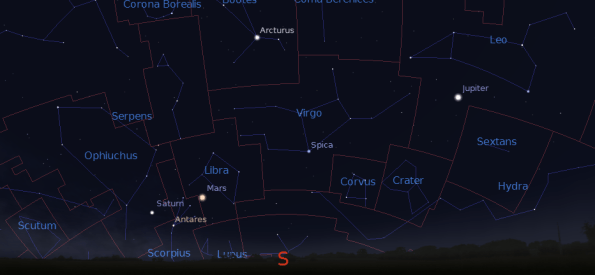
The Planets and constellations, with their boundaries for 11 p.m., June 1, 2016. Note that Mars is back in Libra. Created using Stellarium.
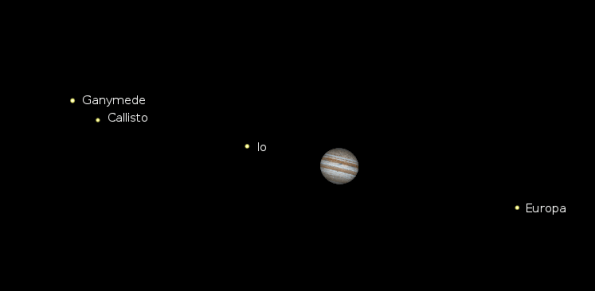
Jupiter and its Galilean moons at 11 p.m. June 1, 2016. Jupiter’s apparent diameter will be 37.1″. Created using Cartes du Ciel (Sky Charts).
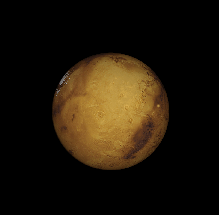
Mars as it might be seen in a large telescope with high power at 11 p.m. June 1, 2016. Mars apparent diameter is 18.6″. The central meridian will be 124.75 degrees. Created using Cartes du Ciel (Sky Charts).
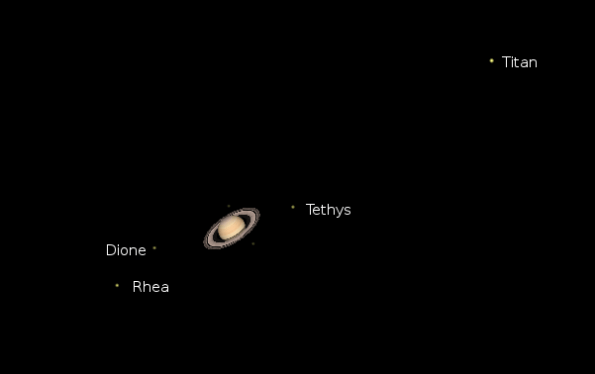
Saturn and its moons at 11 p.m. June 1, 2016. The apparent diameter of the planet will be 18.4″. The rings span 42.8″, larger than the apparent diameter of Jupiter. Created using Cartes du Ciel (Sky Charts).
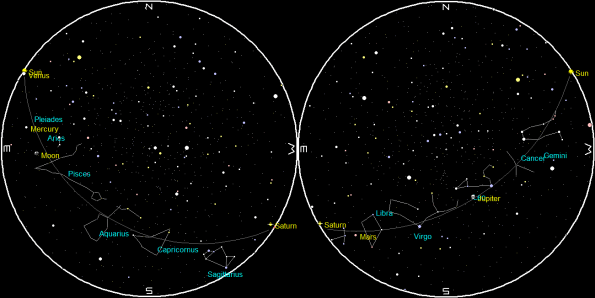
Planets at sunset and sunrise of a single night starting with sunset on the right on June 1, 2016. The night ends on the left with sunrise on June 2. If you are using Firefox right-click on the image and select View Image to enlarge the image. That goes for all the large images.
Forty first anniversary program
Being Planet Wednesday I was too busy to acknowledge it, but Ephemeris is 41 years old today. Astronomically speaking this program starts Ephemeris’ forty second trip around the Sun. What wonders await this go round?
05/31/2016 – Ephemeris – Previewing June’s bright skies
Ephemeris for Tuesday, May 31st. Today the Sun will be up for 15 hours and 20 minutes, setting at 9:20, and it will rise tomorrow at 6:00. The Moon, 2 days past last quarter, will rise at 3:55 tomorrow morning.
Tomorrow will be the first of June, so let’s preview June skies. There will be a lot of sunlight in June. The daylight hours will increase a bit from 15 hours and 21 minutes tomorrow to 15 hours and 34 minutes on the 20th, the solstice, retreating back to 15 hours 31 minutes at month’s end. At this time of the year the sunset times for Ludington, Interlochen, Petoskey and Mackinaw City are very nearly the same.* However the sunrise times are at their most divergent. With Ludington’s sunrise being 14 minutes later than Mackinaw City’s. The altitude of the sun above the southern horizon at local noon will increase from about 67 and a half degrees to 68 and three-quarters on the 20th. Local noon, when the sun is actually due south will occur at about 1:43 p.m.
Times are for the Traverse City/Interlochen area of Michigan. They may be different for your location.
* See http://ephemeris.bjmoler.org/calendar.htm
Addendum
June Star Chart
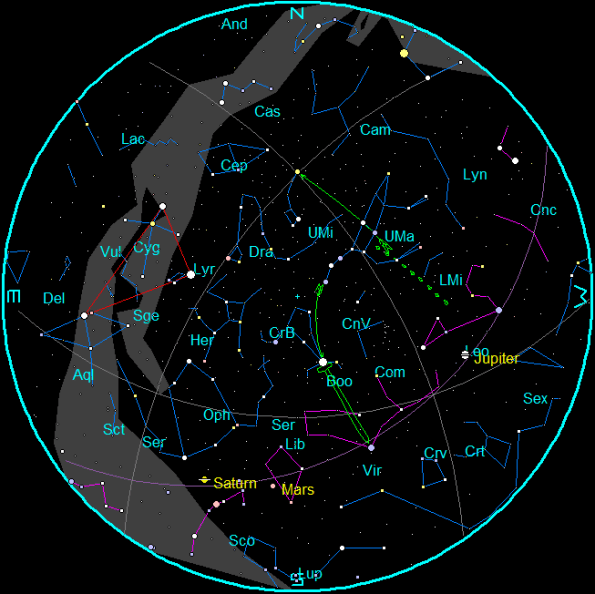
Star Chart for June 2016. Created using my LookingUp program. To enlarge in Firefox Right-click on image then click View image.
The planets and stars are plotted for the 15th at 11 p.m. EDT. That is chart time. Note, Traverse City is located approximately 45 minutes behind our time meridian. (An hour 45 minutes behind our daylight saving time meridian.) To duplicate the star positions on a planisphere you may have to set it to 1:45 earlier than the current time if you are near your time meridian.
Evening nautical twilight ends at 10:45 p.m. EDT on the 1st, increasing to 10:57 p.m. EDT on the 30th.
Morning nautical twilight starts at 4:36 a.m. EDT on the 1st, and decreasing to 4:35 a.m. EDT on the 30th.
Add a half hour to the chart time every week before the 15th and subtract a half hour for every week after the 15th. Before the 13th also subtract an hour for Standard Time.
For a list of constellation names to go with the abbreviations click here.
- Pointer stars at the front of the bowl of the Big Dipper point to Polaris the North Star
- A leaky Big Dipper drips on Leo
- Follow the arc of the handle of the Big Dipper to the star Arcturus
- Extend the arc to a spike to point to Spica.
- The Summer Triangle is outlined in red. Vega in Lyra (Lyr), Deneb in Cygnus (Cyg) and Altair in Aquila (Aql).
Calendar of Planetary Events
Credit: Sky Events Calendar by Fred Espenak and Sumit Dutta (NASA’s GSFC)
To generate your own calendar go to http://eclipse.gsfc.nasa.gov/SKYCAL/SKYCAL.html
Times are Eastern Time. Some additions made to aid clarity.
    Date    Time      Event
Jun 01  We            Venus: 1.5° W
    03  Fr  1:43 a.m. Saturn Opposition
    03  Fr  5:47 a.m. Moon-Mercury: 0.7° N
    03  Fr  6:55 a.m. Moon Perigee: 361100 km
    04  Sa 11:00 p.m. New Moon
    05  Su  4:59 a.m. Mercury Greatest Elongation: 24.2° W
    06  Mo  5:13 a.m. Moon North Dec.: 18.6° N
    06  Mo  5:34 p.m. Venus Superior Conjunction with the Sun.
    10  Fr 10:47 a.m. Moon-Regulus: 2.2° N
    11  Sa  3:35 p.m. Moon-Jupiter: 1.6° N
    11  Sa  6:20 p.m. Moon Ascending Node
    12  Su  4:10 a.m. First Quarter
    13  Mo  6:06 a.m. Mercury-Pleiades: 6.8° S
    15  We  8:00 a.m. Moon Apogee: 405000 km
    18  Sa  8:40 p.m. Moon-Saturn: 3.6° S
    18  Sa 11:39 p.m. Mercury-Aldebaran: 3.8° N
    20  Mo  7:02 p.m. Full Moon
    20  Mo  2:52 p.m. Moon South Dec.: 18.6° S
    20  Mo  6:35 p.m. Summer Solstice
    26  Su  1:28 a.m. Moon Descending Node
    27  Mo  2:19 p.m. Last Quarter
Jul 01                Venus: 6.8° E

