Archive
01/05/2016 – Ephemeris – The crescent moon is passing the morning planets
Ephemeris for Tuesday, January 5th. The Sun will rise at 8:20. It’ll be up for 8 hours and 56 minutes, setting at 5:16. The Moon, 3 days past last quarter, will rise at 4:48 tomorrow morning.
This morning the crescent Moon will be in the morning sky about half way between Venus below and Mars above. Reddish Mars is to the left of the bright blue-white star Spica nearly in the south at 7 a.m. Jupiter is way high in the south-southwest by then. Venus is approaching Saturn, and they will apparently cross paths this Saturday. By tomorrow morning the Moon will be much closer to Venus, with our Morning Star about 5 degrees, or 10 Moon diameters below and left of the thin crescent Moon, which should be exhibiting earthshine by then. By Thursday the Moon will be about the same distance to the left of Venus. The line that can be drawn through planets, along the Zodiac, is lying down as the Sun is slowly heading northward.
Times are for the Traverse City/Interlochen area of Michigan. They may be different for your location.
Addendum
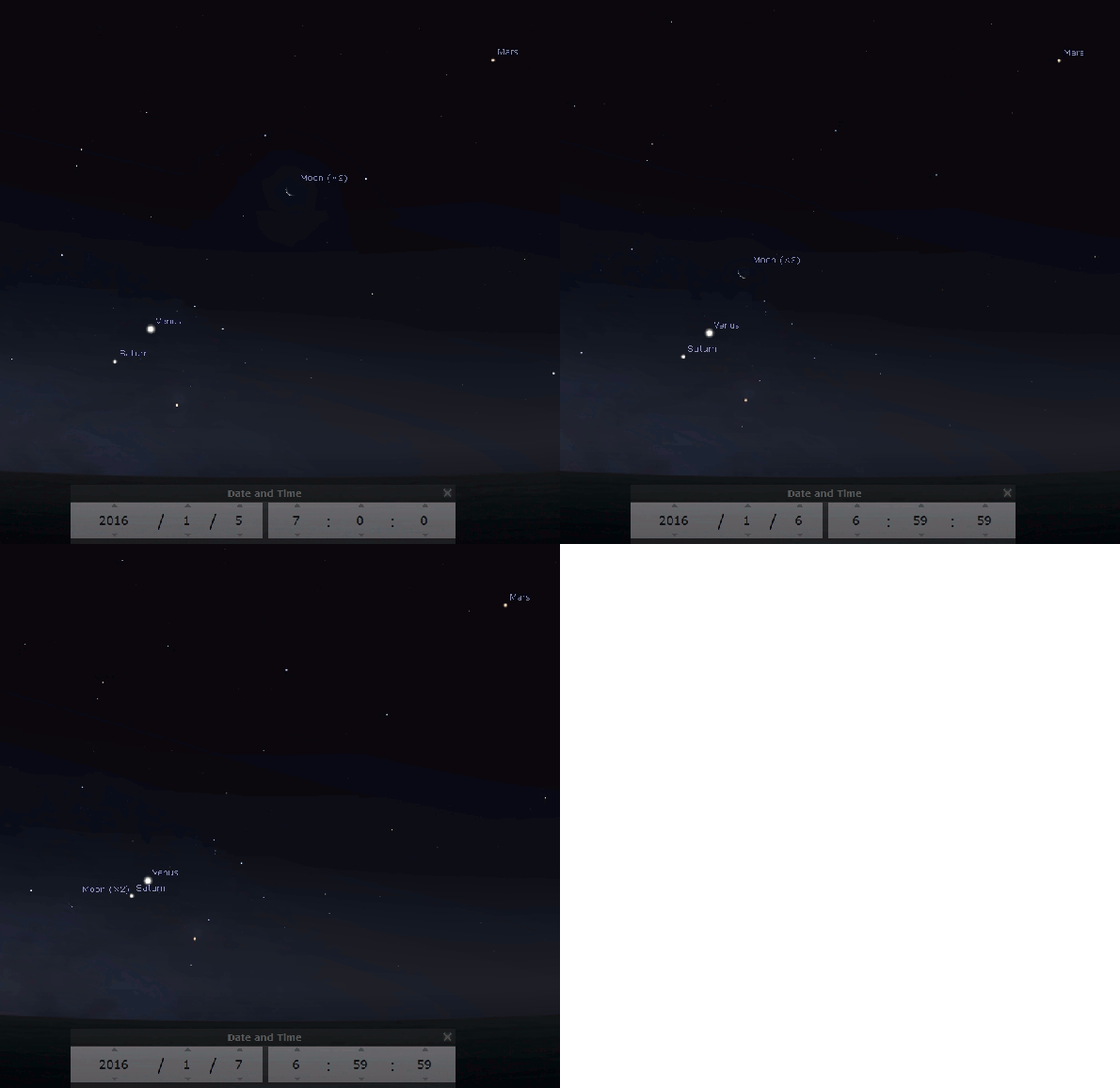
The travels of the crescent Moon by Venus and Saturn. Positions shown for 7 a.m. on consecutive mornings: January 5-7, 2016. The moon is shown twice its size for clarity. Created using Stellarium and GIMP.
01/04/2016 – Ephemeris – Some named stars in Orion and how to remember them
Ephemeris for Monday, January 4th. The Sun will rise at 8:20. It’ll be up for 8 hours and 55 minutes, setting at 5:15. The Moon, 2 days past last quarter, will rise at 3:49 tomorrow morning
Now that the Moon has fled let’s turn to the dark skies of winter and the magnificent constellation of Orion the hunter. At 9 p.m. he’s not yet completely upright in the southeast at 9 p.m. His seven bright stars make him easy to spot, starting with his belt of three stars in a straight line angling down to the left. It is inside a rectangle framing his shoulders and knees, leaning now to the left. The bright reddish star at the upper left corner is Betelgeuse, which according to a certain movie one shouldn’t say three-time in a row. The other shoulder star is a name familiar to Harry Potter fans, Bellatrix, though there’s nothing Lestrange about it. The lower right star is the bright blue-white Rigel. All in all a very impressive constellation.
Times are for the Traverse City/Interlochen area of Michigan. They may be different for your location.
Addendum
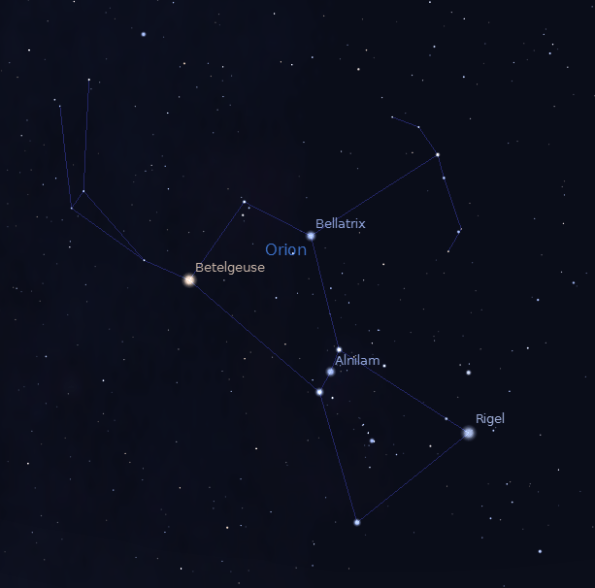
Some of Orion’s star names. Orion at 9 p.m. January 4, 2016. Created using Stellarium.
01/01/2016 – Ephemeris – Happy New Year – It’s a busy few days to start off the year
Happy New Year. This is Bob Moler with Ephemeris for New Years Day, Friday, January 1st, 2016. The Sun will rise at 8:20. It’ll be up for 8 hours and 52 minutes, setting at 5:12. The Moon, 1 day before last quarter, will rise at 12:54 tomorrow morning.
It’s always a busy time, astronomically speaking, around the start of the year. This year even more so. Comet Catalina is found near the bright star Arcturus now, which is a good way to find it in binoculars. Tomorrow at 7:59 p.m. (1:59 UT 3rd) the Earth will reach perihelion, the closest point in its orbit to the Sun at about 91.4 million miles (0.9833 AU). It doesn’t add much to the heat we get from the Sun, but it does make winter a couple of days shorter than summer. Monday at 3 a.m. will see the peak of the Quadrantid meteor shower. Unfortunately that’s about the time the Moon will rise. The radiant is north of the handle of the Big Dipper. Good news: tomorrow is the latest sunrise, it should be rising earlier until June.
Times are for the Traverse City/Interlochen area of Michigan. They may be different for your location.
Addenda
January Star Chart
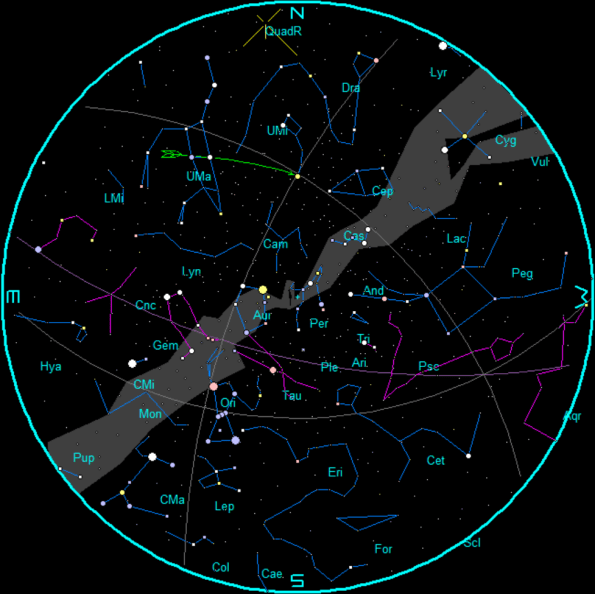
Star Chart for January 2016. Created using my LookingUp program. To enlarge in Firefox Right-click on image then click View Image.
The planets and stars are plotted for the 15th at 9 p.m. EST. That is chart time. Note, Traverse City is located 45 minutes behind our time meridian. To duplicate the star positions on a planisphere you may have to set it to 45 minutes earlier than the current time.
Evening astronomical twilight ends at 6:22 p.m. EST on January 1st, increasing to 6:55 p.m. EST on the 31st.
Morning astronomical twilight starts at 7:09 a.m. EST on January 1st, and decreasing to 6:57 a.m. EST on the 31st.
Add a half hour to the chart time every week before the 15th and subtract and hour for every week after the 15th.
For a list of constellation names to go with the abbreviations click here.
- Pointer stars at the front of the bowl of the Big Dipper point to Polaris the North Star.
- QuadR is the Quadrantid meteor shower radiant
Calendar of Planetary Events
Credit: Sky Events Calendar by Fred Espenak and Sumit Dutta (NASA’s GSFC)
To generate your own calendar go to http://eclipse.gsfc.nasa.gov/SKYCAL/SKYCAL.html
Times are Eastern Time. Some additions made to aid clarity.
     Date   Local      Event
            Time EST
Jan  01  Fr            Venus: 37.9° W
     02  Sa 12:30 a.m. Last Quarter
     02  Sa  6:53 a.m. Moon Apogee: 404300 km
     02  Sa  7:59 p.m. Perihelion: 0.9833 AU
     03  Su  1:45 p.m. Moon-Mars: 1.6° S
     04  Mo  3:01 a.m. Quadrantid Shower: ZHR = 120
     06  We  6:57 p.m. Moon-Venus: 3.3° S
     06  We 11:57 p.m. Moon-Saturn: 3.6° S
     07  Th  6:32 a.m. Venus-Antares: 6.4° N
     08  Fr 12:56 p.m. Moon South Dec.: 18.4° S
     09  Sa  2:42 a.m. Venus-Saturn: 0.1° N
     09  Sa  8:30 p.m. New Moon
     14  Th  9:02 a.m. Mercury Inferior Conj.
     14  Th 10:48 a.m. Moon Descending Node
     14  Th  9:10 p.m. Moon Perigee: 369600 km
     16  Sa  6:26 p.m. First Quarter
     19  Tu  9:16 p.m. Moon-Aldebaran: 0.5° S (Occultation*)
     21  Th 11:41 a.m. Moon North Dec.: 18.4° N
     23  Sa  8:46 p.m. Full Moon
     26  Tu 12:10 a.m. Moon-Regulus: 2.8° N
     27  We  6:58 p.m. Moon Ascending Node
     27  We  8:14 p.m. Moon-Jupiter: 1.6° N
     30  Sa  4:10 a.m. Moon Apogee: 404600 km
     31  Su 10:28 p.m. Last Quarter
Feb  01  Mo            Venus: 31.4° W
* Occultation of Aldebaran For the Grand Traverse Area ± 1-2 minutes:
Disappearance 9:06 p.m. Reappearance 10:25 p.m. I’ll have more information on the 19th.
Occultation Map
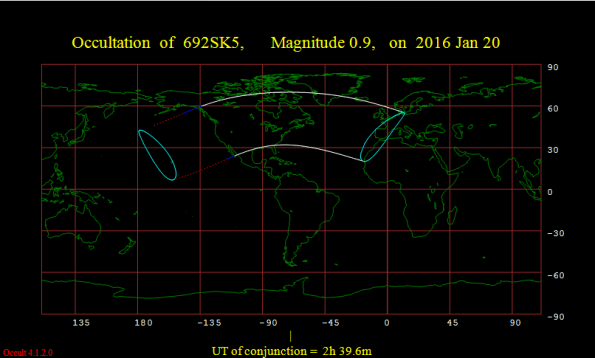
Occultation visibility map for January 20, 2016 (UT). Credit IOTA/Occult4 program.
Estimating occultation timings for your location
I used Cartes du Ciel the free software that I have a link to on the right. Make sure that the program is set for topocentric positions under Setup/Solar System. And you have entered your position under Setup/Observatory. You can find your location in Google Earth, or your GPS device or smart phone.
You can also use Stellarium. Just make sure the Moon is normal sized.
In both programs you can lock the Moon or Aldebaran in the center of the screen Pick a time in advance of the occultation and using the set time window walk the star towards the Moon, mark the time. Then walk the star out from the Moon and record the reappearance time. That’s it.
This should work with other planetarium programs too.
For better accuracy go to the International Occultation Timing Association (IOTA) website. Download and install their Occult4 program for Windows computers. Follow the instructions. When I ran the program for my location, the location I use for Interlochen/Traverse City (Since I live approximately half-way between the two). I got results within a half-minute of the IOTA Occult4 program results. So the approximation method using these planetarium programs is valid.
Comet C/2013 US10 (Catalina)
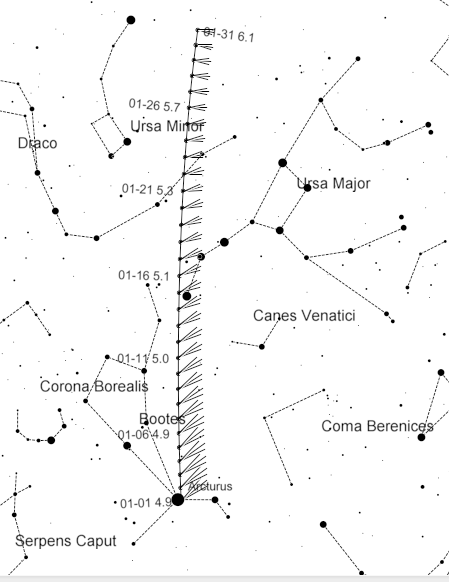
The track of Comet C/2013 US10 (Catalina) for January 2016. Created using Cartes du Ciel (Sky Charts).
The comet is roughly one magnitude fainter than given. Comet is plotted every day at 4 a.m. EST (9 hr UT) with the date and magnitude labeled every 5th day. According to the brightness graph the comet began to under perform in brightness back in September, however, according to a new brightness formula the comet may increase in brightness by a magnitude by late February when it will be well placed for viewing all night. To monitor the brightness reports from observers go to http://www.aerith.net/comet/catalog/2013US10/2013US10.html.
xxxvvvvv
12/31/2015 – Ephemeris – Next year’s big astronomical event
Ephemeris for New Years Eve, Thursday, December 31st. The Sun will rise at 8:20. It’ll be up for 8 hours and 51 minutes, setting at 5:11. The Moon, 2 days before last quarter, will rise at 11:56 this evening.
The big astronomical event of 2016 will be the passage of the planet Mercury across the face of the Sun on May 9th. This type of event is called a transit. Back in 2012 we saw the transit of Venus, an extremely rare event that won’t be repeated for over 100 years. Transits of Mercury are not so rare. The next will be in three years. It also will not be as impressive as a transit of Venus because Mercury is a tiny planet and looks smaller than a small sunspot on the Sun. It cannot be seen without a solar filtered telescope. The actual Transit will last about 7 ½ hours. Should it be clear for all or part of that time members of the Grand Traverse Astronomical Society will be at two locations to show the event.
Times are for the Traverse City/Interlochen area of Michigan. They may be different for your location.
Addendum
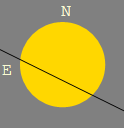
Path of Mercury across the face of the Sun from east to west. Credit IOTA/Occult4
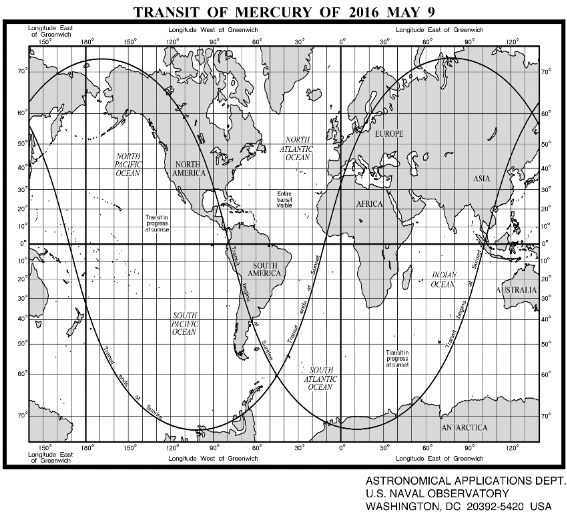
Transit of Mercury visibility map. Click on the Image to view a higher resolution pdf. Credit; Astronomical Almanac Online/USNO
       TRANSIT OF MERCURY GEOCENTRIC PHASES
                                              Position
                                   UT          Angle
                               d  h  m   s        °
Ingress, exterior contact  May 9 11 12 17.6     83.2
Ingress, interior contact      9 11 15 29.5     83.5
Least angular distance         9 14 57 25.3    153.8
Egress, interior contact       9 18 39 12.8    224.1
Egress, exterior contact       9 18 42 24.8    224.4

Least angular distance from the center of the Sun: 5' 18".5
Position angle:  Contact point measured counterclockwise from the north
   point on the face of the Sun.
UT = Universal time A.K.A. Greenwich Mean Time (GMT or Zulu).
   Subtract 4 hours to obtain Eastern Daylight Time (EDT) for
   most of Michigan.  In short the transit will span from
   7:12 a.m. to 2:42 p.m.
Above time-table is from Astronomical phenomena for 2016 Credit: USNO/UKHO
12/30/2015 – Ephemeris – Last look at the bright planets for this year
Ephemeris for Wednesday, December 30th. The Sun will rise at 8:19. It’ll be up for 8 hours and 50 minutes, setting at 5:10. The Moon, 3 days before last quarter, will rise at 10:58 this evening.
Let’s check out the whereabouts of the bright naked eye planets. Mercury moved to its greatest separation from the Sun Monday night. It will be visible very low in the southwest before it sets at 6:42 p.m. in the west-southwest. In the morning sky there are four bright planets. Jupiter will be the first to rise, actually at 11:23 p.m., in the east. Tomorrow it will be just left of the Moon. Mars will rise next at 2:27 a.m. also in the east. It’s left of the bright star Spica. Venus will rise at 5:11 a.m. in the east-southeast. Saturn will rise at 6:10 a.m. in the east-southeast. Comet Catalina is a binocular object just below the bright star Arcturus, which is pointed to by the arc of the handle of the Big Dipper.
Times are for the Traverse City/Interlochen area of Michigan. They may be different for your location.
Addendum
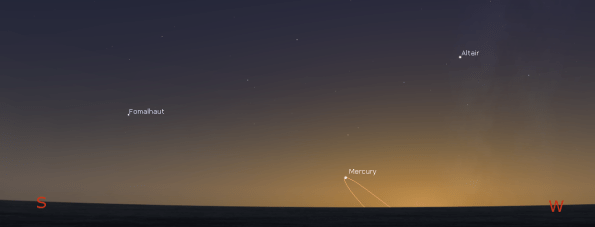
Mercury at 6 p.m., 50 minutes after sunset, December 30, 2015. It may be visible as early as 5:30. Binoculars will help. Created using Stellarium.
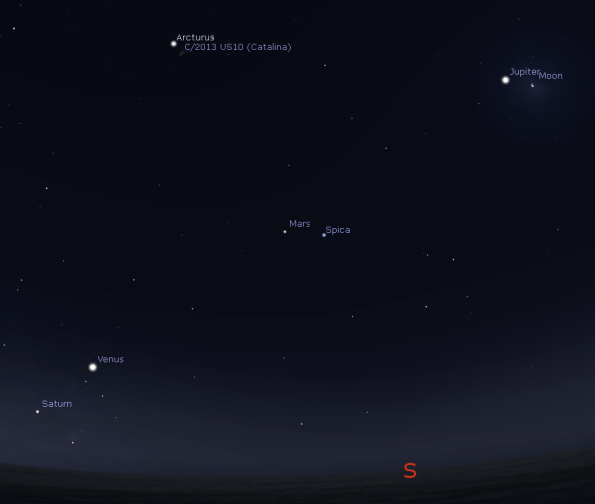
The morning planets, Jupiter, Mars, Venus and Saturn, plus Comet Catalina at 7 a.m. December 31, 2015. Created using Stellarium.
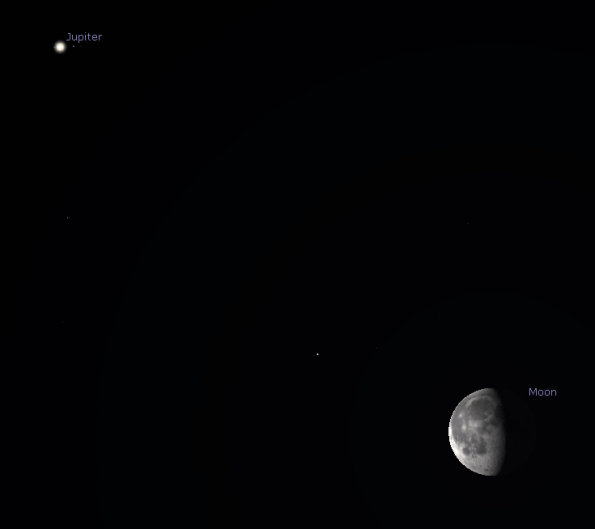
Jupiter and the Moon tomorrow morning December 31, 2015 at 7 a.m. Created using Stellarium.
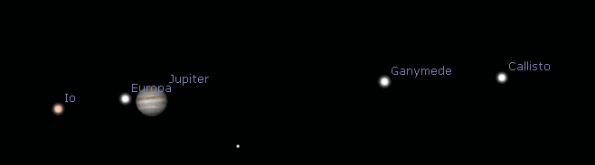
Telescopic view of Jupiter at 7 a.m. December 31, 2015. Created using Stellarium.
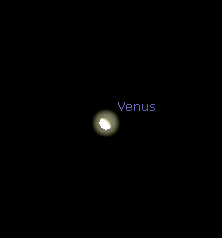
Telescopic view of Venus at 7 a.m. December 31, 2015. Created using Stellarium.
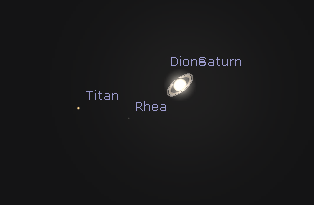
Telescopic view of Saturn at 7 a.m. December 31, 2015. The satellites would be pretty much invisible except for Titan with Saturn low in the sky in twilight. Created using Stellarium.
The three planet telescopic views are shown to the same scale, that is seen with the same magnification.
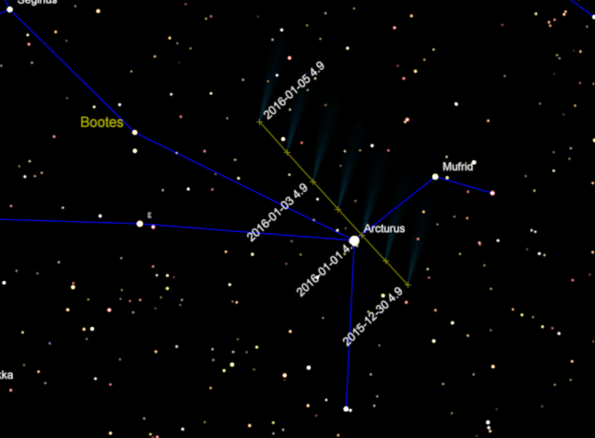
Comet Catalina’s path for the next week. Note the magnitudes for the comet are about 1 magnitude too bright. It will take binoculars or a small telescope to spot the comet which will not show a tail visually. Created using Cartes du Ciel (Sky Charts)..
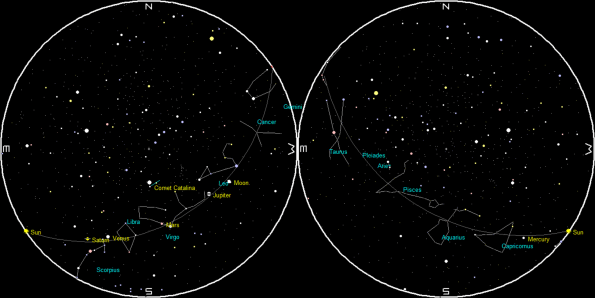
This is a chart showing the sunrise and sunset skies for December 30, 2015 showing the location of the planets, the Moon and Comet Catalina at that time. Created using my LookingUp program.
Several of the images above are shown smaller than actual size. Image expansion lately hasn’t worked. If you are using Firefox, right-click on the image, and then click on View Image.
12/29/2015 – Ephemeris – Some space triumphs of 2015
Ephemeris for Tuesday, December 29th. The Sun will rise at 8:19. It’ll be up for 8 hours and 50 minutes, setting at 5:10. The Moon, half way from full to last quarter, will rise at 9:58 this evening.
This past year had several important events. Perhaps the biggest was the flyby of Pluto and its moons July 14th By the New Horizons spacecraft. The transmission of data and images will continue for most of 2016, but what has been revealed has been spectacular if puzzling. In other space news Blue Origin landed their New Shepard rocket vertically after sending it straight up 60 miles. In June the SpaceX Falcon 9 blew up while attempting to send its 7th resupply Dragon capsule to the International Space Station. Eight days ago The Falcon 9 returned to flight orbiting 11 satellites for Orbocomm, and flew the booster from over 100 miles up and 100 miles out over the Atlantic to land upright on its designated landing pad back at the cape.
Times are for the Traverse City/Interlochen area of Michigan. They may be different for your location.
Addendum
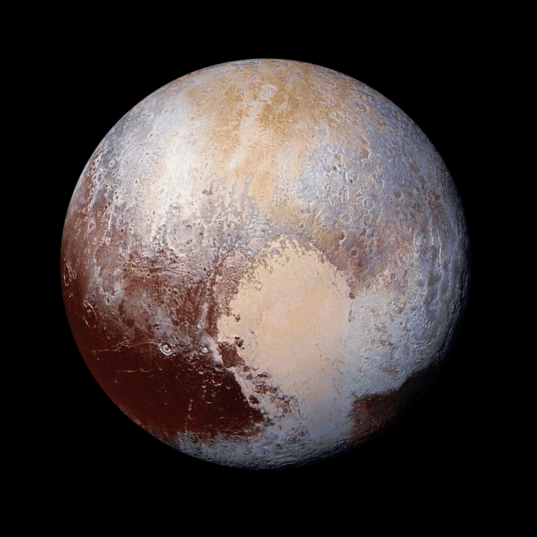
Enhanced color portrait of Pluto by the New Horizons spacecraft. Credit: NASA/JHUAPL/SwRI.

Blue Origin New Shepard rocket, with landing legs expended about to land. Credit: Blue Origin.
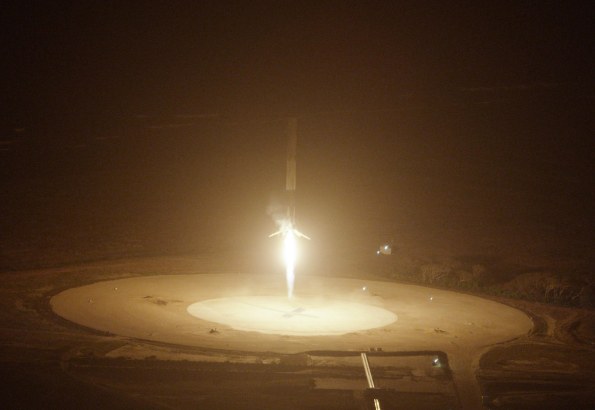
First stage of the SpaceX Falcon 9 descending on its center rocket engine to the center of the main landing pad at Cape Canaveral. Credit: SpaceX.
These weren’t the only highlights of 2015. Having only 45 seconds to devote to the story, I picked the three most important events. I consider the reuseability of rockets to be the Holy Grail of reducing the cost to access to space. The Space Shuttle was a partial, but ultimately failed solution. SpaceX had the most difficult task in refurbishment and reuse because the first stage had to endure a supersonic reentry, though it didn’t need a heat shield. We’ll have to see if the cost of recycling rocket boosters is cheaper than building one from scratch.
12/28/2015 – Ephemeris – Mercury is at its greatest penetration into the evening tonight
Ephemeris for Monday, December 28th. The Sun will rise at 8:19. It’ll be up for 8 hours and 49 minutes, setting at 5:09. The Moon, 3 days past full, will rise at 8:57 this evening.
Later this evening the tiny planet Mercury will appear at its greatest separation from the Sun. This is a little early to be viewing Mercury in the evening. Generally the best time to be able to view Mercury, when it’s east of the Sun, in the evening is from late winter into spring. Mercury’s event is called its greatest eastern elongation from the Sun. The sky may be dark enough in the west to start looking for Mercury 20 minutes after sunset. That’s about 5:30 when Mercury will be 9 degrees above the true horizon and due southwest. For the next half hour Mercury will drop to 5 degrees altitude, but the skies will be darker. Mercury will set at 6:38, and you will lose it before that. Mercury has always been a difficult planet to view from the Earth.
Times are for the Traverse City/Interlochen area of Michigan. They may be different for your location.
Addendum
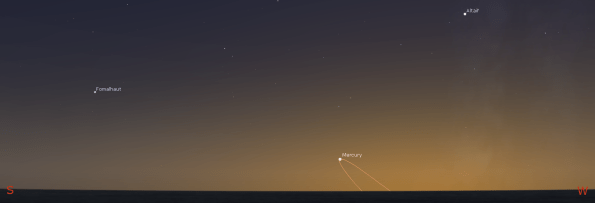
Mercury at greatest eastern elongation (19.7 degrees) from the Sun. 6 p.m. December 28, 2015. Created using Stellarium.
12/25/2015 – Ephemeris – This year’s Christmas Stars
Merry Christmas. This is Bob Moler with Ephemeris for Christmas Day, Friday, December 25th. The Sun will rise at 8:18. It’ll be up for 8 hours and 48 minutes, setting at 5:07. The Moon, at full today, will rise at 5:53 this evening.
It’s Christmas morning, and if it’s clear the full Moon will low in the west. Venus the brilliant Morning Star will be low in the southeast, Jupiter, second only to Venus in brightness will appear half way up to the zenith in the south. Venus or perhaps Jupiter, take your pick can be this year’s Christmas Star. The bright stars in the evening sky tonight are those of winter, that have looked down on us in their familiar patterns for millennia. The bright planets and stars, or even a brilliant supernova, or the one at the top of our Christmas tree, cannot be, according to those astronomers who accept the Star of Bethlehem as a real phenomenon, as what the star was. The leading contenders for the Star have always involved two planets.
Times are for the Traverse City/Interlochen area of Michigan. They may be different for your location.
Addendum
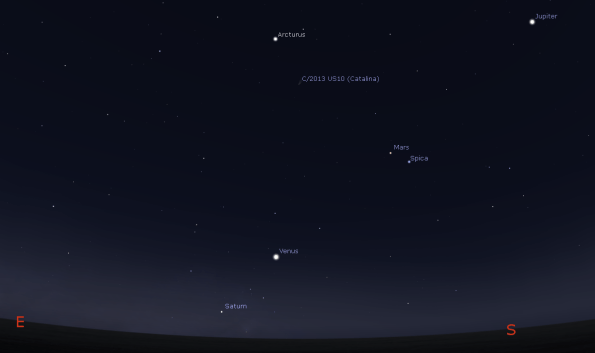
The morning planets, Jupiter, Mars, Venus and Saturn, plus Comet Catalina at 7 a.m. . Created using Stellarium.
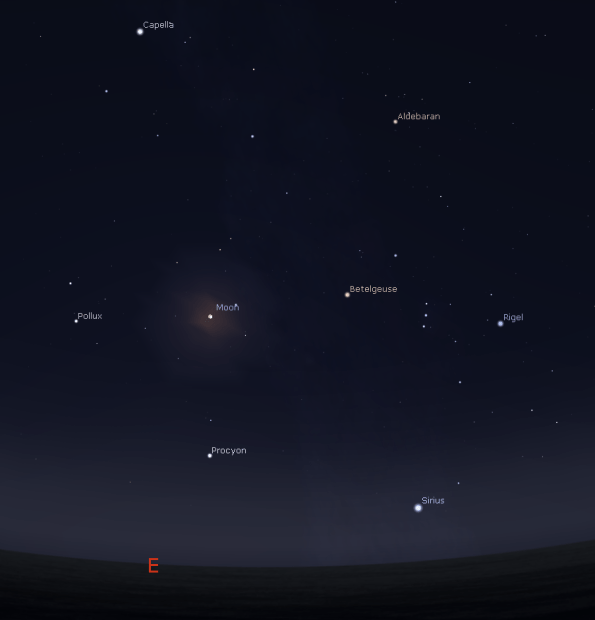
The bright stars of Christmas Night and the full Moon. Created using Stellarium.
12/24/2015 – Ephemeris – Jupiter and Venus the “Star” of Bethlehem?
Ephemeris for Christmas Eve, Thursday, December 24th. The Sun will rise at 8:18. It’ll be up for 8 hours and 48 minutes, setting at 5:06. The Moon, 1 day before full, will set at 8:02 tomorrow morning.
Last year August and earlier this year in June we had a near repeat of two very close conjunctions of Jupiter and Venus that occurred in 3 and 2 BC. These two conjunctions spaced by a month more than the human gestation period and seen against the constellation of Leo the lion, symbol of Judah could have brought the Magi, who were Persian astrologer-priests to Jerusalem, capital of Judea. The events could have signified the them the birth of a king of Judea. It was the interpretation of the scriptures by the scribes that actually sent them to Bethlehem. This version of the Star of Bethlehem seems to be the one that’s being accepted more and more by those who believe the Star has a physical reality.
Times are for the Traverse City/Interlochen area of Michigan. They may be different for your location.
Addendum
Jupiter and Venus Conjunctions August 2014 and June 2015
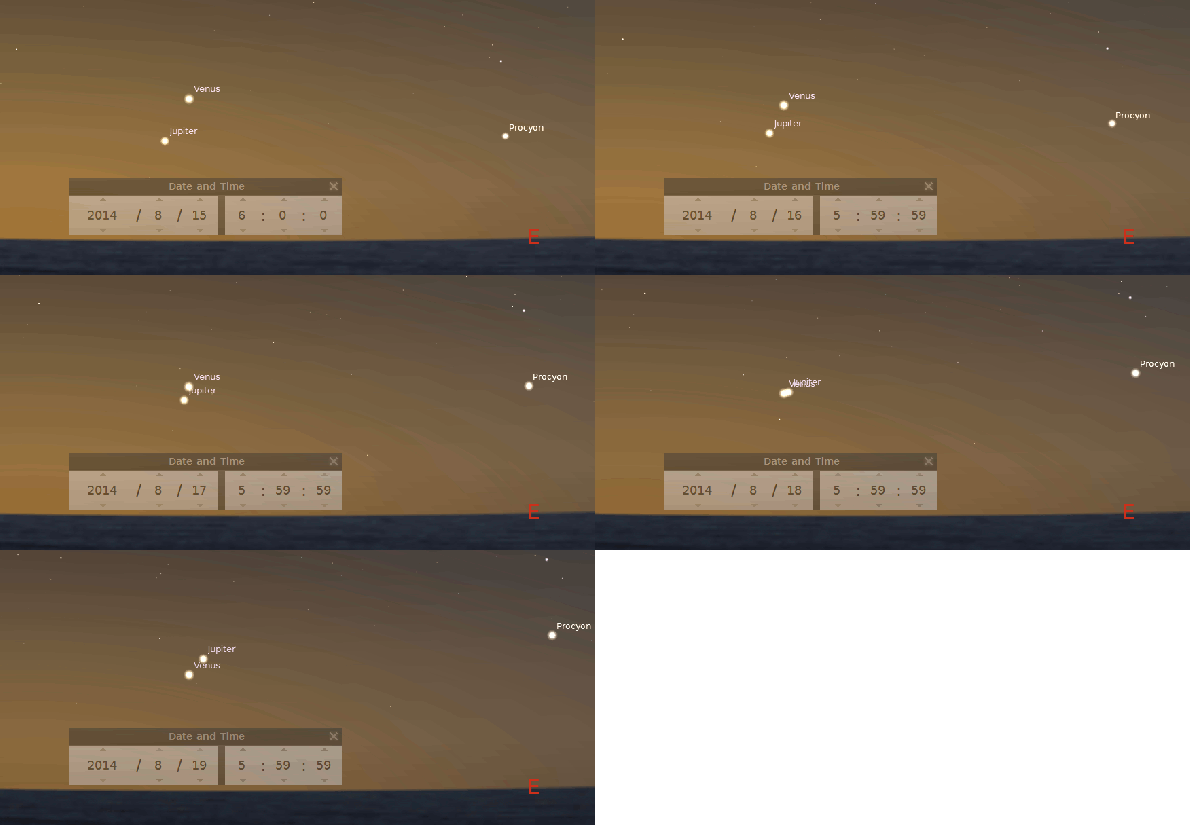
Watch Jupiter and Venus approach each other and separate. From August 15 to August 19, 2018. Created using Stellarium and GIMP.
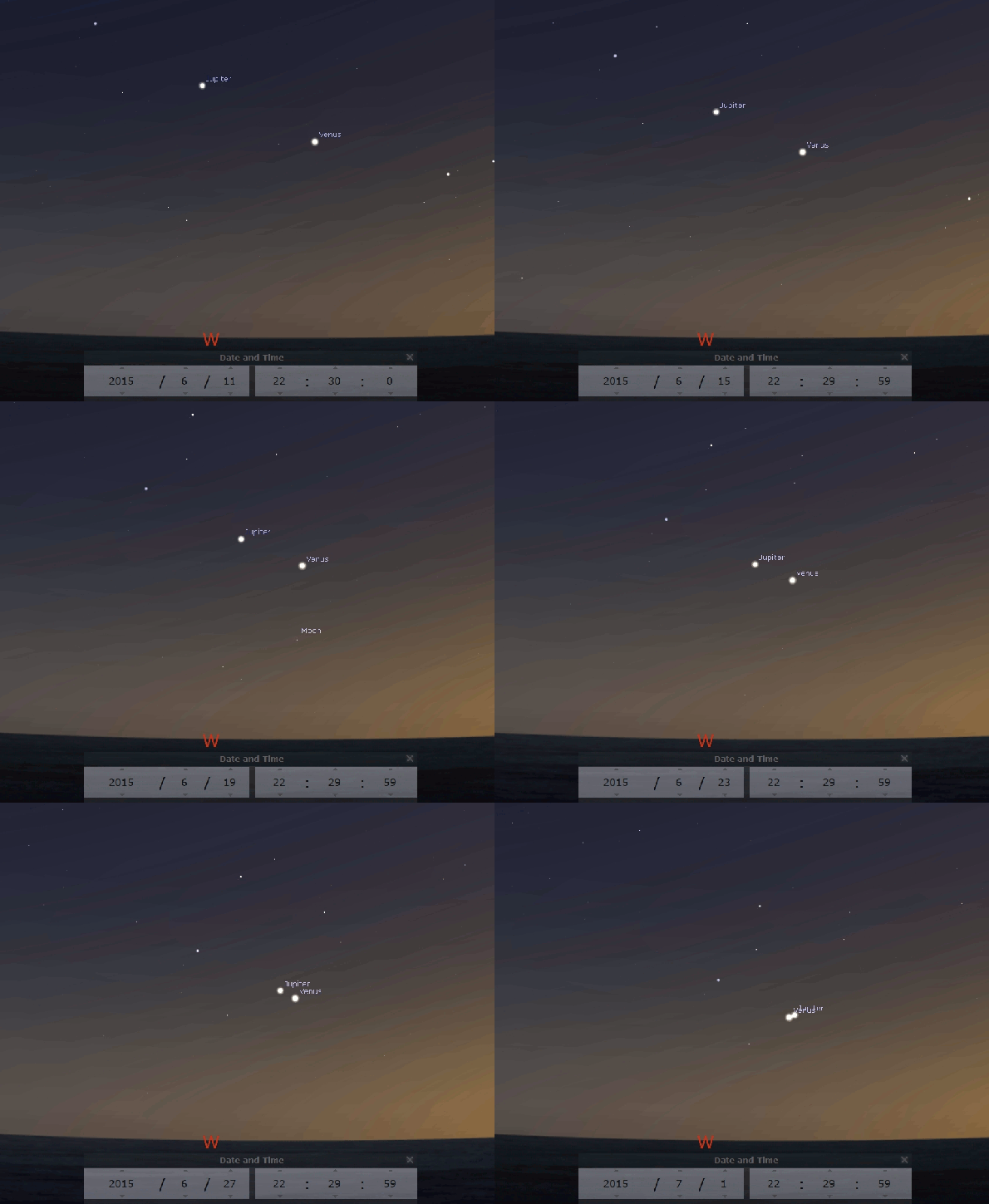
Jupiter-Venus approach animation June 11 to July 1, 2015 at 10:30 p.m. Created using Stellarium and GIMP. Click on image to enlarge.
Jupiter and Venus Conjunctions August 3 BC and June 2 BC
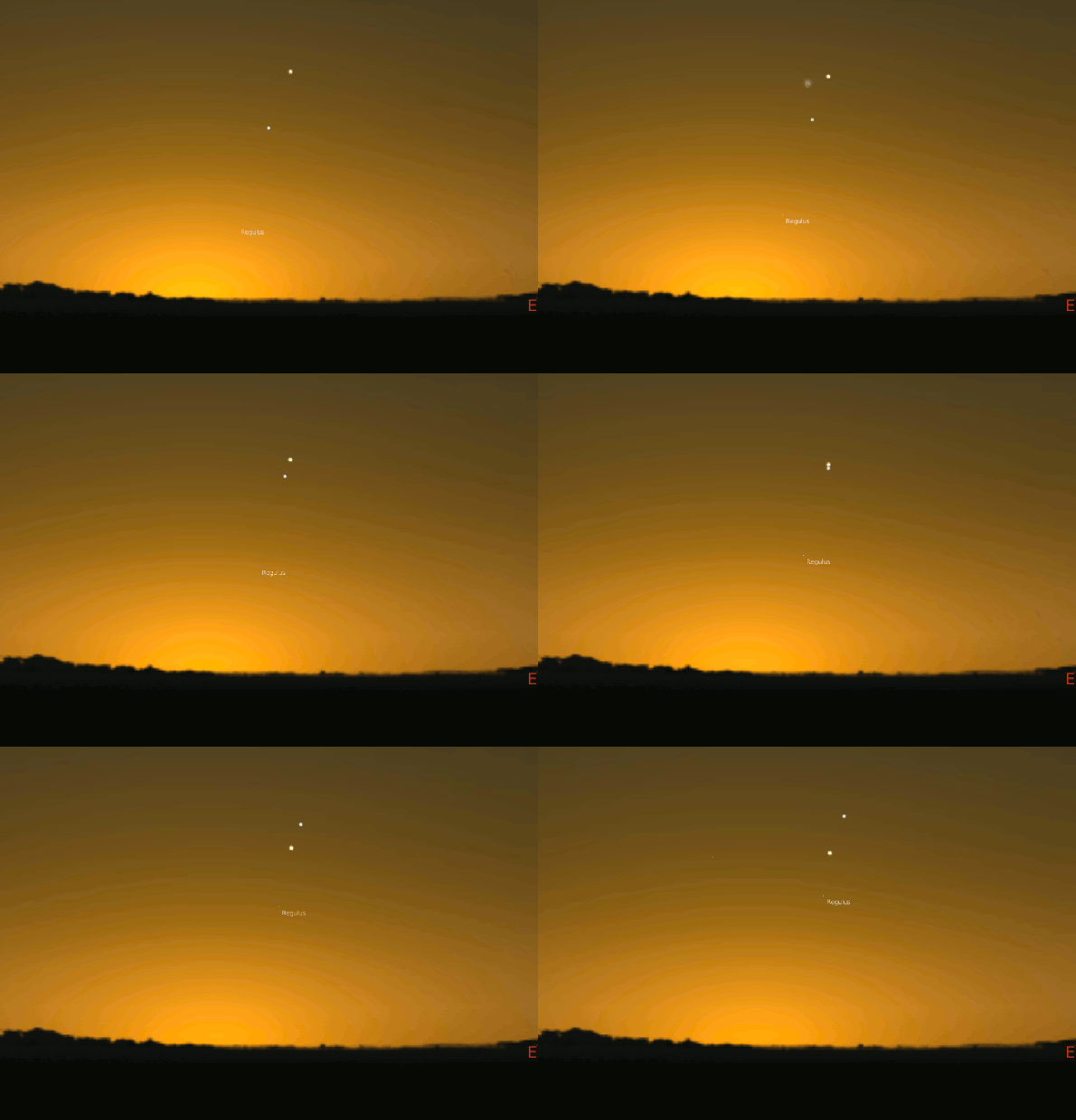
Animation of the Jupiter-Venus conjunction of August 3, 3 BC. in the morning twilight. Created using Stellarium.
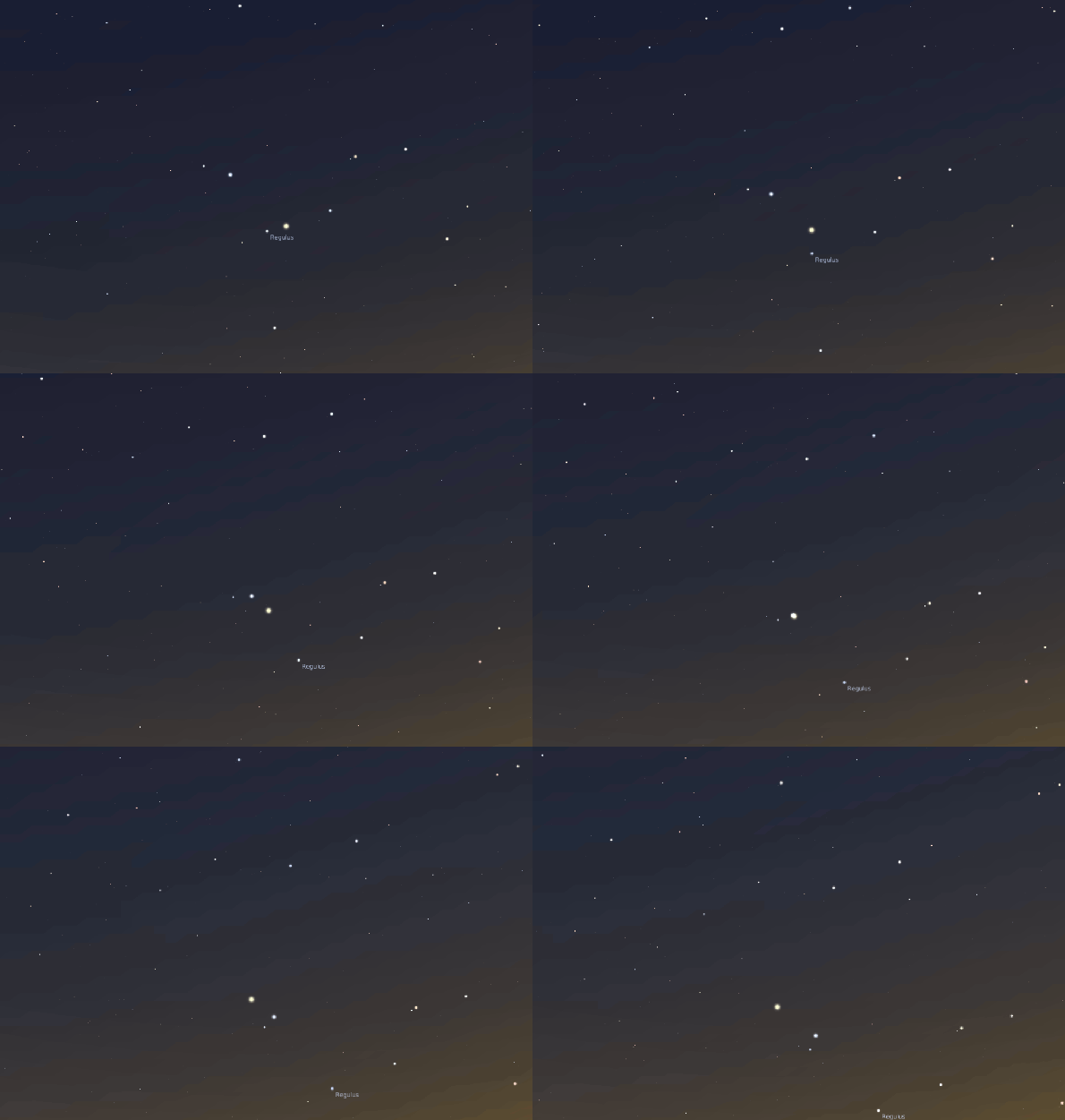
June of 2 BC just after sunset Jupiter and Venus again cross paths. Created using Stellarium.
12/23/2015 – Ephemeris – Only Mercury is making a stand in the evening sky
Ephemeris for Wednesday, December 23rd. The Sun will rise at 8:17. It’ll be up for 8 hours and 48 minutes, setting at 5:05. The Moon, 2 days before full, will set at 7:04 tomorrow morning.
Let’s check out the whereabouts of the bright naked eye planets. Mercury is becoming marginally visible very low in the southwest before it sets at 6:24 p.m. in the west-southwest. In the morning sky there are four bright planets. Jupiter will be the first to rise, actually at 11:49 p.m., in the east. Mars will rise next at 2:33 a.m. also in the east, Venus will rise at 5 a.m. in the east-southeast. Even as Venus and Jupiter separate Mars still lies almost halfway between the two. Don’t confuse Mars with the star Spica which is brighter and below right of it. Saturn will rise at 6:30 a.m. in the east-southeast. Comet Catalina is a binocular object about three widths of a fist held at arm’s length directly above Venus at 6 a.m.
Times are for the Traverse City/Interlochen area of Michigan. They may be different for your location.
Addendum
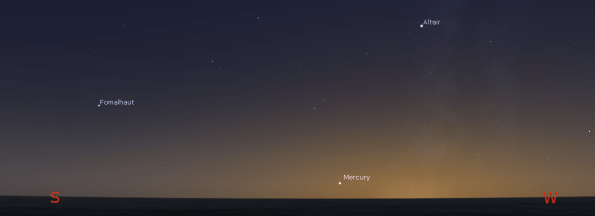
Mercury at 6 p.m., 55 minutes after sunset, December 23, 2015. It may be visible as early as 5:30. Binoculars will help. Created using Stellarium.
The morning planets, Jupiter, Mars, Venus and Saturn, plus Comet Catalina at 7 a.m. December 24, 2015. Created using Stellarium.
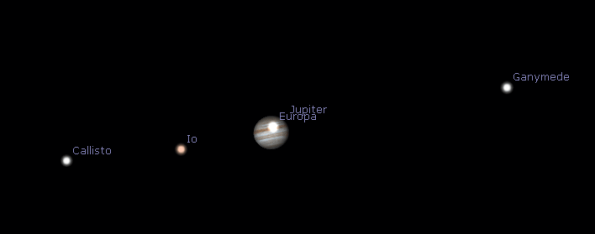
Telescopic view of Jupiter at 7 a.m. December 24, 2015. Note Europa is in transit of Jupiter at that time and would pretty much be invisible. Created using Stellarium.
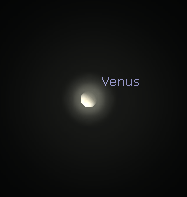
Telescopic view of Venus at 7 a.m. December 24, 2015. Created using Stellarium.
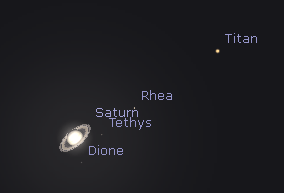
Telescopic view of Saturn at 7 a.m. December 24, 2015. The satellites would be pretty much invisible in the twilight. Created using Stellarium.
Note that the planets shown as they would be seen in telescopes at the same magnification.
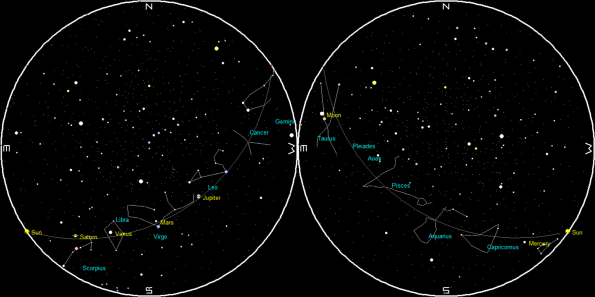
This is a chart showing the sunrise and sunset skies for December 23, 2015 showing the location of the planets and the Moon at that time. Created using my LookingUp program.
A note on enlarging the pictures: Apparently WordPress is not able to enlarge pictures by clicking on them. However if you are using Firefox and you right-click on an image, select View Image to show the image up to full size.

