Archive
Ephemeris for the real Columbus Day for once, Monday, October 12th. The Sun will rise at 7:54. It’ll be up for 11 hours and 9 minutes, setting at 7:03. The Moon is new today, and won’t be visible.
On Columbus’ 4th voyage to the Caribbean he was stranded on Jamaica. For a while the natives of the island fed Columbus and his men. However due to the thievery of some of his crew, these people no longer trusted Columbus any refused them any more supplies. Columbus consulted a table of eclipses and found that a lunar eclipse was to occur on February 29th that year (1504), and that at his location the moon would rise in eclipse. He went to the leader of the people and said that they had displeased their god by refusing his crew food, and that the god would turn the Moon red in anger. It worked. As Arthur C. Clarke once wrote: “Any sufficiently advanced technology is indistinguishable from magic.”
Times are for the Traverse City/Interlochen area of Michigan. They may be different for your location.
Addendum
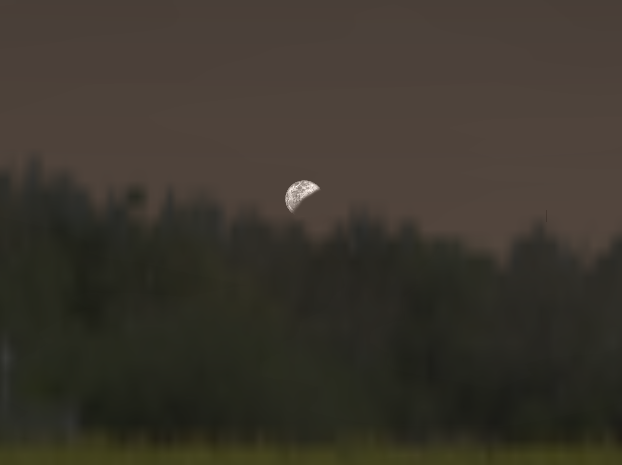
The moon rising from Jamaica February 29, 1504 as shown by Stellarium with some additional shadow darkening by myself.
Tomorrow I’ll look at what Columbus got wrong… Beside being lost.
I note for the record that Stellarium calendar dating includes what I call the Gregorian discontinuity. It drops the 10 days between October 4, 1582 and October 15th, which was the adjustment the Gregorian calendar makes to move ahead the actual vernal equinox from March 11 to the 21st. Christian churches always use the tabular value of March 21 as the vernal equinox for the calculation of the date of Easter. The old Julian calendar let that slip back about 3/4 of a day every century.
10/09/2015 – Ephemeris – The Moon is seen with the morning planets this weekend
Ephemeris for Friday, October 9th. The Sun will rise at 7:50. It’ll be up for 11 hours and 18 minutes, setting at 7:09. The Moon, 3 days before new, will rise at 5:31 tomorrow morning.
This morning up to about 7:15 look to the east at the crescent Moon and the planets. The Moon is between Venus above and Jupiter just below and to the left. Mars will be a bit above and just left of the Moon. Mercury will be farther below the moon to the left and about 22 degrees below the Moon (that’s about twice the width of a fist held at arm’s length.) By Sunday morning the thin sliver of the Moor will be near Mercury with the tiny planet just above left of the Moon. Next Thursday the 15th, Mercury will climb to its greatest angular distance or elongation west of the Sun. It will be getting a bit brighter for a while because even though it’s moving away from us, its phase will be getting fuller. Remember it’s illuminated by the sun.
Times are for the Traverse City/Interlochen area of Michigan. They may be different for your location.
Addendum
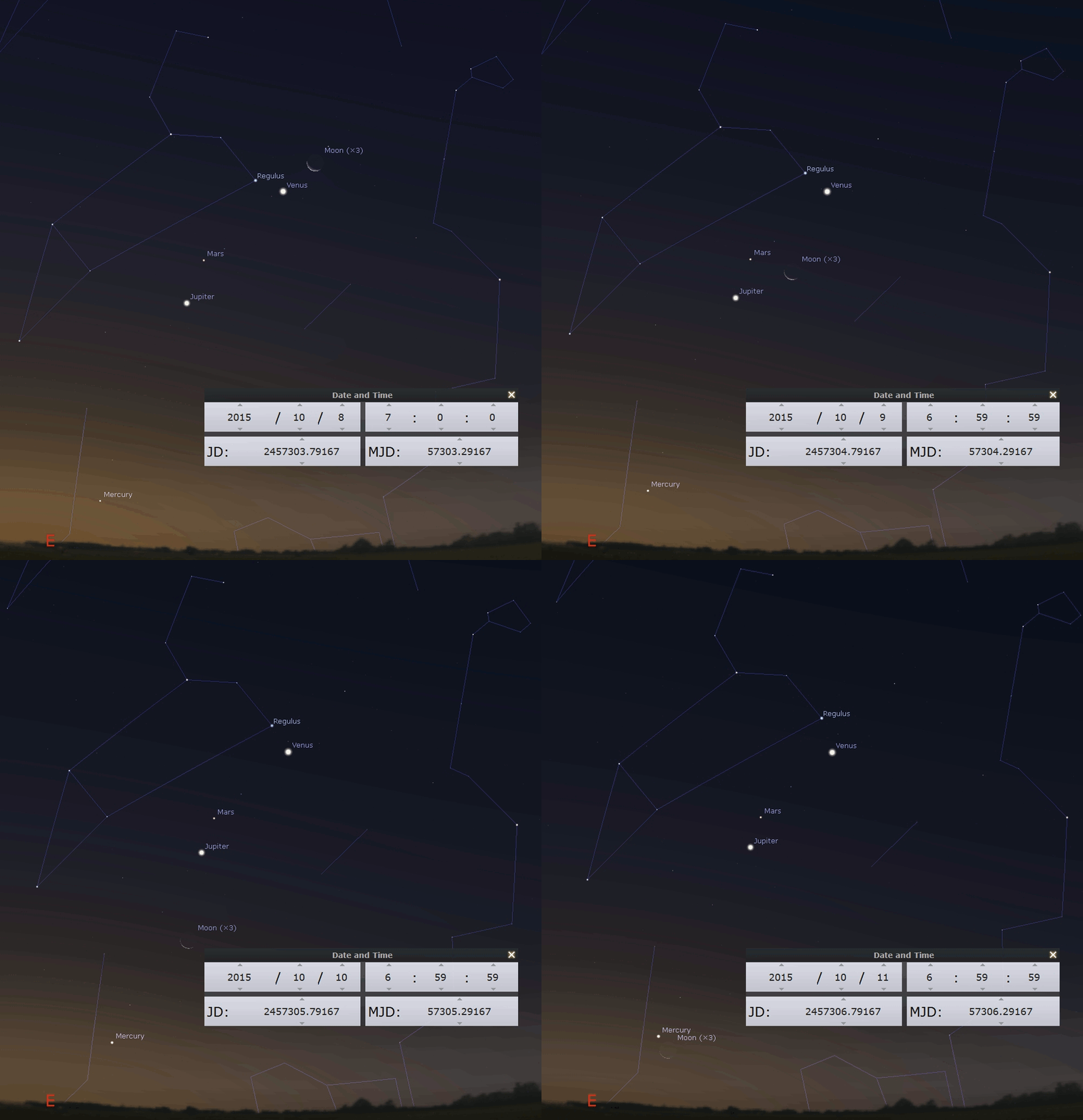
Morning planet animation for 7 a.m. October 8 to 11, 2015. Created using Stellarium and GIMP.
10/07/2015 – Ephemeris – Saturn lingers in the evening, but the planet action is in the morning
Ephemeris for Wednesday, October 7th. The Sun will rise at 7:47. It’ll be up for 11 hours and 24 minutes, setting at 7:12. The Moon, 3 days past last quarter, will rise at 3:34 tomorrow morning.
Lets see what’s happening with the bright planets. Saturn is alone in the evening sky spotted by 8:30 p.m. low in the southwestern sky near the bright star Antares to its left. Antares has a reddish hue, while Saturn is brighter and yellowish. Both these colors are enhanced by being low to the horizon. Saturn will set at 9:22 p.m. The rest of the planet action in the morning sky is getting interesting. Brilliant Venus, the morning star, will rise at 3:58 a.m. a bit north of east. Tomorrow it will be at its greatest separation from the sun and start to fall back. The Moon will be near Venus tomorrow morning. The star Regulus is near Venus. Much dimmer Mars, brighter Jupiter and finally Mercury will rise at 4:35, 4:57 and 6:37 respectively.
Times are for the Traverse City/Interlochen area of Michigan. They may be different for your location.
Addendum
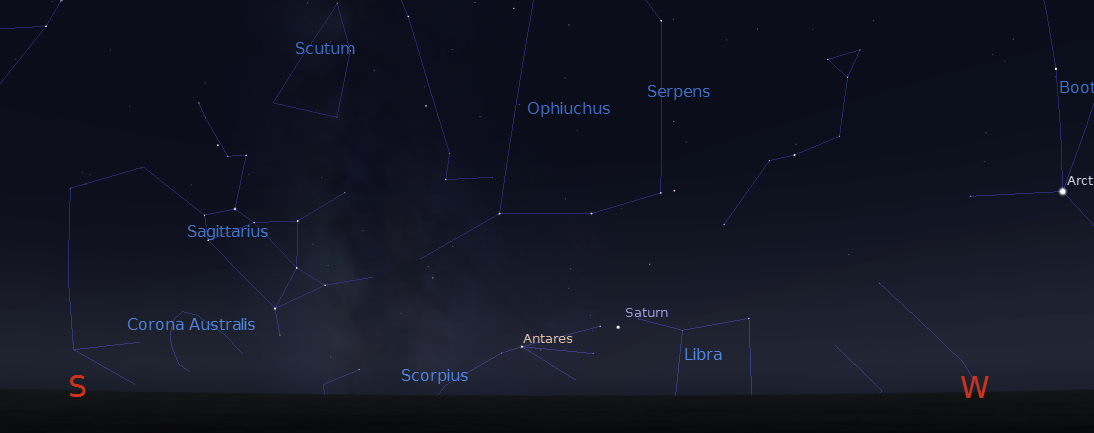
Saturn and setting zodiacal constellations at 8:30 .m. on October 7, 2015. Create using Stellarium.
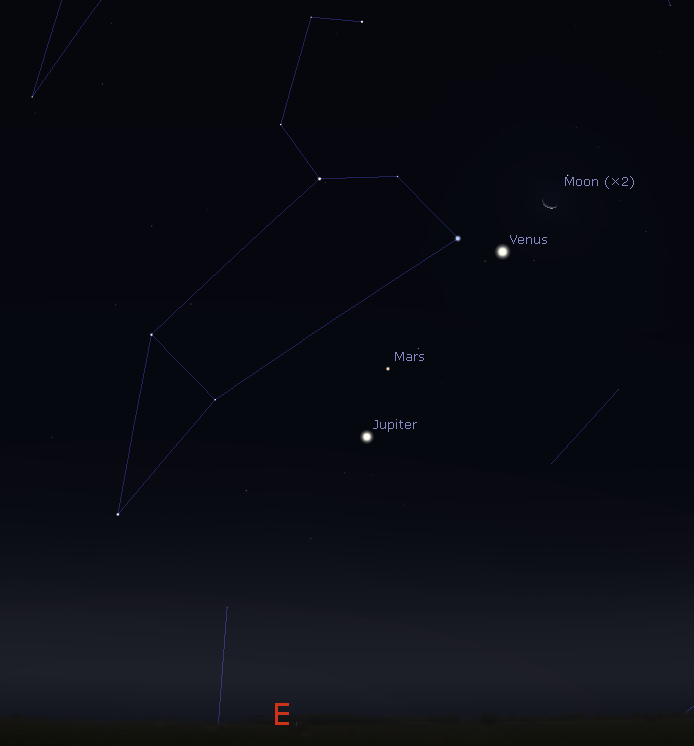
Morning Planets and the Moon at 6:30 a.m. on October 8, 2015. The Moon is shown twice actual size. Created using Stellarium.
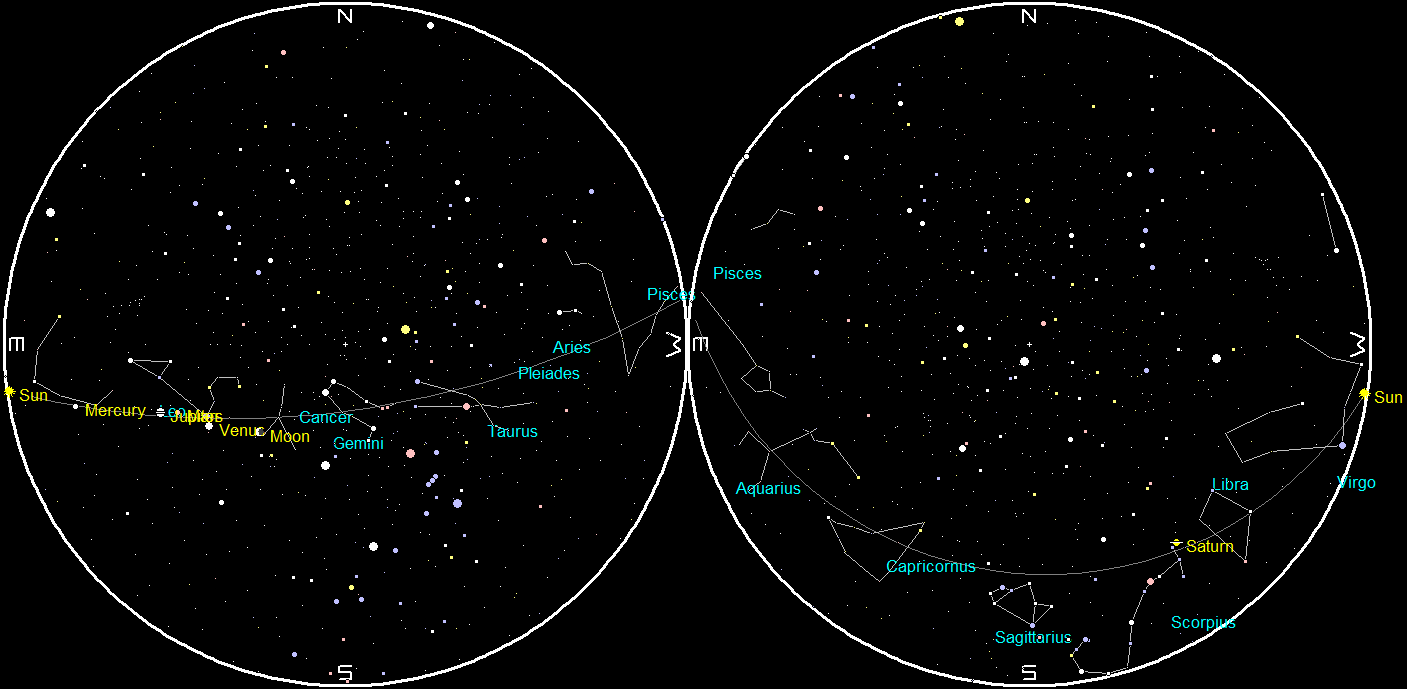
This is a chart showing the sunrise and sunset skies for October 7, 2015 showing the location of the planets and the Moon at that time. Created using my LookingUp program. Click on the image to enlarge.
10/06/2015 – Ephemeris – Deneb our home-town star
Ephemeris for Tuesday, October 6th. The Sun will rise at 7:46. It’ll be up for 11 hours and 27 minutes, setting at 7:14. The Moon, 2 days past last quarter, will rise at 2:36 tomorrow morning.
We, here in Traverse City, Michigan have a pretty unique relation to the bright star Deneb, as is any location near 45 degrees north latitude. Tonight at 9:23 Deneb will be three-quarters of a degree due north of the zenith. Due north means that it’s on our meridian, a line you may remember from your school days. For astronomers it passes from the north point on the horizon, through the overhead point or zenith to the south point on the horizon. Also due to our latitude Deneb is circumpolar, meaning that it doesn’t quite set on a clean northern horizon. Deneb and 56 other stars are used for celestial navigation, which is still taught in case the GPS system goes down due to solar or enemy action.
Times are for the Traverse City/Interlochen area of Michigan. They may be different for your location.
Addendum
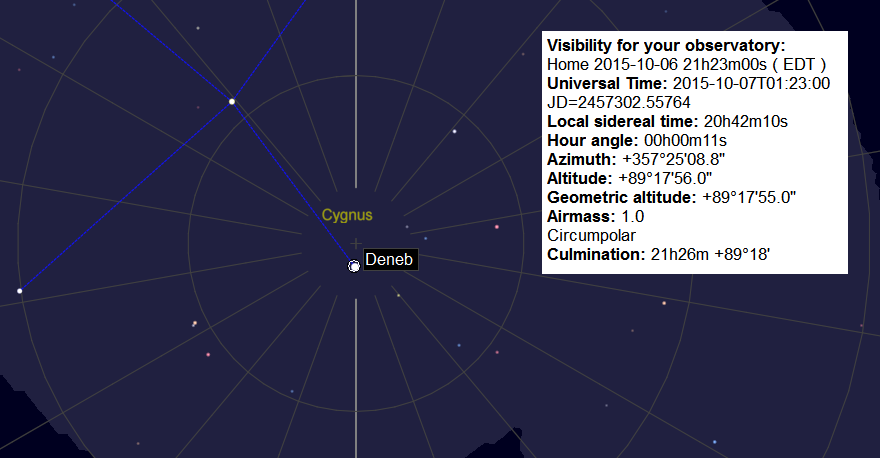
Deneb nearly at the zenith from Traverse City. Created using Cartes du Ciel.
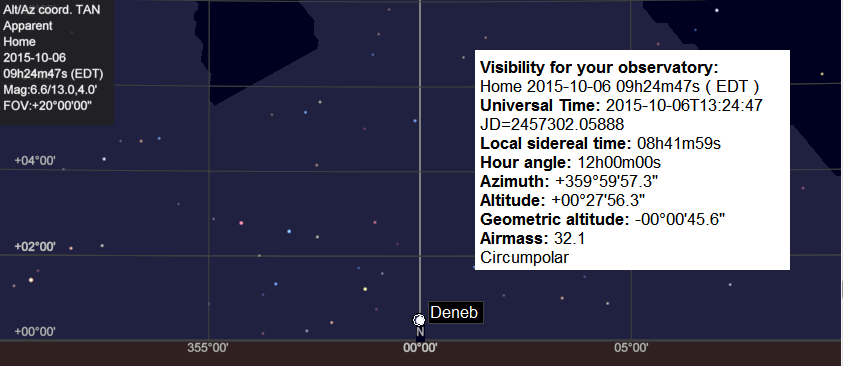
Deneb is close to the horizon due north. Created using Cartes du Ciel.
10/05/2015 – Ephemeris – The loneliest star
Ephemeris for Monday, October 5th. The Sun will rise at 7:45. It’ll be up for 11 hours and 31 minutes, setting at 7:16. The Moon, 1 day past last quarter, will rise at 1:38 tomorrow morning.
There’s a bright and lonely star that appears low in the south for only seven and a half hours a night on autumn evenings. It’s appearance is a sign as sure as the falling leaves that autumn is here At 10 p.m. tonight it’s low in the south-southeast. The star’s name is Fomalhaut, which means fish’s mouth. This is appropriate because it’s in the constellation of Piscis Austrinus, the southern fish. At our latitude it’s the fish that got away, because Fomalhaut appears to be quite alone. The dimness of the constellation’s other stars and location close to the horizon make the fainter stars hard to spot. The earth’s thick atmosphere near the horizon reduces the stars brightness by a factor of two or more, so Fomalhaut appears to keep a lonely vigil in the south.
Times are for the Traverse City/Interlochen area of Michigan. They may be different for your location.
Addendum
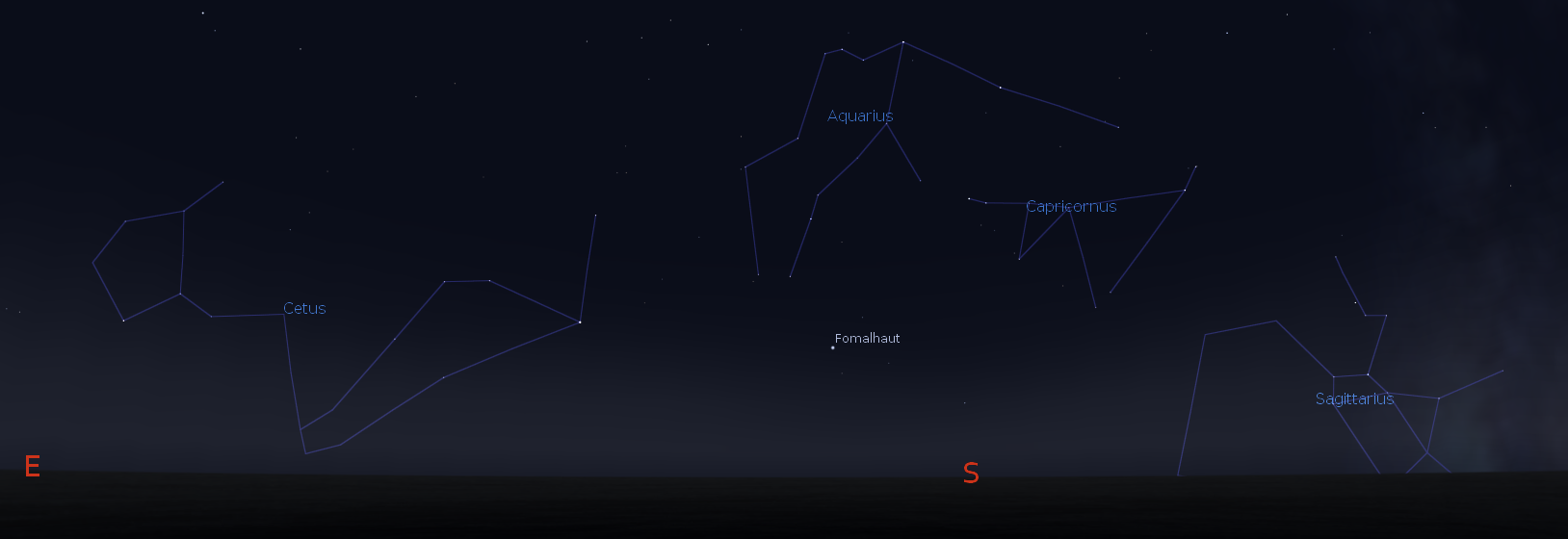
Fomalhaut appears quite alone in the south-southeast at about 10 p.m. Created using Stellarium.
Actually Fomalhaut isn’t all that alone, It apparently has a companion planet.
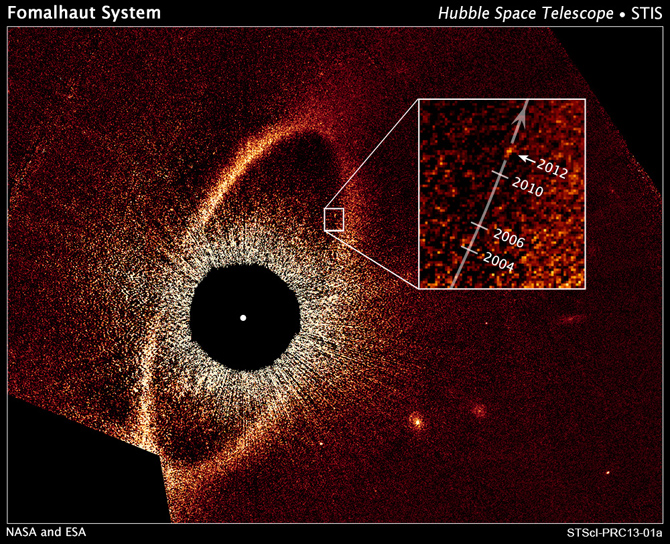
Fomalhaut b and it’s path around its star. Credit: NASA, ESA, and P. Kalas (University of California, Berkeley and SETI Institute)
10/02/2015 – Ephemeris – I talk about Pluto and New Horizons tonight
Ephemeris for Friday, October 2nd. The Sun will rise at 7:41. It’ll be up for 11 hours and 40 minutes, setting at 7:21. The Moon, 2 days before last quarter, will rise at 10:53 this evening.
This evening yours truly will be reviewing the results so far from the New Horizons spacecraft and its close encounter with Pluto and its moons July 14th. This will be at the Grand Traverse Astronomical Society meeting at Northwestern Michigan College’s Rogers Observatory at 8 p.m. If you’ve not been keeping up with the releases of photos of Pluto and its moons be prepared to be amazed by the beauty of this frozen but apparently active world. Afterward from 9 p.m. there will be time to view the wonders of the autumn skies if it’s clear. If not there will be guided tour of the autumn skies via computer simulation. The observatory is located south of Traverse City on Birmley Road between Garfield and Keystone Roads.
Times are for the Traverse City/Interlochen area of Michigan. They may be different for your location.
Addendum
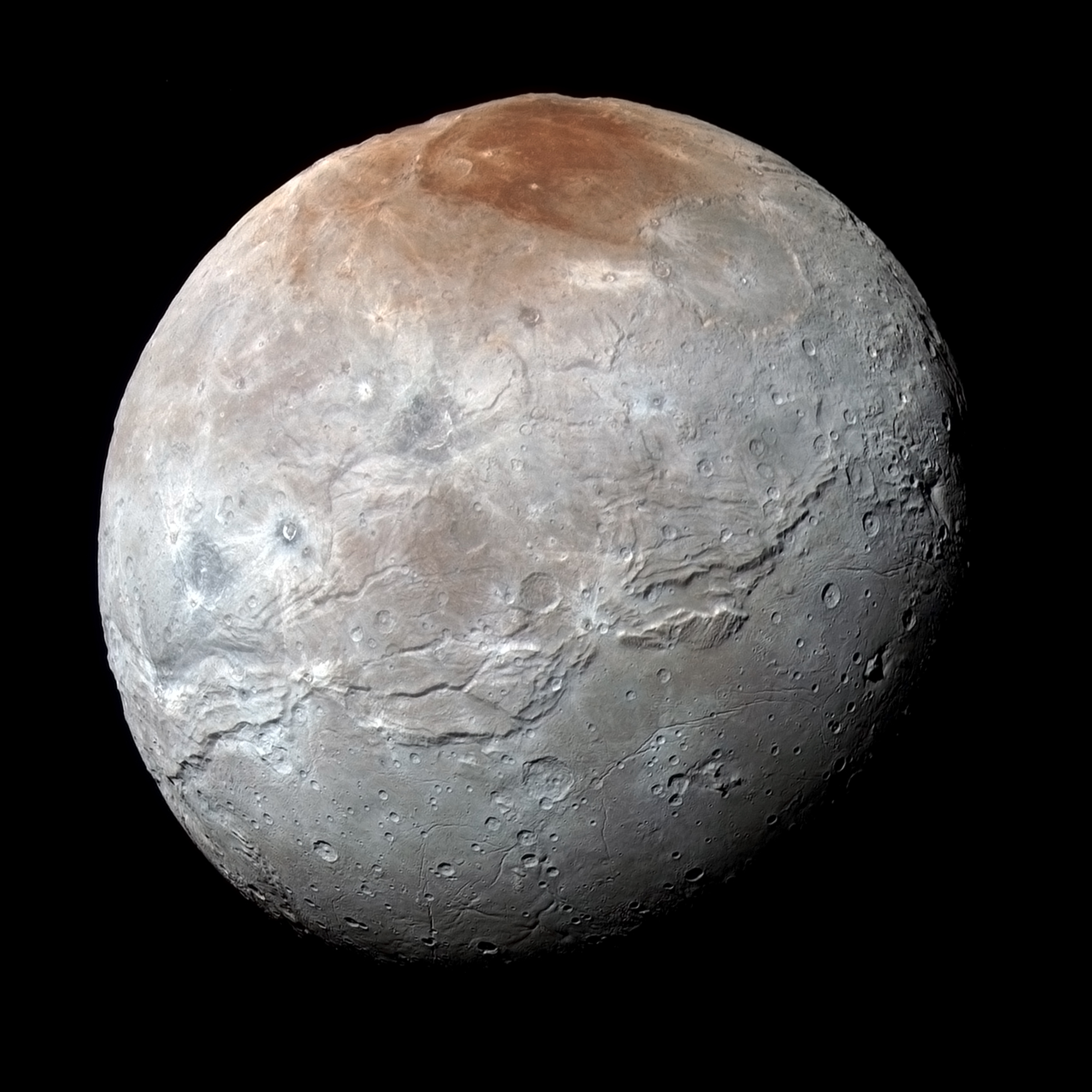
Latest high resolution color image of Charon released yesterday. Credit: NASA/JHUAPL/SwRI.
10/01/2015 – Previewing the month of October
Ephemeris for Thursday, October 1st. The Sun will rise at 7:40. It’ll be up for 11 hours and 43 minutes, setting at 7:23. The Moon, 3 days before last quarter, will rise at 10:04 this evening.
Let’s look at the skies for the month of October. The sun will still be moving south rapidly. Daylight hours in the Interlochen/Traverse City area will drop from 11 hours and 43 minutes today to 10 hours 14 minutes on the 31st. The altitude of the sun above the southern horizon at local noon will be 42 degrees tomorrow, and will descend to 31 degrees on Halloween, also in the Interlochen area. The Straits area will have the sun a degree lower. Local noon, when the sun is due south will be about 1:30 p.m. in Interlochen. The planet Saturn will become harder to spot by the end of the month. After that the evening sky will be devoid of bright planets for many months. The outer planets Uranus and Neptune will be available for the telescope.
Times are for the Traverse City/Interlochen area of Michigan. They may be different for your location.
Addendum
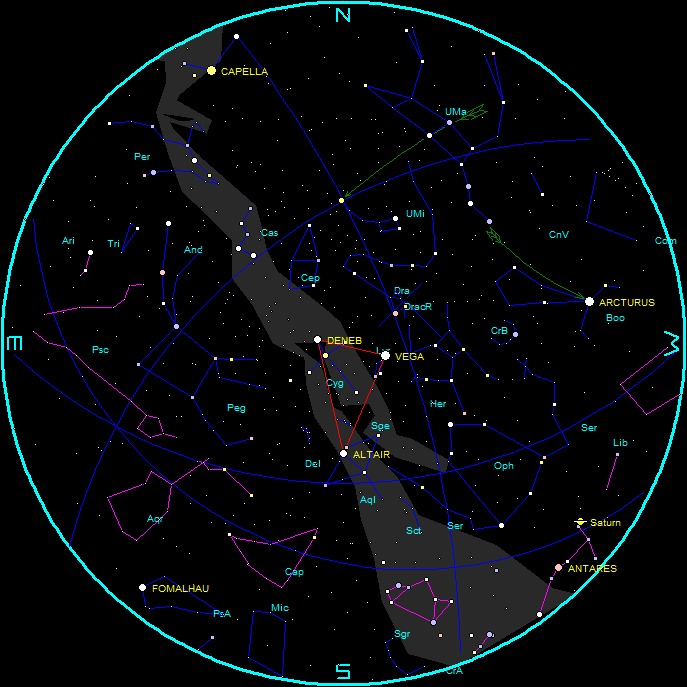
Star Chart for October 2015. Created using my LookingUp program. Click on image to enlarge.
The planets and stars are plotted for the 15th at 8 p.m. EDT. That is chart time. Note, Traverse City is located 1 hour 45 minutes behind our time meridian. To duplicate the star positions on a planisphere you may have to set it to 1 hour 45 minutes earlier than the current time.
Evening astronomical twilight ends at 9 p.m. EDT on October 1st, decreasing to 8:11 p.m. EDT on the 31st..
Morning astronomical twilight starts at 6:02 a.m. EDT on October 1st, and increasing to 6:40 a.m. EDT on the 31st.
Add a half hour to the chart time every week before the 15th and subtract and hour for every week after the 15th.
For a list of constellation names to go with the abbreviations click here.
The green pointer from the Big Dipper is:
- Pointer stars at the front of the bowl of the Big Dipper point to Polaris the North Star.
- Follow the arc of the Big Dipper’s handle to Arcturus.
- The Summer Triangle is shown in red.
Calendar of Planetary Events
Credit: Sky Events Calendar by Fred Espenak and Sumit Dutta (NASA’s GSFC)
To generate your own calendar go to http://eclipse.gsfc.nasa.gov/SKYCAL/SKYCAL.html
Times are Eastern Daylight Time on a 24 hour clock. Some additions made to aid clarity.
Conjunctions like the Venus-Regulus: 2.5° S means Venus will appear 2.5° South of Regulus.
| Oct | 01 | Th | Venus: 43.6° W | |
| 02 | Fr | 08:51 | Moon-Aldebaran: 0.5° S, Occultation* | |
| 03 | Sa | 19:55 | Moon North Dec.: 18.1° N | |
| 04 | Su | 17:06 | Last Quarter | |
| 08 | Th | 16:32 | Moon-Venus: 0.8° N | |
| 08 | Th | 20:26 | Venus-Regulus: 2.5° S | |
| 09 | Fr | 12:51 | Moon-Mars: 3.8° N | |
| 09 | Fr | 19:30 | Moon-Jupiter: 3° N | |
| 11 | Su | 06:54 | Moon Ascending Node | |
| 11 | Su | 09:17 | Moon Apogee: 406400 km | |
| 11 | Su | 23:14 | Uranus Opposition | |
| 12 | Mo | 20:06 | New Moon | |
| 15 | Th | 22:59 | Mercury Elongation: 18.1° W | |
| 16 | Fr | 09:20 | Moon-Saturn: 3.2° S | |
| 17 | Sa | 17:01 | Mars-Jupiter: 0.4° N | |
| 18 | Su | 14:31 | Moon South Dec.: 18.2° S | |
| 20 | Tu | 16:31 | First Quarter | |
| 21 | We | 18:35 | Orionid Shower: ZHR = 20 | |
| 25 | Su | 03:36 | Moon Descending Node | |
| 25 | Su | 17:40 | Venus-Jupiter: 1° N | |
| 26 | Mo | 01:59 | Venus Elongation: 46.4° W | |
| 26 | Mo | 07:59 | Moon Perigee: 358500 km | |
| 27 | Tu | 07:05 | Full Moon | |
| 29 | Th | 17:45 | Moon-Aldebaran: 0.6° S, occultation** | |
| 31 | Sa | 04:02 | Moon North Dec.: 18.2° N | |
| Nov | 01 | Su | Venus: 46.3° W |
| * Visible in N. Pacific and Alaska in the US. During the daytime in the rest of the US except Hawai’i. Check it out here.
** Visible in Europe, parts of northern Africa and western Asia. Check it out here. |
09/30/2015 – Saturn is really alone in the evening sky now – Mercury is leaving today
Ephemeris for Wednesday, September 30th. The Sun will rise at 7:39. It’ll be up for 11 hours and 46 minutes, setting at 7:25. The Moon, 3 days past full, will rise at 9:20 this evening.
Lets look at the planets for this last day of September. Saturn is alone in the evening sky spotted by 8:30 p.m. low in the southwestern sky near the bright star Antares to its left. Antares has a reddish hue, while Saturn is brighter and yellowish. Both these colors are enhanced by being low to the horizon. Saturn will set at 9:47 p.m. The rest of the planet action has moved to the morning sky. Venus, the morning star, will rise at 4 a.m. a bit north of east. Much dimmer Mars will rise at 4:39 a.m. in the east-northeast. Jupiter is beginning to be visible in the morning sky and will rise at 5:17 in the east-northeast. The three will be closing together in the coming weeks. Mercury is at inferior conjunction with the Sun today.
Times are for the Traverse City/Interlochen area of Michigan. They may be different for your location.
Addendum
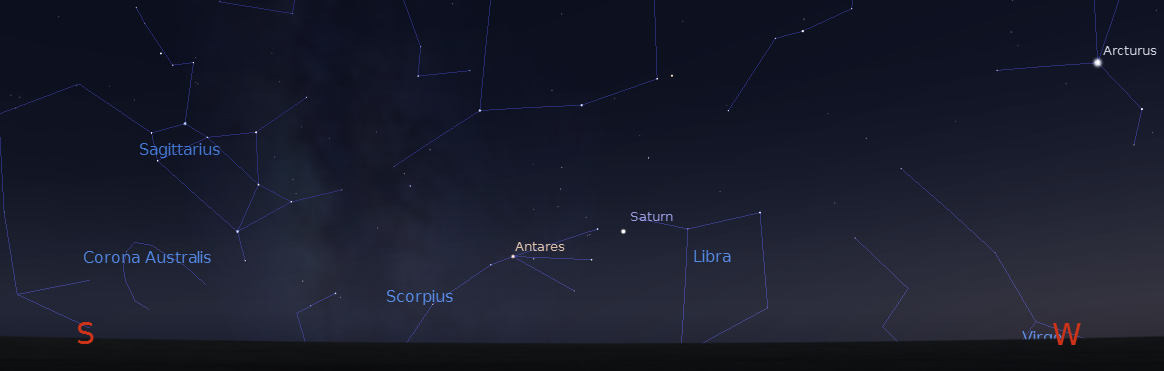
Saturn and two zodiacal constellations at October 1, 2015 Created using Stellarium.
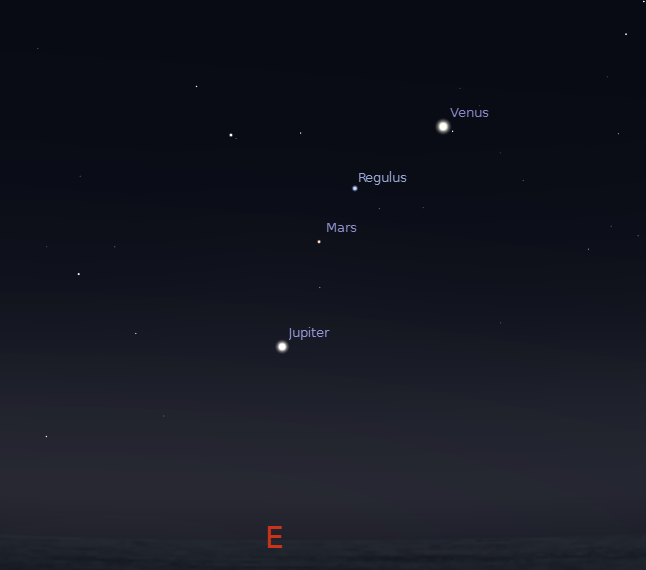
Venus, Mars and Jupiter and the bright st star Regulus at 6:30 a.m. October 1, 2015. Creating using Stellarium.
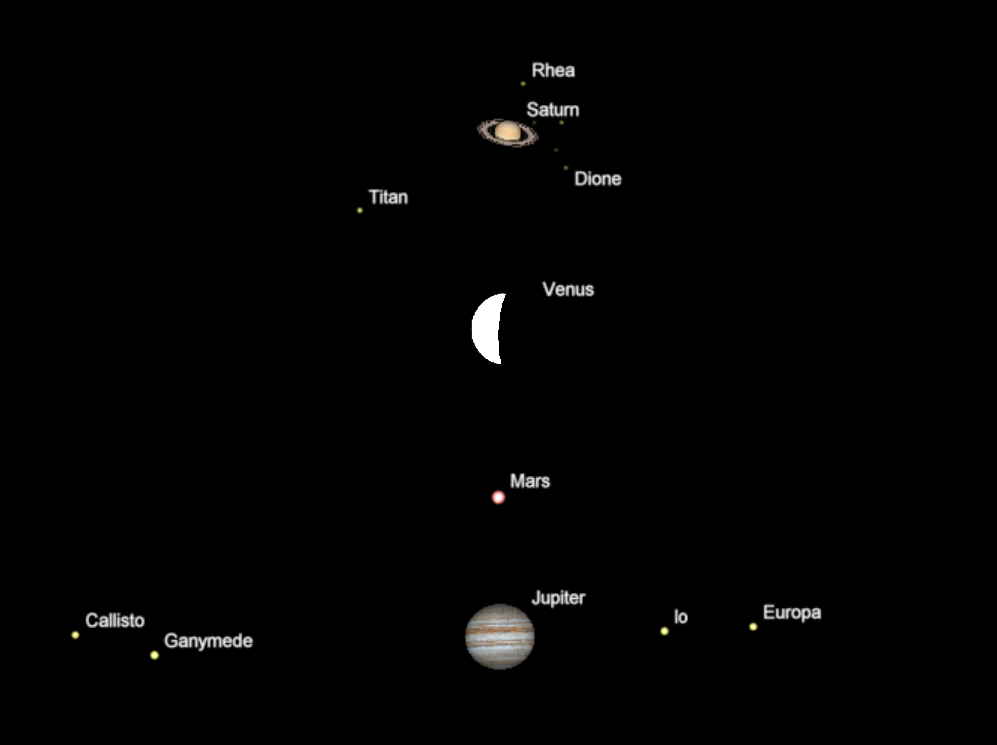
The Bright Planets, in order of appearance as seen with the same telescope magnification. Created using Cartes du Ciel.
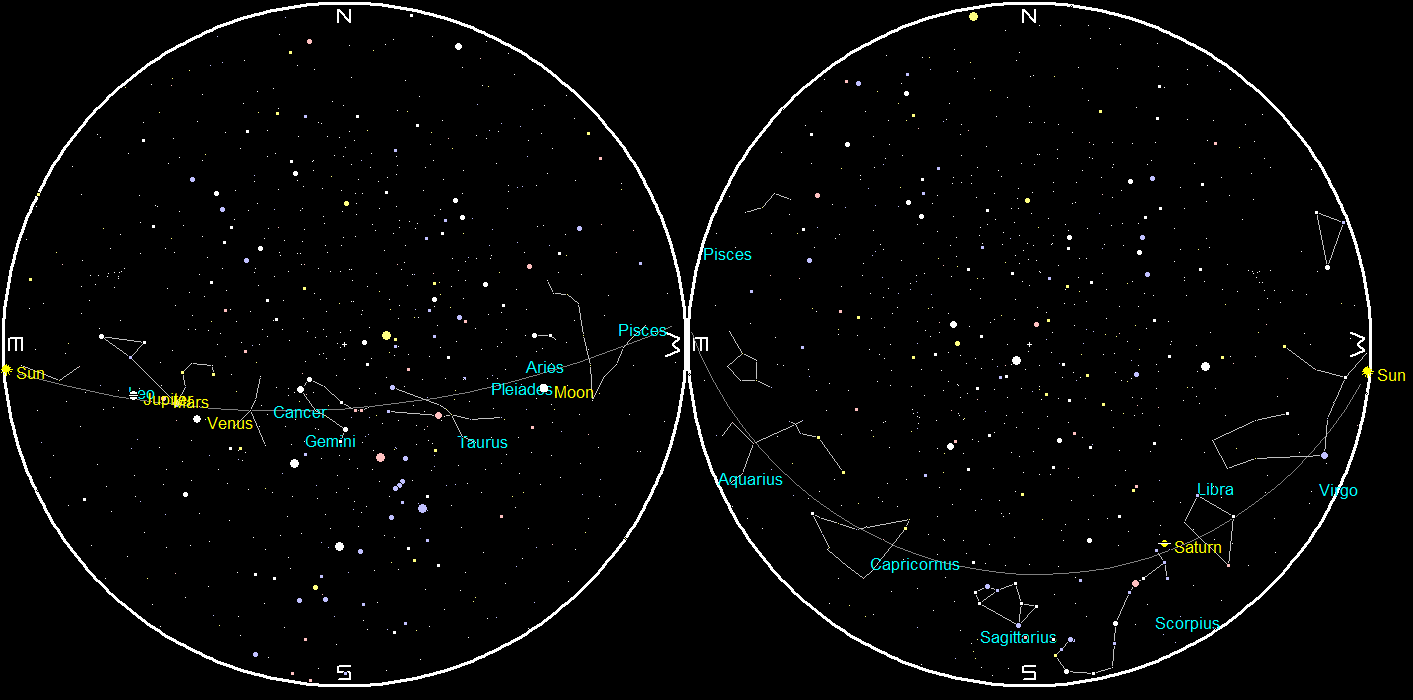
This is a chart showing the sunrise and sunset skies for September 30, 2015 showing the location of the planets and the Moon at that time. Created using my LookingUp program. Click on the image to enlarge.
09/29/2015 – Ephemeris – New Horizons is now downloading some really cool pictures to Earth
Ephemeris for Tuesday, September 29th. The Sun will rise at 7:38. It’ll be up for 11 hours and 49 minutes, setting at 7:27. The Moon, 2 days past full, will rise at 8:38 this evening.
Two and a half months ago the New Horizons spacecraft flew past Pluto, spending the day incommunicado, not wasting any time sending anything back to the Earth. Starting the next day came the flood of data including some highly compressed images. Starting Labor Day weekend the high-resolution, uncompressed images started to come down at one to two thousand bits per second. At that rate a 4 megapixel monochromatic image might take 36 hours to download. Now every Thursday or Friday the New Horizons Team puts several new processed images on the NASA and Johns Hopkins Applied Physics Laboratory websites, along with explanations of what is in the images and the questions they raise.
Times are for the Traverse City/Interlochen area of Michigan. They may be different for your location.
Addendum
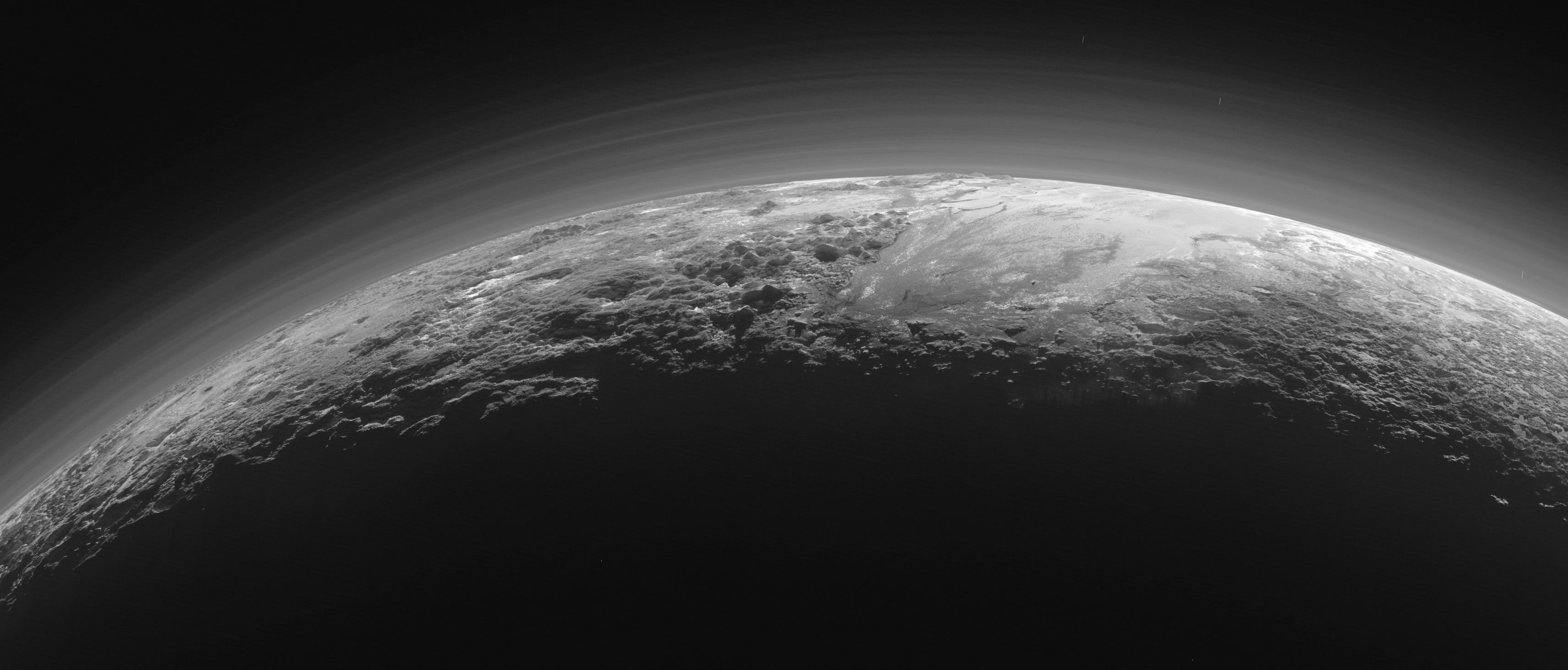
This image, taken just 15 minutes after the New Horizons spacecraft flew its closest to Pluto shows a low angle shot of the lands the spacecraft saw really close up. Check out too the many layers of the atmosphere. Credit: NASA/JHUAPL. Click on the image to enlarge.
I’ll be exploring this and the other amazing photos and other results from New Horizons this Friday at the Grand Traverse Astronomical Society meeting at 8 p.m. at Northwestern Michigan College’s Rogers Observatory south of Traverse City on Birmley Road.
09/28/2015 – Ephemeris – The Harvest Moon effect
Ephemeris for Monday, September 28th. The Sun will rise at 7:36. It’ll be up for 11 hours and 52 minutes, setting at 7:29. The Moon, 1 day past full, will rise at 8:00 this evening.
Yesterday’s full moon was the famous Harvest Moon, the nearest full moon to the autumnal equinox. This is a time of the full and waning gibbous moons in the next few days rising in twilight. In the old days before electric lights it helped farmers by effectively lengthening the hours of light to gather in the crops. The Moon on average rises 50 minutes later each night. The interval between tonight’s moon rise and tomorrow’s will be 38 minutes. The interval between Tuesday and Wednesday will be 42 minutes. This year’s harvest moon effect is spoiled a bit because the Moon was at perigee Sunday, the so-called supermoon, so it’s moving faster in its orbit than average. Like the Sun, the Moon always appears orange or red near the horizon.
Times are for the Traverse City/Interlochen area of Michigan. They may be different for your location.
Addendum
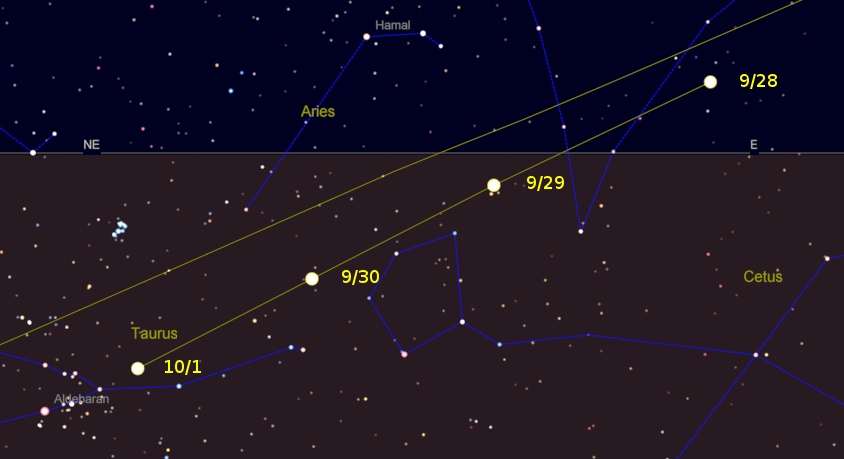
The positions of the Moon from September 28 to October 1, 2015. Note the path of the Moon. At Harvest Moon in northern Michigan time it makes less than a 45 degree angle with the horizon. For other latitudes it’s less than (90 – latitude). shorthand term for 90 – latitude is co-latitude. Created using Cartes du Ciel.
The closer to horizontal the Moon’s path is the shorter the difference in night-to-night rise times.

