Archive
09/25/2015 – Ephemeris – There will be a great lunar eclipse Sunday night
Ephemeris for Friday, September 25th. The Sun will rise at 7:33. It’ll be up for 12 hours and 1 minute, setting at 7:35. The Moon, 2 days before full, will set at 5:34 tomorrow morning.
Lets check out Sunday’s total lunar eclipse. It will be visible from the entire contiguous 48 states, and in its entirety from Colorado, eastward. The partial phase will start at 9:07 p.m. Totality will begin at 10:11 p.m. and extend to 11:23 p.m. when the Moon should appear red in color, illuminated by the combined sunrises and sunsets occurring on the Earth at that moment. The eclipse will end at 12:27 a.m. The eclipse is perfectly viewable with the naked eye or binoculars. For those who want company and commentary as to what’s going on, the Grand Traverse Astronomical Society will provide two locations from which to view the eclipse. The NMC Observatory, south of Traverse City and Platte River Point, part of the Sleeping Bear Dunes National Lakeshore, both weather permitting.
Times are for the Traverse City/Interlochen area of Michigan. They may be different for your location.
Addendum
The next lunar eclipse visible from our area will be January 31, 2018 which will achieve totality just before the moon sets. The next lunar eclipse will be January 20-21, 2019 which will start late in the evening. The problem being that January is a pretty cloudy month around here.
We’re closer to the next solar eclipse, which will be a total eclipse visible at midday, and the center line of the path of totality which will pass from Oregon to South Carolina, passing just south of St. Louis Missouri and north of Nashville Tennessee. For more on the 2017 eclipse check out this NASA eclipse page.
09/24/2015 – Ephemeris – Looking forward to Sunday’s Lunar Eclipse
Ephemeris for Thursday, September 24th. The Sun will rise at 7:32. It’ll be up for 12 hours and 4 minutes, setting at 7:36. The Moon, half way from first quarter to full, will set at 4:20 tomorrow morning.
Lets check out Sunday’s total lunar eclipse. It will be visible from the entire contiguous United States, and in its entirety from Colorado, eastward. The partial phase will start at 9:07 p.m. The total phase will begin at 10:11 p.m. and extend to 11:23 p.m. when the ending partial phase will start. The eclipse will end at 12:27 a.m. The eclipse is perfectly viewable with the naked eye or binoculars. For those who want company and commentary as to what’s going on, the Grand Traverse Astronomical Society will provide two venues from which to view the eclipse: The Northwestern Michigan College’s Rogers Observatory, south of Traverse City on Birmley Rd. and Platte River Point at the end of Lake Michigan Road off M22, part of the Sleeping Bear Dunes National Lakeshore, weather permitting.
Times are for the Traverse City/Interlochen area of Michigan. They may be different for your location.
Addendum
The following is an excerpt from my September 1 post.
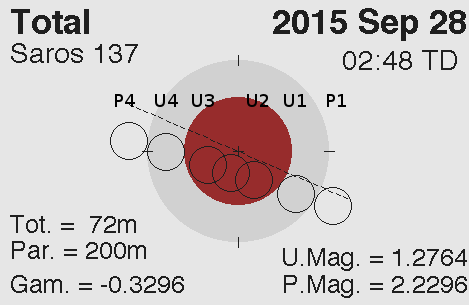
The eclipse occurs on the 28th for Universal Time. It’s the evening of the 27th for us. The Moon travels through the Earth’s shadow from right to left. What are seen are points of contact with the shadow and mid-eclipse. From Five Millennium Canon of Lunar Eclipses (Espenak & Meeus) NASA.
Contact times are labeled P1, U1, U2, U3, U4, and P4. P2 and P3 are omitted because they are synonymous with U1 and U4 respectively:
- P1 – 8:11:47 p.m. Enter the penumbra (unseen). By about 8:30 the duskiness on the left edge of the moon will start to be noticeable.
- U1 – 9:07:11 p.m. Enter the umbra (partial eclipse begins).
- U2 – 10:11:10 p.m. Totality begins.
- Mid eclipse 10:48:17 p.m.
- U3 – 11:23:05 p.m. Totality ends, egress partial phase begins.
- U4 – 12:27:03 a.m. Partial phase ends. The Moon’s upper right edge should appear dusky for the next half hour or so.
- P4 – 1:22:27 a.m. Penumbral phase ends (unseen).
Note: The duskiness of the penumbral phase of the eclipse can be enhanced by viewing through sunglasses.
During the total phase, light leaks in around the Earth due to the bending of light in the Earth’s atmosphere, so the Moon is illuminated by the collective sunrises and sunsets around the globe. This usually gives the Moon a coppery hue, that some are now calling a blood moon. Occasionally, due to volcanic eruptions the Moon can become very dark.
This full moon is also the Harvest Moon and for those who care, a supermoon, it having reached perigee earlier that day.
Weather permitting there will be two GTAS venues to view this eclipse. The first will be the NMC Rogers Observatory. The second will be at the Sleeping Bear Dunes National Lakeshore at Platte River Point at the end of Lake Michigan Road. The site will be open for the visible parts of the eclipse from 9 p.m. to 12:30 a.m.
09/23/2015 – Ephemeris – One planet visible in the evening and three in the morning
Ephemeris for Wednesday, September 23rd. The Sun will rise at 7:30. It’ll be up for 12 hours and 7 minutes, setting at 7:38. The Moon, 2 days past first quarter, will set at 3:09 tomorrow morning.
Lets look at the planets for this first day of autumn. Saturn is alone in the evening sky spotted by 9 p.m. low in the southwestern sky near the bright star Antares to its left. Antares has a reddish hue, while Saturn is brighter and yellowish. Both these colors are enhanced by being low to the horizon. Saturn will set at 10:13 p.m. The rest of the planet action has moved to the morning sky. Venus, the morning star, will rise at 4:09 a.m. a bit north of east. Much dimmer Mars will rise at 4:44 a.m. in the east-northeast. Jupiter is beginning to be visible in the morning sky and will rise at 5:37 in the east-northeast. Mercury, though in the evening sky, sets too soon after the Sun to be visible.
Times are for the Traverse City/Interlochen area of Michigan. They may be different for your location.
Addendum
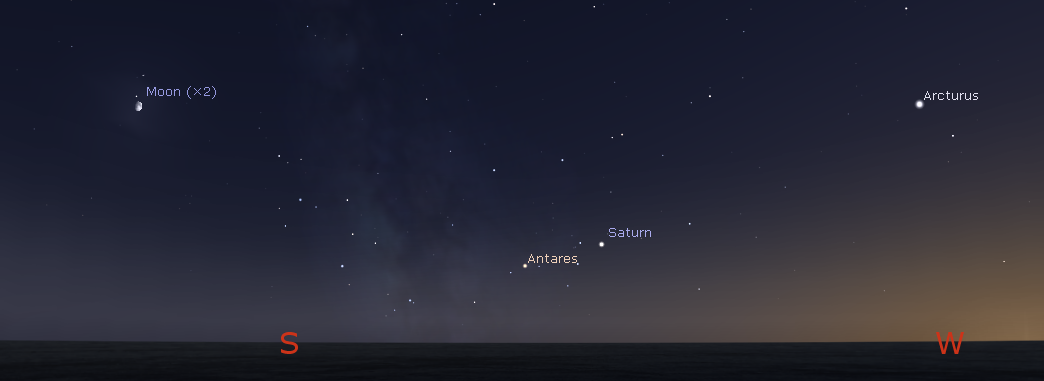
Saturn and the Moon with setting southern summer stars at 8:30 p.m. on September 23, 2015. The Moon is shown twice actual size. Created using Stellarium.
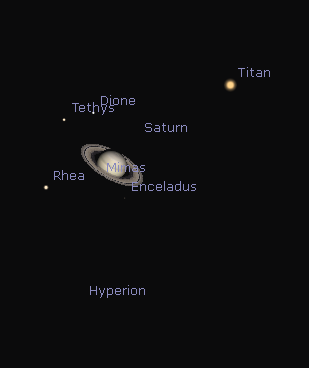
What Saturn and its moons might appear like in a telescope at 8:30 p.m., September 23, 2015. Small telescopes will show only the moon Titan. Created using Stellarium. The telescopic planet charts are all displayed at the same scale.
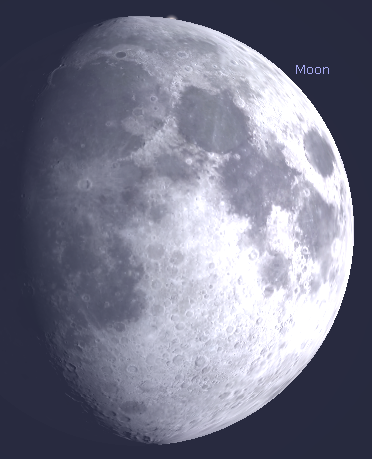
The Moon as it might be seen in binoculars at 8:30 p.m. September 23, 2015. Created using Stellarium.
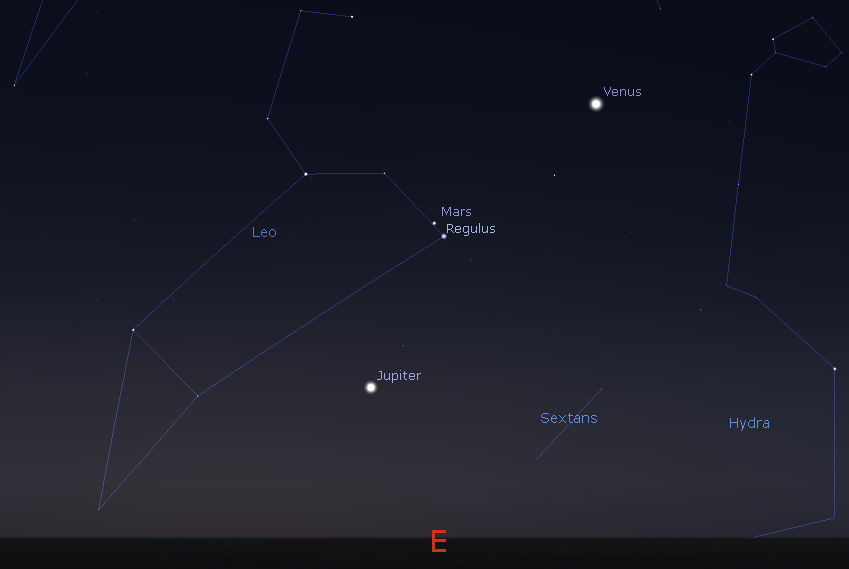
Venus, Mars and Jupiter with the constellation Leo at 6:30 a.m. September 24, 2015. Created using Stellarium.
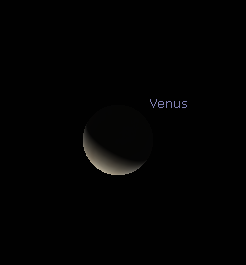
Venus in a telescope at 6:30 a.m. September 24, 2015. Created using Stellarium.
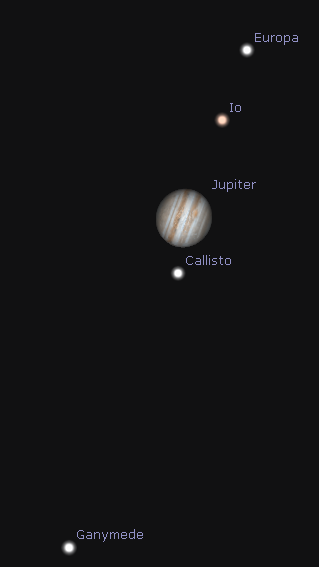
Jupiter and moons in a telescope at 6:30 a.m. September 24, 2015. Created using Stellarium.
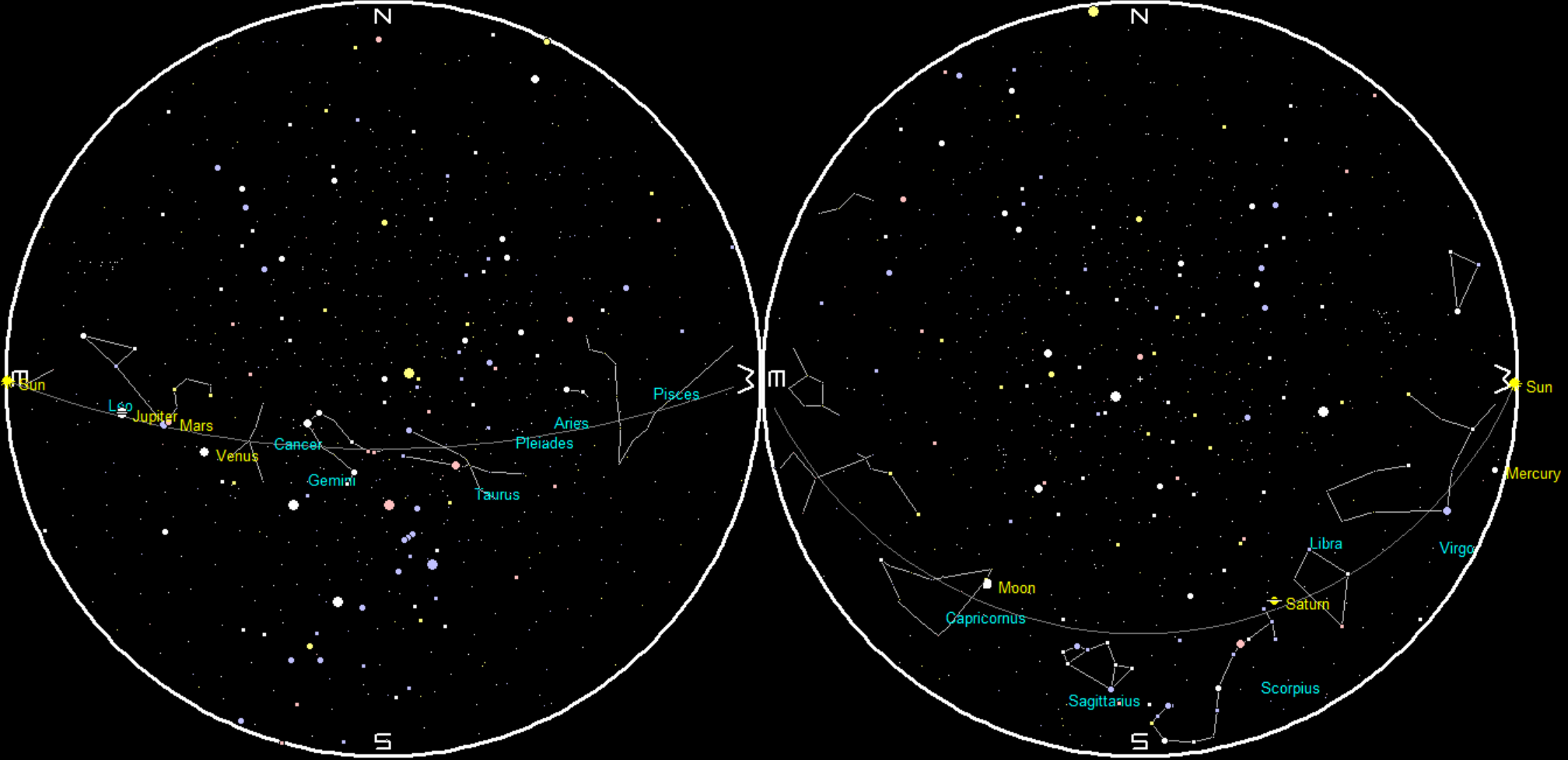
This is a chart showing the sunrise and sunset skies for September 23, 2015 showing the location of the planets and the Moon at that time. Created using my LookingUp program. Click on the image to enlarge.
09/22/2015 – Ephemeris – Equinox tomorrow and September 27th Moon’s triple whammy
Ephemeris for Tuesday, September 22nd. The Sun will rise at 7:29. It’ll be up for 12 hours and 11 minutes, setting at 7:40. The Moon, 1 day past first quarter, will set at 2:02 tomorrow morning.
Tomorrow at 4:20 a.m. before most of us wake up summer will officially end and Autumn will start. That’s the exact time of the autumnal equinox. We are noticing that the days or rather daylight hours are getting noticeably shorter day by day. Autumn will end when the days will stop getting shorter on the first day of winter, December 21st. The full moon this Sunday is triply important. Most important is that a total lunar eclipse will happen. Second, it is the Harvest Moon, the nearest full moon to the autumnal equinox, more on that next week. Also it is the closest the Moon gets to the Earth all year. Yup it’s a so-called supermoon. If the Moon were a 2 inch ball it would be 20 feet from an 8 inch Earth. The supermoon is a foot closer.
Times are for the Traverse City/Interlochen area of Michigan. They may be different for your location.
Addendum
That last bit about the Moon being a two-inch ball will come in handy if you come to the Girl Scout Badge Bash at ECCO in Traverse City Thursday night.
09/21/2015 – Ephemeris – Next Sunday’s total lunar eclipse
Ephemeris for Monday, September 21st. The Sun will rise at 7:28. It’ll be up for 12 hours and 14 minutes, setting at 7:42. The Moon, at first quarter today, will set at 1:02 tomorrow morning.
It’s six days to the total lunar eclipse next Sunday night. The eclipse starts just after 9 p.m. and ends shortly before 12:30 a.m. Of the remarkable four eclipse string at every possible lunar eclipse opportunity, this last one is the best for us, in that it occurs in the evening. The others were in the morning our time or occurred around the time of moon set around here. So if clear skies prevail we will have a wonderful and beautiful total lunar eclipse. Lunar eclipses occur at full moon when the Sun, Earth and Moon line up close enough for the Moon to enter the Earth’s shadow. Generally this only occurs about 1 out of 6 full moons. Eclipses of the Sun and Moon normally appear in pairs. The solar eclipse already occurred 8 days ago.
Times are for the Traverse City/Interlochen area of Michigan. They may be different for your location.
Addendum
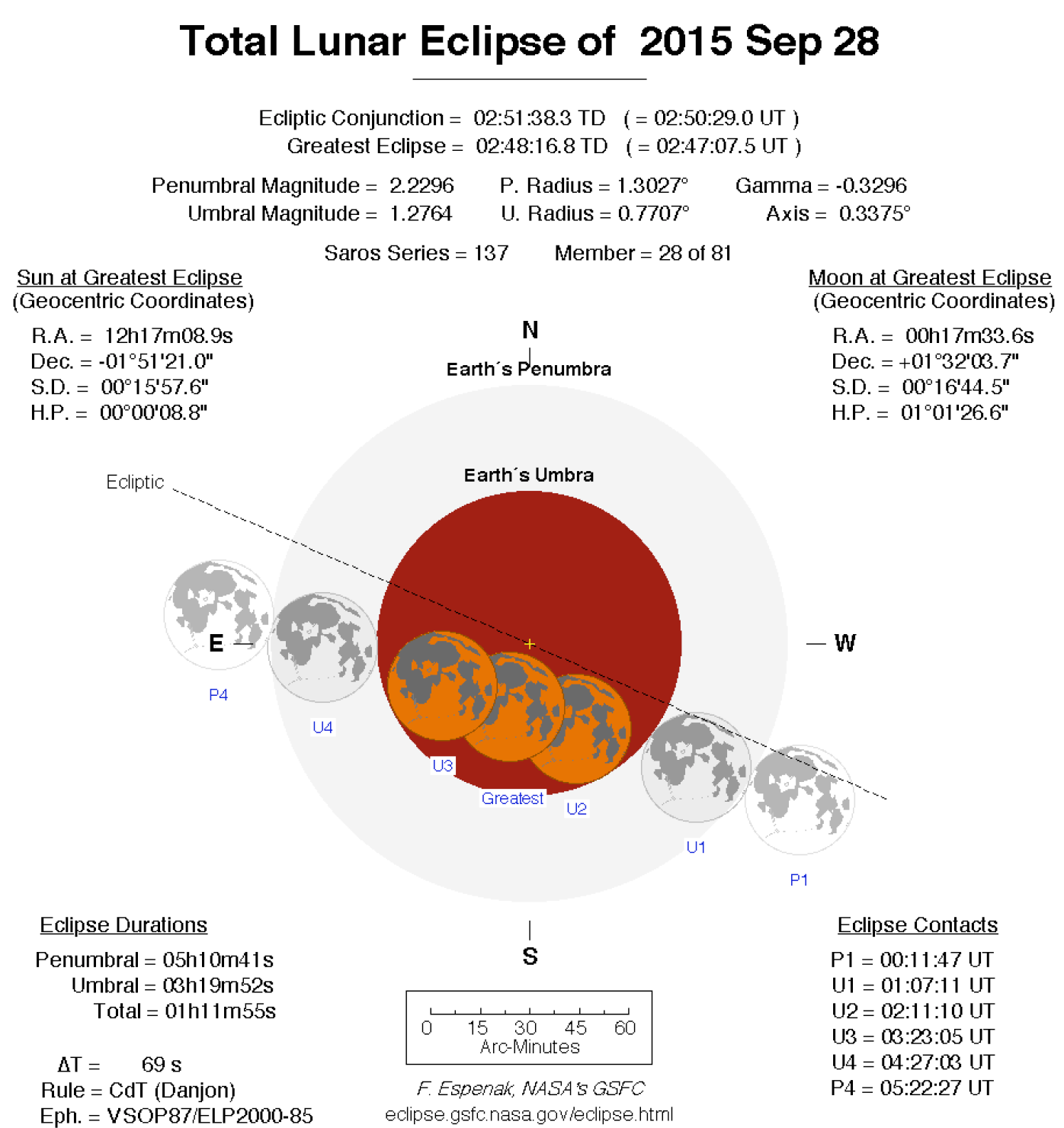
NASA eclipse chart portion. In the eastern US the Date will be September 27. Subtract 4 hours from UT to get EDT (Eastern Daylight Time) Credit: NASA/ Fred Espanek.
Here’s the link to the full chart.
09/18/2015 – Ephemeris – Saturn and the Moon together tonight and tomorrow a big day for the GTAS – It starts with the Leland Heritage Celebration
Ephemeris for Friday, September 18th. The Sun will rise at 7:24. It’ll be up for 12 hours and 23 minutes, setting at 7:48. The Moon, 3 days before first quarter, will set at 10:40 this evening.
Tonight the planet Saturn will appear left of and a bit below the crescent Moon. Saturn will be visible in the evening sky for 2 and a half more months with about a month where it’s high enough to see clearly in telescopes. There are two local astronomical events tomorrow. Tomorrow the Leland Heritage Celebration will take place from 11 a.m. to 4 p.m. at Fish Town in Leland. The Grand Traverse Astronomical Society will be there to show the Sun through member’s telescopes and give out NASA items for the kids. Then a few hours later the crew will be on Front Street in Traverse City for the International Observe the Moon Night starting at 7 p.m. Both events are weather dependent. Rain will affect the Leland event and clouds the evening one.
Times are for the Traverse City/Interlochen area of Michigan. They may be different for your location.
Addendum
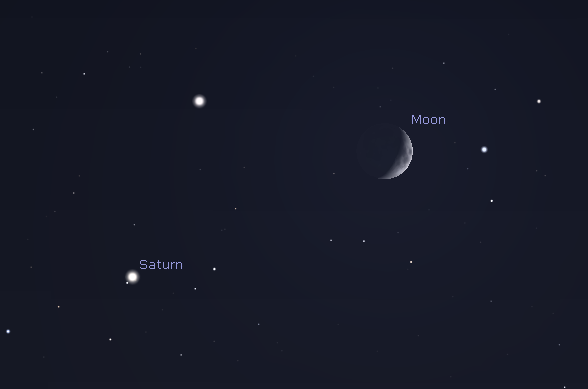
Saturn and the Moon at 9 p.m. September 18 from Northern Michigan. Created using Stellarium.
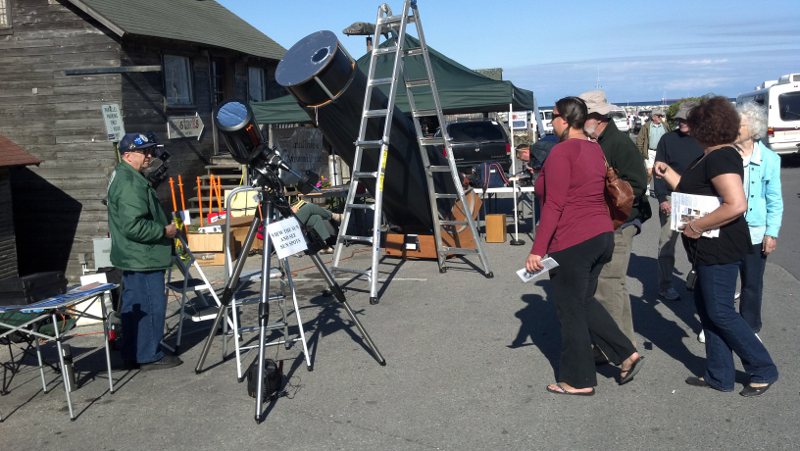
GTAS telescopes at Leland Heritage Celebration in 2011.
09/17/2015 – Ephemeris – International Observe the Moon Night is Saturday
Ephemeris for Thursday, September 17th. The Sun will rise at 7:23. It’ll be up for 12 hours and 26 minutes, setting at 7:50. The Moon, half way from new to first quarter, will set at 10:04 this evening.
The annual International Observe the Moon Night will be observed this Saturday evening. Members of the Grand Traverse Astronomical Society will be stationed on the north side of the 200 block of East Front Street. Starting at 7 p.m. near Orvis Streamside and will be moving our telescopes eastward from time to time to keep up with the westward sinking motion of the Moon over the single story buildings to the south as long as we can. The moon will be a fat crescent with lots of detail visible in telescopes. The society will also have some giveaway items from NASA for the young and not so young. The event will be canceled due to heavy overcast or other inclement weather.
Times are for the Traverse City/Interlochen area of Michigan. They may be different for your location.
Addendum
The information above is for our local location (northwestern lower Michigan). To find the location of the International Observe the Moon Night event near you go here. There’s even a downloadable Moon map for the evening here.
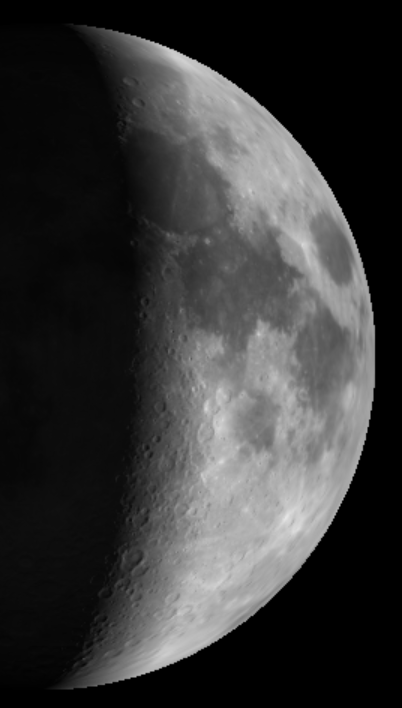
The Moon at 9 p.m. September 19, 2015 (Observe the Moon Night for the Eastern Daylight Time zone. Created with Virtual Moon Atlas.
09/16/2015 – Ephemeris – Looking for Saturn in the evening and Venus, Mars and Jupiter in the morning
Ephemeris for Wednesday, September 16th. The Sun will rise at 7:22. It’ll be up for 12 hours and 29 minutes, setting at 7:52. The Moon, 3 days past new, will set at 9:32 this evening.
Lets look for the bright planets for this week. Saturn is alone in the evening sky spotted by 9 p.m. low in the southwestern sky near the bright star Antares to its left. Antares has a reddish hue, while Saturn is brighter and yellowish. Both these colors are enhanced by being low to the horizon. Saturn will set at 10:39 p.m. The rest of the planet action has moved to the morning sky. Venus, the morning star, will rise at 4:42 a.m. a bit north of east. Much dimmer Mars will rise at 4:48 a.m. in the east-northeast. Jupiter is beginning to be visible in the morning sky and will rise at 5:57, almost an hour before the Sun. Mercury, though in the evening sky, sets too soon after the Sun to be visible.
Times are for the Traverse City/Interlochen area of Michigan. They may be different for your location.
Addendum
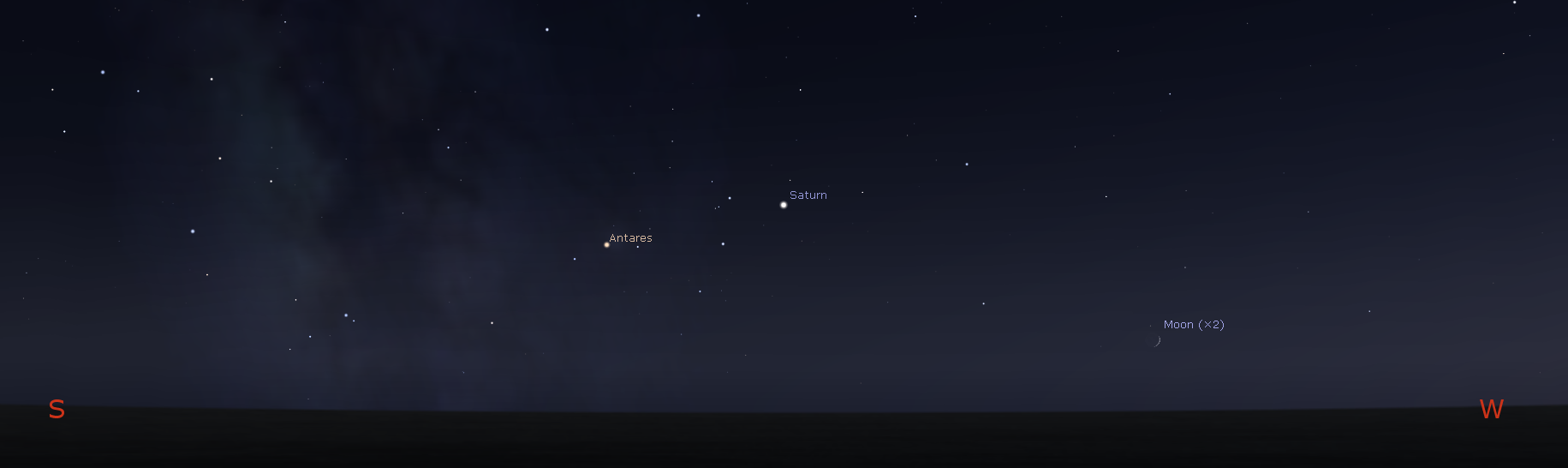
Saturn and the Moon with the Sagittarius teapot pouring its tea on the tail of Scorpius at 9 p.m. September 16, 2015. Created using Stellarium.
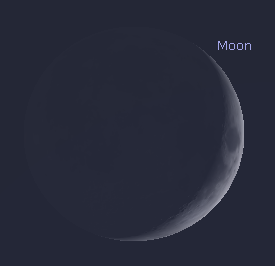
The moon as it might be seen in binoculars at 9 p.m. September 16, 2015. Created using Stellarium.
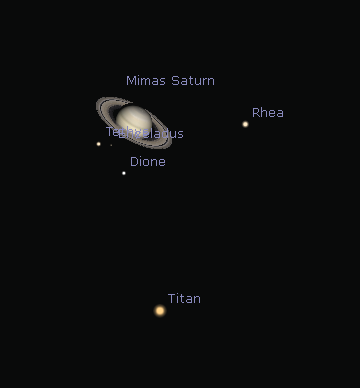
What Saturn and its moons might appear like in a telescope at 9 p.m., September 16, 2015. Small telescopes will show only the moon Titan. Created using Stellarium.
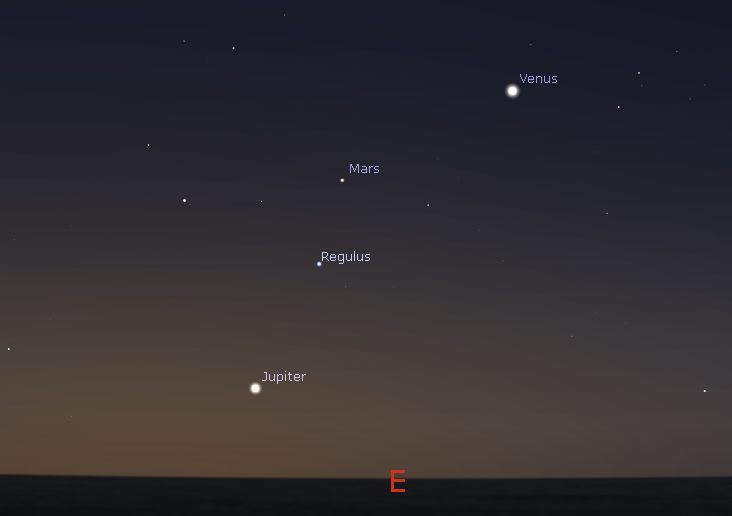
Venus, Mars and Jupiter with the star Regulus in morning twilight at 6:30 a.m. September 17, 2015. Created using Stellarium.
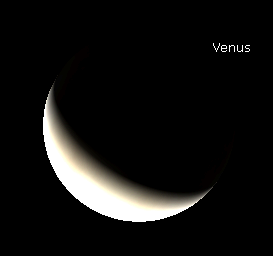
Venus through a telescope – September 17, 2015. Created using Stellarium.
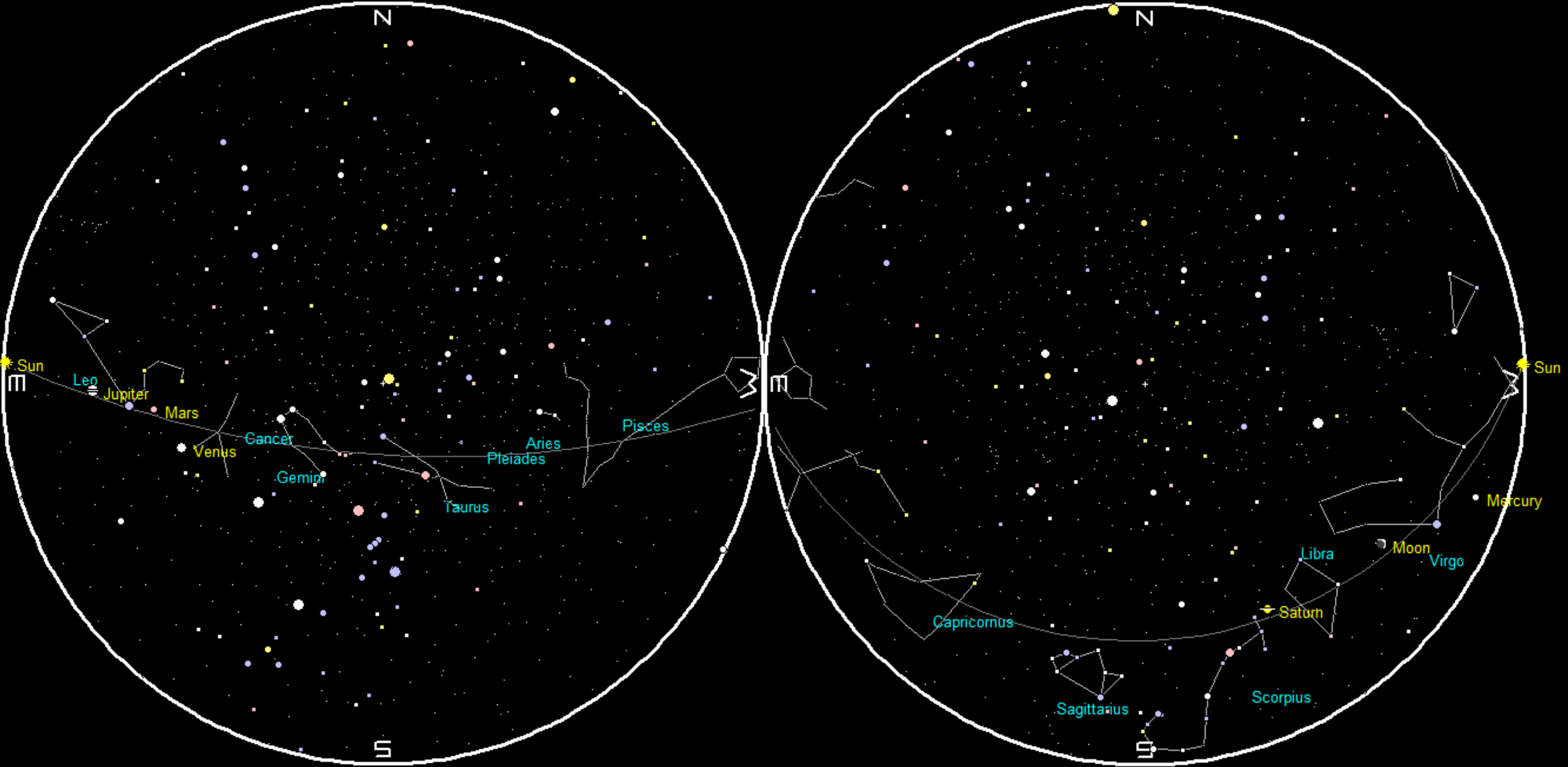
This is a chart showing the sunrise and sunset skies for September 16, 2015 showing the location of the planets and the Moon at that time. Created using my LookingUp program. Click on the image to enlarge.
09/15/15 – Ephemeris – Not another hoax again: This one’s a supposed asteroid collision
Ephemeris for Tuesday, September 15th. The Sun will rise at 7:21. It’ll be up for 12 hours and 32 minutes, setting at 7:53. The Moon, 2 days past new, will set at 9:02 this evening.
There is a bogus prediction from the Internet that been circulating for a month or so. I missed it until a couple of days ago because I visit reputable astronomical web sites. I check near earth asteroids on spaceweather.com, and there is nothing known as of now that’s 22 meters of larger in size that will come within 2 million miles of the Earth this month. The dead giveaway that this prediction is bogus is the fact that the impact point is specific, near Puerto Rico, but the impact time is vague, between the 15th and 28th of September. An object orbiting the Sun, like the Earth travels at 18 and a half miles a second give or take, the asteroid at a comparable velocity, so the impact time would have to be known to the second. On top of the Earth’s position, it also rotates
Times are for the Traverse City/Interlochen area of Michigan. They may be different for your location.
Addendum
Here is a link to NASA’s JPL on the subject.
NASA isn’t the only authority on asteroid orbits and positions. The Minor Planet Center is part of the International Astronomical Union (IAU), and currently operated under a grant from NASA is the clearinghouse for asteroid positions and orbits. Some discoveries and positions are supplied by amateur astronomers who aren’t beholden to any government, so there isn’t any conspiracy to keep the knowledge from the public.
09/14/2015 – Ephemeris – Another odd creature of the Zodiac, a sea-goat
Ephemeris for Monday, September 14th. The Sun will rise at 7:20. It’ll be up for 12 hours and 35 minutes, setting at 7:55. The Moon, 1 day past new, will set at 8:35 this evening.
As the Teapot of the constellation Sagittarius tilts and pours celestial tea on the southwestern horizon, it is followed in the south-southeast by the faint constellation of Capricornus the sea-goat. I’m not sure you’ll see a half goat with a fish’s tail here unless you’ve started Oktoberfest a bit early. To me, it looks like a big sagging triangle with the point down. Capricornus is a constellation of the zodiac, and its claim to fame is a latitude line on the globe at 23 and a half degrees south, called the Tropic of Capricorn. Back a couple of thousand years ago the sun entered Capricornus on the first day of winter, the winter solstice. Thus the latitude where the sun was overhead at that instant was called the Tropic of Capricorn. Due to the wobble of the earth’s axis, the line should now be called the Tropic of Sagittarius.
Times are for the Traverse City/Interlochen area of Michigan. They may be different for your location.
Addendum
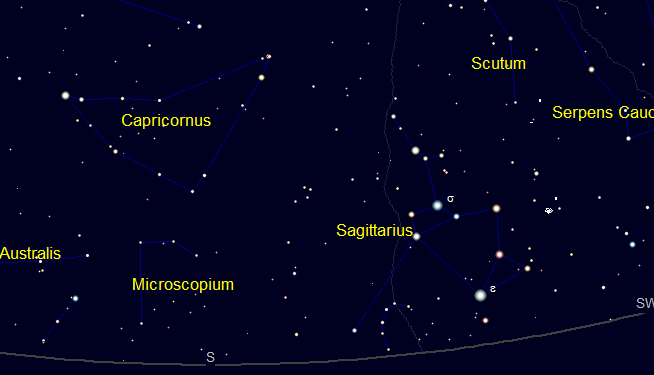
Capricornus represented in Cartes du Ciel
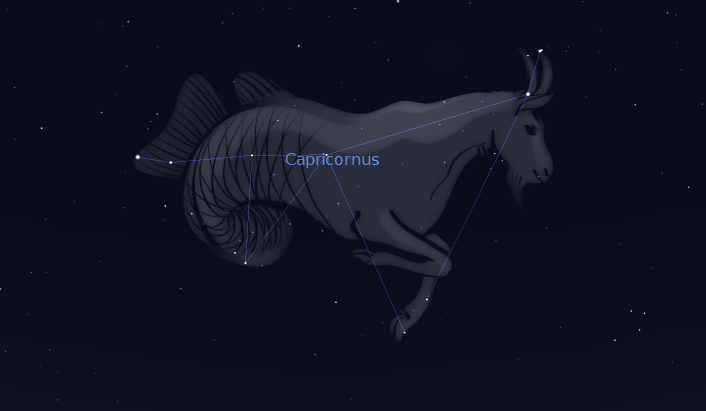
An artist’s rendering of Capricornus. A part of Stellarium’s functionality. The constellation lines are drawn differently than Cartes du Ciel

