Archive
05/05/2015 – Ephemeris – Eta Aquariids, an early visit of Halley’s Comet
Ephemeris for Tuesday, May 5th. Today the Sun will be up for 14 hours and 24 minutes, setting at 8:52. The Moon, 2 days past full, will rise at 10:29 this evening. Tomorrow the Sun will rise at 6:26.
The Eta Aquariid meteor shower will reach peak tomorrow morning. But the Moon will be bright, so only the brightest of them will be seen. However if you’re waiting to see the return of Halley’s Comet, you needn’t wait until the main body of the comet returns in 2061. Halley’s Comet has made many passes of the inner solar system in recorded history, and many more before that, returning to the inner solar system every 76 years or so, before returning to its frigid home beyond Neptune. It’s closest to the Sun, called perihelion is inside Venus’ orbit. On the way in and out it passes close to the Earth’s orbit. It has left a trail of debris, which we pass through in May and again in October.
Times are for the Traverse City/Interlochen area of Michigan. They may be different for your location.
Addendum
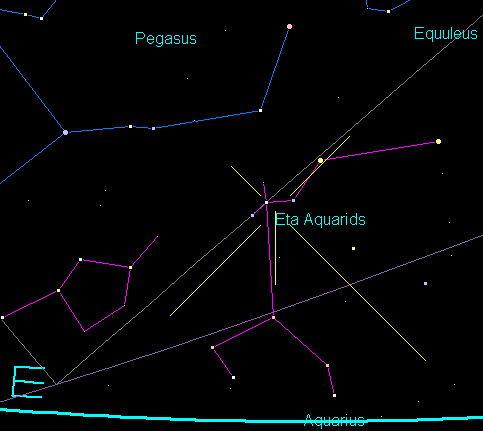
The Eta Aquariid radiant at 5 a.m. The radiant moves slowly to the east with time. Credit: My LookingUp program.
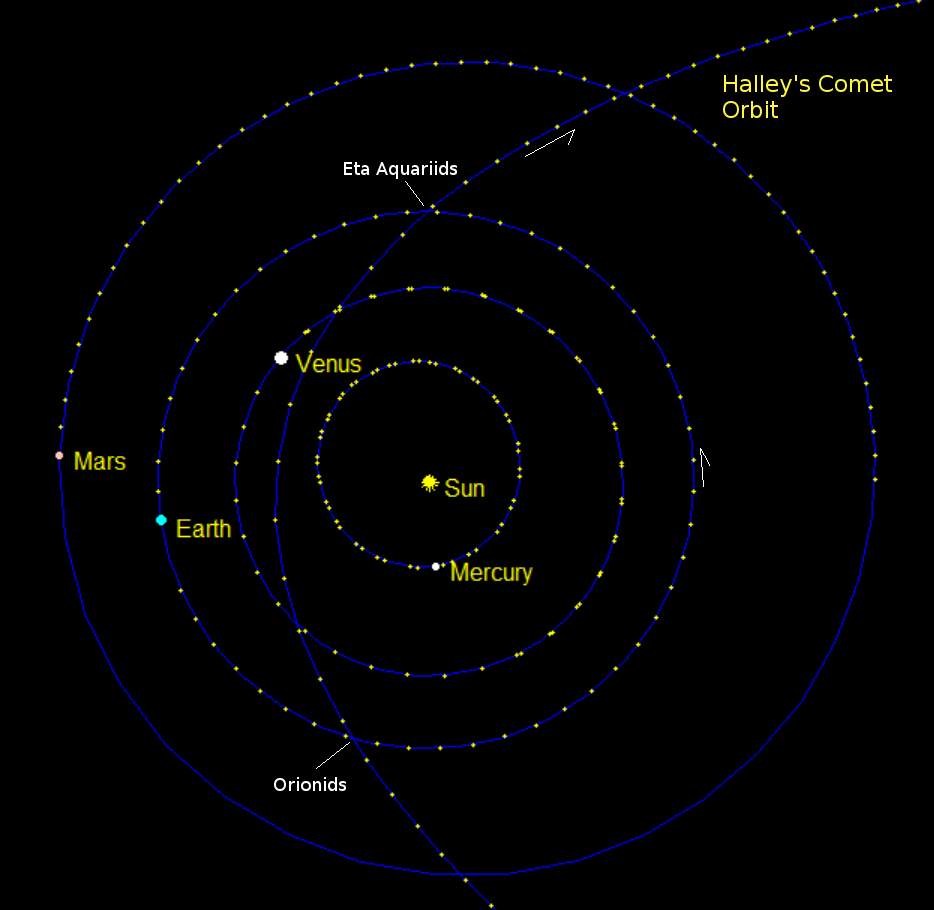
We get two meteor showers from Halley’s Comet. The Orionids, when Halley is approaching the inner solar system, and the Eta Aquariids when it’s leaving. Credit: My LookingUp program.
05/04/2015 – Ephemeris – Last good evening appearance of Mercury for the year*
Note: This program was recorded before the MESSENGER spacecraft crashed into Mercury.
Ephemeris for Monday, May 4th. Today the Sun will be up for 14 hours and 22 minutes, setting at 8:51. The Moon, 1 day past full, will rise at 9:29 this evening. Tomorrow the Sun will rise at 6:27.
The tiny and elusive planet Mercury will be making its final easily observable evening appearance of the year. For the next week or so. Not that Mercury is ever easy to spot. The MESSENGER spacecraft, which has been orbiting Mercury for the past four years is out of fuel and is descending to an impact any day now. It may already have. Mercury is the smallest planet only 50% larger than the diameter of our Moon. There are two planetary satellites larger than it: Jupiter’s Ganymede and Saturn’s Titan. It is a whole lot larger than Pluto, which was demoted to dwarf planet 9 years ago. Mercury is the second densest planet after the Earth. And even Venus with its greenhouse effect is hotter.
Times are for the Traverse City/Interlochen area of Michigan. They may be different for your location.
*For northern hemisphere viewers.
Addendum
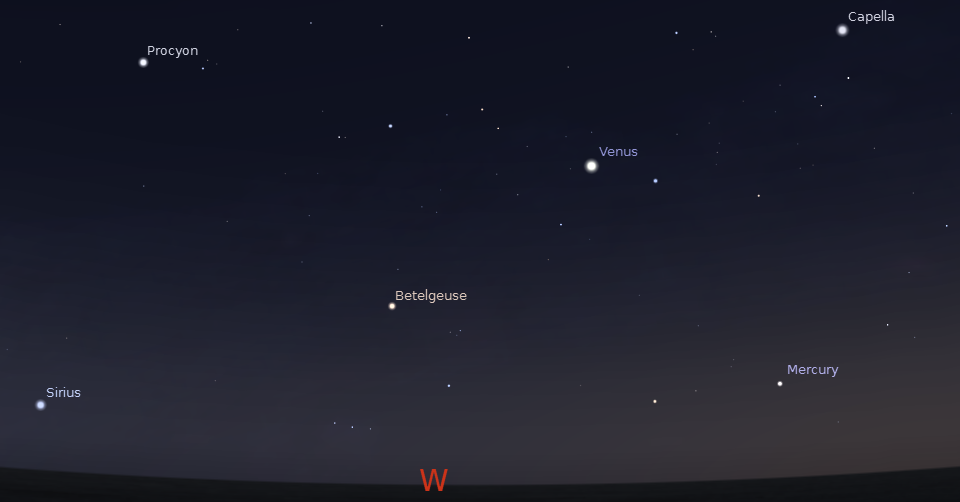
Mercury, Venus and the setting stars of winter at 10 p.m., May 4, 2015. Created using Stellarium.
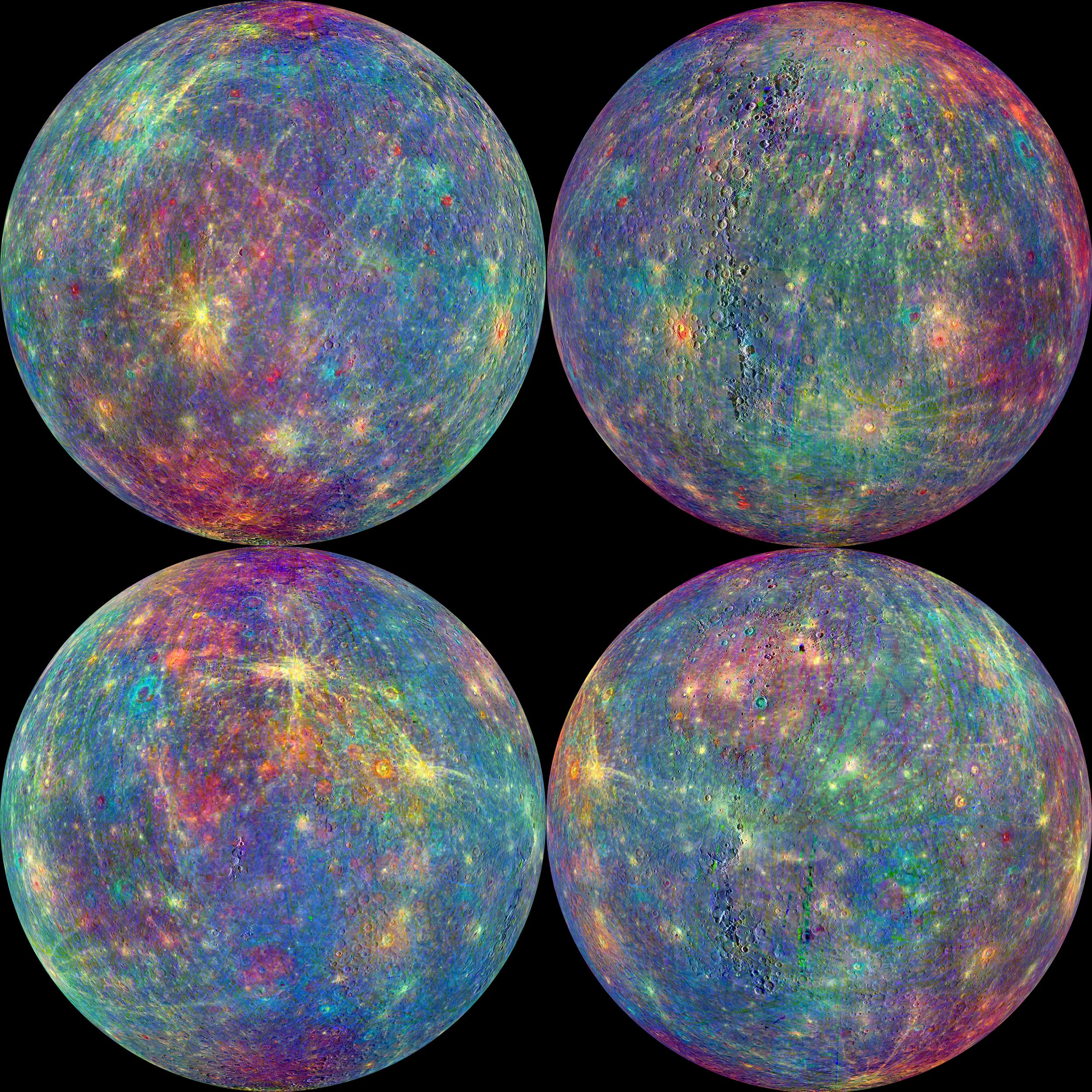
Four views of Mercury with colors based on the mineralogy seen. Credit: NASA/Johns Hopkins University Applied Physics Laboratory/Carnegie Institution of Washington. Click on image to enlarge.
05/01/2015 – Ephemeris – A talk about the Virgo Cluster of galaxies tonight and a star party
Ephemeris for Friday, May 1st. Today the Sun will be up for 14 hours and 14 minutes, setting at 8:47. The Moon, 2 days before full, will set at 5:55 tomorrow morning. Tomorrow the Sun will rise at 6:31.
Tonight yours truly will be presenting the program: The Galaxy Cluster Next Door, at this evening’s meeting of the Grand Traverse Astronomical Society at 8 p.m. at Northwestern Michigan College’s Rogers Observatory. Following at 9 p.m. will be a star party featuring the Moon and planets Venus, Jupiter and later, Saturn. As to the program: There is a patch of the spring sky in the constellation of Virgo the virgin, where we are looking out the thin side of our Milky Way galaxy where there is a huge group of over a thousand galaxies astronomers have dubbed the Virgo Cluster. Galaxy clusters are held together by the gravity of mysterious dark matter, but the clusters are expanding from all the other clusters.
Times are for the Traverse City/Interlochen area of Michigan. They may be different for your location.
Addendum
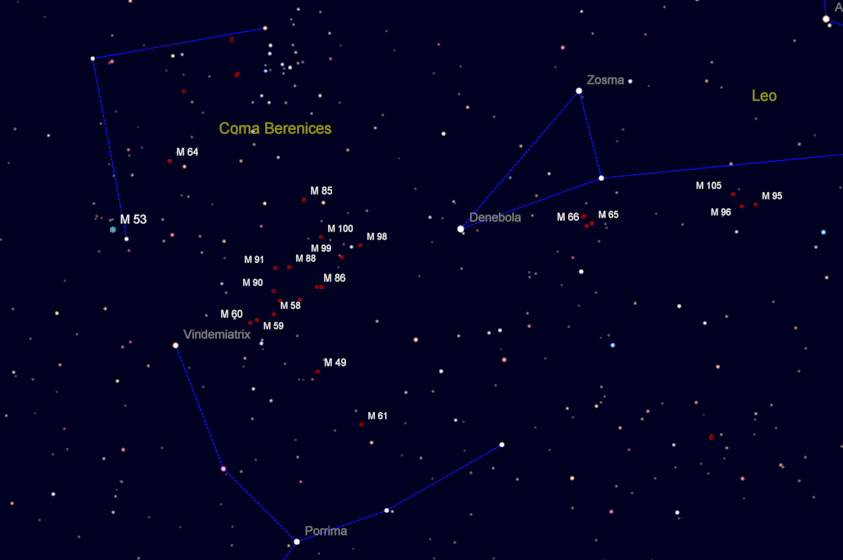
The Messier objects in the central part of the Virgo Cluster. Created with Cartes du Ciel (Sky Charts).
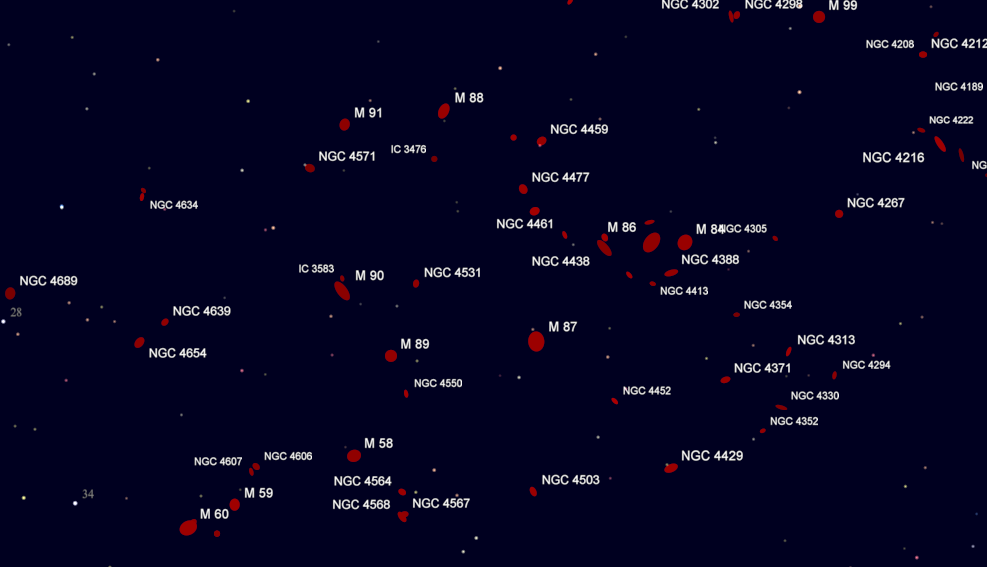
Some of the galaxies in the heart of the Virgo Cluster. Created with Cartes du Ciel (Sky Charts).
04/30/2015 – Ephemeris – Previewing May skies
Ephemeris for Thursday, April 30th. Today the Sun will be up for 14 hours and 11 minutes, setting at 8:46. The Moon, 3 days before full, will set at 5:26 tomorrow morning. Tomorrow the Sun will rise at 6:33.
Let’s look ahead at the month of May, the month when the promise of spring is finally fulfilled. Daylight hours in the Interlochen/Traverse City area will increase from 14 hours and 14 minutes Tomorrow to 15 hours 19 minutes on the 31st. The altitude, or angle, of the sun above the southern horizon at local noon will ascend from 60 degrees tomorrow to 67 degrees at month’s end. The altitude of the sun in the Straits area will be a degree lower than that. Local apparent noon this month, when the sun passes due south, will be about 1:38 p.m. Early this month we’ll have Mercury visible briefly low in the west after sunset. The rest of the bright planets except Mars will also be visible before midnight.
Times are for the Traverse City/Interlochen area of Michigan. They may be different for your location.
Addendum
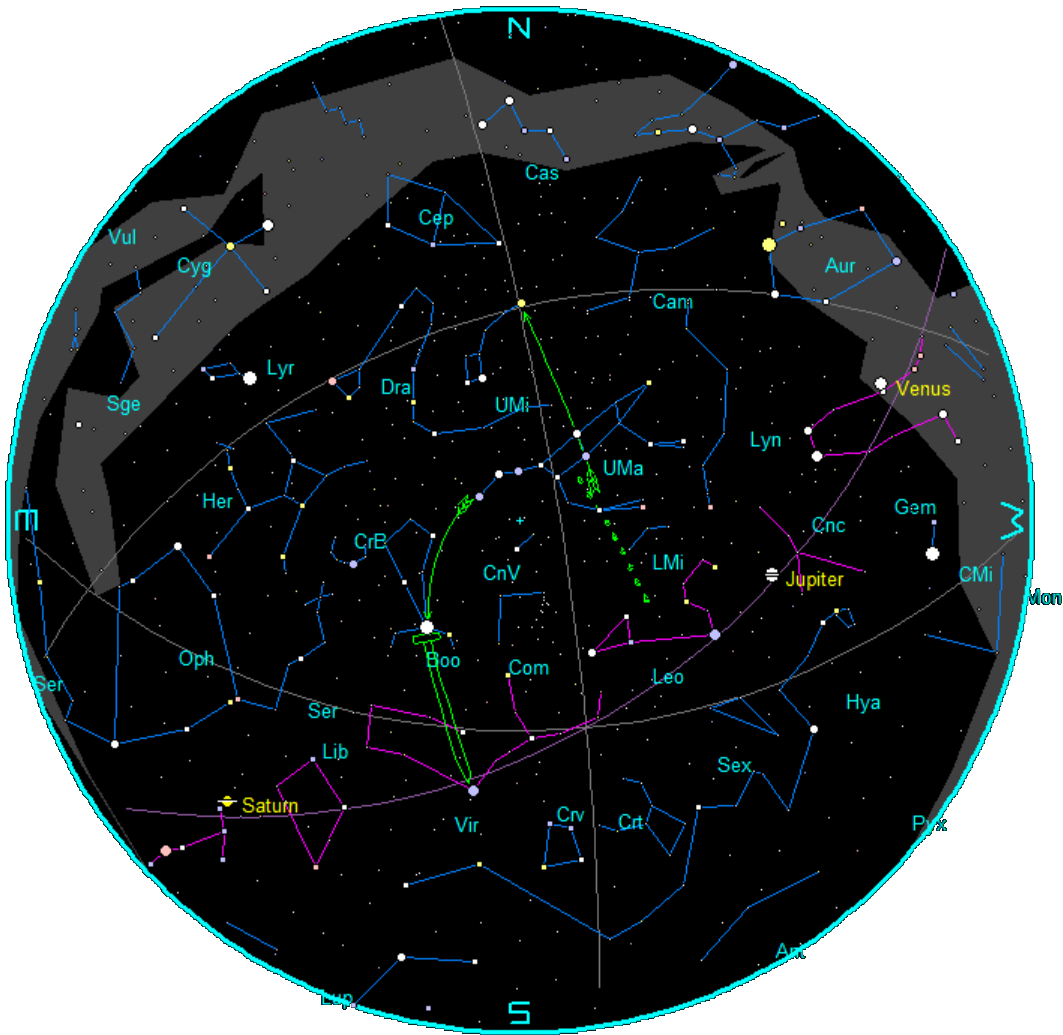
Star Chart for April 2015. Created using my LookingUp program.
The Moon is not plotted. The planets and stars are plotted for the 15th at 11 p.m. EDT. That is chart time.
Evening Astronomical twilight ends at 10:44 p.m. EDT on May 1st, increasing to 11:41 p.m. EDT on the 31st.
Morning astronomical twilight starts at 4:37 a.m. EDT on May 1st, and decreasing to 3:40 a.m. EDT on the 31st.
Add a half hour to the chart time every week before the 15th and subtract and hour for every week after the 15th.
For a list of constellation names to go with the abbreviations click here.
The green pointer from the Big Dipper is:
- Pointer stars at the front of the bowl of the Big Dipper point to Polaris the North Star.
- Drill a hole in the bowl of the Big Dipper and the water will drip on the back of Leo the Lion.
- Follow the arc of the Big Dipper’s handle to Arcturus
- Continue with a spike to Spica
Calendar of Planetary Events
Credit: Sky Events Calendar by Fred Espenak and Sumit Dutta (NASA’s GSFC)
To generate your own calendar go to http://eclipse.gsfc.nasa.gov/SKYCAL/SKYCAL.html
Times are Eastern Daylight Time on a 24 hour clock. Some additions made to aid clarity.
Conjunctions like the Moon-Saturn: 2.3° S means Saturn will appear 2.3° south of the Moon.
| May | 01 | Fr | 05:50 | Moon Ascending Node |
| 01 | Fr | Venus: 42.1° E | ||
| 03 | Su | 23:42 | Full Moon | |
| 05 | Tu | 08:36 | Eta Aquarid Shower: ZHR = 60 | |
| 05 | Tu | 12:18 | Moon-Saturn: 2.1° S | |
| 07 | Th | 00:59 | Mercury Elongation: 21.2° E | |
| 07 | Th | 09:39 | Moon South Dec.: 18.3° S | |
| 11 | Mo | 06:36 | Last Quarter | |
| 14 | Th | 16:37 | Moon Descending Node | |
| 14 | Th | 20:23 | Moon Perigee: 366000 km | |
| 18 | Mo | 00:13 | New Moon | |
| 20 | We | 05:41 | Moon North Dec.: 18.4° N | |
| 22 | Fr | 20:53 | Saturn Opposition | |
| 25 | Mo | 13:19 | First Quarter | |
| 26 | Tu | 18:12 | Moon Apogee: 404200 km | |
| 28 | Th | 10:40 | Moon Ascending Node | |
| 29 | Fr | 13:30 | Venus-Pollux: 4° S | |
| 30 | Sa | 12:53 | Mercury Inferior Conj. | |
| Jun | 01 | Mo | Venus: 45.3° E | |
04/29/2015 – Ephemeris – Last look at the bright planets for April
Ephemeris for Wednesday, April 29th. Today the Sun will be up for 14 hours and 8 minutes, setting at 8:45. The Moon, half way from first quarter to full, will set at 4:59 tomorrow morning. Tomorrow the Sun will rise at 6:34.
Lets take a look at the bright planets for this week. Mercury is low in the western sky after sunset. It’s 19 degrees angle from the sun and will set at 10:32. Our brilliant evening star Venus is high in the west by 9:30 p.m. It will set at 12:27 a.m. Jupiter will appear high in the southwestern sky in the evening. It will set at 3:31 a.m. It’s near the sickle-shaped head of Leo the lion, and it’s the second brightest star-like object in the sky after Venus. In telescopes, Jupiter’s moon Europa will pass in front of Jupiter starting at 11:07 p.m. and its shadow will start across at 1:40 a.m.Saturn will rise in the east-southeast at 10:33 p.m. It will be low in the south as morning twilight brightens.
Times are for the Traverse City/Interlochen area of Michigan. They may be different for your location.
Addendum
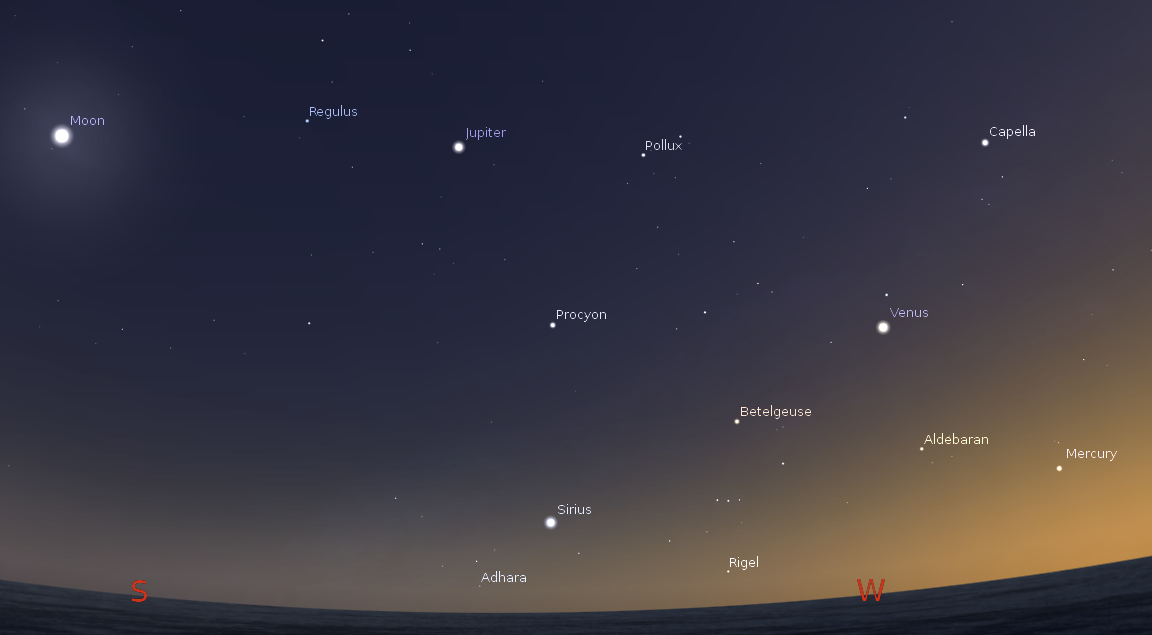
Mercury, Venus, Jupiter and the Moon at 9:30 p.m. April 29, 2015. Created using Stellarium.
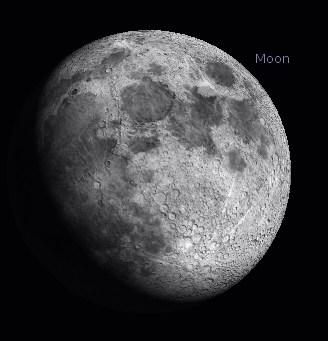
The Moon as it might be seen in binoculars at 10 p.m., April 29, 2015. Created using Stellarium.
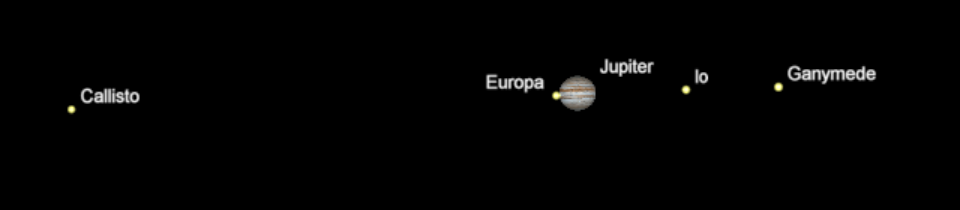
Jupiter at 10:58 p.m. April 29, 2015 with Europa about to transit the planet. Created using Cartes du Ciel (Sky Charts).
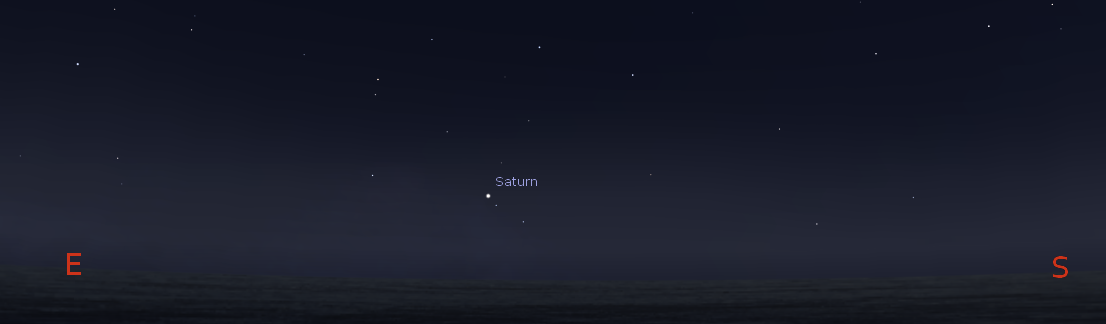
Saturn alone above the southeastern horizon at 11:30 p.m. April 29, 2015. Created using Stellarium.
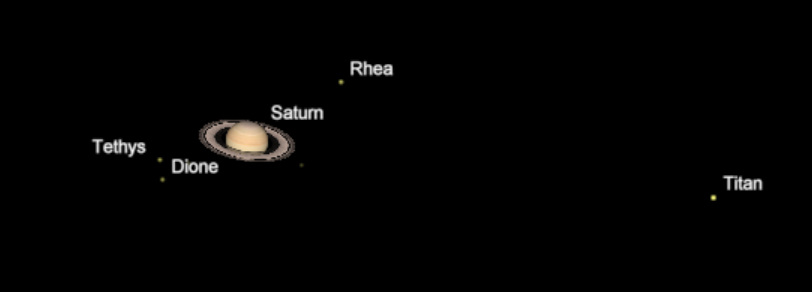
What Saturn and its moons might appear like in a telescope the night of April 29-30, 2015. Small telescopes will show only the moon Titan. Created using Cartes du Ceil (Sky Charts).
04/28/2015 – Ephemeris – Why do the stars of winter disappear so fast?
Ephemeris for Tuesday, April 28th. Today the Sun will be up for 14 hours and 6 minutes, setting at 8:43. The Moon, 3 days past first quarter, will set at 4:32 tomorrow morning. Tomorrow the Sun will rise at 6:36.
At 9:30 p.m. the winter constellation of Orion is above the western horizon, but barely visible in the bright twilight. The sun is moving eastward and northward, setting at about 1 minute and a quarter later each night. That minute and a quarter is due to the Sun’s northward motion north. The Sun’s eastward motion, which is actually the Earth’s orbital motion around the sun, makes the stars set approximately 4 minutes earlier each night. That’s because our time is kept based on the Sun, not the stars. What happens is that the winter stars seem to disappear rather rapidly. We lose the bright stars and constellations of winter which are replaced by the sparser constellations of spring.
Times are for the Traverse City/Interlochen area of Michigan. They may be different for your location.
04/27/2015 – Ephemeris – Two large craters on the Moon for binoculars or a small telescope
Ephemeris for Monday, April 27th. Today the Sun will be up for 14 hours and 3 minutes, setting at 8:42. The Moon, 2 days past first quarter, will set at 4:04 tomorrow morning. Tomorrow the Sun will rise at 6:37.
After taking a look, last week, at some early results from the two spacecraft approaching dwarf planets now, Dawn at Ceres and New Horizons nearing Pluto, let’s get back to our sky and our Moon. Time to get out that telescope or powerful binoculars. The terminator which now is the sunrise line will be cutting through the middle of the crater Copernicus at 10 in the evening. Copernicus, near the Moon’s equator hit a flat lunar sea, so it’s quite conspicuous. Another crater near the Moon’s southern pole is conspicuous because it’s so big. It’s Clavius, with an arc of diminishing sized craters within. It will be completely in sunlight being uncovered slowly now by the terminator.
Times are for the Traverse City/Interlochen area of Michigan. They may be different for your location.
Addendum
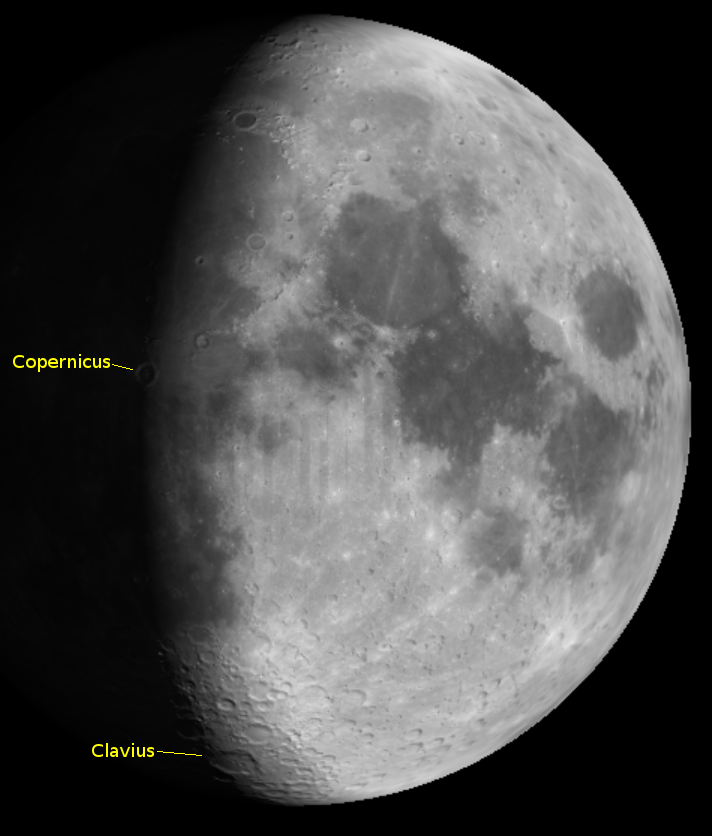
The Moon at 10 p.m. April 27, 2015 EDT (2:00 UT, April 28). Created using Virtual Moon Atlas.
04/24/2015 – Ephemeris – The Dawn spacecraft is descending to dwarf planet Ceres’ day side
Ephemeris for Arbor Day, Friday, April 24th. Today the Sun will be up for 13 hours and 54 minutes, setting at 8:38. The Moon, 1 day before first quarter, will set at 2:26 tomorrow morning. Tomorrow the Sun will rise at 6:42.
The Dawn spacecraft with its ion engine is descending into orbit of that other dwarf planet Ceres, the largest body in the asteroid belt. Over the past month Dawn has been maneuvering over Ceres’ night side to descend into a polar orbit to better survey the planet. Last week the Jet Propulsion Laboratory team that has been operating the spacecraft released a video of several photographs of Ceres’ pole as it rotated. It was still a crescent view, but soon we’ll see Ceres up close and very personal. We’ll get a closer look at those enigmatic white spots. Are they just white ice patches on the surface, or are they ice cryovolcanoes spewing water, or something else? Stay tuned.
Times are for the Traverse City/Interlochen area of Michigan. They may be different for your location.
Addendum
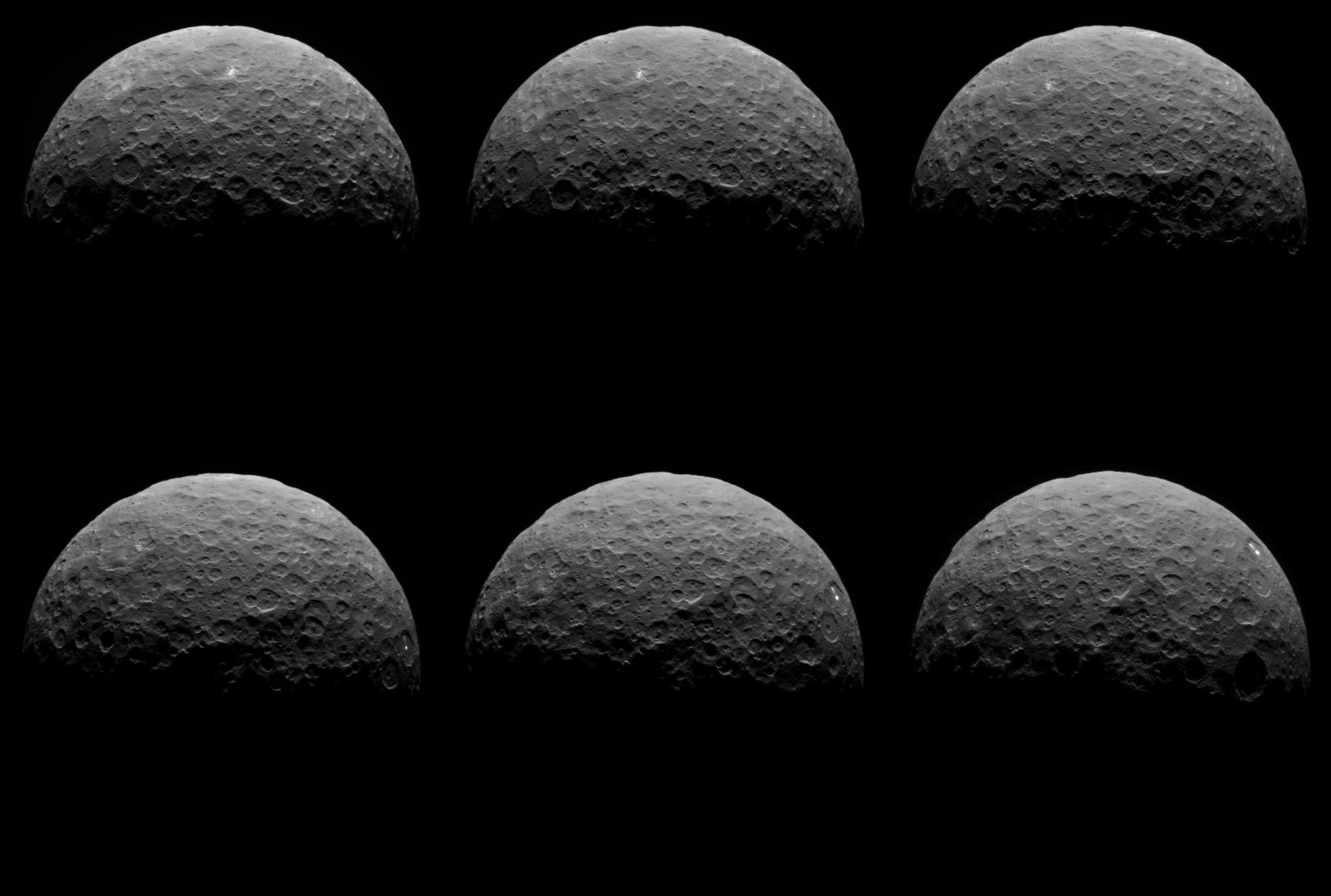
Ceres animation from April 14-15, 2015. Dawn was 14,000 miles (22,000 km) from Ceres. Credit: NASA/JPL-Caltech/UCLA/MPS/DLR/IDA. Click the image to enlarge.
This is a newer animation than the one mentioned in the transcript above that was actually written on the 19th. Here’s a link to the NASA page that describes the image. It also has a link to an enlarged frame containing the double bright spot.
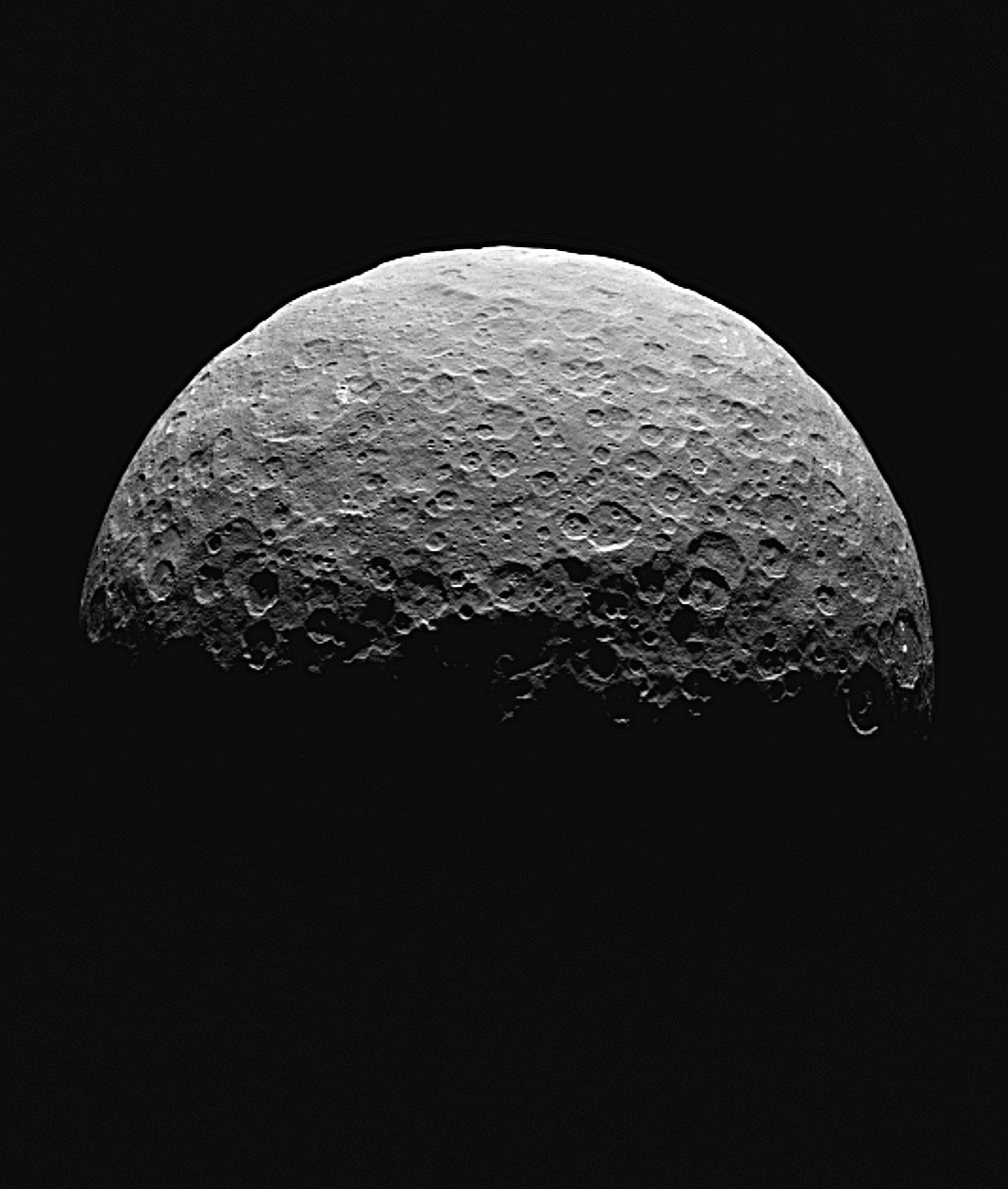
This is a processed still image of Ceres from the above animated sequence of images.
Credit: NASA/JPL-Caltech/UCLA/MPS/DLR/IDA
There’s no help figuring out what they are but the smaller spot is resolved into two spots. The bright one is still unresolved. As of yesterday the Dawn spacecraft should be in its first circular orbit of Ceres at an altitude of 8,400 miles (13,500 km) from Ceres for a few weeks before descending to a lower orbit of Ceres the starting the first week in May.
04/23/2015 – Ephemeris – New Horizons’ first glimpse of Pluto and Charon in color
Ephemeris for Thursday, April 23rd. Today the Sun will be up for 13 hours and 52 minutes, setting at 8:37. The Moon, 2 days before first quarter, will set at 1:44 tomorrow morning. Tomorrow the Sun will rise at 6:43.
Last week NASA’s New Horizons team running the spacecraft that’s been in flight to the dwarf planet Pluto released their first color of Pluto and it’s moon Charon. The photo doesn’t show any surface features. That’s to come in the next month or two. However, Pluto shows kind of a pale orange-pink color, hinting of the colorful images to come. Charon is a dull gray like the dwarf planet Ceres, which Dawn is approaching, and our own Moon. How could two bodies with a common origin appear so different? Stay tuned. New Horizons will pass through the Pluto system in a couple of hours on July 14th, but will send back the mother lode of its data over the next 16 months.
Times are for the Traverse City/Interlochen area of Michigan. They may be different for your location.
Addendum

First color picture of Pluto and its moon Charon taken by the New Horizons spacecraft. Credit: NASA/Johns Hopkins University Applied Physics Laboratory/Southwest Research Institute. Click to enlarge.
From the NASA website:
“This image of Pluto and its largest moon, Charon, was taken by the Ralph color imager aboard NASA’s New Horizons spacecraft on April 9 and downlinked to Earth the following day. It is the first color image ever made of the Pluto system by a spacecraft on approach. The image is a preliminary reconstruction, which will be refined later by the New Horizons science team. Clearly visible are both Pluto and the Texas-sized Charon. The image was made from a distance of about 71 million miles (115 million kilometers)—roughly the distance from the Sun to Venus. At this distance, neither Pluto nor Charon is well resolved by the color imager, but their distinctly different appearances can be seen. As New Horizons approaches its flyby of Pluto on July 14, it will deliver color images that eventually show surface features as small as a few miles across.”
04/22/2015 – Ephemeris – All the bright planets are back now
Ephemeris for Earth Day, Wednesday, April 22nd. Today the Sun will be up for 13 hours and 49 minutes, setting at 8:36. The Moon, 3 days before first quarter, will set at 12:55 tomorrow morning. Tomorrow the Sun will rise at 6:45.
Lets take a look at the bright planets for this week. Mars and Mercury are in conjunction, that is close to each other low in the west just after sunset. Mars appears a bit lower and left of the brighter Mercury. Mars will set tonight at 9:47 with Mercury 5 minutes later. Our brilliant evening star Venus is high in the west by 9 p.m. It will set at 12:15 a.m. Jupiter will appear high in the southwestern sky in the evening. It will set at 3:58 a.m. It’s near the sickle-shaped head of Leo the lion, and it’s the second brightest star-like object in the sky after Venus. Saturn will rise in the east-southeast at 11:03 p.m. It will be low in the south at 5 to 6 a.m.
Times are for the Traverse City/Interlochen area of Michigan. They may be different for your location.
Addendum
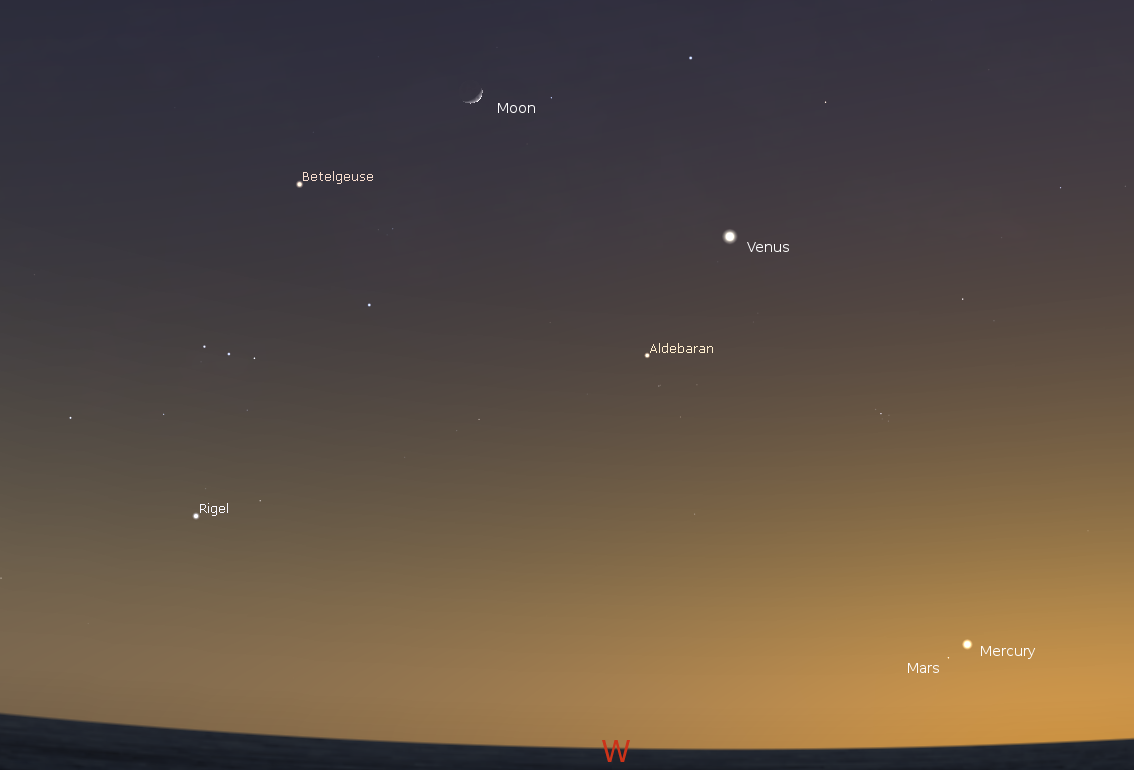
View to the west with Mars, Mercury, Venus and the Moon at 9:15 p.m. April 22, 2015. Created using Stellarium.
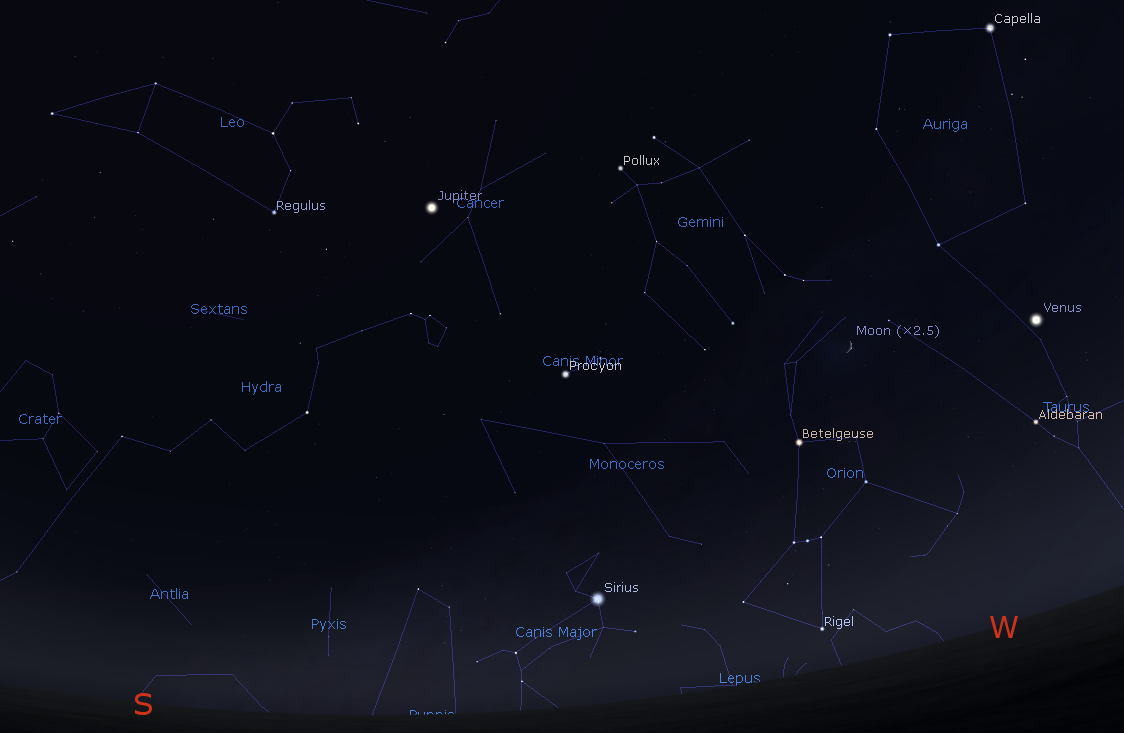
Jupiter, the Moon and the setting winter constellations at 10 p.m. April 22, 2015. Created using Stellarium.
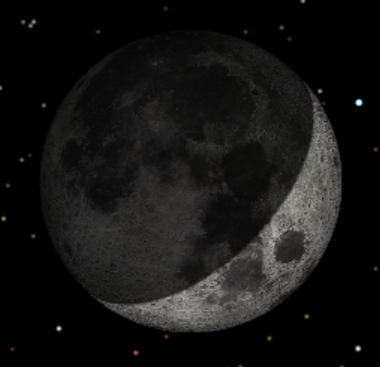
The visibility of the Moon at 10 p.m. on April 22, 2015. Created using Cartes du Ciel (Sky Charts).
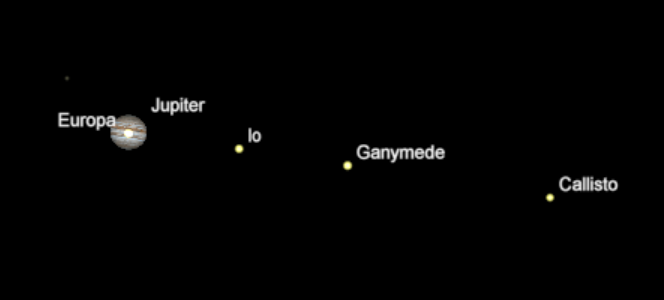
Jupiter and its moons at 10 p.m. Europa will be transiting the face of Jupiter. It’s shadow will start to cross the face of Jupiter at 11:04 p.m.. The transit will end at 11:27 p.m. and the shadow will leave the face of Jupiter at 1:58 a.m. Created using Cartes du Ciel (Sky Charts).
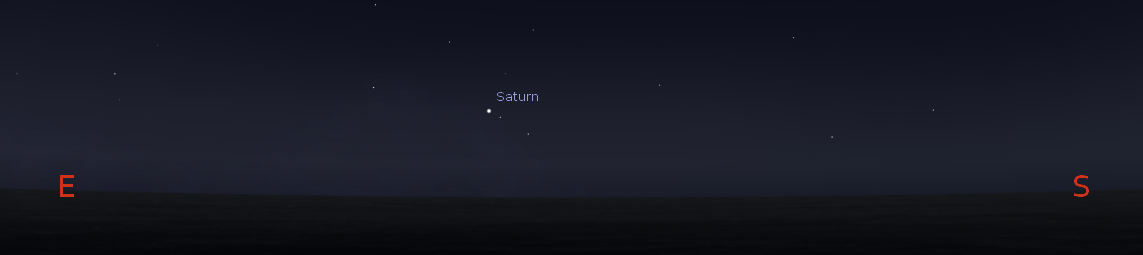
Saturn rising. Shown at midnight, April 22-23 2015. Created using Stellarium.
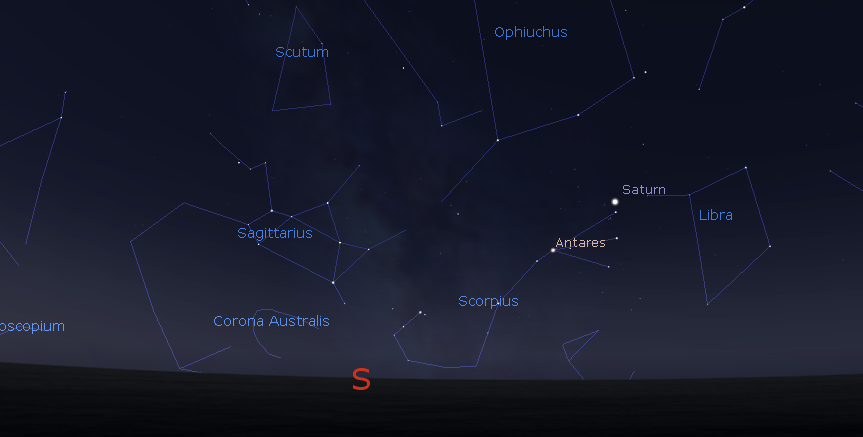
Saturn and the summer constellations at 5:45 a.m. April 23, 2015. Created using Stellarium.
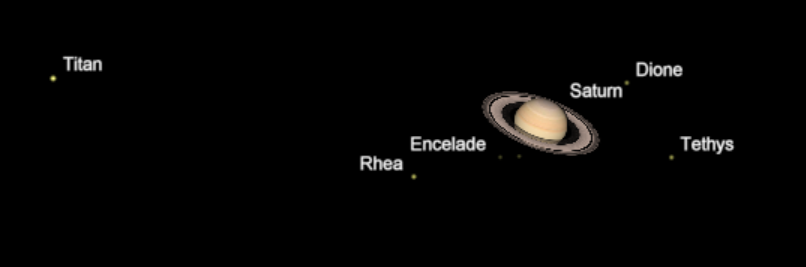
What Saturn and its moons might appear like in a telescope at 5:45 a.m., April 23, 2015. Small telescopes will show only the moon Titan. Created using Cartes du Ceil (Sky Charts).

