Archive
04/21/2015 – Ephemeris – The Moon will pass the Hyades star cluster today to pass near Venus tonight
Apr 21. This is Bob Moler with Ephemeris for Tuesday, April 21st. Today the Sun will be up for 13 hours and 46 minutes, setting at 8:35. The Moon, 3 days past new, will set at midnight. Tomorrow the Sun will rise at 6:47.
The moon, which was new last Saturday passed the face of the constellation Taurus the bull earlier today. The face of Taurus is a letter V shape of stars which is the star cluster called the Hyades. There’s a bright orange star that appears at the left tip of the V called Aldebaran, which actually doesn’t belong to the cluster. At 9:30 the crescent Moon will have also just passed the brilliant planet Venus. By then they will be nearly 8 degrees apart, which is a bit less than the width of a fist held at arm’s length. The Moon, Venus and all the planets move very close along the path of the Sun in the sky, called the ecliptic. Even so the Moon is now about 5 degrees south of the ecliptic and Venus about 2 degrees north of it.
Times are for the Traverse City/Interlochen area of Michigan. They may be different for your location.
Addendum
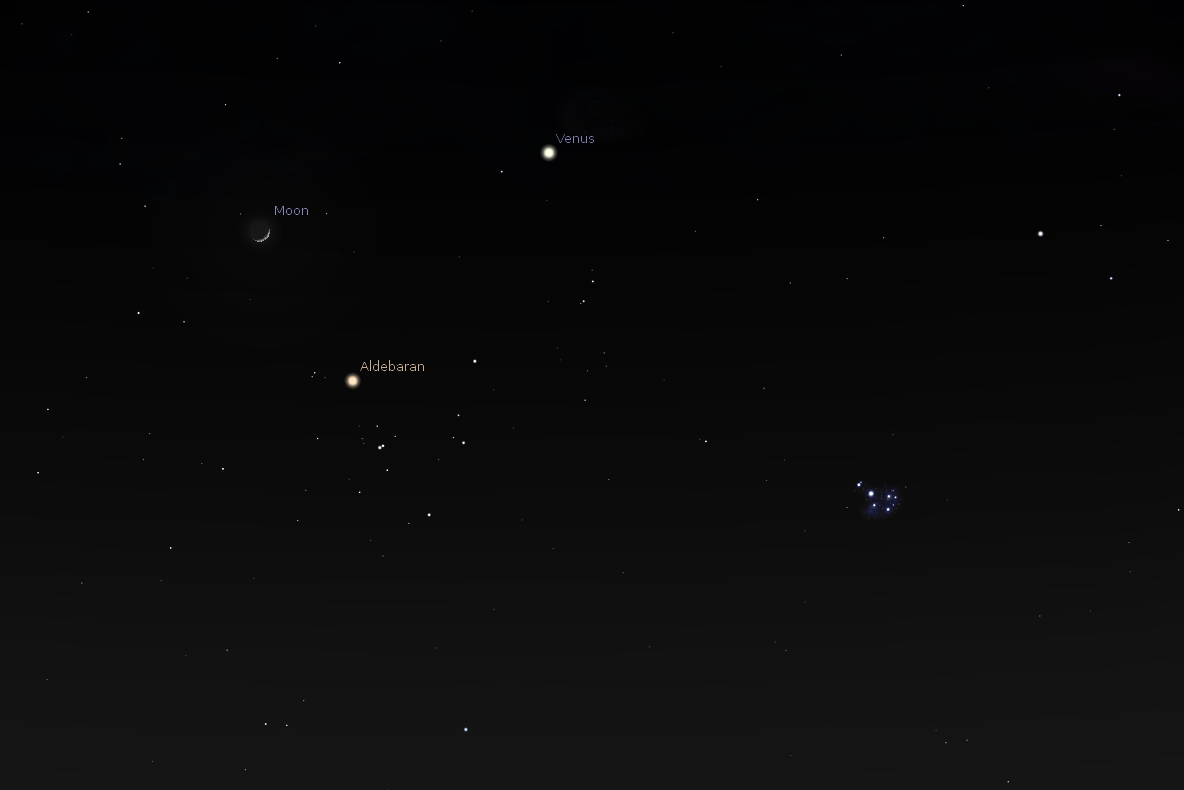
The Moon with Venus and the Hyades at 9:30 p.m. April 21, 2015. Note the Pleiades on the right. Created using Stellarium.
04/20/2015 – Ephemeris – The Lyrid meteor shower will reach peak Wednesday evening
Ephemeris for Monday, April 20th. The Sun rises at 6:50. It’ll be up for 13 hours and 43 minutes, setting at 8:33. The Moon, 2 days past new, will set at 10:57 this evening.
This week the Lyrid meteor shower will reach its peak. The expected peak will be Wednesday the 22nd at 8 p.m. (24 hr UT). Unfortunately the radiant point will not have risen by then. The radiant, near the star Vega in the constellation of Lyra will rise in the northeast by 10 p.m. It will approach the zenith by 6 a.m. as morning twilight brightens. The normal peak hourly rate is about 18 when the radiant is at the zenith, This year it could be as many as 90 per hour. However Europe and Asia will be prime locations to view the shower near the zenith at peak. The shower is caused by the debris of Comet Thatcher, seen only once in 1861. When comets approach the Sun they shed gas, dust and small bits of rock. When the Earth passes through it we get a meteor shower.
Times are for the Traverse City/Interlochen area of Michigan. They may be different for your location.
Addendum
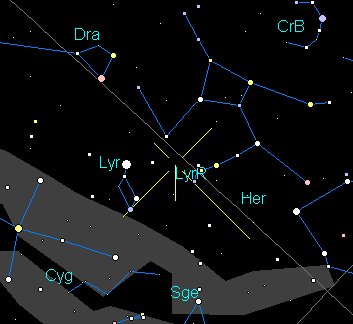
Lyrid meteor radiant is near Lyra and the bright star Vega. Th bright star by “Lyr” is Vega. Create by Bob Moler’s LookingUp program.
04/17/2015 – Ephemeris – First Sleeping Bear Dunes star party of the year
Ephemeris for Friday, April 17th. The Sun rises at 6:55. It’ll be up for 13 hours and 34 minutes, setting at 8:30. The Moon, 1 day before new, will rise at 6:55 tomorrow morning.
Tomorrow, that’s Saturday night the 18th, the Grand Traverse Astronomical Society will host the first of nine viewing opportunities at the Sleeping Bear Dunes National Lakeshore this year. This one will be held at Platte River Point north parking lot, at the end of Lake Michigan Road, off M22, weather permitting. Viewing begins around 9 p.m. with Brilliant Venus and then Jupiter. Later on as it gets dark, other wonders among the stars will be visible. For a complete schedule of viewing opportunities check the park’s website or gtastro.org. They will include viewing the sun on the afternoons of the May through August star parties. Plus there will be an all night Perseid Meteor watch at the Dune Climb the night of August 12th and 13th, and a lunar eclipse watch the evening of September 27th.
Times are for the Traverse City/Interlochen area of Michigan. They may be different for your location.
Addendum
Sleeping Bear Dunes National Lakeshore Star Parties and other Events
|
Day |
Date |
Venue |
Time |
Comments |
|---|---|---|---|---|
|
Saturday |
April 18 |
SBDNL – Platte River Point |
9 – 11 p.m. |
Venus, Jupiter |
|
Saturday |
May 23 |
SBDNL – Dune Climb |
4 – 6 p.m ☼ & 9 – 11 p.m. |
Venus, Jupiter, Moon |
|
Saturday |
June 20 |
SBDNL – Pierce Stocking Drive Stop #3 |
4 – 6 p.m ☼ & 9 – 11 p.m. |
Park at Picnic Mountain. Venus, Jupiter, Moon, Saturn |
|
Saturday |
July 25 |
SBDNL – Platte River Point |
4 – 6 p.m ☼ & 9 – 11 p.m. |
Venus, Jupiter, Moon, Saturn |
|
Saturday |
August 8 |
SBDNL – Thoreson Farm |
4 – 6 p.m ☼ & 9 – 11 p.m. |
Port Oneida Fair. Mercury, Jupiter early, Saturn, Dark, Summer Milky Way |
|
Wednesday |
August 12 |
SBDNL – Dune Climb |
9 p.m. – 5 a.m. |
All night Perseid meteor watch |
|
Saturday |
September 12 |
SBDNL – Dune Climb |
9 – 11 p.m. |
Saturn, Dark skies, Summer Milky Way |
|
Sunday |
September 27 |
SBDNL – Platte River Point |
9 p.m. – 12 m |
Total Lunar Eclipse |
|
Wednesday |
October 21 |
SBDNL – Pierce Stocking Drive Stop #3 |
8 – 10 p.m. |
SBDNL 45th anniversary star party, Moon, bright star clusters and nebulae |
Explanation Key
☼ – Sun viewing
Conditions:
Dark – Dark skies. Deep Sky Objects (DSOs: star clusters, nebulae and galaxies) visible depending on the season.
Twilight – Twilight lasts through out the viewing period. Some Deep Sky Objects may be visible near the end of the viewing period.
Objects other than planets:
Summer Milky Way – Many Deep Sky Objects are visible in our galaxy. The Milky Way is best seen on August and September evenings with the moon out of the sky. This also means dark skies.
Cancellation
The monthly star party events will be cancelled if the sky is not visible due to weather conditions. An official decision will be made by the Lakeshore, usually, one hour before the event. To find out whether an event has been cancelled please check our Facebook page, or Twitter feed, or call park rangers at 231-326-4700, ext. 5005, for a voice mail message with the decision.
4/16/2015 – Ephemeris – A constellation commemorating a real person
Ephemeris for Thursday, April 16th. The Sun rises at 6:57. It’ll be up for 13 hours and 31 minutes, setting at 8:28. The Moon, 2 days before new, will rise at 6:19 tomorrow morning.
Half way up the sky in the east-southeast at 10 p.m. is a tiny and faint constellation of Coma Berenices, or Berenice’s hair. In it are lots of faint stars arrayed to look like several strands of hair. The whole group will fit in the field of a pair of binoculars, which will also show many more stars. The story behind it was that Berenice was a real Queen of Egypt, whose husband was away at war. This was in the days when the Greeks ruled Egypt after Alexander conquered it. She offered her golden tresses to the gods for the king’s safe return. The hair, was placed in a temple. However the offering disappeared when the king returned. Ever since then the constellation of Coma Berenices has been seen to commemorate the queen’s sacrifice.
Times are for the Traverse City/Interlochen area of Michigan. They may be different for your location.
Addendum
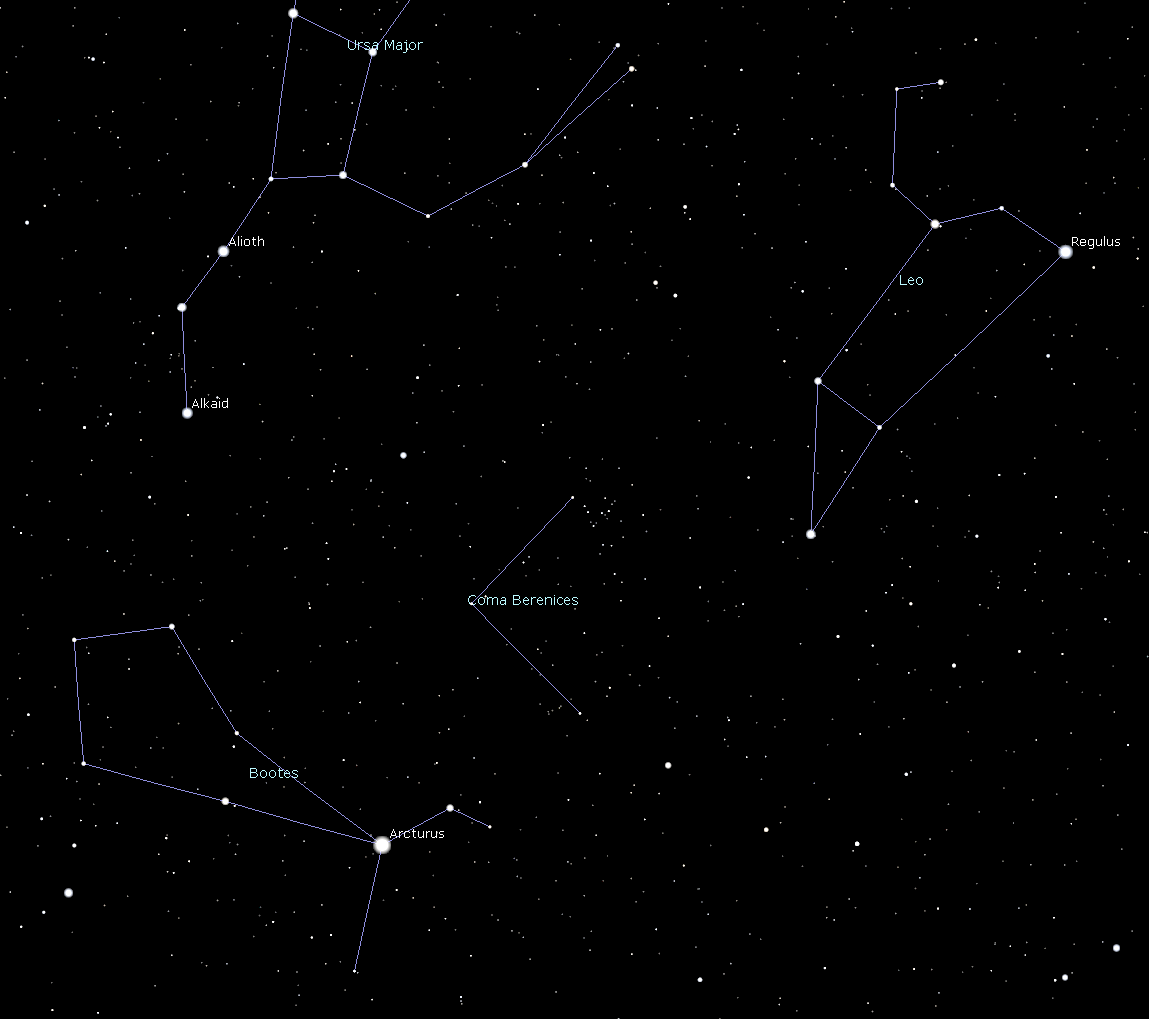
Coma Berenices and neighboring constellations at 10 p.m. on April 16, 2015. Note that only the upper right star of the upside down L shape actually belongs to the cluster. Created using Stellarium.
04/15/2015 – Ephemeris – Besides Tax Day, it’s planets day on Ephemeris
Wednesday, April 15th, Tax Day. The Sun rises at 6:58. It’ll be up for 13 hours and 28 minutes, setting at 8:27. The Moon, 3 days before new, will rise at 5:44 tomorrow morning.
Lets take a look at the bright planets for this week. Our brilliant evening star Venus is high in the west by 9 p.m. It will set at 12:06 a.m. Mars appears much lower and to the right of it. The Red Planet will set tonight at 9:48. Jupiter will appear high in the southern sky in the evening. It will set at 4:25 a.m. It’s near the sickle-shaped head of Leo the lion, and it’s the second brightest star-like object in the sky after Venus. All four moons will be visible in telescopes tonight, Europa will be on the western side of Jupiter casting it’s shadow on the planet in the evening. Saturn will rise in the east-southeast at 11:32 p.m. It will be low in the south at 5 to 6 a.m.
Times are for the Traverse City/Interlochen area of Michigan. They may be different for your location.
Note: Due to some incorrect calculations the Jupiter moon phenomena in the broadcast program was in error. This transcript corrects that.
Addendum
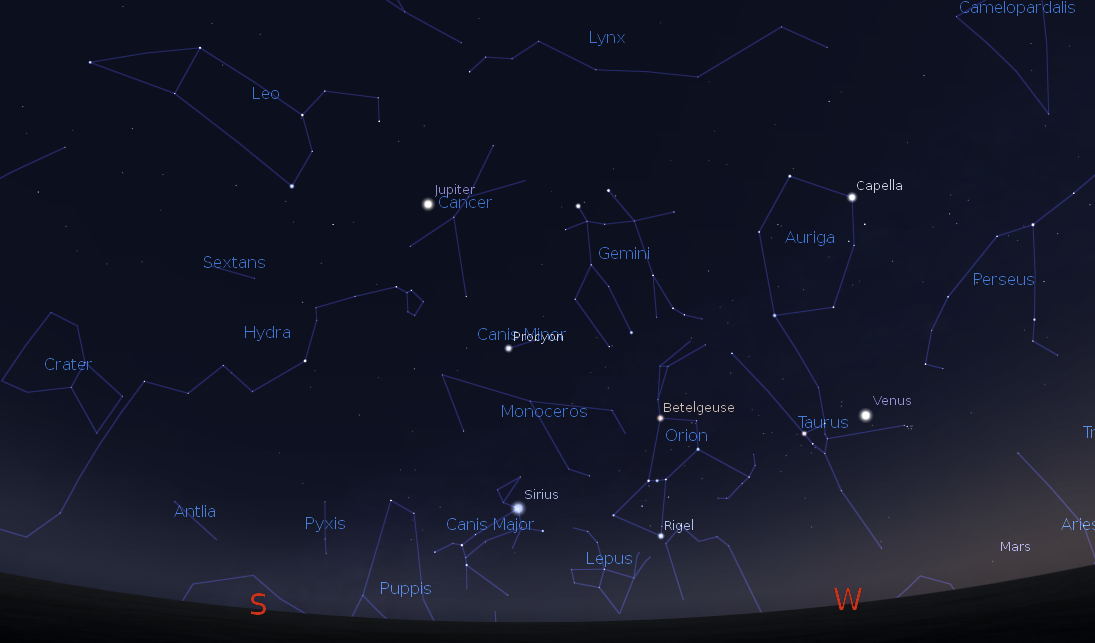
Jupiter, Venus and Mars and remaining winter constellations at 9:30 p.m. April 15, 2015. Created using Stellarium.
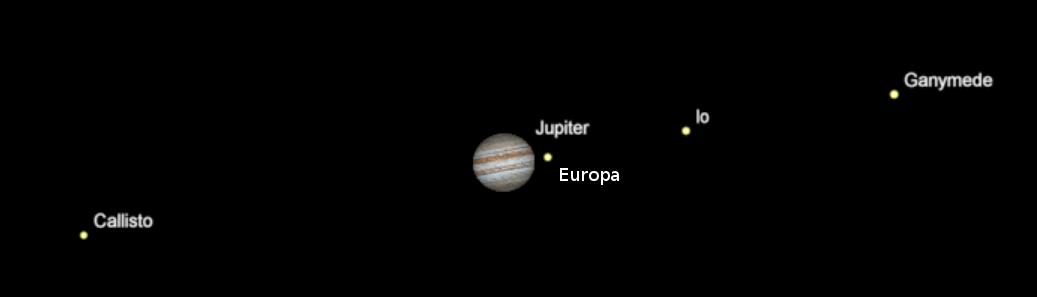
Jupiter and moons as they would appear in a telescope at 9:30 p.m. April 15, 2015. Created using Cartes du Ceil (Sky Charts).
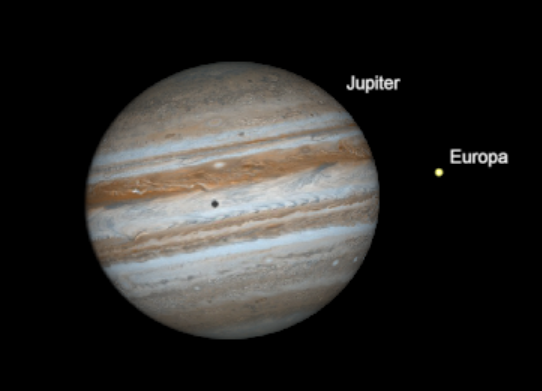
Closeup of Jupiter and Europa with its shadow cast on Jupiter at 9:30 p.m. April 15, 2015. Created using Cartes du Ceil (Sky Charts).
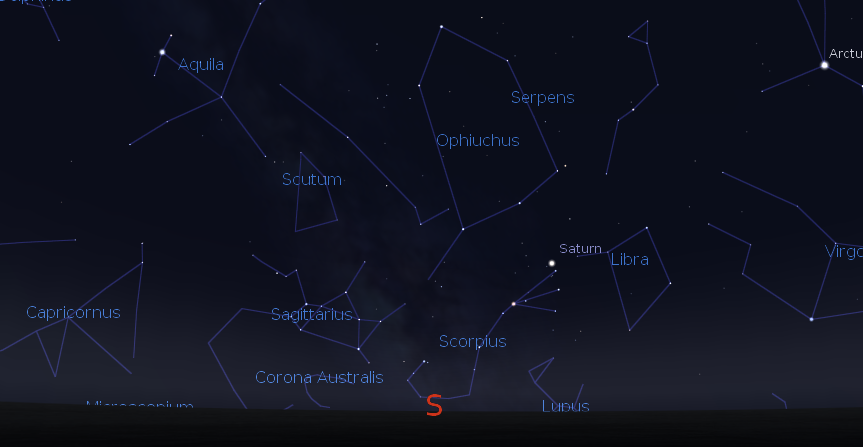
Saturn and the evening stars of summer at 5:30 a.m. April 16, 2015. Created using Stellarium.
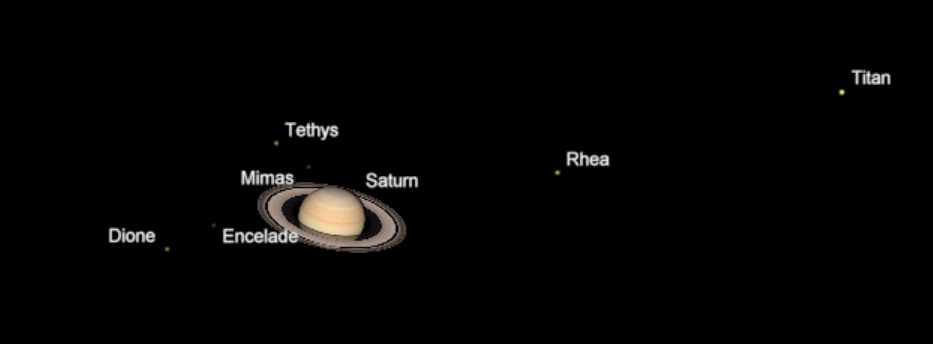
What Saturn and its moons might appear like in a telescope at 5:30 a.m., April 16, 2015. Small telescopes will show only the moon Titan. Created using Cartes du Ceil (Sky Charts).
04/14/2015 – Ephemeris – Arcas and Callisto
Ephemeris for Tuesday, April 14th. The Sun will rise at 7:00. It’ll be up for 13 hours and 25 minutes, setting at 8:26. The Moon, 3 days past last quarter, will rise at 5:08 tomorrow morning.
Rising in the eastern sky at 10 p.m. tonight is the kite shaped constellation of Boötes the herdsman. The bright star Arcturus is at the bottom of the kite, pointed to by the arc of the handle of the Big Dipper, overhead. In one story Boötes represents a young hunter named Arcas, son of Callisto, a beautiful young lady who had the misfortune of being loved by Zeus the chief Greek god. Zeus’ wife Hera, found out about it, and since she couldn’t punish Zeus, turned Callisto into an ugly bear. Arcas, unaware of why his mother disappeared in his youth was about to kill the bear when Zeus intervened and placed them both in the sky. Now Arcas as Boötes chases the Great Bear forever around the pole of the sky each night.
Times are for the Traverse City/Interlochen area of Michigan. They may be different for your location.
Addendum
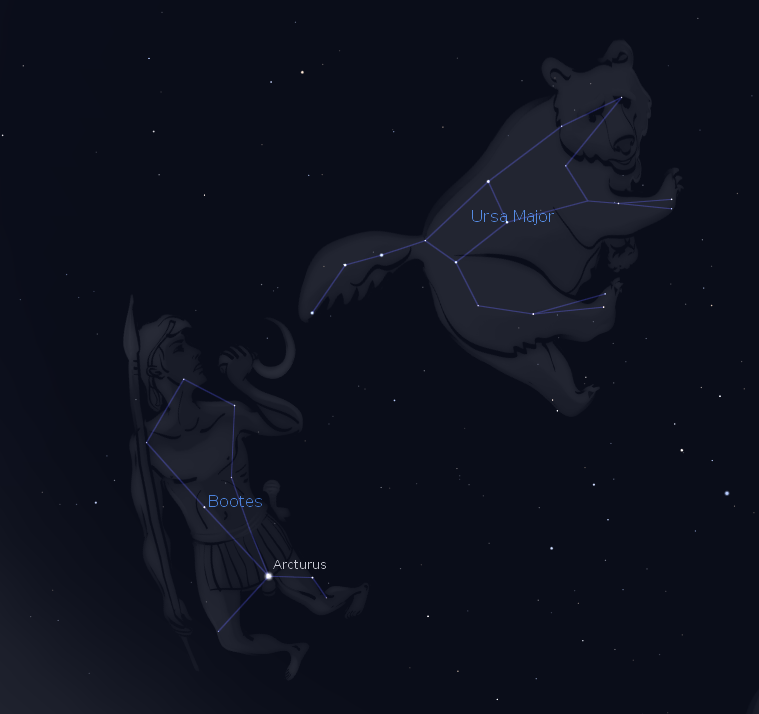
Bootes and Ursa Major aka Arcas chasing Callisto around the pole of the sky. Created using Stellarium.
öö
04/13/2015 – Ephemeris – The Big Dipper as seen from many lands
Ephemeris for Monday, April 13th. The Sun will rise at 7:02. It’ll be up for 13 hours and 22 minutes, setting at 8:25. The Moon, 2 days past last quarter, will rise at 4:31 tomorrow morning.
The Big Dipper will be high in the east, nearly overhead at 10 p.m. It is officially part of Ursa Major, the Great Bear. Other cultures have different representations for this star group. It’s the plough (plow), Charles’ Wain (Charlemagne’s Wagon), the Saucepan, or the Cleaver depending on the country. It performs an invaluable service in pointing out other stars and constellations, especially the star Polaris the north star. That star, which seems to hover over the north pole of the Earth can be found by using the two stars at the front of the bowl of the dipper to point to it. And at our latitude of around 45 degrees north, the Big Dipper is always in the sky. It is one of the circumpolar star groups that can be seen in any season.
Times are for the Traverse City/Interlochen area of Michigan. They may be different for your location.
Addendum
Right now in the spring the Big Dipper is nearly overhead pointing down to Polaris. I’ve turned these upside down so the images make more sense.
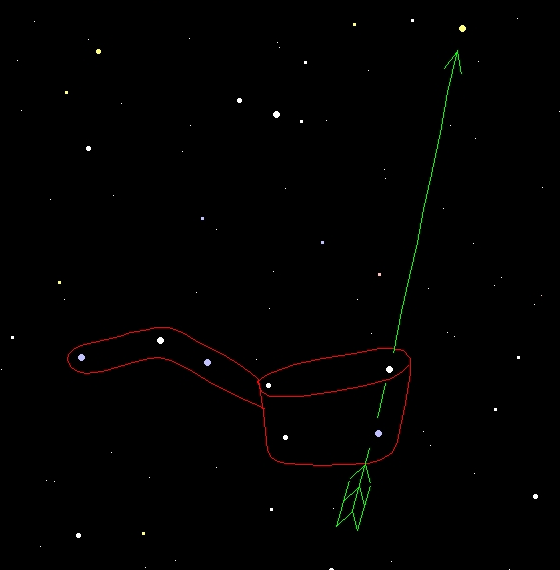
The Big Dipper or Sauce Pan. Credit: Bob Moler’s LookingUp program.
For runaway slaves fleeing northward at night it was their compass… “Follow the Drinking Gourd”
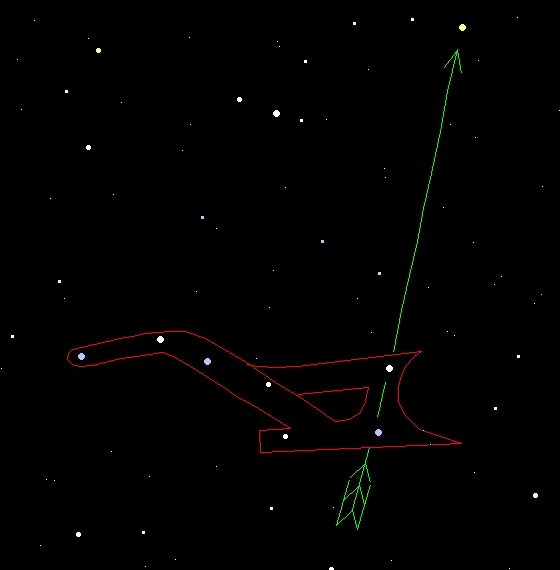
The Plough or plow in American. Credit: Bob Moler’s LookingUp program.
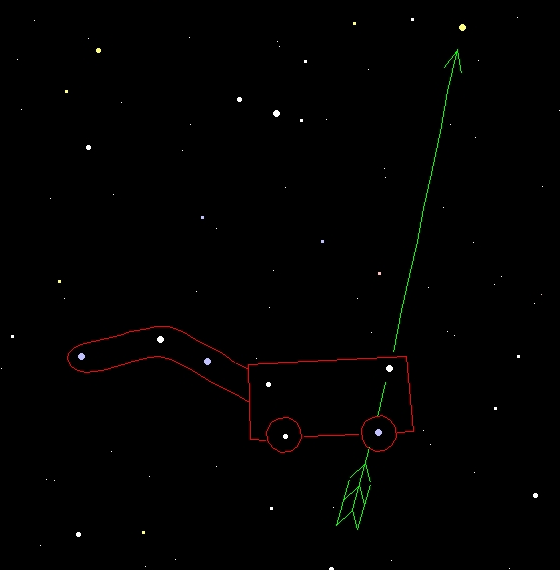
Charles’ Wain. Credit: Bob Moler’s LookingUp program.
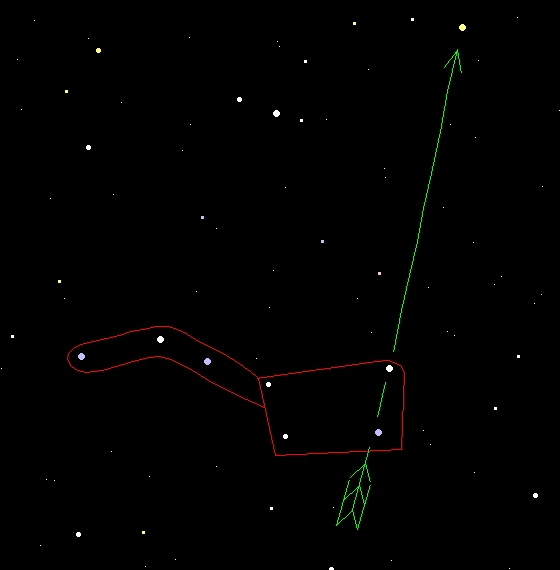
The Cleaver. Credit: Bob Moler’s LookingUp program.
Do you know any others?


04/10/2015 – Ephemeris – Venus will pass the Pleiades tomorrow evening
Ephemeris for Friday, April 10th. The Sun will rise at 7:07. It’ll be up for 13 hours and 13 minutes, setting at 8:21. The Moon, 1 day before last quarter, will rise at 2:22 tomorrow morning.
Tomorrow evening, that’s Saturday the 11th, Venus will pass the Pleiades. Venus will appear below and left of that famous Seven Sisters star cluster by about 5 moon widths, or about a quarter of the width of your fist held at arm’s length. Venus is moving rapidly eastward against the stars and will be approaching Jupiter for the next two and a half months. It will catch up with Jupiter and on June 30th it will be only half of a degree away, the width of the full moon. Jupiter look really bright when seen away from Venus, but to compare them close together, Jupiter can’t hold a candle to Venus. This also the part of the sky, in Leo that one of the planetary events between these two planets occurred that could have been part of the Star of Bethlehem.
Times are for the Traverse City/Interlochen area of Michigan. They may be different for your location.
Addendum
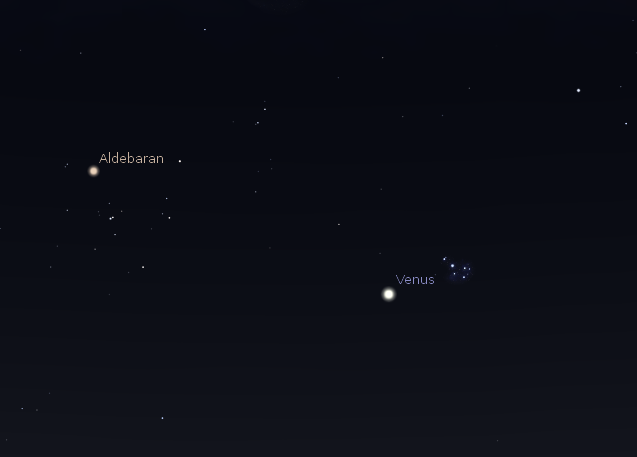
Venus passing the Pleiades at 10 p.m. on April 10, 2015. The Hyades, head of the constellation Taurus the bull, is to the left. Created using Stellarium.
04/09/2015 – Ephemeris – Two water creatures among the stars
Ephemeris for Thursday, April 9th. The Sun will rise at 7:09. It’ll be up for 13 hours and 10 minutes, setting at 8:20. The Moon, 2 days before last quarter, will rise at 1:30 tomorrow morning.
Hydra the water snake is the longest of the constellations. Its head is a group of five stars in a close group below a line between Leo the Lion and Gemini the twins in the southwest. This year it is below Jupiter. Its stars drop down and skirt the horizon underneath Corvus the crow, an interesting box-like constellation and Virgo and dip below the horizon in the southeast. It takes a low southern horizon to follow its body that far. It’s brightest star is Alphard. To the native peoples around here the sickle of Leo, the head of Hydra and stars down to Alphard made the Great Underwater Leopard, ready to snatch the foolish who ventured out on the thin ice and broke through this time of year.
Times are for the Traverse City/Interlochen area of Michigan. They may be different for your location.
Addendum
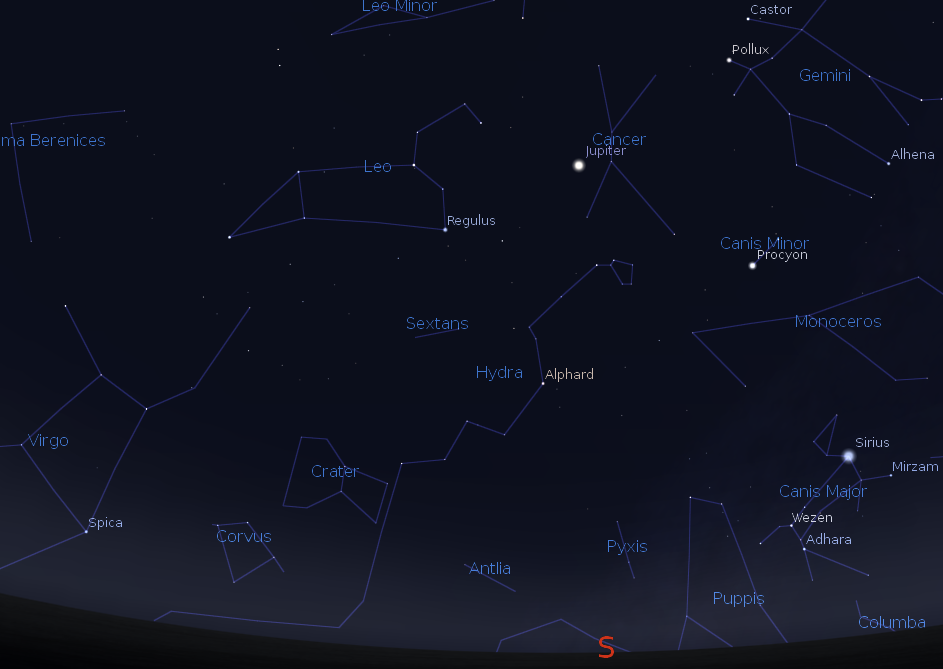
Hydra finder chart for 9:30 p.m. April 9, 2015. Created using Stellarium.
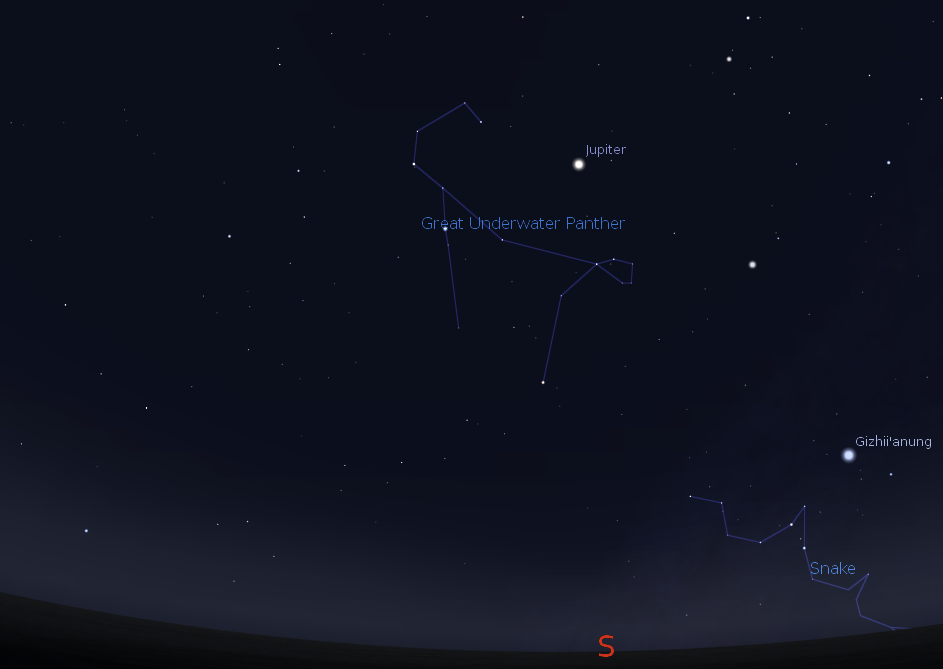
The Anishinaabek Great Underwater Panther. 9:30 p.m. April 9, 2015. Created using Stellarium. Constellation by Bob Moler, based on a video by Michael Wassegijig Price.
The video is here.
04/08/2015 – Ephemeris – It’s bright planet night on Ephemeris
Ephemeris for Wednesday, April 8th. The Sun will rise at 7:11. It’ll be up for 13 hours and 7 minutes, setting at 8:18. The Moon, 3 days before last quarter, will rise at 12:34 tomorrow morning.
Lets take a look at the bright planets for this week. Our brilliant evening star Venus is high in the west by 9 p.m. It will set at 11:43 p.m. Mars appears much lower and to the right of it. The Red Planet will set tonight at 9:48. Jupiter will appear high in the southeastern sky in the evening. It will set at 4:52 a.m. It’s near the sickle-shaped head of Leo the lion, and it’s the second brightest star-like object in the sky after Venus. Three of the four moons will be visible in telescopes tonight, Callisto is behind Jupiter and will reappear at 4:42 a.m., shortly before Jupiter sets. Early risers will be able to spot Saturn which will rise in the east-southeast at 12:01 a.m. It will be low in the south at 5 to 6 a.m.
Times are for the Traverse City/Interlochen area of Michigan. They may be different for your location.
Addendum
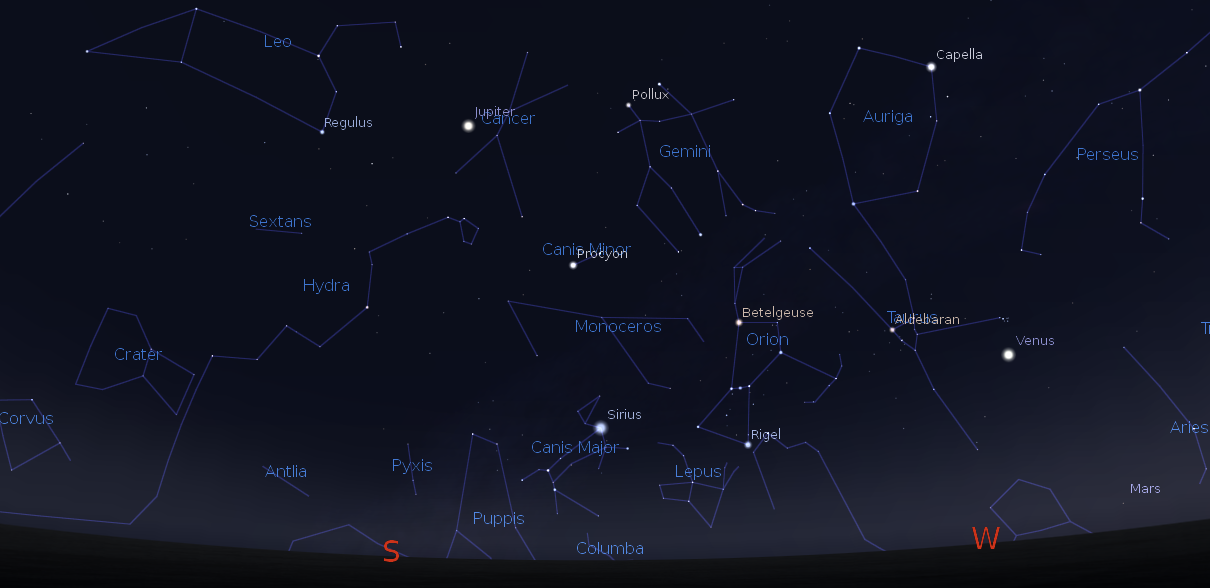
The Moon, Jupiter, Venus and Mars and remaining winter constellations at 9:30 p.m. April 8, 2015. Created using Stellarium.
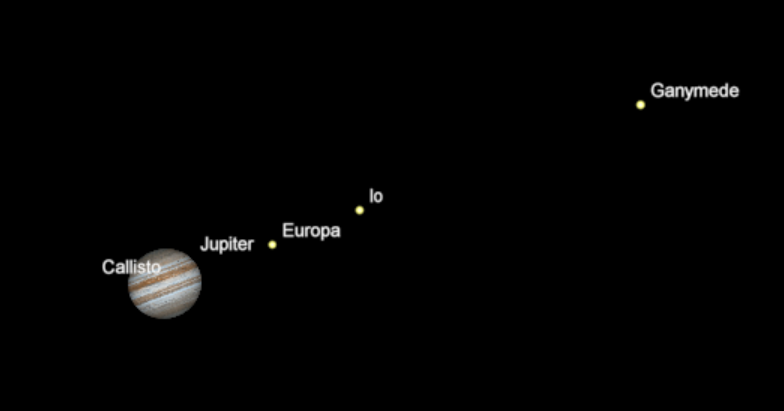
Jupiter and three of its moons. Callisto is tagged, but is behind the planet at 9:30 p.m. April 8, 2015. Created using Cartes du Ceil (Sky Charts).
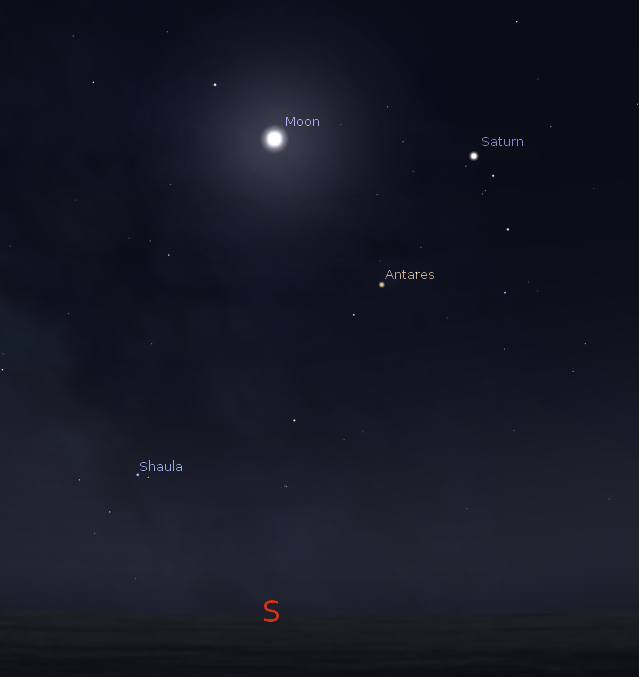
Saturn and the Moon above Scorpius at 5:30 a.m. April 9, 2015. Created using Stellarium.
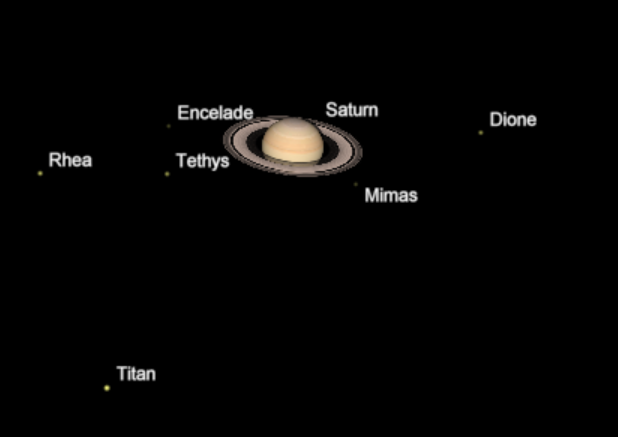
What Saturn and its moons might appear like in a telescope at 5:30 a.m., April 9, 2015. Small telescopes will show only the moon Titan. Created using Cartes du Ceil (Sky Charts).
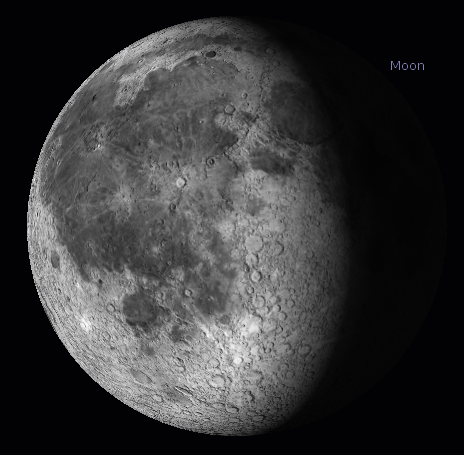
The Moon at 5:30 a.m. April 9, 2015. Created using Cartes du Ceil (Sky Charts).

