Archive
04/07/2015 – Ephemeris – The Moon will pass Saturn tomorrow morning
Ephemeris for Tuesday, April 7th. The Sun will rise at 7:13. It’ll be up for 13 hours and 4 minutes, setting at 8:17. The Moon, 3 days past full, will rise at 11:36 this evening.
The planet Saturn is now rising shortly after midnight. However it is still best seen in the early morning. The Moon will be near Saturn when it rises and will get closer as the morning progresses. By 6 a.m. the Moon will be about four of its widths above and right of Saturn. The Moon will get its closest about 10 a.m., but by then it will be daylight and both will have set. Every week Saturn will rise, and set about a half hour earlier. That’s about an hour every two weeks, and two hours a month. This works for the stars and is pretty close for slow-moving planets like Jupiter and Saturn. So next month at this time Saturn will rise about 10 p.m., and in another month 9 p.m. By then it will be in the sky at sunset, and visible all night.
Times are for the Traverse City/Interlochen area of Michigan. They may be different for your location.
Addendum
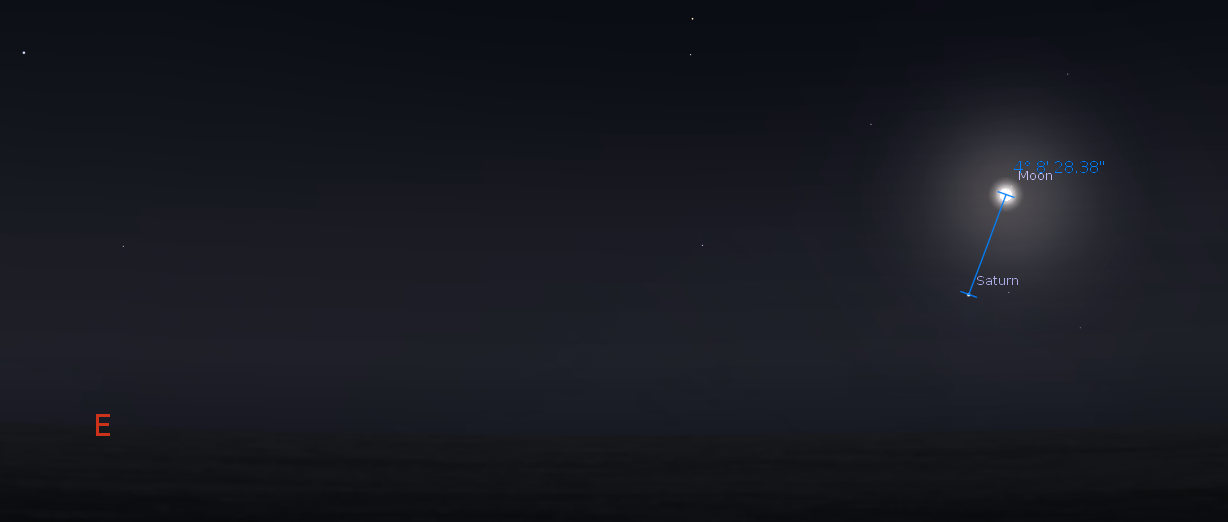
Saturn and the Moon shortly after rising. 12:44 a.m., April 8, 2015. Created using Stellarium.
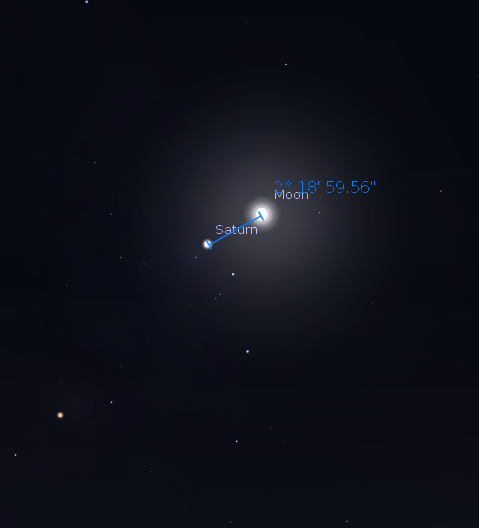
Saturn and the Moon shortly after twilight starts. 5:30 a.m., April 8, 2015. Created using Stellarium.
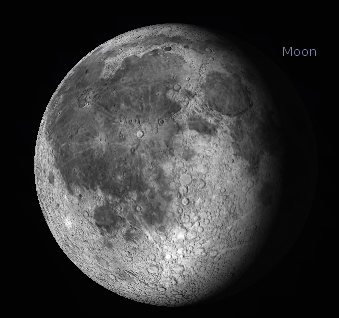
The Moon as it might appear in binoculars at 5:30 a.m. April 8, 2015. Created using Stellarium.
Some Rules of Thumb about the rotation of the earth and its revolution around the Sun.
These are approximate:
Stars rise or set 4 minutes earlier each night.
That’s about a half hour every week, and
It’s about 2 hours every month.
2 hours times 12 months = 24h hours, one rotation of the Earth
As far as viewing the stars and Constellations goes, that’s why we see the constellations in the same positions every year at the same time.
04/06/2015 – Ephemeris – Arcturus the 4th brightest star
Ephemeris for Monday, April 6th. The Sun will rise at 7:14. It’ll be up for 13 hours and 1 minute, setting at 8:16. The Moon, 2 days past full, will rise at 10:37 this evening.
One of the stars that stays up most of the year, except late autumn and most of winter is Arcturus. Now in the evening Arcturus is low in the east. It’s a bright star, officially the 4th brightest star in the night sky, and the 4th brightest star-like object in our night sky after Venus, Jupiter, and Sirius. Arcturus can be found by following the arc of the handle of the Big Dipper to it. Remember, follow the arc to Arcturus. Arcturus belongs to the kite shaped constellation of Boötes, which we’ll visit in greater detail when it’s higher in the sky. Arcturus is an interesting star. It’s 37 light years away, and moving quite rapidly at 75 miles per second (122km/s), mostly across the sky. Some astronomers think that it
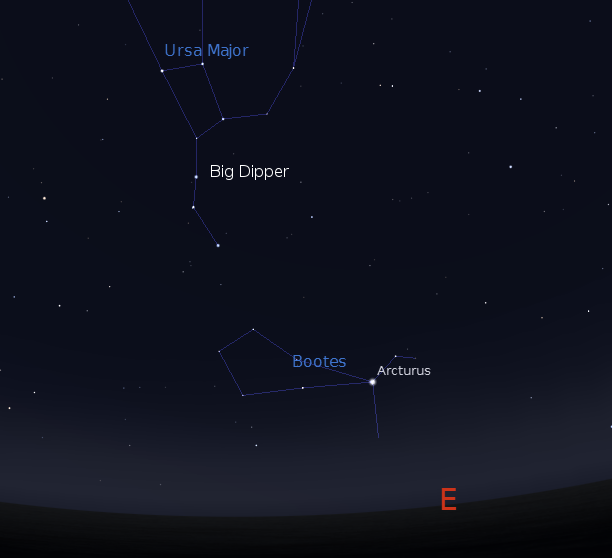
Arcturus off the handle of the Big Dipper at 9:30 p.m. April 6, 2015. Created using Stellarium.
may be part of a captured dwarf galaxy.
Times are for the Traverse City/Interlochen area of Michigan. They may be different for your location.
Addendum
04/03/2015 – Ephemeris – Learn about meteorites tonight
Ephemeris for Good Friday, Friday, April 3rd. The Sun will rise at 7:20. It’ll be up for 12 hours and 52 minutes, setting at 8:12. The Moon, 1 day before full, will set at 7:24 tomorrow morning.
Meteorites will be the topic given by Joe Brooks local meteorite expert and collector at this evening’s meeting of the Grand Traverse Astronomical Society at 8 p.m. at Northwestern Michigan College’s Rogers Observatory. He even has a meteorite that’s pretty much been proven to be from the asteroid Vesta. Today we are all too aware that stones and even bigger asteroids can collide with the earth. Everyone is welcome. Also at 9 p.m. there will be a star party at the observatory. The observatory is located south of Traverse City on Birmley Road between Garfield and Keystone roads. Remember also the partial lunar eclipse tomorrow morning starting at 6:15 a.m. The society and the observatory will not hold an event for it.
Times are for the Traverse City/Interlochen area of Michigan. They may be different for your location.
Addendum
If you missed yesterday’s post about tomorrow morning’s lunar eclipse, click here.
04/02/2015 – Ephemeris – Information on Saturday morning’s lunar eclipse
Ephemeris for Thursday, April 2nd. The Sun will rise at 7:22. It’ll be up for 12 hours and 49 minutes, setting at 8:11. The Moon, 2 days before full, will set at 6:56 tomorrow morning.
Saturday morning we will be able to witness the start of a lunar eclipse. This is the third of four consecutive total lunar eclipses visible from parts of North America. The last and best of them will occur on the evening of September 27th. The totality of Saturday’s eclipse will only last under 5 minutes, but even that will not be visible from here. The partial phase will begin at 6:15 a.m. with the Moon low in the west-southwest. The Moon will progress about half way into the Earth’s shadow by the time it sets at 7:24 a.m. This will be shortly after the 7:17 a.m. sunrise. It is possible to see the eclipse in its entirety via the Internet. Search for Griffith Observatory. The will have a live feed of the eclipse if it’s clear in Los Angeles.
Update: The URL for the LiveStream from Griffith Observatory is http://new.livestream.com/GriffithObservatoryTV/LunarEclipseApril2015
Times are for the Traverse City/Interlochen area of Michigan. They may be different for your location.
Addendum:
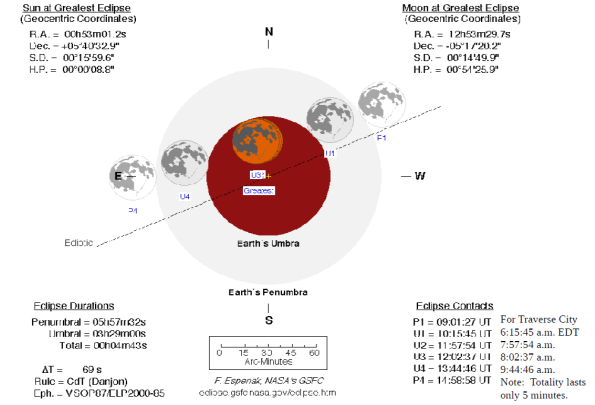
This is an annotated clip of the NASA Eclipse diagram. Click on it to show the entire pdf file.
In the interval P1 to U1 and U4 to P4 the Moon will be only in the Earth’s penumbra, where the Sun’s light is only partially blocked. However for about a half hour before U1 and after U4 the Moon’s edge closest to the umbra will appear dusky.
04/01/2015 – Ephemeris – No fooling, it’s time to look at the bright planets for this week
Ephemeris for April Fools Day, Wednesday, April 1st. The Sun will rise at 7:24. It’ll be up for 12 hours and 45 minutes, setting at 8:10. The Moon, 3 days before full, will set at 6:29 tomorrow morning.
Lets take a look at the bright planets for this week. Brilliant Venus is in the west by 8:40 p.m. It will set at 11:23 p.m. Mars appears much lower and to the right of it. The Red Planet will set tonight at 9:48. Jupiter will appear In the southeastern sky in the evening. It will set at 5:20 a.m. It’s near the sickle-shaped head of Leo the lion, and it’s the second brightest star-like object in the sky after Venus. All four moons will be visible in telescopes tonight, but tomorrow morning the moon Io will duck behind Jupiter at 2:55, but will not pop into sunlight until after Jupiter sets. Early risers will be able to spot Saturn which will rise in the east-southeast at 12:30 a.m. It will be low in the south at 5 to 6 a.m.
Times are for the Traverse City/Interlochen area of Michigan. They may be different for your location.
Addendum
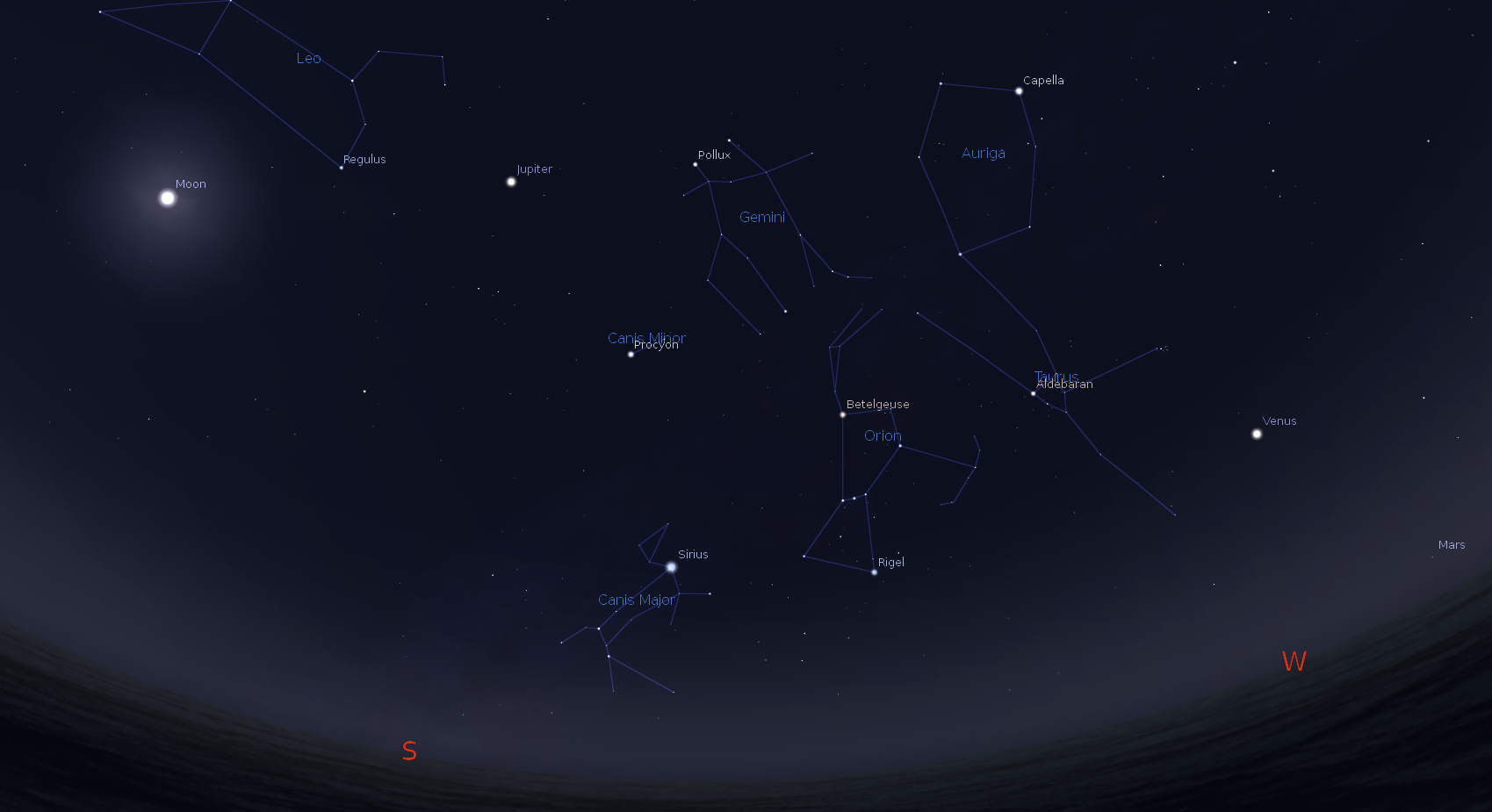
The Moon, evening planets and bright constellations at 9:30 p.m. April 1, 2015. Created using Stellarium.
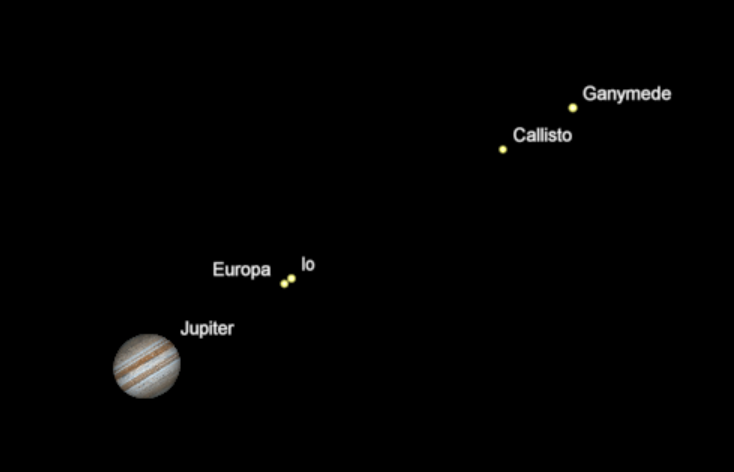
Jupiter as seen in a telescope at 9:30 p.m. April 1, 2014. Europa will partially occult Io starting at 9:41 p.m. for 4 minutes. They will appear to merge. Later at 11:21 p.m. Io will be partially eclipsed in Europa’s shadow for about 4 minutes. Europa will dim slightly. Created using Cartes du Ceil (Sky Charts).
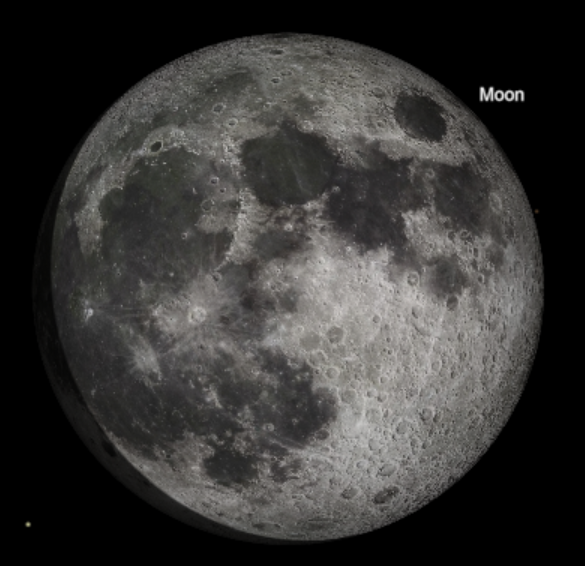
The Moon at 9:30 p.m. April 1, 2015. Created using Cartes du Ceil (Sky Charts).
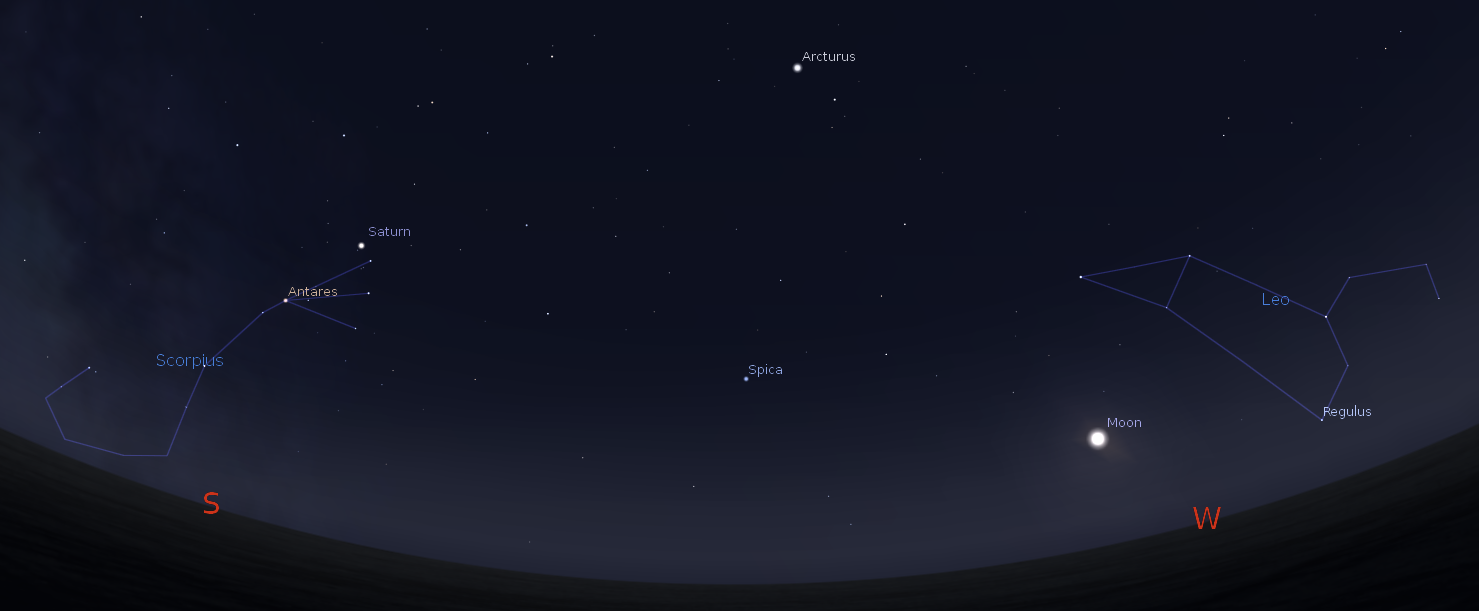
Saturn, the Moon with Scorpius and Leo at 5:30 a.m. April 2, 2015. Created using Stellarium.
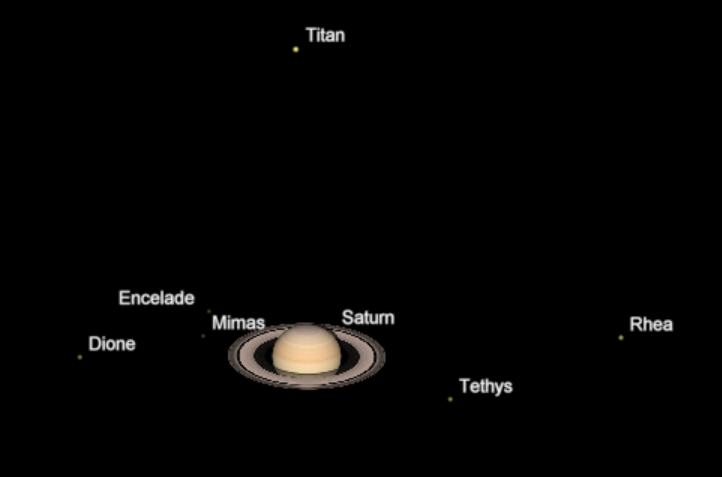
What Saturn and its moons might appear like in a telescope at 5:30 a.m., April 2, 2015. Small telescopes will show only the moon Titan. Created using Cartes du Ceil (Sky Charts).
03/31/2015 – Ephemeris – Previewing April skies
Ephemeris for Tuesday, March 31st. The Sun will rise at 7:25. It’ll be up for 12 hours and 42 minutes, setting at 8:08. The Moon, half way from first quarter to full, will set at 6:02 tomorrow morning.
The 4th month of the year begins tomorrow. Daylight hours in the Interlochen/Traverse City area and will increase from 12 hours and 45 minutes tomorrow to 14 hours 11 minutes on the 30th. The altitude, or angle, of the sun above the southern horizon at local noon will be 50 degrees tomorrow and will ascend to 60 degrees on the 30th. The altitude of the Sun in the Straits area will be a degree lower. The actual time of local apparent noon this month for the Interlochen/Traverse City area, when the sun passes due south, will be about 1:43 p.m. For the straits area local noon occurs about 4 minutes earlier. This Saturday morning we’ll see the first part of a lunar eclipse. This month Venus and Jupiter are our evening planets.
Times are for the Traverse City/Interlochen area of Michigan. They may be different for your location.
Addendum
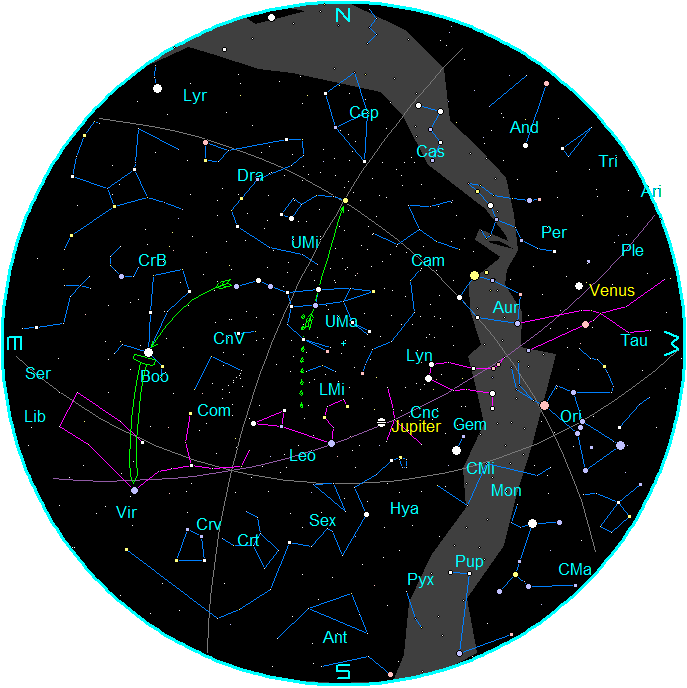
Star Chart for April 2015. Created using my LookingUp program.
The Moon is not plotted. The planets and stars are plotted for the 15th at 10 p.m. EDT. That is chart time.
Evening Astronomical twilight ends at 9:51 p.m. EDT on April 1st, increasing to 10:42 p.m. EDT on the 30th.
Morning astronomical twilight starts at 5:43 a.m. EDT on April 1st, and decreasing to 4:41 a.m. EDT on the 30th.
Add a half hour to the chart time every week before the 15th and subtract and hour for every week after the 15th.
For a list of constellation names to go with the abbreviations click here.
The green pointer from the Big Dipper is:
- Pointer stars at the front of the bowl of the Big Dipper point to Polaris the North Star.
- Drill a hole in the bowl of the Big Dipper and the water will drip on the back of Leo the Lion.
- Follow the arc of the Big Dipper’s handle to Arcturus
- Continue with a spike to Spica
Calendar of Planetary Events
Credit: Sky Events Calendar by Fred Espenak and Sumit Dutta (NASA’s GSFC)
To generate your own calendar go to http://eclipse.gsfc.nasa.gov/SKYCAL/SKYCAL.html
Times are Eastern Daylight Time on a 24 hour clock. Some additions made to aid clarity.
Conjunctions like the Moon-Saturn: 2.3° S means Saturn will appear 2.3° south of the Moon.
| Apr | 01 | We | Venus: 36.6° E | |
| 01 | We | 08:59 | Moon Apogee: 406000 km | |
| 03 | Fr | 23:17 | Moon Ascending Node | |
| 04 | Sa | 08:01 | Partial Lunar Eclipse* | |
| 04 | Sa | 08:06 | Full Moon | |
| 06 | Mo | 09:48 | Uranus Conjunction | |
| 08 | We | 09:08 | Moon-Saturn: 2.3° S | |
| 08 | We | 10:16 | Jupiter-Beehive: 5.4° S | |
| 09 | Th | 23:52 | Mercury Superior Conj. | |
| 10 | Fr | 03:46 | Moon South Dec.: 18.2° S | |
| 11 | Sa | 11:30 | Venus-Pleiades: 2.6° S | |
| 11 | Sa | 23:44 | Last Quarter | |
| 16 | Th | 23:53 | Moon Perigee: 361000 km | |
| 17 | Fr | 09:07 | Moon Descending Node | |
| 18 | Sa | 14:57 | New Moon | |
| 21 | Tu | 12:35 | Moon-Aldebaran: 0.9° S | |
| 21 | Tu | 14:09 | Moon-Venus: 6.8° N | |
| 22 | We | 19:21 | Lyrid Shower: ZHR = 20 | |
| 22 | We | 19:26 | Moon North Dec.: 18.3° N | |
| 25 | Sa | 19:55 | First Quarter | |
| 28 | Tu | 23:55 | Moon Apogee: 405100 km | |
| 30 | Th | 21:29 | Mercury-Pleiades: 1.7° S | |
* For the Grand Traverse area the partial phase of the eclipse will begin at 6:15 a.m. The eclipse will be interrupted by the moon setting at 7:24 a.m. Sunrise will occur at 7:17 a.m. More information will be provided in the Thursday, April 2nd post.
03/30/2015 – Ephemeris – The importance of meteorites and asteroids
Ephemeris for Monday, March 30th. The Sun will rise at 7:27. It’ll be up for 12 hours and 39 minutes, setting at 8:07. The Moon, 3 days past first quarter, will set at 5:33 tomorrow morning.
On Friday the 3rd Joe Brooks will be giving a talk at the Grand Traverse Astronomical Society on meteorites. That will be at 8 p.m. at Northwestern Michigan College’s Rogers Observatory. NASA has the Dawn spacecraft now settling into orbit of the largest asteroid Ceres. It is the asteroid belt that is the source of meteorites. Meteorites are either pieces of destroyed protoplanets due to collisions in the asteroid belt or primitive objects like carbonaceous chondrites pristine that date back to 4.567 billion years ago, the formation of the solar system. Meteorites tend to be contaminated by the environment. That’s why samples of asteroids will be so valuable for planetary defense and understanding the origin of the solar system.
Times are for the Traverse City/Interlochen area of Michigan. They may be different for your location.
Addendum
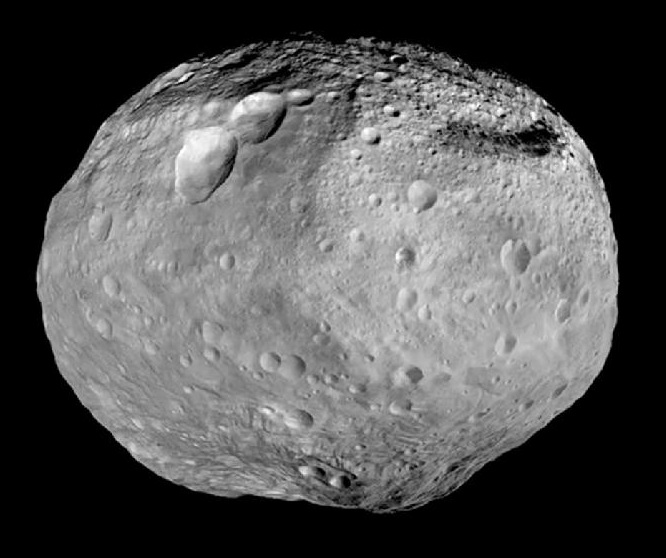
Looking back at Vesta as Dawn headed off to Ceres. Credit: NASA/JPL-Caltech/UCAL/MPS/DLR/IDA
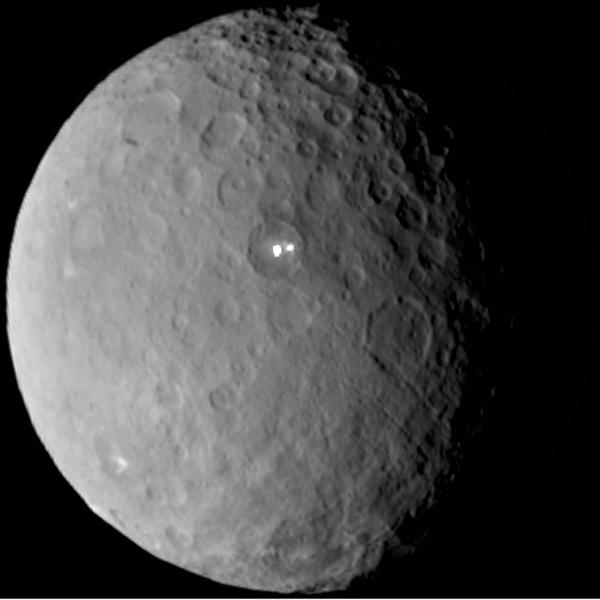
The bright spot is two. Picture taken February 19, 2015 from 29,000 miles (46,700 km). Credit: NASA/JPL-Caltech/UCLA/MPS/DLR/IDA.
03/27/2015 – Ephemeris – The North Star, Polaris
Ephemeris for Friday, March 27th. The Sun will rise at 7:33. It’ll be up for 12 hours and 30 minutes, setting at 8:03. The Moon, at first quarter today, will set at 3:49 tomorrow morning.
Tonight we turn our eyes northward to Polaris, the North Star. It is the closest bright star to the north pole of the sky. It appears nearly stationary as all the other stars appear to revolve around it as the Earth rotates. Some folks, think that Polaris is the brightest star in the sky. It’s not. It is a good solid second magnitude star, about the brightness of a Big Dipper star. The Big Dipper can be used to point to it, by using the two stars at the front of the bowl. Polaris is at the end of the handle of the Little Dipper. The Little Dipper has four dim stars in its rather oddly bent handle and back of its bowl. The two stars at the front of the bowl of the Little Dipper are Kochab and the dimmer Pherkad, which are also called the Guard Stars or the Guardians of the Pole.
Times are for the Traverse City/Interlochen area of Michigan. They may be different for your location.
Addendum
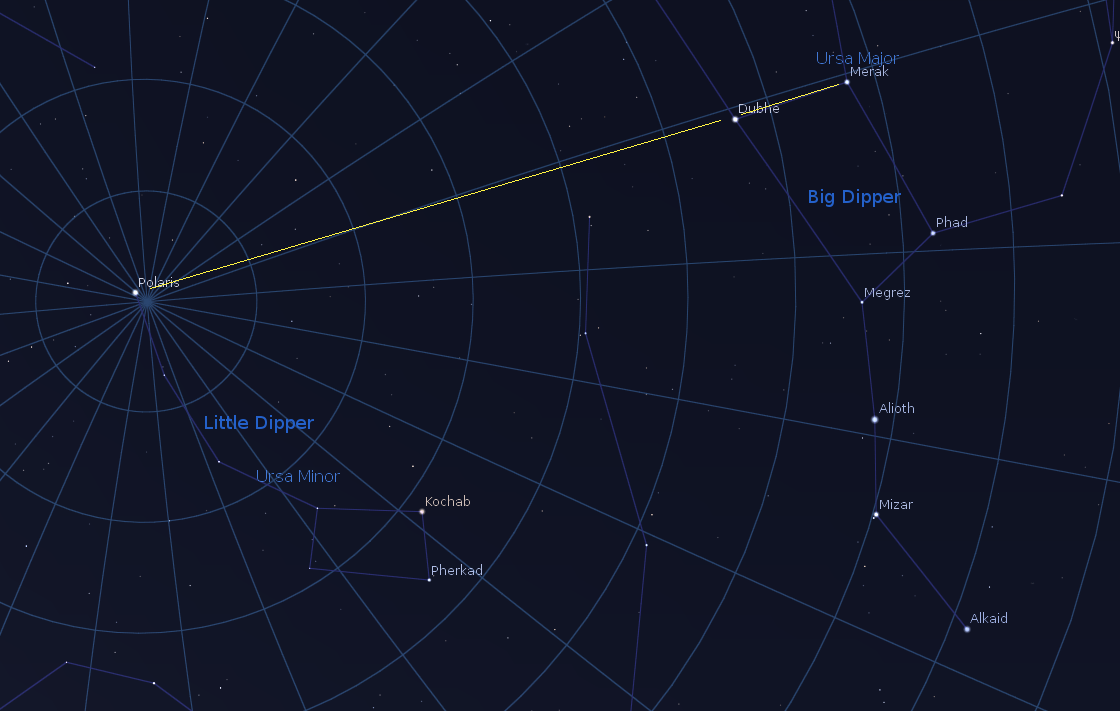
How to find Polaris. The grid is the equatorial grid showing the proximity to the pole. Created using Stellarium.
03/26/2015 – Ephemeris – Regulus the 21st brightest of the 21 brightest “First Magnitude” stars
Ephemeris for Thursday, March 26th. The Sun will rise at 7:35. It’ll be up for 12 hours and 27 minutes, setting at 8:02. The Moon, 1 day before first quarter, will set at 3:04 tomorrow morning.
The bright star below and left of Jupiter as it shines in the southeast in the evening is the star Regulus in Leo the lion. It’s at the base of the backward question mark of stars that make up the head and mane of Leo. It is also an asterism or informal constellation of the Sickle. Regulus is the dimmest of the 21 brightest stars which are called First Magnitude Stars. It is a quadruple star system with two pairs of stars. Regulus is a blue-white star which is rapidly spinning with a period of something like 16 hours, orbited by a possible white dwarf star every 40 days. The star system is 79 light years away. The name Regulus translates to something like Little King Star, befitting its location in the King of the beasts.
Times are for the Traverse City/Interlochen area of Michigan. They may be different for your location.
Addendum
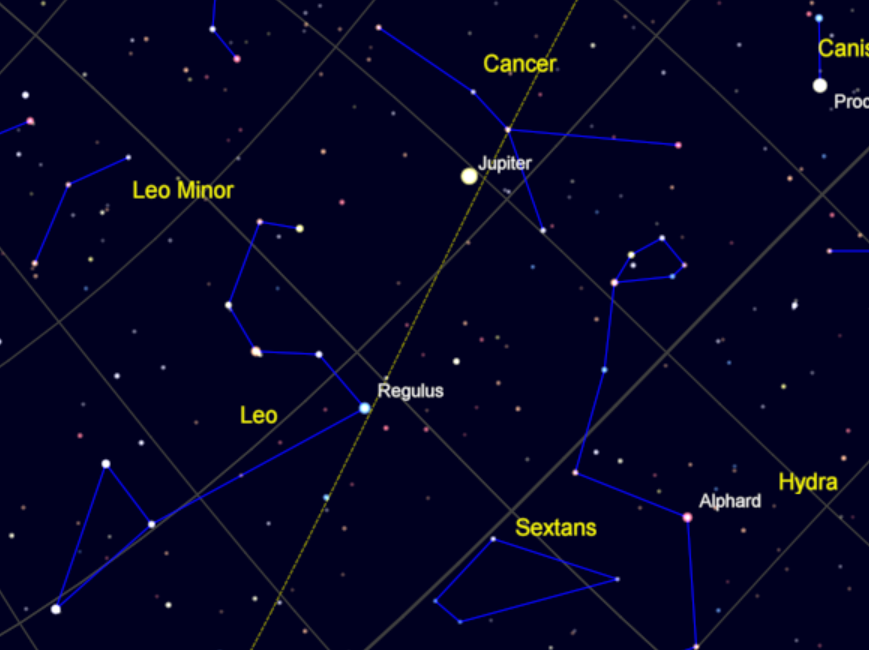
Leo, Regulus and nearby constellations as seen in the east-southeast at 9 p.m. March 26, 2015. Created using Cartes du Ceil (Sky Charts).
Below, zooming in to Regulus BC, the second pair of stars of the Regulus system, which is about 3 minutes of arc northwest of Regulus. It consists of an 8th magnitude and a 14th magnitude star with the same proper motion (motion against the sky) as Regulus.
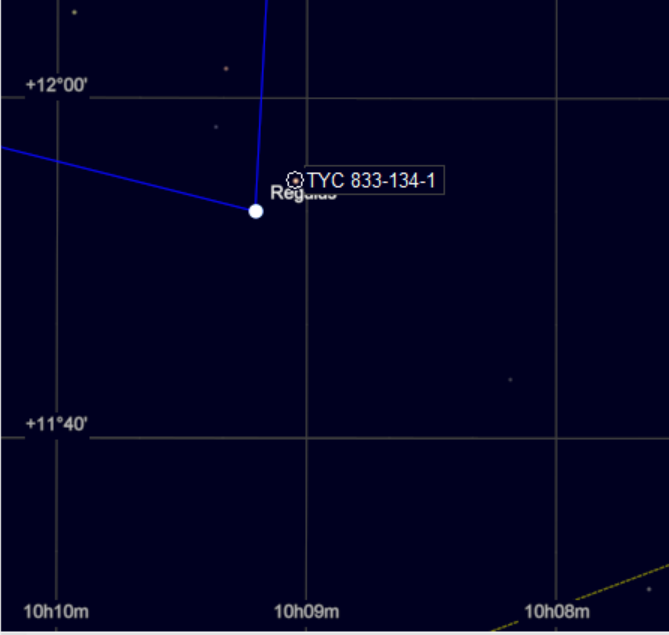
The star TYC 833-134-1 is Regulus B, which is easily visible in telescopes at magnitude 8.1. The star is also listed as HD 87844. The first designation is from the Tycho catalog and is how it’s referenced in Cartes du Ceil. The star is shown, but not named in Stellarium. The is equatorial orientation is created using Cartes du Ceil (Sky Charts).
03/25/2015 – Ephemeris – Where are the bright planets tonight?
Ephemeris for Wednesday, March 25th. The Sun will rise at 7:37. It’ll be up for 12 hours and 24 minutes, setting at 8:01. The Moon, 2 days before first quarter, will set at 2:13 tomorrow morning.
Lets take a look at the bright planets for this week. Brilliant Venus is in the west by 8:30 p.m. It will set at 11:07 p.m. Mars appears much lower and to the right of it. The Red Planet will set tonight at 9:48. Jupiter will appear In the southeastern sky in the evening. It will set at 5:48 a.m. It’s near the sickle-shaped head of Leo the lion, and it’s the second brightest star-like object in the sky after Venus. In telescopes tomorrow morning the moon Io will duck behind Jupiter at 1:05, but will pop into sunlight a bit away from the planet on the other side at 4:23 a.m. because it also will be hidden in Jupiter’s shadow. Early risers will be able to spot Saturn which will rise in the east-southeast at 12:59 a.m. It will be low in the south at 6 to 7 a.m.
Times are for the Traverse City/Interlochen area of Michigan. They may be different for your location.
Addendum
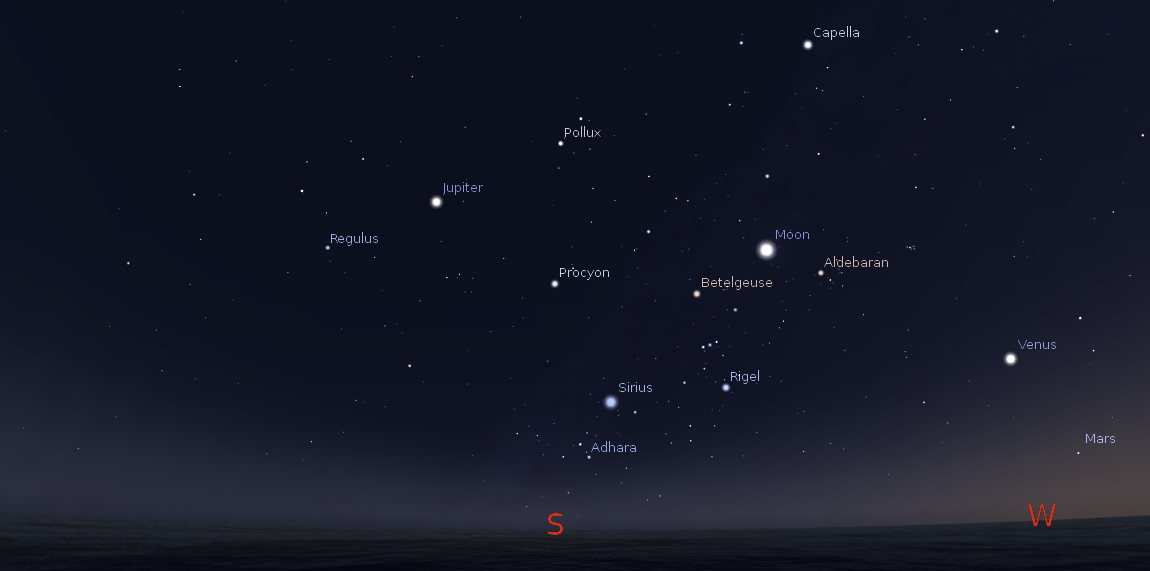
The evening planets of Mars, Venus and Jupiter with the Moon and winter stars. Created using Stellarium.
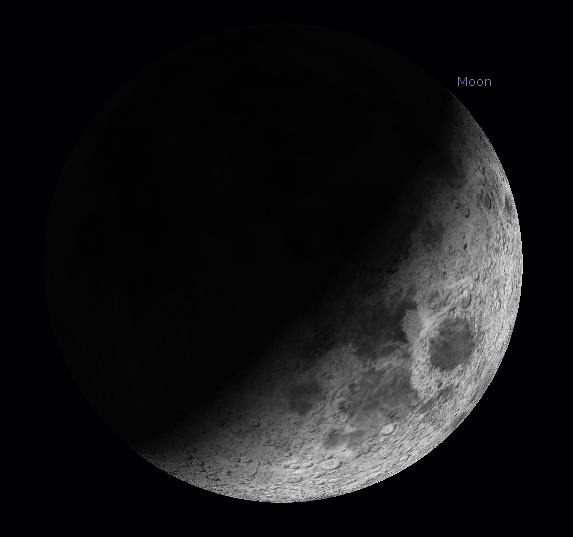
The Moon as it would appear in binoculars at 9 p.m. March 25, 2015. Created using Stellarium.
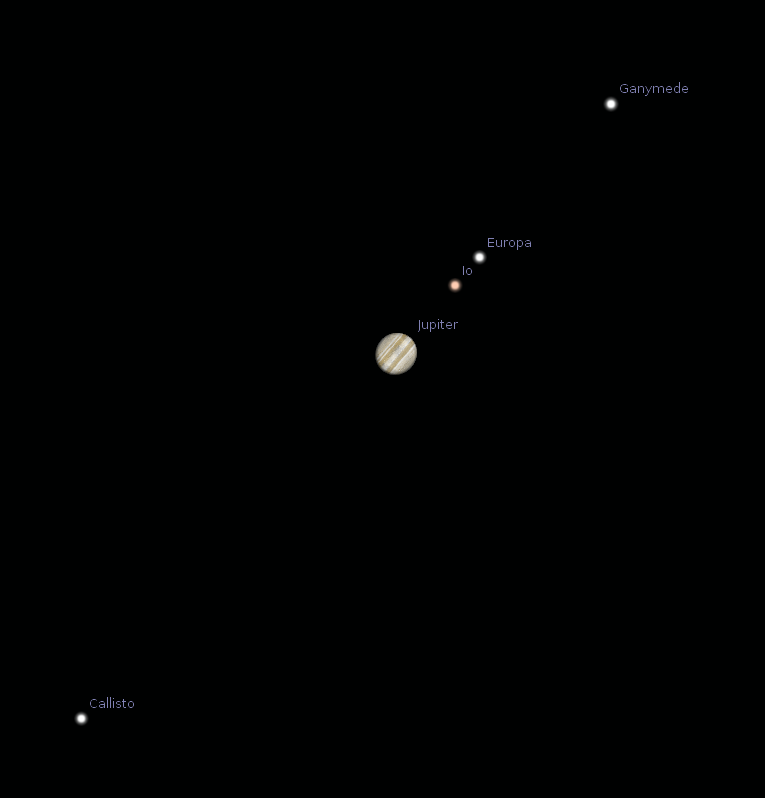
Jupiter and its moons at 9 p.m. March 25, 2015. Created using Stellarium.
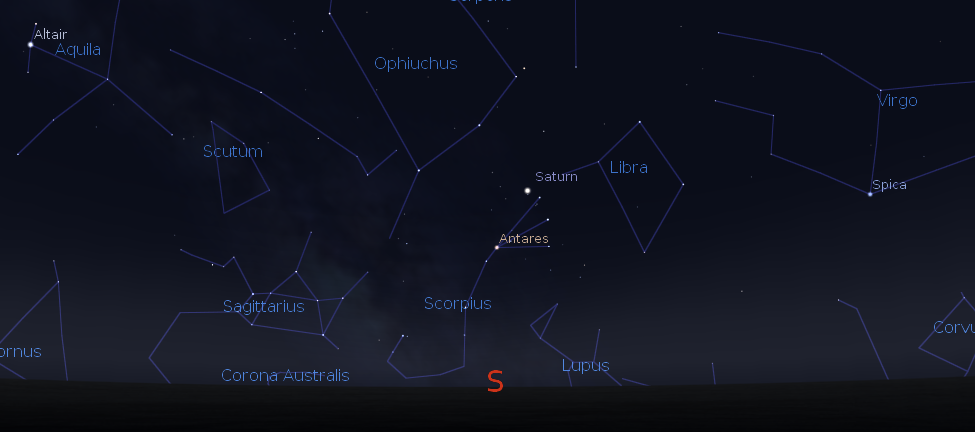
Saturn and the southern summer constellations at 6 a.m. on March 26, 2015. Created using Stellarium.
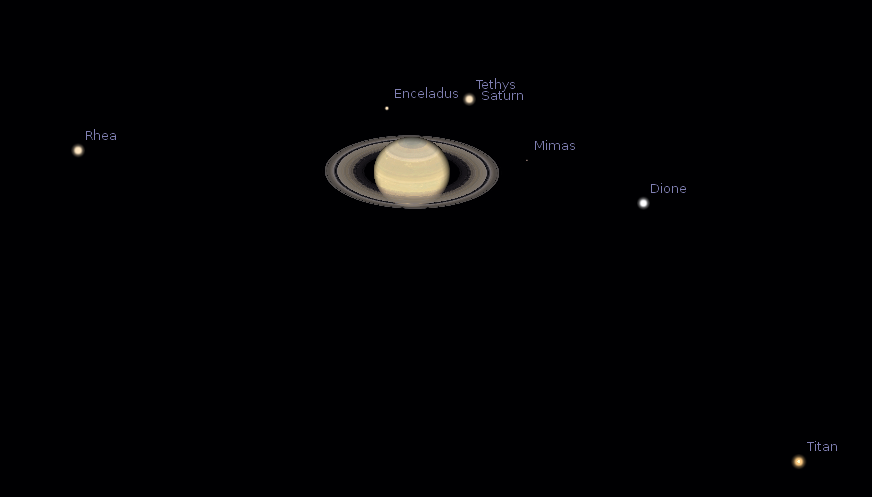
What Saturn and its moons might appear like in a telescope at 6 a.m., March 26, 2015. Small telescopes will show only the moon Titan. Created using Stellarium.

